Sandwich Robot for
Computational Thinking
Reflections from testing with high school pupils
Emanuela Marchetti, Andrea Valente, Nina Bonderup Dohn
The Department of Design, Media and Educational Science
University of Southern Denmark
emanuela@sdu.dk, aval@sdu.dk, nina@sdu.dk
(quick) Game demo
• https://learninggames.sdu.dk/sandwichrobot/levels.
html
• Level 1
• https://learninggames.sdu.dk/sandwichrobot/level01.html
• And level 3
• https://learninggames.sdu.dk/sandwichrobot/level03.html
The goal
• User Centred investigation: how beginner programmers face
algorithmic thinking in solving computational problems, in CT
• which kind of solutions they would adopt, while dealing with the complexity
of algorithmic thinking,
• and which factors can challenge beginners in formulating algorithmic
solutions.
• We have created a casual puzzle-like game with a funny narrative,
designed to demystify technical and mathematical aspects of CT
• can it foster algorithmic thinking practices through code manipulation?
(and how?)
Level + language design Vs CT concepts
• Our level design focused on
• grounding conditionals
• and showing that an algorithm is a solution
to a class of similar problems -> to foster
pattern generalization
• For that -> twin-worlds levels, where the
player writes a single solution to control
two robots
• We designed the language:
• with blocks for moving and rotating,
conditional and two kinds of loops
• not supposed to be Turing complete ->
all commands (but 1 of the loops) always
terminate in one or a small number of steps
• this makes the Notional Machine (Sorva,
2013) very simple
• Taxonomy of CT skills
(Chongtay 2022):
• Decomposition
• logical analysis and data organization
• Pattern matching
• representation of data through model and
simulations
• Design of algorithms
• construction of automatic, sequence-based
solutions
• Pattern generalization and abstraction
• generalization of algorithmic solutions from
one specific problem to a class of similar
problems
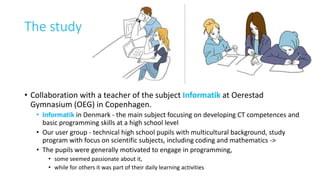
The study
• Collaboration with a teacher of the subject Informatik at Oerestad
Gymnasium (OEG) in Copenhagen.
• Informatik in Denmark - the main subject focusing on developing CT competences and
basic programming skills at a high school level
• Our user group - technical high school pupils with multicultural background, study
program with focus on scientific subjects, including coding and mathematics ->
• The pupils were generally motivated to engage in programming,
• some seemed passionate about it,
• while for others it was part of their daily learning activities
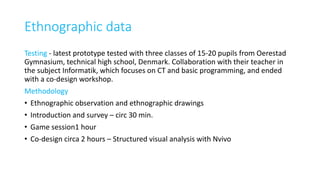
Ethnographic data
Testing - latest prototype tested with three classes of 15-20 pupils from Oerestad
Gymnasium, technical high school, Denmark. Collaboration with their teacher in
the subject Informatik, which focuses on CT and basic programming, and ended
with a co-design workshop.
Methodology
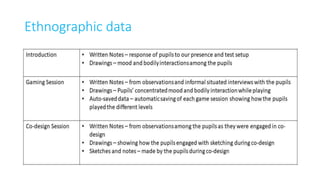
• Ethnographic observation and ethnographic drawings
• Introduction and survey – circ 30 min.
• Game session1 hour
• Co-design circa 2 hours – Structured visual analysis with Nvivo
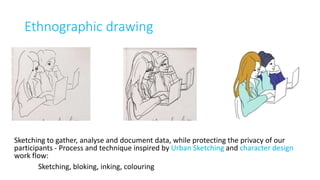
Ethnographic drawing
Sketching to gather, analyse and document data, while protecting the privacy of our
participants - Process and technique inspired by Urban Sketching and character design
work flow:
Sketching, bloking, inking, colouring
Ethnographic data
Findings …
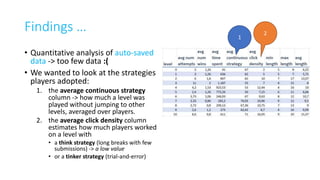
• Quantitative analysis of auto-saved
data -> too few data :(
• We wanted to look at the strategies
players adopted:
1. the average continuous strategy
column -> how much a level was
played without jumping to other
levels, averaged over players.
2. the average click density column
estimates how much players worked
on a level with
• a think strategy (long breaks with few
submissions) -> a low value
• or a tinker strategy (trial-and-error)
1
2
Findings and feedback
• Pupils - interest in the basic concept behind our game and generally
described our game as “fun”.
• Pupils and their teacher saw learning potential in the game:
• For understanding algorithmic thinking,
• For refining their learning at later stages
• Expanded role for our game, leading us to rethink its relation to the pupils’ learning
process
Findings and feedback
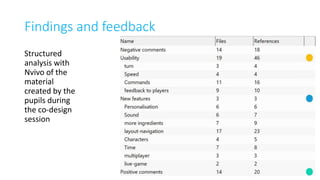
Structured
analysis with
Nvivo of the
material
created by the
pupils during
the co-design
session
Findings and feedback
On-going and future work involves addressing pupils’ feedback, which include:
• Providing a level editor to allow Kahoot-style challenges
• More social/gamification elements
• More animations and juice
• Multiple/alternative reward systems -> what does it mean to have found the best
solution?
-> optimization vs hidden costs and societal consequences of algorithms and
optimization
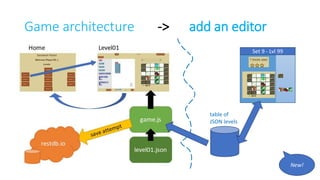
Game architecture -> add an editor
Set 9 - Lvl 99
table of
JSON levels
New!
Conclusion
Our main contribution:
• An exemplar of how the thinking behind algorithmic problem-solving
can be transposed into game mechanics,
• A casual game to reflect and refine understanding on algorithmic
thinking,
• Insights on how a non-technical narrative can support beginners
learning CT
Thanks for your attention :)
Questions? …

Sandwich robot - ECGBL2023.pptx

  • 1.
    Sandwich Robot for ComputationalThinking Reflections from testing with high school pupils Emanuela Marchetti, Andrea Valente, Nina Bonderup Dohn The Department of Design, Media and Educational Science University of Southern Denmark emanuela@sdu.dk, aval@sdu.dk, nina@sdu.dk
  • 2.
    (quick) Game demo •https://learninggames.sdu.dk/sandwichrobot/levels. html • Level 1 • https://learninggames.sdu.dk/sandwichrobot/level01.html • And level 3 • https://learninggames.sdu.dk/sandwichrobot/level03.html
  • 3.
    The goal • UserCentred investigation: how beginner programmers face algorithmic thinking in solving computational problems, in CT • which kind of solutions they would adopt, while dealing with the complexity of algorithmic thinking, • and which factors can challenge beginners in formulating algorithmic solutions. • We have created a casual puzzle-like game with a funny narrative, designed to demystify technical and mathematical aspects of CT • can it foster algorithmic thinking practices through code manipulation? (and how?)
  • 4.
    Level + languagedesign Vs CT concepts • Our level design focused on • grounding conditionals • and showing that an algorithm is a solution to a class of similar problems -> to foster pattern generalization • For that -> twin-worlds levels, where the player writes a single solution to control two robots • We designed the language: • with blocks for moving and rotating, conditional and two kinds of loops • not supposed to be Turing complete -> all commands (but 1 of the loops) always terminate in one or a small number of steps • this makes the Notional Machine (Sorva, 2013) very simple • Taxonomy of CT skills (Chongtay 2022): • Decomposition • logical analysis and data organization • Pattern matching • representation of data through model and simulations • Design of algorithms • construction of automatic, sequence-based solutions • Pattern generalization and abstraction • generalization of algorithmic solutions from one specific problem to a class of similar problems
  • 5.
    The study • Collaborationwith a teacher of the subject Informatik at Oerestad Gymnasium (OEG) in Copenhagen. • Informatik in Denmark - the main subject focusing on developing CT competences and basic programming skills at a high school level • Our user group - technical high school pupils with multicultural background, study program with focus on scientific subjects, including coding and mathematics -> • The pupils were generally motivated to engage in programming, • some seemed passionate about it, • while for others it was part of their daily learning activities
  • 6.
    Ethnographic data Testing -latest prototype tested with three classes of 15-20 pupils from Oerestad Gymnasium, technical high school, Denmark. Collaboration with their teacher in the subject Informatik, which focuses on CT and basic programming, and ended with a co-design workshop. Methodology • Ethnographic observation and ethnographic drawings • Introduction and survey – circ 30 min. • Game session1 hour • Co-design circa 2 hours – Structured visual analysis with Nvivo
  • 7.
    Ethnographic drawing Sketching togather, analyse and document data, while protecting the privacy of our participants - Process and technique inspired by Urban Sketching and character design work flow: Sketching, bloking, inking, colouring
  • 8.
  • 9.
    Findings … • Quantitativeanalysis of auto-saved data -> too few data :( • We wanted to look at the strategies players adopted: 1. the average continuous strategy column -> how much a level was played without jumping to other levels, averaged over players. 2. the average click density column estimates how much players worked on a level with • a think strategy (long breaks with few submissions) -> a low value • or a tinker strategy (trial-and-error) 1 2
  • 10.
    Findings and feedback •Pupils - interest in the basic concept behind our game and generally described our game as “fun”. • Pupils and their teacher saw learning potential in the game: • For understanding algorithmic thinking, • For refining their learning at later stages • Expanded role for our game, leading us to rethink its relation to the pupils’ learning process
  • 11.
    Findings and feedback Structured analysiswith Nvivo of the material created by the pupils during the co-design session
  • 12.
    Findings and feedback On-goingand future work involves addressing pupils’ feedback, which include: • Providing a level editor to allow Kahoot-style challenges • More social/gamification elements • More animations and juice • Multiple/alternative reward systems -> what does it mean to have found the best solution? -> optimization vs hidden costs and societal consequences of algorithms and optimization
  • 13.
    Game architecture ->add an editor Set 9 - Lvl 99 table of JSON levels New!
  • 14.
    Conclusion Our main contribution: •An exemplar of how the thinking behind algorithmic problem-solving can be transposed into game mechanics, • A casual game to reflect and refine understanding on algorithmic thinking, • Insights on how a non-technical narrative can support beginners learning CT
  • 15.
    Thanks for yourattention :) Questions? …

Editor's Notes

  • #14 The original levels are set 1 Any player can create a new level in his/her set. Sets and levels should be sharable among players.