Presented by Abhinandan Kanjikar (Student), Kaushik P M (Student)
Under supervision of Prof. Prashanth Kumar H P
Sapthagiri College of Engineering
Contact number: 8197900404
E mail: abhi.kanjikar@gmail.com
Physical developer technique is a means to detect fingerprints on dry and wet, porous items including
paper articles, rubber gloves, nylon clothing, clay-based products. A solution of an iron salt that reduces
aqueous silver nitrate to finely divided metallic silver which is based on oxidation–reduction couple
involved in the process. This process is like a photographic physical developer which, during processing
of film rolls, undergoes a similar redox reaction, thus deriving its name from it. Dark gray or black
images reveal the fingerprint due to the adsorption of metallic silver particles on the fatty acid and lipid
components of sweat residue.
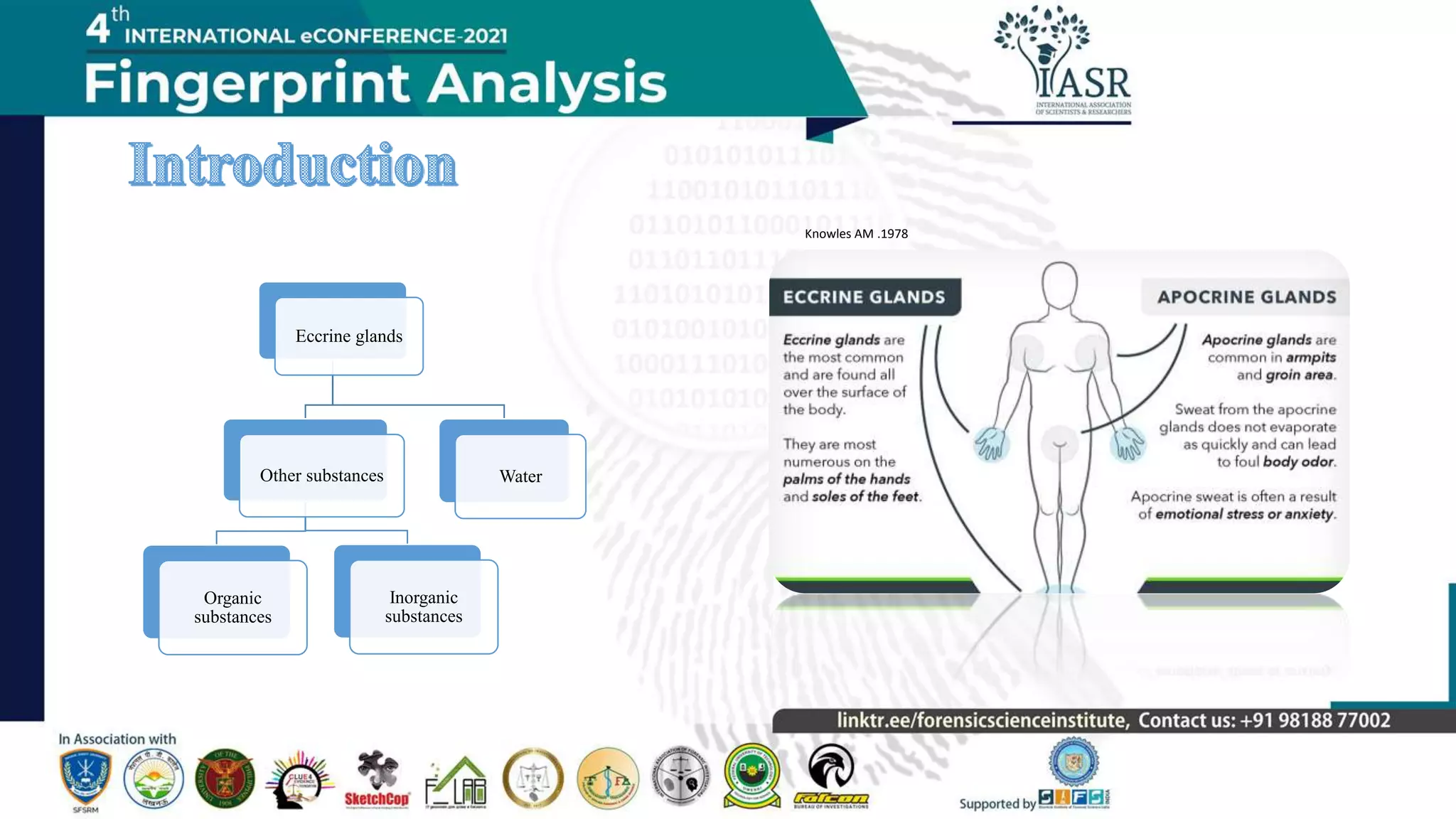
Eccrine glands
Other substances
Organic
substances
Inorganic
substances
Water
Knowles AM .1978
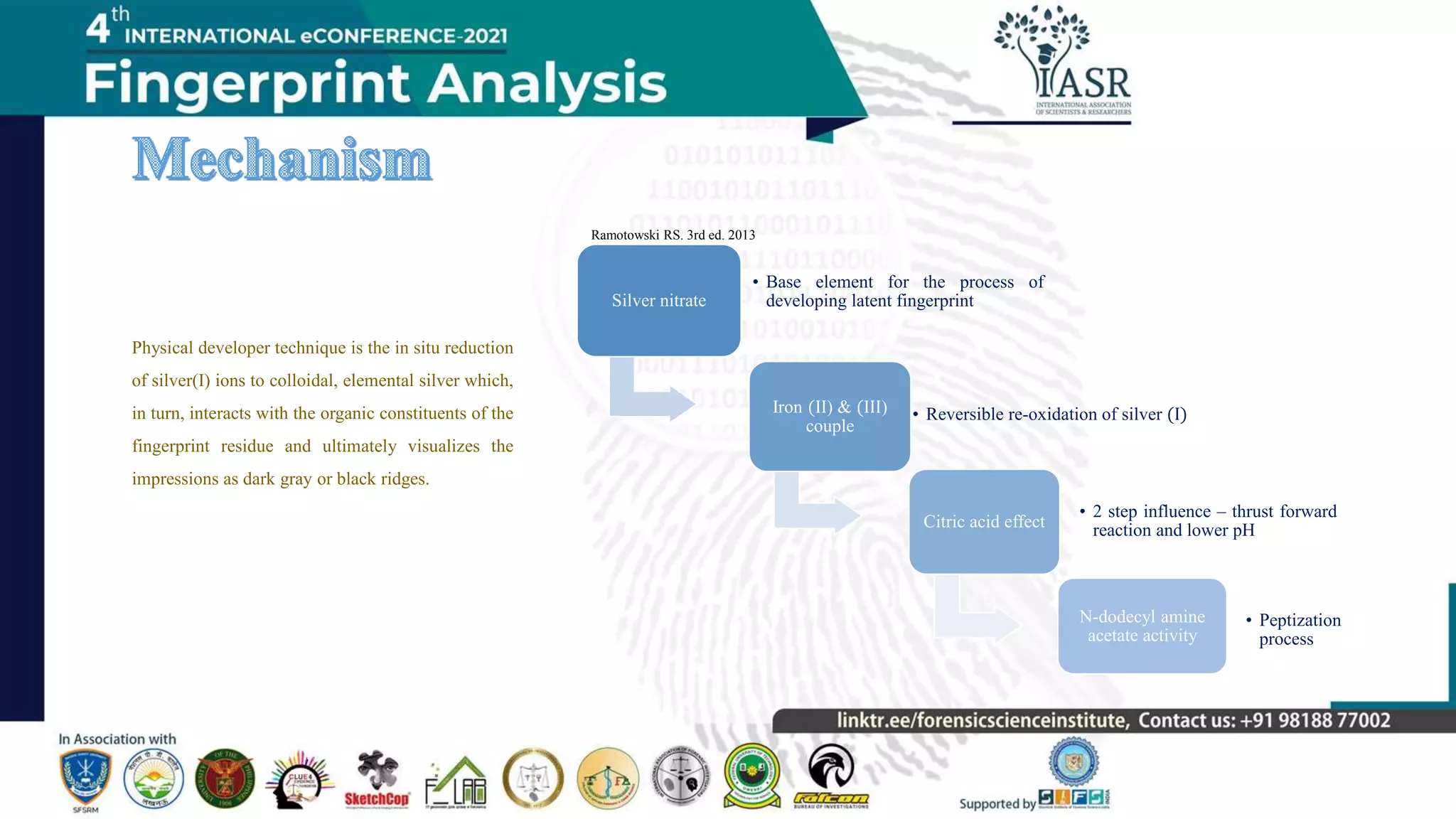
Silver nitrate
• Base element for the process of
developing latent fingerprint
Iron (II) & (III)
couple
• Reversible re-oxidation of silver (I)
Citric acid effect
• 2 step influence – thrust forward
reaction and lower pH
N-dodecyl amine
acetate activity
• Peptization
process
Physical developer technique is the in situ reduction
of silver(I) ions to colloidal, elemental silver which,
in turn, interacts with the organic constituents of the
fingerprint residue and ultimately visualizes the
impressions as dark gray or black ridges.
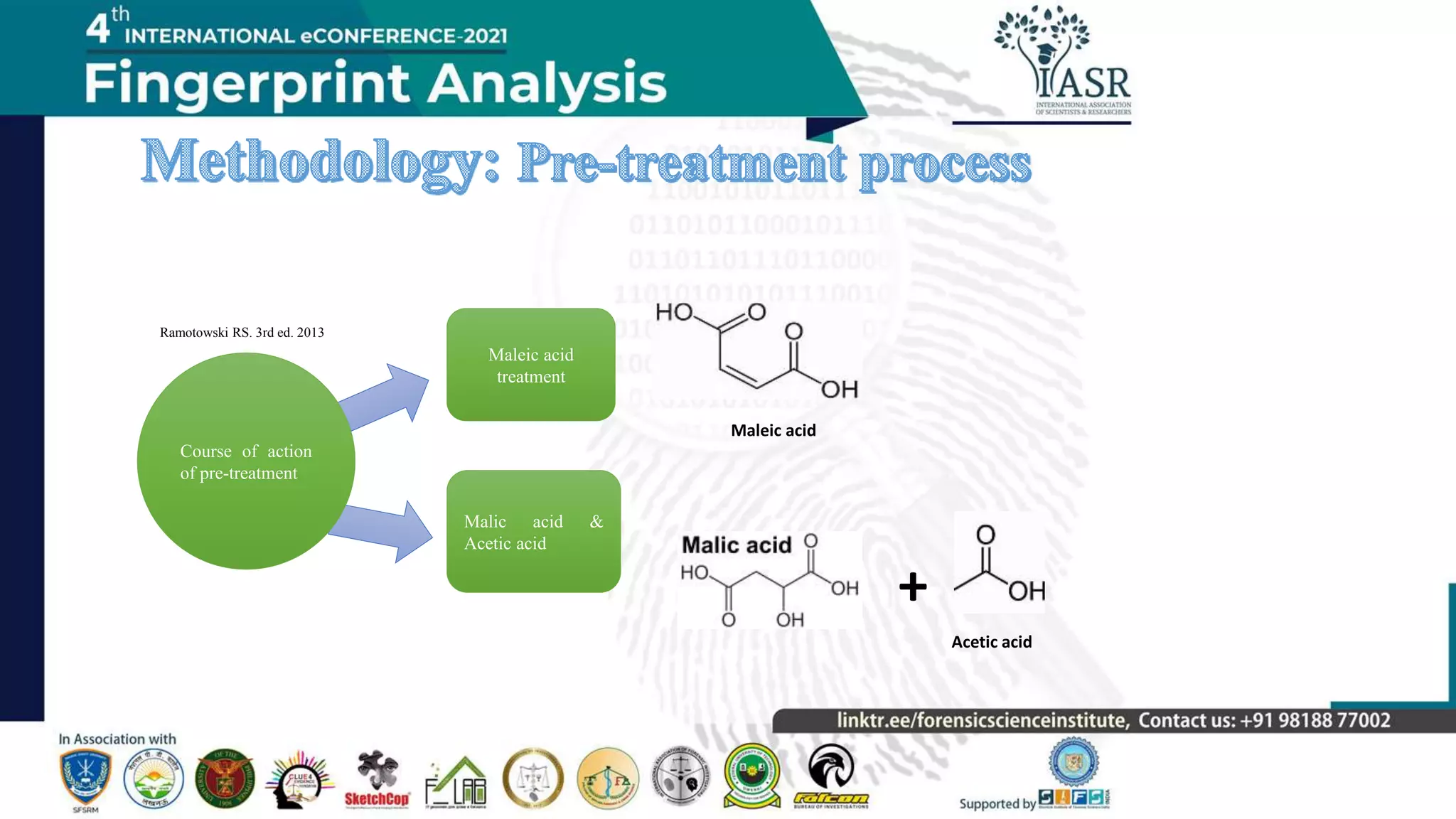
Ramotowski RS. 3rd ed. 2013
Course of action
of pre-treatment
Maleic acid
treatment
Malic acid &
Acetic acid
+
Acetic acid
Maleic acid
Ramotowski RS. 3rd ed. 2013
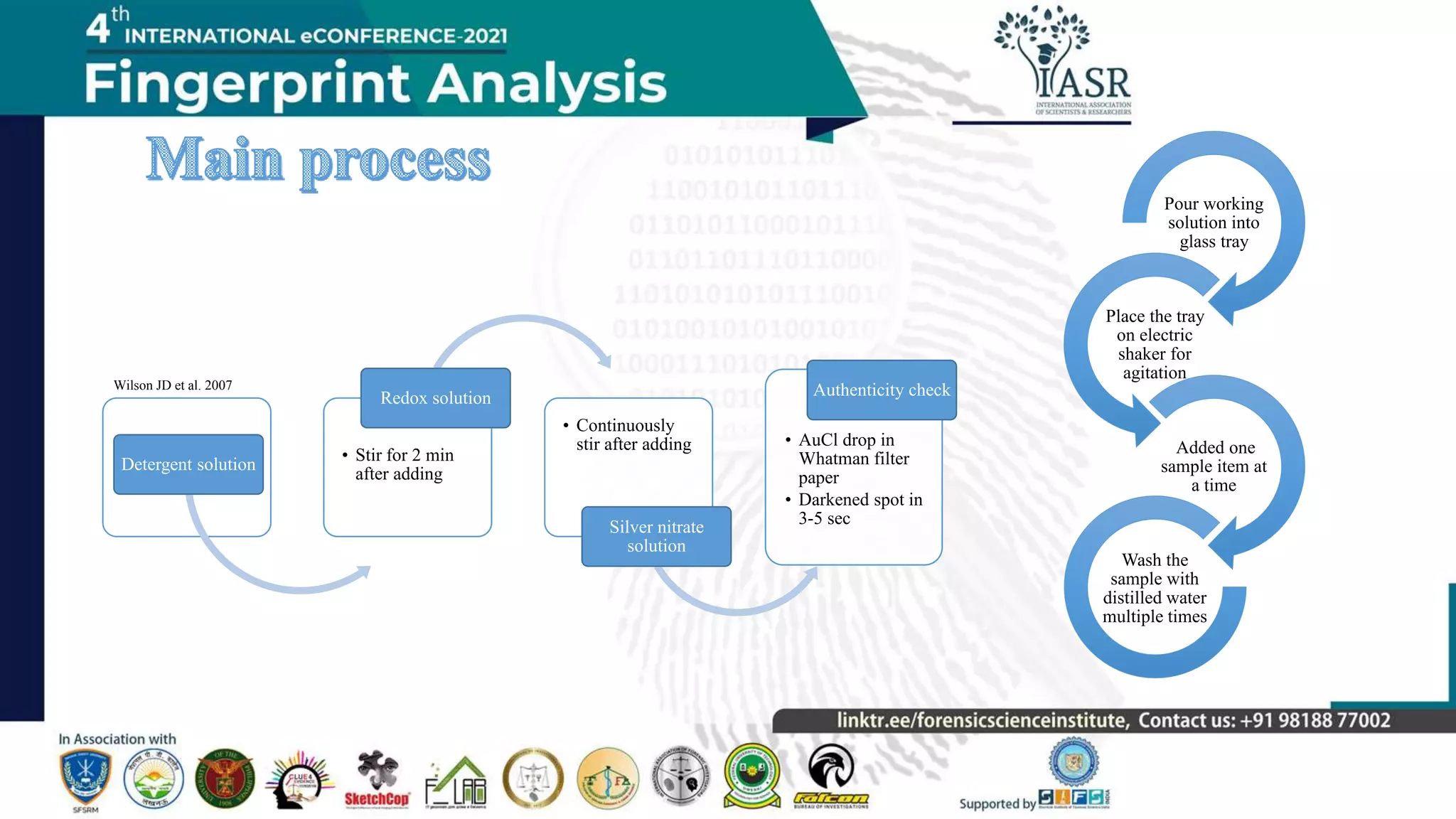
Detergent solution
• Stir for 2 min
after adding
Redox solution
• Continuously
stir after adding
Silver nitrate
solution
• AuCl drop in
Whatman filter
paper
• Darkened spot in
3-5 sec
Authenticity check
Pour working
solution into
glass tray
Place the tray
on electric
shaker for
agitation
Added one
sample item at
a time
Wash the
sample with
distilled water
multiple times
Wilson JD et al. 2007
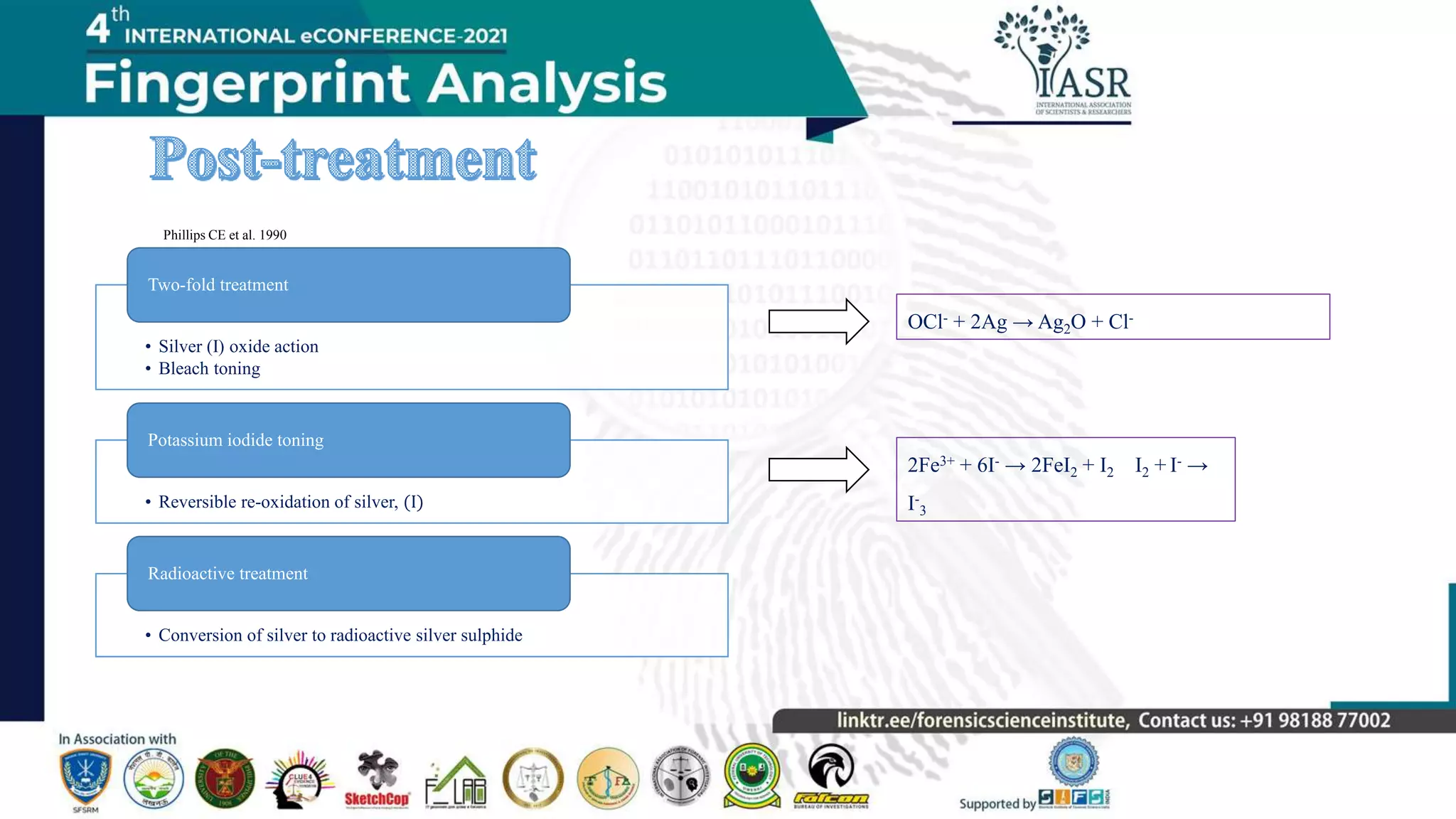
• Silver (I) oxide action
• Bleach toning
Two-fold treatment
• Reversible re-oxidation of silver, (I)
Potassium iodide toning
• Conversion of silver to radioactive silver sulphide
Radioactive treatment
OCl- + 2Ag → Ag2O + Cl-
2Fe3+ + 6I- → 2FeI2 + I2 I2 + I- →
I-
3
Phillips CE et al. 1990
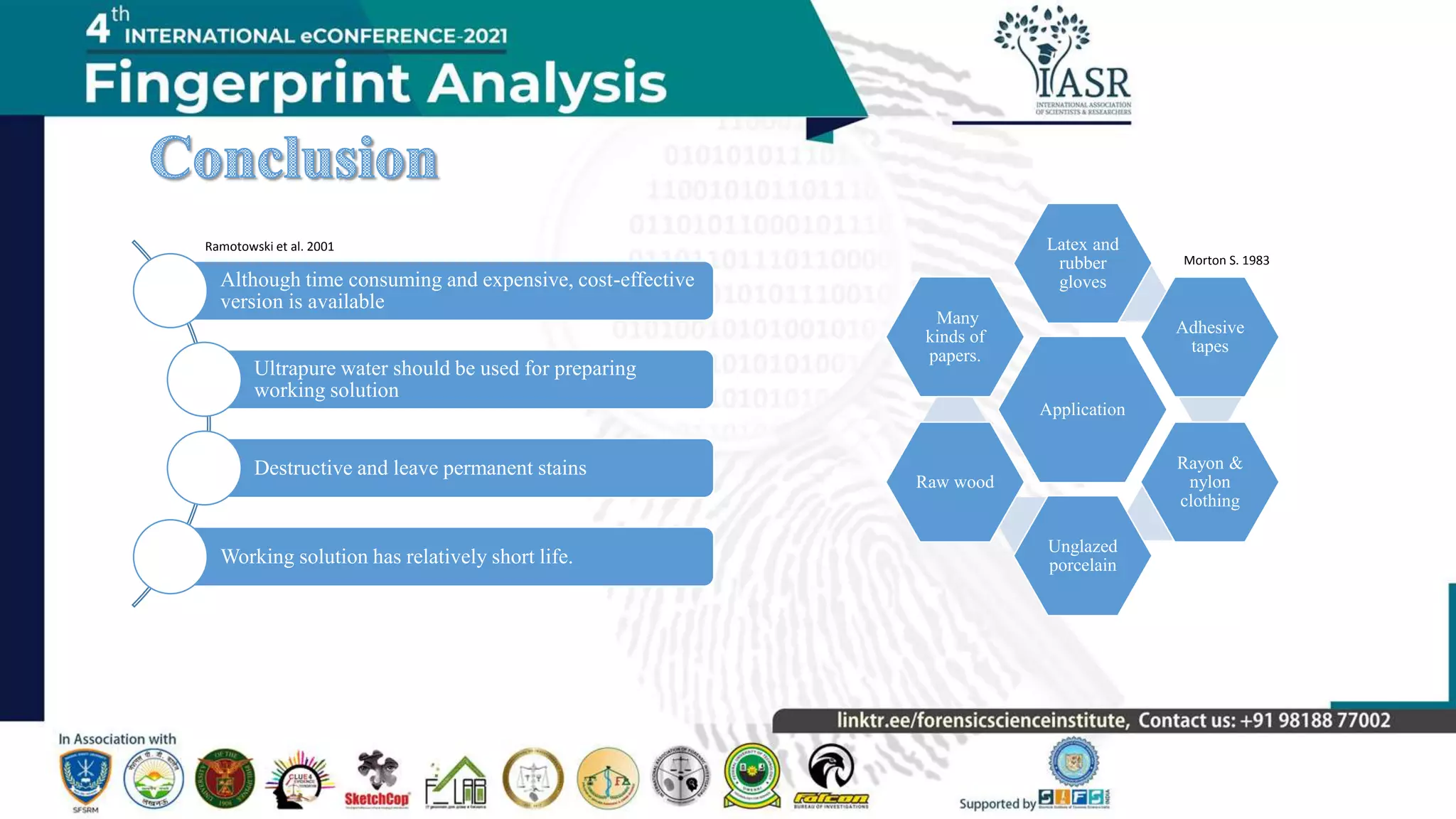
Application
Latex and
rubber
gloves
Adhesive
tapes
Rayon &
nylon
clothing
Unglazed
porcelain
Raw wood
Many
kinds of
papers.
Although time consuming and expensive, cost-effective
version is available
Ultrapure water should be used for preparing
working solution
Destructive and leave permanent stains
Working solution has relatively short life.
Morton S. 1983
Ramotowski et al. 2001
1. Knowles AM. Aspects of physicochemical methods for the detection of fingerprints. J Phys E Sci Instrum 1978.
2. Cantu AA. Silver physical developers for the visualization of latent prints on paper. Forensic Sci Rev 2001.
3. Berson G. Silver staining of proteins in polyacrylamide gels: increased sensitivity by a blue toning solution. Anal Biochem
1983.
4. Ramotowski RS. 3rd ed. In: Ramotowski RS, editor. Lee and gaensslen’s advances in fingerprint technology. Boca Raton:
CRC Press; 2013.
5. Wilson JD, Cantu AA, Antonopoulos G, Surrency MJ. Examination of the steps leading up to the physical developer process
for developing fingerprints. J Forensic Sci 2007
6. Ramotowski RS, Cantu AA. Recent latent print visualization research at the US Secret Service. Fingerprint Whorld 2001
7. Morton S. Shoe print development by PD treatment. Fingerprint Whorld 1983

Fingerprint analysis

  • 1.
    Presented by AbhinandanKanjikar (Student), Kaushik P M (Student) Under supervision of Prof. Prashanth Kumar H P Sapthagiri College of Engineering Contact number: 8197900404 E mail: abhi.kanjikar@gmail.com
  • 2.
    Physical developer techniqueis a means to detect fingerprints on dry and wet, porous items including paper articles, rubber gloves, nylon clothing, clay-based products. A solution of an iron salt that reduces aqueous silver nitrate to finely divided metallic silver which is based on oxidation–reduction couple involved in the process. This process is like a photographic physical developer which, during processing of film rolls, undergoes a similar redox reaction, thus deriving its name from it. Dark gray or black images reveal the fingerprint due to the adsorption of metallic silver particles on the fatty acid and lipid components of sweat residue.
  • 3.
  • 4.
    Silver nitrate • Baseelement for the process of developing latent fingerprint Iron (II) & (III) couple • Reversible re-oxidation of silver (I) Citric acid effect • 2 step influence – thrust forward reaction and lower pH N-dodecyl amine acetate activity • Peptization process Physical developer technique is the in situ reduction of silver(I) ions to colloidal, elemental silver which, in turn, interacts with the organic constituents of the fingerprint residue and ultimately visualizes the impressions as dark gray or black ridges. Ramotowski RS. 3rd ed. 2013
  • 5.
    Course of action ofpre-treatment Maleic acid treatment Malic acid & Acetic acid + Acetic acid Maleic acid Ramotowski RS. 3rd ed. 2013
  • 6.
    Detergent solution • Stirfor 2 min after adding Redox solution • Continuously stir after adding Silver nitrate solution • AuCl drop in Whatman filter paper • Darkened spot in 3-5 sec Authenticity check Pour working solution into glass tray Place the tray on electric shaker for agitation Added one sample item at a time Wash the sample with distilled water multiple times Wilson JD et al. 2007
  • 7.
    • Silver (I)oxide action • Bleach toning Two-fold treatment • Reversible re-oxidation of silver, (I) Potassium iodide toning • Conversion of silver to radioactive silver sulphide Radioactive treatment OCl- + 2Ag → Ag2O + Cl- 2Fe3+ + 6I- → 2FeI2 + I2 I2 + I- → I- 3 Phillips CE et al. 1990
  • 8.
    Application Latex and rubber gloves Adhesive tapes Rayon & nylon clothing Unglazed porcelain Rawwood Many kinds of papers. Although time consuming and expensive, cost-effective version is available Ultrapure water should be used for preparing working solution Destructive and leave permanent stains Working solution has relatively short life. Morton S. 1983 Ramotowski et al. 2001
  • 9.
    1. Knowles AM.Aspects of physicochemical methods for the detection of fingerprints. J Phys E Sci Instrum 1978. 2. Cantu AA. Silver physical developers for the visualization of latent prints on paper. Forensic Sci Rev 2001. 3. Berson G. Silver staining of proteins in polyacrylamide gels: increased sensitivity by a blue toning solution. Anal Biochem 1983. 4. Ramotowski RS. 3rd ed. In: Ramotowski RS, editor. Lee and gaensslen’s advances in fingerprint technology. Boca Raton: CRC Press; 2013. 5. Wilson JD, Cantu AA, Antonopoulos G, Surrency MJ. Examination of the steps leading up to the physical developer process for developing fingerprints. J Forensic Sci 2007 6. Ramotowski RS, Cantu AA. Recent latent print visualization research at the US Secret Service. Fingerprint Whorld 2001 7. Morton S. Shoe print development by PD treatment. Fingerprint Whorld 1983