Genetic diversity as a parameter for
   managing agroforestry systems
                     Aristotelis C. Papageorgiou
                     Forest Genetics Laboratory
                  Democritus University of Thrace
                               Orestiada, Greece
plan
    - genetic diversity
    - changes of genetic diversity
    - genetic system in plant populations
              •   Agriculture
              •   Rangeland
              •   Forest
    - management approach
    - examples / discussion
2                       13/07/11
3   13/07/11
4   13/07/11
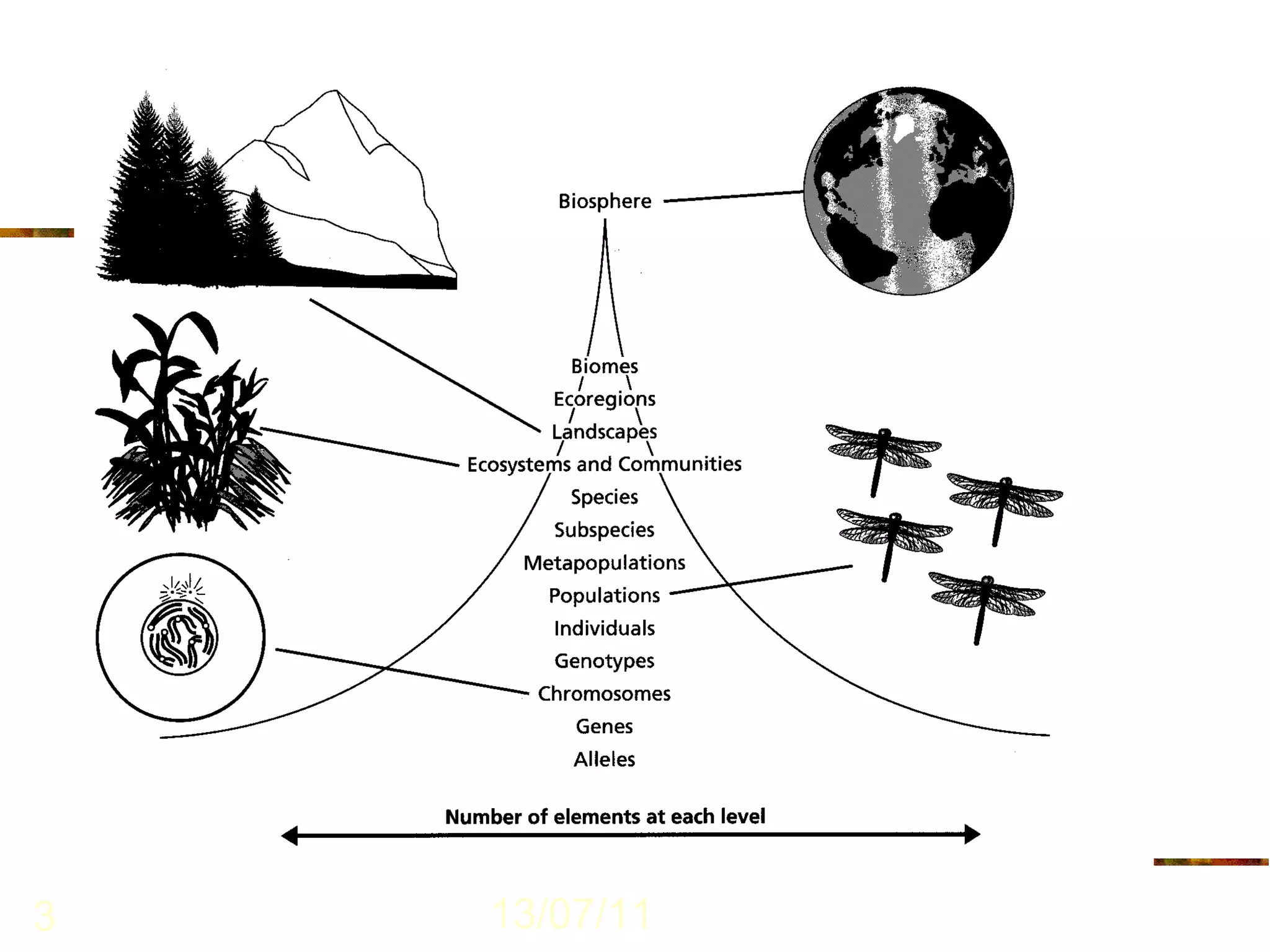
Important things about
    biodiversity
       Is of complex nature and finds its full meaning in
        complex cases (e.g. landscapes and multiple
        levels of organization)
       Involves different perceptions of its meaning and
        importance


5                         13/07/11
Genetic component of biodiversity
       ...is a total of meaningless mathematic
        expressions…
           Perlman & Adelson 1997
       …should not be given priority, since its
        measurement is complicated and expensive…
           Dobson 1995
       Misunderstandings:
           “Laboratory analysis is the first step of any gene
            conservation or management measure”
           “The object of conservation and management
            programmes are the genes we see in the
            laboratories”
6                             13/07/11
So, what is genetic diversity?
       The differences among organisms that can be
        inhereited
           Passing from one generation to the other = mating
           Changes over time = evolution
       Is the basis of all other levels of biodiversity
           Underestimated and under-represented
       Measured by:
           Field observations (environment? / P=G+E)
           Lab observations (practical relevance?


7                            13/07/11
Field observations
    - morphometry
             •   Environmental or genetic?
             •   Multivariable statistics
             •   Landmarks
    - common environment (trials)
             •   Provenance / progeny tests
             •   Traits of practical relevance
                    –   Growth, survival, resistance...etc.
             •   ANOVA

8                       13/07/11
Lab observations
    - previously: chromosomes, visible traits, enzymes
    - nowadays: polymorphism at DNA level
                •   Fragments (fragment length)
                •   Sequencies of nucleotides
                •   Some more sofisticated things...
    - no direct relevance with traits
                •   This changes however
    - frequencies of genotypes and alleles


9                         13/07/11
The population
 - central concept to genetics
 - a set of individuals
           •   Mating (same species – or not?)
           •   Same place (more or less)
 - demography
 - frequency of alleles and genotypes


10                  13/07/11
Alleles and genotypes
 - allele: variant of the same gene that does
   the same job, just differently
           •   Mendel had yellow and green peas (gene
               = pea color / alleles = green and yellow)
           •   A diploid organism can have up to two
               different alleles at each gene
 - genotype: the types of alleles at a gene
           •   Homozygote: two copies of the same
               allele
           •   Heterozygote: two different alleles
11                  13/07/11
Importance of genetic diversity
    Main condition for adaptation under new
     environments
        Maintenance of populations and species
        Stability of communities and ecosystems
        Constant production of goods and services
    Biological information base
        Is transferred over generations and rearranged
         through mating system
        Influenced by population size
        Changes and promotes adaptation
        Is imported and exported
12                         13/07/11
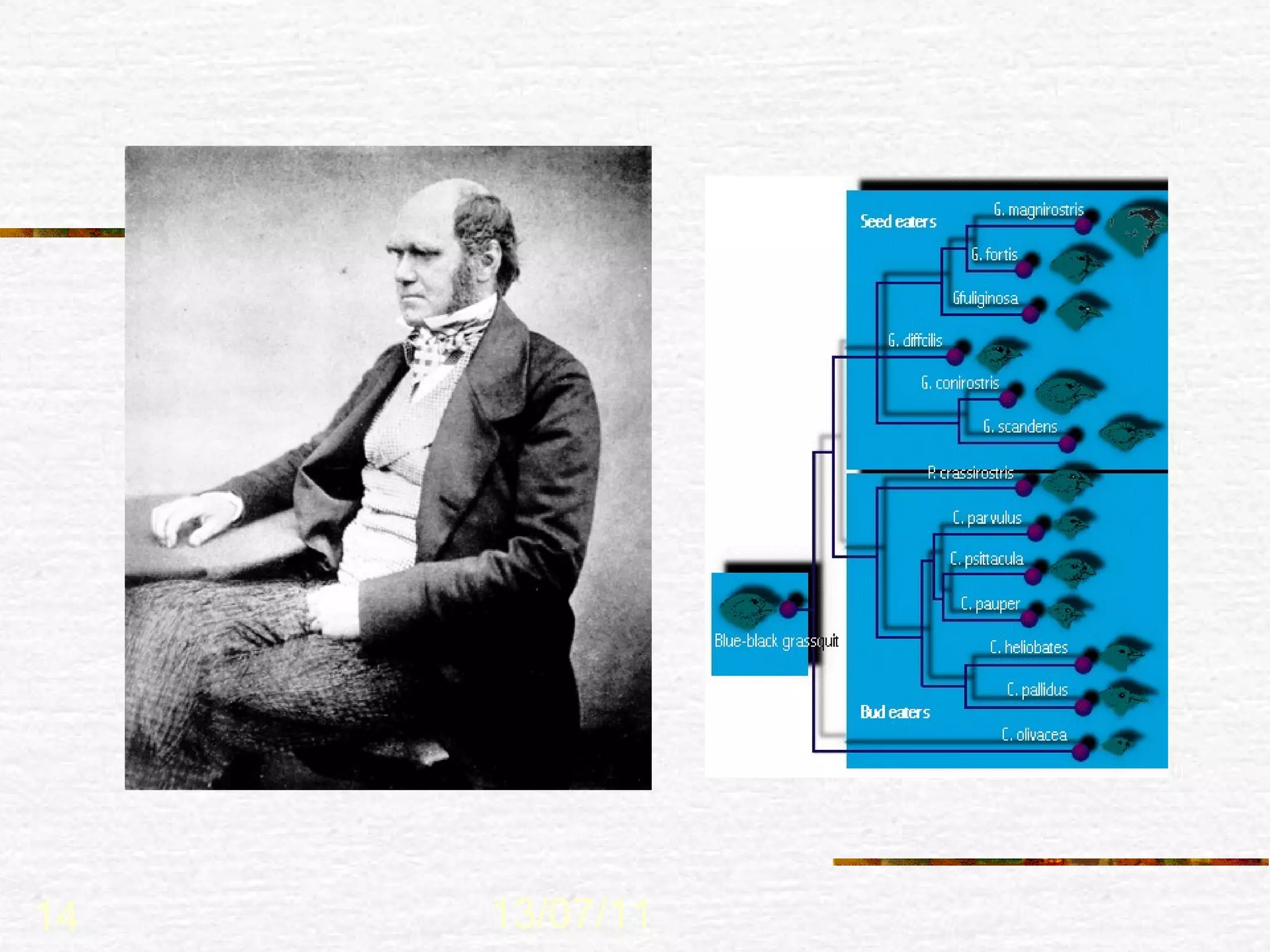
Evolution
 Changes of allele or genotype frequencies
  over time and/or space
          •   Selection / adaptation
          •   Small population size / genetic drift
          •   Non-random mating / inbreeding
          •   Migration / gene flow
          •   Mutation


13                  13/07/11
14   13/07/11
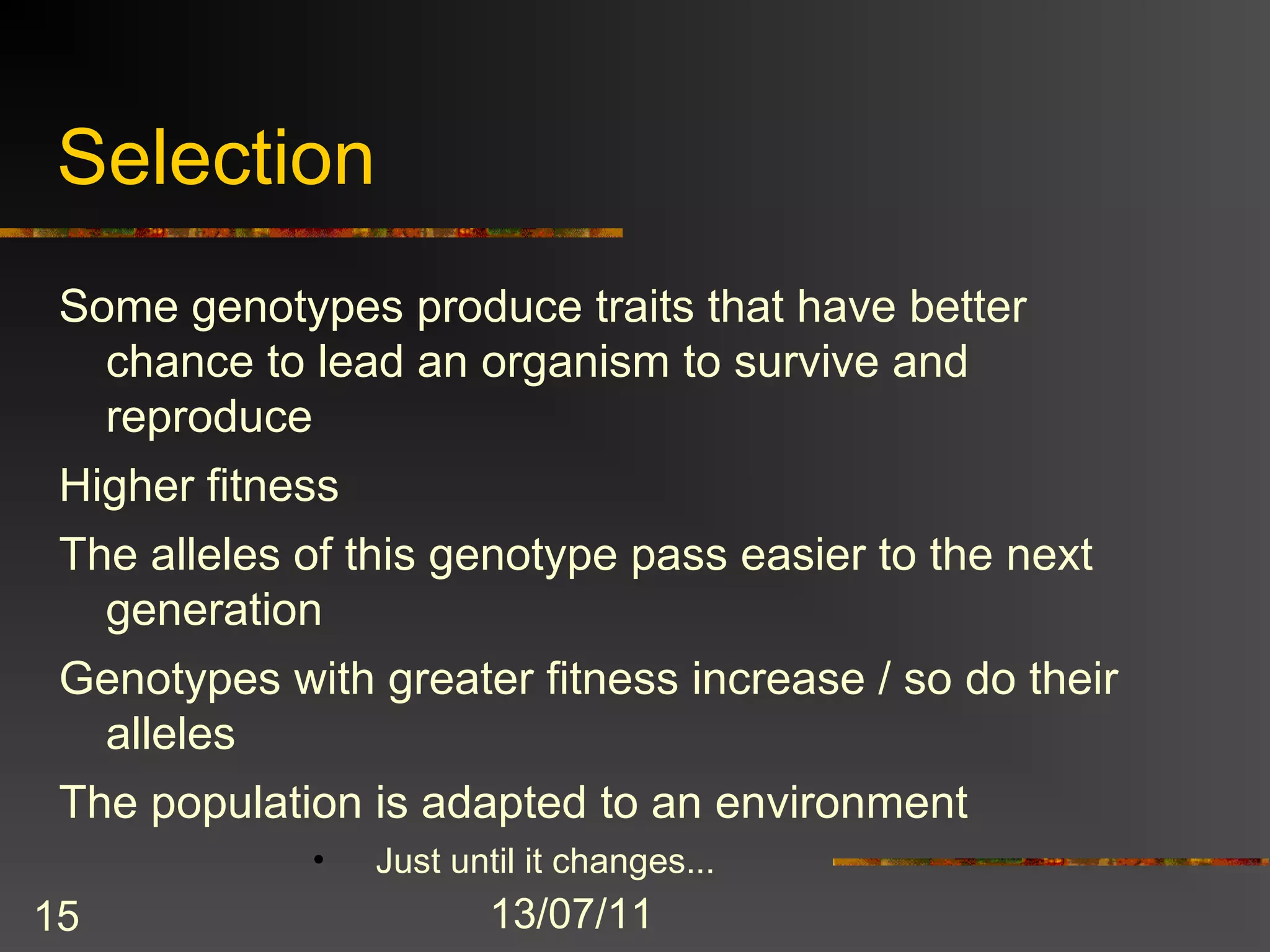
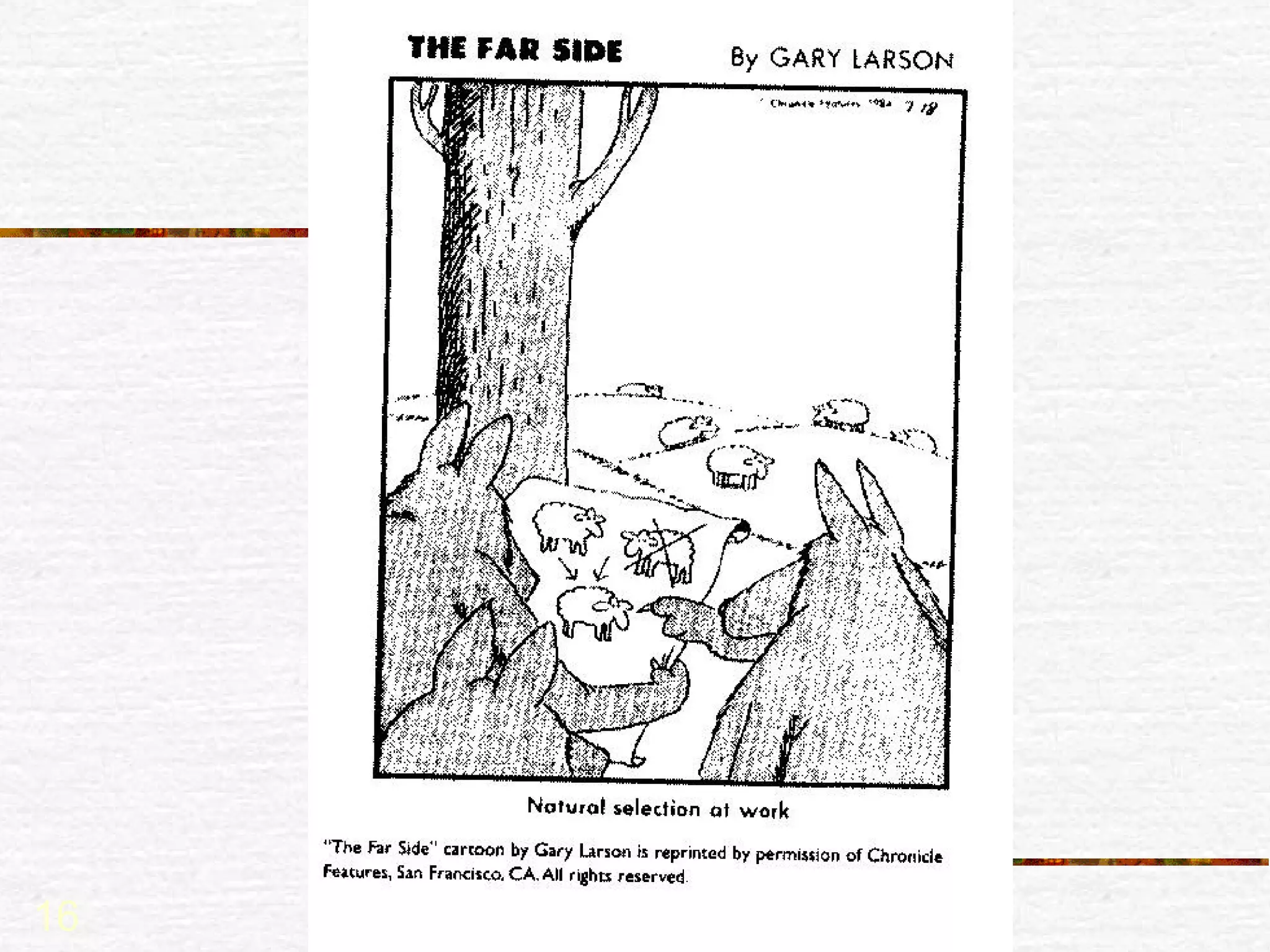
Selection
 Some genotypes produce traits that have better
   chance to lead an organism to survive and
   reproduce
 Higher fitness
 The alleles of this genotype pass easier to the next
   generation
 Genotypes with greater fitness increase / so do their
  alleles
 The population is adapted to an environment
             •    Just until it changes...
15                        13/07/11
16   13/07/11
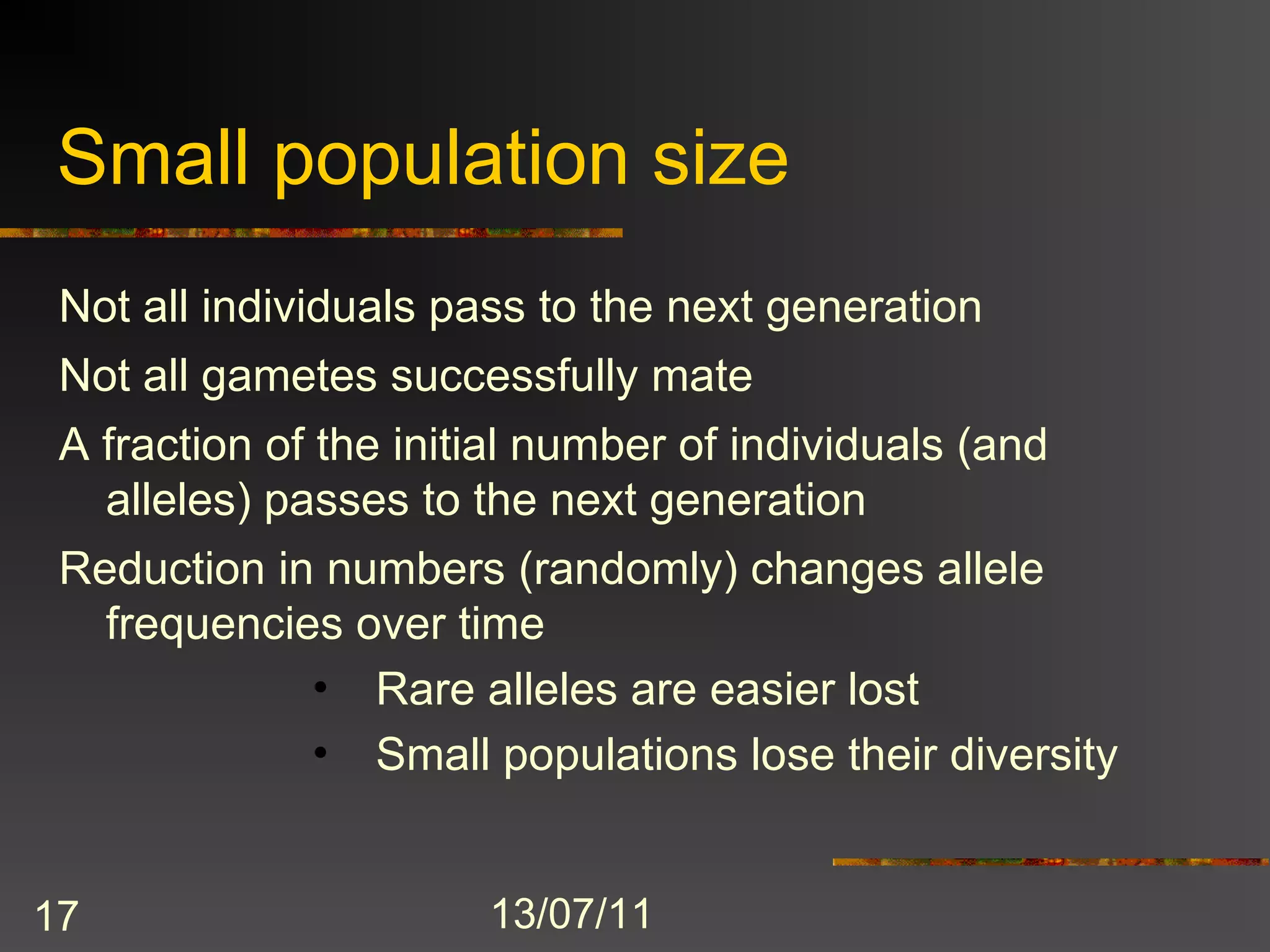
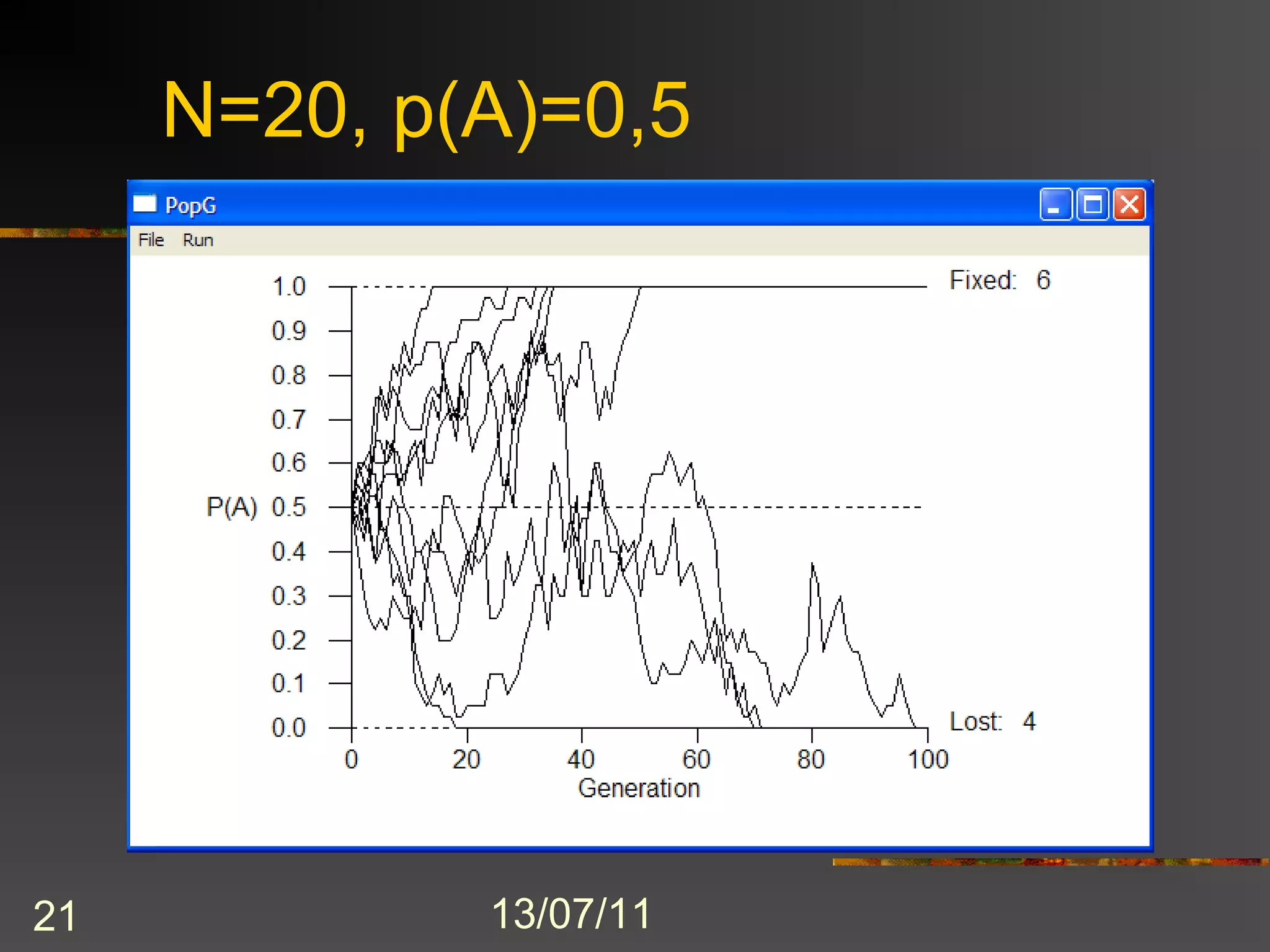
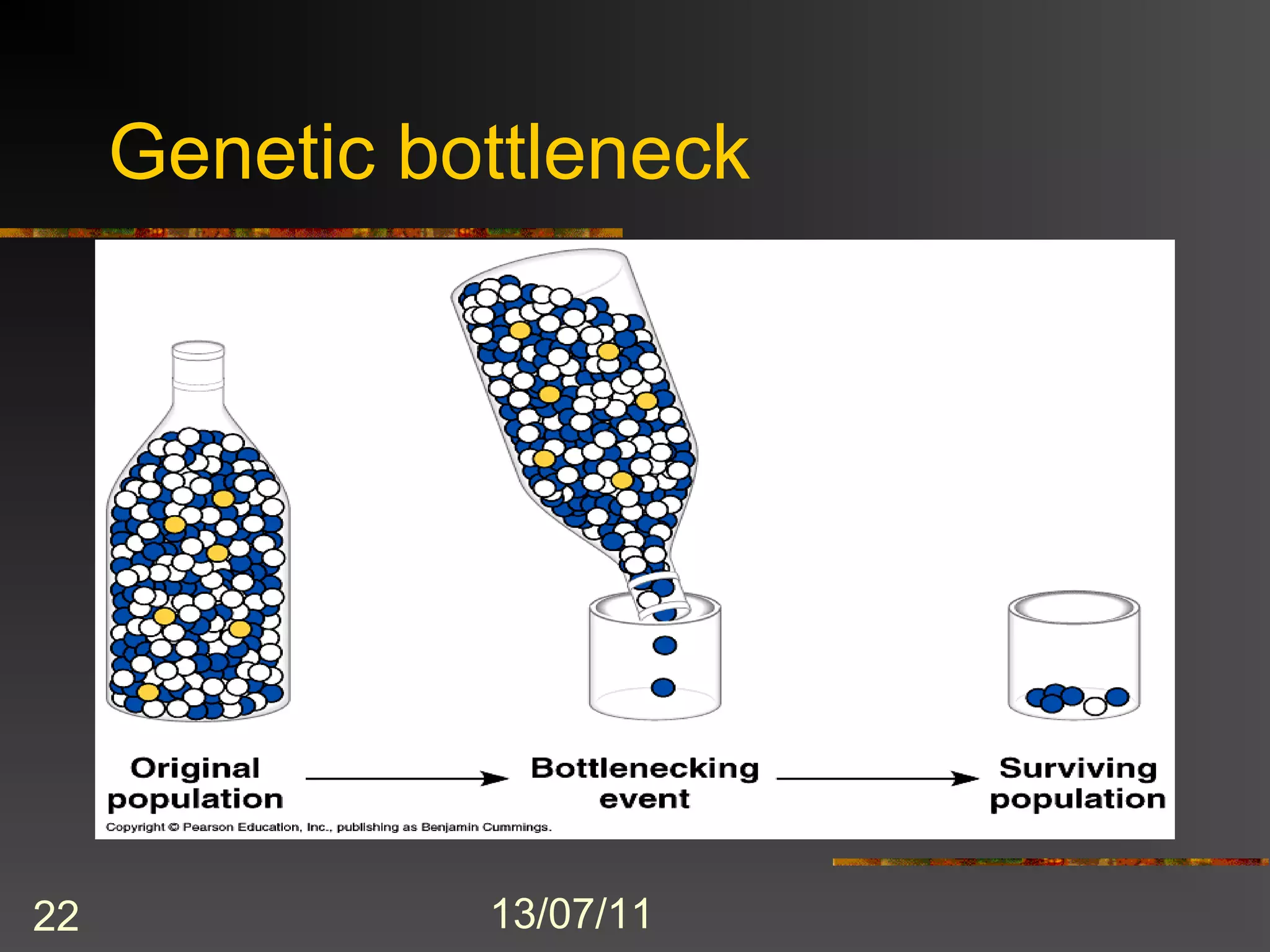
Small population size
 Not all individuals pass to the next generation
 Not all gametes successfully mate
 A fraction of the initial number of individuals (and
   alleles) passes to the next generation
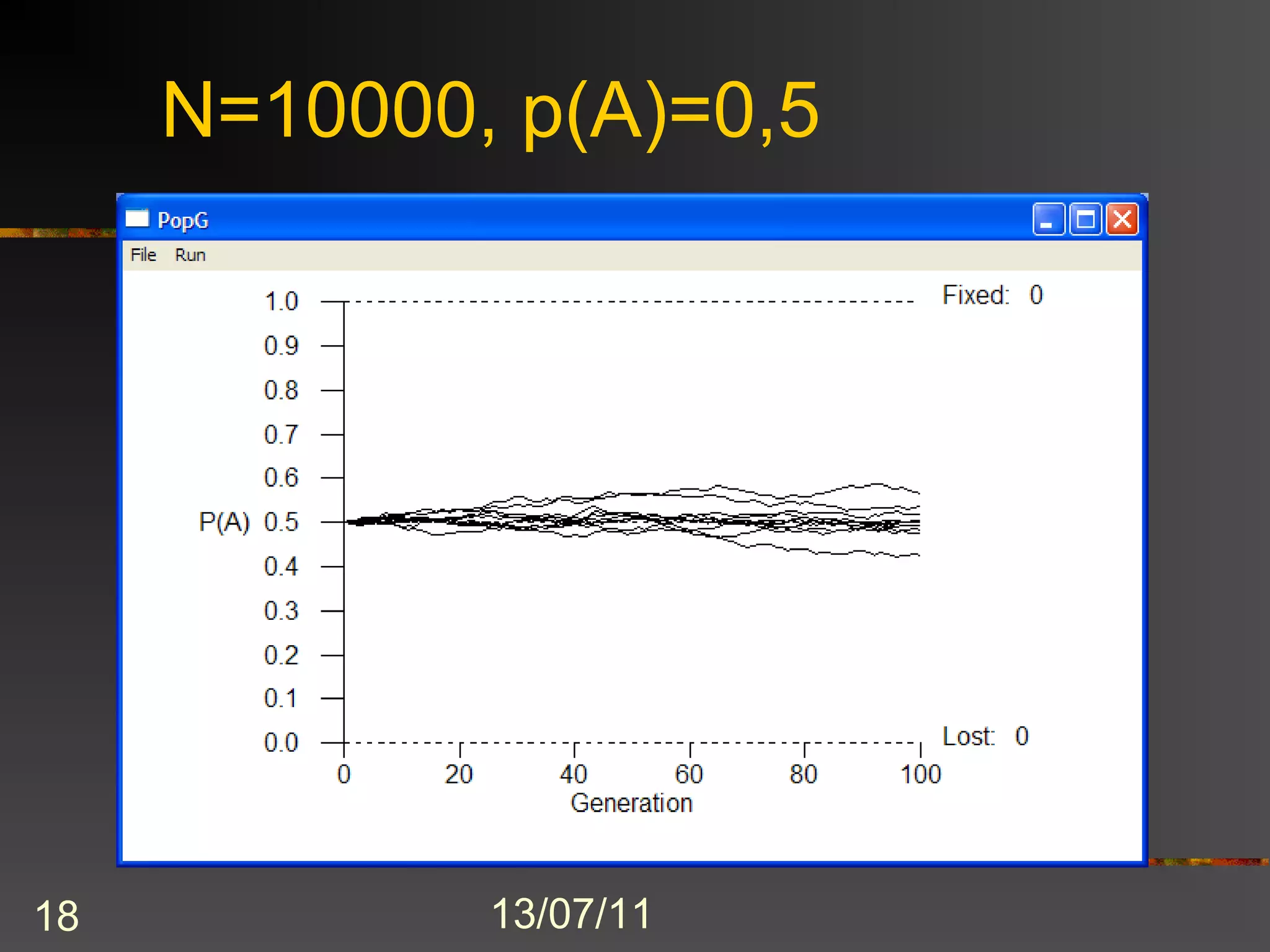
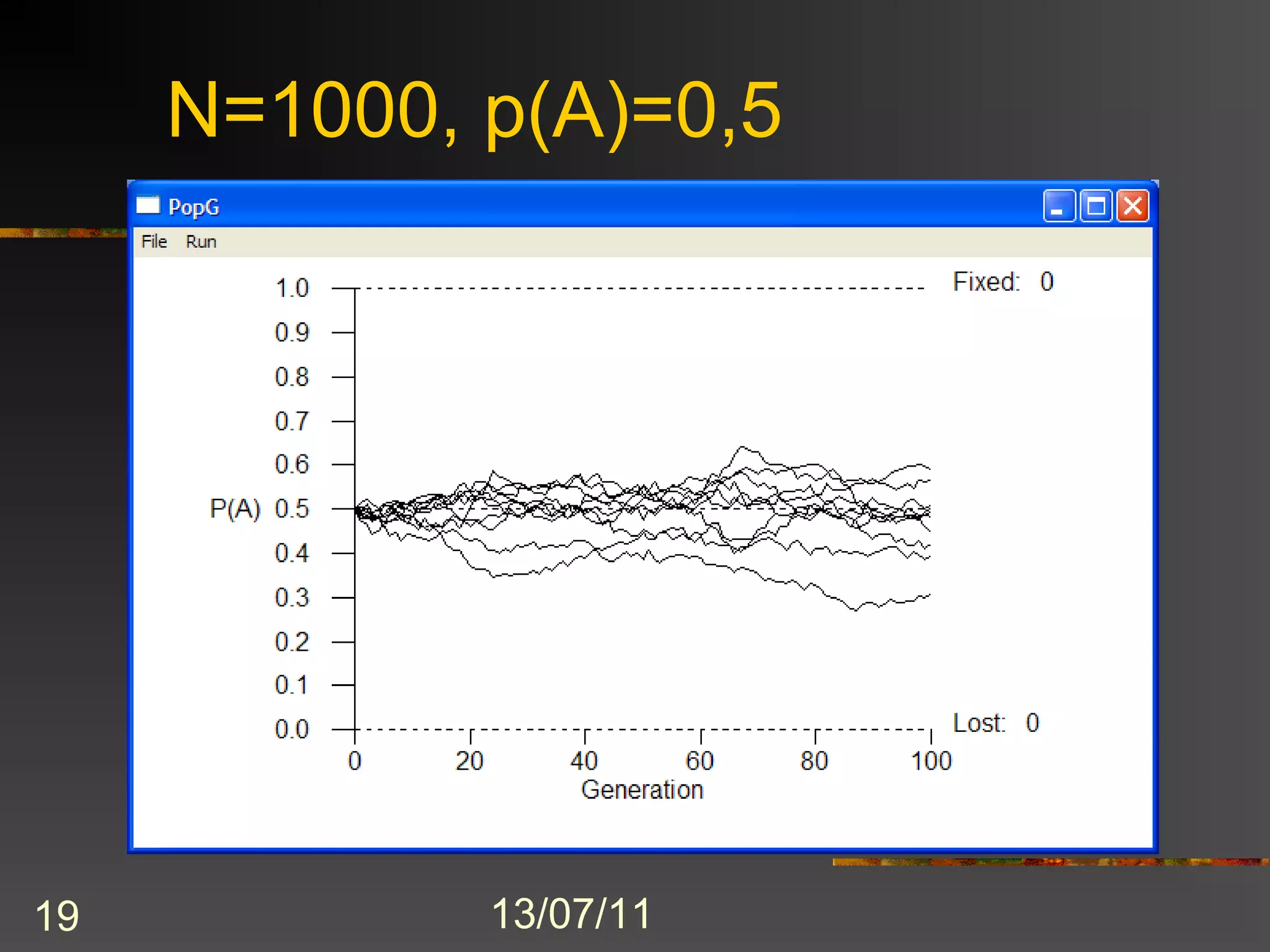
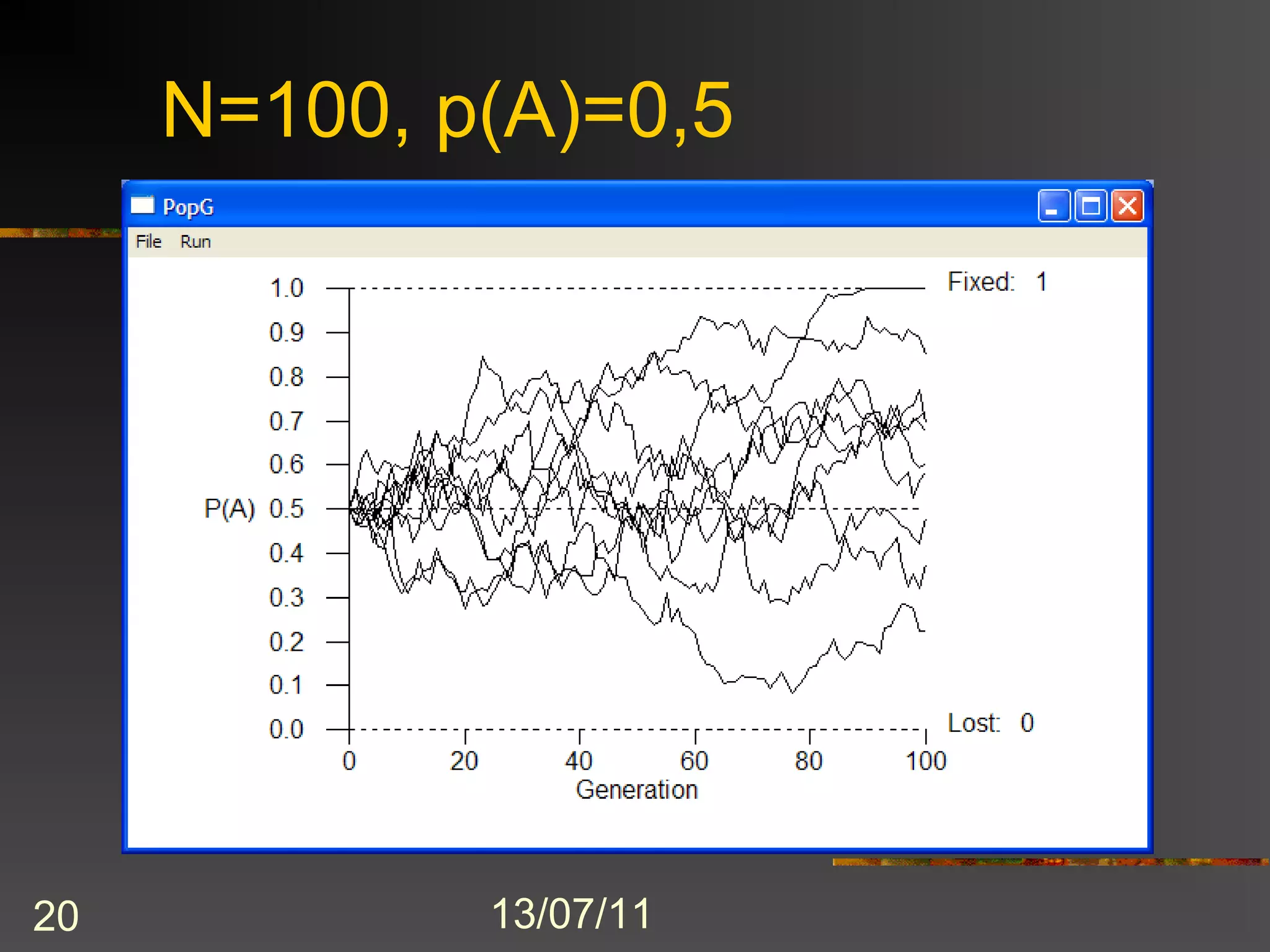
 Reduction in numbers (randomly) changes allele
   frequencies over time
             • Rare alleles are easier lost
             • Small populations lose their diversity


17                     13/07/11
Ν=10000, p(A)=0,5


18           13/07/11
Ν=1000, p(A)=0,5


19           13/07/11
Ν=100, p(A)=0,5


20           13/07/11
Ν=20, p(A)=0,5


21           13/07/11
Genetic bottleneck


22             13/07/11
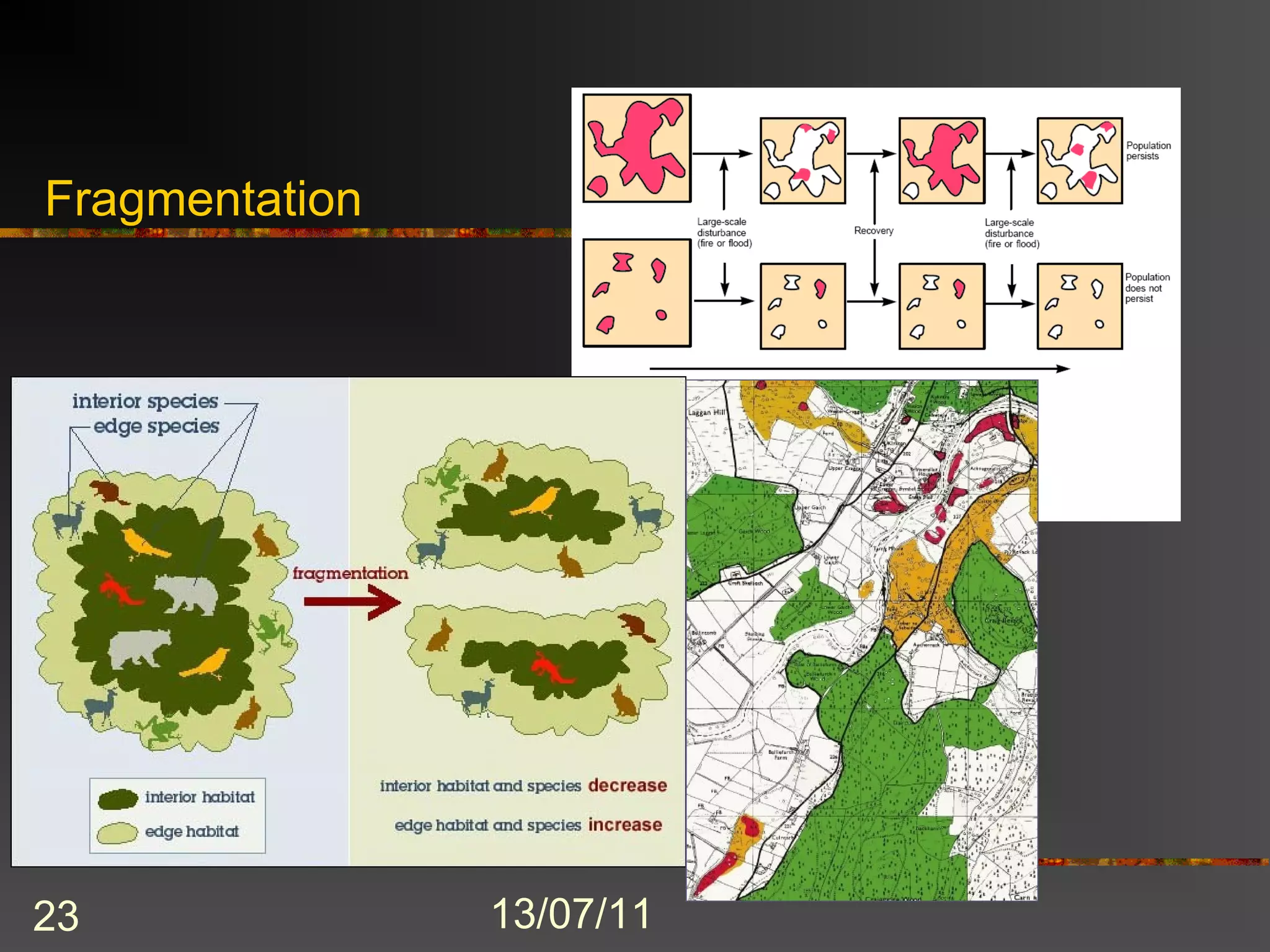
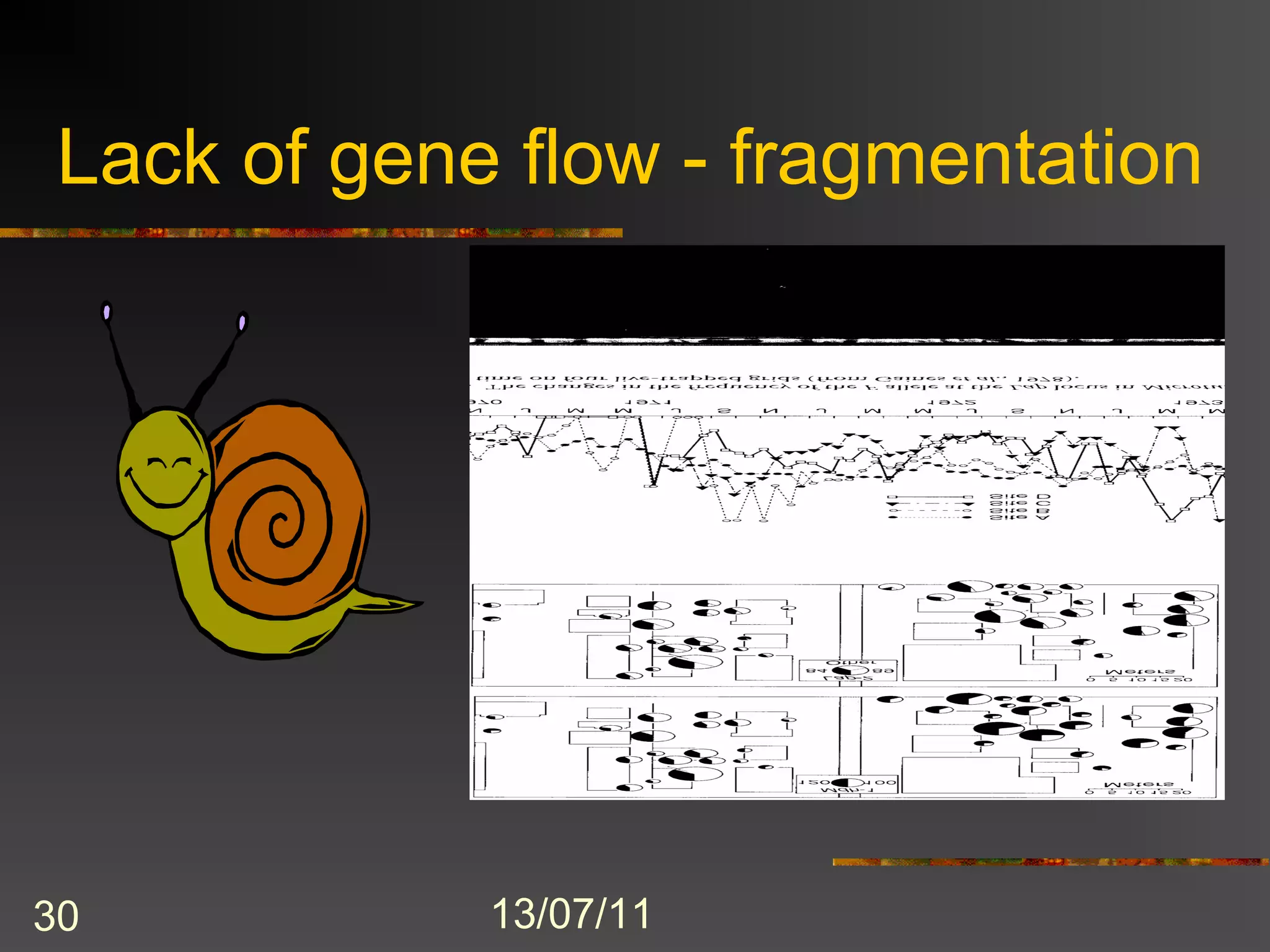
Fragmentation


23              13/07/11
Non random mating
 Random mating
          •   Equal probability of all mating events
          •   Keeps frequencies of alleles and
              genotypes stable
          •   Equilibrium
 Non random mating – inbreeding
          •   Decreases heterozygotes
          •   Increases the appearence of lethal genes
          •   Inbreeding depression

24                  13/07/11
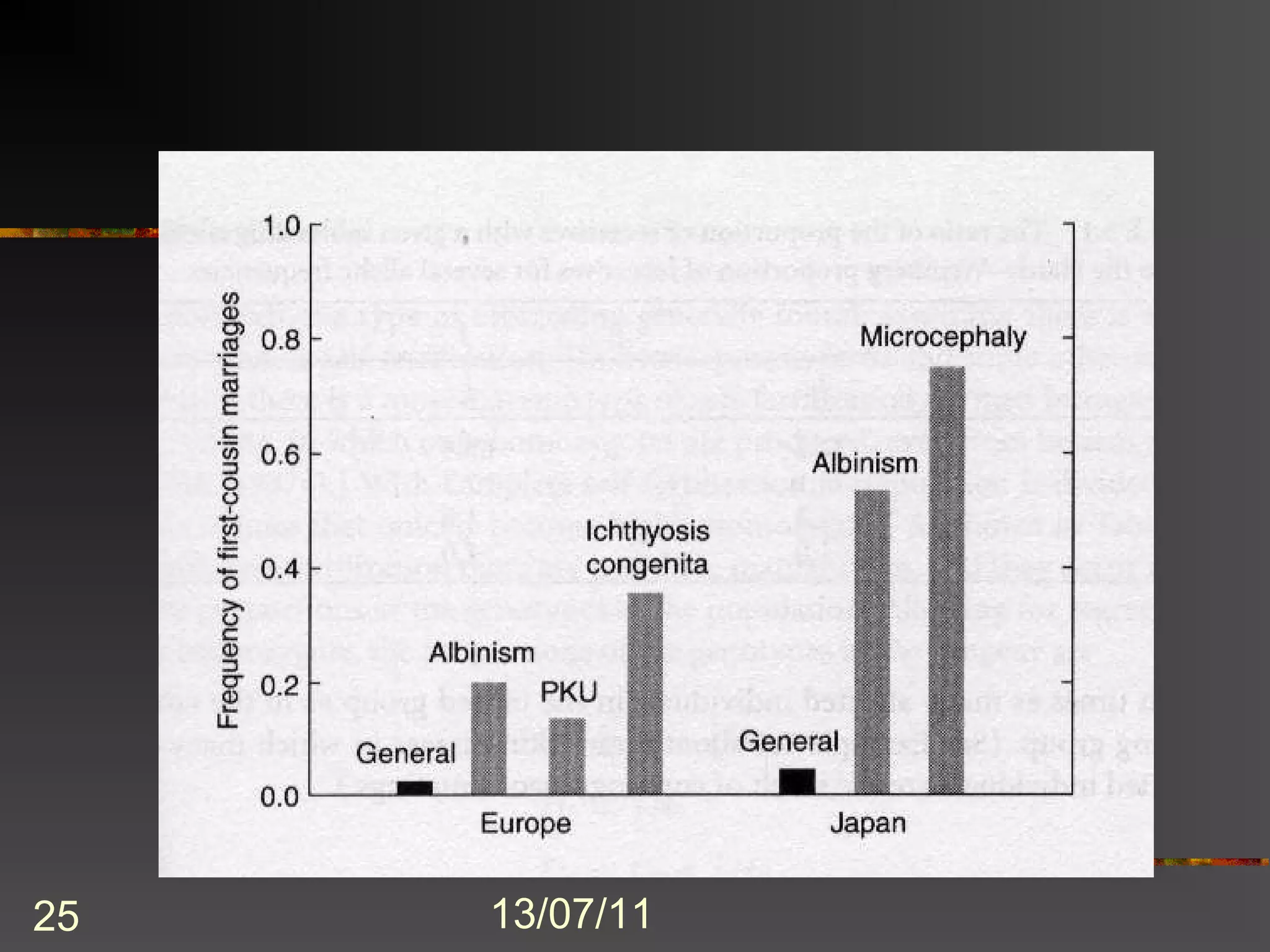
Hedrick p. 183 up


25                 13/07/11
Self – pollination / selfing
 Most severe form of inbreeding
            •   Results in full homozygosity in 6 / 7
                generations
            •   Reduces heterozygotes by 1/2 every
                generation
 In natural plant populations
            •   Dissadvantage in outbreeding species
            •   However, most species self pollinate
            •   Evolutionary advantage under stable
                environment
                   –    Stability of traits
26                 –   13/07/11of lethal genes...
                        Finall loss
Plant breeding
 The creation of new varieties
 In agriculture
               •   Self pollination creates “pure breeds”
               •   Absolutely homozygous
               •   Stable in artificial environment
 In forestry
               •   Self pollination is avoided
               •   Reduces heterozygosity and fitness
               •   More complex and variable environment
27                       13/07/11
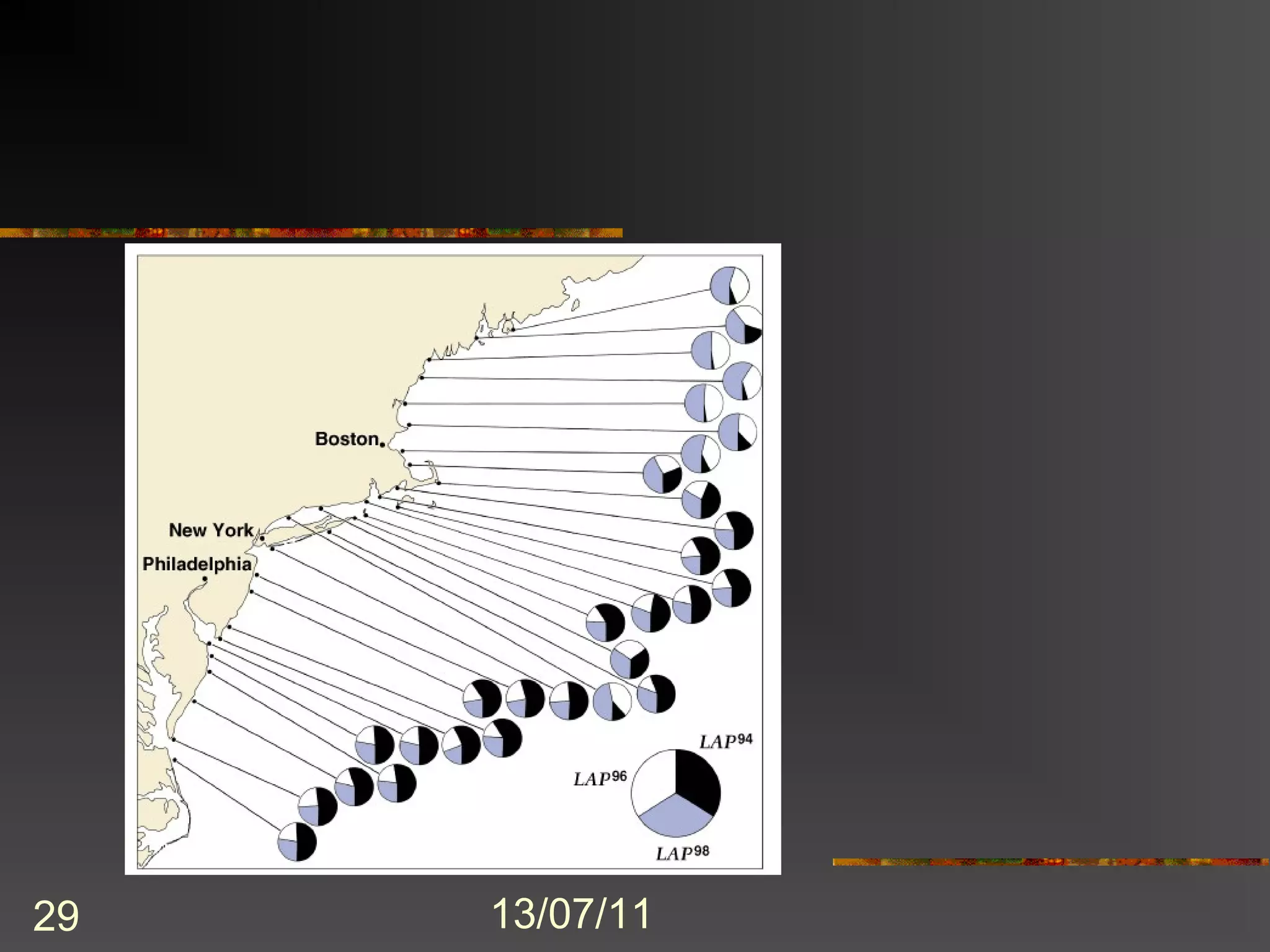
Migration – gene flow
 Migration of individuals (seeds) or gametes
  (pollen)
           •   New alleles arrive aqnd increase diversity
           •   Adaptation may be delayed
 Ideal situation: small levels of gene flow
   allow diffrentiated adaptation and
   maintenance of high diversity levels


28                   13/07/11
29   13/07/11
Lack of gene flow - fragmentation


30           13/07/11
Mutation
 Primary source of variation
 New alleles
 Rare event
 Does not change frequencies of alleles
   much


31               13/07/11
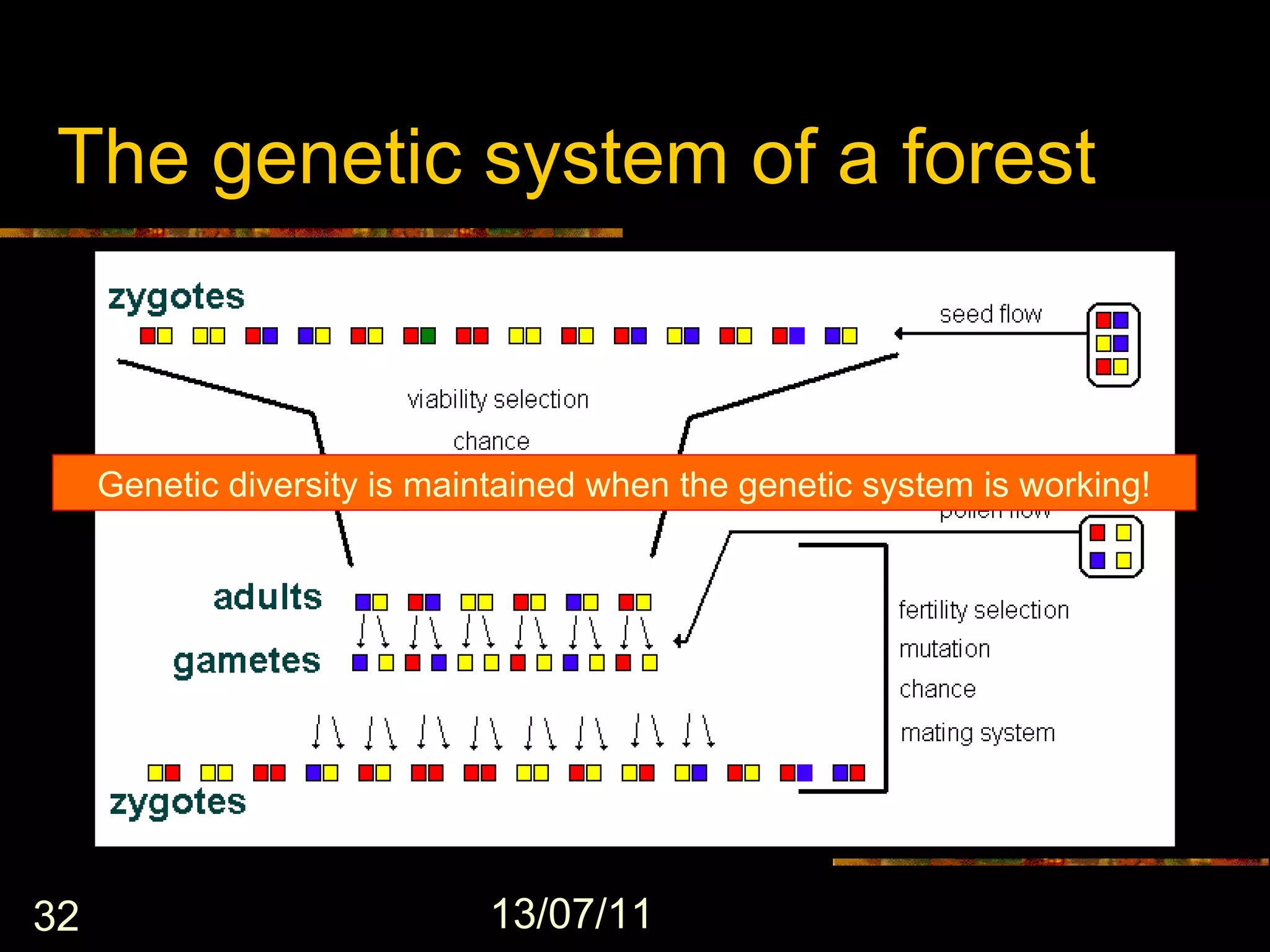
The genetic system of a forest


     Genetic diversity is maintained when the genetic system is working!


32                           13/07/11
In agriculture
 Fields are ecosystems & production units
 Farming requires uniform conditions and uniform
   material (one genotype)
              • Pure lines
              • Hybrids
 How to increase genetic sustainability?
             •   Change the scale!
             •   See the broader picture
             •   Use of local & adapted varieties
             •   Uniformity in the field, not among fieldsI
33                      13/07/11
In Forest Management
 Natural populations on variable sites
           •   Great diversity
 Maintaining genetic diversity
           •   Avoid disturbance of the genetic system
           •   Use natural regeneration dynamics
           •   Avoid fragmentation and small
               populations
           •   Proper / adapted reproductive material
 See the broader picture
34         •   Manage at the landscape level
                   13/07/11
In rangelands and pastures
 Natural ecosystems with large diversity
 Use natural dynamics
 Introduce proper material (local is safe)
 Avoid fragmentation
 Avoid overuse and degradation
 Landscape level


35                 13/07/11
Agroforestry systems
 Extensive, not intensive use of land
 Landscape level management
              •   Keep diversity within and – most important – among
                  landscape elements and among landscapes
 Maintain dynamics of nature
              •   Natural cycles
              •   Genetic system of plants
 Avoid fragmentation – establish connectivity
 Use of proper plant material
              •   Adapted
              •   Variable among units

36                        13/07/11
Strategies

        Forest management
           Secure pollen & seed movement
           Promote natural regeneration
           Expand management in non productive forests

                       – This includes rangelands
        Landscape connectivity
        Sustainable use of rangelands
        Improvement through proper material
        Restoration
             Local seed or best adapted seed

37                         13/07/11
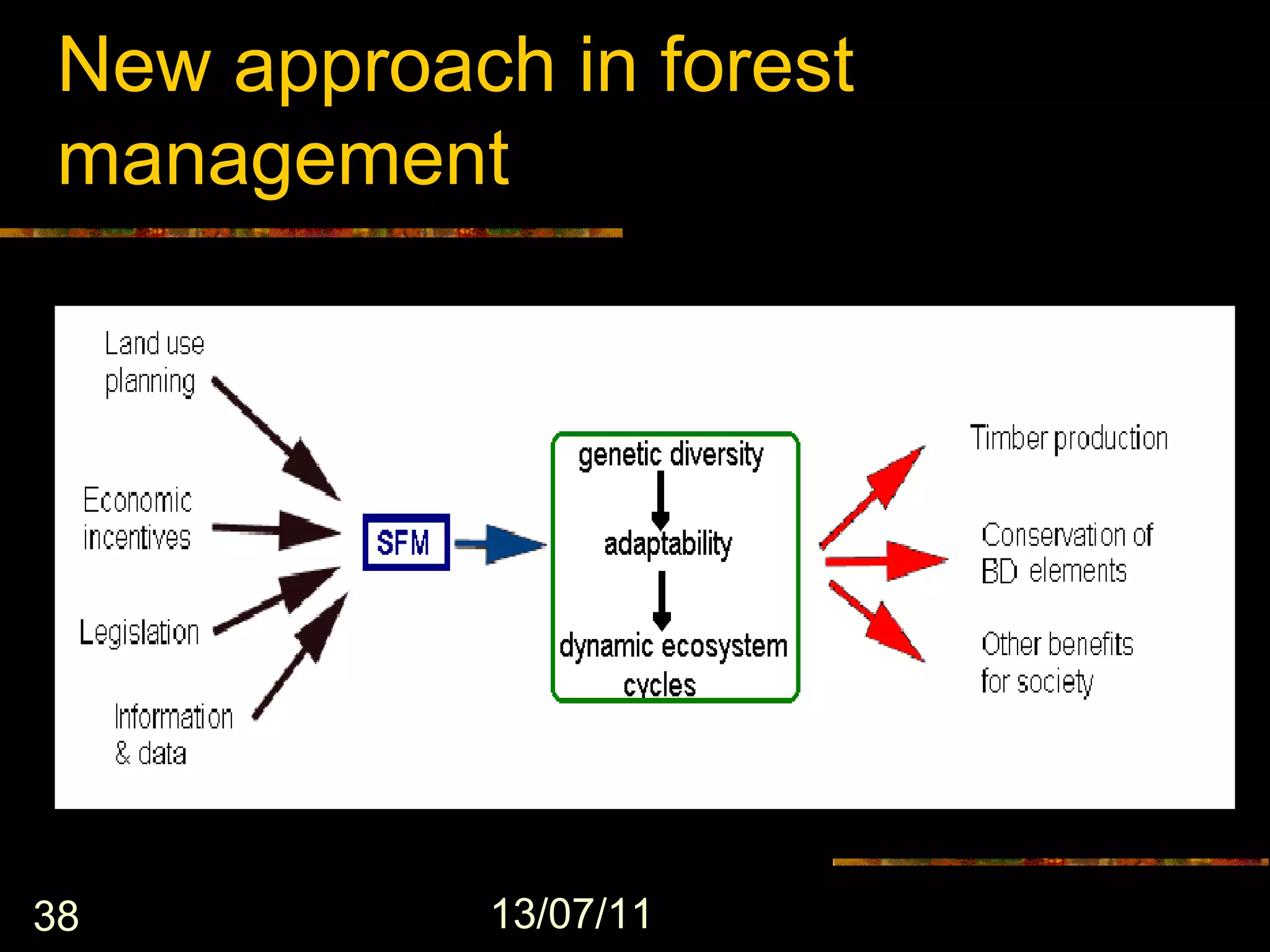
New approach in forest
 management


38          13/07/11
Adaptive conservation &
 management
    Ex situ: to preserve current genetic
     structures for future needs
        Frequent collection of reproductive material
         for plant species
           Restore in gene banks
           Keep in plantations in different locations

        Seed orchards for restoration purposes
        Adaptive breeding

39                         13/07/11
Thank you


40           13/07/11

Genetic diversity as a parameter for managing agroforestry systems

  • 1.
    Genetic diversity asa parameter for managing agroforestry systems Aristotelis C. Papageorgiou Forest Genetics Laboratory Democritus University of Thrace Orestiada, Greece
  • 2.
    plan - genetic diversity - changes of genetic diversity - genetic system in plant populations • Agriculture • Rangeland • Forest - management approach - examples / discussion 2 13/07/11
  • 3.
    3 13/07/11
  • 4.
    4 13/07/11
  • 5.
    Important things about biodiversity  Is of complex nature and finds its full meaning in complex cases (e.g. landscapes and multiple levels of organization)  Involves different perceptions of its meaning and importance 5 13/07/11
  • 6.
    Genetic component ofbiodiversity  ...is a total of meaningless mathematic expressions…  Perlman & Adelson 1997  …should not be given priority, since its measurement is complicated and expensive…  Dobson 1995  Misunderstandings:  “Laboratory analysis is the first step of any gene conservation or management measure”  “The object of conservation and management programmes are the genes we see in the laboratories” 6 13/07/11
  • 7.
    So, what isgenetic diversity?  The differences among organisms that can be inhereited  Passing from one generation to the other = mating  Changes over time = evolution  Is the basis of all other levels of biodiversity  Underestimated and under-represented  Measured by:  Field observations (environment? / P=G+E)  Lab observations (practical relevance? 7 13/07/11
  • 8.
    Field observations - morphometry • Environmental or genetic? • Multivariable statistics • Landmarks - common environment (trials) • Provenance / progeny tests • Traits of practical relevance – Growth, survival, resistance...etc. • ANOVA 8 13/07/11
  • 9.
    Lab observations - previously: chromosomes, visible traits, enzymes - nowadays: polymorphism at DNA level • Fragments (fragment length) • Sequencies of nucleotides • Some more sofisticated things... - no direct relevance with traits • This changes however - frequencies of genotypes and alleles 9 13/07/11
  • 10.
    The population -central concept to genetics - a set of individuals • Mating (same species – or not?) • Same place (more or less) - demography - frequency of alleles and genotypes 10 13/07/11
  • 11.
    Alleles and genotypes - allele: variant of the same gene that does the same job, just differently • Mendel had yellow and green peas (gene = pea color / alleles = green and yellow) • A diploid organism can have up to two different alleles at each gene - genotype: the types of alleles at a gene • Homozygote: two copies of the same allele • Heterozygote: two different alleles 11 13/07/11
  • 12.
    Importance of geneticdiversity  Main condition for adaptation under new environments  Maintenance of populations and species  Stability of communities and ecosystems  Constant production of goods and services  Biological information base  Is transferred over generations and rearranged through mating system  Influenced by population size  Changes and promotes adaptation  Is imported and exported 12 13/07/11
  • 13.
    Evolution Changes ofallele or genotype frequencies over time and/or space • Selection / adaptation • Small population size / genetic drift • Non-random mating / inbreeding • Migration / gene flow • Mutation 13 13/07/11
  • 14.
    14 13/07/11
  • 15.
    Selection Some genotypesproduce traits that have better chance to lead an organism to survive and reproduce Higher fitness The alleles of this genotype pass easier to the next generation Genotypes with greater fitness increase / so do their alleles The population is adapted to an environment • Just until it changes... 15 13/07/11
  • 16.
    16 13/07/11
  • 17.
    Small population size Not all individuals pass to the next generation Not all gametes successfully mate A fraction of the initial number of individuals (and alleles) passes to the next generation Reduction in numbers (randomly) changes allele frequencies over time • Rare alleles are easier lost • Small populations lose their diversity 17 13/07/11
  • 18.
  • 19.
  • 20.
  • 21.
  • 22.
  • 23.
  • 24.
    Non random mating Random mating • Equal probability of all mating events • Keeps frequencies of alleles and genotypes stable • Equilibrium Non random mating – inbreeding • Decreases heterozygotes • Increases the appearence of lethal genes • Inbreeding depression 24 13/07/11
  • 25.
    Hedrick p. 183up 25 13/07/11
  • 26.
    Self – pollination/ selfing Most severe form of inbreeding • Results in full homozygosity in 6 / 7 generations • Reduces heterozygotes by 1/2 every generation In natural plant populations • Dissadvantage in outbreeding species • However, most species self pollinate • Evolutionary advantage under stable environment – Stability of traits 26 – 13/07/11of lethal genes... Finall loss
  • 27.
    Plant breeding Thecreation of new varieties In agriculture • Self pollination creates “pure breeds” • Absolutely homozygous • Stable in artificial environment In forestry • Self pollination is avoided • Reduces heterozygosity and fitness • More complex and variable environment 27 13/07/11
  • 28.
    Migration – geneflow Migration of individuals (seeds) or gametes (pollen) • New alleles arrive aqnd increase diversity • Adaptation may be delayed Ideal situation: small levels of gene flow allow diffrentiated adaptation and maintenance of high diversity levels 28 13/07/11
  • 29.
    29 13/07/11
  • 30.
    Lack of geneflow - fragmentation 30 13/07/11
  • 31.
    Mutation Primary sourceof variation New alleles Rare event Does not change frequencies of alleles much 31 13/07/11
  • 32.
    The genetic systemof a forest Genetic diversity is maintained when the genetic system is working! 32 13/07/11
  • 33.
    In agriculture Fieldsare ecosystems & production units Farming requires uniform conditions and uniform material (one genotype) • Pure lines • Hybrids How to increase genetic sustainability? • Change the scale! • See the broader picture • Use of local & adapted varieties • Uniformity in the field, not among fieldsI 33 13/07/11
  • 34.
    In Forest Management Natural populations on variable sites • Great diversity Maintaining genetic diversity • Avoid disturbance of the genetic system • Use natural regeneration dynamics • Avoid fragmentation and small populations • Proper / adapted reproductive material See the broader picture 34 • Manage at the landscape level 13/07/11
  • 35.
    In rangelands andpastures Natural ecosystems with large diversity Use natural dynamics Introduce proper material (local is safe) Avoid fragmentation Avoid overuse and degradation Landscape level 35 13/07/11
  • 36.
    Agroforestry systems Extensive,not intensive use of land Landscape level management • Keep diversity within and – most important – among landscape elements and among landscapes Maintain dynamics of nature • Natural cycles • Genetic system of plants Avoid fragmentation – establish connectivity Use of proper plant material • Adapted • Variable among units 36 13/07/11
  • 37.
    Strategies  Forest management  Secure pollen & seed movement  Promote natural regeneration  Expand management in non productive forests – This includes rangelands  Landscape connectivity  Sustainable use of rangelands  Improvement through proper material  Restoration  Local seed or best adapted seed 37 13/07/11
  • 38.
    New approach inforest management 38 13/07/11
  • 39.
    Adaptive conservation & management  Ex situ: to preserve current genetic structures for future needs  Frequent collection of reproductive material for plant species  Restore in gene banks  Keep in plantations in different locations  Seed orchards for restoration purposes  Adaptive breeding 39 13/07/11
  • 40.
    Thank you 40 13/07/11