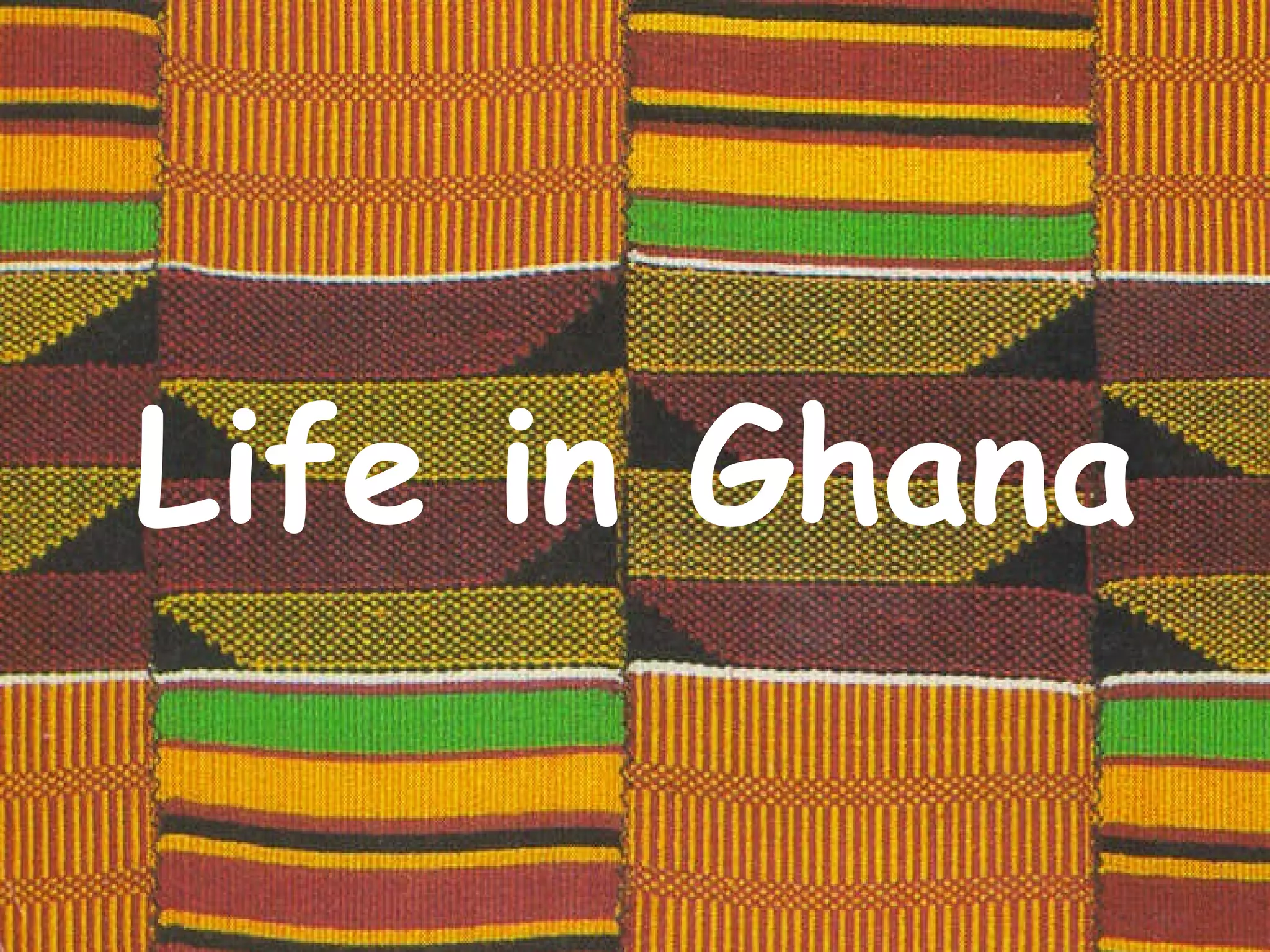
Life in Ghana
SOCIAL CLASSES/GROUPS IN GHANA Like every country, Ghana has its fair share of rich people, poor people, and middle income people living in the cities and the villages. I t is the most hospitable  country in the world and nobody visits Ghana once. Anyone who  has visited Ghana only once has either decided to stay or is desperately  trying to get back there!
 
Life in the Ghanaian Village There are less people in the villages Life here looks more organized People know each other so well People take care of each other’s properties and their children No sense of time – people tell the time by the position of the sun and the sound of animals Life is connected to nature Major economic activity is farming and marketing of farm produce
Children wake up at 6.00 am or sometimes 5.30 am We wake up with sunrise and to the sound of birds and the rooster - *** Usually the first born girl sweeps the compound while the next girl washes the dishes The boys feed the family animals and waters the family garden The common family animals are birds, goats, sheep, turkey, ducks and rabbits After that we all take our buckets and go to the stream or borehole to fetch water On the way to the stream we break sticks with which we brush our teeth The Life of a Child in the Village
The Life of a Child in the Village The family goat, sheep, the rooster, and the rabbit
The Life of a Child in the Village Children usually walk in groups when they go to school Schools serve 6 or 7 villages Distances range between few hundreds of meters to 1 or 1 ½ miles School starts at 8 am and ends at 2.00pm or 3.00pm We usually have two break periods of 15 or 20 minutes each Schools have big time celebrations on Independence days and other holidays ***
The Life of a Child in the Village *** Kids play outside when they return from school
The Life of a Child in the Village Around 4.00pm the kids go home to help prepare the food
The Life of a Child in the Village After the evening meal which finishes around 6.00pm the kids go outside to play Some games include, brao – bey, chaskelen, stay, kwaakwaa Older men and women tell the kids folk tales and anase stories by the fire side – it always ends with drumming and dancing
The Life of a Child in the Village Drumming and dancing is very important in the lives of Ghanaians Music is the food of the soul The talking drums in the durbar of chiefs There is always some drumming and dancing somewhere and kids love it
Drumming & Dancing
The Life of a Child in the Coastal Village The lives of kids in the coastal village revolves around fishing After school the major source of entertainment is around the sea Kids pick up left over fishes and resell them to their friends or bring them into the villages to sell The coastal village kids are the best wave surfers, divers and swimmers one can find
Life on the Coasts
In the Northern Villages
Life in the Ghanaian City A Ghanaian city is virtually a place of business It is usually densely populated People are there to buy and sell Life here is different from life in the village
The Child in the Inner City They wake up earlier than the village kids because they spend long hours to wait their turn to fetch the water Kids mostly eat from food sellers right outside their houses When the kids return from school, its all business They sell everything from sachet water to coconuts In the evenings most of the kids watch televisions together while they talk about their sales experiences during the day
Life in the City In the evenings most kids  sow clothes,  weave kente,  or make other crafts These activities occur in the village settings as well
There are 64 different languages in Ghana To survive in the inner city as a child you have to speak or understand at least 4 languages. How you doing Mp O  mu te sEn – MpO mu yE …..Asante TEE y OO  Teh – Me yE odjo gbaa …..Ga Birika Naba – birika naba Farefare Tooma tooma – aanhah Dagbani Efoah – eeh … EwE Please -  Me pa wo akyew – Asante OfaanyE – Ga Nii ban nzo akana - Frafra Me te pkE gboloo – EwE Nkadjoh – Dagbani Languages in Ghana
Chieftaincy and Inheritance Many ethnic groups An ethnic group Matrilineal and patrilineal forms of inheritance 70 % of Ghana’s ethnic groups are matrilineal Women are responsible for the women so they own the land This is Nana Afia Kobi – She enstools the Asantehene – The King of the Ashantes  The Ashante kingdom gave the British the strongest resistance She veto who the next king is – The queenmother is not the chief or kings wife, she is th Kings mother
Religion and Children Religion is very important in the lives Ghanaian children Christianity, Islam, traditionalists, some traces of Eastern religions Drama and plays about morals, anase folk tales, social issues like drug abuse, HIV – AIDS, domestic violence, parenting etc
Andrea & PPP Africa Andrea has taken a STEP to HELP people to grow themselves out of poverty
PPP Africa’s Goals
PPPAFRICA.ORG We are asking for donations of used shoes…used shoes We are taking it easy - one family at a time We ask the families what prosperity and wealth means to them and what they NEED to achieve it We give them their request and provide them with technical assistance to grow themselves out of poverty

Life In Ghana

  • 1.
  • 2.
    SOCIAL CLASSES/GROUPS INGHANA Like every country, Ghana has its fair share of rich people, poor people, and middle income people living in the cities and the villages. I t is the most hospitable country in the world and nobody visits Ghana once. Anyone who has visited Ghana only once has either decided to stay or is desperately trying to get back there!
  • 3.
  • 4.
    Life in theGhanaian Village There are less people in the villages Life here looks more organized People know each other so well People take care of each other’s properties and their children No sense of time – people tell the time by the position of the sun and the sound of animals Life is connected to nature Major economic activity is farming and marketing of farm produce
  • 5.
    Children wake upat 6.00 am or sometimes 5.30 am We wake up with sunrise and to the sound of birds and the rooster - *** Usually the first born girl sweeps the compound while the next girl washes the dishes The boys feed the family animals and waters the family garden The common family animals are birds, goats, sheep, turkey, ducks and rabbits After that we all take our buckets and go to the stream or borehole to fetch water On the way to the stream we break sticks with which we brush our teeth The Life of a Child in the Village
  • 6.
    The Life ofa Child in the Village The family goat, sheep, the rooster, and the rabbit
  • 7.
    The Life ofa Child in the Village Children usually walk in groups when they go to school Schools serve 6 or 7 villages Distances range between few hundreds of meters to 1 or 1 ½ miles School starts at 8 am and ends at 2.00pm or 3.00pm We usually have two break periods of 15 or 20 minutes each Schools have big time celebrations on Independence days and other holidays ***
  • 8.
    The Life ofa Child in the Village *** Kids play outside when they return from school
  • 9.
    The Life ofa Child in the Village Around 4.00pm the kids go home to help prepare the food
  • 10.
    The Life ofa Child in the Village After the evening meal which finishes around 6.00pm the kids go outside to play Some games include, brao – bey, chaskelen, stay, kwaakwaa Older men and women tell the kids folk tales and anase stories by the fire side – it always ends with drumming and dancing
  • 11.
    The Life ofa Child in the Village Drumming and dancing is very important in the lives of Ghanaians Music is the food of the soul The talking drums in the durbar of chiefs There is always some drumming and dancing somewhere and kids love it
  • 12.
  • 13.
    The Life ofa Child in the Coastal Village The lives of kids in the coastal village revolves around fishing After school the major source of entertainment is around the sea Kids pick up left over fishes and resell them to their friends or bring them into the villages to sell The coastal village kids are the best wave surfers, divers and swimmers one can find
  • 14.
  • 15.
  • 16.
    Life in theGhanaian City A Ghanaian city is virtually a place of business It is usually densely populated People are there to buy and sell Life here is different from life in the village
  • 17.
    The Child inthe Inner City They wake up earlier than the village kids because they spend long hours to wait their turn to fetch the water Kids mostly eat from food sellers right outside their houses When the kids return from school, its all business They sell everything from sachet water to coconuts In the evenings most of the kids watch televisions together while they talk about their sales experiences during the day
  • 18.
    Life in theCity In the evenings most kids sow clothes, weave kente, or make other crafts These activities occur in the village settings as well
  • 19.
    There are 64different languages in Ghana To survive in the inner city as a child you have to speak or understand at least 4 languages. How you doing Mp O mu te sEn – MpO mu yE …..Asante TEE y OO Teh – Me yE odjo gbaa …..Ga Birika Naba – birika naba Farefare Tooma tooma – aanhah Dagbani Efoah – eeh … EwE Please - Me pa wo akyew – Asante OfaanyE – Ga Nii ban nzo akana - Frafra Me te pkE gboloo – EwE Nkadjoh – Dagbani Languages in Ghana
  • 20.
    Chieftaincy and InheritanceMany ethnic groups An ethnic group Matrilineal and patrilineal forms of inheritance 70 % of Ghana’s ethnic groups are matrilineal Women are responsible for the women so they own the land This is Nana Afia Kobi – She enstools the Asantehene – The King of the Ashantes The Ashante kingdom gave the British the strongest resistance She veto who the next king is – The queenmother is not the chief or kings wife, she is th Kings mother
  • 21.
    Religion and ChildrenReligion is very important in the lives Ghanaian children Christianity, Islam, traditionalists, some traces of Eastern religions Drama and plays about morals, anase folk tales, social issues like drug abuse, HIV – AIDS, domestic violence, parenting etc
  • 22.
    Andrea & PPPAfrica Andrea has taken a STEP to HELP people to grow themselves out of poverty
  • 23.
  • 24.
    PPPAFRICA.ORG We areasking for donations of used shoes…used shoes We are taking it easy - one family at a time We ask the families what prosperity and wealth means to them and what they NEED to achieve it We give them their request and provide them with technical assistance to grow themselves out of poverty

Editor's Notes

  • #20 In all these languages