OOP Design, Style,
Characteristics
LECTURE NO 4
COMSATS
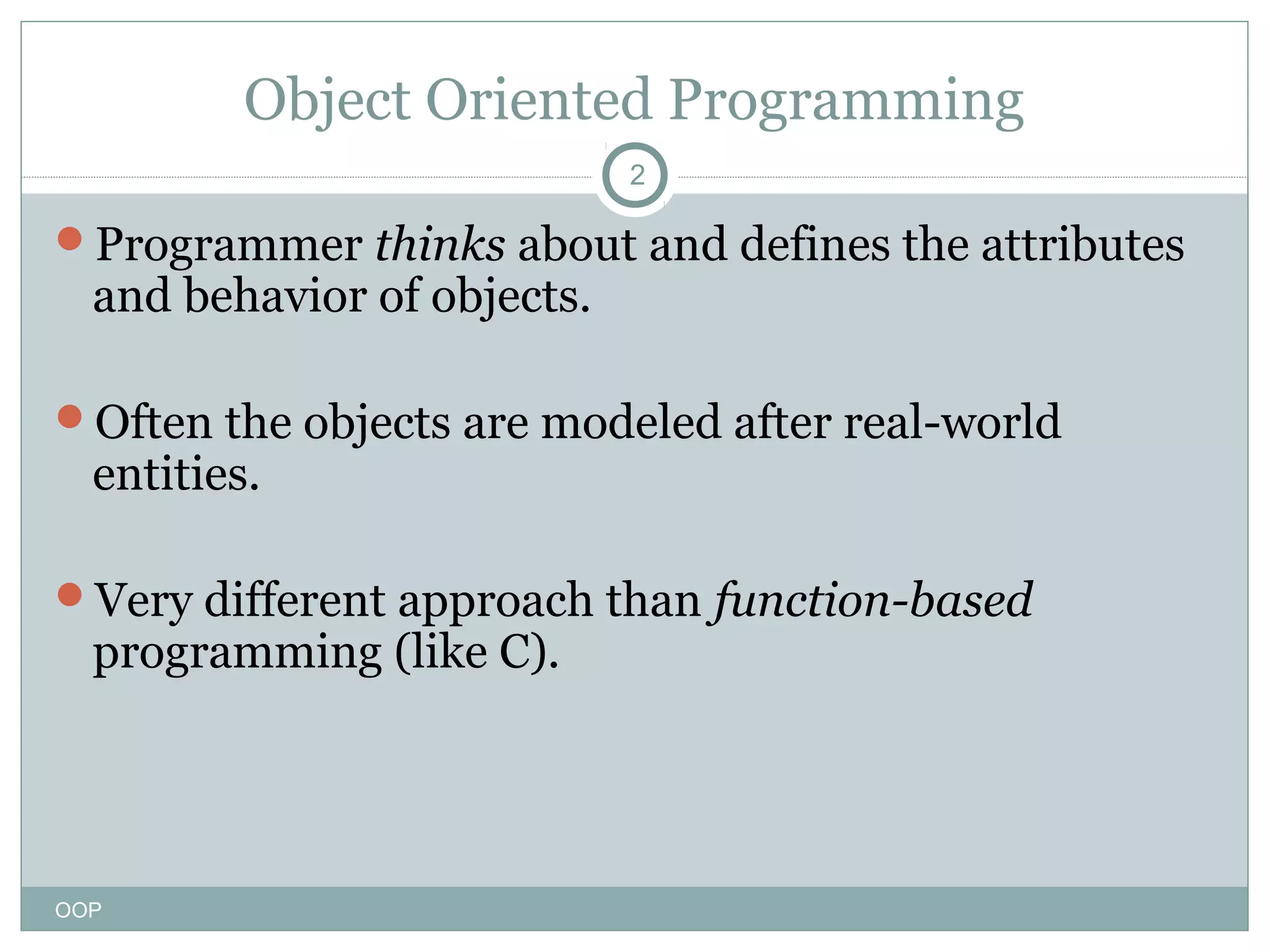
Object Oriented Programming
2

Programmer thinks about and defines the attributes

and behavior of objects.

Often the objects are modeled after real-world

entities.

Very different approach than function-based

programming (like C).

OOP
Reasons for OOP
3

Abstraction
Encapsulation
Information hiding
Inheritance
Polymorphism
Software Engineering Issues

OOP
Object Oriented Programming
4

Object-oriented programming (OOP)
 Encapsulates data (attributes) and functions (behavior) into
packages called classes.
So, Classes are user-defined (programmer-defined)

types.



Data (data members)
Functions (member functions or methods)

In other words, they are structures + functions

OOP
Class: Object Types
5

A C++ class is an object type.
When you create the definition of a class you are

defining the attributes and behavior of a new type.
Attributes are data members.
Behavior is defined by methods.

OOP
Information Hiding
6

The interface to a class is the list of public data

members and methods.
The interface defines the behavior of the class to the
outside world (to other classes and functions that
may access variables of your class type).
The implementation of your class doesn't matter
outside the class – only the interface.

OOP
Information Hiding (cont.)
7

You can change the implementation and

nobody cares! (as long as the interface is the
same).

You can use other peoples classes without fear!

OOP
Inheritence
8

It is possible to extend existing classes without

seeing them.
Add whatever new behavior you want.
Example:



You have a class that represents a "student".
Create a new class that is a "good student".


OOP

Most of the behavior and attributes are the same, but a few are
different – specialized.
Polymorphism
9

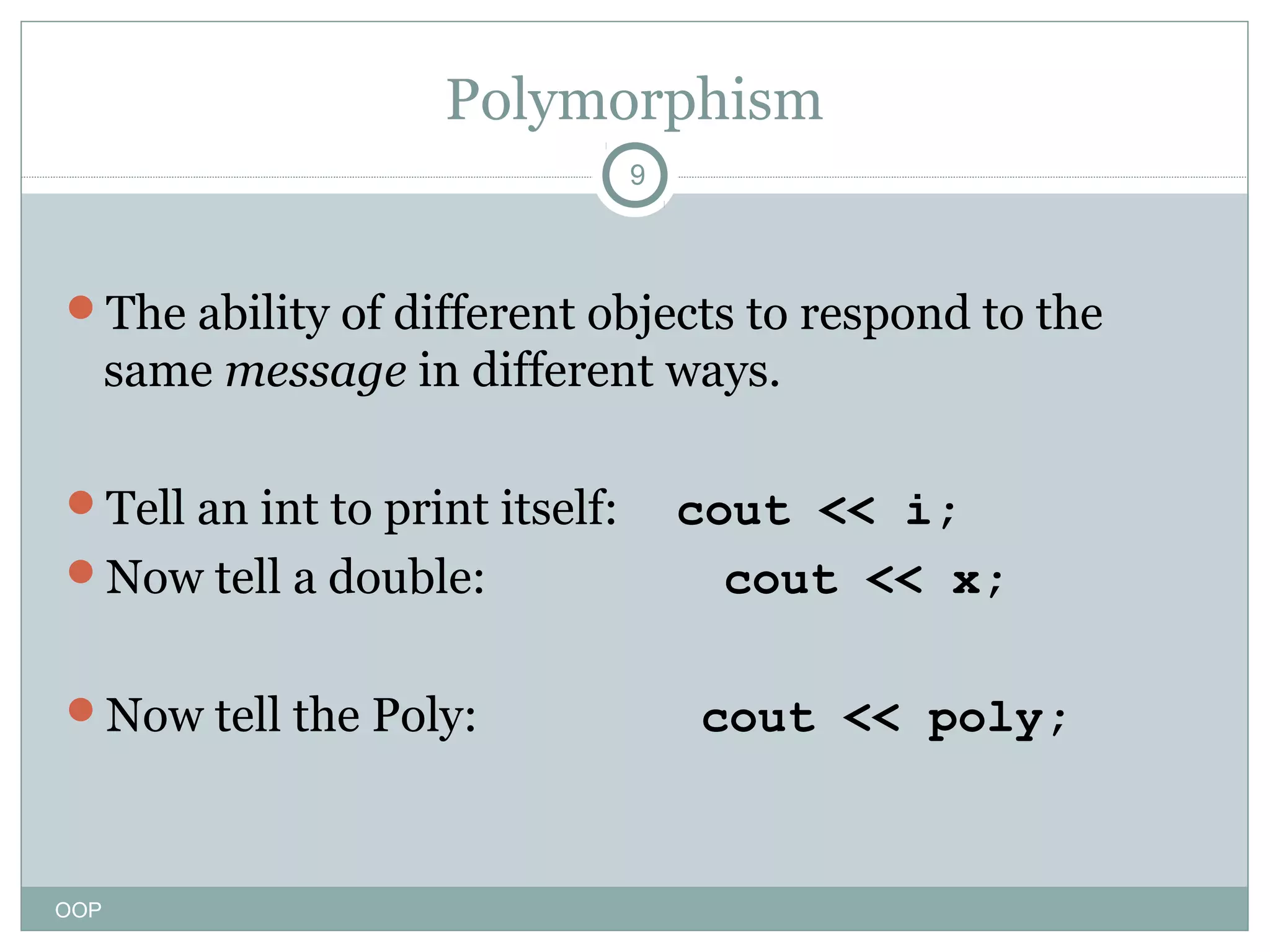
The ability of different objects to respond to the

same message in different ways.
Tell an int to print itself:
Now tell a double:
Now tell the Poly:

OOP

cout << i;
cout << x;
cout << poly;
Private vs. Public
10

Public data members and methods can be accessed

outside the class directly.
The public stuff is the interface.
Private members and methods are for internal use
only.

OOP
C++ Program Structure
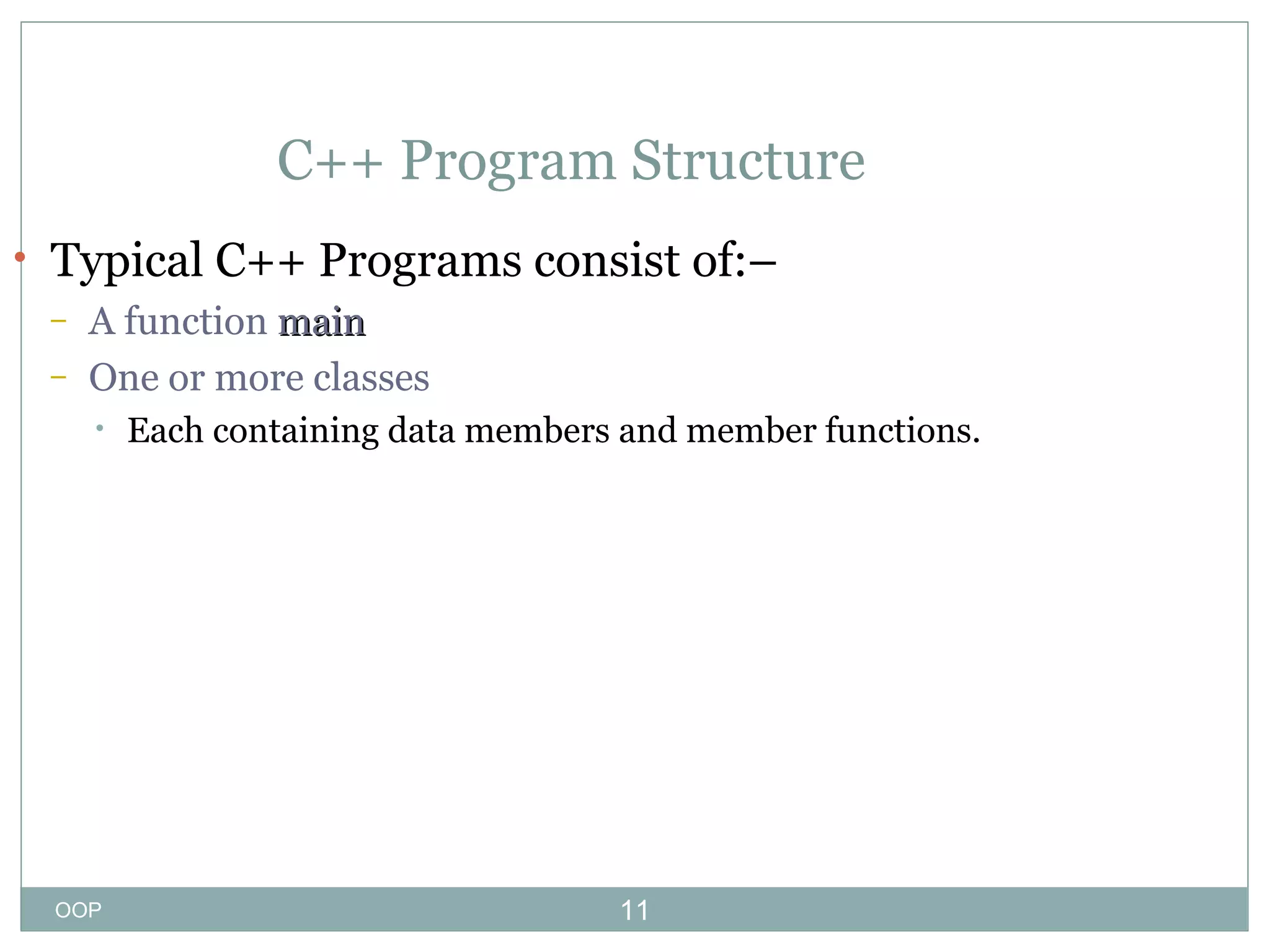
• Typical C++ Programs consist of:–
– A function main
– One or more classes
•

OOP

Each containing data members and member functions.

11
Classes in C++
12

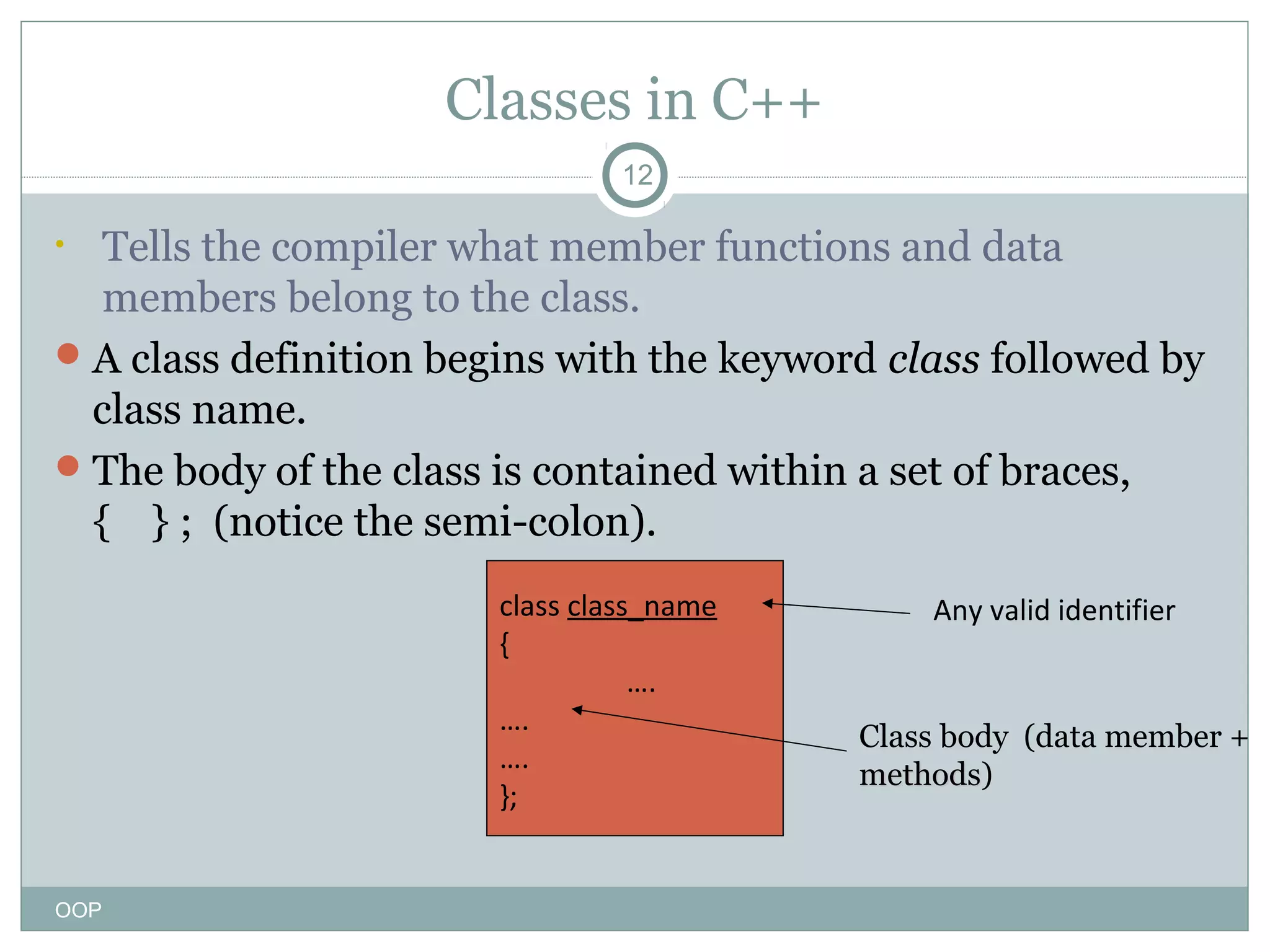
Tells the compiler what member functions and data
members belong to the class.
 A class definition begins with the keyword class followed by
class name.
 The body of the class is contained within a set of braces,
{ } ; (notice the semi-colon).
•

class class_name
{
….
….
….
};

OOP

Any valid identifier

Class body (data member +
methods)
methods
Classes in C++
13

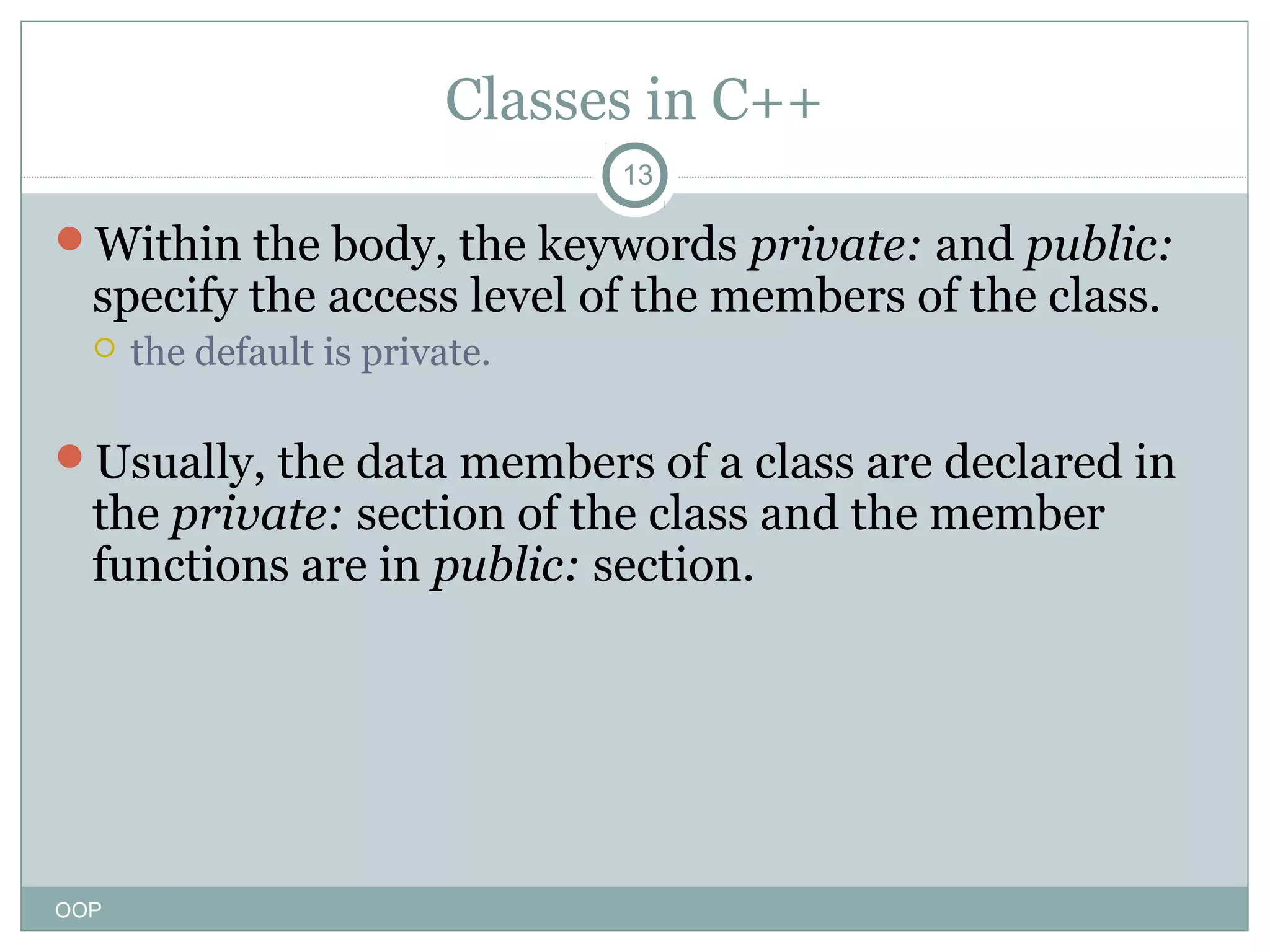
Within the body, the keywords private: and public:

specify the access level of the members of the class.


the default is private.

Usually, the data members of a class are declared in

the private: section of the class and the member
functions are in public: section.

OOP
Classes in C++
14

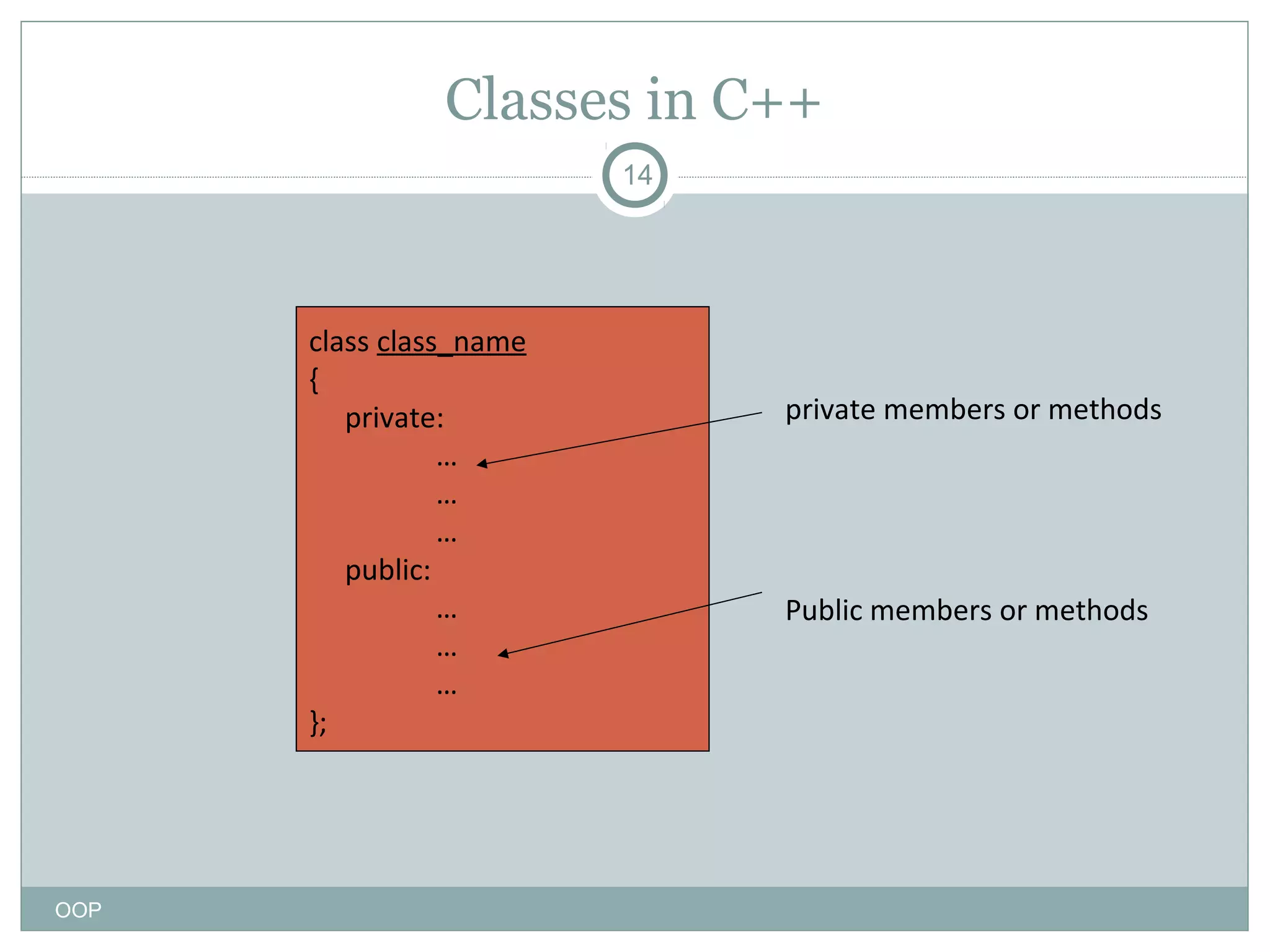
class class_name
{
private:
…
…
…
public:
…
…
…
};

OOP

private members or methods

Public members or methods
Classes in C++
15

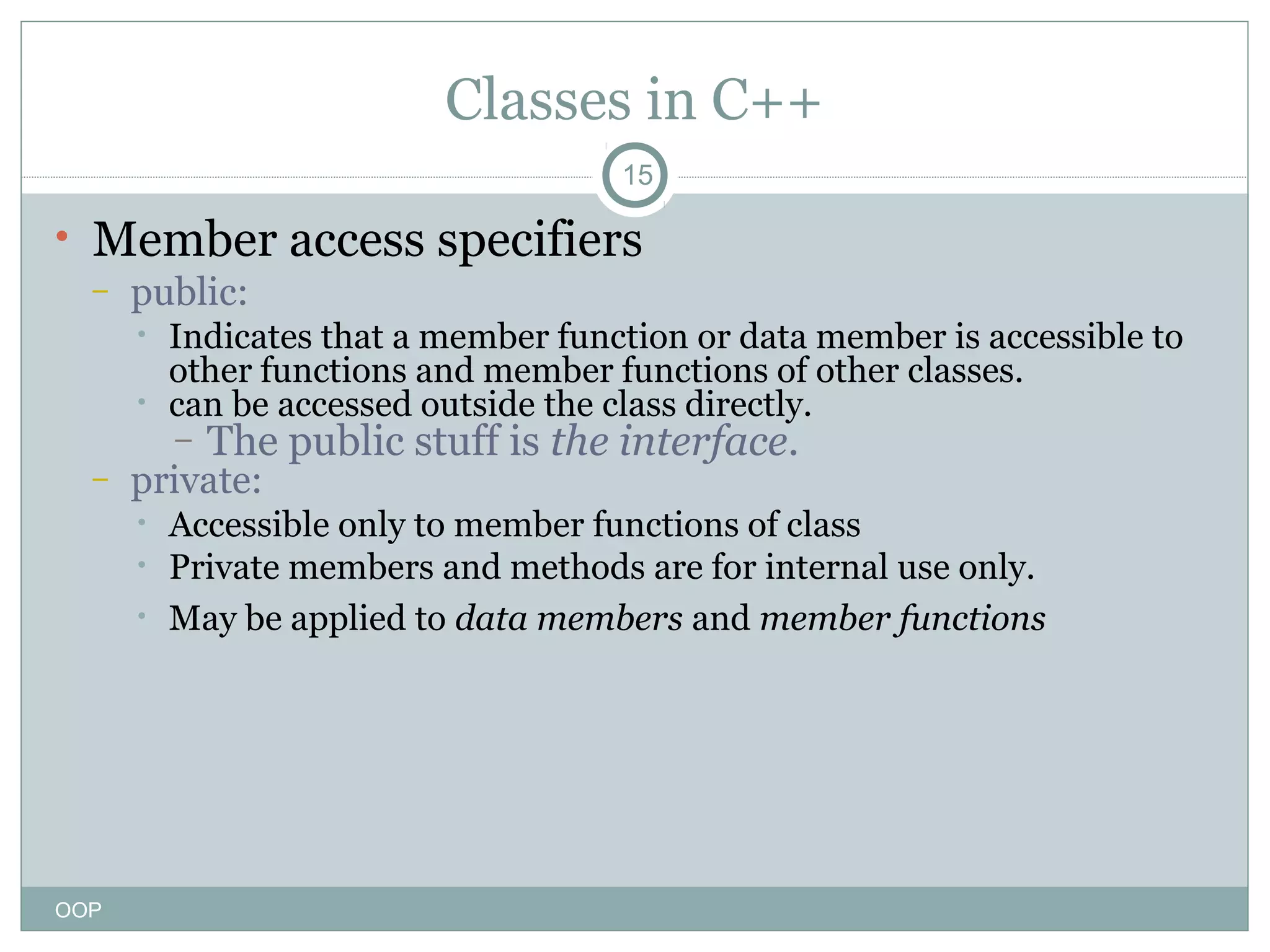
• Member access specifiers
–

public:
•
•

Indicates that a member function or data member is accessible to
other functions and member functions of other classes.
can be accessed outside the class directly.
–

–

private:
•
•
•

OOP

The public stuff is the interface.

Accessible only to member functions of class
Private members and methods are for internal use only.
May be applied to data members and member functions
Class Example
16

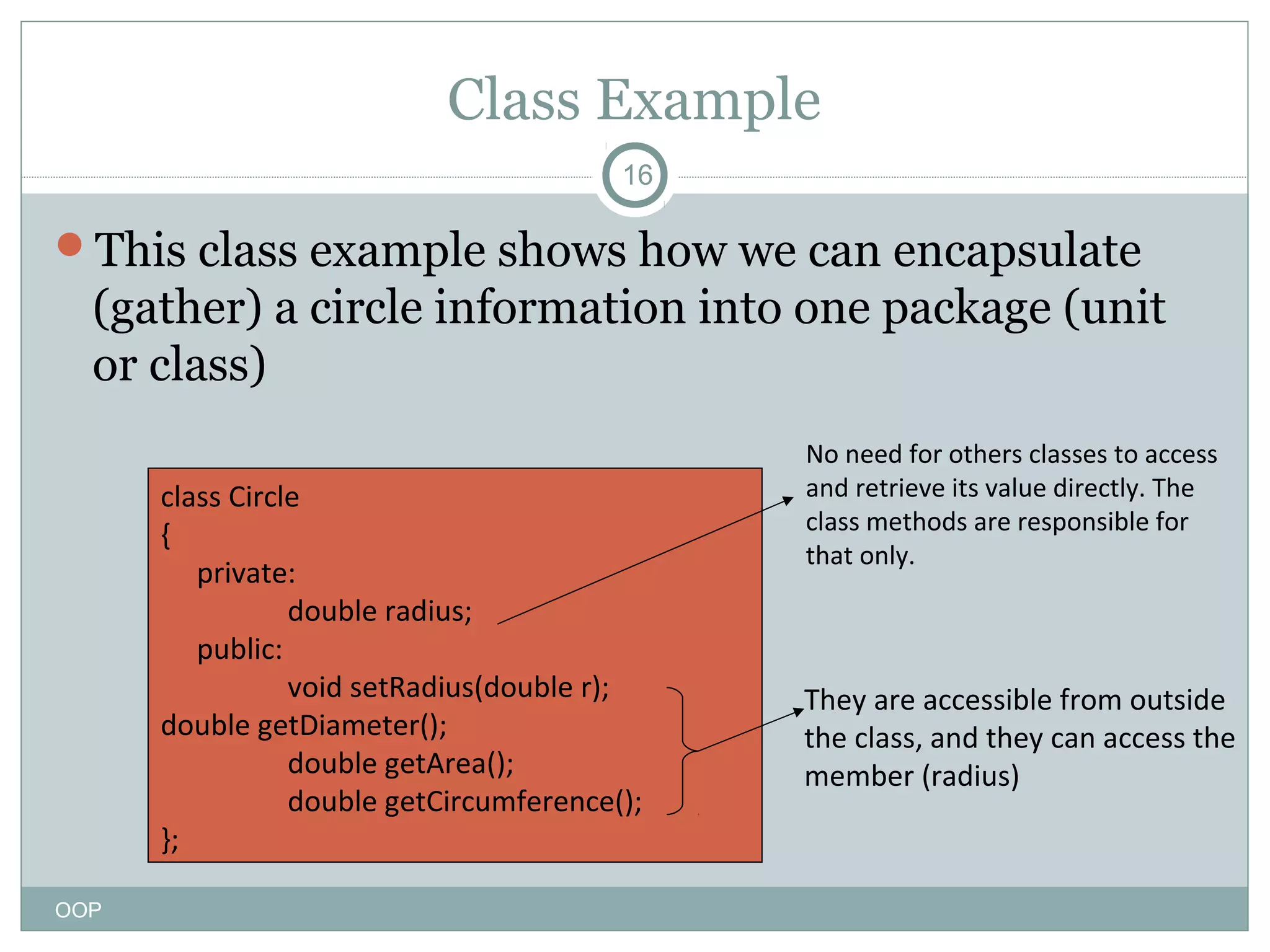
This class example shows how we can encapsulate

(gather) a circle information into one package (unit
or class)
class Circle
{
private:
double radius;
public:
void setRadius(double r);
double getDiameter();
double getArea();
double getCircumference();
};
OOP

No need for others classes to access
and retrieve its value directly. The
class methods are responsible for
that only.

They are accessible from outside
the class, and they can access the
member (radius)
Accessing Data Members
17

Data members are available within each method (as

if they were local variables).
Public data members can be accessed by other

functions using the member access operator "." (just
like struct).

OOP
Accessing class methods
18

Within other class methods, a method can be called

just like a function.
Outside the class, public methods can be called only

when referencing an object of the class.

OOP
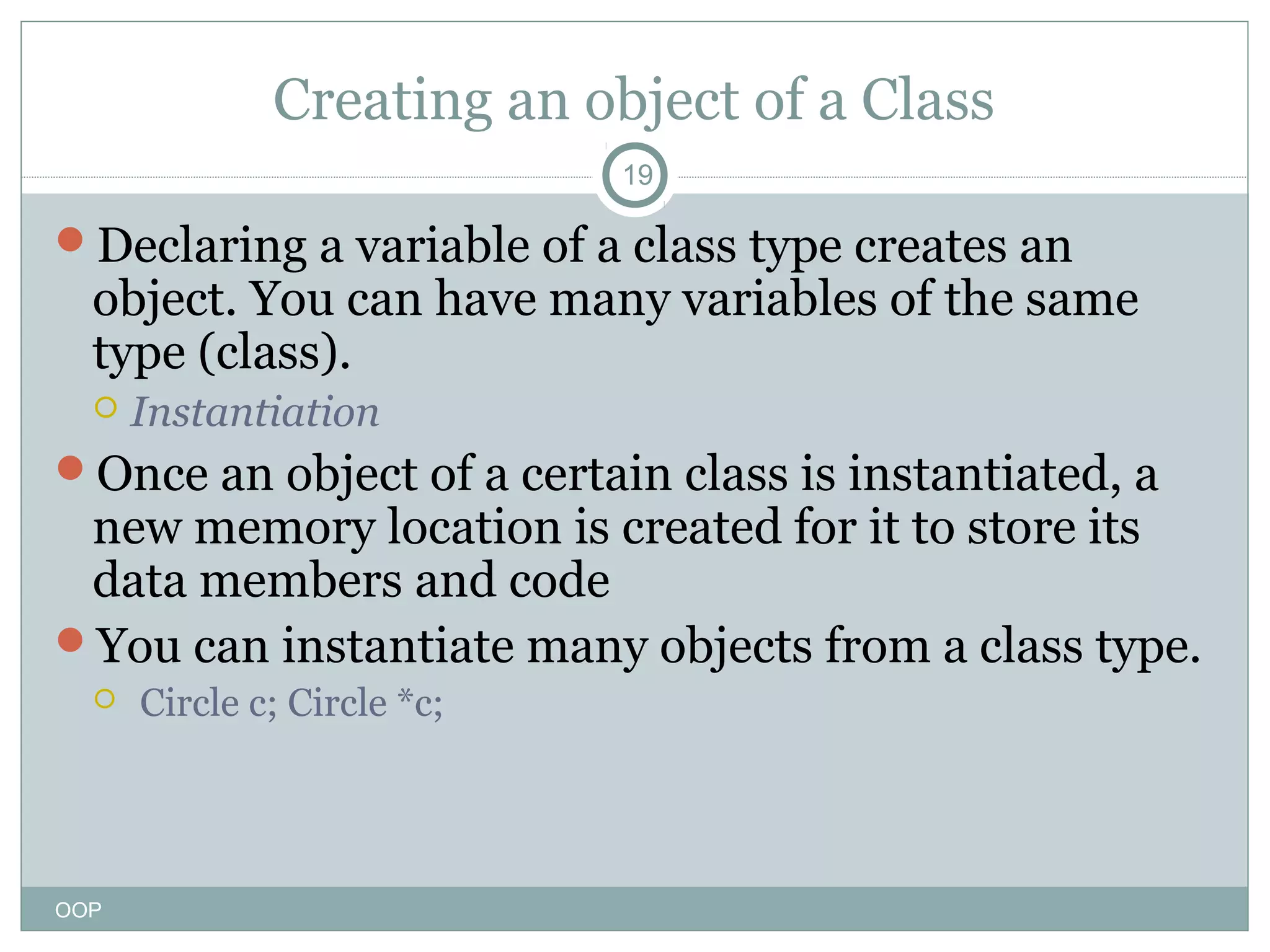
Creating an object of a Class
19

Declaring a variable of a class type creates an

object. You can have many variables of the same
type (class).


Instantiation

Once an object of a certain class is instantiated, a

new memory location is created for it to store its
data members and code
You can instantiate many objects from a class type.


OOP

Circle c; Circle *c;
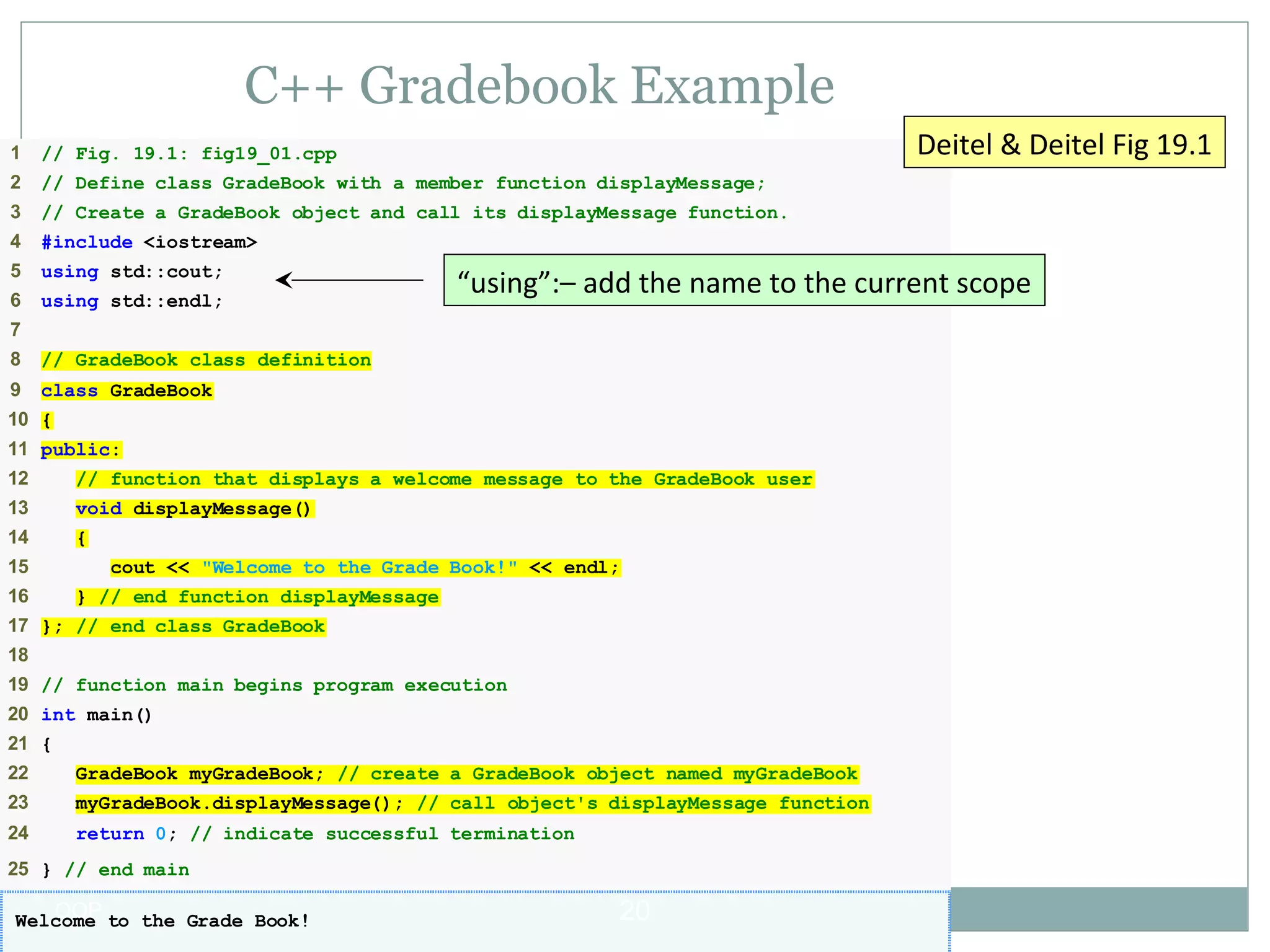
C++ Gradebook Example
Deitel & Deitel Fig 19.1

1

// Fig. 19.1: fig19_01.cpp

2

// Define class GradeBook with a member function displayMessage;

3

// Create a GradeBook object and call its displayMessage function.

4

#include <iostream>

5

using std::cout;

6

using std::endl;

“using”:– add the name to the current scope

7
8

// GradeBook class definition

9

class GradeBook

10 {
11 public:
12

// function that displays a welcome message to the GradeBook user

13

void displayMessage()

14

{

15
16

cout << "Welcome to the Grade Book!" << endl;
} // end function displayMessage

17 }; // end class GradeBook
18
19 // function main begins program execution
20 int main()
21 {
22

GradeBook myGradeBook; // create a GradeBook object named myGradeBook

23

myGradeBook.displayMessage(); // call object's displayMessage function

24

return 0; // indicate successful termination

25 } // end main

OOP
Welcome to the Grade Book!

20
C++ Gradebook Example
1

// Fig. 19.1: fig19_01.cpp

2

// Define class GradeBook with a member function displayMessage;

3

// Create a GradeBook object and call its displayMessage function.

4

#include <iostream>

5

using std::cout;

6

using std::endl;

7
8

// GradeBook class definition

9

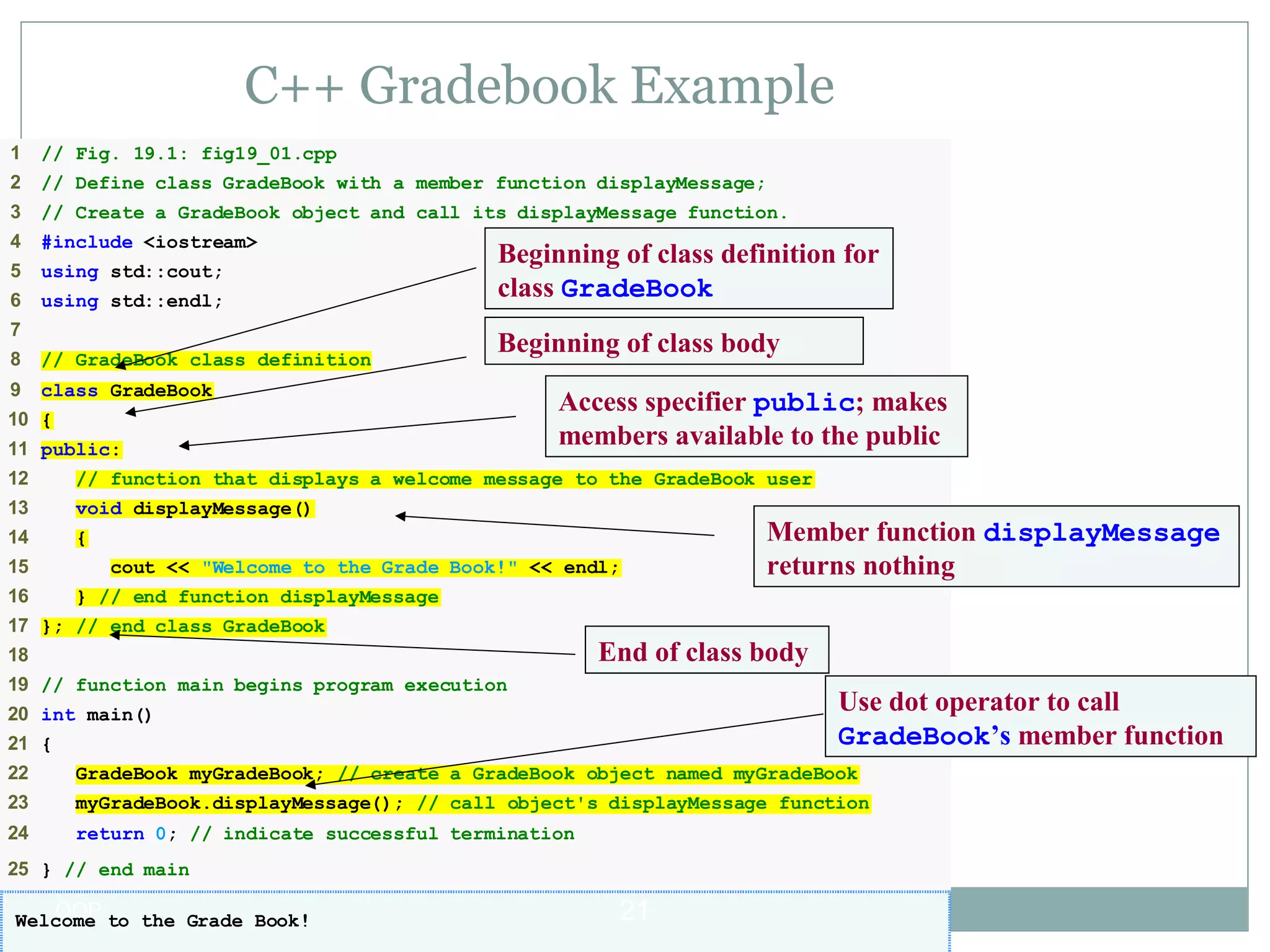
Beginning of class definition for
class GradeBook
Beginning of class body

class GradeBook

10 {
11 public:

Access specifier public; makes
members available to the public

12

// function that displays a welcome message to the GradeBook user

13

void displayMessage()

14

{

15
16

cout << "Welcome to the Grade Book!" << endl;

Member function displayMessage
returns nothing

} // end function displayMessage

17 }; // end class GradeBook
18

End of class body

19 // function main begins program execution

Use dot operator to call
GradeBook’s member function

20 int main()
21 {
22

GradeBook myGradeBook; // create a GradeBook object named myGradeBook

23

myGradeBook.displayMessage(); // call object's displayMessage function

24

return 0; // indicate successful termination

25 } // end main

OOP
Welcome to the Grade Book!

21
C++ Gradebook Example
1

// Fig. 19.1: fig19_01.cpp

2

// Define class GradeBook with a member function displayMessage;

3

// Create a GradeBook object and call its displayMessage function.

4

#include <iostream>

5

using std::cout;

6

using std::endl;

7
8

// GradeBook class definition

9

class GradeBook

10 {
11 public:
12

// function that displays a welcome message to the GradeBook user

13

void displayMessage()

14

{

15
16

ss
s cla in
hi
t of t of ma
c
obje riable
an
ring atic va
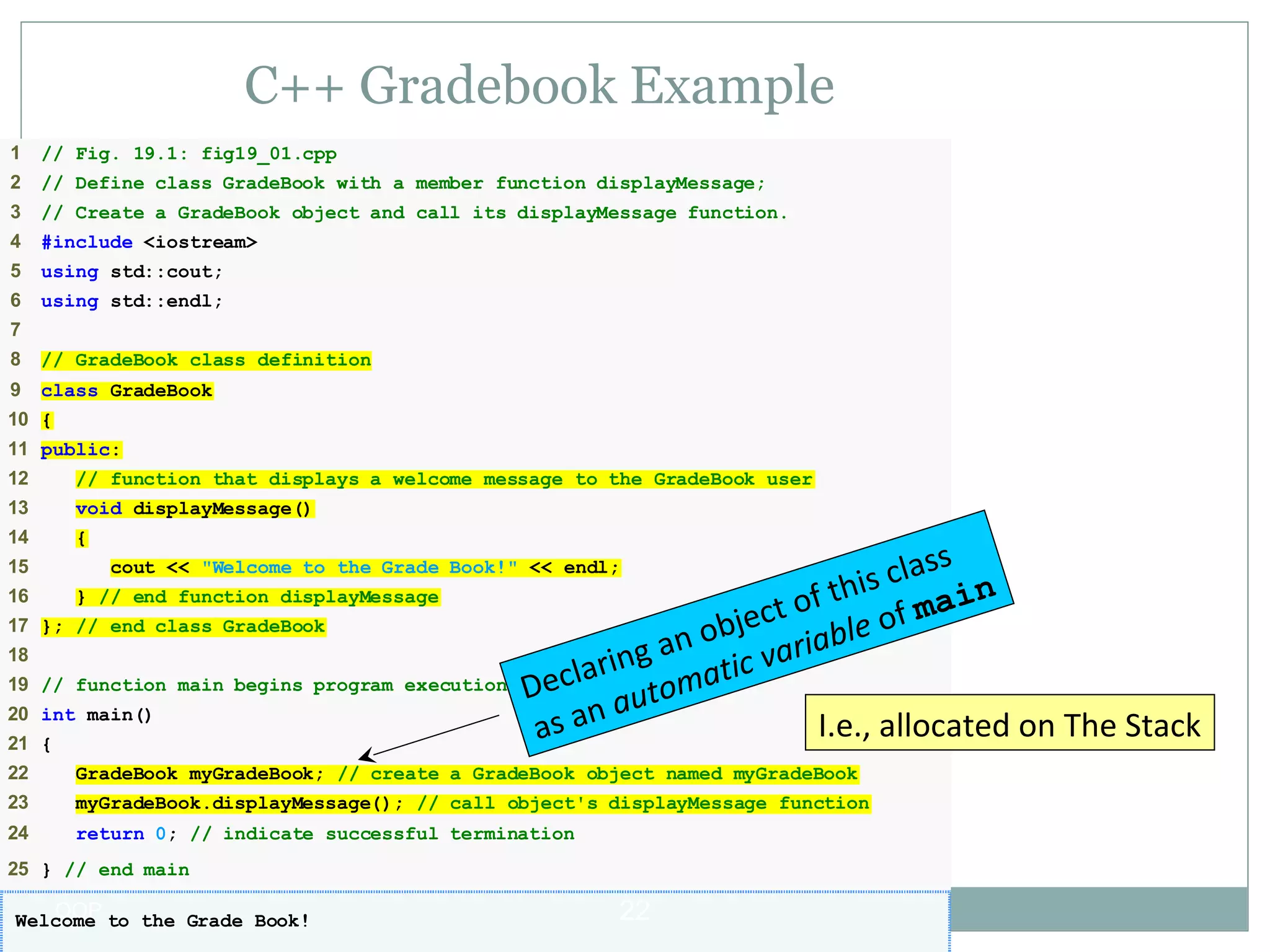
a
Decl autom
I.e., allocated on The Stack
as an

cout << "Welcome to the Grade Book!" << endl;
} // end function displayMessage

17 }; // end class GradeBook
18
19 // function main begins program execution
20 int main()
21 {
22

GradeBook myGradeBook; // create a GradeBook object named myGradeBook

23

myGradeBook.displayMessage(); // call object's displayMessage function

24

return 0; // indicate successful termination

25 } // end main

OOP
Welcome to the Grade Book!

22
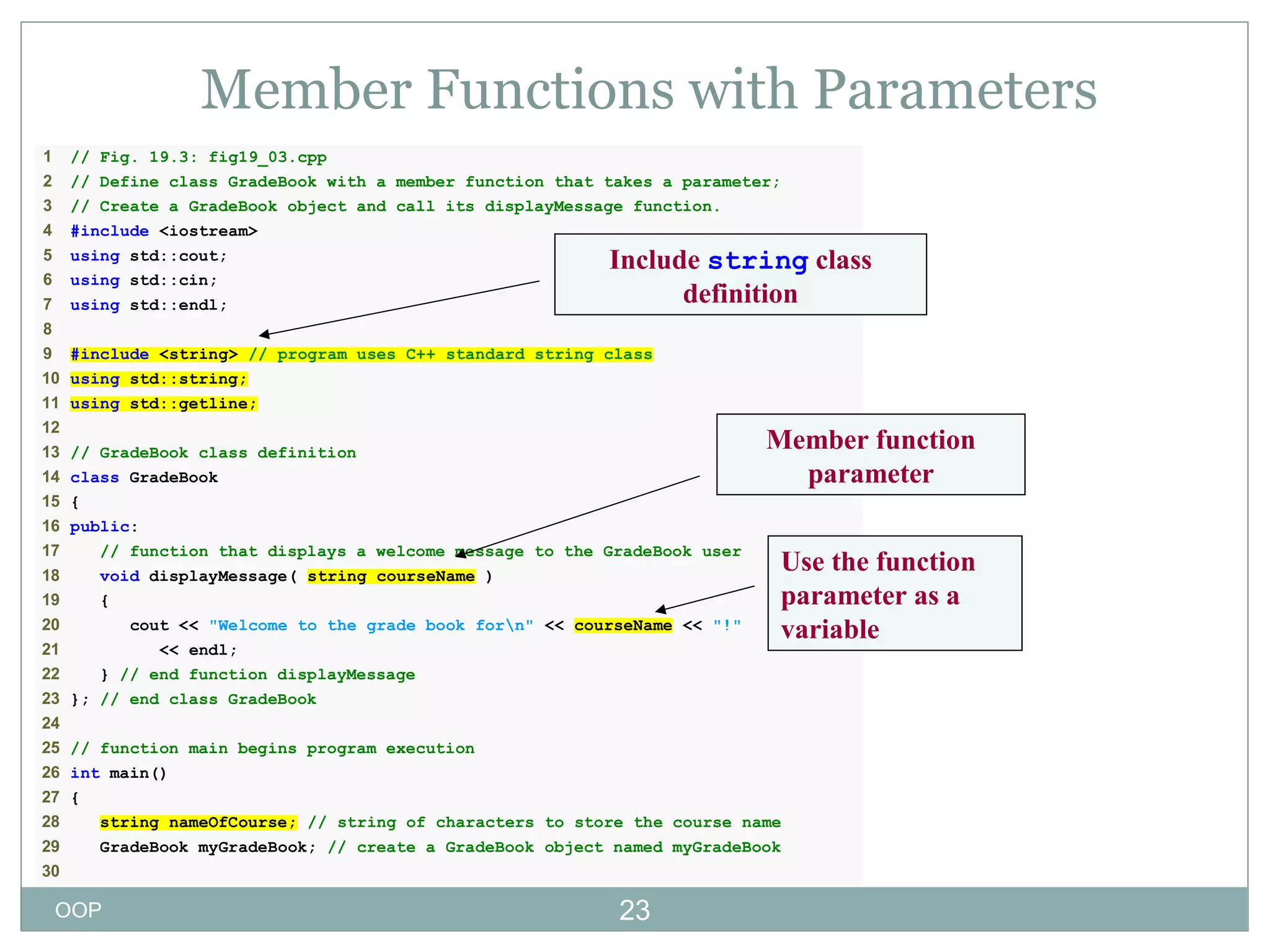
Member Functions with Parameters
1

// Fig. 19.3: fig19_03.cpp

2
3

// Define class GradeBook with a member function that takes a parameter;
// Create a GradeBook object and call its displayMessage function.

4

#include <iostream>

5
6

using std::cout;
using std::cin;

7

using std::endl;

8
9

#include <string> // program uses C++ standard string class

Include string class
definition

10 using std::string;
11 using std::getline;
12

Member function
parameter

13 // GradeBook class definition
14 class GradeBook
15 {
16 public:
17

// function that displays a welcome message to the GradeBook user

18
19

void displayMessage( string courseName )
{

20
21
22

cout << "Welcome to the grade book forn" << courseName << "!"
<< endl;
} // end function displayMessage

Use the function
parameter as a
variable

23 }; // end class GradeBook
24
25 // function main begins program execution
26 int main()
27 {
28

string nameOfCourse; // string of characters to store the course name

29

GradeBook myGradeBook; // create a GradeBook object named myGradeBook

30

OOP

23
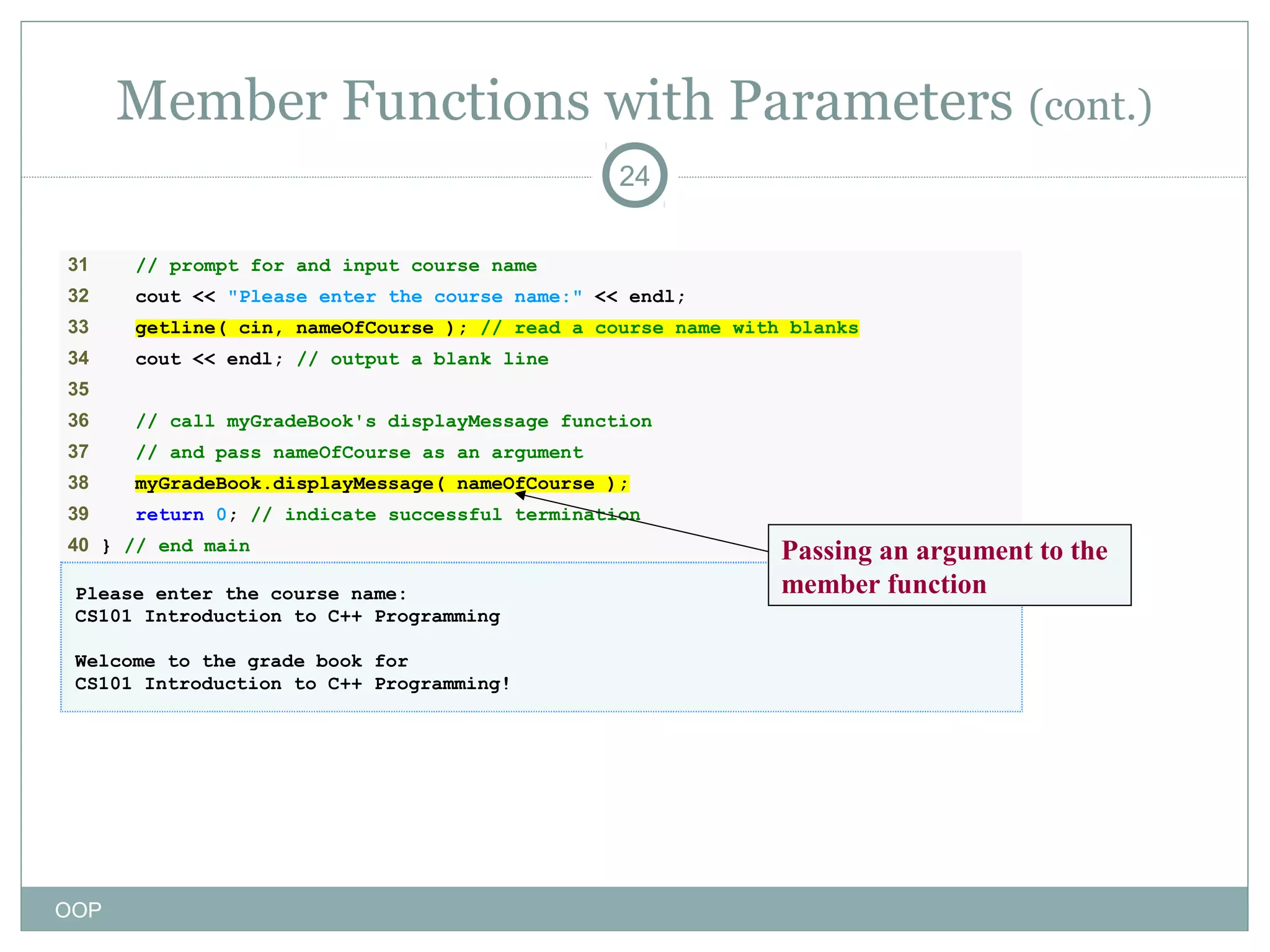
Member Functions with Parameters (cont.)
24
31

// prompt for and input course name

32

cout << "Please enter the course name:" << endl;

33

getline( cin, nameOfCourse ); // read a course name with blanks

34

cout << endl; // output a blank line

35
36

// call myGradeBook's displayMessage function

37

// and pass nameOfCourse as an argument

38

myGradeBook.displayMessage( nameOfCourse );

39

return 0; // indicate successful termination

40 } // end main
Please enter the course name:
CS101 Introduction to C++ Programming
Welcome to the grade book for
CS101 Introduction to C++ Programming!

OOP

Passing an argument to the
member function
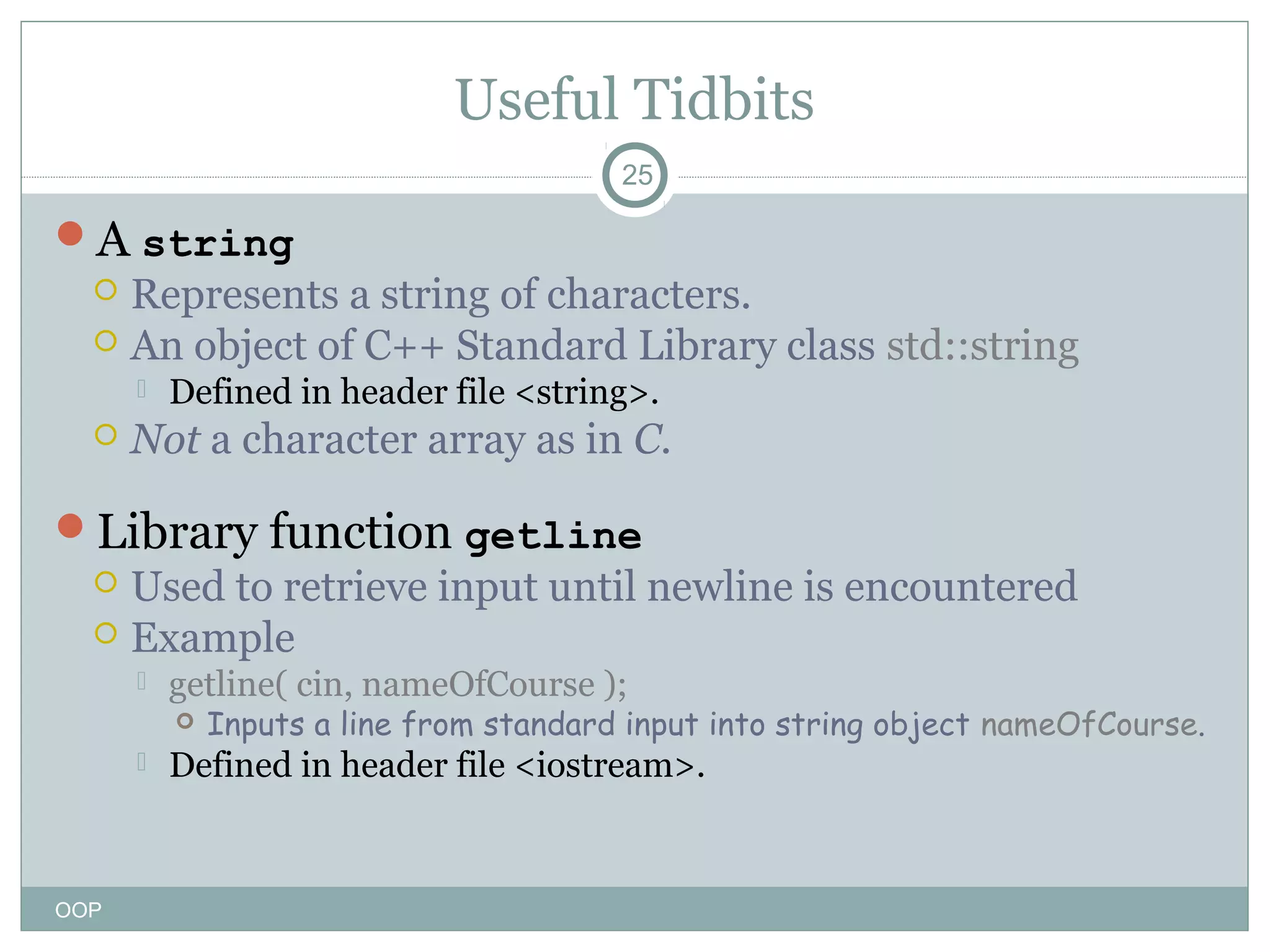
Useful Tidbits
25

A string
 Represents a string of characters.
 An object of C++ Standard Library class std::string




Defined in header file <string>.

Not a character array as in C.

Library function getline
 Used to retrieve input until newline is encountered
 Example


getline( cin, nameOfCourse );




OOP

Inputs a line from standard input into string object nameOfCourse.

Defined in header file <iostream>.
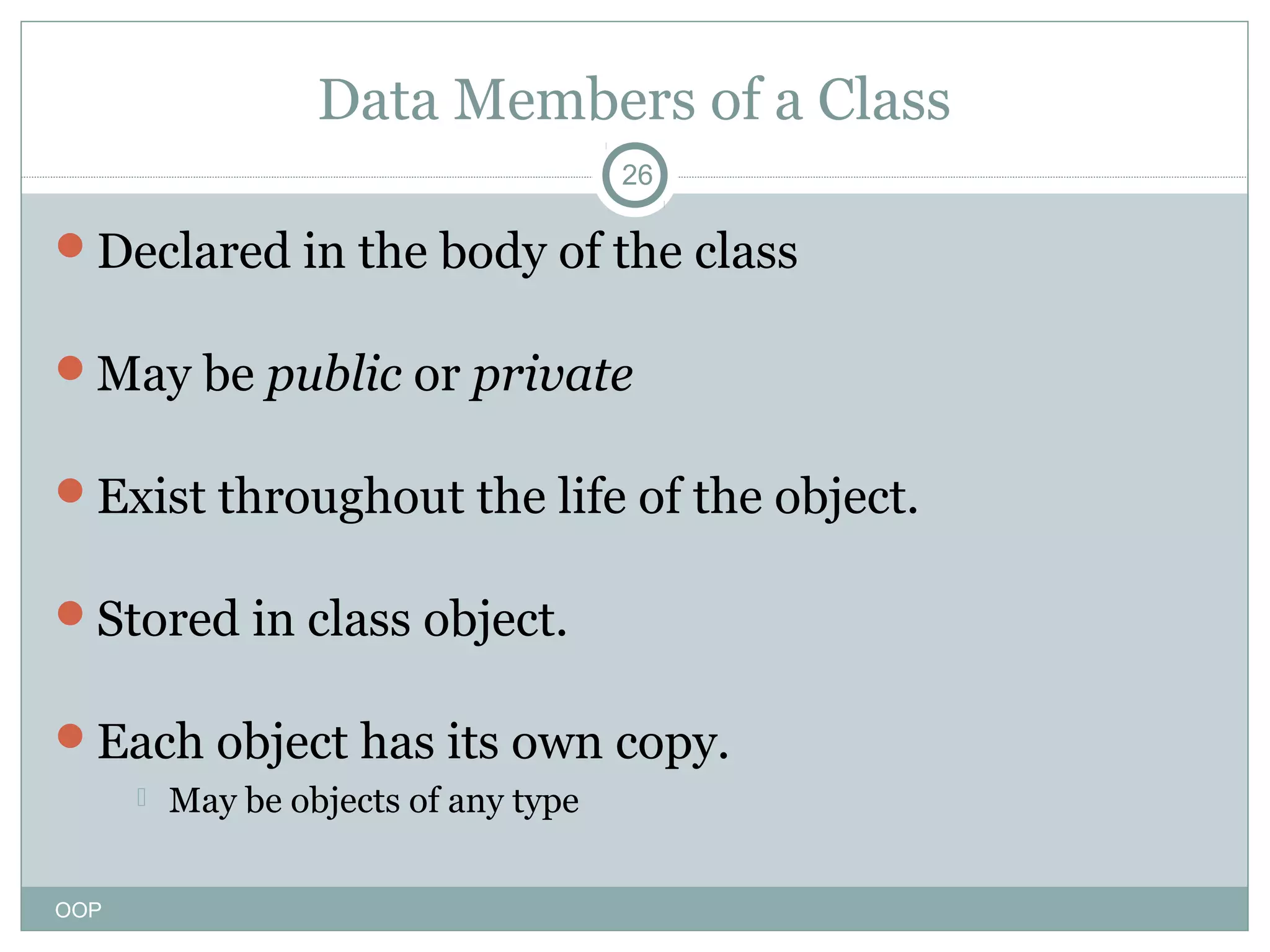
Data Members of a Class
26

Declared in the body of the class
May be public or private
Exist throughout the life of the object.
Stored in class object.
Each object has its own copy.


OOP

May be objects of any type
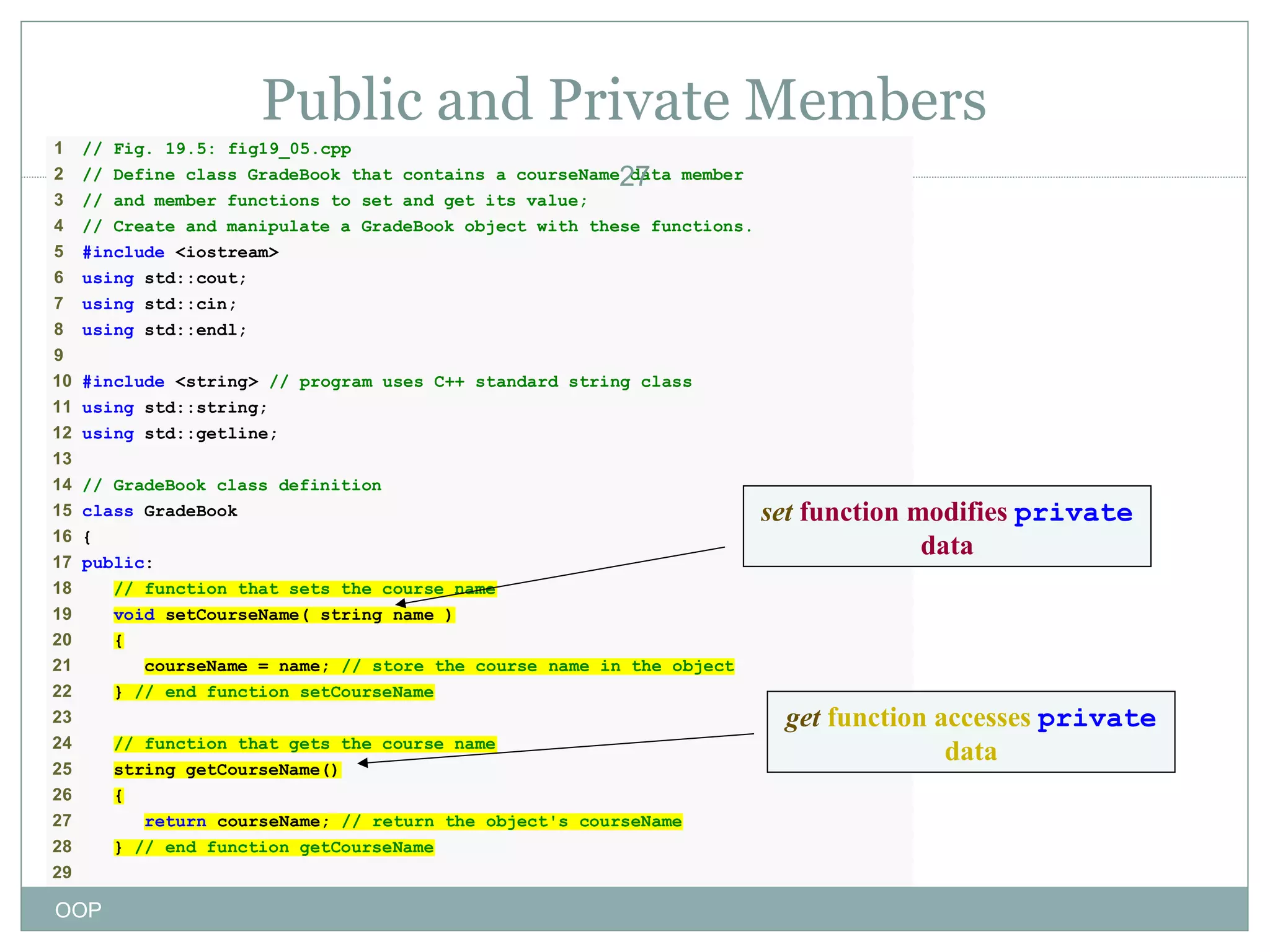
Public and Private Members
1
2

// Fig. 19.5: fig19_05.cpp
// Define class GradeBook that contains a courseName data member

3
4
5

// and member functions to set and get its value;
// Create and manipulate a GradeBook object with these functions.
#include <iostream>

6
7
8
9
10
11
12
13

using std::cout;
using std::cin;
using std::endl;

27

#include <string> // program uses C++ standard string class
using std::string;
using std::getline;

14 // GradeBook class definition
15 class GradeBook
16 {
17 public:
18
// function that sets the course name
19
void setCourseName( string name )
20
{
21
courseName = name; // store the course name in the object
22
} // end function setCourseName
23
24
// function that gets the course name
25
string getCourseName()
26
{
27
return courseName; // return the object's courseName
28
} // end function getCourseName
29

OOP

set function modifies private
data

get function accesses private
data
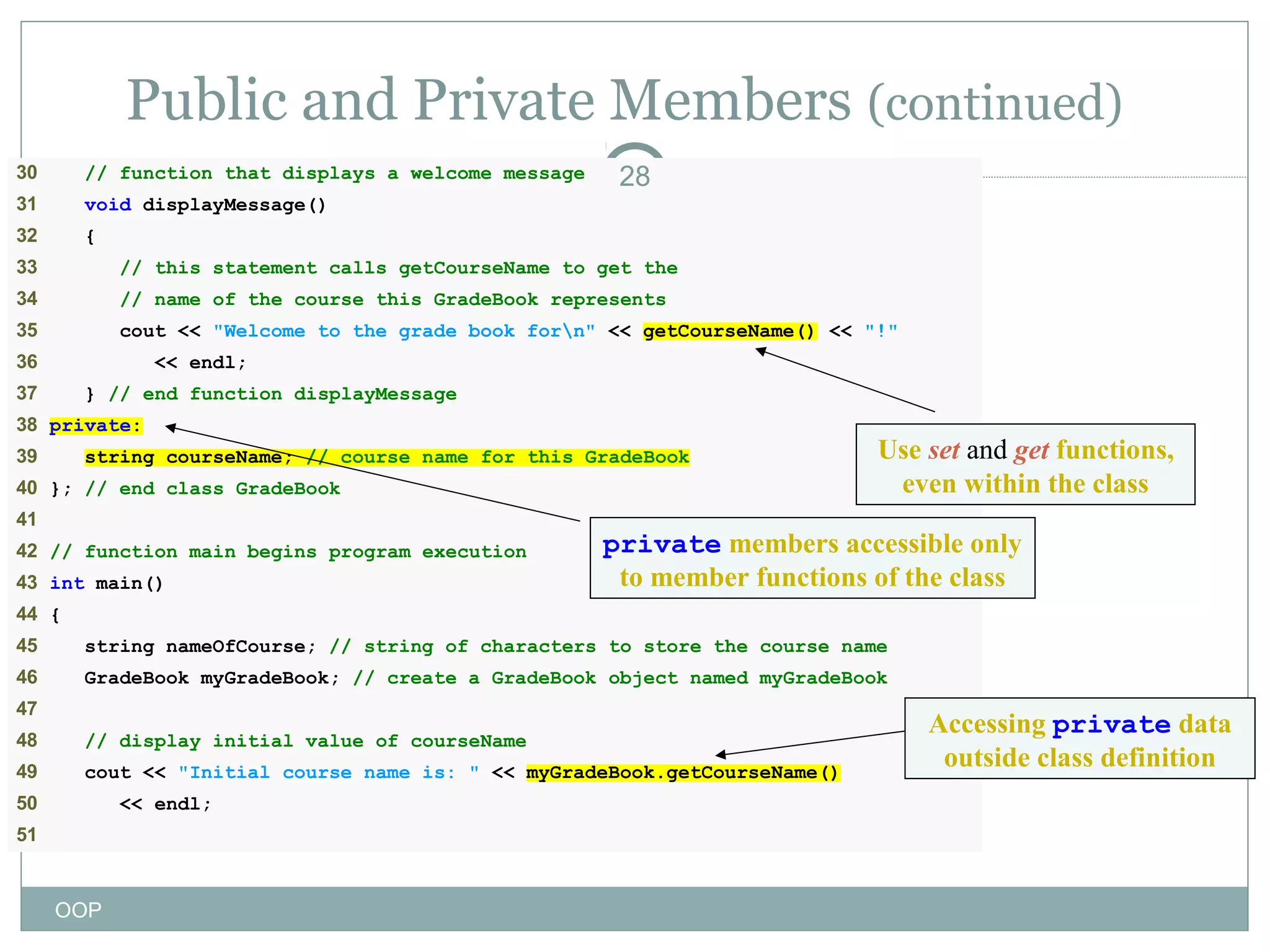
Public and Private Members (continued)
30

// function that displays a welcome message

31
32

28

void displayMessage()
{

33

// this statement calls getCourseName to get the

34

// name of the course this GradeBook represents

35

cout << "Welcome to the grade book forn" << getCourseName() << "!"

36

<< endl;

37

} // end function displayMessage

38 private:
39

string courseName; // course name for this GradeBook

40 }; // end class GradeBook
41
42 // function main begins program execution
43 int main()

Use set and get functions,
even within the class

private members accessible only
to member functions of the class

44 {
45

string nameOfCourse; // string of characters to store the course name

46

GradeBook myGradeBook; // create a GradeBook object named myGradeBook

47
48

// display initial value of courseName

49

cout << "Initial course name is: " << myGradeBook.getCourseName()

50

<< endl;

51

OOP

Accessing private data
outside class definition
Public and Private Members (continued)
29
52

// prompt for, input and set course name

53

cout << "nPlease enter the course name:" << endl;

54

getline( cin, nameOfCourse ); // read a course name with blanks

55

myGradeBook.setCourseName( nameOfCourse ); // set the course name

56
57

cout << endl; // outputs a blank line

58

myGradeBook.displayMessage(); // display message with new course name

59

return 0; // indicate successful termination

60 } // end main
Initial course name is:
Please enter the course name:
CS101 Introduction to C++ Programming
Welcome to the grade book for
CS101 Introduction to C++ Programming!

OOP

Modifying private data outside class
definition
default setting from constructor
is an empty string!!
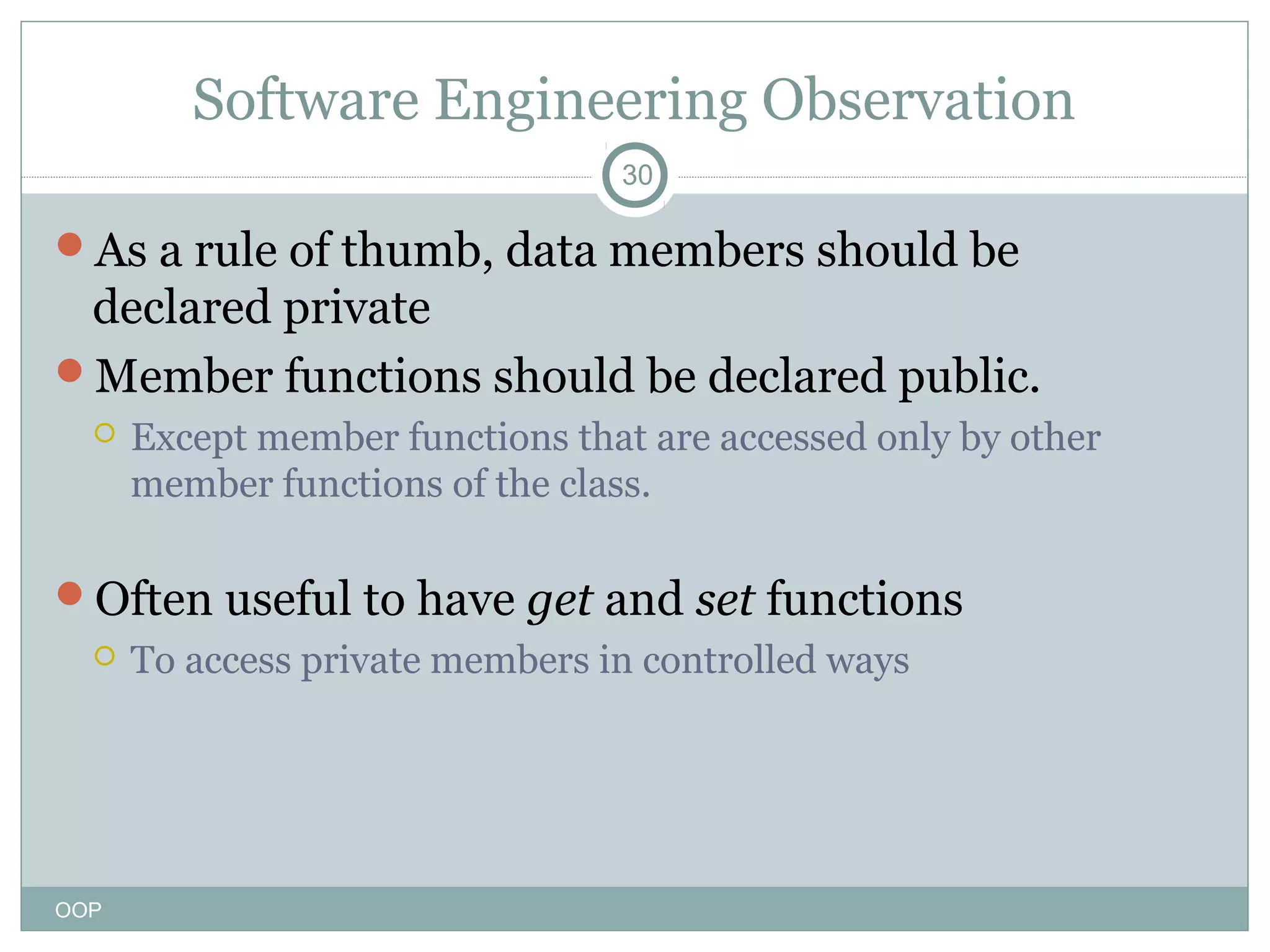
Software Engineering Observation
30

As a rule of thumb, data members should be

declared private
Member functions should be declared public.


Except member functions that are accessed only by other
member functions of the class.

Often useful to have get and set functions


OOP

To access private members in controlled ways
What happens here?
31

class foo {
int i;
// # elements in the array
int a[10];
// array 10 at most
// sum the elements
which i is it ?
int sum(void) {
int i, x=0;
for (i=0;i<i;i++)
x+=a[i];
return(x);
}
...
OOP
Class Scope Operator ::
32

You can solve the previous problem using the "::"

operator classname::membername.
for (i=0;i<foo::i;i++)
x+=a[i];

OOP
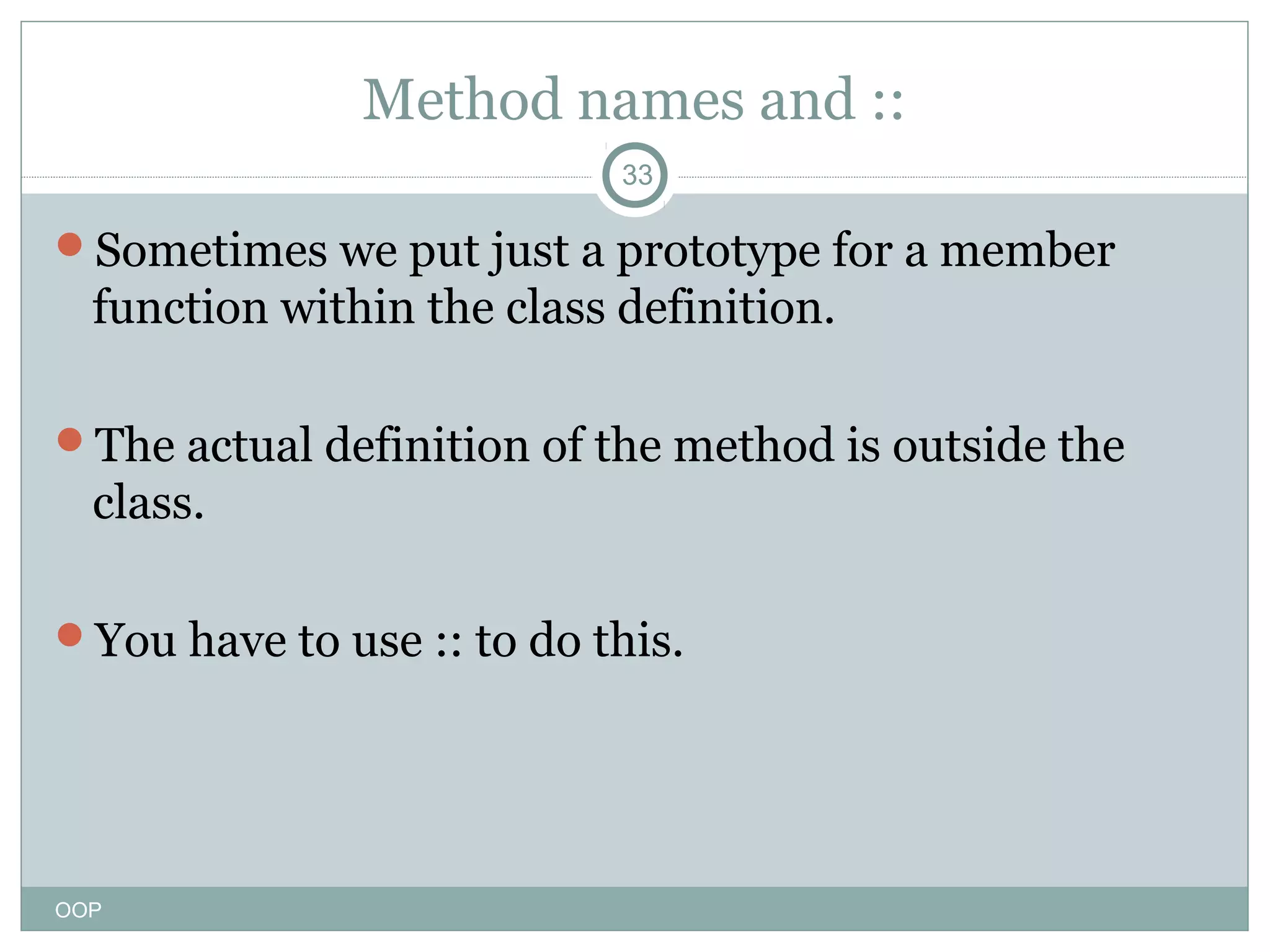
Method names and ::
33

Sometimes we put just a prototype for a member

function within the class definition.
The actual definition of the method is outside the

class.
You have to use :: to do this.

OOP
Example
class foo {
...
int sum(void);
};

34

int foo::sum(void) {
int sum=0;
for (int i=0;i<foo::i;i++) {
sum += a[i];
}
return(sum);
}
OOP
Implementing class methods
35

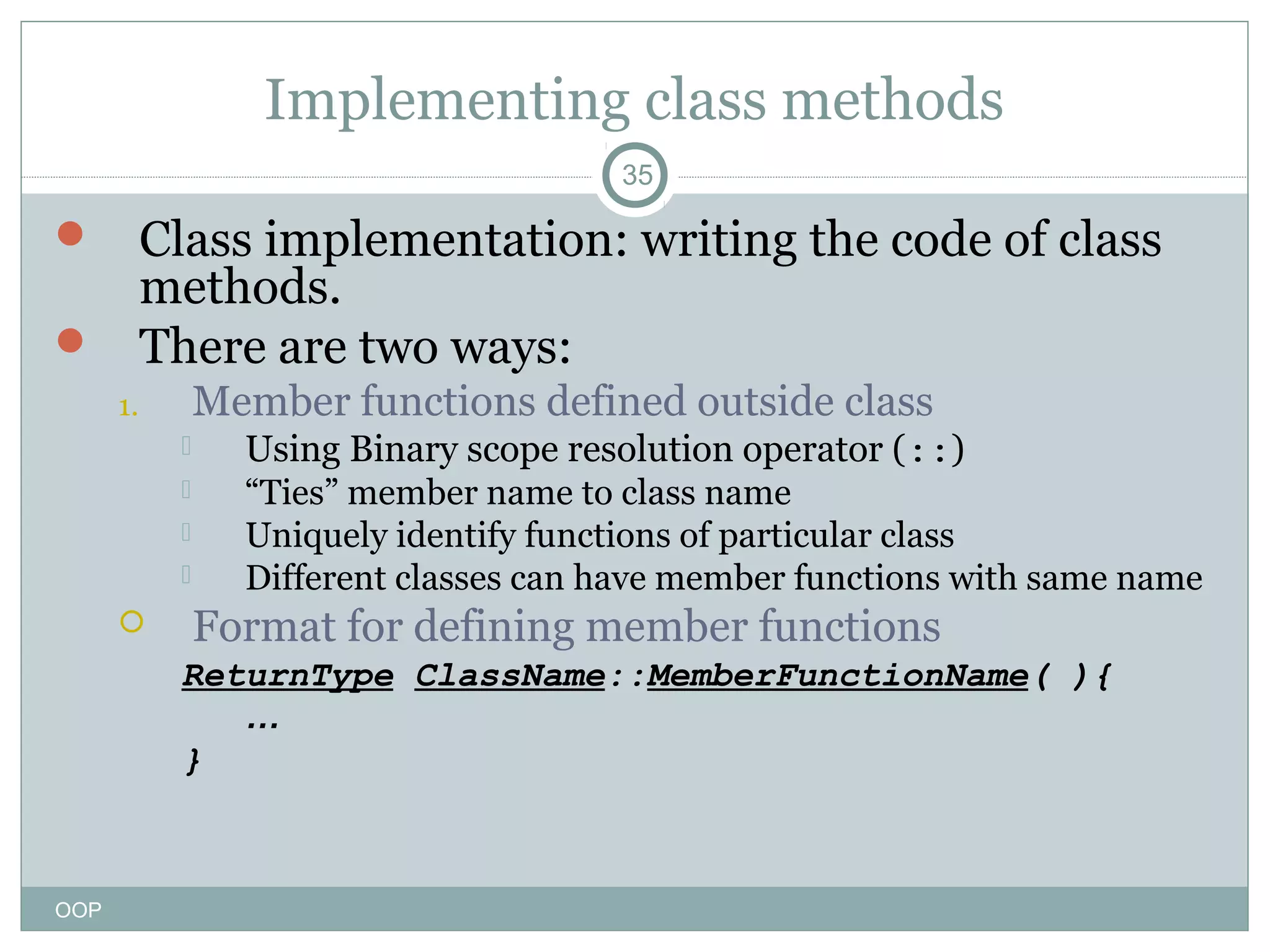
Class implementation: writing the code of class
methods.
 There are two ways:


Member functions defined outside class

1.







Using Binary scope resolution operator (::)
“Ties” member name to class name
Uniquely identify functions of particular class
Different classes can have member functions with same name

Format for defining member functions
ReturnType ClassName::MemberFunctionName( ){
…
}

OOP
Implementing class methods
36

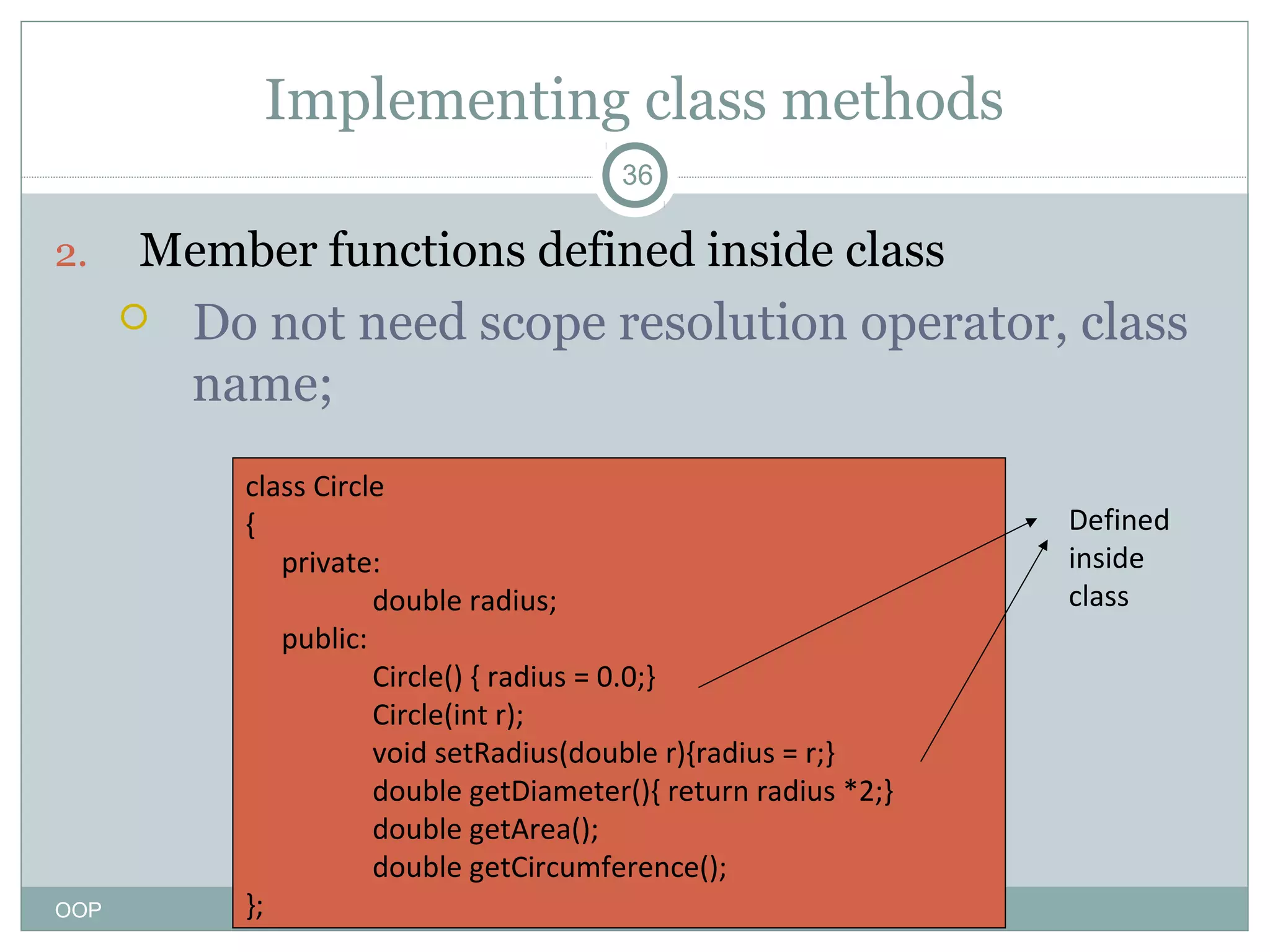
2.

Member functions defined inside class


OOP

Do not need scope resolution operator, class
name;
class Circle
{
private:
double radius;
public:
Circle() { radius = 0.0;}
Circle(int r);
void setRadius(double r){radius = r;}
double getDiameter(){ return radius *2;}
double getArea();
double getCircumference();
};

Defined
inside
class
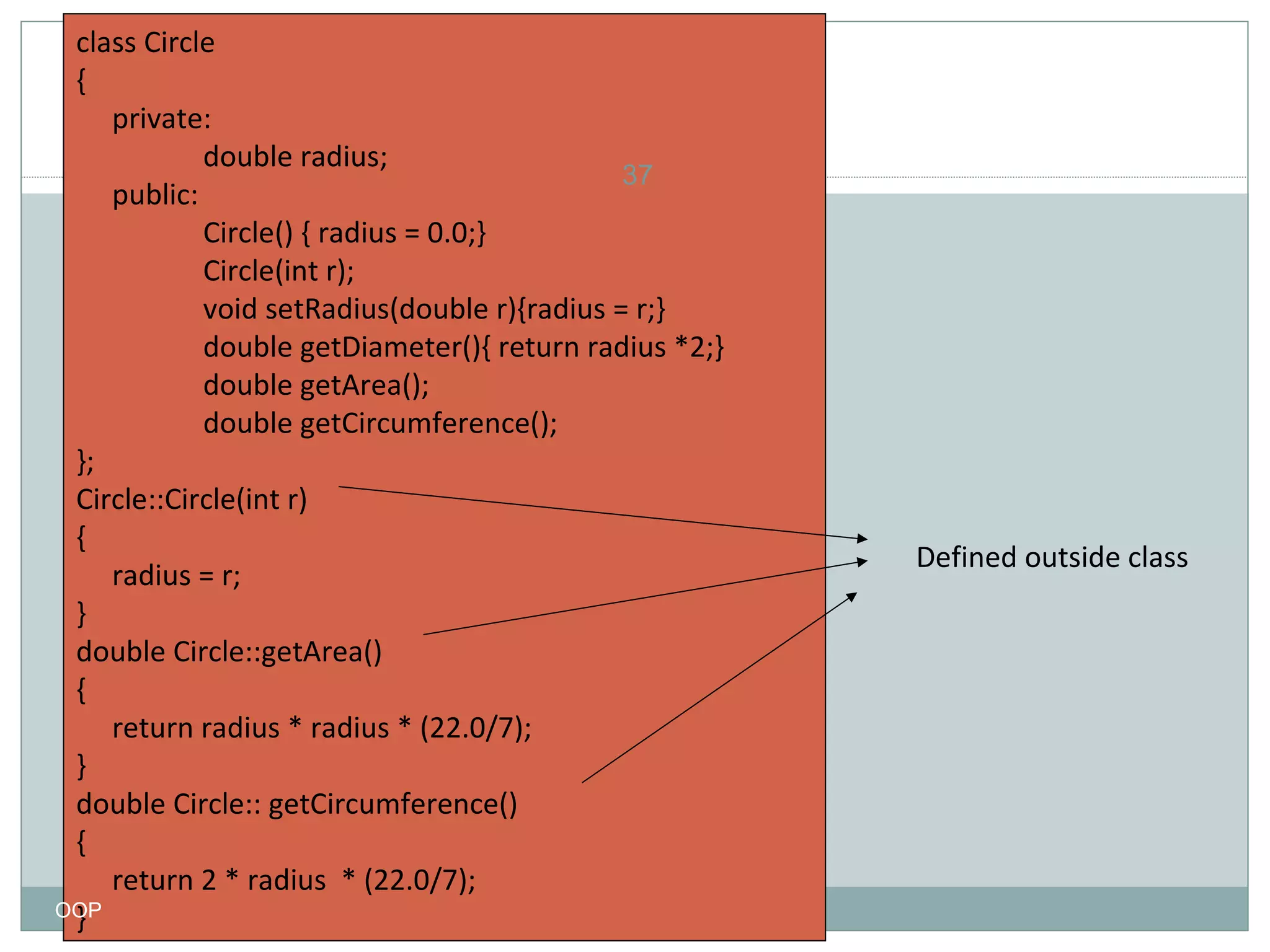
class Circle
{
private:
double radius;
37
public:
Circle() { radius = 0.0;}
Circle(int r);
void setRadius(double r){radius = r;}
double getDiameter(){ return radius *2;}
double getArea();
double getCircumference();
};
Circle::Circle(int r)
{
radius = r;
}
double Circle::getArea()
{
return radius * radius * (22.0/7);
}
double Circle:: getCircumference()
{
return 2 * radius * (22.0/7);
OOP
}

Defined outside class
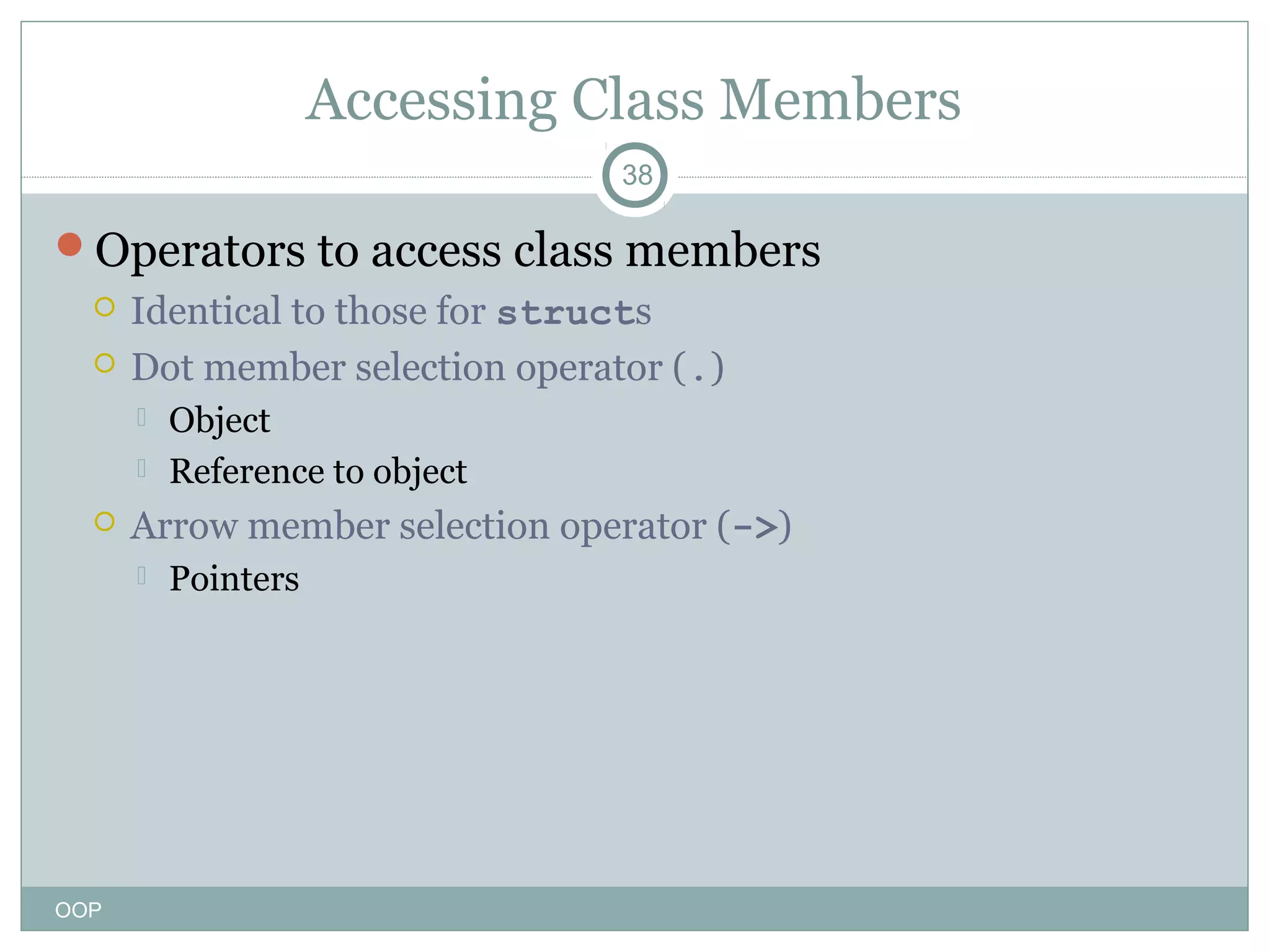
Accessing Class Members
38

Operators to access class members



Identical to those for structs
Dot member selection operator (.)





Arrow member selection operator (->)


OOP

Object
Reference to object
Pointers
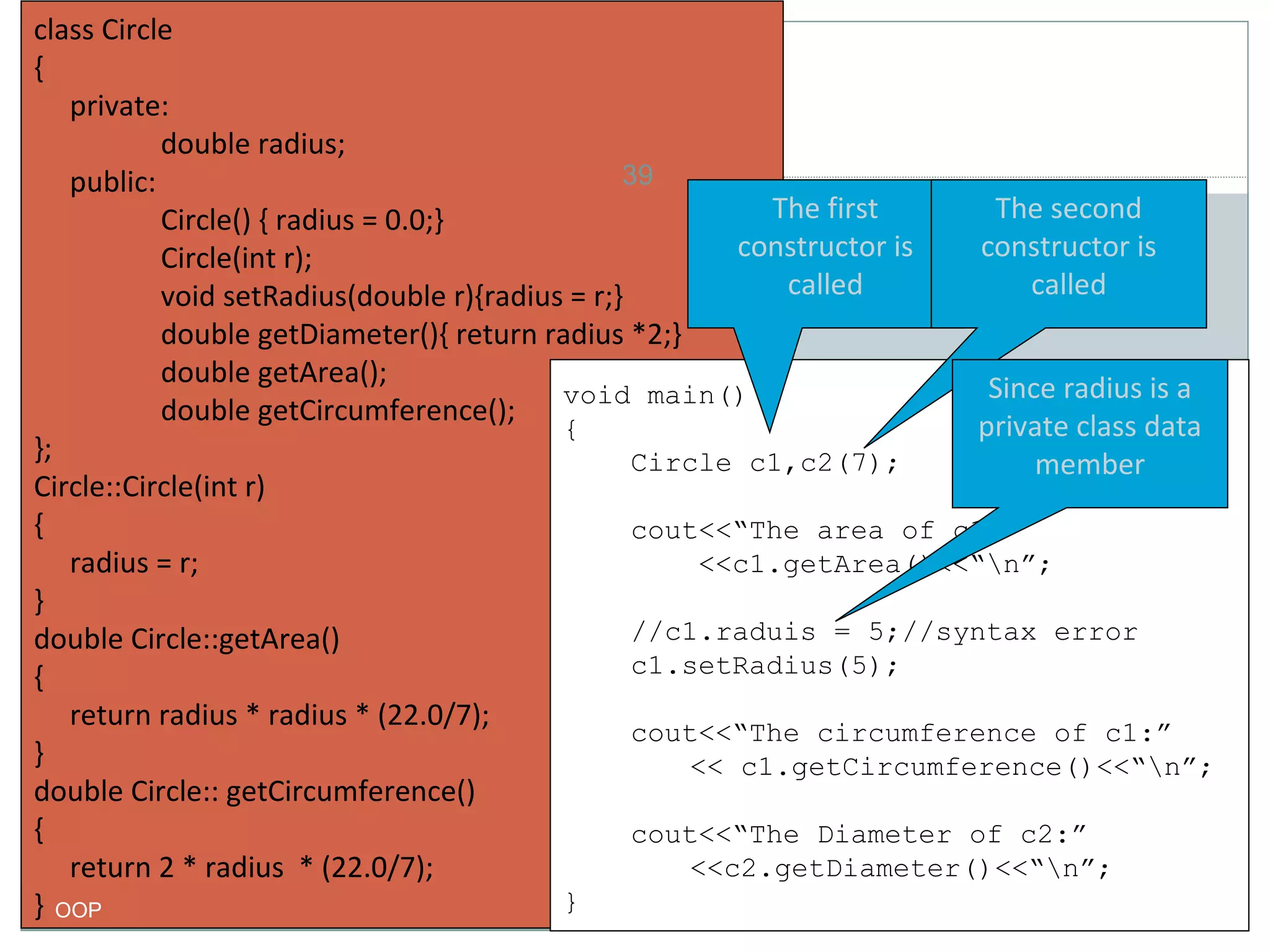
class Circle
{
private:
double radius;
39
public:
The first
The second
Circle() { radius = 0.0;}
constructor is
constructor is
Circle(int r);
called
called
void setRadius(double r){radius = r;}
double getDiameter(){ return radius *2;}
double getArea();
Since radius is a
void main()
double getCircumference();
private class data
{
};
Circle c1,c2(7);
member
Circle::Circle(int r)
{
cout<<“The area of c1:”
<<c1.getArea()<<“n”;
radius = r;
}
//c1.raduis = 5;//syntax error
double Circle::getArea()
c1.setRadius(5);
{
return radius * radius * (22.0/7);
cout<<“The circumference of c1:”
}
<< c1.getCircumference()<<“n”;
double Circle:: getCircumference()
{
cout<<“The Diameter of c2:”
<<c2.getDiameter()<<“n”;
return 2 * radius * (22.0/7);
}
} OOP
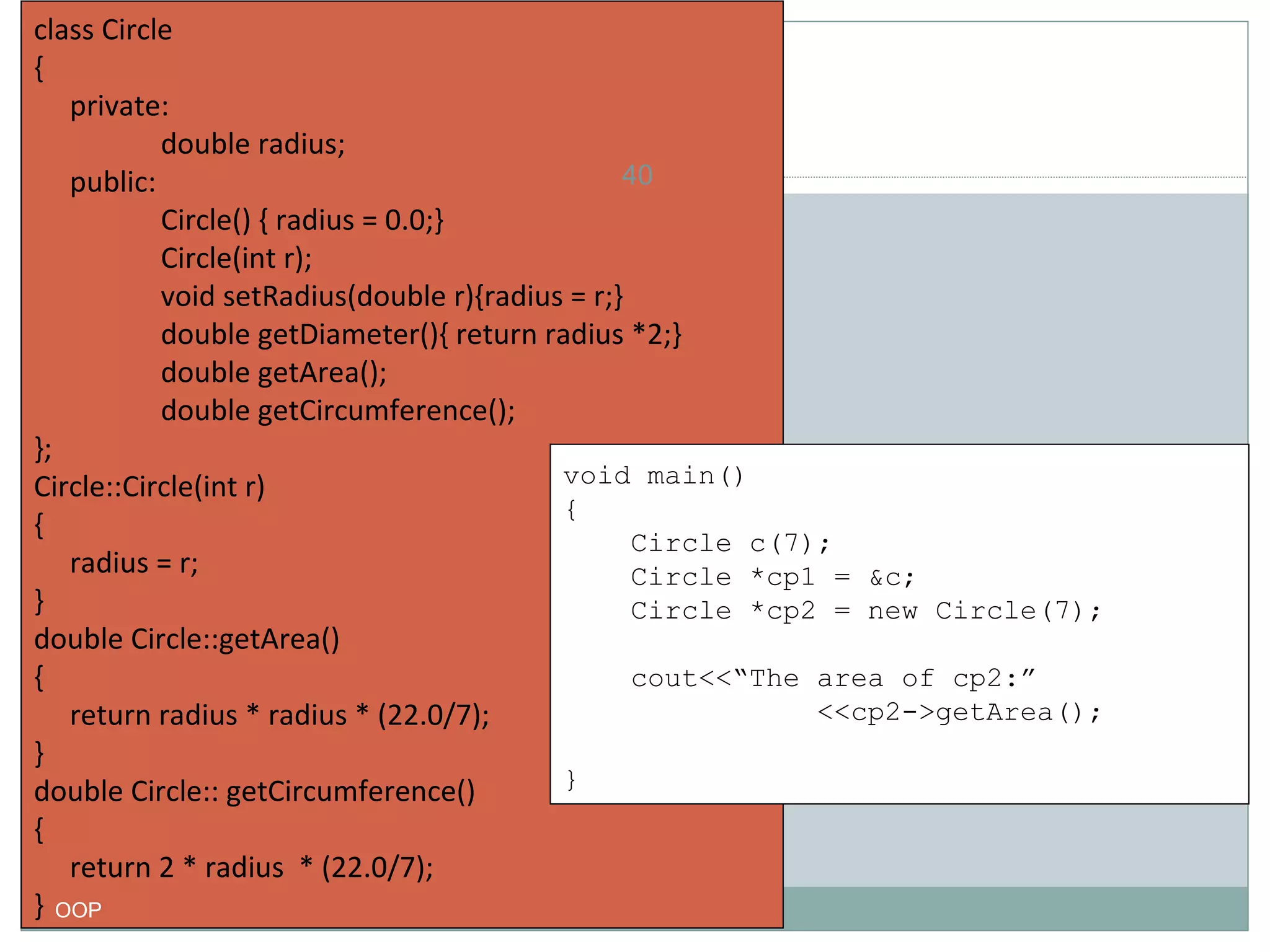
class Circle
{
private:
double radius;
40
public:
Circle() { radius = 0.0;}
Circle(int r);
void setRadius(double r){radius = r;}
double getDiameter(){ return radius *2;}
double getArea();
double getCircumference();
};
void main()
Circle::Circle(int r)
{
{
Circle c(7);
radius = r;
Circle *cp1 = &c;
}
Circle *cp2 = new Circle(7);
double Circle::getArea()
cout<<“The area of cp2:”
{
<<cp2->getArea();
return radius * radius * (22.0/7);
}
}
double Circle:: getCircumference()
{
return 2 * radius * (22.0/7);
} OOP

Oop lec 4(oop design, style, characteristics)

  • 1.
  • 2.
    Object Oriented Programming 2 Programmerthinks about and defines the attributes and behavior of objects. Often the objects are modeled after real-world entities. Very different approach than function-based programming (like C). OOP
  • 3.
    Reasons for OOP 3 Abstraction Encapsulation Informationhiding Inheritance Polymorphism Software Engineering Issues OOP
  • 4.
    Object Oriented Programming 4 Object-orientedprogramming (OOP)  Encapsulates data (attributes) and functions (behavior) into packages called classes. So, Classes are user-defined (programmer-defined) types.   Data (data members) Functions (member functions or methods) In other words, they are structures + functions OOP
  • 5.
    Class: Object Types 5 AC++ class is an object type. When you create the definition of a class you are defining the attributes and behavior of a new type. Attributes are data members. Behavior is defined by methods. OOP
  • 6.
    Information Hiding 6 The interfaceto a class is the list of public data members and methods. The interface defines the behavior of the class to the outside world (to other classes and functions that may access variables of your class type). The implementation of your class doesn't matter outside the class – only the interface. OOP
  • 7.
    Information Hiding (cont.) 7 Youcan change the implementation and nobody cares! (as long as the interface is the same). You can use other peoples classes without fear! OOP
  • 8.
    Inheritence 8 It is possibleto extend existing classes without seeing them. Add whatever new behavior you want. Example:   You have a class that represents a "student". Create a new class that is a "good student".  OOP Most of the behavior and attributes are the same, but a few are different – specialized.
  • 9.
    Polymorphism 9 The ability ofdifferent objects to respond to the same message in different ways. Tell an int to print itself: Now tell a double: Now tell the Poly: OOP cout << i; cout << x; cout << poly;
  • 10.
    Private vs. Public 10 Publicdata members and methods can be accessed outside the class directly. The public stuff is the interface. Private members and methods are for internal use only. OOP
  • 11.
    C++ Program Structure •Typical C++ Programs consist of:– – A function main – One or more classes • OOP Each containing data members and member functions. 11
  • 12.
    Classes in C++ 12 Tellsthe compiler what member functions and data members belong to the class.  A class definition begins with the keyword class followed by class name.  The body of the class is contained within a set of braces, { } ; (notice the semi-colon). • class class_name { …. …. …. }; OOP Any valid identifier Class body (data member + methods) methods
  • 13.
    Classes in C++ 13 Withinthe body, the keywords private: and public: specify the access level of the members of the class.  the default is private. Usually, the data members of a class are declared in the private: section of the class and the member functions are in public: section. OOP
  • 14.
    Classes in C++ 14 classclass_name { private: … … … public: … … … }; OOP private members or methods Public members or methods
  • 15.
    Classes in C++ 15 •Member access specifiers – public: • • Indicates that a member function or data member is accessible to other functions and member functions of other classes. can be accessed outside the class directly. – – private: • • • OOP The public stuff is the interface. Accessible only to member functions of class Private members and methods are for internal use only. May be applied to data members and member functions
  • 16.
    Class Example 16 This classexample shows how we can encapsulate (gather) a circle information into one package (unit or class) class Circle { private: double radius; public: void setRadius(double r); double getDiameter(); double getArea(); double getCircumference(); }; OOP No need for others classes to access and retrieve its value directly. The class methods are responsible for that only. They are accessible from outside the class, and they can access the member (radius)
  • 17.
    Accessing Data Members 17 Datamembers are available within each method (as if they were local variables). Public data members can be accessed by other functions using the member access operator "." (just like struct). OOP
  • 18.
    Accessing class methods 18 Withinother class methods, a method can be called just like a function. Outside the class, public methods can be called only when referencing an object of the class. OOP
  • 19.
    Creating an objectof a Class 19 Declaring a variable of a class type creates an object. You can have many variables of the same type (class).  Instantiation Once an object of a certain class is instantiated, a new memory location is created for it to store its data members and code You can instantiate many objects from a class type.  OOP Circle c; Circle *c;
  • 20.
    C++ Gradebook Example Deitel& Deitel Fig 19.1 1 // Fig. 19.1: fig19_01.cpp 2 // Define class GradeBook with a member function displayMessage; 3 // Create a GradeBook object and call its displayMessage function. 4 #include <iostream> 5 using std::cout; 6 using std::endl; “using”:– add the name to the current scope 7 8 // GradeBook class definition 9 class GradeBook 10 { 11 public: 12 // function that displays a welcome message to the GradeBook user 13 void displayMessage() 14 { 15 16 cout << "Welcome to the Grade Book!" << endl; } // end function displayMessage 17 }; // end class GradeBook 18 19 // function main begins program execution 20 int main() 21 { 22 GradeBook myGradeBook; // create a GradeBook object named myGradeBook 23 myGradeBook.displayMessage(); // call object's displayMessage function 24 return 0; // indicate successful termination 25 } // end main OOP Welcome to the Grade Book! 20
  • 21.
    C++ Gradebook Example 1 //Fig. 19.1: fig19_01.cpp 2 // Define class GradeBook with a member function displayMessage; 3 // Create a GradeBook object and call its displayMessage function. 4 #include <iostream> 5 using std::cout; 6 using std::endl; 7 8 // GradeBook class definition 9 Beginning of class definition for class GradeBook Beginning of class body class GradeBook 10 { 11 public: Access specifier public; makes members available to the public 12 // function that displays a welcome message to the GradeBook user 13 void displayMessage() 14 { 15 16 cout << "Welcome to the Grade Book!" << endl; Member function displayMessage returns nothing } // end function displayMessage 17 }; // end class GradeBook 18 End of class body 19 // function main begins program execution Use dot operator to call GradeBook’s member function 20 int main() 21 { 22 GradeBook myGradeBook; // create a GradeBook object named myGradeBook 23 myGradeBook.displayMessage(); // call object's displayMessage function 24 return 0; // indicate successful termination 25 } // end main OOP Welcome to the Grade Book! 21
  • 22.
    C++ Gradebook Example 1 //Fig. 19.1: fig19_01.cpp 2 // Define class GradeBook with a member function displayMessage; 3 // Create a GradeBook object and call its displayMessage function. 4 #include <iostream> 5 using std::cout; 6 using std::endl; 7 8 // GradeBook class definition 9 class GradeBook 10 { 11 public: 12 // function that displays a welcome message to the GradeBook user 13 void displayMessage() 14 { 15 16 ss s cla in hi t of t of ma c obje riable an ring atic va a Decl autom I.e., allocated on The Stack as an cout << "Welcome to the Grade Book!" << endl; } // end function displayMessage 17 }; // end class GradeBook 18 19 // function main begins program execution 20 int main() 21 { 22 GradeBook myGradeBook; // create a GradeBook object named myGradeBook 23 myGradeBook.displayMessage(); // call object's displayMessage function 24 return 0; // indicate successful termination 25 } // end main OOP Welcome to the Grade Book! 22
  • 23.
    Member Functions withParameters 1 // Fig. 19.3: fig19_03.cpp 2 3 // Define class GradeBook with a member function that takes a parameter; // Create a GradeBook object and call its displayMessage function. 4 #include <iostream> 5 6 using std::cout; using std::cin; 7 using std::endl; 8 9 #include <string> // program uses C++ standard string class Include string class definition 10 using std::string; 11 using std::getline; 12 Member function parameter 13 // GradeBook class definition 14 class GradeBook 15 { 16 public: 17 // function that displays a welcome message to the GradeBook user 18 19 void displayMessage( string courseName ) { 20 21 22 cout << "Welcome to the grade book forn" << courseName << "!" << endl; } // end function displayMessage Use the function parameter as a variable 23 }; // end class GradeBook 24 25 // function main begins program execution 26 int main() 27 { 28 string nameOfCourse; // string of characters to store the course name 29 GradeBook myGradeBook; // create a GradeBook object named myGradeBook 30 OOP 23
  • 24.
    Member Functions withParameters (cont.) 24 31 // prompt for and input course name 32 cout << "Please enter the course name:" << endl; 33 getline( cin, nameOfCourse ); // read a course name with blanks 34 cout << endl; // output a blank line 35 36 // call myGradeBook's displayMessage function 37 // and pass nameOfCourse as an argument 38 myGradeBook.displayMessage( nameOfCourse ); 39 return 0; // indicate successful termination 40 } // end main Please enter the course name: CS101 Introduction to C++ Programming Welcome to the grade book for CS101 Introduction to C++ Programming! OOP Passing an argument to the member function
  • 25.
    Useful Tidbits 25 A string Represents a string of characters.  An object of C++ Standard Library class std::string   Defined in header file <string>. Not a character array as in C. Library function getline  Used to retrieve input until newline is encountered  Example  getline( cin, nameOfCourse );   OOP Inputs a line from standard input into string object nameOfCourse. Defined in header file <iostream>.
  • 26.
    Data Members ofa Class 26 Declared in the body of the class May be public or private Exist throughout the life of the object. Stored in class object. Each object has its own copy.  OOP May be objects of any type
  • 27.
    Public and PrivateMembers 1 2 // Fig. 19.5: fig19_05.cpp // Define class GradeBook that contains a courseName data member 3 4 5 // and member functions to set and get its value; // Create and manipulate a GradeBook object with these functions. #include <iostream> 6 7 8 9 10 11 12 13 using std::cout; using std::cin; using std::endl; 27 #include <string> // program uses C++ standard string class using std::string; using std::getline; 14 // GradeBook class definition 15 class GradeBook 16 { 17 public: 18 // function that sets the course name 19 void setCourseName( string name ) 20 { 21 courseName = name; // store the course name in the object 22 } // end function setCourseName 23 24 // function that gets the course name 25 string getCourseName() 26 { 27 return courseName; // return the object's courseName 28 } // end function getCourseName 29 OOP set function modifies private data get function accesses private data
  • 28.
    Public and PrivateMembers (continued) 30 // function that displays a welcome message 31 32 28 void displayMessage() { 33 // this statement calls getCourseName to get the 34 // name of the course this GradeBook represents 35 cout << "Welcome to the grade book forn" << getCourseName() << "!" 36 << endl; 37 } // end function displayMessage 38 private: 39 string courseName; // course name for this GradeBook 40 }; // end class GradeBook 41 42 // function main begins program execution 43 int main() Use set and get functions, even within the class private members accessible only to member functions of the class 44 { 45 string nameOfCourse; // string of characters to store the course name 46 GradeBook myGradeBook; // create a GradeBook object named myGradeBook 47 48 // display initial value of courseName 49 cout << "Initial course name is: " << myGradeBook.getCourseName() 50 << endl; 51 OOP Accessing private data outside class definition
  • 29.
    Public and PrivateMembers (continued) 29 52 // prompt for, input and set course name 53 cout << "nPlease enter the course name:" << endl; 54 getline( cin, nameOfCourse ); // read a course name with blanks 55 myGradeBook.setCourseName( nameOfCourse ); // set the course name 56 57 cout << endl; // outputs a blank line 58 myGradeBook.displayMessage(); // display message with new course name 59 return 0; // indicate successful termination 60 } // end main Initial course name is: Please enter the course name: CS101 Introduction to C++ Programming Welcome to the grade book for CS101 Introduction to C++ Programming! OOP Modifying private data outside class definition default setting from constructor is an empty string!!
  • 30.
    Software Engineering Observation 30 Asa rule of thumb, data members should be declared private Member functions should be declared public.  Except member functions that are accessed only by other member functions of the class. Often useful to have get and set functions  OOP To access private members in controlled ways
  • 31.
    What happens here? 31 classfoo { int i; // # elements in the array int a[10]; // array 10 at most // sum the elements which i is it ? int sum(void) { int i, x=0; for (i=0;i<i;i++) x+=a[i]; return(x); } ... OOP
  • 32.
    Class Scope Operator:: 32 You can solve the previous problem using the "::" operator classname::membername. for (i=0;i<foo::i;i++) x+=a[i]; OOP
  • 33.
    Method names and:: 33 Sometimes we put just a prototype for a member function within the class definition. The actual definition of the method is outside the class. You have to use :: to do this. OOP
  • 34.
    Example class foo { ... intsum(void); }; 34 int foo::sum(void) { int sum=0; for (int i=0;i<foo::i;i++) { sum += a[i]; } return(sum); } OOP
  • 35.
    Implementing class methods 35 Classimplementation: writing the code of class methods.  There are two ways:  Member functions defined outside class 1.      Using Binary scope resolution operator (::) “Ties” member name to class name Uniquely identify functions of particular class Different classes can have member functions with same name Format for defining member functions ReturnType ClassName::MemberFunctionName( ){ … } OOP
  • 36.
    Implementing class methods 36 2. Memberfunctions defined inside class  OOP Do not need scope resolution operator, class name; class Circle { private: double radius; public: Circle() { radius = 0.0;} Circle(int r); void setRadius(double r){radius = r;} double getDiameter(){ return radius *2;} double getArea(); double getCircumference(); }; Defined inside class
  • 37.
    class Circle { private: double radius; 37 public: Circle(){ radius = 0.0;} Circle(int r); void setRadius(double r){radius = r;} double getDiameter(){ return radius *2;} double getArea(); double getCircumference(); }; Circle::Circle(int r) { radius = r; } double Circle::getArea() { return radius * radius * (22.0/7); } double Circle:: getCircumference() { return 2 * radius * (22.0/7); OOP } Defined outside class
  • 38.
    Accessing Class Members 38 Operatorsto access class members   Identical to those for structs Dot member selection operator (.)    Arrow member selection operator (->)  OOP Object Reference to object Pointers
  • 39.
    class Circle { private: double radius; 39 public: Thefirst The second Circle() { radius = 0.0;} constructor is constructor is Circle(int r); called called void setRadius(double r){radius = r;} double getDiameter(){ return radius *2;} double getArea(); Since radius is a void main() double getCircumference(); private class data { }; Circle c1,c2(7); member Circle::Circle(int r) { cout<<“The area of c1:” <<c1.getArea()<<“n”; radius = r; } //c1.raduis = 5;//syntax error double Circle::getArea() c1.setRadius(5); { return radius * radius * (22.0/7); cout<<“The circumference of c1:” } << c1.getCircumference()<<“n”; double Circle:: getCircumference() { cout<<“The Diameter of c2:” <<c2.getDiameter()<<“n”; return 2 * radius * (22.0/7); } } OOP
  • 40.
    class Circle { private: double radius; 40 public: Circle(){ radius = 0.0;} Circle(int r); void setRadius(double r){radius = r;} double getDiameter(){ return radius *2;} double getArea(); double getCircumference(); }; void main() Circle::Circle(int r) { { Circle c(7); radius = r; Circle *cp1 = &c; } Circle *cp2 = new Circle(7); double Circle::getArea() cout<<“The area of cp2:” { <<cp2->getArea(); return radius * radius * (22.0/7); } } double Circle:: getCircumference() { return 2 * radius * (22.0/7); } OOP