1
Classroom
Management
Dr Muhammad Nisar
3
Objectives
 know what is classroom management
 recognize the importance of classroom management
 identify the components of classroom
 devise a framework to effectively manage all the
components in the classroom
 overcome the problems occurring in the classroom
After attending this workshop, the participants will
be able to:
4
Importance of Classroom Management
classroom management is the single most
important factor governing student learning.
Three authors reviewed 50 years of research on
student learning, encompassing 11,000 statistical
findings. They discovered 28 factors that help
students learn and classroom management was
the number one. The way that teachers run their
learning/working environment determines
whether the individual will be successful or not.
5
classroom
 A place where human and material
resources are utilized for learning .
.
6
Management
 Getting things done through others.
 The effective utilization of human and
materials resources to achieve the
organizational goals.
 The coordination of the personnel's
activities towards organizational goals
7
Classroom Management
 “Classroom management is the
maximum utilization of available
resources for the maximum achievement
of pre-stated objectives.”
 “Classroom management is to Plan,
Organize, Lead and Control the
objective oriented classroom activities.”
8
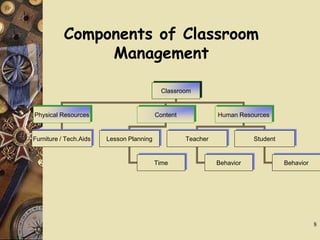
Classroom
Physical Resources Content Human Resources
Furniture / Tech.Aids Lesson Planning Teacher
Behavior
Time
Student
Behavior
Components of Classroom
Management
9
Content management
Revision of previous / additional knowledge
Teacher Role
Student Role (Practical Activities / Experiments / Mental
Exercises lead to creativity)
Time Framework
10
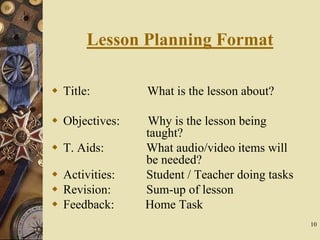
Lesson Planning Format
 Title: What is the lesson about?
 Objectives: Why is the lesson being
taught?
 T. Aids: What audio/video items will
be needed?
 Activities: Student / Teacher doing tasks
 Revision: Sum-up of lesson
 Feedback: Home Task
11
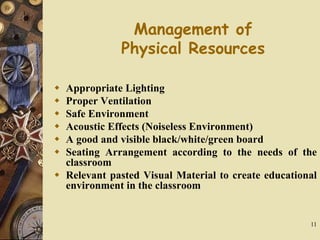
Management of
Physical Resources
 Appropriate Lighting
 Proper Ventilation
 Safe Environment
 Acoustic Effects (Noiseless Environment)
 A good and visible black/white/green board
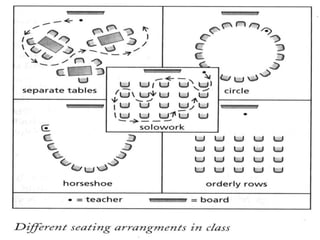
 Seating Arrangement according to the needs of the
classroom
 Relevant pasted Visual Material to create educational
environment in the classroom
12
13
14
Management of Human
Resources.
teacher
Setting Standards
Set behavior standards
 Keep students busy and motivated
 Keep a positive attitude
 Control your emotions
 Corrective measures
15
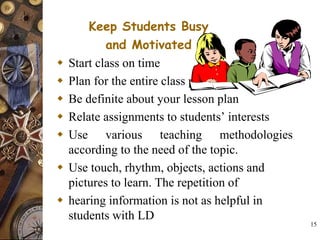
Keep Students Busy
and Motivated
 Start class on time
 Plan for the entire class period
 Be definite about your lesson plan
 Relate assignments to students’ interests
 Use various teaching methodologies
according to the need of the topic.
 Use touch, rhythm, objects, actions and
pictures to learn. The repetition of
 hearing information is not as helpful in
students with LD
16
Keep a Positive Attitude
 Give praise, encouragement and
inspiration
 Be consistent and tolerating .
 Be fair when dealing with
behavioral problems. Favoritism
breeds resentment.
17
Control Your Emotions
 Before assigning a task to the students, keep
yourself in place of them
 Don’t argue with students; however, you may
discuss and / or explain
 Admit errors if you make them as
we are all humans
 Don’t mind if students ask
again and again
18
Corrective Measures
 Don’t make an issue
of everything
 Don’t threaten the
students
 Don’t punish the
entire class because
of the misbehavior
of one or a few
individuals
 Don’t criticize the
students negatively
 Don’t leave school
code of conduct
 Avoid punishing in
the “heat” of anger
19
General Techniques to
Encourage Students
 Make mistakes okay
 Build confidence
 Focus on past success
 Recognize achievement
 Encourage students’
contributions to the class
 Encourage students to help
other students
20
Classroom rules
 To overcome problems and for better learning
environment there should be class room rules.
 Classroom rule should be made with the consent
of the students and in the light of school rules.
 Classroom rules should be displayed in the class
and should also communicated to the parents.
21
Set Behavior Standards
 Be reasonable, firm but fair
 Be consistent
 For the most part, practice what we
preach
 Insist on the general behavior that
students must abide by all the rules
before they speak / do
 Define classroom rules clearly
22
Examples of Bad Rules
Be responsible
 Be a good citizen
 Pay attention
 Be ready to learn
 Demonstrate respect for others
 Respect others' rights
 Respect authority
 Treat school property appropriately
 Do your best
 Take care of your materials
 Maintain appropriate behavior in the classroom
 Be kind to others
 Be polite
23
Examples of Good Rules
 Turn in completed assignments on time.
 Bring paper, pencil, and books to class.
 Sit in your seat unless you have permission to leave it.
 Do what your teacher says immediately.
 Raise your hand and wait for permission to speak.
 Work when you are supposed to.
 Do not bother or hurt others.
 Walk, don't run, at all times in the classroom.
 Keep hands, feet, and objects to yourself.
 Bring books, notebooks, pens, and pencils to class.
24
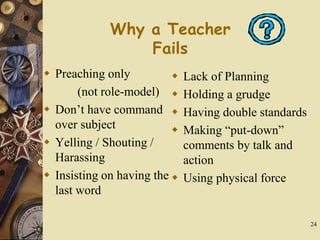
Why a Teacher
Fails
 Preaching only
(not role-model)
 Don’t have command
over subject
 Yelling / Shouting /
Harassing
 Insisting on having the
last word
 Lack of Planning
 Holding a grudge
 Having double standards
 Making “put-down”
comments by talk and
action
 Using physical force
25
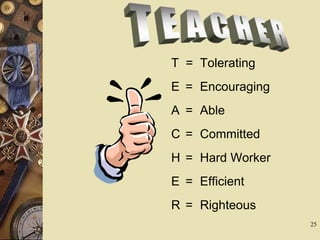
T = Tolerating
E = Encouraging
A = Able
C = Committed
H = Hard Worker
E = Efficient
R = Righteous
26
Teaching Slow-Learners
 Characteristics of the Slow Learner
“This student always has a confused look, always in
for help, never seems to understand material,
consistently does poorly on tests, rarely finishes
tests, can’t use reference materials,, has an
extremely difficult time with new concepts and
can stare at one problem for 45 minutes and be
no farther along than he/she was at the
beginning.”
27
Strategies for Teaching Slow
Learner
 · Have the student sit in the front of the
room near the teacher.
 · Have the student repeat directions to see
if he/she understands them..
 · Monitor the student’s work, ask him/her
to show you what he/she has done when
half completed and have him explain what
he/she is doing.
28
Strategies for Teaching Slow
Learner
 Break down the directions into a sequence of
steps, number the steps, have the student
complete the task one step at a time.
 · Utilize an academically stable student to help
monitor this student’s work or help explain
directions.
 · Before each math lesson put problems on the
board to remind and reinforce the concepts being
applied.
29
Strategies for Teaching Slow
Learner
 · Have the student do two or three problems with
you, tell him/her to do two on his/her own and
then say you will be back to check his/her work.
Then remember to check.
 · Have the student do a shortened version of
class projects.
 · Monitor him/her closely to be sure he/she isn’t
putting down just any answer.
 · When finished with an assignment, ask him/her
to tell you the main idea of the work or explain
the process that he/she used.
30
 Try to check on him/her from time to time
 · Invite him/her in to a morning or
afternoon private session to show concern,
possibly involve parents by calling them
about such a session.
Strategies for Teaching Slow
Learner (cont)
31
Strategies for Teaching Slow
Learner
 Give him/her extra time on tests.
 · Ask another student, whom he/she likes,
to help him/her.
 · Read short stories followed by questions
dealing with the details, sequences, main
idea,, and drawing conclusions.
 · Start by giving simple oral directions and
progress to more difficult ones.

classroom manage.ppt

  • 1.
  • 2.
  • 3.
    3 Objectives  know whatis classroom management  recognize the importance of classroom management  identify the components of classroom  devise a framework to effectively manage all the components in the classroom  overcome the problems occurring in the classroom After attending this workshop, the participants will be able to:
  • 4.
    4 Importance of ClassroomManagement classroom management is the single most important factor governing student learning. Three authors reviewed 50 years of research on student learning, encompassing 11,000 statistical findings. They discovered 28 factors that help students learn and classroom management was the number one. The way that teachers run their learning/working environment determines whether the individual will be successful or not.
  • 5.
    5 classroom  A placewhere human and material resources are utilized for learning . .
  • 6.
    6 Management  Getting thingsdone through others.  The effective utilization of human and materials resources to achieve the organizational goals.  The coordination of the personnel's activities towards organizational goals
  • 7.
    7 Classroom Management  “Classroommanagement is the maximum utilization of available resources for the maximum achievement of pre-stated objectives.”  “Classroom management is to Plan, Organize, Lead and Control the objective oriented classroom activities.”
  • 8.
    8 Classroom Physical Resources ContentHuman Resources Furniture / Tech.Aids Lesson Planning Teacher Behavior Time Student Behavior Components of Classroom Management
  • 9.
    9 Content management Revision ofprevious / additional knowledge Teacher Role Student Role (Practical Activities / Experiments / Mental Exercises lead to creativity) Time Framework
  • 10.
    10 Lesson Planning Format Title: What is the lesson about?  Objectives: Why is the lesson being taught?  T. Aids: What audio/video items will be needed?  Activities: Student / Teacher doing tasks  Revision: Sum-up of lesson  Feedback: Home Task
  • 11.
    11 Management of Physical Resources Appropriate Lighting  Proper Ventilation  Safe Environment  Acoustic Effects (Noiseless Environment)  A good and visible black/white/green board  Seating Arrangement according to the needs of the classroom  Relevant pasted Visual Material to create educational environment in the classroom
  • 12.
  • 13.
  • 14.
    14 Management of Human Resources. teacher SettingStandards Set behavior standards  Keep students busy and motivated  Keep a positive attitude  Control your emotions  Corrective measures
  • 15.
    15 Keep Students Busy andMotivated  Start class on time  Plan for the entire class period  Be definite about your lesson plan  Relate assignments to students’ interests  Use various teaching methodologies according to the need of the topic.  Use touch, rhythm, objects, actions and pictures to learn. The repetition of  hearing information is not as helpful in students with LD
  • 16.
    16 Keep a PositiveAttitude  Give praise, encouragement and inspiration  Be consistent and tolerating .  Be fair when dealing with behavioral problems. Favoritism breeds resentment.
  • 17.
    17 Control Your Emotions Before assigning a task to the students, keep yourself in place of them  Don’t argue with students; however, you may discuss and / or explain  Admit errors if you make them as we are all humans  Don’t mind if students ask again and again
  • 18.
    18 Corrective Measures  Don’tmake an issue of everything  Don’t threaten the students  Don’t punish the entire class because of the misbehavior of one or a few individuals  Don’t criticize the students negatively  Don’t leave school code of conduct  Avoid punishing in the “heat” of anger
  • 19.
    19 General Techniques to EncourageStudents  Make mistakes okay  Build confidence  Focus on past success  Recognize achievement  Encourage students’ contributions to the class  Encourage students to help other students
  • 20.
    20 Classroom rules  Toovercome problems and for better learning environment there should be class room rules.  Classroom rule should be made with the consent of the students and in the light of school rules.  Classroom rules should be displayed in the class and should also communicated to the parents.
  • 21.
    21 Set Behavior Standards Be reasonable, firm but fair  Be consistent  For the most part, practice what we preach  Insist on the general behavior that students must abide by all the rules before they speak / do  Define classroom rules clearly
  • 22.
    22 Examples of BadRules Be responsible  Be a good citizen  Pay attention  Be ready to learn  Demonstrate respect for others  Respect others' rights  Respect authority  Treat school property appropriately  Do your best  Take care of your materials  Maintain appropriate behavior in the classroom  Be kind to others  Be polite
  • 23.
    23 Examples of GoodRules  Turn in completed assignments on time.  Bring paper, pencil, and books to class.  Sit in your seat unless you have permission to leave it.  Do what your teacher says immediately.  Raise your hand and wait for permission to speak.  Work when you are supposed to.  Do not bother or hurt others.  Walk, don't run, at all times in the classroom.  Keep hands, feet, and objects to yourself.  Bring books, notebooks, pens, and pencils to class.
  • 24.
    24 Why a Teacher Fails Preaching only (not role-model)  Don’t have command over subject  Yelling / Shouting / Harassing  Insisting on having the last word  Lack of Planning  Holding a grudge  Having double standards  Making “put-down” comments by talk and action  Using physical force
  • 25.
    25 T = Tolerating E= Encouraging A = Able C = Committed H = Hard Worker E = Efficient R = Righteous
  • 26.
    26 Teaching Slow-Learners  Characteristicsof the Slow Learner “This student always has a confused look, always in for help, never seems to understand material, consistently does poorly on tests, rarely finishes tests, can’t use reference materials,, has an extremely difficult time with new concepts and can stare at one problem for 45 minutes and be no farther along than he/she was at the beginning.”
  • 27.
    27 Strategies for TeachingSlow Learner  · Have the student sit in the front of the room near the teacher.  · Have the student repeat directions to see if he/she understands them..  · Monitor the student’s work, ask him/her to show you what he/she has done when half completed and have him explain what he/she is doing.
  • 28.
    28 Strategies for TeachingSlow Learner  Break down the directions into a sequence of steps, number the steps, have the student complete the task one step at a time.  · Utilize an academically stable student to help monitor this student’s work or help explain directions.  · Before each math lesson put problems on the board to remind and reinforce the concepts being applied.
  • 29.
    29 Strategies for TeachingSlow Learner  · Have the student do two or three problems with you, tell him/her to do two on his/her own and then say you will be back to check his/her work. Then remember to check.  · Have the student do a shortened version of class projects.  · Monitor him/her closely to be sure he/she isn’t putting down just any answer.  · When finished with an assignment, ask him/her to tell you the main idea of the work or explain the process that he/she used.
  • 30.
    30  Try tocheck on him/her from time to time  · Invite him/her in to a morning or afternoon private session to show concern, possibly involve parents by calling them about such a session. Strategies for Teaching Slow Learner (cont)
  • 31.
    31 Strategies for TeachingSlow Learner  Give him/her extra time on tests.  · Ask another student, whom he/she likes, to help him/her.  · Read short stories followed by questions dealing with the details, sequences, main idea,, and drawing conclusions.  · Start by giving simple oral directions and progress to more difficult ones.