Pain
management
By: Muhammad Talha
BScN
(ION-DUHS)
Karachi, Pakistan
Objectives:
At the end of the unit, students will be able to:
• Utilize Functional health pattern to identify patient's problems related to
pain disorder.
• Integrate pathophysiology and pharmacology concepts of pain.
• Apply nursing process with support on Evidence-Based Nursing (EBN)
to provide to the clients with pain.
• Discuss the holistic approach for nursing management of the patient
with pain.
• Develop a teaching plan for a client experiencing disorders of the pain.
Pain:
• An unpleasant sensory and emotional experience associated with
actual or potential tissue damage.
• The clinical definition of pain reinforces that pain is a highly personal and
subjective experience: “Pain is whatever the experiencing person says it is,
existing whenever he says it does”
Types of pain in terms of duration:
•Acute pain involves tissue damage because of surgery, trauma, burn, or
venipuncture, have a short duration and resolve with normal healing.
•Chronic or persistent pain is cancerous or noncancerous that can persist
throughout person’s life.
• Examples of noncancer chronic pain include peripheral neuropathy
from diabetes, back or neck pain after injury, and osteoarthritis pain
from joint degeneration.
• Some conditions can produce both acute and chronic pain.
• For example, some patients with cancer have continuous chronic pain
and experience more intense acute pain periodically, which is called
breakthrough pain (BTP).
Types of pain in terms of pathology:
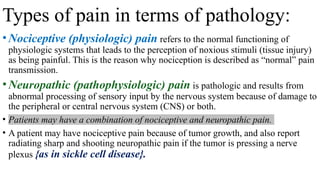
•Nociceptive (physiologic) pain refers to the normal functioning of
physiologic systems that leads to the perception of noxious stimuli (tissue injury)
as being painful. This is the reason why nociception is described as “normal” pain
transmission.
•Neuropathic (pathophysiologic) pain is pathologic and results from
abnormal processing of sensory input by the nervous system because of damage to
the peripheral or central nervous system (CNS) or both.
• Patients may have a combination of nociceptive and neuropathic pain.
• A patient may have nociceptive pain because of tumor growth, and also report
radiating sharp and shooting neuropathic pain if the tumor is pressing a nerve
plexus {as in sickle cell disease}.
Nociceptive pain:
• Nociception includes four specific processes:
• Transduction,
• Transmission,
• Perception, and
• Modulation
Transduction:
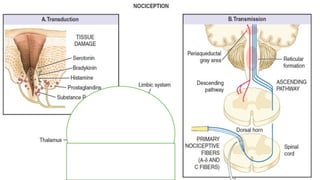
• Transduction refers to the processes by which noxious stimuli, such as a
surgical incision or burn, activate primary afferent neurons called nociceptors,
located throughout the body in the skin, subcutaneous tissue, and visceral
(organ), and somatic (musculoskeletal) structures.
• Noxious stimuli generated because of tissue damage from mechanical (e.g.,
incision, tumor growth), thermal (e.g., burn, frostbite), chemical (e.g., toxins,
chemotherapy), and infectious sources.
• Noxious stimuli cause the release of serotonin, bradykinin, histamine, substance
P, and prostaglandins, which move pain along the pain pathway.
• In addition, sodium, calcium, and potassium ion channels open, resulting in
electrical impulses that are transmitted through the large, rapid conducting A-
delta and smaller, peripheral C-fiber nociceptors.
• Prostaglandins initiate inflammatory responses that increase tissue swelling and
pain at the site of injury.
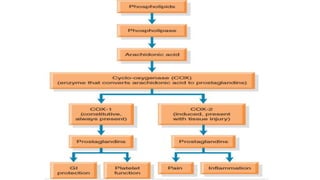
• Prostaglandins form when phospholipase breaks down phospholipids into
arachidonic acid then, cyclo-oxygenase (COX) acts on arachidonic acid to
produce prostaglandins.
• NSAIDs block the formation of prostaglandins.
• The nonselective NSAIDs, such as ibuprofen, naproxen, diclofenac, and ketorolac,
inhibit both COX-1 and COX-2, and
• The selective COX-2 NSAIDs, such as celecoxib, inhibit only COX-2.
Transmission:
• Effective transduction generates an action potential that is transmitted along the
lightly myelinated rapid conducting A-delta fibers and the unmyelinated slower
impulse conducting C fibers.
• The endings of A-delta fibers detect thermal and mechanical injury, allow
relatively quick localization of pain, and are responsible for a rapid reflex
withdrawal from the painful stimulus.
• Unmyelinated C fibers respond to mechanical, thermal, and chemical stimuli.
They produce poorly localized and often aching or burning pain.
• A-beta (β) fibers are the largest of the fibers and respond to touch, movement, and
vibration but do not normally transmit pain.
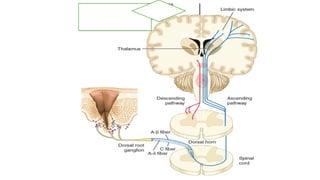
• The action potential impulse with the noxious information passes through the
dorsal root ganglia, then synapses in the dorsal horn of the spinal cord, and then
ascends to the spinal cord and transmits the information to the brain, where pain is
perceived.
• Extensive modulation occurs in the dorsal horn via complex neurochemical
mechanisms.
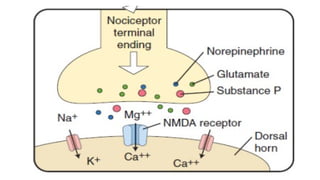
• The primary A-delta fibers release glutamate and C fibers release substance P and
other neuropeptides.
• Glutamate is a key neurotransmitter because it binds to the N-methyl-D-aspartate
(NMDA) receptor and promotes pain transmission (Zhou, 2017).
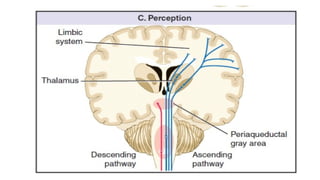
Perception:
• Activation of brain structures for the occurrence of awareness, emotions, and
impulses associated with pain.
Modulation
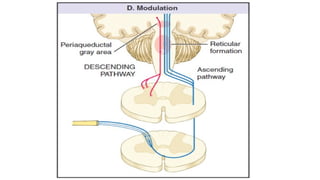
• Serotonin and norepinephrine are inhibitory neurotransmitters that are released in
the spinal cord and the brain stem by the descending (efferent) fibers of the
modulatory system.
• Some antidepressants provide pain relief by blocking the body’s reuptake
(resorption) of serotonin and norepinephrine.
• Endogenous opioids are located throughout the peripheral and central nervous
systems, and like exogenous opioids, they bind to opioid receptors in the
descending system and inhibit pain transmission.
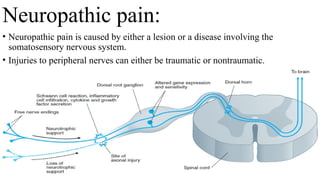
Neuropathic pain:
• Neuropathic pain is caused by either a lesion or a disease involving the
somatosensory nervous system.
• Injuries to peripheral nerves can either be traumatic or nontraumatic.
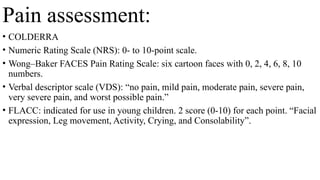
Pain assessment:
• COLDERRA
• Numeric Rating Scale (NRS): 0- to 10-point scale.
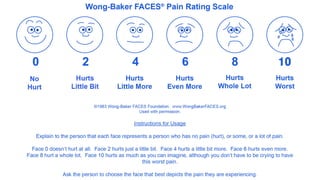
• Wong–Baker FACES Pain Rating Scale: six cartoon faces with 0, 2, 4, 6, 8, 10
numbers.
• Verbal descriptor scale (VDS): “no pain, mild pain, moderate pain, severe pain,
very severe pain, and worst possible pain.”
• FLACC: indicated for use in young children. 2 score (0-10) for each point. “Facial
expression, Leg movement, Activity, Crying, and Consolability”.
Pain management:
1. Nonopioid antispasmodic agents, which include acetaminophen and NSAIDs;
2. Opioid antispasmodic agents, which include, morphine, hydromorphone,
fentanyl, and oxycodone; and
3. Co-analgesic agents (also referred to as adjuvant analgesic agents), which
includes, local anesthetics, some anticonvulsants, and some antidepressants.
Nonopioid agents:
• Acetaminophen and NSAIDs
• They are appropriate alone for mild to some moderate nociceptive pain (e.g.,
from surgery, trauma, or osteoarthritis).
• They are added to opioids, local anesthetics, and/or anticonvulsants as part of a
multimodal analgesic regimen for more severe nociceptive pain.
• Ibuprofen, naproxen, and celecoxib are the most widely used oral NSAIDs.
• Acetaminophen can cause hepatotoxicity.
• NSAIDs can cause gastric toxicity and ulceration.
Opioid Analgesic Agents:
• Opioid analgesic agents are divided into two major groups:
1) Mu agonist opioids (also called morphinelike medications) include
morphine, hydromorphone, hydrocodone, fentanyl, oxycodone &
methadone.
2) Agonist–antagonist opioids include buprenorphine, nalbuphine, and
butorphanol
• There are three major classes of opioid receptor sites involved in analgesia: the
mu, delta, and kappa.
24
Assessment
• Data Collection
• Pain threshold is the level of intensity at which pain becomes appreciable or
perceptible.
• Pain tolerance is the level of intensity or duration of pain the client is
willing or able to endure.
• Assessment Tools
• Initial Pain Assessment Tool
• Pain Intensity Scales
• Psychosocial Pain Assessment
• Developmental Considerations
• Children and Adolescents
Dec 16, 2024
25
Nursing Diagnosis
NANDA-approved diagnoses
• Acute Pain
• Chronic Pain
Dec 16, 2024
26
Outcome Identification and Planning
• Planning focuses on mutual goal setting.
• A goal of nursing care is to use both nonpharmacologic and
pharmacologic interventions in planning strategies to control or
maintain clients at desired levels of functioning and pain.
Dec 16, 2024
27
Implementation
• Behavioral Interventions
• Nurse-Client Relationship
• Biofeedback
• Pharmacologic Pain Management
• Treatment of Neuropathic Pain
Dec 16, 2024
28
Evaluation
• Client’s facial expression and posture
• Presence (or absence) of restlessness
• Vital sign monitoring
• Ongoing use of pain assessment tools
Dec 16, 2024
References:
• Janice L Hinkle, Kerry H. Cheever, Kristen Overbaugh - Brunner & Suddarth's
Textbook of Medical-Surgical Nursing 15th
edition.

Pain Management and their type management

  • 1.
  • 2.
    Objectives: At the endof the unit, students will be able to: • Utilize Functional health pattern to identify patient's problems related to pain disorder. • Integrate pathophysiology and pharmacology concepts of pain. • Apply nursing process with support on Evidence-Based Nursing (EBN) to provide to the clients with pain. • Discuss the holistic approach for nursing management of the patient with pain. • Develop a teaching plan for a client experiencing disorders of the pain.
  • 3.
    Pain: • An unpleasantsensory and emotional experience associated with actual or potential tissue damage. • The clinical definition of pain reinforces that pain is a highly personal and subjective experience: “Pain is whatever the experiencing person says it is, existing whenever he says it does”
  • 4.
    Types of painin terms of duration: •Acute pain involves tissue damage because of surgery, trauma, burn, or venipuncture, have a short duration and resolve with normal healing. •Chronic or persistent pain is cancerous or noncancerous that can persist throughout person’s life. • Examples of noncancer chronic pain include peripheral neuropathy from diabetes, back or neck pain after injury, and osteoarthritis pain from joint degeneration. • Some conditions can produce both acute and chronic pain. • For example, some patients with cancer have continuous chronic pain and experience more intense acute pain periodically, which is called breakthrough pain (BTP).
  • 5.
    Types of painin terms of pathology: •Nociceptive (physiologic) pain refers to the normal functioning of physiologic systems that leads to the perception of noxious stimuli (tissue injury) as being painful. This is the reason why nociception is described as “normal” pain transmission. •Neuropathic (pathophysiologic) pain is pathologic and results from abnormal processing of sensory input by the nervous system because of damage to the peripheral or central nervous system (CNS) or both. • Patients may have a combination of nociceptive and neuropathic pain. • A patient may have nociceptive pain because of tumor growth, and also report radiating sharp and shooting neuropathic pain if the tumor is pressing a nerve plexus {as in sickle cell disease}.
  • 6.
    Nociceptive pain: • Nociceptionincludes four specific processes: • Transduction, • Transmission, • Perception, and • Modulation
  • 7.
    Transduction: • Transduction refersto the processes by which noxious stimuli, such as a surgical incision or burn, activate primary afferent neurons called nociceptors, located throughout the body in the skin, subcutaneous tissue, and visceral (organ), and somatic (musculoskeletal) structures. • Noxious stimuli generated because of tissue damage from mechanical (e.g., incision, tumor growth), thermal (e.g., burn, frostbite), chemical (e.g., toxins, chemotherapy), and infectious sources. • Noxious stimuli cause the release of serotonin, bradykinin, histamine, substance P, and prostaglandins, which move pain along the pain pathway. • In addition, sodium, calcium, and potassium ion channels open, resulting in electrical impulses that are transmitted through the large, rapid conducting A- delta and smaller, peripheral C-fiber nociceptors.
  • 11.
    • Prostaglandins initiateinflammatory responses that increase tissue swelling and pain at the site of injury. • Prostaglandins form when phospholipase breaks down phospholipids into arachidonic acid then, cyclo-oxygenase (COX) acts on arachidonic acid to produce prostaglandins. • NSAIDs block the formation of prostaglandins. • The nonselective NSAIDs, such as ibuprofen, naproxen, diclofenac, and ketorolac, inhibit both COX-1 and COX-2, and • The selective COX-2 NSAIDs, such as celecoxib, inhibit only COX-2.
  • 13.
    Transmission: • Effective transductiongenerates an action potential that is transmitted along the lightly myelinated rapid conducting A-delta fibers and the unmyelinated slower impulse conducting C fibers. • The endings of A-delta fibers detect thermal and mechanical injury, allow relatively quick localization of pain, and are responsible for a rapid reflex withdrawal from the painful stimulus. • Unmyelinated C fibers respond to mechanical, thermal, and chemical stimuli. They produce poorly localized and often aching or burning pain. • A-beta (β) fibers are the largest of the fibers and respond to touch, movement, and vibration but do not normally transmit pain.
  • 14.
    • The actionpotential impulse with the noxious information passes through the dorsal root ganglia, then synapses in the dorsal horn of the spinal cord, and then ascends to the spinal cord and transmits the information to the brain, where pain is perceived. • Extensive modulation occurs in the dorsal horn via complex neurochemical mechanisms. • The primary A-delta fibers release glutamate and C fibers release substance P and other neuropeptides. • Glutamate is a key neurotransmitter because it binds to the N-methyl-D-aspartate (NMDA) receptor and promotes pain transmission (Zhou, 2017).
  • 15.
    Perception: • Activation ofbrain structures for the occurrence of awareness, emotions, and impulses associated with pain. Modulation • Serotonin and norepinephrine are inhibitory neurotransmitters that are released in the spinal cord and the brain stem by the descending (efferent) fibers of the modulatory system. • Some antidepressants provide pain relief by blocking the body’s reuptake (resorption) of serotonin and norepinephrine. • Endogenous opioids are located throughout the peripheral and central nervous systems, and like exogenous opioids, they bind to opioid receptors in the descending system and inhibit pain transmission.
  • 18.
    Neuropathic pain: • Neuropathicpain is caused by either a lesion or a disease involving the somatosensory nervous system. • Injuries to peripheral nerves can either be traumatic or nontraumatic.
  • 19.
    Pain assessment: • COLDERRA •Numeric Rating Scale (NRS): 0- to 10-point scale. • Wong–Baker FACES Pain Rating Scale: six cartoon faces with 0, 2, 4, 6, 8, 10 numbers. • Verbal descriptor scale (VDS): “no pain, mild pain, moderate pain, severe pain, very severe pain, and worst possible pain.” • FLACC: indicated for use in young children. 2 score (0-10) for each point. “Facial expression, Leg movement, Activity, Crying, and Consolability”.
  • 21.
    Pain management: 1. Nonopioidantispasmodic agents, which include acetaminophen and NSAIDs; 2. Opioid antispasmodic agents, which include, morphine, hydromorphone, fentanyl, and oxycodone; and 3. Co-analgesic agents (also referred to as adjuvant analgesic agents), which includes, local anesthetics, some anticonvulsants, and some antidepressants.
  • 22.
    Nonopioid agents: • Acetaminophenand NSAIDs • They are appropriate alone for mild to some moderate nociceptive pain (e.g., from surgery, trauma, or osteoarthritis). • They are added to opioids, local anesthetics, and/or anticonvulsants as part of a multimodal analgesic regimen for more severe nociceptive pain. • Ibuprofen, naproxen, and celecoxib are the most widely used oral NSAIDs. • Acetaminophen can cause hepatotoxicity. • NSAIDs can cause gastric toxicity and ulceration.
  • 23.
    Opioid Analgesic Agents: •Opioid analgesic agents are divided into two major groups: 1) Mu agonist opioids (also called morphinelike medications) include morphine, hydromorphone, hydrocodone, fentanyl, oxycodone & methadone. 2) Agonist–antagonist opioids include buprenorphine, nalbuphine, and butorphanol • There are three major classes of opioid receptor sites involved in analgesia: the mu, delta, and kappa.
  • 24.
    24 Assessment • Data Collection •Pain threshold is the level of intensity at which pain becomes appreciable or perceptible. • Pain tolerance is the level of intensity or duration of pain the client is willing or able to endure. • Assessment Tools • Initial Pain Assessment Tool • Pain Intensity Scales • Psychosocial Pain Assessment • Developmental Considerations • Children and Adolescents Dec 16, 2024
  • 25.
    25 Nursing Diagnosis NANDA-approved diagnoses •Acute Pain • Chronic Pain Dec 16, 2024
  • 26.
    26 Outcome Identification andPlanning • Planning focuses on mutual goal setting. • A goal of nursing care is to use both nonpharmacologic and pharmacologic interventions in planning strategies to control or maintain clients at desired levels of functioning and pain. Dec 16, 2024
  • 27.
    27 Implementation • Behavioral Interventions •Nurse-Client Relationship • Biofeedback • Pharmacologic Pain Management • Treatment of Neuropathic Pain Dec 16, 2024
  • 28.
    28 Evaluation • Client’s facialexpression and posture • Presence (or absence) of restlessness • Vital sign monitoring • Ongoing use of pain assessment tools Dec 16, 2024
  • 29.
    References: • Janice LHinkle, Kerry H. Cheever, Kristen Overbaugh - Brunner & Suddarth's Textbook of Medical-Surgical Nursing 15th edition.