RICE
• Is astaple food of over half the world's people and is grown
on approximately 146 million hectares, more than 10 percent
of total available land.
• Total world production is about 535 million tons of unmilled
or rough rice (paddy).
• Ninety seven percent (97 percent) of the world's rice is grown
by less developed countries, mostly in Asia. China and India
produce about 55 percent of the total crop (IRRI, 1997).
Pre-harvest Operations
• Propertiming is important in harvesting the crop as losses
could be incurred if rice is harvested too soon or too late.
• Immature grains due to too early harvest result in high
percentage of broken and low milling recovery.
• Delayed harvesting exposes the crop to insect, rodent and
bird pests, in addition to increased risks of lodging and
grain shattering. The ideal is to be within the window of
optimum harvest period.
5.
The indicators ofoptimum harvest
of the grain are as follows:
a) The variety has reached the particular date of maturity or number
of days after heading, 28 to 34 days;
b) Eighty percent (80 percent) of the grains or the upper portion of
the panicle has changed from green to straw colour;
c) At least 20 percent of the grains at the base is already in hard
dough stage;
d) Grain moisture content ranges from 21 percent to 24 percent; and
e) The hand-dehulled grain, as indicated by daily tests near the
projected harvest date, is clear and hard.
6.
Harvesting
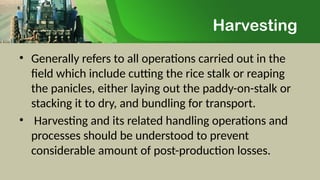
• Generally refersto all operations carried out in the
field which include cutting the rice stalk or reaping
the panicles, either laying out the paddy-on-stalk or
stacking it to dry, and bundling for transport.
• Harvesting and its related handling operations and
processes should be understood to prevent
considerable amount of post-production losses.
7.
Harvesting Methods
(Traditional Methods)
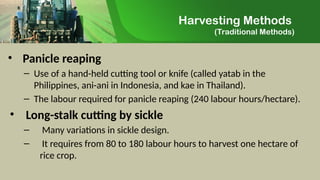
•Panicle reaping
– Use of a hand-held cutting tool or knife (called yatab in the
Philippines, ani-ani in Indonesia, and kae in Thailand).
– The labour required for panicle reaping (240 labour hours/hectare).
• Long-stalk cutting by sickle
– Many variations in sickle design.
– It requires from 80 to 180 labour hours to harvest one hectare of
rice crop.
8.
Harvesting Methods
(Modern mechanicalMethods)
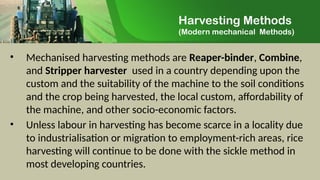
• Mechanised harvesting methods are Reaper-binder, Combine,
and Stripper harvester used in a country depending upon the
custom and the suitability of the machine to the soil conditions
and the crop being harvested, the local custom, affordability of
the machine, and other socio-economic factors.
• Unless labour in harvesting has become scarce in a locality due
to industrialisation or migration to employment-rich areas, rice
harvesting will continue to be done with the sickle method in
most developing countries.
9.
Threshing
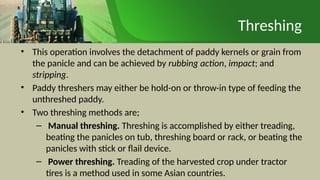
• This operationinvolves the detachment of paddy kernels or grain from
the panicle and can be achieved by rubbing action, impact; and
stripping.
• Paddy threshers may either be hold-on or throw-in type of feeding the
unthreshed paddy.
• Two threshing methods are;
– Manual threshing. Threshing is accomplished by either treading,
beating the panicles on tub, threshing board or rack, or beating the
panicles with stick or flail device.
– Power threshing. Treading of the harvested crop under tractor
tires is a method used in some Asian countries.
10.
Threshing
• Field dryingof the harvested paddy, if it is not a shattering variety,
should be practised moderately during the dry season only.
• If hand-harvested by sickle the grip size bundles are better laid out
separated rather than stacked to achieve greater aeration rather
than stacked.
• Stacking of moist paddy will cause heating up of the paddy,
increasing the activity of microorganisms and initiate a major
deterioration in quality. A safe way is to thresh the paddy
immediately after harvesting.
11.
Drying
• Immediate dryingof the grain after harvest is imperative to
avoid its deterioration. The use of mechanical dryers at the
small farm level has not caught on because of its high initial
cost, uneconomical operation and seasonal utilization.
• Sundrying of paddy is still the most popular method even
among medium-scale rice mills in developing countries
because of the free heat energy although handling costs are
high. However, it is unreliable and the drying rate is not as
controllable as mechanical dryers.
12.
Drying
• In theabsence of heated-air or mechanical dryer during
cloudy or rainy weather after harvest, the paddy should at
least be aerated by thinly spreading it on a floor or piling it in
small heaps and frequently turning it over.
• Spreading or heaping the wet paddy on a mat of fine net laid
over a raised slatted platform would further increase the
aeration surface and drip off any free water. This technique
will save the crop until sunshine weather comes.
13.
Slide Title
Product A
•Feature 1
• Feature 2
• Feature 3
Product B
• Feature 1
• Feature 2
• Feature 3