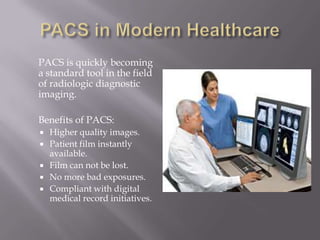
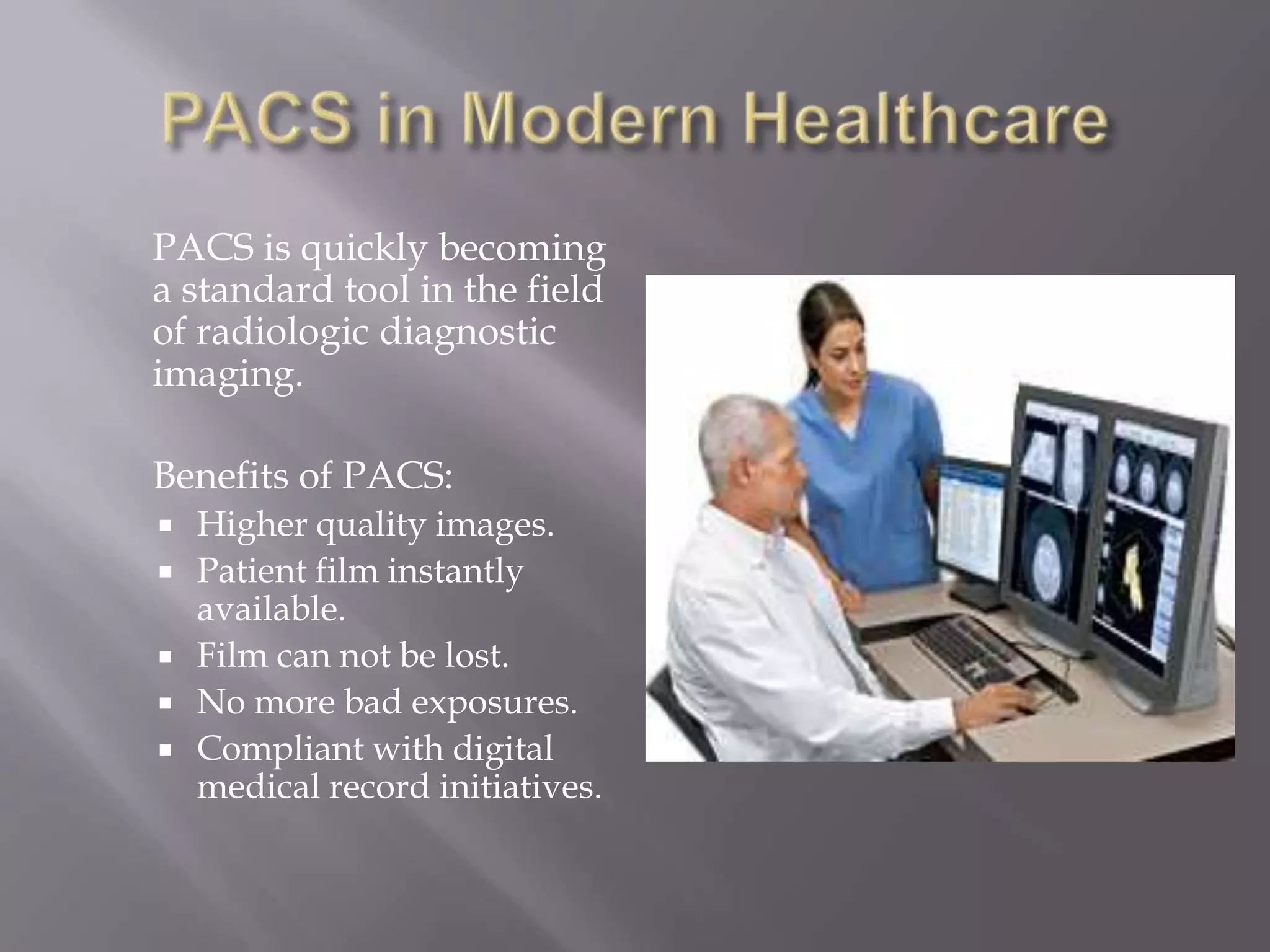
PACS in Modern Healthcare	PACS is quickly becoming a standard tool in the field of radiologic diagnostic imaging.	Benefits of PACS:Higher quality images.Patient film instantly available.Film can not be lost.No more bad exposures.Compliant with digital medical record initiatives.
HIS, RIS, & PACS	Various Information Systems work together to assist in providing modern health care:HIS stands for Health Information System.A database that controls patient admissions, discharges, transfers, and orders.RIS stands for Radiology Information System.A specialized database that is specific to diagnostic imaging procedures that are ordered for patients.PACS stands for Picture Archive Communication System.A high end database that stores diagnostic images and their associated procedure results.
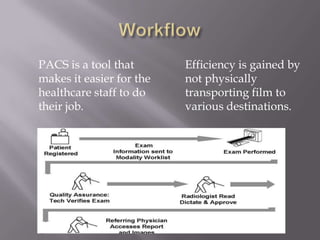
Image Acquisition	PACS acquires images directly from the diagnostic equipment where the exams are performed on the patient.	Orders are input to the HIS.	HIS transfer order request automatically to both RIS and PACS.	Employee will perform exam on a Modality.Modalities are X-Ray machines, Cat Scan, MRI, Ultrasound.	Employee will send images from exam to PACS.	Physician will interpret images through a PACS viewing workstation.
Network Infrastructure	PACS operates best on a Gigabit network connection.	It is ideal to use:Category 6 Ethernet cabling.Gigabit network switches .Private VLAN management.
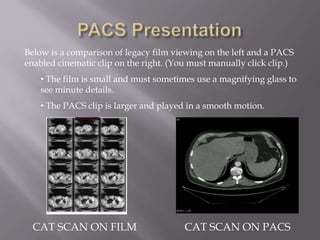
PACS PresentationBelow is a comparison of legacy film viewing on the left and a PACS enabled cinematic clip on the right. (You must manually click clip.) The film is small and must sometimes use a magnifying glass to see minute details.
 The PACS clip is larger and played in a smooth motion.cat scan on filmCat Scan on PACS
PACS Architecture	In the simplest concept, PACS is an online, digital file room but there is actually much more to it:High end database servers sort incoming orders and link information to patient data.Image acquisition servers communicate directly with the imaging modalities.Storage servers control short term and long term access to patient records.Interface servers communicate with other Information Systems.Web servers allow films and records to be viewed anywhere in the world through the internet.Customized workstations allow Radiology staff technologists and radiologists to view, manipulate, and interpret the diagnostic images.
Workflow	PACS is a tool that makes it easier for the healthcare staff to do their job.  	Efficiency is gained by not physically transporting film to various destinations.
Teleradiology	Accessibility is an important feature in today’s workplace and healthcare is no exception.	With the investment of a Virtual Private Network appliance, facilities are able to provide connectivity to services during off-business hours.	In healthcare, time is not money, it’s life.  Vital seconds waiting for a radiologist to drive to the site of care is eliminated by providing access over a secured connection, allowing diagnostic interpretations to occur at home or on the go.
Web Distribution	Not only are patients, in reality, customers of the healthcare industry but so are the referring physicians who send in the orders for diagnostic testing.  It is essential to provide the ordering doctors with real time access to the images and radiologist findings.With the Web server component of PACS, any computer with internet access becomes a powerful tool to aid in care for the sick.  Many PACS vendors are also marketing their product to smart phone users, providing additional access.
ConclusionIn its simplest concept, PACS is an online digital file room.PACS is a significant investment for the technology implementation.Efficiency is gained by eliminating physical film and faster availability to all parties involved.PACS provides real time access in the form of a Web presence.PACS is becoming more prevalent in health care environment as there is an initiative to move medical records into a digital format.

Power Point Assignment

  • 1.
    PACS in ModernHealthcare PACS is quickly becoming a standard tool in the field of radiologic diagnostic imaging. Benefits of PACS:Higher quality images.Patient film instantly available.Film can not be lost.No more bad exposures.Compliant with digital medical record initiatives.
  • 2.
    HIS, RIS, &PACS Various Information Systems work together to assist in providing modern health care:HIS stands for Health Information System.A database that controls patient admissions, discharges, transfers, and orders.RIS stands for Radiology Information System.A specialized database that is specific to diagnostic imaging procedures that are ordered for patients.PACS stands for Picture Archive Communication System.A high end database that stores diagnostic images and their associated procedure results.
  • 3.
    Image Acquisition PACS acquiresimages directly from the diagnostic equipment where the exams are performed on the patient. Orders are input to the HIS. HIS transfer order request automatically to both RIS and PACS. Employee will perform exam on a Modality.Modalities are X-Ray machines, Cat Scan, MRI, Ultrasound. Employee will send images from exam to PACS. Physician will interpret images through a PACS viewing workstation.
  • 4.
    Network Infrastructure PACS operatesbest on a Gigabit network connection. It is ideal to use:Category 6 Ethernet cabling.Gigabit network switches .Private VLAN management.
  • 5.
    PACS PresentationBelow isa comparison of legacy film viewing on the left and a PACS enabled cinematic clip on the right. (You must manually click clip.) The film is small and must sometimes use a magnifying glass to see minute details.
  • 6.
    The PACSclip is larger and played in a smooth motion.cat scan on filmCat Scan on PACS
  • 7.
    PACS Architecture In thesimplest concept, PACS is an online, digital file room but there is actually much more to it:High end database servers sort incoming orders and link information to patient data.Image acquisition servers communicate directly with the imaging modalities.Storage servers control short term and long term access to patient records.Interface servers communicate with other Information Systems.Web servers allow films and records to be viewed anywhere in the world through the internet.Customized workstations allow Radiology staff technologists and radiologists to view, manipulate, and interpret the diagnostic images.
  • 8.
    Workflow PACS is atool that makes it easier for the healthcare staff to do their job. Efficiency is gained by not physically transporting film to various destinations.
  • 9.
    Teleradiology Accessibility is animportant feature in today’s workplace and healthcare is no exception. With the investment of a Virtual Private Network appliance, facilities are able to provide connectivity to services during off-business hours. In healthcare, time is not money, it’s life. Vital seconds waiting for a radiologist to drive to the site of care is eliminated by providing access over a secured connection, allowing diagnostic interpretations to occur at home or on the go.
  • 10.
    Web Distribution Not onlyare patients, in reality, customers of the healthcare industry but so are the referring physicians who send in the orders for diagnostic testing. It is essential to provide the ordering doctors with real time access to the images and radiologist findings.With the Web server component of PACS, any computer with internet access becomes a powerful tool to aid in care for the sick. Many PACS vendors are also marketing their product to smart phone users, providing additional access.
  • 11.
    ConclusionIn its simplestconcept, PACS is an online digital file room.PACS is a significant investment for the technology implementation.Efficiency is gained by eliminating physical film and faster availability to all parties involved.PACS provides real time access in the form of a Web presence.PACS is becoming more prevalent in health care environment as there is an initiative to move medical records into a digital format.