Presenter:
S. Mark Brumbelow, Senior Manager - PYA
TRANSITIONING WITHIN A NEW MARKET
Agenda for today
 Outlining Succession Planning Basics
 Identifying Key Players in the Process
 Setting Goals for Achievement
 Exploring Tax Opportunities
$10,000,000,000,000?
$10,000,000,000,000!!
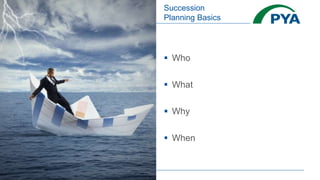
Succession
Planning Basics
 Who
Succession
Planning Basics
 Who
 What
Succession
Planning Basics
 Who
 What
 Why
Succession
Planning Basics
 Who
 What
 Why
 When
Succession Planning – Who is Impacted?
 Business owners
 Large business executives
 Vendors and other stakeholders
Succession Planning – Who is Impacted?
 Business owners
 Large business executives
 Vendors and other stakeholders
 Sons and daughters
Succession Planning – What?
 Direct involvement from executive leadership
 Systemized accountability for development of
future leaders
 Early identification of leadership candidates
 Broad internal commitment to self-improvement
Succession Planning – Why?
 Get skills in place
 Make appropriate investment decisions
 Maximize company value for transition
 Minimize tax burden arising out of transition
Succession Planning – When?
 The sooner the better
Succession Planning – When?
 The sooner the better
 Continuous
Succession Planning – When?
 The sooner the better
 Continuous
 Never too late
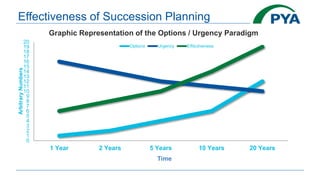
Effectiveness of Succession Planning
0
1
2
3
4
5
6
7
8
9
10
11
12
13
14
15
16
17
18
19
20
1 Year 2 Years 5 Years 10 Years 20 Years
ArbitraryNumbers
Time
Graphic Representation of the Options / Urgency Paradigm
Options Urgency Effectiveness
Key Players -
Who Is Involved?
 Owners
 Key operational leaders
 Invested employees
Key Players -
Who is Involved?
 Owners
 Key operational leaders
 Invested employees
 Human resources
 Outside advisors
Goals for Transition
 Role definition
 Process owners
 Network of strategic advisors
 Jobs skills listing
 Expanded candidate list
 Development plans
 Investment strategies
Who is doing what?
 Planning future strategy
 Recruiting
 Training program design
 Coaching and mentoring
 Developing investment and structure
 Setting cultural tenor and atmosphere
 Designing compensation and incentive plans
 Promoting future vision
 Implementing non-financial initiative
 Recognition and performance monitoring
Title Industry Example
 Consolidation – TitleOne Corporation
 Focus on the big picture – TitleOne
 Turn the focus inward
 Buyer’s bargain
Let’s
Talk
Tax
Transition – Tax Opportunities
 Small Businesses
 Transfer of ownership and responsibility to new generation of
owners
 Long-range cash flow considerations for retiring executives /
owners, and the resulting tax impact
 Protection of closely held nature of the business
 Large Businesses
 Incentive compensation opportunities and potential pitfalls
 Non-compete agreement consideration and valuation
Transition – Tax Opportunities
 Organizational structure could impact options
 Pass-through vs. corporate structures
 With enough time, you can plan around structure issues
 Cash flow opportunities
 Gain deferral could be available to seller
 Eases cash burden on buyer
 Don’t stumble on “Hot Asset” rules
 Gifting and other estate planning strategies
Transition – Tax Challenges
 Valuation of your business – your personal value vs. your business’s
value
 Organizational structure could impact options – especially in the
short-term
 Family dynamics can influence decisions – and those dynamics can
change
 Future owners and future operational leaders might be different
people
Summary
 Get a plan in place
 Align your plan to your business
 Identify successors
 Develop your alliance network
PERSHING YOAKLEY & ASSOCIATES, P.C.
800.270.9629 | www.pyapc.com
S. Mark Brumbelow,
Senior Manager
(800) 270-9629
mbrumbelow@pyapc.com

Transitioning Within a New Market

  • 1.
    Presenter: S. Mark Brumbelow,Senior Manager - PYA TRANSITIONING WITHIN A NEW MARKET
  • 2.
    Agenda for today Outlining Succession Planning Basics  Identifying Key Players in the Process  Setting Goals for Achievement  Exploring Tax Opportunities
  • 3.
  • 4.
  • 5.
  • 6.
  • 7.
  • 8.
  • 9.
    Succession Planning –Who is Impacted?  Business owners  Large business executives  Vendors and other stakeholders
  • 10.
    Succession Planning –Who is Impacted?  Business owners  Large business executives  Vendors and other stakeholders  Sons and daughters
  • 11.
    Succession Planning –What?  Direct involvement from executive leadership  Systemized accountability for development of future leaders  Early identification of leadership candidates  Broad internal commitment to self-improvement
  • 12.
    Succession Planning –Why?  Get skills in place  Make appropriate investment decisions  Maximize company value for transition  Minimize tax burden arising out of transition
  • 13.
    Succession Planning –When?  The sooner the better
  • 14.
    Succession Planning –When?  The sooner the better  Continuous
  • 15.
    Succession Planning –When?  The sooner the better  Continuous  Never too late
  • 16.
    Effectiveness of SuccessionPlanning 0 1 2 3 4 5 6 7 8 9 10 11 12 13 14 15 16 17 18 19 20 1 Year 2 Years 5 Years 10 Years 20 Years ArbitraryNumbers Time Graphic Representation of the Options / Urgency Paradigm Options Urgency Effectiveness
  • 17.
    Key Players - WhoIs Involved?  Owners  Key operational leaders  Invested employees
  • 18.
    Key Players - Whois Involved?  Owners  Key operational leaders  Invested employees  Human resources  Outside advisors
  • 19.
    Goals for Transition Role definition  Process owners  Network of strategic advisors  Jobs skills listing  Expanded candidate list  Development plans  Investment strategies
  • 20.
    Who is doingwhat?  Planning future strategy  Recruiting  Training program design  Coaching and mentoring  Developing investment and structure  Setting cultural tenor and atmosphere  Designing compensation and incentive plans  Promoting future vision  Implementing non-financial initiative  Recognition and performance monitoring
  • 21.
    Title Industry Example Consolidation – TitleOne Corporation  Focus on the big picture – TitleOne  Turn the focus inward  Buyer’s bargain
  • 23.
  • 24.
    Transition – TaxOpportunities  Small Businesses  Transfer of ownership and responsibility to new generation of owners  Long-range cash flow considerations for retiring executives / owners, and the resulting tax impact  Protection of closely held nature of the business  Large Businesses  Incentive compensation opportunities and potential pitfalls  Non-compete agreement consideration and valuation
  • 25.
    Transition – TaxOpportunities  Organizational structure could impact options  Pass-through vs. corporate structures  With enough time, you can plan around structure issues  Cash flow opportunities  Gain deferral could be available to seller  Eases cash burden on buyer  Don’t stumble on “Hot Asset” rules  Gifting and other estate planning strategies
  • 26.
    Transition – TaxChallenges  Valuation of your business – your personal value vs. your business’s value  Organizational structure could impact options – especially in the short-term  Family dynamics can influence decisions – and those dynamics can change  Future owners and future operational leaders might be different people
  • 27.
    Summary  Get aplan in place  Align your plan to your business  Identify successors  Develop your alliance network
  • 29.
    PERSHING YOAKLEY &ASSOCIATES, P.C. 800.270.9629 | www.pyapc.com S. Mark Brumbelow, Senior Manager (800) 270-9629 mbrumbelow@pyapc.com

Editor's Notes

  • #5 $10T would be over 1,680 containers full of $100 bills, and would weigh approximately 220,462,000 lbs.
  • #10 Who else?
  • #11 FORMATTING - I would like to be able to introduce these point one at a time.
  • #13 Elliott Carver in “Tomorrow Never Dies”.
  • #14 Formatting - I would like to be able to introduce these point one at a time.
  • #15 Formatting - I would like to be able to introduce these point one at a time.
  • #16 Formatting - I would like to be able to introduce these point one at a time.
  • #17 Formatting – is there any way to have this slide be click – empty graph – click – options – click – urgency – click – effectiveness?
  • #18 These are the more obvious players in the process…
  • #19 …but if we expand the scope…
  • #20 Title Industry Example Coming Up.
  • #21 FORMATTING - I would like to be able to introduce these point one at a time.
  • #22 What does the deal look like for TitleOne corporate? What about its owners and stakeholders? What does it look like from the TRG perspective? SEE NEXT SLIDE