
Page 0Date: December 1, 2014
Prepared for Tennessee Society of Certified Public Accountants
Valuation Issues in Healthcare
Tennessee Society of Certified Public Accountants
Healthcare Conference
December 1, 2014
Carol Carden, CPA/ABV, ASA, CFE
Page 1Date: December 1, 2014
Prepared for Tennessee Society of Certified Public Accountants
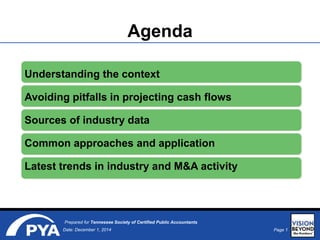
Agenda
Understanding the context
Avoiding pitfalls in projecting cash flows
Sources of industry data
Common approaches and application
Latest trends in industry and M&A activity
Page 2Date: December 1, 2014
Prepared for Tennessee Society of Certified Public Accountants
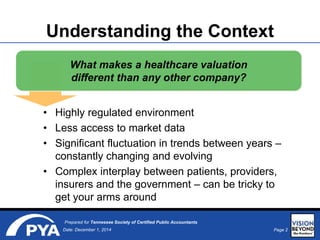
Understanding the Context
What makes a healthcare valuation
different than any other company?
• Highly regulated environment
• Less access to market data
• Significant fluctuation in trends between years –
constantly changing and evolving
• Complex interplay between patients, providers,
insurers and the government – can be tricky to
get your arms around
Page 3Date: December 1, 2014
Prepared for Tennessee Society of Certified Public Accountants
Understanding the Context
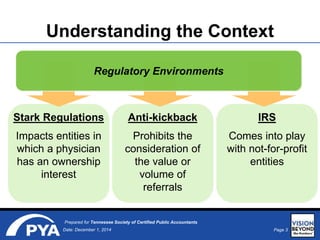
Stark Regulations
Impacts entities in
which a physician
has an ownership
interest
Anti-kickback
Prohibits the
consideration of
the value or
volume of
referrals
IRS
Comes into play
with not-for-profit
entities
Regulatory Environments
Page 4Date: December 1, 2014
Prepared for Tennessee Society of Certified Public Accountants
Understanding the Context
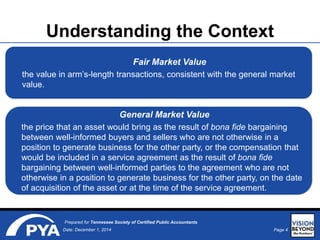
Fair Market Value
the value in arm’s-length transactions, consistent with the general market
value.
General Market Value
the price that an asset would bring as the result of bona fide bargaining
between well-informed buyers and sellers who are not otherwise in a
position to generate business for the other party, or the compensation that
would be included in a service agreement as the result of bona fide
bargaining between well-informed parties to the agreement who are not
otherwise in a position to generate business for the other party, on the date
of acquisition of the asset or at the time of the service agreement.
Page 5Date: December 1, 2014
Prepared for Tennessee Society of Certified Public Accountants
Understanding the Context
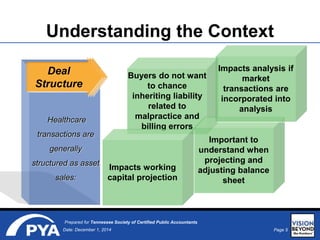
Buyers do not want
to chance
inheriting liability
related to
malpractice and
billing errors
Important to
understand when
projecting and
adjusting balance
sheet
Impacts analysis if
market
transactions are
incorporated into
analysis
Impacts working
capital projection
Healthcare
transactions are
generally
structured as asset
sales:
Deal
Structure
Page 6Date: December 1, 2014
Prepared for Tennessee Society of Certified Public Accountants
Projecting Cash Flows
Common Mistakes in Healthcare
x
x
x
x
Page 7Date: December 1, 2014
Prepared for Tennessee Society of Certified Public Accountants
Projecting Cash Flows
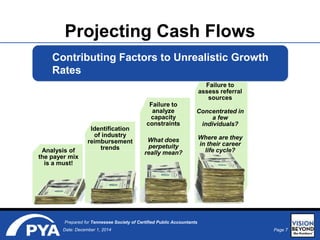
Contributing Factors to Unrealistic Growth
Rates
Analysis of
the payer mix
is a must!
Identification
of industry
reimbursement
trends
Failure to
analyze
capacity
constraints
What does
perpetuity
really mean?
Failure to
assess referral
sources
Concentrated in
a few
individuals?
Where are they
in their career
life cycle?
Page 8Date: December 1, 2014
Prepared for Tennessee Society of Certified Public Accountants
Projecting Cash Flows
Analysis of Reimbursement Trends
Page 9Date: December 1, 2014
Prepared for Tennessee Society of Certified Public Accountants
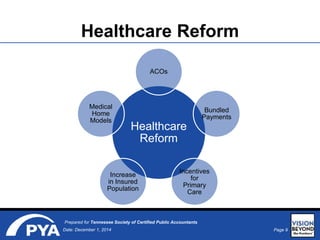
Healthcare Reform
Healthcare
Reform
ACOs
Bundled
Payments
Incentives
for
Primary
Care
Increase
in Insured
Population
Medical
Home
Models
Page 10Date: December 1, 2014
Prepared for Tennessee Society of Certified Public Accountants
Projecting Cash Flows
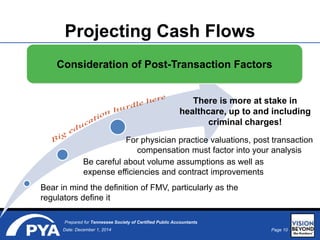
Consideration of Post-Transaction Factors
Bear in mind the definition of FMV, particularly as the
regulators define it
There is more at stake in
healthcare, up to and including
criminal charges!
Be careful about volume assumptions as well as
expense efficiencies and contract improvements
For physician practice valuations, post transaction
compensation must factor into your analysis
Page 11Date: December 1, 2014
Prepared for Tennessee Society of Certified Public Accountants
Projecting Cash Flows
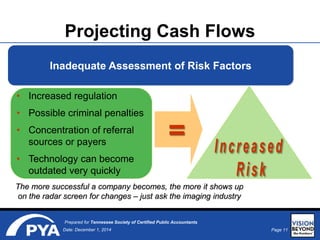
• Increased regulation
• Possible criminal penalties
• Concentration of referral
sources or payers
• Technology can become
outdated very quickly
Inadequate Assessment of Risk Factors
The more successful a company becomes, the more it shows up
on the radar screen for changes – just ask the imaging industry
=
Page 12Date: December 1, 2014
Prepared for Tennessee Society of Certified Public Accountants
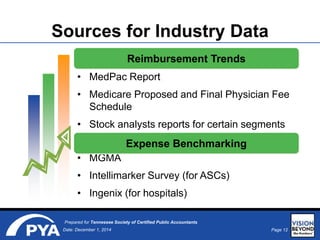
Sources for Industry Data
• MedPac Report
• Medicare Proposed and Final Physician Fee
Schedule
• Stock analysts reports for certain segments
• MGMA
• Intellimarker Survey (for ASCs)
• Ingenix (for hospitals)
Reimbursement Trends
Expense Benchmarking
Page 13Date: December 1, 2014
Prepared for Tennessee Society of Certified Public Accountants
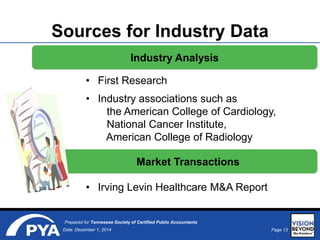
Sources for Industry Data
• First Research
• Industry associations such as
the American College of Cardiology,
National Cancer Institute,
American College of Radiology
• Irving Levin Healthcare M&A Report
Industry Analysis
Market Transactions
Page 14Date: December 1, 2014
Prepared for Tennessee Society of Certified Public Accountants
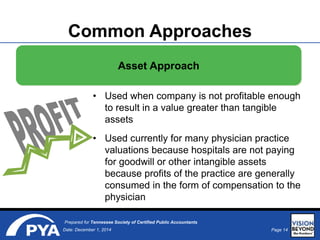
Common Approaches
• Used when company is not profitable enough
to result in a value greater than tangible
assets
• Used currently for many physician practice
valuations because hospitals are not paying
for goodwill or other intangible assets
because profits of the practice are generally
consumed in the form of compensation to the
physician
Asset Approach
Page 15Date: December 1, 2014
Prepared for Tennessee Society of Certified Public Accountants
Common Approaches
Can be complicated as many
smaller healthcare companies
are on a cash basis
Very common for many working
capital assets to be excluded,
so important to understand the
terms of the acquisition
Asset Approach(Continued)
Page 16Date: December 1, 2014
Prepared for Tennessee Society of Certified Public Accountants
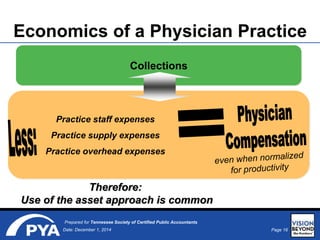
Economics of a Physician Practice
Practice staff expenses
Practice supply expenses
Practice overhead expenses
Collections
Therefore:
Use of the asset approach is common
Page 17Date: December 1, 2014
Prepared for Tennessee Society of Certified Public Accountants
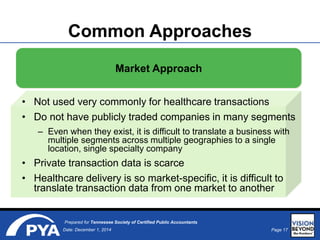
Common Approaches
Market Approach
• Not used very commonly for healthcare transactions
• Do not have publicly traded companies in many segments
– Even when they exist, it is difficult to translate a business with
multiple segments across multiple geographies to a single
location, single specialty company
• Private transaction data is scarce
• Healthcare delivery is so market-specific, it is difficult to
translate transaction data from one market to another
Page 18Date: December 1, 2014
Prepared for Tennessee Society of Certified Public Accountants
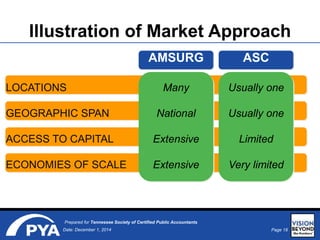
Illustration of Market Approach
AMSURG ASC
LOCATIONS Many Usually one
GEOGRAPHIC SPAN National Usually one
ACCESS TO CAPITAL Extensive Limited
ECONOMIES OF SCALE Extensive Very limited
Page 19Date: December 1, 2014
Prepared for Tennessee Society of Certified Public Accountants
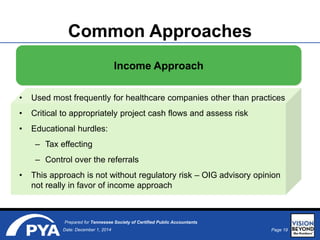
Common Approaches
Income Approach
• Used most frequently for healthcare companies other than practices
• Critical to appropriately project cash flows and assess risk
• Educational hurdles:
– Tax effecting
– Control over the referrals
• This approach is not without regulatory risk – OIG advisory opinion
not really in favor of income approach
Page 20Date: December 1, 2014
Prepared for Tennessee Society of Certified Public Accountants
Common Approaches
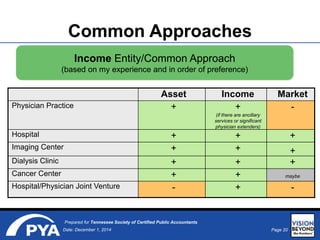
Income Entity/Common Approach
(based on my experience and in order of preference)
Asset Income Market
Physician Practice + +
(if there are ancillary
services or significant
physician extenders)
-
Hospital + + +
Imaging Center + + +
Dialysis Clinic + + +
Cancer Center + + maybe
Hospital/Physician Joint Venture - + -
Page 21Date: December 1, 2014
Prepared for Tennessee Society of Certified Public Accountants
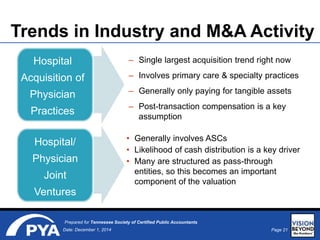
Trends in Industry and M&A Activity
– Single largest acquisition trend right now
– Involves primary care & specialty practices
– Generally only paying for tangible assets
– Post-transaction compensation is a key
assumption
Hospital/
Physician
Joint
Ventures
Hospital
Acquisition of
Physician
Practices
• Generally involves ASCs
• Likelihood of cash distribution is a key driver
• Many are structured as pass-through
entities, so this becomes an important
component of the valuation
Page 22Date: December 1, 2014
Prepared for Tennessee Society of Certified Public Accountants
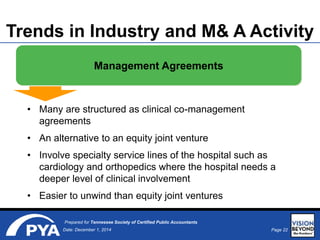
Trends in Industry and M& A Activity
• Many are structured as clinical co-management
agreements
• An alternative to an equity joint venture
• Involve specialty service lines of the hospital such as
cardiology and orthopedics where the hospital needs a
deeper level of clinical involvement
• Easier to unwind than equity joint ventures
Management Agreements
Page 23Date: December 1, 2014
Prepared for Tennessee Society of Certified Public Accountants
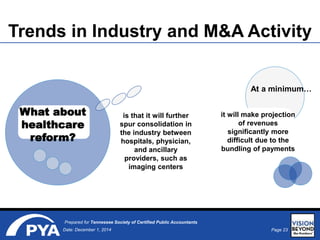
Trends in Industry and M&A Activity
What about
healthcare
reform?
Current thinking…
is that it will further
spur consolidation in
the industry between
hospitals, physician,
and ancillary
providers, such as
imaging centers
At a minimum…
it will make projection
of revenues
significantly more
difficult due to the
bundling of payments
Page 24Date: December 1, 2014
Prepared for Tennessee Society of Certified Public Accountants
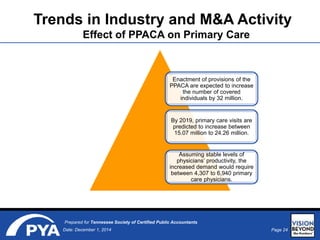
Enactment of provisions of the
PPACA are expected to increase
the number of covered
individuals by 32 million.
By 2019, primary care visits are
predicted to increase between
15.07 million to 24.26 million.
Assuming stable levels of
physicians’ productivity, the
increased demand would require
between 4,307 to 6,940 primary
care physicians.
Trends in Industry and M&A Activity
Effect of PPACA on Primary Care
Page 25Date: December 1, 2014
Prepared for Tennessee Society of Certified Public Accountants
Trends in Industry and M&A Activity
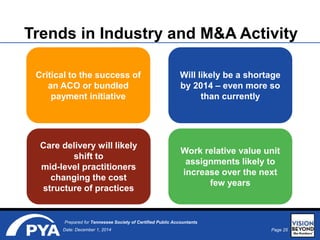
Care delivery will likely
shift to
mid-level practitioners
changing the cost
structure of practices
Work relative value unit
assignments likely to
increase over the next
few years
Critical to the success of
an ACO or bundled
payment initiative
Will likely be a shortage
by 2014 – even more so
than currently
Page 26Date: December 1, 2014
Prepared for Tennessee Society of Certified Public Accountants
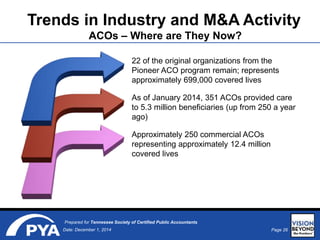
22 of the original organizations from the
Pioneer ACO program remain; represents
approximately 699,000 covered lives
As of January 2014, 351 ACOs provided care
to 5.3 million beneficiaries (up from 250 a year
ago)
Approximately 250 commercial ACOs
representing approximately 12.4 million
covered lives
Trends in Industry and M&A Activity
ACOs – Where are They Now?
Page 27Date: December 1, 2014
Prepared for Tennessee Society of Certified Public Accountants
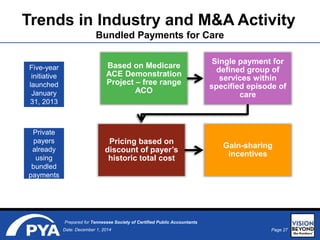
Five-year
initiative
launched
January
31, 2013
Private
payers
already
using
bundled
payments
Based on Medicare
ACE Demonstration
Project – free range
ACO
Single payment for
defined group of
services within
specified episode of
care
Pricing based on
discount of payer’s
historic total cost
Gain-sharing
incentives
Trends in Industry and M&A Activity
Bundled Payments for Care
Page 28Date: December 1, 2014
Prepared for Tennessee Society of Certified Public Accountants
Trends in Industry and M&A Activity
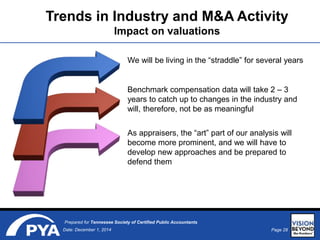
Impact on valuations
We will be living in the “straddle” for several years
Benchmark compensation data will take 2 – 3
years to catch up to changes in the industry and
will, therefore, not be as meaningful
As appraisers, the “art” part of our analysis will
become more prominent, and we will have to
develop new approaches and be prepared to
defend them
Page 29Date: December 1, 2014
Prepared for Tennessee Society of Certified Public Accountants
Questions
Page 30Date: December 1, 2014
Prepared for Tennessee Society of Certified Public Accountants
Contact Information
Carol Carden, CPA/ABV, ASA, CFE
Shareholder
Pershing Yoakley & Associates, P.C.
(865) 673-0844
ccarden@pyapc.com
www.pyapc.com
Twitter: @carolcardenpya

Valuation Issues in Healthcare

  • 1.
    Page 0Date: December1, 2014 Prepared for Tennessee Society of Certified Public Accountants Valuation Issues in Healthcare Tennessee Society of Certified Public Accountants Healthcare Conference December 1, 2014 Carol Carden, CPA/ABV, ASA, CFE
  • 2.
    Page 1Date: December1, 2014 Prepared for Tennessee Society of Certified Public Accountants Agenda Understanding the context Avoiding pitfalls in projecting cash flows Sources of industry data Common approaches and application Latest trends in industry and M&A activity
  • 3.
    Page 2Date: December1, 2014 Prepared for Tennessee Society of Certified Public Accountants Understanding the Context What makes a healthcare valuation different than any other company? • Highly regulated environment • Less access to market data • Significant fluctuation in trends between years – constantly changing and evolving • Complex interplay between patients, providers, insurers and the government – can be tricky to get your arms around
  • 4.
    Page 3Date: December1, 2014 Prepared for Tennessee Society of Certified Public Accountants Understanding the Context Stark Regulations Impacts entities in which a physician has an ownership interest Anti-kickback Prohibits the consideration of the value or volume of referrals IRS Comes into play with not-for-profit entities Regulatory Environments
  • 5.
    Page 4Date: December1, 2014 Prepared for Tennessee Society of Certified Public Accountants Understanding the Context Fair Market Value the value in arm’s-length transactions, consistent with the general market value. General Market Value the price that an asset would bring as the result of bona fide bargaining between well-informed buyers and sellers who are not otherwise in a position to generate business for the other party, or the compensation that would be included in a service agreement as the result of bona fide bargaining between well-informed parties to the agreement who are not otherwise in a position to generate business for the other party, on the date of acquisition of the asset or at the time of the service agreement.
  • 6.
    Page 5Date: December1, 2014 Prepared for Tennessee Society of Certified Public Accountants Understanding the Context Buyers do not want to chance inheriting liability related to malpractice and billing errors Important to understand when projecting and adjusting balance sheet Impacts analysis if market transactions are incorporated into analysis Impacts working capital projection Healthcare transactions are generally structured as asset sales: Deal Structure
  • 7.
    Page 6Date: December1, 2014 Prepared for Tennessee Society of Certified Public Accountants Projecting Cash Flows Common Mistakes in Healthcare x x x x
  • 8.
    Page 7Date: December1, 2014 Prepared for Tennessee Society of Certified Public Accountants Projecting Cash Flows Contributing Factors to Unrealistic Growth Rates Analysis of the payer mix is a must! Identification of industry reimbursement trends Failure to analyze capacity constraints What does perpetuity really mean? Failure to assess referral sources Concentrated in a few individuals? Where are they in their career life cycle?
  • 9.
    Page 8Date: December1, 2014 Prepared for Tennessee Society of Certified Public Accountants Projecting Cash Flows Analysis of Reimbursement Trends
  • 10.
    Page 9Date: December1, 2014 Prepared for Tennessee Society of Certified Public Accountants Healthcare Reform Healthcare Reform ACOs Bundled Payments Incentives for Primary Care Increase in Insured Population Medical Home Models
  • 11.
    Page 10Date: December1, 2014 Prepared for Tennessee Society of Certified Public Accountants Projecting Cash Flows Consideration of Post-Transaction Factors Bear in mind the definition of FMV, particularly as the regulators define it There is more at stake in healthcare, up to and including criminal charges! Be careful about volume assumptions as well as expense efficiencies and contract improvements For physician practice valuations, post transaction compensation must factor into your analysis
  • 12.
    Page 11Date: December1, 2014 Prepared for Tennessee Society of Certified Public Accountants Projecting Cash Flows • Increased regulation • Possible criminal penalties • Concentration of referral sources or payers • Technology can become outdated very quickly Inadequate Assessment of Risk Factors The more successful a company becomes, the more it shows up on the radar screen for changes – just ask the imaging industry =
  • 13.
    Page 12Date: December1, 2014 Prepared for Tennessee Society of Certified Public Accountants Sources for Industry Data • MedPac Report • Medicare Proposed and Final Physician Fee Schedule • Stock analysts reports for certain segments • MGMA • Intellimarker Survey (for ASCs) • Ingenix (for hospitals) Reimbursement Trends Expense Benchmarking
  • 14.
    Page 13Date: December1, 2014 Prepared for Tennessee Society of Certified Public Accountants Sources for Industry Data • First Research • Industry associations such as the American College of Cardiology, National Cancer Institute, American College of Radiology • Irving Levin Healthcare M&A Report Industry Analysis Market Transactions
  • 15.
    Page 14Date: December1, 2014 Prepared for Tennessee Society of Certified Public Accountants Common Approaches • Used when company is not profitable enough to result in a value greater than tangible assets • Used currently for many physician practice valuations because hospitals are not paying for goodwill or other intangible assets because profits of the practice are generally consumed in the form of compensation to the physician Asset Approach
  • 16.
    Page 15Date: December1, 2014 Prepared for Tennessee Society of Certified Public Accountants Common Approaches Can be complicated as many smaller healthcare companies are on a cash basis Very common for many working capital assets to be excluded, so important to understand the terms of the acquisition Asset Approach(Continued)
  • 17.
    Page 16Date: December1, 2014 Prepared for Tennessee Society of Certified Public Accountants Economics of a Physician Practice Practice staff expenses Practice supply expenses Practice overhead expenses Collections Therefore: Use of the asset approach is common
  • 18.
    Page 17Date: December1, 2014 Prepared for Tennessee Society of Certified Public Accountants Common Approaches Market Approach • Not used very commonly for healthcare transactions • Do not have publicly traded companies in many segments – Even when they exist, it is difficult to translate a business with multiple segments across multiple geographies to a single location, single specialty company • Private transaction data is scarce • Healthcare delivery is so market-specific, it is difficult to translate transaction data from one market to another
  • 19.
    Page 18Date: December1, 2014 Prepared for Tennessee Society of Certified Public Accountants Illustration of Market Approach AMSURG ASC LOCATIONS Many Usually one GEOGRAPHIC SPAN National Usually one ACCESS TO CAPITAL Extensive Limited ECONOMIES OF SCALE Extensive Very limited
  • 20.
    Page 19Date: December1, 2014 Prepared for Tennessee Society of Certified Public Accountants Common Approaches Income Approach • Used most frequently for healthcare companies other than practices • Critical to appropriately project cash flows and assess risk • Educational hurdles: – Tax effecting – Control over the referrals • This approach is not without regulatory risk – OIG advisory opinion not really in favor of income approach
  • 21.
    Page 20Date: December1, 2014 Prepared for Tennessee Society of Certified Public Accountants Common Approaches Income Entity/Common Approach (based on my experience and in order of preference) Asset Income Market Physician Practice + + (if there are ancillary services or significant physician extenders) - Hospital + + + Imaging Center + + + Dialysis Clinic + + + Cancer Center + + maybe Hospital/Physician Joint Venture - + -
  • 22.
    Page 21Date: December1, 2014 Prepared for Tennessee Society of Certified Public Accountants Trends in Industry and M&A Activity – Single largest acquisition trend right now – Involves primary care & specialty practices – Generally only paying for tangible assets – Post-transaction compensation is a key assumption Hospital/ Physician Joint Ventures Hospital Acquisition of Physician Practices • Generally involves ASCs • Likelihood of cash distribution is a key driver • Many are structured as pass-through entities, so this becomes an important component of the valuation
  • 23.
    Page 22Date: December1, 2014 Prepared for Tennessee Society of Certified Public Accountants Trends in Industry and M& A Activity • Many are structured as clinical co-management agreements • An alternative to an equity joint venture • Involve specialty service lines of the hospital such as cardiology and orthopedics where the hospital needs a deeper level of clinical involvement • Easier to unwind than equity joint ventures Management Agreements
  • 24.
    Page 23Date: December1, 2014 Prepared for Tennessee Society of Certified Public Accountants Trends in Industry and M&A Activity What about healthcare reform? Current thinking… is that it will further spur consolidation in the industry between hospitals, physician, and ancillary providers, such as imaging centers At a minimum… it will make projection of revenues significantly more difficult due to the bundling of payments
  • 25.
    Page 24Date: December1, 2014 Prepared for Tennessee Society of Certified Public Accountants Enactment of provisions of the PPACA are expected to increase the number of covered individuals by 32 million. By 2019, primary care visits are predicted to increase between 15.07 million to 24.26 million. Assuming stable levels of physicians’ productivity, the increased demand would require between 4,307 to 6,940 primary care physicians. Trends in Industry and M&A Activity Effect of PPACA on Primary Care
  • 26.
    Page 25Date: December1, 2014 Prepared for Tennessee Society of Certified Public Accountants Trends in Industry and M&A Activity Care delivery will likely shift to mid-level practitioners changing the cost structure of practices Work relative value unit assignments likely to increase over the next few years Critical to the success of an ACO or bundled payment initiative Will likely be a shortage by 2014 – even more so than currently
  • 27.
    Page 26Date: December1, 2014 Prepared for Tennessee Society of Certified Public Accountants 22 of the original organizations from the Pioneer ACO program remain; represents approximately 699,000 covered lives As of January 2014, 351 ACOs provided care to 5.3 million beneficiaries (up from 250 a year ago) Approximately 250 commercial ACOs representing approximately 12.4 million covered lives Trends in Industry and M&A Activity ACOs – Where are They Now?
  • 28.
    Page 27Date: December1, 2014 Prepared for Tennessee Society of Certified Public Accountants Five-year initiative launched January 31, 2013 Private payers already using bundled payments Based on Medicare ACE Demonstration Project – free range ACO Single payment for defined group of services within specified episode of care Pricing based on discount of payer’s historic total cost Gain-sharing incentives Trends in Industry and M&A Activity Bundled Payments for Care
  • 29.
    Page 28Date: December1, 2014 Prepared for Tennessee Society of Certified Public Accountants Trends in Industry and M&A Activity Impact on valuations We will be living in the “straddle” for several years Benchmark compensation data will take 2 – 3 years to catch up to changes in the industry and will, therefore, not be as meaningful As appraisers, the “art” part of our analysis will become more prominent, and we will have to develop new approaches and be prepared to defend them
  • 30.
    Page 29Date: December1, 2014 Prepared for Tennessee Society of Certified Public Accountants Questions
  • 31.
    Page 30Date: December1, 2014 Prepared for Tennessee Society of Certified Public Accountants Contact Information Carol Carden, CPA/ABV, ASA, CFE Shareholder Pershing Yoakley & Associates, P.C. (865) 673-0844 ccarden@pyapc.com www.pyapc.com Twitter: @carolcardenpya