The Vicissitudes of Valuing “Value”
Legal and Valuation Issues Associated with
Value-Based Payment Models
AHLA Physicians/Hospitals Institute
Page 1© 2017 Pershing Yoakley & Associates, PC
Agenda
1 Introduction to emerging payment models
2
Application of fraud and abuse laws and IRS rules to
value-based payments
3 Existing regulatory guidance
4 Considerations in determining FMV and CR
Introduction to Emerging Payment Models
Page 3© 2017 Pershing Yoakley & Associates, PC
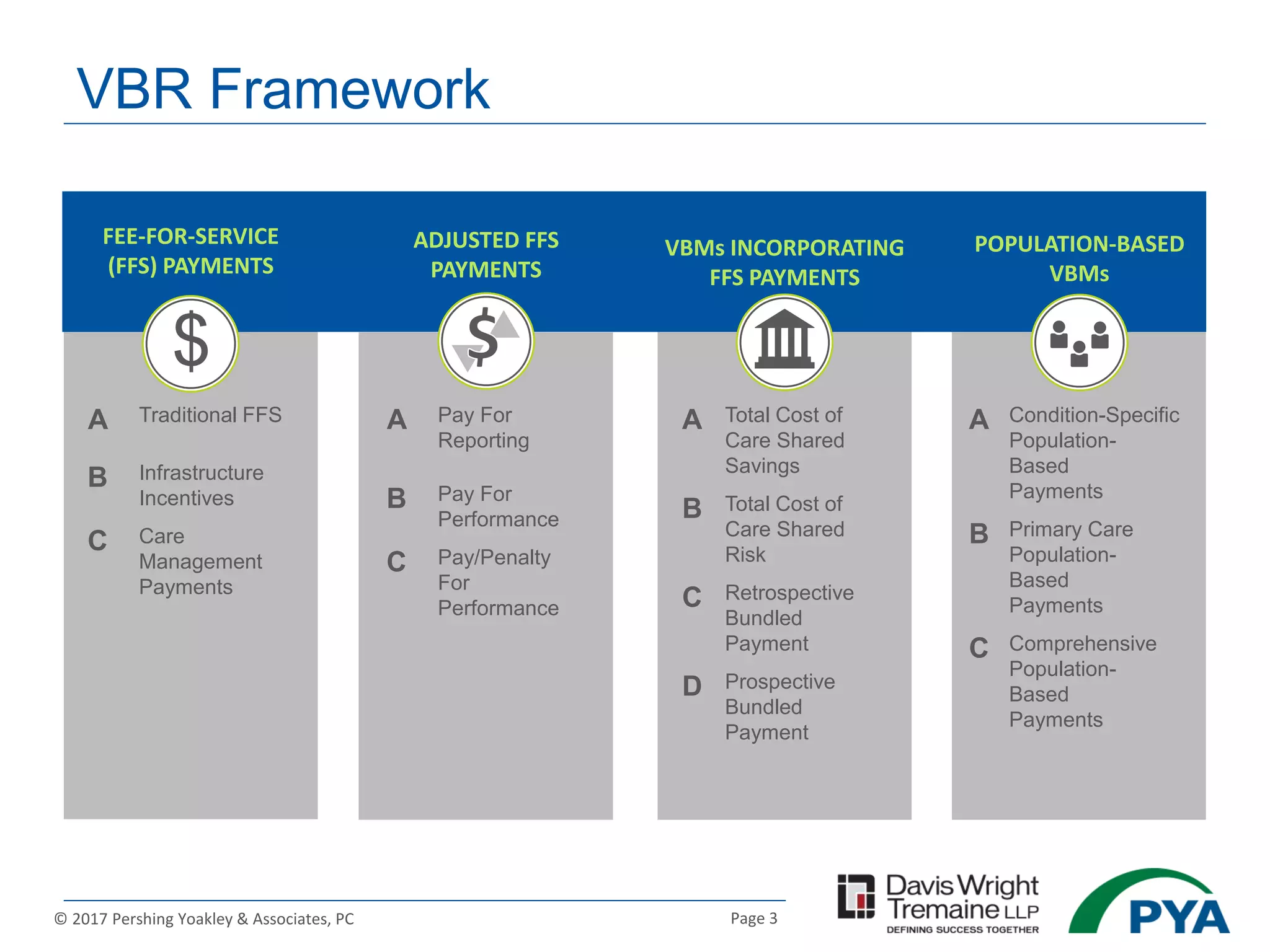
VBR Framework
FEE-FOR-SERVICE
(FFS) PAYMENTS
POPULATION-BASED
VBMs
ADJUSTED FFS
PAYMENTS
VBMs INCORPORATING
FFS PAYMENTS
$
$
Bank
A Pay For
Reporting
B Pay For
Performance
C Pay/Penalty
For
Performance
A Total Cost of
Care Shared
Savings
B Total Cost of
Care Shared
Risk
C Retrospective
Bundled
Payment
D Prospective
Bundled
Payment
A Condition-Specific
Population-
Based
Payments
B Primary Care
Population-
Based
Payments
C Comprehensive
Population-
Based
Payments
A Traditional FFS
B Infrastructure
Incentives
C Care
Management
Payments
Page 4© 2017 Pershing Yoakley & Associates, PC
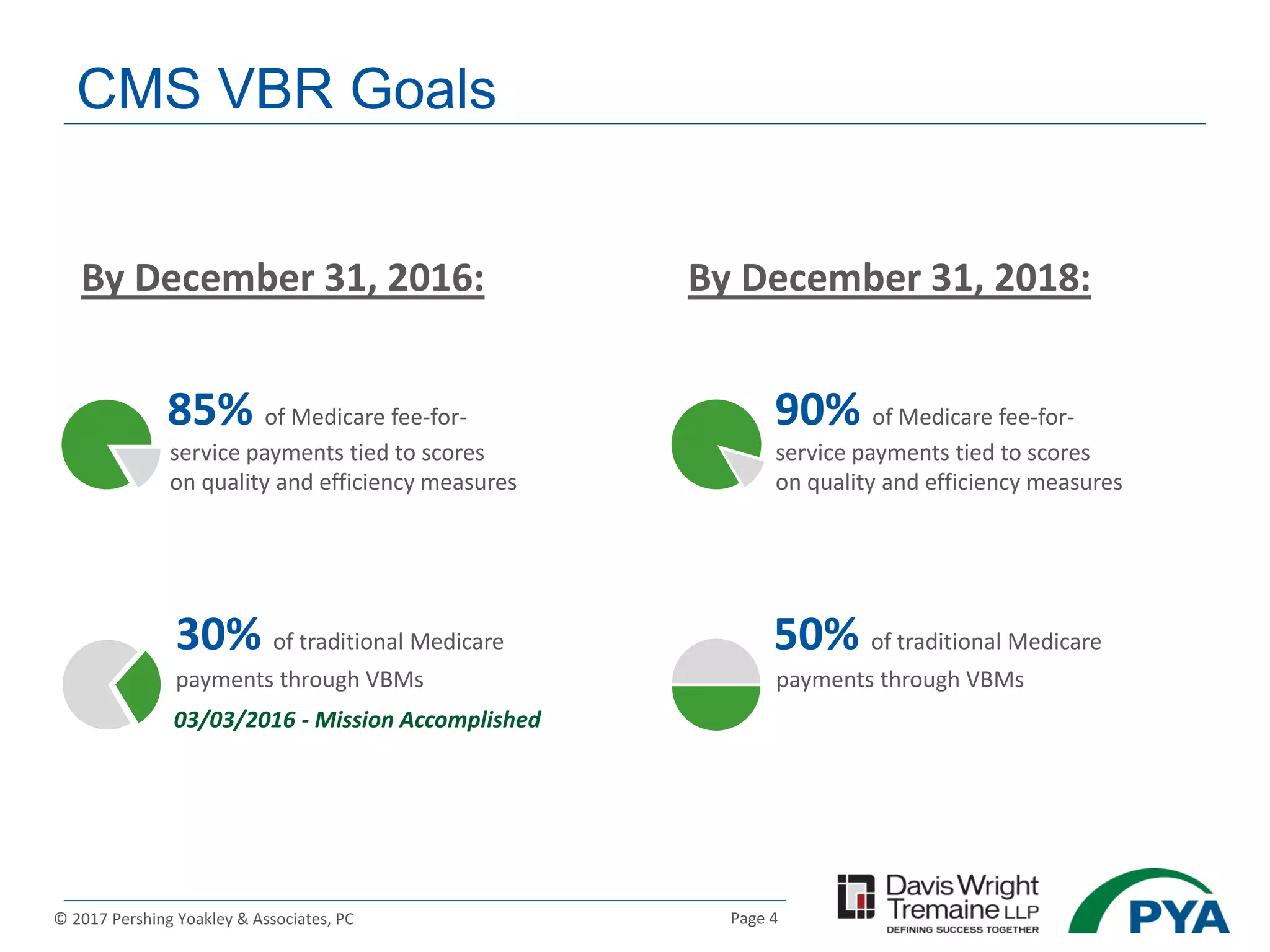
CMS VBR Goals
30% of traditional Medicare
payments through VBMs
50% of traditional Medicare
payments through VBMs
85% of Medicare fee-for-
service payments tied to scores
on quality and efficiency measures
90% of Medicare fee-for-
service payments tied to scores
on quality and efficiency measures
03/03/2016 - Mission Accomplished
By December 31, 2016: By December 31, 2018:
Page 5© 2017 Pershing Yoakley & Associates, PC
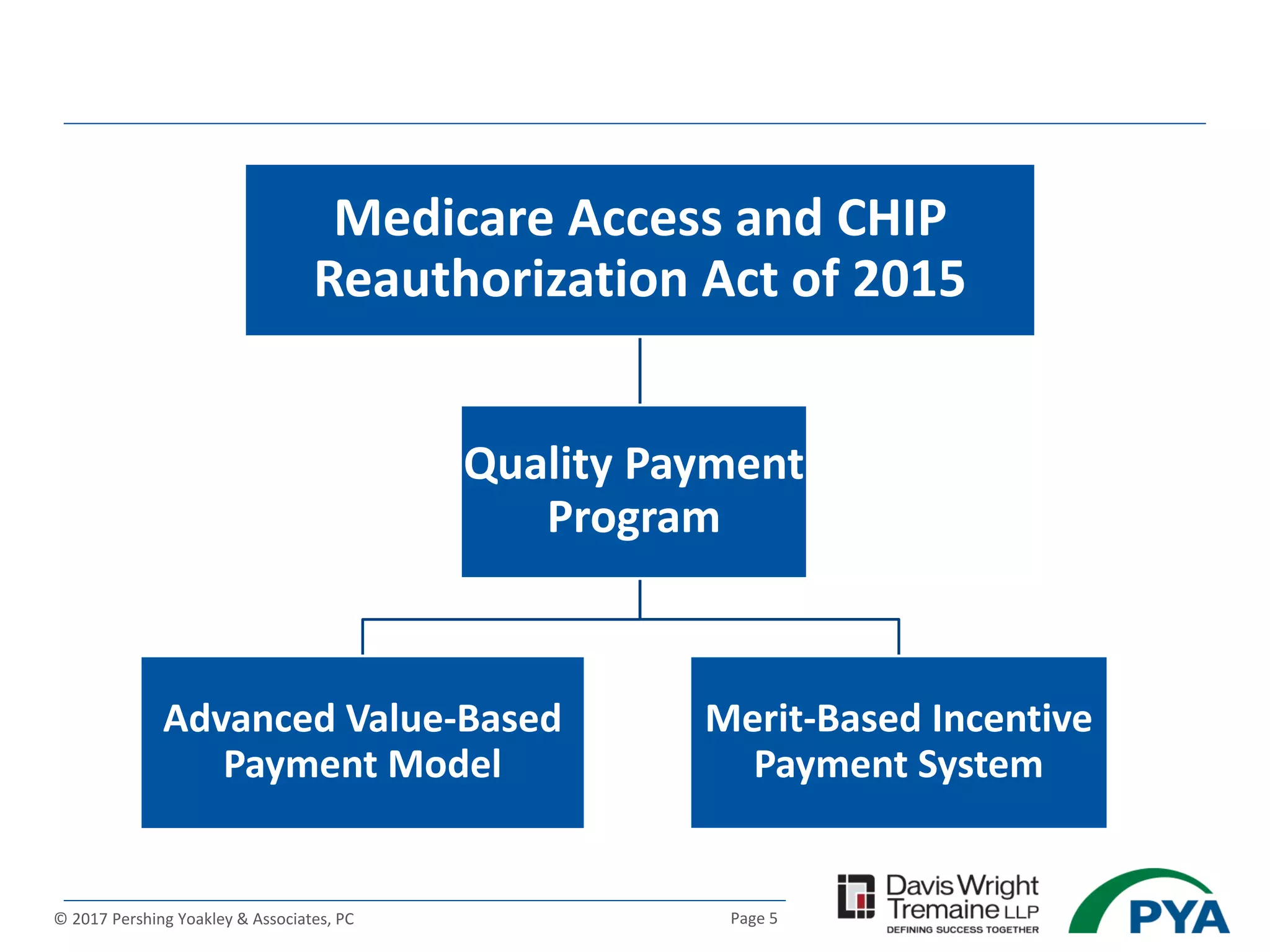
Medicare Access and CHIP
Reauthorization Act of 2015
Advanced Value-Based
Payment Model
Merit-Based Incentive
Payment System
Quality Payment
Program
Page 6© 2017 Pershing Yoakley & Associates, PC
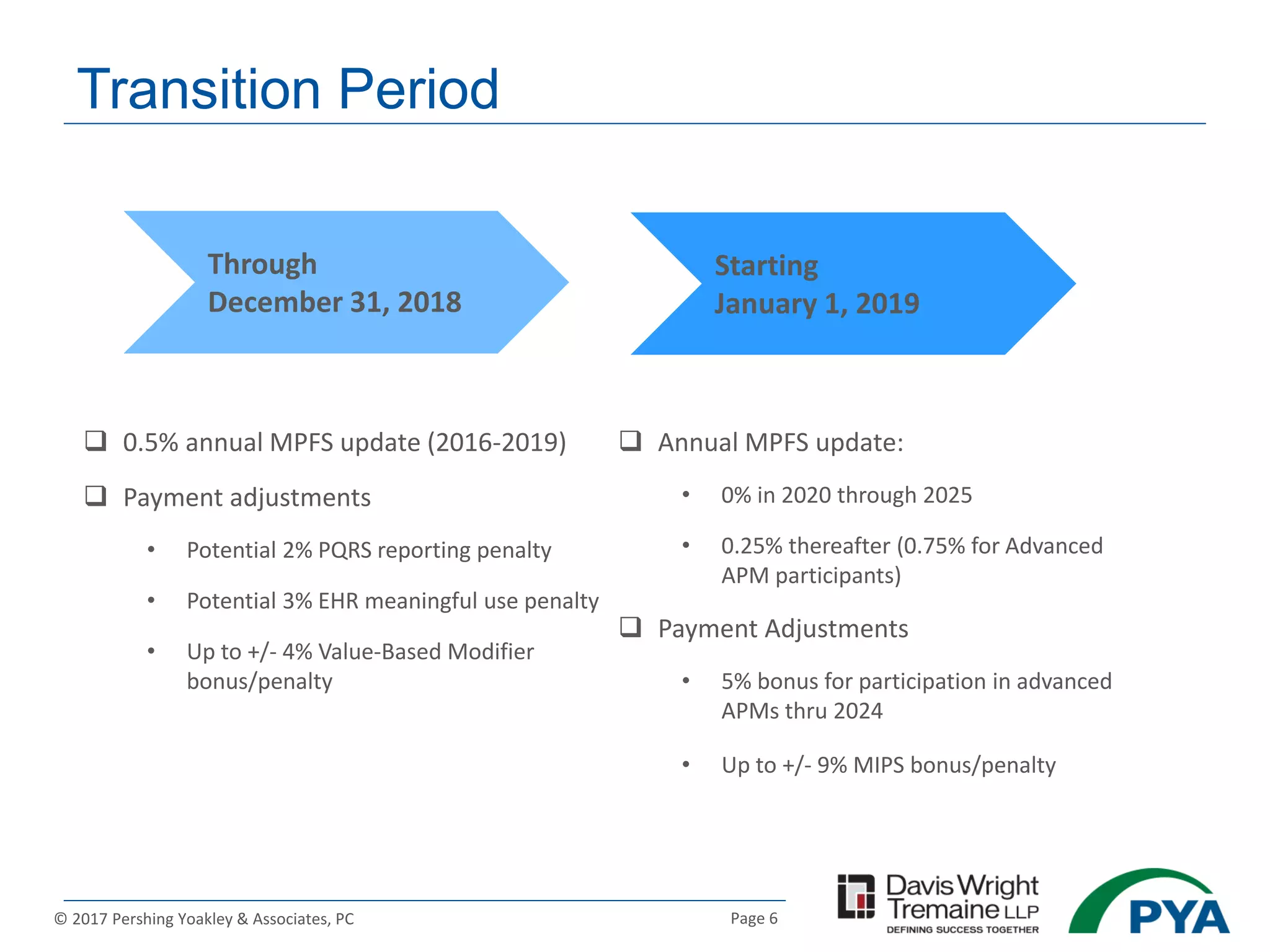
Transition Period
Through
December 31, 2018
Starting
January 1, 2019
 0.5% annual MPFS update (2016-2019)
 Payment adjustments
• Potential 2% PQRS reporting penalty
• Potential 3% EHR meaningful use penalty
• Up to +/- 4% Value-Based Modifier
bonus/penalty
 Annual MPFS update:
• 0% in 2020 through 2025
• 0.25% thereafter (0.75% for Advanced
APM participants)
 Payment Adjustments
• 5% bonus for participation in advanced
APMs thru 2024
• Up to +/- 9% MIPS bonus/penalty
Page 7© 2017 Pershing Yoakley & Associates, PC
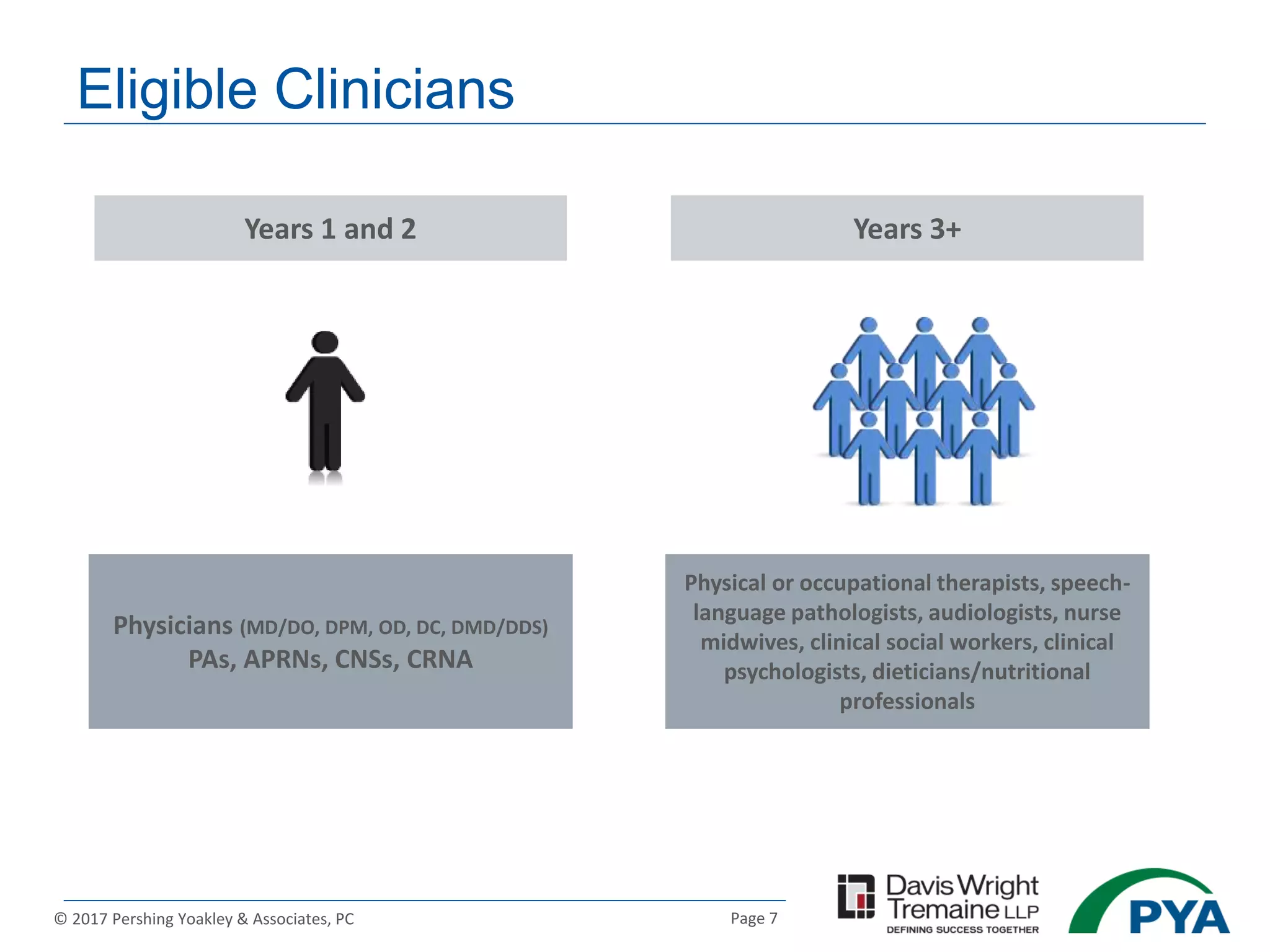
Years 1 and 2 Years 3+
Physicians (MD/DO, DPM, OD, DC, DMD/DDS)
PAs, APRNs, CNSs, CRNA
Physical or occupational therapists, speech-
language pathologists, audiologists, nurse
midwives, clinical social workers, clinical
psychologists, dieticians/nutritional
professionals
Eligible Clinicians
Advanced VBMs
Page 9© 2017 Pershing Yoakley & Associates, PC
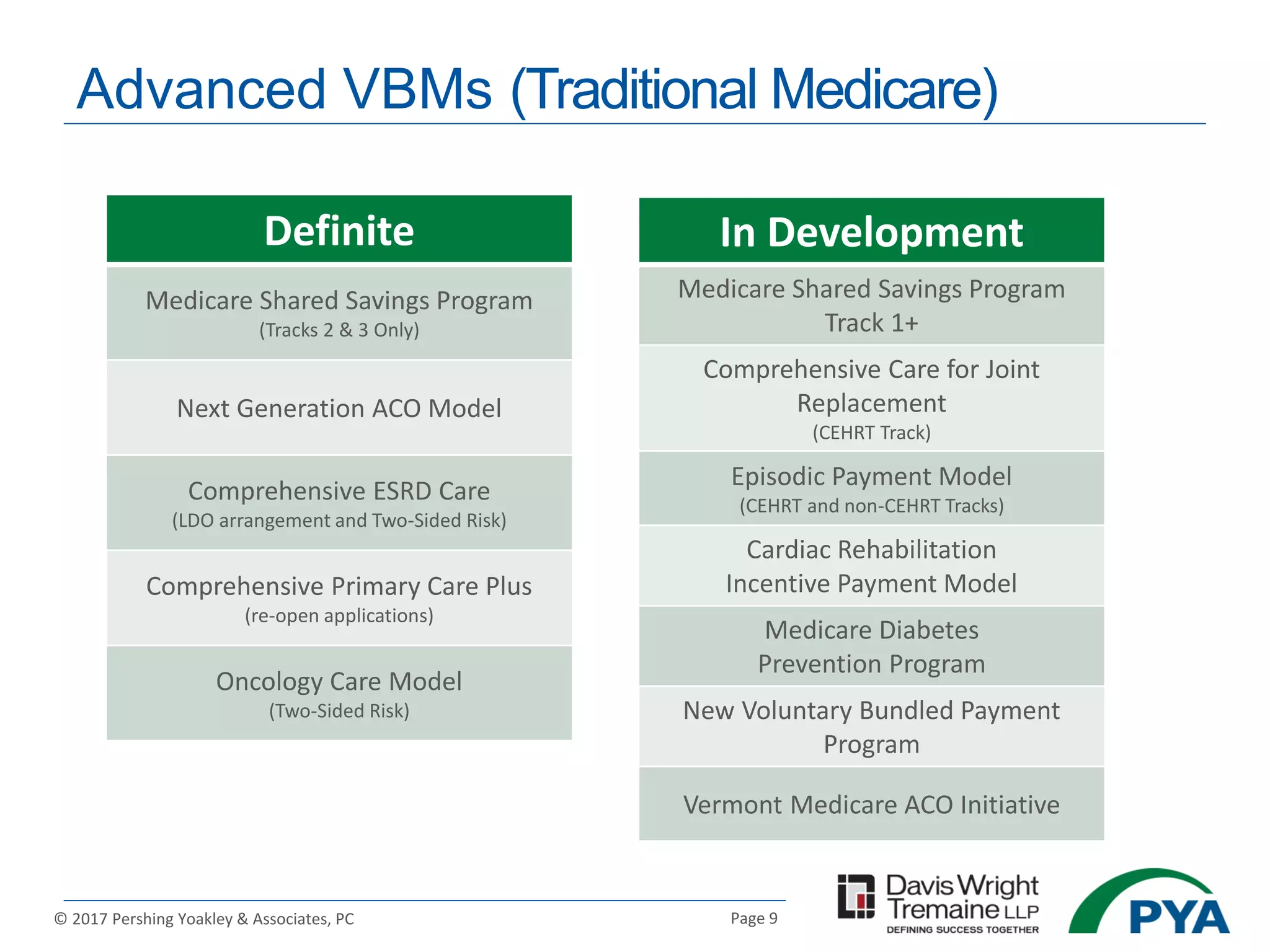
Advanced VBMs (Traditional Medicare)
Definite
Medicare Shared Savings Program
(Tracks 2 & 3 Only)
Next Generation ACO Model
Comprehensive ESRD Care
(LDO arrangement and Two-Sided Risk)
Comprehensive Primary Care Plus
(re-open applications)
Oncology Care Model
(Two-Sided Risk)
In Development
Medicare Shared Savings Program
Track 1+
Comprehensive Care for Joint
Replacement
(CEHRT Track)
Episodic Payment Model
(CEHRT and non-CEHRT Tracks)
Cardiac Rehabilitation
Incentive Payment Model
Medicare Diabetes
Prevention Program
New Voluntary Bundled Payment
Program
Vermont Medicare ACO Initiative
Page 10© 2017 Pershing Yoakley & Associates, PC
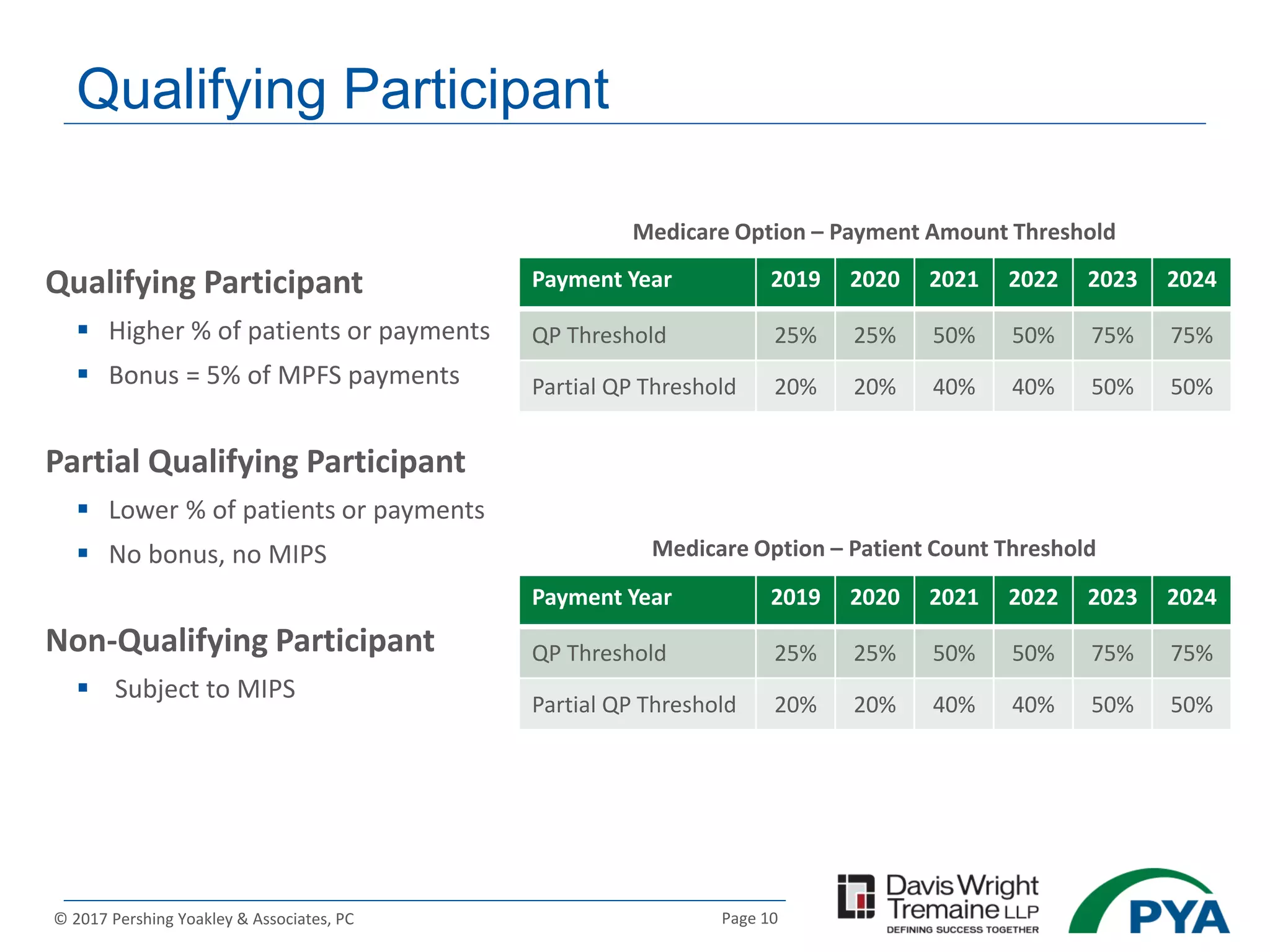
Qualifying Participant
 Higher % of patients or payments
 Bonus = 5% of MPFS payments
Partial Qualifying Participant
 Lower % of patients or payments
 No bonus, no MIPS
Non-Qualifying Participant
 Subject to MIPS
Payment Year 2019 2020 2021 2022 2023 2024
QP Threshold 25% 25% 50% 50% 75% 75%
Partial QP Threshold 20% 20% 40% 40% 50% 50%
Payment Year 2019 2020 2021 2022 2023 2024
QP Threshold 25% 25% 50% 50% 75% 75%
Partial QP Threshold 20% 20% 40% 40% 50% 50%
Medicare Option – Payment Amount Threshold
Medicare Option – Patient Count Threshold
Page 11© 2017 Pershing Yoakley & Associates, PC
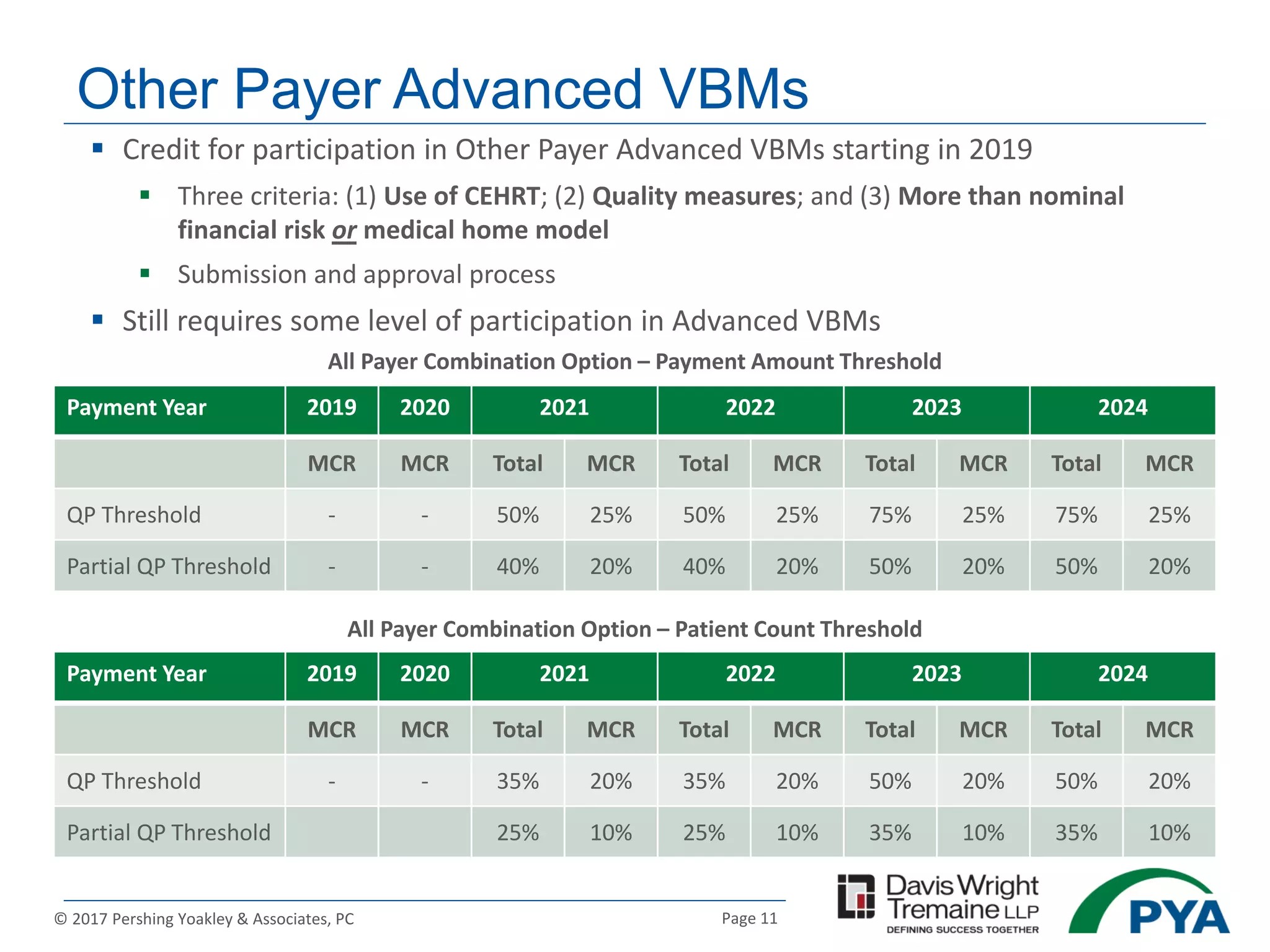
Other Payer Advanced VBMs
 Credit for participation in Other Payer Advanced VBMs starting in 2019
 Three criteria: (1) Use of CEHRT; (2) Quality measures; and (3) More than nominal
financial risk or medical home model
 Submission and approval process
 Still requires some level of participation in Advanced VBMs
Payment Year 2019 2020 2021 2022 2023 2024
MCR MCR Total MCR Total MCR Total MCR Total MCR
QP Threshold - - 50% 25% 50% 25% 75% 25% 75% 25%
Partial QP Threshold - - 40% 20% 40% 20% 50% 20% 50% 20%
Payment Year 2019 2020 2021 2022 2023 2024
MCR MCR Total MCR Total MCR Total MCR Total MCR
QP Threshold - - 35% 20% 35% 20% 50% 20% 50% 20%
Partial QP Threshold 25% 10% 25% 10% 35% 10% 35% 10%
All Payer Combination Option – Payment Amount Threshold
All Payer Combination Option – Patient Count Threshold
MIPS
Page 13© 2017 Pershing Yoakley & Associates, PC
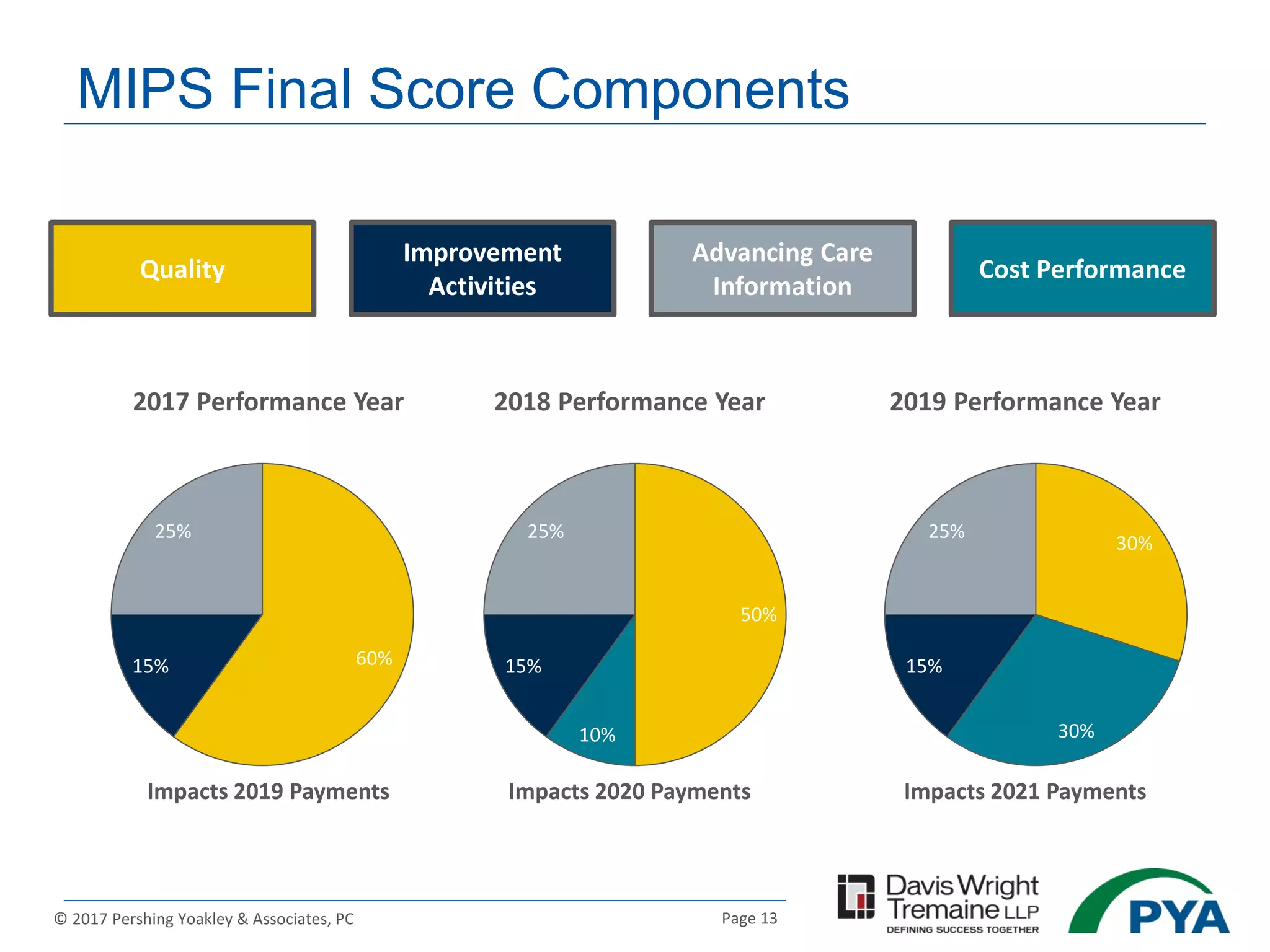
MIPS Final Score Components
Quality Cost Performance
Improvement
Activities
Advancing Care
Information
60%
0%
15%
25%
50%
10%
15%
25%
30%
30%
15%
25%
2017 Performance Year 2018 Performance Year 2019 Performance Year
Impacts 2019 Payments Impacts 2020 Payments Impacts 2021 Payments
Page 14© 2017 Pershing Yoakley & Associates, PC
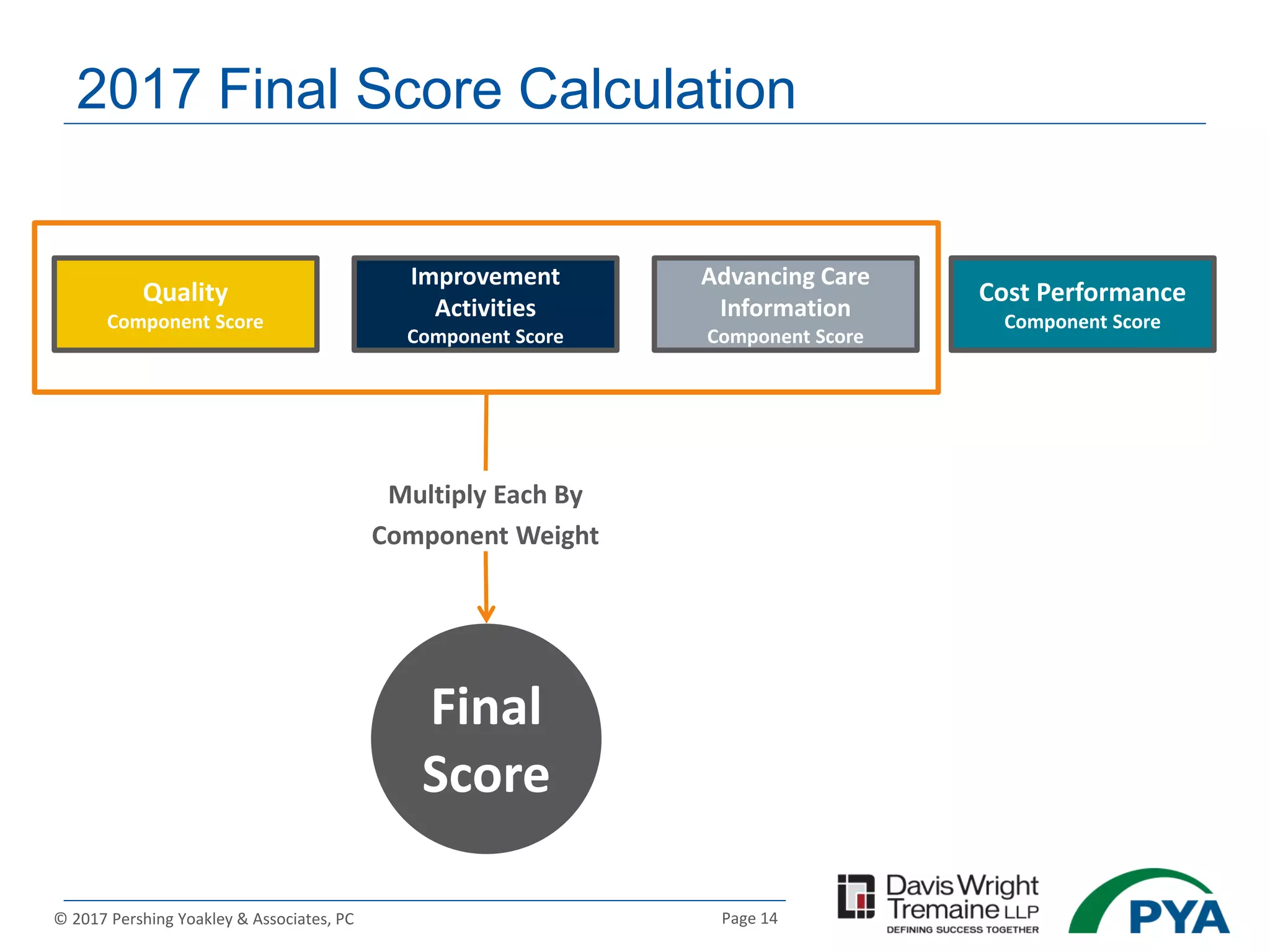
2017 Final Score Calculation
Quality
Component Score
Cost Performance
Component Score
Improvement
Activities
Component Score
Advancing Care
Information
Component Score
Multiply Each By
Component Weight
Final
Score
Page 15© 2017 Pershing Yoakley & Associates, PC
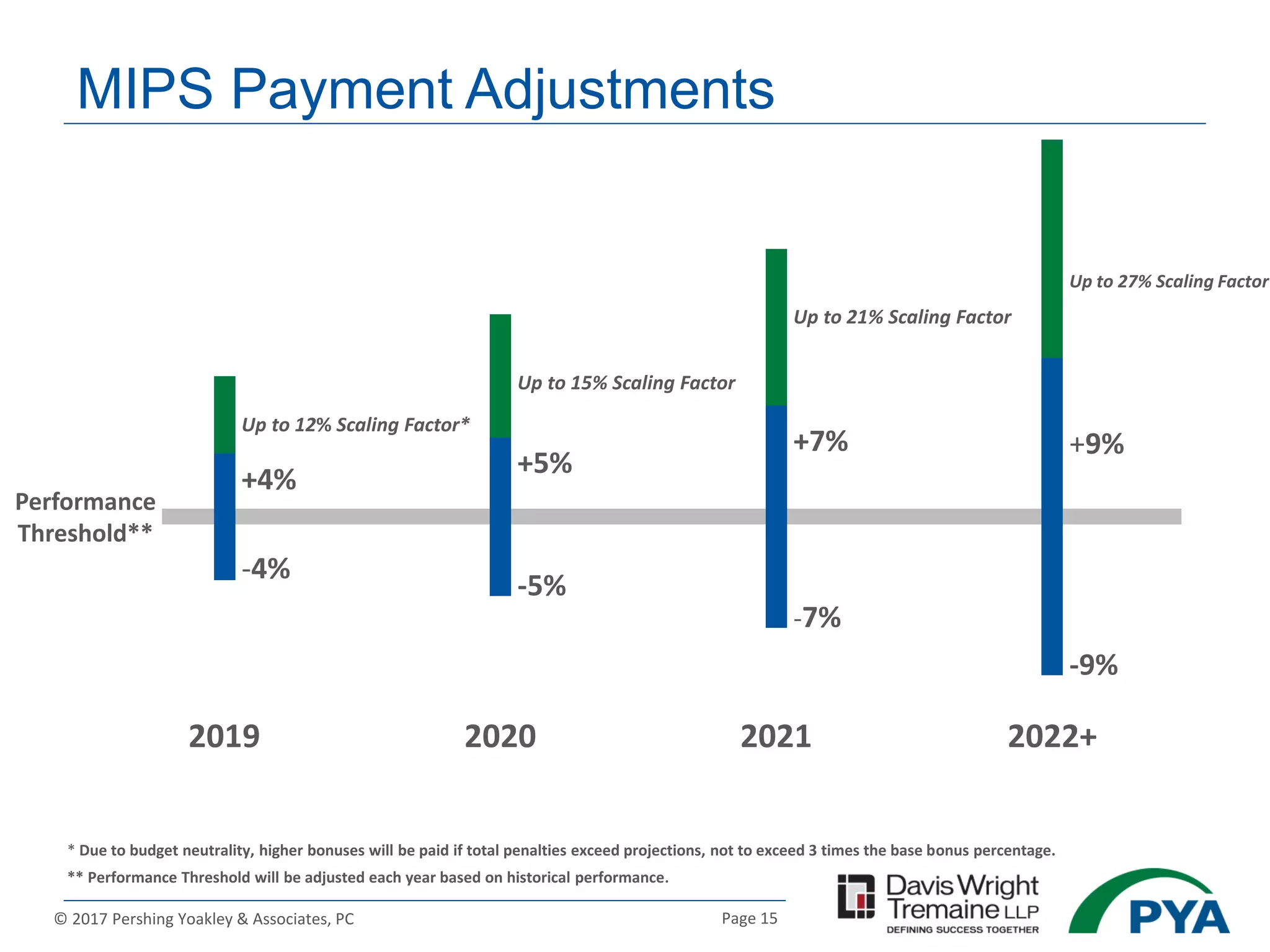
MIPS Payment Adjustments
2019 2022+2020 2021
+4%
-4%
+5%
-5%
+7%
-7%
+9%
-9%
Up to 12% Scaling Factor*
Up to 15% Scaling Factor
Up to 21% Scaling Factor
Up to 27% Scaling Factor
Performance
Threshold**
* Due to budget neutrality, higher bonuses will be paid if total penalties exceed projections, not to exceed 3 times the base bonus percentage.
** Performance Threshold will be adjusted each year based on historical performance.
Page 16© 2017 Pershing Yoakley & Associates, PC
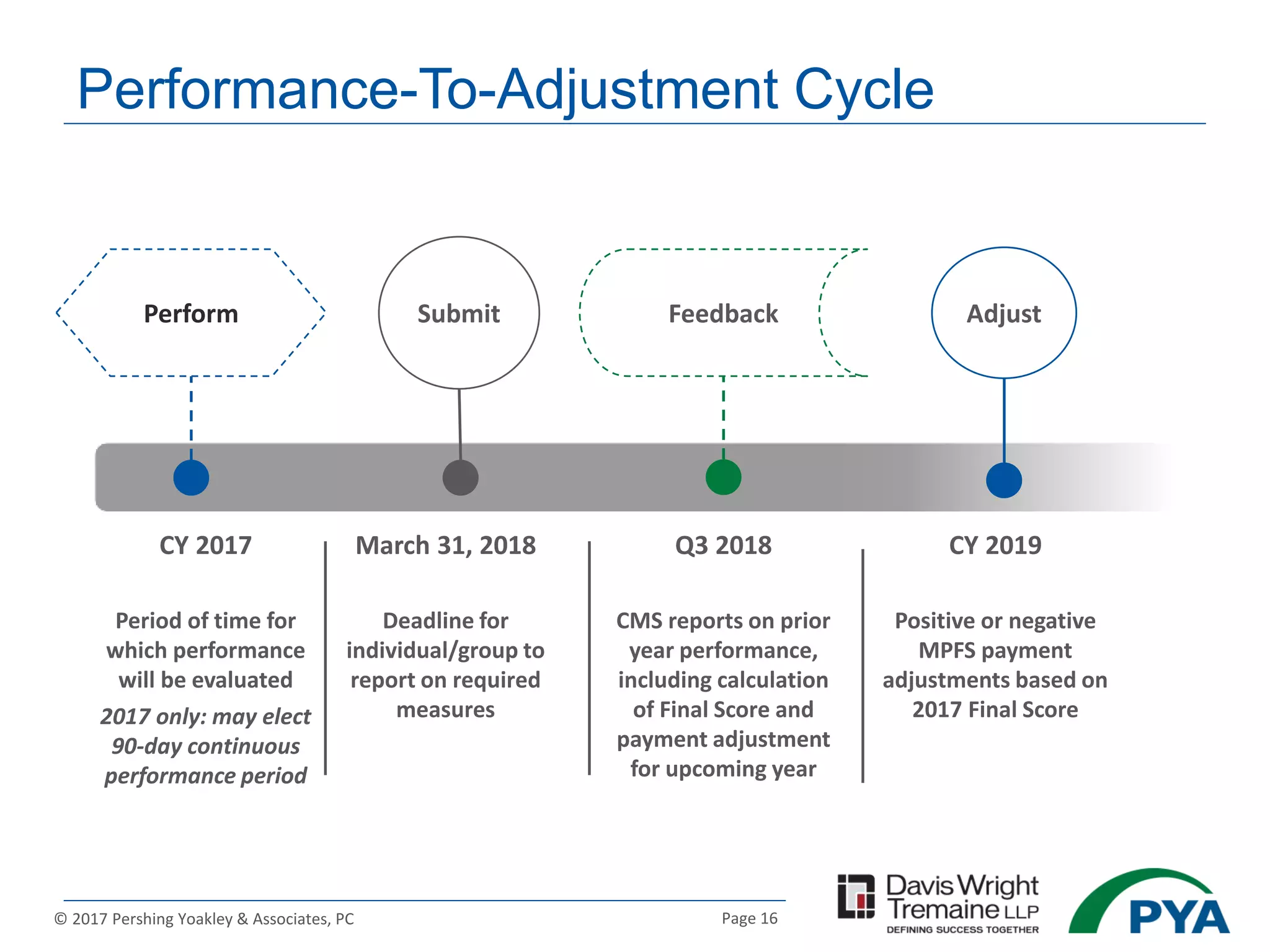
March 31, 2018
Deadline for
individual/group to
report on required
measures
Performance-To-Adjustment Cycle
Perform Submit AdjustFeedback
CY 2017
Period of time for
which performance
will be evaluated
2017 only: may elect
90-day continuous
performance period
Q3 2018
CMS reports on prior
year performance,
including calculation
of Final Score and
payment adjustment
for upcoming year
CY 2019
Positive or negative
MPFS payment
adjustments based on
2017 Final Score
Page 17© 2017 Pershing Yoakley & Associates, PC
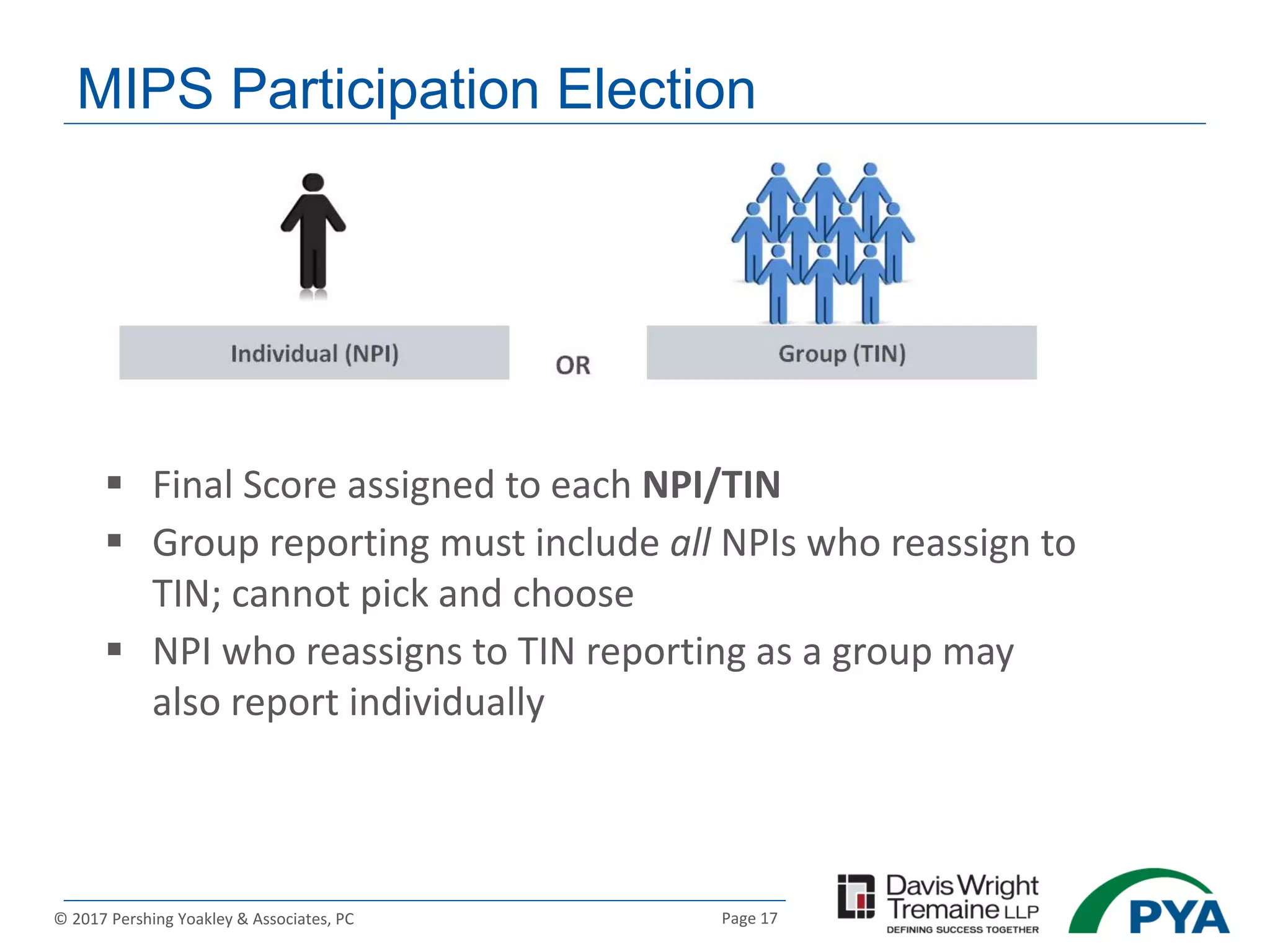
MIPS Participation Election
 Final Score assigned to each NPI/TIN
 Group reporting must include all NPIs who reassign to
TIN; cannot pick and choose
 NPI who reassigns to TIN reporting as a group may
also report individually
Page 18© 2017 Pershing Yoakley & Associates, PC
Low-Volume Threshold
 For 2017, individual or group exempt from MIPS if:
 $30,000 or less in allowable Part B charges; or
 See 100 or fewer traditional Medicare beneficiaries
 If elect group reporting, NPIs who would be exempt if
reporting individually are NOT exempt
 Two determination periods (both with 60-day claims run-out)
 September 1, 2015, to August 31, 2016
 September 1, 2016, to August 31, 2017
Page 19© 2017 Pershing Yoakley & Associates, PC
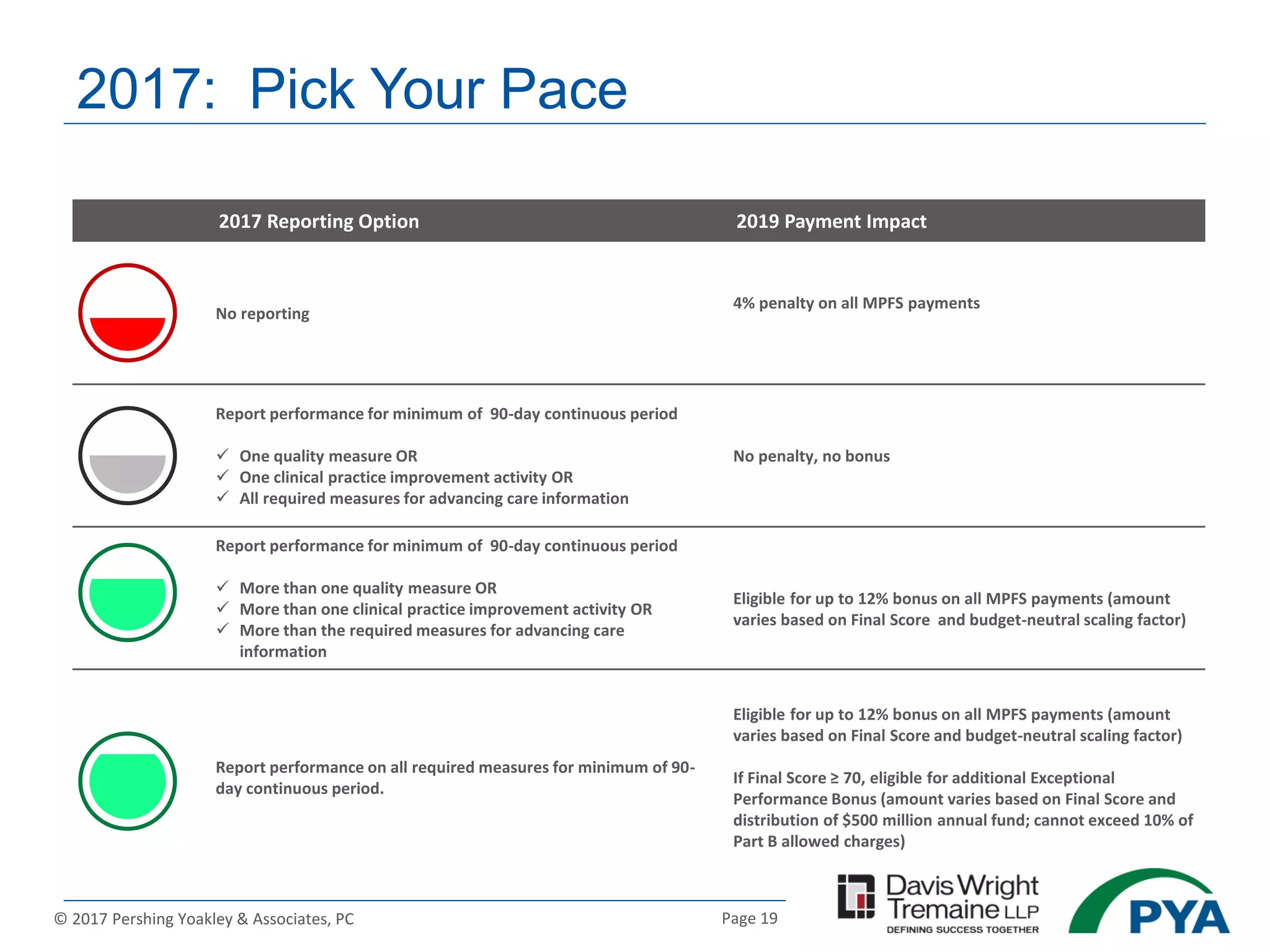
2017: Pick Your Pace
2017 Reporting Option 2019 Payment Impact
No reporting
4% penalty on all MPFS payments
Report performance for minimum of 90-day continuous period
 One quality measure OR
 One clinical practice improvement activity OR
 All required measures for advancing care information
No penalty, no bonus
Report performance for minimum of 90-day continuous period
 More than one quality measure OR
 More than one clinical practice improvement activity OR
 More than the required measures for advancing care
information
Eligible for up to 12% bonus on all MPFS payments (amount
varies based on Final Score and budget-neutral scaling factor)
Report performance on all required measures for minimum of 90-
day continuous period.
Eligible for up to 12% bonus on all MPFS payments (amount
varies based on Final Score and budget-neutral scaling factor)
If Final Score ≥ 70, eligible for additional Exceptional
Performance Bonus (amount varies based on Final Score and
distribution of $500 million annual fund; cannot exceed 10% of
Part B allowed charges)
Application of Fraud and Abuse Laws and
IRS Rules to Value Based Payments
Page 21© 2017 Pershing Yoakley & Associates, PC
Legal Framework
 The federal Physician Self-Referral Prohibition
42 U.S.C. §1395nn
 Anti-Kickback Statute - 42 U.S.C. §1320a-7b(b)
 Civil Money Penalty Gainsharing Prohibition
 Internal Revenue Code prohibition on Private Benefit/ Private
Inurement
 Government’s arguments and court opinions addressing the
Stark Law are redefining the rules and changing the risk analysis
21
Page 22© 2017 Pershing Yoakley & Associates, PC
Legal Framework: Value-Based Payments
 Stark--generally the threshold issue in analysis of physician
compensation
 Generally speaking if comp passes muster under Stark, the AKS
risks should be relatively modest
 Civil Money Penalty Gainsharing Prohibition
 Solved to a large extent by MACRA
 IRS prohibition on Private Benefit/ Private Inurement
 Applies only to tax-exempt organizations
 Stark compliance relevant, but not the end of the analysis
 Note, IRS has its own definition of FMV
 IRS analysis is more principled and more logical than Stark
 Relationship of payments to Exempt Organization’s Mission is
important
22
Page 23© 2017 Pershing Yoakley & Associates, PC
Stark Analysis Should Be Undertaken If:
 An entity directly or indirectly exchanges remuneration with a
physician who refers Medicare patients to the entity for
designated health services
 Key terms:
 Entity
 Remuneration
 Referral
 DHS
 Value-Based Payments almost always trigger need for Stark
Analysis
23
Page 24© 2017 Pershing Yoakley & Associates, PC
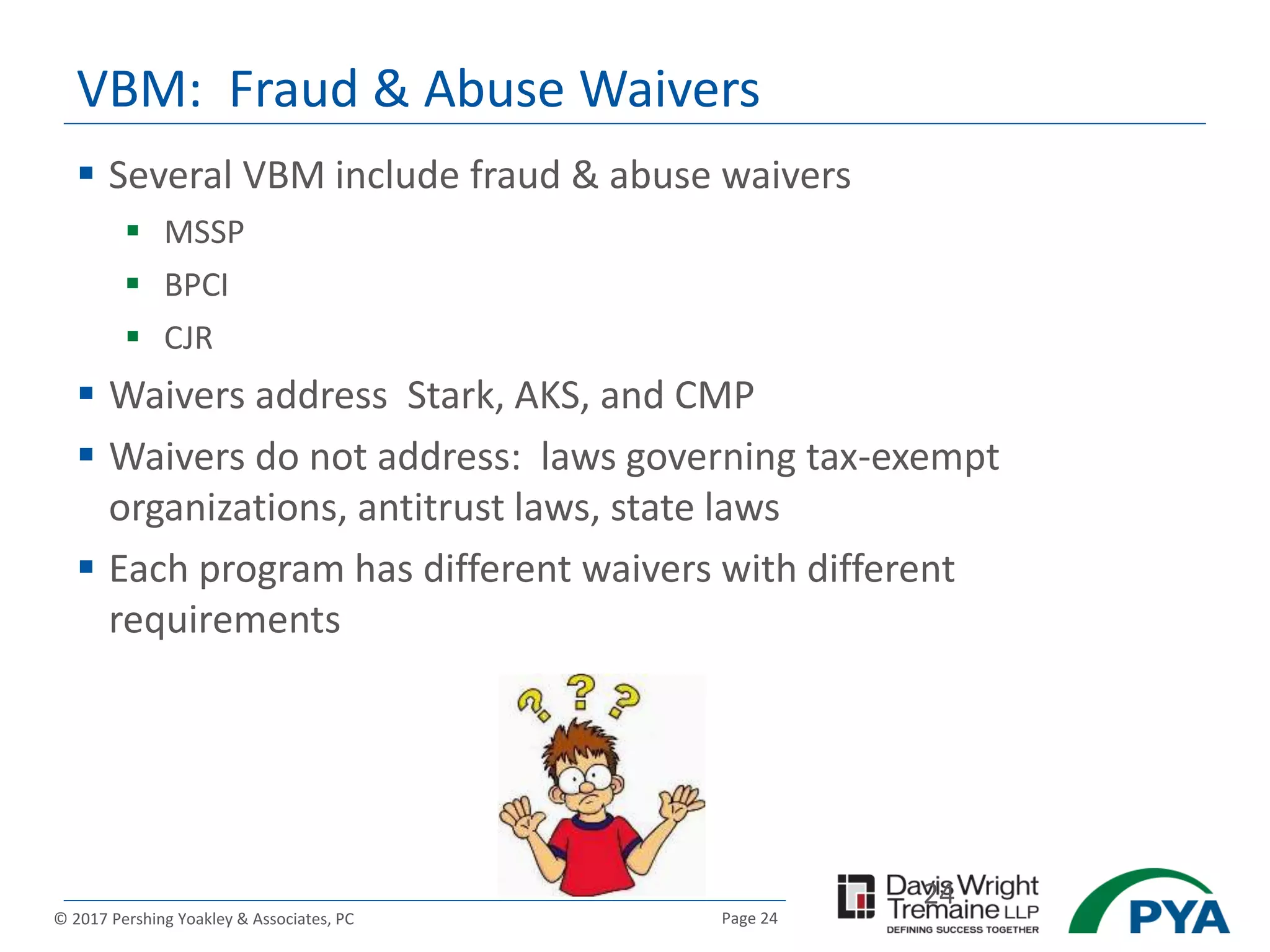
VBM: Fraud & Abuse Waivers
 Several VBM include fraud & abuse waivers
 MSSP
 BPCI
 CJR
 Waivers address Stark, AKS, and CMP
 Waivers do not address: laws governing tax-exempt
organizations, antitrust laws, state laws
 Each program has different waivers with different
requirements
24
Page 25© 2017 Pershing Yoakley & Associates, PC
MSSP Waivers
 Five fraud and abuse waivers
 ACA sec. 3022 authority
 Pay attention to the safeguards
 Key concepts include:
 Governance/accountability
 Reasonably related to MSSP purposes
 Governing body finding
 Transparency
 Website disclosure
 MSSP waivers very broad, user friendly
Page 26© 2017 Pershing Yoakley & Associates, PC
Other Program Waivers
26
 The Bundled Payments for Care Improvement (BPCI) initiative
 Voluntary Program– 4 Models
 Each model has its own F&A Waiver
 Not user friendly
 Comprehensive Joint Replacement Program (CJR)
 Mandatory bundled payment program for hospitals located in selected
zip codes
 3 waivers set forth in Separate Notice from OIG and CMS
 Each waiver protects only those arrangements that meet all of the
applicable regulatory requirements
 Not user friendly
Page 27© 2017 Pershing Yoakley & Associates, PC
 If a hospital makes a valued-based payment that fits within an F&A
waiver to a physician, that payment does not have to comply with a
Stark exception and is immune from AKS prosecution even if it is
not within an AKS safe harbor
 Thus, value-based payments made pursuant to a waiver are not
subject to Stark/AKS FMV or Commercial Reasonableness tests,
because no need for an exception/safe harbor
 But if a physician receives other payments that implicate Stark
his/her financial relationship with the payer entity must fit within
an exception
• Are value-based payments protected by a waiver considered when
analyzing overall compensation the physician receives under either a
hospital employment agreement or services contract?
• Should waiver-protected payments be taken into account in a
“stacking” analysis?
Value-Based Compensation Paid Under Waiver
Page 28© 2017 Pershing Yoakley & Associates, PC
 Strong argument can be made that waiver-protected payments
should not be considered when assessing FMV or CR for purposes
of Stark/AKS
• If CMS intended to apply some type of FMV and CR assessment, it
would have included that in the requirements of the waiver
 Others argue waiver-protected payments can be considered but
that the final result is the same because they increase FMV and CR
 CAUTION: Waivers are the exception, not the rule
• Value-based reimbursement that is not protected by an F&A waiver
must be considered in FMV and CR assessment of physician
compensation
• MIPS payments, commercial gainsharing, etc., would be included
when evaluating overall compensation paid to an employed or
contracted physician
FMV and CR (cont.)
Page 29© 2017 Pershing Yoakley & Associates, PC
 Tax-Exempt Organization: Private Inurement Analysis
• IRS guidance on MSSP
• Notice 2011-20 summarizes how the IRS expects federal tax law to
apply to tax-exempt hospitals and health systems participating in
the Medicare Shared Savings Program
(https://www.irs.gov/pub/irs-drop/n-11-20.pdf)
• Generally positive, but notice indicates arrangements between
ACO and ACO participants should be FMV
 Other value-based reimbursement payments appear to be subject
to private inurement prohibition
• Whether the payments are FMV and CR is relevant to the analysis
Tax-Exempt Organizations: FMV and CR
Page 30© 2017 Pershing Yoakley & Associates, PC
Stark Exceptions: Value-Based Payments
 Risk Sharing Exception
 Indirect Compensation Arrangement Exception
 Group Practice/In-Office Ancillary Services Exception
 Personal Services Arrangement/FMV Exceptions
 Employment Exception
30
Page 31© 2017 Pershing Yoakley & Associates, PC 31
Risk-Sharing Exception
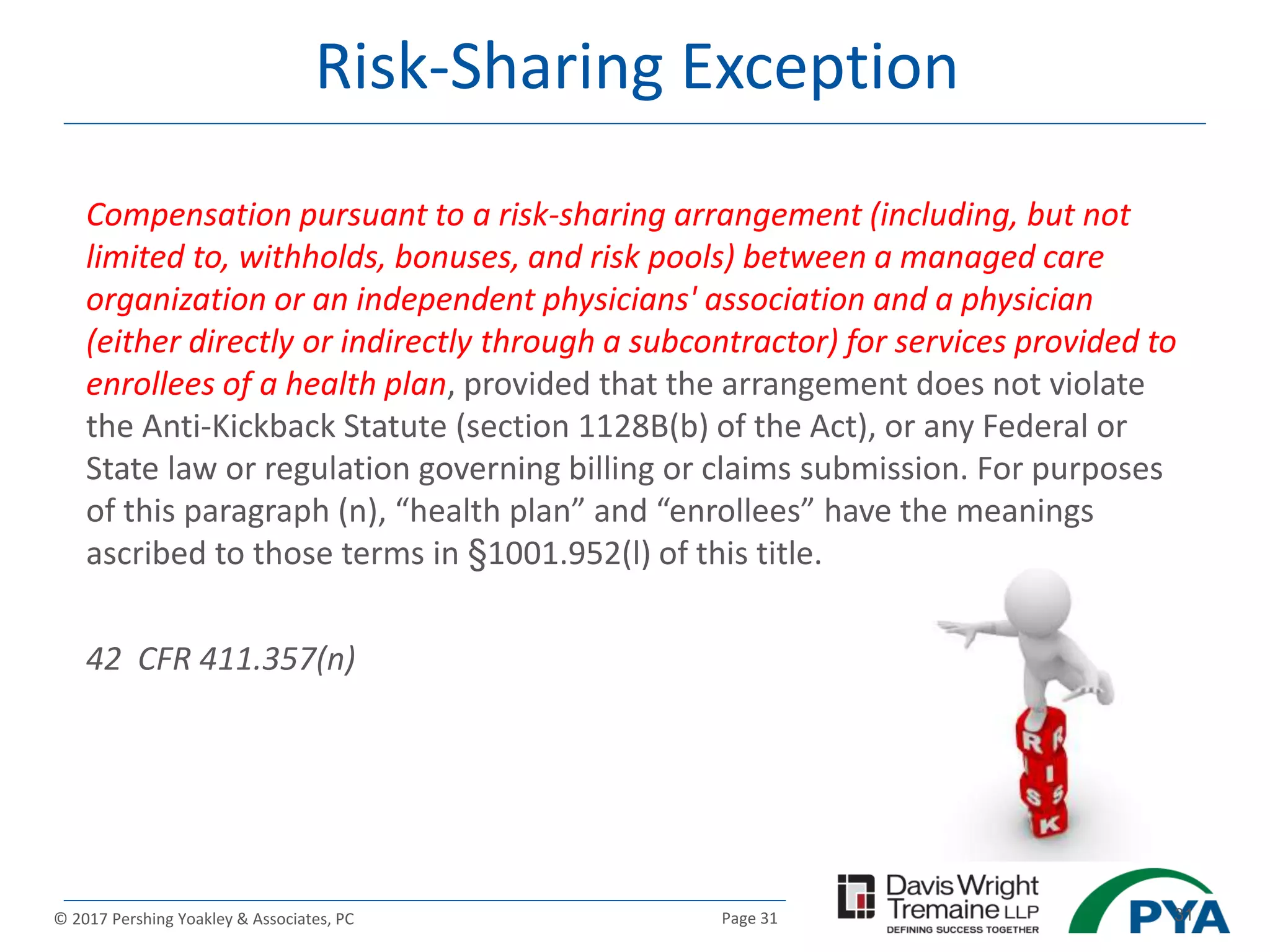
Compensation pursuant to a risk-sharing arrangement (including, but not
limited to, withholds, bonuses, and risk pools) between a managed care
organization or an independent physicians' association and a physician
(either directly or indirectly through a subcontractor) for services provided to
enrollees of a health plan, provided that the arrangement does not violate
the Anti-Kickback Statute (section 1128B(b) of the Act), or any Federal or
State law or regulation governing billing or claims submission. For purposes
of this paragraph (n), “health plan” and “enrollees” have the meanings
ascribed to those terms in §1001.952(l) of this title.
42 CFR 411.357(n)
Page 32© 2017 Pershing Yoakley & Associates, PC 32
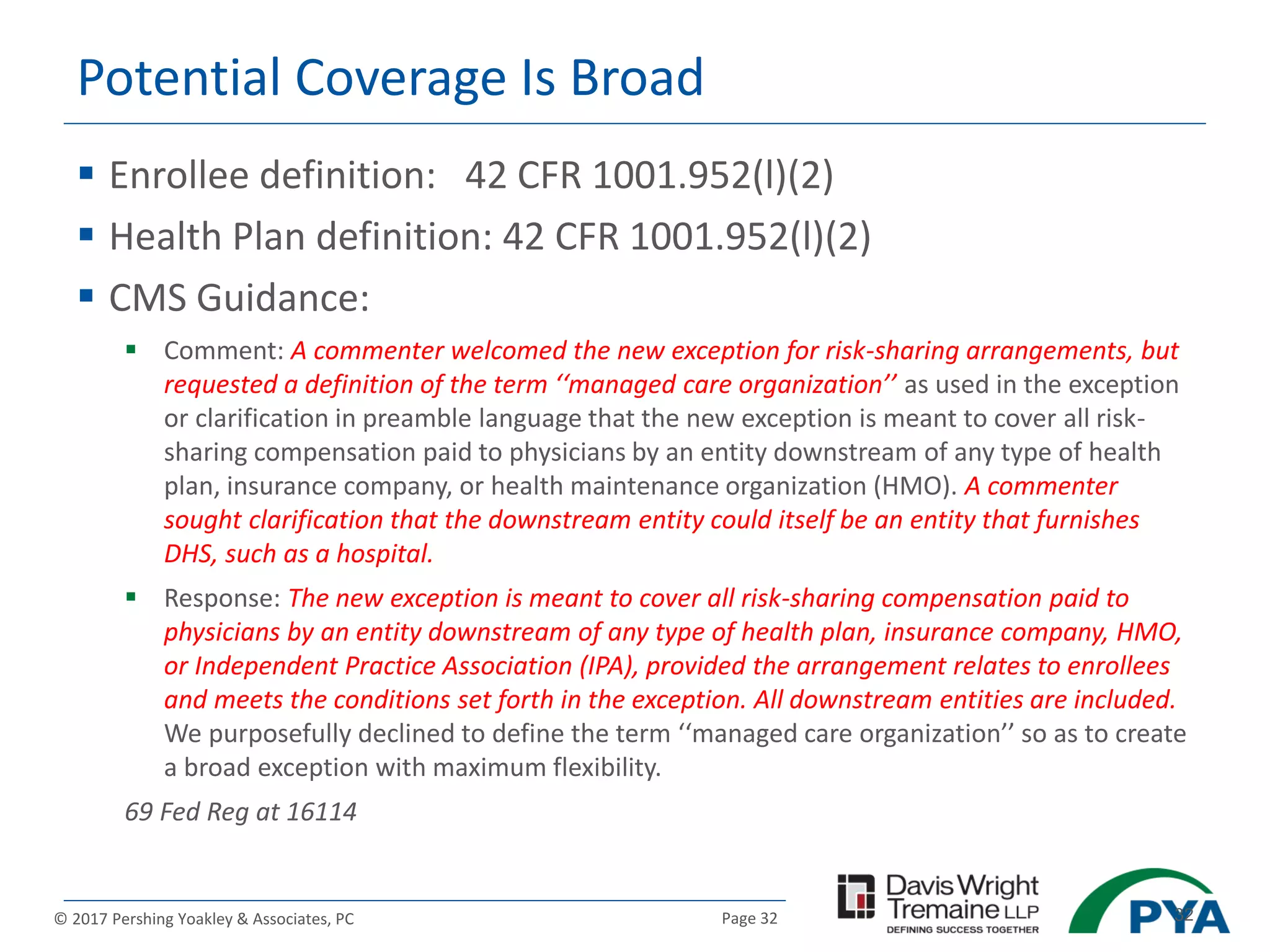
Potential Coverage Is Broad
 Enrollee definition: 42 CFR 1001.952(l)(2)
 Health Plan definition: 42 CFR 1001.952(l)(2)
 CMS Guidance:
 Comment: A commenter welcomed the new exception for risk-sharing arrangements, but
requested a definition of the term ‘‘managed care organization’’ as used in the exception
or clarification in preamble language that the new exception is meant to cover all risk-
sharing compensation paid to physicians by an entity downstream of any type of health
plan, insurance company, or health maintenance organization (HMO). A commenter
sought clarification that the downstream entity could itself be an entity that furnishes
DHS, such as a hospital.
 Response: The new exception is meant to cover all risk-sharing compensation paid to
physicians by an entity downstream of any type of health plan, insurance company, HMO,
or Independent Practice Association (IPA), provided the arrangement relates to enrollees
and meets the conditions set forth in the exception. All downstream entities are included.
We purposefully declined to define the term ‘‘managed care organization’’ so as to create
a broad exception with maximum flexibility.
69 Fed Reg at 16114
Page 33© 2017 Pershing Yoakley & Associates, PC 33
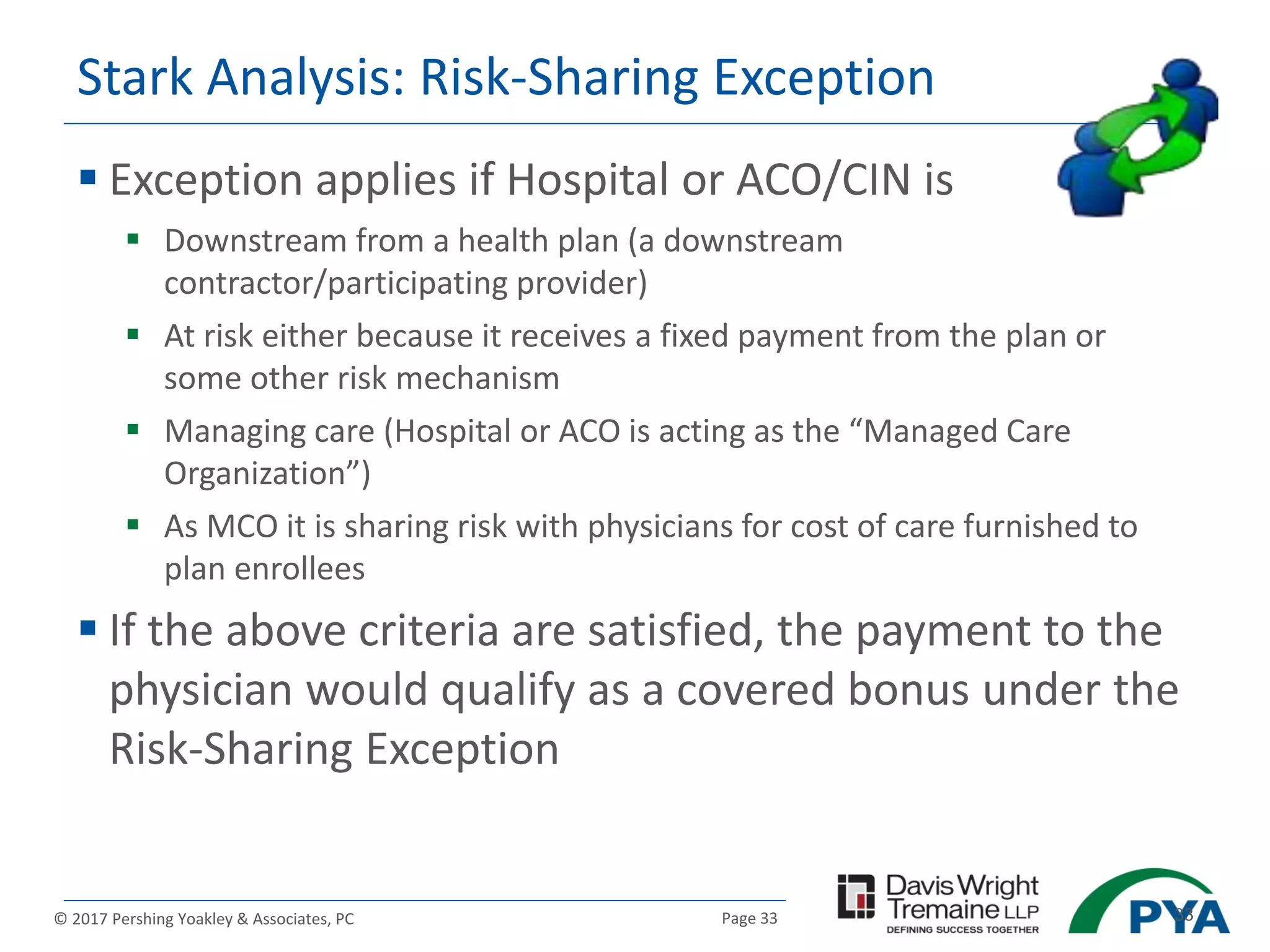
Stark Analysis: Risk-Sharing Exception
 Exception applies if Hospital or ACO/CIN is
 Downstream from a health plan (a downstream
contractor/participating provider)
 At risk either because it receives a fixed payment from the plan or
some other risk mechanism
 Managing care (Hospital or ACO is acting as the “Managed Care
Organization”)
 As MCO it is sharing risk with physicians for cost of care furnished to
plan enrollees
 If the above criteria are satisfied, the payment to the
physician would qualify as a covered bonus under the
Risk-Sharing Exception
Page 34© 2017 Pershing Yoakley & Associates, PC 34
Risk-Sharing Exception
 Pros:
 NO FMV requirement
 NO Commercial Reasonableness requirement
 NO limitation on payments based on v/v
 Cons:
 Only available when Hospital or ACO/CIN acting as MCO downstream of
Health Plan
 Not available in Medicare FFS Context
 Open Issue: How should compensation paid pursuant to this exception
be treated in evaluation of overall compensation under an employment
or services agreement?
 IRS private inurement/private benefit issues must still be addressed
Page 35© 2017 Pershing Yoakley & Associates, PC
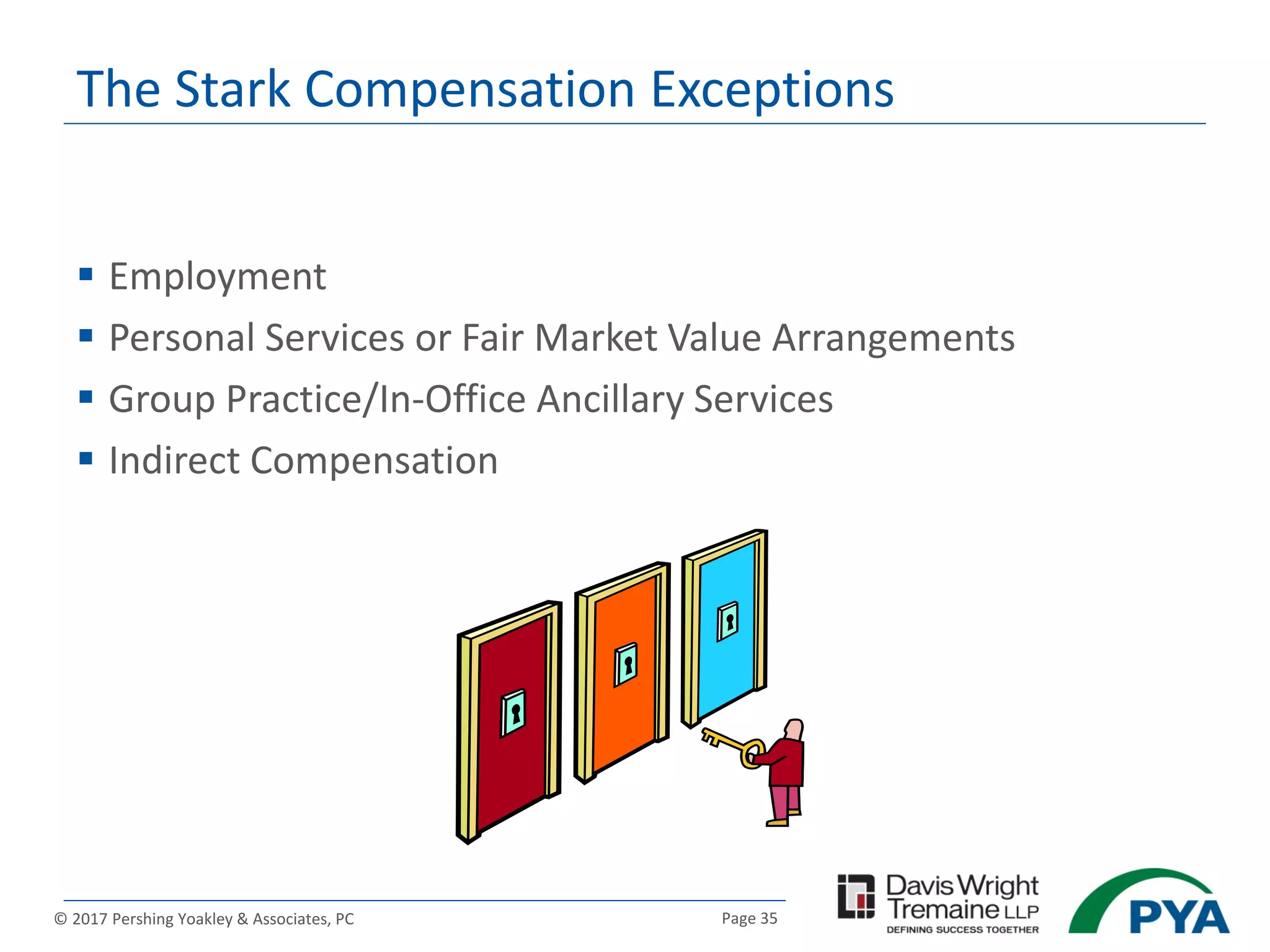
The Stark Compensation Exceptions
 Employment
 Personal Services or Fair Market Value Arrangements
 Group Practice/In-Office Ancillary Services
 Indirect Compensation
Page 36© 2017 Pershing Yoakley & Associates, PC
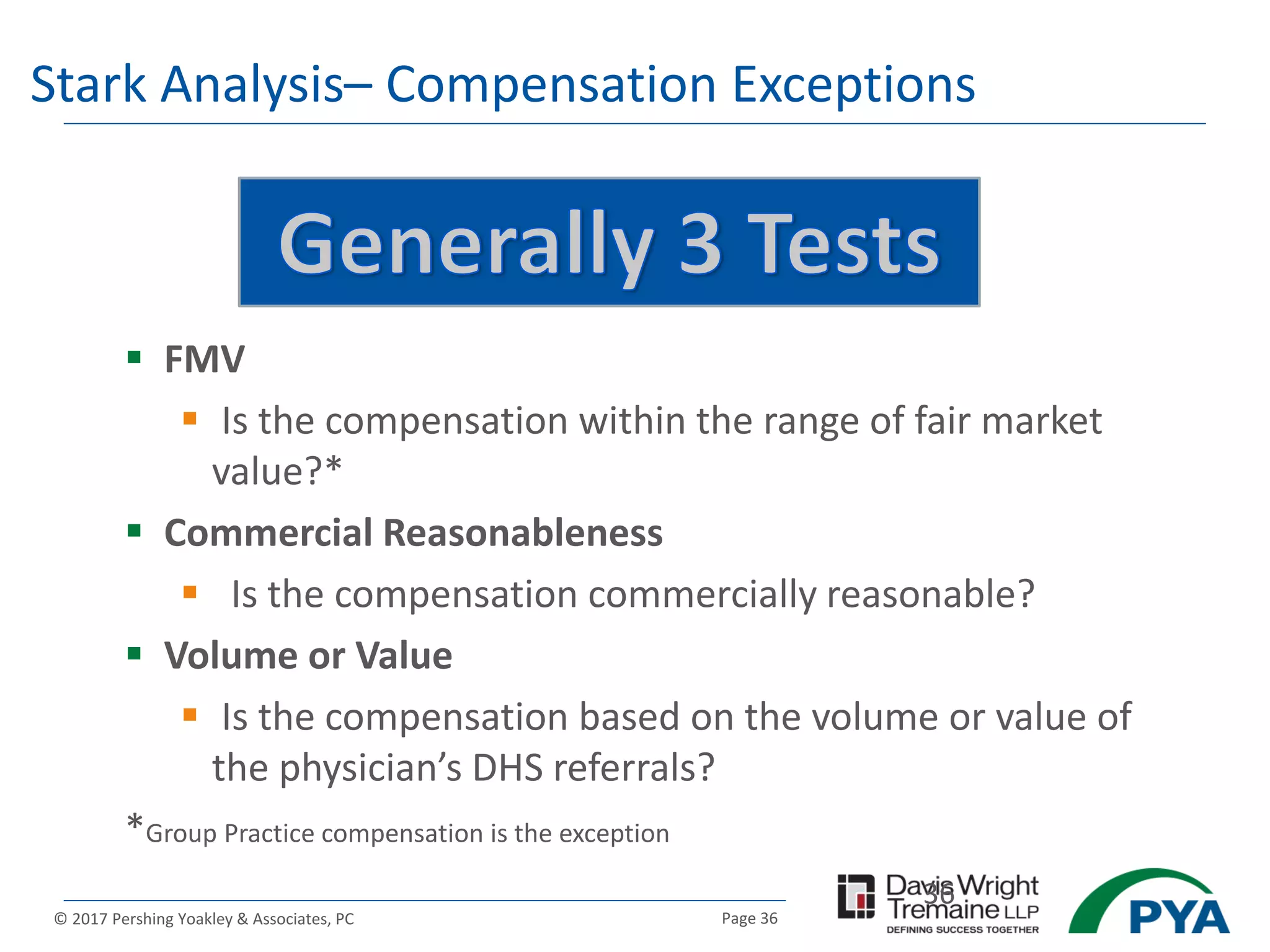
Stark Analysis– Compensation Exceptions
 FMV
 Is the compensation within the range of fair market
value?*
 Commercial Reasonableness
 Is the compensation commercially reasonable?
 Volume or Value
 Is the compensation based on the volume or value of
the physician’s DHS referrals?
*Group Practice compensation is the exception
36
Page 37© 2017 Pershing Yoakley & Associates, PC
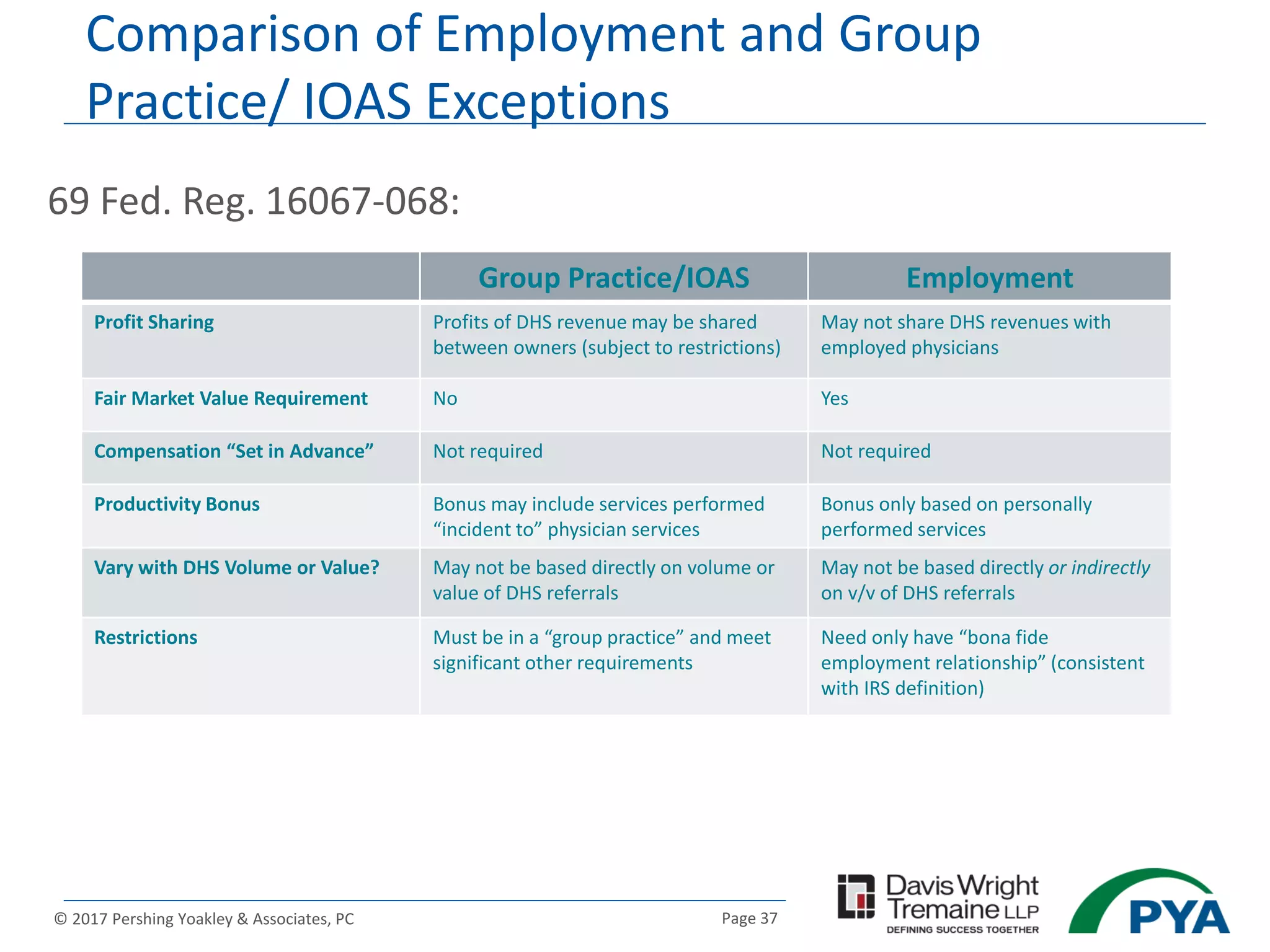
Comparison of Employment and Group
Practice/ IOAS Exceptions
69 Fed. Reg. 16067-068:
Group Practice/IOAS Employment
Profit Sharing Profits of DHS revenue may be shared
between owners (subject to restrictions)
May not share DHS revenues with
employed physicians
Fair Market Value Requirement No Yes
Compensation “Set in Advance” Not required Not required
Productivity Bonus Bonus may include services performed
“incident to” physician services
Bonus only based on personally
performed services
Vary with DHS Volume or Value? May not be based directly on volume or
value of DHS referrals
May not be based directly or indirectly
on v/v of DHS referrals
Restrictions Must be in a “group practice” and meet
significant other requirements
Need only have “bona fide
employment relationship” (consistent
with IRS definition)
Page 38© 2017 Pershing Yoakley & Associates, PC 38
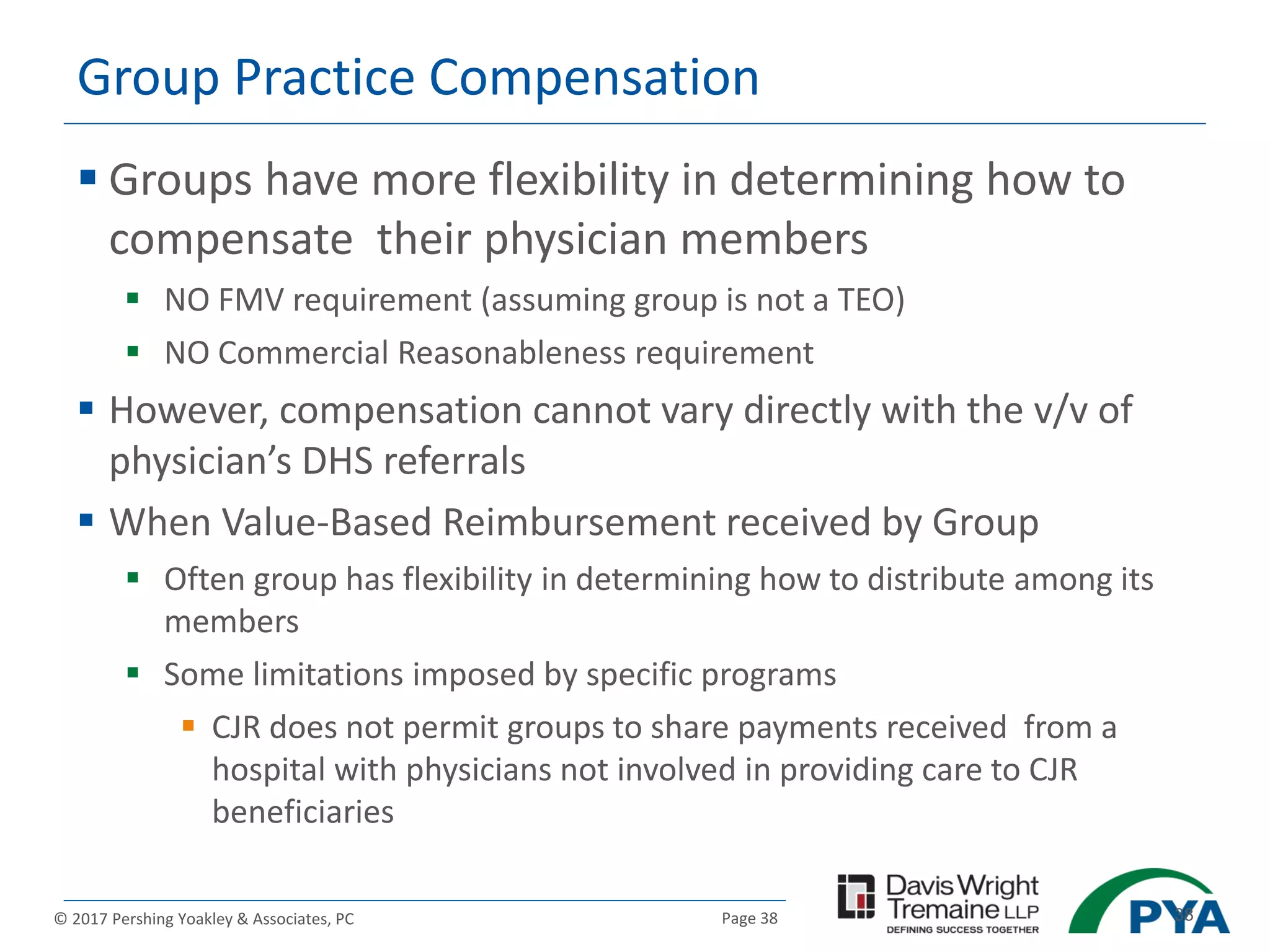
Group Practice Compensation
 Groups have more flexibility in determining how to
compensate their physician members
 NO FMV requirement (assuming group is not a TEO)
 NO Commercial Reasonableness requirement
 However, compensation cannot vary directly with the v/v of
physician’s DHS referrals
 When Value-Based Reimbursement received by Group
 Often group has flexibility in determining how to distribute among its
members
 Some limitations imposed by specific programs
 CJR does not permit groups to share payments received from a
hospital with physicians not involved in providing care to CJR
beneficiaries
Page 39© 2017 Pershing Yoakley & Associates, PC 39
Indirect Compensation Arrangements
 Indirect Compensation Arrangement:
 “Unbroken Chain” of any number of entities between physician and DHS
entity
 Compensation to physician from closest link in chain varies with, OR
OTHERWISE REFLECTS, volume or value of referrals to entity providing DHS
 Entity providing DHS has actual knowledge or acts in reckless disregard of
existence of such relationship
42 CFR 411.354(2)
 Indirect Comp Exception:
 Compensation received by MD from closest entity in the chain is FMV for
services and not determined based on v/v of referrals or other business
generated by MD for the DHS entity
 Set out in writing, signed, etc., except if employment, where must be for
identifiable services and commercially reasonable even if no referrals to
employer
 Does not violate the AKS
42 CFR 411.357(p)
Page 40© 2017 Pershing Yoakley & Associates, PC 40
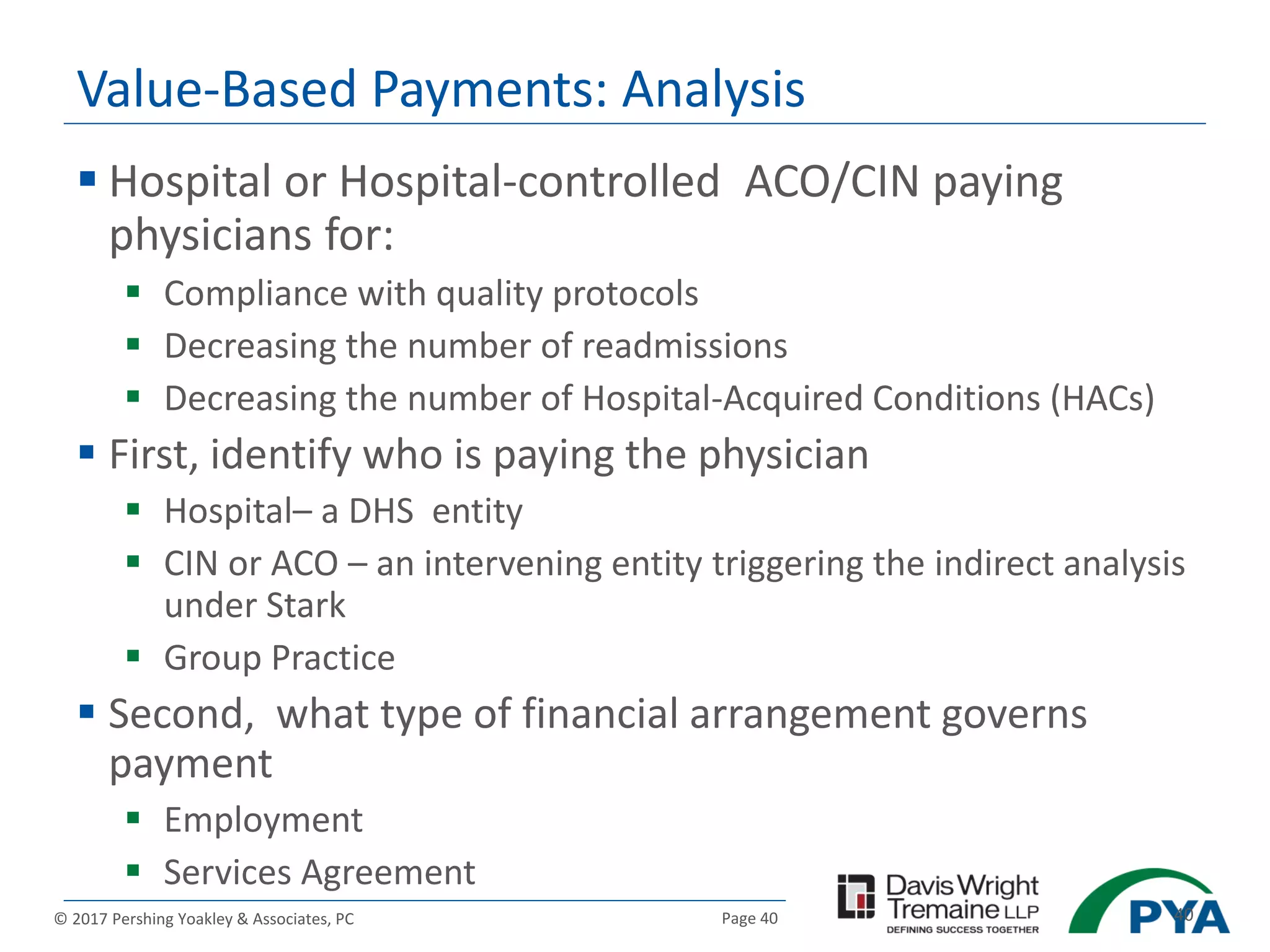
Value-Based Payments: Analysis
 Hospital or Hospital-controlled ACO/CIN paying
physicians for:
 Compliance with quality protocols
 Decreasing the number of readmissions
 Decreasing the number of Hospital-Acquired Conditions (HACs)
 First, identify who is paying the physician
 Hospital– a DHS entity
 CIN or ACO – an intervening entity triggering the indirect analysis
under Stark
 Group Practice
 Second, what type of financial arrangement governs
payment
 Employment
 Services Agreement
Page 41© 2017 Pershing Yoakley & Associates, PC 41
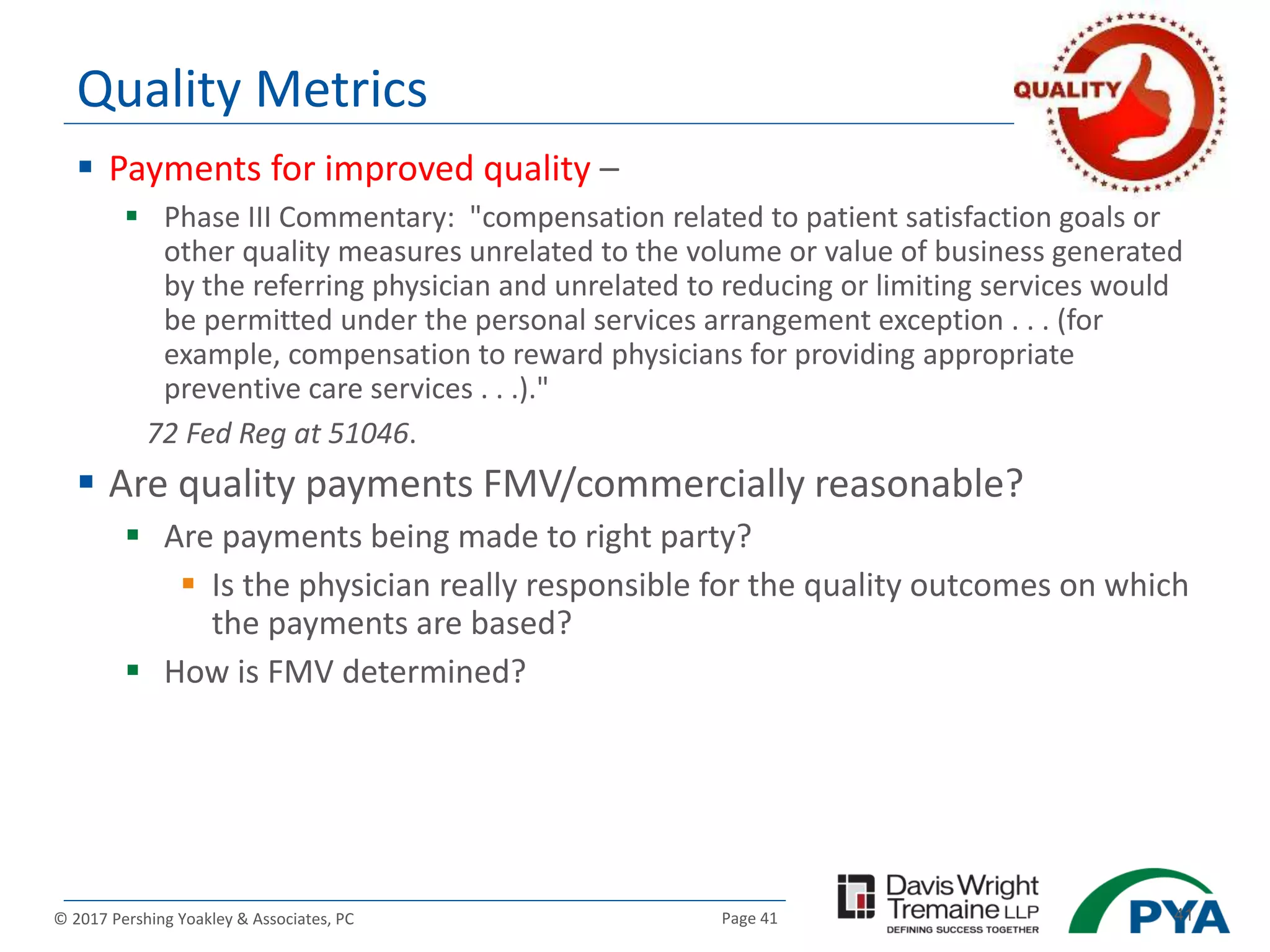
Quality Metrics
 Payments for improved quality –
 Phase III Commentary: "compensation related to patient satisfaction goals or
other quality measures unrelated to the volume or value of business generated
by the referring physician and unrelated to reducing or limiting services would
be permitted under the personal services arrangement exception . . . (for
example, compensation to reward physicians for providing appropriate
preventive care services . . .)."
72 Fed Reg at 51046.
 Are quality payments FMV/commercially reasonable?
 Are payments being made to right party?
 Is the physician really responsible for the quality outcomes on which
the payments are based?
 How is FMV determined?
Page 42© 2017 Pershing Yoakley & Associates, PC 42
Value-Based Comp
 Payment for decreasing readmissions: Are such payments
based on volume or value of referrals or other business
between the parties?
 Maybe– Maybe not
 Structure as per patient payment--- Take advantage of special rules
on compensation in Stark Regulations
 If funds flow through an ACO/CIN likely that indirect analysis would
apply
 Enables parties to take advantage of more liberal indirect
compensation arrangement exception
 FMV and Commercial Reasonableness
 Payments for decreasing HACs: Are payments based on volume
or value of referrals?
 Perhaps
 Structure as a per patient or per service payment---special rules on
compensation
 FMV and Commercial Reasonableness
Page 43© 2017 Pershing Yoakley & Associates, PC 43
Value-Based Payment Challenges
 Private Practice Physicians
 To what extent can Hospital or CIN assist an independent physician group MIPS
Quality Reporting or Meaningful Use requirements?
 When does the assistance create a financial relationship that doesn’t fit
within a Stark exception?
 When does the assistance cross the line to raise inurement issues?
 Physicians in ACO/CIN
 Is the amount paid to the group FMV and Commercially Reasonable given the
group’s role in generating the Value-Based Reimbursement?
 What about the payments to individual physicians?
 If Physicians are paid under multiple Value-Based Payment
arrangements:
 Double dipping?
 Is Total Compensation still FMV and CR?
 Stacking analysis
Considerations in Determining FMV and CR
Page 45© 2017 Pershing Yoakley & Associates, PC
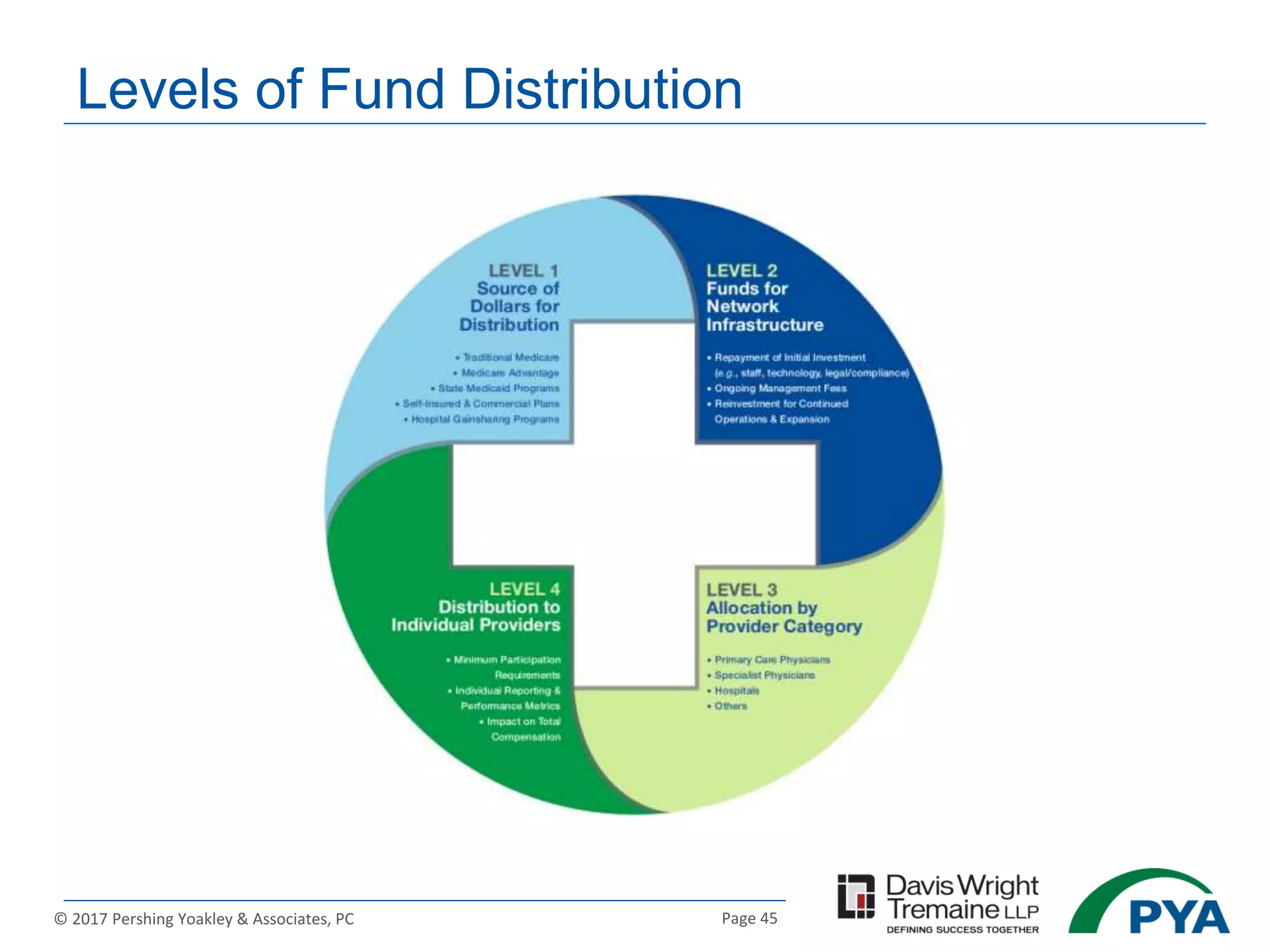
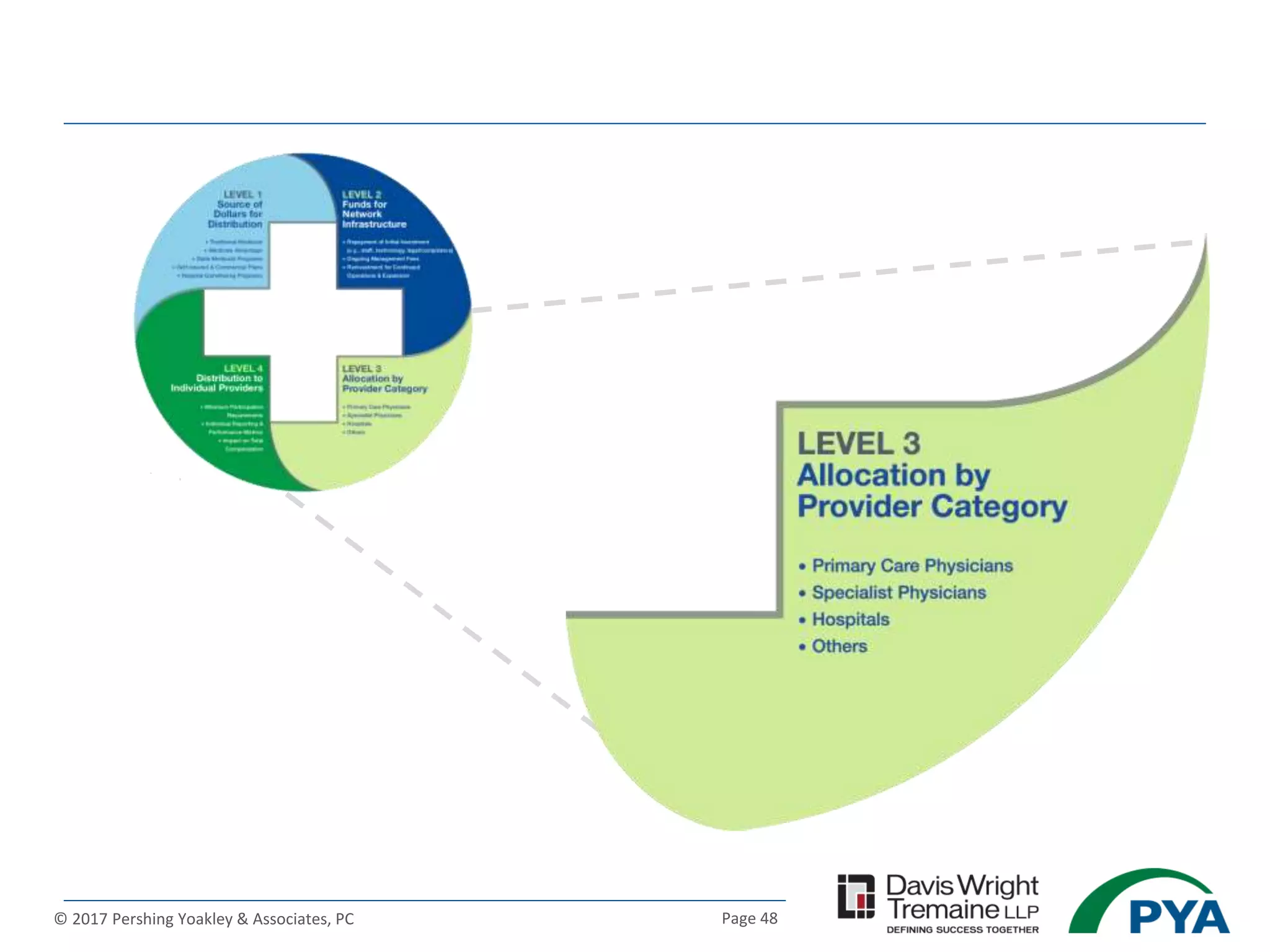
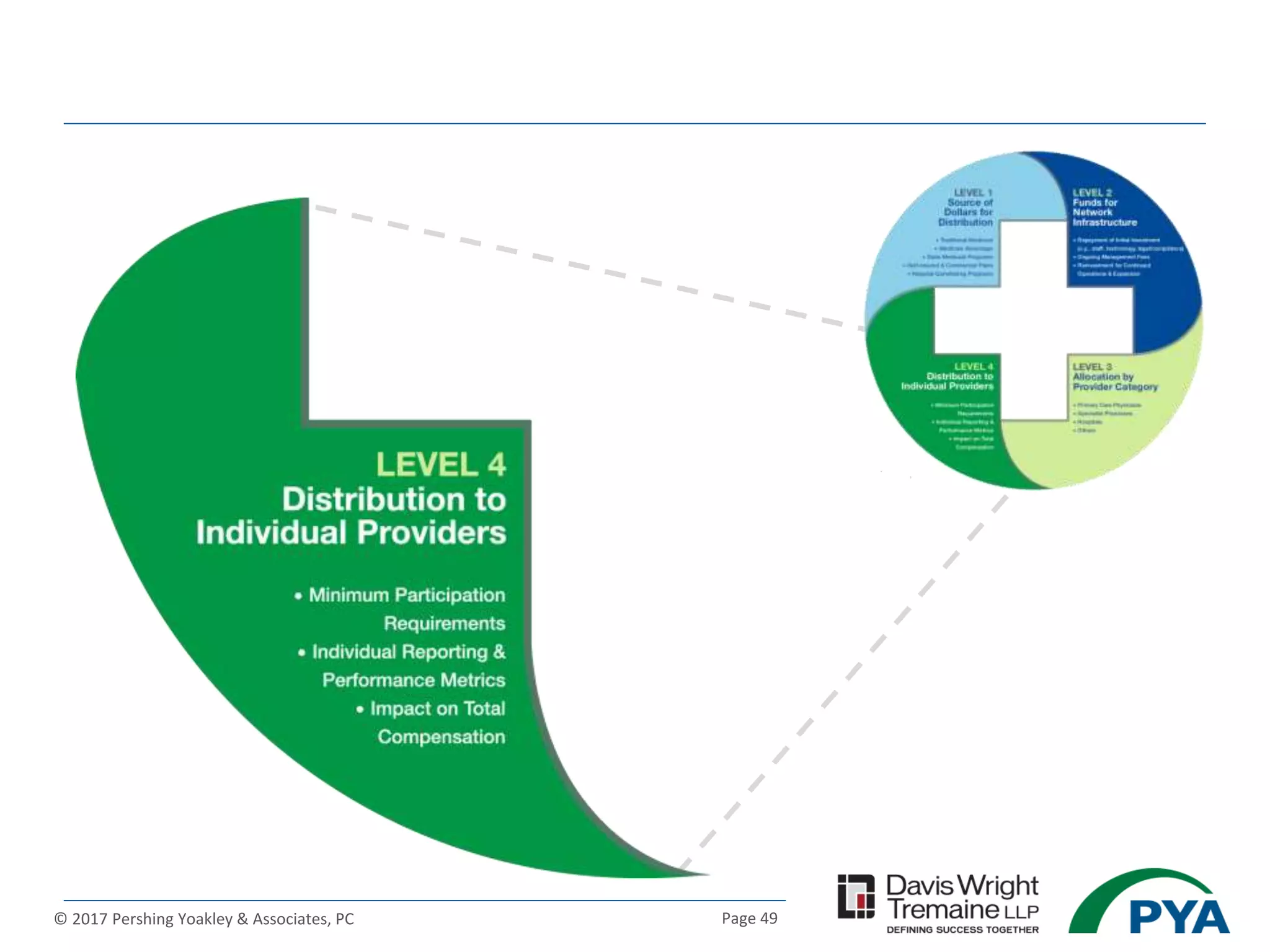
Levels of Fund Distribution
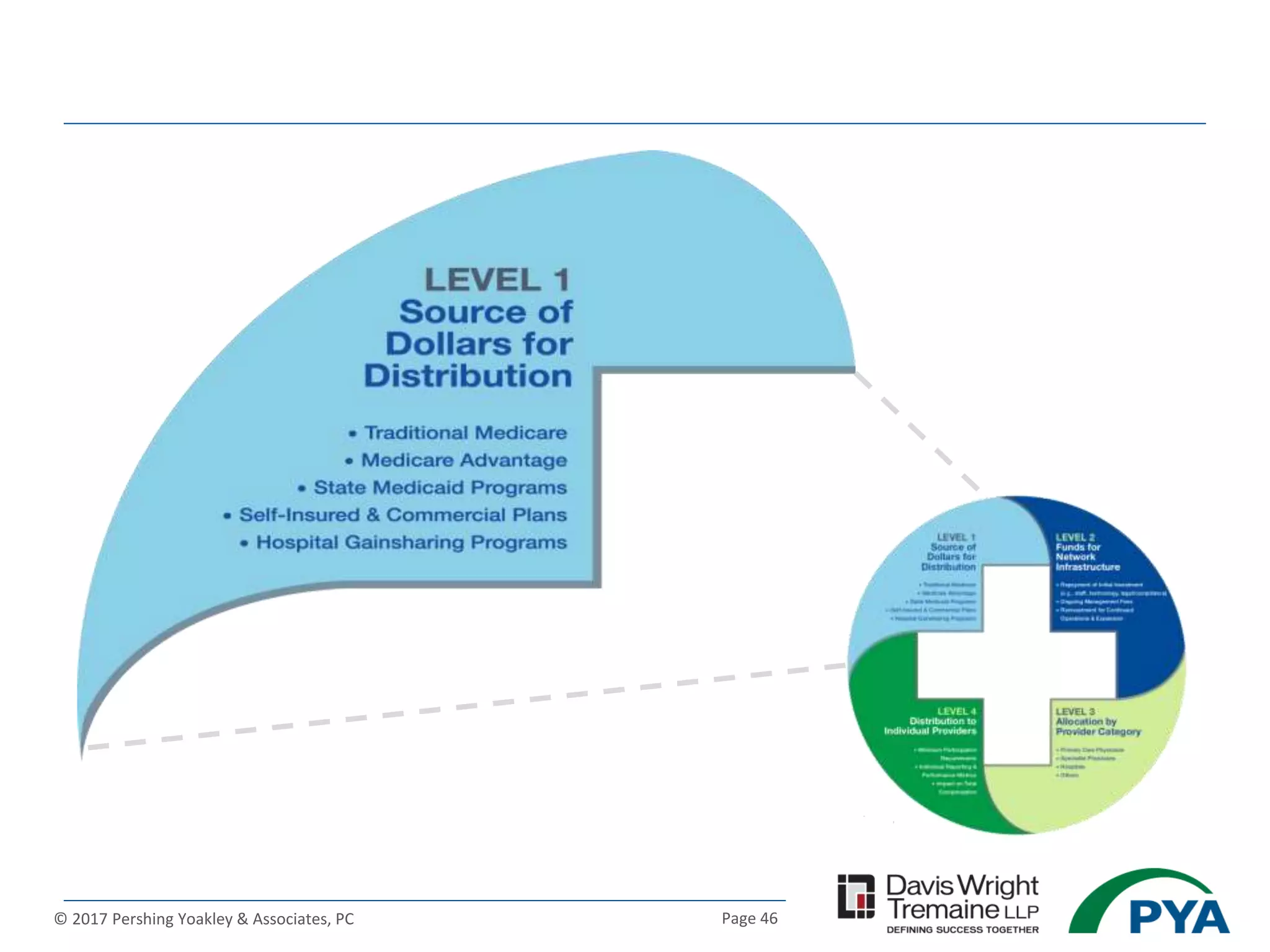
Page 46© 2017 Pershing Yoakley & Associates, PC
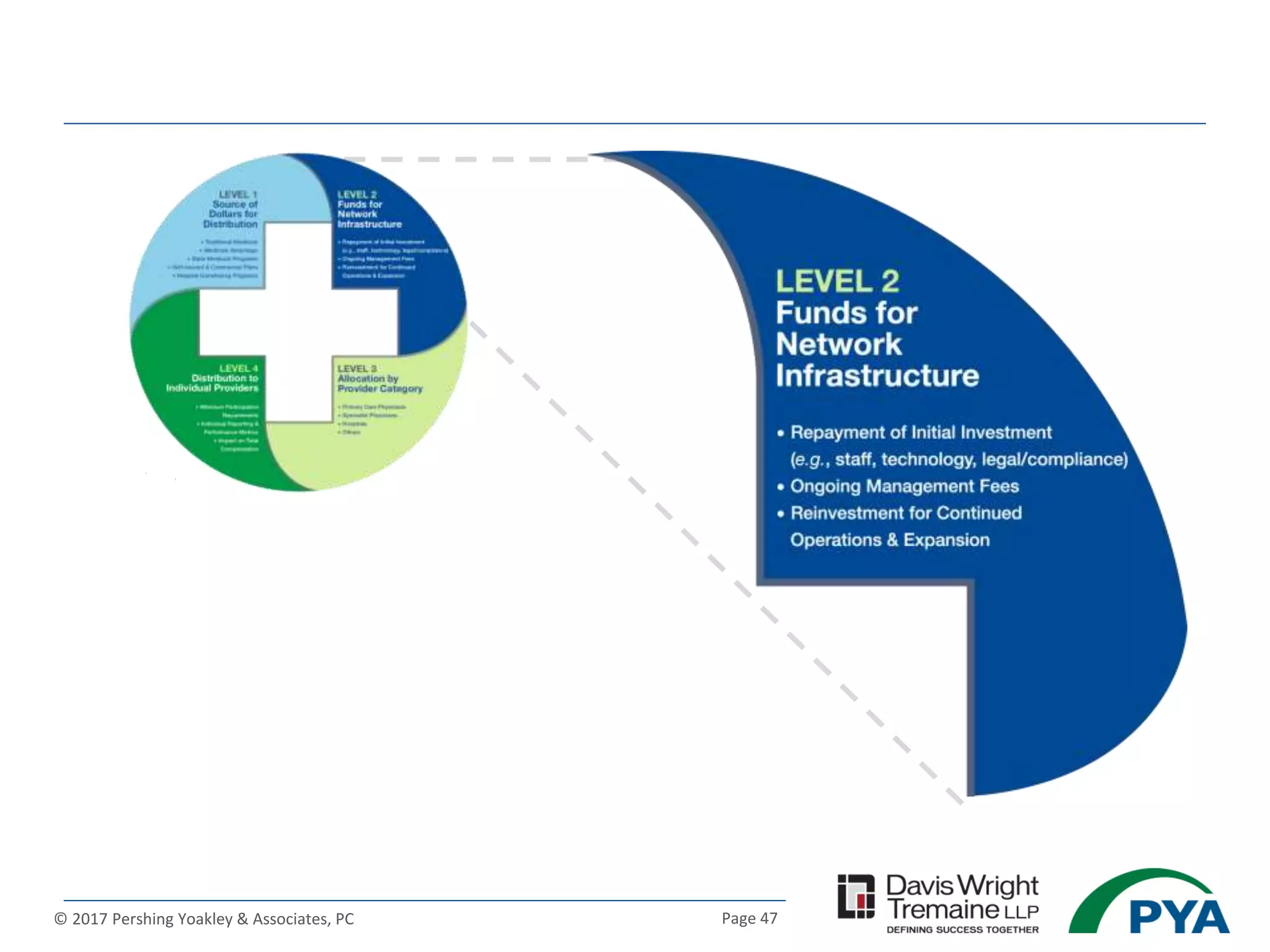
Page 47© 2017 Pershing Yoakley & Associates, PC
Page 48© 2017 Pershing Yoakley & Associates, PC
Page 49© 2017 Pershing Yoakley & Associates, PC
Carol Carden, CPA/ABV, ASA, CFE
Principal, PYA
ccarden@pyapc.com
(865) 684-2813
Contact Information
Robert Homchick, JD
Partner, Davis Wright Tremaine LLP
roberthomchick@dwt.com
(206) 757-8063

The Vicissitudes of Valuing Value--Legal and Valuation Issues Associated with Value-Based Payment Models

  • 1.
    The Vicissitudes ofValuing “Value” Legal and Valuation Issues Associated with Value-Based Payment Models AHLA Physicians/Hospitals Institute
  • 2.
    Page 1© 2017Pershing Yoakley & Associates, PC Agenda 1 Introduction to emerging payment models 2 Application of fraud and abuse laws and IRS rules to value-based payments 3 Existing regulatory guidance 4 Considerations in determining FMV and CR
  • 3.
  • 4.
    Page 3© 2017Pershing Yoakley & Associates, PC VBR Framework FEE-FOR-SERVICE (FFS) PAYMENTS POPULATION-BASED VBMs ADJUSTED FFS PAYMENTS VBMs INCORPORATING FFS PAYMENTS $ $ Bank A Pay For Reporting B Pay For Performance C Pay/Penalty For Performance A Total Cost of Care Shared Savings B Total Cost of Care Shared Risk C Retrospective Bundled Payment D Prospective Bundled Payment A Condition-Specific Population- Based Payments B Primary Care Population- Based Payments C Comprehensive Population- Based Payments A Traditional FFS B Infrastructure Incentives C Care Management Payments
  • 5.
    Page 4© 2017Pershing Yoakley & Associates, PC CMS VBR Goals 30% of traditional Medicare payments through VBMs 50% of traditional Medicare payments through VBMs 85% of Medicare fee-for- service payments tied to scores on quality and efficiency measures 90% of Medicare fee-for- service payments tied to scores on quality and efficiency measures 03/03/2016 - Mission Accomplished By December 31, 2016: By December 31, 2018:
  • 6.
    Page 5© 2017Pershing Yoakley & Associates, PC Medicare Access and CHIP Reauthorization Act of 2015 Advanced Value-Based Payment Model Merit-Based Incentive Payment System Quality Payment Program
  • 7.
    Page 6© 2017Pershing Yoakley & Associates, PC Transition Period Through December 31, 2018 Starting January 1, 2019  0.5% annual MPFS update (2016-2019)  Payment adjustments • Potential 2% PQRS reporting penalty • Potential 3% EHR meaningful use penalty • Up to +/- 4% Value-Based Modifier bonus/penalty  Annual MPFS update: • 0% in 2020 through 2025 • 0.25% thereafter (0.75% for Advanced APM participants)  Payment Adjustments • 5% bonus for participation in advanced APMs thru 2024 • Up to +/- 9% MIPS bonus/penalty
  • 8.
    Page 7© 2017Pershing Yoakley & Associates, PC Years 1 and 2 Years 3+ Physicians (MD/DO, DPM, OD, DC, DMD/DDS) PAs, APRNs, CNSs, CRNA Physical or occupational therapists, speech- language pathologists, audiologists, nurse midwives, clinical social workers, clinical psychologists, dieticians/nutritional professionals Eligible Clinicians
  • 9.
  • 10.
    Page 9© 2017Pershing Yoakley & Associates, PC Advanced VBMs (Traditional Medicare) Definite Medicare Shared Savings Program (Tracks 2 & 3 Only) Next Generation ACO Model Comprehensive ESRD Care (LDO arrangement and Two-Sided Risk) Comprehensive Primary Care Plus (re-open applications) Oncology Care Model (Two-Sided Risk) In Development Medicare Shared Savings Program Track 1+ Comprehensive Care for Joint Replacement (CEHRT Track) Episodic Payment Model (CEHRT and non-CEHRT Tracks) Cardiac Rehabilitation Incentive Payment Model Medicare Diabetes Prevention Program New Voluntary Bundled Payment Program Vermont Medicare ACO Initiative
  • 11.
    Page 10© 2017Pershing Yoakley & Associates, PC Qualifying Participant Qualifying Participant  Higher % of patients or payments  Bonus = 5% of MPFS payments Partial Qualifying Participant  Lower % of patients or payments  No bonus, no MIPS Non-Qualifying Participant  Subject to MIPS Payment Year 2019 2020 2021 2022 2023 2024 QP Threshold 25% 25% 50% 50% 75% 75% Partial QP Threshold 20% 20% 40% 40% 50% 50% Payment Year 2019 2020 2021 2022 2023 2024 QP Threshold 25% 25% 50% 50% 75% 75% Partial QP Threshold 20% 20% 40% 40% 50% 50% Medicare Option – Payment Amount Threshold Medicare Option – Patient Count Threshold
  • 12.
    Page 11© 2017Pershing Yoakley & Associates, PC Other Payer Advanced VBMs  Credit for participation in Other Payer Advanced VBMs starting in 2019  Three criteria: (1) Use of CEHRT; (2) Quality measures; and (3) More than nominal financial risk or medical home model  Submission and approval process  Still requires some level of participation in Advanced VBMs Payment Year 2019 2020 2021 2022 2023 2024 MCR MCR Total MCR Total MCR Total MCR Total MCR QP Threshold - - 50% 25% 50% 25% 75% 25% 75% 25% Partial QP Threshold - - 40% 20% 40% 20% 50% 20% 50% 20% Payment Year 2019 2020 2021 2022 2023 2024 MCR MCR Total MCR Total MCR Total MCR Total MCR QP Threshold - - 35% 20% 35% 20% 50% 20% 50% 20% Partial QP Threshold 25% 10% 25% 10% 35% 10% 35% 10% All Payer Combination Option – Payment Amount Threshold All Payer Combination Option – Patient Count Threshold
  • 13.
  • 14.
    Page 13© 2017Pershing Yoakley & Associates, PC MIPS Final Score Components Quality Cost Performance Improvement Activities Advancing Care Information 60% 0% 15% 25% 50% 10% 15% 25% 30% 30% 15% 25% 2017 Performance Year 2018 Performance Year 2019 Performance Year Impacts 2019 Payments Impacts 2020 Payments Impacts 2021 Payments
  • 15.
    Page 14© 2017Pershing Yoakley & Associates, PC 2017 Final Score Calculation Quality Component Score Cost Performance Component Score Improvement Activities Component Score Advancing Care Information Component Score Multiply Each By Component Weight Final Score
  • 16.
    Page 15© 2017Pershing Yoakley & Associates, PC MIPS Payment Adjustments 2019 2022+2020 2021 +4% -4% +5% -5% +7% -7% +9% -9% Up to 12% Scaling Factor* Up to 15% Scaling Factor Up to 21% Scaling Factor Up to 27% Scaling Factor Performance Threshold** * Due to budget neutrality, higher bonuses will be paid if total penalties exceed projections, not to exceed 3 times the base bonus percentage. ** Performance Threshold will be adjusted each year based on historical performance.
  • 17.
    Page 16© 2017Pershing Yoakley & Associates, PC March 31, 2018 Deadline for individual/group to report on required measures Performance-To-Adjustment Cycle Perform Submit AdjustFeedback CY 2017 Period of time for which performance will be evaluated 2017 only: may elect 90-day continuous performance period Q3 2018 CMS reports on prior year performance, including calculation of Final Score and payment adjustment for upcoming year CY 2019 Positive or negative MPFS payment adjustments based on 2017 Final Score
  • 18.
    Page 17© 2017Pershing Yoakley & Associates, PC MIPS Participation Election  Final Score assigned to each NPI/TIN  Group reporting must include all NPIs who reassign to TIN; cannot pick and choose  NPI who reassigns to TIN reporting as a group may also report individually
  • 19.
    Page 18© 2017Pershing Yoakley & Associates, PC Low-Volume Threshold  For 2017, individual or group exempt from MIPS if:  $30,000 or less in allowable Part B charges; or  See 100 or fewer traditional Medicare beneficiaries  If elect group reporting, NPIs who would be exempt if reporting individually are NOT exempt  Two determination periods (both with 60-day claims run-out)  September 1, 2015, to August 31, 2016  September 1, 2016, to August 31, 2017
  • 20.
    Page 19© 2017Pershing Yoakley & Associates, PC 2017: Pick Your Pace 2017 Reporting Option 2019 Payment Impact No reporting 4% penalty on all MPFS payments Report performance for minimum of 90-day continuous period  One quality measure OR  One clinical practice improvement activity OR  All required measures for advancing care information No penalty, no bonus Report performance for minimum of 90-day continuous period  More than one quality measure OR  More than one clinical practice improvement activity OR  More than the required measures for advancing care information Eligible for up to 12% bonus on all MPFS payments (amount varies based on Final Score and budget-neutral scaling factor) Report performance on all required measures for minimum of 90- day continuous period. Eligible for up to 12% bonus on all MPFS payments (amount varies based on Final Score and budget-neutral scaling factor) If Final Score ≥ 70, eligible for additional Exceptional Performance Bonus (amount varies based on Final Score and distribution of $500 million annual fund; cannot exceed 10% of Part B allowed charges)
  • 21.
    Application of Fraudand Abuse Laws and IRS Rules to Value Based Payments
  • 22.
    Page 21© 2017Pershing Yoakley & Associates, PC Legal Framework  The federal Physician Self-Referral Prohibition 42 U.S.C. §1395nn  Anti-Kickback Statute - 42 U.S.C. §1320a-7b(b)  Civil Money Penalty Gainsharing Prohibition  Internal Revenue Code prohibition on Private Benefit/ Private Inurement  Government’s arguments and court opinions addressing the Stark Law are redefining the rules and changing the risk analysis 21
  • 23.
    Page 22© 2017Pershing Yoakley & Associates, PC Legal Framework: Value-Based Payments  Stark--generally the threshold issue in analysis of physician compensation  Generally speaking if comp passes muster under Stark, the AKS risks should be relatively modest  Civil Money Penalty Gainsharing Prohibition  Solved to a large extent by MACRA  IRS prohibition on Private Benefit/ Private Inurement  Applies only to tax-exempt organizations  Stark compliance relevant, but not the end of the analysis  Note, IRS has its own definition of FMV  IRS analysis is more principled and more logical than Stark  Relationship of payments to Exempt Organization’s Mission is important 22
  • 24.
    Page 23© 2017Pershing Yoakley & Associates, PC Stark Analysis Should Be Undertaken If:  An entity directly or indirectly exchanges remuneration with a physician who refers Medicare patients to the entity for designated health services  Key terms:  Entity  Remuneration  Referral  DHS  Value-Based Payments almost always trigger need for Stark Analysis 23
  • 25.
    Page 24© 2017Pershing Yoakley & Associates, PC VBM: Fraud & Abuse Waivers  Several VBM include fraud & abuse waivers  MSSP  BPCI  CJR  Waivers address Stark, AKS, and CMP  Waivers do not address: laws governing tax-exempt organizations, antitrust laws, state laws  Each program has different waivers with different requirements 24
  • 26.
    Page 25© 2017Pershing Yoakley & Associates, PC MSSP Waivers  Five fraud and abuse waivers  ACA sec. 3022 authority  Pay attention to the safeguards  Key concepts include:  Governance/accountability  Reasonably related to MSSP purposes  Governing body finding  Transparency  Website disclosure  MSSP waivers very broad, user friendly
  • 27.
    Page 26© 2017Pershing Yoakley & Associates, PC Other Program Waivers 26  The Bundled Payments for Care Improvement (BPCI) initiative  Voluntary Program– 4 Models  Each model has its own F&A Waiver  Not user friendly  Comprehensive Joint Replacement Program (CJR)  Mandatory bundled payment program for hospitals located in selected zip codes  3 waivers set forth in Separate Notice from OIG and CMS  Each waiver protects only those arrangements that meet all of the applicable regulatory requirements  Not user friendly
  • 28.
    Page 27© 2017Pershing Yoakley & Associates, PC  If a hospital makes a valued-based payment that fits within an F&A waiver to a physician, that payment does not have to comply with a Stark exception and is immune from AKS prosecution even if it is not within an AKS safe harbor  Thus, value-based payments made pursuant to a waiver are not subject to Stark/AKS FMV or Commercial Reasonableness tests, because no need for an exception/safe harbor  But if a physician receives other payments that implicate Stark his/her financial relationship with the payer entity must fit within an exception • Are value-based payments protected by a waiver considered when analyzing overall compensation the physician receives under either a hospital employment agreement or services contract? • Should waiver-protected payments be taken into account in a “stacking” analysis? Value-Based Compensation Paid Under Waiver
  • 29.
    Page 28© 2017Pershing Yoakley & Associates, PC  Strong argument can be made that waiver-protected payments should not be considered when assessing FMV or CR for purposes of Stark/AKS • If CMS intended to apply some type of FMV and CR assessment, it would have included that in the requirements of the waiver  Others argue waiver-protected payments can be considered but that the final result is the same because they increase FMV and CR  CAUTION: Waivers are the exception, not the rule • Value-based reimbursement that is not protected by an F&A waiver must be considered in FMV and CR assessment of physician compensation • MIPS payments, commercial gainsharing, etc., would be included when evaluating overall compensation paid to an employed or contracted physician FMV and CR (cont.)
  • 30.
    Page 29© 2017Pershing Yoakley & Associates, PC  Tax-Exempt Organization: Private Inurement Analysis • IRS guidance on MSSP • Notice 2011-20 summarizes how the IRS expects federal tax law to apply to tax-exempt hospitals and health systems participating in the Medicare Shared Savings Program (https://www.irs.gov/pub/irs-drop/n-11-20.pdf) • Generally positive, but notice indicates arrangements between ACO and ACO participants should be FMV  Other value-based reimbursement payments appear to be subject to private inurement prohibition • Whether the payments are FMV and CR is relevant to the analysis Tax-Exempt Organizations: FMV and CR
  • 31.
    Page 30© 2017Pershing Yoakley & Associates, PC Stark Exceptions: Value-Based Payments  Risk Sharing Exception  Indirect Compensation Arrangement Exception  Group Practice/In-Office Ancillary Services Exception  Personal Services Arrangement/FMV Exceptions  Employment Exception 30
  • 32.
    Page 31© 2017Pershing Yoakley & Associates, PC 31 Risk-Sharing Exception Compensation pursuant to a risk-sharing arrangement (including, but not limited to, withholds, bonuses, and risk pools) between a managed care organization or an independent physicians' association and a physician (either directly or indirectly through a subcontractor) for services provided to enrollees of a health plan, provided that the arrangement does not violate the Anti-Kickback Statute (section 1128B(b) of the Act), or any Federal or State law or regulation governing billing or claims submission. For purposes of this paragraph (n), “health plan” and “enrollees” have the meanings ascribed to those terms in §1001.952(l) of this title. 42 CFR 411.357(n)
  • 33.
    Page 32© 2017Pershing Yoakley & Associates, PC 32 Potential Coverage Is Broad  Enrollee definition: 42 CFR 1001.952(l)(2)  Health Plan definition: 42 CFR 1001.952(l)(2)  CMS Guidance:  Comment: A commenter welcomed the new exception for risk-sharing arrangements, but requested a definition of the term ‘‘managed care organization’’ as used in the exception or clarification in preamble language that the new exception is meant to cover all risk- sharing compensation paid to physicians by an entity downstream of any type of health plan, insurance company, or health maintenance organization (HMO). A commenter sought clarification that the downstream entity could itself be an entity that furnishes DHS, such as a hospital.  Response: The new exception is meant to cover all risk-sharing compensation paid to physicians by an entity downstream of any type of health plan, insurance company, HMO, or Independent Practice Association (IPA), provided the arrangement relates to enrollees and meets the conditions set forth in the exception. All downstream entities are included. We purposefully declined to define the term ‘‘managed care organization’’ so as to create a broad exception with maximum flexibility. 69 Fed Reg at 16114
  • 34.
    Page 33© 2017Pershing Yoakley & Associates, PC 33 Stark Analysis: Risk-Sharing Exception  Exception applies if Hospital or ACO/CIN is  Downstream from a health plan (a downstream contractor/participating provider)  At risk either because it receives a fixed payment from the plan or some other risk mechanism  Managing care (Hospital or ACO is acting as the “Managed Care Organization”)  As MCO it is sharing risk with physicians for cost of care furnished to plan enrollees  If the above criteria are satisfied, the payment to the physician would qualify as a covered bonus under the Risk-Sharing Exception
  • 35.
    Page 34© 2017Pershing Yoakley & Associates, PC 34 Risk-Sharing Exception  Pros:  NO FMV requirement  NO Commercial Reasonableness requirement  NO limitation on payments based on v/v  Cons:  Only available when Hospital or ACO/CIN acting as MCO downstream of Health Plan  Not available in Medicare FFS Context  Open Issue: How should compensation paid pursuant to this exception be treated in evaluation of overall compensation under an employment or services agreement?  IRS private inurement/private benefit issues must still be addressed
  • 36.
    Page 35© 2017Pershing Yoakley & Associates, PC The Stark Compensation Exceptions  Employment  Personal Services or Fair Market Value Arrangements  Group Practice/In-Office Ancillary Services  Indirect Compensation
  • 37.
    Page 36© 2017Pershing Yoakley & Associates, PC Stark Analysis– Compensation Exceptions  FMV  Is the compensation within the range of fair market value?*  Commercial Reasonableness  Is the compensation commercially reasonable?  Volume or Value  Is the compensation based on the volume or value of the physician’s DHS referrals? *Group Practice compensation is the exception 36
  • 38.
    Page 37© 2017Pershing Yoakley & Associates, PC Comparison of Employment and Group Practice/ IOAS Exceptions 69 Fed. Reg. 16067-068: Group Practice/IOAS Employment Profit Sharing Profits of DHS revenue may be shared between owners (subject to restrictions) May not share DHS revenues with employed physicians Fair Market Value Requirement No Yes Compensation “Set in Advance” Not required Not required Productivity Bonus Bonus may include services performed “incident to” physician services Bonus only based on personally performed services Vary with DHS Volume or Value? May not be based directly on volume or value of DHS referrals May not be based directly or indirectly on v/v of DHS referrals Restrictions Must be in a “group practice” and meet significant other requirements Need only have “bona fide employment relationship” (consistent with IRS definition)
  • 39.
    Page 38© 2017Pershing Yoakley & Associates, PC 38 Group Practice Compensation  Groups have more flexibility in determining how to compensate their physician members  NO FMV requirement (assuming group is not a TEO)  NO Commercial Reasonableness requirement  However, compensation cannot vary directly with the v/v of physician’s DHS referrals  When Value-Based Reimbursement received by Group  Often group has flexibility in determining how to distribute among its members  Some limitations imposed by specific programs  CJR does not permit groups to share payments received from a hospital with physicians not involved in providing care to CJR beneficiaries
  • 40.
    Page 39© 2017Pershing Yoakley & Associates, PC 39 Indirect Compensation Arrangements  Indirect Compensation Arrangement:  “Unbroken Chain” of any number of entities between physician and DHS entity  Compensation to physician from closest link in chain varies with, OR OTHERWISE REFLECTS, volume or value of referrals to entity providing DHS  Entity providing DHS has actual knowledge or acts in reckless disregard of existence of such relationship 42 CFR 411.354(2)  Indirect Comp Exception:  Compensation received by MD from closest entity in the chain is FMV for services and not determined based on v/v of referrals or other business generated by MD for the DHS entity  Set out in writing, signed, etc., except if employment, where must be for identifiable services and commercially reasonable even if no referrals to employer  Does not violate the AKS 42 CFR 411.357(p)
  • 41.
    Page 40© 2017Pershing Yoakley & Associates, PC 40 Value-Based Payments: Analysis  Hospital or Hospital-controlled ACO/CIN paying physicians for:  Compliance with quality protocols  Decreasing the number of readmissions  Decreasing the number of Hospital-Acquired Conditions (HACs)  First, identify who is paying the physician  Hospital– a DHS entity  CIN or ACO – an intervening entity triggering the indirect analysis under Stark  Group Practice  Second, what type of financial arrangement governs payment  Employment  Services Agreement
  • 42.
    Page 41© 2017Pershing Yoakley & Associates, PC 41 Quality Metrics  Payments for improved quality –  Phase III Commentary: "compensation related to patient satisfaction goals or other quality measures unrelated to the volume or value of business generated by the referring physician and unrelated to reducing or limiting services would be permitted under the personal services arrangement exception . . . (for example, compensation to reward physicians for providing appropriate preventive care services . . .)." 72 Fed Reg at 51046.  Are quality payments FMV/commercially reasonable?  Are payments being made to right party?  Is the physician really responsible for the quality outcomes on which the payments are based?  How is FMV determined?
  • 43.
    Page 42© 2017Pershing Yoakley & Associates, PC 42 Value-Based Comp  Payment for decreasing readmissions: Are such payments based on volume or value of referrals or other business between the parties?  Maybe– Maybe not  Structure as per patient payment--- Take advantage of special rules on compensation in Stark Regulations  If funds flow through an ACO/CIN likely that indirect analysis would apply  Enables parties to take advantage of more liberal indirect compensation arrangement exception  FMV and Commercial Reasonableness  Payments for decreasing HACs: Are payments based on volume or value of referrals?  Perhaps  Structure as a per patient or per service payment---special rules on compensation  FMV and Commercial Reasonableness
  • 44.
    Page 43© 2017Pershing Yoakley & Associates, PC 43 Value-Based Payment Challenges  Private Practice Physicians  To what extent can Hospital or CIN assist an independent physician group MIPS Quality Reporting or Meaningful Use requirements?  When does the assistance create a financial relationship that doesn’t fit within a Stark exception?  When does the assistance cross the line to raise inurement issues?  Physicians in ACO/CIN  Is the amount paid to the group FMV and Commercially Reasonable given the group’s role in generating the Value-Based Reimbursement?  What about the payments to individual physicians?  If Physicians are paid under multiple Value-Based Payment arrangements:  Double dipping?  Is Total Compensation still FMV and CR?  Stacking analysis
  • 45.
  • 46.
    Page 45© 2017Pershing Yoakley & Associates, PC Levels of Fund Distribution
  • 47.
    Page 46© 2017Pershing Yoakley & Associates, PC
  • 48.
    Page 47© 2017Pershing Yoakley & Associates, PC
  • 49.
    Page 48© 2017Pershing Yoakley & Associates, PC
  • 50.
    Page 49© 2017Pershing Yoakley & Associates, PC
  • 51.
    Carol Carden, CPA/ABV,ASA, CFE Principal, PYA ccarden@pyapc.com (865) 684-2813 Contact Information Robert Homchick, JD Partner, Davis Wright Tremaine LLP roberthomchick@dwt.com (206) 757-8063