
Valuing Hospitals
© 2014 Business Valuation Resources, LLC
Questions@BVResources.com
© 2014 Business Valuation Resources, LLC
Hospital Valuations
In the Health Reform Era
July 31, 2014
Don Barbo, Director
Deloitte Financial Advisory Services LLP
Robbie Mundy, Senior Manager
Pershing Yoakley & Associates, P.C.
Questions@BVResources.com
© 2014 Business Valuation Resources, LLC
Questions@BVResources.com
© 2014 Business Valuation Resources, LLC
Hospital Transaction Activity
Rebound in transaction activity as the credit crisis
lessened
Passage of healthcare reform increased the pace of
transaction activity
Transaction volume expected to continue increasing as
capital begins flowing to the market
Valuing Hospitals
© 2014 Business Valuation Resources, LLC
Questions@BVResources.com
© 2014 Business Valuation Resources, LLC
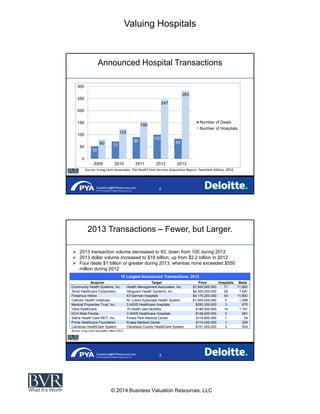
Announced Hospital Transactions
52
72
90
100
8380
125
156
247
283
0
50
100
150
200
250
300
2009 2010 2011 2012 2013
Number of Deals
Number of Hospitals
Questions@BVResources.com
© 2014 Business Valuation Resources, LLC
2013 Transactions Fewer, but Larger.
2013 transaction volume decreased to 83, down from 100 during 2012
2013 dollar volume increased to $19 billion, up from $2.2 billion in 2012
Four deals $1 billion or greater during 2013, whereas none exceeded $550
million during 2012
10 Largest Announced Transactions, 2013
Acquirer Target Price Hospitals Beds
Community Health Systems, Inc. Health Management Associates, Inc. $7,600,000,000 71 11,000
Tenet Healthcare Corporation Vanguard Health Systems, Inc. $4,300,000,000 28 7,081
Fresenius Helios 43 German hospitals $4,175,200,000 43 11,800
Catholic Health Initiatives St. Luke's Episcopal Health System $1,000,000,000 5 1,098
Medical Properties Trust, Inc. 3 IASIS Healthcare hospitals $283,300,000 3 670
Vibra Healthcare 16 health care facilities $186,500,000 14 1,181
HCA West Florida 3 IASIS Healthcare Hospitals $146,000,000 3 691
Sabra Health Care REIT, Inc. Forest Park Medical Center $119,800,000 1 54
Prime Healthcare Foundation Knapp Medical Center $110,000,000 1 209
Carolinas HealthCare System Cleveland County HealthCare System $101,000,000 3 504
Source: Irving Levin Associates, March 2014.
Valuing Hospitals
© 2014 Business Valuation Resources, LLC
Questions@BVResources.com
© 2014 Business Valuation Resources, LLC
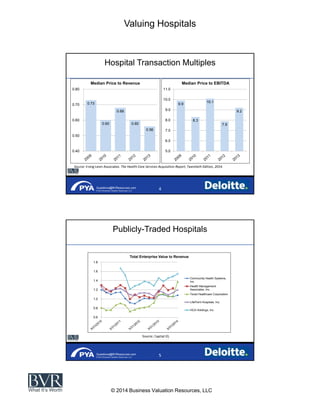
Hospital Transaction Multiples
0.73
0.60
0.68
0.60
0.56
0.40
0.50
0.60
0.70
0.80
Median Price to Revenue
9.9
8.3
10.1
7.9
9.2
5.0
6.0
7.0
8.0
9.0
10.0
11.0
Median Price to EBITDA
Questions@BVResources.com
© 2014 Business Valuation Resources, LLC
Publicly-Traded Hospitals
0.6
0.8
1.0
1.2
1.4
1.6
1.8
Total Enterprise Value to Revenue
Community Health Systems,
Inc.
Health Management
Associates, Inc.
Tenet Healthcare Corporation
LifePoint Hospitals, Inc.
HCA Holdings, Inc.
Valuing Hospitals
© 2014 Business Valuation Resources, LLC
Questions@BVResources.com
© 2014 Business Valuation Resources, LLC
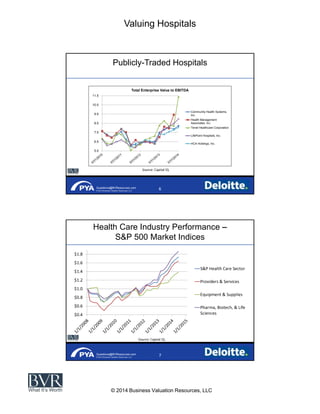
Publicly-Traded Hospitals
5.5
6.5
7.5
8.5
9.5
10.5
11.5
Total Enterprise Value to EBITDA
Community Health Systems,
Inc.
Health Management
Associates, Inc.
Tenet Healthcare Corporation
LifePoint Hospitals, Inc.
HCA Holdings, Inc.
Questions@BVResources.com
© 2014 Business Valuation Resources, LLC
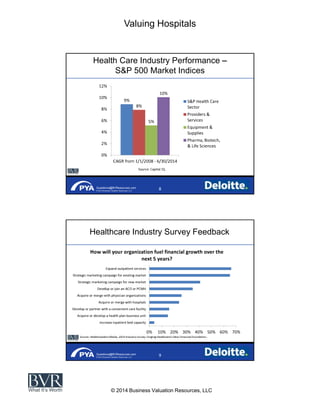
Health Care Industry Performance
S&P 500 Market Indices
Valuing Hospitals
© 2014 Business Valuation Resources, LLC
Questions@BVResources.com
© 2014 Business Valuation Resources, LLC
Health Care Industry Performance
S&P 500 Market Indices
Questions@BVResources.com
© 2014 Business Valuation Resources, LLC
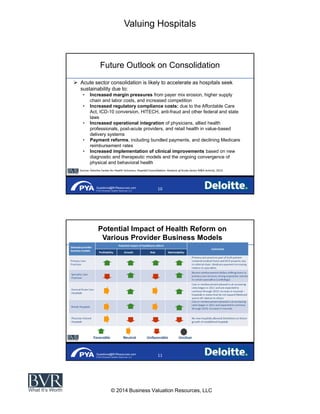
Healthcare Industry Survey Feedback
Valuing Hospitals
© 2014 Business Valuation Resources, LLC
Questions@BVResources.com
© 2014 Business Valuation Resources, LLC
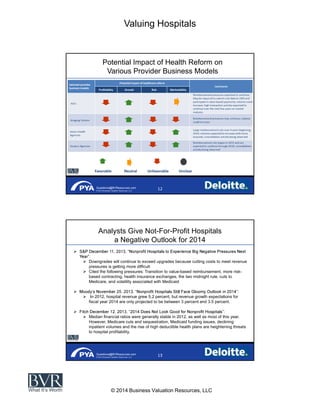
Future Outlook on Consolidation
Acute sector consolidation is likely to accelerate as hospitals seek
sustainability due to:
Increased margin pressures from payer mix erosion, higher supply
chain and labor costs, and increased competition
Increased regulatory compliance costs: due to the Affordable Care
Act, ICD-10 conversion, HITECH, anti-fraud and other federal and state
laws
Increased operational integration of physicians, allied health
professionals, post-acute providers, and retail health in value-based
delivery systems
Payment reforms, including bundled payments, and declining Medicare
reimbursement rates
Increased implementation of clinical improvements based on new
diagnostic and therapeutic models and the ongoing convergence of
physical and behavioral health
Questions@BVResources.com
© 2014 Business Valuation Resources, LLC
Potential Impact of Health Reform on
Various Provider Business Models
Copyright © 2011 Deloitte Development LLC. All rights reserved.
Valuing Hospitals
© 2014 Business Valuation Resources, LLC
Questions@BVResources.com
© 2014 Business Valuation Resources, LLC
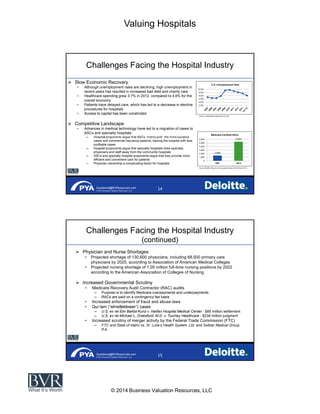
Potential Impact of Health Reform on
Various Provider Business Models
Copyright © 2011 Deloitte Development LLC. All rights reserved.
Questions@BVResources.com
© 2014 Business Valuation Resources, LLC
Analysts Give Not-For-Profit Hospitals
a Negative Outlook for 2014
Downgrades will continue to exceed upgrades because cutting costs to meet revenue
pressures is getting more difficult
Cited the following pressures: Transition to value-based reimbursement, more risk-
based contracting, health insurance exchanges, the two midnight rule, cuts to
Medicare, and volatility associated with Medicaid
In 2012, hospital revenue grew 5.2 percent, but revenue growth expectations for
fiscal year 2014 are only projected to be between 3 percent and 3.5 percent.
Median financial ratios were generally stable in 2012, as well as most of this year.
However, Medicare cuts and sequestration, Medicaid funding issues, declining
inpatient volumes and the rise of high deductible health plans are heightening threats
to hospital profitability.
Valuing Hospitals
© 2014 Business Valuation Resources, LLC
Questions@BVResources.com
© 2014 Business Valuation Resources, LLC
Challenges Facing the Hospital Industry
Slow Economic Recovery
Although unemployment rates are declining, high unemployment in
recent years has resulted in increased bad debt and charity care
Healthcare spending grew 3.7% in 2012, compared to 4.6% for the
overall economy
Patients have delayed care, which has led to a decrease in elective
procedures for hospitals
Access to capital has been constricted
Competitive Landscape
Advances in medical technology have led to a migration of cases to
ASCs and specialty hospitals
-
cases and commercial insurance patients, leaving the hospital with less
profitable cases
Hospital proponents argue that specialty hospitals draw specialty
physicians and staff away from the community hospitals
ASCs and specialty hospital proponents argue that they provide more
efficient and convenient care for patients
Physician ownership a complicating factor for hospitals
Source: United States Department of Labor
0.0%
2.0%
4.0%
6.0%
8.0%
10.0%
U.S. Unemployment Rate
0
1,000
2,000
3,000
4,000
5,000
6,000
1991 2012
Medicare-Certified ASCs
Source: MedPac Report to the Congress, March 2003 & March 2014
Questions@BVResources.com
© 2014 Business Valuation Resources, LLC
Challenges Facing the Hospital Industry
(continued)
Physician and Nurse Shortages
Projected shortage of 130,600 physicians, including 68,500 primary care
physicians by 2025, according to Association of American Medical Colleges
Projected nursing shortage of 1.05 million full-time nursing positions by 2022
according to the American Association of Colleges of Nursing
Increased Governmental Scrutiny
Medicare Recovery Audit Contractor (RAC) audits
Purpose is to identify Medicare overpayments and underpayments
RACs are paid on a contingency fee basis
Increased enforcement of fraud and abuse laws
U.S. ex rel Elin Baklid-Kunz v. Halifax Hospital Medical Center - $85 million settlement
U.S. ex rel Michael L. Drakeford, M.D. v. Tuomey Healthcare - $238 million judgment
Increased scrutiny of merger activity by the Federal Trade Commission (FTC)
P.A.
Valuing Hospitals
© 2014 Business Valuation Resources, LLC
Questions@BVResources.com
© 2014 Business Valuation Resources, LLC
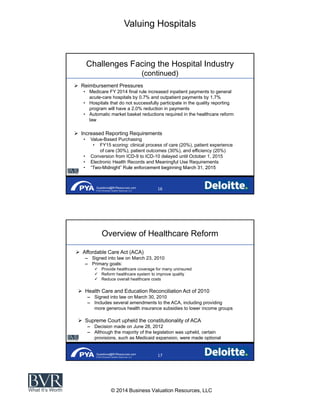
Challenges Facing the Hospital Industry
(continued)
Reimbursement Pressures
Medicare FY 2014 final rule increased inpatient payments to general
acute-care hospitals by 0.7% and outpatient payments by 1.7%
Hospitals that do not successfully participate in the quality reporting
program will have a 2.0% reduction in payments
Automatic market basket reductions required in the healthcare reform
law
Increased Reporting Requirements
Value-Based Purchasing
FY15 scoring: clinical process of care (20%), patient experience
of care (30%), patient outcomes (30%), and efficiency (20%)
Conversion from ICD-9 to ICD-10 delayed until October 1, 2015
Electronic Health Records and Meaningful Use Requirements
-
Questions@BVResources.com
© 2014 Business Valuation Resources, LLC
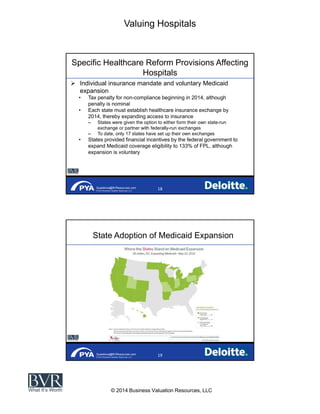
Overview of Healthcare Reform
Affordable Care Act (ACA)
Signed into law on March 23, 2010
Primary goals:
Provide healthcare coverage for many uninsured
Reform healthcare system to improve quality
Reduce overall healthcare costs
Health Care and Education Reconciliation Act of 2010
Signed into law on March 30, 2010
Includes several amendments to the ACA, including providing
more generous health insurance subsidies to lower income groups
Supreme Court upheld the constitutionality of ACA
Decision made on June 28, 2012
Although the majority of the legislation was upheld, certain
provisions, such as Medicaid expansion, were made optional
Valuing Hospitals
© 2014 Business Valuation Resources, LLC
Questions@BVResources.com
© 2014 Business Valuation Resources, LLC
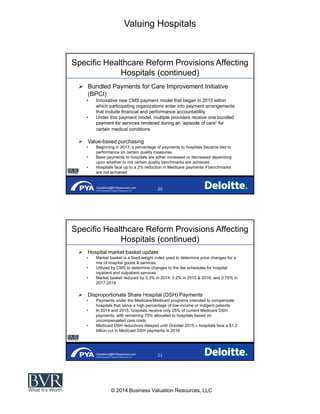
Specific Healthcare Reform Provisions Affecting
Hospitals
Individual insurance mandate and voluntary Medicaid
expansion
Tax penalty for non-compliance beginning in 2014, although
penalty is nominal
Each state must establish healthcare insurance exchange by
2014, thereby expanding access to insurance
States were given the option to either form their own state-run
exchange or partner with federally-run exchanges
To date, only 17 states have set up their own exchanges
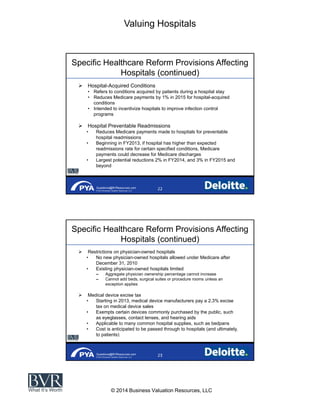
States provided financial incentives by the federal government to
expand Medicaid coverage eligibility to 133% of FPL, although
expansion is voluntary
Questions@BVResources.com
© 2014 Business Valuation Resources, LLC
State Adoption of Medicaid Expansion
Valuing Hospitals
© 2014 Business Valuation Resources, LLC
Questions@BVResources.com
© 2014 Business Valuation Resources, LLC
Specific Healthcare Reform Provisions Affecting
Hospitals (continued)
Bundled Payments for Care Improvement Initiative
(BPCI)
Innovative new CMS payment model that began in 2013 within
which participating organizations enter into payment arrangements
that include financial and performance accountability
Under this payment model, multiple providers receive one bundled
certain medical conditions
Value-based purchasing
Beginning in 2013, a percentage of payments to hospitals became tied to
performance on certain quality measures
Base payments to hospitals are either increased or decreased depending
upon whether or not certain quality benchmarks are achieved
Hospitals face up to a 2% reduction in Medicare payments if benchmarks
are not achieved
Questions@BVResources.com
© 2014 Business Valuation Resources, LLC
Specific Healthcare Reform Provisions Affecting
Hospitals (continued)
Hospital market basket update
Market basket is a fixed-weight index used to determine price changes for a
mix of hospital goods & services
Utilized by CMS to determine changes to the fee schedules for hospital
inpatient and outpatient services
Market basket reduced by 0.3% in 2014; 0.2% in 2015 & 2016; and 0.75% in
2017-2019
Disproportionate Share Hospital (DSH) Payments
Payments under the Medicare/Medicaid programs intended to compensate
hospitals that serve a high percentage of low-income or indigent patients
In 2014 and 2015, hospitals receive only 25% of current Medicare DSH
payments, with remaining 75% allocated to hospitals based on
uncompensated care costs
Medicaid DSH reductions delayed until October 2015 hospitals face a $1.2
billion cut in Medicaid DSH payments in 2016
Valuing Hospitals
© 2014 Business Valuation Resources, LLC
Questions@BVResources.com
© 2014 Business Valuation Resources, LLC
Specific Healthcare Reform Provisions Affecting
Hospitals (continued)
Hospital-Acquired Conditions
Refers to conditions acquired by patients during a hospital stay
Reduces Medicare payments by 1% in 2015 for hospital-acquired
conditions
Intended to incentivize hospitals to improve infection control
programs
Hospital Preventable Readmissions
Reduces Medicare payments made to hospitals for preventable
hospital readmissions
Beginning in FY2013, if hospital has higher than expected
readmissions rate for certain specified conditions, Medicare
payments could decrease for Medicare discharges
Largest potential reductions 2% in FY2014, and 3% in FY2015 and
beyond
Questions@BVResources.com
© 2014 Business Valuation Resources, LLC
Specific Healthcare Reform Provisions Affecting
Hospitals (continued)
Restrictions on physician-owned hospitals
No new physician-owned hospitals allowed under Medicare after
December 31, 2010
Existing physician-owned hospitals limited
Aggregate physician ownership percentage cannot increase
Cannot add beds, surgical suites or procedure rooms unless an
exception applies
Medical device excise tax
Starting in 2013, medical device manufacturers pay a 2.3% excise
tax on medical device sales
Exempts certain devices commonly purchased by the public, such
as eyeglasses, contact lenses, and hearing aids
Applicable to many common hospital supplies, such as bedpans
Cost is anticipated to be passed through to hospitals (and ultimately,
to patients)
Valuing Hospitals
© 2014 Business Valuation Resources, LLC
Questions@BVResources.com
© 2014 Business Valuation Resources, LLC
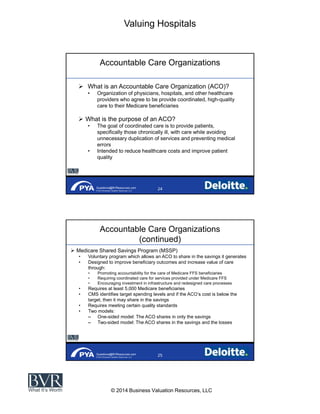
Accountable Care Organizations
What is an Accountable Care Organization (ACO)?
Organization of physicians, hospitals, and other healthcare
providers who agree to be provide coordinated, high-quality
care to their Medicare beneficiaries
What is the purpose of an ACO?
The goal of coordinated care is to provide patients,
specifically those chronically ill, with care while avoiding
unnecessary duplication of services and preventing medical
errors
Intended to reduce healthcare costs and improve patient
quality
Questions@BVResources.com
© 2014 Business Valuation Resources, LLC
Accountable Care Organizations
(continued)
Medicare Shared Savings Program (MSSP)
Voluntary program which allows an ACO to share in the savings it generates
Designed to improve beneficiary outcomes and increase value of care
through:
Promoting accountability for the care of Medicare FFS beneficiaries
Requiring coordinated care for services provided under Medicare FFS
Encouraging investment in infrastructure and redesigned care processes
Requires at least 5,000 Medicare beneficiaries
CMS identifies target spending levels and if the cost is below the
target, then it may share in the savings
Requires meeting certain quality standards
Two models:
One-sided model: The ACO shares in only the savings
Two-sided model: The ACO shares in the savings and the losses
Valuing Hospitals
© 2014 Business Valuation Resources, LLC
Questions@BVResources.com
© 2014 Business Valuation Resources, LLC
Accountable Care Organizations
(continued)
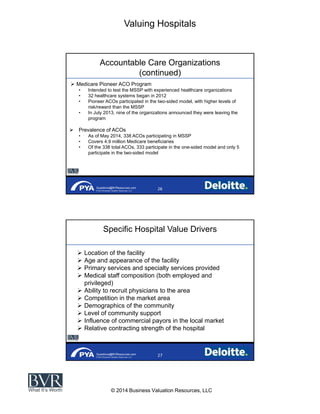
Medicare Pioneer ACO Program
Intended to test the MSSP with experienced healthcare organizations
32 healthcare systems began in 2012
Pioneer ACOs participated in the two-sided model, with higher levels of
risk/reward than the MSSP
In July 2013, nine of the organizations announced they were leaving the
program
Prevalence of ACOs
As of May 2014, 338 ACOs participating in MSSP
Covers 4.9 million Medicare beneficiaries
Of the 338 total ACOs, 333 participate in the one-sided model and only 5
participate in the two-sided model
Questions@BVResources.com
© 2014 Business Valuation Resources, LLC
Specific Hospital Value Drivers
Location of the facility
Age and appearance of the facility
Primary services and specialty services provided
Medical staff composition (both employed and
privileged)
Ability to recruit physicians to the area
Competition in the market area
Demographics of the community
Level of community support
Influence of commercial payors in the local market
Relative contracting strength of the hospital
Valuing Hospitals
© 2014 Business Valuation Resources, LLC
Questions@BVResources.com
© 2014 Business Valuation Resources, LLC
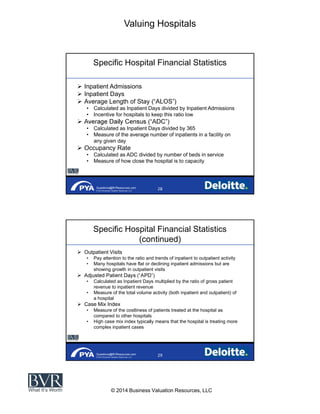
Specific Hospital Financial Statistics
Inpatient Admissions
Inpatient Days
Average Length of Stay
Calculated as Inpatient Days divided by Inpatient Admissions
Incentive for hospitals to keep this ratio low
Calculated as Inpatient Days divided by 365
Measure of the average number of inpatients in a facility on
any given day
Occupancy Rate
Calculated as ADC divided by number of beds in service
Measure of how close the hospital is to capacity
Questions@BVResources.com
© 2014 Business Valuation Resources, LLC
Specific Hospital Financial Statistics
(continued)
Outpatient Visits
Pay attention to the ratio and trends of inpatient to outpatient activity
Many hospitals have flat or declining inpatient admissions but are
showing growth in outpatient visits
Calculated as Inpatient Days multiplied by the ratio of gross patient
revenue to inpatient revenue
Measure of the total volume activity (both inpatient and outpatient) of
a hospital
Case Mix Index
Measure of the costliness of patients treated at the hospital as
compared to other hospitals
High case mix index typically means that the hospital is treating more
complex inpatient cases
Valuing Hospitals
© 2014 Business Valuation Resources, LLC
Questions@BVResources.com
© 2014 Business Valuation Resources, LLC
Specific Hospital Financial Statistics
(continued)
Specific Operating Expenses
Salaries and benefits expense
Salaries/benefit expense as a percent of net revenues
Salaries/benefit expense per FTE employees
Number of FTE employees per in-service beds
Medical supplies expense
Medical supplies expense as a percent of net revenues
Medical supplies expense per APD
Bad debt expense
Bad debt expense as a percent of net revenues
Has been an increasing expense for many hospitals
Questions@BVResources.com
© 2014 Business Valuation Resources, LLC
About Your Speakers

Valuing Hospitals

  • 1.
    Valuing Hospitals © 2014Business Valuation Resources, LLC Questions@BVResources.com © 2014 Business Valuation Resources, LLC Hospital Valuations In the Health Reform Era July 31, 2014 Don Barbo, Director Deloitte Financial Advisory Services LLP Robbie Mundy, Senior Manager Pershing Yoakley & Associates, P.C. Questions@BVResources.com © 2014 Business Valuation Resources, LLC Questions@BVResources.com © 2014 Business Valuation Resources, LLC Hospital Transaction Activity Rebound in transaction activity as the credit crisis lessened Passage of healthcare reform increased the pace of transaction activity Transaction volume expected to continue increasing as capital begins flowing to the market
  • 2.
    Valuing Hospitals © 2014Business Valuation Resources, LLC Questions@BVResources.com © 2014 Business Valuation Resources, LLC Announced Hospital Transactions 52 72 90 100 8380 125 156 247 283 0 50 100 150 200 250 300 2009 2010 2011 2012 2013 Number of Deals Number of Hospitals Questions@BVResources.com © 2014 Business Valuation Resources, LLC 2013 Transactions Fewer, but Larger. 2013 transaction volume decreased to 83, down from 100 during 2012 2013 dollar volume increased to $19 billion, up from $2.2 billion in 2012 Four deals $1 billion or greater during 2013, whereas none exceeded $550 million during 2012 10 Largest Announced Transactions, 2013 Acquirer Target Price Hospitals Beds Community Health Systems, Inc. Health Management Associates, Inc. $7,600,000,000 71 11,000 Tenet Healthcare Corporation Vanguard Health Systems, Inc. $4,300,000,000 28 7,081 Fresenius Helios 43 German hospitals $4,175,200,000 43 11,800 Catholic Health Initiatives St. Luke's Episcopal Health System $1,000,000,000 5 1,098 Medical Properties Trust, Inc. 3 IASIS Healthcare hospitals $283,300,000 3 670 Vibra Healthcare 16 health care facilities $186,500,000 14 1,181 HCA West Florida 3 IASIS Healthcare Hospitals $146,000,000 3 691 Sabra Health Care REIT, Inc. Forest Park Medical Center $119,800,000 1 54 Prime Healthcare Foundation Knapp Medical Center $110,000,000 1 209 Carolinas HealthCare System Cleveland County HealthCare System $101,000,000 3 504 Source: Irving Levin Associates, March 2014.
  • 3.
    Valuing Hospitals © 2014Business Valuation Resources, LLC Questions@BVResources.com © 2014 Business Valuation Resources, LLC Hospital Transaction Multiples 0.73 0.60 0.68 0.60 0.56 0.40 0.50 0.60 0.70 0.80 Median Price to Revenue 9.9 8.3 10.1 7.9 9.2 5.0 6.0 7.0 8.0 9.0 10.0 11.0 Median Price to EBITDA Questions@BVResources.com © 2014 Business Valuation Resources, LLC Publicly-Traded Hospitals 0.6 0.8 1.0 1.2 1.4 1.6 1.8 Total Enterprise Value to Revenue Community Health Systems, Inc. Health Management Associates, Inc. Tenet Healthcare Corporation LifePoint Hospitals, Inc. HCA Holdings, Inc.
  • 4.
    Valuing Hospitals © 2014Business Valuation Resources, LLC Questions@BVResources.com © 2014 Business Valuation Resources, LLC Publicly-Traded Hospitals 5.5 6.5 7.5 8.5 9.5 10.5 11.5 Total Enterprise Value to EBITDA Community Health Systems, Inc. Health Management Associates, Inc. Tenet Healthcare Corporation LifePoint Hospitals, Inc. HCA Holdings, Inc. Questions@BVResources.com © 2014 Business Valuation Resources, LLC Health Care Industry Performance S&P 500 Market Indices
  • 5.
    Valuing Hospitals © 2014Business Valuation Resources, LLC Questions@BVResources.com © 2014 Business Valuation Resources, LLC Health Care Industry Performance S&P 500 Market Indices Questions@BVResources.com © 2014 Business Valuation Resources, LLC Healthcare Industry Survey Feedback
  • 6.
    Valuing Hospitals © 2014Business Valuation Resources, LLC Questions@BVResources.com © 2014 Business Valuation Resources, LLC Future Outlook on Consolidation Acute sector consolidation is likely to accelerate as hospitals seek sustainability due to: Increased margin pressures from payer mix erosion, higher supply chain and labor costs, and increased competition Increased regulatory compliance costs: due to the Affordable Care Act, ICD-10 conversion, HITECH, anti-fraud and other federal and state laws Increased operational integration of physicians, allied health professionals, post-acute providers, and retail health in value-based delivery systems Payment reforms, including bundled payments, and declining Medicare reimbursement rates Increased implementation of clinical improvements based on new diagnostic and therapeutic models and the ongoing convergence of physical and behavioral health Questions@BVResources.com © 2014 Business Valuation Resources, LLC Potential Impact of Health Reform on Various Provider Business Models Copyright © 2011 Deloitte Development LLC. All rights reserved.
  • 7.
    Valuing Hospitals © 2014Business Valuation Resources, LLC Questions@BVResources.com © 2014 Business Valuation Resources, LLC Potential Impact of Health Reform on Various Provider Business Models Copyright © 2011 Deloitte Development LLC. All rights reserved. Questions@BVResources.com © 2014 Business Valuation Resources, LLC Analysts Give Not-For-Profit Hospitals a Negative Outlook for 2014 Downgrades will continue to exceed upgrades because cutting costs to meet revenue pressures is getting more difficult Cited the following pressures: Transition to value-based reimbursement, more risk- based contracting, health insurance exchanges, the two midnight rule, cuts to Medicare, and volatility associated with Medicaid In 2012, hospital revenue grew 5.2 percent, but revenue growth expectations for fiscal year 2014 are only projected to be between 3 percent and 3.5 percent. Median financial ratios were generally stable in 2012, as well as most of this year. However, Medicare cuts and sequestration, Medicaid funding issues, declining inpatient volumes and the rise of high deductible health plans are heightening threats to hospital profitability.
  • 8.
    Valuing Hospitals © 2014Business Valuation Resources, LLC Questions@BVResources.com © 2014 Business Valuation Resources, LLC Challenges Facing the Hospital Industry Slow Economic Recovery Although unemployment rates are declining, high unemployment in recent years has resulted in increased bad debt and charity care Healthcare spending grew 3.7% in 2012, compared to 4.6% for the overall economy Patients have delayed care, which has led to a decrease in elective procedures for hospitals Access to capital has been constricted Competitive Landscape Advances in medical technology have led to a migration of cases to ASCs and specialty hospitals - cases and commercial insurance patients, leaving the hospital with less profitable cases Hospital proponents argue that specialty hospitals draw specialty physicians and staff away from the community hospitals ASCs and specialty hospital proponents argue that they provide more efficient and convenient care for patients Physician ownership a complicating factor for hospitals Source: United States Department of Labor 0.0% 2.0% 4.0% 6.0% 8.0% 10.0% U.S. Unemployment Rate 0 1,000 2,000 3,000 4,000 5,000 6,000 1991 2012 Medicare-Certified ASCs Source: MedPac Report to the Congress, March 2003 & March 2014 Questions@BVResources.com © 2014 Business Valuation Resources, LLC Challenges Facing the Hospital Industry (continued) Physician and Nurse Shortages Projected shortage of 130,600 physicians, including 68,500 primary care physicians by 2025, according to Association of American Medical Colleges Projected nursing shortage of 1.05 million full-time nursing positions by 2022 according to the American Association of Colleges of Nursing Increased Governmental Scrutiny Medicare Recovery Audit Contractor (RAC) audits Purpose is to identify Medicare overpayments and underpayments RACs are paid on a contingency fee basis Increased enforcement of fraud and abuse laws U.S. ex rel Elin Baklid-Kunz v. Halifax Hospital Medical Center - $85 million settlement U.S. ex rel Michael L. Drakeford, M.D. v. Tuomey Healthcare - $238 million judgment Increased scrutiny of merger activity by the Federal Trade Commission (FTC) P.A.
  • 9.
    Valuing Hospitals © 2014Business Valuation Resources, LLC Questions@BVResources.com © 2014 Business Valuation Resources, LLC Challenges Facing the Hospital Industry (continued) Reimbursement Pressures Medicare FY 2014 final rule increased inpatient payments to general acute-care hospitals by 0.7% and outpatient payments by 1.7% Hospitals that do not successfully participate in the quality reporting program will have a 2.0% reduction in payments Automatic market basket reductions required in the healthcare reform law Increased Reporting Requirements Value-Based Purchasing FY15 scoring: clinical process of care (20%), patient experience of care (30%), patient outcomes (30%), and efficiency (20%) Conversion from ICD-9 to ICD-10 delayed until October 1, 2015 Electronic Health Records and Meaningful Use Requirements - Questions@BVResources.com © 2014 Business Valuation Resources, LLC Overview of Healthcare Reform Affordable Care Act (ACA) Signed into law on March 23, 2010 Primary goals: Provide healthcare coverage for many uninsured Reform healthcare system to improve quality Reduce overall healthcare costs Health Care and Education Reconciliation Act of 2010 Signed into law on March 30, 2010 Includes several amendments to the ACA, including providing more generous health insurance subsidies to lower income groups Supreme Court upheld the constitutionality of ACA Decision made on June 28, 2012 Although the majority of the legislation was upheld, certain provisions, such as Medicaid expansion, were made optional
  • 10.
    Valuing Hospitals © 2014Business Valuation Resources, LLC Questions@BVResources.com © 2014 Business Valuation Resources, LLC Specific Healthcare Reform Provisions Affecting Hospitals Individual insurance mandate and voluntary Medicaid expansion Tax penalty for non-compliance beginning in 2014, although penalty is nominal Each state must establish healthcare insurance exchange by 2014, thereby expanding access to insurance States were given the option to either form their own state-run exchange or partner with federally-run exchanges To date, only 17 states have set up their own exchanges States provided financial incentives by the federal government to expand Medicaid coverage eligibility to 133% of FPL, although expansion is voluntary Questions@BVResources.com © 2014 Business Valuation Resources, LLC State Adoption of Medicaid Expansion
  • 11.
    Valuing Hospitals © 2014Business Valuation Resources, LLC Questions@BVResources.com © 2014 Business Valuation Resources, LLC Specific Healthcare Reform Provisions Affecting Hospitals (continued) Bundled Payments for Care Improvement Initiative (BPCI) Innovative new CMS payment model that began in 2013 within which participating organizations enter into payment arrangements that include financial and performance accountability Under this payment model, multiple providers receive one bundled certain medical conditions Value-based purchasing Beginning in 2013, a percentage of payments to hospitals became tied to performance on certain quality measures Base payments to hospitals are either increased or decreased depending upon whether or not certain quality benchmarks are achieved Hospitals face up to a 2% reduction in Medicare payments if benchmarks are not achieved Questions@BVResources.com © 2014 Business Valuation Resources, LLC Specific Healthcare Reform Provisions Affecting Hospitals (continued) Hospital market basket update Market basket is a fixed-weight index used to determine price changes for a mix of hospital goods & services Utilized by CMS to determine changes to the fee schedules for hospital inpatient and outpatient services Market basket reduced by 0.3% in 2014; 0.2% in 2015 & 2016; and 0.75% in 2017-2019 Disproportionate Share Hospital (DSH) Payments Payments under the Medicare/Medicaid programs intended to compensate hospitals that serve a high percentage of low-income or indigent patients In 2014 and 2015, hospitals receive only 25% of current Medicare DSH payments, with remaining 75% allocated to hospitals based on uncompensated care costs Medicaid DSH reductions delayed until October 2015 hospitals face a $1.2 billion cut in Medicaid DSH payments in 2016
  • 12.
    Valuing Hospitals © 2014Business Valuation Resources, LLC Questions@BVResources.com © 2014 Business Valuation Resources, LLC Specific Healthcare Reform Provisions Affecting Hospitals (continued) Hospital-Acquired Conditions Refers to conditions acquired by patients during a hospital stay Reduces Medicare payments by 1% in 2015 for hospital-acquired conditions Intended to incentivize hospitals to improve infection control programs Hospital Preventable Readmissions Reduces Medicare payments made to hospitals for preventable hospital readmissions Beginning in FY2013, if hospital has higher than expected readmissions rate for certain specified conditions, Medicare payments could decrease for Medicare discharges Largest potential reductions 2% in FY2014, and 3% in FY2015 and beyond Questions@BVResources.com © 2014 Business Valuation Resources, LLC Specific Healthcare Reform Provisions Affecting Hospitals (continued) Restrictions on physician-owned hospitals No new physician-owned hospitals allowed under Medicare after December 31, 2010 Existing physician-owned hospitals limited Aggregate physician ownership percentage cannot increase Cannot add beds, surgical suites or procedure rooms unless an exception applies Medical device excise tax Starting in 2013, medical device manufacturers pay a 2.3% excise tax on medical device sales Exempts certain devices commonly purchased by the public, such as eyeglasses, contact lenses, and hearing aids Applicable to many common hospital supplies, such as bedpans Cost is anticipated to be passed through to hospitals (and ultimately, to patients)
  • 13.
    Valuing Hospitals © 2014Business Valuation Resources, LLC Questions@BVResources.com © 2014 Business Valuation Resources, LLC Accountable Care Organizations What is an Accountable Care Organization (ACO)? Organization of physicians, hospitals, and other healthcare providers who agree to be provide coordinated, high-quality care to their Medicare beneficiaries What is the purpose of an ACO? The goal of coordinated care is to provide patients, specifically those chronically ill, with care while avoiding unnecessary duplication of services and preventing medical errors Intended to reduce healthcare costs and improve patient quality Questions@BVResources.com © 2014 Business Valuation Resources, LLC Accountable Care Organizations (continued) Medicare Shared Savings Program (MSSP) Voluntary program which allows an ACO to share in the savings it generates Designed to improve beneficiary outcomes and increase value of care through: Promoting accountability for the care of Medicare FFS beneficiaries Requiring coordinated care for services provided under Medicare FFS Encouraging investment in infrastructure and redesigned care processes Requires at least 5,000 Medicare beneficiaries CMS identifies target spending levels and if the cost is below the target, then it may share in the savings Requires meeting certain quality standards Two models: One-sided model: The ACO shares in only the savings Two-sided model: The ACO shares in the savings and the losses
  • 14.
    Valuing Hospitals © 2014Business Valuation Resources, LLC Questions@BVResources.com © 2014 Business Valuation Resources, LLC Accountable Care Organizations (continued) Medicare Pioneer ACO Program Intended to test the MSSP with experienced healthcare organizations 32 healthcare systems began in 2012 Pioneer ACOs participated in the two-sided model, with higher levels of risk/reward than the MSSP In July 2013, nine of the organizations announced they were leaving the program Prevalence of ACOs As of May 2014, 338 ACOs participating in MSSP Covers 4.9 million Medicare beneficiaries Of the 338 total ACOs, 333 participate in the one-sided model and only 5 participate in the two-sided model Questions@BVResources.com © 2014 Business Valuation Resources, LLC Specific Hospital Value Drivers Location of the facility Age and appearance of the facility Primary services and specialty services provided Medical staff composition (both employed and privileged) Ability to recruit physicians to the area Competition in the market area Demographics of the community Level of community support Influence of commercial payors in the local market Relative contracting strength of the hospital
  • 15.
    Valuing Hospitals © 2014Business Valuation Resources, LLC Questions@BVResources.com © 2014 Business Valuation Resources, LLC Specific Hospital Financial Statistics Inpatient Admissions Inpatient Days Average Length of Stay Calculated as Inpatient Days divided by Inpatient Admissions Incentive for hospitals to keep this ratio low Calculated as Inpatient Days divided by 365 Measure of the average number of inpatients in a facility on any given day Occupancy Rate Calculated as ADC divided by number of beds in service Measure of how close the hospital is to capacity Questions@BVResources.com © 2014 Business Valuation Resources, LLC Specific Hospital Financial Statistics (continued) Outpatient Visits Pay attention to the ratio and trends of inpatient to outpatient activity Many hospitals have flat or declining inpatient admissions but are showing growth in outpatient visits Calculated as Inpatient Days multiplied by the ratio of gross patient revenue to inpatient revenue Measure of the total volume activity (both inpatient and outpatient) of a hospital Case Mix Index Measure of the costliness of patients treated at the hospital as compared to other hospitals High case mix index typically means that the hospital is treating more complex inpatient cases
  • 16.
    Valuing Hospitals © 2014Business Valuation Resources, LLC Questions@BVResources.com © 2014 Business Valuation Resources, LLC Specific Hospital Financial Statistics (continued) Specific Operating Expenses Salaries and benefits expense Salaries/benefit expense as a percent of net revenues Salaries/benefit expense per FTE employees Number of FTE employees per in-service beds Medical supplies expense Medical supplies expense as a percent of net revenues Medical supplies expense per APD Bad debt expense Bad debt expense as a percent of net revenues Has been an increasing expense for many hospitals Questions@BVResources.com © 2014 Business Valuation Resources, LLC About Your Speakers