



Hot Valuation Issues for Physician 
Agreements 
#AICPAhealth 
2014 AICPA National Healthcare Conference 
November 6, 2014 
Carol W. Carden, CPA/ABV, ASA, CFE
Agenda 
Overview 
Multiple Layers of Physician Compensation – FMV and CR 
Losses and Commercial Reasonableness 
Impact of Health Reform 
Questions 
American Institute of CPAs #AICPAhealth
Speaker Biography 
Carol Carden is a Principal with Pershing Yoakley & Associates, P.C., and 
provides business valuation and related consulting services to a wide variety 
of business organizations, primarily in the healthcare industry. Ms. Carden’s 
primary areas of expertise are in finance, valuation, managed care and 
revenue cycle operations for healthcare organizations. She has performed 
appraisals of businesses and securities for a wide variety of purposes such 
as mergers, acquisitions, joint ventures, management service agreements and 
other intangible assets. 
In addition to being a Certified Public Accountant, she has also earned the 
Accredited in Business Valuation (ABV) credential from the American Institute 
of Certified Public Accountants, the Accredited Senior Appraiser (ASA) 
credential from the American Society of Appraisers and the Certified Fraud 
Examiner (CFE) credential from the Association of Certified Fraud Examiners. 
She is the Chair of the Executive Committee for Forensic and Valuation 
Services and the former Chair of the Business Valuation Committee for the 
AICPA, was Chair of the 2010 National AICPA Business Valuation Conference 
and was on the planning committee for the 2011 AICPA National Healthcare 
Conference. She was inducted into the AICPA Business Valuation Hall of Fame 
in 2013.
Multiple Layers of Physician 
#AICPAhealth 
Compensation
Overview 
Hospitals and other organizations are utilizing more complex 
compensation models, often with multiple layers of compensation 
for multiple services (sometimes referred to as “stacking”). 
With these types of models, it is important to: 
• Understand the various functional agreements and how they relate to each 
other. 
• Know when a “stacking” analysis is in order. 
• Be aware of the multiple benchmark compensation data sources available. 
• Be aware of the various forms of compensation that are included in clinical 
benchmark data. 
• Appreciate the increased risks in stacking agreements. 
• Ensure that each component of compensation, and the components when 
viewed in their entirety, do not exceed fair market value (“FMV”) and are 
commercially reasonable. 
American Institute of CPAs #AICPAhealth
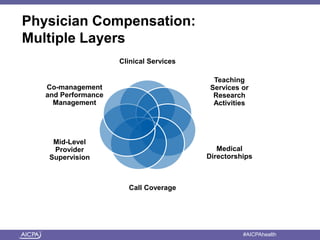
Physician Compensation: 
Multiple Layers 
Clinical Services 
Teaching 
Services or 
Research 
Activities 
Medical 
Directorships 
Call Coverage 
Co-management 
and Performance 
Management 
Mid-Level 
Provider 
Supervision 
American Institute of CPAs #AICPAhealth
Physician Compensation: 
Multiple Layers (Cont’d) 
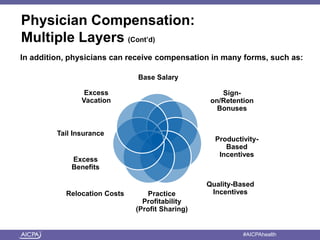
In addition, physicians can receive compensation in many forms, such as: 
Base Salary 
Sign-on/ 
Retention 
Bonuses 
Productivity- 
Based 
Incentives 
Quality-Based 
Practice Incentives 
Profitability 
(Profit Sharing) 
Excess 
Vacation 
Tail Insurance 
Excess 
Benefits 
Relocation Costs 
American Institute of CPAs #AICPAhealth
Physician Compensation: 
Multiple Layers (Cont’d) 
As new compensation models become more complex, in 
certain cases “the sum of the parts can exceed the whole” 
and create commercial reasonableness and FMV issues 
for the organization. 
American Institute of CPAs #AICPAhealth
Evaluation of Increased Risks 
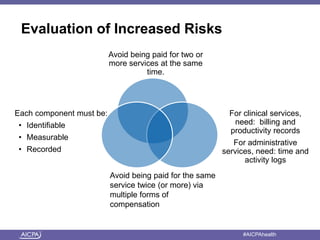
Avoid being paid for two or 
more services at the same 
time. 
For clinical services, 
need: billing and 
productivity records 
For administrative 
services, need: time and 
activity logs 
Each component must be: 
• Identifiable 
• Measurable 
• Recorded 
Avoid being paid for the same 
service twice (or more) via 
multiple forms of 
compensation 
American Institute of CPAs #AICPAhealth
Evaluation of Increased Risks (Cont’d) 
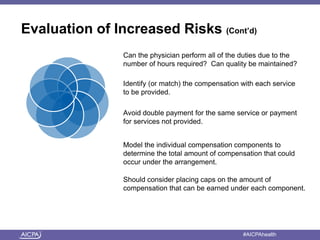
Can the physician perform all of the duties due to the 
number of hours required? Can quality be maintained? 
Identify (or match) the compensation with each service 
to be provided. 
Avoid double payment for the same service or payment 
for services not provided. 
Model the individual compensation components to 
determine the total amount of compensation that could 
occur under the arrangement. 
Should consider placing caps on the amount of 
compensation that can be earned under each component. 
American Institute of CPAs #AICPAhealth
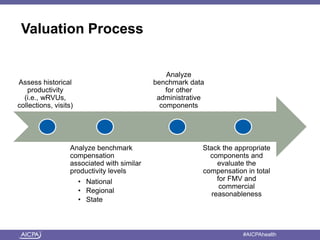
Valuation Process 
Assess historical 
productivity 
(i.e., wRVUs, 
collections, visits) 
Analyze benchmark 
compensation 
associated with similar 
productivity levels 
• National 
• Regional 
• State 
Analyze 
benchmark data 
for other 
administrative 
components 
Stack the appropriate 
components and 
evaluate the 
compensation in total 
for FMV and 
commercial 
reasonableness 
American Institute of CPAs #AICPAhealth
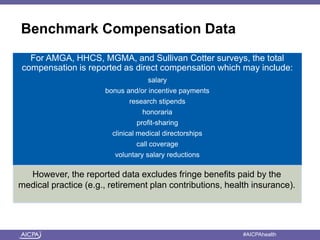
Benchmark Compensation Data 
For AMGA, HHCS, MGMA, and Sullivan Cotter surveys, the total 
compensation is reported as direct compensation which may include: 
salary 
bonus and/or incentive payments 
research stipends 
honoraria 
profit-sharing 
clinical medical directorships 
call coverage 
voluntary salary reductions 
However, the reported data excludes fringe benefits paid by the 
medical practice (e.g., retirement plan contributions, health insurance). 
American Institute of CPAs #AICPAhealth
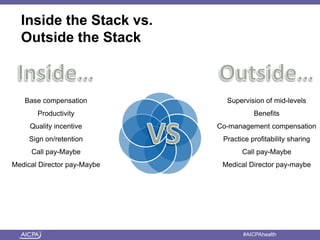
Inside the Stack vs. 
Outside the Stack 
Base compensation 
Productivity 
Quality incentive 
Sign on/retention 
Call pay-Maybe 
Medical Director pay-Maybe 
Supervision of mid-levels 
Benefits 
Co-management compensation 
Practice profitability sharing 
Call pay-Maybe 
Medical Director pay-maybe 
American Institute of CPAs #AICPAhealth
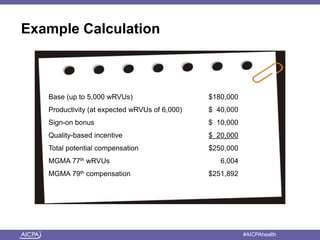
Example Calculation 
Base (up to 5,000 wRVUs) $180,000 
Productivity (at expected wRVUs of 6,000) $ 40,000 
Sign-on bonus $ 10,000 
Quality-based incentive $ 20,000 
Total potential compensation $250,000 
MGMA 77th wRVUs 6,004 
MGMA 79th compensation $251,892 
American Institute of CPAs #AICPAhealth
Losses and Commercial 
#AICPAhealth 
Reasonableness
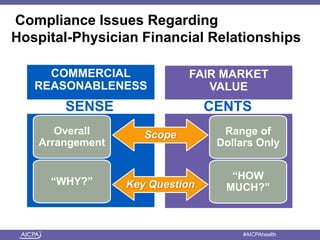
Compliance Issues Regarding 
Hospital-Physician Financial Relationships 
COMMERCIAL 
REASONABLENESS 
FAIR MARKET 
VALUE 
SENSE CENTS 
Overall 
Arrangement 
“WHY?” 
Range of 
Dollars Only 
“HOW 
MUCH?” 
Scope 
Key Question 
American Institute of CPAs #AICPAhealth
Commercial Reasonableness 
Department of Health and Human Services Definition1 
• An arrangement which appears to be “a sensible, prudent business 
agreement, from the perspective of the particular parties involved, even 
in the absence of any potential referrals.” 
Stark Definition2 
• “An arrangement will be considered ‘commercially reasonable’ in the 
absence of referrals if the arrangement would make commercial sense 
if entered into by a reasonable entity of similar type and size and a 
reasonable physician of similar scope and specialty, even if there were 
no potential designated health services (“DHS”) referrals.” 
OIG Threshold 3 
• Compensation arrangements with physicians should be “reasonable 
and necessary.” 
1 63 Fed. Reg. 1700 (Jan. 9, 1998). 
2 69 Fed. Reg. 16093 (March 26, 2004). 
3“OIG Compliance Program For Individual and Small Group Physician Practices,” Notice, 65 Fed. Reg. 59434 (Oct. 5, 2000); OIG Advisory Opinion 
No. 07-10, September 20, 2007, pg. 6, 10; “OIG Supplemental Compliance Program Guidance for Hospitals,” Notice, 70 Fed. Reg. 4858 (Jan. 31, 
2005). 
American Institute of CPAs #AICPAhealth
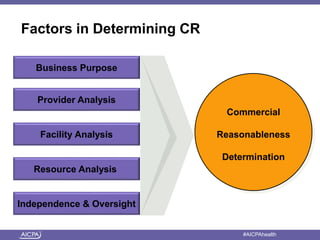
Factors in Determining CR 
Business Purpose 
Provider Analysis 
Facility Analysis 
Resource Analysis 
Independence & Oversight 
Commercial 
Reasonableness 
Determination 
American Institute of CPAs #AICPAhealth
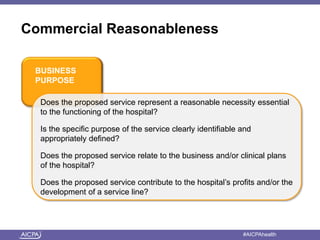
Commercial Reasonableness 
BUSINESS 
PURPOSE 
Does the proposed service represent a reasonable necessity essential 
to the functioning of the hospital? 
Is the specific purpose of the service clearly identifiable and 
appropriately defined? 
Does the proposed service relate to the business and/or clinical plans 
of the hospital? 
Does the proposed service contribute to the hospital’s profits and/or the 
development of a service line? 
American Institute of CPAs #AICPAhealth
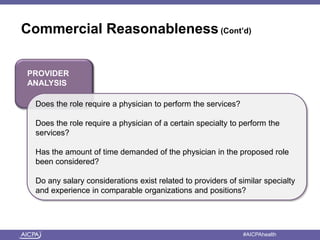
Commercial Reasonableness (Cont’d) 
PROVIDER 
ANALYSIS 
Does the role require a physician to perform the services? 
Does the role require a physician of a certain specialty to perform the 
services? 
Has the amount of time demanded of the physician in the proposed role 
been considered? 
Do any salary considerations exist related to providers of similar specialty 
and experience in comparable organizations and positions? 
American Institute of CPAs #AICPAhealth
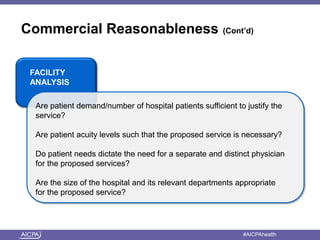
Commercial Reasonableness (Cont’d) 
FACILITY 
ANALYSIS 
Text Goes Here 
Are patient demand/number of hospital patients sufficient to justify the 
service? 
Are patient acuity levels such that the proposed service is necessary? 
Do patient needs dictate the need for a separate and distinct physician 
for the proposed services? 
Are the size of the hospital and its relevant departments appropriate 
for the proposed service? 
American Institute of CPAs #AICPAhealth
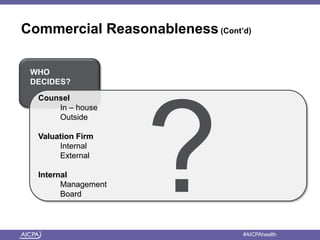
Commercial Reasonableness (Cont’d) 
WHO 
DECIDES? 
Counsel 
In – house 
Outside 
Valuation Firm 
Internal 
External 
Internal 
Management 
Board 
American Institute of CPAs #AICPAhealth
Safeguards 
Use qualified legal counsel / valuation firms 
Do not have multiple valuations 
Needs Assessment from provider that makes the business case for the arrangement (absent 
referrals) 
Transaction and compensation must be viewed as a whole 
Avoid part-time employment arrangements, particularly with full-time benefits 
American Institute of CPAs #AICPAhealth
Safeguards (Cont’d) 
Expected Losses/ROI factor 
Allow for adjustments in terms based on marketplace/hospital changes; no fixed fees (without 
revaluation) for more than 2-3 years 
Term and Termination triggers 
Clearly defined scope of services; documentation of services 
Limit number of arrangements covering same services/service line 
American Institute of CPAs #AICPAhealth
Renewals and Financial Losses 
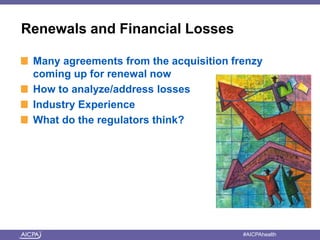
Many agreements from the acquisition frenzy 
coming up for renewal now 
How to analyze/address losses 
Industry Experience 
What do the regulators think? 
American Institute of CPAs #AICPAhealth
Analyzing/Addressing Losses 
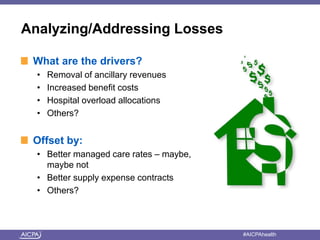
What are the drivers? 
• Removal of ancillary revenues 
• Increased benefit costs 
• Hospital overload allocations 
• Others? 
Offset by: 
• Better managed care rates – maybe, 
maybe not 
• Better supply expense contracts 
• Others? 
American Institute of CPAs #AICPAhealth
Analyzing/Addressing Losses (Cont’d) 
What if Losses remain after specific factor analysis? 
• Contribution to mission/community need 
• Uniqueness of specialty 
• Competitive nature of managed care market 
• What would compensation look like if the physicians were still in 
private practice? 
American Institute of CPAs #AICPAhealth
Industry Experience 
Benchmarks publish average 
losses per physician for some 
specialties (MGMA Cost 
Survey for example) 
Is the comparison apples to 
apples? 
Would the argument persuade 
a regulator? 
American Institute of CPAs #AICPAhealth
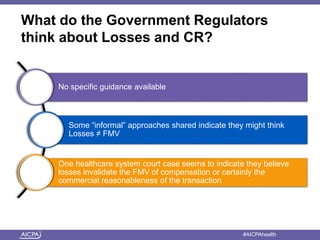
What do the Government Regulators 
think about Losses and CR? 
No specific guidance available 
Some “informal” approaches shared indicate they might think 
Losses ≠ FMV 
One healthcare system court case seems to indicate they believe 
losses invalidate the FMV of compensation or certainly the 
commercial reasonableness of the transaction 
American Institute of CPAs #AICPAhealth
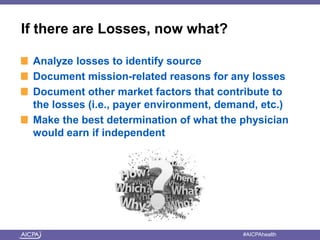
If there are Losses, now what? 
Analyze losses to identify source 
Document mission-related reasons for any losses 
Document other market factors that contribute to 
the losses (i.e., payer environment, demand, etc.) 
Make the best determination of what the physician 
would earn if independent 
American Institute of CPAs #AICPAhealth
Impact of Health Reform 
#AICPAhealth
State of Health Reform 
Continue to see positive trends in 
primary care compensation and 
“prestige” 
Still a strong consolidation 
environment, particularly for primary 
care 
Quality incentive/withholds the norm, 
not the exception 
• MGMA indicates 64% of respondents had a 
quality bonus/withhold 
• AMGA indicated 31% had compensation tied to 
something other than production 
American Institute of CPAs #AICPAhealth
State of Health Reform (cont.) 
More services are covered 
More patients with coverage 
• Are these primarily Medicaid patients? 
• Will patients be forced to accept a lower level 
of care (i.e. a mid-level provider) due to 
shortages? 
Higher out-of-pocket expenses for 
patients – could translate to less 
elective care 
American Institute of CPAs #AICPAhealth
State of Health Reform (cont.) 
Increasing transparency for providers 
• Data.Medicare.Gov Website –includes 
comparison for Physician, ACO, Home Health, 
Dialysis and Hospitals 
• Commercial insurance score cards 
Value-based payment modifier in play 
in 2015 
• Shift from reporting incentive to performance 
incentive/reduction 
No loss of momentum in bundling 
payments or ACO development 
American Institute of CPAs #AICPAhealth
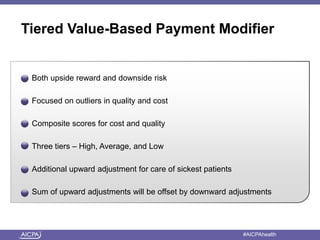
Tiered Value-Based Payment Modifier 
Both upside reward and downside risk 
Focused on outliers in quality and cost 
Composite scores for cost and quality 
Three tiers – High, Average, and Low 
Additional upward adjustment for care of sickest patients 
Sum of upward adjustments will be offset by downward adjustments 
American Institute of CPAs #AICPAhealth
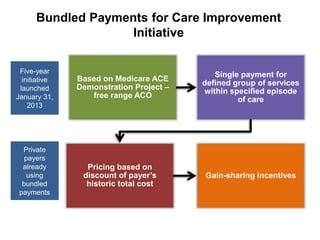
Bundled Payments for Care Improvement 
Five-year 
initiative 
launched 
January 31, 
2013 
Private 
payers 
already 
using 
bundled 
payments 
Initiative 
Based on Medicare ACE 
Demonstration Project – 
free range ACO 
Single payment for 
defined group of services 
within specified episode 
of care 
Pricing based on 
discount of payer’s 
historic total cost 
Gain-sharing incentives
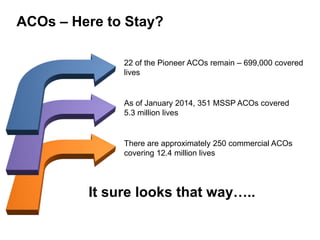
ACOs – Here to Stay? 
22 of the Pioneer ACOs remain – 699,000 covered 
lives 
As of January 2014, 351 MSSP ACOs covered 
5.3 million lives 
There are approximately 250 commercial ACOs 
covering 12.4 million lives 
It sure looks that way…..
#AICPAhealth 
Questions?
Contact Information 
Carol Carden, CPA/ABV, ASA 
PYA 
(800) 270-9629 
ccarden@pyapc.com 
www.pyapc.com 
Twitter: @carolcardenpya 
American Institute of CPAs #AICPAhealth

Hot Valuation Issues for Physician Agreements

  • 1.
    Hot Valuation Issuesfor Physician Agreements #AICPAhealth 2014 AICPA National Healthcare Conference November 6, 2014 Carol W. Carden, CPA/ABV, ASA, CFE
  • 2.
    Agenda Overview MultipleLayers of Physician Compensation – FMV and CR Losses and Commercial Reasonableness Impact of Health Reform Questions American Institute of CPAs #AICPAhealth
  • 3.
    Speaker Biography CarolCarden is a Principal with Pershing Yoakley & Associates, P.C., and provides business valuation and related consulting services to a wide variety of business organizations, primarily in the healthcare industry. Ms. Carden’s primary areas of expertise are in finance, valuation, managed care and revenue cycle operations for healthcare organizations. She has performed appraisals of businesses and securities for a wide variety of purposes such as mergers, acquisitions, joint ventures, management service agreements and other intangible assets. In addition to being a Certified Public Accountant, she has also earned the Accredited in Business Valuation (ABV) credential from the American Institute of Certified Public Accountants, the Accredited Senior Appraiser (ASA) credential from the American Society of Appraisers and the Certified Fraud Examiner (CFE) credential from the Association of Certified Fraud Examiners. She is the Chair of the Executive Committee for Forensic and Valuation Services and the former Chair of the Business Valuation Committee for the AICPA, was Chair of the 2010 National AICPA Business Valuation Conference and was on the planning committee for the 2011 AICPA National Healthcare Conference. She was inducted into the AICPA Business Valuation Hall of Fame in 2013.
  • 4.
    Multiple Layers ofPhysician #AICPAhealth Compensation
  • 5.
    Overview Hospitals andother organizations are utilizing more complex compensation models, often with multiple layers of compensation for multiple services (sometimes referred to as “stacking”). With these types of models, it is important to: • Understand the various functional agreements and how they relate to each other. • Know when a “stacking” analysis is in order. • Be aware of the multiple benchmark compensation data sources available. • Be aware of the various forms of compensation that are included in clinical benchmark data. • Appreciate the increased risks in stacking agreements. • Ensure that each component of compensation, and the components when viewed in their entirety, do not exceed fair market value (“FMV”) and are commercially reasonable. American Institute of CPAs #AICPAhealth
  • 6.
    Physician Compensation: MultipleLayers Clinical Services Teaching Services or Research Activities Medical Directorships Call Coverage Co-management and Performance Management Mid-Level Provider Supervision American Institute of CPAs #AICPAhealth
  • 7.
    Physician Compensation: MultipleLayers (Cont’d) In addition, physicians can receive compensation in many forms, such as: Base Salary Sign-on/ Retention Bonuses Productivity- Based Incentives Quality-Based Practice Incentives Profitability (Profit Sharing) Excess Vacation Tail Insurance Excess Benefits Relocation Costs American Institute of CPAs #AICPAhealth
  • 8.
    Physician Compensation: MultipleLayers (Cont’d) As new compensation models become more complex, in certain cases “the sum of the parts can exceed the whole” and create commercial reasonableness and FMV issues for the organization. American Institute of CPAs #AICPAhealth
  • 9.
    Evaluation of IncreasedRisks Avoid being paid for two or more services at the same time. For clinical services, need: billing and productivity records For administrative services, need: time and activity logs Each component must be: • Identifiable • Measurable • Recorded Avoid being paid for the same service twice (or more) via multiple forms of compensation American Institute of CPAs #AICPAhealth
  • 10.
    Evaluation of IncreasedRisks (Cont’d) Can the physician perform all of the duties due to the number of hours required? Can quality be maintained? Identify (or match) the compensation with each service to be provided. Avoid double payment for the same service or payment for services not provided. Model the individual compensation components to determine the total amount of compensation that could occur under the arrangement. Should consider placing caps on the amount of compensation that can be earned under each component. American Institute of CPAs #AICPAhealth
  • 11.
    Valuation Process Assesshistorical productivity (i.e., wRVUs, collections, visits) Analyze benchmark compensation associated with similar productivity levels • National • Regional • State Analyze benchmark data for other administrative components Stack the appropriate components and evaluate the compensation in total for FMV and commercial reasonableness American Institute of CPAs #AICPAhealth
  • 12.
    Benchmark Compensation Data For AMGA, HHCS, MGMA, and Sullivan Cotter surveys, the total compensation is reported as direct compensation which may include: salary bonus and/or incentive payments research stipends honoraria profit-sharing clinical medical directorships call coverage voluntary salary reductions However, the reported data excludes fringe benefits paid by the medical practice (e.g., retirement plan contributions, health insurance). American Institute of CPAs #AICPAhealth
  • 13.
    Inside the Stackvs. Outside the Stack Base compensation Productivity Quality incentive Sign on/retention Call pay-Maybe Medical Director pay-Maybe Supervision of mid-levels Benefits Co-management compensation Practice profitability sharing Call pay-Maybe Medical Director pay-maybe American Institute of CPAs #AICPAhealth
  • 14.
    Example Calculation Base(up to 5,000 wRVUs) $180,000 Productivity (at expected wRVUs of 6,000) $ 40,000 Sign-on bonus $ 10,000 Quality-based incentive $ 20,000 Total potential compensation $250,000 MGMA 77th wRVUs 6,004 MGMA 79th compensation $251,892 American Institute of CPAs #AICPAhealth
  • 15.
    Losses and Commercial #AICPAhealth Reasonableness
  • 16.
    Compliance Issues Regarding Hospital-Physician Financial Relationships COMMERCIAL REASONABLENESS FAIR MARKET VALUE SENSE CENTS Overall Arrangement “WHY?” Range of Dollars Only “HOW MUCH?” Scope Key Question American Institute of CPAs #AICPAhealth
  • 17.
    Commercial Reasonableness Departmentof Health and Human Services Definition1 • An arrangement which appears to be “a sensible, prudent business agreement, from the perspective of the particular parties involved, even in the absence of any potential referrals.” Stark Definition2 • “An arrangement will be considered ‘commercially reasonable’ in the absence of referrals if the arrangement would make commercial sense if entered into by a reasonable entity of similar type and size and a reasonable physician of similar scope and specialty, even if there were no potential designated health services (“DHS”) referrals.” OIG Threshold 3 • Compensation arrangements with physicians should be “reasonable and necessary.” 1 63 Fed. Reg. 1700 (Jan. 9, 1998). 2 69 Fed. Reg. 16093 (March 26, 2004). 3“OIG Compliance Program For Individual and Small Group Physician Practices,” Notice, 65 Fed. Reg. 59434 (Oct. 5, 2000); OIG Advisory Opinion No. 07-10, September 20, 2007, pg. 6, 10; “OIG Supplemental Compliance Program Guidance for Hospitals,” Notice, 70 Fed. Reg. 4858 (Jan. 31, 2005). American Institute of CPAs #AICPAhealth
  • 18.
    Factors in DeterminingCR Business Purpose Provider Analysis Facility Analysis Resource Analysis Independence & Oversight Commercial Reasonableness Determination American Institute of CPAs #AICPAhealth
  • 19.
    Commercial Reasonableness BUSINESS PURPOSE Does the proposed service represent a reasonable necessity essential to the functioning of the hospital? Is the specific purpose of the service clearly identifiable and appropriately defined? Does the proposed service relate to the business and/or clinical plans of the hospital? Does the proposed service contribute to the hospital’s profits and/or the development of a service line? American Institute of CPAs #AICPAhealth
  • 20.
    Commercial Reasonableness (Cont’d) PROVIDER ANALYSIS Does the role require a physician to perform the services? Does the role require a physician of a certain specialty to perform the services? Has the amount of time demanded of the physician in the proposed role been considered? Do any salary considerations exist related to providers of similar specialty and experience in comparable organizations and positions? American Institute of CPAs #AICPAhealth
  • 21.
    Commercial Reasonableness (Cont’d) FACILITY ANALYSIS Text Goes Here Are patient demand/number of hospital patients sufficient to justify the service? Are patient acuity levels such that the proposed service is necessary? Do patient needs dictate the need for a separate and distinct physician for the proposed services? Are the size of the hospital and its relevant departments appropriate for the proposed service? American Institute of CPAs #AICPAhealth
  • 22.
    Commercial Reasonableness (Cont’d) WHO DECIDES? Counsel In – house Outside Valuation Firm Internal External Internal Management Board American Institute of CPAs #AICPAhealth
  • 23.
    Safeguards Use qualifiedlegal counsel / valuation firms Do not have multiple valuations Needs Assessment from provider that makes the business case for the arrangement (absent referrals) Transaction and compensation must be viewed as a whole Avoid part-time employment arrangements, particularly with full-time benefits American Institute of CPAs #AICPAhealth
  • 24.
    Safeguards (Cont’d) ExpectedLosses/ROI factor Allow for adjustments in terms based on marketplace/hospital changes; no fixed fees (without revaluation) for more than 2-3 years Term and Termination triggers Clearly defined scope of services; documentation of services Limit number of arrangements covering same services/service line American Institute of CPAs #AICPAhealth
  • 25.
    Renewals and FinancialLosses Many agreements from the acquisition frenzy coming up for renewal now How to analyze/address losses Industry Experience What do the regulators think? American Institute of CPAs #AICPAhealth
  • 26.
    Analyzing/Addressing Losses Whatare the drivers? • Removal of ancillary revenues • Increased benefit costs • Hospital overload allocations • Others? Offset by: • Better managed care rates – maybe, maybe not • Better supply expense contracts • Others? American Institute of CPAs #AICPAhealth
  • 27.
    Analyzing/Addressing Losses (Cont’d) What if Losses remain after specific factor analysis? • Contribution to mission/community need • Uniqueness of specialty • Competitive nature of managed care market • What would compensation look like if the physicians were still in private practice? American Institute of CPAs #AICPAhealth
  • 28.
    Industry Experience Benchmarkspublish average losses per physician for some specialties (MGMA Cost Survey for example) Is the comparison apples to apples? Would the argument persuade a regulator? American Institute of CPAs #AICPAhealth
  • 29.
    What do theGovernment Regulators think about Losses and CR? No specific guidance available Some “informal” approaches shared indicate they might think Losses ≠ FMV One healthcare system court case seems to indicate they believe losses invalidate the FMV of compensation or certainly the commercial reasonableness of the transaction American Institute of CPAs #AICPAhealth
  • 30.
    If there areLosses, now what? Analyze losses to identify source Document mission-related reasons for any losses Document other market factors that contribute to the losses (i.e., payer environment, demand, etc.) Make the best determination of what the physician would earn if independent American Institute of CPAs #AICPAhealth
  • 31.
    Impact of HealthReform #AICPAhealth
  • 32.
    State of HealthReform Continue to see positive trends in primary care compensation and “prestige” Still a strong consolidation environment, particularly for primary care Quality incentive/withholds the norm, not the exception • MGMA indicates 64% of respondents had a quality bonus/withhold • AMGA indicated 31% had compensation tied to something other than production American Institute of CPAs #AICPAhealth
  • 33.
    State of HealthReform (cont.) More services are covered More patients with coverage • Are these primarily Medicaid patients? • Will patients be forced to accept a lower level of care (i.e. a mid-level provider) due to shortages? Higher out-of-pocket expenses for patients – could translate to less elective care American Institute of CPAs #AICPAhealth
  • 34.
    State of HealthReform (cont.) Increasing transparency for providers • Data.Medicare.Gov Website –includes comparison for Physician, ACO, Home Health, Dialysis and Hospitals • Commercial insurance score cards Value-based payment modifier in play in 2015 • Shift from reporting incentive to performance incentive/reduction No loss of momentum in bundling payments or ACO development American Institute of CPAs #AICPAhealth
  • 35.
    Tiered Value-Based PaymentModifier Both upside reward and downside risk Focused on outliers in quality and cost Composite scores for cost and quality Three tiers – High, Average, and Low Additional upward adjustment for care of sickest patients Sum of upward adjustments will be offset by downward adjustments American Institute of CPAs #AICPAhealth
  • 36.
    Bundled Payments forCare Improvement Five-year initiative launched January 31, 2013 Private payers already using bundled payments Initiative Based on Medicare ACE Demonstration Project – free range ACO Single payment for defined group of services within specified episode of care Pricing based on discount of payer’s historic total cost Gain-sharing incentives
  • 37.
    ACOs – Hereto Stay? 22 of the Pioneer ACOs remain – 699,000 covered lives As of January 2014, 351 MSSP ACOs covered 5.3 million lives There are approximately 250 commercial ACOs covering 12.4 million lives It sure looks that way…..
  • 38.
  • 39.
    Contact Information CarolCarden, CPA/ABV, ASA PYA (800) 270-9629 ccarden@pyapc.com www.pyapc.com Twitter: @carolcardenpya American Institute of CPAs #AICPAhealth