Evaluation Methods P A C E hysician sthma are ducation
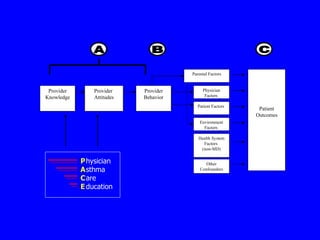
Patient Outcomes Health System Factors  (non-MD) Other Confounders Parental Factors Patient Factors   Environment Factors   Physician Factors   A C B Provider  Attitudes Provider Behavior Provider Knowledge P A C E hysician sthma are ducation
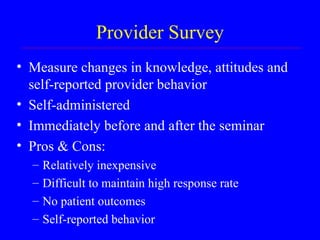
Provider Survey Measure changes in knowledge, attitudes and self-reported provider behavior Self-administered Immediately before and after the seminar Pros & Cons: Relatively inexpensive Difficult to maintain high response rate No patient outcomes Self-reported behavior
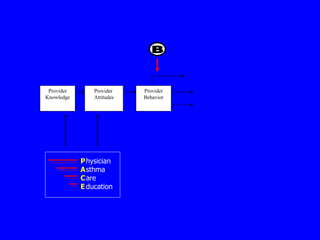
B Provider  Attitudes Provider Behavior Provider Knowledge P A C E hysician sthma are ducation
Medical Record Audit Measure changes in provider behavior Requires trained chart reviewers  Pros & Cons: Information regarding physician prescription, outpatient visits (urgent & non-urgent) Poor documentation of asthma counseling, asthma severity Consent may be required from each patient/parent Information on outpatient asthma health care utilization
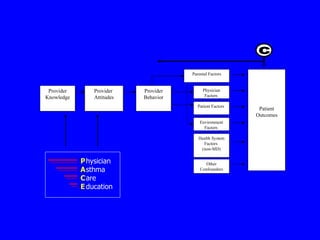
Patient Outcomes Health System Factors  (non-MD) Other Confounders Parental Factors Patient Factors   Environment Factors   Physician Factors   C Provider  Attitudes Provider Behavior Provider Knowledge P A C E hysician sthma are ducation
Parent Telephone Survey Measure changes in outcomes, self-management Requires trained telephone interviewers Pros & Cons: Information on outpatient asthma health care utilization, parent perceptions of physician behavior, asthma severity and asthma control Difficult to schedule, high cost Consent required from each patient/parent May need to confirm medications, actual physician prescription (versus patient adherence)
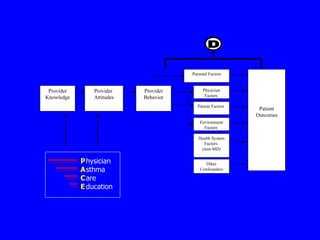
Patient Outcomes Health System Factors  (non-MD) Other Confounders Parental Factors Patient Factors   Environment Factors   Physician Factors   D Provider  Attitudes Provider Behavior Provider Knowledge P A C E hysician sthma are ducation
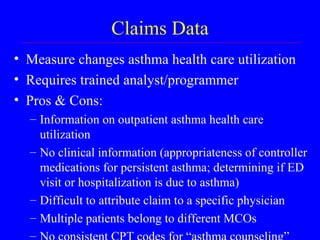
Claims Data Measure changes asthma health care utilization Requires trained analyst/programmer Pros & Cons: Information on outpatient asthma health care utilization No clinical information (appropriateness of controller medications for persistent asthma; determining if ED visit or hospitalization is due to asthma) Difficult to attribute claim to a specific physician Multiple patients belong to different MCOs No consistent CPT codes for “asthma counseling”
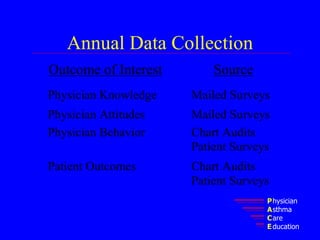
Annual Data Collection P A C E hysician sthma are ducation

PACE evaluation methods

  • 1.
    Evaluation Methods PA C E hysician sthma are ducation
  • 2.
    Patient Outcomes HealthSystem Factors (non-MD) Other Confounders Parental Factors Patient Factors Environment Factors Physician Factors A C B Provider Attitudes Provider Behavior Provider Knowledge P A C E hysician sthma are ducation
  • 3.
    Provider Survey Measurechanges in knowledge, attitudes and self-reported provider behavior Self-administered Immediately before and after the seminar Pros & Cons: Relatively inexpensive Difficult to maintain high response rate No patient outcomes Self-reported behavior
  • 4.
    B Provider Attitudes Provider Behavior Provider Knowledge P A C E hysician sthma are ducation
  • 5.
    Medical Record AuditMeasure changes in provider behavior Requires trained chart reviewers Pros & Cons: Information regarding physician prescription, outpatient visits (urgent & non-urgent) Poor documentation of asthma counseling, asthma severity Consent may be required from each patient/parent Information on outpatient asthma health care utilization
  • 6.
    Patient Outcomes HealthSystem Factors (non-MD) Other Confounders Parental Factors Patient Factors Environment Factors Physician Factors C Provider Attitudes Provider Behavior Provider Knowledge P A C E hysician sthma are ducation
  • 7.
    Parent Telephone SurveyMeasure changes in outcomes, self-management Requires trained telephone interviewers Pros & Cons: Information on outpatient asthma health care utilization, parent perceptions of physician behavior, asthma severity and asthma control Difficult to schedule, high cost Consent required from each patient/parent May need to confirm medications, actual physician prescription (versus patient adherence)
  • 8.
    Patient Outcomes HealthSystem Factors (non-MD) Other Confounders Parental Factors Patient Factors Environment Factors Physician Factors D Provider Attitudes Provider Behavior Provider Knowledge P A C E hysician sthma are ducation
  • 9.
    Claims Data Measurechanges asthma health care utilization Requires trained analyst/programmer Pros & Cons: Information on outpatient asthma health care utilization No clinical information (appropriateness of controller medications for persistent asthma; determining if ED visit or hospitalization is due to asthma) Difficult to attribute claim to a specific physician Multiple patients belong to different MCOs No consistent CPT codes for “asthma counseling”
  • 10.
    Annual Data CollectionP A C E hysician sthma are ducation

Editor's Notes

  • #2 The following text describes this slide for the visually impaired. Physician Asthma Care Education, also known as PACE, Evaluation Methods.
  • #3 The following text describes the model in this slide for the visually impaired. Physician asthma care education, abbreviated as PACE, can have an impact on patient outcomes via a number of channels. PACE targets provider knowledge and attitudes, which turn can affect provider behavior. Provider behaviors, in turn, can affect parental factors, physician factors, patient factors, and environmental factors. These factors affect patient outcomes. Additionally, patient outcomes are affected by non-MD health system factors and other potential confounders. This slide highlights three components of the model, A: provider knowledge and attitudes; B: provider behavior and other factors influencing outcomes; and C: patient outcomes..
  • #5 The following text describes the model in this slide for the visually impaired. Physician asthma care education, abbreviated as PACE, can have an impact on patient outcomes via a number of channels. PACE targets provider knowledge and attitudes, which in turn can affect provider behavior. Provider behaviors, in turn, can affect parental factors, physician factors, patient factors, and environmental factors. These factors affect patient outcomes. Additionally, patient outcomes are affected by non-MD health system factors and other potential confounders. This slide highlights component B of the model; provider behavior.
  • #7 The following text describes the model in this slide for the visually impaired. Physician asthma care education, abbreviated as PACE, can have an impact on patient outcomes via a number of channels. PACE targets provider knowledge and attitudes, which turn can affect provider behavior. Provider behaviors, in turn, can affect parental factors, physician factors, patient factors, and environmental factors. These factors affect patient outcomes. Additionally, patient outcomes are affected by non-MD health system factors and other potential confounders. This slide highlights component C full model; patient outcomes.
  • #9 The following text describes the model in this slide for the visually impaired. Physician asthma care education, abbreviated as PACE, can have an impact on patient outcomes via a number of channels. PACE targets provider knowledge and attitudes, which turn can affect provider behavior. Provider behaviors, in turn, can affect parental factors, physician factors, patient factors, and environmental factors. These factors affect patient outcomes. Additionally, patient outcomes are affected by non-MD health system factors and other potential confounders. This slide shows the entire model and suggests there is a component D; the combined interaction of provider behavior and external factors on patient outcomes.
  • #11 The following text describes the model in this slide for the visually impaired. The title of this slide is annual data collection. There are two column headers: outcome of interest and source. The following lists the outcome of interest followed by its source(s): Physician knowledge, mailed surveys. Physician attitudes, mailed surveys. Physician behavior, chart audits and patient surveys. Patient Outcomes, chart audits and patient surveys.