Medical-Legal & Ethical Issues in Nursing
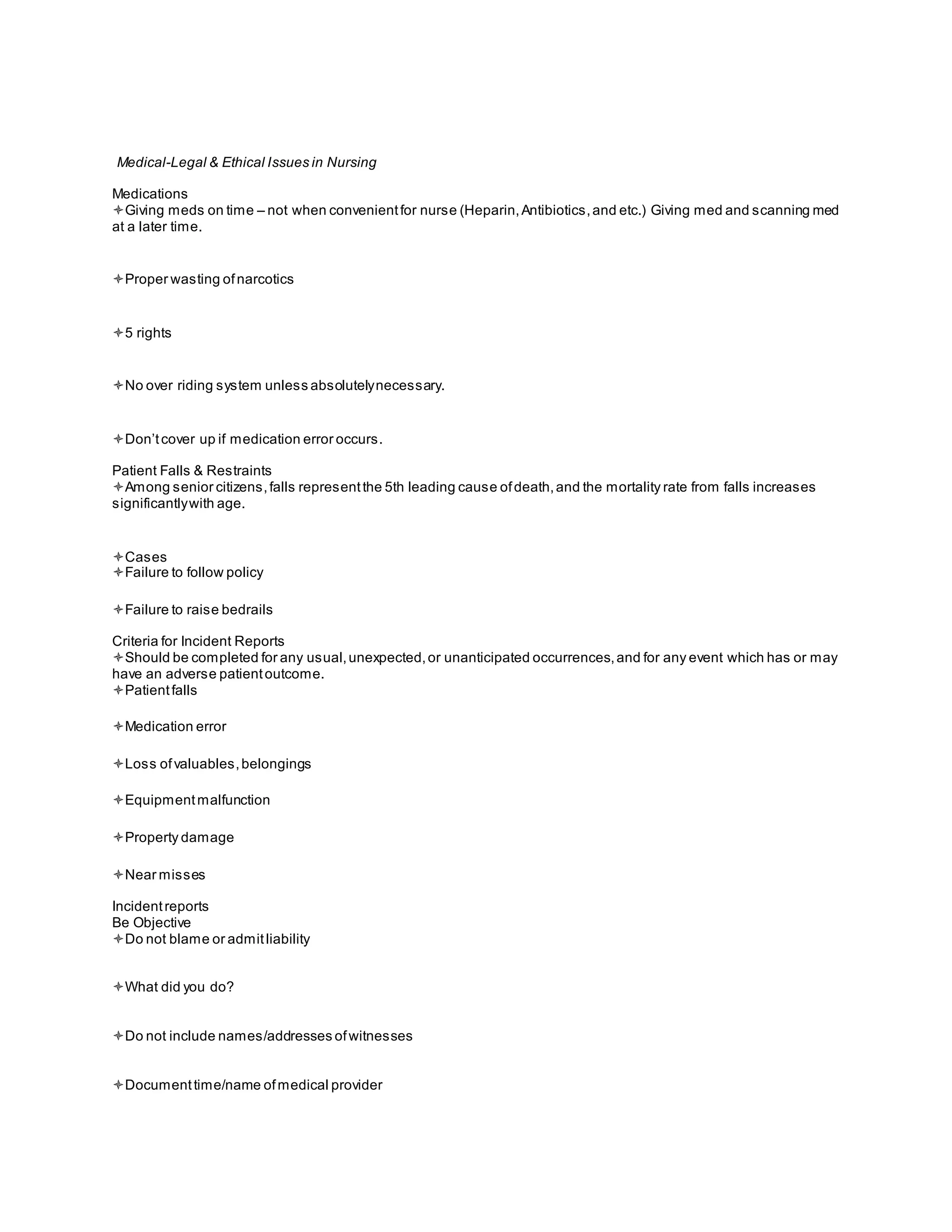
Medications
Giving meds on time – not when convenientfor nurse (Heparin,Antibiotics,and etc.) Giving med and scanning med
at a later time.
Proper wasting ofnarcotics
5 rights
No over riding system unless absolutelynecessary.
Don’tcover up if medication error occurs.
Patient Falls & Restraints
Among senior citizens,falls representthe 5th leading cause ofdeath,and the mortality rate from falls increases
significantlywith age.
Cases
Failure to follow policy
Failure to raise bedrails
Criteria for Incident Reports
Should be completed for any usual,unexpected,or unanticipated occurrences,and for any event which has or may
have an adverse patientoutcome.
Patientfalls
Medication error
Loss ofvaluables,belongings
Equipmentmalfunction
Property damage
Near misses
Incidentreports
Be Objective
Do not blame or admitliability
What did you do?
Do not include names/addresses ofwitnesses
Documenttime/name ofmedical provider
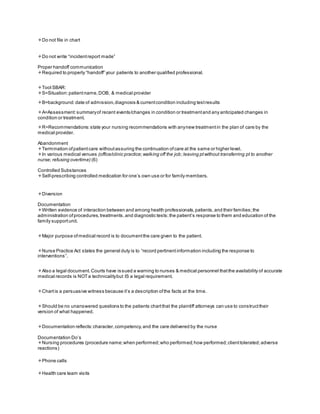
Do not file in chart
Do not write “incidentreport made”
Proper handoff communication
Required to properly “handoff” your patients to another qualified professional.
Tool SBAR:
S=Situation:patientname,DOB, & medical provider
B=background:date of admission,diagnosis & currentcondition including testresults
A=Assessment:summaryof recent events/changes in condition or treatmentand any anticipated changes in
condition or treatment.
R=Recommendations:state your nursing recommendations with anynew treatmentin the plan of care by the
medical provider.
Abandonment
Termination ofpatientcare withoutassuring the continuation ofcare at the same or higher level.
In various medical venues (office/clinic practice;walking off the job;leaving ptwithout transferring pt to another
nurse; refusing overtime) (6)
Controlled Substances
Self-prescribing controlled medication for one’s own use or for family members.
Diversion
Documentation
Written evidence of interaction between and among health professionals,patients,and their families;the
administration ofprocedures,treatments,and diagnostic tests;the patient’s response to them and education of the
family supportunit.
Major purpose ofmedical record is to documentthe care given to the patient.
Nurse Practice Act states the general duty is to “record pertinentinformation including the response to
interventions”.
Also a legal document.Courts have issued a warning to nurses & medical personnel thatthe availability of accurate
medical records is NOTa technicalitybut IS a legal requirement.
Chartis a persuasive witness because it’s a description ofthe facts at the time.
Should be no unanswered questions to the patients chartthat the plaintiff attorneys can use to constructtheir
version of what happened.
Documentation reflects:character,competency,and the care delivered by the nurse
Documentation Do’s
Nursing procedures (procedure name;when performed;who performed;how performed;clienttolerated;adverse
reactions)
Phone calls
Health care team visits
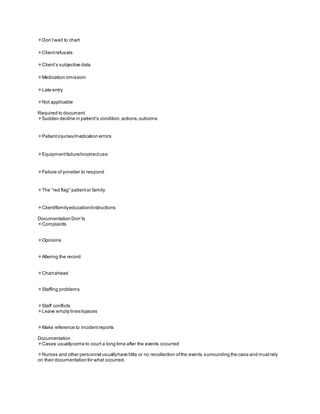
Don’twait to chart
Clientrefusals
Client’s subjective data
Medication omission
Late entry
Not applicable
Required to document
Sudden decline in patient’s condition,actions,outcome
Patientinjuries/medication errors
Equipmentfailure/incorrectuse
Failure of provider to respond
The “red flag” patientor family
Client/familyeducation/instructions
Documentation Don’ts
Complaints
Opinions
Altering the record
Chartahead
Staffing problems
Staff conflicts
Leave empty lines/spaces
Make reference to incidentreports
Documentation
Cases usuallycome to court a long time after the events occurred
Nurses and other personnel usuallyhave little or no recollection ofthe events surrounding the case and mustrely
on their documentation for what occurred.
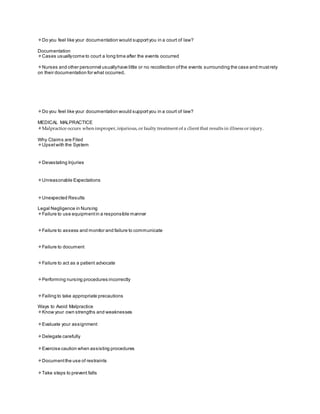
Do you feel like your documentation would supportyou in a court of law?
Documentation
Cases usuallycome to court a long time after the events occurred
Nurses and other personnel usuallyhave little or no recollection ofthe events surrounding the case and mustrely
on their documentation for what occurred.
Do you feel like your documentation would supportyou in a court of law?
MEDICAL MALPRACTICE
Malpractice occurs when improper, injurious, or faulty treatment of a client that results in illness or injury.
Why Claims are Filed
Upsetwith the System
Devastating Injuries
Unreasonable Expectations
Unexpected Results
Legal Negligence in Nursing
Failure to use equipmentin a responsible manner
Failure to assess and monitor and failure to communicate
Failure to document
Failure to act as a patient advocate
Performing nursing procedures incorrectly
Failing to take appropriate precautions
Ways to Avoid Malpractice
Know your own strengths and weaknesses
Evaluate your assignment
Delegate carefully
Exercise caution when assisting procedures
Documentthe use of restraints
Take steps to prevent falls
Complywith laws aboutadvance directives
Follow hospital policies and procedures
Keep policies and procedures up to date
Provide a safe environment
ELEMENTS OF NEGLIGENCE
Deviation from the standard of care that results in harm to the patient
4 elements ofnegligence
Duty to act (Nurse – Patient relationship)
Breach of duty (SOC not followed - reasonablyprudentnurse)
Damage (Physical & Psychological) No damage no case!
Causal connection (reasonablyclose connection between nurses conduct& injury)
Nursing Charges
Most common charges broughtagainstnurses include
Substance abuse
Incompetence
Negligence
THREE CATEGORIESOF IMPAIRMENT
PROFESSIONAL
Deficit in Medical Knowledge, Expertise or Judgment
BEHAVIORAL
Includes unprofessional, unethical, or criminal conduct
MEDICAL
Conditions which permanently impede or preclude a provider from safely practicing medicine
Code of Ethics
Code of ethics defines the moral principles thatgovern how you practice nursing and is the foundation on which
nursing is built.
Legal definition:“the minimum standards ofappropriate conductwithin legal and regulatoryparameters involving
the duty owed to your patient and other members ofyour profession.”
Submitting work vouchers for home care visits not made
Breach of confidentiality
Fraud
Refusing to provide care for patientof specific cultural origin
Grounds for Suspension & Revocation of License
Incompetentnursing practice
Professional misconduct
Conviction of a crime (Homicide;theft; manslaughter;illegible possession ofcontrolled substance;sexual assault;
arson;DUI)
Violations mayinclude
Procurementofa license by fraud
Unprofessional,dishonorable,immoral,or illegal conduct
Performance ofspecific actions prohibited bystatue
Malpractice

S2

  • 1.
    Medical-Legal & EthicalIssues in Nursing Medications Giving meds on time – not when convenientfor nurse (Heparin,Antibiotics,and etc.) Giving med and scanning med at a later time. Proper wasting ofnarcotics 5 rights No over riding system unless absolutelynecessary. Don’tcover up if medication error occurs. Patient Falls & Restraints Among senior citizens,falls representthe 5th leading cause ofdeath,and the mortality rate from falls increases significantlywith age. Cases Failure to follow policy Failure to raise bedrails Criteria for Incident Reports Should be completed for any usual,unexpected,or unanticipated occurrences,and for any event which has or may have an adverse patientoutcome. Patientfalls Medication error Loss ofvaluables,belongings Equipmentmalfunction Property damage Near misses Incidentreports Be Objective Do not blame or admitliability What did you do? Do not include names/addresses ofwitnesses Documenttime/name ofmedical provider
  • 2.
    Do not filein chart Do not write “incidentreport made” Proper handoff communication Required to properly “handoff” your patients to another qualified professional. Tool SBAR: S=Situation:patientname,DOB, & medical provider B=background:date of admission,diagnosis & currentcondition including testresults A=Assessment:summaryof recent events/changes in condition or treatmentand any anticipated changes in condition or treatment. R=Recommendations:state your nursing recommendations with anynew treatmentin the plan of care by the medical provider. Abandonment Termination ofpatientcare withoutassuring the continuation ofcare at the same or higher level. In various medical venues (office/clinic practice;walking off the job;leaving ptwithout transferring pt to another nurse; refusing overtime) (6) Controlled Substances Self-prescribing controlled medication for one’s own use or for family members. Diversion Documentation Written evidence of interaction between and among health professionals,patients,and their families;the administration ofprocedures,treatments,and diagnostic tests;the patient’s response to them and education of the family supportunit. Major purpose ofmedical record is to documentthe care given to the patient. Nurse Practice Act states the general duty is to “record pertinentinformation including the response to interventions”. Also a legal document.Courts have issued a warning to nurses & medical personnel thatthe availability of accurate medical records is NOTa technicalitybut IS a legal requirement. Chartis a persuasive witness because it’s a description ofthe facts at the time. Should be no unanswered questions to the patients chartthat the plaintiff attorneys can use to constructtheir version of what happened. Documentation reflects:character,competency,and the care delivered by the nurse Documentation Do’s Nursing procedures (procedure name;when performed;who performed;how performed;clienttolerated;adverse reactions) Phone calls Health care team visits
  • 3.
    Don’twait to chart Clientrefusals Client’ssubjective data Medication omission Late entry Not applicable Required to document Sudden decline in patient’s condition,actions,outcome Patientinjuries/medication errors Equipmentfailure/incorrectuse Failure of provider to respond The “red flag” patientor family Client/familyeducation/instructions Documentation Don’ts Complaints Opinions Altering the record Chartahead Staffing problems Staff conflicts Leave empty lines/spaces Make reference to incidentreports Documentation Cases usuallycome to court a long time after the events occurred Nurses and other personnel usuallyhave little or no recollection ofthe events surrounding the case and mustrely on their documentation for what occurred.
  • 4.
    Do you feellike your documentation would supportyou in a court of law? Documentation Cases usuallycome to court a long time after the events occurred Nurses and other personnel usuallyhave little or no recollection ofthe events surrounding the case and mustrely on their documentation for what occurred. Do you feel like your documentation would supportyou in a court of law? MEDICAL MALPRACTICE Malpractice occurs when improper, injurious, or faulty treatment of a client that results in illness or injury. Why Claims are Filed Upsetwith the System Devastating Injuries Unreasonable Expectations Unexpected Results Legal Negligence in Nursing Failure to use equipmentin a responsible manner Failure to assess and monitor and failure to communicate Failure to document Failure to act as a patient advocate Performing nursing procedures incorrectly Failing to take appropriate precautions Ways to Avoid Malpractice Know your own strengths and weaknesses Evaluate your assignment Delegate carefully Exercise caution when assisting procedures Documentthe use of restraints Take steps to prevent falls
  • 5.
    Complywith laws aboutadvancedirectives Follow hospital policies and procedures Keep policies and procedures up to date Provide a safe environment ELEMENTS OF NEGLIGENCE Deviation from the standard of care that results in harm to the patient 4 elements ofnegligence Duty to act (Nurse – Patient relationship) Breach of duty (SOC not followed - reasonablyprudentnurse) Damage (Physical & Psychological) No damage no case! Causal connection (reasonablyclose connection between nurses conduct& injury) Nursing Charges Most common charges broughtagainstnurses include Substance abuse Incompetence Negligence THREE CATEGORIESOF IMPAIRMENT PROFESSIONAL Deficit in Medical Knowledge, Expertise or Judgment BEHAVIORAL Includes unprofessional, unethical, or criminal conduct MEDICAL Conditions which permanently impede or preclude a provider from safely practicing medicine Code of Ethics Code of ethics defines the moral principles thatgovern how you practice nursing and is the foundation on which nursing is built. Legal definition:“the minimum standards ofappropriate conductwithin legal and regulatoryparameters involving the duty owed to your patient and other members ofyour profession.” Submitting work vouchers for home care visits not made Breach of confidentiality Fraud Refusing to provide care for patientof specific cultural origin Grounds for Suspension & Revocation of License Incompetentnursing practice Professional misconduct Conviction of a crime (Homicide;theft; manslaughter;illegible possession ofcontrolled substance;sexual assault; arson;DUI) Violations mayinclude
  • 6.
    Procurementofa license byfraud Unprofessional,dishonorable,immoral,or illegal conduct Performance ofspecific actions prohibited bystatue Malpractice