Behavi or al Heal t h
I nt egr at i on
Paul Schoenfeld, PhD; Director Behavioral Health
The Everett Clinic
Dr . Paul Schoenf el d
Di r ect or Behavi or al Heal t h, TEC
Today’ s goal s
• Be aware of the continuum of behavioral
health integration
• Know why it matters
• Apply learnings today
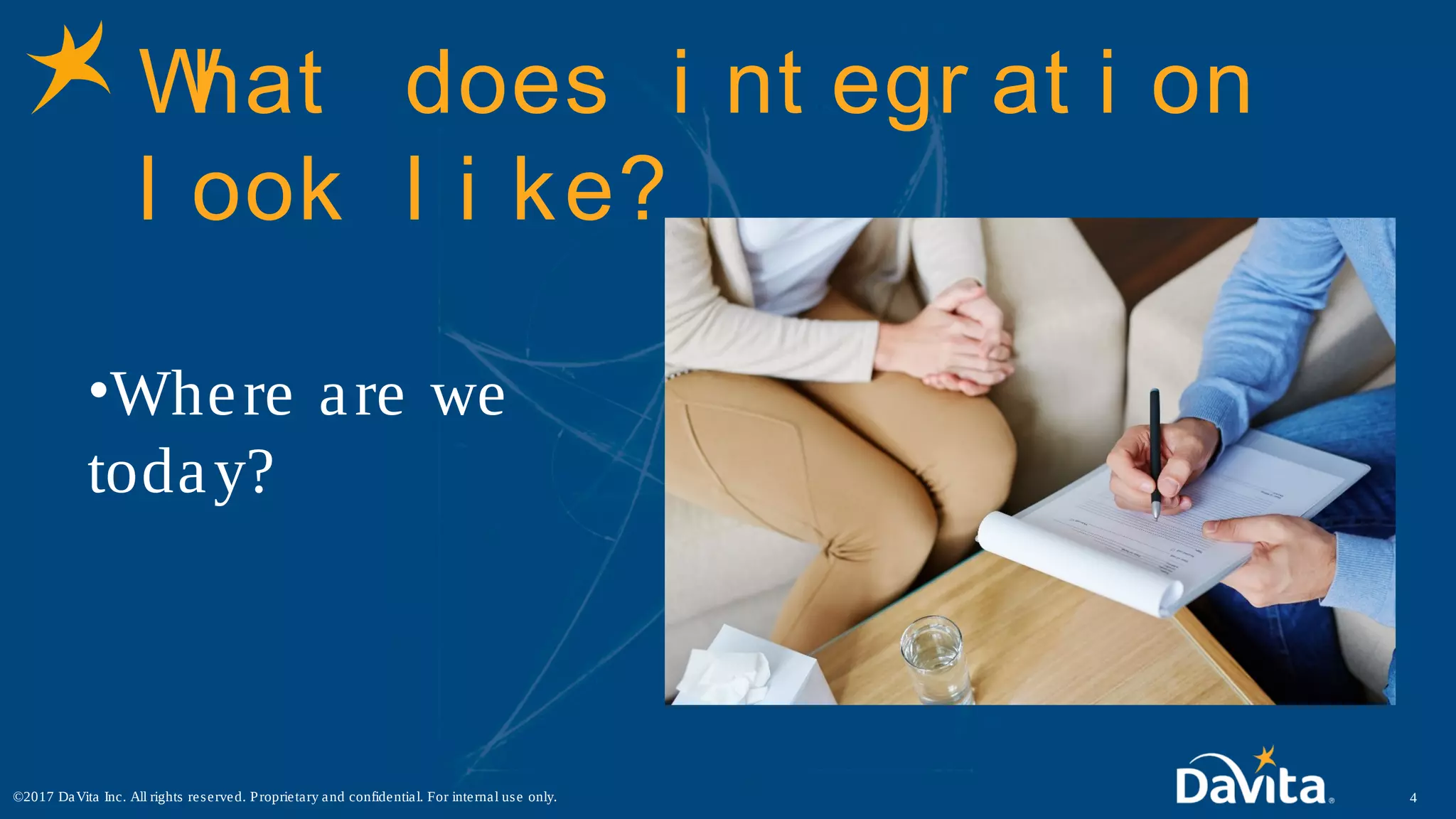
What does i nt egr at i on
l ook l i ke?
•Where are we
today?
4©2017 DaVita Inc. All rights reserved. Proprietary and confidential. For internal use only.
TEC Jour ney
TEC Jour ney: Why We
Began- 1993• Poor access to BH care
• Lack of communication
• Inconsistent quality of care
• Long-term therapy – without demonstrated
outcomes: One size fits all
• Value-based contracts elevate need
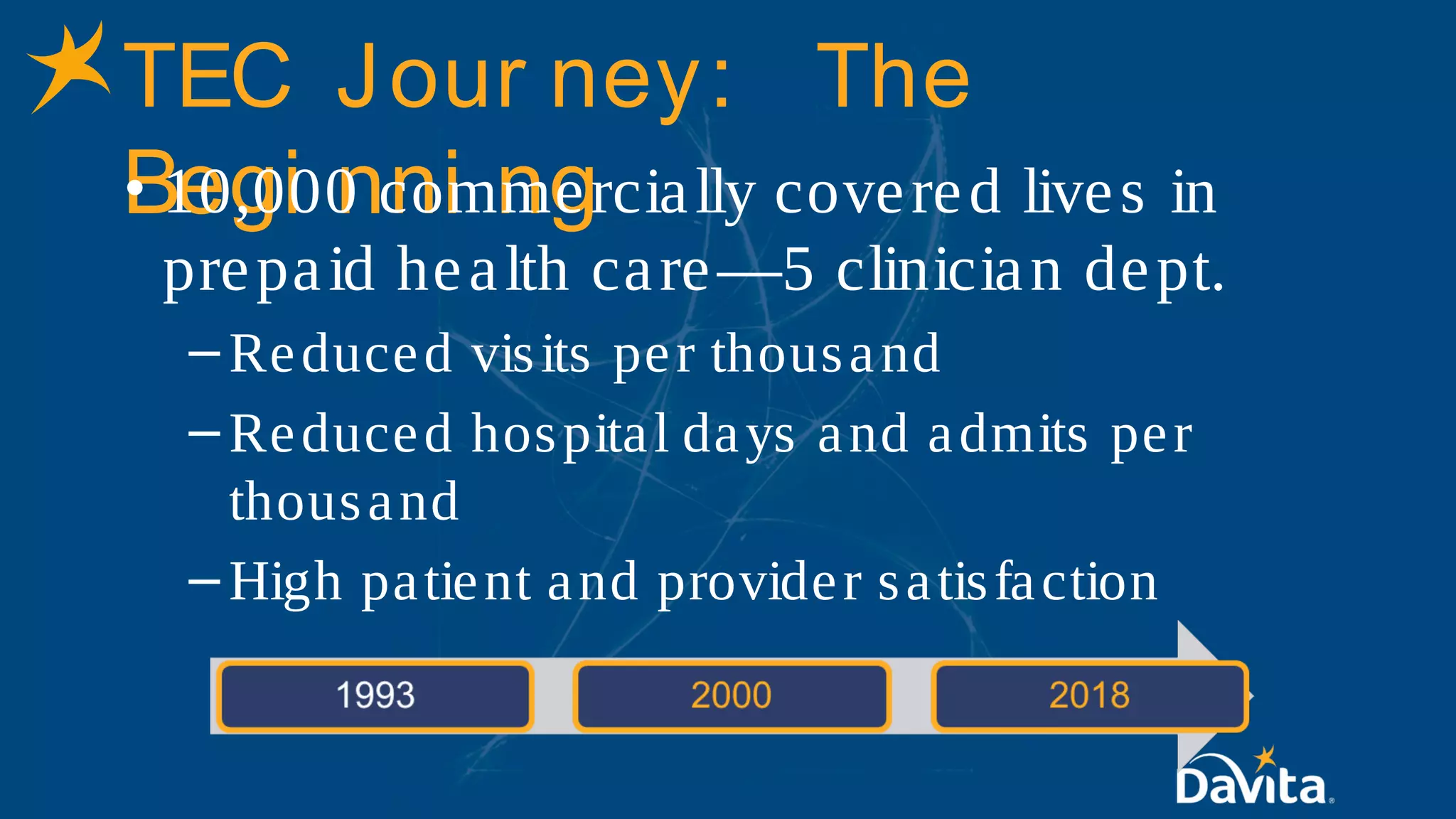
TEC Jour ney: The
Begi nni ng• 10,000 commercially covered lives in
prepaid health care—5 clinician dept.
– Reduced visits per thousand
– Reduced hospital days and admits per
thousand
– High patient and provider satisfaction
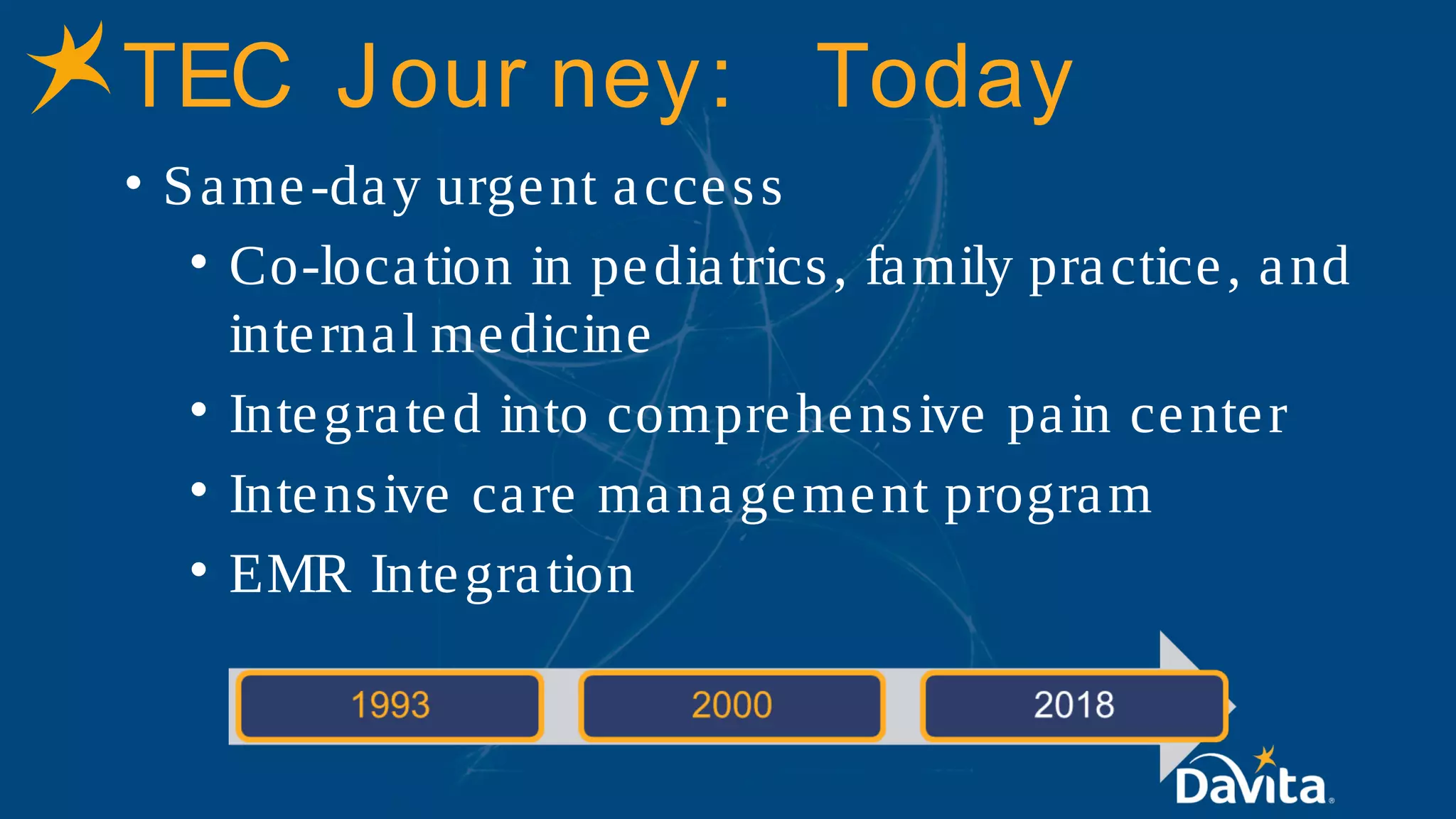
TEC Jour ney: Today
• Same-day urgent access
• Co-location in pediatrics, family practice, and
internal medicine
• Integrated into comprehensive pain center
• Intensive care management program
• EMR Integration
Fast Fact s: 2017- 2018
• 500 new intakes per month
• 40 Clinicians: 6 MD’s, 4 ARNP’s, 18
Master’s clinicians, 12 PhD’s
• 2 Care Managers, 3 Medical Assistants
• 43,319 visits in 2017
• 10,000 plus patients
• 4.1 visits per counseling episode
9©2017 DaVita Inc. All rights reserved. Proprietary and confidential. For internal use only.
Measur i ng Out comes:
Boei ng•Evaluate a medical home model
– 740 high cost commercial patients with chronic health
problems or high expenses
•Results:
– 20% reduction in per-capita medical cost of care
– 56% reduction in absenteeism
Measur e Out comes: Boei ng
Cost• Integrated care at TEC reduces number of
visits per patient by 40% compared to
outside providers
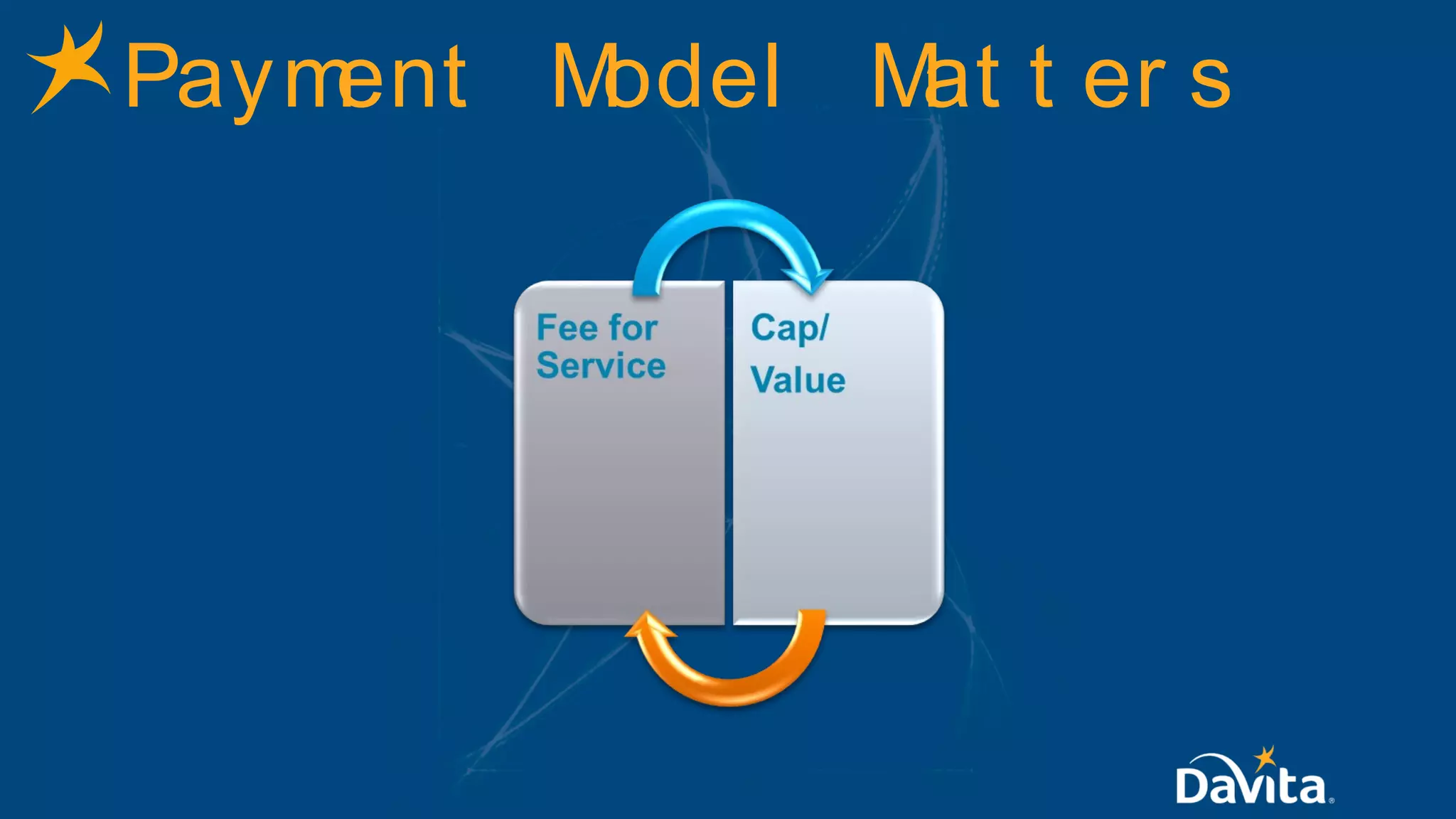
Payment Model Mat t er s
Tool s f or heal t hy l i vi ng
• Adverse Childhood Experiences (ACE’S)
• PHQ-9, with added questions
• Distress thermometer
13©2017 DaVita Inc. All rights reserved. Proprietary and confidential. For internal use only.
Adver se Chi l dhood
Exper i ences• Complete the questionnaire on your own.
14©2017 DaVita Inc. All rights reserved. Proprietary and confidential. For internal use only.
What was your scor e?
• How many had 0 ACE?
• How many had 1 ACE?
• How many had 2 ACE?
• How many had 3 ACE? 4?
• How many had 5 or more?
15©2017 DaVita Inc. All rights reserved. Proprietary and confidential. For internal use only.
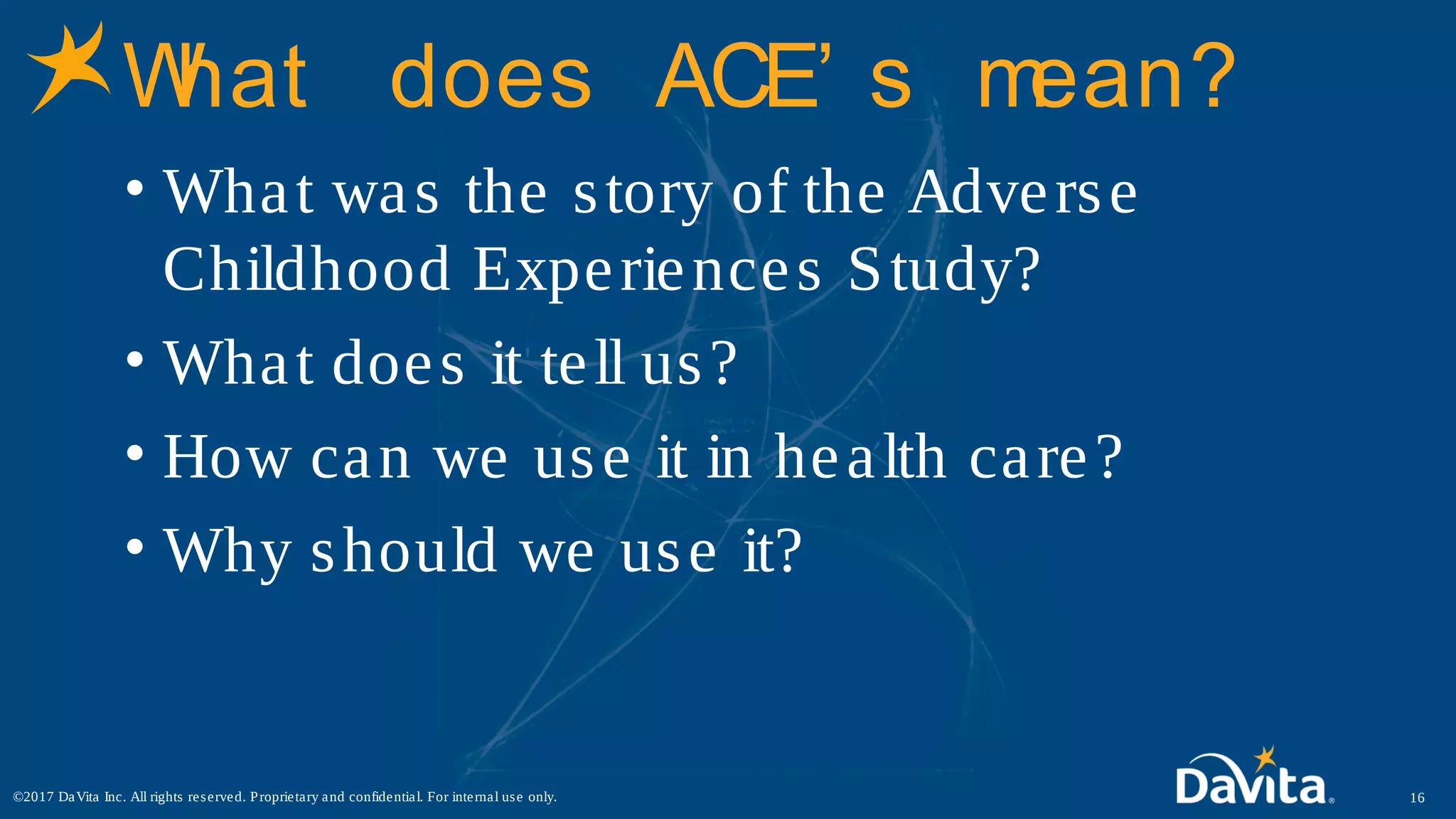
What does ACE’ s mean?
• What was the story of the Adverse
Childhood Experiences Study?
• What does it tell us?
• How can we use it in health care?
• Why should we use it?
16©2017 DaVita Inc. All rights reserved. Proprietary and confidential. For internal use only.
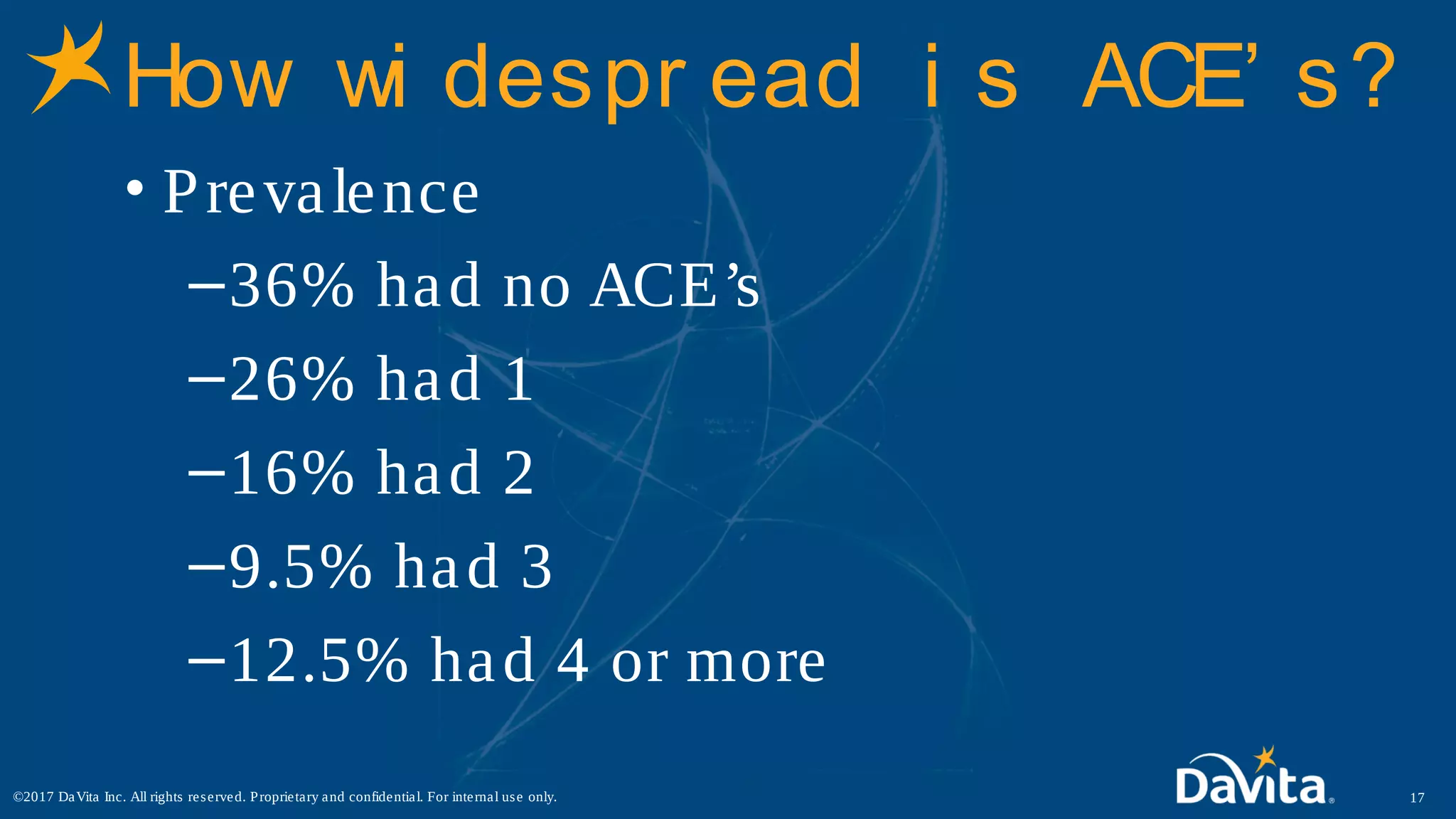
How wi despr ead i s ACE’ s?
• Prevalence
–36% had no ACE’s
–26% had 1
–16% had 2
–9.5% had 3
–12.5% had 4 or more
17©2017 DaVita Inc. All rights reserved. Proprietary and confidential. For internal use only.
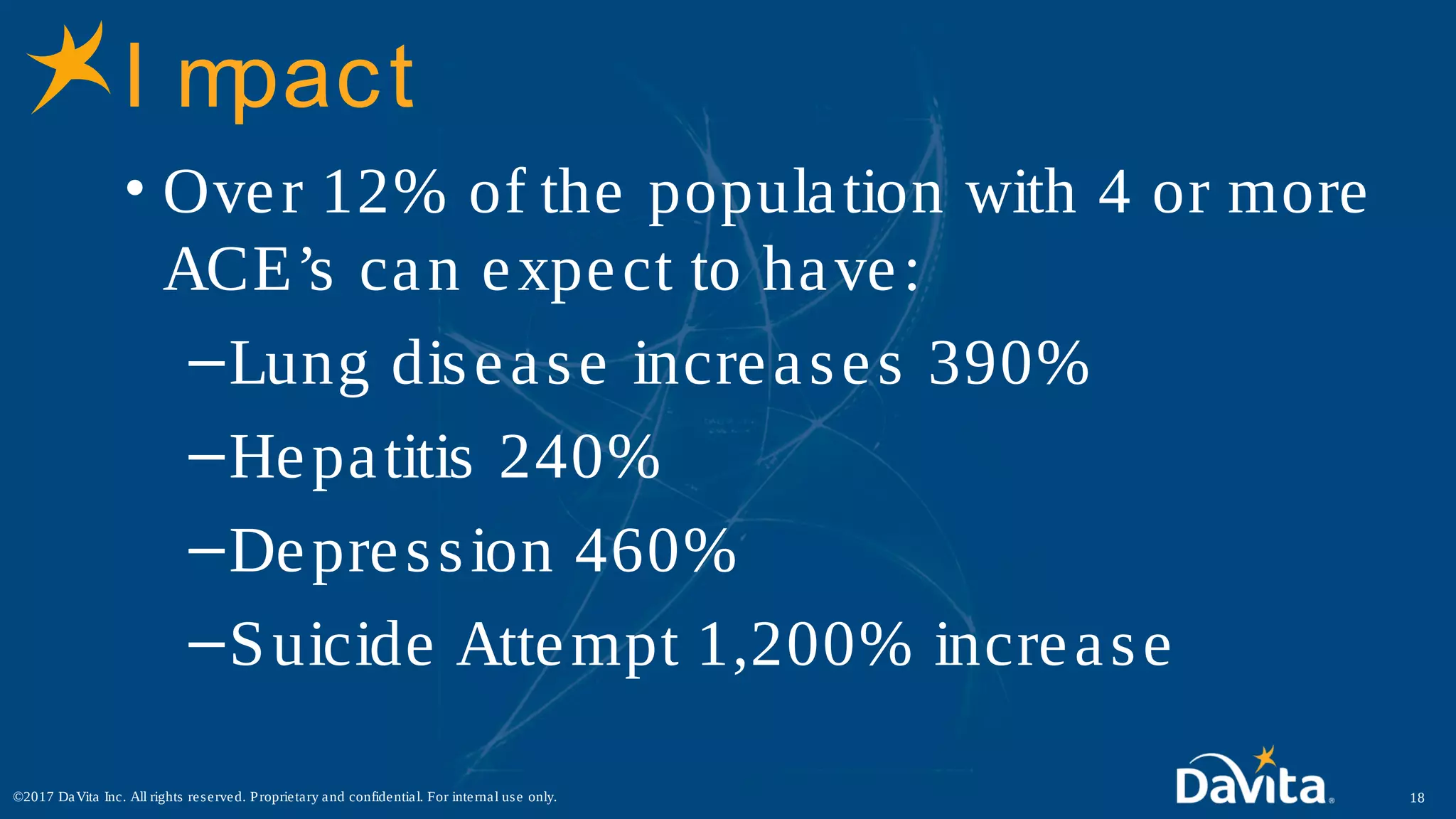
I mpact
• Over 12% of the population with 4 or more
ACE’s can expect to have:
–Lung disease increases 390%
–Hepatitis 240%
–Depression 460%
–Suicide Attempt 1,200% increase
18©2017 DaVita Inc. All rights reserved. Proprietary and confidential. For internal use only.
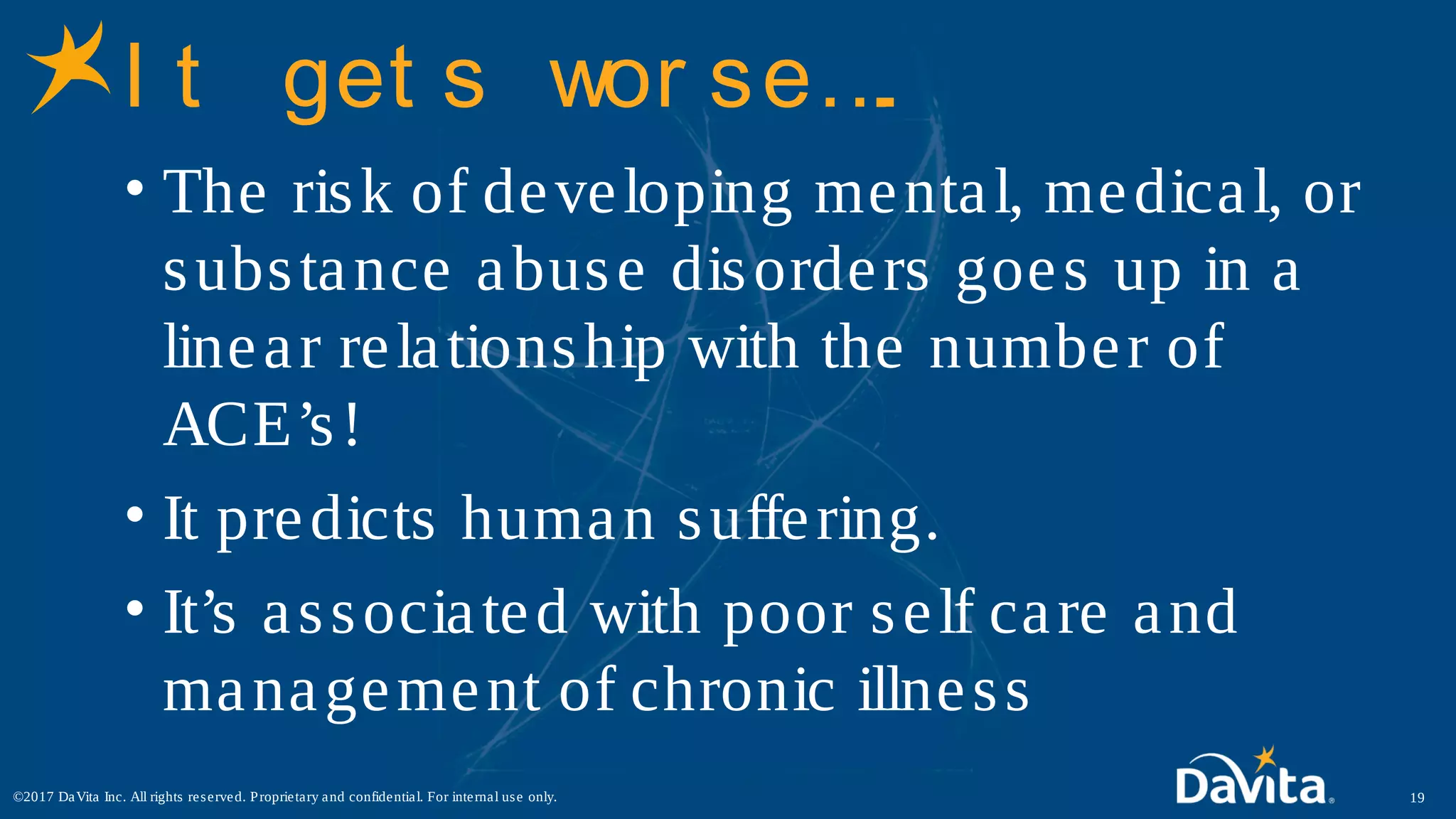
I t get s wor se….
• The risk of developing mental, medical, or
substance abuse disorders goes up in a
linear relationship with the number of
ACE’s!
• It predicts human suffering.
• It’s associated with poor self care and
management of chronic illness
19©2017 DaVita Inc. All rights reserved. Proprietary and confidential. For internal use only.
Tal ki ng hel ps…
• When patients simply shared their ACE
stories with their providers, who listened,
there was a 35% reduction in medical
office visits
• When they talked to a therapist, they were
50% less likely to come back to see their
doctor
20©2017 DaVita Inc. All rights reserved. Proprietary and confidential. For internal use only.
Measur e depr essi on and
di st r ess• PHQ-9 with added questions
–Anxiety, Substance Abuse
• 30-40% of referred patients have
undiagnosed Substance abuse issues
• Administered at every visit in BH
• Treat to target
21©2017 DaVita Inc. All rights reserved. Proprietary and confidential. For internal use only.
Di st r ess Ther momet er
• Used on cancer care
• Correlates well with longer paper and
pencil questionnaires
• Easy to complete; useful in many settings
22©2017 DaVita Inc. All rights reserved. Proprietary and confidential. For internal use only.
Key Poi nt s
• Identify risk factors (ACE)
• Assess Depression and Distress
• Measure outcomes: change
• Communication with PCP’s
• Good access
23©2017 DaVita Inc. All rights reserved. Proprietary and confidential. For internal use only.
What can you do i n your
set t i ng?
24©2017 DaVita Inc. All rights reserved. Proprietary and confidential. For internal use only.
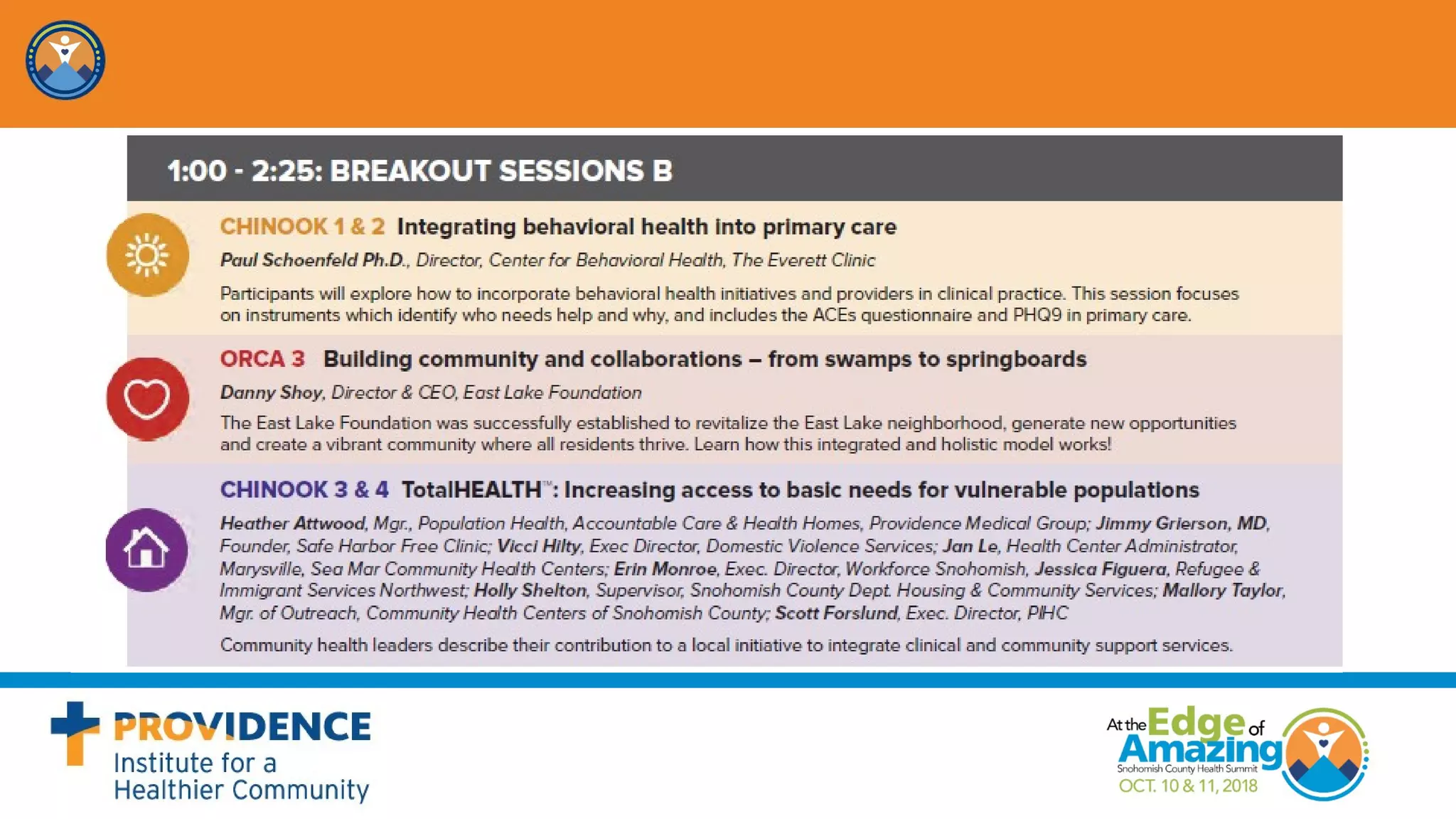
Edge of Amazing: Breakout Session B - Integrating behavioral health into primary care

Edge of Amazing: Breakout Session B - Integrating behavioral health into primary care

  • 1.
    Behavi or alHeal t h I nt egr at i on Paul Schoenfeld, PhD; Director Behavioral Health The Everett Clinic
  • 2.
    Dr . PaulSchoenf el d Di r ect or Behavi or al Heal t h, TEC
  • 3.
    Today’ s goals • Be aware of the continuum of behavioral health integration • Know why it matters • Apply learnings today
  • 4.
    What does int egr at i on l ook l i ke? •Where are we today? 4©2017 DaVita Inc. All rights reserved. Proprietary and confidential. For internal use only.
  • 5.
  • 6.
    TEC Jour ney:Why We Began- 1993• Poor access to BH care • Lack of communication • Inconsistent quality of care • Long-term therapy – without demonstrated outcomes: One size fits all • Value-based contracts elevate need
  • 7.
    TEC Jour ney:The Begi nni ng• 10,000 commercially covered lives in prepaid health care—5 clinician dept. – Reduced visits per thousand – Reduced hospital days and admits per thousand – High patient and provider satisfaction
  • 8.
    TEC Jour ney:Today • Same-day urgent access • Co-location in pediatrics, family practice, and internal medicine • Integrated into comprehensive pain center • Intensive care management program • EMR Integration
  • 9.
    Fast Fact s:2017- 2018 • 500 new intakes per month • 40 Clinicians: 6 MD’s, 4 ARNP’s, 18 Master’s clinicians, 12 PhD’s • 2 Care Managers, 3 Medical Assistants • 43,319 visits in 2017 • 10,000 plus patients • 4.1 visits per counseling episode 9©2017 DaVita Inc. All rights reserved. Proprietary and confidential. For internal use only.
  • 10.
    Measur i ngOut comes: Boei ng•Evaluate a medical home model – 740 high cost commercial patients with chronic health problems or high expenses •Results: – 20% reduction in per-capita medical cost of care – 56% reduction in absenteeism
  • 11.
    Measur e Outcomes: Boei ng Cost• Integrated care at TEC reduces number of visits per patient by 40% compared to outside providers
  • 12.
  • 13.
    Tool s for heal t hy l i vi ng • Adverse Childhood Experiences (ACE’S) • PHQ-9, with added questions • Distress thermometer 13©2017 DaVita Inc. All rights reserved. Proprietary and confidential. For internal use only.
  • 14.
    Adver se Chil dhood Exper i ences• Complete the questionnaire on your own. 14©2017 DaVita Inc. All rights reserved. Proprietary and confidential. For internal use only.
  • 15.
    What was yourscor e? • How many had 0 ACE? • How many had 1 ACE? • How many had 2 ACE? • How many had 3 ACE? 4? • How many had 5 or more? 15©2017 DaVita Inc. All rights reserved. Proprietary and confidential. For internal use only.
  • 16.
    What does ACE’s mean? • What was the story of the Adverse Childhood Experiences Study? • What does it tell us? • How can we use it in health care? • Why should we use it? 16©2017 DaVita Inc. All rights reserved. Proprietary and confidential. For internal use only.
  • 17.
    How wi despread i s ACE’ s? • Prevalence –36% had no ACE’s –26% had 1 –16% had 2 –9.5% had 3 –12.5% had 4 or more 17©2017 DaVita Inc. All rights reserved. Proprietary and confidential. For internal use only.
  • 18.
    I mpact • Over12% of the population with 4 or more ACE’s can expect to have: –Lung disease increases 390% –Hepatitis 240% –Depression 460% –Suicide Attempt 1,200% increase 18©2017 DaVita Inc. All rights reserved. Proprietary and confidential. For internal use only.
  • 19.
    I t gets wor se…. • The risk of developing mental, medical, or substance abuse disorders goes up in a linear relationship with the number of ACE’s! • It predicts human suffering. • It’s associated with poor self care and management of chronic illness 19©2017 DaVita Inc. All rights reserved. Proprietary and confidential. For internal use only.
  • 20.
    Tal ki nghel ps… • When patients simply shared their ACE stories with their providers, who listened, there was a 35% reduction in medical office visits • When they talked to a therapist, they were 50% less likely to come back to see their doctor 20©2017 DaVita Inc. All rights reserved. Proprietary and confidential. For internal use only.
  • 21.
    Measur e depressi on and di st r ess• PHQ-9 with added questions –Anxiety, Substance Abuse • 30-40% of referred patients have undiagnosed Substance abuse issues • Administered at every visit in BH • Treat to target 21©2017 DaVita Inc. All rights reserved. Proprietary and confidential. For internal use only.
  • 22.
    Di st ress Ther momet er • Used on cancer care • Correlates well with longer paper and pencil questionnaires • Easy to complete; useful in many settings 22©2017 DaVita Inc. All rights reserved. Proprietary and confidential. For internal use only.
  • 23.
    Key Poi nts • Identify risk factors (ACE) • Assess Depression and Distress • Measure outcomes: change • Communication with PCP’s • Good access 23©2017 DaVita Inc. All rights reserved. Proprietary and confidential. For internal use only.
  • 24.
    What can youdo i n your set t i ng? 24©2017 DaVita Inc. All rights reserved. Proprietary and confidential. For internal use only.

Editor's Notes

  • #2 Introduction slide
  • #4 But there is another way. And if we intend to create a special place, we should pursue this way. This way involves taking a different approach. This will take us down the path of broadly integrating the care of mind and body together in a wholly different way. This way is different but not uncharted. In fact, our speaker today will share over 10 years of experience with BH integration. And our panel will bring together speakers from diverse backgrounds to discuss a variety of approaches to achieve integration. Doesn’t mean it will be simple, as there are payment model barrier to recognize and to overcome. But we can do it, and if we want to have a special place, we will do it.
  • #8 Started small; minimal investment Focused on patients in prepaid healthcare Emphasis on cost-effective groups and classes for high incidence conditions Brief therapy approach
  • #9 Continued focus on evidence based group programs for: Anxiety, Depression, PTSD, Personality disorders, chronic physical illness, Shared Medical Appointments
  • #11 KEY POINT Learnings: These commercial patients had high incidence of BH diagnoses, and without BH integration, the underlying issues would not have surfaced for intervention. These were patients which led providers to cringe, long problem lists, ED visits, anxiety, history of trauma. When care was transferred from IMED to combination of FP and Therapist, the work evolved from formal diagnosis and treatment (typical medical model) to group visits, engagement, peer support and improvements were realized. The importance of surfacing and managing a history of high ace score was highlighted. ACE is a way of measuring lifetime risk based on a multiplicity of adverse childhood experiences. The Commercial high cost population in the Boeing project had a high incidence of early childhood adverse experiences
  • #12 An ongoing relationship with BH does not imply 20 visits per patient each year. With effective interventions, most patients are treated in 4 visits or less.
  • #13 In FFS environment, most payers including United have a separate arrangement for BH services, separate and distinct from the medical contract. In the WA market, these providers are typically contracted at very low rates. There is limited vetting and quality management. BH carve-out networks evolved as a means to assure some access, however access is often very limited. Even solo BH providers who are part of the Carve Out network commonly limit enrollment as the rates of pay are so low. There is typically no requirement or service agreement in place for information sharing standards, outcome measures or utilization guidelines. Even with an effective staff model, there is work to be done to create insurance payment models which reward appropriate effectiveness rather than volume. In the capitated environment, specialty networks have dominated the BH scene. Again, similar service concerns exist especially concerning access. However, within the prepaid market, there are fewer barriers to establishing the integration processes and structures which support effective management such as case management, Shared Medical Appointments, warm handoffs and consultation without the patient being present.
  • #15 Predictive tool