CHILD SEXUAL EXPLOITATION
A regional audit to explore the child
sexual exploitation knowledge and
training needs of healthcare staff.
• To present the background and context to this
audit exploring the CSE knowledge and
training needs of healthcare staff.
• To explain the four project workstreams.
• To communicate the key messages and
recommendations arising from this work.
AIMS
DEFINITION*:
“A form of sexual abuse that involves the manipulation
and/or coercion of young people under the age of 18
into sexual activity in exchange for things such as
money, gifts, accommodation, affection or status. The
manipulation or ‘grooming’ process involves
befriending children, gaining their trust, and often
feeding them drugs and alcohol, sometimes over a
long period of time, before the abuse begins.”
(Barnardo’s, 2012)
(*Used in conjunction with the statutory guidance (DCSF, 2009))
CHILD SEXUAL EXPLOITATION
Child Sexual Exploitation (CSE) is a national issue:
Government involvement, National Working Group and
several key reports
• Puppet on a string (Barnado’s, 2011)
• Out of Mind, Out of Sight (CEOP, 2011)
• National Action Plan on CSE (DfE, 2011; 2012)
• Parliamentary Inquiry into CSE (Home Affairs Committee, 2013)
• Nationwide Inquiry into CSE in Gangs and Groups (OCC,
2012; 2013)
• DH/Health Working Group Report on CSE (2014)
• Local Reports & Serious Case Reviews e.g. Jay (2014)
BACKGROUND
• Aim - to audit the child sexual exploitation knowledge
and training needs of staff required to undertake at
least ‘Level Two’ safeguarding children training* across 9
NHS Provider Trusts, and community healthcare
providers including GPs, dentists and pharmacists in
one region.
• *As per ‘Intercollegiate Guidance’ on health staff roles
and competence in safeguarding and child protection.
‘Level Two’ training relates to the particular needs of
those practitioners whose roles bring them into contact
with children, young people and/or parents/carers.
CSE AUDIT
• Completed between October 2013 and March 2014
• Commissioned and funded by a Health Education
England Local Education and Training Board (LETB).
• Comprised four inter-related workstreams; supported
by a Young Persons’ Panel and an Expert Reference
Group.
CSE AUDIT
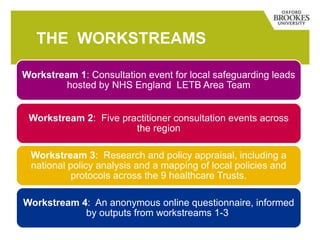
THE WORKSTREAMS
Workstream 1: Consultation event for local safeguarding leads
hosted by NHS England LETB Area Team
Workstream 2: Five practitioner consultation events across
the region
Workstream 3: Research and policy appraisal, including a
national policy analysis and a mapping of local policies and
protocols across the 9 healthcare Trusts.
Workstream 4: An anonymous online questionnaire, informed
by outputs from workstreams 1-3
 The very real potential of the role of universal health care services in
preventing, recognising and responding to CSE;
 The importance of health care staff having an understanding of consent
and information-sharing (including the notion of childhood extending to
18 years);
 Knowledge gaps across the sample, in particular around the
prevalence of child sexual exploitation as a form of child maltreatment,
knowledge about how to assess whether young people are engaged in
exploitative or consensual relationships and accessing protocols and
guidance around this issue;
KEY FINDINGS
KEY FINDINGS
 Whilst risk factors for, and indicators of, CSE are denoted in the
national policy, the evidence that CSE is difficult to identify at both a
personal and professional level must be acknowledged;
 A National Working Group looking at the health contribution (and
published as we were concluding the audit) highlighted both a lack of
curiosity by health care staff, as well as a tendency to assume that
young people are engaging in consensual activity (Department of
Health, 2014);
 There needs to be a greater emphasis on how health care
professionals can work with and engage young people, rather than
local policy purely directing that this should happen;
KEY FINDINGS – LOCAL POLICIES
 National guidance recommends that in addition to contributing to
and following LCSB policy, each Trust should have a stand-alone
policy/or procedure applying national and LCSB procedures to the
specific health care setting. Only one Trust had such a policy,
although three others were in the process of reviewing and
developing their policies;
 Whilst LCSB policy documents were often very good, they rarely
identified the specific contribution of the health care setting or health
care staff, were often very detailed and were light on the prevention
of CSE, an area that is of particular importance to health care
practitioners;
KEY FINDINGS - SURVEY
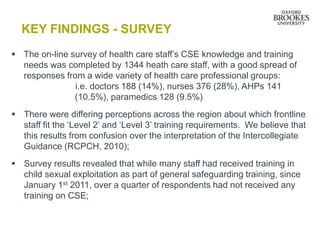
 The on-line survey of health care staff’s CSE knowledge and training
needs was completed by 1344 heath care staff, with a good spread of
responses from a wide variety of health care professional groups:
i.e. doctors 188 (14%), nurses 376 (28%), AHPs 141
(10.5%), paramedics 128 (9.5%)
 There were differing perceptions across the region about which frontline
staff fit the ‘Level 2’ and ‘Level 3’ training requirements. We believe that
this results from confusion over the interpretation of the Intercollegiate
Guidance (RCPCH, 2010);
 Survey results revealed that while many staff had received training in
child sexual exploitation as part of general safeguarding training, since
January 1st 2011, over a quarter of respondents had not received any
training on CSE;
KEY FINDINGS - SURVEY
 53.2% of the survey respondents reported that they had not accessed
written protocols and guidance on CSE;
 Open-text comments indicated that while some individuals felt guidance
was good, others commented that it was difficult to access;
 Even where there are excellent protocols, it is important to be able to
understand how these are shared and promoted to front-line health
professionals;
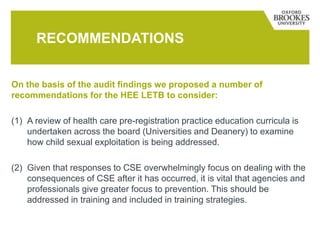
On the basis of the audit findings we proposed a number of
recommendations for the HEE LETB to consider:
(1) A review of health care pre-registration practice education curricula is
undertaken across the board (Universities and Deanery) to examine
how child sexual exploitation is being addressed.
(2) Given that responses to CSE overwhelmingly focus on dealing with the
consequences of CSE after it has occurred, it is vital that agencies and
professionals give greater focus to prevention. This should be
addressed in training and included in training strategies.
RECOMMENDATIONS
RECOMMENDATIONS
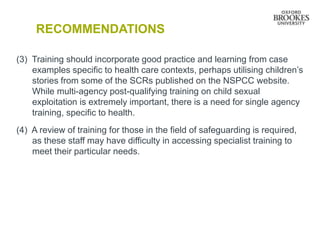
(3) Training should incorporate good practice and learning from case
examples specific to health care contexts, perhaps utilising children’s
stories from some of the SCRs published on the NSPCC website.
While multi-agency post-qualifying training on child sexual
exploitation is extremely important, there is a need for single agency
training, specific to health.
(4) A review of training for those in the field of safeguarding is required,
as these staff may have difficulty in accessing specialist training to
meet their particular needs.
RECOMMENDATIONS
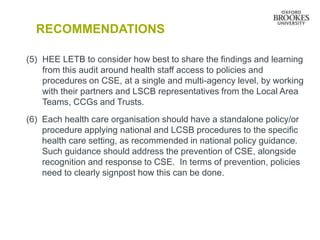
(5) HEE LETB to consider how best to share the findings and learning
from this audit around health staff access to policies and
procedures on CSE, at a single and multi-agency level, by working
with their partners and LSCB representatives from the Local Area
Teams, CCGs and Trusts.
(6) Each health care organisation should have a standalone policy/or
procedure applying national and LCSB procedures to the specific
health care setting, as recommended in national policy guidance.
Such guidance should address the prevention of CSE, alongside
recognition and response to CSE. In terms of prevention, policies
need to clearly signpost how this can be done.
RECOMMENDATIONS
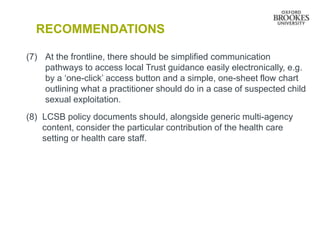
(7) At the frontline, there should be simplified communication
pathways to access local Trust guidance easily electronically, e.g.
by a ‘one-click’ access button and a simple, one-sheet flow chart
outlining what a practitioner should do in a case of suspected child
sexual exploitation.
(8) LCSB policy documents should, alongside generic multi-agency
content, consider the particular contribution of the health care
setting or health care staff.
RECOMMENDATIONS
(9) HEE LETB and partners should promote a consistent approach to
what constitutes the various levels of training as outlined in the
Intercollegiate Guidance (RCPCH, 2010), which staff fit those
levels and the required safeguarding training within the levels.
This is important to benchmark staff knowledge of child sexual
exploitation and to contribute to the development of future learning
and development opportunities in this key area of practice.*
(10) A re-audit should occur in 12 to 18 months in order to review
whether changes in staff knowledge and training have taken place
(*The third edition of the Intercollegiate Guidance was published shortly
after this audit was completed).
• We would like to express our sincere appreciation to all the audit study
participants across the Region;
• The Trusts and Clinical Commissioning Groups involved in the audit,
the HEE LETB, the Young Persons’ Panel and the Expert Reference
Group;
• Many thanks also to the Communication Leads, Managers and Training
Leads of Trusts and LSCBs who were involved in disseminating
information about the audit survey in Phase Four.
ACKNOWLEDGEMENTS
For further information please contact:
• Jane Appleton - jvappleton@brookes.ac.uk
• Catherine Powell - catherine.powell@soton.ac.uk
CONTACT US

Child Sexual Exploitation

  • 1.
    CHILD SEXUAL EXPLOITATION Aregional audit to explore the child sexual exploitation knowledge and training needs of healthcare staff.
  • 2.
    • To presentthe background and context to this audit exploring the CSE knowledge and training needs of healthcare staff. • To explain the four project workstreams. • To communicate the key messages and recommendations arising from this work. AIMS
  • 3.
    DEFINITION*: “A form ofsexual abuse that involves the manipulation and/or coercion of young people under the age of 18 into sexual activity in exchange for things such as money, gifts, accommodation, affection or status. The manipulation or ‘grooming’ process involves befriending children, gaining their trust, and often feeding them drugs and alcohol, sometimes over a long period of time, before the abuse begins.” (Barnardo’s, 2012) (*Used in conjunction with the statutory guidance (DCSF, 2009)) CHILD SEXUAL EXPLOITATION
  • 4.
    Child Sexual Exploitation(CSE) is a national issue: Government involvement, National Working Group and several key reports • Puppet on a string (Barnado’s, 2011) • Out of Mind, Out of Sight (CEOP, 2011) • National Action Plan on CSE (DfE, 2011; 2012) • Parliamentary Inquiry into CSE (Home Affairs Committee, 2013) • Nationwide Inquiry into CSE in Gangs and Groups (OCC, 2012; 2013) • DH/Health Working Group Report on CSE (2014) • Local Reports & Serious Case Reviews e.g. Jay (2014) BACKGROUND
  • 5.
    • Aim -to audit the child sexual exploitation knowledge and training needs of staff required to undertake at least ‘Level Two’ safeguarding children training* across 9 NHS Provider Trusts, and community healthcare providers including GPs, dentists and pharmacists in one region. • *As per ‘Intercollegiate Guidance’ on health staff roles and competence in safeguarding and child protection. ‘Level Two’ training relates to the particular needs of those practitioners whose roles bring them into contact with children, young people and/or parents/carers. CSE AUDIT
  • 6.
    • Completed betweenOctober 2013 and March 2014 • Commissioned and funded by a Health Education England Local Education and Training Board (LETB). • Comprised four inter-related workstreams; supported by a Young Persons’ Panel and an Expert Reference Group. CSE AUDIT
  • 7.
    THE WORKSTREAMS Workstream 1:Consultation event for local safeguarding leads hosted by NHS England LETB Area Team Workstream 2: Five practitioner consultation events across the region Workstream 3: Research and policy appraisal, including a national policy analysis and a mapping of local policies and protocols across the 9 healthcare Trusts. Workstream 4: An anonymous online questionnaire, informed by outputs from workstreams 1-3
  • 8.
     The veryreal potential of the role of universal health care services in preventing, recognising and responding to CSE;  The importance of health care staff having an understanding of consent and information-sharing (including the notion of childhood extending to 18 years);  Knowledge gaps across the sample, in particular around the prevalence of child sexual exploitation as a form of child maltreatment, knowledge about how to assess whether young people are engaged in exploitative or consensual relationships and accessing protocols and guidance around this issue; KEY FINDINGS
  • 9.
    KEY FINDINGS  Whilstrisk factors for, and indicators of, CSE are denoted in the national policy, the evidence that CSE is difficult to identify at both a personal and professional level must be acknowledged;  A National Working Group looking at the health contribution (and published as we were concluding the audit) highlighted both a lack of curiosity by health care staff, as well as a tendency to assume that young people are engaging in consensual activity (Department of Health, 2014);  There needs to be a greater emphasis on how health care professionals can work with and engage young people, rather than local policy purely directing that this should happen;
  • 10.
    KEY FINDINGS –LOCAL POLICIES  National guidance recommends that in addition to contributing to and following LCSB policy, each Trust should have a stand-alone policy/or procedure applying national and LCSB procedures to the specific health care setting. Only one Trust had such a policy, although three others were in the process of reviewing and developing their policies;  Whilst LCSB policy documents were often very good, they rarely identified the specific contribution of the health care setting or health care staff, were often very detailed and were light on the prevention of CSE, an area that is of particular importance to health care practitioners;
  • 11.
    KEY FINDINGS -SURVEY  The on-line survey of health care staff’s CSE knowledge and training needs was completed by 1344 heath care staff, with a good spread of responses from a wide variety of health care professional groups: i.e. doctors 188 (14%), nurses 376 (28%), AHPs 141 (10.5%), paramedics 128 (9.5%)  There were differing perceptions across the region about which frontline staff fit the ‘Level 2’ and ‘Level 3’ training requirements. We believe that this results from confusion over the interpretation of the Intercollegiate Guidance (RCPCH, 2010);  Survey results revealed that while many staff had received training in child sexual exploitation as part of general safeguarding training, since January 1st 2011, over a quarter of respondents had not received any training on CSE;
  • 12.
    KEY FINDINGS -SURVEY  53.2% of the survey respondents reported that they had not accessed written protocols and guidance on CSE;  Open-text comments indicated that while some individuals felt guidance was good, others commented that it was difficult to access;  Even where there are excellent protocols, it is important to be able to understand how these are shared and promoted to front-line health professionals;
  • 13.
    On the basisof the audit findings we proposed a number of recommendations for the HEE LETB to consider: (1) A review of health care pre-registration practice education curricula is undertaken across the board (Universities and Deanery) to examine how child sexual exploitation is being addressed. (2) Given that responses to CSE overwhelmingly focus on dealing with the consequences of CSE after it has occurred, it is vital that agencies and professionals give greater focus to prevention. This should be addressed in training and included in training strategies. RECOMMENDATIONS
  • 14.
    RECOMMENDATIONS (3) Training shouldincorporate good practice and learning from case examples specific to health care contexts, perhaps utilising children’s stories from some of the SCRs published on the NSPCC website. While multi-agency post-qualifying training on child sexual exploitation is extremely important, there is a need for single agency training, specific to health. (4) A review of training for those in the field of safeguarding is required, as these staff may have difficulty in accessing specialist training to meet their particular needs.
  • 15.
    RECOMMENDATIONS (5) HEE LETBto consider how best to share the findings and learning from this audit around health staff access to policies and procedures on CSE, at a single and multi-agency level, by working with their partners and LSCB representatives from the Local Area Teams, CCGs and Trusts. (6) Each health care organisation should have a standalone policy/or procedure applying national and LCSB procedures to the specific health care setting, as recommended in national policy guidance. Such guidance should address the prevention of CSE, alongside recognition and response to CSE. In terms of prevention, policies need to clearly signpost how this can be done.
  • 16.
    RECOMMENDATIONS (7) At thefrontline, there should be simplified communication pathways to access local Trust guidance easily electronically, e.g. by a ‘one-click’ access button and a simple, one-sheet flow chart outlining what a practitioner should do in a case of suspected child sexual exploitation. (8) LCSB policy documents should, alongside generic multi-agency content, consider the particular contribution of the health care setting or health care staff.
  • 17.
    RECOMMENDATIONS (9) HEE LETBand partners should promote a consistent approach to what constitutes the various levels of training as outlined in the Intercollegiate Guidance (RCPCH, 2010), which staff fit those levels and the required safeguarding training within the levels. This is important to benchmark staff knowledge of child sexual exploitation and to contribute to the development of future learning and development opportunities in this key area of practice.* (10) A re-audit should occur in 12 to 18 months in order to review whether changes in staff knowledge and training have taken place (*The third edition of the Intercollegiate Guidance was published shortly after this audit was completed).
  • 18.
    • We wouldlike to express our sincere appreciation to all the audit study participants across the Region; • The Trusts and Clinical Commissioning Groups involved in the audit, the HEE LETB, the Young Persons’ Panel and the Expert Reference Group; • Many thanks also to the Communication Leads, Managers and Training Leads of Trusts and LSCBs who were involved in disseminating information about the audit survey in Phase Four. ACKNOWLEDGEMENTS
  • 19.
    For further informationplease contact: • Jane Appleton - jvappleton@brookes.ac.uk • Catherine Powell - catherine.powell@soton.ac.uk CONTACT US