1
Child Sexual Exploitation Review
Derbyshire County Council - Improvement and
Scrutiny Committee – People
Final Report of the Review Working Group
18 May 2016
Cllr. John Frudd (Working group Chair)
Cllr. Kath Lauro
Cllr. Glennice Birkin
Cllr. Daniel Walton
David Rose – Improvement and Scrutiny Officer, Derbyshire County Council.
2
Contents
1. Introduction 3
2. Executive summary and recommendations 4
3. Background to the report 7
4. Initial research 8
5. Report findings 13
6. Report conclusions 44
Acknowledgements –
The Chair and Members of the working group would like to thank the
Members and officers of Derbyshire County Council who have contributed to
this report (left) and the wide range of partners (right):
Alison Pritchard
Amanda Clarke
Barbara Ackrill
Bish Sharif
Bob Smith
Cathy Barrass
Dan White
Debbie Peacock
Gertie Whitfield
Ian Johnson
Jane Brooks
Jinter Thraves
Jordan Stapleton
Julie Oldknow
Katya Bates
Linda Dale
Orlinda Dias
Mel Meggs
Michelle Collins
Rachel Sidebottom
Roz Savage
Ruth Peat
Sara Bartlett
Sharon Birch
Tracey Goode
Vanessa Grant
All organisations that contributed to the consultation
All residents that contributed to the consultation
Amber Valley Multi Agency Team Staff
Derbyshire Police Staff from the Central Referral Unit
Derbyshire Safeguarding Children’s Board (DSCB)
DSCB CSE sub-group
Telford and Wrekin Council
Claire Muir – School Governor Representative - Primary
Deborah Turner – Trade Union Representative
DI Gemma Booth – Derbyshire Police
Natalie Walters – Safe and Sound
Nicola Dalby – Safe and Sound
Tom Duffin – Parents Against Child Sexual Exploitation (PACE)
3
1. Introduction
Councillor John Frudd, Vice-Chair of the Improvement and Scrutiny – People
Committee and Chair of the Working Group, introduces this report;
“Child sexual exploitation (CSE) is a serious abuse and a crime which is a
national problem that hurts the most vulnerable people.
We carried out this review to make sure the council and its partners are doing
everything possible to keep children safe and support victims. We have
consulted widely with young people, residents and organisations to
understand the awareness and perceptions of how CSE is being deterred.
Also, what is being done and what can be done by everyone involved in
ensuring the safeguarding of young people.
This report presents our findings of how the Authority is working with partners
to deter CSE and support victims. Members and officers of Improvement and
Scrutiny, Cabinet and officers have worked together to bring this report to a
conclusion with partners, including the residents of Derbyshire and I would like
to thank all those involved for their assistance and contributions.”
Councillor John Frudd
Vice-Chair, Improvement and Scrutiny Committee -
People
4
2. Executive Summary and Recommendations
The review has found that there has been valuable partnership working to
increase awareness and manage the risks of CSE in Derbyshire. This has
been confirmed through recent audits showing excellent working practices,
including from the charity Safe and Sound and the independent auditor Adele
Gladman. All recommendations that were proposed in the audits have been
incorporated into the CSE action plan. An independent peer review of the
Derbyshire Safeguarding Children’s Board judged it to be a highly effective.
Her Majesty’s Inspectorate of Constabulary’s assessment of Derbyshire
Constabulary was good in regard to Police Effectiveness (Vulnerability) which
highlighted good partnership working. Additionally, feedback from partners is
that Derbyshire is leading the way in some areas, for example partnership
working in relation to taskforce meetings to share information of CSE risks.
Prevention work has been a focus, most notably through the successful
‘Chelsea’s Choice’ drama, which was seen by over 7,000 school children with
a measurable increase in awareness of CSE after watching the production.
The consultation with residents and organisations highlighted good levels of
awareness of CSE and the on-line use by their children. The vast majority of
organisations felt they had a role to play in preventing CSE, with high levels of
valuable staff training being undertaken.
The review has also found areas of development, which build on the excellent
work of partners to ensure young people are deterred from the risks of CSE.
Providing support to victims of CSE, those who have experienced or are at
high risk, is imperative. This needs to include therapeutic support where it is
suitable for the victim. The consultation highlighted that parents received
information on CSE mostly from news reports and nearly a quarter had not
previously sought information on CSE. Parents stated they would prefer
information on CSE delivered via schools. Continued support and offer of
advice to school staff is imperative, as they can potentially be the first to spot
signs that a young person is at risk of CSE. Also, it is important to put in place
monitoring information which allows the Authority and its partners to
understand if work to deter CSE is really making a difference.
Lastly, the issue of CSE is highly complex and very difficult to respond to. The
review endorses all the work that has gone into raising awareness of CSE, not
only to young people, but parents, carers and the population as a whole. It is
indeed ‘Everybody’s Business’ to deter CSE and this can be helped through
regular training and knowledge sharing by all.
5
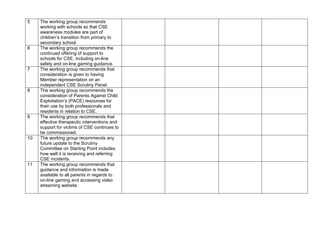
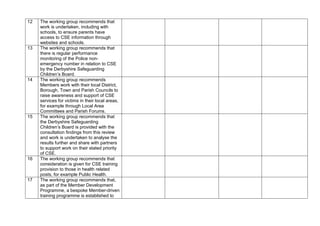
The working group Members have made the following recommendations
which the Improvement and Scrutiny Committee – People is asked to accept
and refer to Cabinet for approval and implementation of the proposals;
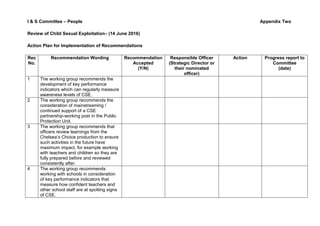
1. The working group recommends the development of key performance
indicators which can regularly measure awareness levels of CSE.
2. The working group recommends the consideration of mainstreaming /
continued support of a CSE partnership-working post in the Public
Protection Unit.
3. The working group recommends that officers review learnings from the
Chelsea’s Choice production to ensure such activities in the future have
maximum impact, for example working with teachers and children so
they are fully prepared before and reviewed consistently after.
4. The working group recommends working with schools in consideration
of key performance indicators that measure how confident teachers and
other school staff are at spotting signs of CSE.
5. The working group recommends working with schools so that CSE
awareness modules are part of children’s transition from primary to
secondary school.
6. The working group recommends the continued offering of support to
schools for CSE, including on-line safety and on-line gaming guidance.
7. The working group recommends that consideration is given to having
Member representation on an independent CSE Scrutiny Panel.
8. The working group recommends the consideration of Parents Against
Child Exploitation’s (PACE) resources for their use by both
professionals and residents in relation to CSE.
9. The working group recommends that effective therapeutic interventions
and support for victims of CSE continues to be commissioned.
10. The working group recommends any future update to the Scrutiny
Committee on Starting Point includes how well it is receiving and
referring CSE incidents.
11. The working group recommends that guidance and information is made
available to all parents in regards to on-line gaming and accessing
video streaming website.
6
12. The working group recommends that work is undertaken, including with
schools, to ensure parents have access to CSE information through
websites and schools.
13. The working group recommends that there is regular performance
monitoring of the Police non-emergency number in relation to CSE by
the Derbyshire Safeguarding Children’s Board.
14. The working group recommends Members work with their local District,
Borough, Town and Parish Councils to raise awareness and support of
CSE services for victims in their local areas, for example through Local
Area Committees and Parish Forums.
15. The working group recommends that the Derbyshire Safeguarding
Children’s Board is provided with the consultation findings from this
review and work is undertaken to analyse the results further and share
with partners to support work on their stated priority of CSE.
16. The working group recommends that consideration is given for CSE
training provision to those in health related posts, for example Public
Health.
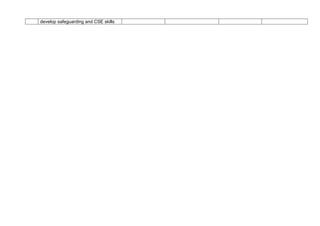
17. The working group recommends that, as part of the Member
Development Programme, a bespoke Member-driven training
programme is established to develop safeguarding and CSE skills.
The Improvement and Scrutiny Committee – People will monitor the
implementation of these recommendations as and when appropriate.
7
3. Background to the report
The review of how the Authority is working to deter child sexual exploitation
was agreed by the Committee on 1 July 2015 and it to be undertaken by the
standing safeguarding working group. Past work undertaken by this group
including children’s safeguarding issues such as on-line safety, those at risk,
those in care as well as CSE. The review scope considered the following lines
of inquiry:
• The current CSE strategy and action plan and how it is delivering
services to prevent CSE in Derbyshire with partners (including on-line
safety)
• How CSE risks are identified and monitored
• Consulting with young people, residents and organisations on their
knowledge and awareness of CSE and on-line safety
• The CSE training provided to staff and whether front line staff feel that
they have the right skills and tools to equip them to work effectively with
CSE
• Good practice in other authorities
It is important to note that the scope of the review does not include child
abuse (although CSE is recognised to be a part of child abuse). The working
group note the work the Authority is undertaking in response to historic and
new child abuse cases. For the purposes of this review, the working group
used the following definition of CSE:
“CSE is the abuse of children and young people up to the age of 18,
particularly where the young person is being manipulated, coerced or forced
into engaging in sexual activity. As a form of manipulation and control, the
young person may receive gifts, affection, drugs, alcohol or attention from
their abuser. Commonly, the young person may believe they are in a loving,
consensual relationship, when in fact they are being exploited.”
Members also note the Government’s consultation which is currently being
carried out regarding a new definition of CSE and the response from the
Authority and partners.
8
4. Initial Research
A desk research exercise was carried out of the current and historic
international research and practice that has been carried out in regard to
combating CSE.
The Virtual Staff College (VSC) undertook a desk review, advised by Dr David
N Jones, former President of the International Federation of Social Workers
and currently Chair of a Local Safeguarding Children Board (LSCB). This
chapter summarises the findings of ‘Child Sexual Exploitation: A study of
international comparisons’. Additionally, the National Working Group (NWG)
completed a desk research of recommendations that have come from a range
of reports, inquiries, serious case reviews and research into CSE from the last
few years. Ofsted’s report into Leeds City Council’s Safeguarding Services is
also cited. This was the only Children Safeguarding Services to be rated
‘outstanding’ by Ofsted.
Main findings
The VSC comparative study has not identified fundamental differences in the
response to CSE between the UK and the other countries studied. The
elements which make up the UK response are broadly replicated elsewhere.
The study did not set out to undertake a formal comparative evaluation of
national systems, but a quick overview suggests that the UK structures are
probably more established and systematic than those found in most countries,
for all their argued shortcomings, with the possible exception of Sweden.
Given this, the main recommendation was government and relevant public
agencies should continue to develop and refine current strategies, remaining
open to learning from other countries and mindful that there are no ready
solutions to successfully addressing the sexual exploitation of children and
young people. The findings from this report suggest that:
• CSE always involves an abuse of adult power in relation to young
people, a lack of respect for their development and a denial of their
rights;
• All young people have rights, especially in respect of their bodily
integrity;
• All young people should know about the risks of CSE, how they can
avoid becoming involved and where they can seek help;
9
• CSE involves a significant minority of young people, many but not all of
whom are in vulnerable circumstances;
• Young people being cared for away from home and family are
significantly more at risk of being drawn into CSE;
• Young people involved in CSE frequently do not understand or perceive
the risks in their behaviour, may well resent and resist intervention and
in some cases require protection from their own behaviour;
• There is an apparent reluctance (with the exception of Sweden) to
acknowledge that prevention requires a twin focus – a) on protecting
young people and better equipping them to protect themselves; and b)
on interventions for perpetrators and those at risk of committing
offences which are an appropriate balance of treatment and criminal
responses;
• Intervention to prevent and disrupt CSE must almost always involve
coordination between law enforcement and youth and care services;
The report went on to make the following recommendations in respective of
local authorities:
• Public authorities should be explicit that sexual exploitation of young
people will never be tolerated and will be reported whenever it is
suspected, and that the rights of children and young people will be
respected;
• Government, professional bodies, media structures and advocacy
bodies should work together to prevent sexual exploitation of children in
media coverage, including preventing the sexualisation of children and
young people in pictures and videos;
• Training should be provided for those engaged in the ‘night economy’
including hotels, clubs, taxi firms and restaurants, to raise awareness of
the risks of CSE and identify what to do when there are suspicions;
• Those providing out of home care and youth services for young people
should receive training in the identification and disruption of CSE and in
good practice to support young people who may be at risk of becoming
involved in CSE.
10
• Agencies providing services for young people should recognise that
CSE is a specific form of child abuse which should be managed within
the LSCB partnership in each locality,
• Disruption of CSE activity involving adolescents requires distinctive
strategies which may not necessarily replicate standard procedures for
intervention in child abuse involving younger children;
• Agencies should ensure that there is joint training for police, social
workers and others involved in direct work with CSE victims and those
who exploit them;
• The knowledge and skills of youth and community workers should be
recognised as making a significant contribution to the management of
CSE;
• Public bodies, national and religious institutions and the general public
should report suspicions of CSE to the appropriate authorities;
• Government and others making public comment on CSE should make
clear, when voicing criticisms of service agencies in relation to past
practice involving non-recent abuse, that the context for historic abuse
has changed and should not be presented as typical of current practice.
The recommendations listed above are in keeping with those that have been
presented in a range of reports, inquiries, serious case reviews and research
into CSE from the last few years.
Louise Casey’s (Director General – Troubled Families, CLG) report into
Rotherham Council was published on 4th February 2015, as a result of the
CSE issues experienced by victims uncovered by the Jay Report. Pre-dating
this review were two separate enquiries (Communities and Local Government
and Ofsted) into CSE, which were published on the 19th November 2015.
The CLG Committee’s enquiry into CSE issues in Rotherham revealed
systemic failures in local council scrutiny, governance, and leadership.
Ofsted published findings of their ‘thematic’ inspection of CSE. Such
inspections look to seek good and bad practice from a ‘deep dive’ into a
collection of authorities’ work on CSE.
The Ofsted inspection of eight local authorities work into CSE found that local
arrangements to tackle sexual exploitation were often underdeveloped, and
leadership frequently lacking. Additionally, some areas had only begun to
11
address the issue strategically within the last 12 months, despite statutory
guidance being issued more than five years ago.
There have also been various other reports that provide evidence of CSE
independent of government inspections. An independent report completed by
Ann Coffrey, MP in October 2014 highlighted the experiences of young people
in Greater Manchester. The main themes were being approached in the street
(often when wearing school uniform), a lack of trust in reporting incidences to
the Police, worries over usage of some website in terms of bullying but no
longer feeling threatened being on-line as “you can just block or delete it”. The
report laid out numerous recommendations in relation to Great Manchester’s
public agencies, although these can be considered in relation to other areas.
In terms of the Police’s response to CSE issues, Her Majesty’s Inspectorate of
Constabulary’s (HMIC) produced a series of reports in July 2015 on the
protection of children. One report looked specifically at findings from 21
inspections of police forces’ responses to child protection. Another report
focused on how police forces deal with children who are being exploited on-
line. A third report examined how police forces are sharing and cross-checking
information on criminality. HMIC concluded that pockets of excellent practice
observed across all inspections were the result of dedicated and professional
individuals and teams, rather than a united, understood and applied focus on
protecting children at force level. Additionally, not enough is being done in
police forces to find out the effects on children of police intervention, nor to
understand their experiences when they come into contact with the police.
This means that forces do not know what works in protecting children or how
successful or positive their impact is on children. Overall, the findings from
HMIC’s child protection inspections demonstrate an under-recognition and
under-estimation of risk. The reports warn that if the child protection system is
in some cases struggling to manage the current demands made of it, it will not
cope with a greater number of cases which are likely to be uncovered in the
future.
Barnardo’s, the British charity which cares for vulnerable children and young
people produced a briefing which summarised the findings of a two-year
programme. 31 case-studies with families highlighted three overall themes;
knowledge and confidence about keeping safe, self-awareness and self-
esteem and finally, relationships at home. Their recommendations focused on
recognising the vital role of parents and carers in protecting children at risk of
CSE and the importance of raising awareness.
12
The NSPCC conduct annual state of the nation reports on child safety. Their
most recent report highlights that the UK have seen the number of recorded
sexual offences against children increase by between 12% and 39% in
2013/14 compared with the previous year. This surge could partially be
accounted for by an increased willingness to report abuse following media
focus on the issue, which is to be welcomed. However it does mean that more
children are speaking out, only to find little support to help them recover from
abuse.
This increase in official figures is mirrored by the NSPCC helpline and
ChildLine – both of which saw a rise in people coming forward. Helpline
contacts have risen every year since 2009/10 – and the nature of these
contacts has been increasingly concerning. Referrals to statutory agencies
this year hit the highest ever peak of 46% of contacts. For ChildLine,
counselling sessions where the main concern was sexual abuse or online
sexual abuse accounted for 45% of discussions. On the ChildLine website,
sexting (sexually explicit photographs or messages via mobile phone) was the
most viewed ‘ChildLine Explore’ page in 2014/15.
The NSPCC go on to say that an increased confidence in confronting sexual
abuse should be welcomed. An NSPCC study into disclosures of childhood
abuse showed that for some children disclosure was often significantly
delayed from the start of the abuse – by 7.8 years on average. Delay can
have damaging consequences.
Members noted the Local Government Association’s (LGA) resource pack for
councils on the issue of CSE. This contains case studies and recommended
key lines of inquiry for Members to pursue when scrutinising the work
regarding CSE. The recommended key lines of inquiry were incorporated into
the working group’s review of CSE.
Main conclusion
Perhaps the greatest challenge is to recognise that CSE is a symptom of
deeper social challenges. Building a national culture of mutual respect for
human dignity is probably the foundation of an effective CSE strategy in the
UK and around the world. This presents a real challenge, demanding political
and professional leaders with vision and integrity – and a determination to
build a culture of respect for those who are vulnerable and at risk.
13
5. Report Findings
5.1 The current CSE strategy and action plan and how it is delivering services
to prevent CSE in Derbyshire with partners (including on-line safety)
Derbyshire Safeguarding Children’s Board (DSCB)
Members were briefed by the Chair of the DSCB on the Board’s co-ordinating
role in regard to CSE.
Members noted the agreement of a joint City and County CSE strategy. It is a
comprehensive document, focusing on prevention, protection and prosecution.
Key principles include partnership working with parents and other
professionals; cross-county working; and recognising links to other issues
such as when a child goes missing and substance misuse. Separate action
plans have been retained for each area and the CSE sub-group regularly
reviews progress of ongoing work. The DSCB CSE action plan was reviewed
and updated after the Jay Report, which was an independent inquiry into
practice in Rotherham from 1997-2013, to ensure actions were robust and
young people were being appropriately safeguarded.
There has been ongoing development of safeguarding children policies and
procedures – a new chapter, Safeguarding Children Abused through CSE,
has been added to the online procedures. This raises practitioner awareness
of the CSE Risk Assessment Toolkit and the Operation Liberty form, which is
the mechanism by which information and possible intelligence regarding CSE
can be shared with the police in Derbyshire. The chapter identifies actions that
should be taken in relation to each level of risk, and is clear that all levels of
risk require some response.
An e-safety strategy was developed in recognition that online abuse is a
growing issue. The strategy states that “all young people who have been the
subject of indecent images or sexual exploitation…will be protected from
further abuse and given appropriate support.” An action plan has been
agreed. Members noted that this will remain a high priority for DSCB.
Members also noted that the Derbyshire Child Sexual Exploitation Guidance
and Toolkit for professionals was implemented this year. The purpose of the
guidance and toolkit is to enable professionals to use the concerns they have
about a child, and use presenting indicators as a means of assessing their
level of risk of child sexual exploitation in a quick and consistent manner.
14
Members noted the comprehensive guidance, including suggestions for
intervention, disruption techniques, and sources of further guidance. This will
be used by practitioners and inform good practice, which in turn will benefit the
young people affected by CSE.
The DSCB has also continued to audit the work being delivered regarding
CSE. Over the last year the Board commissioned an independent audit into
practitioner responses to children and young people at risk of CSE in the
Derbyshire area. This is covered in the sub-chapters below in more detail.
Members also noted the work in regarding trafficking, Derbyshire being one of
23 local authorities who engaged in a government trial of new independent,
specialist advocates for child trafficking victims.
Overall, Members noted the independent peer review of the DCSB, carried out
by Lincolnshire Safeguarding Board to evaluate the boards’ governance
arrangements. The review concluded that the DSCB is a highly effective board
with a number of key strengths.
Performance Improvement Board
Members noted the regular performance monitoring of safeguarding which is
reported by the Performance Improvement Board. This report provides the
DSCB with an update on the performance of safeguarding services. Members
also noted that the analysis has been communicated more widely, for example
to the Corporate Management Team and to Members through the
Improvement and Scrutiny People Committee’s Safeguarding working group.
Information available for the 12 months ending December 2015 shows that
CSE was flagged as a potential issue in 5.2% of referrals to Social Care. This
represents a 2.4 percentage point increase when compared with 2.8% for
2014/15.
For the 12 months ending December 2015, the percentage of referrals where
CSE was flagged as a potential issue where a decision was made within 1
working day (92.7%) was 0.5 percentage points higher than for all referrals
(93.2%) and 2.2 percentage points higher when compared with the
percentage for 2014/15 (90.5).
For referrals to Social Care during the 12 months ending December 2015
where CSE was flagged, the most common outcome in Derbyshire was to
progress to a Strategy Discussion (35.7%), although this was not always the
most common outcome for each locality, the percentage of which varied
between localities from 66.2% in High Peak & North Dales to 11.7% in
15
Chesterfield. Information for the 12 months ending December 2015 shows that
of the 6847 social care assessments completed, 313 (4.6%) had CSE flagged
as a potential issue. Additionally, 222 (70.9%) of social care assessments
where CSE was flagged were completed within 45 working days of referral.
This compares with 74.4% of all social care assessments completed within
timescale (as reported above).
The working group recommends the development of key performance
indicators which can regularly measure awareness levels of CSE.
CSE action plan
Members noted the CSE action plan which underpins the CSE strategy. The
CSE action plan is a ‘living document’ and is regularly updated. The plan
covers many different areas and ensures that work is coordinated and is
linked to the strategic aims.
The output and outcomes of the CSE action plan are highlighted in the
following chapters, and Members are reassured that the wide range of activity
by many different partners can be managed by the plan and through the CSE
sub-group.
CSE sub-group
Members noted the work of the CSE sub-group which has been set up as part
of the DSCB. The CSE sub-group has numerous task and finish groups which
include developing the action plan in regard to, among others, training and
communications. The CSE sub-group meets regularly to update on progress
and has attendees from many agencies. Outputs and outcomes of the sub-
groups work is communicated up to the DSCB main board.
Members noted that the Child Protection Manager (Vulnerable Young People
and CSE) is only a temporary post until October 2016. The evidence gathered
throughout the review highlighted the hugely important work of ensuring that
partnership working is co-ordinated and the CSE strategy is implemented
through the action plan. The sustainability of this important work may need to
be clarified.
The working group recommends the consideration of mainstreaming /
continued support of a CSE partnership-working post in the Public
Protection Unit.
16
CSE Audits
Members noted the audit conducted by Adele Gladman in late 2014 and the
work carried out by the Authority to implement its recommendations and
findings, which included:
• The positive working and that Derbyshire was ahead of other authorities
in some aspects of CSE work.
• There has been follow up work in regard to one case which featured in
the original audit, with a visit to the Police HQ to look at the systems
being used.
• There was also follow up on looking at how the Police are putting the
victim at the forefront.
• The original audit also picked up whistle blowing policies that people
can use if they have concerns about CSE.
Members noted all the recommendations from the audit have been put into the
CSE action plan.
In addition, Members noted the Safe and Sound audit. Safe and Sound were
provided with the names of all children on the Authority’s records who went
missing. National research has shown that young people that go missing are
vulnerable to being targeted by perpetrators involved in CSE. The key findings
were:
• 30% of people who went missing from care from June-December 2013
exhibited indicators of CSE.
• This figure was 95% for those who lived at home and went missing.
• Indicators of CSE were recognised by professionals working with the
young person in most cases.
• However this was not always in the early stages of a young person’s
exposure to risk of CSE.
• There was some poor recording identified, as well as some issues
around information sharing and partnership working.
17
As part of the audit, and to address some of the issues found, 11
recommendations were presented to the Authority by Safe and Sound.
Members noted that these are now being incorporated into the CSE Action
Plan.
School safeguarding audits
Members noted the findings from the most recent published school
safeguarding audit which showed there continues to be a link between
Personal, Health and Social Education (PSHE) in the school curriculum and
confidence in dealing with the sensitive Safeguarding issues. Those schools
who have a recognised PSHE programme use the NSPCC School Service
and can demonstrate they are addressing the subject of CSE, grooming and
on-line Safety.
Members noted the audit summary finding that there remains some
inconsistency and levels of commitment around the County as this does
depend on the awareness of the staff re the issue at primary level. Also, the
levels of confidence in tackling the issues and in some cases a willingness to
accept that the issues exist at a primary level school age.
Members also noted that there are now around 200 Primary Schools in
Derbyshire who have used the NSPCC Schools Service and who are now
requesting the service for a repeat visit. Awareness needs to be continually
raised regarding CSE issues within Primary Schools. This includes assisting
teachers with the understanding that we have very young children at risk and
that they are being targeted either face to face or online. Primary Schools do
play an essential role in educating their children along with their
parents/carers about the dangers. Primary Schools need further
understanding that they also play an important role in the CSE preventative
agenda and how to equip young children with skills to deal with this and
develop resilience for when they are in transition to Secondary School. This is
covered in more detail in the sub-chapter ‘CSE in schools’.
Members also noted that there is confidence from the audit returns and from
the Secondary Forums held in the autumn that most secondary schools have
and are planning to embed CSE into their curriculum. There are links with a
strong PSHE curriculum and those schools providing lessons, workshops and
inviting in external contributors. There is awareness in secondary schools and
a correlation with reporting concerns into the Police and Starting Point as a
result of either individual or group disclosures. This can follow preventative
work undertaken in a school and when in the course of establishing open
18
environments where students can approach and talk to school staff about this
and related issues. An example is that many of the secondary schools now
have student support services with trained staff, where they have bought in
additional productions of Chelsea’s Choice and invited in additional workshops
including working with the police.
Members noted that there are current shortfalls around the provision of
training for Safeguarding Designated Leads and support mechanisms to
support and sustain the work. This is covered in more detail in the sub-
chapter ‘CSE in schools’.
Preventative work including ‘Chelsea’s Choice’
Members noted and were fully supportive of ‘Chelsea’s Choice’, a
preventative programme for schools run by the Alter Ego theatre company.
This was delivered to schools across the county for a total of seven weeks
from November to December 2014 and February 2015. This was a joint
initiative funded by the DSCB, Derbyshire Community Safety and the
Derbyshire Police and Crime Commissioner.
53 schools and other settings (including special schools and support centres)
took part, with a total of 75 performances for mainly year 8 students. This
included a performance for out of school tutored/electively home educated
young people and supporting staff/adults. The total audience figure was 7,350
young people.
Members noted that with this CSE awareness raising event for Derbyshire’s
young people, a parent and carer CSE information leaflet was developed by
DSCB and Safe and Sound. This awareness for parents and carers was
circulated widely by schools and added to school websites and other forums
for future reference. For the period of the productions, Derbyshire Police
hosted an on-line virtual surgery in the evenings, which was offered as an
additional resource to young people who may have wanted to speak further to
a professional regarding CSE or other issues.
Members noted the impact of this programme can be illustrated by the fact
that there were 14 concerns/ disclosures from 11 of the schools who
participated. The evaluations returned from schools also indicated an increase
in the awareness of CSE knowledge among young people and the
professionals working with them.
Initial feedback from young people regarding what was learnt included, “never
get involved in the wrong crowd and don’t do things to please anyone else. Be
19
yourself.” Another student said they had learnt “not to get involved in bad
relationships.”
Members noted the feedback results which showed that 11% of young people
felt they knew a bit or ‘loads’ about CSE before the Chelsea’s Choice
production. This increased to 93% after the production. When asked to state
one thing they learnt which they did not know before, 55% said they ‘learnt
about the Dangers (how to keep safe on line & in the community)’. Members
also noted that 40% stated the production would make a difference to their
use of social media. Also, encouragingly 27% were already aware of the
dangers and had privacy settings. However, Members noted that 18% said it
would not make a difference. Also 8% stated they don’t use social media.
The feedback also showed that 24% of the respondents would report
concerns to their parent/carer or another adult. The view from officers is
therefore more work in the school needs undertaking with parents/carers if
their child reports to them and how they understand the issues, know how to
respond, report and protect.
Members noted that feedback from young people indicated that e-safety is a
major concern for them. Another positive outcome of the whole Chelsea’s
Choice project is the sustained impact it appears to have had on a large range
of people, from young people, school staff and other safeguarding
professionals, many of whom continue to speak about Chelsea’s Choice.
The working group recommends that officers review learnings from the
Chelsea’s Choice production to ensure such activities in the future have
maximum impact, for example working with teachers and children so
they are fully prepared before and reviewed consistently after.
On-line safety
Members noted the heightened priority of on-line safety. This work has come
about due to the large rise in non-contact sexual exploitation, particularly
among children.
Members were provided with evidence that there is under-reporting of
incidents of child sexual exploitation, particularly non-contact sexual
exploitation via the internet. The ‘Think You Know’ website allows users to
report abuse, for example a child reporting that they have been inappropriately
contacted by someone whilst on-line. There are 1,600 reports of abuse across
the country. The reporting is monitored 24 hours a day and someone can
intervene if a child is in immediate danger.
20
Members noted a recent small study which showed that 30% of 9-10 years old
had accessed hard core pornography via their laptop/desktop. This study did
not include smart phones or tablets. ‘Sexting’ has become a prevailing issue,
and Members noted the work by the Authority and partners of awareness
raising campaigns on this subject being delivered to school children. Members
noted report findings where when these photos are shared, it is estimated that
80% of the images are picked up by sexual offenders/people intending to
groom. Another recent study showed 40% of 13-16 year olds send images of
themselves, which could be classed as ‘sexting’. The vast majority, nine in
ten, were female.
Members noted the wide range of work to raise awareness and tackle the
issues surrounding on-line safety, which included:
• An informative and educational launch of a Christmas Sexting campaign
included a covering letter from Derbyshire Police to all parents/carers;
• A leaflet on CSE, and on- line Safety was sent to 40,000 primary age
pupils along with an informative letter to parents and carers.
• A CSE Tool Kit specifically for Primary Schools is currently being
drafted along the lines of the Secondary School CSE Tool Kit.
CSE in schools
Members noted the work of the Authority in relation to delivering safeguarding
and CSE support to schools in Derbyshire. The role of the Child Protection
Manager for schools was developed as schools were requesting an interface
with the Authority on children’s safeguarding. The role is based in the Central
Referral Unit at Derbyshire Police and covers a multiple of roles, including
child protection, education improvement and safeguarding.
Members noted that schools are very worried about CSE issues and take it
very seriously. Feedback from schools was that understanding CSE and
training on CSE was the most important need. This has been gathered
through safeguarding audit returns and the well-attended School Forum
events, where over 200 schools come together twice a year. Members noted
that the DSCB is putting on 3-6 training sessions for schools to help raise
awareness and CSE skills in schools.
21
Members noted the 2013 national research by YouGov which showed 43% of
teachers would not be confident of spotting the signs of CSE. It is hoped that
this should now improve given the national and local spotlight on CSE.
The working group recommends working with schools in consideration
of key performance indicators that measure how confident teachers and
other school staff are at spotting signs of CSE.
Members noted the importance of the transition between primary and
secondary school in relation to CSE. Ofsted have now included in their
inspection how schools prepare for transition. This is usually a key time for
children and where they can be vulnerable, for example moving to a much
larger school and meeting new children. More Primaries are reporting
concerns around internet use amongst very young children and their
increased vulnerability to be targeted. Members noted that some of
Derbyshire Primaries are using resources available and over 170 have invited
the NSPCC Child Line service into their school to support the work.
Furthermore, Members noted the consultation results (as in section 5.3) that
the vast majority of respondents (90%) thought children should receive
information on CSE in primary school.
The working group recommends working with schools so that CSE
awareness modules are part of children’s transition from primary to
secondary school.
Members also noted the emerging evidence of secondary schools using the
CSE toolkit and resources. Schools have bought in additional performances of
Chelsea’s Choice, using other external providers and evidence from schools
that are now embedding CSE into their curriculum.
CSE in Personal, Health and Social Education (PHSE)
PSHE is not a statutory duty in schools, however many schools including
Academies recognise its importance and have retained it within their
curriculum. Members noted however, not all secondary schools have adopted
this approach and there is a link between schools that have less of a
commitment to PSHE and weaker safeguarding in the school or setting. This
is especially evident in Secondary Schools who have devolved PSHE into
tutor time, or given over a few days per year to explore sex and relationships
along with issues like CSE and on-line safety.
Members also noted that in support of raising awareness of CSE for young
people, teachers and other school staff had the opportunity to attend
22
curriculum training. This has ensured the messages relating to CSE are
sustained in schools and could be revisited as part of PSHE. A resource to
support the curriculum delivery of CSE in Derbyshire’s secondary schools has
also been developed and shared. Members noted the continued activity
relating to CSE and the commitment to sustain the positive steps already
taken to raise awareness with both young people and professionals. Members
noted the School Improvement Service CSE module, which is an excellent
piece of work according to Safe and Sound. Added to this, the findings from
the consultation with parents/guardians (as in section 5.3) that children are
accessing on-line gaming and video streaming sites such as YouTube make it
vital that schools are being supported in the area of CSE and on-line safety.
The working group recommends the continued offering of support to
schools for CSE, including on-line safety and on-line gaming guidance.
Elective Home Education
Members were briefed on the work of the Authority in relation to home
education. Members noted that there are currently around 530 young people
known to be home educated in Derbyshire. Schools have a duty to inform the
Authority of any removals from school roll for the purposes of home education.
As it is not a statutory duty for parents/carers to inform the local Authority of
children being home educated, the number will not give the full picture.
Members noted some of the reasons for elective home education, including:
• Young person did not get their preferred school place
• Physical and Mental Health issues
• Financial issues
• Transport issues
• Holidays in the school term
• Special needs
• Bullying
• Religious or cultural
• Philosophical
23
The Authority does offer and carry out home visits to those parents who will
accept these. It is not a legal requirement, however. The Department for
Education guidance to authorities regarding elective home education states
that there is no routine monitoring role for the Authority. However, the LA can
intervene if it appears that a suitable education is not being provided. The
council can also be involved, in the usual way, if there are any safeguarding
concerns. Although some authorities have reduced their home visits,
Derbyshire continue to offer and undertake such visits. Members noted that
the Authority takes a partnership approach when working with home educated
young people and their parents/carers. Members also noted the various home
education groups and organisations in Derbyshire.
The Authority published a guidance document for those parents who are or
are considering elective home education. Guidance is also provided to
members of the Multi Agency Teams and Starting Point. Members noted that
the safeguarding concerns occur in and out of home education. However,
there was concern to safeguarding if the local Authority has no ability to know
such a child exists. The local Authority may become aware of the child if they
have been referred from another public organisation, for example Nurse, GP
or A&E.
Community Safety
Members noted the work of the Derbyshire Community Safety team regarding
awareness of CSE issues in the wider community including licensed premises
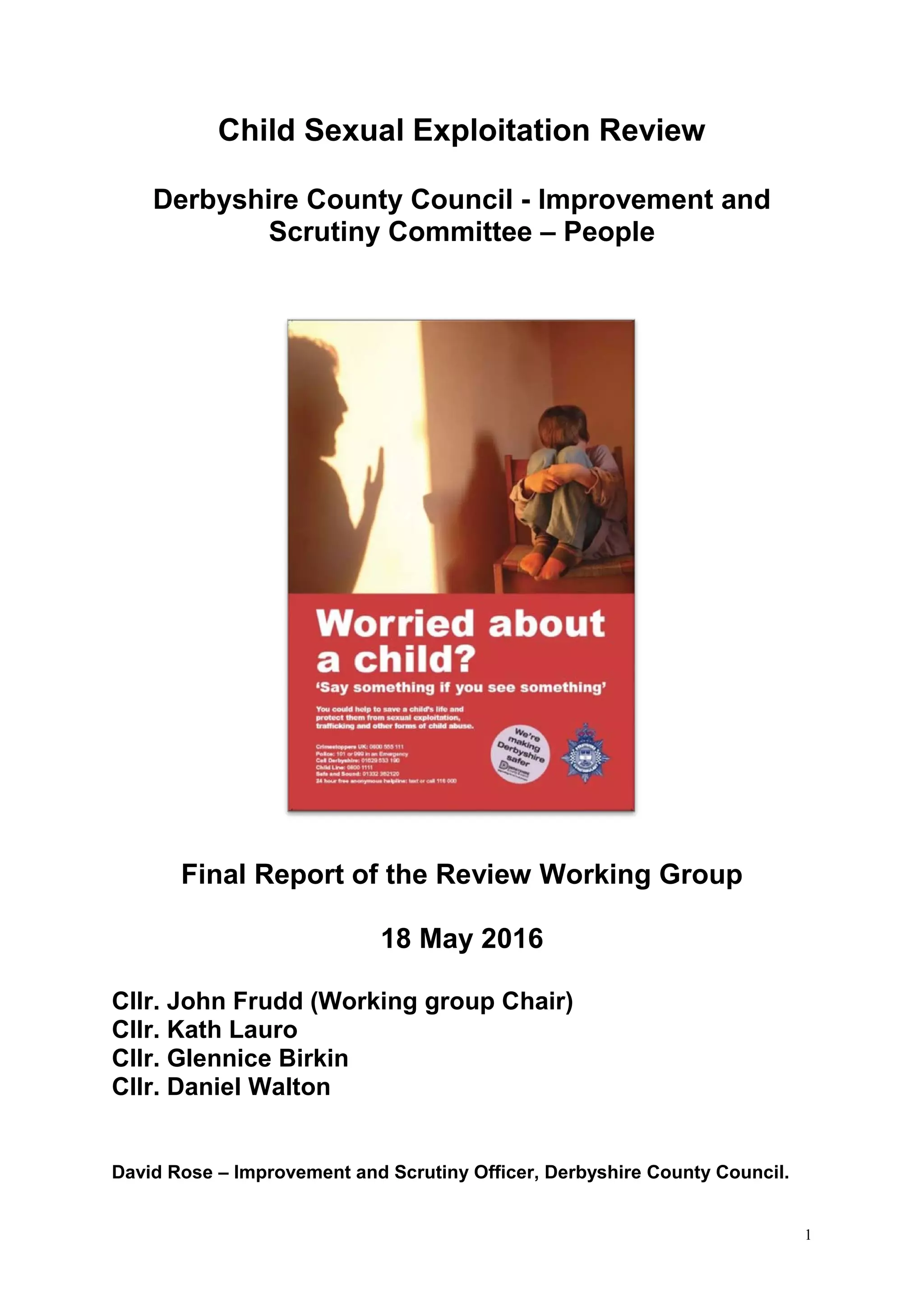
and taxis. The Say Something if you See Something campaign (SSSS) seeks
to equip local businesses and communities with tools for identifying and
responding to children who need protection from exploitation.
The recent poster campaign to highlight SSSS has been widely advertised in
public buildings, open public areas, shops and licensed premises. Initial
feedback has been very positive in terms of increased awareness and
referrals.
CSE task force
Members noted the CSE taskforce which has been set up containing Police
and other partners, including from the Authority. The taskforce looks at where
people at risk of CSE are gathering to identify hotspots. The taskforce meets
monthly and uses task and finish groups to complete actions from the CSE
strategy and action plan.
24
Members noted the need to work in schools, youth clubs and children’s homes
to understand what policies are in place and if there being adhered too.
Members also noted that it is hard to prosecute offenders, in part due to the
demand for investigations increasing and that one area that may need
focusing is ‘return’ interviews by the police after children have gone missing,
particularly from care homes.
Multi Agency Teams (MAT)
Members of the working group met with representatives of the MATs in Amber
Valley. There was a mix of Family Resource Workers, Youth Workers,
Personal Advisors and Education Welfare Officers.
Members noted that the most appropriate worker is the single contact for a
family although some MAT has sole workers in different areas (eg a Family
Resource Worker doing some Youth Working). The work done can
complement pastoral work in school, however the pastoral work can be seen
as being punitive and ‘being told off’.
As covered in a separate sub-chapter, the transition between primary and
secondary is vital for children, according to MAT workers. Members noted
some concern that the deletion of Education Welfare Officers and their role
merged into other roles may impact outcomes for children. Concerns were
also raised about a lack of understanding in schools over role of Education
Welfare Officer.
Members noted that MAT workers felt there should be a member of CAMHs
linked to each MAT which did not seem to be the case in some teams. Also,
issues were raised over some children not engaging with CAMHs. This issue
is covered in more detail in the sub-chapter Public Health commissioned
services.
Members also noted the positive reception of MAT workers of the guidance
published on CSE by the Safeguarding Board.
Safe and Sound
Members noted the jointly funded Framework contract between the Police and
Crime Commissioner, Derby City Council and Derbyshire County Council for
provision of Child Sexual Exploitation services by Safe and Sound.
25
Safe and Sound are one of the largest independent charities in the country
working on CSE. Their structured programme provides one-to-one support,
training, referrals and awareness-raising. They work mainly with the police but
increasingly with other public agencies, such as local authorities, health
etc…Only recently have they started to work in Derbyshire on a one-to-one
support basis. In the past it had been a signposting facility. Some of the
children have no support from other agencies. Others have a lot, and in these
cases Safe and Sound may not get involved as much.
Members noted the work Safe and Sound have contributed to the newly
formed CSE strategy for Derby and Derbyshire as detailed in previous sub-
chapters. They are also part of the CSE sub-group of the DCSB. Safe and
Sound have been commissioned to provide one-to-one support to 15 young
people considered to be high risk. A specialist team has been set up by
Derbyshire Police (Spoke Team) which has provided support, advice and
guidance to individual professionals and organisations.
Members were encouraged that the Authority and partners are proactively
working very well in comparison to others, according to Safe and Sound.
However, although there is evidence of good work, all wards in Derbyshire
have some sort of CSE issue, be it investigatory work, referrals or knowledge
that it may occur. They also felt the Chelsea’s Choice was an excellent
production and a Safe and Sound representative at all productions to ensure
there is support for children and adults who may wish to disclose anything as
a result of seeing the production.
Members noted the work of Safe and Sound and commend its value to the
development of CSE awareness, professionals’ skills and victim support. The
work to establish and develop, with the Police, an independent CSE scrutiny
Panel is to be applauded and Members would be keen to contribute in anyway
they can.
The working group recommend consideration is given to having Member
representation on an independent CSE Scrutiny Panel.
Parents Against Child Sexual Exploitation (PACE)
Members noted the work of PACE in relation to supporting victims of CSE and
their parents. PACE is a national charity which now has 20 members of staff
and is in their 20th
year. They work with and alongside parents, carers and
26
public agencies to support children subject to or at risk of CSE. There is a
national telephone number and an office based in Leeds. The charity tends to
get 50% of self-referrals. More referrals are coming from safeguarding boards,
as awareness of the charity’s services increases. Most referrals come when
the child is at high risk of CSE.
Members noted the charity’s strategy which is based on four areas:
• Increasing information
• Managing behaviour at home
• Action of the perpetrator
• Access to specialists’ support services
Although they mainly work in North East and North West England, they have
volunteer befrienders across the country and these have seen to work well.
The befrienders are matched with victims and spend time listening to their
needs.
There are resources available on-line for parents and practioners. One is
called ‘Keeping it Together’ which is a parent’s guide to dealing with CSE. A
free eLearning resource is also available and has been used by over 20,000
parents. PACE use local champions to increase the awareness of their
resources and publicise via NWG and LCSB’s including Derbyshire’s. They
have also produced a Community Briefing Pack which helps train local
community’s and cascade the training out wider.
Members also noted feedback from PACE, in that parents sometimes feel
‘failures’ in respect of their children who are victims of CSE. It is becoming
increasingly evident that teachers, after parents can be vitally important in
spotting the signs of a child being victim of CSE. Members and officers noted
the opportunity for PACE to publicise their resources via school active
websites and the bi-annual school safeguarding conferences.
The working group recommends the consideration of Parents Against
Child Exploitation’s (PACE) resources for their use by both
professionals and residents in relation to CSE.
27
Public Health
Members noted the work of Public Health, the Health Needs Assessment and
the different commissioned services of Public Health in the area of CSE.
There is currently work, by Children’s Services and Public Health working
together, to finalise an interim CSE needs assessment. A more in-depth piece
of work is proposed by Public Health in 2016-17 as part of the Joint Strategic
Needs Assessment.
It is proposed to undertake a health needs assessment of child sexual
exploitation in Derbyshire. The health needs assessment will aim to add to
what we know about the scale and nature of CSE, the needs of victims, the
prevalence of underlying risk factors for victims and perpetrators, and the
evidence-base for effective service delivery across all partners.
The health needs assessment will look to add value to existing data and
information and builds on the recommendations from the CSE audit. It will look
at the broader therapeutic services and include comparative data where
possible. Members noted, however that data on CSE is difficult to collect in
some cases.
Members noted that different agencies are being consulted on the health
needs assessment and it will go through the CSE sub group to the DSCB.
There will be work done on prevention, looking at vulnerability and risk factors.
It may also inform the development of a ‘pathway’ to ensure wrap around
services which can be commissioned by different agencies, for example,
Clinical Commissioning Groups, local Authority social care and public health.
Health commissioned services
Members noted that the research evidence on the links between CSE and
health is limited. For example: ‘This is a very difficult group to research, the
few studies that do exist … are not designed to give estimates of prevalence
or provide representative data on patterns of health needs’ (Health Working
group report on Child Sexual Exploitation, 2014).
Physical and mental health problems can both contribute to and arise from
sexual exploitation. All the children interviewed for the Children’s
Commissioner’s Inquiry into Child Sexual Exploitation in Gangs and Groups
(CSEGG) inquiry had experienced physical violence and 48% had injuries
requiring a visit to an A&E department. Other adverse health impacts include:
28
• Drug/alcohol problems
• Self-harm
• Mental health problems (e.g. depression, post-traumatic stress disorder,
anxiety)
• Sexual health problems
• Pregnancy/miscarriages/terminations
Members noted the work to commission services for young people in relation
to CSE. Services include Children’s Substance Misuse and Children’s Sexual
Health. Members also noted that there is a Joint Commissioning Group,
containing representatives from the Authority, Health and other agencies
which will be responsible for commissioning these types of services for
Derbyshire.
Members noted the extra money being made available by the NHS to develop
the ‘Future in mind’ programme. This includes support for CSE. Members also
noted that there will be a repeat consultation with schools to understand those
children aged 13 and their mental and emotional health and wellbeing.
Members noted the importance of providing therapeutic support to those
victims of CSE who require it.
The ‘Future in Mind’ project will help clarify the commissioning priorities of the
Authority and its partners in regard to mental health. Members noted the
importance of this work and the need for the relevant support for CSE victims,
both recently experienced and historic sex abuse (including those recently
disclosed). Members also noted that the importance of ensuring support for
these victims is being included when developing commissioning priorities.
Money has been allocated to the CCG’s from the Department of Health, which
has been half way through the 2015/16 financial year. Work has been
completed on allocating the funding. This includes expanding the Safe and
Sound and SV2 services to include counselling services. A range of services
will be available via telephone, one to one support, peer support etc.
The working group recommends that effective therapeutic interventions
and support for victims of CSE continues to be commissioned.
29
Members noted that GP’s are getting better at knowing how and where to
refer people in respect of mental health and wellbeing. However, the Authority
is developing more detailed information and engaging with GP’s to ensure
they are more informed. Members also noted that Starting Point needs to
have all this information to ensure appropriate referrals and support. Members
additionally noted that waiting lists for those wanting Child and Adolescent
Mental Health Services (CAMHS) support is coming down now there has been
more funding put towards it from the Futures in Mind programme.
Members noted commissioned services such as Safe and Sound that are
contracted to work one to one. However these are not therapeutic services.
Additionally, SV2 are commissioned by OPCC, County and City Councils.
They provide support for victims of sexual violence, including medical
examinations. There is a 1.6 FTE support and a separate counselling service.
It is proposed to extend the counselling service as currently it is only for those
aged 14 and over. Members noted that SV2 support those who are victims of
a sexual violent act, and this may not extend to those who have been victims
of CSE. Members also noted the work on understanding gaps in provision and
looking to fill them. A map of provision will be developed showing providers,
what they do and where.
Additionally, general emotional support is also provided by Relate and Action
for Children. Additional funding has also been provided to both Relate and
Action for Children through Future in Mind. Members noted that CAMHS
South Derbyshire have conducted a quick data gathering exercise on how
many children are at risk of CSE and who they have worked with in the past.
Members also noted the work of the Horizons service which is provided by
Derby Teaching Hospitals Clinical Psychology Department. This organisation
supports children in care with complex needs and provides therapeutic
interventions. They have completed an audit of those who have experienced
CSE or judged high risk.
Derbyshire Constabulary
Members noted the important and successful work done by the Police, as
assessed by Her Majesty’s Inspectorate of Constabularies (HMIC).
Members also noted HMIC’s findings that increasingly, the constabulary is
focusing on so-called hidden crimes such as domestic abuse and child sexual
exploitation with a view to protecting the most vulnerable members of the
community.
30
The inspection of how Derbyshire Constabulary deals with victims who are
vulnerable in some way found examples of good practice, in particular, officers
and staff are quick to put in place effective protection for domestic abuse
victims. In addition, the constabulary has recently increased the number of
specialist staff and officers dedicated to dealing with cases of domestic abuse
and child sexual exploitation, and its central referral unit will improve the
service the constabulary provides to victims.
The HMIC report went onto state that increasingly, crime in England and
Wales is committed online and through the use of digital devices such as
tablets, computers or mobile phones. All forces have to retrieve data from
these devices and examine them for evidence. Police staff, in what is known
as the high tech crime units (HTCU), carry out these examinations. In
Derbyshire, there is a well-managed HTCU which has an effective
prioritisation process to deal with the most serious offences first. For example,
in cases involving child safeguarding issues, a mobile phone containing vital
evidence can be examined immediately. For lower priority cases, teams also
have the ability to examine some devices locally, without having to submit
them to the HTCU.
Members noted HMIC’s findings that the Constabulary has good working
arrangements with partner organisations. It has established a central referral
unit (CRU) which provides a ‘gateway’ through which local partners can share
information. This enables care plans to be developed more rapidly to protect
vulnerable people. Some partners, such as children’s, health and education
services, recognising the benefits, have seconded their own staff to work in
the unit.
The Public Protection Unit (PPU) is the lead unit within the Constabulary with
responsibility for protecting vulnerable people and supporting victims. The
PPU is staffed with specialist resources and a recent review has increased the
number of officers dealing with domestic abuse and child sexual exploitation.
Information sharing protocols with partner organisations have been agreed to
ensure work to tackle child sexual exploitation brings together public sector
partners and voluntary organisations in an effective alliance.
Bolsover District Council
Members noted the scrutiny work of Bolsover District Council. The Council
produced an annual Community Safety Plan which had to tie in with the Police
and Crime Commissioners plan and the Derbyshire County Council plan. This
year, extra priority had been given to organised immigration crime which
31
included child sexual exploitation (CSE). The main aim of the three plans was
to raise awareness and ensure prevention, protection and prosecution. The
District Councils main role was prevention.
5.2 How CSE risks are identified and monitored
Higher Risk CSE
Members noted the work of the PPU, based at Derbyshire Constabulary
Headquarters. The Child Exploitation Investigation Unit predominantly
consists of the CSE Unit (off line CSE although it is accepted many cases are
cyber enabled) and Paedophile Online Investigation Team (POLIT) who deal
with online CSE. Both teams focus on the medium and higher risk
investigations. Lower risk is conducted through the divisional boroughs with
the specialist team being available to offer support/guidance.
Members noted that in the POLIT, there are 2 Detective Sergeants, 6
Detectives, 2 Investigative Support Officers and an Intelligence Officer.
Derbyshire is part of a national pilot to show how authorities deal with on-line
images used by high-risk individuals. This is through the University of
Liverpool. Members also noted that the College of Policing undertook a review
the work of the Force in regards to CSE.
Members found the team is resourced well and take enforcement action on
every POLIT investigation. There has been a 40% increase in POLIT
investigations, for example, in November 2015 alone there were 24 new
cases. Overall, there are currently around 121 new cases. Enforcement
includes warrants to enter homes and do history and background checks, for
example if their on register. Categorisation of level of risk (L/M/H/VH) is
determined using tools (KIRAT 2). In addition, images collected are classified
A/B/C in terms of content. All this evidence is then used to help charging
decisions for Crown Prosecution Service and criminal convictions.
Lower risk CSE
Members noted the variety of difference CSE models due to the nature of the
offending. For example; inappropriate relationships, the boyfriend model (as
described in Chelsea’s Choice), gang related etc…Lower risk CSE is tracked
via Police Officers and Police Community Support Officers in local
vulnerability units or in community policing roles.
32
As highlighted in the sub-chapter CSE taskforce meetings, three-weekly
meetings take place with different agencies to discuss CSE and includes
partners from Health, Education, Local Authority, A&E and Police Intelligence.
Meetings discuss various issues and gather intelligence, based around:
• Locations – hot spots and how disruption can occur
• Offenders
• High Risk Victims
Traditional performance data fails to show the bigger picture of what success
looks like with regard to CSE disruption, which can be hard to measure in
traditional forms. Members noted that the Police in Derbyshire have had to
upskill staff in CSE issues. Safe and Sound have helped in providing
vulnerability training, which includes 90 minutes on CSE which has gone to all
frontline police staff. Members were encouraged by the Police feedback that
partnership working was going well. This is helped by the three-weekly
meetings as mentioned
Central Referral Unit
Members visited the Central Referral Unit (CRU) at Derbyshire Constabulary
headquarters and met various Police and civilian staff.
The CRU covers referrals about:
• Child Abuse
• Vulnerable Adults
• Domestic Violence
• MARAC’s
• Sarah’s Law – sex abuse referrals
• Clare’s Law – domestic violence referrals
The CRU collates, manages and distributes data and information regarding
the above to various partners. Referrals can also come in from members of
the public. The CRU can prioritise calls – detective sergeant or senior member
33
of support staff can help determine this. 101 calls are also monitored. Calls for
incidents of domestic violence mean that an officer will go out and undertake a
Domestic Violence Risk Assessment. This is based on the Domestic Abuse,
Stalking and Honour Based Violence (DASH) Risk Identification, Assessment
and Management Model. However, Derbyshire do allows overwriting the
standard form and questions. Information is then stored at CRU and referred
out or stored for future work. The CRU now refers all domestic violence
instances where a child is present in the environment to the appropriate
agencies. For example, they don’t have to be at the scene when the domestic
violence took place, but may visit at weekends.
Members noted there are approximately 20-30 cases per day in Derbyshire of
domestic violence instances where a child is marked as present. The issue of
child self-neglect was raised as a potential issue for the future.
Missing children that have CSE concerns are referred to the relevant officers.
Those who are missing mainly return quickly and tend to be 13-15 years old.
No data is kept on the reasons why children go missing – Police look at each
instance on its own merits.
Members noted that officers working on in missing children cases are involved
in Starting Point, which has been subject to a separate scrutiny review in
2015. The review’s findings showed excellent preparatory work as it went live
and recommended an update to be presented to the Committee at future
dates.
The working group recommends any future update to the Scrutiny
Committee on Starting Point includes how well it is receiving and
referring CSE incidents.
Vulnerable adult referrals come from Social Care, Mental Health, Police,
Hospitals and DV Unit, among others. Police staff looks to see if a crime has
been committed and this can be taken further if necessary including criminal
investigation. If an incident is assessed as low level the information is referred
to Safer Neighbourhood Teams.
5.3 Consulting with young people, residents and organisations on their
knowledge and awareness of CSE and on-line safety
As part of the review, Members were keen to gain an understanding from
parents/guardians and organisations of their views of CSE. To this end, an on-
34
line consultation was conducted open to all residents and organisations in
Derbyshire. The consultation ran from 1st
February to 1st
April 2016. This
period coincided with national CSE awareness day on 18th
March.
Communication of this, together with the consultation was delivered through
posters, social media and email messages. Additionally, the Chair of the
working group was interviewed on Radio Sheffield regarding the consultation
and the CSE review.
To ensure that the consultation targeted appropriate questions to the right
audience, there was a separate questionnaire for parents/guardians and one
for organisations. In all, 216 parents/guardians responded to the consultation,
together with 165 organisations. This volume of feedback regarding CSE will
be of immense value, not only for the purposes of the review, but for the
Children Services department and all partners involved in the work of CSE.
Parents/Guardians
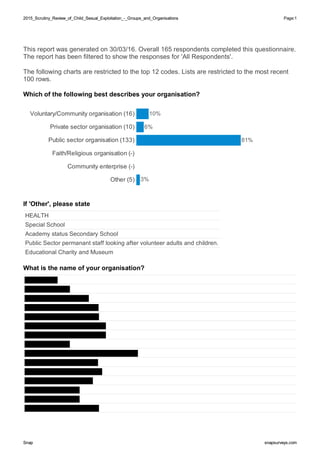
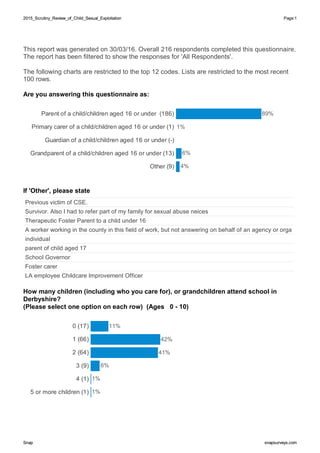
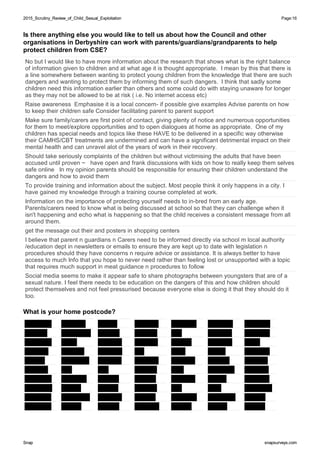
Members noted the findings from the 216 respondents from the
parents/guardians questionnaire. A full summary of the results can be found in
appendix one.
The vast majority of respondents (89%) was a parent of child/children under
16 and had one or two children. This is representative of Derbyshire as a
whole, where Census data shows 86% of families with children have one or
two children. Additionally, 80% of the children went to school in Derbyshire.
Other demographic information collected from the consultation highlights
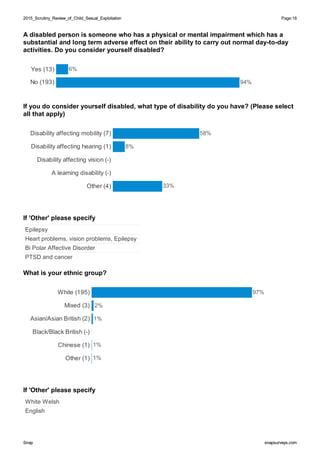
being representative of Derbyshire, with 94% not considering themselves
disabled and 97% of being in the white ethnic group. However, Members
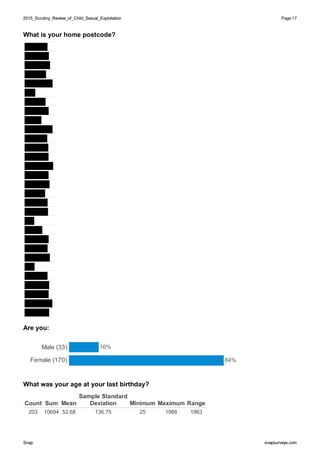
noted that 84% of respondents were female; therefore the consultation is not
gender representative of Derbyshire.
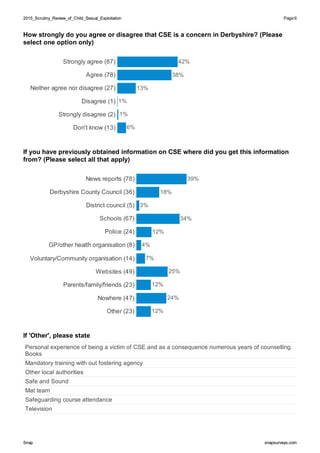
Overall, nearly all (99%) of respondents thought CSE affects both boys and
girls and 80% agree that CSE is a concern in Derbyshire.
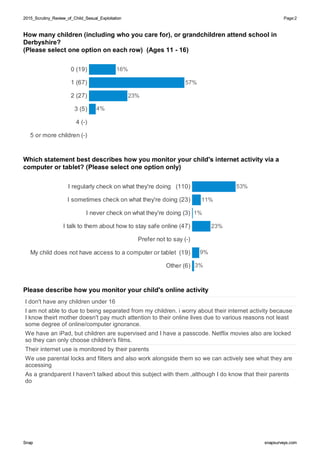
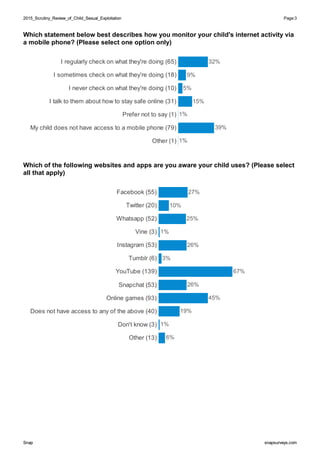
Members noted the greater use by children of tablets / computers than mobile
phones. Whereas only 9% of respondents stated their child does not have
access to a computer or tablet, this increased to 39% for mobile phones.
In terms of monitoring their child’s internet activity, 53% of parents stated they
regularly check on what their child is doing via their tablet or computer. A
further 23% talk to them about how to stay safe on-line.
Members also noted parents’ awareness of websites and apps which their
child uses. Facebook, Whatsapp and Instagram were selected by around a
35
quarter of respondents (multiple selections were allowed). However, the top
two were YouTube (67%) and on-line games (45%). The latter is of
importance to understand further, given the accessibility and sharing of
information, for example through message boards linked to the on-line game.
Members noted the guidance that is available from the NSPCC and
campaigns such as ‘Ask About Games’ from the games trade body, Ukie.
Developing further relationships with this body would be beneficial.
Furthermore, there are institutions such as Get Safe Online
(www.getsafeonline.org). Indeed, an OnePoll survey commissioned by Get
Safe Online with 2,000 parents showed 37% felt they had no control over their
‘kids’ online gaming. Also, a quarter was unaware of the security risks to their
‘kids’ from online gaming and knew their ‘kids’ had disclosed personal
information.
The working group recommends that guidance and information is made
available to all parents in regards to on-line gaming and accessing video
streaming website.
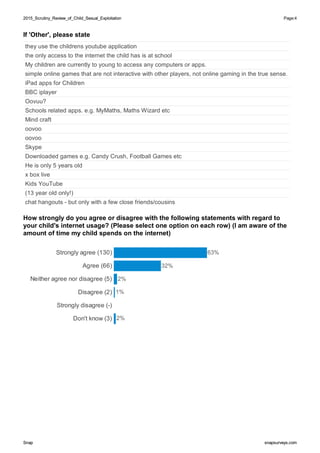
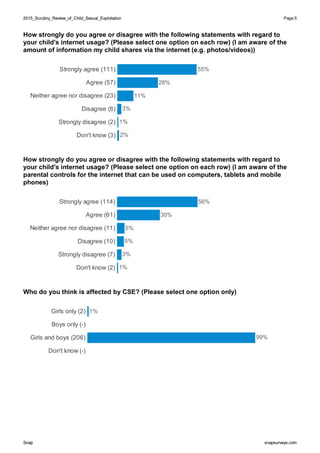
The vast majority of respondents (95%) stated they were aware of the amount
of time their child spends on the internet and 83% were aware of the
information which their child shares on-line, for example photos and videos.
Furthermore, 86% felt they were aware of the parental controls that can be
used on computers, tablets and mobile phones.
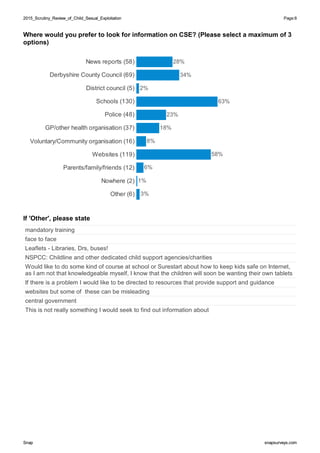
Members noted that the source which most respondents stated they had
obtained information of CSE was news reports (39%). This was followed by
from schools (34%) and websites (25%). Members also noted that 24% of
respondents had not previously obtained information on CSE. In terms of
where respondents wish to look for information on CSE, the majority (63%)
gave schools as a preference (they were allowed up to three choices).
Members noted the consultation results which suggest schools are a key
information source for parents regarding CSE. Websites was also a preferred
option (58%) for parents, nearly double the next preferred option of Derbyshire
County Council (34%).
The working group recommends that work is undertaken, including with
schools, to ensure parents have access to CSE information through
websites and schools.
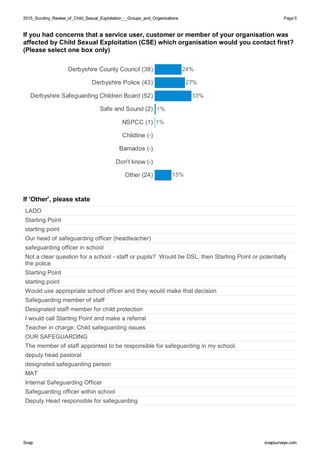
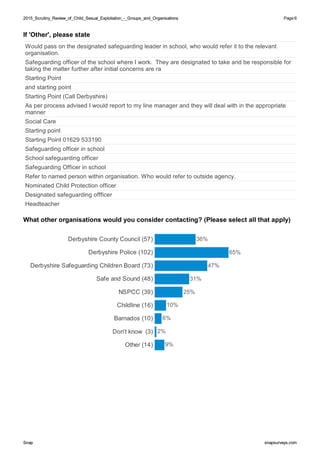
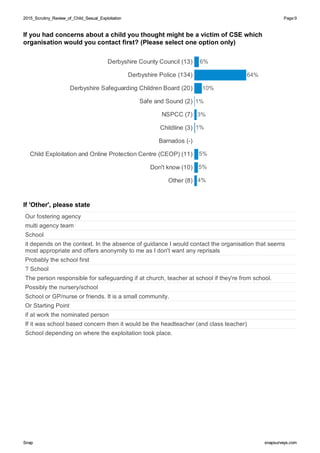
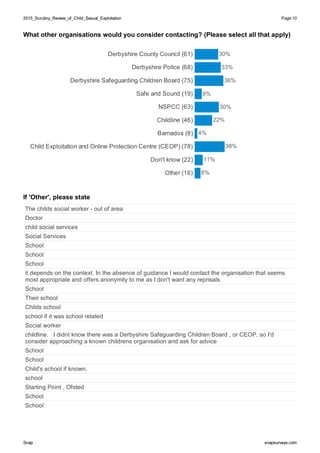
Members also noted that respondents would contact the Police first if they had
concerns about a child being victim of CSE. This was overwhelmingly chosen
as the first organisation by two thirds (64%) with the DSCB next at 10%.
36
Members noted this may have implications regarding the Police non-
emergency number contact service (101), especially given the recent issues
encountered with call waiting times and abandoned calls increasing. Although
action is being carried out to remedy the issue, Members felt it prudent to
ensure there is sufficient ongoing monitoring of police contact performance in
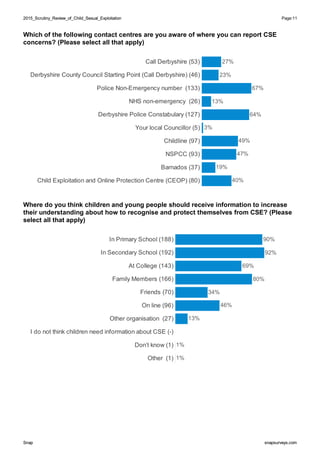
relation to CSE. This is pertinent given that two thirds (67%) of respondents
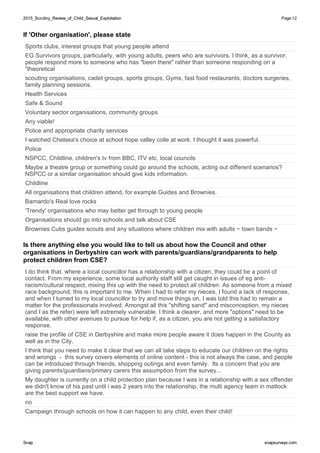
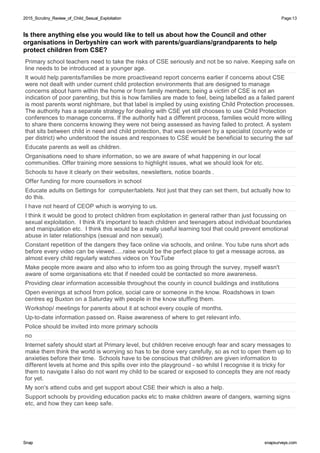
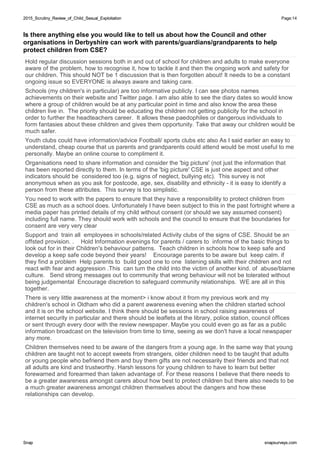
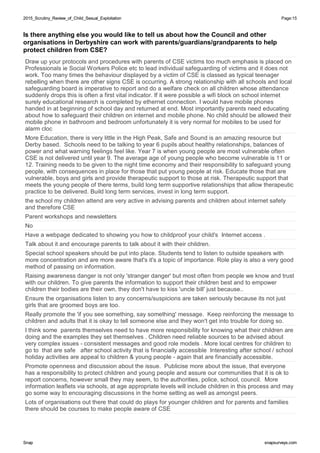
are aware of the 101 number.
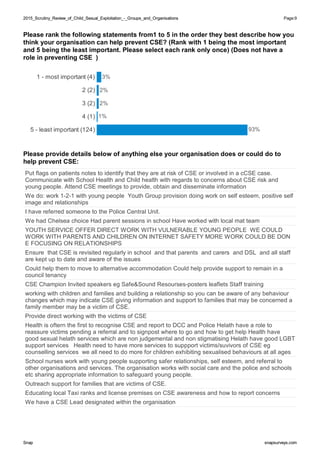
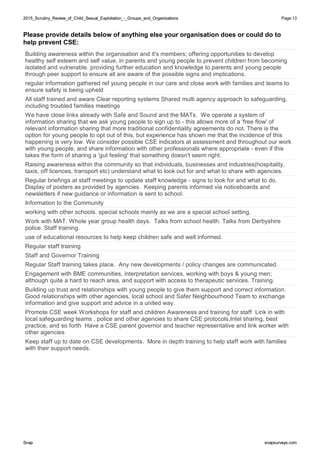
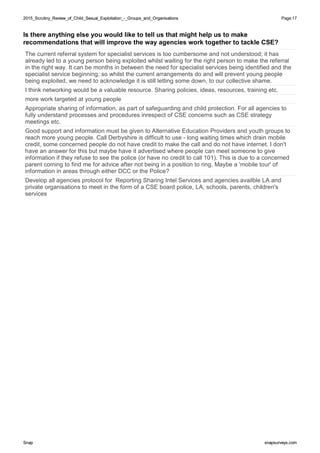
The working group recommends that there is regular performance
monitoring of the Police non-emergency number in relation to CSE by
the Derbyshire Safeguarding Children’s Board.
Members also noted that there was lower awareness of Call Derbyshire and
Starting Point (27% and 23% respectively) compared to nearly half of
respondents who stated they were aware of Childline and NSPCC. This may
be partly due to Starting Point being relatively new. A recommendation has
already been proposed in this review regarding receiving an update on the
performance of Starting Point.
Members additionally noted that the vast majority of respondents (90%)
thought children should receive information on CSE in primary school.
Respondents also felt information should be provided in secondary school
(92%) and 80% stated it can come from family members. Members noted that
there is a recommendation in this review regarding children receiving
information on CSE in the transition from primary to secondary school. The
consultation findings do back up this recommendation proposal.
The consultation also invited respondents to provide comments on what more
can be done to help protect children from CSE. Analysis of the comments
highlighted some key themes. Of the 50 comments received, nearly half (20)
encouraged more raising of awareness of CSE including on-line safety. This
included to both parents and children. A further 12 comments felt activity can
be through schools, including support for schools to educate children and
parents. Suggestions included open evenings, workshops and specialist
speakers. Nine comments were made about how preventing CSE is not just
the duty of professionals but for us all. An illustrative diagram of the key
themes can be found in appendix two.
Groups/organisations
Members noted the findings from the 165 respondents from the
groups/organisations questionnaire. A full summary of the results can be
found in appendix three.
37
The majority of respondents were from public sector organisations (81%) with
10% from community and voluntary groups and 6% from the private sector.
Organisations from the public sector included many schools from Derbyshire
across all key stages. Overall, 93% of respondents felt they had a role in
preventing CSE. Members noted the comments which were invited to explain
what respondent’s organisations do or could do to help prevent CSE. Of the
132 comments received, 31 were about education and raising awareness of
CSE. A further 19 were around the work of schools directly in educating and
safeguarding and 14 were about referrals and sharing information. A further 8
were on working with CSE victims and those at risk. There were 60 comments
regarding what else can be done to prevent CSE. Some common themes
came out, including information sharing and the referral process. Another
theme was specialist provision, including counselling, drama provision,
targeting work to 15 and 16 year olds and education on positive relationships.
Other themes were raising awareness of CSE and partnership working.
Members noted that some respondents would contact Derbyshire County
Council (24%), Derbyshire Police (27%) or the DSCB (33%) first if they had a
CSE concern. Although this is in contrast to the much higher percentage of
parents/guardians who would go to the Police first, it is perhaps
understandable given that the organisations would have knowledge of referral
routes. However, organisations did choose the Police the most (65%) in terms
of who they would also contact (after giving the first preference).
Members noted the results of the question asking respondents a number of
statements that best describe how they think their organisation helps prevent
CSE. Working with the Council and Police to support victims and survivors of
CSE had the largest polarisation. Although 33% of respondents felt it was the
most important, 35% also stated it was of lower importance (choosing 4 out of
the 5 point scale). Further analysis of those respondents who felt it was of
lower importance showed, of the 57 respondents, 41 were from schools and
seven were from various areas of Derbyshire County Council. Members noted
that these results may be due to the perception that CSE victim support is a
specialist area which needs expert professionals. Whilst this is true, it should
be noted this should not preclude all organisations from putting the victim and
potential victims at the heart of all activities, including ensuring where they can
be referred too.
When asked if the description making sure staff know who to contact if they
have CSE concerns, 60% felt this was important and 65% felt it was important
to provide information to children about CSE. There was more of a spread of
38
levels of importance when respondents were asked about providing
information to parents and carers about CSE. Given the findings from the
parents consultation regarding where they would like to obtain their
information from (schools, websites), Members noted that there may be some
buy-in needed to ensure provision is given the required level of importance.
Members also noted there was a high level (88%) of staff training and
information provision regarding CSE by organisations. Furthermore, the vast
majority (94%) strongly agreed / agreed that the training or information
provided was valuable. The majority of respondents (78%) strongly agreed /
agreed that organisations are working together to tackle CSE. Of this, nearly a
quarter (23%) strongly agreed suggesting there are still opportunities for
improved partnership working. This is to be expected, as there is a continual
drive for development. Members noted that part of this is raising awareness, a
responsibility which falls on everyone – it is of course ‘everybody’s business’.
This includes Members themselves, who have strong local contacts and
connections in their respective electoral divisions, together with the district
council and parish wards
The working group recommends Members work with their local District,
Borough, Town and Parish Councils to raise awareness and support of
CSE services for victims in their local areas, for example through Local
Area Committees and Parish Forums.
Members noted the findings from consultation with the Keeping it Real (KIR)
Programme. This focused on young people’s knowledge and awareness
levels of current CSE service providers.
The young people said that they would contact parents, police, youth workers,
social workers and Sexual Health Services if they had a concern about CSE
for themselves or a friend. The services that young people are aware of with
regard to CSE included GP’s emergency contraception, walk in centres, KIR
Programme, Childline, Frank, Reporting Button via the CEOP website,
Barnardo’s and Sexual Health Services. Young people heard about these
services from schools, KIR Programme, adverts ‘pop ups’ whilst playing on
devices/computers.
Members noted the findings from the consultation regarding the CSE services
young people would like to see delivered and how. They stated CSE services
should be delivered through more KIR Programmed groups. This and other
groups could be provided out of young people’s local areas as not to
stigmatise, with transport provided there and back. In terms of how the service
39
should be delivered, the preferred formats would be groups, one-to-ones, a
mixture of both and support groups
Members also noted that the young people stated there is not enough
provision of information through social media, websites and posters on CSE.
They felt that they have to search for any information and need eye catching
posters, produced by young people working with designers. Peer mentors
were also seen as a good way of being able to talk about CSE to people their
own age.
It was felt was that other ways information can be communicated can be via
leaflet, texts, SnapChat and Twitter. Members did note some feedback that
the YOUTHINC website was not used to find information on CSE. However,
this may be just an outlier based on a few comments.
Members noted that there was evidence of some knowledge of how to use
social media safely. This included using security settings, not talking to
‘randoms’ (unknown people), keeping their profile safe, having privacy settings
high, blocking people you don’t know and not sharing personal information.
There was also evidence of knowledge of the dangers of sharing photos and
messages on-line with others. This included losing control of photo (for
example no longer being private), receiving photos from others, distribution of
pornographic images and sexting.
The consultation results not only support the review and its recommendations,
it also provides the Authority and its partners with some detailed information to
support their work in preventing CSE and supporting victims and their families.
The working group recommends that the Derbyshire Safeguarding
Children’s Board are provided with the consultation findings from this
review and work is undertaken to analyse the results further and share
with partners to support work on their stated priority of CSE.
5.4 The CSE training provided to staff and whether front line staff feel that
they have the right training and tools to equip them to work effectively with
CSE
CSE Training Provision: Integrated approach
Members noted the integrated approach to CSE training which is being
implemented by the Authority with its partners. Initially Children’s Services
delivered 4 to 6 sessions a year for their own staff. Community Safety have
40
now modified the course material so that the examples and scenarios used
are more relevant to a range of partner organisations.
Members noted the “Recognising and reporting CSE” which is a half day
course delivered to 50 participants at a time. It has been delivered once a
month. To ensure its sustainability the course is delivered by a pool of trainers
from partner organisations. A company called “Paper Data” have evaluated 3
courses so far. The results suggest that the course leads to an improvement
in the participants understanding of CSE. The results from the consultation
with organisations seem to back this up.
A CSE e-learning package has also been launched. This course will have the
same objectives as the half day course but will not cover the topic in such
depth. Three ‘Say Something if you see Something’ courses have been
piloted with taxi drivers, two in Chesterfield and one in Ilkeston. They were
delivered by Licensing Managers from Chesterfield and South Derbyshire.
Members also noted the work being carried out to deliver messages in
licensed vehicles, public buses etc…intend to raise awareness of CSE.
Members further noted the work of Safe and Sound for CSE training. This
group was commissioned in 2013 to provide basic CSE awareness training
and intermediate and advanced level CSE to staff involved in working with and
supporting children and young people across Derbyshire. In 2014/15,
approximately 500 individuals were trained.
Members were encouraged by the results of feedback of participants, with at
least 60% improved knowledge, based on scoring themselves pre and post
training. The value of the training was scored on average 9 out of 10, as well
as the trainer. Overall, 95% of respondents stated they achieved their learning
outcomes.
However, Members also noted the feedback that further advanced training
was required for some staff, for example front line practitioners including
residential staff. Safe and Sound analysis of training needs shows that 973
members of staff should be targeted with a further 650 to be potentially
targeted in 2016/17. Members noted the wide range of posts in the target
groups, for example, youth workers, social workers, foster carers to name only
but a few of the extensive list. However, there appears to be an absence of
health related staff posts in the target group lists, for example sexual health
41
workers in Public Health. This also appears to apply to call handlers, for
example staff in Call Derbyshire.
The working group recommends that consideration is given for CSE
training provision to those in health related posts, for example Public
Health.
Members were encouraged that the recommendations from Adele Gladman’s
audit were taken into account when designing the training course content.
Wider safeguarding training
Members noted that the DSCB run a comprehensive training programme
designed for people who work with or for children and covers safeguarding
issues at different levels. A recommended training programme for Members is
‘Everybody’s Business’, which provides the foundation for safeguarding issues
to be understood. The programme also offers some subject specific training,
including:
• Neglect
• Child Development
• ‘Toxic Trio’ - Domestic Violence, Parental Mental Health and
Substance Misuse
• Child Sexual Exploitation
• Domestic Violence
The working group recommends that as part of the Member
Development Programme, a bespoke Member-driven training
programme is established to develop safeguarding and CSE skills.
5.6 Good practice in other authorities
Members noted the good practice examples from various research and
inspections. Although these are too numerous to mention them all, the two
examples illustrate good work which can be shared by professionals.
42
Victoria, Australia:
The Office of Professional Practice, within the Department of Human Services
(DHS), has been running a child sexual exploitation prevention project with
Victoria Police over the past few years to establish a more effective response
to the sexual exploitation of young people. It has been focusing on young
people who are in out of home care as they are seen as most at risk of child
sexual exploitation (Australian Institute of Family Studies, 2014).
The work has been led by the DHS, which has co-located officers into the
Victoria police force to build a strong network between the two organisations.
Close collaboration occurs with the specialist Victorian Police squads, who
work with child abuse and sexual crime, and the sex crimes division. They are
also helping police understand and effectively use the Australian National
Child Offender Register (ANCOR) reports.
The project has trained about 2,000 people in the last year. It has brought
police, child protection officers and residential care workers together through
this training – encouraging them to work together and think about how they
can respond in more effective ways through increased collaboration.
The aim is to put in place a more proactive response to child sexual
exploitation. Teamwork between social care and residential care officers and
the police is critical so that information sharing occurs in a more targeted way.
The work is encouraging more senior and experienced staff within the social
care and residential care setting to work on the more difficult serious cases
and is increasing the training and supervision that staff receives to handle
such cases. The aim is to create an environment where young people are
more likely to disclose and that staff are more capable of identifying and
understanding the patterns around ‘grooming’.
Leeds City Council
According to Ofsted, considerable progress has been made by Leeds City
Council over the past two years in tackling CSE. Practitioner awareness
training has been rolled out across the partnership. A CSE risk and
identification tool, together with a vulnerability risk management plan, supports
social workers to analyse a child’s vulnerability and risk of sexual exploitation.
In 2013 a Child Sexual Exploitation and Missing Coordinator was appointed,
based within the Integrated Safeguarding Unit. A CSE project worker was also
appointed to work extensively with looked after children and care leavers,
providing a clear focus, together with advocacy, access and assertive
43
outreach. This is providing clear support pathways for children and young
people identified as being at risk of, or experiencing, sexual exploitation.
The LGA’s resource pack on CSE contains further examples of good practice,
covering prosecutions, improved information sharing, joint training, risk
assessment, and awareness-raising (including for those responsible for
licensed premises).
44
6. Report conclusions
The working group acknowledges the work that the Authority has done with
partners to raise awareness of CSE and support victims.
The challenge for all is to ensure that the processes are in place to ensure
that all stakeholders are fully supported to prevent and protect vulnerable
children and prosecute those who commit such crimes.
The findings and recommendations from this report will help the Authority’s
continual improvement in the safeguarding of young people in and around
Derbyshire.
2015_Scrutiny_Review_of_Child_Sexual_Exploitation_-_Groups_and_Organisations2015_Scrutiny_Review_of_Child_Sexual_Exploitation_-_Groups_and_Organisations Page:1
SnapSnap snapsurveys.comsnapsurveys.com
This report was generated on 30/03/16. Overall 165 respondents completed this questionnaire.
The report has been filtered to show the responses for 'All Respondents'.
The following charts are restricted to the top 12 codes. Lists are restricted to the most recent
100 rows.
Which of the following best describes your organisation?
Voluntary/Community organisation (16)
Private sector organisation (10)
Public sector organisation (133)
Faith/Religious organisation (-)
Community enterprise (-)
Other (5) 3%
6%
81%
10%
If 'Other', please state
HEALTH
Special School
Academy status Secondary School
Public Sector permanant staff looking after volunteer adults and children.
Educational Charity and Museum
What is the name of your organisation?
Appendix One
2015_Scrutiny_Review_of_Child_Sexual_Exploitation_-_Groups_and_Organisations2015_Scrutiny_Review_of_Child_Sexual_Exploitation_-_Groups_and_Organisations Page:2
SnapSnap snapsurveys.comsnapsurveys.com
What is the name of your organisation?
2015_Scrutiny_Review_of_Child_Sexual_Exploitation_-_Groups_and_Organisations2015_Scrutiny_Review_of_Child_Sexual_Exploitation_-_Groups_and_Organisations Page:3
SnapSnap snapsurveys.comsnapsurveys.com
What is the name of your organisation?
2015_Scrutiny_Review_of_Child_Sexual_Exploitation_-_Groups_and_Organisations2015_Scrutiny_Review_of_Child_Sexual_Exploitation_-_Groups_and_Organisations Page:4
SnapSnap snapsurveys.comsnapsurveys.com
What is the name of your organisation?
What is the postcode of your organisation?
2015_Scrutiny_Review_of_Child_Sexual_Exploitation_-_Groups_and_Organisations2015_Scrutiny_Review_of_Child_Sexual_Exploitation_-_Groups_and_Organisations Page:5
SnapSnap snapsurveys.comsnapsurveys.com
If you had concerns that a service user, customer or member of your organisation was
affected by Child Sexual Exploitation (CSE) which organisation would you contact first?
(Please select one box only)
Derbyshire County Council (38)
Derbyshire Police (43)
Derbyshire Safeguarding Children Board (52)
Safe and Sound (2)
NSPCC (1)
Childline (-)
Barnados (-)
Don't know (-)
Other (24)
27%
1%
33%
1%
24%
15%
If 'Other', please state
LADO
Starting Point
starting point
Our head of safeguarding officer (headteacher)
safeguarding officer in school
Not a clear question for a school - staff or pupils? Would be DSL, then Starting Point or potentially
the police
Starting Point
starting point
Would use appropriate school officer and they would make that decision
Safeguarding member of staff
Designated staff member for child protection
I would call Starting Point and make a referral
Teacher in charge: Child safeguarding issues
OUR SAFEGUARDING
The member of staff appointed to be responsible for safeguarding in my school.
deputy head pastoral
designated safeguarding person
MAT
Internal Safeguarding Officer
Safeguarding officer within school
Deputy Head responsible for safeguarding
2015_Scrutiny_Review_of_Child_Sexual_Exploitation_-_Groups_and_Organisations2015_Scrutiny_Review_of_Child_Sexual_Exploitation_-_Groups_and_Organisations Page:6
SnapSnap snapsurveys.comsnapsurveys.com
If 'Other', please state
Would pass on the designated safeguarding leader in school, who would refer it to the relevant
organisation.
Safeguarding officer of the school where I work. They are designated to take and be responsible for
taking the matter further after initial concerns are ra
Starting Point
and starting point
Starting Point (Call Derbyshire)
As per process advised I would report to my line manager and they will deal with in the appropriate
manner
Social Care
Starting point
Starting Point 01629 533190
Safeguarding officer in school
School safeguarding officer
Safeguarding Officer in school
Refer to named person within organisation. Who would refer to outside agency.
Nominated Child Protection officer
Designated safeguarding offficer
Headteacher
What other organisations would you consider contacting? (Please select all that apply)
Derbyshire County Council (57)
Derbyshire Police (102)
Derbyshire Safeguarding Children Board (73)
Safe and Sound (48)
NSPCC (39)
Childline (16)
Barnados (10)
Don't know (3)
Other (14)
25%
36%
65%
47%
31%
10%
6%
2%
9%
2015_Scrutiny_Review_of_Child_Sexual_Exploitation_-_Groups_and_Organisations2015_Scrutiny_Review_of_Child_Sexual_Exploitation_-_Groups_and_Organisations Page:7
SnapSnap snapsurveys.comsnapsurveys.com
If 'Other', please state
LADO
Social care
MAT
PACE
Independent counsellor
Starting Point
as above
Safeguarding member of staff
I may contact other organisations but not immediately.
Should not be necessary but if the issue not followed up I would consider a direct referral to DCC
Miles Dent, Child Protection Manager. Local Authority Designated Officer (LADO)
Starting Point
Starting Point
social care
I would leave this to the safeguarding officer
All get dealt with by Safeguarding officers in school, out of school it would be the poilce
Would consult with named person within organisation for advice and either pass on concerns to be
dealt with by that person or act under their advice.
Dependent on area
I would act on advice given by Safeguarding officer
Multi Agency Team,
Please rank the following statements from1 to 5 in the order they best describe how you
think your organisation can help prevent CSE? (Rank with 1 being the most important
and 5 being the least important. Please select each rank only once) (Working with the
Council and police to support victims and survivors of CSE and their families )
1 - most important (53)
2 (28)
3 (21)
4 (57)
5 - least important (2) 1%
33%
17%
13%
35%
2015_Scrutiny_Review_of_Child_Sexual_Exploitation_-_Groups_and_Organisations2015_Scrutiny_Review_of_Child_Sexual_Exploitation_-_Groups_and_Organisations Page:8
SnapSnap snapsurveys.comsnapsurveys.com
Please rank the following statements from1 to 5 in the order they best describe how you
think your organisation can help prevent CSE? (Rank with 1 being the most important
and 5 being the least important. Please select each rank only once) (Making sure our
staff and volunteers know who to contact if they are concerned that someone is
affected by CSE)
1 - most important (98)
2 (36)
3 (24)
4 (5)
5 - least important (1) 1%
60%
22%
15%
3%
Please rank the following statements from1 to 5 in the order they best describe how you
think your organisation can help prevent CSE? (Rank with 1 being the most important
and 5 being the least important. Please select each rank only once) (Providing
information to children and young people about how to keep themselves safe from CSE)
1 - most important (106)
2 (30)
3 (20)
4 (6)
5 - least important (2) 1%
65%
18%
12%
4%
Please rank the following statements from1 to 5 in the order they best describe how you
think your organisation can help prevent CSE? (Rank with 1 being the most important
and 5 being the least important. Please select each rank only once) (Providing
information to parents and carers about how to keep children safe from CSE )
1 - most important (59)
2 (41)
3 (38)
4 (21)
5 - least important (2) 1%
37%
26%
24%
13%
2015_Scrutiny_Review_of_Child_Sexual_Exploitation_-_Groups_and_Organisations2015_Scrutiny_Review_of_Child_Sexual_Exploitation_-_Groups_and_Organisations Page:9
SnapSnap snapsurveys.comsnapsurveys.com
Please rank the following statements from1 to 5 in the order they best describe how you
think your organisation can help prevent CSE? (Rank with 1 being the most important
and 5 being the least important. Please select each rank only once) (Does not have a
role in preventing CSE )
1 - most important (4)
2 (2)
3 (2)
4 (1)
5 - least important (124) 93%
3%
2%
2%
1%
Please provide details below of anything else your organisation does or could do to
help prevent CSE:
Put flags on patients notes to identify that they are at risk of CSE or involved in a cCSE case.
Communicate with School Health and Child health with regards to concerns about CSE risk and
young people. Attend CSE meetings to provide, obtain and disseminate information
We do: work 1-2-1 with young people Youth Group provision doing work on self esteem, positive self
image and relationships
I have referred someone to the Police Central Unit.
We had Chelsea choice Had parent sessions in school Have worked with local mat team
YOUTH SERVICE OFFER DIRECT WORK WITH VULNERABLE YOUNG PEOPLE WE COULD
WORK WITH PARENTS AND CHILDREN ON INTERNET SAFETY MORE WORK COULD BE DON
E FOCUSING ON RELATIONSHIPS
Ensure that CSE is revisited regularly in school and that parents and carers and DSL and all staff
are kept up to date and aware of the issues
Could help them to move to alternative accommodation Could help provide support to remain in a
council tenancy
CSE Champion Invited speakers eg Safe&Sound Resourses-posters leaflets Staff training
working with children and families and building a relationship so you can be aware of any behaviour
changes which may indicate CSE giving information and support to families that may be concerned a
family member may be a victim of CSE.
Provide direct working with the victims of CSE
Health is oftern the first to recognise CSE and report to DCC and Police Helath have a role to
reassure victims pending a referral and to signpost where to go and how to get help Health have
good sexual helath services which are non judgemental and non stigmatising Helath have good LGBT
support services Health need to have more services to suppport victims/suvivors of CSE eg
counselling services we all need to do more for children exhibiting sexualised behaviours at all ages
School nurses work with young people supporting safer relationships, self esteem, and referral to
other organisations and services. The organisation works with social care and the police and schools
etc sharing appropriate information to safeguard young people.
Outreach support for families that are victims of CSE.
Educating local Taxi ranks and license premises on CSE awareness and how to report concerns
We have a CSE Lead designated within the organisation
2015_Scrutiny_Review_of_Child_Sexual_Exploitation_-_Groups_and_Organisations2015_Scrutiny_Review_of_Child_Sexual_Exploitation_-_Groups_and_Organisations Page:10
SnapSnap snapsurveys.comsnapsurveys.com
Please provide details below of anything else your organisation does or could do to
help prevent CSE:
Staff training through an annual safeguarding rolling programme Enhanced training for those with
Level 3 competencies
We provide Consent Workshops across the County and the City to help young people understand
Consent in the full sense of the word. We provide support to other organisations around
understanding the grooming process and choice.
Training and workshops
Our organisation could: Raise awareness to families (parents and children) we support who are
vulnerable and hard to reach. Raise awareness to volunteers who support families. Raise awareness
to staff who support volunteers and families.
Support form other departments and other agencies
Working with DCC to provide training and awareness raising for Taxi drivers via our licensing function.
Arrest and prosecute offenders, disrupt CSE
provides intelligence via operation liberty form to disrupt CSE. Consultation to Safe and Sound,
special advice to CPS and asessments of young people who may go to court regarding wellbeing
through the trial
Build positive relationships with young people that enables us to spot signs of CSE.
CSE Awarness training use of the CSE assessment tool
By providing training and ongoing support, by trying to educate and support health professionals and
others as to the affects of contact and disclosure and to enable more positive outcomes for survivors
by providing survivor led workshops.
As a DS in the CEIU unit, we speak to the victims of crime and deal with the suspects via the judicial
system
Chelsea's Choice presentation. Talks from local police Work in Citizenship lessons Work in form
periods Assemblies
We have outside agencies in to give talks to students as well as the police who hold workshops and
assemblies.
Education
super learning days
Information on school website, information on newsletters, information on notice boards. PSHE work
on CSE making children and their parents more aware of the issues.
GREATER EMPHASIS ON IT BEING EVERYBODYS RESPONSIBILITY TO BE AWARE OF AND
KNOW EXACTLY WHAT TO DO WHEN CONCERNS ARE IDENTIFIED
We carry out checks on vulnerable students using the prescribed checklist. Hold weekly external
agency meetings to discuss vulnerable young people Train staff to be watchful for the signs of young
people being vulnerable Assign keyworkers to vulnerable young people Signpost to external agencies
where necessary liaise with parents & carers about general vulnerability of young people and specific
cases of young people with actual or potential vulnerability.
We follow a strict safeguarding policy and procedure
We have had workshops in school around CSE. We have also worked with identified youngsters. We
are also working our Local MAT team on supporting those students who appear most vulnerable. We
have had police assemblies and also safeguarding workshops. CSE materials displayed in school
Ensures children are taught regularly about how to keep themselves safe. Ensures training for staff is
an ongoing programme.
2015_Scrutiny_Review_of_Child_Sexual_Exploitation_-_Groups_and_Organisations2015_Scrutiny_Review_of_Child_Sexual_Exploitation_-_Groups_and_Organisations Page:11
SnapSnap snapsurveys.comsnapsurveys.com
Please provide details below of anything else your organisation does or could do to
help prevent CSE:
Communicate with the local police and MAT team in regards to any information that needs to be
shared. Provide information in school to support Y/P who have concerns and educate around the
dangers/signs of CSE.
We work with NSPCC to ensure all pupils are made aware of how to keep themselves safe. We run a
biannual 'safety week' which includes workshops on how to keep safe (including online) We have run
meetings for parents to explore online safety.
Sharing info with other agencies working with young people and their families to ensure the 'whole
picture' is gathered on an individual. Train school staff on warning signs and appropriate responses.
Using the PSE programme to give information to students Training staff around what to look for
Making sure that the referral process goes smoothly
Legislative training and safeguarding procedures in place. Annual audit carried out of safeguarding
procedures.
Working with outside agencies and building strong relationships with school users to understand
family issues and to have knowledge of their situations and vulnerabilities.
follows all usual safeguarding measures
We use the NSPCC underwear rule resources.
I think it would be good if there was a programme for schools to deliver which not only covered CSE
but also covered other safeguarding issues. If it was in the curriculum as a programme like we have
for esafety, then it would be integral to what we do and not just done when an issue occurs.
Up-to-date training. Ensuring it is embedded across the curriculum, age appropriate and always at the
for front of teaching and learning.
Governor awareness
The following provision takes place at Netherthorpe School: Assemblies on CSE Briefings on CSE to
staff and students Training on CSE The promotion on CSE campaigns to students, through the use of
posters and letters CSE/ Safeguarding cards supplied to staff detailing procedures.
We provide an induction process to volunteers helping out in our school to make them aware of CSE
and signs to look out for and what to do if they are concerned. Staff receive regular updates
regarding CSE - we do not just treat it as once a year training.
We educate all children to stay safe. Educate staff and parents
A lot of edication re issue. Chelsea's choice etc / victims talking to students. On line safeguarding
training.
Check employees have up to date CRB. Education on internet safety to young people and parents.
Workshops for students Staff training Safeguarding leads within the organisation Lessons (PHSE etc)
dedicated to CSE Displays, posters etc aimed at students to give support organisations
We have regular staff training on CSE matters. We are all aware of who to contact if any concerns
are raised. We are encouraged to raise ANY concerns no matter how tenuous they are. we have a
good working practice throughout the staff of reporting any concerns about our students safety in
general.
All staff are DBS cleared and trained in safeguarding. Staff are told to inform the police as soon as
they think a crime may have been comitted. All cases are reported to the Safeguarding Officer at HQ
Air Cadets. We attend MASH with the LADO and provide whatever assistance is required.
We help manage a park in partnership with Amber Valley Borough Council.. if we notice strangers on
the park or notice cars parked that raise any concerns or are not known to us, we would note
numbers and contact local police.. this has resulted in the past to the police taking action against
individuals that should not be around young or vulnerable peoplt
Inset day talks, online courses, out of school speaker, plays focusing on internet safety and being
safe
2015_Scrutiny_Review_of_Child_Sexual_Exploitation_-_Groups_and_Organisations2015_Scrutiny_Review_of_Child_Sexual_Exploitation_-_Groups_and_Organisations Page:12
SnapSnap snapsurveys.comsnapsurveys.com
Please provide details below of anything else your organisation does or could do to
help prevent CSE:
Chelsea's choice informed student body. Operation liberty awareness amongst staff and the role of
staff training is highly important.
Being aware of families who need support is crucial, building up relationships with families which are
positive. All staff require training not just Teachers
All our staff and volunteers are required to attend a safeguarding awareness raising session. This
session provides basic information about signs of abuse and/or exploitation and provides detailed
information about what to do and who to go to (our Safeguarding Co-ordinator) should they have a
concern about a child or young person or about the behaviour of an adult and what happens after a
concern is raised.
We lead on the strategic response to CSE and related concerns so we are doing as much as possible
to help prevent the issue
Incorporate it in the curriculum through PHSE topics-annually.
Derbyshire County Council within Health and Communities does have a clear escalation path from
front line staff to manager. We may also want to link in with schools if we have concerns about a child
not sure if this happens or not
I am part of a team that provides support to professionals and frontline staff in order to up skill the
existing workforce and increase confidence when working with children and young people affected by
CSE. I feel that this is an effective and sustainable approach given the economic climate and
reducing resources - this ensures that every young person who needs CSE intervention can get it
even if they do not meet the desired thresholds for specialist 1:1 support. I do feel that we could
provide a better space for working with young people (it is not very child friendly) and that we should
do more activities with young people in order to help build and maintain effective working
relationships with the young people we see.
We have been very proactive in addressing concerns regarding CSE. A robust safeguarding process
(CPOMS) enables staff to record any concerns on the on-line data base, whether they are confirmed
or not, so that senior managers can be made aware and take action. We work closely with both
young people and their families as well as allocated social workers. We are aware of making referrals
to Starting Point when required to do so. All our staff have had safeguarding training including
additional training on CSE. Staff are aware of the signs and symptoms of CSE and feel able to report
any concerns they have. We work with the young people on keeping themselves safe through PHSE;
however, we also talk about safety within all our subject areas as
make sure that vulnerable young people have chances to boost their self-esteem through arts, sports
etc provide facilities for young people to become part of a group supported by adults who can build
trusting relationships, model appropriate behaviour, educate to prevent CSE teams to go into school
to explain the dangers and to encourage young people to watch out for each other
Keep vigilant and encourage the staff to never become complacent just because their training
sessions are up to date - don't take it as complete- CSE will be happening in our local communities
and we need to protect our vulnerable citizens.
We currently provide a therapeutic and systemic approach to the whole family and directly working
with the child or young person to give a level of knowledge and understanding to prevent CSE.
We need a better understanding of disabled children's needs especially those who cannot
communication clearly or at all. Training in signs of pain, distress etc is useful but each child is
different eg we encounter children who show no response to pain or who display unusual reactions to
pain eg laughing, smiling. This cannot be taught as a one-size-fits-all approach and needs joined up
working with all carers and professionals who work with the child to share information and advice
particular to that child.
Raise awareness with other agencies /school of CSE and challenge views.
Carers receive training and support to look after young people who have been or are at risk of CSE;
they have skills in identifying signs and warnings
2015_Scrutiny_Review_of_Child_Sexual_Exploitation_-_Groups_and_Organisations2015_Scrutiny_Review_of_Child_Sexual_Exploitation_-_Groups_and_Organisations Page:13
SnapSnap snapsurveys.comsnapsurveys.com
Please provide details below of anything else your organisation does or could do to
help prevent CSE:
Building awareness within the organisation and it's members; offering opportunities to develop
healthy self esteem and self value, in parents and young people to prevent children from becoming
isolated and vulnerable. providing further education and knowledge to parents and young people
through peer support to ensure all are aware of the possible signs and implications.
regular information gathered ref young people in our care and close work with families and teams to
ensure safety is being upheld
All staff trained and aware Clear reporting systems Shared multi agency approach to safeguarding,
including troubled families meetings
We have close links already with Safe and Sound and the MATs. We operate a system of
information sharing that we ask young people to sign up to - this allows more of a 'free flow' of
relevant information sharing that more traditional confidentiality agreements do not. There is the
option for young people to opt out of this, but experience has shown me that the incidence of this
happening is very low. We consider possible CSE indicators at assessment and throughout our work
with young people, and share information with other professionals where appropriate - even if this
takes the form of sharing a 'gut feeling' that something doesn't seem right.
Raising awareness within the community so that individuals, businesses and industries(hospitality,
taxis, off licences, transport etc) understand what to look out for and what to share with agencies.
Regular briefings at staff meetings to update staff knowledge - signs to look for and what to do.
Display of posters as provided by agencies. Keeping parents informed via noticeboards and
newsletters if new guidance or information is sent to school.
Information to the Community
working with other schools. special schools mainly as we are a special school setting.
Work with MAT. Whole year group health days. Talks from school health. Talks from Derbyshire
police. Staff training.
use of educational resources to help keep children safe and well informed.
Regular staff training
Staff and Governor Training
Regular Staff training takes place. Any new developments / policy changes are communicated.
Engagement with BME communities, interpretation services, working with boys & young men;
although quite a hard to reach area, and support with access to therapeutic services. Training.
Building up trust and relationships with young people to give them support and correct information.
Good relationships with other agencies, local school and Safer Neighbourhood Team to exchange
information and give support and advice in a united way.
Promote CSE week Workshops for staff and children Awareness and training for staff Link in with
local safeguarding teams , police and other agencies to share CSE protocols,Intel sharing, best
practice, and so forth Have a CSE parent governor and teacher representative and link worker with
other agencies
Keep staff up to date on CSE developments. More in depth training to help staff work with families
with their support needs.
2015_Scrutiny_Review_of_Child_Sexual_Exploitation_-_Groups_and_Organisations2015_Scrutiny_Review_of_Child_Sexual_Exploitation_-_Groups_and_Organisations Page:14
SnapSnap snapsurveys.comsnapsurveys.com
Have your staff and/or volunteers in your organisation received information or training
about CSE?
Yes (144)
No (11)
Don't know (8)
88%
7%
5%
If 'Yes', how strongly do you agree or disagree that the training or information was
valuable for your role?
Strongly Agree (95)
Agree (43)
Neither agree nor disagree (6)
Disagree (-)
Strongly disagree (-)
Don’t know (3)
29%
4%
65%
2%
How strongly do you agree or disagree that organisations in Derby and Derbyshire are
working together to tackle CSE?
Strongly Agree (37)
Agree (89)
Neither agree nor disagree (25)
Disagree (2)
Strongly disagree (-)
Don’t know (8)
23%
55%
16%
1%
5%
Is there anything else you would like to tell us that might help us to make
recommendations that will improve the way agencies work together to tackle CSE?
More visible posters in public areas about CSE. Increased training/awareness raising to shops, cafes
and hotels to report if they see suspicious activity.
More co-ordinated response with police and DCC
Educate the most likely children better in this subject.
Support in raising awareness of students and parents Help with vulnerable groups Somebody to
provide a listening ear
2015_Scrutiny_Review_of_Child_Sexual_Exploitation_-_Groups_and_Organisations2015_Scrutiny_Review_of_Child_Sexual_Exploitation_-_Groups_and_Organisations Page:15
SnapSnap snapsurveys.comsnapsurveys.com
Is there anything else you would like to tell us that might help us to make
recommendations that will improve the way agencies work together to tackle CSE?
CHELSEA,S CHOICE WAS A GREAT TOOL FOR BOTH PROFECTIONALS AND YOUNG PEOPLE
AND SHOULD HAVE BEAN AN ONGOING PROGRAM. DRAMA GROUPS USING YOUNG PEOPLE
MAY ALSO HELP THEM EXPLOOR THIS DIFFICULT SUBJECT.
Information sharing Joint policies
It would be good to have a specialist nurse in CSE to work as part of Starting Point to advise and
support multiagency team and to support Health staff.
There is a gap in services for victims of CSE - with lack of clarity about gold standard, but a view that
there needs to be a number of different services available at the time that the young perosn needs it.
There is a need for specialist provision within some more generic services. Commissioining of
children's services is fragmented and there is no one body with responsibilty
To understand that CSE is about sexual violence and coercion, it covers different sectors and the
affects can be pervasive to a client.
Creation of a group hub or on-line secure network
A clear pathway for organisations to follow should they come in to contact with CSE. Our organisation
is not sure of the correct way to access support, how to refer and what support is out there that we
could signpost/promote to the families and volunteer we support.
Detailed joined up training , to stop agencies working in silo's and not sure who to or how to share
sensitive information.
push through the new briefer definition that recognises that consent in an under 18 year old is
irrelevent and sees CSE as a form of Child abuse
To share information more readily.
The inclusion of survivors in training exercises has been shown to be very effective at changing
outcomes.
It is important that their is cross agency working to ensure progress is made.
People need to share information more readily in regards to names, areas and modus operandi of the
perps.
The school is keep to participate in anything that will help keep our children, staff and families safe.
Ensure all relevant agencies are included in working / strategy groups and receive relevant feedback
to ensure they can play their part in protecting young people from CSE effectively.
Better communication between Social Care/Mat teams and schools
More funding into drama performances/speakers to give students a different voice to the usual staff
about the issue, the work done in the first year was good but it only was seen by one year group
Schools need access to framework i/mosaic as soon as possible to be able to support vulnerable
pupils more effectively. This has been promised for about 2 years now and is still to be fully
operational.
no enough communication to part time staff, its always second hand and not always correct.
Materials suitable for use at primary age
More specific training and regular updates about CSE
I think Derbyshire Safeguarding Board provides a great service on keeping schools up-to-date with
information and there has been training provided which we have attended and has been very
informative.
too much time is spent focusing on telling the kids what a bad relationship is. i think more time and
resources needs to be given to teaching pupils about what a positive relationship is. Sex ed is taught
so mechanically in schools with none of the real emotional guidance that should accompany it.
We are aware of new resources to support Primary Schools in delivering the teaching around CSE
and it would be fantastic if these were made available to all schools as a point of urgency.
2015_Scrutiny_Review_of_Child_Sexual_Exploitation_-_Groups_and_Organisations2015_Scrutiny_Review_of_Child_Sexual_Exploitation_-_Groups_and_Organisations Page:16
SnapSnap snapsurveys.comsnapsurveys.com
Is there anything else you would like to tell us that might help us to make
recommendations that will improve the way agencies work together to tackle CSE?
Girls and boys older than 15 who are at risk or of or suffering form CSE are still seen by the Police
and Social Services as "in control" of their actions, and actions are not taken to stop the exploitation
from happening. Not enough resources are put in place in particular by Social Services, and too
many changes of personnel mean the case histories need starting all the time, and concerns are not
given enough consideration.
Health services need to work more closely with other agencies.
Improved and regular staff training A "visible" presence in schools, youth clubs etc of a safeguarding
professional
It's very difficult to know how to share information when our children are so young. Advice on this
would be helpful.
Some police officers do not recognise that we have a part to play and will not release or share
information with us. Others do, and it works far more efficiently. There should be a formal
recognition process that organisations can sign up to that will enable inter-agency cooperation.
Would it be possible to offer free trying for identified individuals in groups to cascade trying down to
their groups and then keep a database of the training and in addition send information to identified
individuals
- the more inter-agency work is promoted the better for all. Early intervention with high risk groups is
essential to reducing the risk factors and the contraction in services such as MAT or the funding of
programmes in schools (e.g. counselling) is worrying at a time when there appears to be increased
risk of CSE.
As policy is to escalate to line manager, that is what I do, so I don't see the process and how
decisions are taken based on the information I provide
Full time support from MAT - Case workers sharing their cases so that children and families are not
adversely effected by staff on 'Non-working' days.
We need more joined up working and communication in terms of what training is being delivered - it
feels that there are lots of different training events available but these do not appear to be
coordinated and no one seems to know what material is being delivered by who.
All agencies have a part to play in keeping children and young people safe. Although social work can
be very complex and challenging, social workers must listen and take action from other providers of
services if they feel a child is at risk of harm. The one recent case of CSE we felt was not handled
well. It came down to resources which we understand is an important issue but did nothing to reduce
the level of risk for this girl. A letter of complaint was sent to the Local Authority but no response was
received.
school staff can be ill-prepared to train each other in this difficult subject. A teacher friend of mine was
just given some information to read but everyone working with children needs proper training from a
knowledgeable and experienced team.
Higher level of communication between DCC and Police. Working from same systems to provide
information, tighter timescales for Appendix B's and information exchanges. Ownership/ level of
responsibility to a case, avoid being passed through various departments (time consuming).
Developing further knowledge surrounding the psychological impact of CSE on both the young
person and the parents. Having information readily available to support parents to understand the
psychology of 'trauma bonding' etc. to allow them to improve relationships with their children
developing the support they can offer. Agencies being aware of the young persons psychological
responses to CSE and the development of a culture to support, rather than the victim becoming
criminalised for their actions.
I am new to DCC and don't know what is currently being done so it difficult to answer.
Regular updates
Simply that the more information that can be shared the better
2015_Scrutiny_Review_of_Child_Sexual_Exploitation_-_Groups_and_Organisations2015_Scrutiny_Review_of_Child_Sexual_Exploitation_-_Groups_and_Organisations Page:17
SnapSnap snapsurveys.comsnapsurveys.com
Is there anything else you would like to tell us that might help us to make
recommendations that will improve the way agencies work together to tackle CSE?
The current referral system for specialist services is too cumbersome and not understood; it has
already led to a young person being exploited whilst waiting for the right person to make the referral
in the right way. It can be months in between the need for specialist services being identified and the
specialist service beginning; so whilst the current arrangements do and will prevent young people
being exploited, we need to acknowledge it is still letting some down, to our collective shame.
I think networking would be a valuable resource. Sharing policies, ideas, resources, training etc.
more work targeted at young people
Appropriate sharing of information, as part of safeguarding and child protection. For all agencies to
fully understand processes and procedures inrespect of CSE concerns such as CSE strategy
meetings etc.
Good support and information must be given to Alternative Education Providers and youth groups to
reach more young people. Call Derbyshire is difficult to use - long waiting times which drain mobile
credit, some concerned people do not have credit to make the call and do not have internet. I don't
have an answer for this but maybe have it advertised where people can meet someone to give
information if they refuse to see the police (or have no credit to call 101). This is due to a concerned
parent coming to find me for advice after not being in a position to ring. Maybe a 'mobile tour' of
information in areas through either DCC or the Police?
Develop all agencies protocol for Reporting Sharing Intel Services and agencies availble LA and
private organisations to meet in the form of a CSE board police, LA, schools, parents, children's
services
2015_Scrutiny_Review_of_Child_Sexual_Exploitation2015_Scrutiny_Review_of_Child_Sexual_Exploitation Page:1
SnapSnap snapsurveys.comsnapsurveys.com
This report was generated on 30/03/16. Overall 216 respondents completed this questionnaire.
The report has been filtered to show the responses for 'All Respondents'.
The following charts are restricted to the top 12 codes. Lists are restricted to the most recent
100 rows.
Are you answering this questionnaire as:
Parent of a child/children aged 16 or under (186)
Primary carer of a child/children aged 16 or under (1)
Guardian of a child/children aged 16 or under (-)
Grandparent of a child/children aged 16 or under (13)
Other (9)
1%
89%
4%
6%
If 'Other', please state
Previous victim of CSE.
Survivor. Also I had to refer part of my family for sexual abuse neices
Therapeutic Foster Parent to a child under 16
A worker working in the county in this field of work, but not answering on behalf of an agency or orga
individual
parent of child aged 17
School Governor
Foster carer
LA employee Childcare Improvement Officer
How many children (including who you care for), or grandchildren attend school in
Derbyshire?
(Please select one option on each row) (Ages 0 - 10)
0 (17)
1 (66)
2 (64)
3 (9)
4 (1)
5 or more children (1)
1%
11%
42%
41%
6%
1%
2015_Scrutiny_Review_of_Child_Sexual_Exploitation2015_Scrutiny_Review_of_Child_Sexual_Exploitation Page:2
SnapSnap snapsurveys.comsnapsurveys.com
How many children (including who you care for), or grandchildren attend school in
Derbyshire?
(Please select one option on each row) (Ages 11 - 16)
0 (19)
1 (67)
2 (27)
3 (5)
4 (-)
5 or more children (-)
16%
57%
23%
4%
Which statement best describes how you monitor your child's internet activity via a
computer or tablet? (Please select one option only)
I regularly check on what they're doing (110)
I sometimes check on what they're doing (23)
I never check on what they're doing (3)
I talk to them about how to stay safe online (47)
Prefer not to say (-)
My child does not have access to a computer or tablet (19)
Other (6)
11%
1%
53%
23%
3%
9%
Please describe how you monitor your child's online activity
I don't have any children under 16
I am not able to due to being separated from my children. i worry about their internet activity because
I know theirt mother doesn't pay much attention to their online lives due to various reasons not least
some degree of online/computer ignorance.
We have an iPad, but children are supervised and I have a passcode. Netflix movies also are locked
so they can only choose children's films.
Their internet use is monitored by their parents
We use parental locks and filters and also work alongside them so we can actively see what they are
accessing
As a grandparent I haven't talked about this subject with them ,although I do know that their parents
do
2015_Scrutiny_Review_of_Child_Sexual_Exploitation2015_Scrutiny_Review_of_Child_Sexual_Exploitation Page:3
SnapSnap snapsurveys.comsnapsurveys.com
Which statement below best describes how you monitor your child's internet activity via
a mobile phone? (Please select one option only)
I regularly check on what they're doing (65)
I sometimes check on what they're doing (18)
I never check on what they're doing (10)
I talk to them about how to stay safe online (31)
Prefer not to say (1)
My child does not have access to a mobile phone (79)
Other (1) 1%
15%
39%
1%
32%
5%
9%
Which of the following websites and apps are you aware your child uses? (Please select
all that apply)
Facebook (55)
Twitter (20)
Whatsapp (52)
Vine (3)
Instagram (53)
Tumblr (6)
YouTube (139)
Snapchat (53)
Online games (93)
Does not have access to any of the above (40)
Don't know (3)
Other (13)
26%
67%
3%
26%
19%
27%
10%
25%
45%
1%
1%
6%
2015_Scrutiny_Review_of_Child_Sexual_Exploitation2015_Scrutiny_Review_of_Child_Sexual_Exploitation Page:4
SnapSnap snapsurveys.comsnapsurveys.com
If 'Other', please state
they use the childrens youtube application
the only access to the internet the child has is at school
My children are currently to young to access any computers or apps.
simple online games that are not interactive with other players, not online gaming in the true sense.
iPad apps for Children
BBC iplayer
Oovuu?
Schools related apps. e.g. MyMaths, Maths Wizard etc
Mind craft
oovoo
oovoo
Skype
Downloaded games e.g. Candy Crush, Football Games etc
He is only 5 years old
x box live
Kids YouTube
(13 year old only!)
chat hangouts - but only with a few close friends/cousins
How strongly do you agree or disagree with the following statements with regard to
your child's internet usage? (Please select one option on each row) (I am aware of the
amount of time my child spends on the internet)
Strongly agree (130)
Agree (66)
Neither agree nor disagree (5)
Disagree (2)
Strongly disagree (-)
Don't know (3) 2%
32%
63%
1%
2%
2015_Scrutiny_Review_of_Child_Sexual_Exploitation2015_Scrutiny_Review_of_Child_Sexual_Exploitation Page:5
SnapSnap snapsurveys.comsnapsurveys.com
How strongly do you agree or disagree with the following statements with regard to
your child's internet usage? (Please select one option on each row) (I am aware of the
amount of information my child shares via the internet (e.g. photos/videos))
Strongly agree (111)
Agree (57)
Neither agree nor disagree (23)
Disagree (6)
Strongly disagree (2)
Don't know (3) 2%
1%
55%
28%
11%
3%
How strongly do you agree or disagree with the following statements with regard to
your child's internet usage? (Please select one option on each row) (I am aware of the
parental controls for the internet that can be used on computers, tablets and mobile
phones)
Strongly agree (114)
Agree (61)
Neither agree nor disagree (11)
Disagree (10)
Strongly disagree (7)
Don't know (2) 1%
3%
56%
30%
5%
5%
Who do you think is affected by CSE? (Please select one option only)
Girls only (2)
Boys only (-)
Girls and boys (206)
Don't know (-)
1%
99%
2015_Scrutiny_Review_of_Child_Sexual_Exploitation2015_Scrutiny_Review_of_Child_Sexual_Exploitation Page:6
SnapSnap snapsurveys.comsnapsurveys.com
How strongly do you agree or disagree that CSE is a concern in Derbyshire? (Please
select one option only)
Strongly agree (87)
Agree (78)
Neither agree nor disagree (27)
Disagree (1)
Strongly disagree (2)
Don't know (13) 6%
1%
42%
38%
13%
1%
If you have previously obtained information on CSE where did you get this information
from? (Please select all that apply)
News reports (78)
Derbyshire County Council (36)
District council (5)
Schools (67)
Police (24)
GP/other health organisation (8)
Voluntary/Community organisation (14)
Websites (49)
Parents/family/friends (23)
Nowhere (47)
Other (23)
12%
25%
7%
4%
12%
39%
18%
3%
34%
24%
12%
If 'Other', please state
Personal experience of being a victim of CSE and as a consequence numerous years of counselling.
Books
Mandatory training with out fostering agency
Other local authorities
Safe and Sound
Mat team
Safeguarding course attendance
Television
2015_Scrutiny_Review_of_Child_Sexual_Exploitation2015_Scrutiny_Review_of_Child_Sexual_Exploitation Page:7
SnapSnap snapsurveys.comsnapsurveys.com
If 'Other', please state
Through work, we are sent information regularly.
workplace
Work-based training
Employer
my husband is a police officer, I'm a retired police officer. We both have been trained in "prevent"
Currently doing a course in Level 2 Support Teaching and Learning in schools.
Work
TV programmes
Safeguarding course that I attended because I work with children
Pace (Parents against child sexual exploitation)
Profession CSE Social Work Manager
I work for a local health authority and this is covered in annual essential training.
Through work
Paid and voluntary roles with C&YP
Training at work
paremts session at school with presentations as above
Courses through the fostering agency
work
Place of work (work in Early Years) and my husband works in IT
training at work
On recent Safeguarding Training for school as I am a serving Governor
Staffordshire School not Derbyshire!
2015_Scrutiny_Review_of_Child_Sexual_Exploitation2015_Scrutiny_Review_of_Child_Sexual_Exploitation Page:8
SnapSnap snapsurveys.comsnapsurveys.com
Where would you prefer to look for information on CSE? (Please select a maximum of 3
options)
News reports (58)
Derbyshire County Council (69)
District council (5)
Schools (130)
Police (48)
GP/other health organisation (37)
Voluntary/Community organisation (16)
Websites (119)
Parents/family/friends (12)
Nowhere (2)
Other (6)
6%
58%
8%
18%
23%
28%
34%
2%
1%
63%
3%
If 'Other', please state
mandatory training
face to face
Leaflets - Libraries, Drs, buses!
NSPCC: Childline and other dedicated child support agencies/charities
Would like to do some kind of course at school or Surestart about how to keep kids safe on Internet,
as I am not that knowledgeable myself, I know that the children will soon be wanting their own tablets
If there is a problem I would like to be directed to resources that provide support and guidance
websites but some of these can be misleading
central government
This is not really something I would seek to find out information about
2015_Scrutiny_Review_of_Child_Sexual_Exploitation2015_Scrutiny_Review_of_Child_Sexual_Exploitation Page:9
SnapSnap snapsurveys.comsnapsurveys.com
If you had concerns about a child you thought might be a victim of CSE which
organisation would you contact first? (Please select one option only)
Derbyshire County Council (13)
Derbyshire Police (134)
Derbyshire Safeguarding Children Board (20)
Safe and Sound (2)
NSPCC (7)
Childline (3)
Barnados (-)
Child Exploitation and Online Protection Centre (CEOP) (11)
Don't know (10)
Other (8)
3%
1%
6%
64%
10%
1%
5%
5%
4%
If 'Other', please state
Our fostering agency
multi agency team
School
it depends on the context. In the absence of guidance I would contact the organisation that seems
most appropriate and offers anonymity to me as I don't want any reprisals
Probably the school first
? School
The person responsible for safeguarding if at church, teacher at school if they're from school.
Possibly the nursery/school
School or GP/nurse or friends. It is a small community.
Or Starting Point
if at work the nominated person
If it was school based concern then it would be the headteacher (and class teacher)
School depending on where the exploitation took place.
2015_Scrutiny_Review_of_Child_Sexual_Exploitation2015_Scrutiny_Review_of_Child_Sexual_Exploitation Page:10
SnapSnap snapsurveys.comsnapsurveys.com
What other organisations would you consider contacting? (Please select all that apply)
Derbyshire County Council (61)
Derbyshire Police (68)
Derbyshire Safeguarding Children Board (75)
Safe and Sound (19)
NSPCC (63)
Childline (46)
Barnados (8)
Child Exploitation and Online Protection Centre (CEOP) (78)
Don't know (22)
Other (16)
4%
30%
22%
30%
33%
36%
9%
38%
11%
8%
If 'Other', please state
The childs social worker - out of area
Doctor
child social services
Social Services
School
School
School
it depends on the context. In the absence of guidance I would contact the organisation that seems
most appropriate and offers anonymity to me as I don't want any reprisals
School
Their school
Childs school
school if it was school related
Social worker
childline. I didnt know there was a Derbyshire Safeguarding Children Board , or CEOP, so I'd
consider approaching a known childrens organisation and ask for advice
School
School
Child's school if known.
school
Starting Point , Ofsted
School
School
2015_Scrutiny_Review_of_Child_Sexual_Exploitation2015_Scrutiny_Review_of_Child_Sexual_Exploitation Page:11
SnapSnap snapsurveys.comsnapsurveys.com
Which of the following contact centres are you aware of where you can report CSE
concerns? (Please select all that apply)
Call Derbyshire (53)
Derbyshire County Council Starting Point (Call Derbyshire) (46)
Police Non-Emergency number (133)
NHS non-emergency (26)
Derbyshire Police Constabulary (127)
Your local Councillor (5)
Childline (97)
NSPCC (93)
Barnados (37)
Child Exploitation and Online Protection Centre (CEOP) (80)
49%
64%
3%
27%
23%
67%
47%
13%
19%
40%
Where do you think children and young people should receive information to increase
their understanding about how to recognise and protect themselves from CSE? (Please
select all that apply)
In Primary School (188)
In Secondary School (192)
At College (143)
Family Members (166)
Friends (70)
On line (96)
Other organisation (27)
I do not think children need information about CSE (-)
Don’t know (1)
Other (1)
13%
46%
34%
90%
92%
69%
1%
80%
1%
2015_Scrutiny_Review_of_Child_Sexual_Exploitation2015_Scrutiny_Review_of_Child_Sexual_Exploitation Page:12
SnapSnap snapsurveys.comsnapsurveys.com
If 'Other organisation', please state
Sports clubs, interest groups that young people attend
EG Survivors groups, particularly, with young adults, peers who are survivors. I think, as a survivor,
people respond more to someone who has "been there" rather than someone responding on a
"theoretical
scouting organisations, cadet groups, sports groups, Gyms, fast food restaurants, doctors surgeries,
family planning sessions.
Health Services
Safe & Sound
Voluntary sector organisations, community groups
Any viable!
Police and appropriate charity services
I watched Chelsea's choice at school hope valley colle at work. I thought it was powerful.
Police
NSPCC, Childline, children's tv from BBC, ITV etc, local councils
Maybe a theatre group or something could go around the schools, acting out different scenarios?
NSPCC or a similar organisation should give kids information.
Childline
All organisations that children attend, for example Guides and Brownies.
Barnardo's Real love rocks
'Trendy' organisations who may better get through to young people
Organisations should go into schools and talk about CSE
Brownies Cubs guides scouts and any situations where children mix with adults ~ town bands ~
Is there anything else you would like to tell us about how the Council and other
organisations in Derbyshire can work with parents/guardians/grandparents to help
protect children from CSE?
I do think that. where a local councillor has a relationship with a citizen, they could be a point of
contact. From my experience, some local authority staff still get caught in issues of eg anti-
racism/cultural respect, mixing this up with the need to protect all children. As someone from a mixed
race background, this is important to me. When I had to refer my nieces, I found a lack of response,
and when I turned to my local councillor to try and move things on, I was told this had to remain a
matter for the professionals involved. Amongst all this "shifting sand" and misconception, my nieces
(and I as the refer) were left extremely vulnerable. I think a clearer, and more "options" need to be
available, with other avenues to pursue for help if, as a citizen, you are not getting a satisfactory
response.
raise the profile of CSE in Derbyshire and make more people aware it does happen in the County as
well as in the City.
I think that you need to make it clear that we can all take steps to educate our children on the rights
and wrongs - this survey covers elements of online content - this is not always the case, and people
can be introduced through friends, shopping outings and even family. Its a concern that you are
giving parents/guardians/primary carers this assumption from the survey...
My daughter is currently on a child protection plan because I was in a relationship with a sex offender
we didn't know of his past until i was 2 years into the relationship, the multi agency team in matlock
are the best support we have.
no
Campaign through schools on how it can happen to any child, even their child!
2015_Scrutiny_Review_of_Child_Sexual_Exploitation2015_Scrutiny_Review_of_Child_Sexual_Exploitation Page:13
SnapSnap snapsurveys.comsnapsurveys.com
Is there anything else you would like to tell us about how the Council and other
organisations in Derbyshire can work with parents/guardians/grandparents to help
protect children from CSE?
Primary school teachers need to take the risks of CSE seriously and not be so naive. Keeping safe on
line needs to be introduced at a younger age.
It would help parents/families be more proactiveand report concerns earlier if concerns about CSE
were not dealt with under current child protection environments that are designed to manage
concerns about harm within the home or from family members; being a victim of CSE is not an
indication of poor parenting, but this is how families are made to feel, being labelled as a failed parent
is most parents worst nightmare, but that label is implied by using existing Child Protection processes.
The authority has a separate strategy for dealing with CSE yet still chooses to use Child Protection
conferences to manage concerns. If the authority had a different process, families would more willing
to share there concerns knowing they were not being assessed as having failed to protect. A system
that sits between child in need and child protection, that was overseen by a specialist (county wide or
per district) who understood the issues and responses to CSE would be beneficial to securing the saf
Educate parents as well as children.
Organisations need to share information, so we are aware of what happening in our local
communities. Offer training more sessions to highlight issues, what we should look for etc.
Schools to have it clearly on their websites, newsletters, notice boards .
Offer funding for more counsellors in school
Educate adults on Settings for computer/tablets. Not just that they can set them, but actually how to
do this.
I have not heard of CEOP which is worrying to us.
I think it would be good to protect children from exploitation in general rather than just focussing on
sexual exploitation. I think it's important to teach children and teenagers about individual boundaries
and manipulation etc. I think this would be a really useful learning tool that could prevent emotional
abuse in later relationships (sexual and non sexual).
Constant repetition of the dangers they face online via schools, and online. You tube runs short ads
before every video can be viewed.....raise would be the perfect place to get a message across, as
almost every child regularly watches videos on YouTube
Make people more aware and also who to inform too as going through the survey, myself wasn't
aware of some organisations etc that if needed could be contacted so more awareness.
Providing clear information accessible throughout the county in council buildings and institutions
Open evenings at school from police, social care or someone in the know. Roadshows in town
centres eg Buxton on a Saturday with people in the know stuffing them.
Workshop/ meetings for parents about it at school every couple of months.
Up-to-date information passed on. Raise awareness of where to get relevant info.
Police should be invited into more primary schools
no
Internet safety should start at Primary level, but children receive enough fear and scary messages to
make them think the world is worrying so has to be done very carefully, so as not to open them up to
anxieties before their time. Schools have to be conscious that children are given information to
different levels at home and this spills over into the playground - so whilst I recognise it is tricky for
them to navigate I also do not want my child to be scared or exposed to concepts they are not ready
for yet.
My son's attend cubs and get support about CSE their which is also a help.
Support schools by providing education packs etc to make children aware of dangers, warning signs
etc, and how they can keep safe.
2015_Scrutiny_Review_of_Child_Sexual_Exploitation2015_Scrutiny_Review_of_Child_Sexual_Exploitation Page:14
SnapSnap snapsurveys.comsnapsurveys.com
Is there anything else you would like to tell us about how the Council and other
organisations in Derbyshire can work with parents/guardians/grandparents to help
protect children from CSE?
Hold regular discussion sessions both in and out of school for children and adults to make everyone
aware of the problem, how to recognise it, how to tackle it and then the ongoing work and safety for
our children. This should NOT be 1 discussion that is then forgotten about! It needs to be a constant
ongoing issue so EVERYONE is always aware and taking care.
Schools (my children's in particular) are too informative publicly. I can see photos names
achievements on their website and Twitter page. I am also able to see the diary dates so would know
where a group of children would be at any particular point in time and also know the area these
children live in. The priority should be educating the children not getting publicity for the school in
order to further the headteachers career. It allows these paedophiles or dangerous individuals to
form fantasies about these children and gives them opportunity. Take that away our children would be
much safer.
Youth clubs could have information/advice Football/ sports clubs etc also As I said earlier an easy to
understand, cheap course that us parents and grandparents could attend would be most useful to me
personally. Maybe an online course to compliment it.
Organisations need to share information and consider the 'big picture' (not just the information that
has been reported directly to them. In terms of the 'big picture' CSE is just one aspect and other
indicators should be considered too (e.g. signs of neglect, bullying etc). This survey is not
anonymous when as you ask for postcode, age, sex, disability and ethnicity - it is easy to identify a
person from these attributes. This survey is too simplistic.
You need to work with the papers to ensure that they have a responsibility to protect children from
CSE as much as a school does. Unfortunately I have been subject to this in the past fortnight where a
media paper has printed details of my child without consent (or should we say assumed consent)
including full name. They should work with schools and the council to ensure that the boundaries for
consent are very very clear
Support and train all employees in schools/related Activity clubs of the signs of CSE. Should be an
offsted provision. . Hold Information evenings for parents / carers to informe of the basic things to
look out for in their Children's behaviour patterns. Teach children in schools how to keep safe and
develop a keep safe code beyond their years! Encourage parents to be aware but keep calm. if
they find a problem Help parents to build good one to one listening skills with their children and not
react with fear and aggression .This can turn the child into the victim of another kind. of abuse/blame
culture. Send strong messages out to community that wrong behaviour will not be tolerated without
being judgemental Encourage discretion to safeguard community relationships. WE are all in this
together.
There is very little awareness at the moment> i know about it from my previous work and my
children's school in Oldham who did a parent awareness evening when the children started school
and it is on the school website. I think there should be sessions in school raising awareness of
internet security in particular and there should be leaflets at the library, police station, council offices
or sent through every door with the review newspaper. Maybe you could even go as far as a public
information broadcast on the television from time to time, seeing as we don't have a local newspaper
any more.
Children themselves need to be aware of the dangers from a young age. In the same way that young
children are taught not to accept sweets from strangers, older children need to be taught that adults
or young people who befriend them and buy them gifts are not necessarily their friends and that not
all adults are kind and trustworthy. Harsh lessons for young children to have to learn but better
forewarned and forearmed than taken advantage of. For these reasons I believe that there needs to
be a greater awareness amongst carers about how best to protect children but there also needs to be
a much greater awareness amongst children themselves about the dangers and how these
relationships can develop.
2015_Scrutiny_Review_of_Child_Sexual_Exploitation2015_Scrutiny_Review_of_Child_Sexual_Exploitation Page:15
SnapSnap snapsurveys.comsnapsurveys.com
Is there anything else you would like to tell us about how the Council and other
organisations in Derbyshire can work with parents/guardians/grandparents to help
protect children from CSE?
Draw up your protocols and procedures with parents of CSE victims too much emphasis is placed on
Professionals ie Social Workers Police etc to lead individual safeguarding of victims and it does not
work. Too many times the behaviour displayed by a victim of CSE is classed as typical teenager
rebelling when there are other signs CSE is occurring. A strong relationship with all schools and local
safeguarding board is imperative to report and do a welfare check on all children whose attendance
suddenly drops this is often a first vital indicator. If it were possible a wifi block on school internet
surely educational research is completed by ethernet connection. I would have mobile phones
handed in at beginning of school day and returned at end. Most importantly parents need educating
about how to safeguard their children on internet and mobile phone. No child should be allowed their
mobile phone in bathroom and bedroom unfortunately it is very normal for mobiles to be used for
alarm cloc
More Education, there is very little in the High Peak, Safe and Sound is an amazing resource but
Derby based. Schools need to be talking to year 6 pupils about healthy relationships, balances of
power and what warning feelings feel like. Year 7 is when young people are most vulnerable often
CSE is not delivered until year 9. The average age of young people who become vulnerable is 11 or
12. Training needs to be given to the night time economy and their responsibility to safeguard young
people, with consequences in place for those that put young people at risk. Educate those that are
vulnerable, boys and girls and provide therapeutic support to those at risk. Therapeutic support that
meets the young people of there terms, build long term supportive relationships that allow therapeutic
practice to be delivered. Build long term services, invest in long term support.
the school my children attend are very active in advising parents and children about internet safety
and therefore CSE
Parent workshops and newsletters
No
Have a webpage dedicated to showing you how to childproof your child's Internet access .
Talk about it and encourage parents to talk about it with their children.
Special school speakers should be put into place. Students tend to listen to outside speakers with
more concentration and are more aware that's it's a topic of importance. Role play is also a very good
method of passing on information.
Raising awareness danger is not only 'stranger danger' but most often from people we know and trust
with our children. To give parents the information to support their children best and to empower
children their bodies are their own, they don't have to kiss 'uncle bill' just because..
Ensure the organisations listen to any concerns/suspicions are taken seriously because its not just
girls that are groomed boys are too.
Really promote the 'if you see something, say something' message. Keep reinforcing the message to
children and adults that it is okay to tell someone else and they won't get into trouble for doing so.
I think some parents themselves need to have more responsibility for knowing what their children are
doing and the examples they set themselves . Children need reliable sources to be advised about
very complex issues - consistent messages and good role models . More local centres for children to
go to that are safe after school activity that is financially accessible Interesting after school / school
holiday activities are appeal to children & young people - again that are financially accessible.
Promote openness and discussion about the issue. Publicise more about the issue, that everyone
has a responsibility to protect children and young people and assure our communities that it is ok to
report concerns, however small they may seem, to the authorities, police, school, council. More
information leaflets via schools, at age appropriate levels will include children in this process and may
go some way to encouraging discussions in the home setting as well as amongst peers.
Lots of organisations out there that could do plays for younger children and for parents and families
there should be courses to make people aware of CSE
2015_Scrutiny_Review_of_Child_Sexual_Exploitation2015_Scrutiny_Review_of_Child_Sexual_Exploitation Page:16
SnapSnap snapsurveys.comsnapsurveys.com
Is there anything else you would like to tell us about how the Council and other
organisations in Derbyshire can work with parents/guardians/grandparents to help
protect children from CSE?
No but I would like to have more information about the research that shows what is the right balance
of information given to children and at what age it is thought appropriate. I mean by this that there is
a line somewhere between wanting to protect young children from the knowledge that there are such
dangers and wanting to protect them by informing them of such dangers. I think that sadly some
children need this information earlier than others and some could do with staying unaware for longer
as they may not be allowed to be at risk ( i.e. No internet access etc)
Raise awareness Emphasise it is a local concern- if possible give examples Advise parents on how
to keep their children safe Consider facilitating parent to parent support
Make sure family/carers are first point of contact, giving plenty of notice and numerous opportunities
for them to meet/explore opportunities and to open dialogues at home as appropriate. One of my
children has special needs and topics like these HAVE to be delivered in a specific way otherwise
their CAMHS/CBT treatments are undermined and can have a significant detrimental impact on their
mental health and can unravel alot of the years of work in their recovery.
Should take seriously complaints of the children but without victimising the adults that have been
accused until proven ~ have open and frank discussions with kids on how to really keep them selves
safe online In my opinion parents should be responsible for ensuring their children understand the
dangers and how to avoid them
To provide training and information about the subject. Most people think it only happens in a city. I
have gained my knowledge through a training course completed at work.
Information on the importance of protecting yourself needs to in-bred from an early age.
Parents/carers need to know what is being discussed at school so that they can challenge when it
isn't happening and echo what is happening so that the child receives a consistent message from all
around them.
get the message out their and posters in shopping centers
I believe that parent n guardians n Carers need to be informed directly via school m local authority
/education dept in newsletters or emails to ensure they are kept up to date with legislation n
procedures should they have concerns n require advice or assistance. It is always better to have
access to much Info that you hope to never need rather than feeling lost or unsupported with a topic
that requires much support in meat guidance n procedures to follow
Social media seems to make it appear safe to share photographs between youngsters that are of a
sexual nature. I feel there needs to be education on the dangers of this and how children should
protect themselves and not feel pressurised because everyone else is doing it that they should do it
too.
What is your home postcode?
2015_Scrutiny_Review_of_Child_Sexual_Exploitation2015_Scrutiny_Review_of_Child_Sexual_Exploitation Page:17
SnapSnap snapsurveys.comsnapsurveys.com
What is your home postcode?
Are you:
Male (33)
Female (170)
16%
84%
What was your age at your last birthday?
Count Sum Mean
Sample Standard
Deviation Minimum Maximum Range
203 10694 52.68 136.75 25 1988 1963
2015_Scrutiny_Review_of_Child_Sexual_Exploitation2015_Scrutiny_Review_of_Child_Sexual_Exploitation Page:18
SnapSnap snapsurveys.comsnapsurveys.com
A disabled person is someone who has a physical or mental impairment which has a
substantial and long term adverse effect on their ability to carry out normal day-to-day
activities. Do you consider yourself disabled?
Yes (13)
No (193)
6%
94%
If you do consider yourself disabled, what type of disability do you have? (Please select
all that apply)
Disability affecting mobility (7)
Disability affecting hearing (1)
Disability affecting vision (-)
A learning disability (-)
Other (4) 33%
58%
8%
If 'Other' please specify
Epilepsy
Heart problems, vision problems, Epilepsy
Bi Polar Affective Disorder
PTSD and cancer
What is your ethnic group?
White (195)
Mixed (3)
Asian/Asian British (2)
Black/Black British (-)
Chinese (1)
Other (1) 1%
1%
97%
2%
1%
If 'Other' please specify
White Welsh
English
I & S Committee – People Appendix Two
Review of Child Sexual Exploitation– (14 June 2016)
Action Plan for Implementation of Recommendations
Rec
No.
Recommendation Wording Recommendation
Accepted
(Y/N)
Responsible Officer
(Strategic Director or
their nominated
officer)
Action Progress report to
Committee
(date)
1 The working group recommends the
development of key performance
indicators which can regularly measure
awareness levels of CSE.
2 The working group recommends the
consideration of mainstreaming /
continued support of a CSE
partnership-working post in the Public
Protection Unit.
3 The working group recommends that
officers review learnings from the
Chelsea’s Choice production to ensure
such activities in the future have
maximum impact, for example working
with teachers and children so they are
fully prepared before and reviewed
consistently after.
4 The working group recommends
working with schools in consideration
of key performance indicators that
measure how confident teachers and
other school staff are at spotting signs
of CSE.
5 The working group recommends
working with schools so that CSE
awareness modules are part of
children’s transition from primary to
secondary school.
6 The working group recommends the
continued offering of support to
schools for CSE, including on-line
safety and on-line gaming guidance.
7 The working group recommends that
consideration is given to having
Member representation on an
independent CSE Scrutiny Panel.
8 The working group recommends the
consideration of Parents Against Child
Exploitation’s (PACE) resources for
their use by both professionals and
residents in relation to CSE.
9 The working group recommends that
effective therapeutic interventions and
support for victims of CSE continues to
be commissioned.
10 The working group recommends any
future update to the Scrutiny
Committee on Starting Point includes
how well it is receiving and referring
CSE incidents.
11 The working group recommends that
guidance and information is made
available to all parents in regards to
on-line gaming and accessing video
streaming website.
12 The working group recommends that
work is undertaken, including with
schools, to ensure parents have
access to CSE information through
websites and schools.
13 The working group recommends that
there is regular performance
monitoring of the Police non-
emergency number in relation to CSE
by the Derbyshire Safeguarding
Children’s Board.
14 The working group recommends
Members work with their local District,
Borough, Town and Parish Councils to
raise awareness and support of CSE
services for victims in their local areas,
for example through Local Area
Committees and Parish Forums.
15 The working group recommends that
the Derbyshire Safeguarding
Children’s Board is provided with the
consultation findings from this review
and work is undertaken to analyse the
results further and share with partners
to support work on their stated priority
of CSE.
16 The working group recommends that
consideration is given for CSE training
provision to those in health related
posts, for example Public Health.
17 The working group recommends that,
as part of the Member Development
Programme, a bespoke Member-driven
training programme is established to
develop safeguarding and CSE skills

2016 - Child Sexual Exploitation Review

  • 1.
    1 Child Sexual ExploitationReview Derbyshire County Council - Improvement and Scrutiny Committee – People Final Report of the Review Working Group 18 May 2016 Cllr. John Frudd (Working group Chair) Cllr. Kath Lauro Cllr. Glennice Birkin Cllr. Daniel Walton David Rose – Improvement and Scrutiny Officer, Derbyshire County Council.
  • 2.
    2 Contents 1. Introduction 3 2.Executive summary and recommendations 4 3. Background to the report 7 4. Initial research 8 5. Report findings 13 6. Report conclusions 44 Acknowledgements – The Chair and Members of the working group would like to thank the Members and officers of Derbyshire County Council who have contributed to this report (left) and the wide range of partners (right): Alison Pritchard Amanda Clarke Barbara Ackrill Bish Sharif Bob Smith Cathy Barrass Dan White Debbie Peacock Gertie Whitfield Ian Johnson Jane Brooks Jinter Thraves Jordan Stapleton Julie Oldknow Katya Bates Linda Dale Orlinda Dias Mel Meggs Michelle Collins Rachel Sidebottom Roz Savage Ruth Peat Sara Bartlett Sharon Birch Tracey Goode Vanessa Grant All organisations that contributed to the consultation All residents that contributed to the consultation Amber Valley Multi Agency Team Staff Derbyshire Police Staff from the Central Referral Unit Derbyshire Safeguarding Children’s Board (DSCB) DSCB CSE sub-group Telford and Wrekin Council Claire Muir – School Governor Representative - Primary Deborah Turner – Trade Union Representative DI Gemma Booth – Derbyshire Police Natalie Walters – Safe and Sound Nicola Dalby – Safe and Sound Tom Duffin – Parents Against Child Sexual Exploitation (PACE)
  • 3.
    3 1. Introduction Councillor JohnFrudd, Vice-Chair of the Improvement and Scrutiny – People Committee and Chair of the Working Group, introduces this report; “Child sexual exploitation (CSE) is a serious abuse and a crime which is a national problem that hurts the most vulnerable people. We carried out this review to make sure the council and its partners are doing everything possible to keep children safe and support victims. We have consulted widely with young people, residents and organisations to understand the awareness and perceptions of how CSE is being deterred. Also, what is being done and what can be done by everyone involved in ensuring the safeguarding of young people. This report presents our findings of how the Authority is working with partners to deter CSE and support victims. Members and officers of Improvement and Scrutiny, Cabinet and officers have worked together to bring this report to a conclusion with partners, including the residents of Derbyshire and I would like to thank all those involved for their assistance and contributions.” Councillor John Frudd Vice-Chair, Improvement and Scrutiny Committee - People
  • 4.
    4 2. Executive Summaryand Recommendations The review has found that there has been valuable partnership working to increase awareness and manage the risks of CSE in Derbyshire. This has been confirmed through recent audits showing excellent working practices, including from the charity Safe and Sound and the independent auditor Adele Gladman. All recommendations that were proposed in the audits have been incorporated into the CSE action plan. An independent peer review of the Derbyshire Safeguarding Children’s Board judged it to be a highly effective. Her Majesty’s Inspectorate of Constabulary’s assessment of Derbyshire Constabulary was good in regard to Police Effectiveness (Vulnerability) which highlighted good partnership working. Additionally, feedback from partners is that Derbyshire is leading the way in some areas, for example partnership working in relation to taskforce meetings to share information of CSE risks. Prevention work has been a focus, most notably through the successful ‘Chelsea’s Choice’ drama, which was seen by over 7,000 school children with a measurable increase in awareness of CSE after watching the production. The consultation with residents and organisations highlighted good levels of awareness of CSE and the on-line use by their children. The vast majority of organisations felt they had a role to play in preventing CSE, with high levels of valuable staff training being undertaken. The review has also found areas of development, which build on the excellent work of partners to ensure young people are deterred from the risks of CSE. Providing support to victims of CSE, those who have experienced or are at high risk, is imperative. This needs to include therapeutic support where it is suitable for the victim. The consultation highlighted that parents received information on CSE mostly from news reports and nearly a quarter had not previously sought information on CSE. Parents stated they would prefer information on CSE delivered via schools. Continued support and offer of advice to school staff is imperative, as they can potentially be the first to spot signs that a young person is at risk of CSE. Also, it is important to put in place monitoring information which allows the Authority and its partners to understand if work to deter CSE is really making a difference. Lastly, the issue of CSE is highly complex and very difficult to respond to. The review endorses all the work that has gone into raising awareness of CSE, not only to young people, but parents, carers and the population as a whole. It is indeed ‘Everybody’s Business’ to deter CSE and this can be helped through regular training and knowledge sharing by all.
  • 5.
    5 The working groupMembers have made the following recommendations which the Improvement and Scrutiny Committee – People is asked to accept and refer to Cabinet for approval and implementation of the proposals; 1. The working group recommends the development of key performance indicators which can regularly measure awareness levels of CSE. 2. The working group recommends the consideration of mainstreaming / continued support of a CSE partnership-working post in the Public Protection Unit. 3. The working group recommends that officers review learnings from the Chelsea’s Choice production to ensure such activities in the future have maximum impact, for example working with teachers and children so they are fully prepared before and reviewed consistently after. 4. The working group recommends working with schools in consideration of key performance indicators that measure how confident teachers and other school staff are at spotting signs of CSE. 5. The working group recommends working with schools so that CSE awareness modules are part of children’s transition from primary to secondary school. 6. The working group recommends the continued offering of support to schools for CSE, including on-line safety and on-line gaming guidance. 7. The working group recommends that consideration is given to having Member representation on an independent CSE Scrutiny Panel. 8. The working group recommends the consideration of Parents Against Child Exploitation’s (PACE) resources for their use by both professionals and residents in relation to CSE. 9. The working group recommends that effective therapeutic interventions and support for victims of CSE continues to be commissioned. 10. The working group recommends any future update to the Scrutiny Committee on Starting Point includes how well it is receiving and referring CSE incidents. 11. The working group recommends that guidance and information is made available to all parents in regards to on-line gaming and accessing video streaming website.
  • 6.
    6 12. The workinggroup recommends that work is undertaken, including with schools, to ensure parents have access to CSE information through websites and schools. 13. The working group recommends that there is regular performance monitoring of the Police non-emergency number in relation to CSE by the Derbyshire Safeguarding Children’s Board. 14. The working group recommends Members work with their local District, Borough, Town and Parish Councils to raise awareness and support of CSE services for victims in their local areas, for example through Local Area Committees and Parish Forums. 15. The working group recommends that the Derbyshire Safeguarding Children’s Board is provided with the consultation findings from this review and work is undertaken to analyse the results further and share with partners to support work on their stated priority of CSE. 16. The working group recommends that consideration is given for CSE training provision to those in health related posts, for example Public Health. 17. The working group recommends that, as part of the Member Development Programme, a bespoke Member-driven training programme is established to develop safeguarding and CSE skills. The Improvement and Scrutiny Committee – People will monitor the implementation of these recommendations as and when appropriate.
  • 7.
    7 3. Background tothe report The review of how the Authority is working to deter child sexual exploitation was agreed by the Committee on 1 July 2015 and it to be undertaken by the standing safeguarding working group. Past work undertaken by this group including children’s safeguarding issues such as on-line safety, those at risk, those in care as well as CSE. The review scope considered the following lines of inquiry: • The current CSE strategy and action plan and how it is delivering services to prevent CSE in Derbyshire with partners (including on-line safety) • How CSE risks are identified and monitored • Consulting with young people, residents and organisations on their knowledge and awareness of CSE and on-line safety • The CSE training provided to staff and whether front line staff feel that they have the right skills and tools to equip them to work effectively with CSE • Good practice in other authorities It is important to note that the scope of the review does not include child abuse (although CSE is recognised to be a part of child abuse). The working group note the work the Authority is undertaking in response to historic and new child abuse cases. For the purposes of this review, the working group used the following definition of CSE: “CSE is the abuse of children and young people up to the age of 18, particularly where the young person is being manipulated, coerced or forced into engaging in sexual activity. As a form of manipulation and control, the young person may receive gifts, affection, drugs, alcohol or attention from their abuser. Commonly, the young person may believe they are in a loving, consensual relationship, when in fact they are being exploited.” Members also note the Government’s consultation which is currently being carried out regarding a new definition of CSE and the response from the Authority and partners.
  • 8.
    8 4. Initial Research Adesk research exercise was carried out of the current and historic international research and practice that has been carried out in regard to combating CSE. The Virtual Staff College (VSC) undertook a desk review, advised by Dr David N Jones, former President of the International Federation of Social Workers and currently Chair of a Local Safeguarding Children Board (LSCB). This chapter summarises the findings of ‘Child Sexual Exploitation: A study of international comparisons’. Additionally, the National Working Group (NWG) completed a desk research of recommendations that have come from a range of reports, inquiries, serious case reviews and research into CSE from the last few years. Ofsted’s report into Leeds City Council’s Safeguarding Services is also cited. This was the only Children Safeguarding Services to be rated ‘outstanding’ by Ofsted. Main findings The VSC comparative study has not identified fundamental differences in the response to CSE between the UK and the other countries studied. The elements which make up the UK response are broadly replicated elsewhere. The study did not set out to undertake a formal comparative evaluation of national systems, but a quick overview suggests that the UK structures are probably more established and systematic than those found in most countries, for all their argued shortcomings, with the possible exception of Sweden. Given this, the main recommendation was government and relevant public agencies should continue to develop and refine current strategies, remaining open to learning from other countries and mindful that there are no ready solutions to successfully addressing the sexual exploitation of children and young people. The findings from this report suggest that: • CSE always involves an abuse of adult power in relation to young people, a lack of respect for their development and a denial of their rights; • All young people have rights, especially in respect of their bodily integrity; • All young people should know about the risks of CSE, how they can avoid becoming involved and where they can seek help;
  • 9.
    9 • CSE involvesa significant minority of young people, many but not all of whom are in vulnerable circumstances; • Young people being cared for away from home and family are significantly more at risk of being drawn into CSE; • Young people involved in CSE frequently do not understand or perceive the risks in their behaviour, may well resent and resist intervention and in some cases require protection from their own behaviour; • There is an apparent reluctance (with the exception of Sweden) to acknowledge that prevention requires a twin focus – a) on protecting young people and better equipping them to protect themselves; and b) on interventions for perpetrators and those at risk of committing offences which are an appropriate balance of treatment and criminal responses; • Intervention to prevent and disrupt CSE must almost always involve coordination between law enforcement and youth and care services; The report went on to make the following recommendations in respective of local authorities: • Public authorities should be explicit that sexual exploitation of young people will never be tolerated and will be reported whenever it is suspected, and that the rights of children and young people will be respected; • Government, professional bodies, media structures and advocacy bodies should work together to prevent sexual exploitation of children in media coverage, including preventing the sexualisation of children and young people in pictures and videos; • Training should be provided for those engaged in the ‘night economy’ including hotels, clubs, taxi firms and restaurants, to raise awareness of the risks of CSE and identify what to do when there are suspicions; • Those providing out of home care and youth services for young people should receive training in the identification and disruption of CSE and in good practice to support young people who may be at risk of becoming involved in CSE.
  • 10.
    10 • Agencies providingservices for young people should recognise that CSE is a specific form of child abuse which should be managed within the LSCB partnership in each locality, • Disruption of CSE activity involving adolescents requires distinctive strategies which may not necessarily replicate standard procedures for intervention in child abuse involving younger children; • Agencies should ensure that there is joint training for police, social workers and others involved in direct work with CSE victims and those who exploit them; • The knowledge and skills of youth and community workers should be recognised as making a significant contribution to the management of CSE; • Public bodies, national and religious institutions and the general public should report suspicions of CSE to the appropriate authorities; • Government and others making public comment on CSE should make clear, when voicing criticisms of service agencies in relation to past practice involving non-recent abuse, that the context for historic abuse has changed and should not be presented as typical of current practice. The recommendations listed above are in keeping with those that have been presented in a range of reports, inquiries, serious case reviews and research into CSE from the last few years. Louise Casey’s (Director General – Troubled Families, CLG) report into Rotherham Council was published on 4th February 2015, as a result of the CSE issues experienced by victims uncovered by the Jay Report. Pre-dating this review were two separate enquiries (Communities and Local Government and Ofsted) into CSE, which were published on the 19th November 2015. The CLG Committee’s enquiry into CSE issues in Rotherham revealed systemic failures in local council scrutiny, governance, and leadership. Ofsted published findings of their ‘thematic’ inspection of CSE. Such inspections look to seek good and bad practice from a ‘deep dive’ into a collection of authorities’ work on CSE. The Ofsted inspection of eight local authorities work into CSE found that local arrangements to tackle sexual exploitation were often underdeveloped, and leadership frequently lacking. Additionally, some areas had only begun to
  • 11.
    11 address the issuestrategically within the last 12 months, despite statutory guidance being issued more than five years ago. There have also been various other reports that provide evidence of CSE independent of government inspections. An independent report completed by Ann Coffrey, MP in October 2014 highlighted the experiences of young people in Greater Manchester. The main themes were being approached in the street (often when wearing school uniform), a lack of trust in reporting incidences to the Police, worries over usage of some website in terms of bullying but no longer feeling threatened being on-line as “you can just block or delete it”. The report laid out numerous recommendations in relation to Great Manchester’s public agencies, although these can be considered in relation to other areas. In terms of the Police’s response to CSE issues, Her Majesty’s Inspectorate of Constabulary’s (HMIC) produced a series of reports in July 2015 on the protection of children. One report looked specifically at findings from 21 inspections of police forces’ responses to child protection. Another report focused on how police forces deal with children who are being exploited on- line. A third report examined how police forces are sharing and cross-checking information on criminality. HMIC concluded that pockets of excellent practice observed across all inspections were the result of dedicated and professional individuals and teams, rather than a united, understood and applied focus on protecting children at force level. Additionally, not enough is being done in police forces to find out the effects on children of police intervention, nor to understand their experiences when they come into contact with the police. This means that forces do not know what works in protecting children or how successful or positive their impact is on children. Overall, the findings from HMIC’s child protection inspections demonstrate an under-recognition and under-estimation of risk. The reports warn that if the child protection system is in some cases struggling to manage the current demands made of it, it will not cope with a greater number of cases which are likely to be uncovered in the future. Barnardo’s, the British charity which cares for vulnerable children and young people produced a briefing which summarised the findings of a two-year programme. 31 case-studies with families highlighted three overall themes; knowledge and confidence about keeping safe, self-awareness and self- esteem and finally, relationships at home. Their recommendations focused on recognising the vital role of parents and carers in protecting children at risk of CSE and the importance of raising awareness.
  • 12.
    12 The NSPCC conductannual state of the nation reports on child safety. Their most recent report highlights that the UK have seen the number of recorded sexual offences against children increase by between 12% and 39% in 2013/14 compared with the previous year. This surge could partially be accounted for by an increased willingness to report abuse following media focus on the issue, which is to be welcomed. However it does mean that more children are speaking out, only to find little support to help them recover from abuse. This increase in official figures is mirrored by the NSPCC helpline and ChildLine – both of which saw a rise in people coming forward. Helpline contacts have risen every year since 2009/10 – and the nature of these contacts has been increasingly concerning. Referrals to statutory agencies this year hit the highest ever peak of 46% of contacts. For ChildLine, counselling sessions where the main concern was sexual abuse or online sexual abuse accounted for 45% of discussions. On the ChildLine website, sexting (sexually explicit photographs or messages via mobile phone) was the most viewed ‘ChildLine Explore’ page in 2014/15. The NSPCC go on to say that an increased confidence in confronting sexual abuse should be welcomed. An NSPCC study into disclosures of childhood abuse showed that for some children disclosure was often significantly delayed from the start of the abuse – by 7.8 years on average. Delay can have damaging consequences. Members noted the Local Government Association’s (LGA) resource pack for councils on the issue of CSE. This contains case studies and recommended key lines of inquiry for Members to pursue when scrutinising the work regarding CSE. The recommended key lines of inquiry were incorporated into the working group’s review of CSE. Main conclusion Perhaps the greatest challenge is to recognise that CSE is a symptom of deeper social challenges. Building a national culture of mutual respect for human dignity is probably the foundation of an effective CSE strategy in the UK and around the world. This presents a real challenge, demanding political and professional leaders with vision and integrity – and a determination to build a culture of respect for those who are vulnerable and at risk.
  • 13.
    13 5. Report Findings 5.1The current CSE strategy and action plan and how it is delivering services to prevent CSE in Derbyshire with partners (including on-line safety) Derbyshire Safeguarding Children’s Board (DSCB) Members were briefed by the Chair of the DSCB on the Board’s co-ordinating role in regard to CSE. Members noted the agreement of a joint City and County CSE strategy. It is a comprehensive document, focusing on prevention, protection and prosecution. Key principles include partnership working with parents and other professionals; cross-county working; and recognising links to other issues such as when a child goes missing and substance misuse. Separate action plans have been retained for each area and the CSE sub-group regularly reviews progress of ongoing work. The DSCB CSE action plan was reviewed and updated after the Jay Report, which was an independent inquiry into practice in Rotherham from 1997-2013, to ensure actions were robust and young people were being appropriately safeguarded. There has been ongoing development of safeguarding children policies and procedures – a new chapter, Safeguarding Children Abused through CSE, has been added to the online procedures. This raises practitioner awareness of the CSE Risk Assessment Toolkit and the Operation Liberty form, which is the mechanism by which information and possible intelligence regarding CSE can be shared with the police in Derbyshire. The chapter identifies actions that should be taken in relation to each level of risk, and is clear that all levels of risk require some response. An e-safety strategy was developed in recognition that online abuse is a growing issue. The strategy states that “all young people who have been the subject of indecent images or sexual exploitation…will be protected from further abuse and given appropriate support.” An action plan has been agreed. Members noted that this will remain a high priority for DSCB. Members also noted that the Derbyshire Child Sexual Exploitation Guidance and Toolkit for professionals was implemented this year. The purpose of the guidance and toolkit is to enable professionals to use the concerns they have about a child, and use presenting indicators as a means of assessing their level of risk of child sexual exploitation in a quick and consistent manner.
  • 14.
    14 Members noted thecomprehensive guidance, including suggestions for intervention, disruption techniques, and sources of further guidance. This will be used by practitioners and inform good practice, which in turn will benefit the young people affected by CSE. The DSCB has also continued to audit the work being delivered regarding CSE. Over the last year the Board commissioned an independent audit into practitioner responses to children and young people at risk of CSE in the Derbyshire area. This is covered in the sub-chapters below in more detail. Members also noted the work in regarding trafficking, Derbyshire being one of 23 local authorities who engaged in a government trial of new independent, specialist advocates for child trafficking victims. Overall, Members noted the independent peer review of the DCSB, carried out by Lincolnshire Safeguarding Board to evaluate the boards’ governance arrangements. The review concluded that the DSCB is a highly effective board with a number of key strengths. Performance Improvement Board Members noted the regular performance monitoring of safeguarding which is reported by the Performance Improvement Board. This report provides the DSCB with an update on the performance of safeguarding services. Members also noted that the analysis has been communicated more widely, for example to the Corporate Management Team and to Members through the Improvement and Scrutiny People Committee’s Safeguarding working group. Information available for the 12 months ending December 2015 shows that CSE was flagged as a potential issue in 5.2% of referrals to Social Care. This represents a 2.4 percentage point increase when compared with 2.8% for 2014/15. For the 12 months ending December 2015, the percentage of referrals where CSE was flagged as a potential issue where a decision was made within 1 working day (92.7%) was 0.5 percentage points higher than for all referrals (93.2%) and 2.2 percentage points higher when compared with the percentage for 2014/15 (90.5). For referrals to Social Care during the 12 months ending December 2015 where CSE was flagged, the most common outcome in Derbyshire was to progress to a Strategy Discussion (35.7%), although this was not always the most common outcome for each locality, the percentage of which varied between localities from 66.2% in High Peak & North Dales to 11.7% in
  • 15.
    15 Chesterfield. Information forthe 12 months ending December 2015 shows that of the 6847 social care assessments completed, 313 (4.6%) had CSE flagged as a potential issue. Additionally, 222 (70.9%) of social care assessments where CSE was flagged were completed within 45 working days of referral. This compares with 74.4% of all social care assessments completed within timescale (as reported above). The working group recommends the development of key performance indicators which can regularly measure awareness levels of CSE. CSE action plan Members noted the CSE action plan which underpins the CSE strategy. The CSE action plan is a ‘living document’ and is regularly updated. The plan covers many different areas and ensures that work is coordinated and is linked to the strategic aims. The output and outcomes of the CSE action plan are highlighted in the following chapters, and Members are reassured that the wide range of activity by many different partners can be managed by the plan and through the CSE sub-group. CSE sub-group Members noted the work of the CSE sub-group which has been set up as part of the DSCB. The CSE sub-group has numerous task and finish groups which include developing the action plan in regard to, among others, training and communications. The CSE sub-group meets regularly to update on progress and has attendees from many agencies. Outputs and outcomes of the sub- groups work is communicated up to the DSCB main board. Members noted that the Child Protection Manager (Vulnerable Young People and CSE) is only a temporary post until October 2016. The evidence gathered throughout the review highlighted the hugely important work of ensuring that partnership working is co-ordinated and the CSE strategy is implemented through the action plan. The sustainability of this important work may need to be clarified. The working group recommends the consideration of mainstreaming / continued support of a CSE partnership-working post in the Public Protection Unit.
  • 16.
    16 CSE Audits Members notedthe audit conducted by Adele Gladman in late 2014 and the work carried out by the Authority to implement its recommendations and findings, which included: • The positive working and that Derbyshire was ahead of other authorities in some aspects of CSE work. • There has been follow up work in regard to one case which featured in the original audit, with a visit to the Police HQ to look at the systems being used. • There was also follow up on looking at how the Police are putting the victim at the forefront. • The original audit also picked up whistle blowing policies that people can use if they have concerns about CSE. Members noted all the recommendations from the audit have been put into the CSE action plan. In addition, Members noted the Safe and Sound audit. Safe and Sound were provided with the names of all children on the Authority’s records who went missing. National research has shown that young people that go missing are vulnerable to being targeted by perpetrators involved in CSE. The key findings were: • 30% of people who went missing from care from June-December 2013 exhibited indicators of CSE. • This figure was 95% for those who lived at home and went missing. • Indicators of CSE were recognised by professionals working with the young person in most cases. • However this was not always in the early stages of a young person’s exposure to risk of CSE. • There was some poor recording identified, as well as some issues around information sharing and partnership working.
  • 17.
    17 As part ofthe audit, and to address some of the issues found, 11 recommendations were presented to the Authority by Safe and Sound. Members noted that these are now being incorporated into the CSE Action Plan. School safeguarding audits Members noted the findings from the most recent published school safeguarding audit which showed there continues to be a link between Personal, Health and Social Education (PSHE) in the school curriculum and confidence in dealing with the sensitive Safeguarding issues. Those schools who have a recognised PSHE programme use the NSPCC School Service and can demonstrate they are addressing the subject of CSE, grooming and on-line Safety. Members noted the audit summary finding that there remains some inconsistency and levels of commitment around the County as this does depend on the awareness of the staff re the issue at primary level. Also, the levels of confidence in tackling the issues and in some cases a willingness to accept that the issues exist at a primary level school age. Members also noted that there are now around 200 Primary Schools in Derbyshire who have used the NSPCC Schools Service and who are now requesting the service for a repeat visit. Awareness needs to be continually raised regarding CSE issues within Primary Schools. This includes assisting teachers with the understanding that we have very young children at risk and that they are being targeted either face to face or online. Primary Schools do play an essential role in educating their children along with their parents/carers about the dangers. Primary Schools need further understanding that they also play an important role in the CSE preventative agenda and how to equip young children with skills to deal with this and develop resilience for when they are in transition to Secondary School. This is covered in more detail in the sub-chapter ‘CSE in schools’. Members also noted that there is confidence from the audit returns and from the Secondary Forums held in the autumn that most secondary schools have and are planning to embed CSE into their curriculum. There are links with a strong PSHE curriculum and those schools providing lessons, workshops and inviting in external contributors. There is awareness in secondary schools and a correlation with reporting concerns into the Police and Starting Point as a result of either individual or group disclosures. This can follow preventative work undertaken in a school and when in the course of establishing open
  • 18.
    18 environments where studentscan approach and talk to school staff about this and related issues. An example is that many of the secondary schools now have student support services with trained staff, where they have bought in additional productions of Chelsea’s Choice and invited in additional workshops including working with the police. Members noted that there are current shortfalls around the provision of training for Safeguarding Designated Leads and support mechanisms to support and sustain the work. This is covered in more detail in the sub- chapter ‘CSE in schools’. Preventative work including ‘Chelsea’s Choice’ Members noted and were fully supportive of ‘Chelsea’s Choice’, a preventative programme for schools run by the Alter Ego theatre company. This was delivered to schools across the county for a total of seven weeks from November to December 2014 and February 2015. This was a joint initiative funded by the DSCB, Derbyshire Community Safety and the Derbyshire Police and Crime Commissioner. 53 schools and other settings (including special schools and support centres) took part, with a total of 75 performances for mainly year 8 students. This included a performance for out of school tutored/electively home educated young people and supporting staff/adults. The total audience figure was 7,350 young people. Members noted that with this CSE awareness raising event for Derbyshire’s young people, a parent and carer CSE information leaflet was developed by DSCB and Safe and Sound. This awareness for parents and carers was circulated widely by schools and added to school websites and other forums for future reference. For the period of the productions, Derbyshire Police hosted an on-line virtual surgery in the evenings, which was offered as an additional resource to young people who may have wanted to speak further to a professional regarding CSE or other issues. Members noted the impact of this programme can be illustrated by the fact that there were 14 concerns/ disclosures from 11 of the schools who participated. The evaluations returned from schools also indicated an increase in the awareness of CSE knowledge among young people and the professionals working with them. Initial feedback from young people regarding what was learnt included, “never get involved in the wrong crowd and don’t do things to please anyone else. Be
  • 19.
    19 yourself.” Another studentsaid they had learnt “not to get involved in bad relationships.” Members noted the feedback results which showed that 11% of young people felt they knew a bit or ‘loads’ about CSE before the Chelsea’s Choice production. This increased to 93% after the production. When asked to state one thing they learnt which they did not know before, 55% said they ‘learnt about the Dangers (how to keep safe on line & in the community)’. Members also noted that 40% stated the production would make a difference to their use of social media. Also, encouragingly 27% were already aware of the dangers and had privacy settings. However, Members noted that 18% said it would not make a difference. Also 8% stated they don’t use social media. The feedback also showed that 24% of the respondents would report concerns to their parent/carer or another adult. The view from officers is therefore more work in the school needs undertaking with parents/carers if their child reports to them and how they understand the issues, know how to respond, report and protect. Members noted that feedback from young people indicated that e-safety is a major concern for them. Another positive outcome of the whole Chelsea’s Choice project is the sustained impact it appears to have had on a large range of people, from young people, school staff and other safeguarding professionals, many of whom continue to speak about Chelsea’s Choice. The working group recommends that officers review learnings from the Chelsea’s Choice production to ensure such activities in the future have maximum impact, for example working with teachers and children so they are fully prepared before and reviewed consistently after. On-line safety Members noted the heightened priority of on-line safety. This work has come about due to the large rise in non-contact sexual exploitation, particularly among children. Members were provided with evidence that there is under-reporting of incidents of child sexual exploitation, particularly non-contact sexual exploitation via the internet. The ‘Think You Know’ website allows users to report abuse, for example a child reporting that they have been inappropriately contacted by someone whilst on-line. There are 1,600 reports of abuse across the country. The reporting is monitored 24 hours a day and someone can intervene if a child is in immediate danger.
  • 20.
    20 Members noted arecent small study which showed that 30% of 9-10 years old had accessed hard core pornography via their laptop/desktop. This study did not include smart phones or tablets. ‘Sexting’ has become a prevailing issue, and Members noted the work by the Authority and partners of awareness raising campaigns on this subject being delivered to school children. Members noted report findings where when these photos are shared, it is estimated that 80% of the images are picked up by sexual offenders/people intending to groom. Another recent study showed 40% of 13-16 year olds send images of themselves, which could be classed as ‘sexting’. The vast majority, nine in ten, were female. Members noted the wide range of work to raise awareness and tackle the issues surrounding on-line safety, which included: • An informative and educational launch of a Christmas Sexting campaign included a covering letter from Derbyshire Police to all parents/carers; • A leaflet on CSE, and on- line Safety was sent to 40,000 primary age pupils along with an informative letter to parents and carers. • A CSE Tool Kit specifically for Primary Schools is currently being drafted along the lines of the Secondary School CSE Tool Kit. CSE in schools Members noted the work of the Authority in relation to delivering safeguarding and CSE support to schools in Derbyshire. The role of the Child Protection Manager for schools was developed as schools were requesting an interface with the Authority on children’s safeguarding. The role is based in the Central Referral Unit at Derbyshire Police and covers a multiple of roles, including child protection, education improvement and safeguarding. Members noted that schools are very worried about CSE issues and take it very seriously. Feedback from schools was that understanding CSE and training on CSE was the most important need. This has been gathered through safeguarding audit returns and the well-attended School Forum events, where over 200 schools come together twice a year. Members noted that the DSCB is putting on 3-6 training sessions for schools to help raise awareness and CSE skills in schools.
  • 21.
    21 Members noted the2013 national research by YouGov which showed 43% of teachers would not be confident of spotting the signs of CSE. It is hoped that this should now improve given the national and local spotlight on CSE. The working group recommends working with schools in consideration of key performance indicators that measure how confident teachers and other school staff are at spotting signs of CSE. Members noted the importance of the transition between primary and secondary school in relation to CSE. Ofsted have now included in their inspection how schools prepare for transition. This is usually a key time for children and where they can be vulnerable, for example moving to a much larger school and meeting new children. More Primaries are reporting concerns around internet use amongst very young children and their increased vulnerability to be targeted. Members noted that some of Derbyshire Primaries are using resources available and over 170 have invited the NSPCC Child Line service into their school to support the work. Furthermore, Members noted the consultation results (as in section 5.3) that the vast majority of respondents (90%) thought children should receive information on CSE in primary school. The working group recommends working with schools so that CSE awareness modules are part of children’s transition from primary to secondary school. Members also noted the emerging evidence of secondary schools using the CSE toolkit and resources. Schools have bought in additional performances of Chelsea’s Choice, using other external providers and evidence from schools that are now embedding CSE into their curriculum. CSE in Personal, Health and Social Education (PHSE) PSHE is not a statutory duty in schools, however many schools including Academies recognise its importance and have retained it within their curriculum. Members noted however, not all secondary schools have adopted this approach and there is a link between schools that have less of a commitment to PSHE and weaker safeguarding in the school or setting. This is especially evident in Secondary Schools who have devolved PSHE into tutor time, or given over a few days per year to explore sex and relationships along with issues like CSE and on-line safety. Members also noted that in support of raising awareness of CSE for young people, teachers and other school staff had the opportunity to attend
  • 22.
    22 curriculum training. Thishas ensured the messages relating to CSE are sustained in schools and could be revisited as part of PSHE. A resource to support the curriculum delivery of CSE in Derbyshire’s secondary schools has also been developed and shared. Members noted the continued activity relating to CSE and the commitment to sustain the positive steps already taken to raise awareness with both young people and professionals. Members noted the School Improvement Service CSE module, which is an excellent piece of work according to Safe and Sound. Added to this, the findings from the consultation with parents/guardians (as in section 5.3) that children are accessing on-line gaming and video streaming sites such as YouTube make it vital that schools are being supported in the area of CSE and on-line safety. The working group recommends the continued offering of support to schools for CSE, including on-line safety and on-line gaming guidance. Elective Home Education Members were briefed on the work of the Authority in relation to home education. Members noted that there are currently around 530 young people known to be home educated in Derbyshire. Schools have a duty to inform the Authority of any removals from school roll for the purposes of home education. As it is not a statutory duty for parents/carers to inform the local Authority of children being home educated, the number will not give the full picture. Members noted some of the reasons for elective home education, including: • Young person did not get their preferred school place • Physical and Mental Health issues • Financial issues • Transport issues • Holidays in the school term • Special needs • Bullying • Religious or cultural • Philosophical
  • 23.
    23 The Authority doesoffer and carry out home visits to those parents who will accept these. It is not a legal requirement, however. The Department for Education guidance to authorities regarding elective home education states that there is no routine monitoring role for the Authority. However, the LA can intervene if it appears that a suitable education is not being provided. The council can also be involved, in the usual way, if there are any safeguarding concerns. Although some authorities have reduced their home visits, Derbyshire continue to offer and undertake such visits. Members noted that the Authority takes a partnership approach when working with home educated young people and their parents/carers. Members also noted the various home education groups and organisations in Derbyshire. The Authority published a guidance document for those parents who are or are considering elective home education. Guidance is also provided to members of the Multi Agency Teams and Starting Point. Members noted that the safeguarding concerns occur in and out of home education. However, there was concern to safeguarding if the local Authority has no ability to know such a child exists. The local Authority may become aware of the child if they have been referred from another public organisation, for example Nurse, GP or A&E. Community Safety Members noted the work of the Derbyshire Community Safety team regarding awareness of CSE issues in the wider community including licensed premises and taxis. The Say Something if you See Something campaign (SSSS) seeks to equip local businesses and communities with tools for identifying and responding to children who need protection from exploitation. The recent poster campaign to highlight SSSS has been widely advertised in public buildings, open public areas, shops and licensed premises. Initial feedback has been very positive in terms of increased awareness and referrals. CSE task force Members noted the CSE taskforce which has been set up containing Police and other partners, including from the Authority. The taskforce looks at where people at risk of CSE are gathering to identify hotspots. The taskforce meets monthly and uses task and finish groups to complete actions from the CSE strategy and action plan.
  • 24.
    24 Members noted theneed to work in schools, youth clubs and children’s homes to understand what policies are in place and if there being adhered too. Members also noted that it is hard to prosecute offenders, in part due to the demand for investigations increasing and that one area that may need focusing is ‘return’ interviews by the police after children have gone missing, particularly from care homes. Multi Agency Teams (MAT) Members of the working group met with representatives of the MATs in Amber Valley. There was a mix of Family Resource Workers, Youth Workers, Personal Advisors and Education Welfare Officers. Members noted that the most appropriate worker is the single contact for a family although some MAT has sole workers in different areas (eg a Family Resource Worker doing some Youth Working). The work done can complement pastoral work in school, however the pastoral work can be seen as being punitive and ‘being told off’. As covered in a separate sub-chapter, the transition between primary and secondary is vital for children, according to MAT workers. Members noted some concern that the deletion of Education Welfare Officers and their role merged into other roles may impact outcomes for children. Concerns were also raised about a lack of understanding in schools over role of Education Welfare Officer. Members noted that MAT workers felt there should be a member of CAMHs linked to each MAT which did not seem to be the case in some teams. Also, issues were raised over some children not engaging with CAMHs. This issue is covered in more detail in the sub-chapter Public Health commissioned services. Members also noted the positive reception of MAT workers of the guidance published on CSE by the Safeguarding Board. Safe and Sound Members noted the jointly funded Framework contract between the Police and Crime Commissioner, Derby City Council and Derbyshire County Council for provision of Child Sexual Exploitation services by Safe and Sound.
  • 25.
    25 Safe and Soundare one of the largest independent charities in the country working on CSE. Their structured programme provides one-to-one support, training, referrals and awareness-raising. They work mainly with the police but increasingly with other public agencies, such as local authorities, health etc…Only recently have they started to work in Derbyshire on a one-to-one support basis. In the past it had been a signposting facility. Some of the children have no support from other agencies. Others have a lot, and in these cases Safe and Sound may not get involved as much. Members noted the work Safe and Sound have contributed to the newly formed CSE strategy for Derby and Derbyshire as detailed in previous sub- chapters. They are also part of the CSE sub-group of the DCSB. Safe and Sound have been commissioned to provide one-to-one support to 15 young people considered to be high risk. A specialist team has been set up by Derbyshire Police (Spoke Team) which has provided support, advice and guidance to individual professionals and organisations. Members were encouraged that the Authority and partners are proactively working very well in comparison to others, according to Safe and Sound. However, although there is evidence of good work, all wards in Derbyshire have some sort of CSE issue, be it investigatory work, referrals or knowledge that it may occur. They also felt the Chelsea’s Choice was an excellent production and a Safe and Sound representative at all productions to ensure there is support for children and adults who may wish to disclose anything as a result of seeing the production. Members noted the work of Safe and Sound and commend its value to the development of CSE awareness, professionals’ skills and victim support. The work to establish and develop, with the Police, an independent CSE scrutiny Panel is to be applauded and Members would be keen to contribute in anyway they can. The working group recommend consideration is given to having Member representation on an independent CSE Scrutiny Panel. Parents Against Child Sexual Exploitation (PACE) Members noted the work of PACE in relation to supporting victims of CSE and their parents. PACE is a national charity which now has 20 members of staff and is in their 20th year. They work with and alongside parents, carers and
  • 26.
    26 public agencies tosupport children subject to or at risk of CSE. There is a national telephone number and an office based in Leeds. The charity tends to get 50% of self-referrals. More referrals are coming from safeguarding boards, as awareness of the charity’s services increases. Most referrals come when the child is at high risk of CSE. Members noted the charity’s strategy which is based on four areas: • Increasing information • Managing behaviour at home • Action of the perpetrator • Access to specialists’ support services Although they mainly work in North East and North West England, they have volunteer befrienders across the country and these have seen to work well. The befrienders are matched with victims and spend time listening to their needs. There are resources available on-line for parents and practioners. One is called ‘Keeping it Together’ which is a parent’s guide to dealing with CSE. A free eLearning resource is also available and has been used by over 20,000 parents. PACE use local champions to increase the awareness of their resources and publicise via NWG and LCSB’s including Derbyshire’s. They have also produced a Community Briefing Pack which helps train local community’s and cascade the training out wider. Members also noted feedback from PACE, in that parents sometimes feel ‘failures’ in respect of their children who are victims of CSE. It is becoming increasingly evident that teachers, after parents can be vitally important in spotting the signs of a child being victim of CSE. Members and officers noted the opportunity for PACE to publicise their resources via school active websites and the bi-annual school safeguarding conferences. The working group recommends the consideration of Parents Against Child Exploitation’s (PACE) resources for their use by both professionals and residents in relation to CSE.
  • 27.
    27 Public Health Members notedthe work of Public Health, the Health Needs Assessment and the different commissioned services of Public Health in the area of CSE. There is currently work, by Children’s Services and Public Health working together, to finalise an interim CSE needs assessment. A more in-depth piece of work is proposed by Public Health in 2016-17 as part of the Joint Strategic Needs Assessment. It is proposed to undertake a health needs assessment of child sexual exploitation in Derbyshire. The health needs assessment will aim to add to what we know about the scale and nature of CSE, the needs of victims, the prevalence of underlying risk factors for victims and perpetrators, and the evidence-base for effective service delivery across all partners. The health needs assessment will look to add value to existing data and information and builds on the recommendations from the CSE audit. It will look at the broader therapeutic services and include comparative data where possible. Members noted, however that data on CSE is difficult to collect in some cases. Members noted that different agencies are being consulted on the health needs assessment and it will go through the CSE sub group to the DSCB. There will be work done on prevention, looking at vulnerability and risk factors. It may also inform the development of a ‘pathway’ to ensure wrap around services which can be commissioned by different agencies, for example, Clinical Commissioning Groups, local Authority social care and public health. Health commissioned services Members noted that the research evidence on the links between CSE and health is limited. For example: ‘This is a very difficult group to research, the few studies that do exist … are not designed to give estimates of prevalence or provide representative data on patterns of health needs’ (Health Working group report on Child Sexual Exploitation, 2014). Physical and mental health problems can both contribute to and arise from sexual exploitation. All the children interviewed for the Children’s Commissioner’s Inquiry into Child Sexual Exploitation in Gangs and Groups (CSEGG) inquiry had experienced physical violence and 48% had injuries requiring a visit to an A&E department. Other adverse health impacts include:
  • 28.
    28 • Drug/alcohol problems •Self-harm • Mental health problems (e.g. depression, post-traumatic stress disorder, anxiety) • Sexual health problems • Pregnancy/miscarriages/terminations Members noted the work to commission services for young people in relation to CSE. Services include Children’s Substance Misuse and Children’s Sexual Health. Members also noted that there is a Joint Commissioning Group, containing representatives from the Authority, Health and other agencies which will be responsible for commissioning these types of services for Derbyshire. Members noted the extra money being made available by the NHS to develop the ‘Future in mind’ programme. This includes support for CSE. Members also noted that there will be a repeat consultation with schools to understand those children aged 13 and their mental and emotional health and wellbeing. Members noted the importance of providing therapeutic support to those victims of CSE who require it. The ‘Future in Mind’ project will help clarify the commissioning priorities of the Authority and its partners in regard to mental health. Members noted the importance of this work and the need for the relevant support for CSE victims, both recently experienced and historic sex abuse (including those recently disclosed). Members also noted that the importance of ensuring support for these victims is being included when developing commissioning priorities. Money has been allocated to the CCG’s from the Department of Health, which has been half way through the 2015/16 financial year. Work has been completed on allocating the funding. This includes expanding the Safe and Sound and SV2 services to include counselling services. A range of services will be available via telephone, one to one support, peer support etc. The working group recommends that effective therapeutic interventions and support for victims of CSE continues to be commissioned.
  • 29.
    29 Members noted thatGP’s are getting better at knowing how and where to refer people in respect of mental health and wellbeing. However, the Authority is developing more detailed information and engaging with GP’s to ensure they are more informed. Members also noted that Starting Point needs to have all this information to ensure appropriate referrals and support. Members additionally noted that waiting lists for those wanting Child and Adolescent Mental Health Services (CAMHS) support is coming down now there has been more funding put towards it from the Futures in Mind programme. Members noted commissioned services such as Safe and Sound that are contracted to work one to one. However these are not therapeutic services. Additionally, SV2 are commissioned by OPCC, County and City Councils. They provide support for victims of sexual violence, including medical examinations. There is a 1.6 FTE support and a separate counselling service. It is proposed to extend the counselling service as currently it is only for those aged 14 and over. Members noted that SV2 support those who are victims of a sexual violent act, and this may not extend to those who have been victims of CSE. Members also noted the work on understanding gaps in provision and looking to fill them. A map of provision will be developed showing providers, what they do and where. Additionally, general emotional support is also provided by Relate and Action for Children. Additional funding has also been provided to both Relate and Action for Children through Future in Mind. Members noted that CAMHS South Derbyshire have conducted a quick data gathering exercise on how many children are at risk of CSE and who they have worked with in the past. Members also noted the work of the Horizons service which is provided by Derby Teaching Hospitals Clinical Psychology Department. This organisation supports children in care with complex needs and provides therapeutic interventions. They have completed an audit of those who have experienced CSE or judged high risk. Derbyshire Constabulary Members noted the important and successful work done by the Police, as assessed by Her Majesty’s Inspectorate of Constabularies (HMIC). Members also noted HMIC’s findings that increasingly, the constabulary is focusing on so-called hidden crimes such as domestic abuse and child sexual exploitation with a view to protecting the most vulnerable members of the community.
  • 30.
    30 The inspection ofhow Derbyshire Constabulary deals with victims who are vulnerable in some way found examples of good practice, in particular, officers and staff are quick to put in place effective protection for domestic abuse victims. In addition, the constabulary has recently increased the number of specialist staff and officers dedicated to dealing with cases of domestic abuse and child sexual exploitation, and its central referral unit will improve the service the constabulary provides to victims. The HMIC report went onto state that increasingly, crime in England and Wales is committed online and through the use of digital devices such as tablets, computers or mobile phones. All forces have to retrieve data from these devices and examine them for evidence. Police staff, in what is known as the high tech crime units (HTCU), carry out these examinations. In Derbyshire, there is a well-managed HTCU which has an effective prioritisation process to deal with the most serious offences first. For example, in cases involving child safeguarding issues, a mobile phone containing vital evidence can be examined immediately. For lower priority cases, teams also have the ability to examine some devices locally, without having to submit them to the HTCU. Members noted HMIC’s findings that the Constabulary has good working arrangements with partner organisations. It has established a central referral unit (CRU) which provides a ‘gateway’ through which local partners can share information. This enables care plans to be developed more rapidly to protect vulnerable people. Some partners, such as children’s, health and education services, recognising the benefits, have seconded their own staff to work in the unit. The Public Protection Unit (PPU) is the lead unit within the Constabulary with responsibility for protecting vulnerable people and supporting victims. The PPU is staffed with specialist resources and a recent review has increased the number of officers dealing with domestic abuse and child sexual exploitation. Information sharing protocols with partner organisations have been agreed to ensure work to tackle child sexual exploitation brings together public sector partners and voluntary organisations in an effective alliance. Bolsover District Council Members noted the scrutiny work of Bolsover District Council. The Council produced an annual Community Safety Plan which had to tie in with the Police and Crime Commissioners plan and the Derbyshire County Council plan. This year, extra priority had been given to organised immigration crime which
  • 31.
    31 included child sexualexploitation (CSE). The main aim of the three plans was to raise awareness and ensure prevention, protection and prosecution. The District Councils main role was prevention. 5.2 How CSE risks are identified and monitored Higher Risk CSE Members noted the work of the PPU, based at Derbyshire Constabulary Headquarters. The Child Exploitation Investigation Unit predominantly consists of the CSE Unit (off line CSE although it is accepted many cases are cyber enabled) and Paedophile Online Investigation Team (POLIT) who deal with online CSE. Both teams focus on the medium and higher risk investigations. Lower risk is conducted through the divisional boroughs with the specialist team being available to offer support/guidance. Members noted that in the POLIT, there are 2 Detective Sergeants, 6 Detectives, 2 Investigative Support Officers and an Intelligence Officer. Derbyshire is part of a national pilot to show how authorities deal with on-line images used by high-risk individuals. This is through the University of Liverpool. Members also noted that the College of Policing undertook a review the work of the Force in regards to CSE. Members found the team is resourced well and take enforcement action on every POLIT investigation. There has been a 40% increase in POLIT investigations, for example, in November 2015 alone there were 24 new cases. Overall, there are currently around 121 new cases. Enforcement includes warrants to enter homes and do history and background checks, for example if their on register. Categorisation of level of risk (L/M/H/VH) is determined using tools (KIRAT 2). In addition, images collected are classified A/B/C in terms of content. All this evidence is then used to help charging decisions for Crown Prosecution Service and criminal convictions. Lower risk CSE Members noted the variety of difference CSE models due to the nature of the offending. For example; inappropriate relationships, the boyfriend model (as described in Chelsea’s Choice), gang related etc…Lower risk CSE is tracked via Police Officers and Police Community Support Officers in local vulnerability units or in community policing roles.
  • 32.
    32 As highlighted inthe sub-chapter CSE taskforce meetings, three-weekly meetings take place with different agencies to discuss CSE and includes partners from Health, Education, Local Authority, A&E and Police Intelligence. Meetings discuss various issues and gather intelligence, based around: • Locations – hot spots and how disruption can occur • Offenders • High Risk Victims Traditional performance data fails to show the bigger picture of what success looks like with regard to CSE disruption, which can be hard to measure in traditional forms. Members noted that the Police in Derbyshire have had to upskill staff in CSE issues. Safe and Sound have helped in providing vulnerability training, which includes 90 minutes on CSE which has gone to all frontline police staff. Members were encouraged by the Police feedback that partnership working was going well. This is helped by the three-weekly meetings as mentioned Central Referral Unit Members visited the Central Referral Unit (CRU) at Derbyshire Constabulary headquarters and met various Police and civilian staff. The CRU covers referrals about: • Child Abuse • Vulnerable Adults • Domestic Violence • MARAC’s • Sarah’s Law – sex abuse referrals • Clare’s Law – domestic violence referrals The CRU collates, manages and distributes data and information regarding the above to various partners. Referrals can also come in from members of the public. The CRU can prioritise calls – detective sergeant or senior member
  • 33.
    33 of support staffcan help determine this. 101 calls are also monitored. Calls for incidents of domestic violence mean that an officer will go out and undertake a Domestic Violence Risk Assessment. This is based on the Domestic Abuse, Stalking and Honour Based Violence (DASH) Risk Identification, Assessment and Management Model. However, Derbyshire do allows overwriting the standard form and questions. Information is then stored at CRU and referred out or stored for future work. The CRU now refers all domestic violence instances where a child is present in the environment to the appropriate agencies. For example, they don’t have to be at the scene when the domestic violence took place, but may visit at weekends. Members noted there are approximately 20-30 cases per day in Derbyshire of domestic violence instances where a child is marked as present. The issue of child self-neglect was raised as a potential issue for the future. Missing children that have CSE concerns are referred to the relevant officers. Those who are missing mainly return quickly and tend to be 13-15 years old. No data is kept on the reasons why children go missing – Police look at each instance on its own merits. Members noted that officers working on in missing children cases are involved in Starting Point, which has been subject to a separate scrutiny review in 2015. The review’s findings showed excellent preparatory work as it went live and recommended an update to be presented to the Committee at future dates. The working group recommends any future update to the Scrutiny Committee on Starting Point includes how well it is receiving and referring CSE incidents. Vulnerable adult referrals come from Social Care, Mental Health, Police, Hospitals and DV Unit, among others. Police staff looks to see if a crime has been committed and this can be taken further if necessary including criminal investigation. If an incident is assessed as low level the information is referred to Safer Neighbourhood Teams. 5.3 Consulting with young people, residents and organisations on their knowledge and awareness of CSE and on-line safety As part of the review, Members were keen to gain an understanding from parents/guardians and organisations of their views of CSE. To this end, an on-
  • 34.
    34 line consultation wasconducted open to all residents and organisations in Derbyshire. The consultation ran from 1st February to 1st April 2016. This period coincided with national CSE awareness day on 18th March. Communication of this, together with the consultation was delivered through posters, social media and email messages. Additionally, the Chair of the working group was interviewed on Radio Sheffield regarding the consultation and the CSE review. To ensure that the consultation targeted appropriate questions to the right audience, there was a separate questionnaire for parents/guardians and one for organisations. In all, 216 parents/guardians responded to the consultation, together with 165 organisations. This volume of feedback regarding CSE will be of immense value, not only for the purposes of the review, but for the Children Services department and all partners involved in the work of CSE. Parents/Guardians Members noted the findings from the 216 respondents from the parents/guardians questionnaire. A full summary of the results can be found in appendix one. The vast majority of respondents (89%) was a parent of child/children under 16 and had one or two children. This is representative of Derbyshire as a whole, where Census data shows 86% of families with children have one or two children. Additionally, 80% of the children went to school in Derbyshire. Other demographic information collected from the consultation highlights being representative of Derbyshire, with 94% not considering themselves disabled and 97% of being in the white ethnic group. However, Members noted that 84% of respondents were female; therefore the consultation is not gender representative of Derbyshire. Overall, nearly all (99%) of respondents thought CSE affects both boys and girls and 80% agree that CSE is a concern in Derbyshire. Members noted the greater use by children of tablets / computers than mobile phones. Whereas only 9% of respondents stated their child does not have access to a computer or tablet, this increased to 39% for mobile phones. In terms of monitoring their child’s internet activity, 53% of parents stated they regularly check on what their child is doing via their tablet or computer. A further 23% talk to them about how to stay safe on-line. Members also noted parents’ awareness of websites and apps which their child uses. Facebook, Whatsapp and Instagram were selected by around a
  • 35.
    35 quarter of respondents(multiple selections were allowed). However, the top two were YouTube (67%) and on-line games (45%). The latter is of importance to understand further, given the accessibility and sharing of information, for example through message boards linked to the on-line game. Members noted the guidance that is available from the NSPCC and campaigns such as ‘Ask About Games’ from the games trade body, Ukie. Developing further relationships with this body would be beneficial. Furthermore, there are institutions such as Get Safe Online (www.getsafeonline.org). Indeed, an OnePoll survey commissioned by Get Safe Online with 2,000 parents showed 37% felt they had no control over their ‘kids’ online gaming. Also, a quarter was unaware of the security risks to their ‘kids’ from online gaming and knew their ‘kids’ had disclosed personal information. The working group recommends that guidance and information is made available to all parents in regards to on-line gaming and accessing video streaming website. The vast majority of respondents (95%) stated they were aware of the amount of time their child spends on the internet and 83% were aware of the information which their child shares on-line, for example photos and videos. Furthermore, 86% felt they were aware of the parental controls that can be used on computers, tablets and mobile phones. Members noted that the source which most respondents stated they had obtained information of CSE was news reports (39%). This was followed by from schools (34%) and websites (25%). Members also noted that 24% of respondents had not previously obtained information on CSE. In terms of where respondents wish to look for information on CSE, the majority (63%) gave schools as a preference (they were allowed up to three choices). Members noted the consultation results which suggest schools are a key information source for parents regarding CSE. Websites was also a preferred option (58%) for parents, nearly double the next preferred option of Derbyshire County Council (34%). The working group recommends that work is undertaken, including with schools, to ensure parents have access to CSE information through websites and schools. Members also noted that respondents would contact the Police first if they had concerns about a child being victim of CSE. This was overwhelmingly chosen as the first organisation by two thirds (64%) with the DSCB next at 10%.
  • 36.
    36 Members noted thismay have implications regarding the Police non- emergency number contact service (101), especially given the recent issues encountered with call waiting times and abandoned calls increasing. Although action is being carried out to remedy the issue, Members felt it prudent to ensure there is sufficient ongoing monitoring of police contact performance in relation to CSE. This is pertinent given that two thirds (67%) of respondents are aware of the 101 number. The working group recommends that there is regular performance monitoring of the Police non-emergency number in relation to CSE by the Derbyshire Safeguarding Children’s Board. Members also noted that there was lower awareness of Call Derbyshire and Starting Point (27% and 23% respectively) compared to nearly half of respondents who stated they were aware of Childline and NSPCC. This may be partly due to Starting Point being relatively new. A recommendation has already been proposed in this review regarding receiving an update on the performance of Starting Point. Members additionally noted that the vast majority of respondents (90%) thought children should receive information on CSE in primary school. Respondents also felt information should be provided in secondary school (92%) and 80% stated it can come from family members. Members noted that there is a recommendation in this review regarding children receiving information on CSE in the transition from primary to secondary school. The consultation findings do back up this recommendation proposal. The consultation also invited respondents to provide comments on what more can be done to help protect children from CSE. Analysis of the comments highlighted some key themes. Of the 50 comments received, nearly half (20) encouraged more raising of awareness of CSE including on-line safety. This included to both parents and children. A further 12 comments felt activity can be through schools, including support for schools to educate children and parents. Suggestions included open evenings, workshops and specialist speakers. Nine comments were made about how preventing CSE is not just the duty of professionals but for us all. An illustrative diagram of the key themes can be found in appendix two. Groups/organisations Members noted the findings from the 165 respondents from the groups/organisations questionnaire. A full summary of the results can be found in appendix three.
  • 37.
    37 The majority ofrespondents were from public sector organisations (81%) with 10% from community and voluntary groups and 6% from the private sector. Organisations from the public sector included many schools from Derbyshire across all key stages. Overall, 93% of respondents felt they had a role in preventing CSE. Members noted the comments which were invited to explain what respondent’s organisations do or could do to help prevent CSE. Of the 132 comments received, 31 were about education and raising awareness of CSE. A further 19 were around the work of schools directly in educating and safeguarding and 14 were about referrals and sharing information. A further 8 were on working with CSE victims and those at risk. There were 60 comments regarding what else can be done to prevent CSE. Some common themes came out, including information sharing and the referral process. Another theme was specialist provision, including counselling, drama provision, targeting work to 15 and 16 year olds and education on positive relationships. Other themes were raising awareness of CSE and partnership working. Members noted that some respondents would contact Derbyshire County Council (24%), Derbyshire Police (27%) or the DSCB (33%) first if they had a CSE concern. Although this is in contrast to the much higher percentage of parents/guardians who would go to the Police first, it is perhaps understandable given that the organisations would have knowledge of referral routes. However, organisations did choose the Police the most (65%) in terms of who they would also contact (after giving the first preference). Members noted the results of the question asking respondents a number of statements that best describe how they think their organisation helps prevent CSE. Working with the Council and Police to support victims and survivors of CSE had the largest polarisation. Although 33% of respondents felt it was the most important, 35% also stated it was of lower importance (choosing 4 out of the 5 point scale). Further analysis of those respondents who felt it was of lower importance showed, of the 57 respondents, 41 were from schools and seven were from various areas of Derbyshire County Council. Members noted that these results may be due to the perception that CSE victim support is a specialist area which needs expert professionals. Whilst this is true, it should be noted this should not preclude all organisations from putting the victim and potential victims at the heart of all activities, including ensuring where they can be referred too. When asked if the description making sure staff know who to contact if they have CSE concerns, 60% felt this was important and 65% felt it was important to provide information to children about CSE. There was more of a spread of
  • 38.
    38 levels of importancewhen respondents were asked about providing information to parents and carers about CSE. Given the findings from the parents consultation regarding where they would like to obtain their information from (schools, websites), Members noted that there may be some buy-in needed to ensure provision is given the required level of importance. Members also noted there was a high level (88%) of staff training and information provision regarding CSE by organisations. Furthermore, the vast majority (94%) strongly agreed / agreed that the training or information provided was valuable. The majority of respondents (78%) strongly agreed / agreed that organisations are working together to tackle CSE. Of this, nearly a quarter (23%) strongly agreed suggesting there are still opportunities for improved partnership working. This is to be expected, as there is a continual drive for development. Members noted that part of this is raising awareness, a responsibility which falls on everyone – it is of course ‘everybody’s business’. This includes Members themselves, who have strong local contacts and connections in their respective electoral divisions, together with the district council and parish wards The working group recommends Members work with their local District, Borough, Town and Parish Councils to raise awareness and support of CSE services for victims in their local areas, for example through Local Area Committees and Parish Forums. Members noted the findings from consultation with the Keeping it Real (KIR) Programme. This focused on young people’s knowledge and awareness levels of current CSE service providers. The young people said that they would contact parents, police, youth workers, social workers and Sexual Health Services if they had a concern about CSE for themselves or a friend. The services that young people are aware of with regard to CSE included GP’s emergency contraception, walk in centres, KIR Programme, Childline, Frank, Reporting Button via the CEOP website, Barnardo’s and Sexual Health Services. Young people heard about these services from schools, KIR Programme, adverts ‘pop ups’ whilst playing on devices/computers. Members noted the findings from the consultation regarding the CSE services young people would like to see delivered and how. They stated CSE services should be delivered through more KIR Programmed groups. This and other groups could be provided out of young people’s local areas as not to stigmatise, with transport provided there and back. In terms of how the service
  • 39.
    39 should be delivered,the preferred formats would be groups, one-to-ones, a mixture of both and support groups Members also noted that the young people stated there is not enough provision of information through social media, websites and posters on CSE. They felt that they have to search for any information and need eye catching posters, produced by young people working with designers. Peer mentors were also seen as a good way of being able to talk about CSE to people their own age. It was felt was that other ways information can be communicated can be via leaflet, texts, SnapChat and Twitter. Members did note some feedback that the YOUTHINC website was not used to find information on CSE. However, this may be just an outlier based on a few comments. Members noted that there was evidence of some knowledge of how to use social media safely. This included using security settings, not talking to ‘randoms’ (unknown people), keeping their profile safe, having privacy settings high, blocking people you don’t know and not sharing personal information. There was also evidence of knowledge of the dangers of sharing photos and messages on-line with others. This included losing control of photo (for example no longer being private), receiving photos from others, distribution of pornographic images and sexting. The consultation results not only support the review and its recommendations, it also provides the Authority and its partners with some detailed information to support their work in preventing CSE and supporting victims and their families. The working group recommends that the Derbyshire Safeguarding Children’s Board are provided with the consultation findings from this review and work is undertaken to analyse the results further and share with partners to support work on their stated priority of CSE. 5.4 The CSE training provided to staff and whether front line staff feel that they have the right training and tools to equip them to work effectively with CSE CSE Training Provision: Integrated approach Members noted the integrated approach to CSE training which is being implemented by the Authority with its partners. Initially Children’s Services delivered 4 to 6 sessions a year for their own staff. Community Safety have
  • 40.
    40 now modified thecourse material so that the examples and scenarios used are more relevant to a range of partner organisations. Members noted the “Recognising and reporting CSE” which is a half day course delivered to 50 participants at a time. It has been delivered once a month. To ensure its sustainability the course is delivered by a pool of trainers from partner organisations. A company called “Paper Data” have evaluated 3 courses so far. The results suggest that the course leads to an improvement in the participants understanding of CSE. The results from the consultation with organisations seem to back this up. A CSE e-learning package has also been launched. This course will have the same objectives as the half day course but will not cover the topic in such depth. Three ‘Say Something if you see Something’ courses have been piloted with taxi drivers, two in Chesterfield and one in Ilkeston. They were delivered by Licensing Managers from Chesterfield and South Derbyshire. Members also noted the work being carried out to deliver messages in licensed vehicles, public buses etc…intend to raise awareness of CSE. Members further noted the work of Safe and Sound for CSE training. This group was commissioned in 2013 to provide basic CSE awareness training and intermediate and advanced level CSE to staff involved in working with and supporting children and young people across Derbyshire. In 2014/15, approximately 500 individuals were trained. Members were encouraged by the results of feedback of participants, with at least 60% improved knowledge, based on scoring themselves pre and post training. The value of the training was scored on average 9 out of 10, as well as the trainer. Overall, 95% of respondents stated they achieved their learning outcomes. However, Members also noted the feedback that further advanced training was required for some staff, for example front line practitioners including residential staff. Safe and Sound analysis of training needs shows that 973 members of staff should be targeted with a further 650 to be potentially targeted in 2016/17. Members noted the wide range of posts in the target groups, for example, youth workers, social workers, foster carers to name only but a few of the extensive list. However, there appears to be an absence of health related staff posts in the target group lists, for example sexual health
  • 41.
    41 workers in PublicHealth. This also appears to apply to call handlers, for example staff in Call Derbyshire. The working group recommends that consideration is given for CSE training provision to those in health related posts, for example Public Health. Members were encouraged that the recommendations from Adele Gladman’s audit were taken into account when designing the training course content. Wider safeguarding training Members noted that the DSCB run a comprehensive training programme designed for people who work with or for children and covers safeguarding issues at different levels. A recommended training programme for Members is ‘Everybody’s Business’, which provides the foundation for safeguarding issues to be understood. The programme also offers some subject specific training, including: • Neglect • Child Development • ‘Toxic Trio’ - Domestic Violence, Parental Mental Health and Substance Misuse • Child Sexual Exploitation • Domestic Violence The working group recommends that as part of the Member Development Programme, a bespoke Member-driven training programme is established to develop safeguarding and CSE skills. 5.6 Good practice in other authorities Members noted the good practice examples from various research and inspections. Although these are too numerous to mention them all, the two examples illustrate good work which can be shared by professionals.
  • 42.
    42 Victoria, Australia: The Officeof Professional Practice, within the Department of Human Services (DHS), has been running a child sexual exploitation prevention project with Victoria Police over the past few years to establish a more effective response to the sexual exploitation of young people. It has been focusing on young people who are in out of home care as they are seen as most at risk of child sexual exploitation (Australian Institute of Family Studies, 2014). The work has been led by the DHS, which has co-located officers into the Victoria police force to build a strong network between the two organisations. Close collaboration occurs with the specialist Victorian Police squads, who work with child abuse and sexual crime, and the sex crimes division. They are also helping police understand and effectively use the Australian National Child Offender Register (ANCOR) reports. The project has trained about 2,000 people in the last year. It has brought police, child protection officers and residential care workers together through this training – encouraging them to work together and think about how they can respond in more effective ways through increased collaboration. The aim is to put in place a more proactive response to child sexual exploitation. Teamwork between social care and residential care officers and the police is critical so that information sharing occurs in a more targeted way. The work is encouraging more senior and experienced staff within the social care and residential care setting to work on the more difficult serious cases and is increasing the training and supervision that staff receives to handle such cases. The aim is to create an environment where young people are more likely to disclose and that staff are more capable of identifying and understanding the patterns around ‘grooming’. Leeds City Council According to Ofsted, considerable progress has been made by Leeds City Council over the past two years in tackling CSE. Practitioner awareness training has been rolled out across the partnership. A CSE risk and identification tool, together with a vulnerability risk management plan, supports social workers to analyse a child’s vulnerability and risk of sexual exploitation. In 2013 a Child Sexual Exploitation and Missing Coordinator was appointed, based within the Integrated Safeguarding Unit. A CSE project worker was also appointed to work extensively with looked after children and care leavers, providing a clear focus, together with advocacy, access and assertive
  • 43.
    43 outreach. This isproviding clear support pathways for children and young people identified as being at risk of, or experiencing, sexual exploitation. The LGA’s resource pack on CSE contains further examples of good practice, covering prosecutions, improved information sharing, joint training, risk assessment, and awareness-raising (including for those responsible for licensed premises).
  • 44.
    44 6. Report conclusions Theworking group acknowledges the work that the Authority has done with partners to raise awareness of CSE and support victims. The challenge for all is to ensure that the processes are in place to ensure that all stakeholders are fully supported to prevent and protect vulnerable children and prosecute those who commit such crimes. The findings and recommendations from this report will help the Authority’s continual improvement in the safeguarding of young people in and around Derbyshire.
  • 45.
    2015_Scrutiny_Review_of_Child_Sexual_Exploitation_-_Groups_and_Organisations2015_Scrutiny_Review_of_Child_Sexual_Exploitation_-_Groups_and_Organisations Page:1 SnapSnap snapsurveys.comsnapsurveys.com Thisreport was generated on 30/03/16. Overall 165 respondents completed this questionnaire. The report has been filtered to show the responses for 'All Respondents'. The following charts are restricted to the top 12 codes. Lists are restricted to the most recent 100 rows. Which of the following best describes your organisation? Voluntary/Community organisation (16) Private sector organisation (10) Public sector organisation (133) Faith/Religious organisation (-) Community enterprise (-) Other (5) 3% 6% 81% 10% If 'Other', please state HEALTH Special School Academy status Secondary School Public Sector permanant staff looking after volunteer adults and children. Educational Charity and Museum What is the name of your organisation? Appendix One
  • 46.
  • 47.
  • 48.
  • 49.
    2015_Scrutiny_Review_of_Child_Sexual_Exploitation_-_Groups_and_Organisations2015_Scrutiny_Review_of_Child_Sexual_Exploitation_-_Groups_and_Organisations Page:5 SnapSnap snapsurveys.comsnapsurveys.com Ifyou had concerns that a service user, customer or member of your organisation was affected by Child Sexual Exploitation (CSE) which organisation would you contact first? (Please select one box only) Derbyshire County Council (38) Derbyshire Police (43) Derbyshire Safeguarding Children Board (52) Safe and Sound (2) NSPCC (1) Childline (-) Barnados (-) Don't know (-) Other (24) 27% 1% 33% 1% 24% 15% If 'Other', please state LADO Starting Point starting point Our head of safeguarding officer (headteacher) safeguarding officer in school Not a clear question for a school - staff or pupils? Would be DSL, then Starting Point or potentially the police Starting Point starting point Would use appropriate school officer and they would make that decision Safeguarding member of staff Designated staff member for child protection I would call Starting Point and make a referral Teacher in charge: Child safeguarding issues OUR SAFEGUARDING The member of staff appointed to be responsible for safeguarding in my school. deputy head pastoral designated safeguarding person MAT Internal Safeguarding Officer Safeguarding officer within school Deputy Head responsible for safeguarding
  • 50.
    2015_Scrutiny_Review_of_Child_Sexual_Exploitation_-_Groups_and_Organisations2015_Scrutiny_Review_of_Child_Sexual_Exploitation_-_Groups_and_Organisations Page:6 SnapSnap snapsurveys.comsnapsurveys.com If'Other', please state Would pass on the designated safeguarding leader in school, who would refer it to the relevant organisation. Safeguarding officer of the school where I work. They are designated to take and be responsible for taking the matter further after initial concerns are ra Starting Point and starting point Starting Point (Call Derbyshire) As per process advised I would report to my line manager and they will deal with in the appropriate manner Social Care Starting point Starting Point 01629 533190 Safeguarding officer in school School safeguarding officer Safeguarding Officer in school Refer to named person within organisation. Who would refer to outside agency. Nominated Child Protection officer Designated safeguarding offficer Headteacher What other organisations would you consider contacting? (Please select all that apply) Derbyshire County Council (57) Derbyshire Police (102) Derbyshire Safeguarding Children Board (73) Safe and Sound (48) NSPCC (39) Childline (16) Barnados (10) Don't know (3) Other (14) 25% 36% 65% 47% 31% 10% 6% 2% 9%
  • 51.
    2015_Scrutiny_Review_of_Child_Sexual_Exploitation_-_Groups_and_Organisations2015_Scrutiny_Review_of_Child_Sexual_Exploitation_-_Groups_and_Organisations Page:7 SnapSnap snapsurveys.comsnapsurveys.com If'Other', please state LADO Social care MAT PACE Independent counsellor Starting Point as above Safeguarding member of staff I may contact other organisations but not immediately. Should not be necessary but if the issue not followed up I would consider a direct referral to DCC Miles Dent, Child Protection Manager. Local Authority Designated Officer (LADO) Starting Point Starting Point social care I would leave this to the safeguarding officer All get dealt with by Safeguarding officers in school, out of school it would be the poilce Would consult with named person within organisation for advice and either pass on concerns to be dealt with by that person or act under their advice. Dependent on area I would act on advice given by Safeguarding officer Multi Agency Team, Please rank the following statements from1 to 5 in the order they best describe how you think your organisation can help prevent CSE? (Rank with 1 being the most important and 5 being the least important. Please select each rank only once) (Working with the Council and police to support victims and survivors of CSE and their families ) 1 - most important (53) 2 (28) 3 (21) 4 (57) 5 - least important (2) 1% 33% 17% 13% 35%
  • 52.
    2015_Scrutiny_Review_of_Child_Sexual_Exploitation_-_Groups_and_Organisations2015_Scrutiny_Review_of_Child_Sexual_Exploitation_-_Groups_and_Organisations Page:8 SnapSnap snapsurveys.comsnapsurveys.com Pleaserank the following statements from1 to 5 in the order they best describe how you think your organisation can help prevent CSE? (Rank with 1 being the most important and 5 being the least important. Please select each rank only once) (Making sure our staff and volunteers know who to contact if they are concerned that someone is affected by CSE) 1 - most important (98) 2 (36) 3 (24) 4 (5) 5 - least important (1) 1% 60% 22% 15% 3% Please rank the following statements from1 to 5 in the order they best describe how you think your organisation can help prevent CSE? (Rank with 1 being the most important and 5 being the least important. Please select each rank only once) (Providing information to children and young people about how to keep themselves safe from CSE) 1 - most important (106) 2 (30) 3 (20) 4 (6) 5 - least important (2) 1% 65% 18% 12% 4% Please rank the following statements from1 to 5 in the order they best describe how you think your organisation can help prevent CSE? (Rank with 1 being the most important and 5 being the least important. Please select each rank only once) (Providing information to parents and carers about how to keep children safe from CSE ) 1 - most important (59) 2 (41) 3 (38) 4 (21) 5 - least important (2) 1% 37% 26% 24% 13%
  • 53.
    2015_Scrutiny_Review_of_Child_Sexual_Exploitation_-_Groups_and_Organisations2015_Scrutiny_Review_of_Child_Sexual_Exploitation_-_Groups_and_Organisations Page:9 SnapSnap snapsurveys.comsnapsurveys.com Pleaserank the following statements from1 to 5 in the order they best describe how you think your organisation can help prevent CSE? (Rank with 1 being the most important and 5 being the least important. Please select each rank only once) (Does not have a role in preventing CSE ) 1 - most important (4) 2 (2) 3 (2) 4 (1) 5 - least important (124) 93% 3% 2% 2% 1% Please provide details below of anything else your organisation does or could do to help prevent CSE: Put flags on patients notes to identify that they are at risk of CSE or involved in a cCSE case. Communicate with School Health and Child health with regards to concerns about CSE risk and young people. Attend CSE meetings to provide, obtain and disseminate information We do: work 1-2-1 with young people Youth Group provision doing work on self esteem, positive self image and relationships I have referred someone to the Police Central Unit. We had Chelsea choice Had parent sessions in school Have worked with local mat team YOUTH SERVICE OFFER DIRECT WORK WITH VULNERABLE YOUNG PEOPLE WE COULD WORK WITH PARENTS AND CHILDREN ON INTERNET SAFETY MORE WORK COULD BE DON E FOCUSING ON RELATIONSHIPS Ensure that CSE is revisited regularly in school and that parents and carers and DSL and all staff are kept up to date and aware of the issues Could help them to move to alternative accommodation Could help provide support to remain in a council tenancy CSE Champion Invited speakers eg Safe&Sound Resourses-posters leaflets Staff training working with children and families and building a relationship so you can be aware of any behaviour changes which may indicate CSE giving information and support to families that may be concerned a family member may be a victim of CSE. Provide direct working with the victims of CSE Health is oftern the first to recognise CSE and report to DCC and Police Helath have a role to reassure victims pending a referral and to signpost where to go and how to get help Health have good sexual helath services which are non judgemental and non stigmatising Helath have good LGBT support services Health need to have more services to suppport victims/suvivors of CSE eg counselling services we all need to do more for children exhibiting sexualised behaviours at all ages School nurses work with young people supporting safer relationships, self esteem, and referral to other organisations and services. The organisation works with social care and the police and schools etc sharing appropriate information to safeguard young people. Outreach support for families that are victims of CSE. Educating local Taxi ranks and license premises on CSE awareness and how to report concerns We have a CSE Lead designated within the organisation
  • 54.
    2015_Scrutiny_Review_of_Child_Sexual_Exploitation_-_Groups_and_Organisations2015_Scrutiny_Review_of_Child_Sexual_Exploitation_-_Groups_and_Organisations Page:10 SnapSnap snapsurveys.comsnapsurveys.com Pleaseprovide details below of anything else your organisation does or could do to help prevent CSE: Staff training through an annual safeguarding rolling programme Enhanced training for those with Level 3 competencies We provide Consent Workshops across the County and the City to help young people understand Consent in the full sense of the word. We provide support to other organisations around understanding the grooming process and choice. Training and workshops Our organisation could: Raise awareness to families (parents and children) we support who are vulnerable and hard to reach. Raise awareness to volunteers who support families. Raise awareness to staff who support volunteers and families. Support form other departments and other agencies Working with DCC to provide training and awareness raising for Taxi drivers via our licensing function. Arrest and prosecute offenders, disrupt CSE provides intelligence via operation liberty form to disrupt CSE. Consultation to Safe and Sound, special advice to CPS and asessments of young people who may go to court regarding wellbeing through the trial Build positive relationships with young people that enables us to spot signs of CSE. CSE Awarness training use of the CSE assessment tool By providing training and ongoing support, by trying to educate and support health professionals and others as to the affects of contact and disclosure and to enable more positive outcomes for survivors by providing survivor led workshops. As a DS in the CEIU unit, we speak to the victims of crime and deal with the suspects via the judicial system Chelsea's Choice presentation. Talks from local police Work in Citizenship lessons Work in form periods Assemblies We have outside agencies in to give talks to students as well as the police who hold workshops and assemblies. Education super learning days Information on school website, information on newsletters, information on notice boards. PSHE work on CSE making children and their parents more aware of the issues. GREATER EMPHASIS ON IT BEING EVERYBODYS RESPONSIBILITY TO BE AWARE OF AND KNOW EXACTLY WHAT TO DO WHEN CONCERNS ARE IDENTIFIED We carry out checks on vulnerable students using the prescribed checklist. Hold weekly external agency meetings to discuss vulnerable young people Train staff to be watchful for the signs of young people being vulnerable Assign keyworkers to vulnerable young people Signpost to external agencies where necessary liaise with parents & carers about general vulnerability of young people and specific cases of young people with actual or potential vulnerability. We follow a strict safeguarding policy and procedure We have had workshops in school around CSE. We have also worked with identified youngsters. We are also working our Local MAT team on supporting those students who appear most vulnerable. We have had police assemblies and also safeguarding workshops. CSE materials displayed in school Ensures children are taught regularly about how to keep themselves safe. Ensures training for staff is an ongoing programme.
  • 55.
    2015_Scrutiny_Review_of_Child_Sexual_Exploitation_-_Groups_and_Organisations2015_Scrutiny_Review_of_Child_Sexual_Exploitation_-_Groups_and_Organisations Page:11 SnapSnap snapsurveys.comsnapsurveys.com Pleaseprovide details below of anything else your organisation does or could do to help prevent CSE: Communicate with the local police and MAT team in regards to any information that needs to be shared. Provide information in school to support Y/P who have concerns and educate around the dangers/signs of CSE. We work with NSPCC to ensure all pupils are made aware of how to keep themselves safe. We run a biannual 'safety week' which includes workshops on how to keep safe (including online) We have run meetings for parents to explore online safety. Sharing info with other agencies working with young people and their families to ensure the 'whole picture' is gathered on an individual. Train school staff on warning signs and appropriate responses. Using the PSE programme to give information to students Training staff around what to look for Making sure that the referral process goes smoothly Legislative training and safeguarding procedures in place. Annual audit carried out of safeguarding procedures. Working with outside agencies and building strong relationships with school users to understand family issues and to have knowledge of their situations and vulnerabilities. follows all usual safeguarding measures We use the NSPCC underwear rule resources. I think it would be good if there was a programme for schools to deliver which not only covered CSE but also covered other safeguarding issues. If it was in the curriculum as a programme like we have for esafety, then it would be integral to what we do and not just done when an issue occurs. Up-to-date training. Ensuring it is embedded across the curriculum, age appropriate and always at the for front of teaching and learning. Governor awareness The following provision takes place at Netherthorpe School: Assemblies on CSE Briefings on CSE to staff and students Training on CSE The promotion on CSE campaigns to students, through the use of posters and letters CSE/ Safeguarding cards supplied to staff detailing procedures. We provide an induction process to volunteers helping out in our school to make them aware of CSE and signs to look out for and what to do if they are concerned. Staff receive regular updates regarding CSE - we do not just treat it as once a year training. We educate all children to stay safe. Educate staff and parents A lot of edication re issue. Chelsea's choice etc / victims talking to students. On line safeguarding training. Check employees have up to date CRB. Education on internet safety to young people and parents. Workshops for students Staff training Safeguarding leads within the organisation Lessons (PHSE etc) dedicated to CSE Displays, posters etc aimed at students to give support organisations We have regular staff training on CSE matters. We are all aware of who to contact if any concerns are raised. We are encouraged to raise ANY concerns no matter how tenuous they are. we have a good working practice throughout the staff of reporting any concerns about our students safety in general. All staff are DBS cleared and trained in safeguarding. Staff are told to inform the police as soon as they think a crime may have been comitted. All cases are reported to the Safeguarding Officer at HQ Air Cadets. We attend MASH with the LADO and provide whatever assistance is required. We help manage a park in partnership with Amber Valley Borough Council.. if we notice strangers on the park or notice cars parked that raise any concerns or are not known to us, we would note numbers and contact local police.. this has resulted in the past to the police taking action against individuals that should not be around young or vulnerable peoplt Inset day talks, online courses, out of school speaker, plays focusing on internet safety and being safe
  • 56.
    2015_Scrutiny_Review_of_Child_Sexual_Exploitation_-_Groups_and_Organisations2015_Scrutiny_Review_of_Child_Sexual_Exploitation_-_Groups_and_Organisations Page:12 SnapSnap snapsurveys.comsnapsurveys.com Pleaseprovide details below of anything else your organisation does or could do to help prevent CSE: Chelsea's choice informed student body. Operation liberty awareness amongst staff and the role of staff training is highly important. Being aware of families who need support is crucial, building up relationships with families which are positive. All staff require training not just Teachers All our staff and volunteers are required to attend a safeguarding awareness raising session. This session provides basic information about signs of abuse and/or exploitation and provides detailed information about what to do and who to go to (our Safeguarding Co-ordinator) should they have a concern about a child or young person or about the behaviour of an adult and what happens after a concern is raised. We lead on the strategic response to CSE and related concerns so we are doing as much as possible to help prevent the issue Incorporate it in the curriculum through PHSE topics-annually. Derbyshire County Council within Health and Communities does have a clear escalation path from front line staff to manager. We may also want to link in with schools if we have concerns about a child not sure if this happens or not I am part of a team that provides support to professionals and frontline staff in order to up skill the existing workforce and increase confidence when working with children and young people affected by CSE. I feel that this is an effective and sustainable approach given the economic climate and reducing resources - this ensures that every young person who needs CSE intervention can get it even if they do not meet the desired thresholds for specialist 1:1 support. I do feel that we could provide a better space for working with young people (it is not very child friendly) and that we should do more activities with young people in order to help build and maintain effective working relationships with the young people we see. We have been very proactive in addressing concerns regarding CSE. A robust safeguarding process (CPOMS) enables staff to record any concerns on the on-line data base, whether they are confirmed or not, so that senior managers can be made aware and take action. We work closely with both young people and their families as well as allocated social workers. We are aware of making referrals to Starting Point when required to do so. All our staff have had safeguarding training including additional training on CSE. Staff are aware of the signs and symptoms of CSE and feel able to report any concerns they have. We work with the young people on keeping themselves safe through PHSE; however, we also talk about safety within all our subject areas as make sure that vulnerable young people have chances to boost their self-esteem through arts, sports etc provide facilities for young people to become part of a group supported by adults who can build trusting relationships, model appropriate behaviour, educate to prevent CSE teams to go into school to explain the dangers and to encourage young people to watch out for each other Keep vigilant and encourage the staff to never become complacent just because their training sessions are up to date - don't take it as complete- CSE will be happening in our local communities and we need to protect our vulnerable citizens. We currently provide a therapeutic and systemic approach to the whole family and directly working with the child or young person to give a level of knowledge and understanding to prevent CSE. We need a better understanding of disabled children's needs especially those who cannot communication clearly or at all. Training in signs of pain, distress etc is useful but each child is different eg we encounter children who show no response to pain or who display unusual reactions to pain eg laughing, smiling. This cannot be taught as a one-size-fits-all approach and needs joined up working with all carers and professionals who work with the child to share information and advice particular to that child. Raise awareness with other agencies /school of CSE and challenge views. Carers receive training and support to look after young people who have been or are at risk of CSE; they have skills in identifying signs and warnings
  • 57.
    2015_Scrutiny_Review_of_Child_Sexual_Exploitation_-_Groups_and_Organisations2015_Scrutiny_Review_of_Child_Sexual_Exploitation_-_Groups_and_Organisations Page:13 SnapSnap snapsurveys.comsnapsurveys.com Pleaseprovide details below of anything else your organisation does or could do to help prevent CSE: Building awareness within the organisation and it's members; offering opportunities to develop healthy self esteem and self value, in parents and young people to prevent children from becoming isolated and vulnerable. providing further education and knowledge to parents and young people through peer support to ensure all are aware of the possible signs and implications. regular information gathered ref young people in our care and close work with families and teams to ensure safety is being upheld All staff trained and aware Clear reporting systems Shared multi agency approach to safeguarding, including troubled families meetings We have close links already with Safe and Sound and the MATs. We operate a system of information sharing that we ask young people to sign up to - this allows more of a 'free flow' of relevant information sharing that more traditional confidentiality agreements do not. There is the option for young people to opt out of this, but experience has shown me that the incidence of this happening is very low. We consider possible CSE indicators at assessment and throughout our work with young people, and share information with other professionals where appropriate - even if this takes the form of sharing a 'gut feeling' that something doesn't seem right. Raising awareness within the community so that individuals, businesses and industries(hospitality, taxis, off licences, transport etc) understand what to look out for and what to share with agencies. Regular briefings at staff meetings to update staff knowledge - signs to look for and what to do. Display of posters as provided by agencies. Keeping parents informed via noticeboards and newsletters if new guidance or information is sent to school. Information to the Community working with other schools. special schools mainly as we are a special school setting. Work with MAT. Whole year group health days. Talks from school health. Talks from Derbyshire police. Staff training. use of educational resources to help keep children safe and well informed. Regular staff training Staff and Governor Training Regular Staff training takes place. Any new developments / policy changes are communicated. Engagement with BME communities, interpretation services, working with boys & young men; although quite a hard to reach area, and support with access to therapeutic services. Training. Building up trust and relationships with young people to give them support and correct information. Good relationships with other agencies, local school and Safer Neighbourhood Team to exchange information and give support and advice in a united way. Promote CSE week Workshops for staff and children Awareness and training for staff Link in with local safeguarding teams , police and other agencies to share CSE protocols,Intel sharing, best practice, and so forth Have a CSE parent governor and teacher representative and link worker with other agencies Keep staff up to date on CSE developments. More in depth training to help staff work with families with their support needs.
  • 58.
    2015_Scrutiny_Review_of_Child_Sexual_Exploitation_-_Groups_and_Organisations2015_Scrutiny_Review_of_Child_Sexual_Exploitation_-_Groups_and_Organisations Page:14 SnapSnap snapsurveys.comsnapsurveys.com Haveyour staff and/or volunteers in your organisation received information or training about CSE? Yes (144) No (11) Don't know (8) 88% 7% 5% If 'Yes', how strongly do you agree or disagree that the training or information was valuable for your role? Strongly Agree (95) Agree (43) Neither agree nor disagree (6) Disagree (-) Strongly disagree (-) Don’t know (3) 29% 4% 65% 2% How strongly do you agree or disagree that organisations in Derby and Derbyshire are working together to tackle CSE? Strongly Agree (37) Agree (89) Neither agree nor disagree (25) Disagree (2) Strongly disagree (-) Don’t know (8) 23% 55% 16% 1% 5% Is there anything else you would like to tell us that might help us to make recommendations that will improve the way agencies work together to tackle CSE? More visible posters in public areas about CSE. Increased training/awareness raising to shops, cafes and hotels to report if they see suspicious activity. More co-ordinated response with police and DCC Educate the most likely children better in this subject. Support in raising awareness of students and parents Help with vulnerable groups Somebody to provide a listening ear
  • 59.
    2015_Scrutiny_Review_of_Child_Sexual_Exploitation_-_Groups_and_Organisations2015_Scrutiny_Review_of_Child_Sexual_Exploitation_-_Groups_and_Organisations Page:15 SnapSnap snapsurveys.comsnapsurveys.com Isthere anything else you would like to tell us that might help us to make recommendations that will improve the way agencies work together to tackle CSE? CHELSEA,S CHOICE WAS A GREAT TOOL FOR BOTH PROFECTIONALS AND YOUNG PEOPLE AND SHOULD HAVE BEAN AN ONGOING PROGRAM. DRAMA GROUPS USING YOUNG PEOPLE MAY ALSO HELP THEM EXPLOOR THIS DIFFICULT SUBJECT. Information sharing Joint policies It would be good to have a specialist nurse in CSE to work as part of Starting Point to advise and support multiagency team and to support Health staff. There is a gap in services for victims of CSE - with lack of clarity about gold standard, but a view that there needs to be a number of different services available at the time that the young perosn needs it. There is a need for specialist provision within some more generic services. Commissioining of children's services is fragmented and there is no one body with responsibilty To understand that CSE is about sexual violence and coercion, it covers different sectors and the affects can be pervasive to a client. Creation of a group hub or on-line secure network A clear pathway for organisations to follow should they come in to contact with CSE. Our organisation is not sure of the correct way to access support, how to refer and what support is out there that we could signpost/promote to the families and volunteer we support. Detailed joined up training , to stop agencies working in silo's and not sure who to or how to share sensitive information. push through the new briefer definition that recognises that consent in an under 18 year old is irrelevent and sees CSE as a form of Child abuse To share information more readily. The inclusion of survivors in training exercises has been shown to be very effective at changing outcomes. It is important that their is cross agency working to ensure progress is made. People need to share information more readily in regards to names, areas and modus operandi of the perps. The school is keep to participate in anything that will help keep our children, staff and families safe. Ensure all relevant agencies are included in working / strategy groups and receive relevant feedback to ensure they can play their part in protecting young people from CSE effectively. Better communication between Social Care/Mat teams and schools More funding into drama performances/speakers to give students a different voice to the usual staff about the issue, the work done in the first year was good but it only was seen by one year group Schools need access to framework i/mosaic as soon as possible to be able to support vulnerable pupils more effectively. This has been promised for about 2 years now and is still to be fully operational. no enough communication to part time staff, its always second hand and not always correct. Materials suitable for use at primary age More specific training and regular updates about CSE I think Derbyshire Safeguarding Board provides a great service on keeping schools up-to-date with information and there has been training provided which we have attended and has been very informative. too much time is spent focusing on telling the kids what a bad relationship is. i think more time and resources needs to be given to teaching pupils about what a positive relationship is. Sex ed is taught so mechanically in schools with none of the real emotional guidance that should accompany it. We are aware of new resources to support Primary Schools in delivering the teaching around CSE and it would be fantastic if these were made available to all schools as a point of urgency.
  • 60.
    2015_Scrutiny_Review_of_Child_Sexual_Exploitation_-_Groups_and_Organisations2015_Scrutiny_Review_of_Child_Sexual_Exploitation_-_Groups_and_Organisations Page:16 SnapSnap snapsurveys.comsnapsurveys.com Isthere anything else you would like to tell us that might help us to make recommendations that will improve the way agencies work together to tackle CSE? Girls and boys older than 15 who are at risk or of or suffering form CSE are still seen by the Police and Social Services as "in control" of their actions, and actions are not taken to stop the exploitation from happening. Not enough resources are put in place in particular by Social Services, and too many changes of personnel mean the case histories need starting all the time, and concerns are not given enough consideration. Health services need to work more closely with other agencies. Improved and regular staff training A "visible" presence in schools, youth clubs etc of a safeguarding professional It's very difficult to know how to share information when our children are so young. Advice on this would be helpful. Some police officers do not recognise that we have a part to play and will not release or share information with us. Others do, and it works far more efficiently. There should be a formal recognition process that organisations can sign up to that will enable inter-agency cooperation. Would it be possible to offer free trying for identified individuals in groups to cascade trying down to their groups and then keep a database of the training and in addition send information to identified individuals - the more inter-agency work is promoted the better for all. Early intervention with high risk groups is essential to reducing the risk factors and the contraction in services such as MAT or the funding of programmes in schools (e.g. counselling) is worrying at a time when there appears to be increased risk of CSE. As policy is to escalate to line manager, that is what I do, so I don't see the process and how decisions are taken based on the information I provide Full time support from MAT - Case workers sharing their cases so that children and families are not adversely effected by staff on 'Non-working' days. We need more joined up working and communication in terms of what training is being delivered - it feels that there are lots of different training events available but these do not appear to be coordinated and no one seems to know what material is being delivered by who. All agencies have a part to play in keeping children and young people safe. Although social work can be very complex and challenging, social workers must listen and take action from other providers of services if they feel a child is at risk of harm. The one recent case of CSE we felt was not handled well. It came down to resources which we understand is an important issue but did nothing to reduce the level of risk for this girl. A letter of complaint was sent to the Local Authority but no response was received. school staff can be ill-prepared to train each other in this difficult subject. A teacher friend of mine was just given some information to read but everyone working with children needs proper training from a knowledgeable and experienced team. Higher level of communication between DCC and Police. Working from same systems to provide information, tighter timescales for Appendix B's and information exchanges. Ownership/ level of responsibility to a case, avoid being passed through various departments (time consuming). Developing further knowledge surrounding the psychological impact of CSE on both the young person and the parents. Having information readily available to support parents to understand the psychology of 'trauma bonding' etc. to allow them to improve relationships with their children developing the support they can offer. Agencies being aware of the young persons psychological responses to CSE and the development of a culture to support, rather than the victim becoming criminalised for their actions. I am new to DCC and don't know what is currently being done so it difficult to answer. Regular updates Simply that the more information that can be shared the better
  • 61.
    2015_Scrutiny_Review_of_Child_Sexual_Exploitation_-_Groups_and_Organisations2015_Scrutiny_Review_of_Child_Sexual_Exploitation_-_Groups_and_Organisations Page:17 SnapSnap snapsurveys.comsnapsurveys.com Isthere anything else you would like to tell us that might help us to make recommendations that will improve the way agencies work together to tackle CSE? The current referral system for specialist services is too cumbersome and not understood; it has already led to a young person being exploited whilst waiting for the right person to make the referral in the right way. It can be months in between the need for specialist services being identified and the specialist service beginning; so whilst the current arrangements do and will prevent young people being exploited, we need to acknowledge it is still letting some down, to our collective shame. I think networking would be a valuable resource. Sharing policies, ideas, resources, training etc. more work targeted at young people Appropriate sharing of information, as part of safeguarding and child protection. For all agencies to fully understand processes and procedures inrespect of CSE concerns such as CSE strategy meetings etc. Good support and information must be given to Alternative Education Providers and youth groups to reach more young people. Call Derbyshire is difficult to use - long waiting times which drain mobile credit, some concerned people do not have credit to make the call and do not have internet. I don't have an answer for this but maybe have it advertised where people can meet someone to give information if they refuse to see the police (or have no credit to call 101). This is due to a concerned parent coming to find me for advice after not being in a position to ring. Maybe a 'mobile tour' of information in areas through either DCC or the Police? Develop all agencies protocol for Reporting Sharing Intel Services and agencies availble LA and private organisations to meet in the form of a CSE board police, LA, schools, parents, children's services
  • 62.
    2015_Scrutiny_Review_of_Child_Sexual_Exploitation2015_Scrutiny_Review_of_Child_Sexual_Exploitation Page:1 SnapSnap snapsurveys.comsnapsurveys.com Thisreport was generated on 30/03/16. Overall 216 respondents completed this questionnaire. The report has been filtered to show the responses for 'All Respondents'. The following charts are restricted to the top 12 codes. Lists are restricted to the most recent 100 rows. Are you answering this questionnaire as: Parent of a child/children aged 16 or under (186) Primary carer of a child/children aged 16 or under (1) Guardian of a child/children aged 16 or under (-) Grandparent of a child/children aged 16 or under (13) Other (9) 1% 89% 4% 6% If 'Other', please state Previous victim of CSE. Survivor. Also I had to refer part of my family for sexual abuse neices Therapeutic Foster Parent to a child under 16 A worker working in the county in this field of work, but not answering on behalf of an agency or orga individual parent of child aged 17 School Governor Foster carer LA employee Childcare Improvement Officer How many children (including who you care for), or grandchildren attend school in Derbyshire? (Please select one option on each row) (Ages 0 - 10) 0 (17) 1 (66) 2 (64) 3 (9) 4 (1) 5 or more children (1) 1% 11% 42% 41% 6% 1%
  • 63.
    2015_Scrutiny_Review_of_Child_Sexual_Exploitation2015_Scrutiny_Review_of_Child_Sexual_Exploitation Page:2 SnapSnap snapsurveys.comsnapsurveys.com Howmany children (including who you care for), or grandchildren attend school in Derbyshire? (Please select one option on each row) (Ages 11 - 16) 0 (19) 1 (67) 2 (27) 3 (5) 4 (-) 5 or more children (-) 16% 57% 23% 4% Which statement best describes how you monitor your child's internet activity via a computer or tablet? (Please select one option only) I regularly check on what they're doing (110) I sometimes check on what they're doing (23) I never check on what they're doing (3) I talk to them about how to stay safe online (47) Prefer not to say (-) My child does not have access to a computer or tablet (19) Other (6) 11% 1% 53% 23% 3% 9% Please describe how you monitor your child's online activity I don't have any children under 16 I am not able to due to being separated from my children. i worry about their internet activity because I know theirt mother doesn't pay much attention to their online lives due to various reasons not least some degree of online/computer ignorance. We have an iPad, but children are supervised and I have a passcode. Netflix movies also are locked so they can only choose children's films. Their internet use is monitored by their parents We use parental locks and filters and also work alongside them so we can actively see what they are accessing As a grandparent I haven't talked about this subject with them ,although I do know that their parents do
  • 64.
    2015_Scrutiny_Review_of_Child_Sexual_Exploitation2015_Scrutiny_Review_of_Child_Sexual_Exploitation Page:3 SnapSnap snapsurveys.comsnapsurveys.com Whichstatement below best describes how you monitor your child's internet activity via a mobile phone? (Please select one option only) I regularly check on what they're doing (65) I sometimes check on what they're doing (18) I never check on what they're doing (10) I talk to them about how to stay safe online (31) Prefer not to say (1) My child does not have access to a mobile phone (79) Other (1) 1% 15% 39% 1% 32% 5% 9% Which of the following websites and apps are you aware your child uses? (Please select all that apply) Facebook (55) Twitter (20) Whatsapp (52) Vine (3) Instagram (53) Tumblr (6) YouTube (139) Snapchat (53) Online games (93) Does not have access to any of the above (40) Don't know (3) Other (13) 26% 67% 3% 26% 19% 27% 10% 25% 45% 1% 1% 6%
  • 65.
    2015_Scrutiny_Review_of_Child_Sexual_Exploitation2015_Scrutiny_Review_of_Child_Sexual_Exploitation Page:4 SnapSnap snapsurveys.comsnapsurveys.com If'Other', please state they use the childrens youtube application the only access to the internet the child has is at school My children are currently to young to access any computers or apps. simple online games that are not interactive with other players, not online gaming in the true sense. iPad apps for Children BBC iplayer Oovuu? Schools related apps. e.g. MyMaths, Maths Wizard etc Mind craft oovoo oovoo Skype Downloaded games e.g. Candy Crush, Football Games etc He is only 5 years old x box live Kids YouTube (13 year old only!) chat hangouts - but only with a few close friends/cousins How strongly do you agree or disagree with the following statements with regard to your child's internet usage? (Please select one option on each row) (I am aware of the amount of time my child spends on the internet) Strongly agree (130) Agree (66) Neither agree nor disagree (5) Disagree (2) Strongly disagree (-) Don't know (3) 2% 32% 63% 1% 2%
  • 66.
    2015_Scrutiny_Review_of_Child_Sexual_Exploitation2015_Scrutiny_Review_of_Child_Sexual_Exploitation Page:5 SnapSnap snapsurveys.comsnapsurveys.com Howstrongly do you agree or disagree with the following statements with regard to your child's internet usage? (Please select one option on each row) (I am aware of the amount of information my child shares via the internet (e.g. photos/videos)) Strongly agree (111) Agree (57) Neither agree nor disagree (23) Disagree (6) Strongly disagree (2) Don't know (3) 2% 1% 55% 28% 11% 3% How strongly do you agree or disagree with the following statements with regard to your child's internet usage? (Please select one option on each row) (I am aware of the parental controls for the internet that can be used on computers, tablets and mobile phones) Strongly agree (114) Agree (61) Neither agree nor disagree (11) Disagree (10) Strongly disagree (7) Don't know (2) 1% 3% 56% 30% 5% 5% Who do you think is affected by CSE? (Please select one option only) Girls only (2) Boys only (-) Girls and boys (206) Don't know (-) 1% 99%
  • 67.
    2015_Scrutiny_Review_of_Child_Sexual_Exploitation2015_Scrutiny_Review_of_Child_Sexual_Exploitation Page:6 SnapSnap snapsurveys.comsnapsurveys.com Howstrongly do you agree or disagree that CSE is a concern in Derbyshire? (Please select one option only) Strongly agree (87) Agree (78) Neither agree nor disagree (27) Disagree (1) Strongly disagree (2) Don't know (13) 6% 1% 42% 38% 13% 1% If you have previously obtained information on CSE where did you get this information from? (Please select all that apply) News reports (78) Derbyshire County Council (36) District council (5) Schools (67) Police (24) GP/other health organisation (8) Voluntary/Community organisation (14) Websites (49) Parents/family/friends (23) Nowhere (47) Other (23) 12% 25% 7% 4% 12% 39% 18% 3% 34% 24% 12% If 'Other', please state Personal experience of being a victim of CSE and as a consequence numerous years of counselling. Books Mandatory training with out fostering agency Other local authorities Safe and Sound Mat team Safeguarding course attendance Television
  • 68.
    2015_Scrutiny_Review_of_Child_Sexual_Exploitation2015_Scrutiny_Review_of_Child_Sexual_Exploitation Page:7 SnapSnap snapsurveys.comsnapsurveys.com If'Other', please state Through work, we are sent information regularly. workplace Work-based training Employer my husband is a police officer, I'm a retired police officer. We both have been trained in "prevent" Currently doing a course in Level 2 Support Teaching and Learning in schools. Work TV programmes Safeguarding course that I attended because I work with children Pace (Parents against child sexual exploitation) Profession CSE Social Work Manager I work for a local health authority and this is covered in annual essential training. Through work Paid and voluntary roles with C&YP Training at work paremts session at school with presentations as above Courses through the fostering agency work Place of work (work in Early Years) and my husband works in IT training at work On recent Safeguarding Training for school as I am a serving Governor Staffordshire School not Derbyshire!
  • 69.
    2015_Scrutiny_Review_of_Child_Sexual_Exploitation2015_Scrutiny_Review_of_Child_Sexual_Exploitation Page:8 SnapSnap snapsurveys.comsnapsurveys.com Wherewould you prefer to look for information on CSE? (Please select a maximum of 3 options) News reports (58) Derbyshire County Council (69) District council (5) Schools (130) Police (48) GP/other health organisation (37) Voluntary/Community organisation (16) Websites (119) Parents/family/friends (12) Nowhere (2) Other (6) 6% 58% 8% 18% 23% 28% 34% 2% 1% 63% 3% If 'Other', please state mandatory training face to face Leaflets - Libraries, Drs, buses! NSPCC: Childline and other dedicated child support agencies/charities Would like to do some kind of course at school or Surestart about how to keep kids safe on Internet, as I am not that knowledgeable myself, I know that the children will soon be wanting their own tablets If there is a problem I would like to be directed to resources that provide support and guidance websites but some of these can be misleading central government This is not really something I would seek to find out information about
  • 70.
    2015_Scrutiny_Review_of_Child_Sexual_Exploitation2015_Scrutiny_Review_of_Child_Sexual_Exploitation Page:9 SnapSnap snapsurveys.comsnapsurveys.com Ifyou had concerns about a child you thought might be a victim of CSE which organisation would you contact first? (Please select one option only) Derbyshire County Council (13) Derbyshire Police (134) Derbyshire Safeguarding Children Board (20) Safe and Sound (2) NSPCC (7) Childline (3) Barnados (-) Child Exploitation and Online Protection Centre (CEOP) (11) Don't know (10) Other (8) 3% 1% 6% 64% 10% 1% 5% 5% 4% If 'Other', please state Our fostering agency multi agency team School it depends on the context. In the absence of guidance I would contact the organisation that seems most appropriate and offers anonymity to me as I don't want any reprisals Probably the school first ? School The person responsible for safeguarding if at church, teacher at school if they're from school. Possibly the nursery/school School or GP/nurse or friends. It is a small community. Or Starting Point if at work the nominated person If it was school based concern then it would be the headteacher (and class teacher) School depending on where the exploitation took place.
  • 71.
    2015_Scrutiny_Review_of_Child_Sexual_Exploitation2015_Scrutiny_Review_of_Child_Sexual_Exploitation Page:10 SnapSnap snapsurveys.comsnapsurveys.com Whatother organisations would you consider contacting? (Please select all that apply) Derbyshire County Council (61) Derbyshire Police (68) Derbyshire Safeguarding Children Board (75) Safe and Sound (19) NSPCC (63) Childline (46) Barnados (8) Child Exploitation and Online Protection Centre (CEOP) (78) Don't know (22) Other (16) 4% 30% 22% 30% 33% 36% 9% 38% 11% 8% If 'Other', please state The childs social worker - out of area Doctor child social services Social Services School School School it depends on the context. In the absence of guidance I would contact the organisation that seems most appropriate and offers anonymity to me as I don't want any reprisals School Their school Childs school school if it was school related Social worker childline. I didnt know there was a Derbyshire Safeguarding Children Board , or CEOP, so I'd consider approaching a known childrens organisation and ask for advice School School Child's school if known. school Starting Point , Ofsted School School
  • 72.
    2015_Scrutiny_Review_of_Child_Sexual_Exploitation2015_Scrutiny_Review_of_Child_Sexual_Exploitation Page:11 SnapSnap snapsurveys.comsnapsurveys.com Whichof the following contact centres are you aware of where you can report CSE concerns? (Please select all that apply) Call Derbyshire (53) Derbyshire County Council Starting Point (Call Derbyshire) (46) Police Non-Emergency number (133) NHS non-emergency (26) Derbyshire Police Constabulary (127) Your local Councillor (5) Childline (97) NSPCC (93) Barnados (37) Child Exploitation and Online Protection Centre (CEOP) (80) 49% 64% 3% 27% 23% 67% 47% 13% 19% 40% Where do you think children and young people should receive information to increase their understanding about how to recognise and protect themselves from CSE? (Please select all that apply) In Primary School (188) In Secondary School (192) At College (143) Family Members (166) Friends (70) On line (96) Other organisation (27) I do not think children need information about CSE (-) Don’t know (1) Other (1) 13% 46% 34% 90% 92% 69% 1% 80% 1%
  • 73.
    2015_Scrutiny_Review_of_Child_Sexual_Exploitation2015_Scrutiny_Review_of_Child_Sexual_Exploitation Page:12 SnapSnap snapsurveys.comsnapsurveys.com If'Other organisation', please state Sports clubs, interest groups that young people attend EG Survivors groups, particularly, with young adults, peers who are survivors. I think, as a survivor, people respond more to someone who has "been there" rather than someone responding on a "theoretical scouting organisations, cadet groups, sports groups, Gyms, fast food restaurants, doctors surgeries, family planning sessions. Health Services Safe & Sound Voluntary sector organisations, community groups Any viable! Police and appropriate charity services I watched Chelsea's choice at school hope valley colle at work. I thought it was powerful. Police NSPCC, Childline, children's tv from BBC, ITV etc, local councils Maybe a theatre group or something could go around the schools, acting out different scenarios? NSPCC or a similar organisation should give kids information. Childline All organisations that children attend, for example Guides and Brownies. Barnardo's Real love rocks 'Trendy' organisations who may better get through to young people Organisations should go into schools and talk about CSE Brownies Cubs guides scouts and any situations where children mix with adults ~ town bands ~ Is there anything else you would like to tell us about how the Council and other organisations in Derbyshire can work with parents/guardians/grandparents to help protect children from CSE? I do think that. where a local councillor has a relationship with a citizen, they could be a point of contact. From my experience, some local authority staff still get caught in issues of eg anti- racism/cultural respect, mixing this up with the need to protect all children. As someone from a mixed race background, this is important to me. When I had to refer my nieces, I found a lack of response, and when I turned to my local councillor to try and move things on, I was told this had to remain a matter for the professionals involved. Amongst all this "shifting sand" and misconception, my nieces (and I as the refer) were left extremely vulnerable. I think a clearer, and more "options" need to be available, with other avenues to pursue for help if, as a citizen, you are not getting a satisfactory response. raise the profile of CSE in Derbyshire and make more people aware it does happen in the County as well as in the City. I think that you need to make it clear that we can all take steps to educate our children on the rights and wrongs - this survey covers elements of online content - this is not always the case, and people can be introduced through friends, shopping outings and even family. Its a concern that you are giving parents/guardians/primary carers this assumption from the survey... My daughter is currently on a child protection plan because I was in a relationship with a sex offender we didn't know of his past until i was 2 years into the relationship, the multi agency team in matlock are the best support we have. no Campaign through schools on how it can happen to any child, even their child!
  • 74.
    2015_Scrutiny_Review_of_Child_Sexual_Exploitation2015_Scrutiny_Review_of_Child_Sexual_Exploitation Page:13 SnapSnap snapsurveys.comsnapsurveys.com Isthere anything else you would like to tell us about how the Council and other organisations in Derbyshire can work with parents/guardians/grandparents to help protect children from CSE? Primary school teachers need to take the risks of CSE seriously and not be so naive. Keeping safe on line needs to be introduced at a younger age. It would help parents/families be more proactiveand report concerns earlier if concerns about CSE were not dealt with under current child protection environments that are designed to manage concerns about harm within the home or from family members; being a victim of CSE is not an indication of poor parenting, but this is how families are made to feel, being labelled as a failed parent is most parents worst nightmare, but that label is implied by using existing Child Protection processes. The authority has a separate strategy for dealing with CSE yet still chooses to use Child Protection conferences to manage concerns. If the authority had a different process, families would more willing to share there concerns knowing they were not being assessed as having failed to protect. A system that sits between child in need and child protection, that was overseen by a specialist (county wide or per district) who understood the issues and responses to CSE would be beneficial to securing the saf Educate parents as well as children. Organisations need to share information, so we are aware of what happening in our local communities. Offer training more sessions to highlight issues, what we should look for etc. Schools to have it clearly on their websites, newsletters, notice boards . Offer funding for more counsellors in school Educate adults on Settings for computer/tablets. Not just that they can set them, but actually how to do this. I have not heard of CEOP which is worrying to us. I think it would be good to protect children from exploitation in general rather than just focussing on sexual exploitation. I think it's important to teach children and teenagers about individual boundaries and manipulation etc. I think this would be a really useful learning tool that could prevent emotional abuse in later relationships (sexual and non sexual). Constant repetition of the dangers they face online via schools, and online. You tube runs short ads before every video can be viewed.....raise would be the perfect place to get a message across, as almost every child regularly watches videos on YouTube Make people more aware and also who to inform too as going through the survey, myself wasn't aware of some organisations etc that if needed could be contacted so more awareness. Providing clear information accessible throughout the county in council buildings and institutions Open evenings at school from police, social care or someone in the know. Roadshows in town centres eg Buxton on a Saturday with people in the know stuffing them. Workshop/ meetings for parents about it at school every couple of months. Up-to-date information passed on. Raise awareness of where to get relevant info. Police should be invited into more primary schools no Internet safety should start at Primary level, but children receive enough fear and scary messages to make them think the world is worrying so has to be done very carefully, so as not to open them up to anxieties before their time. Schools have to be conscious that children are given information to different levels at home and this spills over into the playground - so whilst I recognise it is tricky for them to navigate I also do not want my child to be scared or exposed to concepts they are not ready for yet. My son's attend cubs and get support about CSE their which is also a help. Support schools by providing education packs etc to make children aware of dangers, warning signs etc, and how they can keep safe.
  • 75.
    2015_Scrutiny_Review_of_Child_Sexual_Exploitation2015_Scrutiny_Review_of_Child_Sexual_Exploitation Page:14 SnapSnap snapsurveys.comsnapsurveys.com Isthere anything else you would like to tell us about how the Council and other organisations in Derbyshire can work with parents/guardians/grandparents to help protect children from CSE? Hold regular discussion sessions both in and out of school for children and adults to make everyone aware of the problem, how to recognise it, how to tackle it and then the ongoing work and safety for our children. This should NOT be 1 discussion that is then forgotten about! It needs to be a constant ongoing issue so EVERYONE is always aware and taking care. Schools (my children's in particular) are too informative publicly. I can see photos names achievements on their website and Twitter page. I am also able to see the diary dates so would know where a group of children would be at any particular point in time and also know the area these children live in. The priority should be educating the children not getting publicity for the school in order to further the headteachers career. It allows these paedophiles or dangerous individuals to form fantasies about these children and gives them opportunity. Take that away our children would be much safer. Youth clubs could have information/advice Football/ sports clubs etc also As I said earlier an easy to understand, cheap course that us parents and grandparents could attend would be most useful to me personally. Maybe an online course to compliment it. Organisations need to share information and consider the 'big picture' (not just the information that has been reported directly to them. In terms of the 'big picture' CSE is just one aspect and other indicators should be considered too (e.g. signs of neglect, bullying etc). This survey is not anonymous when as you ask for postcode, age, sex, disability and ethnicity - it is easy to identify a person from these attributes. This survey is too simplistic. You need to work with the papers to ensure that they have a responsibility to protect children from CSE as much as a school does. Unfortunately I have been subject to this in the past fortnight where a media paper has printed details of my child without consent (or should we say assumed consent) including full name. They should work with schools and the council to ensure that the boundaries for consent are very very clear Support and train all employees in schools/related Activity clubs of the signs of CSE. Should be an offsted provision. . Hold Information evenings for parents / carers to informe of the basic things to look out for in their Children's behaviour patterns. Teach children in schools how to keep safe and develop a keep safe code beyond their years! Encourage parents to be aware but keep calm. if they find a problem Help parents to build good one to one listening skills with their children and not react with fear and aggression .This can turn the child into the victim of another kind. of abuse/blame culture. Send strong messages out to community that wrong behaviour will not be tolerated without being judgemental Encourage discretion to safeguard community relationships. WE are all in this together. There is very little awareness at the moment> i know about it from my previous work and my children's school in Oldham who did a parent awareness evening when the children started school and it is on the school website. I think there should be sessions in school raising awareness of internet security in particular and there should be leaflets at the library, police station, council offices or sent through every door with the review newspaper. Maybe you could even go as far as a public information broadcast on the television from time to time, seeing as we don't have a local newspaper any more. Children themselves need to be aware of the dangers from a young age. In the same way that young children are taught not to accept sweets from strangers, older children need to be taught that adults or young people who befriend them and buy them gifts are not necessarily their friends and that not all adults are kind and trustworthy. Harsh lessons for young children to have to learn but better forewarned and forearmed than taken advantage of. For these reasons I believe that there needs to be a greater awareness amongst carers about how best to protect children but there also needs to be a much greater awareness amongst children themselves about the dangers and how these relationships can develop.
  • 76.
    2015_Scrutiny_Review_of_Child_Sexual_Exploitation2015_Scrutiny_Review_of_Child_Sexual_Exploitation Page:15 SnapSnap snapsurveys.comsnapsurveys.com Isthere anything else you would like to tell us about how the Council and other organisations in Derbyshire can work with parents/guardians/grandparents to help protect children from CSE? Draw up your protocols and procedures with parents of CSE victims too much emphasis is placed on Professionals ie Social Workers Police etc to lead individual safeguarding of victims and it does not work. Too many times the behaviour displayed by a victim of CSE is classed as typical teenager rebelling when there are other signs CSE is occurring. A strong relationship with all schools and local safeguarding board is imperative to report and do a welfare check on all children whose attendance suddenly drops this is often a first vital indicator. If it were possible a wifi block on school internet surely educational research is completed by ethernet connection. I would have mobile phones handed in at beginning of school day and returned at end. Most importantly parents need educating about how to safeguard their children on internet and mobile phone. No child should be allowed their mobile phone in bathroom and bedroom unfortunately it is very normal for mobiles to be used for alarm cloc More Education, there is very little in the High Peak, Safe and Sound is an amazing resource but Derby based. Schools need to be talking to year 6 pupils about healthy relationships, balances of power and what warning feelings feel like. Year 7 is when young people are most vulnerable often CSE is not delivered until year 9. The average age of young people who become vulnerable is 11 or 12. Training needs to be given to the night time economy and their responsibility to safeguard young people, with consequences in place for those that put young people at risk. Educate those that are vulnerable, boys and girls and provide therapeutic support to those at risk. Therapeutic support that meets the young people of there terms, build long term supportive relationships that allow therapeutic practice to be delivered. Build long term services, invest in long term support. the school my children attend are very active in advising parents and children about internet safety and therefore CSE Parent workshops and newsletters No Have a webpage dedicated to showing you how to childproof your child's Internet access . Talk about it and encourage parents to talk about it with their children. Special school speakers should be put into place. Students tend to listen to outside speakers with more concentration and are more aware that's it's a topic of importance. Role play is also a very good method of passing on information. Raising awareness danger is not only 'stranger danger' but most often from people we know and trust with our children. To give parents the information to support their children best and to empower children their bodies are their own, they don't have to kiss 'uncle bill' just because.. Ensure the organisations listen to any concerns/suspicions are taken seriously because its not just girls that are groomed boys are too. Really promote the 'if you see something, say something' message. Keep reinforcing the message to children and adults that it is okay to tell someone else and they won't get into trouble for doing so. I think some parents themselves need to have more responsibility for knowing what their children are doing and the examples they set themselves . Children need reliable sources to be advised about very complex issues - consistent messages and good role models . More local centres for children to go to that are safe after school activity that is financially accessible Interesting after school / school holiday activities are appeal to children & young people - again that are financially accessible. Promote openness and discussion about the issue. Publicise more about the issue, that everyone has a responsibility to protect children and young people and assure our communities that it is ok to report concerns, however small they may seem, to the authorities, police, school, council. More information leaflets via schools, at age appropriate levels will include children in this process and may go some way to encouraging discussions in the home setting as well as amongst peers. Lots of organisations out there that could do plays for younger children and for parents and families there should be courses to make people aware of CSE
  • 77.
    2015_Scrutiny_Review_of_Child_Sexual_Exploitation2015_Scrutiny_Review_of_Child_Sexual_Exploitation Page:16 SnapSnap snapsurveys.comsnapsurveys.com Isthere anything else you would like to tell us about how the Council and other organisations in Derbyshire can work with parents/guardians/grandparents to help protect children from CSE? No but I would like to have more information about the research that shows what is the right balance of information given to children and at what age it is thought appropriate. I mean by this that there is a line somewhere between wanting to protect young children from the knowledge that there are such dangers and wanting to protect them by informing them of such dangers. I think that sadly some children need this information earlier than others and some could do with staying unaware for longer as they may not be allowed to be at risk ( i.e. No internet access etc) Raise awareness Emphasise it is a local concern- if possible give examples Advise parents on how to keep their children safe Consider facilitating parent to parent support Make sure family/carers are first point of contact, giving plenty of notice and numerous opportunities for them to meet/explore opportunities and to open dialogues at home as appropriate. One of my children has special needs and topics like these HAVE to be delivered in a specific way otherwise their CAMHS/CBT treatments are undermined and can have a significant detrimental impact on their mental health and can unravel alot of the years of work in their recovery. Should take seriously complaints of the children but without victimising the adults that have been accused until proven ~ have open and frank discussions with kids on how to really keep them selves safe online In my opinion parents should be responsible for ensuring their children understand the dangers and how to avoid them To provide training and information about the subject. Most people think it only happens in a city. I have gained my knowledge through a training course completed at work. Information on the importance of protecting yourself needs to in-bred from an early age. Parents/carers need to know what is being discussed at school so that they can challenge when it isn't happening and echo what is happening so that the child receives a consistent message from all around them. get the message out their and posters in shopping centers I believe that parent n guardians n Carers need to be informed directly via school m local authority /education dept in newsletters or emails to ensure they are kept up to date with legislation n procedures should they have concerns n require advice or assistance. It is always better to have access to much Info that you hope to never need rather than feeling lost or unsupported with a topic that requires much support in meat guidance n procedures to follow Social media seems to make it appear safe to share photographs between youngsters that are of a sexual nature. I feel there needs to be education on the dangers of this and how children should protect themselves and not feel pressurised because everyone else is doing it that they should do it too. What is your home postcode?
  • 78.
    2015_Scrutiny_Review_of_Child_Sexual_Exploitation2015_Scrutiny_Review_of_Child_Sexual_Exploitation Page:17 SnapSnap snapsurveys.comsnapsurveys.com Whatis your home postcode? Are you: Male (33) Female (170) 16% 84% What was your age at your last birthday? Count Sum Mean Sample Standard Deviation Minimum Maximum Range 203 10694 52.68 136.75 25 1988 1963
  • 79.
    2015_Scrutiny_Review_of_Child_Sexual_Exploitation2015_Scrutiny_Review_of_Child_Sexual_Exploitation Page:18 SnapSnap snapsurveys.comsnapsurveys.com Adisabled person is someone who has a physical or mental impairment which has a substantial and long term adverse effect on their ability to carry out normal day-to-day activities. Do you consider yourself disabled? Yes (13) No (193) 6% 94% If you do consider yourself disabled, what type of disability do you have? (Please select all that apply) Disability affecting mobility (7) Disability affecting hearing (1) Disability affecting vision (-) A learning disability (-) Other (4) 33% 58% 8% If 'Other' please specify Epilepsy Heart problems, vision problems, Epilepsy Bi Polar Affective Disorder PTSD and cancer What is your ethnic group? White (195) Mixed (3) Asian/Asian British (2) Black/Black British (-) Chinese (1) Other (1) 1% 1% 97% 2% 1% If 'Other' please specify White Welsh English
  • 80.
    I & SCommittee – People Appendix Two Review of Child Sexual Exploitation– (14 June 2016) Action Plan for Implementation of Recommendations Rec No. Recommendation Wording Recommendation Accepted (Y/N) Responsible Officer (Strategic Director or their nominated officer) Action Progress report to Committee (date) 1 The working group recommends the development of key performance indicators which can regularly measure awareness levels of CSE. 2 The working group recommends the consideration of mainstreaming / continued support of a CSE partnership-working post in the Public Protection Unit. 3 The working group recommends that officers review learnings from the Chelsea’s Choice production to ensure such activities in the future have maximum impact, for example working with teachers and children so they are fully prepared before and reviewed consistently after. 4 The working group recommends working with schools in consideration of key performance indicators that measure how confident teachers and other school staff are at spotting signs of CSE.
  • 81.
    5 The workinggroup recommends working with schools so that CSE awareness modules are part of children’s transition from primary to secondary school. 6 The working group recommends the continued offering of support to schools for CSE, including on-line safety and on-line gaming guidance. 7 The working group recommends that consideration is given to having Member representation on an independent CSE Scrutiny Panel. 8 The working group recommends the consideration of Parents Against Child Exploitation’s (PACE) resources for their use by both professionals and residents in relation to CSE. 9 The working group recommends that effective therapeutic interventions and support for victims of CSE continues to be commissioned. 10 The working group recommends any future update to the Scrutiny Committee on Starting Point includes how well it is receiving and referring CSE incidents. 11 The working group recommends that guidance and information is made available to all parents in regards to on-line gaming and accessing video streaming website.
  • 82.
    12 The workinggroup recommends that work is undertaken, including with schools, to ensure parents have access to CSE information through websites and schools. 13 The working group recommends that there is regular performance monitoring of the Police non- emergency number in relation to CSE by the Derbyshire Safeguarding Children’s Board. 14 The working group recommends Members work with their local District, Borough, Town and Parish Councils to raise awareness and support of CSE services for victims in their local areas, for example through Local Area Committees and Parish Forums. 15 The working group recommends that the Derbyshire Safeguarding Children’s Board is provided with the consultation findings from this review and work is undertaken to analyse the results further and share with partners to support work on their stated priority of CSE. 16 The working group recommends that consideration is given for CSE training provision to those in health related posts, for example Public Health. 17 The working group recommends that, as part of the Member Development Programme, a bespoke Member-driven training programme is established to
  • 83.