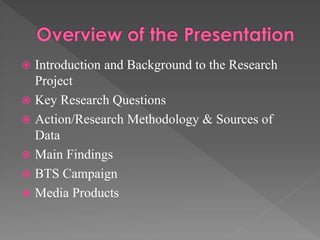
Introduction and Background to the Research
Project
 Key Research Questions
 Action/Research Methodology & Sources of
Data
 Main Findings
 BTS Campaign
 Media Products



Child sexual abuse (CSA) or intra-familial sexual
violence is significant not only as a violation of the
personal integrity of young women, boys and girls
but also because it has been shown to enhance risk
for HIV infection and other adverse physiological
and psychological outcomes.



Although child sexual abuse in various forms is
criminalized, until recently, there has been little
critical academic examination of the underlying
factors – gendered, cultural, sexual, and economic or
otherwise which contribute to its existence in this
region.


Between 2006 and 2012 two major studies were
carried out in this region. Both supported by
UNICEF



1) Eastern Caribbean – Adele Jones and
Colleagues now published in a volume entitled:
› Understanding Child Sexual Abuse: Perspectives from

the Caribbean
 2) Breaking the Silence: A Multi-Sectoral Research

Project to End Child Sexual Abuse – Trinidad and
Tobago supported by UN Trust Fund to End
Violence Against Women, UNICEF, UWI-GORTT
Research Development Fund.


Accompanied by the Break the Silence (BTS)
Campaign which started in T&T but has now been
taking up by UNICEF and the UNITE Campaign for
the entire Caribbean region


Stakeholders reported CSA/incest to be prevalent;



In many instances was accepted or at least
unremarked upon;



It was felt that as a form of sexual activity in a context
of unequal power relations, there could be
implications for HIV;



It was necessary to find out how it was understood,
rationalized and the meanings attached to it; and to
have clear protocols and policies to address this issue


While for years there had been a problem of under-reporting,
there is today no doubt that CSA is rampant in Trinidad and
Tobago. Since 1991 at least 10% of reports to the Rape Crisis
Society (RCS) in Trinidad have consistently concerned incest
(defined as intercourse between children and biological or step
relatives) (Roberts et al., 2009).



Reports of sexual abuse overall to RCS have increased since
2004, which the organization attributes to increased media
coverage of the topic and public education about the importance
of speaking out about it (Barclay, 2008).



Since the start of this project and the related campaign, reports
have increased exponentially


In a six-month period in 2006, some 165 cases of
child sexual abuse were reported to the police, of
which 85% related to violations of girls (16%
were cases of incest). According to the RCS 2008
Annual Report, 42% of clients to RCS were
under age 17 and 65% under 27 years old
(Roberts et al., 2009).



More recently in March, 2013, Margaret
Sampson-Brown, head of the Victim and Witness
Support Unit of the TTPS Reported that :
“There have already been over 200 reported
cases of incest, rape and sexual abuse for this
year in Central Trinidad alone. “We have had
almost 800 clients coming to us from
Central...including Chaguanas, Couva, and
those outlying areas,”
(Violence Against Children Conference,
Monday.11, March 2013)


While childhood incest occurs among children of
both sexes, the existing literature suggests that it
is more prevalent among females (Finkelhor,
Hotaling, Lewis and Smith, 2005).



In the Caribbean, observers report a frequency
not only between biological fathers and their
daughters, but also between step fathers and
female children of their spouses. Additionally
children may also be at risk from non-relatives,
as well as well as other family members.


Action/Research Project – Breaking the Silence:
A Multi-Sectoral Approach to Address Child
Sexual Abuse and Childhood Incest in Trinidad
and Tobago



Carried out between 2008-2011, Institute for
Gender and Development Studies UWI, St.
Augustine Campus



Part of a wider research programme on Gender,
Sexuality and Implications for HIV
 To

understand ethnographically the
socio-cultural and gendered meanings
associated with CSA and childhood
incest within the sexual cultures in
Trinidad and Tobago;


Sensitize stakeholders to the gendered, socio-cultural and
psycho-social issues underlying CSA and childhood incest;



Develop multi-disciplinary, community-based interventions
for the empowerment of women, children of both sexes and
men in addressing childhood incest and in the prevention
and treatment of HIV/AIDS;



In collaboration with stakeholders make recommendations
for the development of new protocols, policies and
strategies in various sectors to prevent and respond to CSA
and childhood incest.











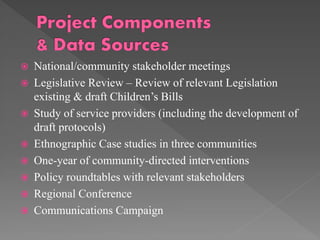
National/community stakeholder meetings
Legislative Review – Review of relevant Legislation
existing & draft Children’s Bills
Study of service providers (including the development of
draft protocols)
Ethnographic Case studies in three communities
One-year of community-directed interventions
Policy roundtables with relevant stakeholders
Regional Conference
Communications Campaign
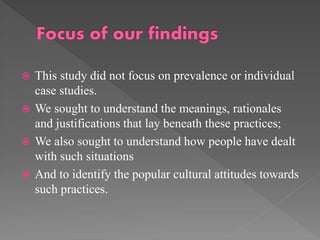
This study did not focus on prevalence or individual
case studies.
 We sought to understand the meanings, rationales
and justifications that lay beneath these practices;
 We also sought to understand how people have dealt
with such situations
 And to identify the popular cultural attitudes towards
such practices.

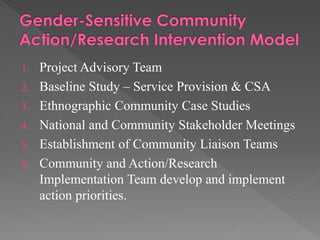
Project Advisory Team
2. Baseline Study – Service Provision & CSA
3. Ethnographic Community Case Studies
4. National and Community Stakeholder Meetings
5. Establishment of Community Liaison Teams
6. Community and Action/Research
Implementation Team develop and implement
action priorities.
1.
7. Orientation/training for Community Liaison
Committee members,
8. Community Interventions – Skills Building, Popular
Education and Sensitization, Service Provision.
› Methodologies – Schools workshops, teachers workshops,

parenting workshops, support group for survivors, theatre
in education, cottage meetings, spoken word poetry,
invisible theatre etc.

9. Data derived from the intervention process
10. Integrated and ongoing Evaluations


Sexual relations between older men and young
“underage” girls were considered common.
 Females were expected to control the naturally
aggressive sexuality of the men in their communities
and protect their children
 Lack of a blood connection often justified abuse by
stepfathers. As one respondent said, “Stepfathers
think that because they are not biological they can
have sex” (male, 51 years old).
 Consent

- the onus is not on men to refuse
BUT on women/girls to not be available



Stated awareness by the boys that they too could
be victims of CSA from male perpetrators but
resistance to discussing this.



Adults do not view boys’ sexual relations with older
women as abuse
“That is batting practice (male, 30-40) ”






Gender ideologies shaped both men’s and women's
attitudes to and responses to child sexual abuse;
Support systems to address this situation were
virtually non-existent.
At the time of the study minors could not report
abuse without an adult present.
There was a lack of safe spaces for child survivors of
CSA
The absence of sex education and gender
sensitization meant that women and girls, boys and
men were not empowered to respond appropriately
 Sexual ‘rites of passage’ by male caregiver
I not feeding any cow for anyone else to drink milk
from [male, 40]
 Acceptance of sexual activity with young girls
After 8 is Breakfast; After 9 is mine; After 12 is lunch
It’s wrong, but normal [group of men, 16-60].
 Refusing sex that appears to be available is a sign of
homosexuality
Men cannot refuse sex or else they would be

considered funny [male, 30]
 Not drinking of alcohol also seen as unmasculine
A man who does not drink rum is a manicou man
[ male 30-40]


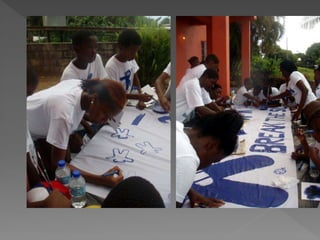
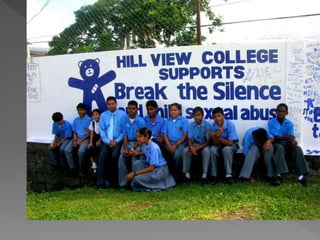
Aim - BTS Campaign

› Decrease stigma & raise awareness
› Encourage policy makers to move to action
› Establish a regional and global symbol

similar to the HIV/AIDS and Breast Cancer
ribbons.


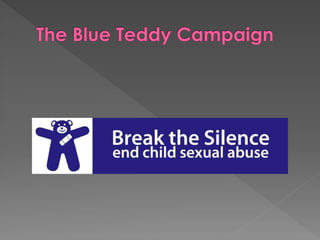
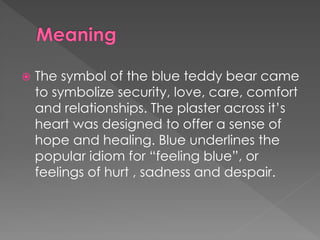
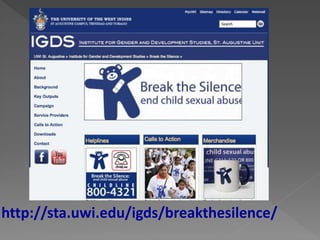
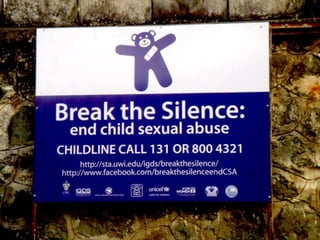
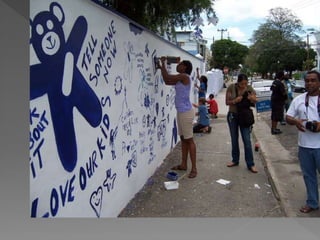
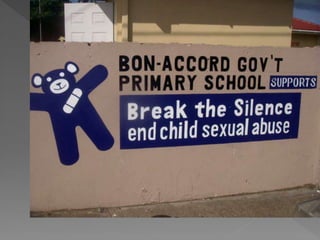
The symbol of the blue teddy bear came
to symbolize security, love, care, comfort
and relationships. The plaster across it’s
heart was designed to offer a sense of
hope and healing. Blue underlines the
popular idiom for “feeling blue”, or
feelings of hurt , sadness and despair.
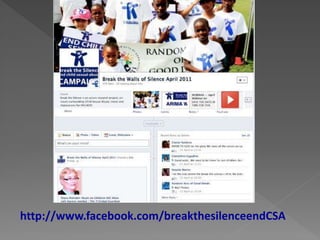
ONLINE
http://sta.uwi.edu/igds/breakthesil
ence/index.asp
http://sta.uwi.edu/igds/breakthesilence/
http://www.facebook.com/breakthesilenceendCSA
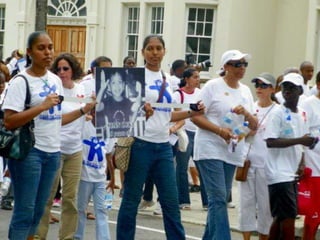
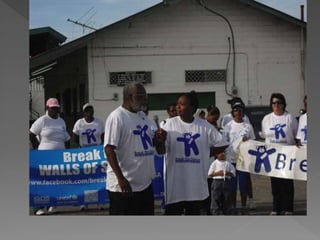
Spreading the
Campaign
to a National
Scale
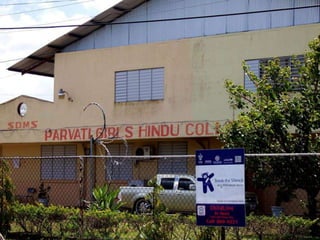
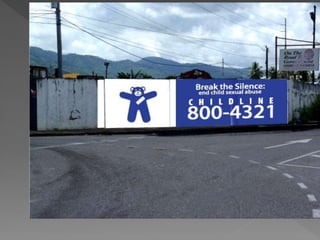
SIGNS and
BILLBOARDS
45
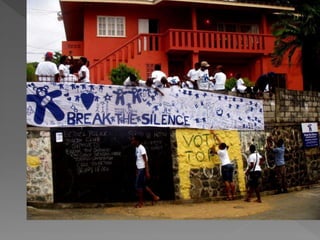
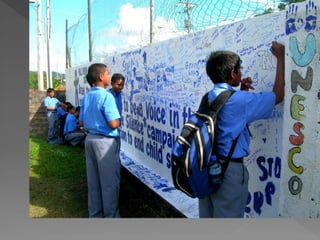
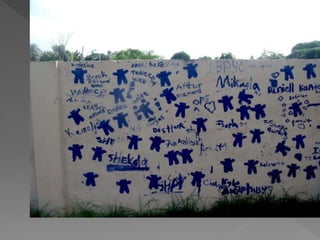
WALLS and
PAINTING
Project Report
 Literature Review
 Legislative Review
 Five Policy Briefs
› Gender
› Education
› HIV and CSA
› Service Delivery
› Legislation

Draft Protocols for Child Sexual Abuse/Incest
Service Delivery developed by service providers.
 BTS Posters and Postcards with service provider
information
 Documentary Film and Educational Booklet
 13 Webisodes and 4 min video
 Radio Soap Opera with the Toco Community
 Academic papers and posters



Incorporation of gender and sexuality education
in teacher and social work education
programmes;
 Parenting programmes and HFLE programmes
must include issues of gender and sexuality
 Work with men must focus on the need to take
responsibility for their sexual actions and
decision-making
 Strengthened social intervention programmes and
support systems at all levels of society


Psycho-social support for survivors
 Young women and young men must be empowered
to be independent in their decision-making;
 Homophobia must be addressed as this contributes to
extremes of masculine behaviours – hyperheterosexuality in order to prove one’s masculinity
 Parents and households must be supported to meet
the challenges of 21st Century parenting.


The social context for child sexual abuse in the
Caribbean involves several inter-connecting factors
such as: gender inequality; social norms based on
patriarchal values; domestic violence, the economic
dependence of many women on men and the status
of children.
 Meanings attached to masculinity and femininity, for
instance, have implications for CSA as they shape
how girls and boys experience their bodies, their
sexuality and their sexual rights.
 These ideas also shape the kinds of power to which
they have access and to which they are especially
vulnerable.


Through the work of UNICEF and the UN
System this campaign has been expanded at a
sub-regional level;



In Trinidad and Tobago the campaign will now
be taken to another level through the work of the
Ministry of Gender, Youth and Child
Development supported by UNICEF.


With the support of UNICEF, the IGDS will
collaborate with the MGY&CD in hosting a
programme of capacity building for civil society
organisations, the media, police and judicial
officers.



We look forward to working with all of you in
addressing this critical but complex national
challenge.


In an increasingly sexualised world, how
are issues of power, pleasure and social
justice to be reconciled ?
Thank You

Break the Silence Project Overview

  • 2.
    Introduction and Backgroundto the Research Project  Key Research Questions  Action/Research Methodology & Sources of Data  Main Findings  BTS Campaign  Media Products 
  • 4.
     Child sexual abuse(CSA) or intra-familial sexual violence is significant not only as a violation of the personal integrity of young women, boys and girls but also because it has been shown to enhance risk for HIV infection and other adverse physiological and psychological outcomes.  Although child sexual abuse in various forms is criminalized, until recently, there has been little critical academic examination of the underlying factors – gendered, cultural, sexual, and economic or otherwise which contribute to its existence in this region.
  • 5.
     Between 2006 and2012 two major studies were carried out in this region. Both supported by UNICEF  1) Eastern Caribbean – Adele Jones and Colleagues now published in a volume entitled: › Understanding Child Sexual Abuse: Perspectives from the Caribbean
  • 6.
     2) Breakingthe Silence: A Multi-Sectoral Research Project to End Child Sexual Abuse – Trinidad and Tobago supported by UN Trust Fund to End Violence Against Women, UNICEF, UWI-GORTT Research Development Fund.  Accompanied by the Break the Silence (BTS) Campaign which started in T&T but has now been taking up by UNICEF and the UNITE Campaign for the entire Caribbean region
  • 7.
     Stakeholders reported CSA/incestto be prevalent;  In many instances was accepted or at least unremarked upon;  It was felt that as a form of sexual activity in a context of unequal power relations, there could be implications for HIV;  It was necessary to find out how it was understood, rationalized and the meanings attached to it; and to have clear protocols and policies to address this issue
  • 8.
     While for yearsthere had been a problem of under-reporting, there is today no doubt that CSA is rampant in Trinidad and Tobago. Since 1991 at least 10% of reports to the Rape Crisis Society (RCS) in Trinidad have consistently concerned incest (defined as intercourse between children and biological or step relatives) (Roberts et al., 2009).  Reports of sexual abuse overall to RCS have increased since 2004, which the organization attributes to increased media coverage of the topic and public education about the importance of speaking out about it (Barclay, 2008).  Since the start of this project and the related campaign, reports have increased exponentially
  • 9.
     In a six-monthperiod in 2006, some 165 cases of child sexual abuse were reported to the police, of which 85% related to violations of girls (16% were cases of incest). According to the RCS 2008 Annual Report, 42% of clients to RCS were under age 17 and 65% under 27 years old (Roberts et al., 2009).  More recently in March, 2013, Margaret Sampson-Brown, head of the Victim and Witness Support Unit of the TTPS Reported that :
  • 10.
    “There have alreadybeen over 200 reported cases of incest, rape and sexual abuse for this year in Central Trinidad alone. “We have had almost 800 clients coming to us from Central...including Chaguanas, Couva, and those outlying areas,” (Violence Against Children Conference, Monday.11, March 2013)
  • 11.
     While childhood incestoccurs among children of both sexes, the existing literature suggests that it is more prevalent among females (Finkelhor, Hotaling, Lewis and Smith, 2005).  In the Caribbean, observers report a frequency not only between biological fathers and their daughters, but also between step fathers and female children of their spouses. Additionally children may also be at risk from non-relatives, as well as well as other family members.
  • 12.
     Action/Research Project –Breaking the Silence: A Multi-Sectoral Approach to Address Child Sexual Abuse and Childhood Incest in Trinidad and Tobago  Carried out between 2008-2011, Institute for Gender and Development Studies UWI, St. Augustine Campus  Part of a wider research programme on Gender, Sexuality and Implications for HIV
  • 14.
     To understand ethnographicallythe socio-cultural and gendered meanings associated with CSA and childhood incest within the sexual cultures in Trinidad and Tobago;
  • 15.
     Sensitize stakeholders tothe gendered, socio-cultural and psycho-social issues underlying CSA and childhood incest;  Develop multi-disciplinary, community-based interventions for the empowerment of women, children of both sexes and men in addressing childhood incest and in the prevention and treatment of HIV/AIDS;  In collaboration with stakeholders make recommendations for the development of new protocols, policies and strategies in various sectors to prevent and respond to CSA and childhood incest.
  • 17.
            National/community stakeholder meetings LegislativeReview – Review of relevant Legislation existing & draft Children’s Bills Study of service providers (including the development of draft protocols) Ethnographic Case studies in three communities One-year of community-directed interventions Policy roundtables with relevant stakeholders Regional Conference Communications Campaign
  • 18.
    This study didnot focus on prevalence or individual case studies.  We sought to understand the meanings, rationales and justifications that lay beneath these practices;  We also sought to understand how people have dealt with such situations  And to identify the popular cultural attitudes towards such practices. 
  • 19.
    Project Advisory Team 2.Baseline Study – Service Provision & CSA 3. Ethnographic Community Case Studies 4. National and Community Stakeholder Meetings 5. Establishment of Community Liaison Teams 6. Community and Action/Research Implementation Team develop and implement action priorities. 1.
  • 20.
    7. Orientation/training forCommunity Liaison Committee members, 8. Community Interventions – Skills Building, Popular Education and Sensitization, Service Provision. › Methodologies – Schools workshops, teachers workshops, parenting workshops, support group for survivors, theatre in education, cottage meetings, spoken word poetry, invisible theatre etc. 9. Data derived from the intervention process 10. Integrated and ongoing Evaluations
  • 22.
     Sexual relations betweenolder men and young “underage” girls were considered common.  Females were expected to control the naturally aggressive sexuality of the men in their communities and protect their children  Lack of a blood connection often justified abuse by stepfathers. As one respondent said, “Stepfathers think that because they are not biological they can have sex” (male, 51 years old).
  • 23.
     Consent - theonus is not on men to refuse BUT on women/girls to not be available  Stated awareness by the boys that they too could be victims of CSA from male perpetrators but resistance to discussing this.  Adults do not view boys’ sexual relations with older women as abuse “That is batting practice (male, 30-40) ”
  • 24.
         Gender ideologies shapedboth men’s and women's attitudes to and responses to child sexual abuse; Support systems to address this situation were virtually non-existent. At the time of the study minors could not report abuse without an adult present. There was a lack of safe spaces for child survivors of CSA The absence of sex education and gender sensitization meant that women and girls, boys and men were not empowered to respond appropriately
  • 25.
     Sexual ‘ritesof passage’ by male caregiver I not feeding any cow for anyone else to drink milk from [male, 40]  Acceptance of sexual activity with young girls After 8 is Breakfast; After 9 is mine; After 12 is lunch It’s wrong, but normal [group of men, 16-60].  Refusing sex that appears to be available is a sign of homosexuality Men cannot refuse sex or else they would be considered funny [male, 30]  Not drinking of alcohol also seen as unmasculine A man who does not drink rum is a manicou man [ male 30-40]
  • 27.
     Aim - BTSCampaign › Decrease stigma & raise awareness › Encourage policy makers to move to action › Establish a regional and global symbol similar to the HIV/AIDS and Breast Cancer ribbons.
  • 28.
     The symbol ofthe blue teddy bear came to symbolize security, love, care, comfort and relationships. The plaster across it’s heart was designed to offer a sense of hope and healing. Blue underlines the popular idiom for “feeling blue”, or feelings of hurt , sadness and despair.
  • 35.
  • 36.
  • 37.
  • 38.
  • 39.
  • 43.
  • 45.
  • 47.
  • 53.
    Project Report  LiteratureReview  Legislative Review  Five Policy Briefs › Gender › Education › HIV and CSA › Service Delivery › Legislation 
  • 54.
    Draft Protocols forChild Sexual Abuse/Incest Service Delivery developed by service providers.  BTS Posters and Postcards with service provider information  Documentary Film and Educational Booklet  13 Webisodes and 4 min video  Radio Soap Opera with the Toco Community  Academic papers and posters 
  • 55.
     Incorporation of genderand sexuality education in teacher and social work education programmes;  Parenting programmes and HFLE programmes must include issues of gender and sexuality  Work with men must focus on the need to take responsibility for their sexual actions and decision-making  Strengthened social intervention programmes and support systems at all levels of society
  • 56.
     Psycho-social support forsurvivors  Young women and young men must be empowered to be independent in their decision-making;  Homophobia must be addressed as this contributes to extremes of masculine behaviours – hyperheterosexuality in order to prove one’s masculinity  Parents and households must be supported to meet the challenges of 21st Century parenting.
  • 57.
     The social contextfor child sexual abuse in the Caribbean involves several inter-connecting factors such as: gender inequality; social norms based on patriarchal values; domestic violence, the economic dependence of many women on men and the status of children.  Meanings attached to masculinity and femininity, for instance, have implications for CSA as they shape how girls and boys experience their bodies, their sexuality and their sexual rights.  These ideas also shape the kinds of power to which they have access and to which they are especially vulnerable.
  • 58.
     Through the workof UNICEF and the UN System this campaign has been expanded at a sub-regional level;  In Trinidad and Tobago the campaign will now be taken to another level through the work of the Ministry of Gender, Youth and Child Development supported by UNICEF.
  • 59.
     With the supportof UNICEF, the IGDS will collaborate with the MGY&CD in hosting a programme of capacity building for civil society organisations, the media, police and judicial officers.  We look forward to working with all of you in addressing this critical but complex national challenge.
  • 60.
     In an increasinglysexualised world, how are issues of power, pleasure and social justice to be reconciled ?
  • 61.