Hamza Kheddar Int. Journal of Engineering Research and Applications www.ijera.com
ISSN : 2248-9622, Vol. 5, Issue 3, ( Part -4) March 2015, pp.85-89
www.ijera.com 85 | P a g e
Implementation of Interleaving Methods on MELP 2.4 Coder to
Reduce Packet Loss in the Voice over IP (VoIP) Transmission
Hamza Kheddar*, Bachir Boudraa **
*(Department of Telecommunication, LCPTS Lab USTHB University, Algeria)
** (Department of Telecommunication, LCPTS Lab USTHB University, Algeria)
ABSTRACT
The work consists first of making improvements of a MELP coder running at 2.4 kbps by the implementation of
packets lost concealment techniques based on the receiver. These techniques consist of interleaving information
frames, then, we conducted a comparative study of several interlacing methods. For this, we used the evaluation
technique standardized by ITU-T called PESQ (Perceptual Evaluation of Speech Quality).
Keywords –VoIP Transmission, Interleaving, MELP Coding, PLC, PESQ.
I. INTRODUCTION
In a VoIP system, at the receiver, some packages
may be missing; this packet loss degrades the voice
quality and translates into ruptures of the
conversation and impression of hatching of speech. It
is therefore essential to establish a mechanism for
concealing the losses. Several algorithms masking
packet loss also called PLC (Packet Loss
Concealment) are used both at the transmitter and/or
the receiver.
Our work is to improve the MELP codec
operates at 2.4 Kbps by implementing concealment
techniques of lost frames based on the receiver.
These techniques consist of interleaving information
frames. We then conducted a comparative study of
the implemented methods. The comparative
assessment was made using a method called PESQ
(Perceptual Evaluation of Speech Quality).
II. MELP CODING
The MELP has now become the new military
and Federal standard for speech at 2.4 kbps, replacing
federal standards FS-1015 (LPC-10) and FS-1016
(CELP) speech that produce poor quality at this rate.
Implementing a MELP coder involves four steps:
analysis, encoding, decoding and synthesis [1] – [2].
A) MELP Encoder
In the synthesis MELP, LP (linear prediction)
all-pole filter is excited by a signal built from
periodic contributions and noise.
At the encoder (Fig.1), the LP parameters are
first determined. The residual is then obtained. The
pitch is estimated from the low-pass filtering of the
speech signal. The voicing strengths are evaluated
based on the correlation maxima of the band-pass
filtered signal. Voicing determines how the periodic
parts and noise contribute to the excitement of the LP
in specific frequency bands. Describe, in fact, the
presence of periodicity in the function of the
frequency signal. The Fourier coefficients define the
spectral characteristics of the periodic excitation of
LP. They are usually calculated from the FFT of the
signal. Determining the gain can be performed either
on the LP residual or directly on the speech signal,
synchronously or with a fixed length window [3].
Fig.1 Basic schema of MELP Encoder
B) MELP decoder
At the decoder (Fig.2), the periodic part of the
excitement is generated from the Fourier coefficients
interpolated. Fourier synthesis is applied to spectra in
which the Fourier coefficients are placed at the
harmonic frequencies derived from the interpolated
pitch. The sound of excitement is generated from
white noise. The frequency bands of the periodic part
of the signal and noise are shaped through time
domain filtering according to the transmitted voicing
information. The two components of the excitation
are added and the signal is scaled by the encoded
gain. Finally, the linear prediction synthesis is
performed [3].
Input speech
LP
residual
LP Parameters
Pitch
Analysis
Band-pass
Voicing
LP
Analysis
Gain
Analysis
Fourrier Coeff. Estimation
Gain
Voicing
Pitch
Fourrier
Coeff.
RESEARCH ARTICLE OPEN ACCESS
Hamza Kheddar Int. Journal of Engineering Research and Applications www.ijera.com
ISSN : 2248-9622, Vol. 5, Issue 3, ( Part -4) March 2015, pp.85-89
www.ijera.com 86 | P a g e
Fig.2 Basic schema of MELP Decoder.
III. INTERLEAVING
To achieve a voice in real-time high quality,
packet loss concealment mechanism must be put in
place. Several packet loss concealment algorithms
PLC (Packet Loss Concealment) are used either at
the transmitter or at the receiver [4]-[6].
Interlacing is an effective method to disperse packet
loss bursts into a series of small losses. As a result,
the errors will be produced on relatively short code
words and the listener will be able to mentally
interpolate small gaps. The intelligibility of speech is
then preserved.
A) Implementation of some interleaving
methods
1- Convolutional interleavers
A convolutional interleaver can be modeled as a
shift register arrangement, each having a
characteristic vector. In a convolutional interleaver of
degree 𝑑, the input vector sequence is divided into 𝑑
subsequences. Each sub-sequence consists of a
different number of connected shift registers, which
thus corresponds to a different delay according to the
number of feature vectors that are stored there [7]. A
convolutional interleaver of degree 4 is illustrated in
fig.3. A convolutional interleaver size N (𝑑 = 𝑁
subsequences) takes the form:
𝜋 𝑐𝑜𝑛𝑣 𝑖 = 𝑖 − 𝑑 𝑖 𝑚𝑜𝑑 𝑑 (1)
2- Decorrelated convolutional interleaver
The decorrelated convolutional interleaver
introduced the same decorrelated structure of the
convolutional interleaver described above. A
decorrelated convolutional interleaver is formed by
permuting the order in which the individual sub-
sequences are accessible. For a decorrelated
convolutional interleaver of size 𝑑, the order in which
the sub-sequences are accessible is defined by the
permutation 𝑃 of the length 𝑑 [7]. For example, a
decorrelated interleaver of size 4, using the
permutation 𝑃 = {1 3 0 2}, is shown in fig.4. In the
general case, at time index 𝑖, a feature vector will be
delivered to subsequence 𝑃 (𝑖 𝑚𝑜𝑑 𝑑), which has a
delay of 𝑑(𝑃(𝑖 𝑚𝑜𝑑 𝑑))frames. Thus:
𝜋 𝑑𝑒𝑐 𝑖 = 𝑖 − 𝑑 𝑃(𝑖 𝑚𝑜𝑑 𝑑) (2)
Fig.4 Decorrelated convolutional interleaver of size d
= 4 and for a permutation P = {1 3 0 2}.
IV. INDENTATIONS AND EQUATIONS
3- Interleaving by grouping
The grouping process and interleaving produces
a vector of coefficients of 𝑣 = 𝑣𝑖|𝑖 =
1,…,𝑀𝐿𝑀−1. Fig.5 shows a simple example where
𝑀 = 3 is the block index and 𝐿 = 2 is the half of
the length of the block of the analysis window. The
coefficients are grouped and interleaved by using the
following three steps: In (1), each line corresponds to
a block and each block, the coefficients are grouped
into frames. In (2), the frames of smallest scale
(block 0) are interleaved in pairs with the immediate
upper frame in the (block 1). This first step produces
two new frames of interleaved coefficients. In (3),
this two frames are interleaved with the frame of
largest scale (block 2) in such a way that the resulting
vector has alternatively a coefficients of each block:
one of block 2, followed by one of block 1, followed
by one of block 0, followed by one of block 2, and so
on [8].
Fig.5 interleaving by grouping process with M =
3, L = 2.
Output
Input
Sequence
Input
sequen
ce
directi
on
i-3
i-6i-2
i-1 i-5 i-9
0
1
2
3
Output
Input
Sequence
Fig.3 Convolutional interleaver of degree d = 4.
Input
sequen
ce
directi
on
i-3
i-6i-2
i-1 i-5 i-9
0
1
2
3
Out put
Sequence
VoicingPitch
Fourrier
Coeff. Gain
Noise
Generator
Fourier
Synthesis
Excitation
Mix
LP
Synthesis
LP
Paramerers
Hamza Kheddar Int. Journal of Engineering Research and Applications www.ijera.com
ISSN : 2248-9622, Vol. 5, Issue 3, ( Part -4) March 2015, pp.85-89
www.ijera.com 87 | P a g e
4- Optimal spread block interleavers
A block interleaver of degree d operates by re-
arranging the transmission order of a 𝑑 × 𝑑 block of
input vectors. Two block interleavers, 𝜋 𝑏𝑙𝑜𝑐 1
and 𝜋 𝑏𝑙𝑜𝑐 2, [6] are considered optimal in terms of
maximizing their spread for given degree, and are
given [7].
𝜋 𝑏𝑙𝑜𝑐 1 𝑖𝑑 + 𝑗 = 𝑑 − 1 − 𝑗 𝑑 + 𝑖 𝑤ℎ𝑒𝑟𝑒 0 ≤ 𝑖,
≤ 𝑑 − 1 (3)
𝜋 𝑏𝑙𝑜𝑐 2 𝑖𝑑 + 𝑗 = 𝑗𝑑 + 𝑑 − 1 − 𝑖 𝑤ℎ𝑒𝑟𝑒 0 ≤ 𝑖, 𝑗
≤ 𝑑 − 1 (4)
The operation of these interleavers can be
considered as a rotation of d × d of the feature vectors
located in the buffer memory (buffer) either 90 °
clockwise or 90 ° anti-clockwise, as shown in fig.6.
Fig.6 Rotation of buffer by 90° anti-clockwise [7].
V. COMPARATIVE STUDY BETWEEN
INTERLEAVING METHODS
We simulated different packet loss to introduce
degradations in the synthetic signal. These losses
were simulated randomly by using the RAND
function which follows a uniform distribution law.
The packet loss rate is given by the following
formula:
Rate =
number of lost frames
nombre of total trames
x 100 (5)
We also calculate the PESQ score by comparing
the output of speech signals (synthesized) with those
of reference speech. Tab.1 provides an overview of
limits of quality evaluations according to
recommendation P.862 [9].
PESQ Value Speech quality
3 ≤ PESQ ≤ 4 Very Acceptable
2.5 ≤ PESQ < 3 Acceptable
2 ≤ PESQ <
2.5
Low
PESQ < 2 Unacceptable (intelligibility is
lost)
Tab.1 Limits evaluation of speech quality according
to P.862 recommendation.
1- Description of the speech signals used in the
tests
To test and validate our methods, we used a
linguistic material formed of multilingual corpus. The
first consists of APPB Arabic sentences (Arabic
Phrases Phonetically Balanced) developed in our
laboratory [10]. This corpus contains a total of 60
sentences, 10 sentences pronounced by 3 female and
3 male speakers. The sampling frequency of the
speech signal files was 10 kHz; we had to make a
sub-sampling of the entire database to 8 kHz, to put it
in the terms of telephony. For the French and English
languages, we used the famous phrases, phonetically
balanced "la bise et le soleil" and "the sun and the
wind."
2- Ratings of MELP coder implemented
The use of encoders to transmit voice over a
communication channel results a decrease of the
perceived quality. This decrease is due to the
compression mechanism of the data used. Therefore,
there is a maximum PESQ score that can be obtained.
It is obvious that when degradation appears in the
network, its performance should only be estimated
with respect to this maximum score. We therefore
evaluated the performance of MELP coder operating
at 2.4 kbps for male and female speakers. We
summarize the results obtained in Tab.2.
Tab.2 Resultants’ of 2.4 kbps MELP encoder
objective tests.
3- Implementations results for an example of the
speech signal.
Fig.7 shows an example of results obtained by
the decorrelated convolutional interleaver on Arabic
sentence with distribution of these errors along the
buffer for 12% of a loss rate.
Fig.7 Results obtained by the convolutional
interleaver decorrelated on sentence ‫يوم‬ ‫ال‬ ‫ماء‬ ‫نم‬ ‫م‬ ‫,ن‬ a)
original signal, b) synthetic signal with random loss
of a frame without interleaving c) synthetic signal
after interleaving, for the same losses.
4- Performance of 2.4 MELP coder for different
types of interleaving
The interleaving techniques mentioned in the cf.
part.III have been implemented and led to the results
shown in Tab.3. The PESQ will be measured for
transmissions corresponding to losses of consecutive
packets. We have considered the loss of 1, 2 or 3
consecutive packets; these losses can be repeated
over the entire buffer of the signal, causing a global
MELP à 2.4 kbps
(PESQ)
Male speakers 2.99
Female speakers 2.89
Hamza Kheddar Int. Journal of Engineering Research and Applications www.ijera.com
ISSN : 2248-9622, Vol. 5, Issue 3, ( Part -4) March 2015, pp.85-89
www.ijera.com 88 | P a g e
error given by the loss rate in %, represented by the
first column of the table (Tab.3). The tables and
graph presented in this section provide the frame loss
rate for the entire database. These rates are quantified
based on loss rates before and after application of
different interleaving types: optimal interleaving,
interleaving by grouping, convolutional interleaving
and decorrelated convolutional interleaving. We give
each time the average value of PESQ for each
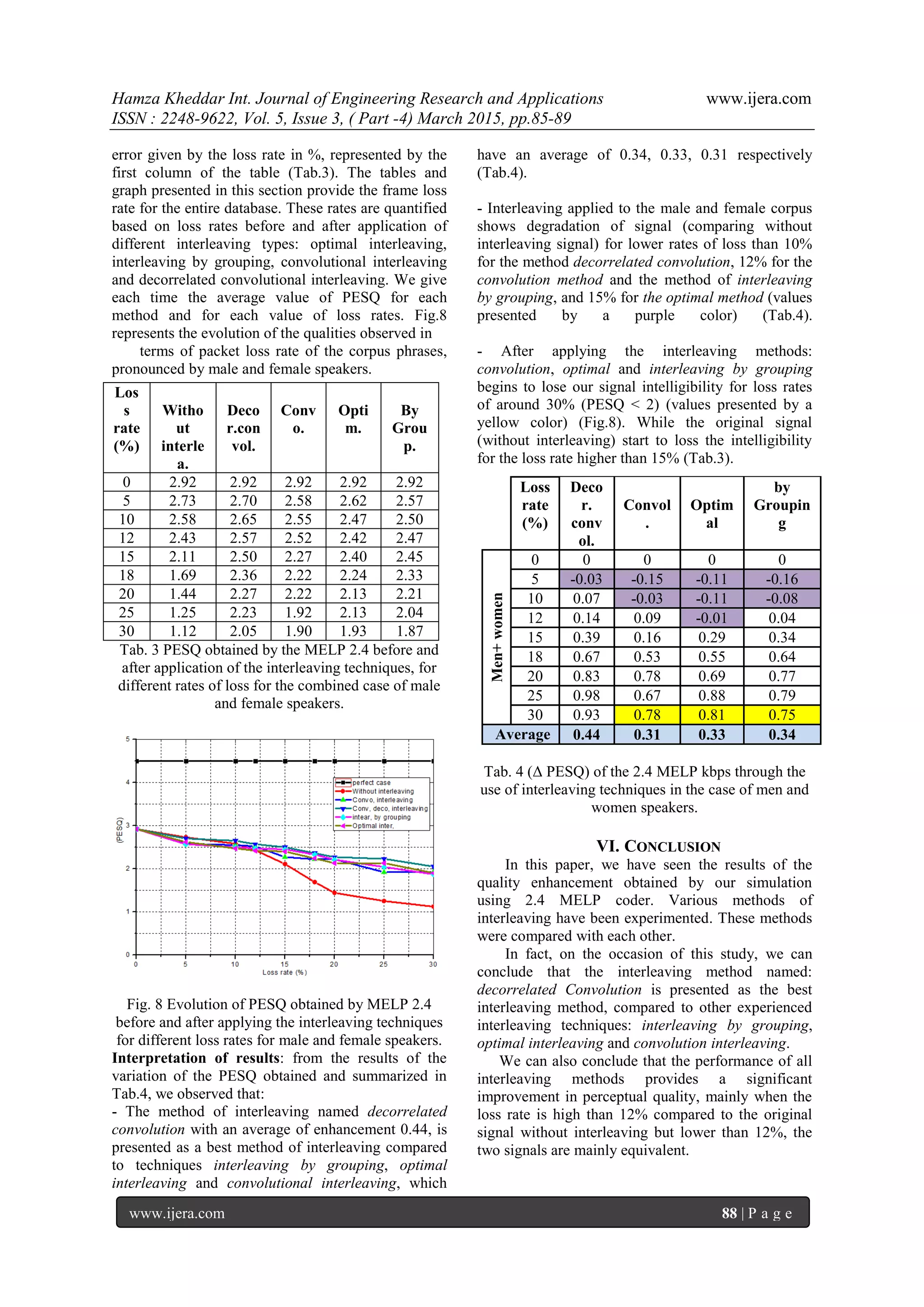
method and for each value of loss rates. Fig.8
represents the evolution of the qualities observed in
terms of packet loss rate of the corpus phrases,
pronounced by male and female speakers.
Tab. 3 PESQ obtained by the MELP 2.4 before and
after application of the interleaving techniques, for
different rates of loss for the combined case of male
and female speakers.
Fig. 8 Evolution of PESQ obtained by MELP 2.4
before and after applying the interleaving techniques
for different loss rates for male and female speakers.
Interpretation of results: from the results of the
variation of the PESQ obtained and summarized in
Tab.4, we observed that:
- The method of interleaving named decorrelated
convolution with an average of enhancement 0.44, is
presented as a best method of interleaving compared
to techniques interleaving by grouping, optimal
interleaving and convolutional interleaving, which
have an average of 0.34, 0.33, 0.31 respectively
(Tab.4).
- Interleaving applied to the male and female corpus
shows degradation of signal (comparing without
interleaving signal) for lower rates of loss than 10%
for the method decorrelated convolution, 12% for the
convolution method and the method of interleaving
by grouping, and 15% for the optimal method (values
presented by a purple color) (Tab.4).
- After applying the interleaving methods:
convolution, optimal and interleaving by grouping
begins to lose our signal intelligibility for loss rates
of around 30% (PESQ < 2) (values presented by a
yellow color) (Fig.8). While the original signal
(without interleaving) start to loss the intelligibility
for the loss rate higher than 15% (Tab.3).
Tab. 4 (Δ PESQ) of the 2.4 MELP kbps through the
use of interleaving techniques in the case of men and
women speakers.
VI. CONCLUSION
In this paper, we have seen the results of the
quality enhancement obtained by our simulation
using 2.4 MELP coder. Various methods of
interleaving have been experimented. These methods
were compared with each other.
In fact, on the occasion of this study, we can
conclude that the interleaving method named:
decorrelated Convolution is presented as the best
interleaving method, compared to other experienced
interleaving techniques: interleaving by grouping,
optimal interleaving and convolution interleaving.
We can also conclude that the performance of all
interleaving methods provides a significant
improvement in perceptual quality, mainly when the
loss rate is high than 12% compared to the original
signal without interleaving but lower than 12%, the
two signals are mainly equivalent.
Los
s
rate
(%)
Witho
ut
interle
a.
Deco
r.con
vol.
Conv
o.
Opti
m.
By
Grou
p.
0 2.92 2.92 2.92 2.92 2.92
5 2.73 2.70 2.58 2.62 2.57
10 2.58 2.65 2.55 2.47 2.50
12 2.43 2.57 2.52 2.42 2.47
15 2.11 2.50 2.27 2.40 2.45
18 1.69 2.36 2.22 2.24 2.33
20 1.44 2.27 2.22 2.13 2.21
25 1.25 2.23 1.92 2.13 2.04
30 1.12 2.05 1.90 1.93 1.87
Loss
rate
(%)
Deco
r.
conv
ol.
Convol
.
Optim
al
by
Groupin
g
Men+women
0 0 0 0 0
5 -0.03 -0.15 -0.11 -0.16
10 0.07 -0.03 -0.11 -0.08
12 0.14 0.09 -0.01 0.04
15 0.39 0.16 0.29 0.34
18 0.67 0.53 0.55 0.64
20 0.83 0.78 0.69 0.77
25 0.98 0.67 0.88 0.79
30 0.93 0.78 0.81 0.75
Average 0.44 0.31 0.33 0.34
Hamza Kheddar Int. Journal of Engineering Research and Applications www.ijera.com
ISSN : 2248-9622, Vol. 5, Issue 3, ( Part -4) March 2015, pp.85-89
www.ijera.com 89 | P a g e
REFERENCES
[1] G.Baudoin, J. Cernocký, P. Gournay, et G.
Chollet, Codage de la parole à bas et très bas
débit. Département Signaux et
Télécommunications, ESIEE BP 99 93162.
[2] J. Edward, Daniel and Keith A, Federal
Standard 2.4 kbps MELP Over IP,Roc. 43 rd
IEEE Midwest Symp. on Circuits and
Systems, Lansing MI, 0-7803-6475-9,
pp.568-571, Aug 8-11,2000.
[3] J. Stachurski, A. McCree, V. Viswanathan,
high quality MELP coding at bit-rates
around 4 kb/s. 0-7803-5041-3/99, pp 485-
488, IEEE 1999.
[4] C. Perkins, O. Hodson, et V. Hardman, A
Survey of Packet Loss Recovery Techniques
for Streaming Audio. 0890-8044, pp.40-48,
IEEE Network .September/October 1998.
[5] Teck-Kuen Chua and David C. Pheanis,
QoS Evaluation of Sender-Based Loss-
Recovery Techniques for VoIP. 0890-8044,
pp.14-22, IEEE Network.
November/December 2006.
[6] B.P. Milner, A.B. James. Analysis and
compensation of packet loss in distributed
speech recognition using interleaving,
pp.1947- 1950, ISCA-SPEECH. September
1-4, 2003.
[7] B.P. Milner, A.B. James, A Comparison of
Efficient Interleaver Designs for Real Time
Distributed Speech Recognition, ASIDE,
November 10-11. 2005.
[8] Gal Richard, E. Ravelli, Student et L.
Daudet, Union of MDCT Bases for Audio
Coding, IEEE transactions on audio,
speech, and language processing, vol. 16,
pp.1361-1372. No. 8, November 2008.
[9] ITU-T, Recommendation P.862, Perceptual
evaluation of speech quality (PESQ), an
objective method for end-to-end speech
quality assessment of narrowband telephone
networks and speech codecs. 2001.
[10] M. Boudraa, B. Boudraa, B. Guérin. Twenty
lists of Ten Arabic Sentences for
Assessment. Acustica, vol. 86, pp. 870-882,
2000.

Implementation of Interleaving Methods on MELP 2.4 Coder to Reduce Packet Loss in the Voice over IP (VoIP) Transmission

  • 1.
    Hamza Kheddar Int.Journal of Engineering Research and Applications www.ijera.com ISSN : 2248-9622, Vol. 5, Issue 3, ( Part -4) March 2015, pp.85-89 www.ijera.com 85 | P a g e Implementation of Interleaving Methods on MELP 2.4 Coder to Reduce Packet Loss in the Voice over IP (VoIP) Transmission Hamza Kheddar*, Bachir Boudraa ** *(Department of Telecommunication, LCPTS Lab USTHB University, Algeria) ** (Department of Telecommunication, LCPTS Lab USTHB University, Algeria) ABSTRACT The work consists first of making improvements of a MELP coder running at 2.4 kbps by the implementation of packets lost concealment techniques based on the receiver. These techniques consist of interleaving information frames, then, we conducted a comparative study of several interlacing methods. For this, we used the evaluation technique standardized by ITU-T called PESQ (Perceptual Evaluation of Speech Quality). Keywords –VoIP Transmission, Interleaving, MELP Coding, PLC, PESQ. I. INTRODUCTION In a VoIP system, at the receiver, some packages may be missing; this packet loss degrades the voice quality and translates into ruptures of the conversation and impression of hatching of speech. It is therefore essential to establish a mechanism for concealing the losses. Several algorithms masking packet loss also called PLC (Packet Loss Concealment) are used both at the transmitter and/or the receiver. Our work is to improve the MELP codec operates at 2.4 Kbps by implementing concealment techniques of lost frames based on the receiver. These techniques consist of interleaving information frames. We then conducted a comparative study of the implemented methods. The comparative assessment was made using a method called PESQ (Perceptual Evaluation of Speech Quality). II. MELP CODING The MELP has now become the new military and Federal standard for speech at 2.4 kbps, replacing federal standards FS-1015 (LPC-10) and FS-1016 (CELP) speech that produce poor quality at this rate. Implementing a MELP coder involves four steps: analysis, encoding, decoding and synthesis [1] – [2]. A) MELP Encoder In the synthesis MELP, LP (linear prediction) all-pole filter is excited by a signal built from periodic contributions and noise. At the encoder (Fig.1), the LP parameters are first determined. The residual is then obtained. The pitch is estimated from the low-pass filtering of the speech signal. The voicing strengths are evaluated based on the correlation maxima of the band-pass filtered signal. Voicing determines how the periodic parts and noise contribute to the excitement of the LP in specific frequency bands. Describe, in fact, the presence of periodicity in the function of the frequency signal. The Fourier coefficients define the spectral characteristics of the periodic excitation of LP. They are usually calculated from the FFT of the signal. Determining the gain can be performed either on the LP residual or directly on the speech signal, synchronously or with a fixed length window [3]. Fig.1 Basic schema of MELP Encoder B) MELP decoder At the decoder (Fig.2), the periodic part of the excitement is generated from the Fourier coefficients interpolated. Fourier synthesis is applied to spectra in which the Fourier coefficients are placed at the harmonic frequencies derived from the interpolated pitch. The sound of excitement is generated from white noise. The frequency bands of the periodic part of the signal and noise are shaped through time domain filtering according to the transmitted voicing information. The two components of the excitation are added and the signal is scaled by the encoded gain. Finally, the linear prediction synthesis is performed [3]. Input speech LP residual LP Parameters Pitch Analysis Band-pass Voicing LP Analysis Gain Analysis Fourrier Coeff. Estimation Gain Voicing Pitch Fourrier Coeff. RESEARCH ARTICLE OPEN ACCESS
  • 2.
    Hamza Kheddar Int.Journal of Engineering Research and Applications www.ijera.com ISSN : 2248-9622, Vol. 5, Issue 3, ( Part -4) March 2015, pp.85-89 www.ijera.com 86 | P a g e Fig.2 Basic schema of MELP Decoder. III. INTERLEAVING To achieve a voice in real-time high quality, packet loss concealment mechanism must be put in place. Several packet loss concealment algorithms PLC (Packet Loss Concealment) are used either at the transmitter or at the receiver [4]-[6]. Interlacing is an effective method to disperse packet loss bursts into a series of small losses. As a result, the errors will be produced on relatively short code words and the listener will be able to mentally interpolate small gaps. The intelligibility of speech is then preserved. A) Implementation of some interleaving methods 1- Convolutional interleavers A convolutional interleaver can be modeled as a shift register arrangement, each having a characteristic vector. In a convolutional interleaver of degree 𝑑, the input vector sequence is divided into 𝑑 subsequences. Each sub-sequence consists of a different number of connected shift registers, which thus corresponds to a different delay according to the number of feature vectors that are stored there [7]. A convolutional interleaver of degree 4 is illustrated in fig.3. A convolutional interleaver size N (𝑑 = 𝑁 subsequences) takes the form: 𝜋 𝑐𝑜𝑛𝑣 𝑖 = 𝑖 − 𝑑 𝑖 𝑚𝑜𝑑 𝑑 (1) 2- Decorrelated convolutional interleaver The decorrelated convolutional interleaver introduced the same decorrelated structure of the convolutional interleaver described above. A decorrelated convolutional interleaver is formed by permuting the order in which the individual sub- sequences are accessible. For a decorrelated convolutional interleaver of size 𝑑, the order in which the sub-sequences are accessible is defined by the permutation 𝑃 of the length 𝑑 [7]. For example, a decorrelated interleaver of size 4, using the permutation 𝑃 = {1 3 0 2}, is shown in fig.4. In the general case, at time index 𝑖, a feature vector will be delivered to subsequence 𝑃 (𝑖 𝑚𝑜𝑑 𝑑), which has a delay of 𝑑(𝑃(𝑖 𝑚𝑜𝑑 𝑑))frames. Thus: 𝜋 𝑑𝑒𝑐 𝑖 = 𝑖 − 𝑑 𝑃(𝑖 𝑚𝑜𝑑 𝑑) (2) Fig.4 Decorrelated convolutional interleaver of size d = 4 and for a permutation P = {1 3 0 2}. IV. INDENTATIONS AND EQUATIONS 3- Interleaving by grouping The grouping process and interleaving produces a vector of coefficients of 𝑣 = 𝑣𝑖|𝑖 = 1,…,𝑀𝐿𝑀−1. Fig.5 shows a simple example where 𝑀 = 3 is the block index and 𝐿 = 2 is the half of the length of the block of the analysis window. The coefficients are grouped and interleaved by using the following three steps: In (1), each line corresponds to a block and each block, the coefficients are grouped into frames. In (2), the frames of smallest scale (block 0) are interleaved in pairs with the immediate upper frame in the (block 1). This first step produces two new frames of interleaved coefficients. In (3), this two frames are interleaved with the frame of largest scale (block 2) in such a way that the resulting vector has alternatively a coefficients of each block: one of block 2, followed by one of block 1, followed by one of block 0, followed by one of block 2, and so on [8]. Fig.5 interleaving by grouping process with M = 3, L = 2. Output Input Sequence Input sequen ce directi on i-3 i-6i-2 i-1 i-5 i-9 0 1 2 3 Output Input Sequence Fig.3 Convolutional interleaver of degree d = 4. Input sequen ce directi on i-3 i-6i-2 i-1 i-5 i-9 0 1 2 3 Out put Sequence VoicingPitch Fourrier Coeff. Gain Noise Generator Fourier Synthesis Excitation Mix LP Synthesis LP Paramerers
  • 3.
    Hamza Kheddar Int.Journal of Engineering Research and Applications www.ijera.com ISSN : 2248-9622, Vol. 5, Issue 3, ( Part -4) March 2015, pp.85-89 www.ijera.com 87 | P a g e 4- Optimal spread block interleavers A block interleaver of degree d operates by re- arranging the transmission order of a 𝑑 × 𝑑 block of input vectors. Two block interleavers, 𝜋 𝑏𝑙𝑜𝑐 1 and 𝜋 𝑏𝑙𝑜𝑐 2, [6] are considered optimal in terms of maximizing their spread for given degree, and are given [7]. 𝜋 𝑏𝑙𝑜𝑐 1 𝑖𝑑 + 𝑗 = 𝑑 − 1 − 𝑗 𝑑 + 𝑖 𝑤ℎ𝑒𝑟𝑒 0 ≤ 𝑖, ≤ 𝑑 − 1 (3) 𝜋 𝑏𝑙𝑜𝑐 2 𝑖𝑑 + 𝑗 = 𝑗𝑑 + 𝑑 − 1 − 𝑖 𝑤ℎ𝑒𝑟𝑒 0 ≤ 𝑖, 𝑗 ≤ 𝑑 − 1 (4) The operation of these interleavers can be considered as a rotation of d × d of the feature vectors located in the buffer memory (buffer) either 90 ° clockwise or 90 ° anti-clockwise, as shown in fig.6. Fig.6 Rotation of buffer by 90° anti-clockwise [7]. V. COMPARATIVE STUDY BETWEEN INTERLEAVING METHODS We simulated different packet loss to introduce degradations in the synthetic signal. These losses were simulated randomly by using the RAND function which follows a uniform distribution law. The packet loss rate is given by the following formula: Rate = number of lost frames nombre of total trames x 100 (5) We also calculate the PESQ score by comparing the output of speech signals (synthesized) with those of reference speech. Tab.1 provides an overview of limits of quality evaluations according to recommendation P.862 [9]. PESQ Value Speech quality 3 ≤ PESQ ≤ 4 Very Acceptable 2.5 ≤ PESQ < 3 Acceptable 2 ≤ PESQ < 2.5 Low PESQ < 2 Unacceptable (intelligibility is lost) Tab.1 Limits evaluation of speech quality according to P.862 recommendation. 1- Description of the speech signals used in the tests To test and validate our methods, we used a linguistic material formed of multilingual corpus. The first consists of APPB Arabic sentences (Arabic Phrases Phonetically Balanced) developed in our laboratory [10]. This corpus contains a total of 60 sentences, 10 sentences pronounced by 3 female and 3 male speakers. The sampling frequency of the speech signal files was 10 kHz; we had to make a sub-sampling of the entire database to 8 kHz, to put it in the terms of telephony. For the French and English languages, we used the famous phrases, phonetically balanced "la bise et le soleil" and "the sun and the wind." 2- Ratings of MELP coder implemented The use of encoders to transmit voice over a communication channel results a decrease of the perceived quality. This decrease is due to the compression mechanism of the data used. Therefore, there is a maximum PESQ score that can be obtained. It is obvious that when degradation appears in the network, its performance should only be estimated with respect to this maximum score. We therefore evaluated the performance of MELP coder operating at 2.4 kbps for male and female speakers. We summarize the results obtained in Tab.2. Tab.2 Resultants’ of 2.4 kbps MELP encoder objective tests. 3- Implementations results for an example of the speech signal. Fig.7 shows an example of results obtained by the decorrelated convolutional interleaver on Arabic sentence with distribution of these errors along the buffer for 12% of a loss rate. Fig.7 Results obtained by the convolutional interleaver decorrelated on sentence ‫يوم‬ ‫ال‬ ‫ماء‬ ‫نم‬ ‫م‬ ‫,ن‬ a) original signal, b) synthetic signal with random loss of a frame without interleaving c) synthetic signal after interleaving, for the same losses. 4- Performance of 2.4 MELP coder for different types of interleaving The interleaving techniques mentioned in the cf. part.III have been implemented and led to the results shown in Tab.3. The PESQ will be measured for transmissions corresponding to losses of consecutive packets. We have considered the loss of 1, 2 or 3 consecutive packets; these losses can be repeated over the entire buffer of the signal, causing a global MELP à 2.4 kbps (PESQ) Male speakers 2.99 Female speakers 2.89
  • 4.
    Hamza Kheddar Int.Journal of Engineering Research and Applications www.ijera.com ISSN : 2248-9622, Vol. 5, Issue 3, ( Part -4) March 2015, pp.85-89 www.ijera.com 88 | P a g e error given by the loss rate in %, represented by the first column of the table (Tab.3). The tables and graph presented in this section provide the frame loss rate for the entire database. These rates are quantified based on loss rates before and after application of different interleaving types: optimal interleaving, interleaving by grouping, convolutional interleaving and decorrelated convolutional interleaving. We give each time the average value of PESQ for each method and for each value of loss rates. Fig.8 represents the evolution of the qualities observed in terms of packet loss rate of the corpus phrases, pronounced by male and female speakers. Tab. 3 PESQ obtained by the MELP 2.4 before and after application of the interleaving techniques, for different rates of loss for the combined case of male and female speakers. Fig. 8 Evolution of PESQ obtained by MELP 2.4 before and after applying the interleaving techniques for different loss rates for male and female speakers. Interpretation of results: from the results of the variation of the PESQ obtained and summarized in Tab.4, we observed that: - The method of interleaving named decorrelated convolution with an average of enhancement 0.44, is presented as a best method of interleaving compared to techniques interleaving by grouping, optimal interleaving and convolutional interleaving, which have an average of 0.34, 0.33, 0.31 respectively (Tab.4). - Interleaving applied to the male and female corpus shows degradation of signal (comparing without interleaving signal) for lower rates of loss than 10% for the method decorrelated convolution, 12% for the convolution method and the method of interleaving by grouping, and 15% for the optimal method (values presented by a purple color) (Tab.4). - After applying the interleaving methods: convolution, optimal and interleaving by grouping begins to lose our signal intelligibility for loss rates of around 30% (PESQ < 2) (values presented by a yellow color) (Fig.8). While the original signal (without interleaving) start to loss the intelligibility for the loss rate higher than 15% (Tab.3). Tab. 4 (Δ PESQ) of the 2.4 MELP kbps through the use of interleaving techniques in the case of men and women speakers. VI. CONCLUSION In this paper, we have seen the results of the quality enhancement obtained by our simulation using 2.4 MELP coder. Various methods of interleaving have been experimented. These methods were compared with each other. In fact, on the occasion of this study, we can conclude that the interleaving method named: decorrelated Convolution is presented as the best interleaving method, compared to other experienced interleaving techniques: interleaving by grouping, optimal interleaving and convolution interleaving. We can also conclude that the performance of all interleaving methods provides a significant improvement in perceptual quality, mainly when the loss rate is high than 12% compared to the original signal without interleaving but lower than 12%, the two signals are mainly equivalent. Los s rate (%) Witho ut interle a. Deco r.con vol. Conv o. Opti m. By Grou p. 0 2.92 2.92 2.92 2.92 2.92 5 2.73 2.70 2.58 2.62 2.57 10 2.58 2.65 2.55 2.47 2.50 12 2.43 2.57 2.52 2.42 2.47 15 2.11 2.50 2.27 2.40 2.45 18 1.69 2.36 2.22 2.24 2.33 20 1.44 2.27 2.22 2.13 2.21 25 1.25 2.23 1.92 2.13 2.04 30 1.12 2.05 1.90 1.93 1.87 Loss rate (%) Deco r. conv ol. Convol . Optim al by Groupin g Men+women 0 0 0 0 0 5 -0.03 -0.15 -0.11 -0.16 10 0.07 -0.03 -0.11 -0.08 12 0.14 0.09 -0.01 0.04 15 0.39 0.16 0.29 0.34 18 0.67 0.53 0.55 0.64 20 0.83 0.78 0.69 0.77 25 0.98 0.67 0.88 0.79 30 0.93 0.78 0.81 0.75 Average 0.44 0.31 0.33 0.34
  • 5.
    Hamza Kheddar Int.Journal of Engineering Research and Applications www.ijera.com ISSN : 2248-9622, Vol. 5, Issue 3, ( Part -4) March 2015, pp.85-89 www.ijera.com 89 | P a g e REFERENCES [1] G.Baudoin, J. Cernocký, P. Gournay, et G. Chollet, Codage de la parole à bas et très bas débit. Département Signaux et Télécommunications, ESIEE BP 99 93162. [2] J. Edward, Daniel and Keith A, Federal Standard 2.4 kbps MELP Over IP,Roc. 43 rd IEEE Midwest Symp. on Circuits and Systems, Lansing MI, 0-7803-6475-9, pp.568-571, Aug 8-11,2000. [3] J. Stachurski, A. McCree, V. Viswanathan, high quality MELP coding at bit-rates around 4 kb/s. 0-7803-5041-3/99, pp 485- 488, IEEE 1999. [4] C. Perkins, O. Hodson, et V. Hardman, A Survey of Packet Loss Recovery Techniques for Streaming Audio. 0890-8044, pp.40-48, IEEE Network .September/October 1998. [5] Teck-Kuen Chua and David C. Pheanis, QoS Evaluation of Sender-Based Loss- Recovery Techniques for VoIP. 0890-8044, pp.14-22, IEEE Network. November/December 2006. [6] B.P. Milner, A.B. James. Analysis and compensation of packet loss in distributed speech recognition using interleaving, pp.1947- 1950, ISCA-SPEECH. September 1-4, 2003. [7] B.P. Milner, A.B. James, A Comparison of Efficient Interleaver Designs for Real Time Distributed Speech Recognition, ASIDE, November 10-11. 2005. [8] Gal Richard, E. Ravelli, Student et L. Daudet, Union of MDCT Bases for Audio Coding, IEEE transactions on audio, speech, and language processing, vol. 16, pp.1361-1372. No. 8, November 2008. [9] ITU-T, Recommendation P.862, Perceptual evaluation of speech quality (PESQ), an objective method for end-to-end speech quality assessment of narrowband telephone networks and speech codecs. 2001. [10] M. Boudraa, B. Boudraa, B. Guérin. Twenty lists of Ten Arabic Sentences for Assessment. Acustica, vol. 86, pp. 870-882, 2000.