1
Effective Communication (EC) To
Improve Patient Safety
Patient Safety Unit
Quality in Medical Care Section
Ministry of Health Malaysia
@ Secretariat, Patient Safety Council Malaysia
In Collaboration with :
Patient Safety Module Technical Committee
1
2
•Understand the importance of EC.
•Learn the basic concept of EC & its barrier.
•Understand how EC can improve Patient Safety.
Learning Objectives
3
Communication is a root cause of nearly 70% the event
reported to the JCHAO from 1995 - 2005
Failure to communicate safety concern and poor
collaboration led to incidents such as medication error,
diagnostic error and wrong surgeries
(Joint Commission on Accreditation of Healthcare Organizations, JCHAO)
Why Communication in Healthcare is
Important?
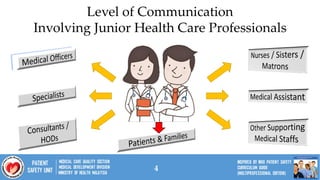
4
Level of Communication
Involving Junior Health Care Professionals
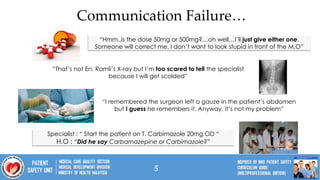
5
“Hmm..is the dose 50mg or 500mg?…oh well…I’ll just give either one.
Someone will correct me. I don’t want to look stupid in front of the M.O”
“That’s not En. Ramli’s X-ray but I’m too scared to tell the specialist
because I will get scolded”
“I remembered the surgeon left a gauze in the patient’s abdomen
but I guess he remembers it. Anyway, it’s not my problem”
Specialist : “ Start the patient on T. Carbimazole 20mg OD “
H.O : “Did he say Carbamazepine or Carbimazole?”
Communication Failure…
6
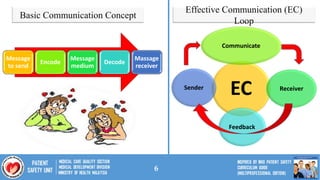
EC
Communicate
Receiver
Feedback
Sender
Message
to send
Encode
Message
medium
Decode
Massage
receiver
Basic Communication Concept
Effective Communication (EC)
Loop
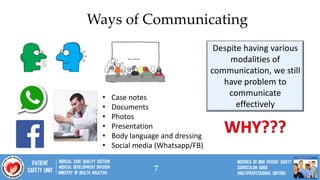
7
• Case notes
• Documents
• Photos
• Presentation
• Body language and dressing
• Social media (Whatsapp/FB)
Despite having various
modalities of
communication, we still
have problem to
communicate
effectively
Ways of Communicating
8
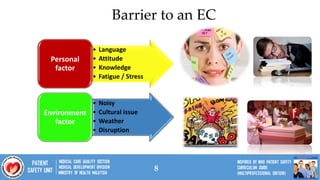
• Language
• Attitude
• Knowledge
• Fatigue / Stress
Personal
factor
• Noisy
• Cultural issue
• Weather
• Disruption
Environment
factor
Barrier to an EC
9
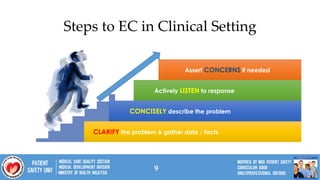
CLARIFY the problem & gather data / factsCLARIFY the problem & gather data / facts
CONCISELY describe the problemCONCISELY describe the problem
Actively LISTEN to responseActively LISTEN to response
Assert CONCERNS if neededAssert CONCERNS if needed
Steps to EC in Clinical Setting
10
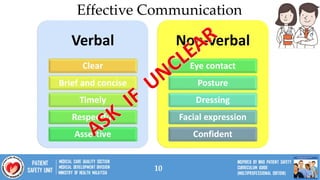
Verbal
Clear
Brief and concise
Timely
Respectful
Assertive
Non-verbal
Eye contact
Posture
Dressing
Facial expression
Confident
Effective Communication
11
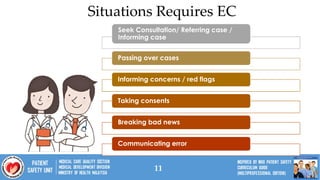
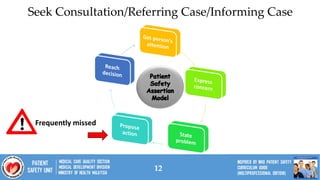
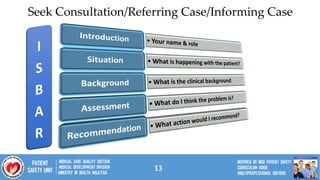
Seek Consultation/ Referring case /
Informing case
Passing over cases
Informing concerns / red flags
Taking consents
Breaking bad news
Communicating error
Situations Requires EC
12
Frequently missed
Seek Consultation/Referring Case/Informing Case
13
Seek Consultation/Referring Case/Informing Case
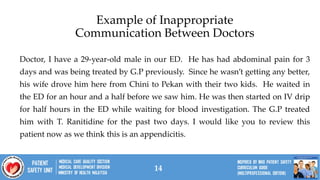
14
Doctor, I have a 29-year-old male in our ED. He has had abdominal pain for 3
days and was being treated by G.P previously. Since he wasn’t getting any better,
his wife drove him here from Chini to Pekan with their two kids. He waited in
the ED for an hour and a half before we saw him. He was then started on IV drip
for half hours in the ED while waiting for blood investigation. The G.P treated
him with T. Ranitidine for the past two days. I would like you to review this
patient now as we think this is an appendicitis.
Example of Inappropriate
Communication Between Doctors
15
• Introduction & Situation
• Dr Ali, this is Dr. Abu from the ED. I have this 29 year old male En. X complaining of severe
RLQ abdominal pain x3/7 and fever x1/7. Currently admitted to yellow zone with impression
of acute appendicitis
• Background
• He has had this pain since 3 days ago and worsen today. Initially at the umbilical region
and today it is worsen over the RLQ. His fever started today. Otherwise, he had nausea and
loss of appetite during the course of illness. No other urinary symptoms , UGIB and LGIB
symptoms. BO normal. He has been treated by a G.P for presumed gastritis with T.
Ranitidine. No past medical or surgical history.
• Assessment
• Generally the patient had mild dehydration. His HR = 104, BP = 110/75, Temp = 38.5. His
abdomen is soft, tender over the RLQ with +ve rebound tenderness. Other systemic
examination was normal. FBC came back as leukocytosis (WBC: 16 ) with neutrophil
predominance. UFEME : normal . BUSE : normal.
• Recommendation
• We have kept him nil by mouth and started him on IV drip NS maintenance. Kindly review
him for further management. Do you have any inquiry regarding the patient?
“Doctor to Doctor” Communication Using ISBAR
VIDEO
16
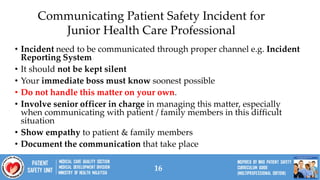
• Incident need to be communicated through proper channel e.g. Incident
Reporting System
• It should not be kept silent
• Your immediate boss must know soonest possible
• Do not handle this matter on your own.
• Involve senior officer in charge in managing this matter, especially
when communicating with patient / family members in this difficult
situation
• Show empathy to patient & family members
• Document the communication that take place
Communicating Patient Safety Incident for
Junior Health Care Professional
17
Take Home Messages
“Treat people the way you want to be treated. Talk to
people the way you want to be talked to...”
Communication is vital in Patient Safety!
18
Acknowledgement
Dr. Nor ‘Aishah bt Abu Bakar
Dr. Mohd Suffian bin Mohd Dzakwan
Dr. Khairulina Haireen bt Khalid
Dr. Ahmad Muzammil bin Abu Bakar
Pn. Sharmila Mat Zain
YBhg. Dato’ Dr Zamyn Zuki Tan Sri Dato’ Mohd Zuki
Dr. Saari Mohamad Yatim
En. Arun A/L Adi
Pn. Maznah Abd Wahab

P3 EFFECTIVE COMMUNICATION HOUSEMANSHIP MALAYSIA

  • 1.
    1 Effective Communication (EC)To Improve Patient Safety Patient Safety Unit Quality in Medical Care Section Ministry of Health Malaysia @ Secretariat, Patient Safety Council Malaysia In Collaboration with : Patient Safety Module Technical Committee 1
  • 2.
    2 •Understand the importanceof EC. •Learn the basic concept of EC & its barrier. •Understand how EC can improve Patient Safety. Learning Objectives
  • 3.
    3 Communication is aroot cause of nearly 70% the event reported to the JCHAO from 1995 - 2005 Failure to communicate safety concern and poor collaboration led to incidents such as medication error, diagnostic error and wrong surgeries (Joint Commission on Accreditation of Healthcare Organizations, JCHAO) Why Communication in Healthcare is Important?
  • 4.
    4 Level of Communication InvolvingJunior Health Care Professionals
  • 5.
    5 “Hmm..is the dose50mg or 500mg?…oh well…I’ll just give either one. Someone will correct me. I don’t want to look stupid in front of the M.O” “That’s not En. Ramli’s X-ray but I’m too scared to tell the specialist because I will get scolded” “I remembered the surgeon left a gauze in the patient’s abdomen but I guess he remembers it. Anyway, it’s not my problem” Specialist : “ Start the patient on T. Carbimazole 20mg OD “ H.O : “Did he say Carbamazepine or Carbimazole?” Communication Failure…
  • 6.
  • 7.
    7 • Case notes •Documents • Photos • Presentation • Body language and dressing • Social media (Whatsapp/FB) Despite having various modalities of communication, we still have problem to communicate effectively Ways of Communicating
  • 8.
    8 • Language • Attitude •Knowledge • Fatigue / Stress Personal factor • Noisy • Cultural issue • Weather • Disruption Environment factor Barrier to an EC
  • 9.
    9 CLARIFY the problem& gather data / factsCLARIFY the problem & gather data / facts CONCISELY describe the problemCONCISELY describe the problem Actively LISTEN to responseActively LISTEN to response Assert CONCERNS if neededAssert CONCERNS if needed Steps to EC in Clinical Setting
  • 10.
    10 Verbal Clear Brief and concise Timely Respectful Assertive Non-verbal Eyecontact Posture Dressing Facial expression Confident Effective Communication
  • 11.
    11 Seek Consultation/ Referringcase / Informing case Passing over cases Informing concerns / red flags Taking consents Breaking bad news Communicating error Situations Requires EC
  • 12.
  • 13.
  • 14.
    14 Doctor, I havea 29-year-old male in our ED. He has had abdominal pain for 3 days and was being treated by G.P previously. Since he wasn’t getting any better, his wife drove him here from Chini to Pekan with their two kids. He waited in the ED for an hour and a half before we saw him. He was then started on IV drip for half hours in the ED while waiting for blood investigation. The G.P treated him with T. Ranitidine for the past two days. I would like you to review this patient now as we think this is an appendicitis. Example of Inappropriate Communication Between Doctors
  • 15.
    15 • Introduction &Situation • Dr Ali, this is Dr. Abu from the ED. I have this 29 year old male En. X complaining of severe RLQ abdominal pain x3/7 and fever x1/7. Currently admitted to yellow zone with impression of acute appendicitis • Background • He has had this pain since 3 days ago and worsen today. Initially at the umbilical region and today it is worsen over the RLQ. His fever started today. Otherwise, he had nausea and loss of appetite during the course of illness. No other urinary symptoms , UGIB and LGIB symptoms. BO normal. He has been treated by a G.P for presumed gastritis with T. Ranitidine. No past medical or surgical history. • Assessment • Generally the patient had mild dehydration. His HR = 104, BP = 110/75, Temp = 38.5. His abdomen is soft, tender over the RLQ with +ve rebound tenderness. Other systemic examination was normal. FBC came back as leukocytosis (WBC: 16 ) with neutrophil predominance. UFEME : normal . BUSE : normal. • Recommendation • We have kept him nil by mouth and started him on IV drip NS maintenance. Kindly review him for further management. Do you have any inquiry regarding the patient? “Doctor to Doctor” Communication Using ISBAR VIDEO
  • 16.
    16 • Incident needto be communicated through proper channel e.g. Incident Reporting System • It should not be kept silent • Your immediate boss must know soonest possible • Do not handle this matter on your own. • Involve senior officer in charge in managing this matter, especially when communicating with patient / family members in this difficult situation • Show empathy to patient & family members • Document the communication that take place Communicating Patient Safety Incident for Junior Health Care Professional
  • 17.
    17 Take Home Messages “Treatpeople the way you want to be treated. Talk to people the way you want to be talked to...” Communication is vital in Patient Safety!
  • 18.
    18 Acknowledgement Dr. Nor ‘Aishahbt Abu Bakar Dr. Mohd Suffian bin Mohd Dzakwan Dr. Khairulina Haireen bt Khalid Dr. Ahmad Muzammil bin Abu Bakar Pn. Sharmila Mat Zain YBhg. Dato’ Dr Zamyn Zuki Tan Sri Dato’ Mohd Zuki Dr. Saari Mohamad Yatim En. Arun A/L Adi Pn. Maznah Abd Wahab