Test Concerning Population
VARIANCE OR STANDARD DEVIATION WHEN n ≥ 30
P- VALUE:
P- value is used in hypothesis testing to help you Accept or reject the
null hypothesis. The p value is the evidence against a null hypothesis.
The smaller the p-value, the stronger the evidence that you should
reject the null hypothesis.
MAKE DECISION BY USING P-VALUE IN Z - STATISTIC
IF P- Value ≤ α; Reject H0
IF P- Value > α; Fail to Reject H0 (Accept H0)
NOTE:
I would try to solve following examples by
1- Using classical approach
2- Using P-value approach
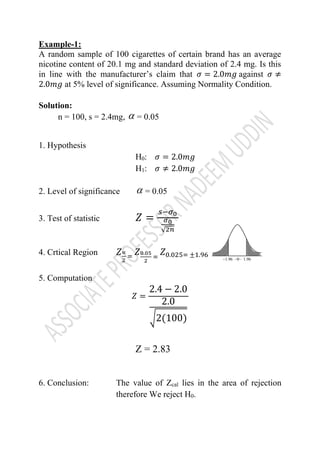
Example-1:
A random sample of 100 cigarettes of certain brand has an average
nicotine content of 20.1 mg and standard deviation of 2.4 mg. Is this
in line with the manufacturer’s claim that 𝜎 = 2.0𝑚𝑔 against 𝜎 ≠
2.0𝑚𝑔 at 5% level of significance. Assuming Normality Condition.
Solution:
n = 100, s = 2.4mg, = 0.05
1. Hypothesis
H0: 𝜎 = 2.0𝑚𝑔
H1: 𝜎 ≠ 2.0𝑚𝑔
2. Level of significance = 0.05
3. Test of statistic 𝑍 =
𝑠−𝜎0
𝜎0
√2𝑛
4. Crtical Region 𝑍∝
2
= 𝑍0.05
2
=
𝑍0.025= ±1.96
5. Computation
𝑍 =
2.4 − 2.0
2.0
√2(100)
Z = 2.83
6. Conclusion: The value of Zcal lies in the area of rejection
therefore We reject H0.


−1.96 –0– 1.96
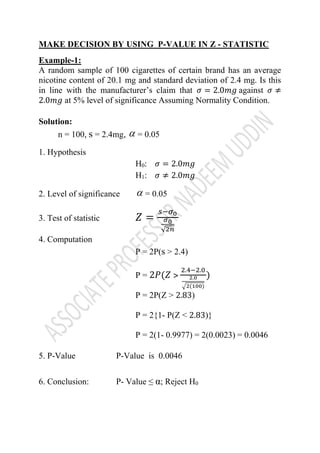
MAKE DECISION BY USING P-VALUE IN Z - STATISTIC
Example-1:
A random sample of 100 cigarettes of certain brand has an average
nicotine content of 20.1 mg and standard deviation of 2.4 mg. Is this
in line with the manufacturer’s claim that 𝜎 = 2.0𝑚𝑔 against 𝜎 ≠
2.0𝑚𝑔 at 5% level of significance Assuming Normality Condition.
Solution:
n = 100, s = 2.4mg, = 0.05
1. Hypothesis
H0: 𝜎 = 2.0𝑚𝑔
H1: 𝜎 ≠ 2.0𝑚𝑔
2. Level of significance = 0.05
3. Test of statistic 𝑍 =
𝑠−𝜎0
𝜎0
√2𝑛
4. Computation
P = 2P(s ˃ 2.4)
P = 2𝑃(𝑍 ˃
2.4−2.0
2.0
√2(100)
)
P = 2P(Z ˃ 2.83)
P = 2{1- P(Z ˂ 2.83)}
P = 2(1- 0.9977) = 2(0.0023) = 0.0046
5. P-Value P-Value is 0.0046
6. Conclusion: P- Value ≤ α; Reject H0



P value in population standard deviation

  • 2.
    Test Concerning Population VARIANCEOR STANDARD DEVIATION WHEN n ≥ 30 P- VALUE: P- value is used in hypothesis testing to help you Accept or reject the null hypothesis. The p value is the evidence against a null hypothesis. The smaller the p-value, the stronger the evidence that you should reject the null hypothesis. MAKE DECISION BY USING P-VALUE IN Z - STATISTIC IF P- Value ≤ α; Reject H0 IF P- Value > α; Fail to Reject H0 (Accept H0) NOTE: I would try to solve following examples by 1- Using classical approach 2- Using P-value approach
  • 3.
    Example-1: A random sampleof 100 cigarettes of certain brand has an average nicotine content of 20.1 mg and standard deviation of 2.4 mg. Is this in line with the manufacturer’s claim that 𝜎 = 2.0𝑚𝑔 against 𝜎 ≠ 2.0𝑚𝑔 at 5% level of significance. Assuming Normality Condition. Solution: n = 100, s = 2.4mg, = 0.05 1. Hypothesis H0: 𝜎 = 2.0𝑚𝑔 H1: 𝜎 ≠ 2.0𝑚𝑔 2. Level of significance = 0.05 3. Test of statistic 𝑍 = 𝑠−𝜎0 𝜎0 √2𝑛 4. Crtical Region 𝑍∝ 2 = 𝑍0.05 2 = 𝑍0.025= ±1.96 5. Computation 𝑍 = 2.4 − 2.0 2.0 √2(100) Z = 2.83 6. Conclusion: The value of Zcal lies in the area of rejection therefore We reject H0.   −1.96 –0– 1.96
  • 4.
    MAKE DECISION BYUSING P-VALUE IN Z - STATISTIC Example-1: A random sample of 100 cigarettes of certain brand has an average nicotine content of 20.1 mg and standard deviation of 2.4 mg. Is this in line with the manufacturer’s claim that 𝜎 = 2.0𝑚𝑔 against 𝜎 ≠ 2.0𝑚𝑔 at 5% level of significance Assuming Normality Condition. Solution: n = 100, s = 2.4mg, = 0.05 1. Hypothesis H0: 𝜎 = 2.0𝑚𝑔 H1: 𝜎 ≠ 2.0𝑚𝑔 2. Level of significance = 0.05 3. Test of statistic 𝑍 = 𝑠−𝜎0 𝜎0 √2𝑛 4. Computation P = 2P(s ˃ 2.4) P = 2𝑃(𝑍 ˃ 2.4−2.0 2.0 √2(100) ) P = 2P(Z ˃ 2.83) P = 2{1- P(Z ˂ 2.83)} P = 2(1- 0.9977) = 2(0.0023) = 0.0046 5. P-Value P-Value is 0.0046 6. Conclusion: P- Value ≤ α; Reject H0  