OXYGEN THERAPY
SURG LT CDR IA AKUBO
INTENSIVE CARE UNIT
NNRH OJO
1
OUTLINE








Introduction
Pathway of O2
Indication of O2 therapy
O2 Delivery systems
Monitoring of O2 therapy
Complications of O2 therapy
Conclusion
References
2
INTRODUCTION





History:
Joseph Priestly, an English Chemist in 1774
discoverd O2.
He prepared O2 by heating mercury oxide with a
burning glass.
He found that oxygen does not dissolve in water
and it made conbustion stronger.
Antonie-Laurent Lavoiser Clarified use of O2
for combustion & respiration with elimination
of CO2 & H2O.
3
INTRODUCTION


Definition:
Oxygen therapy is the administration of
oxygen at concentrations greater than
that in ambient air with the intent of
treating or preventing the symptoms
and manifestations of hypoxia.1
4
INTRODUCTION







Properties of O2:
O2 is tasteless, colourless & odourless gas.
Make 21% of atmospheric air.
Boiling point -183°C
Melting point -218°C
Critical point -118°C
Relative Density -1.105
5
INTRODUCTION
•
•
•
•
Sources Of Oxygen.
Ambient air
Oxygen Manifold (Wall oxygen)
Oxygen cylinders
Oxygen Concentrators
6
INTRODUCTION



Storage:
Liquid form
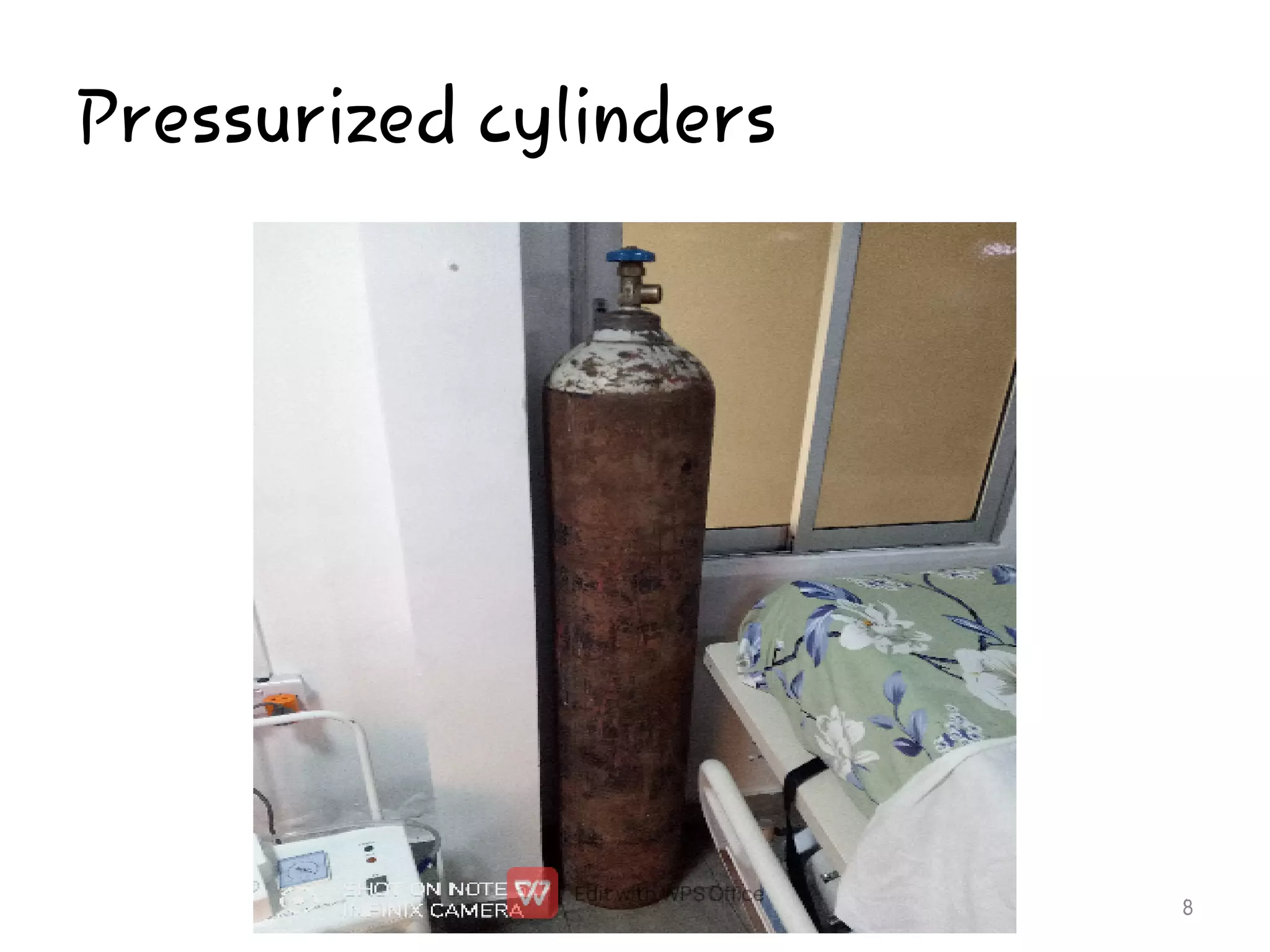
Pressurized cylinders
7
Pressurized cylinders
8
PATHWAY OF O2


O2 Cascade
O2 Flux
9
PATHWAY OF O2
–
–
–
–
–
–
Partial pressure of oxygen in:
Dry atmospheric air; 21KPa (160mmHg)
Humid tracheal air; 19.8KPa (150mmHg)
Alveolar air; 14KPa (106mmHg)
Arterial blood; 13.3KPa (100mmHg)
Capillary blood; 6 – 7KPa (45-55mmHg)
Mitochondria; 1 – 5KPa (7.5-40mmHg)
10
PATHWAY OF O2

•
•



O2 Flux = Amount of delivered/ unit time
CO*Arterial O2 Content
CO*{(10*Hb*SaO2*1.34) + (10*PaO2*0.0225)
Normal Range-
800-1200ml/min
500-700ml/min/m2
11
INDICATION FOR O2

•
–
–
•
–
–
–
Hypoxia
Respiratory Failure
Type I
Type II
Cardiac
CCF
MI
Dehydration
12
INDICATION FOR O2

•
–
–
•
–
•
–
–
Hypoxia
Demand
Seizures
Sepsis/fever
Toxicity
Cyanide toxicity
Haemic
Anaemia
Carboxyhaemoglobinemia, Methemoglobinemia
13
INDICATION FOR O2
•
–
–
–
–
Clinical Indicators:
dyspnoea, tachypnoea, bradypnoea, apnoea
pallor, cyanosis
lethargy or restlessness
use of accessory muscles: nasal flaring,
intercostal or sternal recession, tracheal tug
14
O2 DELIVERY SYSTEM






Non Invasive
Variable performance equipment
Nasal cannula/prongs
Face mask
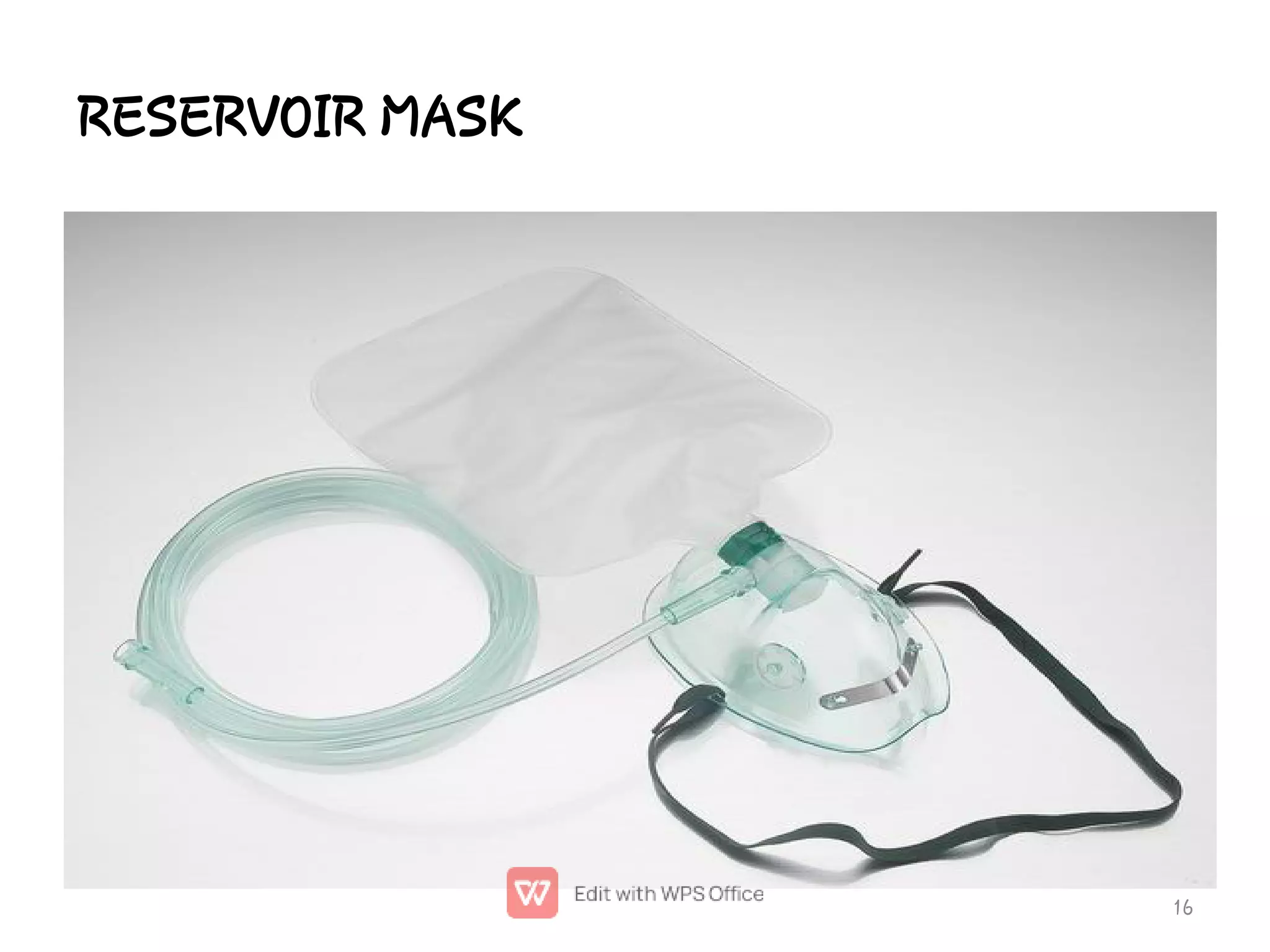
Non reservoir mask
Reservoir mask
15
RESERVOIR MASK
16
RESERVOIR MASK
17
O2 DELIVERY SYSTEM






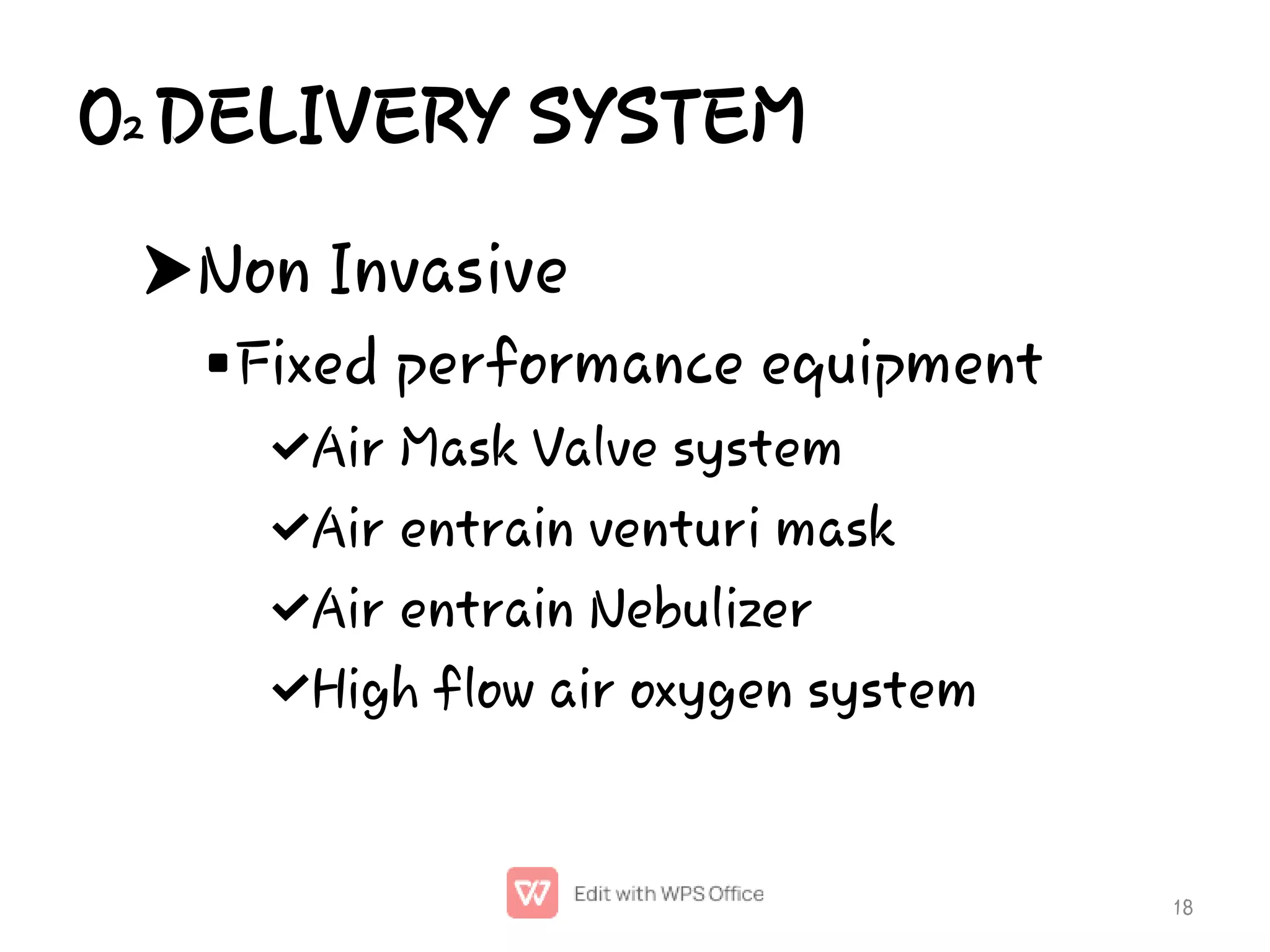
Non Invasive
Fixed performance equipment
Air Mask Valve system
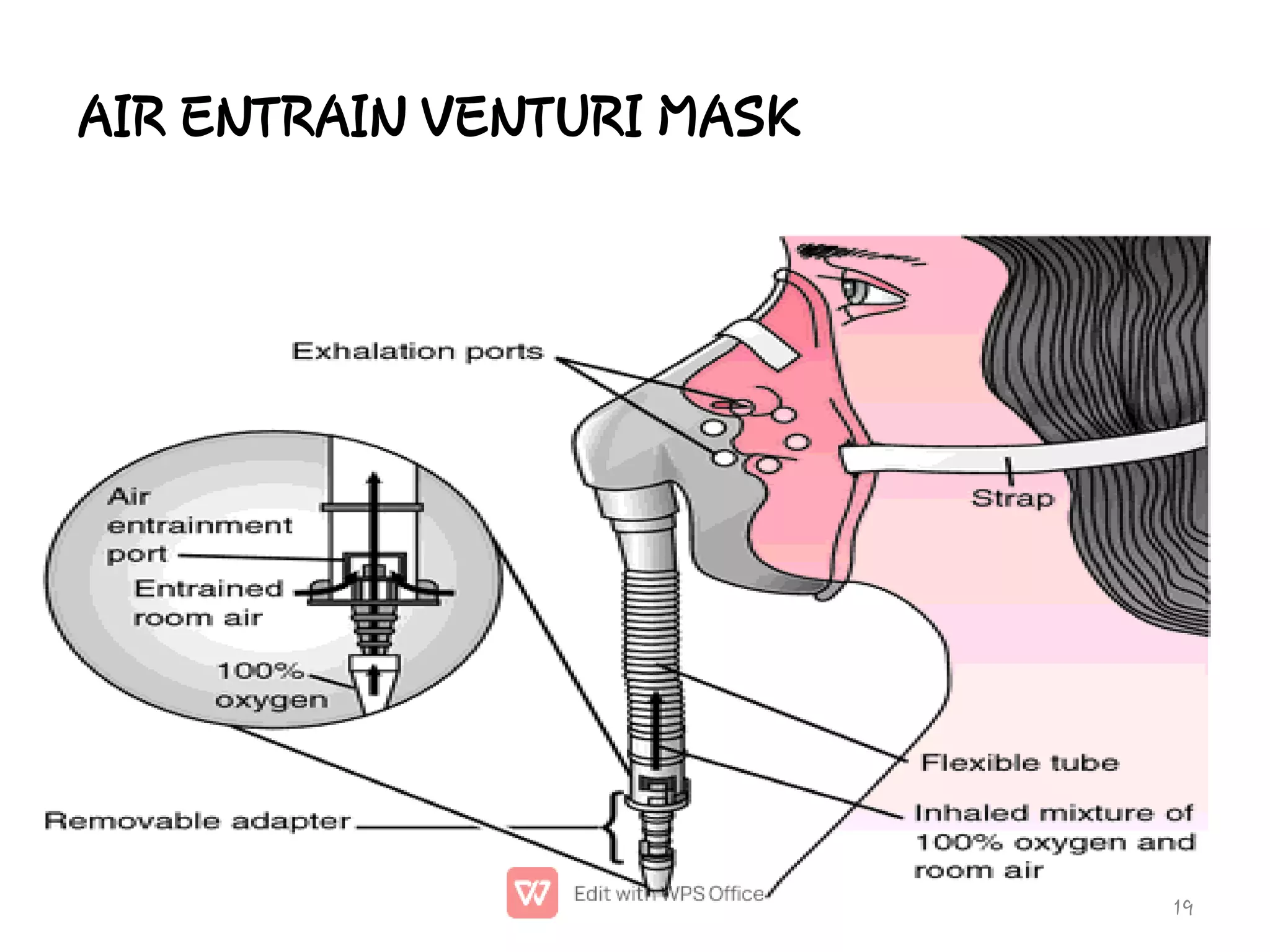
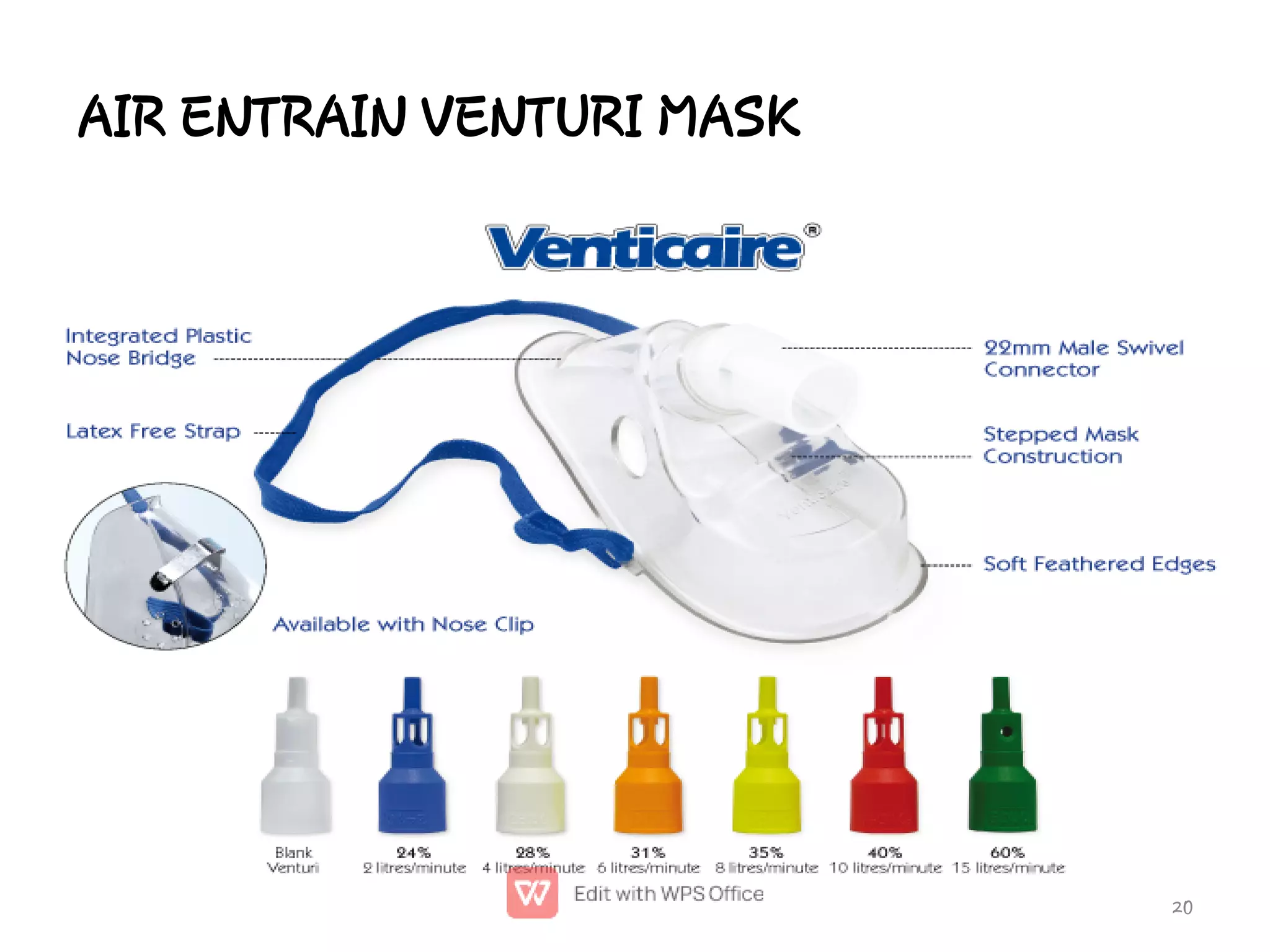
Air entrain venturi mask
Air entrain Nebulizer
High flow air oxygen system
18
AIR ENTRAIN VENTURI MASK
19
AIR ENTRAIN VENTURI MASK
20
O2 Delivery systems




Invasive
Cricothyrotomy
Endotrachial tube
Trachiostomy tube
21
O2 Delivery systems
•
–
–
–
Mechanical ventilation:
Anaesthetic Machine
Ventilators
Heart Lung Machine
22
VENTILATOR
23
MONITORING OF O2 THERAPY







Clinical
Pulse
Skin colour
Respiratory findings
Laboratory
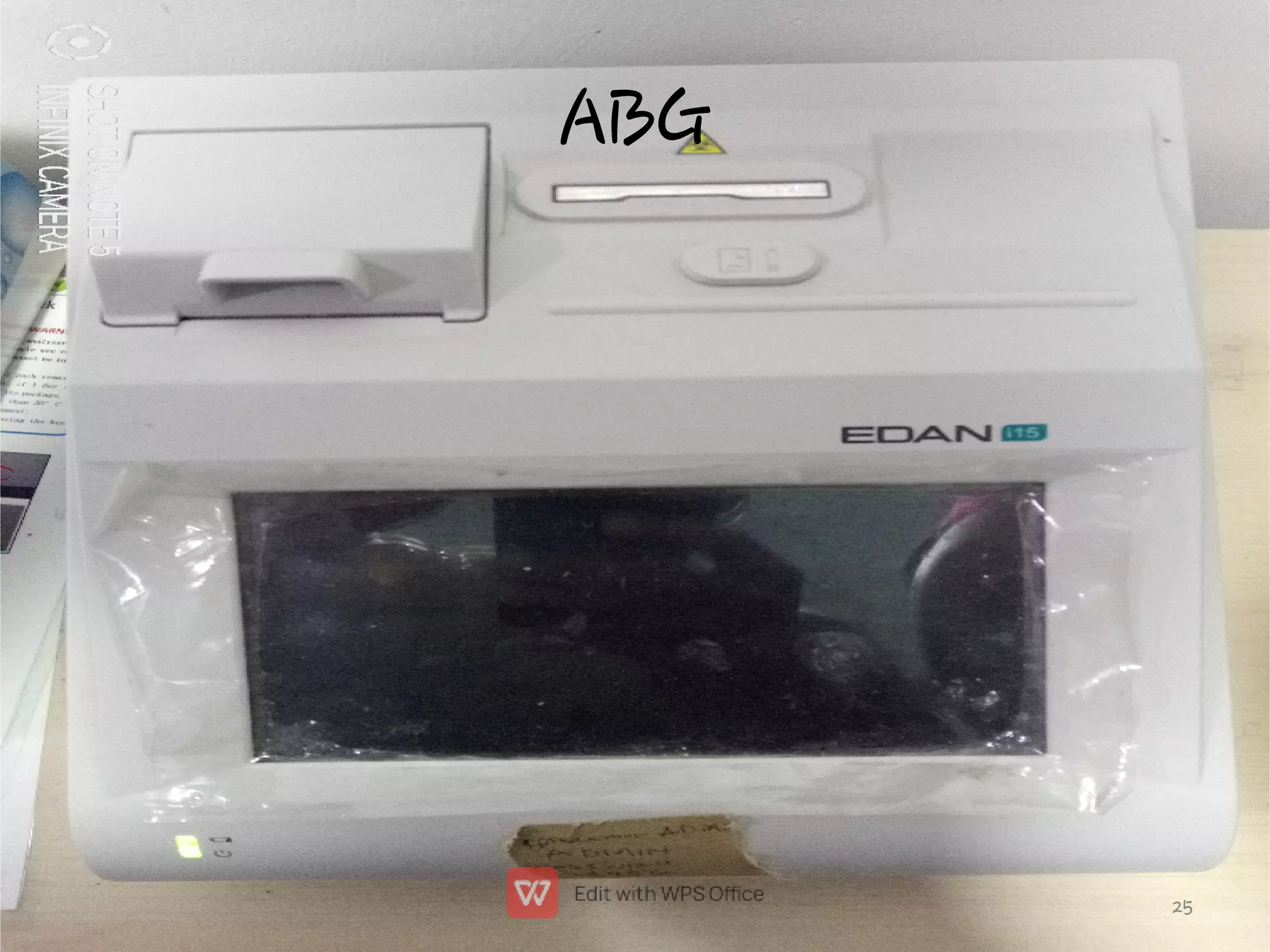
Pulse oxymetry
ABG 24
ABG
25
NORMAL ABG VALUES
•
•
•
•
•
–
–
PH: 7.36-7.44
PaCO2: 35-45mmHg /4.6-6.0KPa
PaO2: 75-105mmHg / 10-14KPa
HCO3
-: 24-28mEq/L (20-26mmol/L)
NOTE:
1mmHg-1Torr
1KPa-7.5mmHg
26
MULTIPARAMETER DISPLAY MONITOR
27
MONITORING OF O2 THERAPY
28
COMPLICATION OF O2 THERAPY




CNS Toxicity
Absorption atelectesis
Pulmonary toxicity
Fire Hazard
29
REFERENCES
1.
2.
3.
4.
Fulmer JD, Snider GL. ACCP-NHLBI National
Conference on Oxygen Therapy.
Update in anaesthesia Basic sciences:
Volume 24, Number 2 December 2008
A-Z in Anaesthesia & Intensive care, An
encyclopaedia of principles & practice, 3rd
edition by S M Yentis, N P Hirsch, G B Smith.
Textbook of Anaesthesia for postgraduates
by T K Agasti, 1st edition: 2011
30
REFERENCES
5. Clinical Anaesthesiology: G. E. Morgan Jr, M. S.
Mikhail, M. J. Murray; 4th edition
6. Text book of Anaesthesia: A. R. Aitkinhead, G.
Smith, D. J. Rowbothan; 5th edition
7. Anaesthesia secrets: J. Duke MD; 4th edition
8. Wikipedia, the free encyclopedia.mht
9. NNRH Ojo Photo library.
31

Oxygen therapy ANG.pdf