The Great Change
Debate
05Mar15
Output from the post lunch
exercise on behaviours that help
organisations embrace change
The Challenge
Each group was asked to identify the behaviours that each
individual can display in order to help organisations
embrace change.
Behaviour was defined as:
• The WORDS you say
• HOW you say them
• FACIAL expressions
• BODY LANGUAGE
 Engage/involve early
 2-way dialogue – regularly
 Acknowledge uncertainty
 Communicate even when you don’t have the decisions
– Explain the journey
 Balanced overview of benefits/ disbenefits
– And clarity re were they site
– Sell them as challenges
– Make them sound positive
 Bring all shareholders in early
 Normalise change – recognise that it’s always happening (eg
continuous improvement) just that some changes are bigger
than others
 Make them part of the solution – choices/ solutions
 Coach and facilitate decision making vs telling
 Acknowledge that it will be uncomfortable
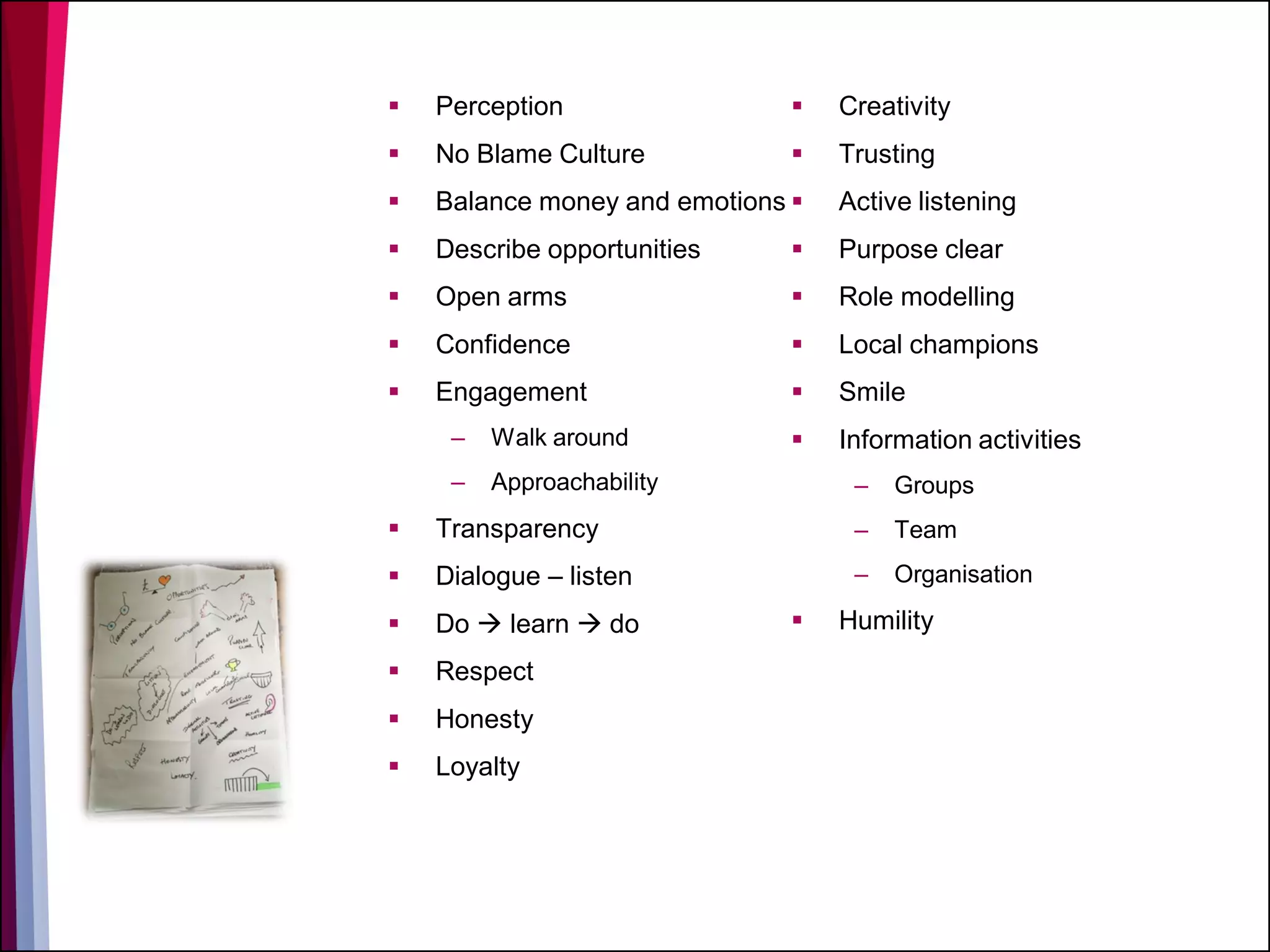
 Perception
 No Blame Culture
 Balance money and emotions
 Describe opportunities
 Open arms
 Confidence
 Engagement
– Walk around
– Approachability
 Transparency
 Dialogue – listen
 Do  learn  do
 Respect
 Honesty
 Loyalty
 Creativity
 Trusting
 Active listening
 Purpose clear
 Role modelling
 Local champions
 Smile
 Information activities
– Groups
– Team
– Organisation
 Humility
 Honouring the past – learn fro it
 Self awareness and presentation, use of appropriate language
 Active listening to people affected by change
 Transparency of objectives
 Authentic dialogue
 Openness to challenge
 Consistency of behaviour
 Prepare people for change
 Authenticity
 WIIFM (self-interest)
 Open and inclusive environment
 Listening
 Engagement
 Demonstrate how people will be
heard
 Try to remove the fear of failure
 Change network – ambassadors
 Pilots and learning – sharing
successes and benefits
 Involvement and contribution
from the beginning
 Strong vision/purpose
 Recognising needs for support
and training
 Relevance – tailored
communication and
engagement
– Pitching to the audience
 Feedback (2-way)
 Visibility – top level living the
change
 Clear roles and responsibilities
 Lifecycle change
 Allow and encourage innovation
 Empathy
 Myth busting
 “This change destroys what
we’re going to do”
– Community
– Refocus discussion
 New world paradigm
– future stability and
growth
 “I don’t want to be here”
– Positive exit
 “People are disposable”
– Genuine engagement
 “We can’t stop doing this”
– Better ways
 “They don’t understand more
cost saving”
– Explain decision thinking
– Bigger picture
 “Job loss”
– Job opportunity
 “More work”
– Gain more knowledge
 “I like what I do now”
– Brave New World
– Better decision (or at least
ok)
 “Change weary”
 “My views are never listened to”
– Involve others in design
– Communal working on
change
 “It’s a done deal”
 Positive language
 Case studies of good examples
 Value-add , improve outcomes
– Opportunity, safeguarding
 Inclusive engagement
 Safe environment for debate
 Leadership
– Body language
– Leading by example
 Driving right culture and
behaviours
– Aligning performance
management framework
(reward and recognition)
 Understanding change
environment ie audience
 Clear, understood, shared vision
 Honest, credible leadership
– Example and questions
 Change capability and capacity
 Understand wider stakeholders
ie customers; suppliers
 Enabling innovation across the
operational model ie system
processes, organisation
 Effective planning
WHAT
 Take time to explain – as far as
you can
 Recognise and acknowledge
the influence/limits
 Change is normal/healthy part
of life
 Encourage involvement in the
change
 Paint the picture – inspiring
 Genuine/authentic –
winners/losers
 Carefully crafted communication
– Your role and how you can
get involved
 WIFM – Management
 Make opportunities visible
 OK to be open in raising
concerns/complaints
HOW
 F2F where possible – put a face
to the change
 All ideas are heard and valued
 An inclusive culture
 Demonstrate understanding of positives and negatives of the idea
 Open and honest
 Regular communications
 Understanding of individual impact
 Hope based communications
– Why are we doing it
 Active sponsorship
– Walk the walk and talk the
talk (educate them)
 Recognise failure – its ok to fail
but learn from it
 Encourage two way
communication
 Demonstration learning . . . “we
have learned from . . .”
 Involve/understand those
affected and keep going
– What’s in it from them
– Timelines
– Consistent
 Uncover ‘unease’ early
 Acknowledge negative/hesitant
comments
– Respond to
 Involve in ‘the how’
– Business advocates
– Incorporate into culture
– Put the right people on
projects
– Recognise and reward
– Set objectives
 Link to personal and group values
 Openness and transparency
 Safety and trust
 Responsiveness
 Co-ordination
 Role models
 Engagement and consistency
 Leading by example
 Genuine enthusiasm
 Evidence WIIFM
 Enable co-ownership
 Embrace resistance
 Be open, listen, EI stuff
 Honesty – be fallible
 Be accessible – engaged/actively
 Be human – be present
 Use quick wins to show change is working – and can happen
 Inclusive language – jargon free
 Address fears - concerns
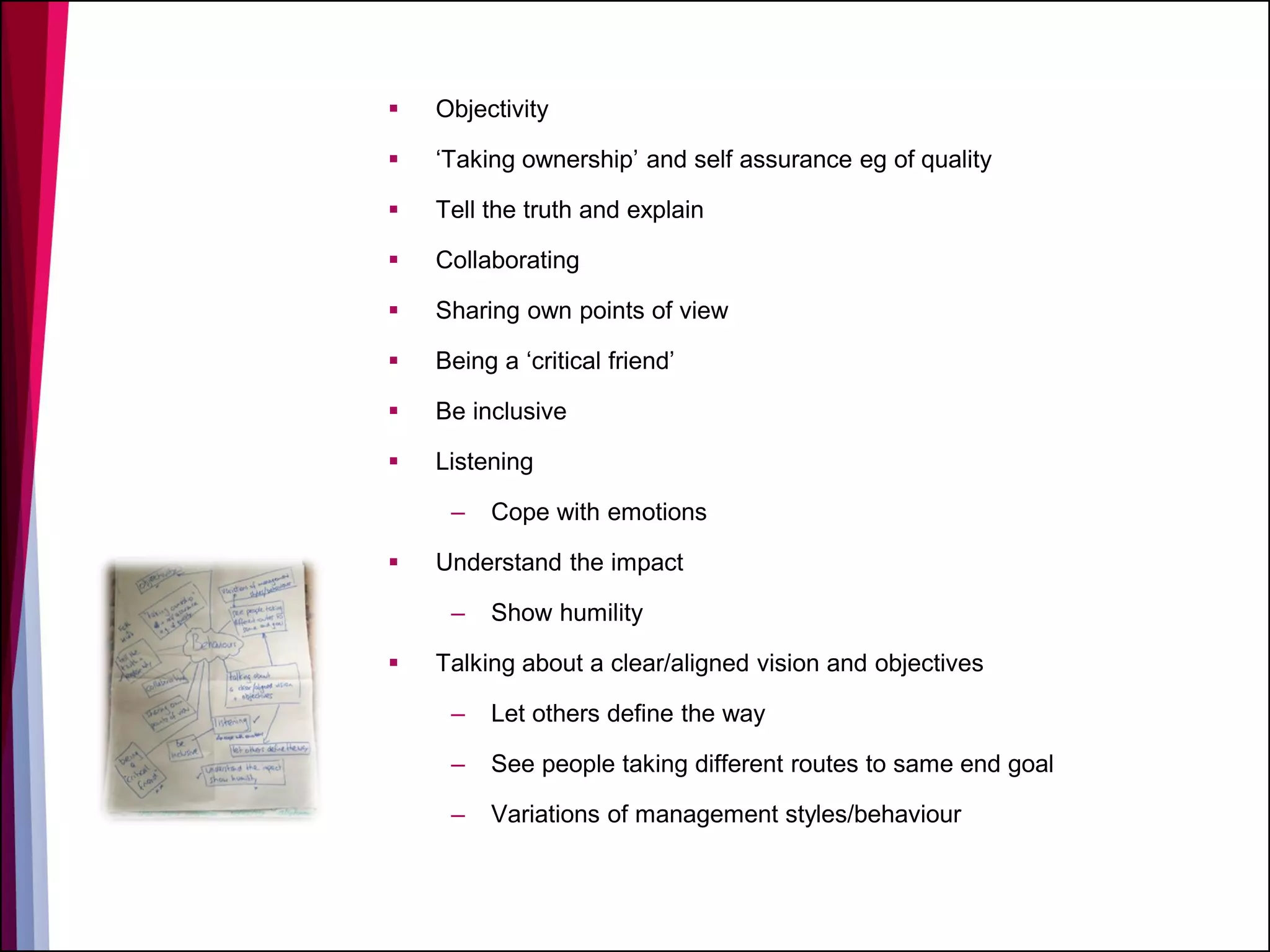
 Objectivity
 ‘Taking ownership’ and self assurance eg of quality
 Tell the truth and explain
 Collaborating
 Sharing own points of view
 Being a ‘critical friend’
 Be inclusive
 Listening
– Cope with emotions
 Understand the impact
– Show humility
 Talking about a clear/aligned vision and objectives
– Let others define the way
– See people taking different routes to same end goal
– Variations of management styles/behaviour
 Time helps and timing
 People awareness
– Emotional responses
– Their values
 Be passionate about change
 Demonstrate belief
– Believe – honest/open
– Active delivery – energy/body language
– Smile to enforce positive
 Listen to what is being said
 Engage audience – judge impact of message
 Use comparisons, similes, stories, pictures
 Be real – acknowledge what is bad
 Celebrate passing of ‘old’ problems – history
 Be confident – have integrity
 Apply real context – their agenda/alignment
 Use their language - reflective
 Leadership (build trust, remove fear)
– Active communication of plan
 Open, authentic, consistency
 Clarity of vision
– Active listening/observation
– Change own behaviour
 Invest in the change capability
– Time, money
– Demonstration of engagement
 Be flexible/adaptable
 Align change to incentives
 Bespoke messenging, tailored/facilitated 2 way communication – to
help provide positives
 Awareness of cultural differences
 Timely – time and frequency – communications
 Use of change agents/champions
 Open and honest communications
 Acknowledge history –
– what is done well and keePing
– What is done badly, how going to do better
 ‘Moving towards’ language
 Active listening
– Understand their position
 Put yourself in someone else’s position
 Tone of voice – how will it be heard?
– Condescending or calming?
 Be careful with words and language – now ‘hard sell’
 Environment – flexible
 Ask people “what do you think?”
 Watch – how are people reacting?
– Saying yes but face/eyes saying no
 What words resonate with people?
– Respect
 Elaborate options and repeat

Output from behaviours exercise at the Great Change Debate

  • 1.
    The Great Change Debate 05Mar15 Outputfrom the post lunch exercise on behaviours that help organisations embrace change
  • 2.
    The Challenge Each groupwas asked to identify the behaviours that each individual can display in order to help organisations embrace change. Behaviour was defined as: • The WORDS you say • HOW you say them • FACIAL expressions • BODY LANGUAGE
  • 3.
     Engage/involve early 2-way dialogue – regularly  Acknowledge uncertainty  Communicate even when you don’t have the decisions – Explain the journey  Balanced overview of benefits/ disbenefits – And clarity re were they site – Sell them as challenges – Make them sound positive  Bring all shareholders in early  Normalise change – recognise that it’s always happening (eg continuous improvement) just that some changes are bigger than others  Make them part of the solution – choices/ solutions  Coach and facilitate decision making vs telling  Acknowledge that it will be uncomfortable
  • 4.
     Perception  NoBlame Culture  Balance money and emotions  Describe opportunities  Open arms  Confidence  Engagement – Walk around – Approachability  Transparency  Dialogue – listen  Do  learn  do  Respect  Honesty  Loyalty  Creativity  Trusting  Active listening  Purpose clear  Role modelling  Local champions  Smile  Information activities – Groups – Team – Organisation  Humility
  • 5.
     Honouring thepast – learn fro it  Self awareness and presentation, use of appropriate language  Active listening to people affected by change  Transparency of objectives  Authentic dialogue  Openness to challenge  Consistency of behaviour
  • 6.
     Prepare peoplefor change  Authenticity  WIIFM (self-interest)  Open and inclusive environment  Listening  Engagement  Demonstrate how people will be heard  Try to remove the fear of failure  Change network – ambassadors  Pilots and learning – sharing successes and benefits  Involvement and contribution from the beginning  Strong vision/purpose  Recognising needs for support and training  Relevance – tailored communication and engagement – Pitching to the audience  Feedback (2-way)  Visibility – top level living the change  Clear roles and responsibilities  Lifecycle change  Allow and encourage innovation  Empathy  Myth busting
  • 7.
     “This changedestroys what we’re going to do” – Community – Refocus discussion  New world paradigm – future stability and growth  “I don’t want to be here” – Positive exit  “People are disposable” – Genuine engagement  “We can’t stop doing this” – Better ways  “They don’t understand more cost saving” – Explain decision thinking – Bigger picture  “Job loss” – Job opportunity  “More work” – Gain more knowledge  “I like what I do now” – Brave New World – Better decision (or at least ok)  “Change weary”  “My views are never listened to” – Involve others in design – Communal working on change  “It’s a done deal”
  • 8.
     Positive language Case studies of good examples  Value-add , improve outcomes – Opportunity, safeguarding  Inclusive engagement  Safe environment for debate  Leadership – Body language – Leading by example  Driving right culture and behaviours – Aligning performance management framework (reward and recognition)  Understanding change environment ie audience  Clear, understood, shared vision  Honest, credible leadership – Example and questions  Change capability and capacity  Understand wider stakeholders ie customers; suppliers  Enabling innovation across the operational model ie system processes, organisation  Effective planning
  • 9.
    WHAT  Take timeto explain – as far as you can  Recognise and acknowledge the influence/limits  Change is normal/healthy part of life  Encourage involvement in the change  Paint the picture – inspiring  Genuine/authentic – winners/losers  Carefully crafted communication – Your role and how you can get involved  WIFM – Management  Make opportunities visible  OK to be open in raising concerns/complaints HOW  F2F where possible – put a face to the change
  • 10.
     All ideasare heard and valued  An inclusive culture  Demonstrate understanding of positives and negatives of the idea  Open and honest  Regular communications  Understanding of individual impact
  • 11.
     Hope basedcommunications – Why are we doing it  Active sponsorship – Walk the walk and talk the talk (educate them)  Recognise failure – its ok to fail but learn from it  Encourage two way communication  Demonstration learning . . . “we have learned from . . .”  Involve/understand those affected and keep going – What’s in it from them – Timelines – Consistent  Uncover ‘unease’ early  Acknowledge negative/hesitant comments – Respond to  Involve in ‘the how’ – Business advocates – Incorporate into culture – Put the right people on projects – Recognise and reward – Set objectives
  • 12.
     Link topersonal and group values  Openness and transparency  Safety and trust  Responsiveness  Co-ordination  Role models  Engagement and consistency
  • 13.
     Leading byexample  Genuine enthusiasm  Evidence WIIFM  Enable co-ownership  Embrace resistance  Be open, listen, EI stuff  Honesty – be fallible  Be accessible – engaged/actively  Be human – be present  Use quick wins to show change is working – and can happen  Inclusive language – jargon free  Address fears - concerns
  • 14.
     Objectivity  ‘Takingownership’ and self assurance eg of quality  Tell the truth and explain  Collaborating  Sharing own points of view  Being a ‘critical friend’  Be inclusive  Listening – Cope with emotions  Understand the impact – Show humility  Talking about a clear/aligned vision and objectives – Let others define the way – See people taking different routes to same end goal – Variations of management styles/behaviour
  • 15.
     Time helpsand timing  People awareness – Emotional responses – Their values  Be passionate about change  Demonstrate belief – Believe – honest/open – Active delivery – energy/body language – Smile to enforce positive  Listen to what is being said  Engage audience – judge impact of message  Use comparisons, similes, stories, pictures  Be real – acknowledge what is bad  Celebrate passing of ‘old’ problems – history  Be confident – have integrity  Apply real context – their agenda/alignment  Use their language - reflective
  • 16.
     Leadership (buildtrust, remove fear) – Active communication of plan  Open, authentic, consistency  Clarity of vision – Active listening/observation – Change own behaviour  Invest in the change capability – Time, money – Demonstration of engagement  Be flexible/adaptable
  • 17.
     Align changeto incentives  Bespoke messenging, tailored/facilitated 2 way communication – to help provide positives  Awareness of cultural differences  Timely – time and frequency – communications  Use of change agents/champions  Open and honest communications  Acknowledge history – – what is done well and keePing – What is done badly, how going to do better
  • 18.
     ‘Moving towards’language  Active listening – Understand their position  Put yourself in someone else’s position  Tone of voice – how will it be heard? – Condescending or calming?  Be careful with words and language – now ‘hard sell’  Environment – flexible  Ask people “what do you think?”  Watch – how are people reacting? – Saying yes but face/eyes saying no  What words resonate with people? – Respect  Elaborate options and repeat