Human RelationSkills
Zahiruddin Othman
GCN 505 T H E W I S D O M Y O U
S E E K I S A L R E A D Y
W I T H I N Y O U
Personality
andAttitude
Effects
Personality is a set of traits
that can explain or predict a
person’s behavior in a variety of
situations.
Attitude is a mental and
emotional entity that
characterizes a person
Four
Temperament
Theory
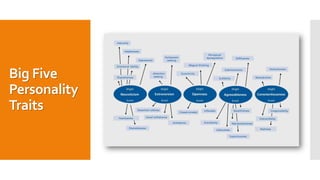
Big Five
Personality
Traits
Holland’s
Theory of
Vocational
Choice
Improving
Your
Attitude
When you wake up
in the morning,
decide you are
going to have an
excellent day.
Be conscious of
your negative
thoughts
Try to avoid
negative thinking.
Spend time with
positive people
Spend time in a
comfortable
physical
environment
Personality
andTeam
Performance
Orderliness,
Perfectionist, Inflexible
Detail Oriented
Unable to Discard
Perfectionism
Can’t Delegate
Work Oriented
Miserly
Over Conscientious
Rigid
Halo effect – drawing a general
positive impression on an
individual on the basis of a single
characteristic
Horn effect – reverse halo effect
Contrast effect – evaluating a
person’s characteristics that are
affected by comparisons of other
people recently encountered
Antisocial
Personality
Disorder
Disregard Rights
of Others (and
meet Conduct
Disorder)
Unlawful
Reckless
Deceitful
Irresponsible
Impulsive
Lack Remorse
Aggressive
Self-esteem is the opinion you have of
yourself and your perception on your value as
a person. High self-esteem people are
comfortable with who they are.
Self-confidence is your belief in yourself and
your abilities. People with high self-esteem
often have self-confidence, although this may
not always be the case.
Self-image
Self-
esteem
Self-
confidence
Self-
efficacy
Projection
Self-efficacy is the confidence
you have to carry out a specific
task
Self-image is how an individual
thinks others view him or her
Projection is how your self-
esteem is reflected in the way you
treat others
Grandiose, Needs
Admiration,Without
Empathy
Self Important
Exploitative
Fantasies of Success
Lacks Empathy
Feels Special
Envious
Needs Admiration
Arrogant
Entitled
1. Use positive self-talk and visual
imagery
2. Take risks
3. Accomplish
4. Know your strengths and
weaknesses
5. Choose to spend time with people
who boost your self-esteem
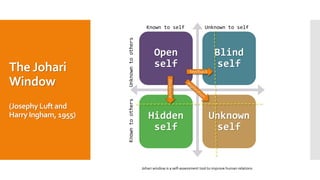
The Johari
Window
(Josephy Luft and
Harry Ingham, 1955)
Open
self
Blind
self
Hidden
self
Unknown
self
Known to self Unknown to self
KnowntoothersUnknowntoothers
feedback
disclosureJohari window is a self-assessment tool to improve human relations
Self
awareness
Social
awareness
Self
management
Social skills
• Working within a diverse
environment
• Working in group
• Understanding our
attitude and personality
• Communicating
effectively
• Etiquette
• Networking
• Communicating verbally
and non-verbally
• Dealing with conflict
• Understanding our
attitude and personality
• Working within union
• Decision making in group
• Negotiation skills
• Communicating effectively,
verbally and in writing
• Understanding non-verbal
communication
• Ability to handle change
• Motivating myself
• Being an effective leader
• Making good ethical choice
• Continuous learning
• Time management
• Self esteem
• Understanding
personal motivation
• Stress management
• Goal setting
SELF / SOCIAL
REGULATION/RECOGNITION
Seminars and workshops
• Attending a workshop can improve skills in specific area.
• It could be related to your field or completely unrelated.
Read
• Books, magazines and websites about your industry can keep you abreast of any
change
Convention
• Attending convention in your field can broaden knowledge and provide important
contact and networking opportunities.
Coaching and mentoring
• Find someone who you admire and someone who is successful and learn from them.
Travel
• Travel broaden our experience
Socially
• Spend time with friends
Continuous
Improvement
Aprocessoflearningnewthings
toenhanceyourselfprofessionally
andpersonally
DO
FIRST
DO
NEXT
DO
LATER
DON’T
DO
High/Low
High/Low
Understand
Your
Motivations
22
NeurosisNormal
• Catastrophe
• Life changes
• Hassles
Stressors
• Appraisal
• Perceived control
• Personality
• Coping behavior
• Social support
Intervening factors
• Biological
• Psychological
• Social
Stress reactions
ManageYour
Stress
General Adaptation SyndromeEffects of stress on performance
Stress
Response
Neuro-endocrine
system
Goal
Setting
There should
always be a
timeframe
attached to a
specific goal.
Most
individuals will
have longer-
term and
shorter-term
goals.
TIME-
ORIENTED
The goal that
is set must be
something you
are willing and
able to work
toward
The goal
cannot be
someone
else’s goal.
REALISTIC
Is the goal
reasonable
enough to be
accomplished?
Make sure the
goal is not out
of reach or
below
standard
performance
ATTAINABLE
From and to
Can you track
the progress
and measure
the outcome
MEASURABLE
Who,What,
Where,When,
Why,Which
Define the
goal as much
as possible,
with no
ambiguous
language
SPECIFIC
Work
Effectively
inGroups
BasicTeam
Dynamics
Open communication
Effective coordination Efficient cooperation
High levels
of interdependence
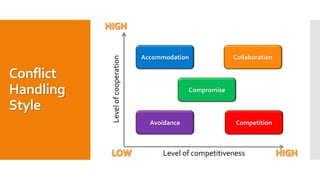
Conflict
Handling
Style
Accommodation
Competition
Collaboration
Compromise
Avoidance
Level of competitiveness
Levelofcooperation

Human relation skills