Delivering Workforce Change Management
Mark Bradshaw
Director
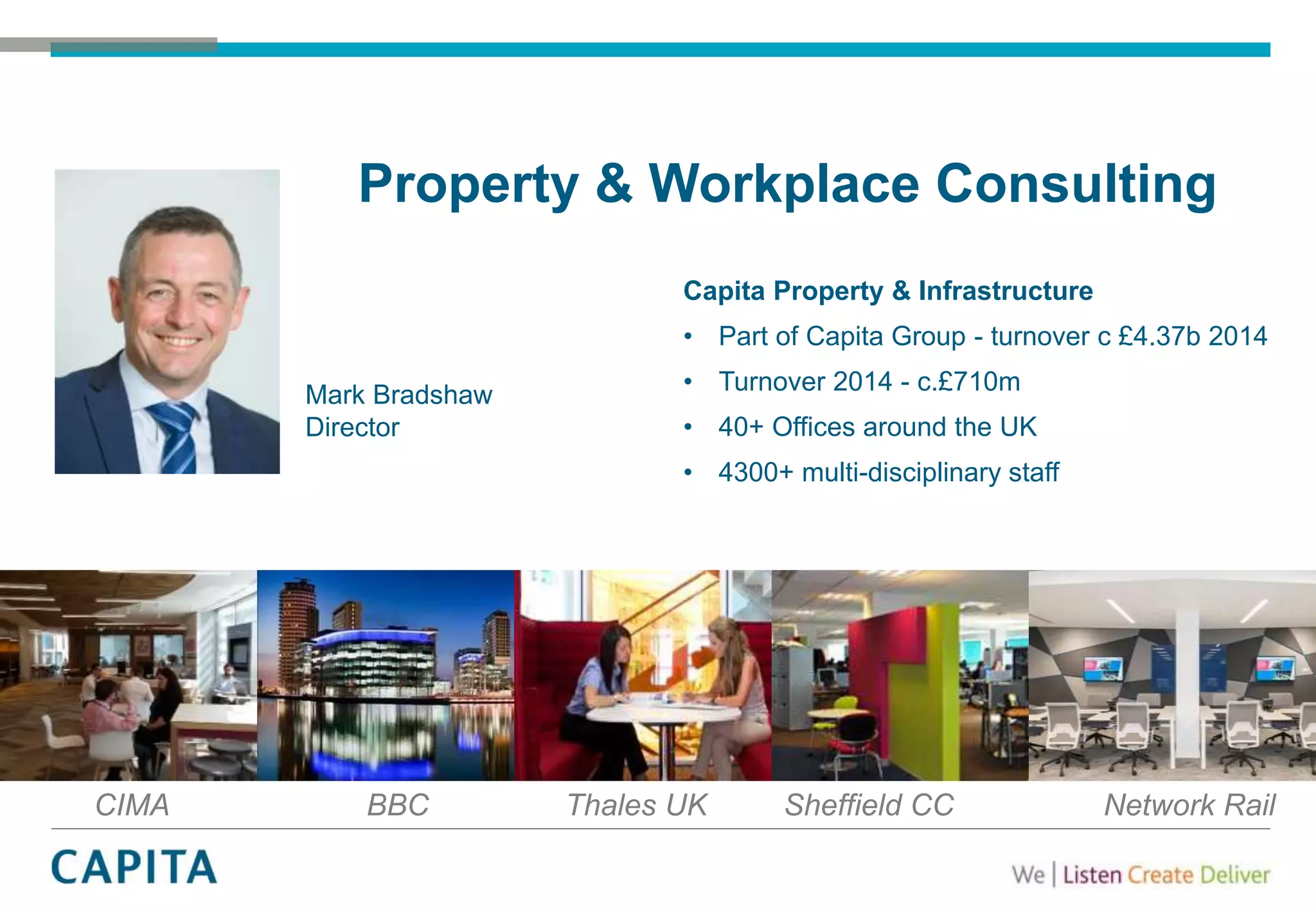
Network RailBBC Thales UKCIMA Sheffield CC
Capita Property & Infrastructure
• Part of Capita Group - turnover c £4.37b 2014
• Turnover 2014 - c.£710m
• 40+ Offices around the UK
• 4300+ multi-disciplinary staff
Property & Workplace Consulting
Agenda
Developing a Strategic Approach to Workforce Change Management
1. What are the key ingredients for a successful
workplace and workforce change
programmes?
2. How does the workplace impact the way in
which your workforce behave and operate?
3. Communication and engagement
4. Embedding local knowledge and skills
5. Lessons learned and common pitfalls when
delivering change in the workplace
Why is Change Management Important ?
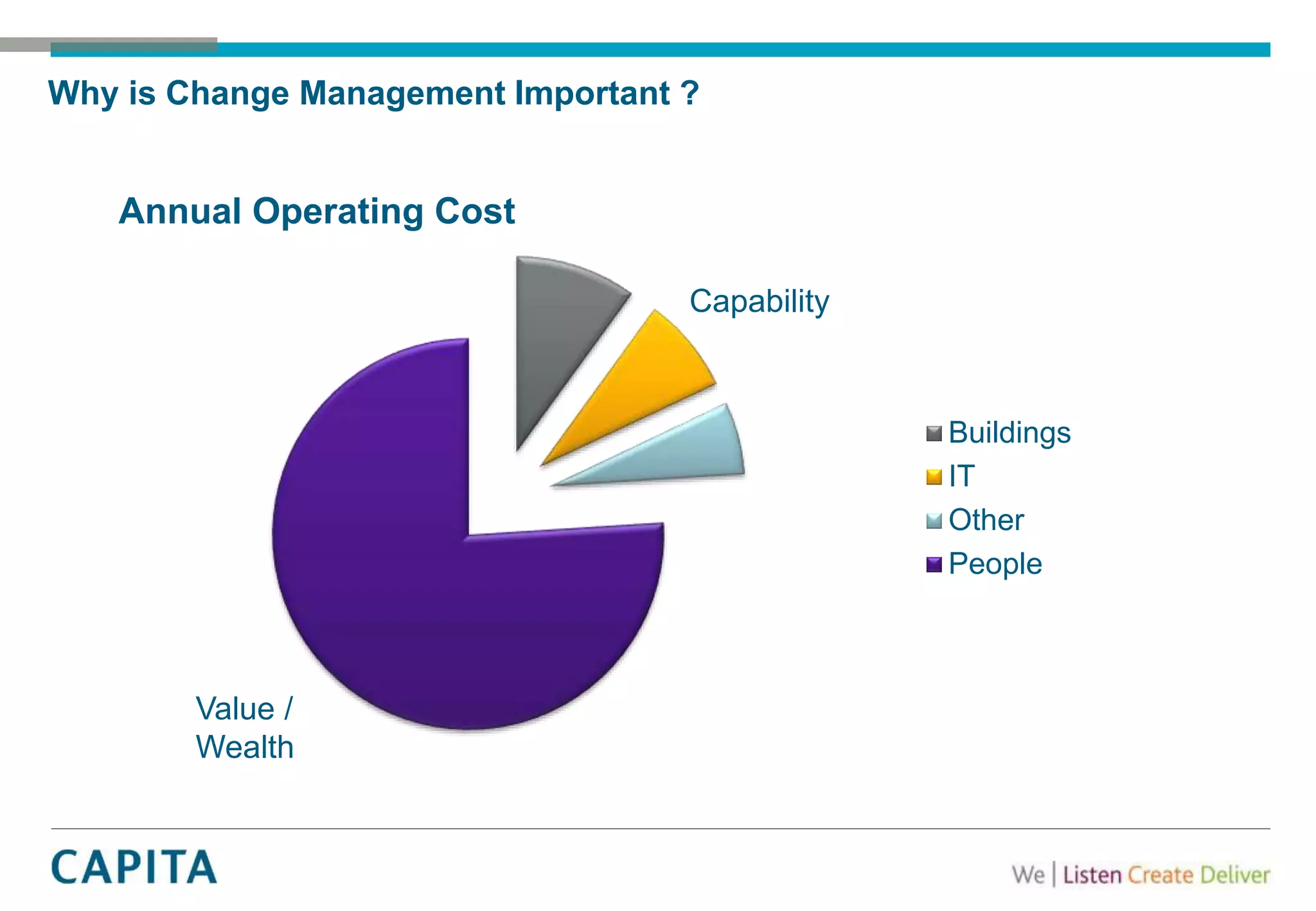
Annual Operating Cost
Buildings
IT
Other
People
Capability
Value /
Wealth
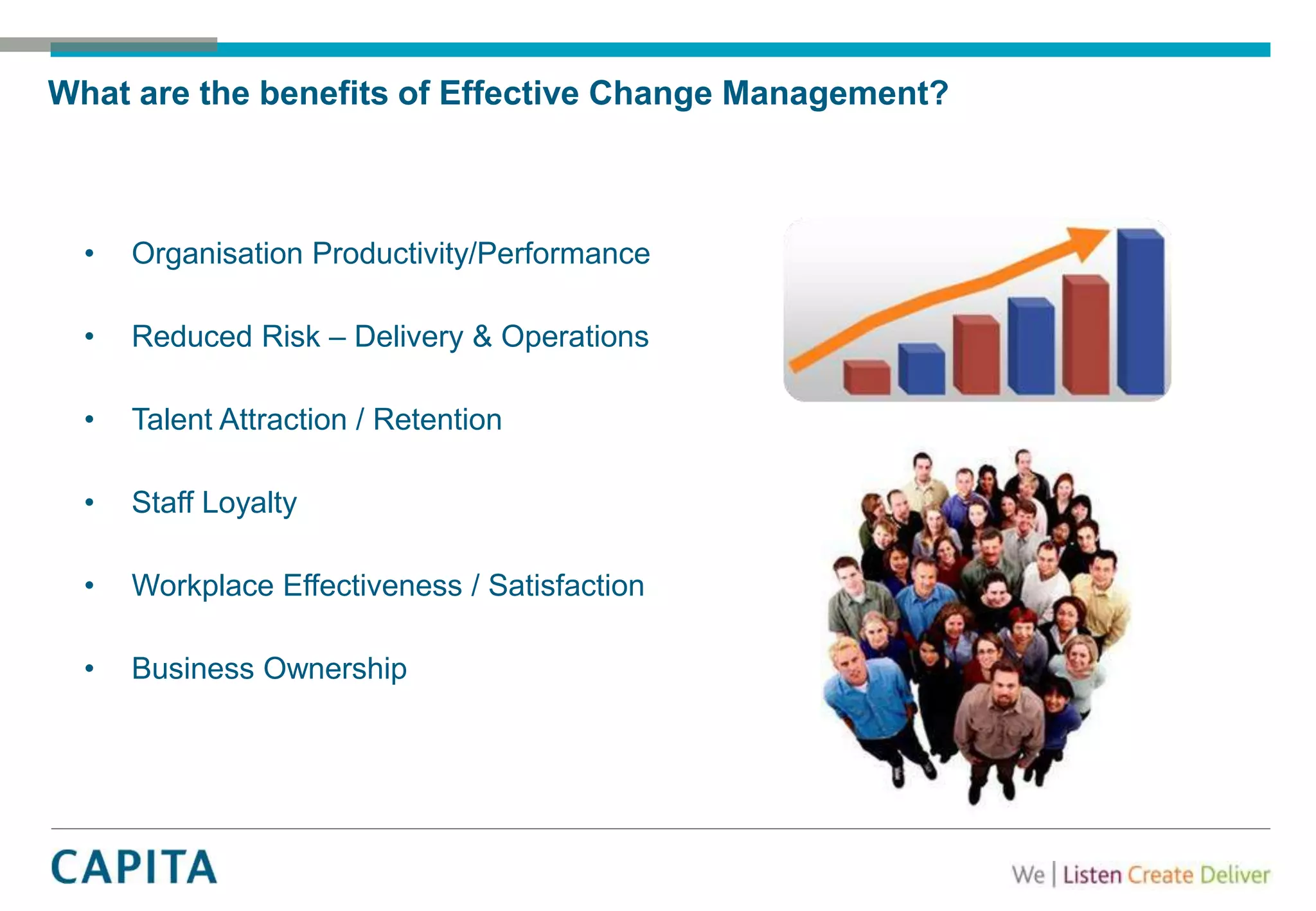
What are the benefits of Effective Change Management?
• Organisation Productivity/Performance
• Reduced Risk – Delivery & Operations
• Talent Attraction / Retention
• Staff Loyalty
• Workplace Effectiveness / Satisfaction
• Business Ownership
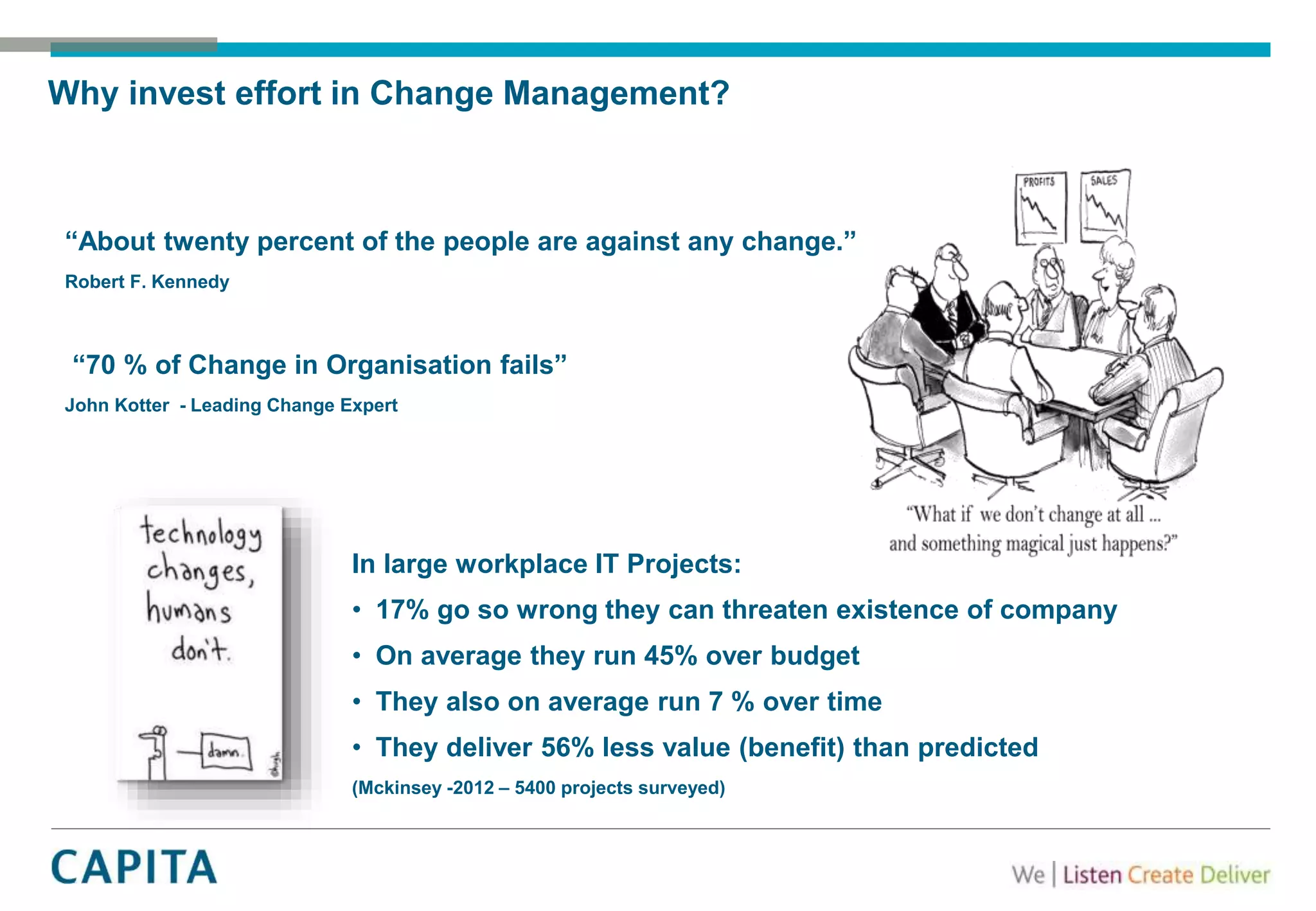
Why invest effort in Change Management?
“About twenty percent of the people are against any change.”
Robert F. Kennedy
“70 % of Change in Organisation fails”
John Kotter - Leading Change Expert
In large workplace IT Projects:
• 17% go so wrong they can threaten existence of company
• On average they run 45% over budget
• They also on average run 7 % over time
• They deliver 56% less value (benefit) than predicted
(Mckinsey -2012 – 5400 projects surveyed)
The Workplace
….its effect on our behaviour and how we operate
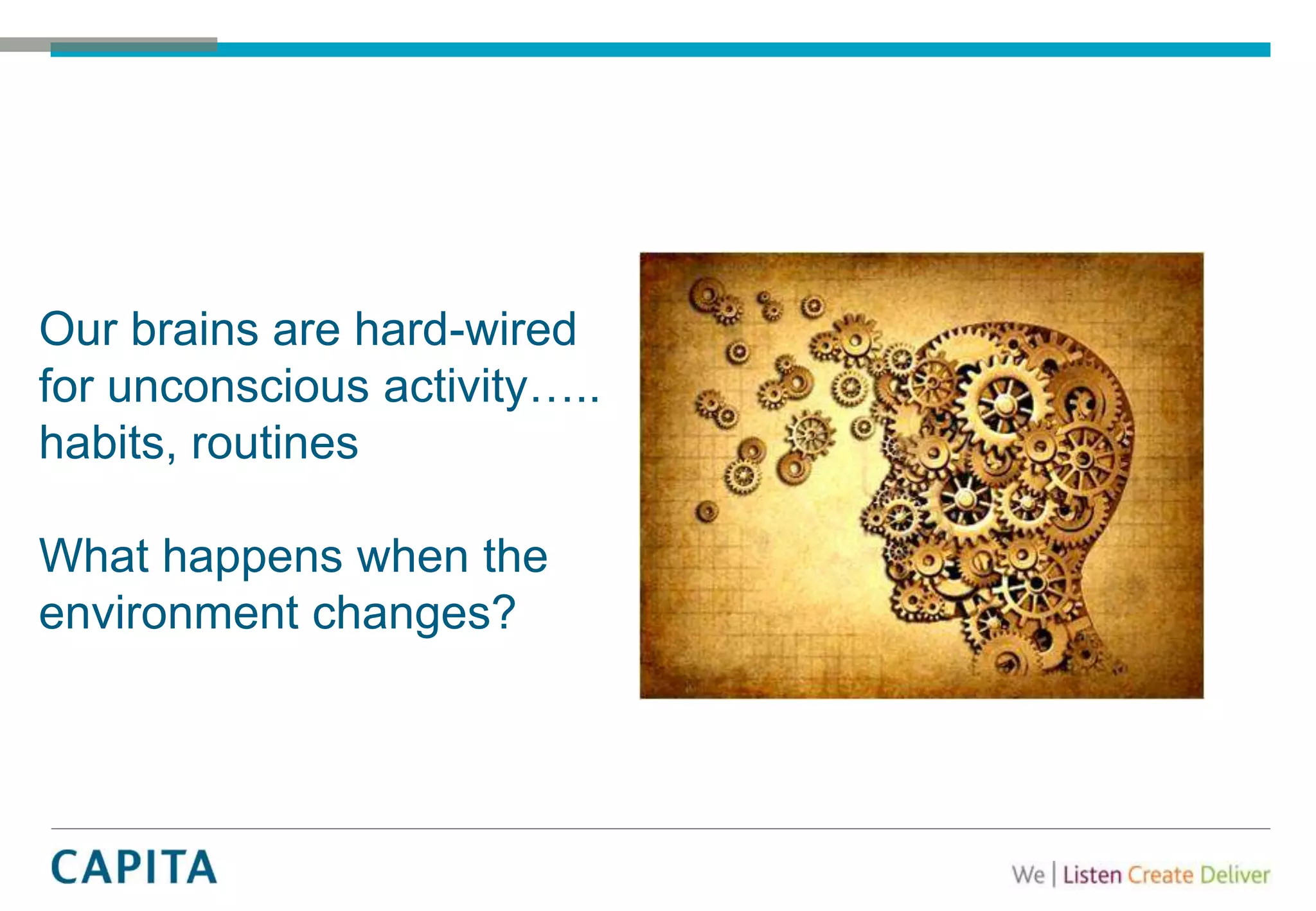
Our brains are hard-wired
for unconscious activity…..
habits, routines
What happens when the
environment changes?
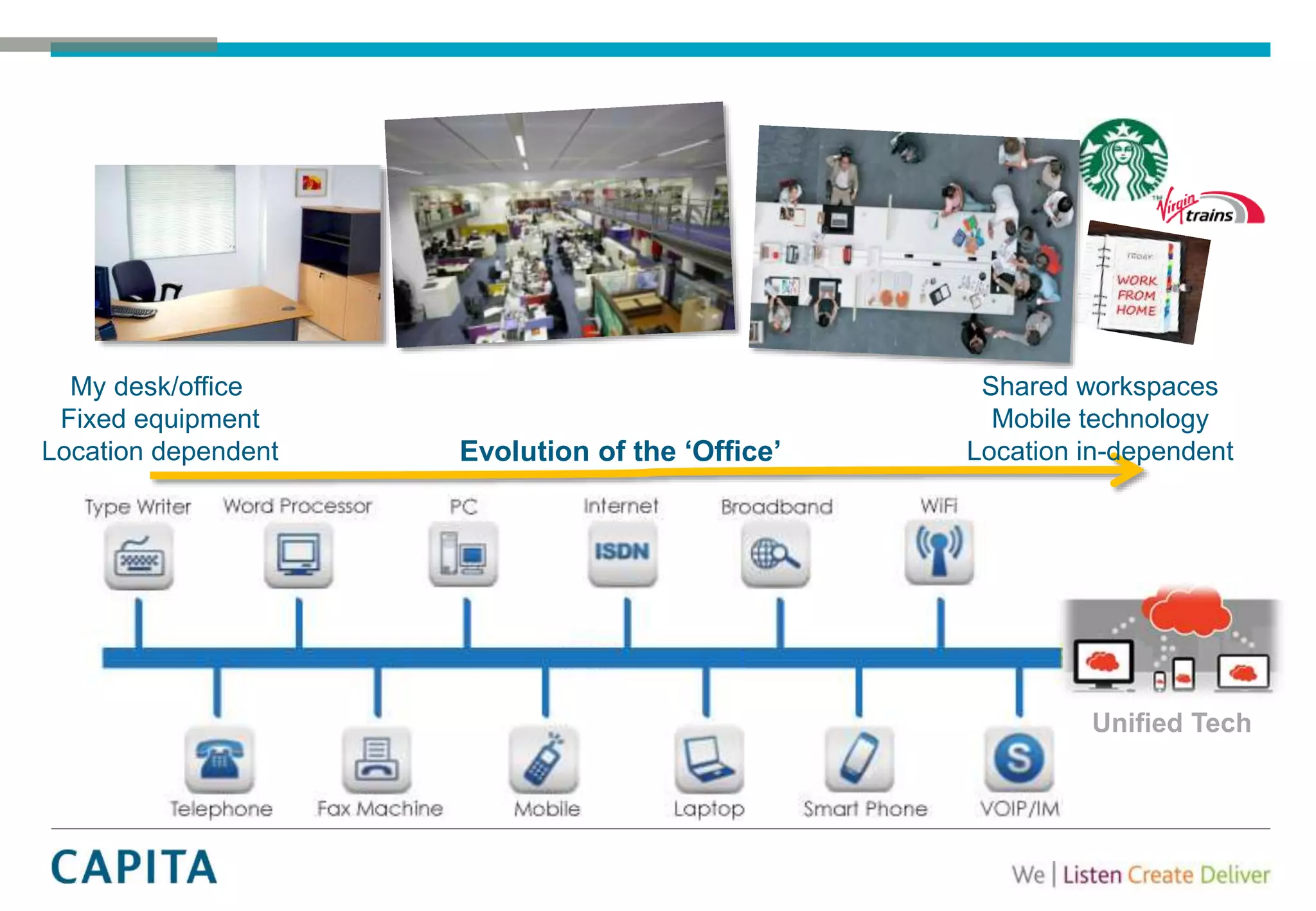
Evolution of the ‘Office’
Unified Tech
My desk/office
Fixed equipment
Location dependent
Shared workspaces
Mobile technology
Location in-dependent
Key Ingredients
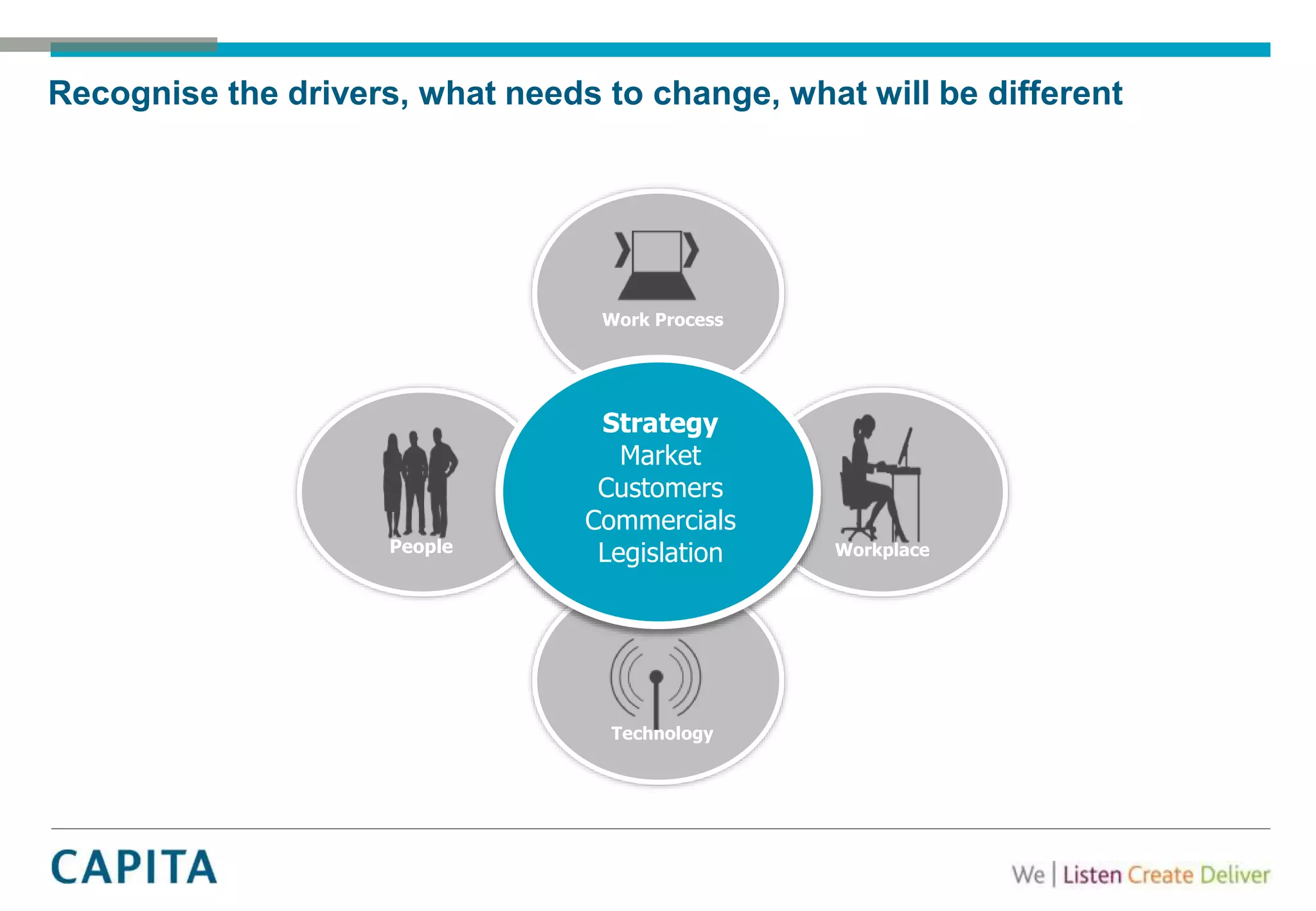
Recognise the drivers, what needs to change, what will be different
Workplace
Work Process
Strategy
Market
Customers
Commercials
LegislationPeople
Technology
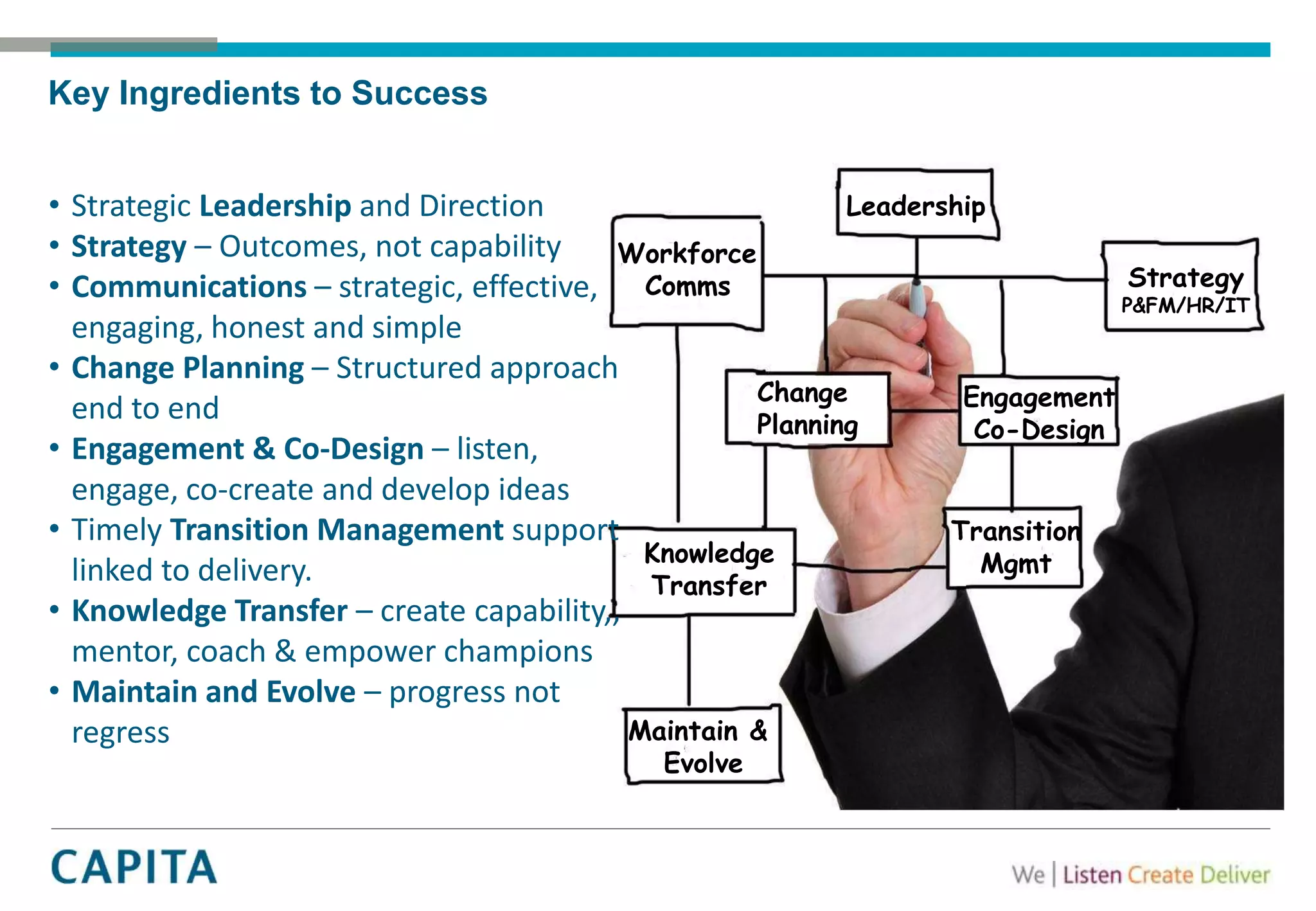
Key Ingredients to Success
Leadership
Workforce
Comms Strategy
P&FM/HR/IT
Knowledge
Transfer
Transition
Mgmt
Maintain &
Evolve
Engagement
Co-Design
• Strategic Leadership and Direction
• Strategy – Outcomes, not capability
• Communications – strategic, effective,
engaging, honest and simple
• Change Planning – Structured approach
end to end
• Engagement & Co-Design – listen,
engage, co-create and develop ideas
• Timely Transition Management support
linked to delivery.
• Knowledge Transfer – create capability,,
mentor, coach & empower champions
• Maintain and Evolve – progress not
regress
Change
Planning
Engagement & Communications
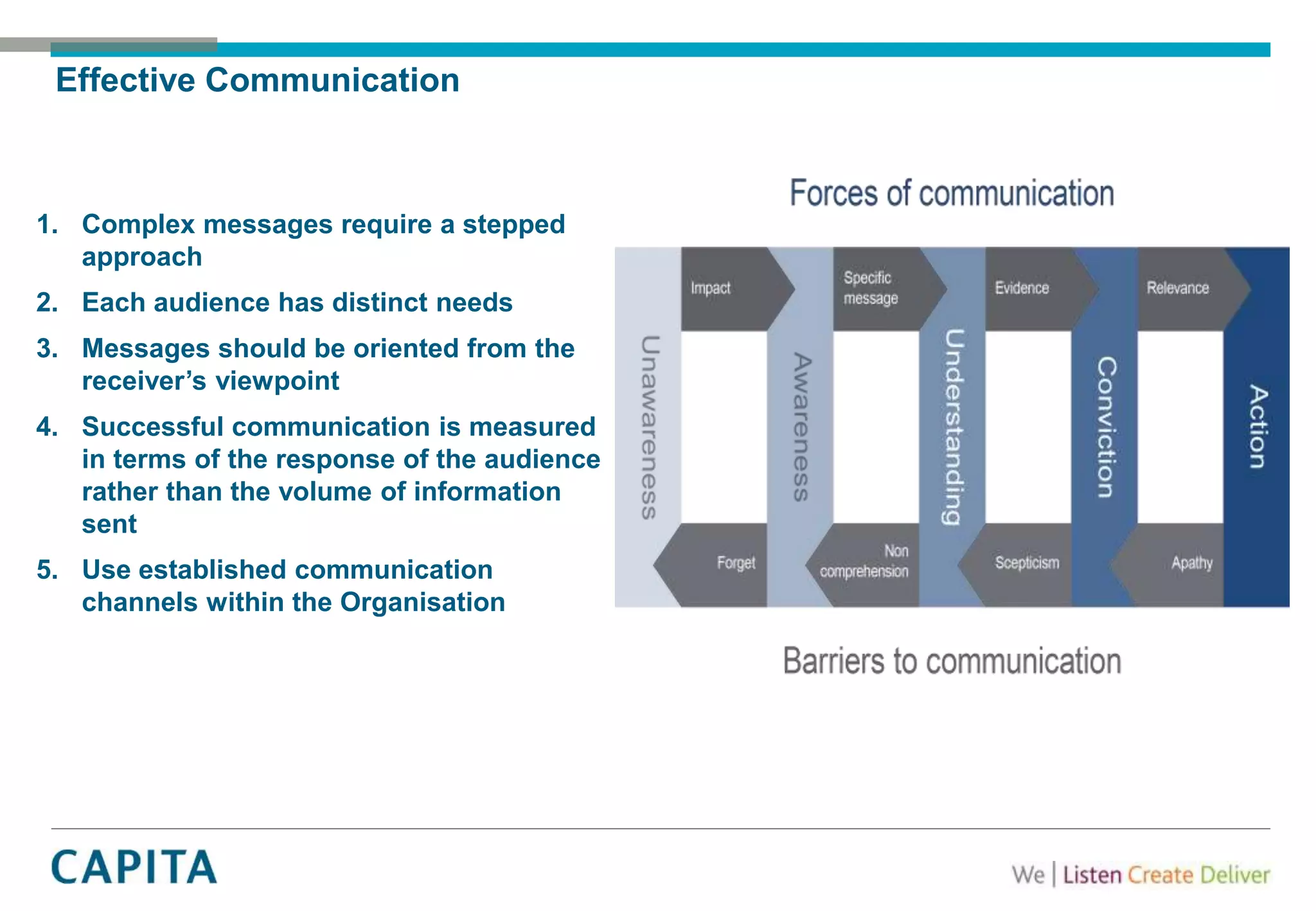
Effective Communication
1. Complex messages require a stepped
approach
2. Each audience has distinct needs
3. Messages should be oriented from the
receiver’s viewpoint
4. Successful communication is measured
in terms of the response of the audience
rather than the volume of information
sent
5. Use established communication
channels within the Organisation
Effective Engagement
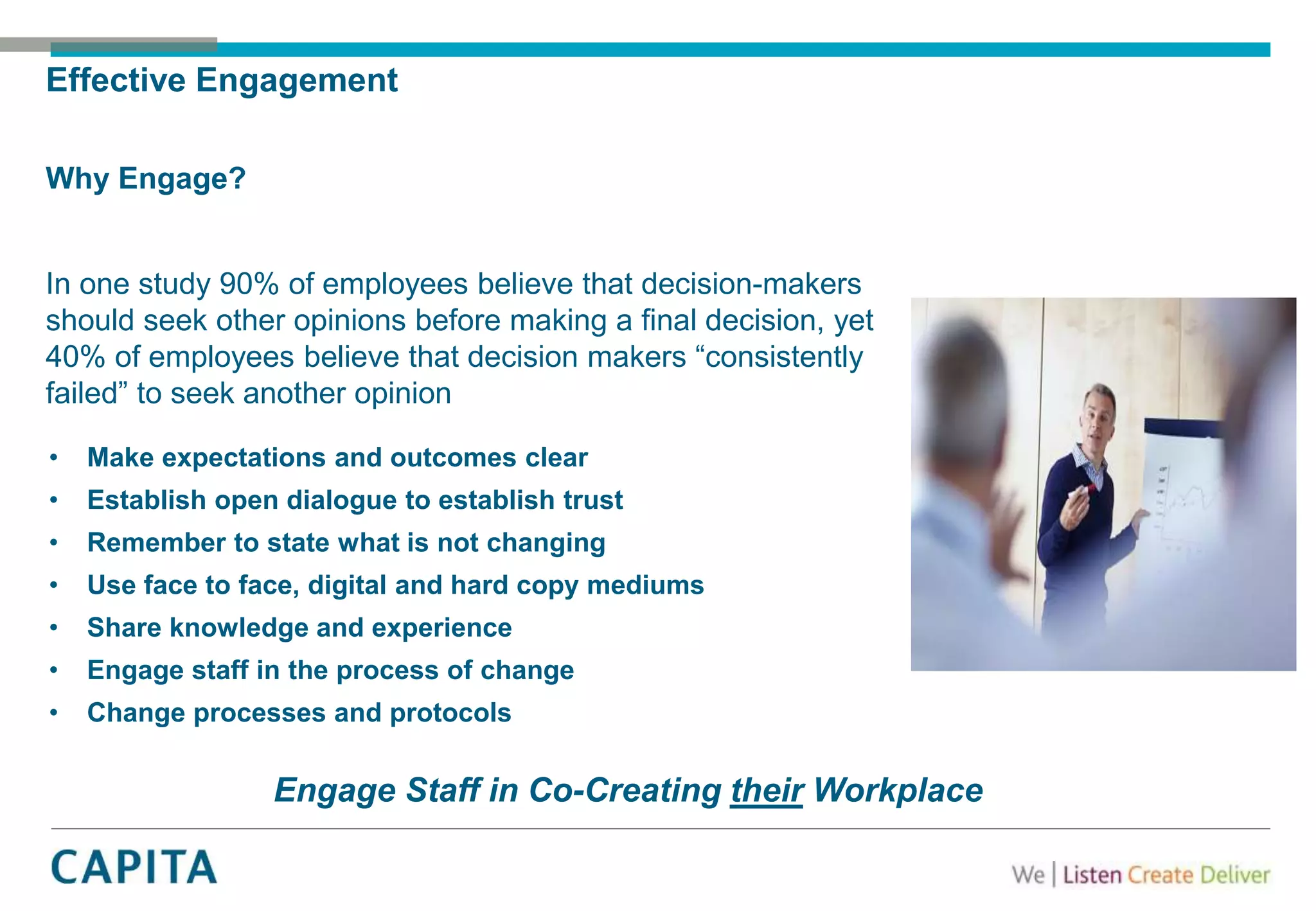
Why Engage?
In one study 90% of employees believe that decision-makers
should seek other opinions before making a final decision, yet
40% of employees believe that decision makers “consistently
failed” to seek another opinion
Engage Staff in Co-Creating their Workplace
• Make expectations and outcomes clear
• Establish open dialogue to establish trust
• Remember to state what is not changing
• Use face to face, digital and hard copy mediums
• Share knowledge and experience
• Engage staff in the process of change
• Change processes and protocols
Embedding Local Knowledge & Skills
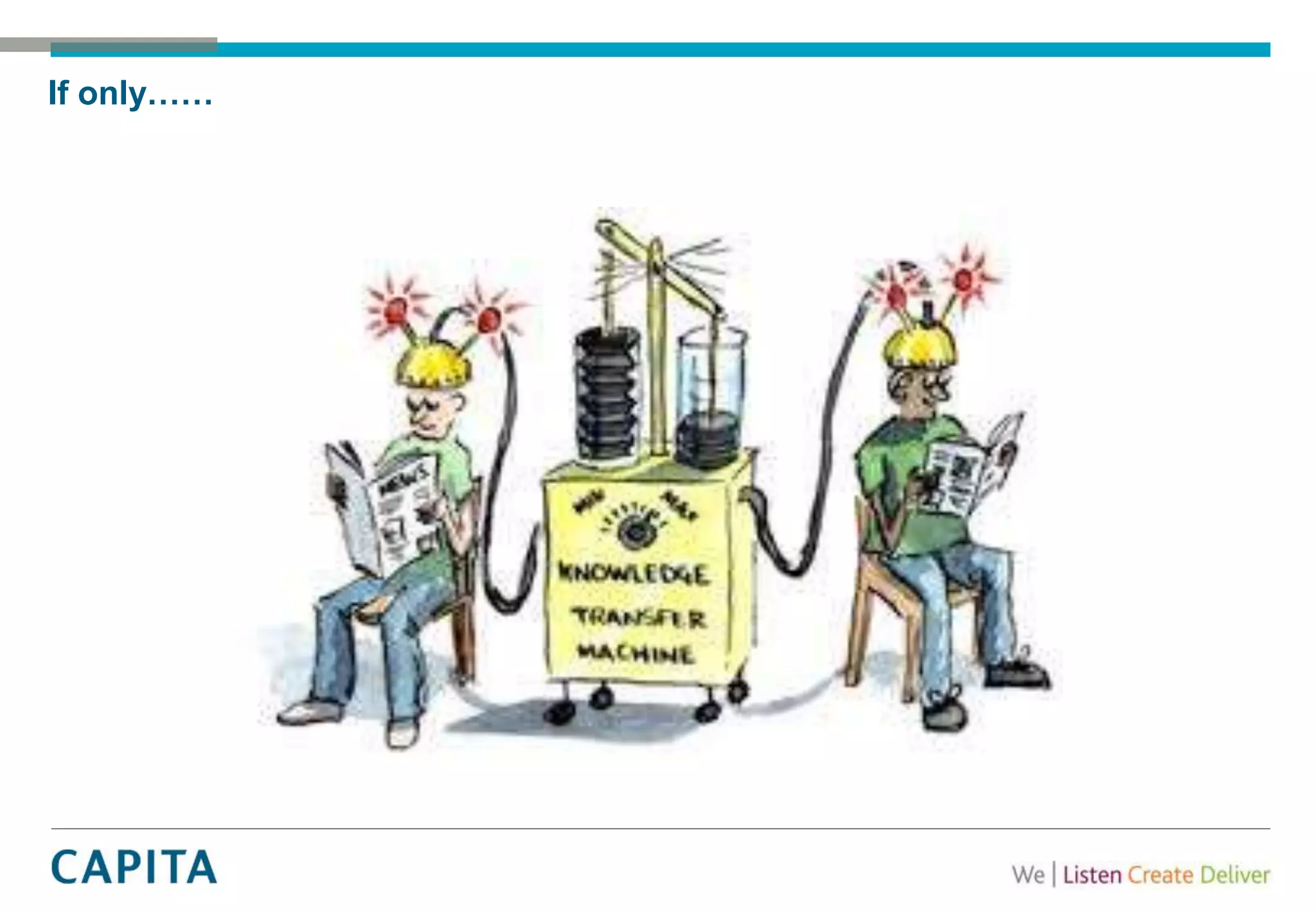
If only……
How do we transfer Knowledge, Skills and Ownership to maintain the change ?
• Mentoring, coaching and training of teams before, during and after
• Identify Workplace Champions - empowered, informed and capable.
• Learning by active participation at all stages
• Maintain engagement and communications –forums, communication channels, brand
• Frequent evaluation – self assessment , reflection and development
Lessons Learnt
• Senior management buy-in and behaviours align to desired future state
• Pilots / Trials - provide staff with a chance to ‘try before they buy(into)’.
• Build good habits – embed them early, create an ‘Employee Charter’
• Shrink the change – emphasise what isn’t changing
• Commitment is the key - active participation is essential
• Recognise success - publicise and promote achievement through the
project
• Effective planning - plan and manage the process of change just like
you’d manage any other project
• Engage, listen and communicate - talk in their language
Change is a process, not an event.
“a long journey starts with a single
step, but a single step doesn’t
guarantee a long journey.....”

FMP Event - Property and Workplace Consulting, it's what we do - Achieve Workplace Transformation - Mark Bradshaw

  • 1.
  • 2.
    Mark Bradshaw Director Network RailBBCThales UKCIMA Sheffield CC Capita Property & Infrastructure • Part of Capita Group - turnover c £4.37b 2014 • Turnover 2014 - c.£710m • 40+ Offices around the UK • 4300+ multi-disciplinary staff Property & Workplace Consulting
  • 3.
    Agenda Developing a StrategicApproach to Workforce Change Management 1. What are the key ingredients for a successful workplace and workforce change programmes? 2. How does the workplace impact the way in which your workforce behave and operate? 3. Communication and engagement 4. Embedding local knowledge and skills 5. Lessons learned and common pitfalls when delivering change in the workplace
  • 4.
    Why is ChangeManagement Important ? Annual Operating Cost Buildings IT Other People Capability Value / Wealth
  • 5.
    What are thebenefits of Effective Change Management? • Organisation Productivity/Performance • Reduced Risk – Delivery & Operations • Talent Attraction / Retention • Staff Loyalty • Workplace Effectiveness / Satisfaction • Business Ownership
  • 6.
    Why invest effortin Change Management? “About twenty percent of the people are against any change.” Robert F. Kennedy “70 % of Change in Organisation fails” John Kotter - Leading Change Expert In large workplace IT Projects: • 17% go so wrong they can threaten existence of company • On average they run 45% over budget • They also on average run 7 % over time • They deliver 56% less value (benefit) than predicted (Mckinsey -2012 – 5400 projects surveyed)
  • 7.
    The Workplace ….its effecton our behaviour and how we operate
  • 8.
    Our brains arehard-wired for unconscious activity….. habits, routines What happens when the environment changes?
  • 9.
    Evolution of the‘Office’ Unified Tech My desk/office Fixed equipment Location dependent Shared workspaces Mobile technology Location in-dependent
  • 10.
  • 11.
    Recognise the drivers,what needs to change, what will be different Workplace Work Process Strategy Market Customers Commercials LegislationPeople Technology
  • 12.
    Key Ingredients toSuccess Leadership Workforce Comms Strategy P&FM/HR/IT Knowledge Transfer Transition Mgmt Maintain & Evolve Engagement Co-Design • Strategic Leadership and Direction • Strategy – Outcomes, not capability • Communications – strategic, effective, engaging, honest and simple • Change Planning – Structured approach end to end • Engagement & Co-Design – listen, engage, co-create and develop ideas • Timely Transition Management support linked to delivery. • Knowledge Transfer – create capability,, mentor, coach & empower champions • Maintain and Evolve – progress not regress Change Planning
  • 13.
  • 14.
    Effective Communication 1. Complexmessages require a stepped approach 2. Each audience has distinct needs 3. Messages should be oriented from the receiver’s viewpoint 4. Successful communication is measured in terms of the response of the audience rather than the volume of information sent 5. Use established communication channels within the Organisation
  • 15.
    Effective Engagement Why Engage? Inone study 90% of employees believe that decision-makers should seek other opinions before making a final decision, yet 40% of employees believe that decision makers “consistently failed” to seek another opinion Engage Staff in Co-Creating their Workplace • Make expectations and outcomes clear • Establish open dialogue to establish trust • Remember to state what is not changing • Use face to face, digital and hard copy mediums • Share knowledge and experience • Engage staff in the process of change • Change processes and protocols
  • 16.
  • 17.
  • 18.
    How do wetransfer Knowledge, Skills and Ownership to maintain the change ? • Mentoring, coaching and training of teams before, during and after • Identify Workplace Champions - empowered, informed and capable. • Learning by active participation at all stages • Maintain engagement and communications –forums, communication channels, brand • Frequent evaluation – self assessment , reflection and development
  • 19.
  • 20.
    • Senior managementbuy-in and behaviours align to desired future state • Pilots / Trials - provide staff with a chance to ‘try before they buy(into)’. • Build good habits – embed them early, create an ‘Employee Charter’ • Shrink the change – emphasise what isn’t changing • Commitment is the key - active participation is essential • Recognise success - publicise and promote achievement through the project • Effective planning - plan and manage the process of change just like you’d manage any other project • Engage, listen and communicate - talk in their language
  • 21.
    Change is aprocess, not an event. “a long journey starts with a single step, but a single step doesn’t guarantee a long journey.....”

Editor's Notes

  • #2 Welcome
  • #3 Welcome all. My name is Mark Bradshaw, I’m the Director of the Property and Workplace Consulting team at Capita I have been leading and delivering change for our clients for over 8 years at Capita following 12years working client side for the BBC as a Workplace Partner. That is where my passion turned to looking at the effect the workplace had on people – what are the true needs, how can we make the workplace enable these and what change is necessary. Change is key – within our team we have change managers, HR and behaviour psychologists…… Over the past 8 years we have worked across many sectors; managed workplace change within many organisations; experienced diverse cultures; overcome many challenges and met some interesting people…….
  • #4 It was a pleasure sitting amongst the presentations and discussions last night. For many years the discussion amongst FM & P has been technical, focused on what we do i.e. property & FM – last night every discussion I was party to referred to the occupiers and the importance of change. Thanks to George from Plantronics and those in the property workshop for kicking the debate off. In the audience we have some ‘change gurus’ and many others who have experienced the delivery of change management and recognise the importance of change – never the less irrespective of where you are its inspiring to see the shift in the way we look at our facilities & services – i.e with the occupier in mind. After all without them we are redundant ! During the next 25 minutes I will share with you my thoughts, experience and aspects of change that I believe are important. Clearly it will not provide you with all the information and tools you need to deliver change however I hope that my presentation proves beneficial to you.
  • #5 As property & FM professionals we can sometimes focus on buildings, maintenance, projects, portfolio events ………creating the right capability in an efficient manner…… however given the daily pressures we can easily forget why we do what we do – to enable the business to be successful and create the right environment for the staff to be effective In our experience most organisations typically direct 75% of their cost on their employees. Its therefore not surprising that the benefits or risks associated with the way people use the space I know of no organisation that does not generate its ‘wealth’ from its people – therefore if a team reduced their productivity by 10% as a result of poor change management its ‘wealth’ is impacted………the result can be catastrophic. By contrast the benefits can be significant – far greater than the property savings delivered
  • #6 The benefits on the screen should all be familiar to you in one way or another. Measuring them can sometimes be a challenge however during last nights discussion George from plantronics referenced example benefits which his business realised– real benefits with value 80% plus reduction in recruitment costs, 95% plus reduction in absence. Consider that evidence suggests a new workplace can increase productivity by at least 11% then its clear to see that the return on investment can be significant
  • #7 So we know there are benefits but why invest considerable effort ? Well, put simply its hard work and it frequently goes wrong….. Don’t underestimate the level of effort, support and management required to effect a change in behaviour. Failure to allocate resources to change management will impact the benefits.
  • #9 Our brains are hard-wired for unconscious activity – habits – because these take little energy thereby allowing the brain to work harder on those conscious actions that require thought processing. First we need to understand we too have habits, and preferences.  If you can recognise yourself, and your habits whilst driving to work, sitting on the train, going to your favourite coffee house ordering the same drink, What happens if your habitual routine is changed……left hand drive you need to think now of yourself in the office, and your colleagues. Any habits or regular behaviours? now consider the need for the support to change those habits, how easy would you find it to use Neros not Starbucks, or just another branch of your normal Starbucks.
  • #10 Now consider how the workplace and technology have evolved. Change is happening, at a faster pace each day I’m given a smart phone…..an assumption I can use it….. ? I’m given office 365………an assumption I can use it …..? We’re provided with a new workplace………why do we assume that we can change our habits and behaviours over a weekend when our office moves?
  • #12 First of all we need to understand the drivers behind the change and then consider what’s changing…… systems, technology, people, workplace, the external environment or all of them ? Then consider what will be different as a result and who will it impact ? that’s the process of change that we need to manage. It might be our employees, it might be our customers, it might be our suppliers and partners….. To be successful change management needs to cut across all areas impacted.
  • #13 Strategic Leadership and Direction Strategy – Outcomes, not capability Communications – strategic, effective, engaging, honest and simple Change Planning – Structured approach end to end Engagement & Co-Design – listen, engage, co-create and develop ideas Timely Transition Management support linked to delivery. Knowledge Transfer – create capability,, mentor, coach & empower champions Maintain and Evolve – progress not regress
  • #15 Communication should be staged with appropriate messaging linked to the stage of change and project. Ensure it is relevant, based on sound evidence and specific Consider the needs of the audience – what do they need, how will they process the message, what do we want to happen as a result. Use internal communication channels – familiar and accessible Think about parallel comms from within the business to ensure it does not get lost.
  • #16 So the workforce believe we should engage during decision making – yet it seems those who make decisions don’t meet their expectations. If we want people to change we need to engage them, co-design and develop We adopt a ‘You said, We did’ philosophy – the workplace and the environment can be tracked back to the business requirements Solving the peoples problems means you need to “listen, create, then deliver” openly and honestly. It is their workplace afterall…
  • #18 The day the project is handed over is not the end. It’s the beginning. Unless the change is managed effectively, post the capability being delivered, old habits will return and the benefits expected will be lost over time. We cant be everywhere, and consultants are expensive, so we need to transfer ownership to the business – give them skills to self manage and develop.
  • #19  Learning by doing as active participants in the design, through to the POE allow the Change Champions to employ ‘active learning’ This will increase the likelihood of embedding the change, and the ongoing support for the change. Keep communications and engagement alive and evaluate how the space is performing for the employees
  • #21 Just a few – there are many………here are some frequent Senior management buy-in and behaviours align to desired future state Pilots / Trials - provide staff with a chance to ‘try before they buy(into)’. Build good habits – embed them early, create an ‘Employee Charter’ Shrink the change – emphasise what isn’t changing Commitment is the key - active participation is essential Recognise success - publicise and promote achievement through the project Effective planning - plan and manage the process of change just like you’d manage any other project Engage, listen and communicate - talk in their language
  • #22 Thank you