1 
Chameleon Suit –Changing the Outlook for EVA 
November 7, 2003 
Ed Hodgson 
Hamilton Sundstrand
2 
Project Basics 
•Advanced Extra-Vehicular Activity System Concept 
•Phase 2 Study 
–March 2002 –January 2004 
•Contract #NAS5-03110 Grant #07605-003-001 
•HS Project Team –Gail Baker, Allison Bender, JoelGoldfarb, Edward Hodgson, Gregory Quinn, FredSribnik, CatherineThibaud-Erkey 
•External Support –NIAC, NASA JSC, NASA HQ, and many, many more.
3 
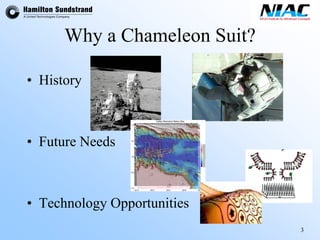
Why a Chameleon Suit? 
•History 
•Future Needs 
•Technology Opportunities
4 
Historical EVA Challenges and Issues 
•Pressure Suit Mobility & Comfort 
•On-Back Weight 
•EVA Expendables 
•Durability / Maintainability
5 
Future Mission NeedsAccessiblePlanetarySurfaceEarth& LEOAnywhere/ AnytimeEarth’sNeighborhood 
•Easier 
•Lighter 
•Cheaper 
•Longer 
•Adaptable
6 
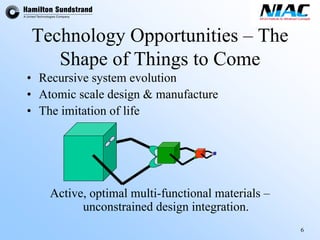
Technology Opportunities –The Shape of Things to Come 
•Recursive system evolution•Atomic scale design & manufacture•The imitation of lifeActive, optimal multi-functional materials – unconstrained design integration.
7 
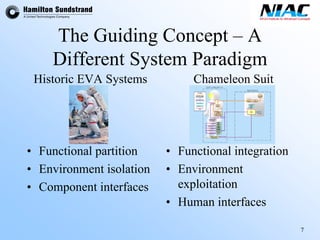
The Guiding Concept –A Different System Paradigm 
Historic EVA Systems•Functional partition•Environment isolation•Component interfacesChameleon Suit•Functional integration•Environment exploitation•Human interfaces
8 
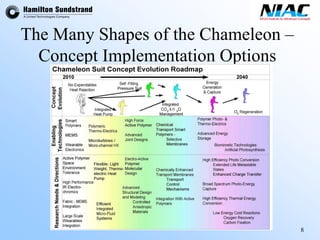
The Many Shapes of the Chameleon – Concept Implementation Options
9 
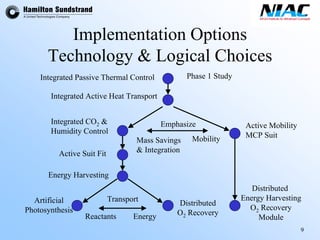
Implementation Options 
Technology & Logical Choices 
Phase 1 Study 
Integrated Passive Thermal Control 
Integrated Active Heat TransportEmphasize 
Integrated CO2& 
Humidity Control 
Active Mobility 
MCP Suit 
Mobility 
Mass Savings 
& Integration 
Active Suit FitTransportArtificialPhotosynthesisEnergy HarvestingDistributed Energy HarvestingO2RecoveryModule 
Distributed 
O2Recovery 
Reactants 
Energy
10 
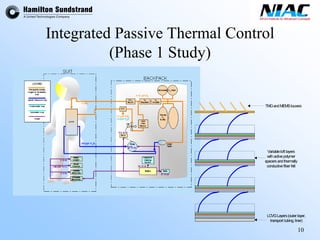
Integrated Passive Thermal Control 
(Phase 1 Study) LCVG Layers (outer layer, transport tubing, liner) TMG and MEMS louversVariable loft layerswith active polymerspacers and thermallyconductive fiber felt
11 
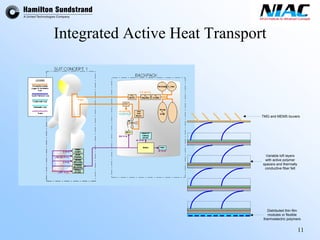
Integrated Active Heat TransportDistributed thin filmmodules or flexiblethermoelectric polymersTMG and MEMS louversVariable loft layerswith active polymerspacers and thermallyconductive fiber felt
12 
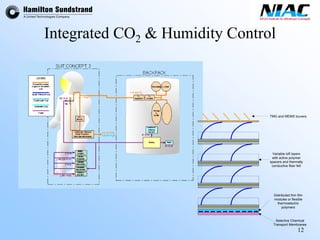
Integrated CO2& Humidity ControlDistributed thin filmmodules or flexiblethermoelectricpolymersTMG and MEMS louversSelective ChemicalTransport MembranesVariable loft layerswith active polymerspacers and thermallyconductive fiber felt
13 
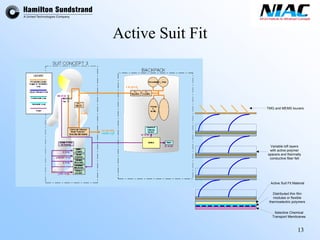
Active Suit FitDistributed thin filmmodules or flexiblethermoelectric polymersTMG and MEMS louversSelective ChemicalTransport MembranesActive Suit Fit MaterialVariable loft layerswith active polymerspacers and thermallyconductive fiber felt
14 
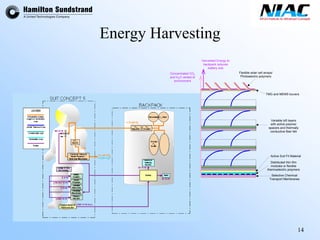
Energy HarvestingDistributed thin filmmodules or flexiblethermoelectric polymersTMG and MEMS louversSelective ChemicalTransport MembranesActive Suit Fit MaterialFlexible solar cell arrays/ Photoelectric polymersConcentrated CO2and H2O vented toenvironmentHarvested Energy tobackpack reducesbattery sizeVariable loft layerswith active polymerspacers and thermallyconductive fiber felt
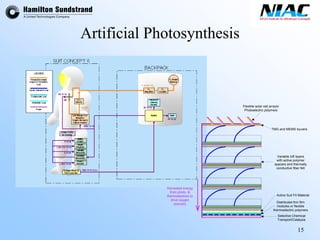
15 
Artificial PhotosynthesisDistributed thin filmmodules or flexiblethermoelectric polymersTMG and MEMS louversVariable loft layerswith active polymerspacers and thermallyconductive fiber feltSelective ChemicalTransport/CatalysisActive Suit Fit MaterialFlexible solar cell arrays/ Photoelectric polymersHarvested energyfrom photo- & thermoelectrics todrive oxygenrecovery
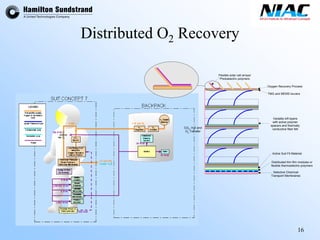
16 
Distributed O2RecoveryDistributed thin film modules orflexible thermoelectric polymersTMG and MEMS louversSelective ChemicalTransport MembranesActive Suit Fit MaterialFlexible solar cell arrays/ Photoelectric polymersOxygen Recovery ProcessVariable loft layerswith active polymerspacers and thermallyconductive fiber feltCO2, H20 andO2 Transfer
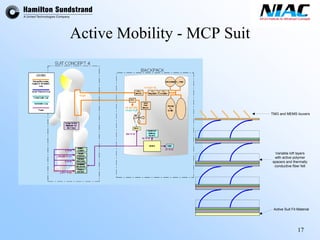
17 
Active Mobility -MCP SuitTMG and MEMS louversActive Suit Fit MaterialVariable loft layerswith active polymerspacers and thermallyconductive fiber felt
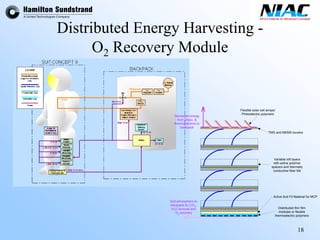
18 
Distributed Energy Harvesting - 
O2Recovery ModuleDistributed thin filmmodules or flexiblethermoelectric polymersTMG and MEMS louversActive Suit Fit Material for MCPFlexible solar cell arrays/ Photoelectric polymersHarvested energyfrom photo- & thermoelectrics tobackpackVariable loft layerswith active polymerspacers and thermallyconductive fiber feltSuit atmosphere tobackpack for CO2, H2O removal andO2 recovery
19 
Enabling Technologies 
•Multi-functional Materials 
•Bio-mimetic Processes 
•Advanced Manufacturing Technologies 
•Information Technologies
20 
Multifunctional Materials 
•Conductive Polymers 
•Shape Change Materials 
•Optically Active Materials 
•Energy Storage and Conversion 
•Chemically Active Materials
21 
Polymers andNanocomposites 
Engineered Materials Revolution 
•Driven by, enabled by, and underlying information revolution 
–Microelectronics > massive complexity > ever smaller features > MEMS 
–Computational, imaging and modeling tools at atomic and molecular scales 
•Ubiquitous in science, industry & society 
•Designer molecules 
–Multi-functional polymers –conductive, mechanically active, optically active, chemically active 
–Biomimetic 
•Nano-composites
22 
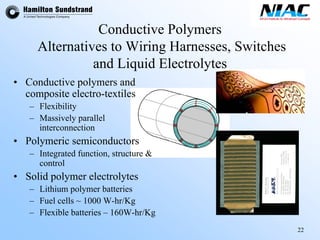
Conductive PolymersAlternatives to Wiring Harnesses, Switches and Liquid Electrolytes•Conductive polymers and composite electro-textiles–Flexibility–Massively parallel interconnection•Polymeric semiconductors–Integrated function, structure & control•Solid polymer electrolytes–Lithium polymer batteries –Fuel cells ~ 1000 W-hr/Kg–Flexible batteries –160W-hr/Kg
23 
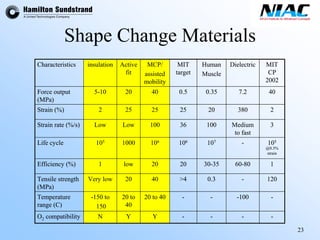
Shape Change Materials 
- -100- 60-80- Medium to fast3807.2Dielectric---20 to 40 20 to 40-150 to150 Temperature range (C) - 0.3 30-35107100200.35 HumanMuscle- 1201105@0.3% strain3240MIT CP 2002NVery low1105Low25-10insulation- >42010636250.5MIT targetY 40201061002540MCP/ assisted mobility20Tensile strength (MPa) Ylow1000Low2520Active fitO2compatibilityEfficiency (%) Life cycleStrain rate (%/s) Strain (%) Force output (MPa) Characteristics- Characteristics
24 
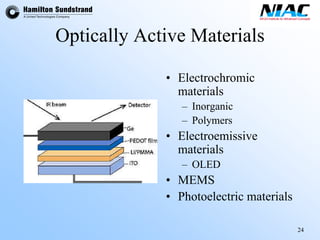
Optically Active Materials 
•Electrochromicmaterials–Inorganic–Polymers•Electroemissivematerials–OLED•MEMS•Photoelectric materials
25 
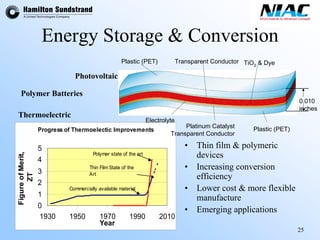
Energy Storage & Conversion 
•Thin film & polymeric devices•Increasing conversion efficiency•Lower cost & more flexible manufacture•Emerging applicationsProgress of Thermoelectic Improvements01234519301950197019902010Year Figure of Merit, ZT Thin Film State of the ArtPolymer state of the artCommercially available materialElectrolytePlastic (PET)Platinum CatalystTransparent Conductor0.010 inchesPlastic (PET)TiO2& DyeTransparent ConductorPhotovoltaicPolymer Batteries 
Thermoelectric
26 
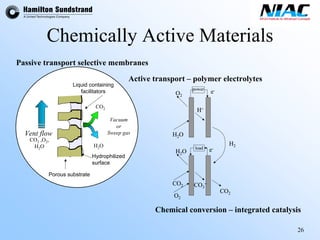
Chemically Active MaterialsO2CO2H2OCO2e-loadH2OO2H2e-powerH+ CO3= O2CO2H2OCO2e-Porous substrateLiquid containing facilitatorsHydrophilized surfaceVent flowCO2,O2, H2OH2OCO2Vacuumor Sweep gasPassive transport selective membranesActive transport –polymer electrolytes 
Chemical conversion –integrated catalysis
27 
Bio-mimetic Processes 
•Membranes 
•Bio-catalysts 
•Artificial Photosynthesis 
•Self-Assembling Systems
28 
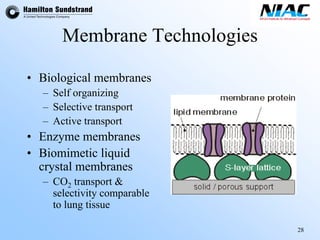
Membrane Technologies 
•Biological membranes 
–Self organizing 
–Selective transport 
–Active transport 
•Enzyme membranes 
•Biomimeticliquid crystal membranes 
–CO2 transport & selectivity comparable to lung tissue
29 
Bio-catalysts 
BiocatalyticProcesses 
•Efficient reactions at useful rates and modest temperatures 
•High specificity 
•Enzymes -organic - stereochemical 
Historical Processes 
•Efficient reactions at high rates , high temperatures 
•Limited specificity 
•Inorganic metals & salts
30 
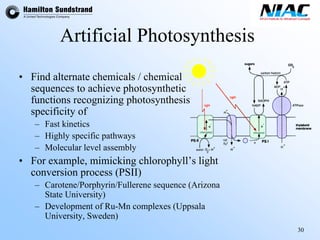
Artificial Photosynthesis 
•Find alternate chemicals / chemical sequences to achieve photosynthetic functions recognizing photosynthesis specificity of–Fast kinetics–Highly specific pathways–Molecular level assembly •For example, mimicking chlorophyll’s light conversion process (PSII) –Carotene/Porphyrin/Fullerene sequence (Arizona State University) –Development of Ru-Mncomplexes (Uppsala University, Sweden)
31 
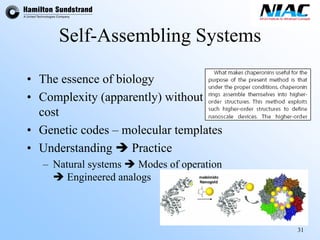
Self-Assembling Systems•The essence of biology•Complexity (apparently) without cost•Genetic codes –molecular templates•Understanding ÎPractice–Natural systems ÎModes of operation ÎEngineered analogs
32 
Advanced Manufacturing Technologies 
•Photo-Lithography 
•Stereo-Lithography 
•Self-Assembling Systems
33 
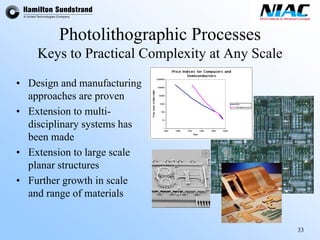
Photolithographic Processes 
Keys to Practical Complexity at Any Scale 
•Design and manufacturing approaches are proven 
•Extension to multi- disciplinary systems has been made 
•Extension to large scale planar structures 
•Further growth in scale and range of materials
34 
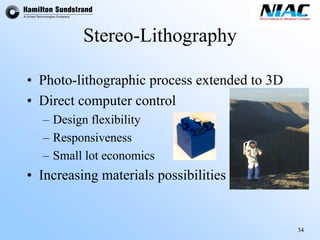
Stereo-Lithography 
•Photo-lithographic process extended to 3D•Direct computer control–Design flexibility–Responsiveness–Small lot economics•Increasing materials possibilities
35 
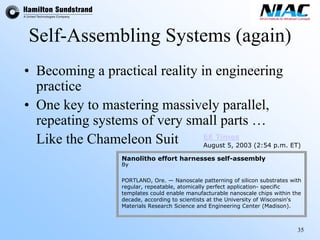
Self-Assembling Systems (again) 
•Becoming a practical reality in engineering practice 
•One key to mastering massively parallel, repeating systems of very small parts … 
Like the Chameleon Suit 
Nanolithoeffort harnesses self-assembly PORTLAND, Ore. —Nanoscalepatterning of silicon substrates with regular, repeatable, atomically perfect application-specific templates could enablemanufacturable nanoscalechips within the decade, according to scientists at the University of Wisconsin'sMaterials Research Science and Engineering Center (Madison). By R. Colin Johnson 
EE Times 
August 5, 2003 (2:54 p.m. ET)
36 
Information Technologies 
•Underlying Technology 
•Information Processing 
•Connectivity 
•Recursive Design 
•Advanced Interfaces
37 
Underlying Technology Base 
•Silicon as a designer material 
–Flexible, easily controlled functionality 
–Consistent continuous structure 
•Photolithographic manufacturing 
–Progressive evolution to smaller scales 
–Consistent, local control ofmicroscalecomposition 
•Automated design, manufacturing processes
38 
Information Processing 
•Dealing with massive complexity essential for and enabled by information revolution enables: 
–Design of complex structures and networks 
–Complex control algorithms and networks 
–Practical coordinated interaction of large numbers of sensors and effectors 
–Analysis and understanding of complex natural systems –designer molecules &biomimeticdesign 
ĂŽChameleon Suit practicality
39 
Connectivity 
•Data bus structures and approaches to enable flow of information among large numbers of cooperating devices with practical overhead 
–Data bus ÎEthernetÎInternet 
•Wireless adaptations Îflexible geometry and topology 
•Smaller, lower power access devices Γsmart dust”
40 
Recursive & Extensible Processes•N-1th generation capabilities enable Nth generation design•Progressive change in scale (smaller), complexity (greater) •Extensible to additional degrees of freedom & new domains–MEMS–Microchannelsystems
41 
Advanced Information Interfaces – Toward Thought Controlled Systems 
•Progress in sensors and signal processing Î 
Robust research in thought controlled systems 
–Military systems &assistivesystems and devices 
•Complex spatial and temporal patterns of very low level signals 
–Noise, individual variability 
•Extensive training, user concentration 
•Limited channel bandwidth < 10 Hz 
•Continued progress and research interest Î Chameleon Suit applications potential
42 
Application Analyses and Results –Is the Concept Real? 
•Thermal Control 
•Transport 
•Mobility 
•Mass Reduction 
•System Energy Balance 
•Implications for System Robustness 
•Artificial Photosynthesis Integration
43 
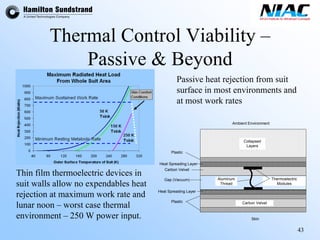
Thermal Control Viability – Passive & BeyondCollapsedLayersThermoelectricModulesHeat Spreading LayerCarbon VelvetPlasticHeat Spreading LayerPlasticCarbon VelvetGap (Vacuum)AluminumThreadSkinAmbient EnvironmentPassive heat rejection from suit surface in most environments and at most work rates 
Thin film thermoelectric devices in suit walls allow no expendables heat rejection at maximum work rate and lunar noon –worst case thermal environment –250 W power input.
44 
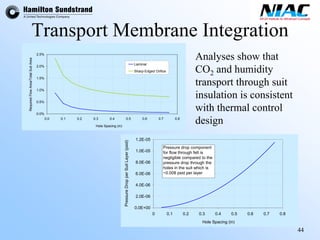
Transport Membrane Integration0.0% 0.5% 1.0% 1.5% 2.0% 2.5% 0.00.10.20.30.40.50.60.70.8Hole Spacing (in) Required Flow Area/Total Suit Area LaminarSharp-Edged Orifice 
Analyses show that CO2and humidity transport through suit insulation is consistent with thermal control design0.0E+002.0E-064.0E-066.0E-068.0E-061.0E-051.2E-0500.10.20.30.40.50.60.70.8Hole Spacing (in) Pressure Drop per Suit Layer (psid) Pressure drop component for flow through felt is negligible compared to the pressure drop through the holes in the suit which is ~0.008 psid per layer
45 
Assisted and Enhanced Mobility 
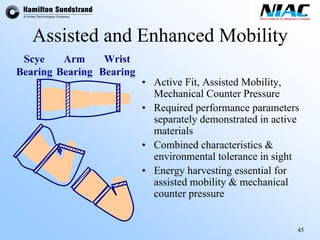
•Active Fit, Assisted Mobility, Mechanical Counter Pressure•Required performance parameters separately demonstrated in active materials•Combined characteristics & environmental tolerance in sight•Energy harvesting essential for assisted mobility & mechanical counter pressureWristBearing 
Scye 
BearingBearing 
Arm
46 
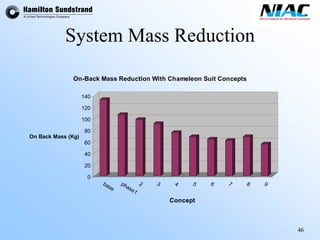
System Mass Reduction020406080100120140On Back Mass (Kg) basephase123456789 ConceptOn-Back Mass Reduction With Chameleon Suit Concepts
47 
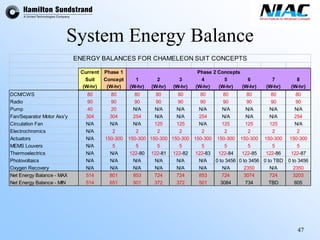
System Energy Balance CurrentPhase 1SuitConcept12345678(W-hr)(W-hr)(W-hr)(W-hr)(W-hr)(W-hr)(W-hr)(W-hr)(W-hr)(W-hr) DCM/CWS80808080808080808080Radio90909090909090909090Pump4020N/AN/AN/AN/AN/AN/AN/AN/AFan/Separator Motor Ass'y304304254N/AN/A254N/AN/AN/A254Circulation FanN/AN/AN/A125125N/A125125125N/AElectrochromicsN/A222222222ActuatorsN/A150-300150-300150-300150-300150-300150-300150-300150-300150-300MEMS LouversN/A555555555ThermoelectricsN/AN/A122-80122-81122-82122-83122-84122-85122-86122-87PhotovoltaicsN/AN/AN/AN/AN/AN/A0 to 34560 to 34560 to TBD0 to 3456Oxygen RecoveryN/AN/AN/AN/AN/AN/AN/A2350N/A2350Net Energy Balance - MAX51480185372472485372430747243203Net Energy Balance - MIN5146515013723725013084734TBD605Phase 2 ConceptsENERGY BALANCES FOR CHAMELEON SUIT CONCEPTS
48 
Implications for System Robustness 
•Current reliability and life issues are eliminated: sublimator, gas trap, filters. 
•Fewer duration limiting resources 
•Massively parallel systems Îgraceful failure responses (gradual performance loss) 
•Inherent environmental sensitivity 
•Central control or common power failures (design mitigation) 
•Local thermal extremes possible with failures
49 
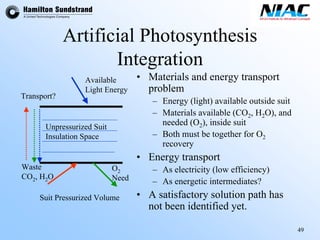
Artificial Photosynthesis Integration•Materials and energy transport problem–Energy (light) available outside suit–Materials available (CO2, H2O), and needed (O2), inside suit–Both must be together for O2recovery•Energy transport–As electricity (low efficiency) –As energetic intermediates? •A satisfactory solution path has not been identified yet. Suit Pressurized VolumeUnpressurizedSuitInsulation SpaceWasteCO2, H2OO2NeedAvailableLight EnergyTransport?
50 
Summary –Vision for the Future 
•The seed has been planted and it will grow! 
–The path is clear to revolutionary change 
–The required technologies are ripening for harvest 
–Targeted research is being explored with many investigators 
–The vision of possibilities has been shared 
–The Chameleon Suit is on our technology roadmap 
•Today’s unsolved problems are not insoluble 
•Perhaps the Chameleon Suit really will look like those Star Trek images after all 
The best possible space suit will be invisible

Outlook foreva

  • 1.
    1 Chameleon Suit–Changing the Outlook for EVA November 7, 2003 Ed Hodgson Hamilton Sundstrand
  • 2.
    2 Project Basics •Advanced Extra-Vehicular Activity System Concept •Phase 2 Study –March 2002 –January 2004 •Contract #NAS5-03110 Grant #07605-003-001 •HS Project Team –Gail Baker, Allison Bender, JoelGoldfarb, Edward Hodgson, Gregory Quinn, FredSribnik, CatherineThibaud-Erkey •External Support –NIAC, NASA JSC, NASA HQ, and many, many more.
  • 3.
    3 Why aChameleon Suit? •History •Future Needs •Technology Opportunities
  • 4.
    4 Historical EVAChallenges and Issues •Pressure Suit Mobility & Comfort •On-Back Weight •EVA Expendables •Durability / Maintainability
  • 5.
    5 Future MissionNeedsAccessiblePlanetarySurfaceEarth& LEOAnywhere/ AnytimeEarth’sNeighborhood •Easier •Lighter •Cheaper •Longer •Adaptable
  • 6.
    6 Technology Opportunities–The Shape of Things to Come •Recursive system evolution•Atomic scale design & manufacture•The imitation of lifeActive, optimal multi-functional materials – unconstrained design integration.
  • 7.
    7 The GuidingConcept –A Different System Paradigm Historic EVA Systems•Functional partition•Environment isolation•Component interfacesChameleon Suit•Functional integration•Environment exploitation•Human interfaces
  • 8.
    8 The ManyShapes of the Chameleon – Concept Implementation Options
  • 9.
    9 Implementation Options Technology & Logical Choices Phase 1 Study Integrated Passive Thermal Control Integrated Active Heat TransportEmphasize Integrated CO2& Humidity Control Active Mobility MCP Suit Mobility Mass Savings & Integration Active Suit FitTransportArtificialPhotosynthesisEnergy HarvestingDistributed Energy HarvestingO2RecoveryModule Distributed O2Recovery Reactants Energy
  • 10.
    10 Integrated PassiveThermal Control (Phase 1 Study) LCVG Layers (outer layer, transport tubing, liner) TMG and MEMS louversVariable loft layerswith active polymerspacers and thermallyconductive fiber felt
  • 11.
    11 Integrated ActiveHeat TransportDistributed thin filmmodules or flexiblethermoelectric polymersTMG and MEMS louversVariable loft layerswith active polymerspacers and thermallyconductive fiber felt
  • 12.
    12 Integrated CO2&Humidity ControlDistributed thin filmmodules or flexiblethermoelectricpolymersTMG and MEMS louversSelective ChemicalTransport MembranesVariable loft layerswith active polymerspacers and thermallyconductive fiber felt
  • 13.
    13 Active SuitFitDistributed thin filmmodules or flexiblethermoelectric polymersTMG and MEMS louversSelective ChemicalTransport MembranesActive Suit Fit MaterialVariable loft layerswith active polymerspacers and thermallyconductive fiber felt
  • 14.
    14 Energy HarvestingDistributedthin filmmodules or flexiblethermoelectric polymersTMG and MEMS louversSelective ChemicalTransport MembranesActive Suit Fit MaterialFlexible solar cell arrays/ Photoelectric polymersConcentrated CO2and H2O vented toenvironmentHarvested Energy tobackpack reducesbattery sizeVariable loft layerswith active polymerspacers and thermallyconductive fiber felt
  • 15.
    15 Artificial PhotosynthesisDistributedthin filmmodules or flexiblethermoelectric polymersTMG and MEMS louversVariable loft layerswith active polymerspacers and thermallyconductive fiber feltSelective ChemicalTransport/CatalysisActive Suit Fit MaterialFlexible solar cell arrays/ Photoelectric polymersHarvested energyfrom photo- & thermoelectrics todrive oxygenrecovery
  • 16.
    16 Distributed O2RecoveryDistributedthin film modules orflexible thermoelectric polymersTMG and MEMS louversSelective ChemicalTransport MembranesActive Suit Fit MaterialFlexible solar cell arrays/ Photoelectric polymersOxygen Recovery ProcessVariable loft layerswith active polymerspacers and thermallyconductive fiber feltCO2, H20 andO2 Transfer
  • 17.
    17 Active Mobility-MCP SuitTMG and MEMS louversActive Suit Fit MaterialVariable loft layerswith active polymerspacers and thermallyconductive fiber felt
  • 18.
    18 Distributed EnergyHarvesting - O2Recovery ModuleDistributed thin filmmodules or flexiblethermoelectric polymersTMG and MEMS louversActive Suit Fit Material for MCPFlexible solar cell arrays/ Photoelectric polymersHarvested energyfrom photo- & thermoelectrics tobackpackVariable loft layerswith active polymerspacers and thermallyconductive fiber feltSuit atmosphere tobackpack for CO2, H2O removal andO2 recovery
  • 19.
    19 Enabling Technologies •Multi-functional Materials •Bio-mimetic Processes •Advanced Manufacturing Technologies •Information Technologies
  • 20.
    20 Multifunctional Materials •Conductive Polymers •Shape Change Materials •Optically Active Materials •Energy Storage and Conversion •Chemically Active Materials
  • 21.
    21 Polymers andNanocomposites Engineered Materials Revolution •Driven by, enabled by, and underlying information revolution –Microelectronics > massive complexity > ever smaller features > MEMS –Computational, imaging and modeling tools at atomic and molecular scales •Ubiquitous in science, industry & society •Designer molecules –Multi-functional polymers –conductive, mechanically active, optically active, chemically active –Biomimetic •Nano-composites
  • 22.
    22 Conductive PolymersAlternativesto Wiring Harnesses, Switches and Liquid Electrolytes•Conductive polymers and composite electro-textiles–Flexibility–Massively parallel interconnection•Polymeric semiconductors–Integrated function, structure & control•Solid polymer electrolytes–Lithium polymer batteries –Fuel cells ~ 1000 W-hr/Kg–Flexible batteries –160W-hr/Kg
  • 23.
    23 Shape ChangeMaterials - -100- 60-80- Medium to fast3807.2Dielectric---20 to 40 20 to 40-150 to150 Temperature range (C) - 0.3 30-35107100200.35 HumanMuscle- 1201105@0.3% strain3240MIT CP 2002NVery low1105Low25-10insulation- >42010636250.5MIT targetY 40201061002540MCP/ assisted mobility20Tensile strength (MPa) Ylow1000Low2520Active fitO2compatibilityEfficiency (%) Life cycleStrain rate (%/s) Strain (%) Force output (MPa) Characteristics- Characteristics
  • 24.
    24 Optically ActiveMaterials •Electrochromicmaterials–Inorganic–Polymers•Electroemissivematerials–OLED•MEMS•Photoelectric materials
  • 25.
    25 Energy Storage& Conversion •Thin film & polymeric devices•Increasing conversion efficiency•Lower cost & more flexible manufacture•Emerging applicationsProgress of Thermoelectic Improvements01234519301950197019902010Year Figure of Merit, ZT Thin Film State of the ArtPolymer state of the artCommercially available materialElectrolytePlastic (PET)Platinum CatalystTransparent Conductor0.010 inchesPlastic (PET)TiO2& DyeTransparent ConductorPhotovoltaicPolymer Batteries Thermoelectric
  • 26.
    26 Chemically ActiveMaterialsO2CO2H2OCO2e-loadH2OO2H2e-powerH+ CO3= O2CO2H2OCO2e-Porous substrateLiquid containing facilitatorsHydrophilized surfaceVent flowCO2,O2, H2OH2OCO2Vacuumor Sweep gasPassive transport selective membranesActive transport –polymer electrolytes Chemical conversion –integrated catalysis
  • 27.
    27 Bio-mimetic Processes •Membranes •Bio-catalysts •Artificial Photosynthesis •Self-Assembling Systems
  • 28.
    28 Membrane Technologies •Biological membranes –Self organizing –Selective transport –Active transport •Enzyme membranes •Biomimeticliquid crystal membranes –CO2 transport & selectivity comparable to lung tissue
  • 29.
    29 Bio-catalysts BiocatalyticProcesses •Efficient reactions at useful rates and modest temperatures •High specificity •Enzymes -organic - stereochemical Historical Processes •Efficient reactions at high rates , high temperatures •Limited specificity •Inorganic metals & salts
  • 30.
    30 Artificial Photosynthesis •Find alternate chemicals / chemical sequences to achieve photosynthetic functions recognizing photosynthesis specificity of–Fast kinetics–Highly specific pathways–Molecular level assembly •For example, mimicking chlorophyll’s light conversion process (PSII) –Carotene/Porphyrin/Fullerene sequence (Arizona State University) –Development of Ru-Mncomplexes (Uppsala University, Sweden)
  • 31.
    31 Self-Assembling Systems•Theessence of biology•Complexity (apparently) without cost•Genetic codes –molecular templates•Understanding ÎPractice–Natural systems ÎModes of operation ÎEngineered analogs
  • 32.
    32 Advanced ManufacturingTechnologies •Photo-Lithography •Stereo-Lithography •Self-Assembling Systems
  • 33.
    33 Photolithographic Processes Keys to Practical Complexity at Any Scale •Design and manufacturing approaches are proven •Extension to multi- disciplinary systems has been made •Extension to large scale planar structures •Further growth in scale and range of materials
  • 34.
    34 Stereo-Lithography •Photo-lithographicprocess extended to 3D•Direct computer control–Design flexibility–Responsiveness–Small lot economics•Increasing materials possibilities
  • 35.
    35 Self-Assembling Systems(again) •Becoming a practical reality in engineering practice •One key to mastering massively parallel, repeating systems of very small parts … Like the Chameleon Suit Nanolithoeffort harnesses self-assembly PORTLAND, Ore. —Nanoscalepatterning of silicon substrates with regular, repeatable, atomically perfect application-specific templates could enablemanufacturable nanoscalechips within the decade, according to scientists at the University of Wisconsin'sMaterials Research Science and Engineering Center (Madison). By R. Colin Johnson EE Times August 5, 2003 (2:54 p.m. ET)
  • 36.
    36 Information Technologies •Underlying Technology •Information Processing •Connectivity •Recursive Design •Advanced Interfaces
  • 37.
    37 Underlying TechnologyBase •Silicon as a designer material –Flexible, easily controlled functionality –Consistent continuous structure •Photolithographic manufacturing –Progressive evolution to smaller scales –Consistent, local control ofmicroscalecomposition •Automated design, manufacturing processes
  • 38.
    38 Information Processing •Dealing with massive complexity essential for and enabled by information revolution enables: –Design of complex structures and networks –Complex control algorithms and networks –Practical coordinated interaction of large numbers of sensors and effectors –Analysis and understanding of complex natural systems –designer molecules &biomimeticdesign ÎChameleon Suit practicality
  • 39.
    39 Connectivity •Databus structures and approaches to enable flow of information among large numbers of cooperating devices with practical overhead –Data bus ÎEthernetÎInternet •Wireless adaptations Îflexible geometry and topology •Smaller, lower power access devices Γsmart dust”
  • 40.
    40 Recursive &Extensible Processes•N-1th generation capabilities enable Nth generation design•Progressive change in scale (smaller), complexity (greater) •Extensible to additional degrees of freedom & new domains–MEMS–Microchannelsystems
  • 41.
    41 Advanced InformationInterfaces – Toward Thought Controlled Systems •Progress in sensors and signal processing Î Robust research in thought controlled systems –Military systems &assistivesystems and devices •Complex spatial and temporal patterns of very low level signals –Noise, individual variability •Extensive training, user concentration •Limited channel bandwidth < 10 Hz •Continued progress and research interest Î Chameleon Suit applications potential
  • 42.
    42 Application Analysesand Results –Is the Concept Real? •Thermal Control •Transport •Mobility •Mass Reduction •System Energy Balance •Implications for System Robustness •Artificial Photosynthesis Integration
  • 43.
    43 Thermal ControlViability – Passive & BeyondCollapsedLayersThermoelectricModulesHeat Spreading LayerCarbon VelvetPlasticHeat Spreading LayerPlasticCarbon VelvetGap (Vacuum)AluminumThreadSkinAmbient EnvironmentPassive heat rejection from suit surface in most environments and at most work rates Thin film thermoelectric devices in suit walls allow no expendables heat rejection at maximum work rate and lunar noon –worst case thermal environment –250 W power input.
  • 44.
    44 Transport MembraneIntegration0.0% 0.5% 1.0% 1.5% 2.0% 2.5% 0.00.10.20.30.40.50.60.70.8Hole Spacing (in) Required Flow Area/Total Suit Area LaminarSharp-Edged Orifice Analyses show that CO2and humidity transport through suit insulation is consistent with thermal control design0.0E+002.0E-064.0E-066.0E-068.0E-061.0E-051.2E-0500.10.20.30.40.50.60.70.8Hole Spacing (in) Pressure Drop per Suit Layer (psid) Pressure drop component for flow through felt is negligible compared to the pressure drop through the holes in the suit which is ~0.008 psid per layer
  • 45.
    45 Assisted andEnhanced Mobility •Active Fit, Assisted Mobility, Mechanical Counter Pressure•Required performance parameters separately demonstrated in active materials•Combined characteristics & environmental tolerance in sight•Energy harvesting essential for assisted mobility & mechanical counter pressureWristBearing Scye BearingBearing Arm
  • 46.
    46 System MassReduction020406080100120140On Back Mass (Kg) basephase123456789 ConceptOn-Back Mass Reduction With Chameleon Suit Concepts
  • 47.
    47 System EnergyBalance CurrentPhase 1SuitConcept12345678(W-hr)(W-hr)(W-hr)(W-hr)(W-hr)(W-hr)(W-hr)(W-hr)(W-hr)(W-hr) DCM/CWS80808080808080808080Radio90909090909090909090Pump4020N/AN/AN/AN/AN/AN/AN/AN/AFan/Separator Motor Ass'y304304254N/AN/A254N/AN/AN/A254Circulation FanN/AN/AN/A125125N/A125125125N/AElectrochromicsN/A222222222ActuatorsN/A150-300150-300150-300150-300150-300150-300150-300150-300150-300MEMS LouversN/A555555555ThermoelectricsN/AN/A122-80122-81122-82122-83122-84122-85122-86122-87PhotovoltaicsN/AN/AN/AN/AN/AN/A0 to 34560 to 34560 to TBD0 to 3456Oxygen RecoveryN/AN/AN/AN/AN/AN/AN/A2350N/A2350Net Energy Balance - MAX51480185372472485372430747243203Net Energy Balance - MIN5146515013723725013084734TBD605Phase 2 ConceptsENERGY BALANCES FOR CHAMELEON SUIT CONCEPTS
  • 48.
    48 Implications forSystem Robustness •Current reliability and life issues are eliminated: sublimator, gas trap, filters. •Fewer duration limiting resources •Massively parallel systems Îgraceful failure responses (gradual performance loss) •Inherent environmental sensitivity •Central control or common power failures (design mitigation) •Local thermal extremes possible with failures
  • 49.
    49 Artificial PhotosynthesisIntegration•Materials and energy transport problem–Energy (light) available outside suit–Materials available (CO2, H2O), and needed (O2), inside suit–Both must be together for O2recovery•Energy transport–As electricity (low efficiency) –As energetic intermediates? •A satisfactory solution path has not been identified yet. Suit Pressurized VolumeUnpressurizedSuitInsulation SpaceWasteCO2, H2OO2NeedAvailableLight EnergyTransport?
  • 50.
    50 Summary –Visionfor the Future •The seed has been planted and it will grow! –The path is clear to revolutionary change –The required technologies are ripening for harvest –Targeted research is being explored with many investigators –The vision of possibilities has been shared –The Chameleon Suit is on our technology roadmap •Today’s unsolved problems are not insoluble •Perhaps the Chameleon Suit really will look like those Star Trek images after all The best possible space suit will be invisible