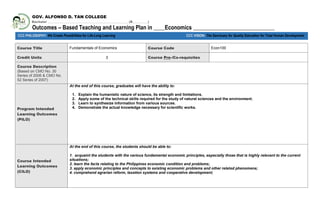
GOV. ALFONSO D. TAN COLLEGE
Bachelor ____________________________________________________ (B__________)
Outcomes – Based Teaching and Learning Plan in ____Economics _____________________________
Course Title Fundamentals of Economics Course Code Econ100
Credit Units 3 Course Pre-/Co-requisites
Course Description
(Based on CMO No. 30
Series of 2006 & CMO No.
52 Series of 2007)
Program Intended
Learning Outcomes
(PILO)
At the end of this course, graduates will have the ability to:
1. Explain the humanistic nature of science, its strength and limitations.
2. Apply some of the technical skills required for the study of natural sciences and the environment.
3. Learn to synthesize information from various sources.
4. Demonstrate the actual knowledge necessary for scientific works.
Course Intended
Learning Outcomes
(CILO)
At the end of this course, the students should be able to:
1. acquaint the students with the various fundamental economic principles, especially those that is highly relevant to the current
situations;
2. learn the facts relating to the Philippines economic condition and problems;
3. apply economic principles and concepts to existing economic problems and other related phenomena;
4. comprehend agrarian reform, taxation systems and cooperative development;
CCC PHILOSOPHY: We Create Possibilities for Life-Long Learning CCC VISION: The Sanctuary for Quality Education for Total Human Development
PRELIMINARY Essential Learning
Intended Learning Outcomes
(ILO)
Suggested
Teaching/Learning
Activities (TLAs)
Assessment
Tasks (ATs)Week Content Standards
Declarative
Knowledge
Functional Knowledge
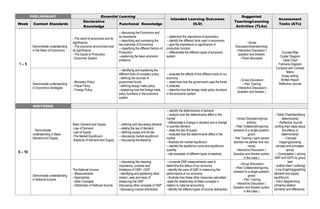
1 – 5
Demonstrate understanding
in the Basic of Economics
--The world of economics and its
significance
--The economic environment and
its significance
--The Inputs to Production
--Economic System
---discussing the Economics and
its importance
---describing and comparing the
two branches of Economics
---classifying the different factors of
Production
--explaining the basic economic
problems
---determine the importance of economics
---identify the different tools used in economics
---give the importance or significance of
production function
---differentiate the different types of economic
system
--Group
Discussion(brainstorming)
--Interactive Discussion (
question and answer)
--Panel discussion
Concept Map
Cluster Diagram
Table Chart
Fishbone Diagram
Compare and Contrast
Matrix
Essay writing
Written Report
Reflective JournalDemonstrate understanding
in Economics Strategies
--Monetary Policy
--Fiscal Policy
--Foreign Policy
---identifying and explaining the
different tools of monetary policy
--defining the sources of
government funds
--defining foreign trade policy
--explaining how the foreign trade
policy functions in the economic
system
---evaluate the effects of the different tools to our
economy
---determine how the government uses the funds
it collected
---describe how the foreign trade policy functions
in the economic system
--Group discussion
---Pair Tutoring
---Interactive Discussion (
Question and Answer )
MIDTERMS
6 – 10
Demonstrate
understanding in Basic
Demand and Supply
Basic Demand and Supply
-Law of Demand
-Law of Supply
-The Market Equilibrium
-Elasticity of Demand and Supply
---defining and discussing demand
---stating the law of demand
---defining supply and its law
---discussing market equilibrium
---discussing the elasticity
---identify the determinants of demand
---analyze how the determinants affect in the
market
--differentiate a change in demand and a change
in quantity demand
---state the law of supply
---evaluate how the determinants affect in the
market
--illustrate the market equilibrium
---identify the equilibrium price and equilibrium
quantity
--cite examples of different types of elasticity
--Group Discussion(group
activity)
--Peer Collaboration(giving
answers to a single question
given)
--Pair Tutoring ( each person
teaches his partner and vice
versa)
Interactive Discussion (
Question and Answer portion
in the class )
--Table Chart(identifying
determinants)
--Reflective Journal
(writing their ideas about
the effects of
determinants)
--Concept
mapping(showing
concept and principles;
terms)
----Computation ( solving
GNP and GDP) by group
task
--outline chart ( outlining)
--Line Graphing(graphing
demand and supply;
equilibrium)
--Venn diagramming
(showing relation:
similarity and difference)
Demonstrate understanding
in National Income
The National Income
--Measurements
--Approaches
--other Concepts
--Distribution of National Income
---discussing the meaning,
importance, purpose and
limitations of GNP—GDP
--identifying and explaining other
means: uses and ways of
measuring the GNP
Discussing other concepts of GNP
--discussing income distribution
---compute GNP measurements used in
determine the status of our economy
--identify the uses of GNP in measuring the
performance of our economy
--illustrate how these other measures calculated
-state the relationship of these concepts in
relation to national accounting
--identify the different types of income distribution
--Group Discussion
--Peer Collaboration(giving
answers to a single question
given)
--Pair Tutoring
Interactive Discussion (
Question and Answer portion
in the class )
SEMI-FINALS
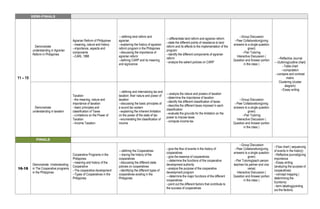
11 – 15
Demonstrate
understanding in Agrarian
Reform in Philippines
Agrarian Reform of Philippines
--meaning, nature and history
--importance, aspects and
components
--CARL 1998
---defining land reform and
agrarian
--explaining the history of agrarian
reform program in the Philippines
--discussing the importance of
agrarian reform
--defining CARP and its meaning
and signicance
---differentiate land reform and agrarian reform
--state the different points of resistance to land
reform and its effects to the implementation of the
program
--identify the different components of agrarian
reform
--analyze the salient policies on CARP
--Group Discussion
--Peer Collaboration(giving
answers to a single question
given)
--Pair Tutoring
Interactive Discussion (
Question and Answer portion
in the class )
--Reflective Journal
---Outlining(outline chart)
--Table chart
--computation
--compare and contrast
matrix
Clustering (cluster
diagram)
--Essay writing
Demonstrate
understanding in taxation
Taxation
--the meaning, nature and
importance of taxation
--basic principles and
classification of Taxes
--Limitations on the Power of
Taxation
--Income Taxation
---defining and internalizing tax and
taxation: their nature and power of
taxation
--discussing the basic principles of
a sound tax system
--explaining the inherent limitation
on the power of the state of tax
--enumerating the classification of
income
---analyze the nature and powers of taxation
--determine the importance of taxation
--identify the different classification of taxes
--describe the different taxes imposed in each
classification
--evaluate the grounds for the limitation on the
power to impose taxes
--compute income tax
--Group Discussion
--Peer Collaboration(giving
answers to a single question
given)
--Pair Tutoring
Interactive Discussion (
Question and Answer portion
in the class )
FINALS
16-18
Demonstrate Understanding
in The Cooperative programs
in the Philippines
Cooperative Programs in the
Philippines
--meaning and history of the
Cooperative
--The cooperative development
--Types of Cooperatives in the
Philippines
---defining the Cooperatives
---tracing the history of the
cooperatives
--discussing the different state
policies on cooperatives
--identifying the different types of
cooperatives existing in the
Philippines
--give the flow of events in the history of
cooperatives
--give the essence of cooperatives
---determine the functions of the cooperative
development authority
--analyze the purpose of the cooperative
development program
---determine the major functions of the different
cooperatives
--point out the different factors that contribute to
the success of cooperatives
--Group Discussion
--Peer Collaboration(giving
answers to a single question
given)
--Pair Tutoring(each person
teaches his partner and vice
versa)
Interactive Discussion (
Question and Answer portion
in the class )
--Flow chart ( sequencing
of events in the history)
--Reflective journal(giving
importance
--Essay writing
(analyzing the purpose of
cooperatives)
--concept mapping (
determining the
fucntions)
--term labeling(pointing
out the factors)
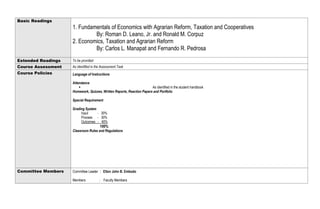
Basic Readings
1. Fundamentals of Economics with Agrarian Reform, Taxation and Cooperatives
By: Roman D. Leano, Jr. and Ronald M. Corpuz
2. Economics, Taxation and Agrarian Reform
By: Carlos L. Manapat and Fernando R. Pedrosa
Extended Readings To be provided
Course Assessment As identified in the Assessment Task
Course Policies Language of Instructions
Attendance
 As identified in the student handbook
Homework, Quizzes, Written Reports, Reaction Papers and Portfolio
Special Requirement
Grading System
Input - 30%
Process - 30%
Outcomes - 40%
100%
Classroom Rules and Regulations
Committee Members Committee Leader : Elton John B. Embodo
Members : Faculty Members
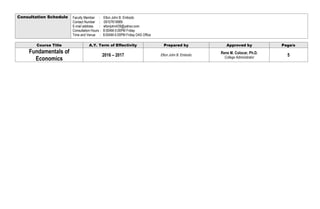
Consultation Schedule Faculty Member : Elton John B. Embodo
Contact Number : 09107619989
E-mail address : eltonjohn439@yahoo.com
Consultation Hours : 8:00AM-5:00PM Friday
Time and Venue : 8:00AM-5:00PM Friday DAS Office
Course Title A.Y. Term of Effectivity Prepared by Approved by Page/s
Fundamentals of
Economics
2016 – 2017 Elton John B. Embodo
Rene M. Colocar, Ph.D.
College Administrator
5

Outcome based teaching learning plan in economics100

  • 1.
    GOV. ALFONSO D.TAN COLLEGE Bachelor ____________________________________________________ (B__________) Outcomes – Based Teaching and Learning Plan in ____Economics _____________________________ Course Title Fundamentals of Economics Course Code Econ100 Credit Units 3 Course Pre-/Co-requisites Course Description (Based on CMO No. 30 Series of 2006 & CMO No. 52 Series of 2007) Program Intended Learning Outcomes (PILO) At the end of this course, graduates will have the ability to: 1. Explain the humanistic nature of science, its strength and limitations. 2. Apply some of the technical skills required for the study of natural sciences and the environment. 3. Learn to synthesize information from various sources. 4. Demonstrate the actual knowledge necessary for scientific works. Course Intended Learning Outcomes (CILO) At the end of this course, the students should be able to: 1. acquaint the students with the various fundamental economic principles, especially those that is highly relevant to the current situations; 2. learn the facts relating to the Philippines economic condition and problems; 3. apply economic principles and concepts to existing economic problems and other related phenomena; 4. comprehend agrarian reform, taxation systems and cooperative development; CCC PHILOSOPHY: We Create Possibilities for Life-Long Learning CCC VISION: The Sanctuary for Quality Education for Total Human Development
  • 2.
    PRELIMINARY Essential Learning IntendedLearning Outcomes (ILO) Suggested Teaching/Learning Activities (TLAs) Assessment Tasks (ATs)Week Content Standards Declarative Knowledge Functional Knowledge 1 – 5 Demonstrate understanding in the Basic of Economics --The world of economics and its significance --The economic environment and its significance --The Inputs to Production --Economic System ---discussing the Economics and its importance ---describing and comparing the two branches of Economics ---classifying the different factors of Production --explaining the basic economic problems ---determine the importance of economics ---identify the different tools used in economics ---give the importance or significance of production function ---differentiate the different types of economic system --Group Discussion(brainstorming) --Interactive Discussion ( question and answer) --Panel discussion Concept Map Cluster Diagram Table Chart Fishbone Diagram Compare and Contrast Matrix Essay writing Written Report Reflective JournalDemonstrate understanding in Economics Strategies --Monetary Policy --Fiscal Policy --Foreign Policy ---identifying and explaining the different tools of monetary policy --defining the sources of government funds --defining foreign trade policy --explaining how the foreign trade policy functions in the economic system ---evaluate the effects of the different tools to our economy ---determine how the government uses the funds it collected ---describe how the foreign trade policy functions in the economic system --Group discussion ---Pair Tutoring ---Interactive Discussion ( Question and Answer ) MIDTERMS 6 – 10 Demonstrate understanding in Basic Demand and Supply Basic Demand and Supply -Law of Demand -Law of Supply -The Market Equilibrium -Elasticity of Demand and Supply ---defining and discussing demand ---stating the law of demand ---defining supply and its law ---discussing market equilibrium ---discussing the elasticity ---identify the determinants of demand ---analyze how the determinants affect in the market --differentiate a change in demand and a change in quantity demand ---state the law of supply ---evaluate how the determinants affect in the market --illustrate the market equilibrium ---identify the equilibrium price and equilibrium quantity --cite examples of different types of elasticity --Group Discussion(group activity) --Peer Collaboration(giving answers to a single question given) --Pair Tutoring ( each person teaches his partner and vice versa) Interactive Discussion ( Question and Answer portion in the class ) --Table Chart(identifying determinants) --Reflective Journal (writing their ideas about the effects of determinants) --Concept mapping(showing concept and principles; terms) ----Computation ( solving GNP and GDP) by group task --outline chart ( outlining) --Line Graphing(graphing demand and supply; equilibrium) --Venn diagramming (showing relation: similarity and difference) Demonstrate understanding in National Income The National Income --Measurements --Approaches --other Concepts --Distribution of National Income ---discussing the meaning, importance, purpose and limitations of GNP—GDP --identifying and explaining other means: uses and ways of measuring the GNP Discussing other concepts of GNP --discussing income distribution ---compute GNP measurements used in determine the status of our economy --identify the uses of GNP in measuring the performance of our economy --illustrate how these other measures calculated -state the relationship of these concepts in relation to national accounting --identify the different types of income distribution --Group Discussion --Peer Collaboration(giving answers to a single question given) --Pair Tutoring Interactive Discussion ( Question and Answer portion in the class )
  • 3.
    SEMI-FINALS 11 – 15 Demonstrate understandingin Agrarian Reform in Philippines Agrarian Reform of Philippines --meaning, nature and history --importance, aspects and components --CARL 1998 ---defining land reform and agrarian --explaining the history of agrarian reform program in the Philippines --discussing the importance of agrarian reform --defining CARP and its meaning and signicance ---differentiate land reform and agrarian reform --state the different points of resistance to land reform and its effects to the implementation of the program --identify the different components of agrarian reform --analyze the salient policies on CARP --Group Discussion --Peer Collaboration(giving answers to a single question given) --Pair Tutoring Interactive Discussion ( Question and Answer portion in the class ) --Reflective Journal ---Outlining(outline chart) --Table chart --computation --compare and contrast matrix Clustering (cluster diagram) --Essay writing Demonstrate understanding in taxation Taxation --the meaning, nature and importance of taxation --basic principles and classification of Taxes --Limitations on the Power of Taxation --Income Taxation ---defining and internalizing tax and taxation: their nature and power of taxation --discussing the basic principles of a sound tax system --explaining the inherent limitation on the power of the state of tax --enumerating the classification of income ---analyze the nature and powers of taxation --determine the importance of taxation --identify the different classification of taxes --describe the different taxes imposed in each classification --evaluate the grounds for the limitation on the power to impose taxes --compute income tax --Group Discussion --Peer Collaboration(giving answers to a single question given) --Pair Tutoring Interactive Discussion ( Question and Answer portion in the class ) FINALS 16-18 Demonstrate Understanding in The Cooperative programs in the Philippines Cooperative Programs in the Philippines --meaning and history of the Cooperative --The cooperative development --Types of Cooperatives in the Philippines ---defining the Cooperatives ---tracing the history of the cooperatives --discussing the different state policies on cooperatives --identifying the different types of cooperatives existing in the Philippines --give the flow of events in the history of cooperatives --give the essence of cooperatives ---determine the functions of the cooperative development authority --analyze the purpose of the cooperative development program ---determine the major functions of the different cooperatives --point out the different factors that contribute to the success of cooperatives --Group Discussion --Peer Collaboration(giving answers to a single question given) --Pair Tutoring(each person teaches his partner and vice versa) Interactive Discussion ( Question and Answer portion in the class ) --Flow chart ( sequencing of events in the history) --Reflective journal(giving importance --Essay writing (analyzing the purpose of cooperatives) --concept mapping ( determining the fucntions) --term labeling(pointing out the factors)
  • 4.
    Basic Readings 1. Fundamentalsof Economics with Agrarian Reform, Taxation and Cooperatives By: Roman D. Leano, Jr. and Ronald M. Corpuz 2. Economics, Taxation and Agrarian Reform By: Carlos L. Manapat and Fernando R. Pedrosa Extended Readings To be provided Course Assessment As identified in the Assessment Task Course Policies Language of Instructions Attendance  As identified in the student handbook Homework, Quizzes, Written Reports, Reaction Papers and Portfolio Special Requirement Grading System Input - 30% Process - 30% Outcomes - 40% 100% Classroom Rules and Regulations Committee Members Committee Leader : Elton John B. Embodo Members : Faculty Members
  • 5.
    Consultation Schedule FacultyMember : Elton John B. Embodo Contact Number : 09107619989 E-mail address : eltonjohn439@yahoo.com Consultation Hours : 8:00AM-5:00PM Friday Time and Venue : 8:00AM-5:00PM Friday DAS Office Course Title A.Y. Term of Effectivity Prepared by Approved by Page/s Fundamentals of Economics 2016 – 2017 Elton John B. Embodo Rene M. Colocar, Ph.D. College Administrator 5