TUMPAKNERS
Economics as an
Applied Science
Specific Objectives
At the end of the lesson, the learner will be able to:
1. Discuss why economics is an applied science;
2. Explain the basic economic problems; and
3. Understand how applied economics work.
In your own opinion, are
the country’s resources
being utilized? Why?
ECONOMICS
APPLIED SCIENCE
• Field of study that is
used to improve
people’s lives, the
application of
economic theories and
models in real life
( Econometrics)
ECONOMICS
APPLIED SCIENCE
• Helps students to learn
about the relationship of a
business and basic
economic theories.
• Focuses on urban
problems, health care
crisis, agricultural
problems , poverty ,
economic growth and the
environment.
WHAT IS ECONOMETRICS?
THE APPLICATION OF STATISTICAL AND MATHEMATICAL THEORIES
TO ECONOMICS FOR THE PURPOSE OF :
•TESTING HYPOTHESES
•FORECASTING FUTURE TRENDS
THE RESULTS OF ECONOMETRIC ARE COMPARED AND
CONTRASTED AGAINST REAL LIFE EXAMPLES.
BASIC
ECONOMIC
PROBLEMS
What to
produce?
If there is scarcity of
goods in a society, the
firms have to make
wise decision on what
goods/ service should
be produced and
determine the quantity
to produced.
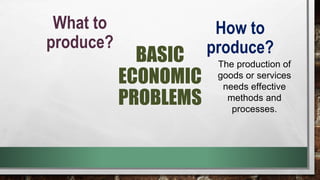
BASIC
ECONOMIC
PROBLEMS
What to
produce?
The production of
goods or services
needs effective
methods and
processes.
How to
produce?
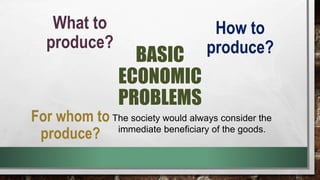
BASIC
ECONOMIC
PROBLEMS
What to
produce?
The society would always consider the
immediate beneficiary of the goods.
How to
produce?
For whom to
produce?
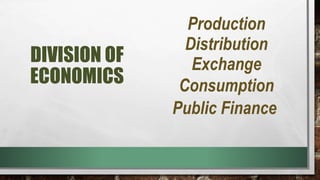
DIVISION OF
ECONOMICS
Production
Distribution
Exchange
Consumption
Public Finance
Production
• This refers to the process of producing or creating
goods needed by the households to satisfy their
needs. The factors of production are called inputs and
the goods and services that have been created are
called outputs of production.
Distribution
• This refers to the marketing of good and services to
different economic outlets for allocation to individual
consumers. In monetary terms, this is the allocation of
income among persons or household.
Exchange
• This is a process of transferring good and services to
a person or persons in return for something. At
present, the medium of exchange used in the market
in money. This means, we can exchange our money
with goods and services.
Consumption
• This refers to the proper utilization of economic
goods. However, goods and services could not be
utilized unless you pay for it. Hence, we can also say
that consumption is spending money for goods and
services in order to yield direct satisfaction.
Public Finance
• This pertains to the activities of the government
regarding taxation, borrowings, and expenditures. It
deals with the efficient use and fair distribution of
public resources in order to achieve maximum social
benefits. This means, government programs and
projects which are funded by taxes and loans are
properly implemented and managed to generate
maximum and optimum benefits for all members of
society.
BASIC
ECONOMIC
PROBLEMS OF
THE COUNTRY
Unemployment
Poverty
Quality of
Infrastructures
Income inequality
Inflation
Unemployment
• When someone could work and wants to work but is
unable to find suitable job.
Unemployment Rate in November 2023 was Estimated
at 3.6 Percent
Unemployment
• Improve the education system of the country,
specially in rural areas.
• More investment opportunities to encourage local and
international opportunities.
• Decrease the retirement age.
Poverty
• A state or condition in which a person or community
lacks the financial resources and essentials for
minimum standard of living.
The Philippines' poverty rate dropped to 22.4%, or 25.24
million people, in the first half of 2023
Poverty
• Reduce unemployment.
• Appropriate policies on labor income.
• Provide unemployment benefits.
• Increase social services ( Education, health care and
food subsidies)
• A system contributing to governmental policy
objectives in areas including industrial development,
trade competitiveness in global markets, efficient us
of natural and human resources , food safety , health,
the environment and climate change.
Quality of
Infrastructures
• The said allocation will be sourced from the
proposed P822. 2 billion national budget for the
Department of Public Works and Highways (DPWH)
in the 2024 National Expenditure Program (NEP)
Quality of
Infrastructures
• Focus on private – public partnerships.
• Reforms on key sectors: power, roads and water.
- Improve cost recovery
- Competition
- Institutional credibility
- Reduce corruption.
Quality of
Infrastructures
• How unevenly income is distributed throughout a
population.
Income inequality
• “The problem of income inequality has grown during
pandemic because informal sector workers have
been faced with a double whammy of significant job
losses..”
• 2 out of 10 Filipino families earn of total family
income.
• Investing in Human capital is the best way to increase
individual wealth and improve the labor force.
• Better Education, health care and social safety.
• Better policies of wages.
Income inequality
• Decline of purchasing power of a given currency over
time.
Inflation
• The Philippine Statistics Authority reported today that
inflation for December 2023 further slowed down to
3.9 percent from 4.1 percent in November 2023,
bringing the full-year average inflation rate to 6.0
percent.
• Disturbances in agricultural sectors, movements in
international oil prices.
• Government can use wage and price controls.
• Boosts import products.
Inflation

Economics as an Applied Science.pptx

  • 1.
  • 2.
  • 3.
    Specific Objectives At theend of the lesson, the learner will be able to: 1. Discuss why economics is an applied science; 2. Explain the basic economic problems; and 3. Understand how applied economics work.
  • 5.
    In your ownopinion, are the country’s resources being utilized? Why?
  • 6.
    ECONOMICS APPLIED SCIENCE • Fieldof study that is used to improve people’s lives, the application of economic theories and models in real life ( Econometrics)
  • 7.
    ECONOMICS APPLIED SCIENCE • Helpsstudents to learn about the relationship of a business and basic economic theories. • Focuses on urban problems, health care crisis, agricultural problems , poverty , economic growth and the environment.
  • 8.
    WHAT IS ECONOMETRICS? THEAPPLICATION OF STATISTICAL AND MATHEMATICAL THEORIES TO ECONOMICS FOR THE PURPOSE OF : •TESTING HYPOTHESES •FORECASTING FUTURE TRENDS THE RESULTS OF ECONOMETRIC ARE COMPARED AND CONTRASTED AGAINST REAL LIFE EXAMPLES.
  • 9.
    BASIC ECONOMIC PROBLEMS What to produce? If thereis scarcity of goods in a society, the firms have to make wise decision on what goods/ service should be produced and determine the quantity to produced.
  • 10.
    BASIC ECONOMIC PROBLEMS What to produce? The productionof goods or services needs effective methods and processes. How to produce?
  • 11.
    BASIC ECONOMIC PROBLEMS What to produce? The societywould always consider the immediate beneficiary of the goods. How to produce? For whom to produce?
  • 12.
  • 13.
    Production • This refersto the process of producing or creating goods needed by the households to satisfy their needs. The factors of production are called inputs and the goods and services that have been created are called outputs of production.
  • 14.
    Distribution • This refersto the marketing of good and services to different economic outlets for allocation to individual consumers. In monetary terms, this is the allocation of income among persons or household.
  • 15.
    Exchange • This isa process of transferring good and services to a person or persons in return for something. At present, the medium of exchange used in the market in money. This means, we can exchange our money with goods and services.
  • 16.
    Consumption • This refersto the proper utilization of economic goods. However, goods and services could not be utilized unless you pay for it. Hence, we can also say that consumption is spending money for goods and services in order to yield direct satisfaction.
  • 17.
    Public Finance • Thispertains to the activities of the government regarding taxation, borrowings, and expenditures. It deals with the efficient use and fair distribution of public resources in order to achieve maximum social benefits. This means, government programs and projects which are funded by taxes and loans are properly implemented and managed to generate maximum and optimum benefits for all members of society.
  • 18.
    BASIC ECONOMIC PROBLEMS OF THE COUNTRY Unemployment Poverty Qualityof Infrastructures Income inequality Inflation
  • 19.
    Unemployment • When someonecould work and wants to work but is unable to find suitable job. Unemployment Rate in November 2023 was Estimated at 3.6 Percent
  • 20.
    Unemployment • Improve theeducation system of the country, specially in rural areas. • More investment opportunities to encourage local and international opportunities. • Decrease the retirement age.
  • 21.
    Poverty • A stateor condition in which a person or community lacks the financial resources and essentials for minimum standard of living. The Philippines' poverty rate dropped to 22.4%, or 25.24 million people, in the first half of 2023
  • 22.
    Poverty • Reduce unemployment. •Appropriate policies on labor income. • Provide unemployment benefits. • Increase social services ( Education, health care and food subsidies)
  • 23.
    • A systemcontributing to governmental policy objectives in areas including industrial development, trade competitiveness in global markets, efficient us of natural and human resources , food safety , health, the environment and climate change. Quality of Infrastructures
  • 24.
    • The saidallocation will be sourced from the proposed P822. 2 billion national budget for the Department of Public Works and Highways (DPWH) in the 2024 National Expenditure Program (NEP) Quality of Infrastructures
  • 25.
    • Focus onprivate – public partnerships. • Reforms on key sectors: power, roads and water. - Improve cost recovery - Competition - Institutional credibility - Reduce corruption. Quality of Infrastructures
  • 26.
    • How unevenlyincome is distributed throughout a population. Income inequality • “The problem of income inequality has grown during pandemic because informal sector workers have been faced with a double whammy of significant job losses..” • 2 out of 10 Filipino families earn of total family income.
  • 27.
    • Investing inHuman capital is the best way to increase individual wealth and improve the labor force. • Better Education, health care and social safety. • Better policies of wages. Income inequality
  • 28.
    • Decline ofpurchasing power of a given currency over time. Inflation • The Philippine Statistics Authority reported today that inflation for December 2023 further slowed down to 3.9 percent from 4.1 percent in November 2023, bringing the full-year average inflation rate to 6.0 percent. • Disturbances in agricultural sectors, movements in international oil prices.
  • 29.
    • Government canuse wage and price controls. • Boosts import products. Inflation