PAGE1
WWW.NICKJORDAN.CA
HORTON HIGH SCHOOL 2014
GLOBAL HISTORY 12
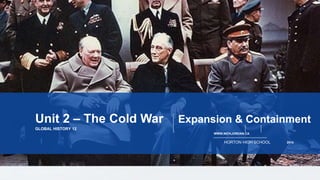
Unit 2 – The Cold War Expansion & Containment
PAGE2
The Cold War Heats Up!
GLOBAL HISTORY 12
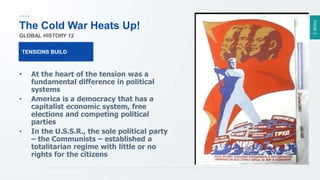
• At the heart of the tension was a
fundamental difference in political
systems
• America is a democracy that has a
capitalist economic system, free
elections and competing political
parties
• In the U.S.S.R., the sole political party
– the Communists – established a
totalitarian regime with little or no
rights for the citizens
TENSIONS BUILD
PAGE3
Make ‘em Pay!
• After the end of the war, a conference was
held in Potsdam, Germany, to set up peace
treaties .
• The countries that fought with Hitler lost
territory and had to pay reparations to
the Allies .
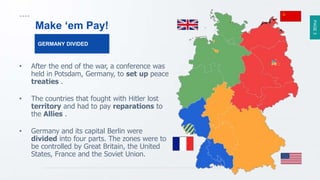
• Germany and its capital Berlin were
divided into four parts. The zones were to
be controlled by Great Britain, the United
States, France and the Soviet Union.
GERMANY DIVIDED
PAGE4
YOU OWE US
• War reparations are
payments intended to
cover damage or injury
inflicted during a war.
• Generally, the term war
reparations refers to
money or goods
changing hands, rather
than such property
transfers as the
annexation of land.
REPARATIONS
PAGE5
YOU OWE US
• At the Yalta Conference
(February, 1945), the
Soviet Union proposed that
German reparations be set
at approximately $20
billion of which the Soviets
wanted half.
• Great Britain and the
United States but didn’t
finalize an amount.
REPARATIONS
PAGE6
Buffer Needed
BUILDING AN IRON CURTAIN
• The Soviet Union suffered an
estimated 20 million WWII deaths,
half of whom were civilian
• As a result they felt justified in their
claim to Eastern Europe. The
countries that they liberated should
be part of their new ‘union’.
• Furthermore, they felt they needed
Eastern Europe as a buffer against
future German aggression
PAGE7
Buffer Needed
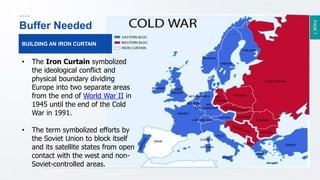
• The Iron Curtain symbolized
the ideological conflict and
physical boundary dividing
Europe into two separate areas
from the end of World War II in
1945 until the end of the Cold
War in 1991.
• The term symbolized efforts by
the Soviet Union to block itself
and its satellite states from open
contact with the west and non-
Soviet-controlled areas.
BUILDING AN IRON CURTAIN
PAGE8
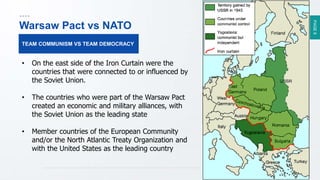
Warsaw Pact vs NATO
TEAM COMMUNISM VS TEAM DEMOCRACY
• On the east side of the Iron Curtain were the
countries that were connected to or influenced by
the Soviet Union.
• The countries who were part of the Warsaw Pact
created an economic and military alliances, with
the Soviet Union as the leading state
• Member countries of the European Community
and/or the North Atlantic Treaty Organization and
with the United States as the leading country
PAGE9
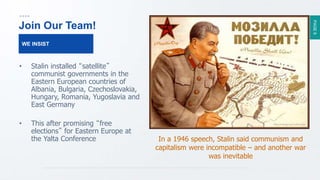
Join Our Team!
• Stalin installed “satellite”
communist governments in the
Eastern European countries of
Albania, Bulgaria, Czechoslovakia,
Hungary, Romania, Yugoslavia and
East Germany
• This after promising “free
elections” for Eastern Europe at
the Yalta Conference
WE INSIST
In a 1946 speech, Stalin said communism and
capitalism were incompatible – and another war
was inevitable
PAGE10
Policy of Containment
• Faced with the Soviet threat,
Truman decided it was time to
“stop babying the Soviets”
• In February 1946, George Kennan,
an American diplomat in Moscow,
proposed a policy of containment
• Containment meant the U.S.
would prevent any further
extension of communist rule
STOP THE COMMUNISTS!
PAGE11
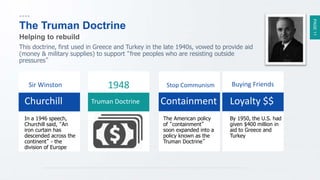
The Truman Doctrine
Helping to rebuild
Sir Winston 1948
This doctrine, first used in Greece and Turkey in the late 1940s, vowed to provide aid
(money & military supplies) to support “free peoples who are resisting outside
pressures”
Churchill
Stop Communism
Containment
Buying Friends
Loyalty $$Truman Doctrine
In a 1946 speech,
Churchill said, “An
iron curtain has
descended across the
continent” - the
division of Europe
The American policy
of “containment”
soon expanded into a
policy known as the
Truman Doctrine”
By 1950, the U.S. had
given $400 million in
aid to Greece and
Turkey
PAGE12
The Marshall Plan
• Post-war Europe was devastated
economically
• In June 1947, Secretary of State George
Marshall proposed a U.S. aid package to
European nations
• Western Europe accepted the help, while
Eastern Europe (read Stalin) rejected the
aid
ECONOMIC AID TO REBUILD EUROPE
The Marshall Plan helped Western Europe
recover economically
PAGE13
The Marshall Plan
• Over the next four years 16
European countries received $13
billion in U.S. aid
• By 1952 Western Europe’s
economy was flourishing
ECONOMIC AID TO REBUILD EUROPE
PAGE14
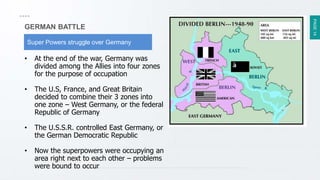
GERMAN BATTLE
Super Powers struggle over Germany
• At the end of the war, Germany was
divided among the Allies into four zones
for the purpose of occupation
• The U.S, France, and Great Britain
decided to combine their 3 zones into
one zone – West Germany, or the federal
Republic of Germany
• The U.S.S.R. controlled East Germany, or
the German Democratic Republic
• Now the superpowers were occupying an
area right next to each other – problems
were bound to occur
PAGE15
BERLIN BLOCKADE 1948
Battle for Berlin
• The Berlin blockade (June ‘48 – May
‘49) was one of the first major
international crises of the Cold War.
• During the multinational occupation of
post–World War II Germany, the Soviet
Union blocked the Western Allies' railway,
road, and canal access to the sectors of
Berlin under allied control.
• Their aim was to force the western powers
to allow the Soviet zone to start supplying
Berlin with food, fuel, and aid, thereby
giving the Soviets practical control over the
entire city.
PAGE16
BERLIN AIRLIFT
Soviet Plan Foiled
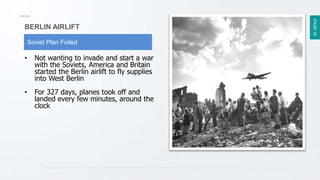
• Not wanting to invade and start a war
with the Soviets, America and Britain
started the Berlin airlift to fly supplies
into West Berlin
• For 327 days, planes took off and
landed every few minutes, around the
clock
PAGE17
BERLIN AIRLIFT
Soviet Plan Foiled
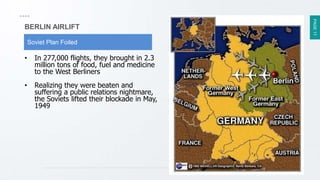
• In 277,000 flights, they brought in 2.3
million tons of food, fuel and medicine
to the West Berliners
• Realizing they were beaten and
suffering a public relations nightmare,
the Soviets lifted their blockade in May,
1949
PAGE18
NATA FORMED
The West Creates a Military Alliance
• The Berlin blockade increased Western
Europe’s fear of Soviet aggression
• As a result, ten West European nations
joined the U.S and Canada on April 4,
1949 to form a defensive alliance
known as the North Atlantic Treaty
Organization

Outcome 2.2-cold-war-expansion-containment

  • 1.
    PAGE1 WWW.NICKJORDAN.CA HORTON HIGH SCHOOL2014 GLOBAL HISTORY 12 Unit 2 – The Cold War Expansion & Containment
  • 2.
    PAGE2 The Cold WarHeats Up! GLOBAL HISTORY 12 • At the heart of the tension was a fundamental difference in political systems • America is a democracy that has a capitalist economic system, free elections and competing political parties • In the U.S.S.R., the sole political party – the Communists – established a totalitarian regime with little or no rights for the citizens TENSIONS BUILD
  • 3.
    PAGE3 Make ‘em Pay! •After the end of the war, a conference was held in Potsdam, Germany, to set up peace treaties . • The countries that fought with Hitler lost territory and had to pay reparations to the Allies . • Germany and its capital Berlin were divided into four parts. The zones were to be controlled by Great Britain, the United States, France and the Soviet Union. GERMANY DIVIDED
  • 4.
    PAGE4 YOU OWE US •War reparations are payments intended to cover damage or injury inflicted during a war. • Generally, the term war reparations refers to money or goods changing hands, rather than such property transfers as the annexation of land. REPARATIONS
  • 5.
    PAGE5 YOU OWE US •At the Yalta Conference (February, 1945), the Soviet Union proposed that German reparations be set at approximately $20 billion of which the Soviets wanted half. • Great Britain and the United States but didn’t finalize an amount. REPARATIONS
  • 6.
    PAGE6 Buffer Needed BUILDING ANIRON CURTAIN • The Soviet Union suffered an estimated 20 million WWII deaths, half of whom were civilian • As a result they felt justified in their claim to Eastern Europe. The countries that they liberated should be part of their new ‘union’. • Furthermore, they felt they needed Eastern Europe as a buffer against future German aggression
  • 7.
    PAGE7 Buffer Needed • TheIron Curtain symbolized the ideological conflict and physical boundary dividing Europe into two separate areas from the end of World War II in 1945 until the end of the Cold War in 1991. • The term symbolized efforts by the Soviet Union to block itself and its satellite states from open contact with the west and non- Soviet-controlled areas. BUILDING AN IRON CURTAIN
  • 8.
    PAGE8 Warsaw Pact vsNATO TEAM COMMUNISM VS TEAM DEMOCRACY • On the east side of the Iron Curtain were the countries that were connected to or influenced by the Soviet Union. • The countries who were part of the Warsaw Pact created an economic and military alliances, with the Soviet Union as the leading state • Member countries of the European Community and/or the North Atlantic Treaty Organization and with the United States as the leading country
  • 9.
    PAGE9 Join Our Team! •Stalin installed “satellite” communist governments in the Eastern European countries of Albania, Bulgaria, Czechoslovakia, Hungary, Romania, Yugoslavia and East Germany • This after promising “free elections” for Eastern Europe at the Yalta Conference WE INSIST In a 1946 speech, Stalin said communism and capitalism were incompatible – and another war was inevitable
  • 10.
    PAGE10 Policy of Containment •Faced with the Soviet threat, Truman decided it was time to “stop babying the Soviets” • In February 1946, George Kennan, an American diplomat in Moscow, proposed a policy of containment • Containment meant the U.S. would prevent any further extension of communist rule STOP THE COMMUNISTS!
  • 11.
    PAGE11 The Truman Doctrine Helpingto rebuild Sir Winston 1948 This doctrine, first used in Greece and Turkey in the late 1940s, vowed to provide aid (money & military supplies) to support “free peoples who are resisting outside pressures” Churchill Stop Communism Containment Buying Friends Loyalty $$Truman Doctrine In a 1946 speech, Churchill said, “An iron curtain has descended across the continent” - the division of Europe The American policy of “containment” soon expanded into a policy known as the Truman Doctrine” By 1950, the U.S. had given $400 million in aid to Greece and Turkey
  • 12.
    PAGE12 The Marshall Plan •Post-war Europe was devastated economically • In June 1947, Secretary of State George Marshall proposed a U.S. aid package to European nations • Western Europe accepted the help, while Eastern Europe (read Stalin) rejected the aid ECONOMIC AID TO REBUILD EUROPE The Marshall Plan helped Western Europe recover economically
  • 13.
    PAGE13 The Marshall Plan •Over the next four years 16 European countries received $13 billion in U.S. aid • By 1952 Western Europe’s economy was flourishing ECONOMIC AID TO REBUILD EUROPE
  • 14.
    PAGE14 GERMAN BATTLE Super Powersstruggle over Germany • At the end of the war, Germany was divided among the Allies into four zones for the purpose of occupation • The U.S, France, and Great Britain decided to combine their 3 zones into one zone – West Germany, or the federal Republic of Germany • The U.S.S.R. controlled East Germany, or the German Democratic Republic • Now the superpowers were occupying an area right next to each other – problems were bound to occur
  • 15.
    PAGE15 BERLIN BLOCKADE 1948 Battlefor Berlin • The Berlin blockade (June ‘48 – May ‘49) was one of the first major international crises of the Cold War. • During the multinational occupation of post–World War II Germany, the Soviet Union blocked the Western Allies' railway, road, and canal access to the sectors of Berlin under allied control. • Their aim was to force the western powers to allow the Soviet zone to start supplying Berlin with food, fuel, and aid, thereby giving the Soviets practical control over the entire city.
  • 16.
    PAGE16 BERLIN AIRLIFT Soviet PlanFoiled • Not wanting to invade and start a war with the Soviets, America and Britain started the Berlin airlift to fly supplies into West Berlin • For 327 days, planes took off and landed every few minutes, around the clock
  • 17.
    PAGE17 BERLIN AIRLIFT Soviet PlanFoiled • In 277,000 flights, they brought in 2.3 million tons of food, fuel and medicine to the West Berliners • Realizing they were beaten and suffering a public relations nightmare, the Soviets lifted their blockade in May, 1949
  • 18.
    PAGE18 NATA FORMED The WestCreates a Military Alliance • The Berlin blockade increased Western Europe’s fear of Soviet aggression • As a result, ten West European nations joined the U.S and Canada on April 4, 1949 to form a defensive alliance known as the North Atlantic Treaty Organization