Nova Scotia's First Nation
Mi'kmaq Heritage
The Population
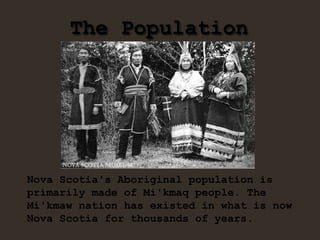
Nova Scotia's Aboriginal population is
primarily made of Mi'kmaq people. The
Mi'kmaw nation has existed in what is now
Nova Scotia for thousands of years.
The Population
There are 24,175 people of Aboriginal
identity in Nova Scotia - an increase of
42% since 2001. This population makes up
2.7% of the total population of Nova
Scotia.
Communities
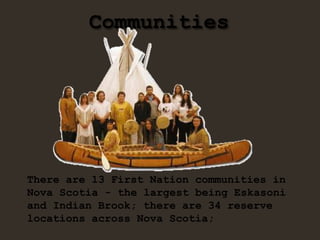
There are 13 First Nation communities in
Nova Scotia - the largest being Eskasoni
and Indian Brook; there are 34 reserve
locations across Nova Scotia;
The Mi'kmaq Story
Samuel de Champlain arrived in Nova Scotia
on May 12, 1604. The establishment of
French outposts in Atlantic Canada led to
the founding of Acadia.
History
Mi'kmaq legend had long foretold the
arrival of white men from across the ocean,
and the appearance of Europeans in tall
ships seemed to fulfil this prophecy:
"Micmacs' first contact with Europeans did
not surprise them or alter their world
view. A legend in which one of their
spiritual beings travelled across the
Atlantic to 'discover' Europe taught that
blue-eyed people would arrive from the east
to disrupt their lives.
History
Micmac people also knew the story of a
woman who had a vision of an island
floating toward their lands; the island was
decked out with tall trees on which were
living beings. Thus the Micmacs were not
startled by the appearance of early
explorers in sailing ships. Instead, they
greeted the newcomers, set up a brisk trade
with them, and looked forward to
incorporating the strangers' new
technologies into their own culture.
History
The arrival of the French, and later the
British, significantly changed the Mi'kmaq
way of life. When I look at my family tree
I see the French influence on my own
family. When I listen to the Mi'kmaq
language I hear Mi'kmaq words borrowed from
the French. The fact that I am Catholic
stems from the time of the first contact
when Chief Membertou converted to
Catholicism.
History
I am Mi'kmaq. I feel a strong connection to
my ancestors and their struggles for
survival. Mi'kmaq people did not passively
accept the newcomers, nor did they give up
their power. Instead, we survived by
adapting and evolving.
According to stories passed down through
Mi'kmaq oral tradition, one of our
ancestors had a vision about the arrival of
the white man. Perhaps this vision arose
from our contact with early Viking
settlers. Regardless, Mi'kmaq people have
always known that more white people would
arrive on their shores.
History
But all was not sweetness and light. With
the goods and the newcomers, came sickness.
Our people began to die from illnesses our
medicine people could not cure. Our
population decreased significantly during
the early period of contact with first the
French, and then the British.
If disease had not decimated the Mi'kmaq
people, the history of Nova Scotia might
have been very different. The friendship
between the French and the Mi'kmaq could
have changed the military outcome in Nova
Scotia if we had not suffered such a
population loss.
s.
History
In commemorating the arrival of the French
in Acadia, we cannot forget the impact of
their arrival on the Mi'kmaq people and our
territory, Mikamaki. Without the Mi'kmaq,
the French would have not survived. At the
same time, the arrival of the French
wrought great change in the Mi'kmaq in
terms of our religious beliefs, our trade
and our health.

The mi kmaq

  • 1.
    Nova Scotia's FirstNation Mi'kmaq Heritage
  • 2.
    The Population Nova Scotia'sAboriginal population is primarily made of Mi'kmaq people. The Mi'kmaw nation has existed in what is now Nova Scotia for thousands of years.
  • 3.
    The Population There are24,175 people of Aboriginal identity in Nova Scotia - an increase of 42% since 2001. This population makes up 2.7% of the total population of Nova Scotia.
  • 4.
    Communities There are 13First Nation communities in Nova Scotia - the largest being Eskasoni and Indian Brook; there are 34 reserve locations across Nova Scotia;
  • 5.
    The Mi'kmaq Story Samuelde Champlain arrived in Nova Scotia on May 12, 1604. The establishment of French outposts in Atlantic Canada led to the founding of Acadia.
  • 6.
    History Mi'kmaq legend hadlong foretold the arrival of white men from across the ocean, and the appearance of Europeans in tall ships seemed to fulfil this prophecy: "Micmacs' first contact with Europeans did not surprise them or alter their world view. A legend in which one of their spiritual beings travelled across the Atlantic to 'discover' Europe taught that blue-eyed people would arrive from the east to disrupt their lives.
  • 7.
    History Micmac people alsoknew the story of a woman who had a vision of an island floating toward their lands; the island was decked out with tall trees on which were living beings. Thus the Micmacs were not startled by the appearance of early explorers in sailing ships. Instead, they greeted the newcomers, set up a brisk trade with them, and looked forward to incorporating the strangers' new technologies into their own culture.
  • 8.
    History The arrival ofthe French, and later the British, significantly changed the Mi'kmaq way of life. When I look at my family tree I see the French influence on my own family. When I listen to the Mi'kmaq language I hear Mi'kmaq words borrowed from the French. The fact that I am Catholic stems from the time of the first contact when Chief Membertou converted to Catholicism.
  • 9.
    History I am Mi'kmaq.I feel a strong connection to my ancestors and their struggles for survival. Mi'kmaq people did not passively accept the newcomers, nor did they give up their power. Instead, we survived by adapting and evolving. According to stories passed down through Mi'kmaq oral tradition, one of our ancestors had a vision about the arrival of the white man. Perhaps this vision arose from our contact with early Viking settlers. Regardless, Mi'kmaq people have always known that more white people would arrive on their shores.
  • 10.
    History But all wasnot sweetness and light. With the goods and the newcomers, came sickness. Our people began to die from illnesses our medicine people could not cure. Our population decreased significantly during the early period of contact with first the French, and then the British. If disease had not decimated the Mi'kmaq people, the history of Nova Scotia might have been very different. The friendship between the French and the Mi'kmaq could have changed the military outcome in Nova Scotia if we had not suffered such a population loss. s.
  • 11.
    History In commemorating thearrival of the French in Acadia, we cannot forget the impact of their arrival on the Mi'kmaq people and our territory, Mikamaki. Without the Mi'kmaq, the French would have not survived. At the same time, the arrival of the French wrought great change in the Mi'kmaq in terms of our religious beliefs, our trade and our health.