

Debating 12 - Mr.Jordan | Middleton Regional High School
Principles of Cross
Examination Debate
Video was not exported from SlideRocket
What is Cross Examination
Debate?
Cross Examination Debate
It is an exercise in a developing the skills of
argumentation. Cross examination is the time of direct
confrontation between opposing members of the teams.
A public question and answer exchange that takes place
in an attempt to influence a judge.
Video was not exported from SlideRocket
A Few Good Men?
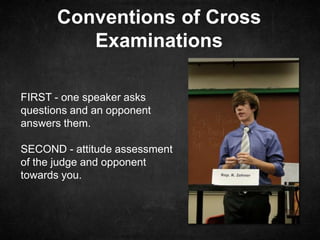
Conventions of Cross
Examinations
FIRST - one speaker asks
questions and an opponent
answers them.
SECOND - attitude assessment
of the judge and opponent
towards you.
Rules?
Avoid sarcasm
Avoid evasiveness
Avoid verbal bullying
Be polite
Be calm
Be focused
Ojectives of Cross Examination
* Clarify points of the opposition
* To expose factual error unsupported assertions made by
the opposition
* To obtain damaging admissions from the opposition.
* To set up arguments for use in subsequent speeches by
your or your partner.
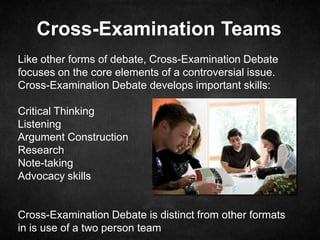
Cross-Examination Teams
Like other forms of debate, Cross-Examination Debate
focuses on the core elements of a controversial issue.
Cross-Examination Debate develops important skills:
Critical Thinking
Listening
Argument Construction
Research
Note-taking
Advocacy skills
Cross-Examination Debate is distinct from other formats
in is use of a two person team
Key Components
Cross-Examination debate
has a flavour all its own.
Debating of every type
rewards those who can think
on their feet, speak well and
prepare thoroughly but
Cross-examination debate
puts special emphasis on
these qualities.
How Cross differs from other
styles:
Cross-Examination debating was developed in the
1920s, to accentuate the clash in debating. It differs from
Parliamentary debate in two senses:
1. No formal interruptions (Points of Order, Privilege or
Information) are permitted, nor (normally) is heckling;
2. There is a period at the end of each debater’s speech
for questioning by an opponent.
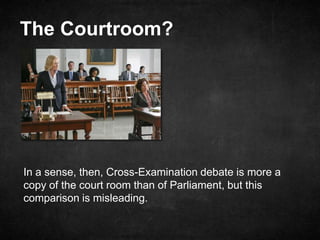
The Courtroom?
In a sense, then, Cross-Examination debate is more a
copy of the court room than of Parliament, but this
comparison is misleading.
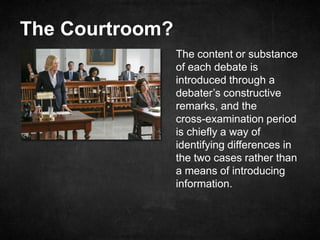
The Courtroom?
The content or substance
of each debate is
introduced through a
debater’s constructive
remarks, and the
cross-examination period
is chiefly a way of
identifying differences in
the two cases rather than
a means of introducing
information.
Cross Examination Basics
The fact that no interruptions are
permitted allows debaters to have
better control over the timing of his
remarks - a telling point will not be
interrupted at the climax by a Point
of Privilege. But the cross-
examination portion of the
debate forces debaters to respond
to their opponent’s arguments, pins
him down to particular views, and
exposes their own argument to a
fairly searching analysis
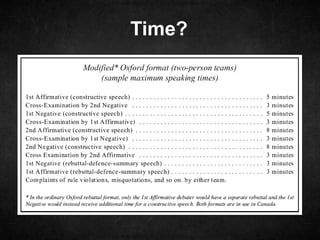
Time?
Cross Rules
1. No formal interruptions are permitted during the course
of the debate, although at the end of the debate, an
opportunity will be afforded to debaters to complain of any
rule violations and misrepresentations by
their opponents.
Cross Rules
2. At the end of each debater’s initial remarks (but not
after the rebuttals, if separate rebuttals are
permitted), that debater will be questioned by an
opponent, usually for up to three or four minutes.
Cross Rules
3. While being questioned, `witnesses`may only answer
questions; they cannot ask questions except to have
confusing queries clarified. They must answer the
questions themselves - neither witnesses nor ‘examiners’
may seek help from colleagues, although both sides may
rely on source materials and books during the
examination. Witnesses must answer all questions
directly and honestly.
Cross Rules
4. While asking questions, an examiner may not make
statements or argue with the witness, only ask questions.
Judges are instructed to disregard information introduced
by an examiner while questioning and to penalize
examiners for breaking the rules.
Cross Rules
5. There are no formal rules of evidence which govern the
sort of question which may be asked, though common
sense dictates that the examination should be limited to
fair questions on relevant subjects; however, there must
be no brow-beating or attempts to belittle an
opponent, and debaters must treat one another with
courtesy.
Score Card
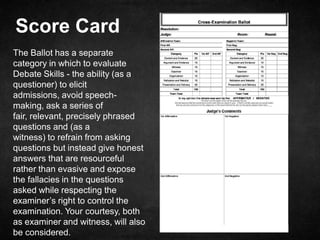
The Ballot has a separate
category in which to evaluate
Debate Skills - the ability (as a
questioner) to elicit
admissions, avoid speech-
making, ask a series of
fair, relevant, precisely phrased
questions and (as a
witness) to refrain from asking
questions but instead give honest
answers that are resourceful
rather than evasive and expose
the fallacies in the questions
asked while respecting the
examiner’s right to control the
examination. Your courtesy, both
as examiner and witness, will also
be considered.
Cross Explained
Video was not exported from SlideRocket

Debate _cross_examination

  • 1.
    Debating 12 -Mr.Jordan | Middleton Regional High School Principles of Cross Examination Debate
  • 3.
    Video was notexported from SlideRocket
  • 4.
    What is CrossExamination Debate?
  • 5.
    Cross Examination Debate Itis an exercise in a developing the skills of argumentation. Cross examination is the time of direct confrontation between opposing members of the teams. A public question and answer exchange that takes place in an attempt to influence a judge.
  • 6.
    Video was notexported from SlideRocket A Few Good Men?
  • 7.
    Conventions of Cross Examinations FIRST- one speaker asks questions and an opponent answers them. SECOND - attitude assessment of the judge and opponent towards you.
  • 8.
    Rules? Avoid sarcasm Avoid evasiveness Avoidverbal bullying Be polite Be calm Be focused
  • 9.
    Ojectives of CrossExamination * Clarify points of the opposition * To expose factual error unsupported assertions made by the opposition * To obtain damaging admissions from the opposition. * To set up arguments for use in subsequent speeches by your or your partner.
  • 10.
    Cross-Examination Teams Like otherforms of debate, Cross-Examination Debate focuses on the core elements of a controversial issue. Cross-Examination Debate develops important skills: Critical Thinking Listening Argument Construction Research Note-taking Advocacy skills Cross-Examination Debate is distinct from other formats in is use of a two person team
  • 11.
    Key Components Cross-Examination debate hasa flavour all its own. Debating of every type rewards those who can think on their feet, speak well and prepare thoroughly but Cross-examination debate puts special emphasis on these qualities.
  • 12.
    How Cross differsfrom other styles: Cross-Examination debating was developed in the 1920s, to accentuate the clash in debating. It differs from Parliamentary debate in two senses: 1. No formal interruptions (Points of Order, Privilege or Information) are permitted, nor (normally) is heckling; 2. There is a period at the end of each debater’s speech for questioning by an opponent.
  • 13.
    The Courtroom? In asense, then, Cross-Examination debate is more a copy of the court room than of Parliament, but this comparison is misleading.
  • 14.
    The Courtroom? The contentor substance of each debate is introduced through a debater’s constructive remarks, and the cross-examination period is chiefly a way of identifying differences in the two cases rather than a means of introducing information.
  • 15.
    Cross Examination Basics Thefact that no interruptions are permitted allows debaters to have better control over the timing of his remarks - a telling point will not be interrupted at the climax by a Point of Privilege. But the cross- examination portion of the debate forces debaters to respond to their opponent’s arguments, pins him down to particular views, and exposes their own argument to a fairly searching analysis
  • 16.
  • 17.
    Cross Rules 1. Noformal interruptions are permitted during the course of the debate, although at the end of the debate, an opportunity will be afforded to debaters to complain of any rule violations and misrepresentations by their opponents.
  • 18.
    Cross Rules 2. Atthe end of each debater’s initial remarks (but not after the rebuttals, if separate rebuttals are permitted), that debater will be questioned by an opponent, usually for up to three or four minutes.
  • 19.
    Cross Rules 3. Whilebeing questioned, `witnesses`may only answer questions; they cannot ask questions except to have confusing queries clarified. They must answer the questions themselves - neither witnesses nor ‘examiners’ may seek help from colleagues, although both sides may rely on source materials and books during the examination. Witnesses must answer all questions directly and honestly.
  • 20.
    Cross Rules 4. Whileasking questions, an examiner may not make statements or argue with the witness, only ask questions. Judges are instructed to disregard information introduced by an examiner while questioning and to penalize examiners for breaking the rules.
  • 21.
    Cross Rules 5. Thereare no formal rules of evidence which govern the sort of question which may be asked, though common sense dictates that the examination should be limited to fair questions on relevant subjects; however, there must be no brow-beating or attempts to belittle an opponent, and debaters must treat one another with courtesy.
  • 22.
    Score Card The Ballothas a separate category in which to evaluate Debate Skills - the ability (as a questioner) to elicit admissions, avoid speech- making, ask a series of fair, relevant, precisely phrased questions and (as a witness) to refrain from asking questions but instead give honest answers that are resourceful rather than evasive and expose the fallacies in the questions asked while respecting the examiner’s right to control the examination. Your courtesy, both as examiner and witness, will also be considered.
  • 23.
    Cross Explained Video wasnot exported from SlideRocket