OUR
ENVIRONMENT
MANAGING THE GARBAGE WE PRODUCE
• Definition of Garbage: Waste materials discarded because they no longer
serve any purpose.
• Types of Waste:
• Biodegradable: Organic matter that decomposes naturally (e.g., vegetable peels, food
scraps).
• Non-Biodegradable: Materials that do not decompose easily (e.g., plastics, metals).
INTRODUCTION
SOURCES OF GARBAGE
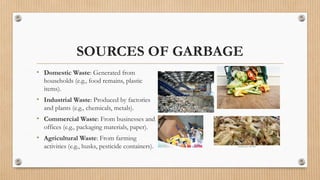
• Domestic Waste: Generated from
households (e.g., food remains, plastic
items).
• Industrial Waste: Produced by factories
and plants (e.g., chemicals, metals).
• Commercial Waste: From businesses and
offices (e.g., packaging materials, paper).
• Agricultural Waste: From farming
activities (e.g., husks, pesticide containers).
BIODEGRADABLE WASTE
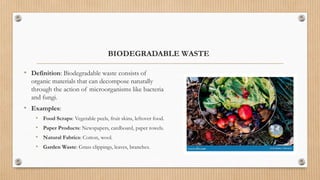
• Definition: Biodegradable waste consists of
organic materials that can decompose naturally
through the action of microorganisms like bacteria
and fungi.
• Examples:
• Food Scraps: Vegetable peels, fruit skins, leftover food.
• Paper Products: Newspapers, cardboard, paper towels.
• Natural Fabrics: Cotton, wool.
• Garden Waste: Grass clippings, leaves, branches.
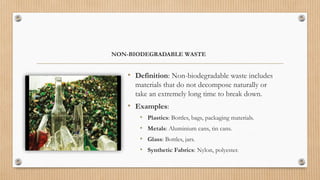
NON-BIODEGRADABLE WASTE
• Definition: Non-biodegradable waste includes
materials that do not decompose naturally or
take an extremely long time to break down.
• Examples:
• Plastics: Bottles, bags, packaging materials.
• Metals: Aluminium cans, tin cans.
• Glass: Bottles, jars.
• Synthetic Fabrics: Nylon, polyester.
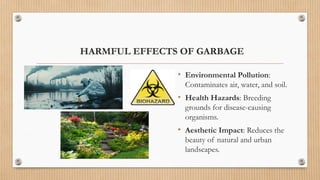
HARMFUL EFFECTS OF GARBAGE
• Environmental Pollution:
Contaminates air, water, and soil.
• Health Hazards: Breeding
grounds for disease-causing
organisms.
• Aesthetic Impact: Reduces the
beauty of natural and urban
landscapes.
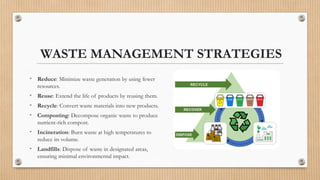
WASTE MANAGEMENT STRATEGIES
• Reduce: Minimize waste generation by using fewer
resources.
• Reuse: Extend the life of products by reusing them.
• Recycle: Convert waste materials into new products.
• Composting: Decompose organic waste to produce
nutrient-rich compost.
• Incineration: Burn waste at high temperatures to
reduce its volume.
• Landfills: Dispose of waste in designated areas,
ensuring minimal environmental impact.
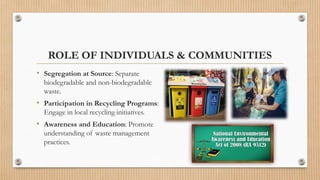
ROLE OF INDIVIDUALS & COMMUNITIES
• Segregation at Source: Separate
biodegradable and non-biodegradable
waste.
• Participation in Recycling Programs:
Engage in local recycling initiatives.
• Awareness and Education: Promote
understanding of waste management
practices.
CONCLUSION
• Collective Responsibility: Effective waste management requires the
combined efforts of individuals, communities, and governments.
• Sustainable Practices: Adopting sustainable waste management practices
ensures a cleaner and healthier environment for future generations.
THANK YOU
BY PRITIKA.H

our environment MANAGING THE GARBAGE WE PRODUCES

  • 1.
  • 2.
    • Definition ofGarbage: Waste materials discarded because they no longer serve any purpose. • Types of Waste: • Biodegradable: Organic matter that decomposes naturally (e.g., vegetable peels, food scraps). • Non-Biodegradable: Materials that do not decompose easily (e.g., plastics, metals). INTRODUCTION
  • 3.
    SOURCES OF GARBAGE •Domestic Waste: Generated from households (e.g., food remains, plastic items). • Industrial Waste: Produced by factories and plants (e.g., chemicals, metals). • Commercial Waste: From businesses and offices (e.g., packaging materials, paper). • Agricultural Waste: From farming activities (e.g., husks, pesticide containers).
  • 4.
    BIODEGRADABLE WASTE • Definition:Biodegradable waste consists of organic materials that can decompose naturally through the action of microorganisms like bacteria and fungi. • Examples: • Food Scraps: Vegetable peels, fruit skins, leftover food. • Paper Products: Newspapers, cardboard, paper towels. • Natural Fabrics: Cotton, wool. • Garden Waste: Grass clippings, leaves, branches.
  • 5.
    NON-BIODEGRADABLE WASTE • Definition:Non-biodegradable waste includes materials that do not decompose naturally or take an extremely long time to break down. • Examples: • Plastics: Bottles, bags, packaging materials. • Metals: Aluminium cans, tin cans. • Glass: Bottles, jars. • Synthetic Fabrics: Nylon, polyester.
  • 6.
    HARMFUL EFFECTS OFGARBAGE • Environmental Pollution: Contaminates air, water, and soil. • Health Hazards: Breeding grounds for disease-causing organisms. • Aesthetic Impact: Reduces the beauty of natural and urban landscapes.
  • 7.
    WASTE MANAGEMENT STRATEGIES •Reduce: Minimize waste generation by using fewer resources. • Reuse: Extend the life of products by reusing them. • Recycle: Convert waste materials into new products. • Composting: Decompose organic waste to produce nutrient-rich compost. • Incineration: Burn waste at high temperatures to reduce its volume. • Landfills: Dispose of waste in designated areas, ensuring minimal environmental impact.
  • 8.
    ROLE OF INDIVIDUALS& COMMUNITIES • Segregation at Source: Separate biodegradable and non-biodegradable waste. • Participation in Recycling Programs: Engage in local recycling initiatives. • Awareness and Education: Promote understanding of waste management practices.
  • 9.
    CONCLUSION • Collective Responsibility:Effective waste management requires the combined efforts of individuals, communities, and governments. • Sustainable Practices: Adopting sustainable waste management practices ensures a cleaner and healthier environment for future generations.
  • 10.