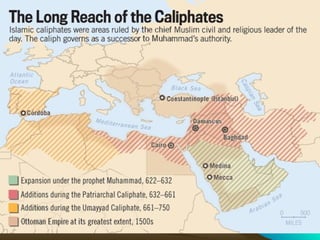
Why do you think Islam spread so rapidly? Arab armies were unified in their beliefs Muslim warriors who died in jihad promised paradise Jihad – “holy war” in defense of Islam; OR internal struggle (ie. against alcoholism, drug addiction, etc.) Existing empires – liked messages of equality Did not force conversion (but “nonbeliever tax”)
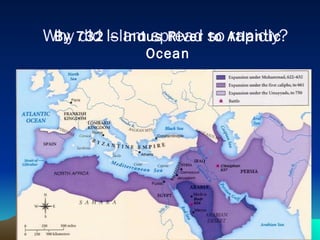
Why did Islam spread so rapidly? By 732 – Indus River to Atlantic Ocean
Islam:  After Muhammad's Death AD 632 – Muhammad dies; dynasties emerge Caliph – successor to Muhammad Dispute:  who will be the leader of Islam? Sunni Muslims Shi’ite   Muslims Any devout Muslim can be caliph Scholars interpret Koran 85-90% Caliph must be direct descendant of Muhammad Imam – leader – interprets Koran/Hadith 10-15%
 
 
Once upon a time… The Middle East met the West First U.S. impressions of ME came through eyes of Christian missionaries By 1800s – ME had fallen behind Science, technology, firepower 20 th  century – OIL becomes major reason US has interests in the ME; influences our foreign policy
 
Nov 26 - 4
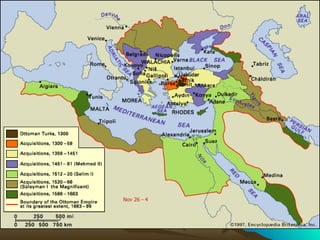
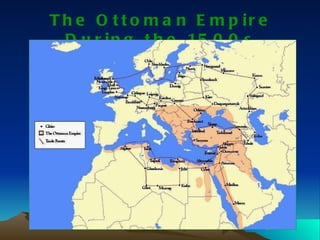
The Ottoman Empire During the 1500s
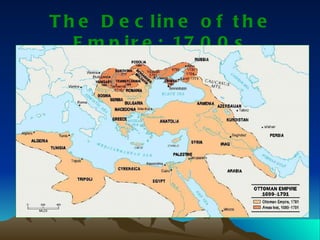
The Decline of the Empire: 1700s
Pre Class List 2 reasons why Islam spread so rapidly. Why did the West (Europe and the US) become interested in Middle Eastern affairs in the early 1900s?
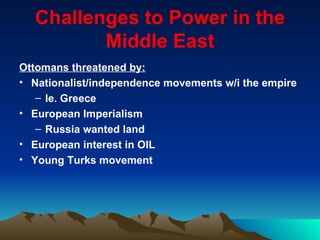
Challenges to Power in the Middle East Ottomans threatened by: Nationalist/independence movements w/i the empire Ie. Greece European Imperialism Russia wanted land European interest in OIL Young Turks movement
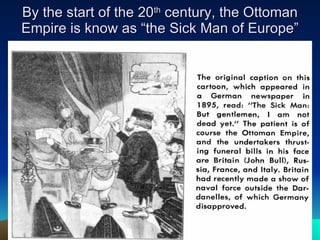
By the start of the 20 th  century, the Ottoman Empire is know as “the Sick Man of Europe”
The Young Turks Program 1908 revolutionaries, GOAL:  constitutional monarchy Pushed for reforms    basic rights: freedom of speech, assembly, press. NOT a democratic movt – believed the STATE should create reforms, not will of people Problem of nationalism – could not unite an empire with so many different groups of people!
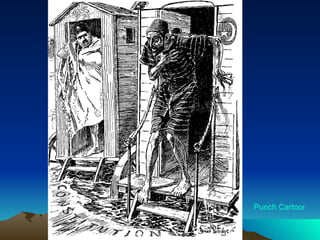
Punch Cartoon of August 12, 1908
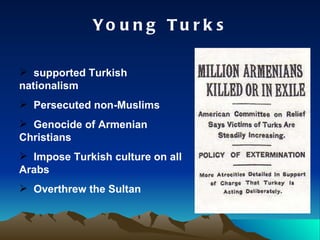
Young Turks supported Turkish nationalism Persecuted non-Muslims Genocide of Armenian Christians Impose Turkish culture on all Arabs Overthrew the Sultan
What is “genocide”? Genocide means any of the following acts committed with intent to destroy, in whole or in part, a national, ethnical, racial or religious group, as such: (a) Killing members of the group; (b) Causing serious bodily or mental harm to members of the group; (c) Deliberately inflicting on the group conditions of life calculated to bring about its physical destruction in whole or in part;  (d) Imposing measures intended to prevent births within the group;  (e) Forcibly transferring children of the group to another group.
 
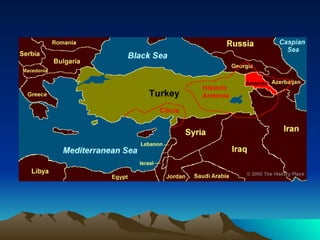
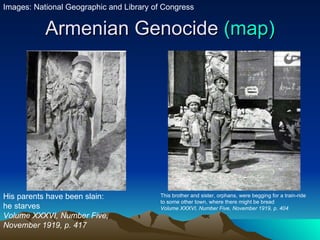
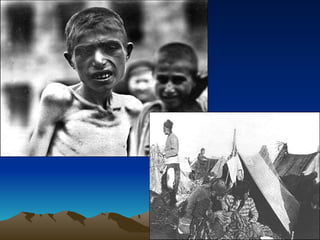
Armenian Genocide  (map) His parents have been slain: he starves Volume XXXVI, Number Five, November 1919, p. 417  This brother and sister, orphans, were begging for a train-ride to some other town, where there might be bread Volume XXXVI, Number Five, November 1919, p. 404  Images: National Geographic and Library of Congress
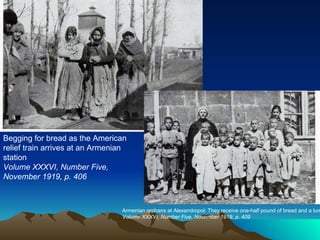
Begging for bread as the American relief train arrives at an Armenian station Volume XXXVI, Number Five, November 1919, p. 406  Armenian orphans at Alexandropol: They receive one-half pound of bread and a lump of sugar per day  Volume XXXVI, Number Five, November 1919, p. 409
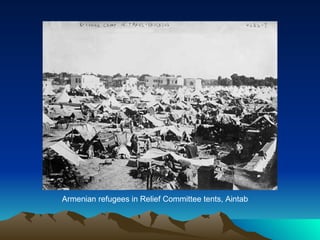
Armenian refugees in Relief Committee tents, Aintab
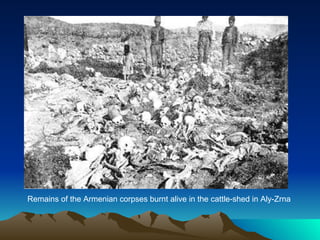
Remains of the Armenian corpses burnt alive in the cattle-shed in Aly-Zrna
 
Image Analysis Look at the piece of artwork that you’ve been given, and answer the following questions: What/who is the subject of the work? What is the story that the artist is trying to tell? List 2 emotions that come to mind when you look at this piece of art. How does the artist use colors, lines, etc. to convey these emotions? Give the painting a title that you think is appropriate The Legacy Project
Armenian Genocide Vote Irks Turkey (March 2010 )
Pre Class  Why did a split occur in the Muslim community following Muhammad’s death?  What are the names of the 2 resulting sects? Why was the Ottoman Empire known as “The Sick Man of Europe” by the beginning of the 20 th  Century?
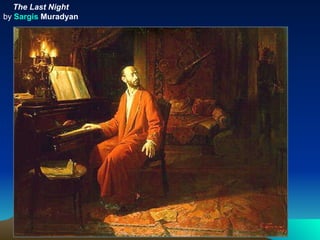
The Last Night by  Sargis   Muradyan
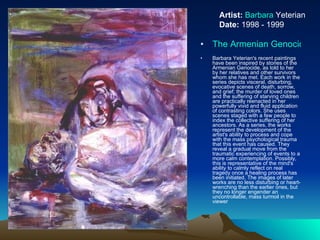
The Armenian Genocide Series Barbara Yeterian's recent paintings have been inspired by stories of the Armenian Genocide, as told to her by her relatives and other survivors whom she has met. Each work in the series depicts visceral, disturbing, evocative scenes of death, sorrow, and grief; the murder of loved ones and the suffering of starving children are practically reenacted in her powerfully vivid and fluid application of contrasting colors. She uses scenes staged with a few people to index the collective suffering of her ancestors. As a series, the works represent the development of the artist's ability to process and cope with the mass psychological trauma that this event has caused. They reveal a gradual move from the traumatic experiencing of events to a more calm contemplation. Possibly, this is representative of the mind's ability to calmly reflect on real tragedy once a healing process has been initiated. The images of later works are no less disturbing or heart-wrenching than the earlier ones, but they no longer engender an uncontrollable, mass turmoil in the viewer  Artist:   Barbara  Yeterian Date:  1998 - 1999
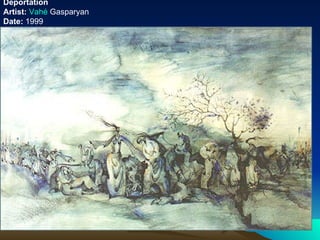
Deportation Artist:   Vahé   Gasparyan Date:  1999
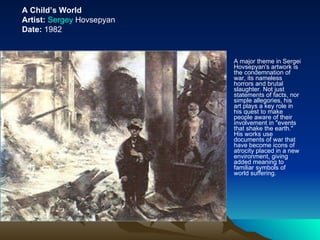
A major theme in Sergei Hovsepyan's artwork is the condemnation of war, its nameless horrors and brutal slaughter. Not just statements of facts, nor simple allegories, his art plays a key role in his quest to make people aware of their involvement in "events that shake the earth." His works use documents of war that have become icons of atrocity placed in a new environment, giving added meaning to familiar symbols of world suffering.  A Child’s World Artist:   Sergey  Hovsepyan Date:  1982
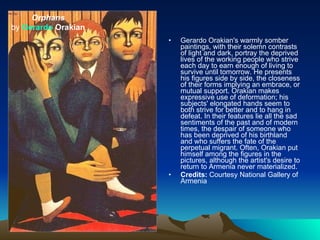
Gerardo Orakian's warmly somber paintings, with their solemn contrasts of light and dark, portray the deprived lives of the working people who strive each day to earn enough of living to survive until tomorrow. He presents his figures side by side, the closeness of their forms implying an embrace, or mutual support. Orakian makes expressive use of deformation; his subjects' elongated hands seem to both strive for better and to hang in defeat. In their features lie all the sad sentiments of the past and of modern times, the despair of someone who has been deprived of his birthland and who suffers the fate of the perpetual migrant. Often, Orakian put himself among the figures in the pictures, although the artist's desire to return to Armenia never materialized. Credits:  Courtesy National Gallery of Armenia Orphans by  Gerardo  Orakian
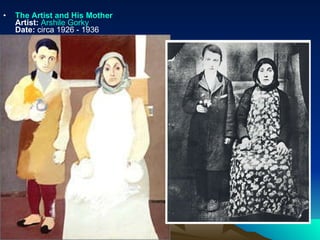
The Artist and His Mother   Artist:   Arshile  Gorky Date:  circa 1926 - 1936 Gorky toiled over this representation of his relationship with his mother for almost a decade. The inspiration for this picture was a photograph of the artist with his mother, which had been taken prior to her tragic death during the Armenian Genocide. Upon his arrival in New York, he began to reproduce the photo, making changes in composition and incorporating surrealist, expressive elements. Comparing the painting with the photo, one realizes that contact between the two persons does not exist anymore. The melancholic boy stands separated from his mother. His face seems to express deep sorrow over the separation. This might also be understood as a metaphorical separation. The flowers in his hand look like an offering to the timeless, monumental figure of the mother. The representation of the mother is interesting: there is a contrast between her colorful face and fragile, almost transparent body. The mask-like character of her face is underlined by the dark window at the back, and her body seems to dissolve outside the picture. Her position, both suspended in air and enthroned in a seat recalls a traditional presentation of the Madonna, accompanied by a worshipping figure.
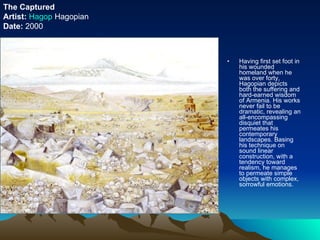
Having first set foot in his wounded homeland when he was over forty, Hagopian depicts both the suffering and hard-earned wisdom of Armenia. His works never fail to be dramatic, revealing an all-encompassing disquiet that permeates his contemporary landscapes. Basing his technique on sound linear construction, with a tendency toward realism, he manages to permeate simple objects with complex, sorrowful emotions. The Captured Artist:   Hagop   Hagopian Date:  2000
Essential Question:  How did events during/after WWI create conflicting views regarding the fate of Palestine in the early 20 th  century?
Turkish Nationalism   (led by Young Turks)   Arab Nationalism  in OE – groups of people want to break away from the empire FUELS
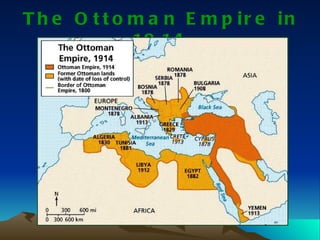
The Ottoman Empire in 1914
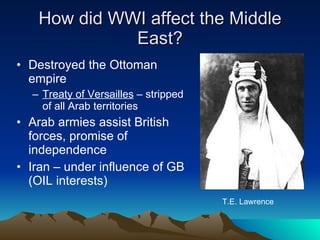
How did WWI affect the Middle East? Destroyed the Ottoman empire Treaty of Versailles  – stripped of all Arab territories Arab armies assist British forces, promise of independence Iran – under influence of GB (OIL interests) T.E. Lawrence
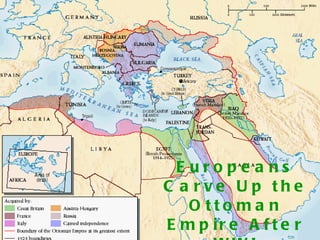
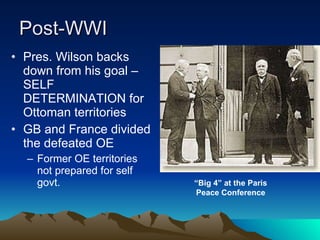
Post-WWI Pres. Wilson backs down from his goal – SELF DETERMINATION for Ottoman territories  GB and France divided the defeated OE Former OE territories not prepared for self govt. “ Big 4” at the Paris Peace Conference
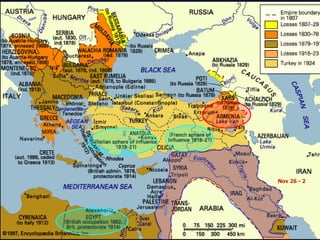
Europeans Carve Up the Ottoman Empire After WWI
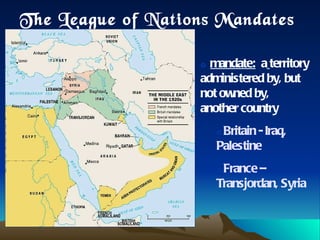
The League of Nations Mandates mandate:   a   territory administered by, but not owned by, another country Britain - Iraq, Palestine  France – Transjordan, Syria
 
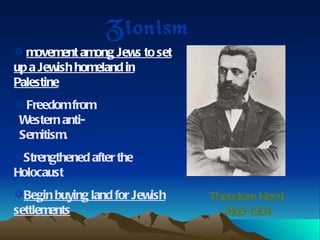
Zionism Theodore Herzl 1860-1904 movement among Jews to set up a Jewish homeland in Palestine Freedom from    Western anti-   Semitism.  Strengthened after the Holocaust Begin buying land for Jewish settlements
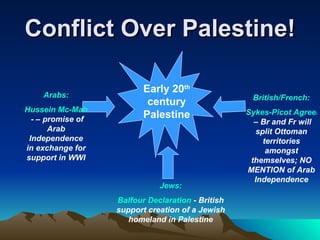
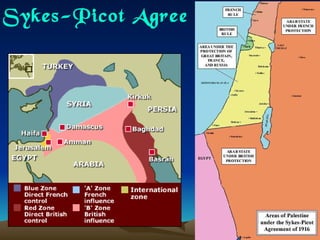
Conflict Over Palestine! Early 20 th  century Palestine Arabs: Hussein Mc-Mahon Letters  - – promise of Arab Independence in exchange for support in WWI Jews: Balfour Declaration  - British support creation of a Jewish homeland in Palestine British/French: Sykes-Picot Agreement  – Br and Fr will split Ottoman territories amongst themselves; NO MENTION of Arab Independence
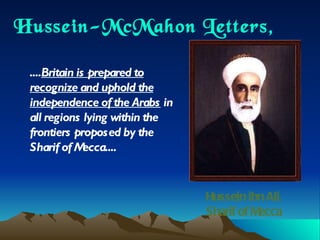
Hussein-McMahon Letters, 1915 .... Britain is prepared to recognize and uphold the independence of the Arabs  in all regions lying within the frontiers proposed by the Sharif of Mecca.... Hussein ibn Ali, Sharif of Mecca
Sykes-Picot Agreement, 1916
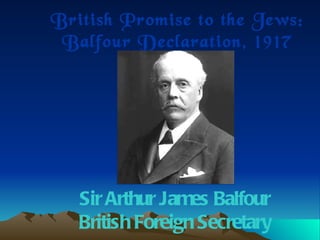
British Promise to the Jews: Balfour Declaration, 1917 Sir Arthur James Balfour British Foreign Secretary
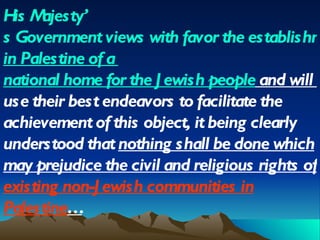
His Majesty ’ s Government views with favor the establishment  in  Palestine of  a   national home for the Jewish people  and will  use their best endeavors to facilitate the achievement of this object, it being clearly understood that  nothing shall be done which may prejudice the civil and religious rights of  existing non-Jewish communities in Palestine …
Pre-Class List  and  explain  the three conflicting agreements made by the British during WWI, which led to the fight over Palestine.
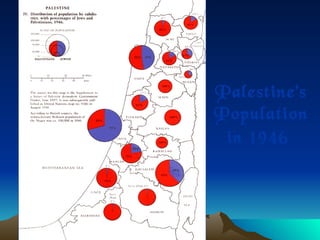
Conflict Over Palestine The Zionist movement came into conflict with Arab Nationalism in Palestine WWII (1940s) 6 million Jews die in the Holocaust, strengthening the movement Sympathy from the West  At the same time, Palestinian Arabs feared they’d become a minority  The British turn the fate of Palestine over to the United Nations…
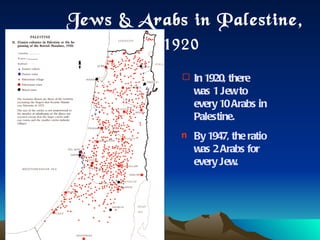
Jews & Arabs in Palestine,  1920   In 1920, there  was 1 Jew to every 10 Arabs in Palestine. By 1947, the ratio  was 2 Arabs for every Jew.
Palestine’s Population in 1946
Creating a Partition Plan… It’s 1947… Together, with your group members you will consider several factors involved in dividing land between the Jews and Palestinians. You will create a map of Palestine that you feel fits the needs of both groups. We will vote for the group whose plan we feel is most fair!
Today… Review the maps you’ve been given Create your partition plan – draw your map  Below your map, write 3 sentences explaining your partition plan  For example – what factors did you take into account when creating it?
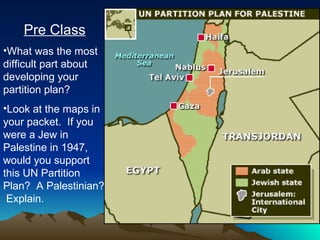
Pre Class What was the most difficult part about developing your partition plan? Look at the maps in your packet.  If you were a Jew in Palestine in 1947, would you support this UN Partition Plan?  A Palestinian?  Explain.
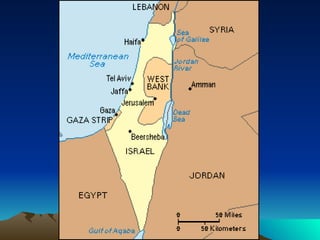
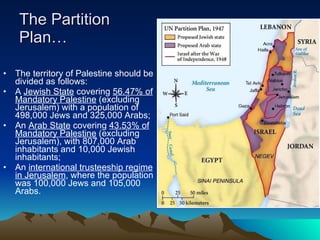
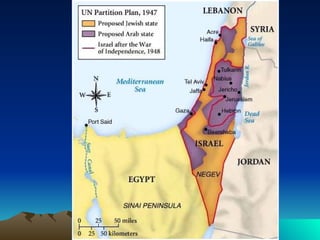
The Partition Plan… The territory of Palestine should be divided as follows:  A  Jewish State  covering  56.47% of Mandatory Palestine  (excluding Jerusalem) with a population of 498,000 Jews and 325,000 Arabs;  An  Arab State  covering  43.53% of Mandatory Palestine  (excluding Jerusalem), with 807,000 Arab inhabitants and 10,000 Jewish inhabitants;  An  international trusteeship regime in Jerusalem , where the population was 100,000 Jews and 105,000 Arabs.
The partition plan also laid down:  A  guarantee of the rights of minorities and religious rights, including free access to and the preservation of Holy Places ;  A constitution of an  Economic Union  between the two states: custom union, joint monetary system, joint administration of main services, equal access to water and energy resources.
 
Nov 26 - 2

Ottoman Empire to WWI

  • 1.
    Why do youthink Islam spread so rapidly? Arab armies were unified in their beliefs Muslim warriors who died in jihad promised paradise Jihad – “holy war” in defense of Islam; OR internal struggle (ie. against alcoholism, drug addiction, etc.) Existing empires – liked messages of equality Did not force conversion (but “nonbeliever tax”)
  • 2.
    Why did Islamspread so rapidly? By 732 – Indus River to Atlantic Ocean
  • 3.
    Islam: AfterMuhammad's Death AD 632 – Muhammad dies; dynasties emerge Caliph – successor to Muhammad Dispute: who will be the leader of Islam? Sunni Muslims Shi’ite Muslims Any devout Muslim can be caliph Scholars interpret Koran 85-90% Caliph must be direct descendant of Muhammad Imam – leader – interprets Koran/Hadith 10-15%
  • 4.
  • 5.
  • 6.
    Once upon atime… The Middle East met the West First U.S. impressions of ME came through eyes of Christian missionaries By 1800s – ME had fallen behind Science, technology, firepower 20 th century – OIL becomes major reason US has interests in the ME; influences our foreign policy
  • 7.
  • 8.
  • 9.
    The Ottoman EmpireDuring the 1500s
  • 10.
    The Decline ofthe Empire: 1700s
  • 11.
    Pre Class List2 reasons why Islam spread so rapidly. Why did the West (Europe and the US) become interested in Middle Eastern affairs in the early 1900s?
  • 12.
    Challenges to Powerin the Middle East Ottomans threatened by: Nationalist/independence movements w/i the empire Ie. Greece European Imperialism Russia wanted land European interest in OIL Young Turks movement
  • 13.
    By the startof the 20 th century, the Ottoman Empire is know as “the Sick Man of Europe”
  • 14.
    The Young TurksProgram 1908 revolutionaries, GOAL: constitutional monarchy Pushed for reforms  basic rights: freedom of speech, assembly, press. NOT a democratic movt – believed the STATE should create reforms, not will of people Problem of nationalism – could not unite an empire with so many different groups of people!
  • 15.
    Punch Cartoon ofAugust 12, 1908
  • 16.
    Young Turks supportedTurkish nationalism Persecuted non-Muslims Genocide of Armenian Christians Impose Turkish culture on all Arabs Overthrew the Sultan
  • 17.
    What is “genocide”?Genocide means any of the following acts committed with intent to destroy, in whole or in part, a national, ethnical, racial or religious group, as such: (a) Killing members of the group; (b) Causing serious bodily or mental harm to members of the group; (c) Deliberately inflicting on the group conditions of life calculated to bring about its physical destruction in whole or in part; (d) Imposing measures intended to prevent births within the group; (e) Forcibly transferring children of the group to another group.
  • 18.
  • 19.
    Armenian Genocide (map) His parents have been slain: he starves Volume XXXVI, Number Five, November 1919, p. 417 This brother and sister, orphans, were begging for a train-ride to some other town, where there might be bread Volume XXXVI, Number Five, November 1919, p. 404 Images: National Geographic and Library of Congress
  • 20.
    Begging for breadas the American relief train arrives at an Armenian station Volume XXXVI, Number Five, November 1919, p. 406 Armenian orphans at Alexandropol: They receive one-half pound of bread and a lump of sugar per day Volume XXXVI, Number Five, November 1919, p. 409
  • 21.
    Armenian refugees inRelief Committee tents, Aintab
  • 22.
    Remains of theArmenian corpses burnt alive in the cattle-shed in Aly-Zrna
  • 23.
  • 24.
    Image Analysis Lookat the piece of artwork that you’ve been given, and answer the following questions: What/who is the subject of the work? What is the story that the artist is trying to tell? List 2 emotions that come to mind when you look at this piece of art. How does the artist use colors, lines, etc. to convey these emotions? Give the painting a title that you think is appropriate The Legacy Project
  • 25.
    Armenian Genocide VoteIrks Turkey (March 2010 )
  • 26.
    Pre Class Why did a split occur in the Muslim community following Muhammad’s death? What are the names of the 2 resulting sects? Why was the Ottoman Empire known as “The Sick Man of Europe” by the beginning of the 20 th Century?
  • 27.
    The Last Nightby Sargis Muradyan
  • 28.
    The Armenian GenocideSeries Barbara Yeterian's recent paintings have been inspired by stories of the Armenian Genocide, as told to her by her relatives and other survivors whom she has met. Each work in the series depicts visceral, disturbing, evocative scenes of death, sorrow, and grief; the murder of loved ones and the suffering of starving children are practically reenacted in her powerfully vivid and fluid application of contrasting colors. She uses scenes staged with a few people to index the collective suffering of her ancestors. As a series, the works represent the development of the artist's ability to process and cope with the mass psychological trauma that this event has caused. They reveal a gradual move from the traumatic experiencing of events to a more calm contemplation. Possibly, this is representative of the mind's ability to calmly reflect on real tragedy once a healing process has been initiated. The images of later works are no less disturbing or heart-wrenching than the earlier ones, but they no longer engender an uncontrollable, mass turmoil in the viewer Artist: Barbara Yeterian Date: 1998 - 1999
  • 29.
    Deportation Artist: Vahé Gasparyan Date: 1999
  • 30.
    A major themein Sergei Hovsepyan's artwork is the condemnation of war, its nameless horrors and brutal slaughter. Not just statements of facts, nor simple allegories, his art plays a key role in his quest to make people aware of their involvement in "events that shake the earth." His works use documents of war that have become icons of atrocity placed in a new environment, giving added meaning to familiar symbols of world suffering. A Child’s World Artist: Sergey Hovsepyan Date: 1982
  • 31.
    Gerardo Orakian's warmlysomber paintings, with their solemn contrasts of light and dark, portray the deprived lives of the working people who strive each day to earn enough of living to survive until tomorrow. He presents his figures side by side, the closeness of their forms implying an embrace, or mutual support. Orakian makes expressive use of deformation; his subjects' elongated hands seem to both strive for better and to hang in defeat. In their features lie all the sad sentiments of the past and of modern times, the despair of someone who has been deprived of his birthland and who suffers the fate of the perpetual migrant. Often, Orakian put himself among the figures in the pictures, although the artist's desire to return to Armenia never materialized. Credits: Courtesy National Gallery of Armenia Orphans by Gerardo Orakian
  • 32.
    The Artist andHis Mother Artist: Arshile Gorky Date: circa 1926 - 1936 Gorky toiled over this representation of his relationship with his mother for almost a decade. The inspiration for this picture was a photograph of the artist with his mother, which had been taken prior to her tragic death during the Armenian Genocide. Upon his arrival in New York, he began to reproduce the photo, making changes in composition and incorporating surrealist, expressive elements. Comparing the painting with the photo, one realizes that contact between the two persons does not exist anymore. The melancholic boy stands separated from his mother. His face seems to express deep sorrow over the separation. This might also be understood as a metaphorical separation. The flowers in his hand look like an offering to the timeless, monumental figure of the mother. The representation of the mother is interesting: there is a contrast between her colorful face and fragile, almost transparent body. The mask-like character of her face is underlined by the dark window at the back, and her body seems to dissolve outside the picture. Her position, both suspended in air and enthroned in a seat recalls a traditional presentation of the Madonna, accompanied by a worshipping figure.
  • 33.
    Having first setfoot in his wounded homeland when he was over forty, Hagopian depicts both the suffering and hard-earned wisdom of Armenia. His works never fail to be dramatic, revealing an all-encompassing disquiet that permeates his contemporary landscapes. Basing his technique on sound linear construction, with a tendency toward realism, he manages to permeate simple objects with complex, sorrowful emotions. The Captured Artist: Hagop Hagopian Date: 2000
  • 34.
    Essential Question: How did events during/after WWI create conflicting views regarding the fate of Palestine in the early 20 th century?
  • 35.
    Turkish Nationalism (led by Young Turks) Arab Nationalism in OE – groups of people want to break away from the empire FUELS
  • 36.
  • 37.
    How did WWIaffect the Middle East? Destroyed the Ottoman empire Treaty of Versailles – stripped of all Arab territories Arab armies assist British forces, promise of independence Iran – under influence of GB (OIL interests) T.E. Lawrence
  • 38.
    Post-WWI Pres. Wilsonbacks down from his goal – SELF DETERMINATION for Ottoman territories GB and France divided the defeated OE Former OE territories not prepared for self govt. “ Big 4” at the Paris Peace Conference
  • 39.
    Europeans Carve Upthe Ottoman Empire After WWI
  • 40.
    The League ofNations Mandates mandate: a territory administered by, but not owned by, another country Britain - Iraq, Palestine France – Transjordan, Syria
  • 41.
  • 42.
    Zionism Theodore Herzl1860-1904 movement among Jews to set up a Jewish homeland in Palestine Freedom from Western anti- Semitism. Strengthened after the Holocaust Begin buying land for Jewish settlements
  • 43.
    Conflict Over Palestine!Early 20 th century Palestine Arabs: Hussein Mc-Mahon Letters - – promise of Arab Independence in exchange for support in WWI Jews: Balfour Declaration - British support creation of a Jewish homeland in Palestine British/French: Sykes-Picot Agreement – Br and Fr will split Ottoman territories amongst themselves; NO MENTION of Arab Independence
  • 44.
    Hussein-McMahon Letters, 1915.... Britain is prepared to recognize and uphold the independence of the Arabs in all regions lying within the frontiers proposed by the Sharif of Mecca.... Hussein ibn Ali, Sharif of Mecca
  • 45.
  • 46.
    British Promise tothe Jews: Balfour Declaration, 1917 Sir Arthur James Balfour British Foreign Secretary
  • 47.
    His Majesty ’s Government views with favor the establishment in Palestine of a national home for the Jewish people and will use their best endeavors to facilitate the achievement of this object, it being clearly understood that nothing shall be done which may prejudice the civil and religious rights of existing non-Jewish communities in Palestine …
  • 48.
    Pre-Class List and explain the three conflicting agreements made by the British during WWI, which led to the fight over Palestine.
  • 49.
    Conflict Over PalestineThe Zionist movement came into conflict with Arab Nationalism in Palestine WWII (1940s) 6 million Jews die in the Holocaust, strengthening the movement Sympathy from the West At the same time, Palestinian Arabs feared they’d become a minority The British turn the fate of Palestine over to the United Nations…
  • 50.
    Jews & Arabsin Palestine, 1920 In 1920, there was 1 Jew to every 10 Arabs in Palestine. By 1947, the ratio was 2 Arabs for every Jew.
  • 51.
  • 52.
    Creating a PartitionPlan… It’s 1947… Together, with your group members you will consider several factors involved in dividing land between the Jews and Palestinians. You will create a map of Palestine that you feel fits the needs of both groups. We will vote for the group whose plan we feel is most fair!
  • 53.
    Today… Review themaps you’ve been given Create your partition plan – draw your map Below your map, write 3 sentences explaining your partition plan For example – what factors did you take into account when creating it?
  • 54.
    Pre Class Whatwas the most difficult part about developing your partition plan? Look at the maps in your packet. If you were a Jew in Palestine in 1947, would you support this UN Partition Plan? A Palestinian? Explain.
  • 55.
    The Partition Plan…The territory of Palestine should be divided as follows: A Jewish State covering 56.47% of Mandatory Palestine (excluding Jerusalem) with a population of 498,000 Jews and 325,000 Arabs; An Arab State covering 43.53% of Mandatory Palestine (excluding Jerusalem), with 807,000 Arab inhabitants and 10,000 Jewish inhabitants; An international trusteeship regime in Jerusalem , where the population was 100,000 Jews and 105,000 Arabs.
  • 56.
    The partition planalso laid down: A guarantee of the rights of minorities and religious rights, including free access to and the preservation of Holy Places ; A constitution of an Economic Union between the two states: custom union, joint monetary system, joint administration of main services, equal access to water and energy resources.
  • 57.
  • 58.