
IN-VIVO SAFETY – PRE IND DRUG DEVELOPMENT
EVERY STEP OF THE WAY
Drug Development Boot Camp
Brian M. Roche, PhD, DSP, DABT
Executive Director of Global Safety Pharmacology
Charles River - Ashland
General Principals
• Two Objectives:
• Pharmacologically active
• Safe for humans
• Goal of preclinical studies is to evaluate toxicity with respect to:
• Target organs
• Dose dependence
• Relationship to exposure
• Potential reversibility
• Off-target effects
• Evaluate toxic effects
• Outcomes are to estimate dose levels for IND toxicology and
safety pharmacology studies.
Goals for IND program
For biopharmaceuticals and small molecules:
• Identify an initial safe dose and appropriate dose
escalation scheme in humans
• Identify potential target organs of toxicity and
determine whether such toxicity is reversible
• Identify appropriate species for toxicology
assessment
• Identify parameters that are predictive of toxicity
and can be clinically monitored
• Communicate risk
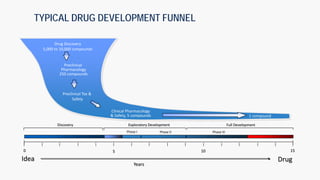
TYPICAL DRUG DEVELOPMENT FUNNEL
Discovery Exploratory Development
Idea Drug
Years
Full Development
Phase I Phase II Phase III
0 155 10
Preclinical
Pharmacology
250 compounds
Preclinical Tox &
Safety
Drug Discovery
5,000 to 10,000 compounds
Clinical Pharmacology
& Safety, 5 compounds 1 compound
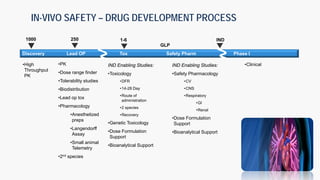
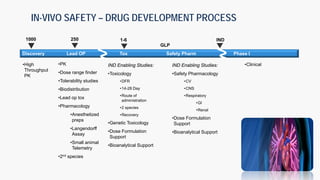
Discovery Lead OP Tox Safety Pharm Phase I
IND
•Clinical•High
Throughput
PK
IND Enabling Studies:
•Safety Pharmacology
•CV
•CNS
•Respiratory
•GI
•Renal
•Dose Formulation
Support
•Bioanalytical Support
IN-VIVO SAFETY – DRUG DEVELOPMENT PROCESS
•PK
•Dose range finder
•Tolerability studies
•Biodistribution
•Lead op tox
•Pharmacology
•Anesthetized
preps
•Langendorff
Assay
•Small animal
Telemetry
•2nd species
1000 250 1-6
IND Enabling Studies:
•Toxicology
•DFR
•14-28 Day
•Route of
administration
•2 species
•Recovery
•Genetic Toxicology
•Dose Formulation
Support
•Bioanalytical Support
GLP
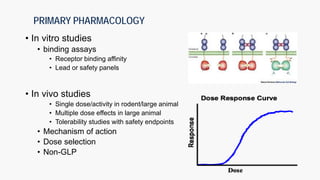
PRIMARY PHARMACOLOGY
• In vitro studies
• binding assays
• Receptor binding affinity
• Lead or safety panels
• In vivo studies
• Single dose/activity in rodent/large animal
• Multiple dose effects in large animal
• Tolerability studies with safety endpoints
• Mechanism of action
• Dose selection
• Non-GLP
PHARMACOKINETICS AND TOXICOKINETICS
• ADME/DMPK
• Metabolic and plasma protein binding studies
• CYP inhibition/induction
• Systemic exposure in the species used for repeat dose
toxicology
• PK in test species and in-vitro biochemical data for
potential drug interactions before Phase 3.
• Nonclinical testing of human metabolites only if exposures are
greater than 10% of total drug exposure. Support Phase 3
clinical studies.
• Data integration
• Interspecies scaling of in vitro and in vivo data to predict IND
and clinical performance
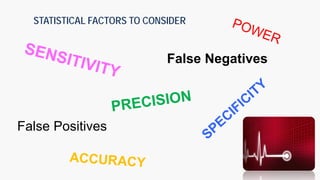
STATISTICAL FACTORS TO CONSIDER
False Positives
False Negatives
Discovery Lead OP Tox Safety Pharm Phase I
IND
•Clinical•High
Throughput
PK
IND Enabling Studies:
•Safety Pharmacology
•CV
•CNS
•Respiratory
•GI
•Renal
•Dose Formulation
Support
•Bioanalytical Support
IN-VIVO SAFETY – DRUG DEVELOPMENT PROCESS
•PK
•Dose range finder
•Tolerability studies
•Biodistribution
•Lead op tox
•Pharmacology
•Anesthetized
preps
•Langendorff
Assay
•Small animal
Telemetry
•2nd species
1000 250 1-6
IND Enabling Studies:
•Toxicology
•DFR
•14-28 Day
•Route of
administration
•2 species
•Recovery
•Genetic Toxicology
•Dose Formulation
Support
•Bioanalytical Support
GLP
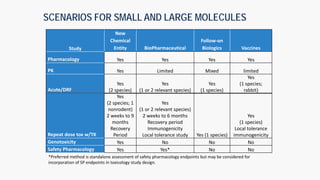
SCENARIOS FOR SMALL AND LARGE MOLECULES
Study
New
Chemical
Entity BioPharmaceutical
Follow-on
Biologics Vaccines
Pharmacology Yes Yes Yes Yes
PK Yes Limited Mixed limited
Acute/DRF
Yes
(2 species)
Yes
(1 or 2 relevant species)
Yes
(1 species)
Yes
(1 species;
rabbit)
Repeat dose tox w/TK
Yes
(2 species; 1
nonrodent)
2 weeks to 9
months
Recovery
Period
Yes
(1 or 2 relevant species)
2 weeks to 6 months
Recovery period
Immunogenicity
Local tolerance study Yes (1 species)
Yes
(1 species)
Local tolerance
immunogenicity
Genotoxicity Yes No No No
Safety Pharmacology Yes Yes* No No
*Preferred method is standalone assessment of safety pharmacology endpoints but may be considered for
incorporation of SP endpoints in toxicology study design.
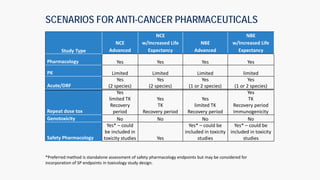
SCENARIOS FOR ANTI-CANCER PHARMACEUTICALS
Study Type
NCE
Advanced
NCE
w/Increased Life
Expectancy
NBE
Advanced
NBE
w/Increased Life
Expectancy
Pharmacology Yes Yes Yes Yes
PK Limited Limited Limited limited
Acute/DRF
Yes
(2 species)
Yes
(2 species)
Yes
(1 or 2 species)
Yes
(1 or 2 species)
Repeat dose tox
Yes
limited TK
Recovery
period
Yes
TK
Recovery period
Yes
limited TK
Recovery period
Yes
TK
Recovery period
Immunogenicity
Genotoxicity No No No No
Safety Pharmacology
Yes* – could
be included in
toxicity studies Yes
Yes* – could be
included in toxicity
studies
Yes* – could be
included in toxicity
studies
*Preferred method is standalone assessment of safety pharmacology endpoints but may be considered for
incorporation of SP endpoints in toxicology study design.
Email:
askcharlesriver@crl.com
Phone:
877.CRIVER.1
THANK YOU
Charles River - Ashland
Backup Slides
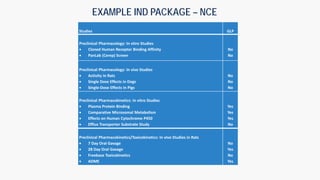
EXAMPLE IND PACKAGE – NCE
Studies GLP
Preclinical Pharmacology: In vitro Studies
• Cloned Human Receptor Binding Affinity
• PanLab (Cerep) Screen
No
No
Preclinical Pharmacology: In vivo Studies
• Activity in Rats
• Single Dose Effects in Dogs
• Single-Dose Effects in Pigs
No
No
No
Preclinical Pharmacokinetics: In vitro Studies
• Plasma Protein Binding
• Comparative Microsomal Metabolism
• Effects on Human Cytochrome P450
• Efflux Transporter Substrate Study
Yes
Yes
Yes
No
Preclinical Pharmacokinetics/Toxicokinetics: In vivo Studies in Rats
• 7 Day Oral Gavage
• 28 Day Oral Gavage
• Freebase Toxicokinetics
• ADME
No
Yes
No
Yes
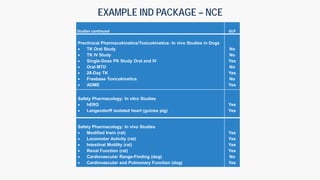
EXAMPLE IND PACKAGE – NCE
Studies continued GLP
Preclinical Pharmacokinetics/Toxicokinetics: In vivo Studies in Dogs
• TK Oral Study
• TK IV Study
• Single-Dose PK Study Oral and IV
• Oral MTD
• 28-Day TK
• Freebase Toxicokinetics
• ADME
No
No
Yes
No
Yes
No
Yes
Safety Pharmacology: In vitro Studies
• hERG
• Langendorff isolated heart (guinea pig)
Yes
Yes
Safety Pharmacology: In vivo Studies
• Modified Irwin (rat)
• Locomotor Activity (rat)
• Intestinal Motility (rat)
• Renal Function (rat)
• Cardiovascular Range-Finding (dog)
• Cardiovascular and Pulmonary Function (dog)
Yes
Yes
Yes
Yes
No
Yes
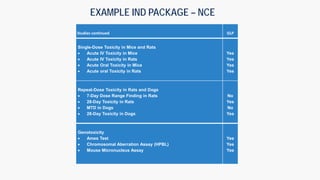
EXAMPLE IND PACKAGE – NCE
Studies continued GLP
Single-Dose Toxicity in Mice and Rats
• Acute IV Toxicity in Mice
• Acute IV Toxicity in Rats
• Acute Oral Toxicity in Mice
• Acute oral Toxicity in Rats
Yes
Yes
Yes
Yes
Repeat-Dose Toxicity in Rats and Dogs
• 7-Day Dose Range Finding in Rats
• 28-Day Toxicity in Rats
• MTD in Dogs
• 28-Day Toxicity in Dogs
No
Yes
No
Yes
Genotoxicity
• Ames Test
• Chromosomal Aberration Assay (HPBL)
• Mouse Micronucleus Assay
Yes
Yes
Yes
17 EVERY STEP OF THE WAY17 EVERY STEP OF THE WAY
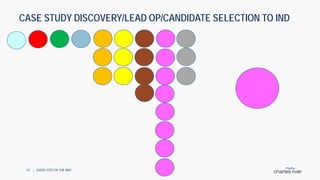
CASE STUDY DISCOVERY/LEAD OP/CANDIDATE SELECTION TO IND

In-Vivo Safety - Pre Ind Drug Development

  • 1.
    IN-VIVO SAFETY –PRE IND DRUG DEVELOPMENT EVERY STEP OF THE WAY EVERY STEP OF THE WAY Drug Development Boot Camp Brian M. Roche, PhD, DSP, DABT Executive Director of Global Safety Pharmacology Charles River - Ashland
  • 2.
    General Principals • TwoObjectives: • Pharmacologically active • Safe for humans • Goal of preclinical studies is to evaluate toxicity with respect to: • Target organs • Dose dependence • Relationship to exposure • Potential reversibility • Off-target effects • Evaluate toxic effects • Outcomes are to estimate dose levels for IND toxicology and safety pharmacology studies.
  • 3.
    Goals for INDprogram For biopharmaceuticals and small molecules: • Identify an initial safe dose and appropriate dose escalation scheme in humans • Identify potential target organs of toxicity and determine whether such toxicity is reversible • Identify appropriate species for toxicology assessment • Identify parameters that are predictive of toxicity and can be clinically monitored • Communicate risk
  • 4.
    TYPICAL DRUG DEVELOPMENTFUNNEL Discovery Exploratory Development Idea Drug Years Full Development Phase I Phase II Phase III 0 155 10 Preclinical Pharmacology 250 compounds Preclinical Tox & Safety Drug Discovery 5,000 to 10,000 compounds Clinical Pharmacology & Safety, 5 compounds 1 compound
  • 5.
    Discovery Lead OPTox Safety Pharm Phase I IND •Clinical•High Throughput PK IND Enabling Studies: •Safety Pharmacology •CV •CNS •Respiratory •GI •Renal •Dose Formulation Support •Bioanalytical Support IN-VIVO SAFETY – DRUG DEVELOPMENT PROCESS •PK •Dose range finder •Tolerability studies •Biodistribution •Lead op tox •Pharmacology •Anesthetized preps •Langendorff Assay •Small animal Telemetry •2nd species 1000 250 1-6 IND Enabling Studies: •Toxicology •DFR •14-28 Day •Route of administration •2 species •Recovery •Genetic Toxicology •Dose Formulation Support •Bioanalytical Support GLP
  • 6.
    PRIMARY PHARMACOLOGY • Invitro studies • binding assays • Receptor binding affinity • Lead or safety panels • In vivo studies • Single dose/activity in rodent/large animal • Multiple dose effects in large animal • Tolerability studies with safety endpoints • Mechanism of action • Dose selection • Non-GLP
  • 7.
    PHARMACOKINETICS AND TOXICOKINETICS •ADME/DMPK • Metabolic and plasma protein binding studies • CYP inhibition/induction • Systemic exposure in the species used for repeat dose toxicology • PK in test species and in-vitro biochemical data for potential drug interactions before Phase 3. • Nonclinical testing of human metabolites only if exposures are greater than 10% of total drug exposure. Support Phase 3 clinical studies. • Data integration • Interspecies scaling of in vitro and in vivo data to predict IND and clinical performance
  • 8.
    STATISTICAL FACTORS TOCONSIDER False Positives False Negatives
  • 9.
    Discovery Lead OPTox Safety Pharm Phase I IND •Clinical•High Throughput PK IND Enabling Studies: •Safety Pharmacology •CV •CNS •Respiratory •GI •Renal •Dose Formulation Support •Bioanalytical Support IN-VIVO SAFETY – DRUG DEVELOPMENT PROCESS •PK •Dose range finder •Tolerability studies •Biodistribution •Lead op tox •Pharmacology •Anesthetized preps •Langendorff Assay •Small animal Telemetry •2nd species 1000 250 1-6 IND Enabling Studies: •Toxicology •DFR •14-28 Day •Route of administration •2 species •Recovery •Genetic Toxicology •Dose Formulation Support •Bioanalytical Support GLP
  • 10.
    SCENARIOS FOR SMALLAND LARGE MOLECULES Study New Chemical Entity BioPharmaceutical Follow-on Biologics Vaccines Pharmacology Yes Yes Yes Yes PK Yes Limited Mixed limited Acute/DRF Yes (2 species) Yes (1 or 2 relevant species) Yes (1 species) Yes (1 species; rabbit) Repeat dose tox w/TK Yes (2 species; 1 nonrodent) 2 weeks to 9 months Recovery Period Yes (1 or 2 relevant species) 2 weeks to 6 months Recovery period Immunogenicity Local tolerance study Yes (1 species) Yes (1 species) Local tolerance immunogenicity Genotoxicity Yes No No No Safety Pharmacology Yes Yes* No No *Preferred method is standalone assessment of safety pharmacology endpoints but may be considered for incorporation of SP endpoints in toxicology study design.
  • 11.
    SCENARIOS FOR ANTI-CANCERPHARMACEUTICALS Study Type NCE Advanced NCE w/Increased Life Expectancy NBE Advanced NBE w/Increased Life Expectancy Pharmacology Yes Yes Yes Yes PK Limited Limited Limited limited Acute/DRF Yes (2 species) Yes (2 species) Yes (1 or 2 species) Yes (1 or 2 species) Repeat dose tox Yes limited TK Recovery period Yes TK Recovery period Yes limited TK Recovery period Yes TK Recovery period Immunogenicity Genotoxicity No No No No Safety Pharmacology Yes* – could be included in toxicity studies Yes Yes* – could be included in toxicity studies Yes* – could be included in toxicity studies *Preferred method is standalone assessment of safety pharmacology endpoints but may be considered for incorporation of SP endpoints in toxicology study design.
  • 12.
  • 13.
  • 14.
    EXAMPLE IND PACKAGE– NCE Studies GLP Preclinical Pharmacology: In vitro Studies • Cloned Human Receptor Binding Affinity • PanLab (Cerep) Screen No No Preclinical Pharmacology: In vivo Studies • Activity in Rats • Single Dose Effects in Dogs • Single-Dose Effects in Pigs No No No Preclinical Pharmacokinetics: In vitro Studies • Plasma Protein Binding • Comparative Microsomal Metabolism • Effects on Human Cytochrome P450 • Efflux Transporter Substrate Study Yes Yes Yes No Preclinical Pharmacokinetics/Toxicokinetics: In vivo Studies in Rats • 7 Day Oral Gavage • 28 Day Oral Gavage • Freebase Toxicokinetics • ADME No Yes No Yes
  • 15.
    EXAMPLE IND PACKAGE– NCE Studies continued GLP Preclinical Pharmacokinetics/Toxicokinetics: In vivo Studies in Dogs • TK Oral Study • TK IV Study • Single-Dose PK Study Oral and IV • Oral MTD • 28-Day TK • Freebase Toxicokinetics • ADME No No Yes No Yes No Yes Safety Pharmacology: In vitro Studies • hERG • Langendorff isolated heart (guinea pig) Yes Yes Safety Pharmacology: In vivo Studies • Modified Irwin (rat) • Locomotor Activity (rat) • Intestinal Motility (rat) • Renal Function (rat) • Cardiovascular Range-Finding (dog) • Cardiovascular and Pulmonary Function (dog) Yes Yes Yes Yes No Yes
  • 16.
    EXAMPLE IND PACKAGE– NCE Studies continued GLP Single-Dose Toxicity in Mice and Rats • Acute IV Toxicity in Mice • Acute IV Toxicity in Rats • Acute Oral Toxicity in Mice • Acute oral Toxicity in Rats Yes Yes Yes Yes Repeat-Dose Toxicity in Rats and Dogs • 7-Day Dose Range Finding in Rats • 28-Day Toxicity in Rats • MTD in Dogs • 28-Day Toxicity in Dogs No Yes No Yes Genotoxicity • Ames Test • Chromosomal Aberration Assay (HPBL) • Mouse Micronucleus Assay Yes Yes Yes
  • 17.
    17 EVERY STEPOF THE WAY17 EVERY STEP OF THE WAY CASE STUDY DISCOVERY/LEAD OP/CANDIDATE SELECTION TO IND