Jeremiah Pamer, DO 
6/19/2016 
jeremiahpamer@gmail.com 
303.880.5664 
Practice question sample set for Osmosis 
 
#1. Basic Science Question 
 
Theme: Cardiovascular 
Pathophysiology Tested: Myocardial infarction and the timeline of macroscopic elements 
associated with light microscopy evaluation of myocardium histology 
 
A 55 year old African American Male who is obese and in obvious distress presents to the 
Emergency Department after driving himself from work with a chief complaint of chest pain. It 
began 45 minutes ago and the pain is described as substernal pressure with intermittent 
electrical shooting pains down his left arm and into his jaw that has been intermittent. He has a 
past medical history of Type II Diabetes, hypertension, hyperlipidemia, and sickle cell trait. His 
medications include Metformin, Pravastatin, Lisinopril and Hydrochlorothiazide. Family history is 
pertinent for his father having had two “heart attacks.” 
 
An ECG is performed and is shown below.  
 
 
https://upload.wikimedia.org/wikipedia/commons/2/2d/Inferior_and_RtV_MI_with_PVC_15_lead.
jpg 
 
Physical Examination is pertinent for dilated pupils bilaterally, no jugular venous distension 
noted and there are accessory muscle utilized with every respiration. The heart has no audible 
rubs, murmurs or bruits heard upon auscultation and has a regular rhythm, with S1 and S2 
noted. The lungs are clear in all fields bilaterally upon auscultation. There are no abdominal 
bruits via auscultation. Femoral, Posterior Tibial and Dorsal Pedis arterial pulses are 2+ 
bilaterally.  
 
Laboratory results include a troponin of 1.4 ng/ml. All other laboratory findings were within 
normal limits.  
 
Despite comprehensive resuscitation efforts the patient dies before he can be taken to the cath 
lab for percutaneous cardiac intervention.  
 
An autopsy was performed and the following illustration is a reliable facsimile of what the 
patient’s heart tissue looked like macroscopically.  
 
 
https://en.wikipedia.org/wiki/Myocardial_infarction#/media/File:Heart_ant_wall_infarction.jpg 
 
Which of the following sets of histological elements are most likely to be found with microscopic 
examination of the patient’s myocardium? 
 
A. Glycogen Depletion, as seen with a PAS Stain and waviness of fibers at border 
Incorrect:​  This description is most indicative of early light microscopy findings after 
myocardial infarction; 4­12 hours post MI. While the cells on the edge of the injury may 
demonstrate the components of Answer A, it is not the best answer. 
B. Ongoing coagulation necrosis, karyopyknosis, hypereosinophilia of myocytes, 
contraction band necrosis in margins and the beginning of neutrophil infiltration 
Correct:​ See Main explanation below 
C. Beginning of disintegration of dead muscle fibers, necrosis of neutrophils, beginning of 
macrophage removal of dead cells at border 
Incorrect:​ (Beginning of disintegration of dead muscle fibers, necrosis of neutrophils, 
beginning of macrophage removal of dead cells at border.) These elements speak to an 
infarction event much earlier than 12­24 hours prior to death, and in this case is 
categorized as 3­7 days post MI. There is no evidence of disintegration of tissue, or 
macrophage involvement, which usually occurs 7­10 days post infarction.  
D. Increased collagen deposition, decreased cellularity 
Incorrect:​ Of all the possible answers, this description would place the myocardial 
infarction the furthest away from this patient’s death. The elements of this answer occur 
between 2­8 weeks post injury. 
 
Main Explanation: ​This question describes a patient who had a massive coronary infarction, as 
demonstrated by his chief complaint, past medical and family history, physical exam, ECG and 
troponin levels. This is a histological pathology question that requires you to know the 
histological findings of myocardium in various time frames after initial infarction. While this 
patient’s description of having this pain for only 45 minutes may seem like a large clue, it is 
actually more of a red­herring in that the troponin levels are extraordinarily elevated and would 
not be seen in this short of time frame, as troponin is indicative of myocardial necrosis. 
Furthermore, atypical chest pain can manifest in ambiguous symptoms, and the patient’s 
confession of not feeling well for weeks immediately prior could mean that he has had 
numerous small infarctions.  
 
The largest piece of evidence used to correctly evaluate this question is the image of the heart 
during dissection. The heart tissue demonstrates that an infarction episode occurred earlier than 
the immediate hours before his death, but within 24 hours of his death. In the initial 4 hours after 
a myocardial infarction there is no change with light histology evaluation of myocardium, but it 
should be noted that electron microscopy may show mitochondrial swelling, relaxed myofibrils 
and glycogen depletion. The consistent dark mottling, coagulation necrosis, and other elements 
of Answer B make this the best answer. Also, troponin levels following MI peak between 18­24 
hours post infarction, and the severely elevated troponin levels seen with this patient point 
toward the time frame inherent with the correct answer.  
 
Major Takeaway: 
Light microscopy and histological evaluation of myocardial tissue after an infarction involves a 
process over time that is important to know to properly identify when the injury happened to the 
heart upon autopsy. The principles behind the initial injury and subsequent changes seen in the 
next 2 months are actually quite simple, and with a satisfactory understanding of inflammatory 
immune agents and when they are involved, the correct answer can be reached reliably.  
This table may help summarize the time frames and changes seen.  
 
Time  Gross examination  Histopathology 
(light microscopy) 
0 ­ 0.5 hours  None  None 
0.5 – 4 hours  None*  ● Glycogen Depletion, as seen with 
a PAS Stain 
● Possibly waviness of fibers at 
border 
4 – 12 hours  ● Sometimes 
dark ​mottling 
● Initiation of ​coagulation necrosis 
● Edema 
● Hemorrhage 
12 – 24 hours  ● Dark mottling  ● Ongoing coagulation necrosis 
● Karyopyknosis 
● Hypereosinophilia​ of myocytes 
● Contraction band necrosis​ in 
margins 
● Beginning of ​neutrophil​ infiltration 
1 – 3 days  ● Infarct center 
becomes 
yellow­​tan 
● Continued coagulation necrosis 
● Loss of nuclei and ​striations 
● Increased infiltration of 
neutrophils to ​interstitium 
3 – 7 days  ● Hyperemia​ at 
border 
● Softening 
yellow­tan 
center 
● Beginning of disintegration of 
dead muscle fibers 
● Necrosis of neutrophils 
● Beginning of ​macrophage 
removal of dead cells at border 
7 – 10 days  ● Maximally soft 
and yellow­tan 
● Red­tan 
margins 
● Increased phagocytosis of dead 
cells at border 
● Beginning of ​granulation tissue 
formation at margins 
10 – 14 days  ● Red­gray and 
depressed 
borders 
● Mature granulation tissue with 
type I collagen​[1] 
2 – 8 weeks  ● Gray­white 
granulation 
tissue 
● Increased collagen deposition 
● Decreased cellularity 
More than 2 
months 
Completed scarring  Dense collagenous scar formed 
https://en.wikipedia.org/wiki/Timeline_of_myocardial_infarction_pathology 
 
References: 
● Bishop JE, Greenbaum R, Gibson DG, Yacoub M, Laurent GJ. Enhanced deposition of 
predominantly type I collagen in myocardial disease. J Mol Cell Cardiol. 
1990;22:1157–1165 
● Rangogiannis NG: The immune system and cardiac repair. Pharmacol Res. 2008, 58: 
88­111 
● Campobasso CP, Dell’Erba AS, Addante A, Zotti F, Marzullo A, Colonna MF: Sudden 
cardiac death and myocardial ischemia indicators: a comparative study of four 
immunohistochemical markers. Am J Forensic Med Pathol. 2008, 29: 154­161. 
 
­­­­­­­­­­­­­­­­­­­­­­­­­­­­­­­­­­­­­­­­­­­­­­­­­­­­­­­­­­­­­­­­­­­­­­­­­­­­­­­­­­­­­­­­­­­­­­­­­­­­­­­­­­­­­­­­­­­­­­­­­­­­­­­
­ 
#2. Diagnosis Question 
 
Theme: Cardiovascular 
Disease Diagnosis Tested: Myocardial Infarction and diagnosis of the postmyocardial 
infarction syndrome, also known as Dressler Syndrome 
 
A moderately distressed 76 year old male presents to your ambulatory clinic for a follow up 
appointment from a myocardial infarction that was diagnosed in the Emergency Department 8 
weeks ago. He had significantly elevated troponin II levels and dramatically elevated ST 
segments in lead II, III and aVF. He now complains of fever, a sore throat, shortness of breath 
and a sharp pain that radiates to the inferior portion of his left scapula, all of which suddenly 
came on 3 days prior. The patient states he assumed he was getting a cold. He is a member of 
a religious organization which prohibits blood transfusions, and due to the risk of needing a 
transfusion refused to undergo percutaneous cardiac intervention while in the Emergency 
Department and left the hospital the next day. The patient has no significant medical history 
prior to having an MI. He has been prescribed numerous medications in the past 8 weeks, but 
sheepishly admits to not taking them regularly. He has continued to smoke 2 packs/day and 
drink ¼ bottle of whisky every day since his myocardial infarction, just as he has done for the 
previous 60 years.  
 
Physical examination demonstrates: 
 
Body System  Pertinent Physical Exam Finding 
CV  Significant Jugular Venous Distension, Regular rate and rhythm, with positive 
rub heard at all cardiac listening posts, no bruits or murmurs.  
Resp  Crackles heard upon auscultation in bilateral lower lung fields 
Abd  3x5 cm pulsatile mass felt left of midline deep in the abdomen 
GU  Positive stool guaiac test 
 
Which of the following best describes the nature of the most likely diagnosis of the his patient?  
A. A disease state frequently characterized by a ​Staphylococcus aureus ​mediated 
endocarditis involving the tricuspid valve 
Incorrect: ​This describes an infective endocarditis secondary to intravenous drug 
abuse, which is overwhelmingly associated with tricuspid involved endocarditis. More 
than half of the IV drug abuse endocarditis diagnoses identify ​Staphylococcus aureus​ as 
the causative agent. While this patient does heavily drink and smoke, no mention of IV 
drug abuse is mentioned, but it certainly is not completely out of the question. However, 
it is not the best answer, as postmyocardial infarction syndrome (Dressler Syndrome) is 
much more likely in the setting of a non­reperfusion infarction injury.  
B. A viral infection of the heart muscle cells that can lead to dilated cardiomyopathy and 
death   
Incorrect:​ It is unlikely this patient has a viral myocarditis when the symptoms and 
medical history point to a postmyocardial infarction syndrome (Dressler Syndrome) as 
being much more likely. The stem of the question does qualify this with stating the 
patient felt like he may have a cold, but don’t let this fool you into choosing viral 
myocarditis as the best answer.  
C. A disease pathology that involves a robust autoimmune response secondary to 
neo­antigens related to tissue injury that may result in fibrinous pericarditis 
Correct: See Main Explanation below 
D. This diagnosis is highly associated with smoking and surgical intervention is generally 
indicated for a lesion that is >5.5cm in males 
Incorrect: ​This describes an Abdominal Aortic Aneurysm (AAA), which this patient is at 
high risk for, especially as a pulsatile mass was palpated deep in the midline of the 
abdomen. This patient does warrant an evaluation for a AAA (first with ultrasound and 
then with CT scan, if indicated) and if the physical exam was correct, he very well may 
have an indication for surgical intervention. However, even though this is the 2nd best 
answer, it is not the best answer compared to postmyocardial infarction syndrome 
(Dressler Syndrome) 
 
Main Explanation:  
Postmyocardial infarction syndrome (Dressler Syndrome) is an autoimmune response 
secondary to a variety of injuries to the heart and surrounding tissue. Specifically, it is thought 
that there are new antigens (neo­antigens) that are from the necrotic and fibrous tissue in the 
injured myocardium that trigger this autoimmune response. This diagnosis has actually 
decreased in incidence in recent years; this is thought to be with the dramatic increase of 
percutaneous cardiac intervention procedures which allow for reperfusion of the injured tissue.  
 
The patient in the vignette elected to forgo the catheter lab due to religious reasons, however, it 
should be noted that the most common reason for a patient not receiving percutaneous cardiac 
intervention is distance from a major medical center with a cath lab.  
 
The best treatment option for postmyocardial infarction syndrome is high dose aspirin, and in 
some refractory cases, corticosteroids. NSAIDs are to be avoided in patients with coronary 
artery disease, in general, and this disease as well.  
 
Major Takeaway: 
Postmyocardial infarction syndrome (Dressler Syndrome)​ should be on the differential in 
any patient who is post cardiac injury (infarction, surgery, PCI) and presents with chest pain, 
especially pericardial type symptoms. While the overall incidence has decreased, in patients 
with non­reperfusion myocardial infarction clinical courses the risk is much higher. First line 
treatment is high dose aspirin, NSAIDs should be avoided.  
 
References: 
● Hutchcroft BJ. Dressler’s syndrome. ​British Medical Journal​. 1972;3(5817):49. 
● Lawrence MS, Wright R. Tamponade in Dressler's syndrome with immunological 
studies. ​Br Med J.​1972 Mar 11;1(5801):665–666. 
● Shahar, A, Hod, H, Barabash, G, et al Disappearance of a syndrome: Dressler’s 
syndrome in the era of thrombolysis.Cardiology85,255­258. 
● Fever after acute myocardial infarction: Dressler's syndrome demonstrated on cardiac 
MRIVan Kolen, K. et al., International Journal of Cardiology , Volume 183 , 209 ­ 210 
­­­­­­­­­­­­­­­­­­­­­­­­­­­­­­­­­­­­­­­­­­­­­­­­­­­­­­­­­­­­­­­­­­­­­­­­­­­­­­­­­­­­­­­­­­­­­­­­­­­­­­­­­­­­­­­­­­­­­­­­­­­­­­­
­ 
#3. Management Question 
 
Theme: Cardiovascular 
Management Principle Tested: ​Recognizing Torsades de pointes and identifying the best first 
treatment option  
 
A 33 year old female is brought to the Emergency Department by police for threatening tourists 
with cannibalistic intent and multiple syncopal episodes witnessed by the police. She is 
delusional and gaining any information from the patient is futile. However, she has a medical 
record that shows frequent psychiatric hospitalizations and a prescription for lithium, among 
other antipsychotics. She is hemodynamically stable upon presentation, and remains so until 
she has another witnessed syncopal episode. She is breathing and has a palpable peripheral 
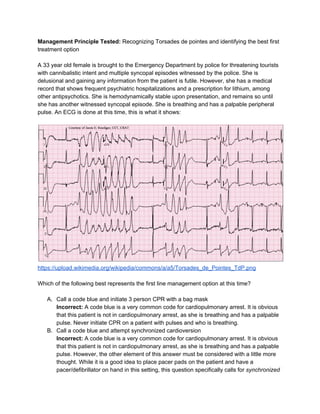
pulse. An ECG is done at this time, this is what it shows: 
 
 
https://upload.wikimedia.org/wikipedia/commons/a/a5/Torsades_de_Pointes_TdP.png  
 
Which of the following best represents the first line management option at this time? 
 
A. Call a code blue and initiate 3 person CPR with a bag mask 
Incorrect:​ A code blue is a very common code for cardiopulmonary arrest. It is obvious 
that this patient is not in cardiopulmonary arrest, as she is breathing and has a palpable 
pulse. Never initiate CPR on a patient with pulses and who is breathing.  
B. Call a code blue and attempt synchronized cardioversion 
Incorrect: ​A code blue is a very common code for cardiopulmonary arrest. It is obvious 
that this patient is not in cardiopulmonary arrest, as she is breathing and has a palpable 
pulse. However, the other element of this answer must be considered with a little more 
thought. While it is a good idea to place pacer pads on the patient and have a 
pacer/defibrillator on hand in this setting, this question specifically calls for ​synchronized 
cardioversion​. The ECG demonstrates no clear QRS complex. A synchronized 
cardioversion is programmed to apply current during the peak of the R wave.  
C. Get a stat lithium toxicology blood test and initiate fluid therapy with normal saline 
Incorrect:​ It is possible that this patient has a lithium overdose, however, the police nor 
the clinical staff has witnessed symptoms associated with elevated lithium overdose, 
other than torsades de pointes (TDP.) Regardless, the acute medical issue that 
demands immediate action is the TDP seen on the 12 lead ECG. While the best therapy 
for lithium overdose is high levels of sodium given intravenously, normal saline would 
most likely be given in the setting of her repeated syncopal episodes. To further clarify, 
we are not given vital signs for this patient which may indicate the need for fluid therapy 
such as hypotension and tachycardia, so it is not known whether this patient should be 
treated with normal saline fluid thereapy. 
D. Administer magnesium sulfate via intravascular push 
Correct:​ Magnesium sulfate is the first line antiarrhythmic treatment for torsades de 
pointes (TDP). The ECG clearly demonstrates TDP, and if there was any doubt, the 
documented prescription for lithium allows for secondary evidence that TDP is the 
diagnosis.   
 
Main Explanation:  
Torsades de pointes (TDP) ​is an acute cardiac rhythm that can lead to ventricular fibrillation 
and sudden cardiac death. Symptoms associated with TDP include palpitations, dizziness, 
syncopal episodes which are usually short lived, as most instances of TDP auto­convert to sinus 
rhythm within 5 seconds of onset. The patient in this question unquestionably has TDP as 
indicated via the ECG and answering this question correctly relies mainly on knowing that 
magnesium sulfate is first line treatment for TDP. However, answers A and B can be ruled out in 
that this patient is clearly not in cardiopulmonary arrest in that she is breathing and there are 
palpable pulses. Even if you are not familiar with what a “code blue” involves, the other 
components of these answers should still allow you to rule out them as candidates for the 
correct answer. Breathing for someone in the way of using a bag mask is inappropriate in that 
the patient is still breathing, and in answer B, synchronized cardioversion is not first line 
treatment in TDP.  
 
TDP has a number of causes, the most common being electrolyte imbalances, including 
hypomagnesemia, hypokalemia and hypocalcemia, and prescription drug interactions and 
side­effect profiles that include prolonged QT syndrome, which is a potential precursor of TDP.  
 
First line treatment is magnesium sulfate.  
 
Major Takeaway:  
Torsades de pointes (TDP)​ is a dangerous cardiac rhythm that can easily lead to sudden 
cardiac death. It has a broad etiology, but the most common reasons are electrolyte imbalances 
(low potassium and/or magnesium), prescription drug interactions, such as clarithromycin, 
levofloxacin, haloperidol and lithium, and also there are congenital causes for prolonged QT 
syndrome. First line treatment is administration of magnesium sulfate via IV. Other 
antiarrhythmics are 2nd line treatment.  
 
 ​References: 
 
● Tzivoni, D, Keren, A, Chenzbraun, A, Gottielb, J, Benhorin, J, Stem, S. Efficacy of 
MgSO4 in torsade de pointes: report on two patients (abstr). ​Isr J Med Sci​. 1983;19:398. 
● Beach, Scott R. et al., QTc Prolongation, Torsades de Pointes, and Psychotropic 
Medications. Psychosomatics , Volume 54 , Issue 1 , 1 ­ 13 
● Del Gobbo LC, Imamura F, Wu JH, et al. Circulating and dietary magnesium and risk of 
cardiovascular disease; a systematic review and meta­analysis of prospective studies. 
Am J Clin Nutr 2013; 98:160 
 

OsmosisSampleQuestions_Pamer