+


OPEN GEOSPATIAL
 RUBY LIBRARIES
  Christopher Helm - GeoIQ
   http://geocommons.com
The Plan
• Keep   it simple

• Introduce     you to geospatial

• Dive   into a few example libs

• Demo     some code!
THIS TALK...


...is for (~Ruby) geospatial newcomers
STAYING SIMPLE
  GeoSpatial is a deep subject

we’re barely skimming the surface
WHAT IS GEOSPATIAL?
LOCATION
DATA
ANALYSIS
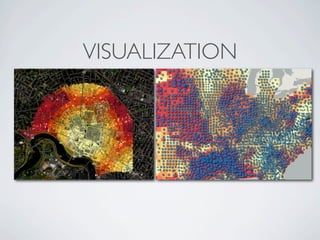
VISUALIZATION
WHY DOES THIS MATTER?


     location is everywhere :)
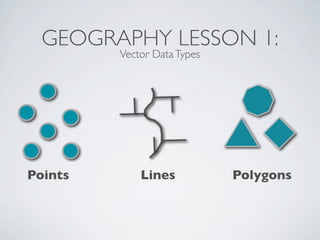
GEOGRAPHY LESSON 1:
         Vector Data Types


Points       Lines           Polygons
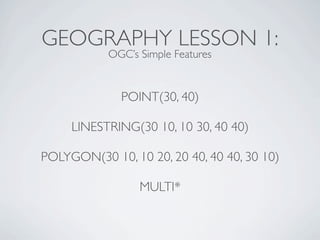
GEOGRAPHY LESSON 1:
           OGC’s Simple Features


              POINT(30, 40)

     LINESTRING(30 10, 10 30, 40 40)

POLYGON(30 10, 10 20, 20 40, 40 40, 30 10)

                 MULTI*
GEOGRAPHY LESSON 2:
     Spatial Relationships

         Buffers
      Intersections
          Clips
        Dissolves
         Unions
       Aggregation
          etc...
GEOGRAPHY LESSON 2:
     Spatial Relationships


     Buffers
GEOGRAPHY LESSON 2:
     Spatial Relationships


          Dissolves
GEOGRAPHY LESSON 2:
         Spatial Relationships


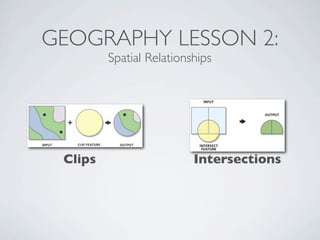
 Clips                    Intersections
GEOGRAPHY LESSON 2:
     Spatial Relationships


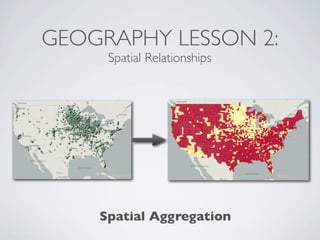
    Spatial Aggregation
GEOGRAPHY LESSON 3:
    Spatial Reference Systems


                   http://www.cartogrammar.com/blog/accidental-map-projections/
GEOGRAPHY LESSON 3:
     Spatial Reference Systems


  Plate Carrée, Geographic, or un-projected
GEOGRAPHY LESSON 3:
    Spatial Reference Systems


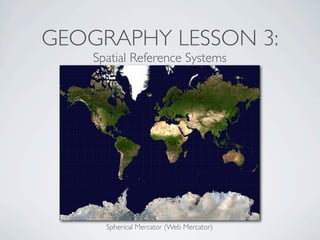
      Spherical Mercator (Web Mercator)
SOME GEOSPATIAL LIBS


•2   categories of libraries

 • 1. Ruby   based GeoSpatial Data Libraries

 • 2. Ruby   bindings location-aware APIs & services
GEOS
             http://trac.osgeo.org/geos/


Geometry Engine - Open Source (GEOS)

 A C++ port of the Java Topology Suite

  Simple Features and spatial operators
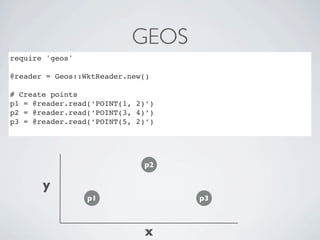
GEOS
require 'geos'

@reader = Geos::WktReader.new()

# Create points
p1 = @reader.read(‘POINT(1, 2)’)
p2 = @reader.read(‘POINT(3, 4)’)
p3 = @reader.read(‘POINT(5, 2)’)


                             p2

       y
                 p1                p3


                             x
GEOS
# Create a more complex shapes
line1 = @reader.read(‘LINESTRING(1 2, 3 4, 5 2)’)
polygon = @reader.read(‘POLYGON(1 2, 3 4, 5 2, 1 2)’)

line2 = @reader.read('LINESTRING(1 4, 4 1)')


             line1                                Polygon


                             line2
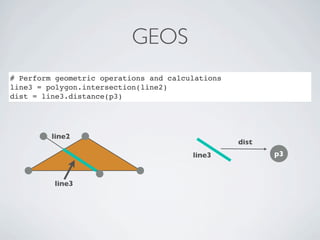
GEOS
# Perform geometric operations and calculations
line3 = polygon.intersection(line2)
dist = line3.distance(p3)


         line2
                                                  dist
                                        line3            p3


         line3
GEOS
# new point
p4 = @reader.read(‘POINT(2.5, 3.5)’)

# create a buffer on p4
buffer = p4.buffer(2)

# now test against the buffer
buffer.contains?(p1) # false
buffer.contains?(p2) # true
buffer.touches?(p3.buffer(1)) # true


                             p2

                                  p4

                 p1                    p3
                              buffer
GEORUBY
                 http://rubyforge.org/projects/georuby/


A Library for working with geometric data types in Ruby

       follows the OGC’s Simple Features Spec

            Think: Point, Lines, and Polygons

            Also data formatters / parsers
                      (KML to Well Known Text)
SPATIAL ADAPTER
      https://github.com/fragility/spatial_adapterxt


      Adapter for ActiveRecord

Handles spatial datatypes coming from:

    PostGreSQL (via PostGIS)
              &
    MySQL (via its spatial ext.)
RGEO
          http://virtuoso.rubyforge.org/rgeo/


     Geospatial datatypes in Ruby

  Standard Spatial analysis operations:
            (buffers, intersections, distances, etc)


       Data format conversions

Flexible - gem and active-record adapter
RUBY GEOCODER
                  http://www.rubygeocoder.com/


        Full featured geocoder for Ruby

                Gem and Rails Plugin

Converts addresses and IPs in lat/lon coordinates

     configurable to work with any service


         Also checkout geokit: http://geokit.rubyforge.org/
RUBY GEOCODER
                       http://www.rubygeocoder.com/


require ‘geocoder’

# look up coordinates of some location
Geocoder.coordinates("25 Main St, Cooperstown, NY")
=> [42.700149, -74.922767]

# distance between Eiffel Tower and Empire State Building
Geocoder::Calculations.distance_between([47.858205,2.294359],
[40.748433,-73.985655])
=> 3619.77359999382

# find the geographic coordinates for an IP address
Geocoder.coordinates("71.166.236.36")
=> [38.6485, -77.3108]
DATABASES

      PostgreSQL / Postgis
              MySQL
            MongoDB
Couch...DB....base (via GeoCouch)
POSTGRESQL

   PostGIS - spatial extension

Uses GEOS for spatial operations
ACTIVERECORD POSTGIS
               https://github.com/dazuma/activerecord-postgis-adapter


create_table :my_spatial_table do |t|
  t.column :shape, :geometry # or t.geometry :shape
  t.line_string :path, :srid => 3785
  t.point :latlon, :geographic => true
end

change_table :my_spatial_table do |t|
  t.index :latlon, :spatial => true
end

# querying
rec = MySpatialTable.where(:latlon => 'POINT(-122 47)').first
MONGODB


require 'mongo'

db = Mongo::Connection.new("localhost", 27017).db("mydb")
auth = db.authenticate(my_user_name, my_password)
coll = db.collection("testCollection")
coll.find("i" => 71).each { |row| puts row.inspect }
MONGODB

# Spatial indexes / queries

coll.create_index([["loc", Mongo::GEO2D]])

coll.find({"loc" => {"$near" => [50, 50]}}, {:limit => 20}).each
do |p|
  puts p.inspect
end
MONGODB


box = [[40.73083, -73.99756], [40.741404, -73.988135]]
coll.find({"loc" : {"$within" : {"$box" : box}}})

center = [50, 50]
radius = 10
coll.find({"loc" : {"$within" : {"$center" : [center, radius]}}})
SOCIAL MEDIA APIS
TWEETSTREAM
            https://github.com/intridea/tweetstream


Simple wrapper to the Twitter Streaming API

 Can search via tags or locations (via bboxes)

Good way to generate geospatial data/content
TWEETSTREAM
require 'rubygems'
require 'tweetstream'

# Use 'track' to track a list of single-word keywords
TweetStream::Client.new('username','password').track('term1',
'term2') do |status|
  puts "#{status.text}"
end

# track tweets within a bbox
TweetStream::Client.new('username','password').locations(‘-122.75,
36.8,-121.75,37.8’) do |status|
  puts "#{status.text}"
end
INSTAGRAM
         https://github.com/Instagram/instagram-ruby-gem


Wrapper to the Instragram’s photo sharing API

    Allows for spatial searching via lat/lon

        very similar to the Flick’r API
CARTAGR.AM
    bloom.io
INSTAGRAM
require "instagram"


# All methods require authentication
Instagram.configure do |config|
  config.client_id = YOUR_CLIENT_KEY
  config.access_token = YOUR_ACCESS_TOKEN
end

# Get a list of media at a given location
puts Instagram.location_recent_media(514276)


# Get a list of media close to a given latitude and longitude
puts Instagram.media_search("37.7808851,-122.3948632")
YELP!
                     http://github.com/shaper/yelp


      Location based lookup for business reviews

Highly local listing accessed in variety of geospatial ways

 another way to create some geospatial data/content
YELP!
YELP!
# create a new client
 client = Yelp::Client.new

# do an address-based search for cream puffs nearby
request = Yelp::Review::Request::Location.new(
             :address => '650 Mission St',
             :city => 'San Francisco',
             :state => 'CA',
             :radius => 2,
             :term => 'cream puffs',
             :yws_id => 'YOUR_YWSID_HERE')

response = client.search(request)
YELP!
# a location-based search for ice cream or donut shops in SF
request = Yelp::Review::Request::Location.new(
            :city => 'San Francisco',
            :state => 'CA',
            :category => [ 'donuts', 'icecream' ],
            :yws_id => 'YOUR_YWSID_HERE')
response = client.search(request)

# a neighborhood name lookup for a geo-location point
request = Yelp::Neighborhood::Request::GeoPoint.new(
            :latitude => 37.782093,
            :longitude => -122.483230,
            :yws_id => 'YOUR_YWSID_HERE')
response = client.search(request)
DATA & ANALYSIS APIS


             Fusion Tables
SIMPLEGEO
             https://github.com/simplegeo/simplegeo-ruby


   API for adding geospatial capabilities to apps

Access POIs, Locational Context, and personal data

    Emphasis on speed, simplicity, and flexibility
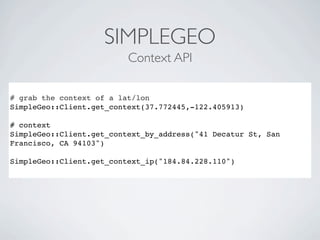
SIMPLEGEO
                          Context API

# grab the context of a lat/lon
SimpleGeo::Client.get_context(37.772445,-122.405913)

# context
SimpleGeo::Client.get_context_by_address("41 Decatur St, San
Francisco, CA 94103")

SimpleGeo::Client.get_context_ip("184.84.228.110")
SIMPLEGEO
                           Places API

SimpleGeo::Client.get_places(37.772445, -122.405913)

options = {'q'=>'Starbucks', 'category'=>'Coffee & Tea',
'radius'=>5}
SimpleGeo::Client.get_places(37.772445, -122.405913, options)

address = "41 Decatur St, San Francisco, CA"
options = {'radius' => 1}
SimpleGeo::Client.get_places_by_address(address, options)

ip = '173.164.219.53'
SimpleGeo::Client.get_places_by_ip(ip)
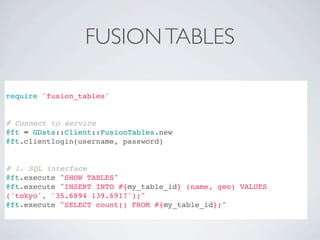
FUSION TABLES
         https://github.com/tokumine/fusion_tables


Direct access to Google’s Fusion Tables API

Full SQL interface or OO query interface

Easy integration to other Google services
                     (maps, earth, viz.)


  Easy storage/retrieve of geospatial data
FUSION TABLES

require 'fusion_tables'


# Connect to service
@ft = GData::Client::FusionTables.new
@ft.clientlogin(username, password)


# 1. SQL interface
@ft.execute "SHOW TABLES"
@ft.execute "INSERT INTO #{my_table_id} (name, geo) VALUES
('tokyo', '35.6894 139.6917');"
@ft.execute "SELECT count() FROM #{my_table_id};"
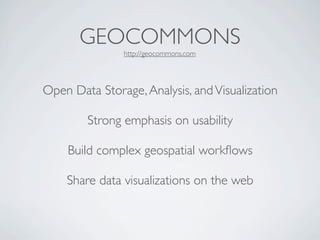
GEOCOMMONS
               http://geocommons.com


Open Data Storage, Analysis, and Visualization

        Strong emphasis on usability

    Build complex geospatial workflows

    Share data visualizations on the web
GEOCOMMONS
 CSV
       Easy Spatial Visualization / Analytics
 SHP
JSON
WMS
                                                Maps & Viz


                     Analytics
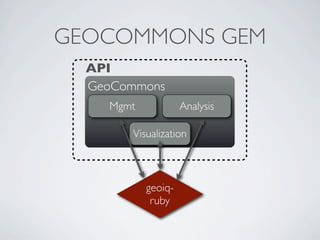
GEOCOMMONS GEM
  API
  GeoCommons
     Mgmt            Analysis

        Visualization


            geoiq-
             ruby
GEOCOMMONS GEM
                             finding data...


# create a client
@geoiq = Geoiq.client("http://geocommons.com", "user", "password")

# search for tags
@geoiq.search("tag:economics")

# Search for data in a location
@geoiq.search("points",{:bbox => ‘-87.2,33.4,-75.9,38.4', :limit=>
10})
GEOCOMMONS GEM
                             getting data...


# get dataset and features
dataset = geoiq.dataset.find(1348)
features = dataset.features

# get features with a custom filter
filtered_features = @dataset.features({"filter[PERIMETER][][max]"
=> 0.3})
bbox_filtered_features = @dataset.features({:bbox =>
'-87.2,33.4,-75.9,38.4'})
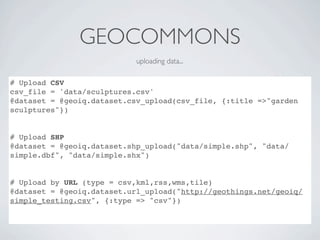
GEOCOMMONS
                            uploading data...

# Upload CSV
csv_file = 'data/sculptures.csv'
@dataset = @geoiq.dataset.csv_upload(csv_file, {:title =>"garden
sculptures"})


# Upload SHP
@dataset = @geoiq.dataset.shp_upload("data/simple.shp", "data/
simple.dbf", "data/simple.shx")


# Upload by URL (type = csv,kml,rss,wms,tile)
@dataset = @geoiq.dataset.url_upload("http://geothings.net/geoiq/
simple_testing.csv", {:type => "csv"})
GEOCOMMONS
                          create new datasets...


# Create a new overlay
data = {‘title’ => ‘My Overlay’, ‘attributes’ => {‘attr1’ => ...}}
overlay = @geoiq.dataset.create(data)


# add features to the overlay
features = {features => [{‘type’ => ‘Point’, ‘coordinates’ =>
[0,0]},{...}]}
@geoiq.dataset.update(id, features)
GEOCOMMONS
                           create new visualizations...

# Create a new map
map = @geoiq.map(:title => "my empty map")
@geoiq_map = map.create

# get a map and it's layers
@map = @geoiq.map.find(239)
layer_titles = @map.layers.map{ |l| l['title']}

# add a dataset to a map as a new layer
@map.add_layer(1466)

#deleting map or dataset
@map.delete
@dataset.delete
PUTTING IT TOGETHER
SOME EXAMPLES...

...THEN QUESTIONS
Code Samples from this talk:

https://github.com/chelm/OSCON-Ruby-GeoSpatial-Intro

OSCON july 2011

  • 1.
    + OPEN GEOSPATIAL RUBYLIBRARIES Christopher Helm - GeoIQ http://geocommons.com
  • 2.
    The Plan • Keep it simple • Introduce you to geospatial • Dive into a few example libs • Demo some code!
  • 3.
    THIS TALK... ...is for(~Ruby) geospatial newcomers
  • 4.
    STAYING SIMPLE GeoSpatial is a deep subject we’re barely skimming the surface
  • 5.
  • 6.
  • 7.
  • 8.
  • 9.
  • 10.
    WHY DOES THISMATTER? location is everywhere :)
  • 11.
    GEOGRAPHY LESSON 1: Vector Data Types Points Lines Polygons
  • 12.
    GEOGRAPHY LESSON 1: OGC’s Simple Features POINT(30, 40) LINESTRING(30 10, 10 30, 40 40) POLYGON(30 10, 10 20, 20 40, 40 40, 30 10) MULTI*
  • 13.
    GEOGRAPHY LESSON 2: Spatial Relationships Buffers Intersections Clips Dissolves Unions Aggregation etc...
  • 14.
    GEOGRAPHY LESSON 2: Spatial Relationships Buffers
  • 15.
    GEOGRAPHY LESSON 2: Spatial Relationships Dissolves
  • 16.
    GEOGRAPHY LESSON 2: Spatial Relationships Clips Intersections
  • 17.
    GEOGRAPHY LESSON 2: Spatial Relationships Spatial Aggregation
  • 18.
    GEOGRAPHY LESSON 3: Spatial Reference Systems http://www.cartogrammar.com/blog/accidental-map-projections/
  • 19.
    GEOGRAPHY LESSON 3: Spatial Reference Systems Plate Carrée, Geographic, or un-projected
  • 20.
    GEOGRAPHY LESSON 3: Spatial Reference Systems Spherical Mercator (Web Mercator)
  • 21.
    SOME GEOSPATIAL LIBS •2 categories of libraries • 1. Ruby based GeoSpatial Data Libraries • 2. Ruby bindings location-aware APIs & services
  • 22.
    GEOS http://trac.osgeo.org/geos/ Geometry Engine - Open Source (GEOS) A C++ port of the Java Topology Suite Simple Features and spatial operators
  • 23.
    GEOS require 'geos' @reader =Geos::WktReader.new() # Create points p1 = @reader.read(‘POINT(1, 2)’) p2 = @reader.read(‘POINT(3, 4)’) p3 = @reader.read(‘POINT(5, 2)’) p2 y p1 p3 x
  • 24.
    GEOS # Create amore complex shapes line1 = @reader.read(‘LINESTRING(1 2, 3 4, 5 2)’) polygon = @reader.read(‘POLYGON(1 2, 3 4, 5 2, 1 2)’) line2 = @reader.read('LINESTRING(1 4, 4 1)') line1 Polygon line2
  • 25.
    GEOS # Perform geometricoperations and calculations line3 = polygon.intersection(line2) dist = line3.distance(p3) line2 dist line3 p3 line3
  • 26.
    GEOS # new point p4= @reader.read(‘POINT(2.5, 3.5)’) # create a buffer on p4 buffer = p4.buffer(2) # now test against the buffer buffer.contains?(p1) # false buffer.contains?(p2) # true buffer.touches?(p3.buffer(1)) # true p2 p4 p1 p3 buffer
  • 27.
    GEORUBY http://rubyforge.org/projects/georuby/ A Library for working with geometric data types in Ruby follows the OGC’s Simple Features Spec Think: Point, Lines, and Polygons Also data formatters / parsers (KML to Well Known Text)
  • 28.
    SPATIAL ADAPTER https://github.com/fragility/spatial_adapterxt Adapter for ActiveRecord Handles spatial datatypes coming from: PostGreSQL (via PostGIS) & MySQL (via its spatial ext.)
  • 29.
    RGEO http://virtuoso.rubyforge.org/rgeo/ Geospatial datatypes in Ruby Standard Spatial analysis operations: (buffers, intersections, distances, etc) Data format conversions Flexible - gem and active-record adapter
  • 30.
    RUBY GEOCODER http://www.rubygeocoder.com/ Full featured geocoder for Ruby Gem and Rails Plugin Converts addresses and IPs in lat/lon coordinates configurable to work with any service Also checkout geokit: http://geokit.rubyforge.org/
  • 31.
    RUBY GEOCODER http://www.rubygeocoder.com/ require ‘geocoder’ # look up coordinates of some location Geocoder.coordinates("25 Main St, Cooperstown, NY") => [42.700149, -74.922767] # distance between Eiffel Tower and Empire State Building Geocoder::Calculations.distance_between([47.858205,2.294359], [40.748433,-73.985655]) => 3619.77359999382 # find the geographic coordinates for an IP address Geocoder.coordinates("71.166.236.36") => [38.6485, -77.3108]
  • 32.
    DATABASES PostgreSQL / Postgis MySQL MongoDB Couch...DB....base (via GeoCouch)
  • 33.
    POSTGRESQL PostGIS - spatial extension Uses GEOS for spatial operations
  • 34.
    ACTIVERECORD POSTGIS https://github.com/dazuma/activerecord-postgis-adapter create_table :my_spatial_table do |t| t.column :shape, :geometry # or t.geometry :shape t.line_string :path, :srid => 3785 t.point :latlon, :geographic => true end change_table :my_spatial_table do |t| t.index :latlon, :spatial => true end # querying rec = MySpatialTable.where(:latlon => 'POINT(-122 47)').first
  • 35.
    MONGODB require 'mongo' db =Mongo::Connection.new("localhost", 27017).db("mydb") auth = db.authenticate(my_user_name, my_password) coll = db.collection("testCollection") coll.find("i" => 71).each { |row| puts row.inspect }
  • 36.
    MONGODB # Spatial indexes/ queries coll.create_index([["loc", Mongo::GEO2D]]) coll.find({"loc" => {"$near" => [50, 50]}}, {:limit => 20}).each do |p| puts p.inspect end
  • 37.
    MONGODB box = [[40.73083,-73.99756], [40.741404, -73.988135]] coll.find({"loc" : {"$within" : {"$box" : box}}}) center = [50, 50] radius = 10 coll.find({"loc" : {"$within" : {"$center" : [center, radius]}}})
  • 38.
  • 39.
    TWEETSTREAM https://github.com/intridea/tweetstream Simple wrapper to the Twitter Streaming API Can search via tags or locations (via bboxes) Good way to generate geospatial data/content
  • 40.
    TWEETSTREAM require 'rubygems' require 'tweetstream' #Use 'track' to track a list of single-word keywords TweetStream::Client.new('username','password').track('term1', 'term2') do |status| puts "#{status.text}" end # track tweets within a bbox TweetStream::Client.new('username','password').locations(‘-122.75, 36.8,-121.75,37.8’) do |status| puts "#{status.text}" end
  • 41.
    INSTAGRAM https://github.com/Instagram/instagram-ruby-gem Wrapper to the Instragram’s photo sharing API Allows for spatial searching via lat/lon very similar to the Flick’r API
  • 42.
    CARTAGR.AM bloom.io
  • 43.
    INSTAGRAM require "instagram" # Allmethods require authentication Instagram.configure do |config| config.client_id = YOUR_CLIENT_KEY config.access_token = YOUR_ACCESS_TOKEN end # Get a list of media at a given location puts Instagram.location_recent_media(514276) # Get a list of media close to a given latitude and longitude puts Instagram.media_search("37.7808851,-122.3948632")
  • 44.
    YELP! http://github.com/shaper/yelp Location based lookup for business reviews Highly local listing accessed in variety of geospatial ways another way to create some geospatial data/content
  • 45.
  • 46.
    YELP! # create anew client client = Yelp::Client.new # do an address-based search for cream puffs nearby request = Yelp::Review::Request::Location.new( :address => '650 Mission St', :city => 'San Francisco', :state => 'CA', :radius => 2, :term => 'cream puffs', :yws_id => 'YOUR_YWSID_HERE') response = client.search(request)
  • 47.
    YELP! # a location-basedsearch for ice cream or donut shops in SF request = Yelp::Review::Request::Location.new( :city => 'San Francisco', :state => 'CA', :category => [ 'donuts', 'icecream' ], :yws_id => 'YOUR_YWSID_HERE') response = client.search(request) # a neighborhood name lookup for a geo-location point request = Yelp::Neighborhood::Request::GeoPoint.new( :latitude => 37.782093, :longitude => -122.483230, :yws_id => 'YOUR_YWSID_HERE') response = client.search(request)
  • 48.
    DATA & ANALYSISAPIS Fusion Tables
  • 49.
    SIMPLEGEO https://github.com/simplegeo/simplegeo-ruby API for adding geospatial capabilities to apps Access POIs, Locational Context, and personal data Emphasis on speed, simplicity, and flexibility
  • 50.
    SIMPLEGEO Context API # grab the context of a lat/lon SimpleGeo::Client.get_context(37.772445,-122.405913) # context SimpleGeo::Client.get_context_by_address("41 Decatur St, San Francisco, CA 94103") SimpleGeo::Client.get_context_ip("184.84.228.110")
  • 51.
    SIMPLEGEO Places API SimpleGeo::Client.get_places(37.772445, -122.405913) options = {'q'=>'Starbucks', 'category'=>'Coffee & Tea', 'radius'=>5} SimpleGeo::Client.get_places(37.772445, -122.405913, options) address = "41 Decatur St, San Francisco, CA" options = {'radius' => 1} SimpleGeo::Client.get_places_by_address(address, options) ip = '173.164.219.53' SimpleGeo::Client.get_places_by_ip(ip)
  • 52.
    FUSION TABLES https://github.com/tokumine/fusion_tables Direct access to Google’s Fusion Tables API Full SQL interface or OO query interface Easy integration to other Google services (maps, earth, viz.) Easy storage/retrieve of geospatial data
  • 53.
    FUSION TABLES require 'fusion_tables' #Connect to service @ft = GData::Client::FusionTables.new @ft.clientlogin(username, password) # 1. SQL interface @ft.execute "SHOW TABLES" @ft.execute "INSERT INTO #{my_table_id} (name, geo) VALUES ('tokyo', '35.6894 139.6917');" @ft.execute "SELECT count() FROM #{my_table_id};"
  • 54.
    GEOCOMMONS http://geocommons.com Open Data Storage, Analysis, and Visualization Strong emphasis on usability Build complex geospatial workflows Share data visualizations on the web
  • 55.
    GEOCOMMONS CSV Easy Spatial Visualization / Analytics SHP JSON WMS Maps & Viz Analytics
  • 56.
    GEOCOMMONS GEM API GeoCommons Mgmt Analysis Visualization geoiq- ruby
  • 57.
    GEOCOMMONS GEM finding data... # create a client @geoiq = Geoiq.client("http://geocommons.com", "user", "password") # search for tags @geoiq.search("tag:economics") # Search for data in a location @geoiq.search("points",{:bbox => ‘-87.2,33.4,-75.9,38.4', :limit=> 10})
  • 58.
    GEOCOMMONS GEM getting data... # get dataset and features dataset = geoiq.dataset.find(1348) features = dataset.features # get features with a custom filter filtered_features = @dataset.features({"filter[PERIMETER][][max]" => 0.3}) bbox_filtered_features = @dataset.features({:bbox => '-87.2,33.4,-75.9,38.4'})
  • 59.
    GEOCOMMONS uploading data... # Upload CSV csv_file = 'data/sculptures.csv' @dataset = @geoiq.dataset.csv_upload(csv_file, {:title =>"garden sculptures"}) # Upload SHP @dataset = @geoiq.dataset.shp_upload("data/simple.shp", "data/ simple.dbf", "data/simple.shx") # Upload by URL (type = csv,kml,rss,wms,tile) @dataset = @geoiq.dataset.url_upload("http://geothings.net/geoiq/ simple_testing.csv", {:type => "csv"})
  • 60.
    GEOCOMMONS create new datasets... # Create a new overlay data = {‘title’ => ‘My Overlay’, ‘attributes’ => {‘attr1’ => ...}} overlay = @geoiq.dataset.create(data) # add features to the overlay features = {features => [{‘type’ => ‘Point’, ‘coordinates’ => [0,0]},{...}]} @geoiq.dataset.update(id, features)
  • 61.
    GEOCOMMONS create new visualizations... # Create a new map map = @geoiq.map(:title => "my empty map") @geoiq_map = map.create # get a map and it's layers @map = @geoiq.map.find(239) layer_titles = @map.layers.map{ |l| l['title']} # add a dataset to a map as a new layer @map.add_layer(1466) #deleting map or dataset @map.delete @dataset.delete
  • 62.
  • 63.
  • 64.
    Code Samples fromthis talk: https://github.com/chelm/OSCON-Ruby-GeoSpatial-Intro