Handling Real-time Geostreams
        #rtgeo #where20


O’Reilly Where 2.0                      TM


March 30, 2010
Background
Wherehoo (2000)
‣   “The Stuff Around You”
‣   “Wherehoo Server: An interactive location service for software agents and intelligent
    systems” - J.Youll, R.Krikorian
‣   In your /etc/services file
BusRadio (2004)
‣   Designed mobile computers to play media while also transmitting telemetry
‣   Looked and sounded like a radio - but really a Linux computer
OneHop (2007)
‣   Bluetooth proximity-based social networking
Table of Contents
Background
‣   Why are we interested in this?
Twitter’s Geo APIs
‣   How do we allow people to talk about place?
Problem statement
‣   What are we trying to have our system do?
Infrastructure
‣   How is Twitter solving this problem?
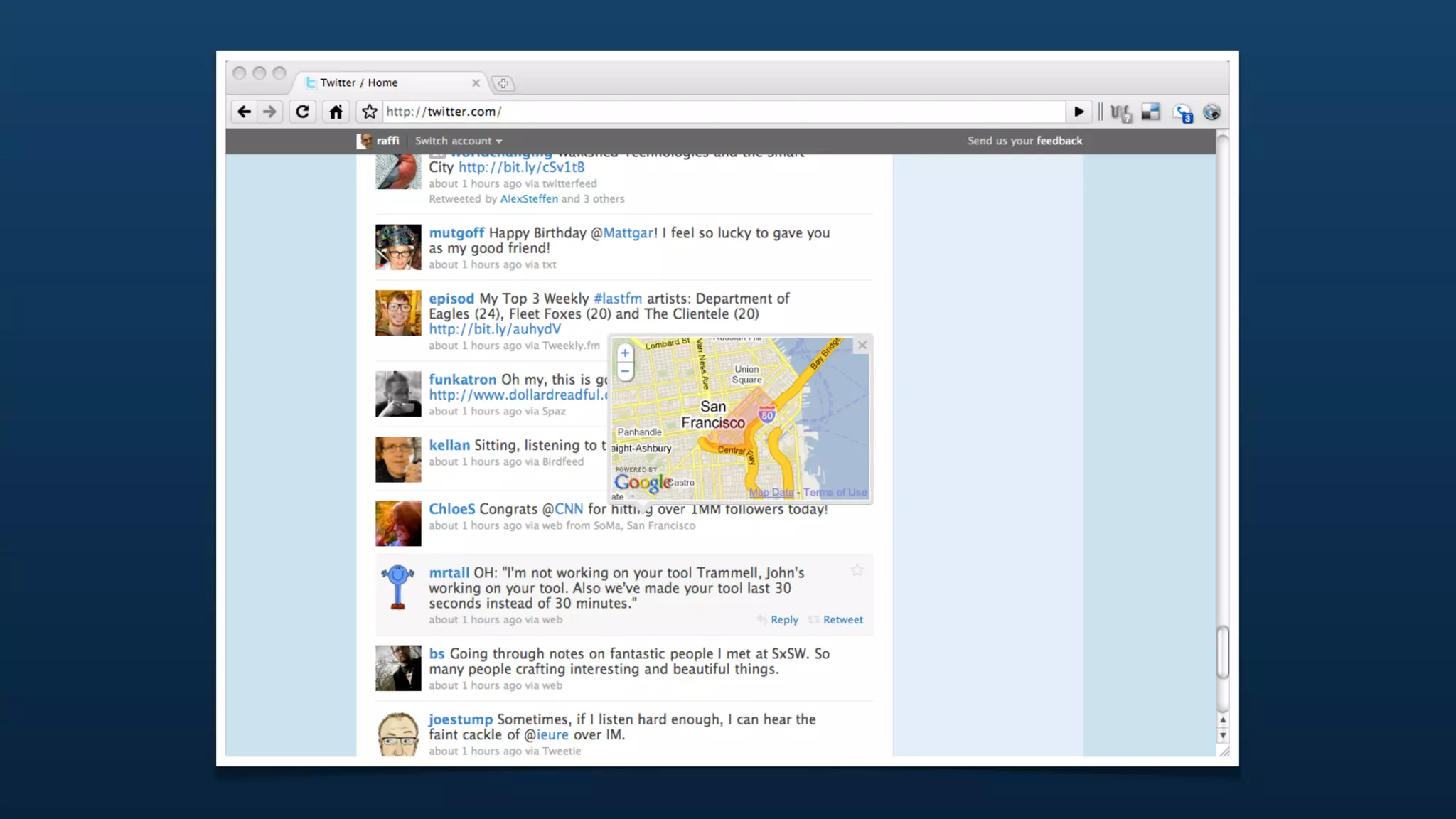
People want to talk
about places
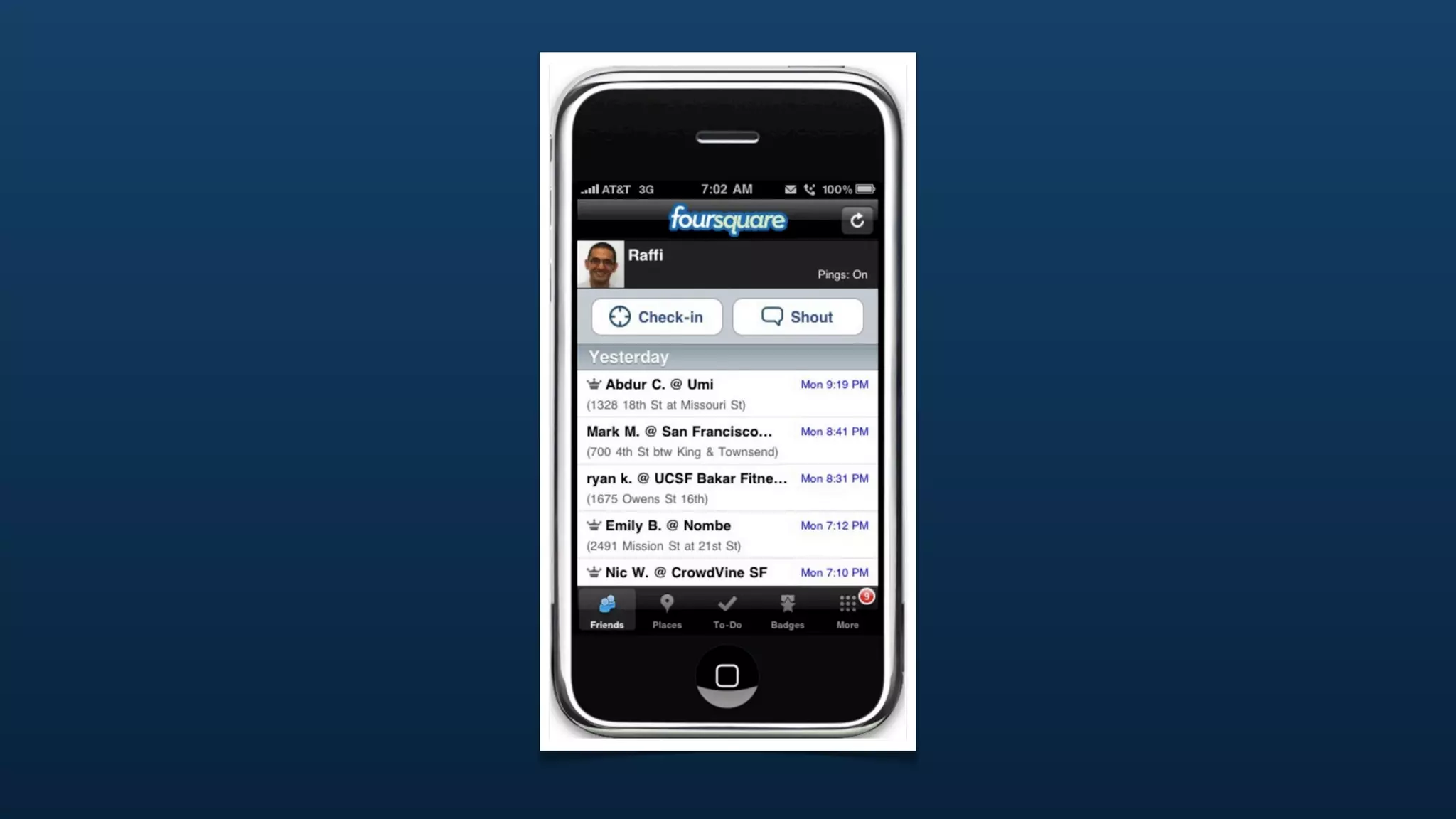
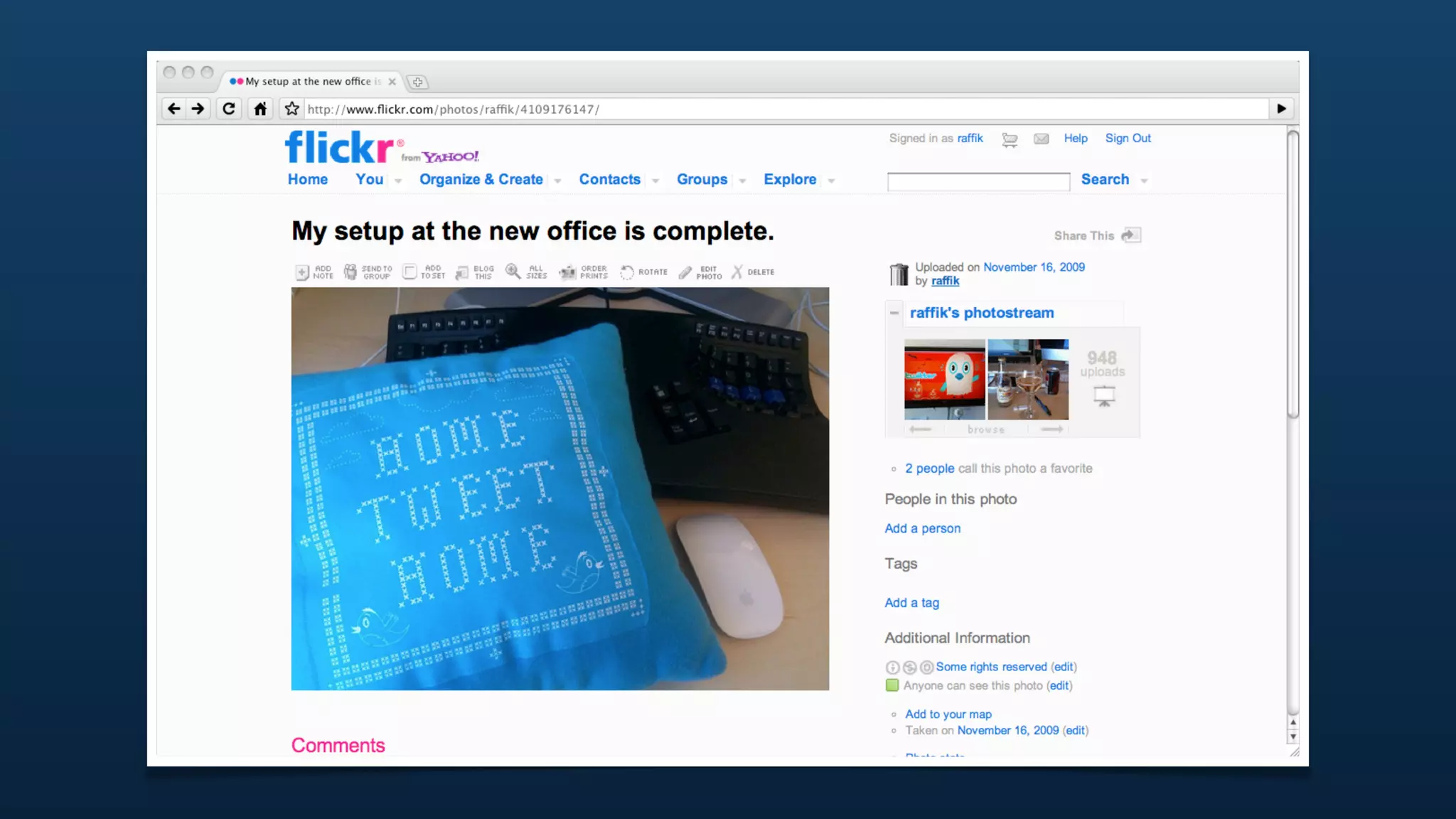
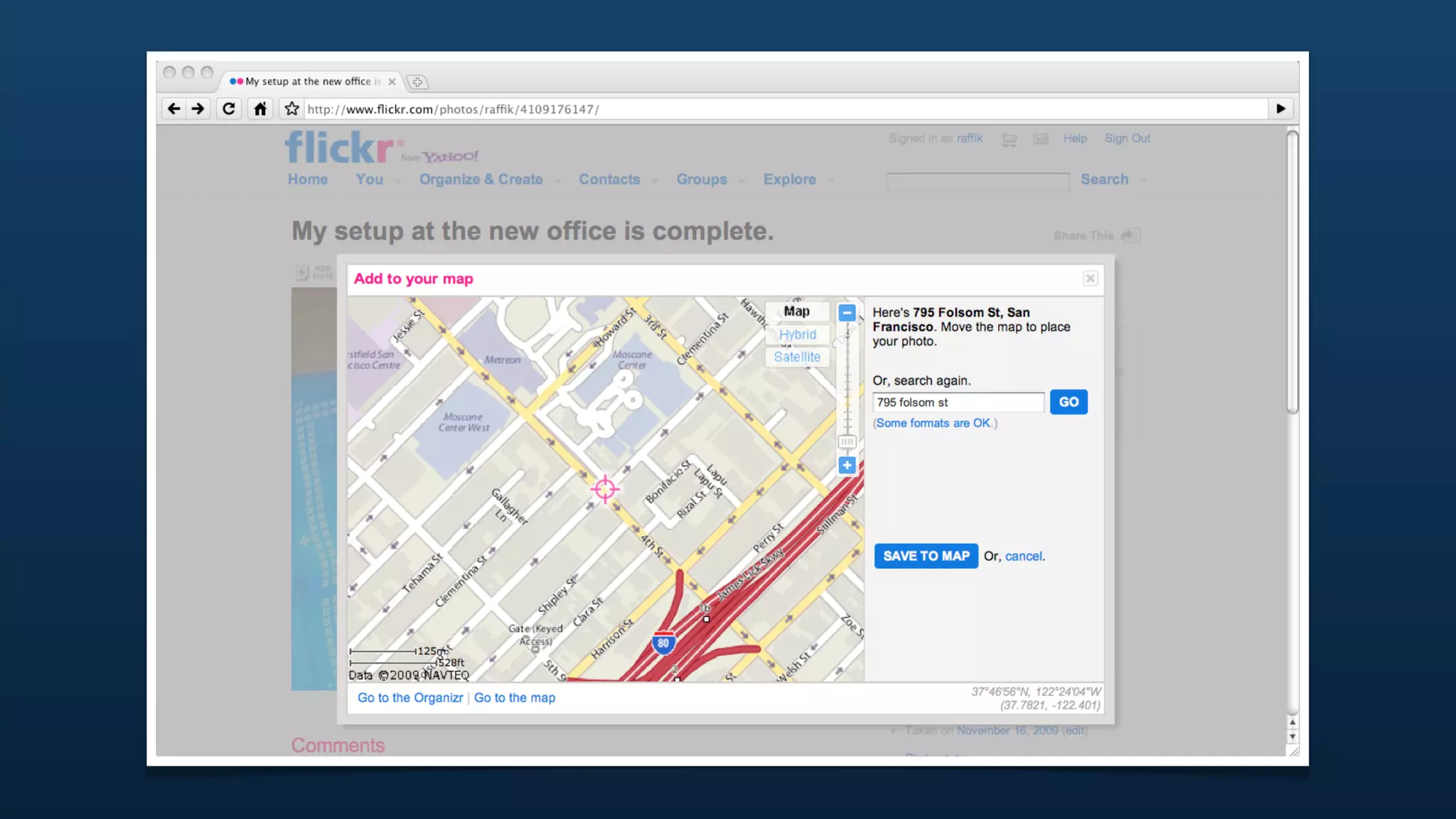
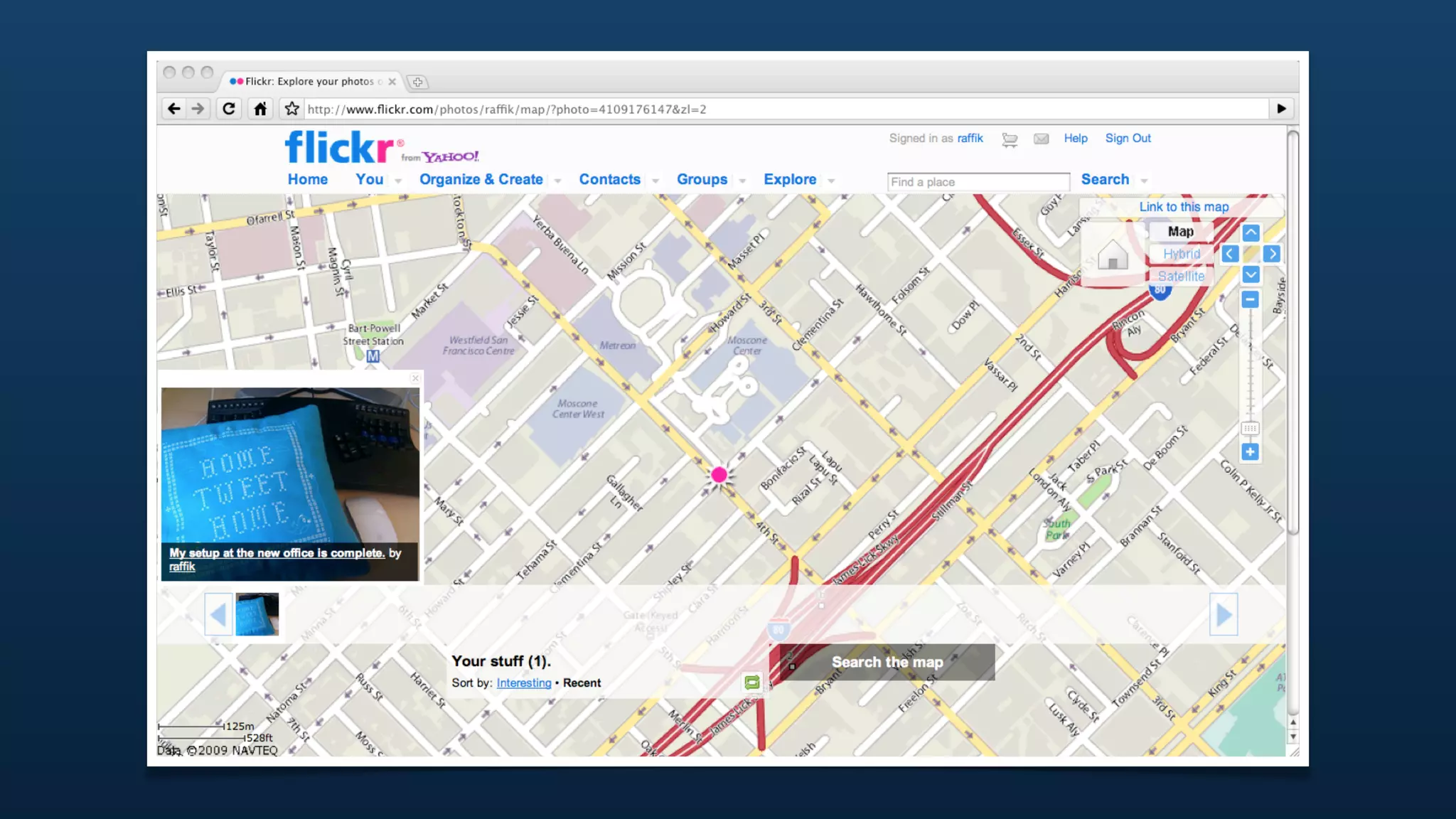
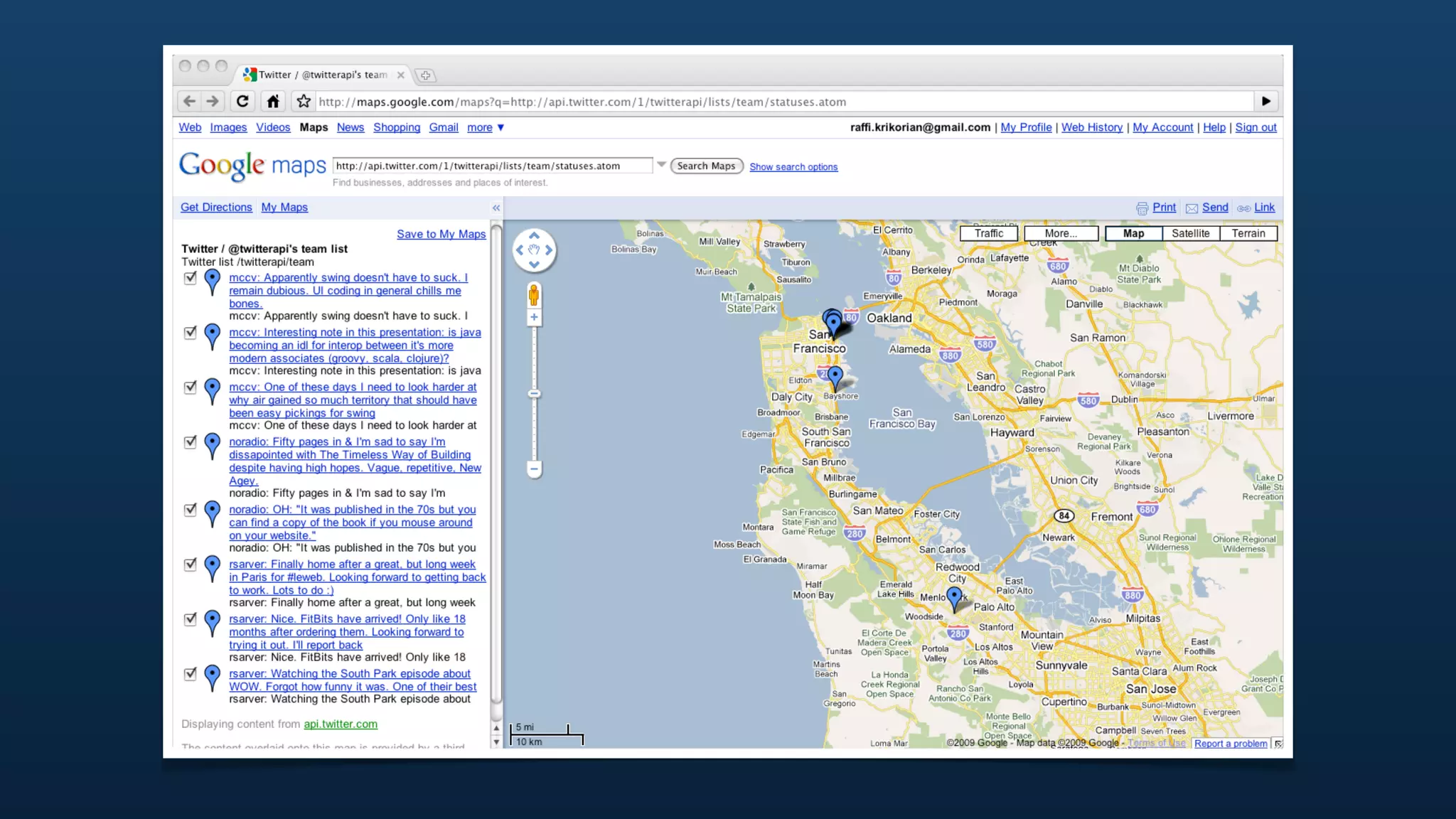
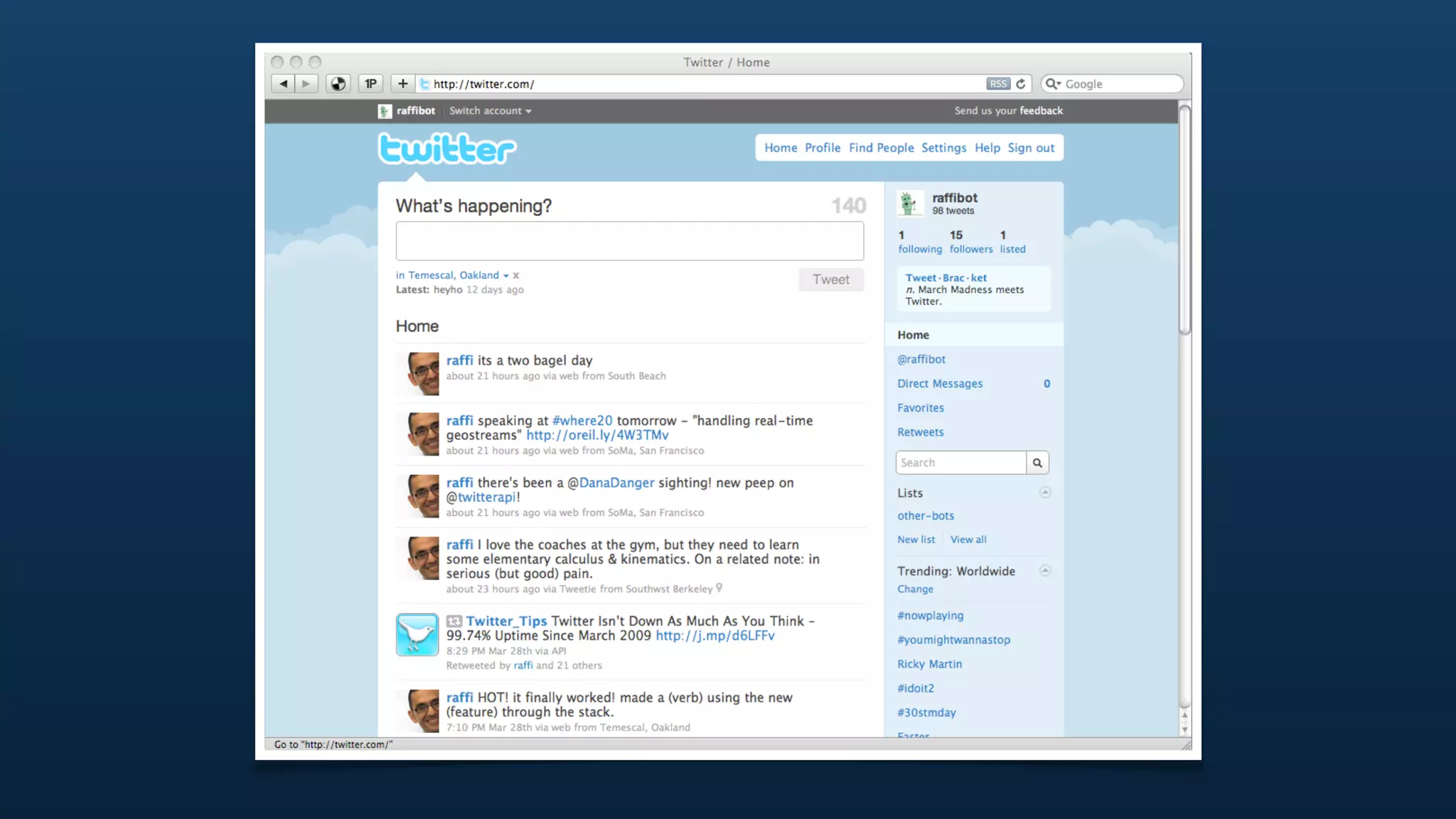
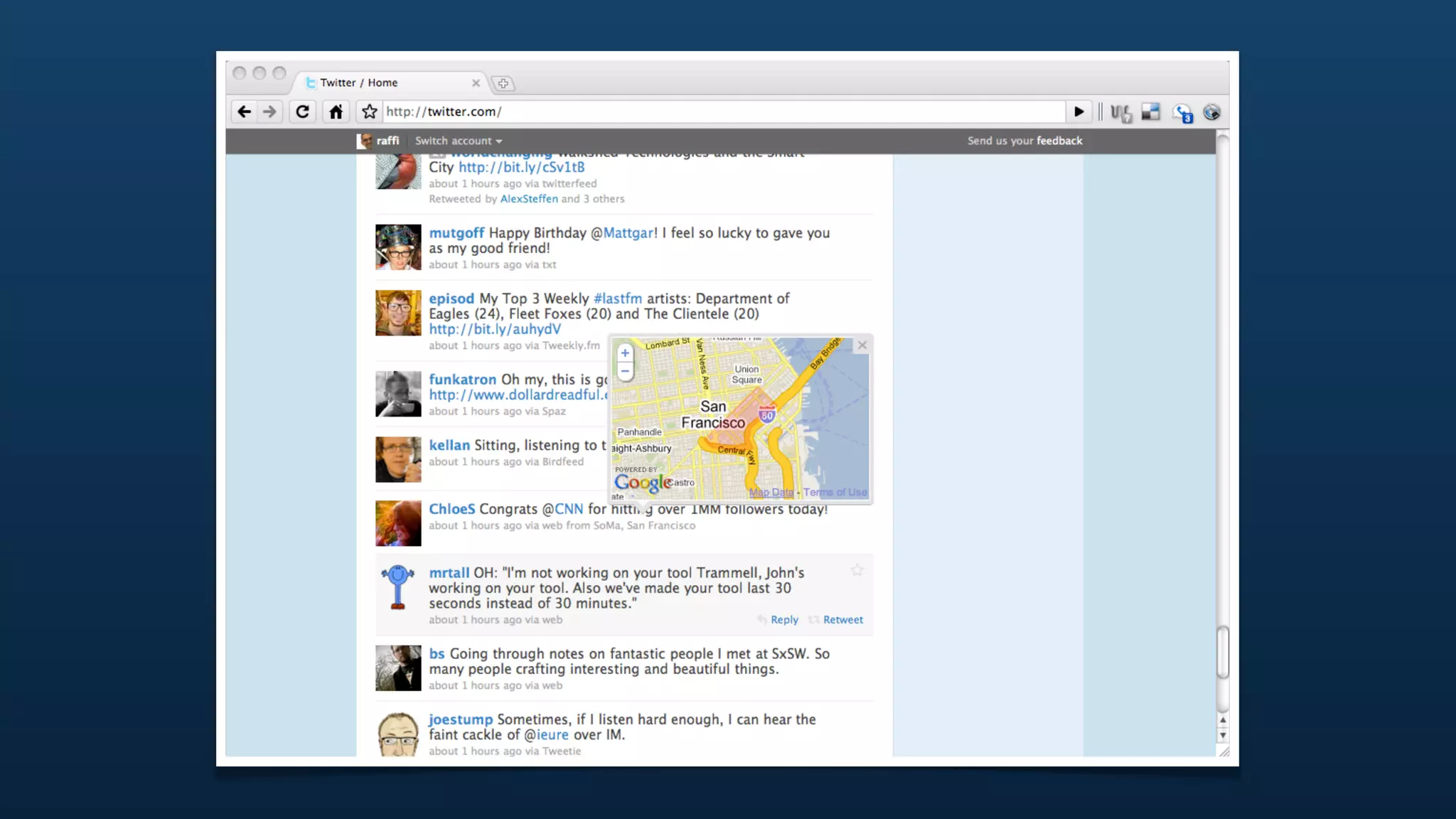
What’s happening here?
Twitter’s Geo APIs
Original attempts
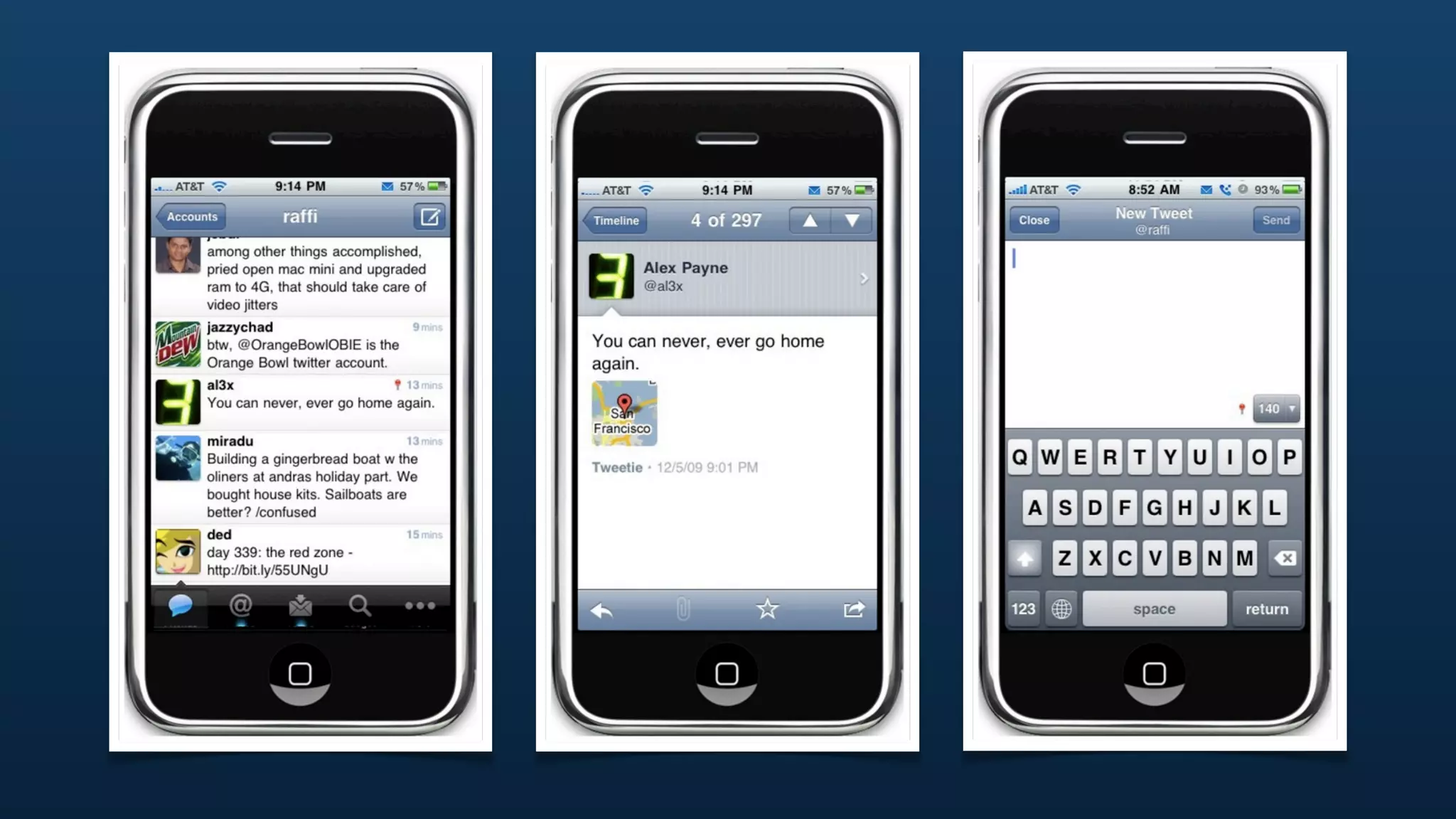
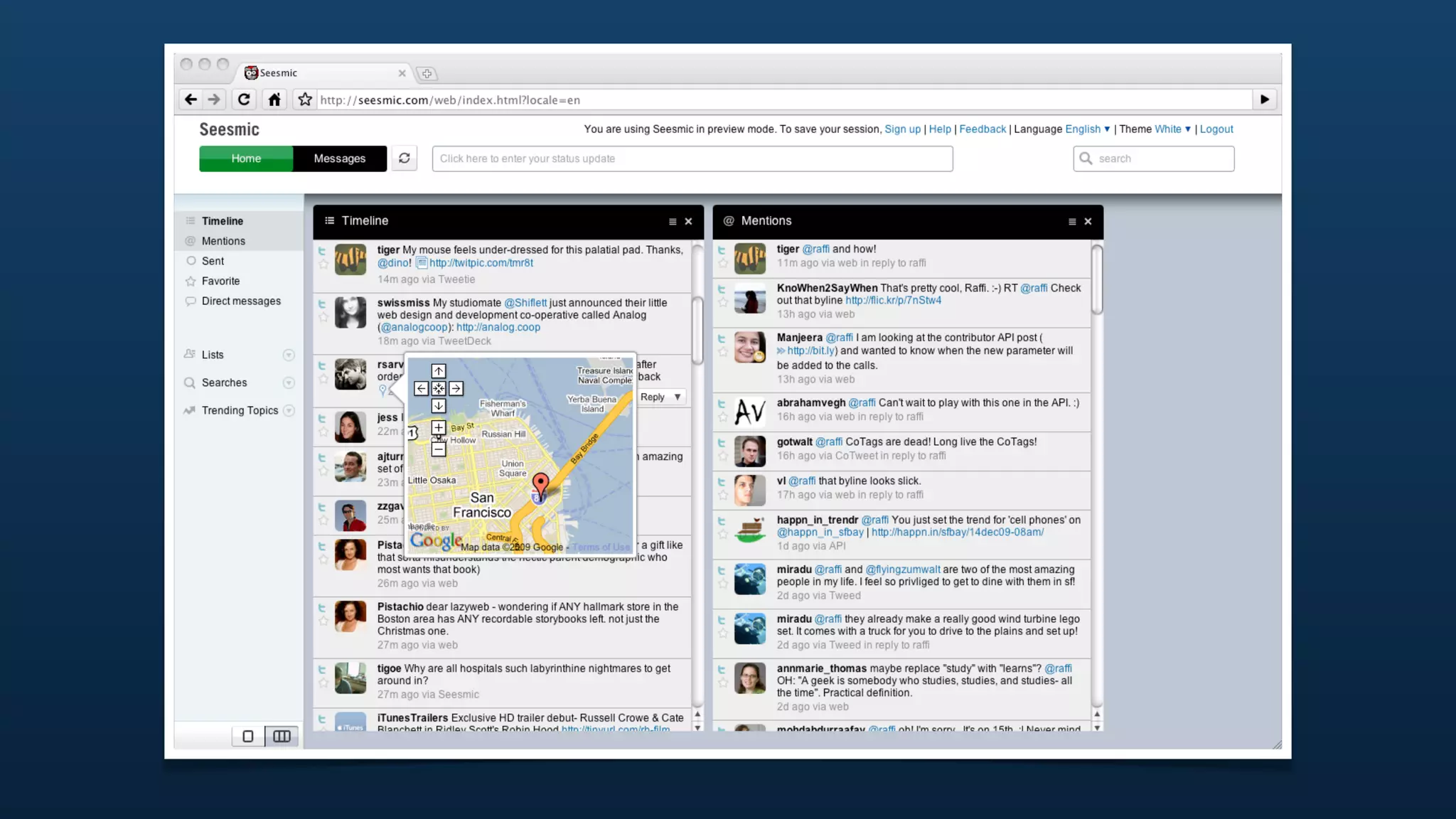
Adding it to the tweet
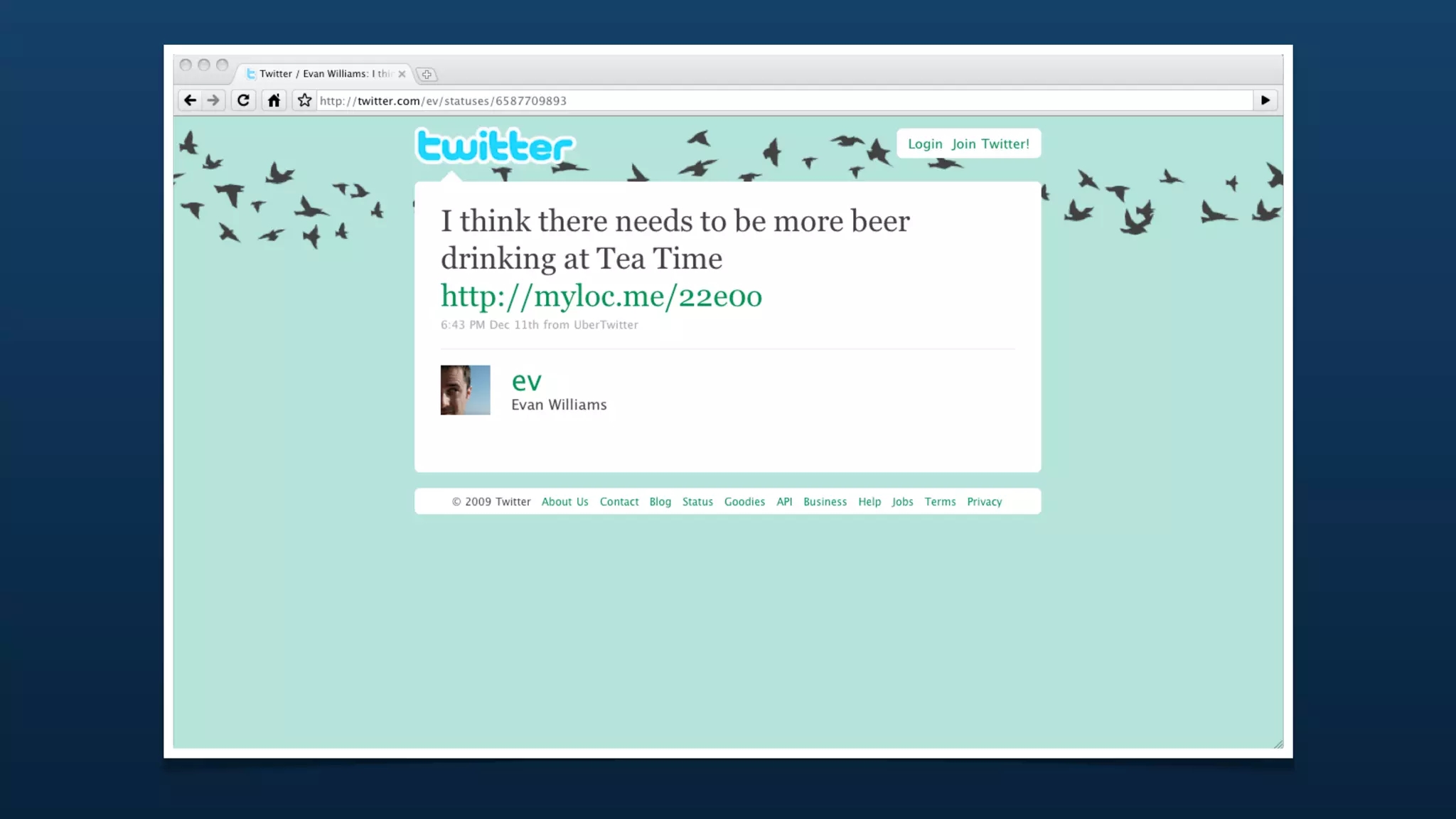
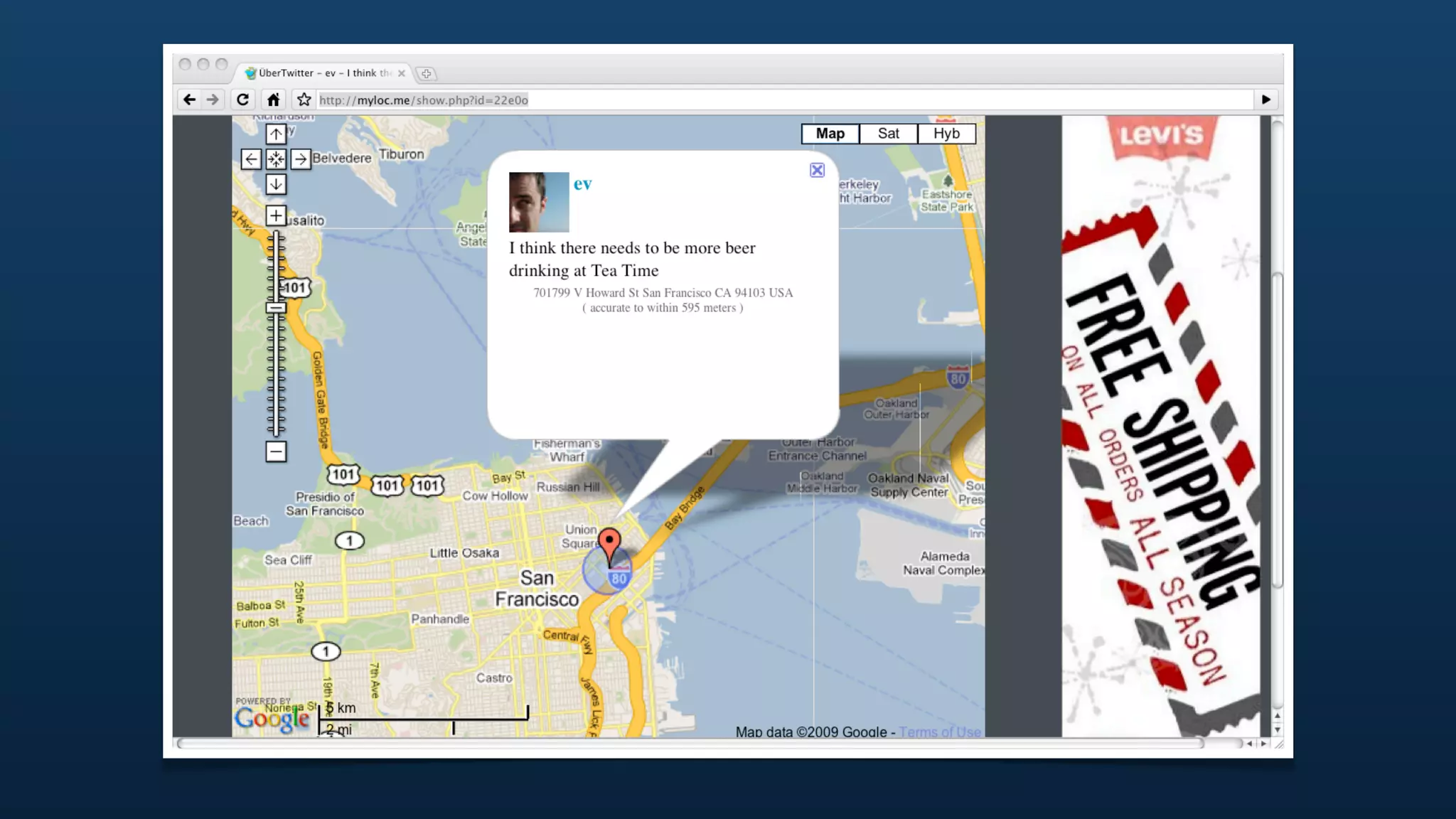
‣   Use myloc.me, et. al. to add text to the tweet
‣   Localizes mobile phone and puts location “in band”
‣   Takes from 140 characters


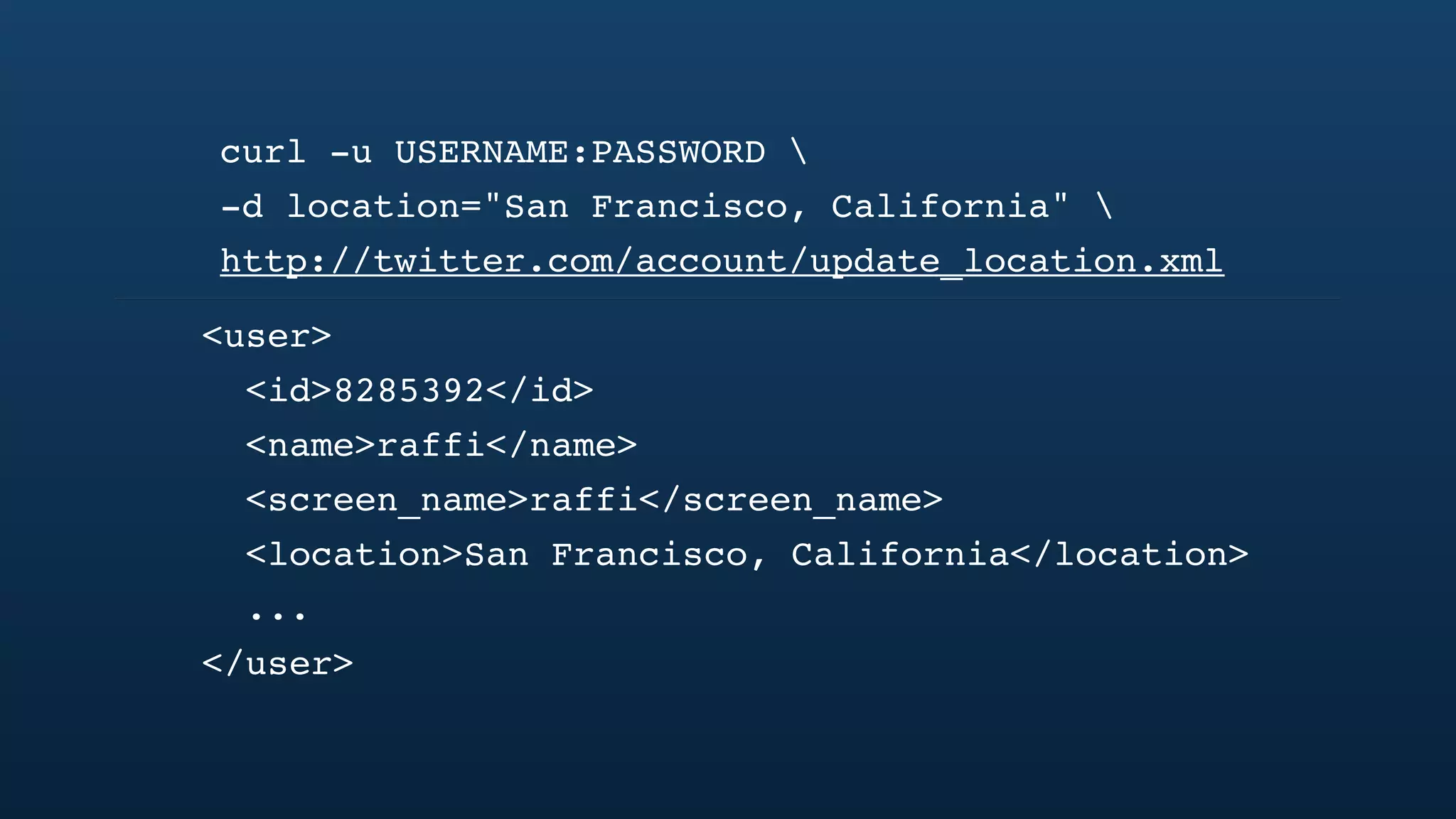
Setting profile level locations
‣   Set the user/location of a Twitter user
‣   There is an API for that!
‣   Not on a per-tweet basis and not designed for high frequency updates
curl -u USERNAME:PASSWORD 
-d location="San Francisco, California" 
http://twitter.com/account/update_location.xml

<user>
  <id>8285392</id>
  <name>raffi</name>
  <screen_name>raffi</screen_name>
  <location>San Francisco, California</location>
  ...
</user>
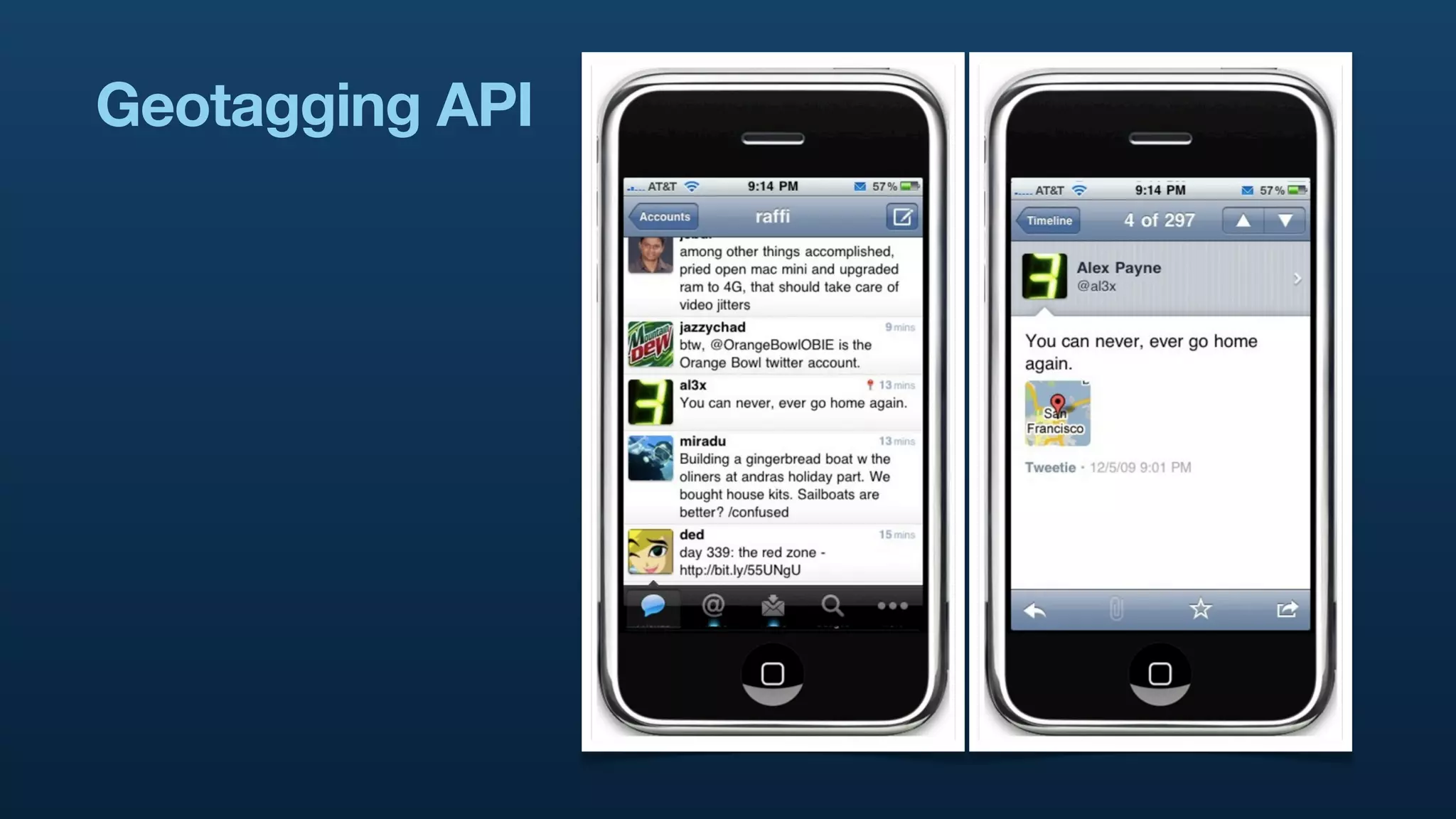
Geotagging API
Geotagging API
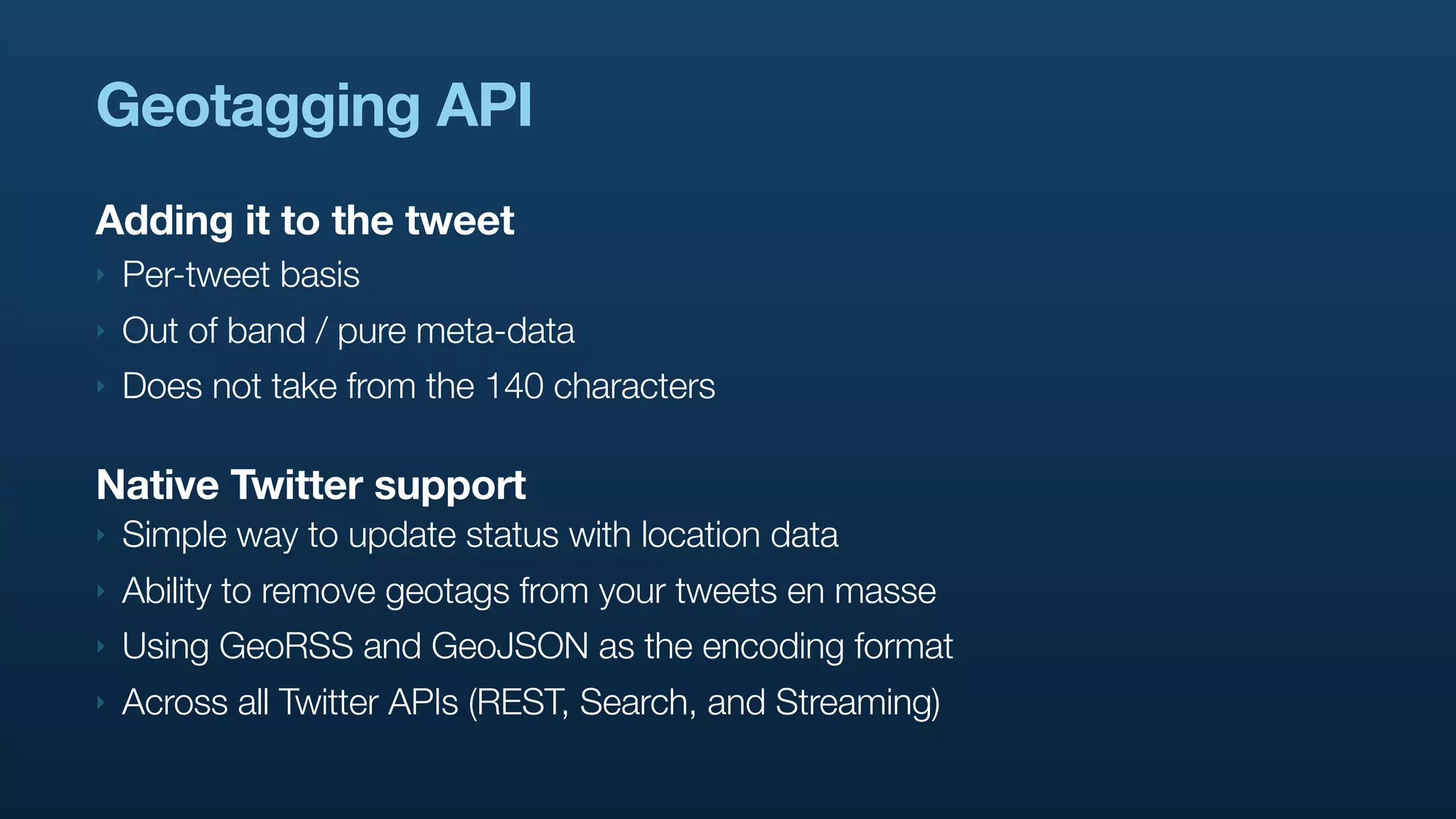
Adding it to the tweet
‣   Per-tweet basis
‣   Out of band / pure meta-data
‣   Does not take from the 140 characters

Native Twitter support
‣   Simple way to update status with location data
‣   Ability to remove geotags from your tweets en masse
‣   Using GeoRSS and GeoJSON as the encoding format
‣   Across all Twitter APIs (REST, Search, and Streaming)
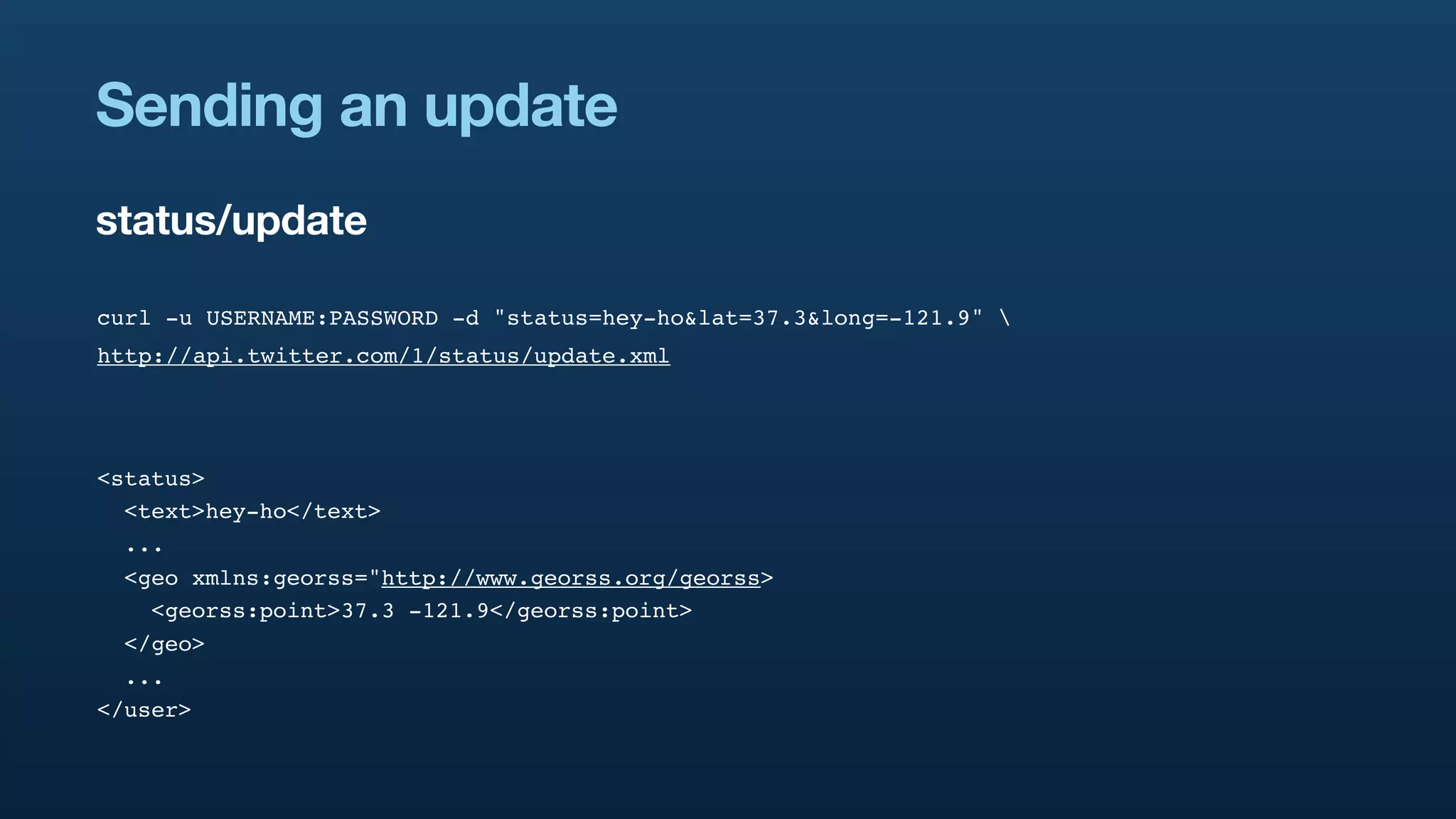
Sending an update
status/update

curl -u USERNAME:PASSWORD -d "status=hey-ho&lat=37.3&long=-121.9" 
http://api.twitter.com/1/status/update.xml


<status>
  <text>hey-ho</text>
  ...
  <geo xmlns:georss="http://www.georss.org/georss>
    <georss:point>37.3 -121.9</georss:point>
  </geo>
  ...
</user>
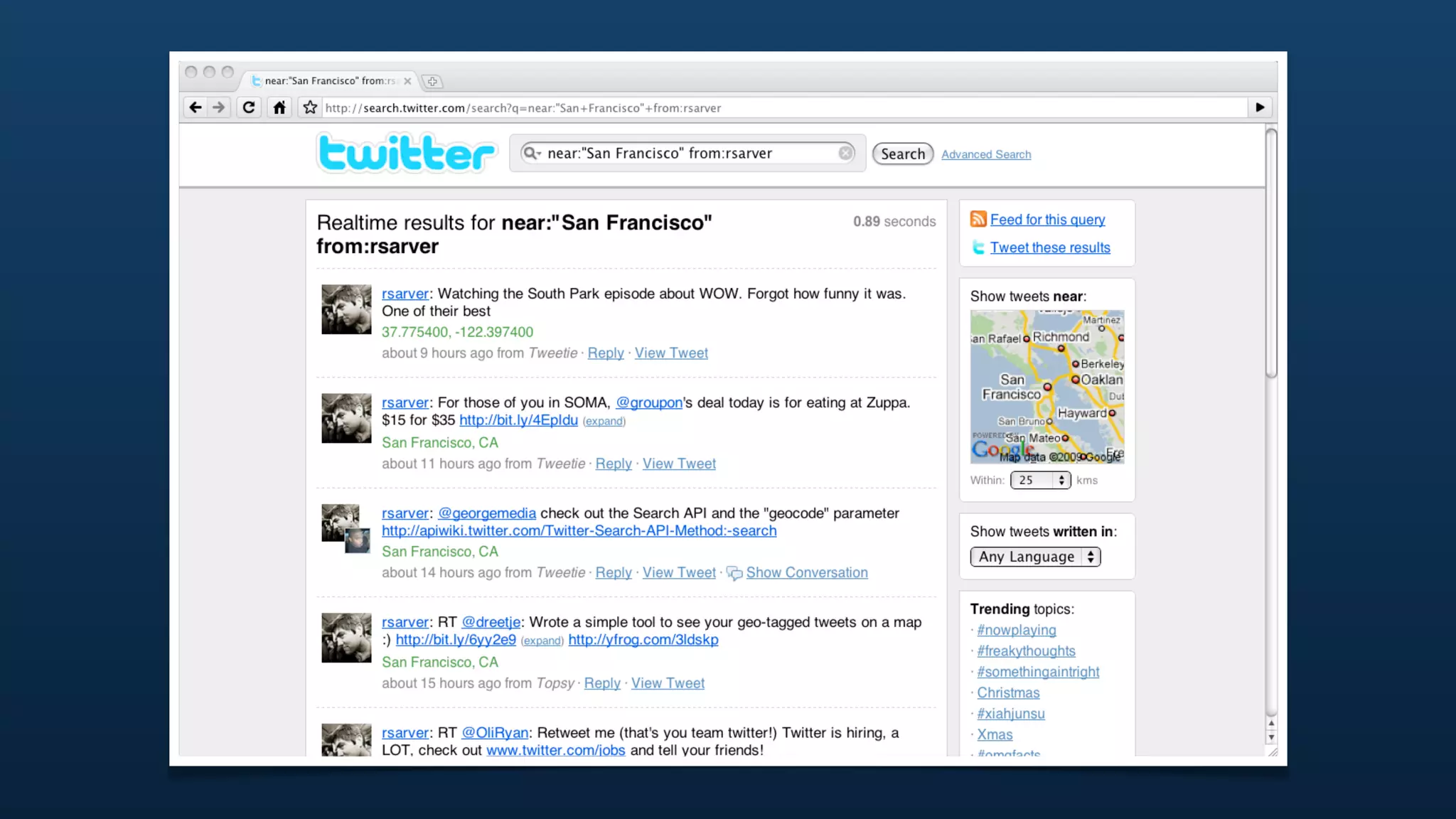
Search
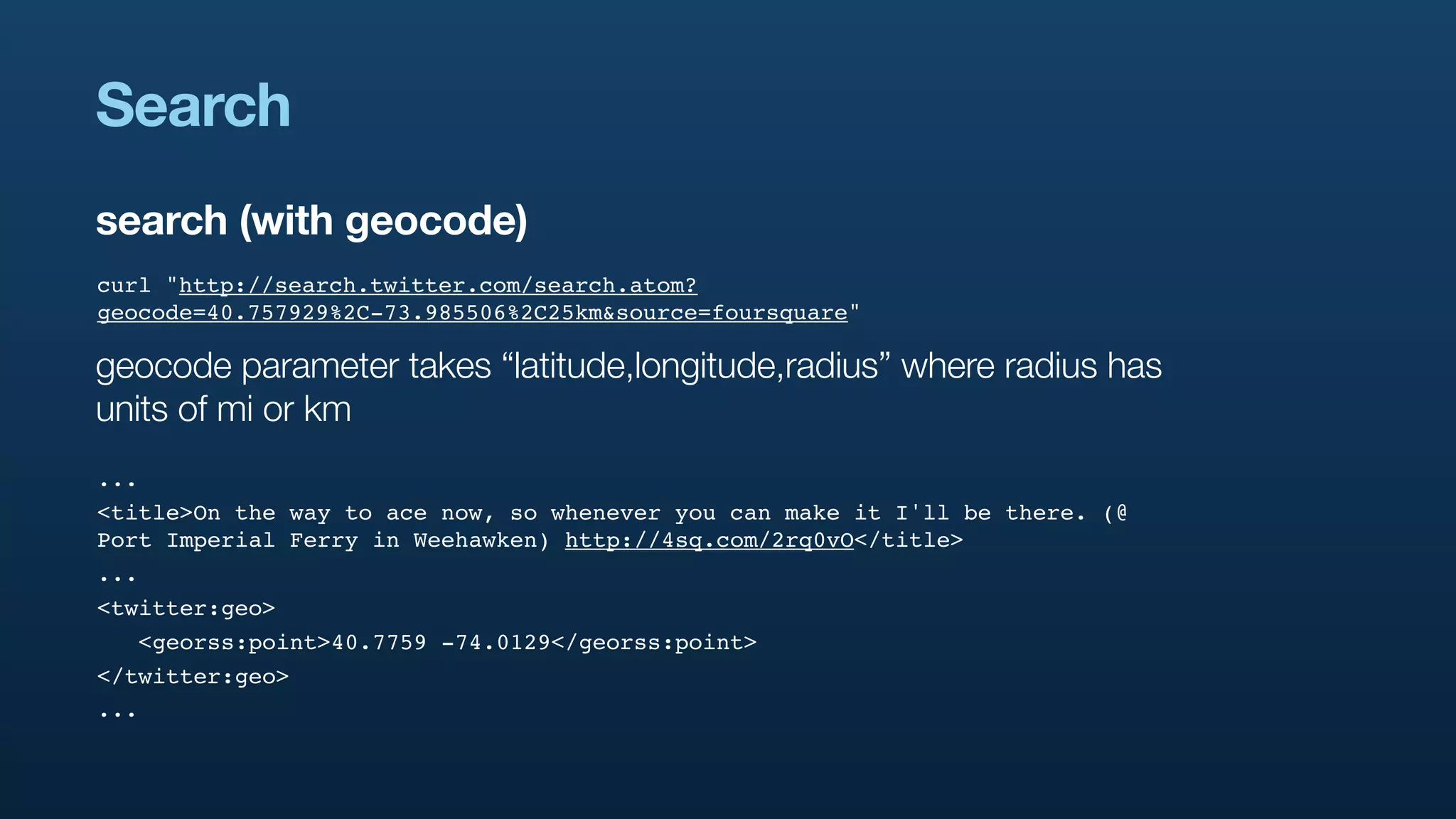
search (with geocode)
curl "http://search.twitter.com/search.atom?
geocode=40.757929%2C-73.985506%2C25km&source=foursquare"

geocode parameter takes “latitude,longitude,radius” where radius has
units of mi or km
...
<title>On the way to ace now, so whenever you can make it I'll be there. (@
Port Imperial Ferry in Weehawken) http://4sq.com/2rq0vO</title>
...
<twitter:geo>
   <georss:point>40.7759 -74.0129</georss:point>
</twitter:geo>
...
Geo-hose
Geo-hose
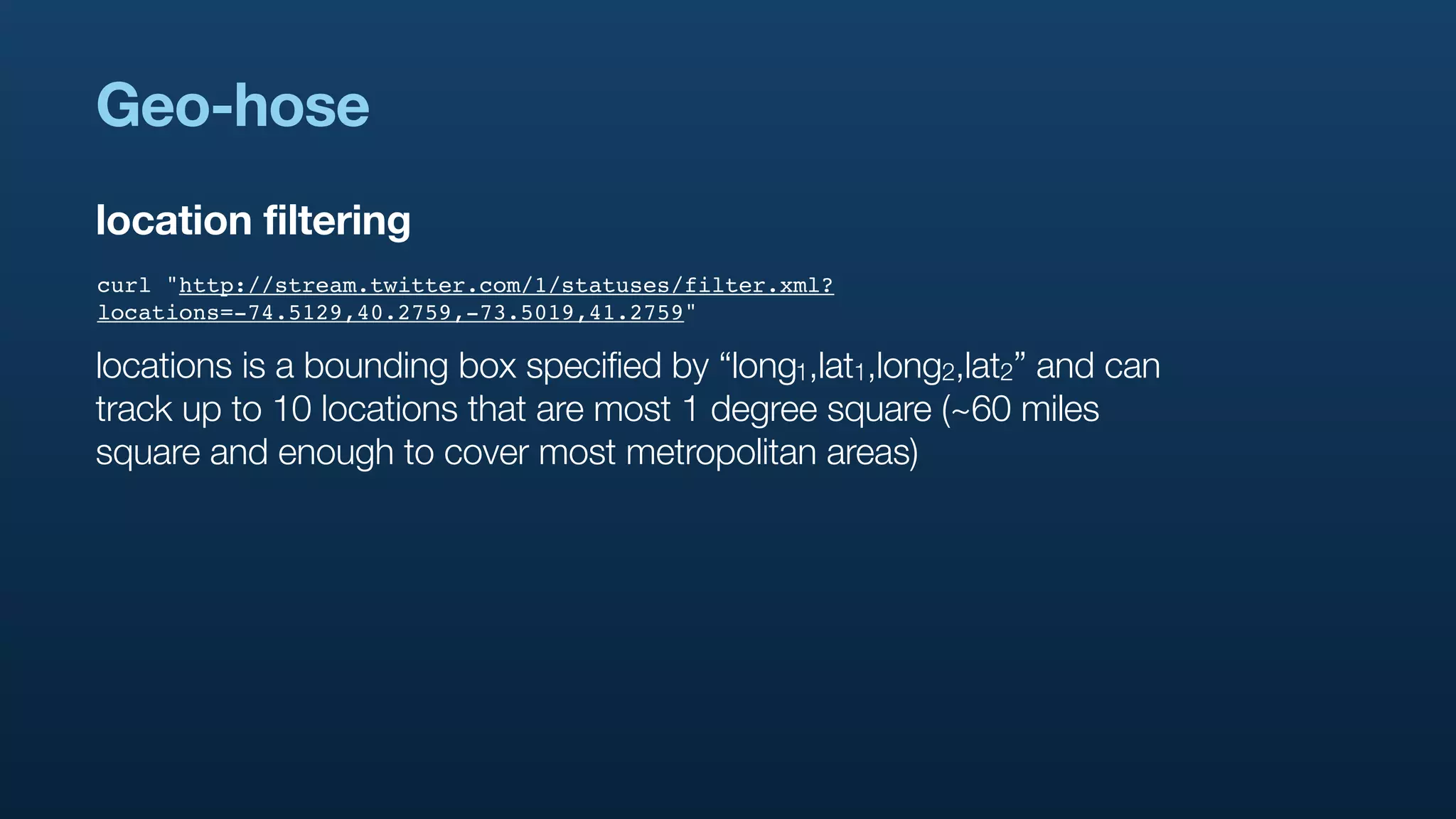
location filtering
curl "http://stream.twitter.com/1/statuses/filter.xml?
locations=-74.5129,40.2759,-73.5019,41.2759"

locations is a bounding box specified by “long1,lat1,long2,lat2” and can
track up to 10 locations that are most 1 degree square (~60 miles
square and enough to cover most metropolitan areas)
Trends API
Trends API
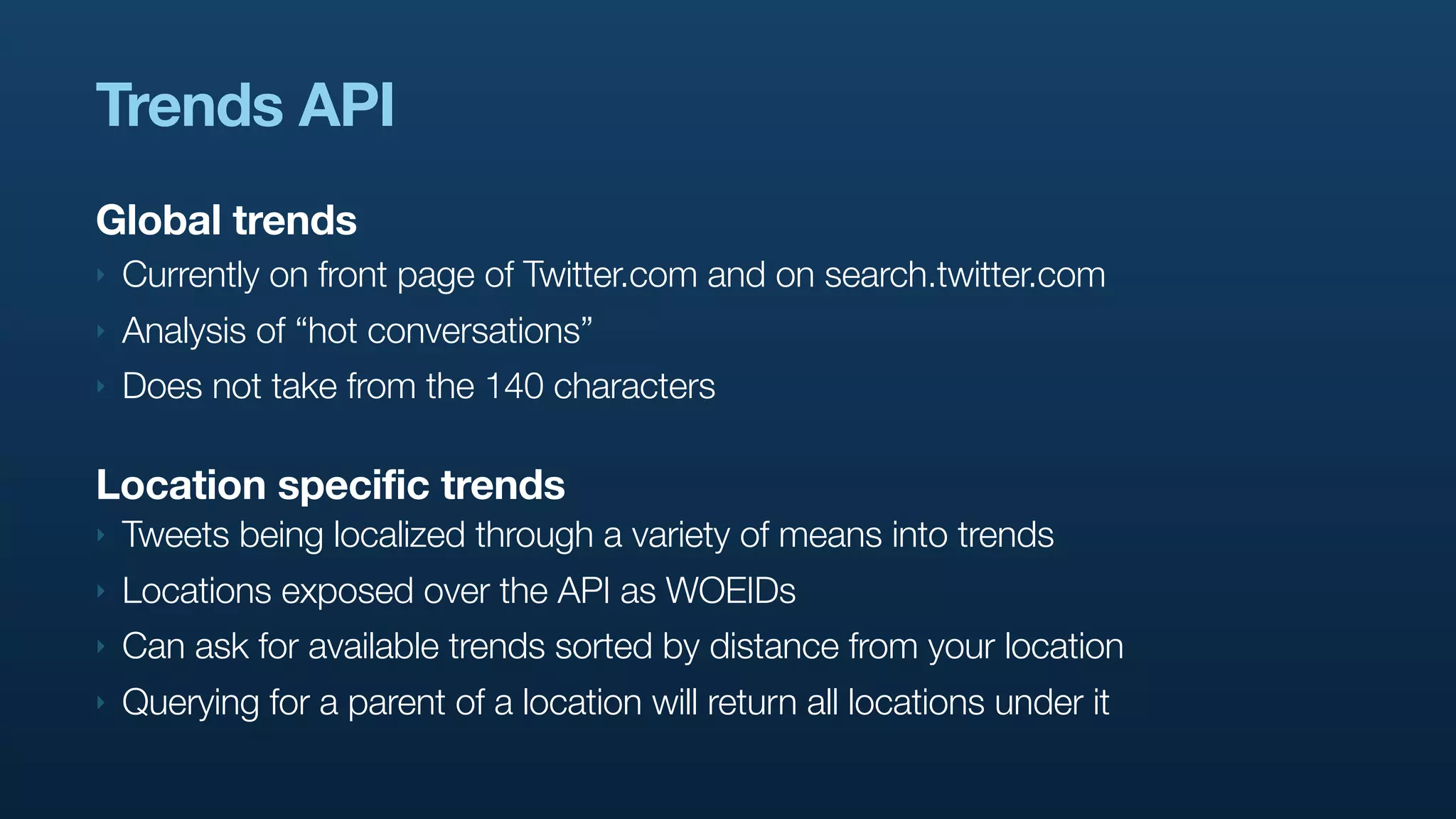
Global trends
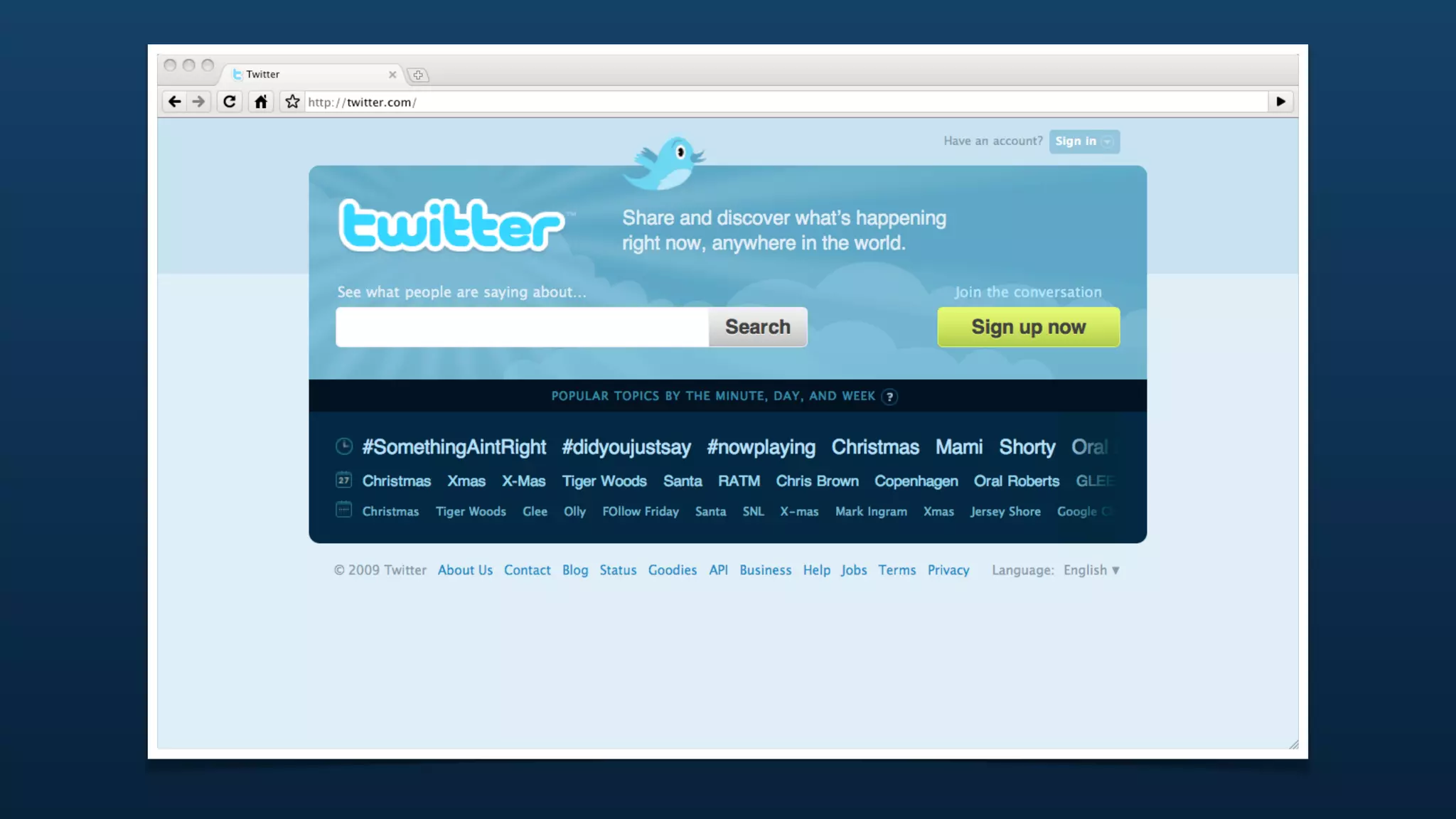
‣   Currently on front page of Twitter.com and on search.twitter.com
‣   Analysis of “hot conversations”
‣   Does not take from the 140 characters

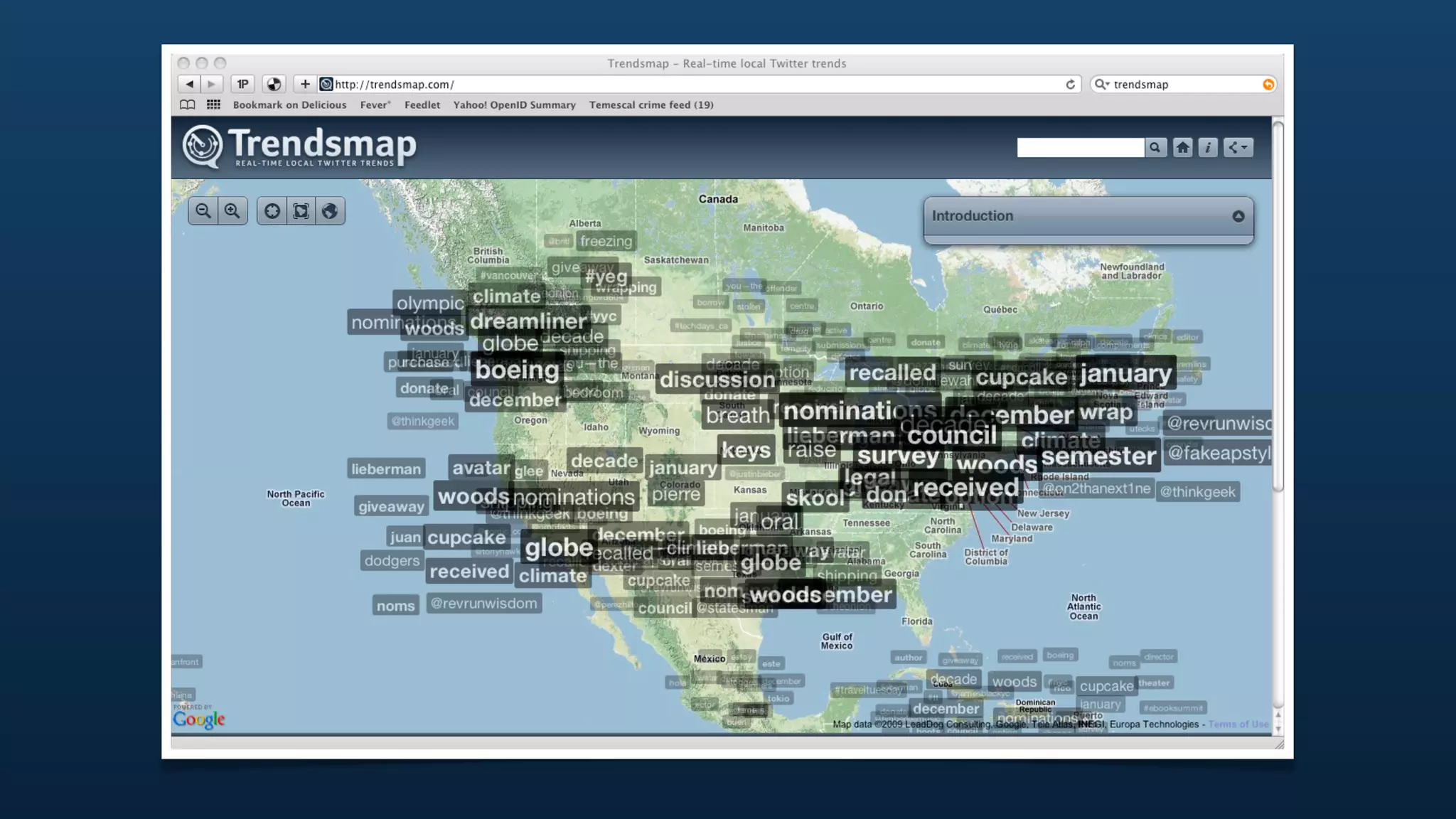
Location specific trends
‣   Tweets being localized through a variety of means into trends
‣   Locations exposed over the API as WOEIDs
‣   Can ask for available trends sorted by distance from your location
‣   Querying for a parent of a location will return all locations under it
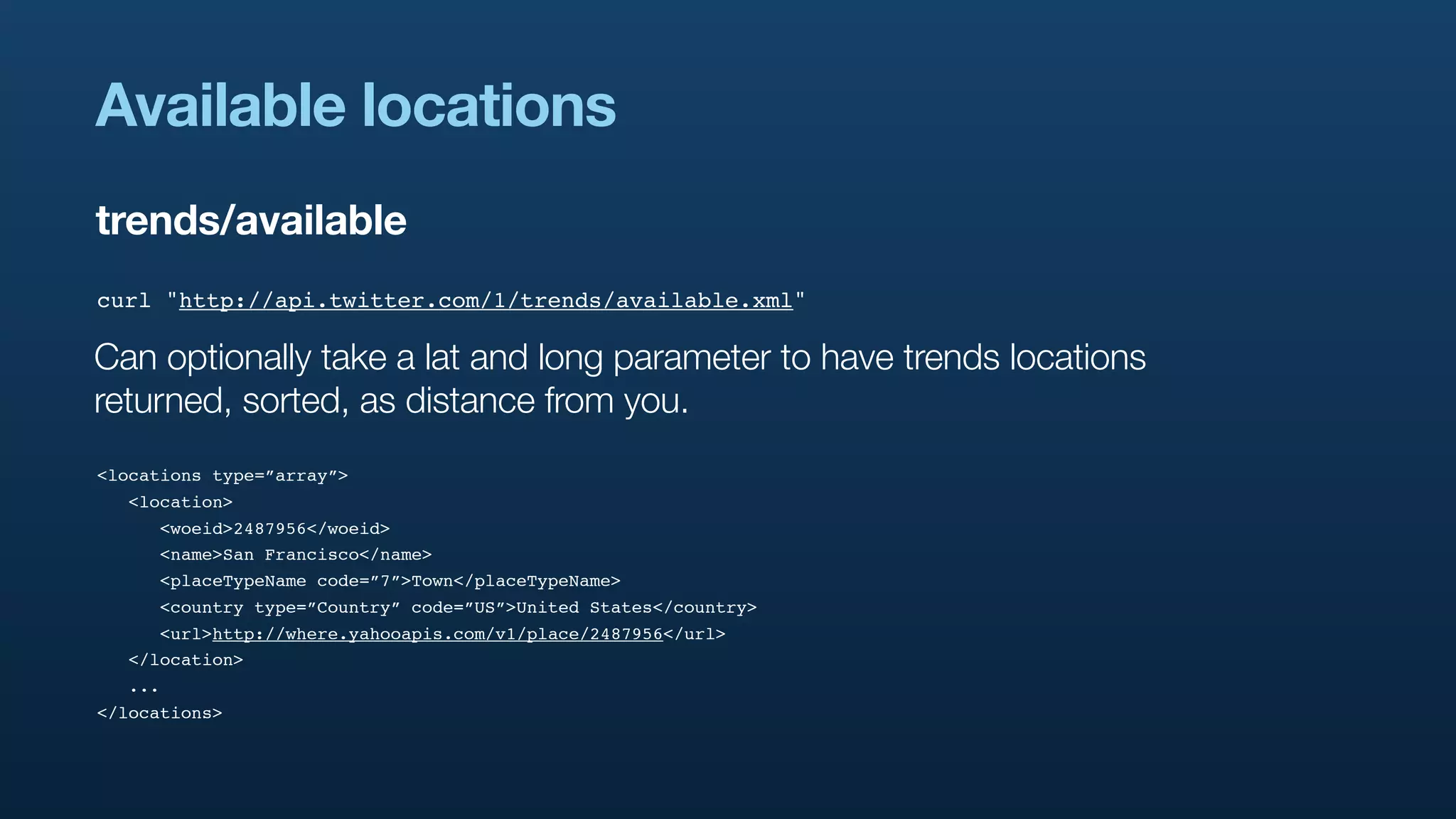
Available locations
trends/available
curl "http://api.twitter.com/1/trends/available.xml"

Can optionally take a lat and long parameter to have trends locations
returned, sorted, as distance from you.
<locations type=”array”>
  <location>
     <woeid>2487956</woeid>
     <name>San Francisco</name>
     <placeTypeName code=”7”>Town</placeTypeName>
     <country type=”Country” code=”US”>United States</country>
     <url>http://where.yahooapis.com/v1/place/2487956</url>
  </location>
  ...
</locations>
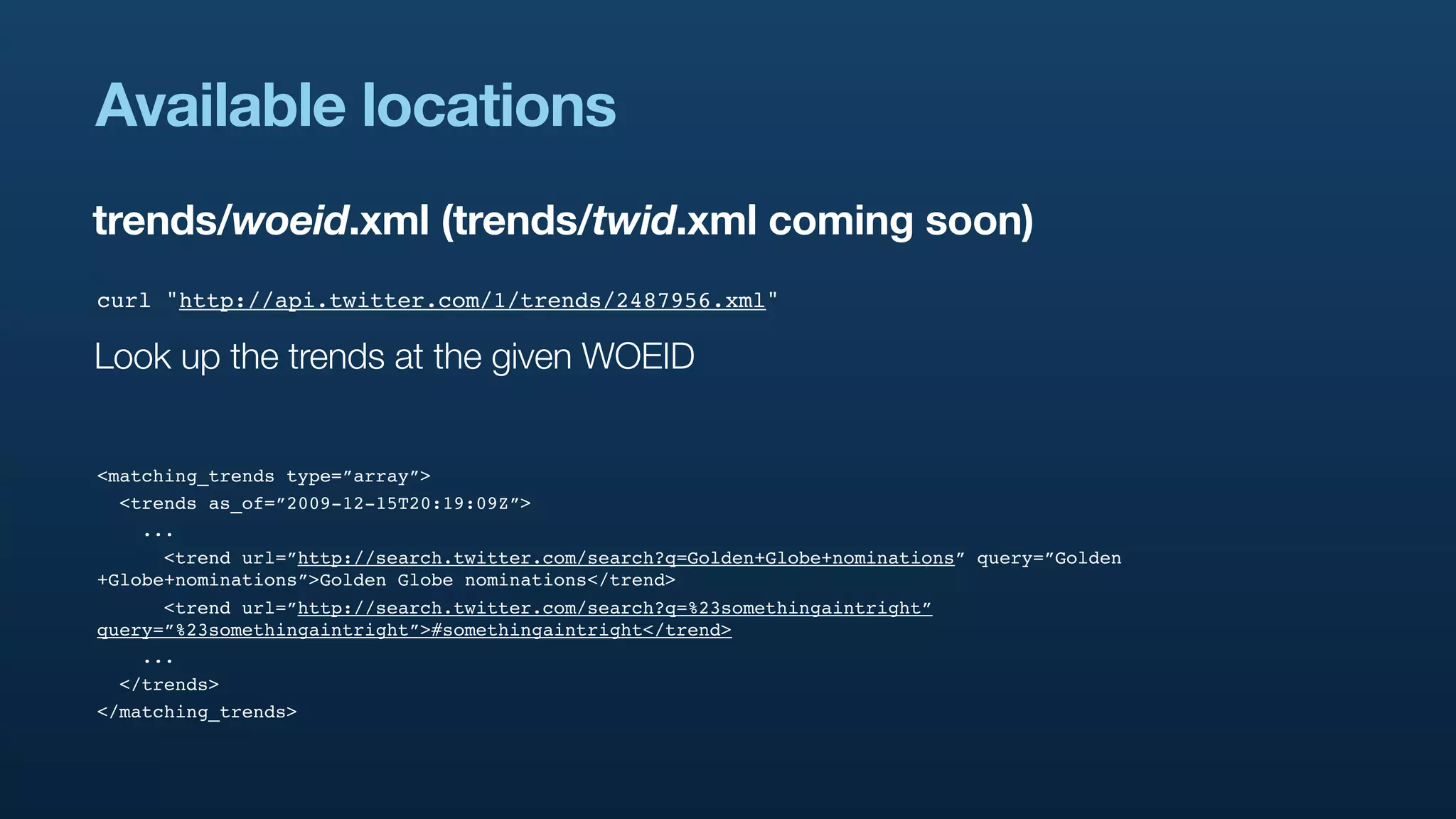
Available locations
trends/woeid.xml (trends/twid.xml coming soon)
curl "http://api.twitter.com/1/trends/2487956.xml"

Look up the trends at the given WOEID


<matching_trends type=”array”>
  <trends as_of=”2009-12-15T20:19:09Z”>
    ...
      <trend url=”http://search.twitter.com/search?q=Golden+Globe+nominations” query=”Golden
+Globe+nominations”>Golden Globe nominations</trend>
      <trend url=”http://search.twitter.com/search?q=%23somethingaintright”
query=”%23somethingaintright”>#somethingaintright</trend>
    ...
  </trends>
</matching_trends>
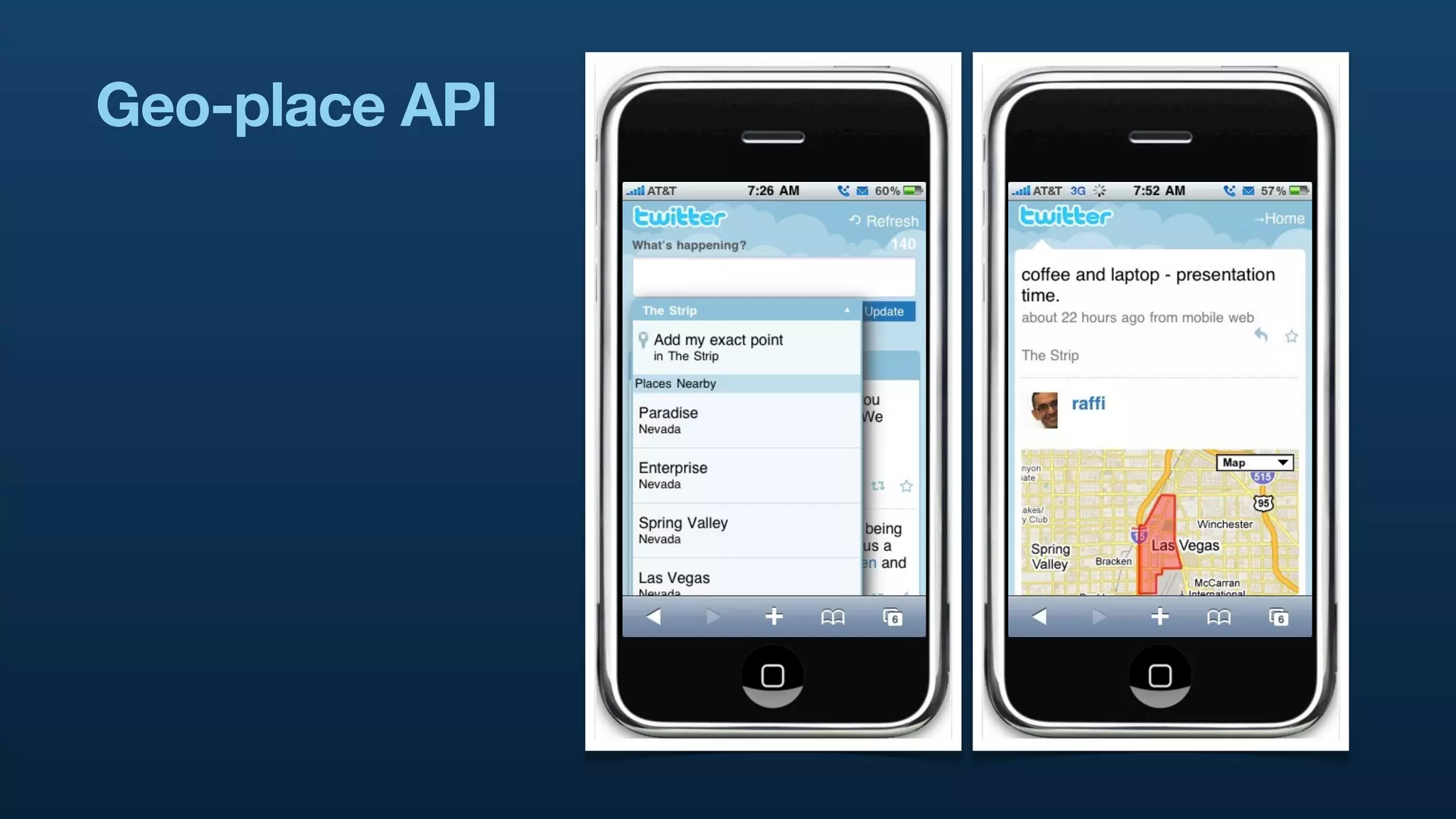
Geo-place API
Geo-place API
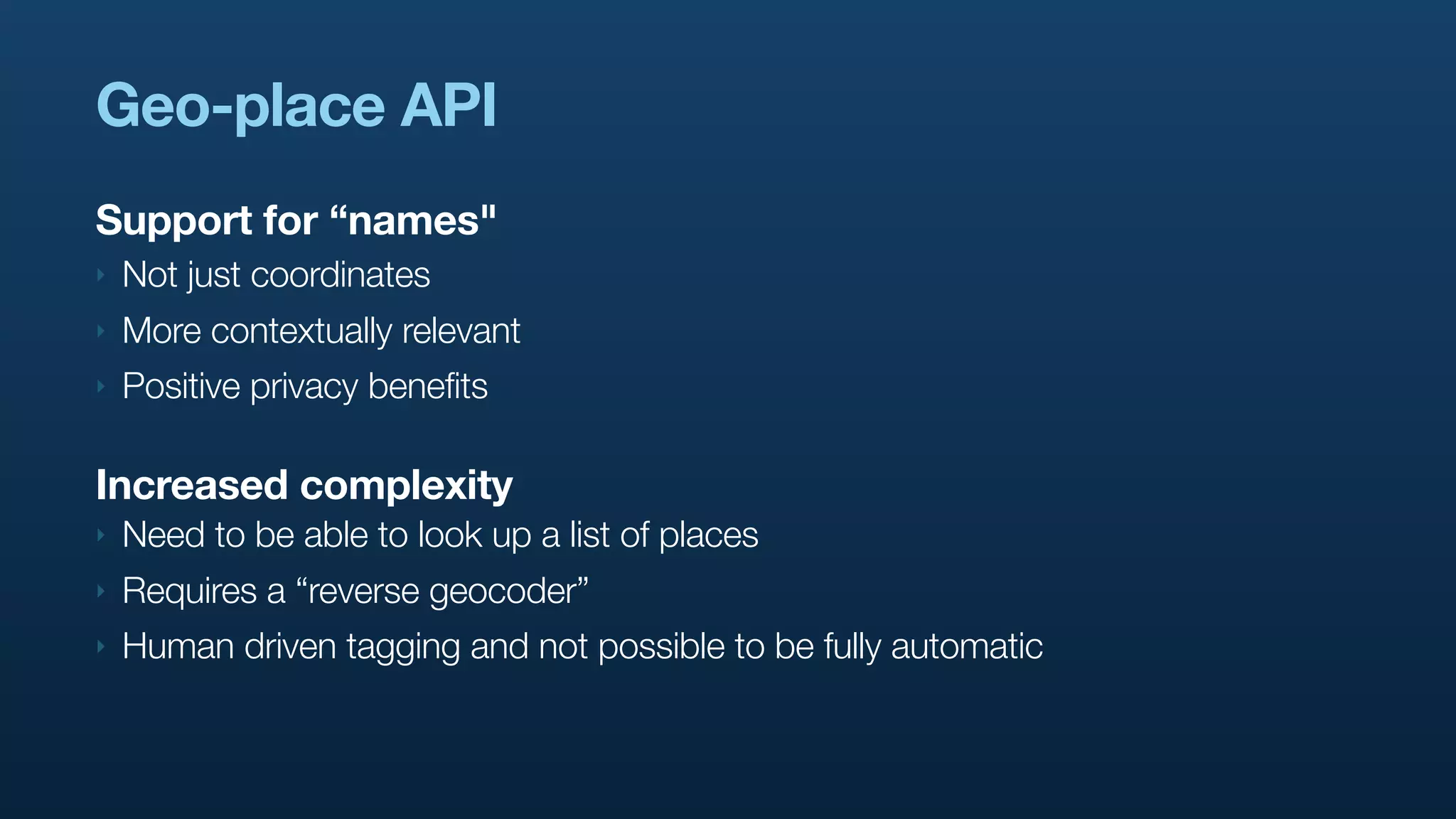
Support for “names"
‣   Not just coordinates
‣   More contextually relevant
‣   Positive privacy benefits

Increased complexity
‣   Need to be able to look up a list of places
‣   Requires a “reverse geocoder”
‣   Human driven tagging and not possible to be fully automatic
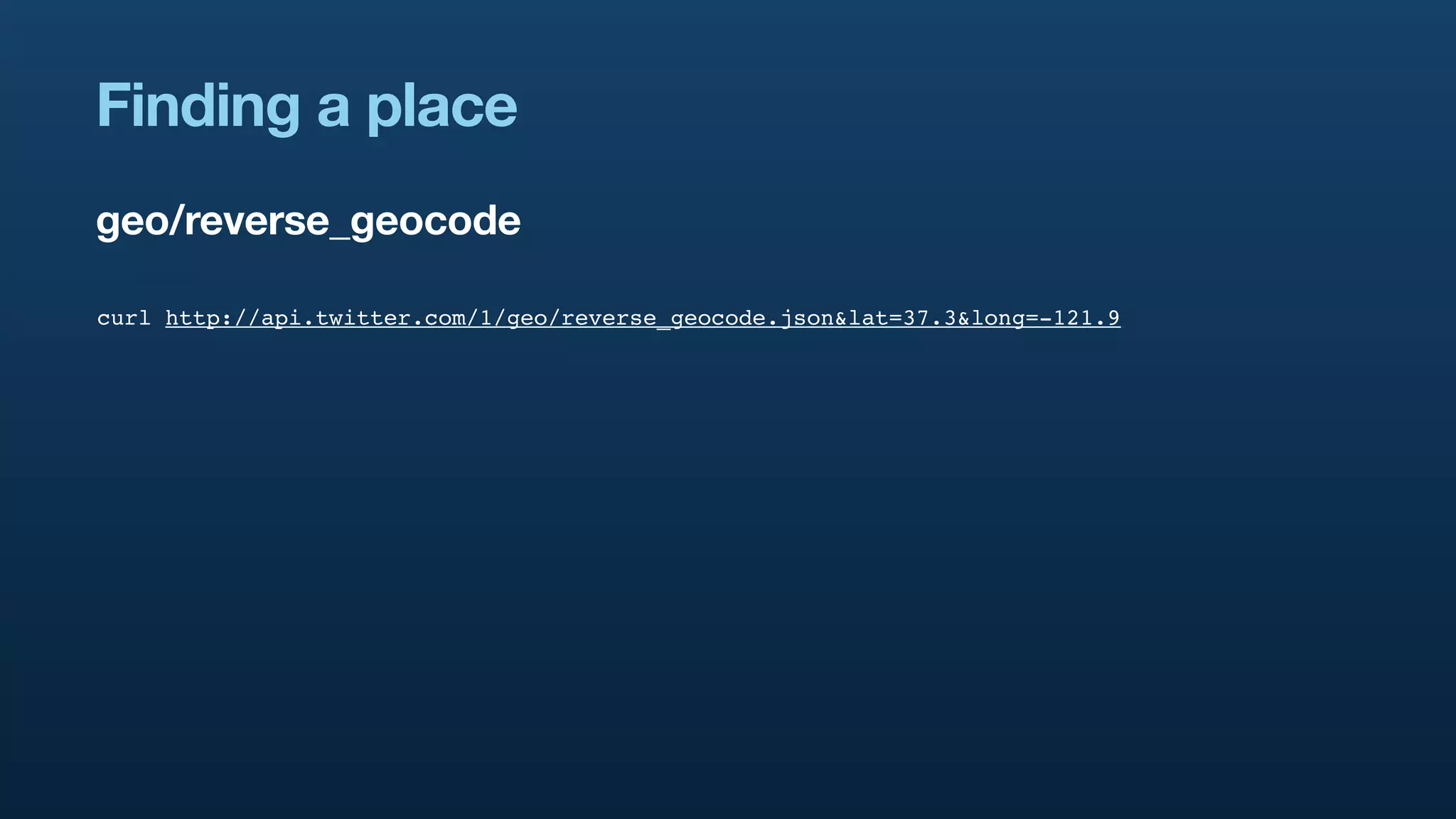
Finding a place
geo/reverse_geocode

curl http://api.twitter.com/1/geo/reverse_geocode.json&lat=37.3&long=-121.9
{
    "result": {
        "places": [
            {
                "place_type":"neighborhood",
                "country_code":"US",
                "contained_within": [...]
                "full_name":"Willow Glen",
                "bounding_box": {
                    "type":"Polygon",
                    "coordinates": [[                  Put some graphic to
                                                       explain what goes in the
                      [-121.92481908, 37.275903], [-121.88083608, 37.275903],
                                                       contained_within
                      [-121.88083608, 37.31548203], [-121.92481908, 37.31548203]
                    ]]
                },
                "name":"Willow Glen",
                "id":"46bc64ecd1da2a46",
                "url":"http://api.twitter.com/1/geo/id/46bc64ecd1da2a46.json",
                "country":""
            },
            ...
          ]
      }
}
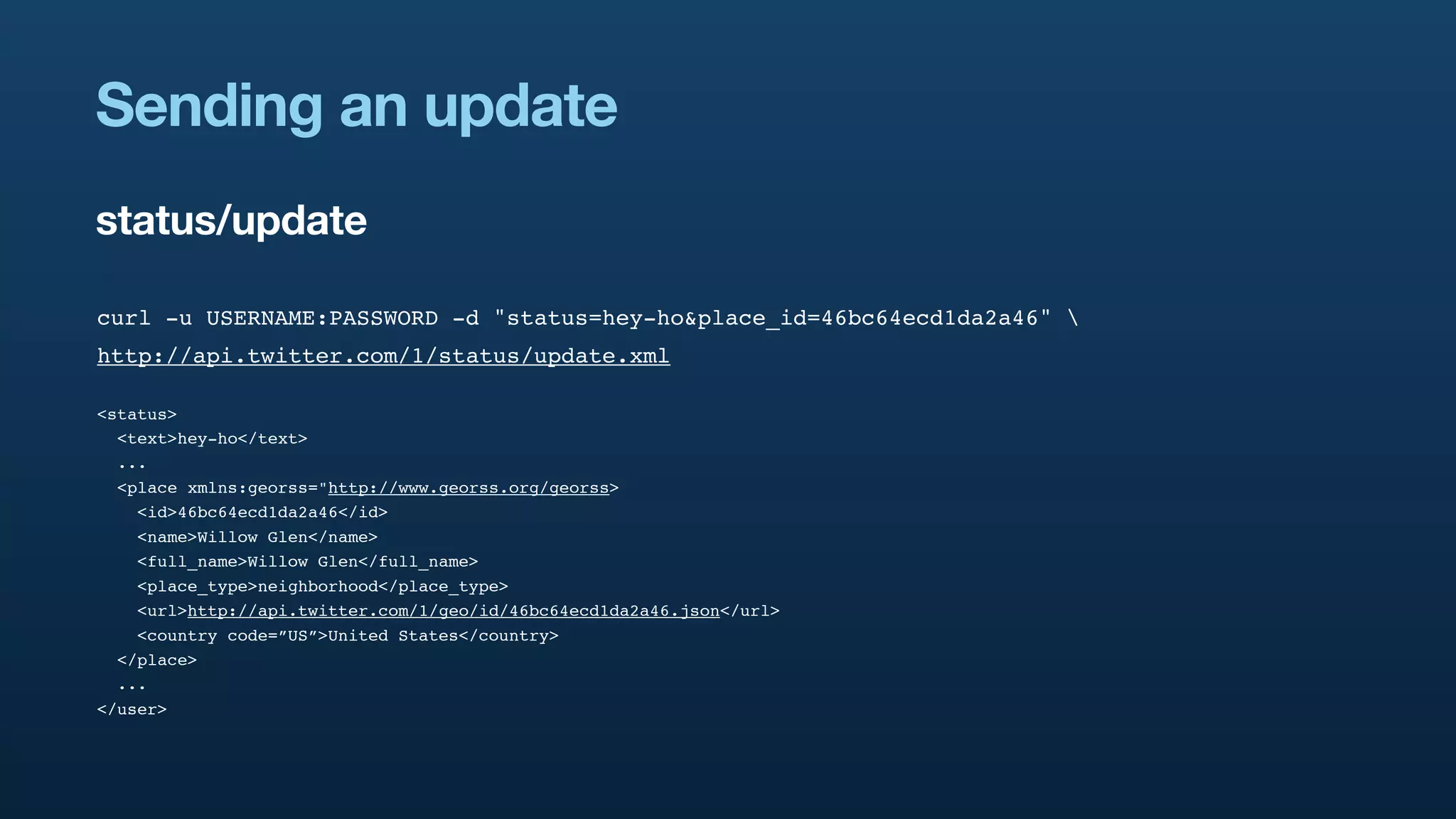
Sending an update
status/update

curl -u USERNAME:PASSWORD -d "status=hey-ho&place_id=46bc64ecd1da2a46" 
http://api.twitter.com/1/status/update.xml

<status>
  <text>hey-ho</text>
  ...
  <place xmlns:georss="http://www.georss.org/georss>
    <id>46bc64ecd1da2a46</id>
    <name>Willow Glen</name>
    <full_name>Willow Glen</full_name>
    <place_type>neighborhood</place_type>
    <url>http://api.twitter.com/1/geo/id/46bc64ecd1da2a46.json</url>
    <country code=”US”>United States</country>
  </place>
  ...
</user>
Problem statement
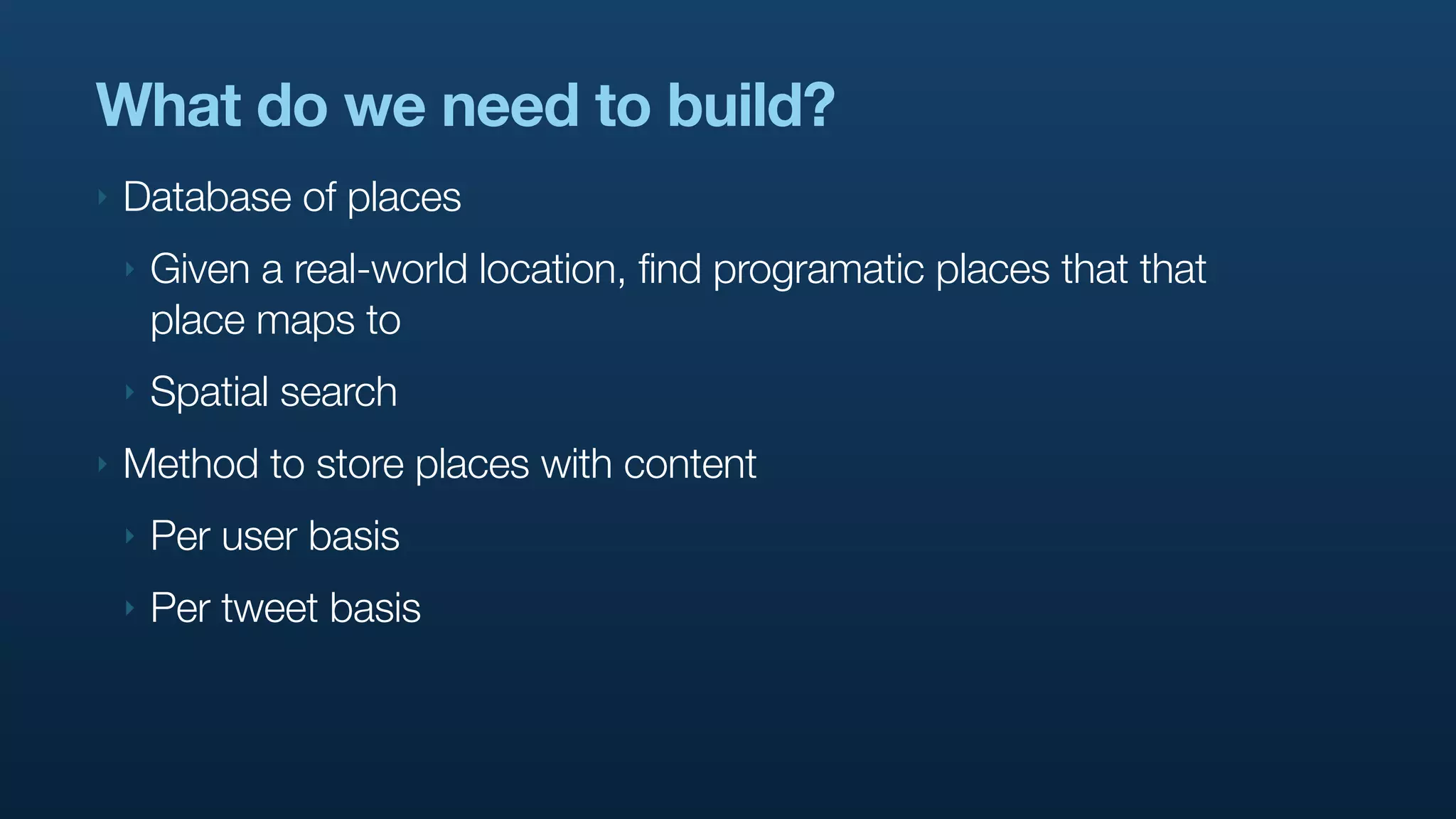
What do we need to build?
‣   Database of places
    ‣   Given a real-world location, find programatic places that that
        place maps to
    ‣   Spatial search
‣   Method to store places with content
    ‣   Per user basis
    ‣   Per tweet basis
Spatial lookup and index
As background... MySQL + GIS
‣   Ability to index points and do a spatial query
    ‣   For example, get points within a bounding rectangle
    ‣   SELECT
        MBRContains(GeomFromText(
        'POLYGON((0 0,0 3,3 3,3 0,0 0))' ), coord)
        FROM geometry
‣   Hard to cache the spatial query
‣   Possibly requires a DB hit on every query
Options
Grid / Quad-tree
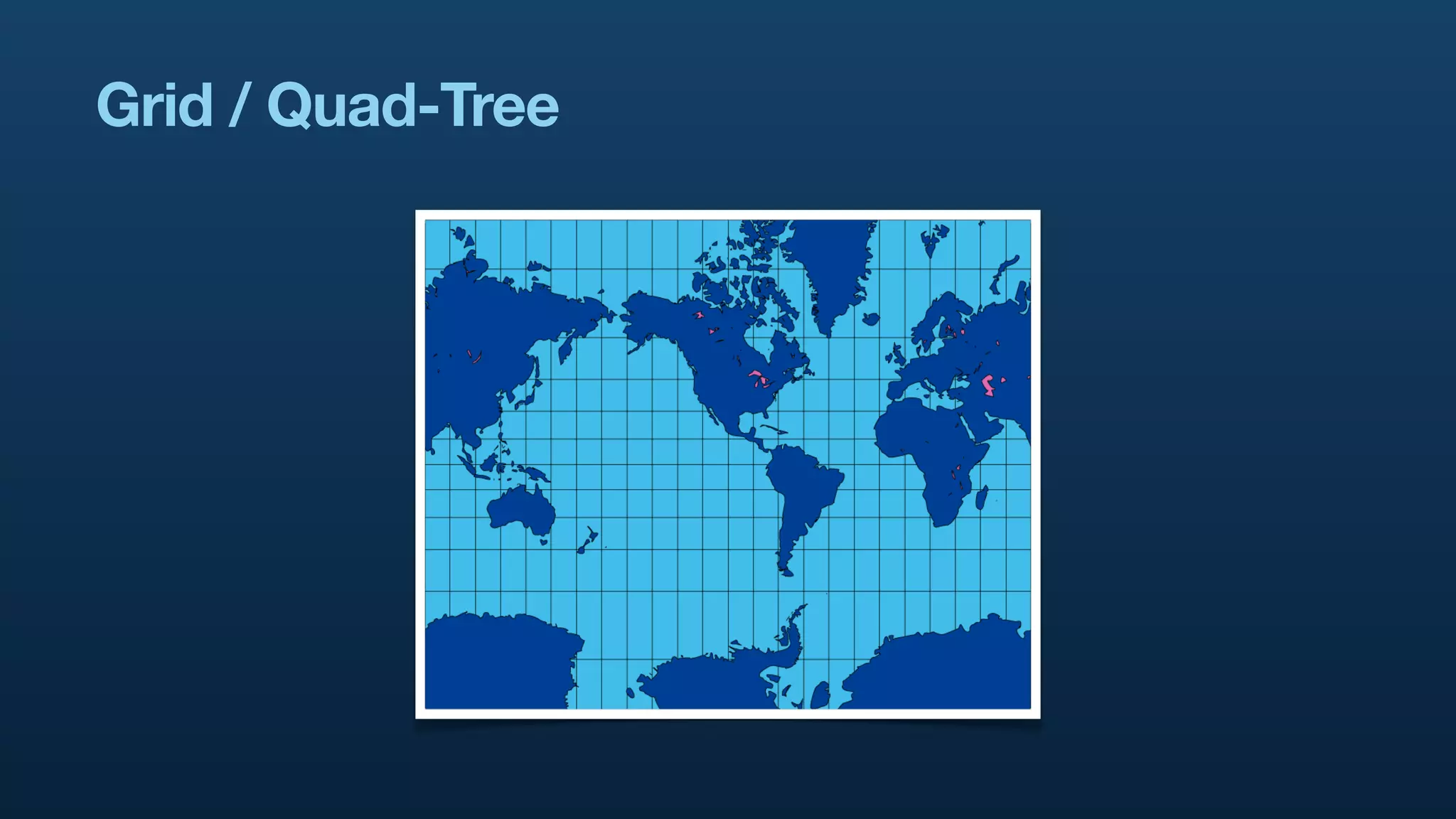
‣   Create a grid (possibly nested) of the entire Earth
Geohash
‣   Arbitrarily precise and hierarchical spatial data reference
Space filling curves
‣   Mapping 2D space into 1D while preserving locality
R-Tree
‣   Spatial access data structure
Grid / Quad-Tree
Grid / Quad-Tree
Grid / Quad-Tree


‣   Recursively subdivide regions
‣   Trie structure to store “prefixes”
‣   Spatially oriented data structure
Geohash
Geohash
‣   37o18’N    121o54’W   = 9q9k4
‣   Hierarchical spatial data structure
‣   Precision encoded
‣   Distance captured
    ‣   Nearby places (usually) share the same prefix
    ‣   The longer the string match, the closer the places are
Geohash
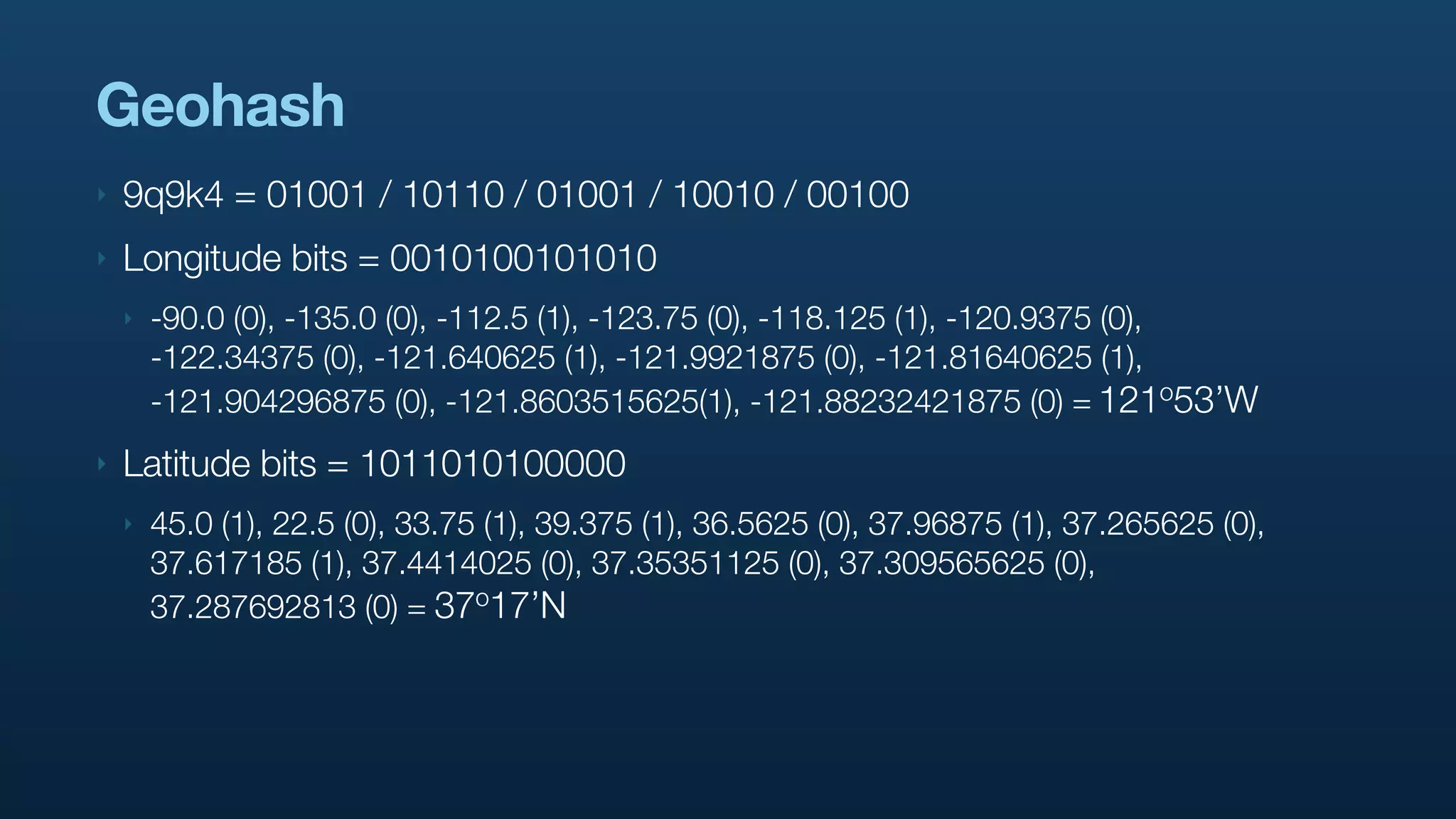
‣   9q9k4 = 01001 / 10110 / 01001 / 10010 / 00100
‣   Longitude bits = 0010100101010
    ‣   -90.0 (0), -135.0 (0), -112.5 (1), -123.75 (0), -118.125 (1), -120.9375 (0),
        -122.34375 (0), -121.640625 (1), -121.9921875 (0), -121.81640625 (1),
        -121.904296875 (0), -121.8603515625(1), -121.88232421875 (0) = 121           o53’W

‣   Latitude bits = 1011010100000
    ‣   45.0 (1), 22.5 (0), 33.75 (1), 39.375 (1), 36.5625 (0), 37.96875 (1), 37.265625 (0),
        37.617185 (1), 37.4414025 (0), 37.35351125 (0), 37.309565625 (0),
        37.287692813 (0) = 37    o17’N
Geohash
‣   Possible to do range query in database
    ‣   Matching based on prefix will return all the points that fit in that
        “grid”
    ‣   Able to store 2D data in a 1D space
Space filling curve
Space filling curve
Space filling curve

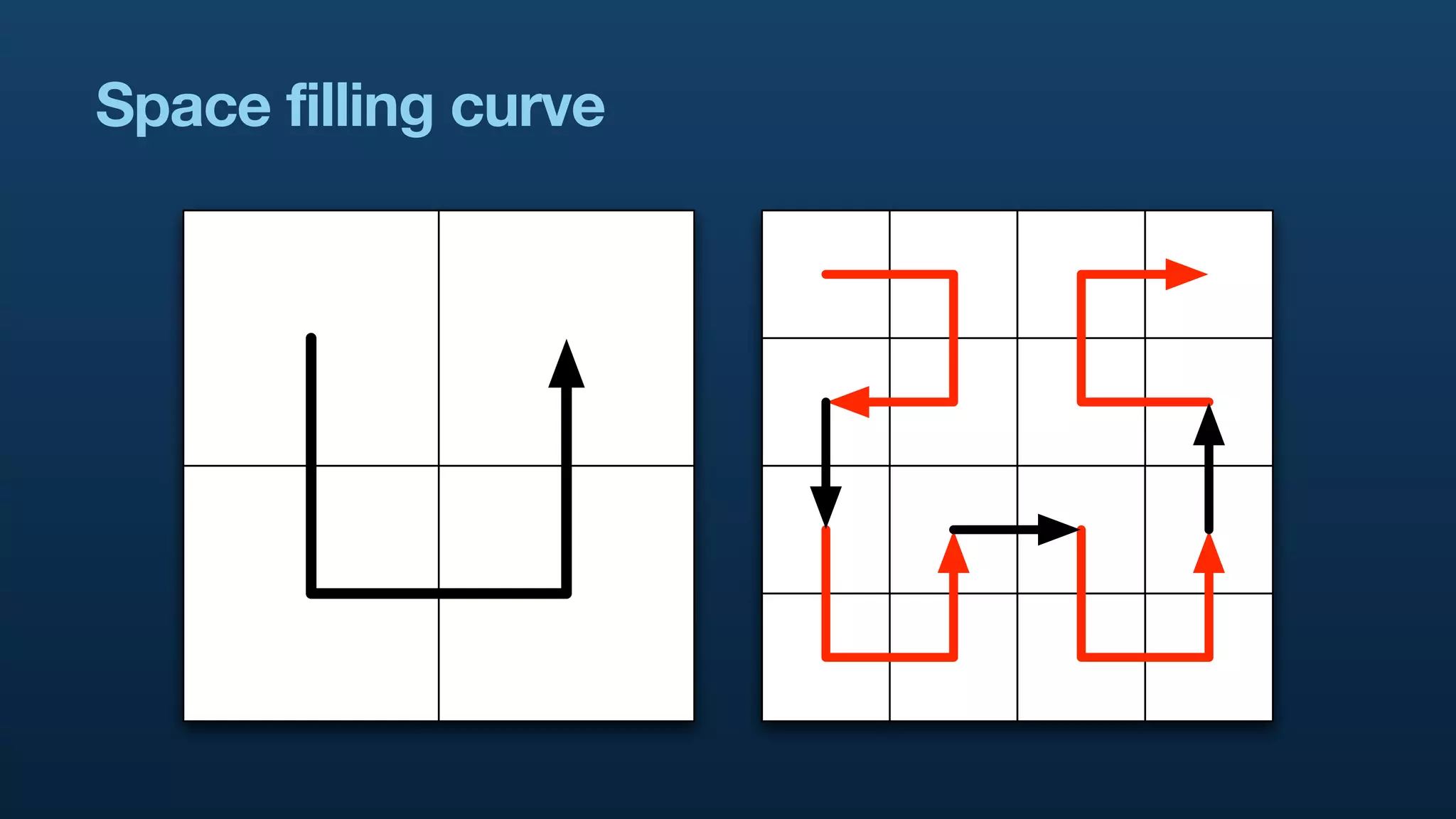
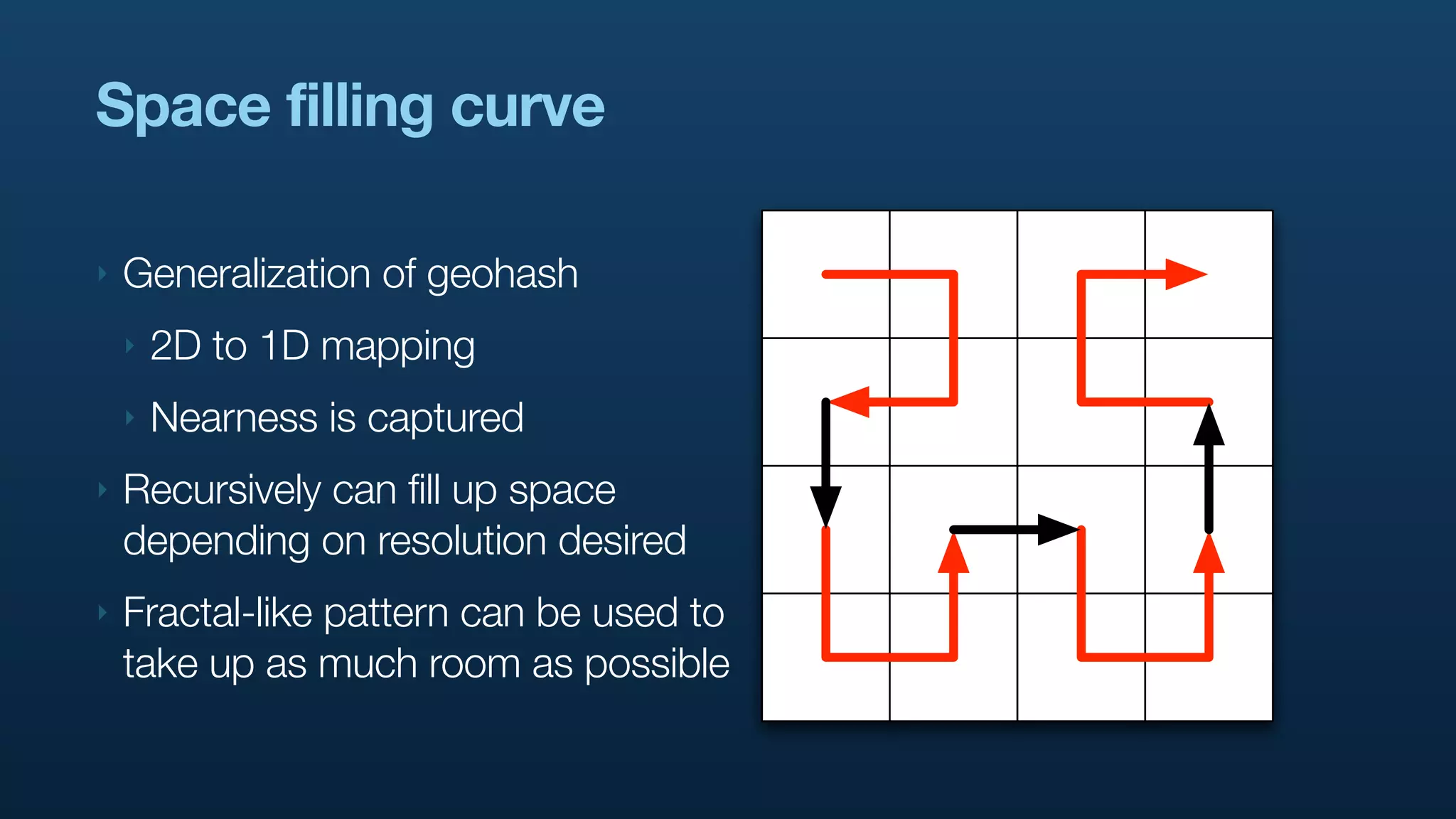
‣   Generalization of geohash
    ‣   2D to 1D mapping
    ‣   Nearness is captured
‣   Recursively can fill up space
    depending on resolution desired
‣   Fractal-like pattern can be used to
    take up as much room as possible
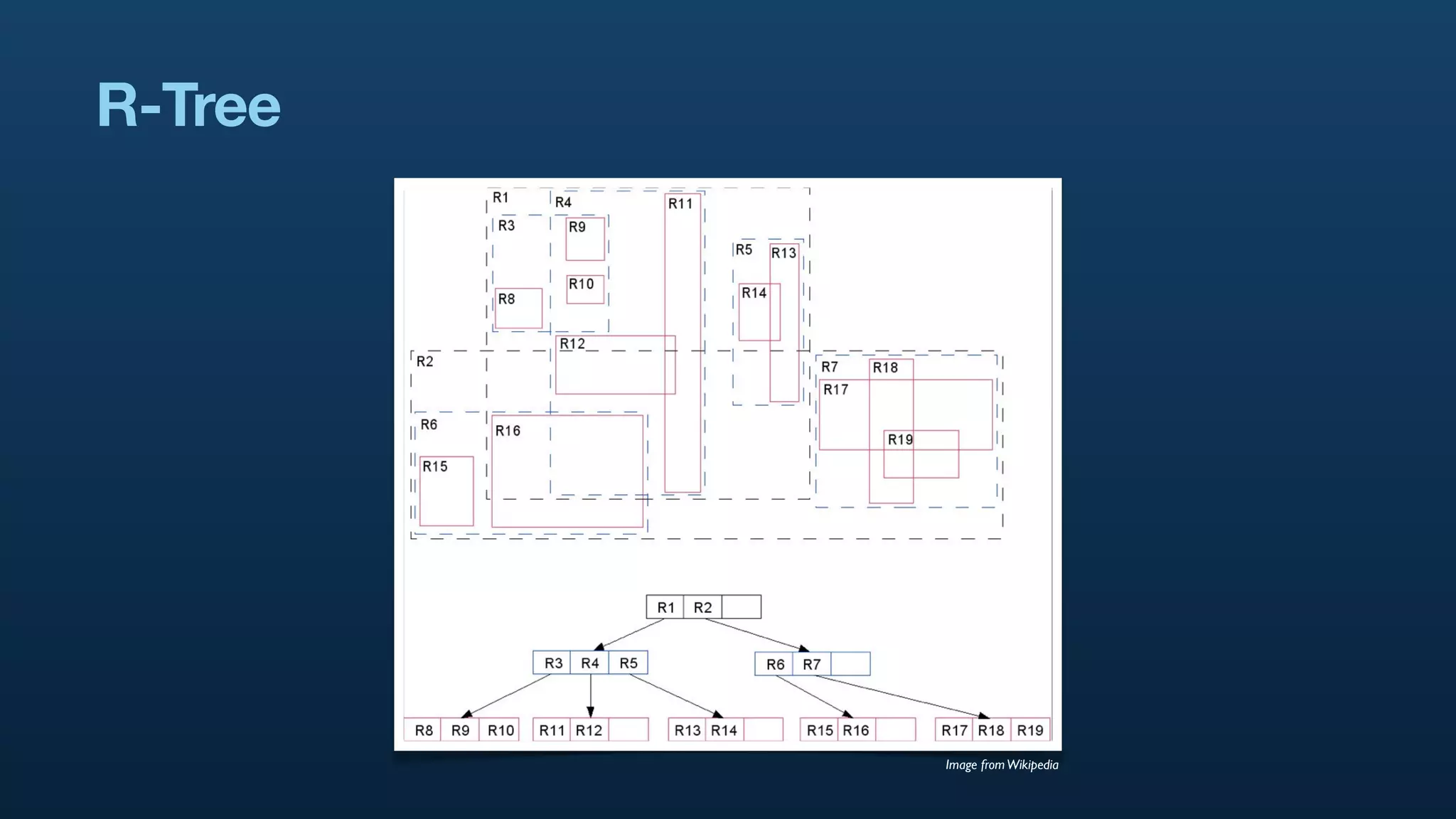
R-Tree
R-Tree


         Image from Wikipedia
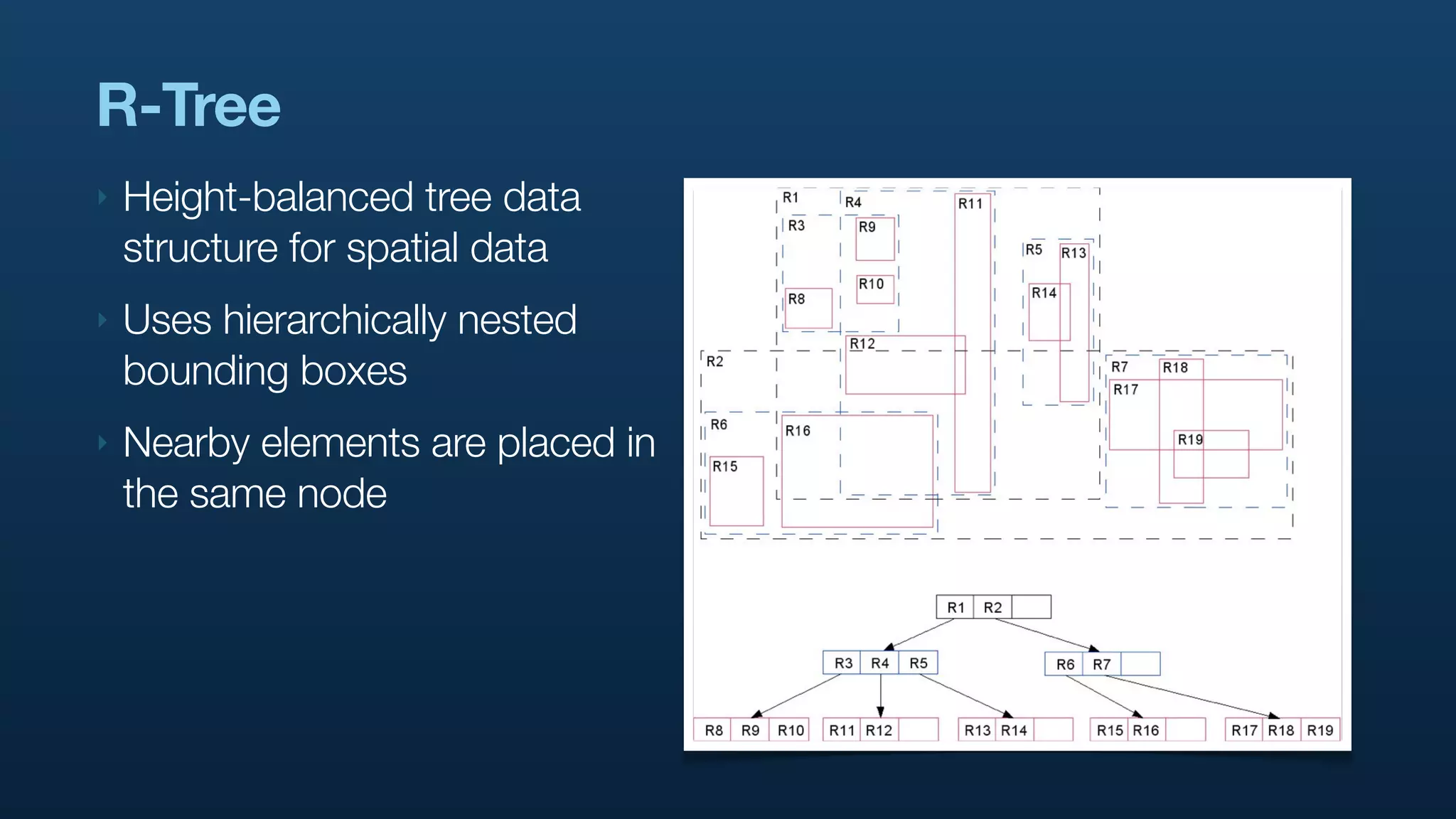
R-Tree
‣   Height-balanced tree data
    structure for spatial data
‣   Uses hierarchically nested
    bounding boxes
‣   Nearby elements are placed in
    the same node
Representations
GeoRSS / GeoJSON
‣   http://www.georss.org/ and http://geojson.org/
‣   <georss:point>37.3 -121.9</georss:point>
‣   {
        “type”:”Point”,
        “coordinates”:[-121.9, 37.3]
    }
How do you store precision?
‣   “Precision” is a hard thing to encode
‣   Accuracy can be encoded with an error radius
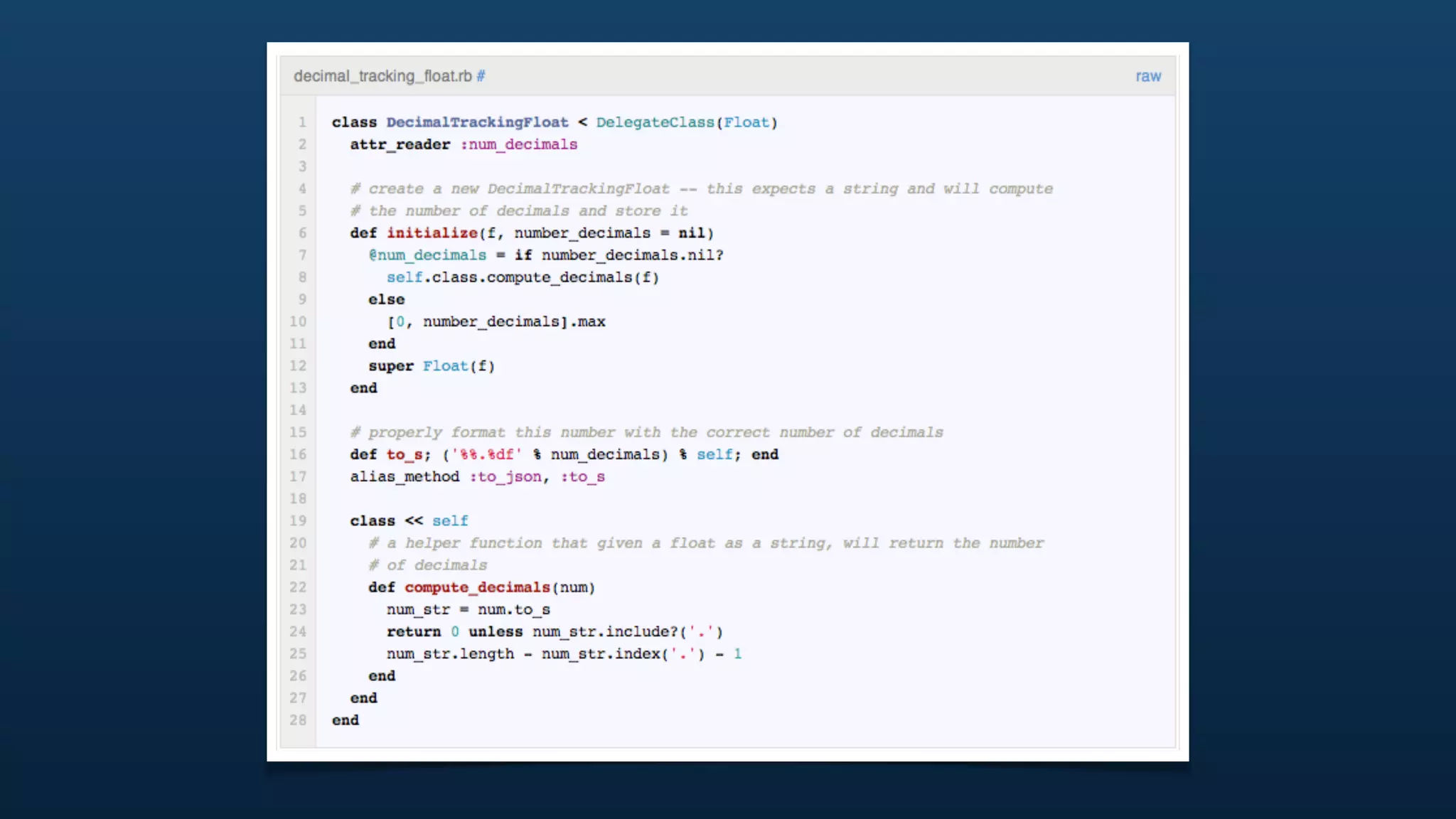
‣   Twitter opts for tracking the number of decimals passed
    ‣   140.0 != 140.00
    ‣   DecimalTrackingFloat
Twitter
Twitter Infrastructure
‣   Ruby on Rails-ish frontend
‣   Scala-based services backend
‣   MySQL and soon to be Cassandra as the store
‣   RPC to back-end or put items into queues
Rock Dove (redux)
Can be used as a homing pigeon
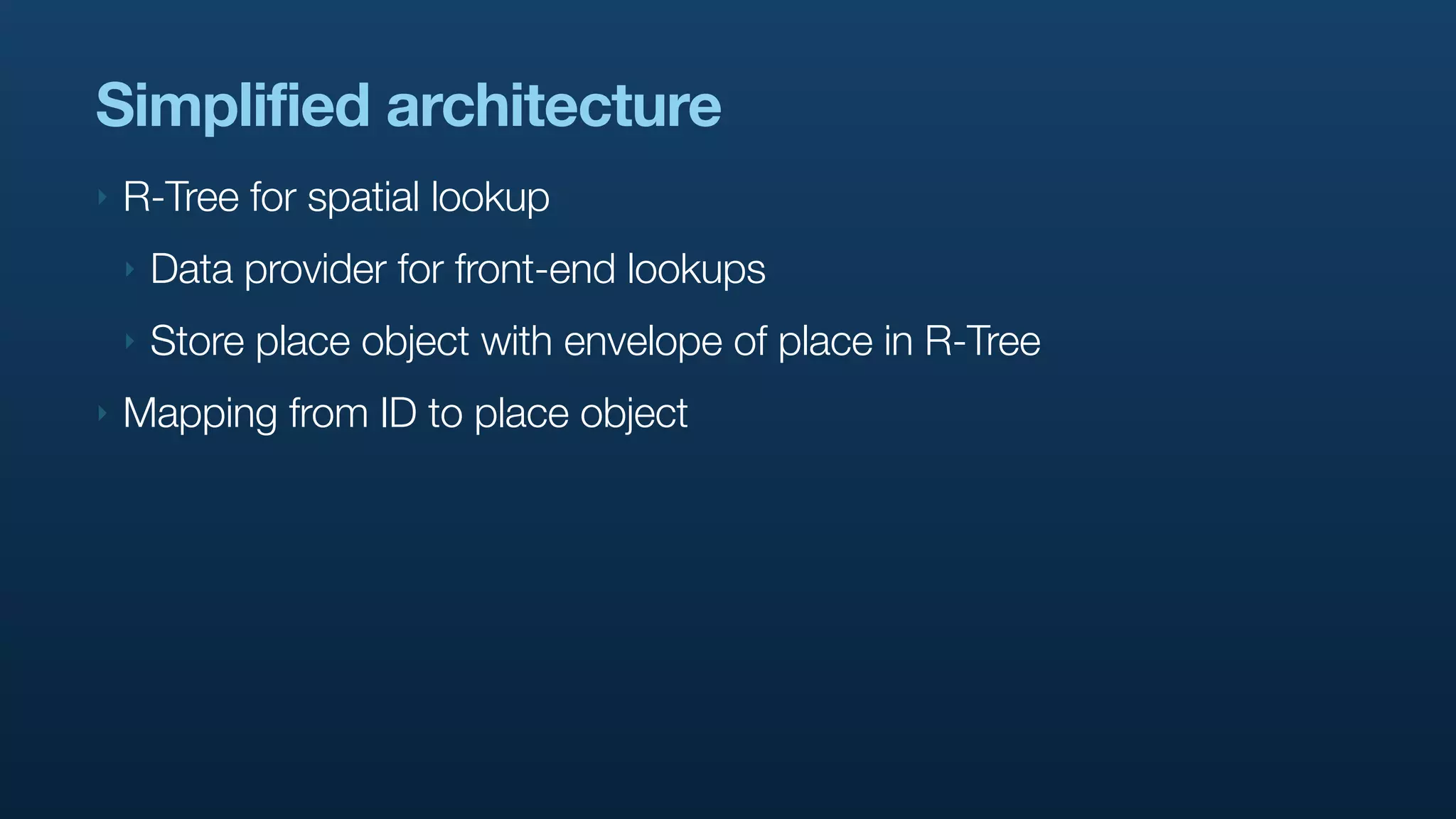
Simplified architecture
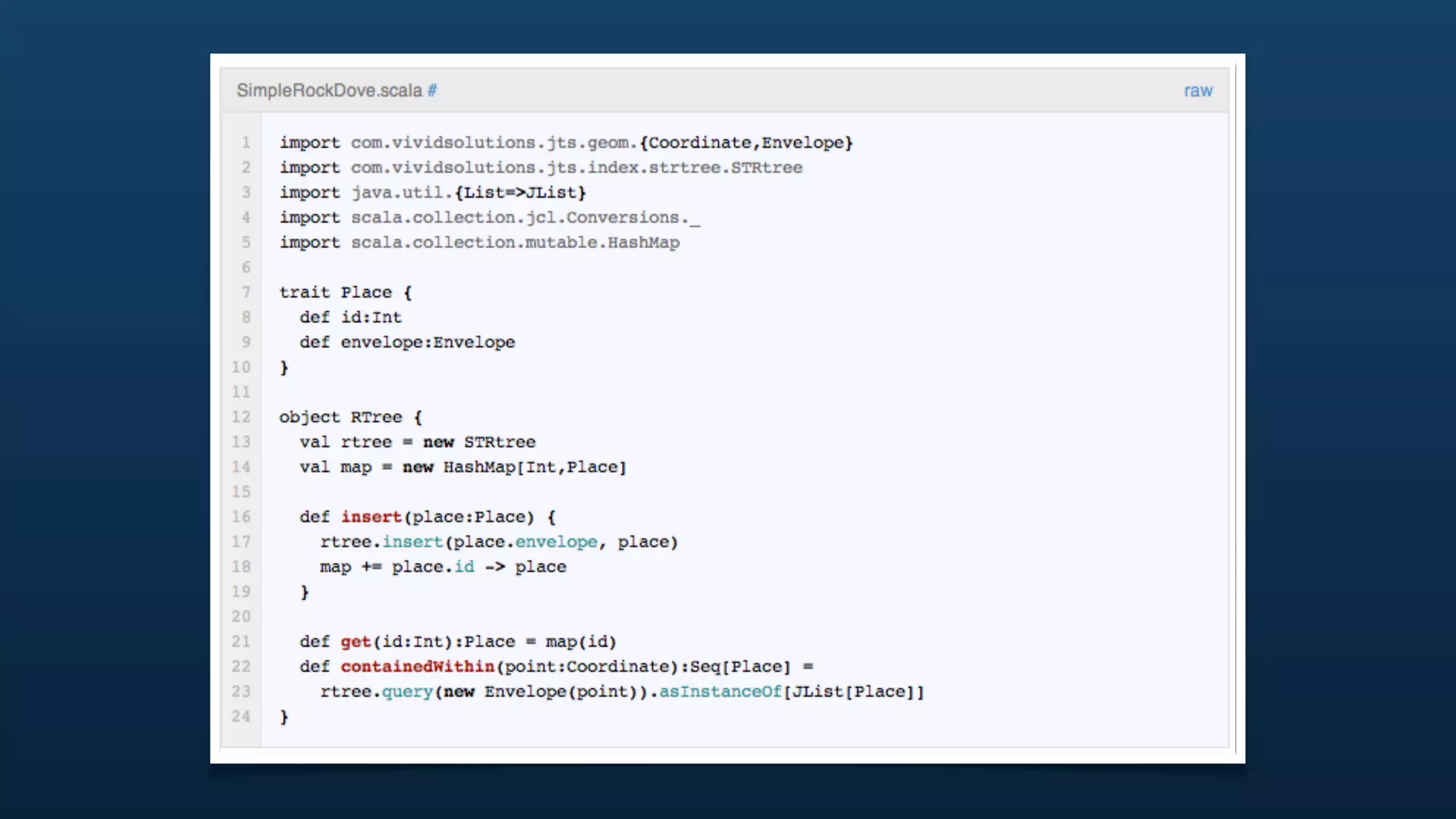
‣   R-Tree for spatial lookup
    ‣   Data provider for front-end lookups
    ‣   Store place object with envelope of place in R-Tree
‣   Mapping from ID to place object
Java Topology Suite (JTS)
‣   http://www.vividsolutions.com/jts/jtshome.htm
‣   Open source
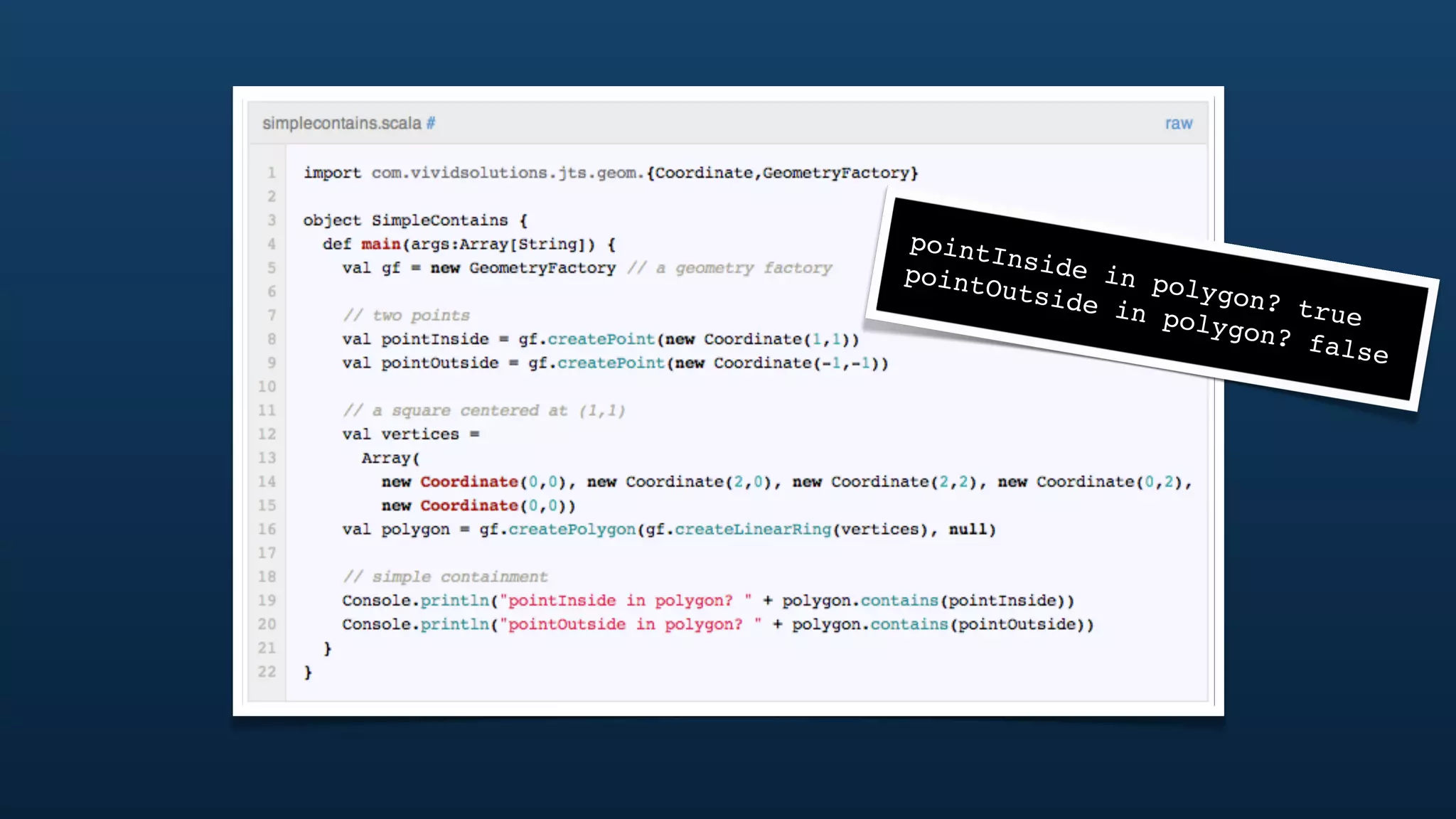
‣   Good for representing and manipulating “geometries”
‣   Has support for fundamental geometric operations
    ‣   contains
    ‣   envelope
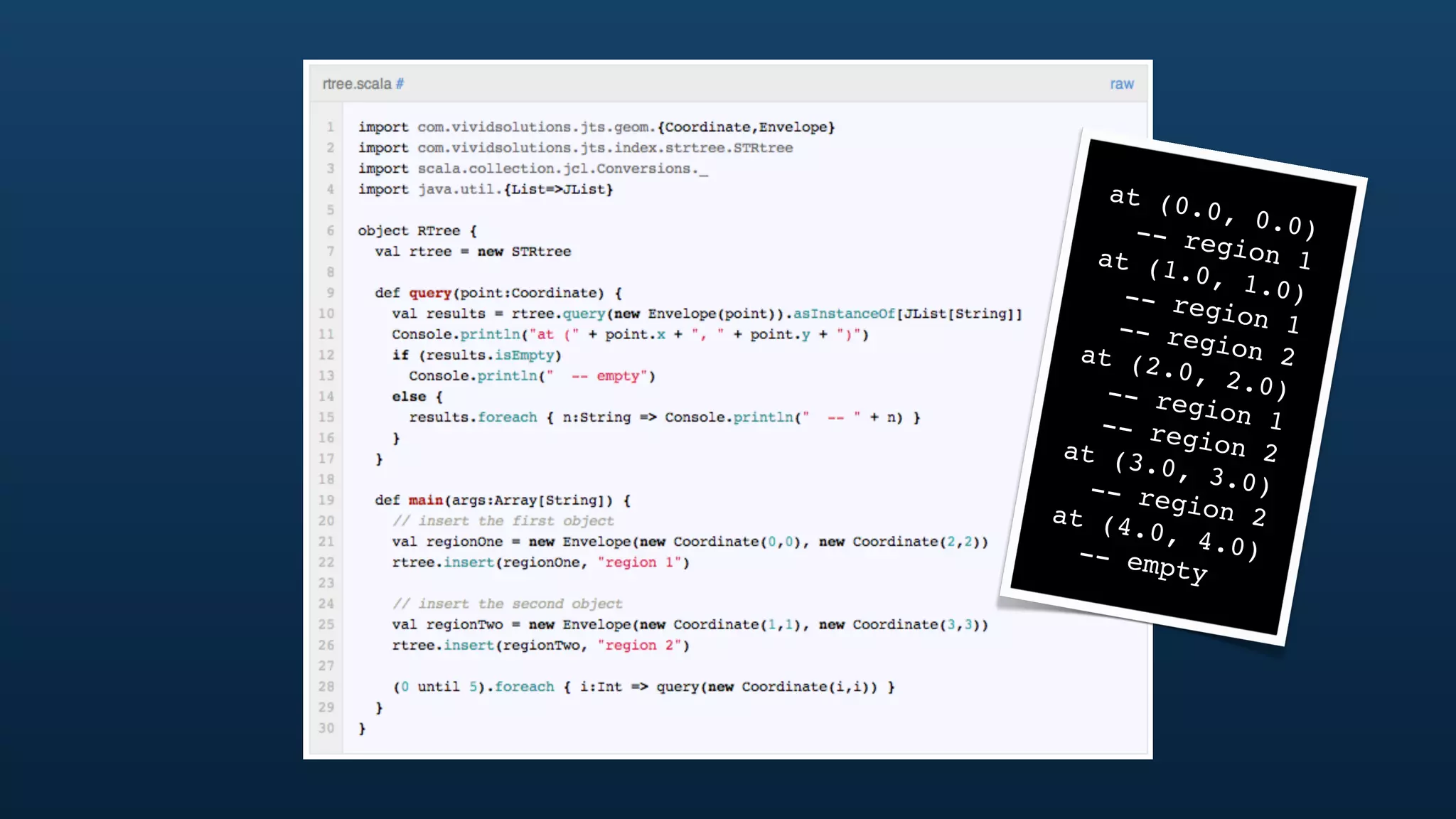
‣   Has a R-Tree implementation
point
      Insid
point       e in
      Outsi       polyg
            de in       on? t
                   polyg      rue
                         on? f
                               alse
at (0
          .0, 0
      -- re      .0)
   at (1    gion
         .0, 1      1
     -- re     .0)
           gion
     -- re         1
  at (2    gion
        .0, 2     2
    -- re     .0)
          gion
    -- re        1
 at (3    gion
       .0, 3    2
   -- re     .0)
at (4    gion
      .0, 4    2
  -- em     .0)
        pty
Java Topology Suite (JTS)
‣   Serializers and deserializers
    ‣   Well-known text (WKT)
    ‣   Well-known binary (WKB)
    ‣   No GeoRSS or GeoJSON support
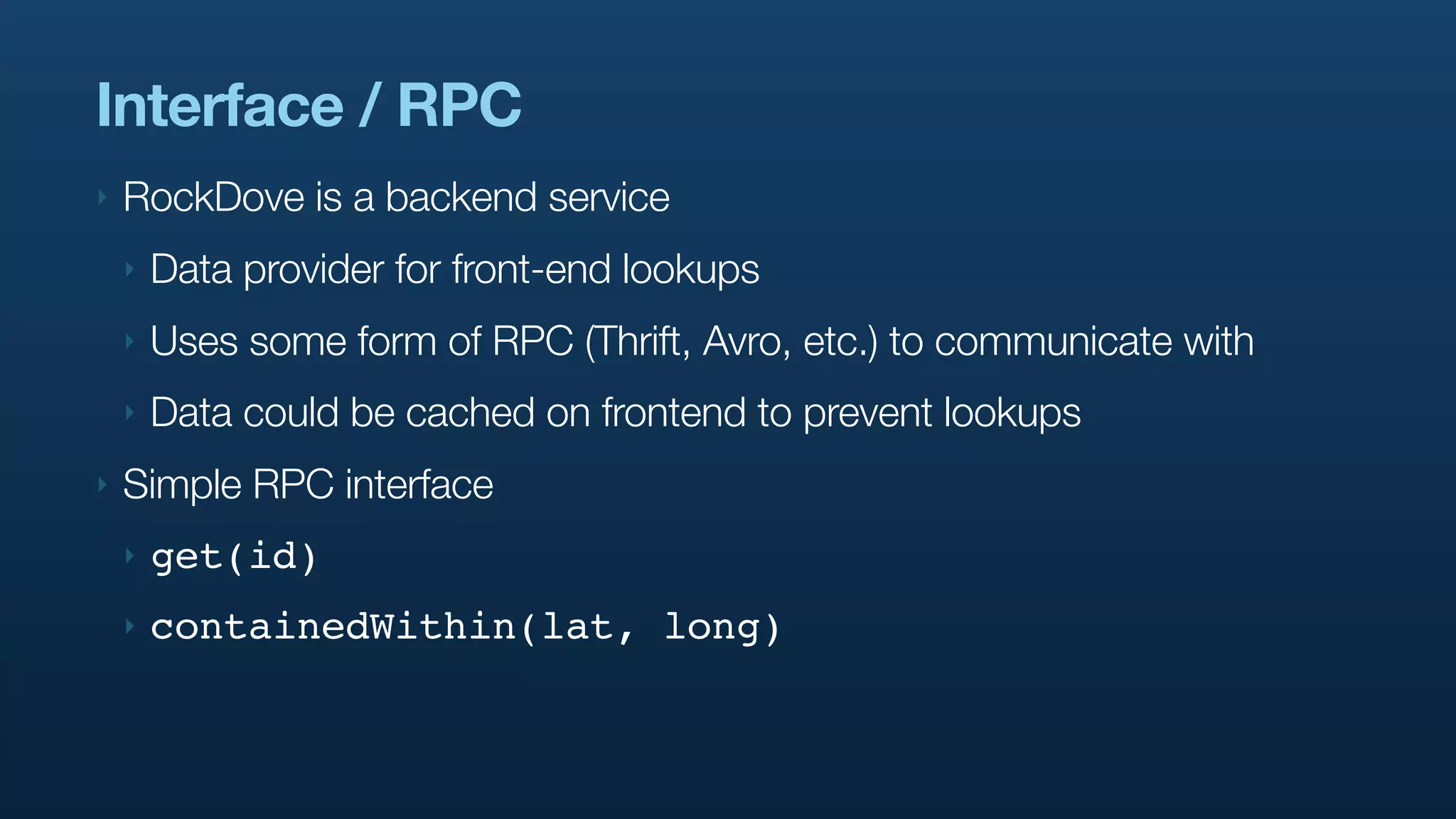
Interface / RPC
‣   RockDove is a backend service
    ‣   Data provider for front-end lookups
    ‣   Uses some form of RPC (Thrift, Avro, etc.) to communicate with
    ‣   Data could be cached on frontend to prevent lookups
‣   Simple RPC interface
    ‣   get(id)
    ‣   containedWithin(lat, long)
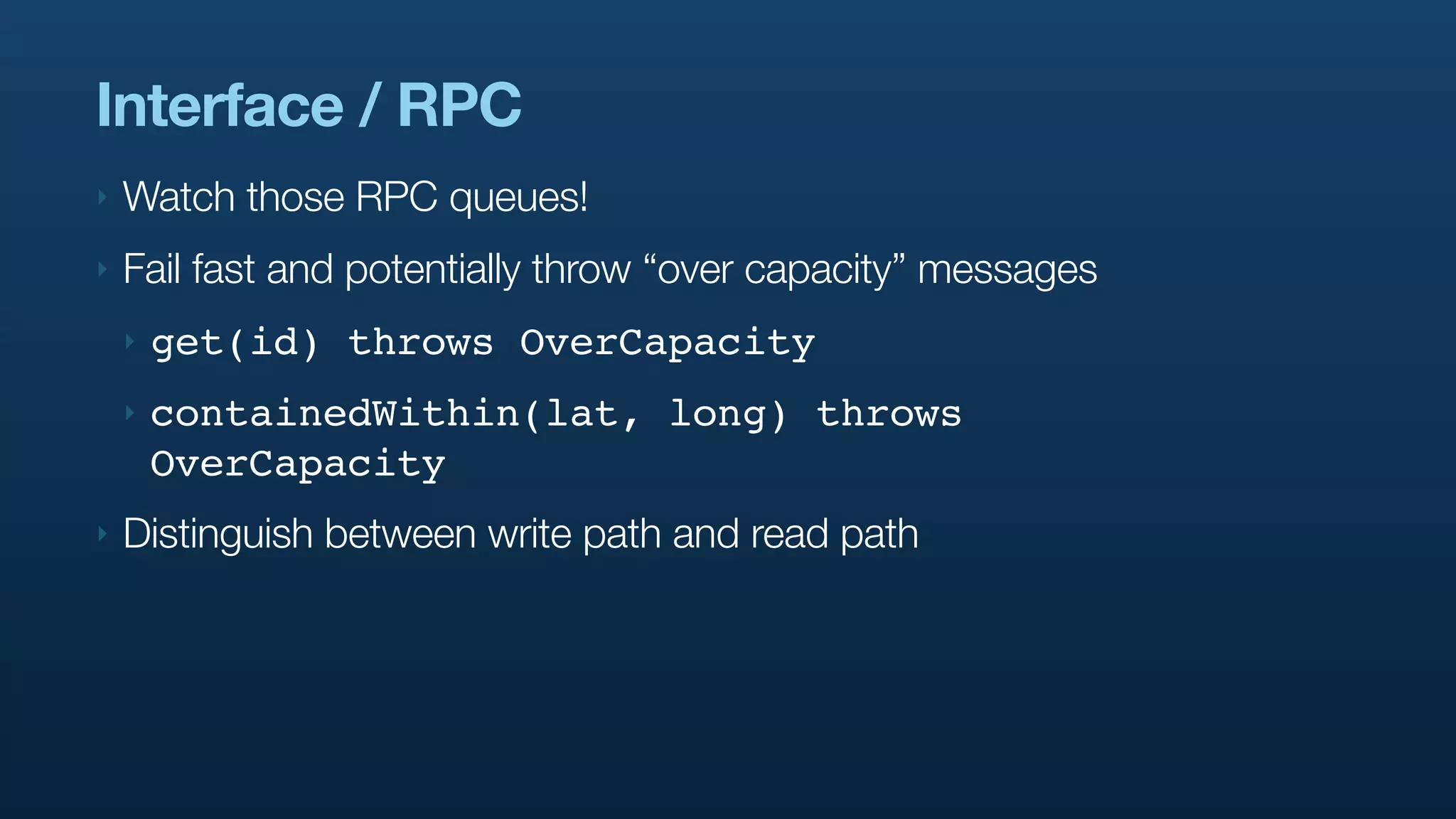
Interface / RPC
‣   Watch those RPC queues!
‣   Fail fast and potentially throw “over capacity” messages
    ‣   get(id) throws OverCapacity
    ‣   containedWithin(lat, long) throws
        OverCapacity
‣   Distinguish between write path and read path
GeoRuby
‣   http://georuby.rubyforge.org/
‣   Open source
‣   OpenGIS Simple Features Interface Standard
‣   Only good for representing geometric entities
‣   GeoRuby::SimpleFeatures::Geometry::from_ewkb
‣   No GeoJSON serializers
Front-end
Bringing geo data to and from the web
Location in Browser
‣   Geolocation API Specification for JavaScript
    navigator.geolocation.getCurrentPosition
‣   Does a callback with a position object
‣   position.coords     has
    ‣   latitude and longitude
    ‣   accuracy
    ‣   other stuff
‣   Support in Firefox 3.5, Chromium, Opera, and others with Google Gears
Hose
Streaming out real-time geo data
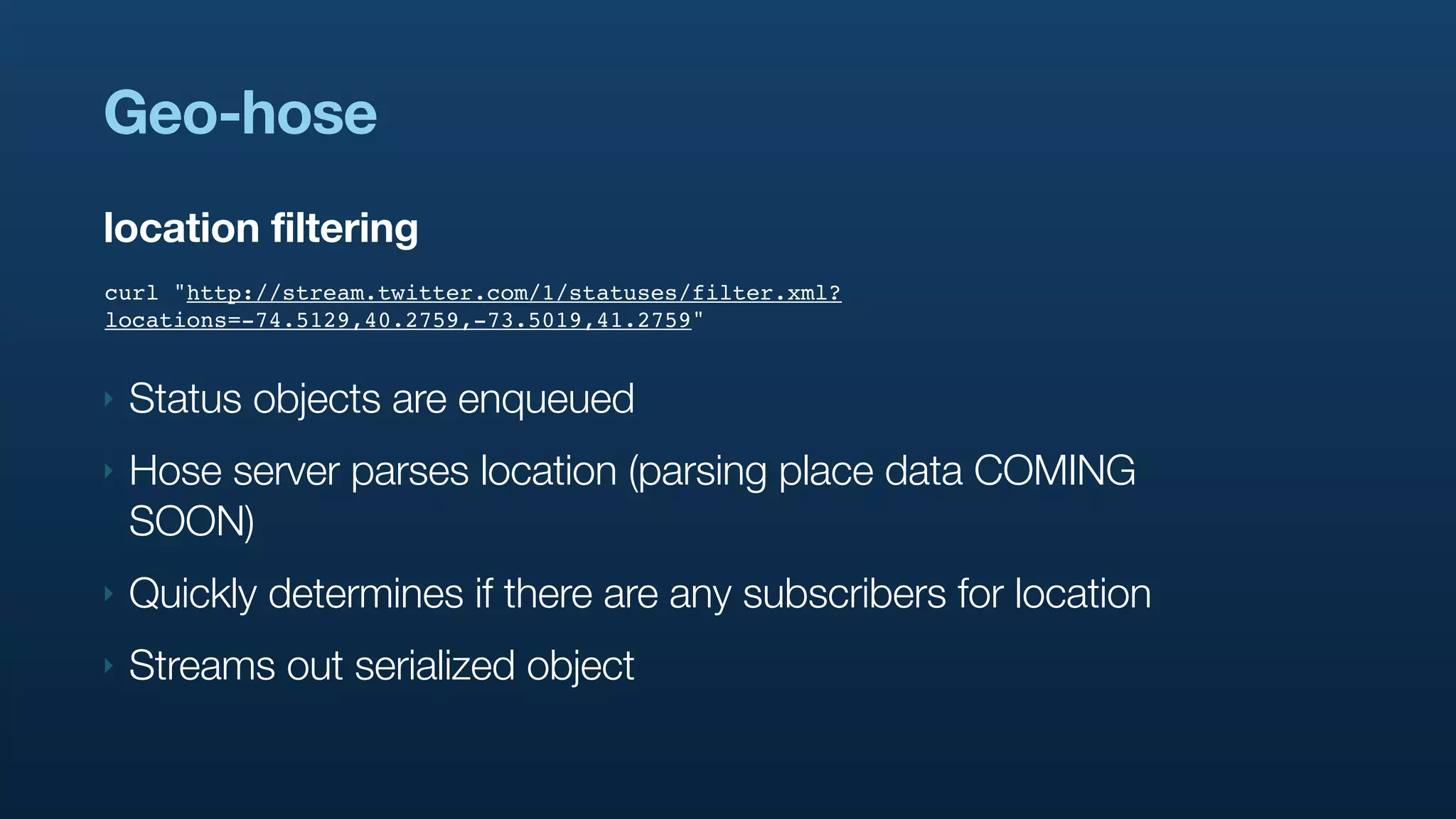
Geo-hose
location filtering
curl "http://stream.twitter.com/1/statuses/filter.xml?
locations=-74.5129,40.2759,-73.5019,41.2759"


‣   Status objects are enqueued
‣   Hose server parses location (parsing place data COMING
    SOON)
‣   Quickly determines if there are any subscribers for location
‣   Streams out serialized object
Thanks also to
‣   Marius Eriksen (@marius)
‣   David Helder (@dhelder)
‣   Marc McBride (@mccv)
‣   John Kalucki (@jkalucki)
Questions?   Follow me at
             twitter.com/raffi


                           TM

Handling Real-time Geostreams

  • 1.
    Handling Real-time Geostreams #rtgeo #where20 O’Reilly Where 2.0 TM March 30, 2010
  • 3.
    Background Wherehoo (2000) ‣ “The Stuff Around You” ‣ “Wherehoo Server: An interactive location service for software agents and intelligent systems” - J.Youll, R.Krikorian ‣ In your /etc/services file BusRadio (2004) ‣ Designed mobile computers to play media while also transmitting telemetry ‣ Looked and sounded like a radio - but really a Linux computer OneHop (2007) ‣ Bluetooth proximity-based social networking
  • 4.
    Table of Contents Background ‣ Why are we interested in this? Twitter’s Geo APIs ‣ How do we allow people to talk about place? Problem statement ‣ What are we trying to have our system do? Infrastructure ‣ How is Twitter solving this problem?
  • 5.
    People want totalk about places
  • 10.
  • 11.
    Original attempts Adding itto the tweet ‣ Use myloc.me, et. al. to add text to the tweet ‣ Localizes mobile phone and puts location “in band” ‣ Takes from 140 characters Setting profile level locations ‣ Set the user/location of a Twitter user ‣ There is an API for that! ‣ Not on a per-tweet basis and not designed for high frequency updates
  • 14.
    curl -u USERNAME:PASSWORD -d location="San Francisco, California" http://twitter.com/account/update_location.xml <user> <id>8285392</id> <name>raffi</name> <screen_name>raffi</screen_name> <location>San Francisco, California</location> ... </user>
  • 15.
  • 16.
    Geotagging API Adding itto the tweet ‣ Per-tweet basis ‣ Out of band / pure meta-data ‣ Does not take from the 140 characters Native Twitter support ‣ Simple way to update status with location data ‣ Ability to remove geotags from your tweets en masse ‣ Using GeoRSS and GeoJSON as the encoding format ‣ Across all Twitter APIs (REST, Search, and Streaming)
  • 17.
    Sending an update status/update curl-u USERNAME:PASSWORD -d "status=hey-ho&lat=37.3&long=-121.9" http://api.twitter.com/1/status/update.xml <status> <text>hey-ho</text> ... <geo xmlns:georss="http://www.georss.org/georss> <georss:point>37.3 -121.9</georss:point> </geo> ... </user>
  • 19.
    Search search (with geocode) curl"http://search.twitter.com/search.atom? geocode=40.757929%2C-73.985506%2C25km&source=foursquare" geocode parameter takes “latitude,longitude,radius” where radius has units of mi or km ... <title>On the way to ace now, so whenever you can make it I'll be there. (@ Port Imperial Ferry in Weehawken) http://4sq.com/2rq0vO</title> ... <twitter:geo> <georss:point>40.7759 -74.0129</georss:point> </twitter:geo> ...
  • 24.
  • 25.
    Geo-hose location filtering curl "http://stream.twitter.com/1/statuses/filter.xml? locations=-74.5129,40.2759,-73.5019,41.2759" locationsis a bounding box specified by “long1,lat1,long2,lat2” and can track up to 10 locations that are most 1 degree square (~60 miles square and enough to cover most metropolitan areas)
  • 26.
  • 28.
    Trends API Global trends ‣ Currently on front page of Twitter.com and on search.twitter.com ‣ Analysis of “hot conversations” ‣ Does not take from the 140 characters Location specific trends ‣ Tweets being localized through a variety of means into trends ‣ Locations exposed over the API as WOEIDs ‣ Can ask for available trends sorted by distance from your location ‣ Querying for a parent of a location will return all locations under it
  • 29.
    Available locations trends/available curl "http://api.twitter.com/1/trends/available.xml" Canoptionally take a lat and long parameter to have trends locations returned, sorted, as distance from you. <locations type=”array”> <location> <woeid>2487956</woeid> <name>San Francisco</name> <placeTypeName code=”7”>Town</placeTypeName> <country type=”Country” code=”US”>United States</country> <url>http://where.yahooapis.com/v1/place/2487956</url> </location> ... </locations>
  • 30.
    Available locations trends/woeid.xml (trends/twid.xmlcoming soon) curl "http://api.twitter.com/1/trends/2487956.xml" Look up the trends at the given WOEID <matching_trends type=”array”> <trends as_of=”2009-12-15T20:19:09Z”> ... <trend url=”http://search.twitter.com/search?q=Golden+Globe+nominations” query=”Golden +Globe+nominations”>Golden Globe nominations</trend> <trend url=”http://search.twitter.com/search?q=%23somethingaintright” query=”%23somethingaintright”>#somethingaintright</trend> ... </trends> </matching_trends>
  • 31.
  • 32.
    Geo-place API Support for“names" ‣ Not just coordinates ‣ More contextually relevant ‣ Positive privacy benefits Increased complexity ‣ Need to be able to look up a list of places ‣ Requires a “reverse geocoder” ‣ Human driven tagging and not possible to be fully automatic
  • 33.
    Finding a place geo/reverse_geocode curlhttp://api.twitter.com/1/geo/reverse_geocode.json&lat=37.3&long=-121.9
  • 34.
    { "result": { "places": [ { "place_type":"neighborhood", "country_code":"US", "contained_within": [...] "full_name":"Willow Glen", "bounding_box": { "type":"Polygon", "coordinates": [[ Put some graphic to explain what goes in the [-121.92481908, 37.275903], [-121.88083608, 37.275903], contained_within [-121.88083608, 37.31548203], [-121.92481908, 37.31548203] ]] }, "name":"Willow Glen", "id":"46bc64ecd1da2a46", "url":"http://api.twitter.com/1/geo/id/46bc64ecd1da2a46.json", "country":"" }, ... ] } }
  • 35.
    Sending an update status/update curl-u USERNAME:PASSWORD -d "status=hey-ho&place_id=46bc64ecd1da2a46" http://api.twitter.com/1/status/update.xml <status> <text>hey-ho</text> ... <place xmlns:georss="http://www.georss.org/georss> <id>46bc64ecd1da2a46</id> <name>Willow Glen</name> <full_name>Willow Glen</full_name> <place_type>neighborhood</place_type> <url>http://api.twitter.com/1/geo/id/46bc64ecd1da2a46.json</url> <country code=”US”>United States</country> </place> ... </user>
  • 37.
    Problem statement What dowe need to build?
  • 38.
    What do weneed to build? ‣ Database of places ‣ Given a real-world location, find programatic places that that place maps to ‣ Spatial search ‣ Method to store places with content ‣ Per user basis ‣ Per tweet basis
  • 39.
  • 40.
    As background... MySQL+ GIS ‣ Ability to index points and do a spatial query ‣ For example, get points within a bounding rectangle ‣ SELECT MBRContains(GeomFromText( 'POLYGON((0 0,0 3,3 3,3 0,0 0))' ), coord) FROM geometry ‣ Hard to cache the spatial query ‣ Possibly requires a DB hit on every query
  • 41.
    Options Grid / Quad-tree ‣ Create a grid (possibly nested) of the entire Earth Geohash ‣ Arbitrarily precise and hierarchical spatial data reference Space filling curves ‣ Mapping 2D space into 1D while preserving locality R-Tree ‣ Spatial access data structure
  • 42.
  • 43.
  • 44.
    Grid / Quad-Tree ‣ Recursively subdivide regions ‣ Trie structure to store “prefixes” ‣ Spatially oriented data structure
  • 45.
  • 46.
    Geohash ‣ 37o18’N 121o54’W = 9q9k4 ‣ Hierarchical spatial data structure ‣ Precision encoded ‣ Distance captured ‣ Nearby places (usually) share the same prefix ‣ The longer the string match, the closer the places are
  • 47.
    Geohash ‣ 9q9k4 = 01001 / 10110 / 01001 / 10010 / 00100 ‣ Longitude bits = 0010100101010 ‣ -90.0 (0), -135.0 (0), -112.5 (1), -123.75 (0), -118.125 (1), -120.9375 (0), -122.34375 (0), -121.640625 (1), -121.9921875 (0), -121.81640625 (1), -121.904296875 (0), -121.8603515625(1), -121.88232421875 (0) = 121 o53’W ‣ Latitude bits = 1011010100000 ‣ 45.0 (1), 22.5 (0), 33.75 (1), 39.375 (1), 36.5625 (0), 37.96875 (1), 37.265625 (0), 37.617185 (1), 37.4414025 (0), 37.35351125 (0), 37.309565625 (0), 37.287692813 (0) = 37 o17’N
  • 48.
    Geohash ‣ Possible to do range query in database ‣ Matching based on prefix will return all the points that fit in that “grid” ‣ Able to store 2D data in a 1D space
  • 49.
  • 50.
  • 51.
    Space filling curve ‣ Generalization of geohash ‣ 2D to 1D mapping ‣ Nearness is captured ‣ Recursively can fill up space depending on resolution desired ‣ Fractal-like pattern can be used to take up as much room as possible
  • 52.
  • 53.
    R-Tree Image from Wikipedia
  • 54.
    R-Tree ‣ Height-balanced tree data structure for spatial data ‣ Uses hierarchically nested bounding boxes ‣ Nearby elements are placed in the same node
  • 55.
  • 56.
    GeoRSS / GeoJSON ‣ http://www.georss.org/ and http://geojson.org/ ‣ <georss:point>37.3 -121.9</georss:point> ‣ { “type”:”Point”, “coordinates”:[-121.9, 37.3] }
  • 57.
    How do youstore precision? ‣ “Precision” is a hard thing to encode ‣ Accuracy can be encoded with an error radius ‣ Twitter opts for tracking the number of decimals passed ‣ 140.0 != 140.00 ‣ DecimalTrackingFloat
  • 59.
  • 60.
    Twitter Infrastructure ‣ Ruby on Rails-ish frontend ‣ Scala-based services backend ‣ MySQL and soon to be Cassandra as the store ‣ RPC to back-end or put items into queues
  • 61.
    Rock Dove (redux) Canbe used as a homing pigeon
  • 63.
    Simplified architecture ‣ R-Tree for spatial lookup ‣ Data provider for front-end lookups ‣ Store place object with envelope of place in R-Tree ‣ Mapping from ID to place object
  • 64.
    Java Topology Suite(JTS) ‣ http://www.vividsolutions.com/jts/jtshome.htm ‣ Open source ‣ Good for representing and manipulating “geometries” ‣ Has support for fundamental geometric operations ‣ contains ‣ envelope ‣ Has a R-Tree implementation
  • 65.
    point Insid point e in Outsi polyg de in on? t polyg rue on? f alse
  • 66.
    at (0 .0, 0 -- re .0) at (1 gion .0, 1 1 -- re .0) gion -- re 1 at (2 gion .0, 2 2 -- re .0) gion -- re 1 at (3 gion .0, 3 2 -- re .0) at (4 gion .0, 4 2 -- em .0) pty
  • 67.
    Java Topology Suite(JTS) ‣ Serializers and deserializers ‣ Well-known text (WKT) ‣ Well-known binary (WKB) ‣ No GeoRSS or GeoJSON support
  • 68.
    Interface / RPC ‣ RockDove is a backend service ‣ Data provider for front-end lookups ‣ Uses some form of RPC (Thrift, Avro, etc.) to communicate with ‣ Data could be cached on frontend to prevent lookups ‣ Simple RPC interface ‣ get(id) ‣ containedWithin(lat, long)
  • 70.
    Interface / RPC ‣ Watch those RPC queues! ‣ Fail fast and potentially throw “over capacity” messages ‣ get(id) throws OverCapacity ‣ containedWithin(lat, long) throws OverCapacity ‣ Distinguish between write path and read path
  • 71.
    GeoRuby ‣ http://georuby.rubyforge.org/ ‣ Open source ‣ OpenGIS Simple Features Interface Standard ‣ Only good for representing geometric entities ‣ GeoRuby::SimpleFeatures::Geometry::from_ewkb ‣ No GeoJSON serializers
  • 73.
    Front-end Bringing geo datato and from the web
  • 74.
    Location in Browser ‣ Geolocation API Specification for JavaScript navigator.geolocation.getCurrentPosition ‣ Does a callback with a position object ‣ position.coords has ‣ latitude and longitude ‣ accuracy ‣ other stuff ‣ Support in Firefox 3.5, Chromium, Opera, and others with Google Gears
  • 77.
  • 78.
    Geo-hose location filtering curl "http://stream.twitter.com/1/statuses/filter.xml? locations=-74.5129,40.2759,-73.5019,41.2759" ‣ Status objects are enqueued ‣ Hose server parses location (parsing place data COMING SOON) ‣ Quickly determines if there are any subscribers for location ‣ Streams out serialized object
  • 79.
    Thanks also to ‣ Marius Eriksen (@marius) ‣ David Helder (@dhelder) ‣ Marc McBride (@mccv) ‣ John Kalucki (@jkalucki)
  • 80.
    Questions? Follow me at twitter.com/raffi TM