9EE306.79 1
DEPARTMENT OFTECHNICAL EDUCATION
ANDHRA PRADESH
NAME : P.KRISHNA
Designation : Lecturer
Branch : ECE
Institute : Govt.Polytechnic, Srikakulam.
Year/Semester : III Semester
Subject : Electronics Engg
Subject code : EE 306 Topic : Oscillators
Duration : 50 Minutes
Sub Topic : Relaxation oscillator Teaching Aids : PPT,
Scans, Animations
2.
9EE306.79 2
Recap
In thelast class, we have learnt
• Crystal oscillator
• Working of Crystal oscillator
• Expression for the frequency of oscillations
• Advantages, disadvantages and applications
3.
9EE306.79 3
Objectives
Objectives
Upon thecompletion of this topic the student will
be able to understand
• Relaxation oscillator
• Working of Relaxation oscillator
• Expression for the frequency of oscillations
• Applications
9EE306.79 8
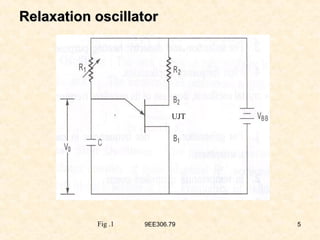
• R
R1
1and R
and R2
2 are resistors
are resistors
• C is capacitor
C is capacitor
• UJT is
UJT is Uni-junction transistor
• V
VBB
BB is Power supply
is Power supply
Components
9.
9EE306.79 9
Circuit analysis
Circuitanalysis
• It is a non-sinusoidal oscillator
• UJT exhibits negative resistance characteristics
• Due to this, it can be used as a relaxation oscillator
• R1 is a variable resistor, which controls the time constant
R1C.
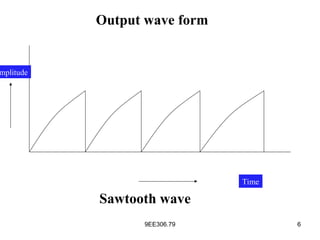
• The discharging of capacitor C through UJT develops saw-tooth
wave form
10.
9EE306.79 10
Circuit operation
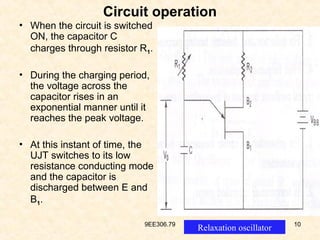
•When the circuit is switched
ON, the capacitor C
charges through resistor R1.
• During the charging period,
the voltage across the
capacitor rises in an
exponential manner until it
reaches the peak voltage.
• At this instant of time, the
UJT switches to its low
resistance conducting mode
and the capacitor is
discharged between E and
B1.
Relaxation oscillator
11.
9EE306.79 11
Operation
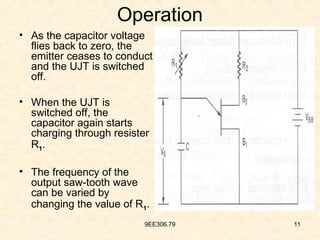
• Asthe capacitor voltage
flies back to zero, the
emitter ceases to conduct
and the UJT is switched
off.
• When the UJT is
switched off, the
capacitor again starts
charging through resister
R1.
• The frequency of the
output saw-tooth wave
can be varied by
changing the value of R1.
12.
9EE306.79 12
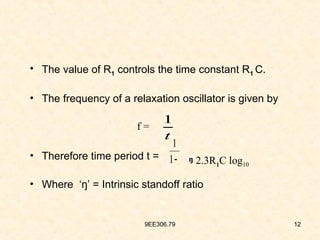
• Thevalue of R1 controls the time constant R1 C.
• The frequency of a relaxation oscillator is given by
• Therefore time period t =
• Where ‘ŋ’ = Intrinsic standoff ratio
t
1
f =
2.3R1C log10
1
1
ŋ
9EE306.79 14
Summary
Summary
We havediscussed about
• Circuit diagram
• Working of Relaxation oscillator
• Frequency of oscillations
• Applications
15.
9EE306.79 15
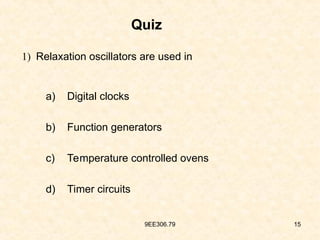
Quiz
1) Relaxationoscillators are used in
a) Digital clocks
b) Function generators
c) Temperature controlled ovens
d) Timer circuits
16.
9EE306.79 16
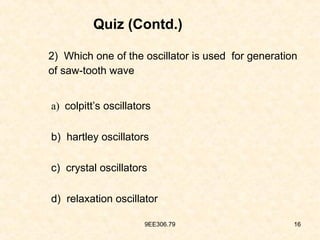
Quiz (Contd.)
2)Which one of the oscillator is used for generation
of saw-tooth wave
a) colpitt’s oscillators
b) hartley oscillators
c) crystal oscillators
d) relaxation oscillator
17.
9EE306.79 17
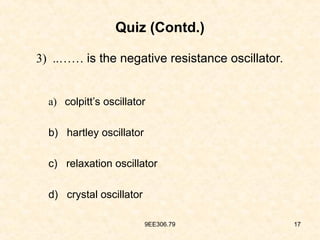
Quiz (Contd.)
3)..…… is the negative resistance oscillator.
a) colpitt’s oscillator
b) hartley oscillator
c) relaxation oscillator
d) crystal oscillator
18.
9EE306.79 18
Frequently AskedQuestions
• Draw and explain the working of Relaxation oscillator ?
• List the applications of Relaxation oscillators ?