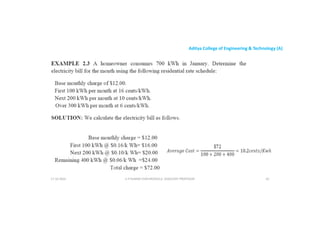
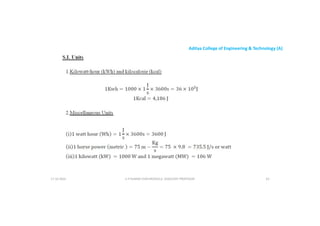
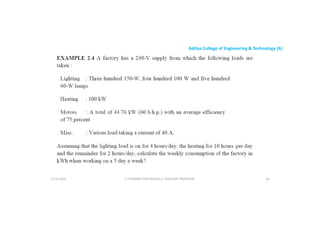
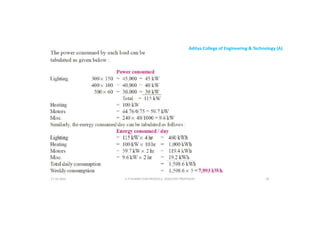
Aditya College of Engineering & Technology (A)
BEEE
By
U P KUMAR CHATURVEDULA
Associate Professor
BEEE
Course Code: 231ES1T01
Associate Professor
Aditya College of Engineering Technology (A)
Surampalem.
.
U P KUMAR CHATURVEDULA ASSOCIATE PROFESSOR 1
17-10-2024
Aditya College of Engineering & Technology (A)
UNIT III: Energy Resources, Electricity Bill & Safety Measures
Energy Resources: Conventional and non-conventional energy resources; Layout and
operation of various Power Generation systems: Hydel, Nuclear, Solar & Wind power
generation.
Electricity bill: Power rating of household appliances including air conditioners, PCs,
Laptops, Printers, etc. Definition of “unit” used for consumption of electrical energy
Equipment Safety Measures: Working principle of Fuse and Miniature circuit breaker
(MCB), merits and demerits. Personal safety measures: Electric Shock, Earthing and its
types, Safety Precautions to avoid shock.
U P KUMAR CHATURVEDULA ASSOCIATE PROFESSOR 2
17-10-2024
Aditya College of Engineering & Technology (A)
SOURCES of POWER GENERATION
• Nonconventional energy (or) renewable energy sources are energy sources that are
continuously produced in nature and are limitless.
• Non-Conventional (Renewable) Energy Sources
Non-Conventional (Renewable) Energy Sources
1. Hydro
2. Solar
3. Wind
4. Tidal
5. Wave
6. Ocean Thermal Energy Conversion
7. Bio-Mass
U P KUMAR CHATURVEDULA ASSOCIATE PROFESSOR 3
17-10-2024
Aditya College of Engineering & Technology (A)
• Conventional sources of energy are the ones that are commonly used, and
generally non-renewable sources of energy, which are being used since a long
time.
• Conventional Energy Sources (Thermal)
1. Coal
2. Gas
3. Oil
4. Nuclear
U P KUMAR CHATURVEDULA ASSOCIATE PROFESSOR 4
17-10-2024
Aditya College of Engineering & Technology (A)
U P KUMAR CHATURVEDULA ASSOCIATE PROFESSOR 5
17-10-2024
Aditya College of Engineering & Technology (A)
Nuclear Power Generation
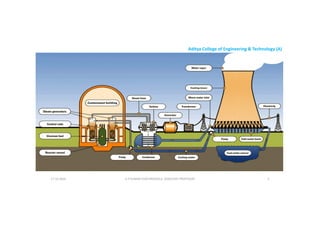
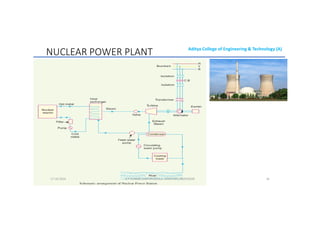
A nuclear power plant is a thermal power station in which the
heat energy is converted into electrical energy. (generating
electricity by using nuclear reactions)
Working: In all thermal power plants the heat is used to
generate steam which drives a steam turbine connected to
a generator which produces electricity.
U P KUMAR CHATURVEDULA ASSOCIATE PROFESSOR 6
17-10-2024
Aditya College of Engineering & Technology (A)
Nuclear fuel
• 1 kg of Uranium U235 can produce as much energy as the
burning of 4500 tonnes of high grade variety of coal or 2000
tonnes of oil.
•
• Construction: The major parts in nuclear power plants are
• nuclear reactor,
• heat exchanger,
• turbine,
• alternator,
• condenser,
• cooling towers,
• control rods and water source
U P KUMAR CHATURVEDULA ASSOCIATE PROFESSOR 7
17-10-2024
Aditya College of Engineering & Technology (A)
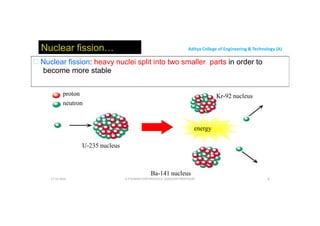
Nuclear fission…
 Nuclear fission: heavy nuclei split into two smaller parts in order to
become more stable
proton
neutron
Kr-92 nucleus
energy
U P KUMAR CHATURVEDULA ASSOCIATE PROFESSOR 8
U-235 nucleus
Ba-141 nucleus
17-10-2024
Aditya College of Engineering & Technology (A)
Nuclear Fission…
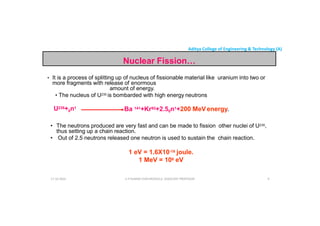
• It is a process of splitting up of nucleus of fissionable material like uranium into two or
more fragments with release of enormous
amount of energy.
amount of energy.
• The nucleus of U235 is bombarded with high energy neutrons
U235+0n1
Ba 141+Kr92+2.50n1+200 MeV energy.
• The neutrons produced are very fast and can be made to fission other nuclei of U235,
thus setting up a chain reaction.
• Out of 2.5 neutrons released one neutron is used to sustain the chain reaction.
U P KUMAR CHATURVEDULA ASSOCIATE PROFESSOR 9
• Out of 2.5 neutrons released one neutron is used to sustain the chain reaction.
1 eV = 1.6X10⁻¹⁹ joule.
1 MeV = 106 eV
17-10-2024
Aditya College of Engineering & Technology (A)
Nuclear (Atomic) Power Plant…
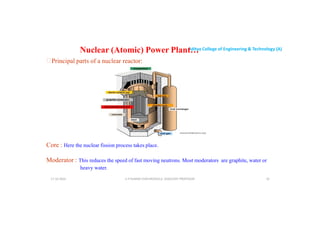
Principal parts of a nuclear reactor:
U P KUMAR CHATURVEDULA ASSOCIATE PROFESSOR 10
Core : Here the nuclear fission process takes place.
Moderator : This reduces the speed of fast moving neutrons. Most moderators are graphite, water or
heavy water.
17-10-2024
Aditya College of Engineering & Technology (A)
Nuclear (Atomic) Power Plant…
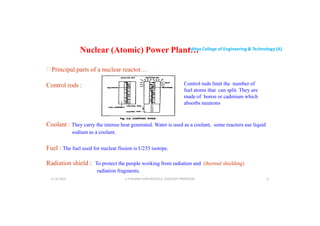
Principal parts of a nuclear reactor…
Control rods : Control rods limit the number of
fuel atoms that can split. They are
Coolant : They carry the intense heat generated. Water is used as a coolant, some reactors use liquid
sodium as a coolant.
fuel atoms that can split. They are
made of boron or cadmium which
absorbs neutrons
U P KUMAR CHATURVEDULA ASSOCIATE PROFESSOR 11
Fuel : The fuel used for nuclear fission is U235 isotope.
Radiation shield : To protect the people working from radiation and (thermal shielding)
radiation fragments.
17-10-2024
Aditya College of Engineering & Technology (A)
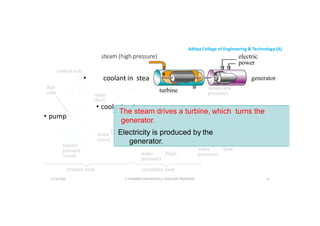
control rods
electric
power
turbine steam (low pressure)
steam (high pressure)
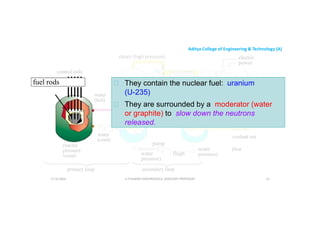
fuel rods  They contain the nuclear fuel: uranium
(U-235)
water
(cool)
water
(hot)
coolant out
turbine steam (low pressure)
steam coolant in
generator steam condenser
(U-235)
 They are surrounded by a moderator (water
or graphite) to slow down the neutrons
released.
reactor
pressure
vessel
water
(cool)
(high
(low
water
pressure)
coolant out
U P KUMAR CHATURVEDULA ASSOCIATE PROFESSOR 12
pump
water
pressure)
primary loop secondary loop
17-10-2024
Aditya College of Engineering & Technology (A)
control rods steam (high pressure) electric power
turbine steam (low
r pressure)
fuel
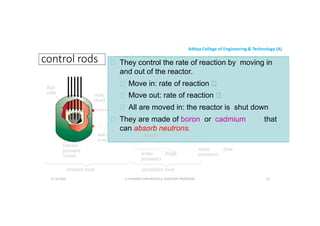
 They control the rate of reaction by moving in
and out of the reactor.
 Move in: rate of reaction 
wat
(coo
wate
(hot)
r pressure)
steam coolant in
generator steam condenser
er coolant out
l)
fuel
rods
 Move out: rate of reaction 
 All are moved in: the reactor is shut down
 They are made of boron or cadmium that
can absorb neutrons.
pump
U P KUMAR CHATURVEDULA ASSOCIATE PROFESSOR 13
reactor
pressure
vessel
wat
(coo
water (low
pressure)
l)
water (high
pressure)
secondary loop
primary loop
pump
17-10-2024
Aditya College of Engineering & Technology (A)
control rods
steam (high pressure)
• coolant in steam condenser
fuel steam (low
turbine
electric
power
generator
steam
generator
• coolant out
• pump
fuel
rods
generator.
water
(hot)
 The steam drives a turbine, which turns the
generator.
water  Electricity is produced by the
(cool)
steam (low
pressure)
turbine
reactor
pressure
vessel
water (low
pressure)
U P KUMAR CHATURVEDULA ASSOCIATE PROFESSOR 14
water (high
pressure)
secondary loop
primary loop
generator.
(cool)
17-10-2024
Aditya College of Engineering & Technology (A)
control rods
fuel
rods water
steam (low
pressure)
turbine
electric
power
steam (high pressure)
rods
water
(cool)
water
(hot)
coolant out
coolant in
steam condenser
pressure)
steam
generator
pump
reactor
pressure
vessel
(cool)
water (low
pressure)
U P KUMAR CHATURVEDULA ASSOCIATE PROFESSOR 15
pump
water (high
pressure)
primary loop secondary loop
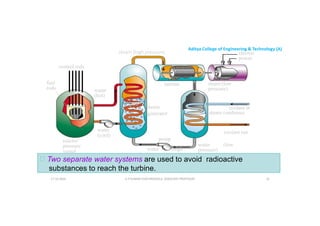
 Two separate water systems are used to avoid radioactive
substances to reach the turbine.
17-10-2024
Aditya College of Engineering & Technology (A)
control rods
turbine
electric
power
steam (low
fuel
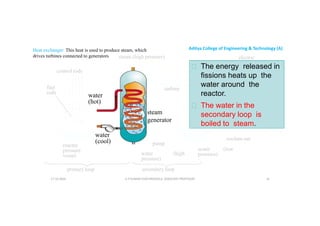
 The energy released in
fissions heats up the
water around the
steam (high pressure)
Heat exchanger: This heat is used to produce steam, which
drives turbines connected to generators
turbine steam (low
pressure)
coolant in
steam condenser
coolant out
fuel
rods reactor.
 The water in the
secondary loop is
boiled to steam.
water
(hot)
water
steam
generator
reactor
pressure
vessel (high
water (low
pressure)
coolant out
pump
water
pressure)
primary loop secondary loop
water
(cool)
U P KUMAR CHATURVEDULA ASSOCIATE PROFESSOR 16
17-10-2024
Aditya College of Engineering & Technology (A)
U P KUMAR CHATURVEDULA ASSOCIATE PROFESSOR 17
17-10-2024
Aditya College of Engineering & Technology (A)
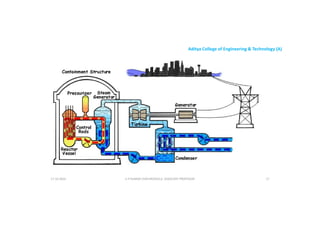
NUCLEAR POWER PLANT
U P KUMAR CHATURVEDULA ASSOCIATE PROFESSOR 18
17-10-2024
Aditya College of Engineering & Technology (A)
• Merits:
• High energy output: Nuclear power plants can generate large amounts of
electricity.
electricity.
• Low greenhouse gas emissions: Nuclear energy is a low-carbon source.
• Continuous operation: Nuclear plants can operate consistently.
• Demerits:
• Radioactive waste: Disposal of nuclear waste is a challenge.
• Safety concerns: Accidents can have catastrophic consequences.
• High initial costs: Building and maintaining nuclear facilities is expensive.
U P KUMAR CHATURVEDULA ASSOCIATE PROFESSOR 19
17-10-2024
Aditya College of Engineering & Technology (A)
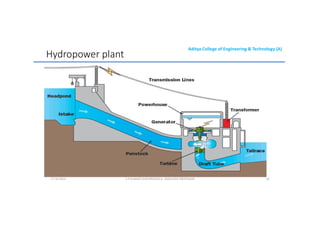
Hydropower plant
U P KUMAR CHATURVEDULA ASSOCIATE PROFESSOR 20
17-10-2024
Aditya College of Engineering & Technology (A)
Hydel Power Generation refers to the generation of electricity by
harnessing the energy of flowing or falling water.
•Working Principle: When water flows through the turbines, it exerts
pressure on their blades. This mechanical energy is converted into
electrical energy by the generators.
•Construction: Hydropower plants consist of a dam to create a reservoir,
which stores water. Water is then released from the reservoir and falls
through turbines, which are connected to generators to produce
electricity.
U P KUMAR CHATURVEDULA ASSOCIATE PROFESSOR 21
17-10-2024
Aditya College of Engineering & Technology (A)
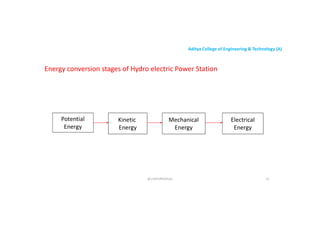
Energy conversion stages of Hydro electric Power Station
Potential
Energy
Kinetic
Energy
Mechanical
Energy
Electrical
Energy
@ CHATURVEDULA 22
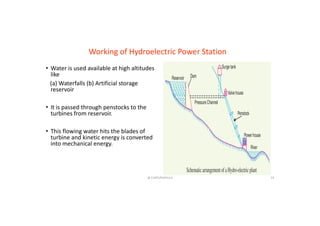
• Water is used available at high altitudes
like
(a) Waterfalls (b) Artificial storage
reservoir
Working of Hydroelectric Power Station
reservoir
• It is passed through penstocks to the
turbines from reservoir.
• This flowing water hits the blades of
turbine and kinetic energy is converted
@ CHATURVEDULA 23
turbine and kinetic energy is converted
into mechanical energy.
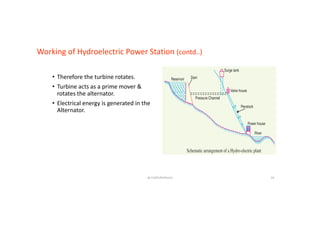
• Therefore the turbine rotates.
• Turbine acts as a prime mover &
Working of Hydroelectric Power Station (contd..)
• Turbine acts as a prime mover &
rotates the alternator.
• Electrical energy is generated in the
Alternator.
@ CHATURVEDULA 24
Aditya College of Engineering & Technology (A)
• In Hydropower plants the potential energy of water at higher level is converted
into kenetic energy when allowed to flow down stream
Principle of Hydro Electric Power Station
into kenetic energy when allowed to flow down stream
• kinetic energy is converted into Mechanical energy with turbine which is
mechanically coupled on the same shaft of alternator which converts
mechanical energy into electrical energy
@ CHATURVEDULA 25
Aditya College of Engineering & Technology (A)
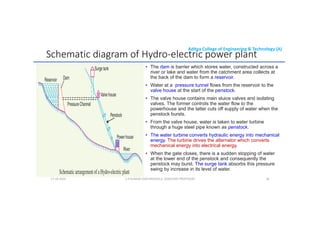
Schematic diagram of Hydro-electric power plant
• The dam is barrier which stores water, constructed across a
river or lake and water from the catchment area collects at
the back of the dam to form a reservoir.
• Water at a pressure tunnel flows from the reservoir to the
valve house at the start of the penstock.
• The valve house contains main sluice valves and isolating
valves. The former controls the water flow to the
powerhouse and the latter cuts off supply of water when the
penstock bursts.
• From the valve house, water is taken to water turbine
through a huge steel pipe known as penstock.
• The water turbine converts hydraulic energy into mechanical
energy. The turbine drives the alternator which converts
mechanical energy into electrical energy.
• When the gate closes, there is a sudden stopping of water
at the lower end of the penstock and consequently the
penstock may burst. The surge tank absorbs this pressure
swing by increase in its level of water.
U P KUMAR CHATURVEDULA ASSOCIATE PROFESSOR 26
17-10-2024
Aditya College of Engineering & Technology (A)
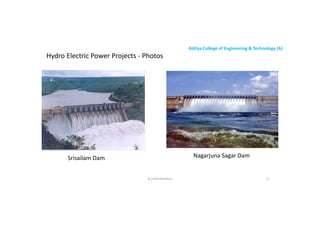
Hydro Electric Power Projects - Photos
@ CHATURVEDULA 27
Srisailam Dam Nagarjuna Sagar Dam
Aditya College of Engineering & Technology (A)
Hydroelectric power station: Advantages
1) It requires no fuel as water is used for the generation of electrical energy.
2) It is quite neat and clean as no smoke or ash is produced.
3) It requires very small running charges because water is the source of energy
which is available free of cost.
4) It is comparatively simple in construction and requires less maintenance.
5) It does not require a long starting time like a steam power station. In fact, such
plants can be put into service instantly.
6) It is robust and has a longer life.
7) Such plants serve many purposes. In addition to the generation of electrical
energy, they also help in irrigation and controlling floods.
8) Although such plants require the attention of highly skilled persons at the time
of construction, yet for operation, a few experienced persons may do the job
well.
U P KUMAR CHATURVEDULA ASSOCIATE PROFESSOR 28
17-10-2024
Aditya College of Engineering & Technology (A)
Hydroelectric power station: Advantages
Environmentally friendly: Hydropower is a clean energy source that
produces no greenhouse gases.
Reliable: It provides a stable and consistent source of electricity.
Low operating costs: Once the plant is built, the ongoing costs are
relatively low.
U P KUMAR CHATURVEDULA ASSOCIATE PROFESSOR 29
17-10-2024
Aditya College of Engineering & Technology (A)
Hydroelectric power station: Disadvantages
1) It involves high capital cost due to construction of dam.
2) There is uncertainty about the availability of huge amount of water due to
dependence on weather conditions.
3) Skilled and experienced hands are required to build the plant.
4) It requires high cost of transmission lines as the plant is located in hilly areas
which are quite away from the consumers.
5) Limited locations: Suitable sites for dams are limited, generally located in hilly
areas
areas
6) Environmental impact: Dam construction can disrupt ecosystems and habitats.
U P KUMAR CHATURVEDULA ASSOCIATE PROFESSOR 30
17-10-2024
Aditya College of Engineering & Technology (A)
• Solar power is the conversion of energy from sun light into
electricity, either directly using photovoltaics or indirectly using
concentrated solar power.
• Photovoltaic cells convert light into an electric current using
the photovoltaic effect
• Concentrated solar power systems use lenses or mirrors and solar
tracking systems to focus a large area of sunlight to a hot spot, often
to drive a steam turbine
U P KUMAR CHATURVEDULA ASSOCIATE PROFESSOR 31
17-10-2024
Aditya College of Engineering & Technology (A)
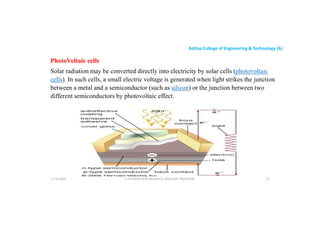
PhotoVoltaic cells
Solar radiation may be converted directly into electricity by solar cells (photovoltaic
cells). In such cells, a small electric voltage is generated when light strikes the junction
between a metal and a semiconductor (such as silicon) or the junction between two
different semiconductors by photovoltaic effect.
U P KUMAR CHATURVEDULA ASSOCIATE PROFESSOR 32
17-10-2024
Aditya College of Engineering & Technology (A)
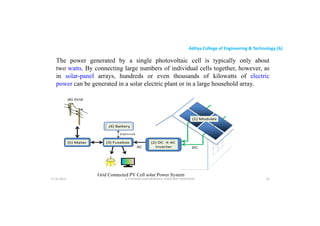
The power generated by a single photovoltaic cell is typically only about
two watts. By connecting large numbers of individual cells together, however, as
in solar-panel arrays, hundreds or even thousands of kilowatts of electric
power can be generated in a solar electric plant or in a large household array.
Grid Connected PV Cell solar Power System
U P KUMAR CHATURVEDULA ASSOCIATE PROFESSOR 33
17-10-2024
Aditya College of Engineering & Technology (A)
There are five main components involved in the making of a grid-
connected solar system.
1.Solar Panels
Solar panels absorb energy from the sunlight and promptly convert it into
a DC supply. That DC power is sent to a solar inverter.
2. Solar Inverter
The inverter is an essential component in the grid connected PV system. It
converts the DC power it receives from the panels into AC power.
The inverter then sends the AC supply to the house so that all the
connected devices can run on solar electricity.
17-10-2024 U P KUMAR CHATURVEDULA ASSOCIATE PROFESSOR 34
connected devices can run on solar electricity.
If the system generates more power than the consumer’s requirement
during the day, it is sent through the net meter and stored in the grid.
Aditya College of Engineering & Technology (A)
3. Fuse Box
The fuse box contains fuses for the positive and negative terminals of the
string combiner box and the recombiner box.
4.Net meter (bidirectional meter)
The net meter withdraws (imports) the exported units from the grid at night.
It keeps all the appliances running. This power exchange is known as net
metering.
17-10-2024 U P KUMAR CHATURVEDULA ASSOCIATE PROFESSOR 35
5.Grid
Grid is the essential part of a grid-connected PV system. It’s more of a sort of
battery since that’s where excess power is sent and then taken back when
needed. So, it’s basically a sort of power backup.
Aditya College of Engineering & Technology (A)
U P KUMAR CHATURVEDULA ASSOCIATE PROFESSOR 36
17-10-2024
Aditya College of Engineering & Technology (A)
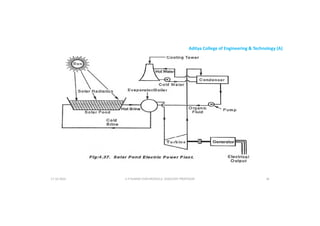
Solar pond electric power plant
 A low temperature thermal electric power production scheme
using solar pond is shown schematically in Fig.4.37.
 The energy obtained from a solar pond is used to drive a
Rankine cycle heat engine. Hot water from the bottom level of
the pond is pumped to boiler where the organic working fluid
is vapourized.
 The vapour then flows under high pressure to the turbine
where it expands and runs an electric generator producing
electricity.
 The exhaust vapour is then condensed in a condenser and the
liquid is pumped back to the evaporator and the cycle is
repeated.
U P KUMAR CHATURVEDULA ASSOCIATE PROFESSOR 37
17-10-2024
Aditya College of Engineering & Technology (A)
Advantages of Solar Energy
• Make Money and Save Money
• Solar Energy Is Abundant
• As Long As there is Light – It Works
• Sunshine Is Free and Environmentally Friendly
• Solar Energy Is Cost Effective & Solar Energy Is Clean
• Greatly Reduced Contribution to Global Warming, reduces carbon
emissions
emissions
• low maintenance cost
U P KUMAR CHATURVEDULA ASSOCIATE PROFESSOR 38
17-10-2024
Aditya College of Engineering & Technology (A)
• Disadvantages
• The energy is not constantly available on earth so storage is needed
to sustain a solar power system through the night and during bad
weather conditions.
to sustain a solar power system through the night and during bad
weather conditions.
• The solar energy is diffused (i.e.,) scattered all over. Since the total
amount of energy available is enormous, the collection and
conservation of solar energy should be carried out over a large area,
which requires large capital investment for the conversion apparatus.
• The high initial costs of installing panels
• Solar energy storage is expensive
• Solar doesn’t work for every roof type
• Solar panels are dependent on sunlight
U P KUMAR CHATURVEDULA ASSOCIATE PROFESSOR 39
17-10-2024
Aditya College of Engineering & Technology (A)
Wind Power Plant
• A wind power plant is a facility that harnesses the kinetic energy of
the wind to generate electricity also known as a wind farm or wind
energy facility,.
• Wind power is a renewable and clean energy source, and plays
significant role in the global effort to transition to more sustainable
energy sources.
• The key components and concepts associated with wind power
plants:
Wind Turbines, Towers, Generators, Power Grid Connection,
Wind Resource Assessment, Environmental Impact, Maintenance and
Operations, Advantages, Challenges
U P KUMAR CHATURVEDULA ASSOCIATE PROFESSOR 40
17-10-2024
Aditya College of Engineering & Technology (A)
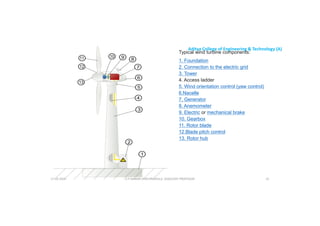
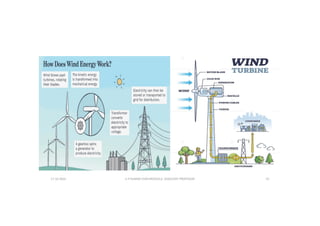
Typical wind turbine components:
1. Foundation
2. Connection to the electric grid
3. Tower
4. Access ladder
5. Wind orientation control (yaw control)
6.Nacelle
7. Generator
8. Anemometer
9. Electric or mechanical brake
10. Gearbox
11. Rotor blade
12.Blade pitch control
13. Rotor hub
13. Rotor hub
U P KUMAR CHATURVEDULA ASSOCIATE PROFESSOR 41
17-10-2024
17-10-2024 U P KUMAR CHATURVEDULA ASSOCIATE PROFESSOR 42
Aditya College of Engineering & Technology (A)
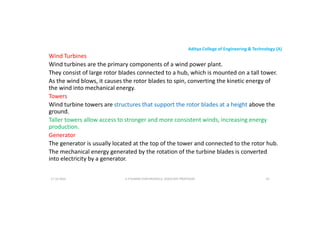
Wind Turbines
Wind turbines are the primary components of a wind power plant.
They consist of large rotor blades connected to a hub, which is mounted on a tall tower.
As the wind blows, it causes the rotor blades to spin, converting the kinetic energy of
the wind into mechanical energy.
Towers
Wind turbine towers are structures that support the rotor blades at a height above the
ground.
Taller towers allow access to stronger and more consistent winds, increasing energy
production.
Generator
Generator
The generator is usually located at the top of the tower and connected to the rotor hub.
The mechanical energy generated by the rotation of the turbine blades is converted
into electricity by a generator.
U P KUMAR CHATURVEDULA ASSOCIATE PROFESSOR 43
17-10-2024
Aditya College of Engineering & Technology (A)
Nacelle
• A nacelle is a cover housing that houses all of the generating
components in a wind turbine, including the generator, gearbox, drive
train, and brake assembly.
Power Grid Connection,
• The electricity generated by the wind turbines is transmitted through power
lines to the electrical grid.
• Wind power plants are often located in areas with high wind speeds, such as
coastal regions or open plains.
U P KUMAR CHATURVEDULA ASSOCIATE PROFESSOR 44
17-10-2024
Aditya College of Engineering & Technology (A)
Wind Resource Assessment,
• Before constructing a wind power plant, developers perform a wind resource
assessment to determine the suitability of the location.
• This involves measuring and analyzing wind speeds at different heights to
estimate the energy potential.
Environmental Impact,
• Wind power is considered a clean energy source, but the construction and
operation of wind power plants can have environmental impacts.
• Potential concerns include bird and bat collisions, habitat disruption, and
visual aesthetics.
U P KUMAR CHATURVEDULA ASSOCIATE PROFESSOR 45
17-10-2024
Aditya College of Engineering & Technology (A)
Maintenance and Operations,
• Regular maintenance is essential to ensure the efficient and safe operation of
the wind turbines.
• Monitoring systems are often employed to detect issues and optimize
performance.
Advantages,
• Wind power is renewable, produces no greenhouse gas emissions during
operation, and reduces dependence on fossil fuels.
• Wind turbines can be installed in various sizes, from small turbines for
residential use to large utility-scale wind farms.
Challenges
Challenges
• Wind power is intermittent, as it depends on wind availability.
• Energy storage solutions and backup power sources are often needed to
address fluctuations in wind power output.
U P KUMAR CHATURVEDULA ASSOCIATE PROFESSOR 46
17-10-2024
Aditya College of Engineering & Technology (A)
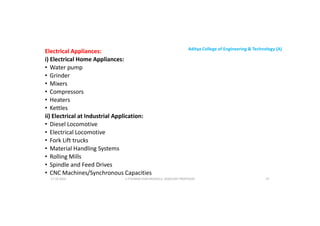
Electrical Appliances:
i) Electrical Home Appliances:
• Water pump
• Grinder
• Mixers
• Compressors
• Compressors
• Heaters
• Kettles
ii) Electrical at Industrial Application:
• Diesel Locomotive
• Electrical Locomotive
• Fork Lift trucks
• Fork Lift trucks
• Material Handling Systems
• Rolling Mills
• Spindle and Feed Drives
• CNC Machines/Synchronous Capacities
U P KUMAR CHATURVEDULA ASSOCIATE PROFESSOR 47
17-10-2024
Aditya College of Engineering & Technology (A)
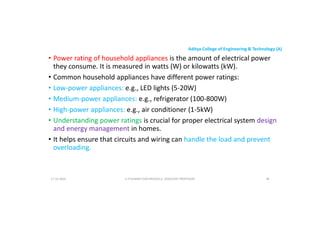
• Power rating of household appliances is the amount of electrical power
they consume. It is measured in watts (W) or kilowatts (kW).
• Common household appliances have different power ratings:
• Low-power appliances: e.g., LED lights (5-20W)
• Medium-power appliances: e.g., refrigerator (100-800W)
• High-power appliances: e.g., air conditioner (1-5kW)
• Understanding power ratings is crucial for proper electrical system design
and energy management in homes.
• It helps ensure that circuits and wiring can handle the load and prevent
overloading.
U P KUMAR CHATURVEDULA ASSOCIATE PROFESSOR 48
17-10-2024
Aditya College of Engineering & Technology (A)
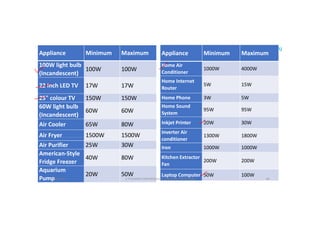
Appliance Minimum Maximum
100W light bulb
(Incandescent)
100W 100W
22 Inch LED TV 17W 17W
Appliance Minimum Maximum
Home Air
Conditioner
1000W 4000W
Home Internet
Router
5W 15W
22 Inch LED TV 17W 17W
25" colour TV 150W 150W
60W light bulb
(Incandescent)
60W 60W
Air Cooler 65W 80W
Air Fryer 1500W 1500W
Router
Home Phone 3W 5W
Home Sound
System
95W 95W
Inkjet Printer 20W 30W
Inverter Air
conditioner
1300W 1800W
Air Fryer 1500W 1500W
Air Purifier 25W 30W
American-Style
Fridge Freezer
40W 80W
Aquarium
Pump
20W 50W
conditioner
1300W 1800W
Iron 1000W 1000W
Kitchen Extractor
Fan
200W 200W
Laptop Computer 50W 100W
U P KUMAR CHATURVEDULA ASSOCIATE PROFESSOR 49
17-10-2024
Aditya College of Engineering & Technology (A)
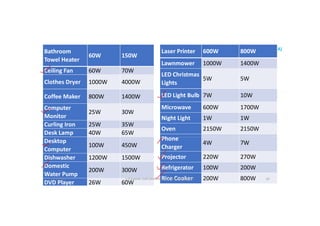
Bathroom
Towel Heater
60W 150W
Ceiling Fan 60W 70W
Clothes Dryer 1000W 4000W
Laser Printer 600W 800W
Lawnmower 1000W 1400W
LED Christmas
Lights
5W 5W
Coffee Maker 800W 1400W
Computer
Monitor
25W 30W
Curling Iron 25W 35W
Desk Lamp 40W 65W
Desktop
LED Light Bulb 7W 10W
Microwave 600W 1700W
Night Light 1W 1W
Oven 2150W 2150W
Phone
Desktop
Computer
100W 450W
Dishwasher 1200W 1500W
Domestic
Water Pump
200W 300W
DVD Player 26W 60W
Phone
Charger
4W 7W
Projector 220W 270W
Refrigerator 100W 200W
Rice Cooker 200W 800W
U P KUMAR CHATURVEDULA ASSOCIATE PROFESSOR 50
17-10-2024
Aditya College of Engineering & Technology (A)
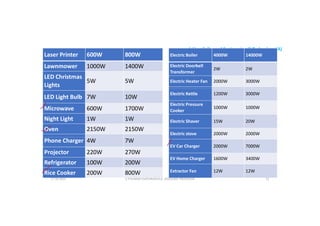
Laser Printer 600W 800W
Lawnmower 1000W 1400W
LED Christmas
Lights
5W 5W
Electric Boiler 4000W 14000W
Electric Doorbell
Transformer
2W 2W
Electric Heater Fan 2000W 3000W
LED Light Bulb 7W 10W
Microwave 600W 1700W
Night Light 1W 1W
Oven 2150W 2150W
Phone Charger 4W 7W
Electric Kettle 1200W 3000W
Electric Pressure
Cooker
1000W 1000W
Electric Shaver 15W 20W
Electric stove 2000W 2000W
Phone Charger 4W 7W
Projector 220W 270W
Refrigerator 100W 200W
Rice Cooker 200W 800W
EV Car Charger 2000W 7000W
EV Home Charger 1600W 3400W
Extractor Fan 12W 12W
U P KUMAR CHATURVEDULA ASSOCIATE PROFESSOR 51
17-10-2024
Aditya College of Engineering & Technology (A)
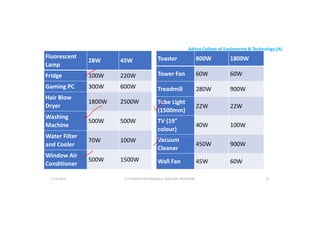
Fluorescent
Lamp
28W 45W
Fridge 100W 220W
Gaming PC 300W 600W
Toaster 800W 1800W
Tower Fan 60W 60W
Treadmill 280W 900W
Gaming PC 300W 600W
Hair Blow
Dryer
1800W 2500W
Washing
Machine
500W 500W
Water Filter
70W 100W
Treadmill 280W 900W
Tube Light
(1500mm)
22W 22W
TV (19"
colour)
40W 100W
Vacuum
Water Filter
and Cooler
70W 100W
Window Air
Conditioner
500W 1500W
Vacuum
Cleaner
450W 900W
Wall Fan 45W 60W
U P KUMAR CHATURVEDULA ASSOCIATE PROFESSOR 52
17-10-2024
Aditya College of Engineering & Technology (A)
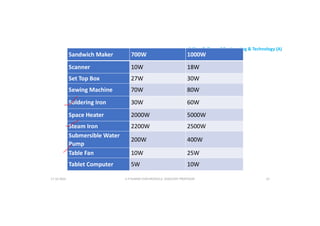
Sandwich Maker 700W 1000W
Scanner 10W 18W
Set Top Box 27W 30W
Sewing Machine 70W 80W
Soldering Iron 30W 60W
Space Heater 2000W 5000W
Steam Iron 2200W 2500W
Submersible Water
200W 400W
Submersible Water
Pump
200W 400W
Table Fan 10W 25W
Tablet Computer 5W 10W
U P KUMAR CHATURVEDULA ASSOCIATE PROFESSOR 53
17-10-2024
Aditya College of Engineering & Technology (A)
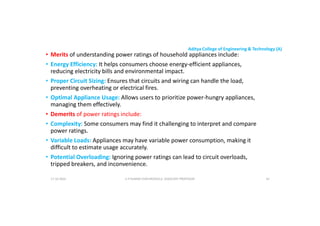
• Merits of understanding power ratings of household appliances include:
• Energy Efficiency: It helps consumers choose energy-efficient appliances,
reducing electricity bills and environmental impact.
• Proper Circuit Sizing: Ensures that circuits and wiring can handle the load,
preventing overheating or electrical fires.
• Optimal Appliance Usage: Allows users to prioritize power-hungry appliances,
managing them effectively.
• Demerits of power ratings include:
• Complexity: Some consumers may find it challenging to interpret and compare
power ratings.
• Variable Loads: Appliances may have variable power consumption, making it
difficult to estimate usage accurately.
• Potential Overloading: Ignoring power ratings can lead to circuit overloads,
tripped breakers, and inconvenience.
U P KUMAR CHATURVEDULA ASSOCIATE PROFESSOR 54
17-10-2024
Aditya College of Engineering & Technology (A)
U P KUMAR CHATURVEDULA ASSOCIATE PROFESSOR 55
17-10-2024
Aditya College of Engineering & Technology (A)
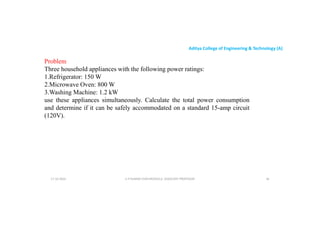
Problem
Three household appliances with the following power ratings:
1.Refrigerator: 150 W
2.Microwave Oven: 800 W
3.Washing Machine: 1.2 kW
use these appliances simultaneously. Calculate the total power consumption
and determine if it can be safely accommodated on a standard 15-amp circuit
(120V).
U P KUMAR CHATURVEDULA ASSOCIATE PROFESSOR 56
17-10-2024
Aditya College of Engineering & Technology (A)
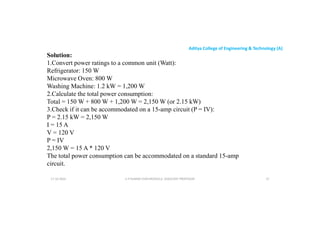
Solution:
1.Convert power ratings to a common unit (Watt):
Refrigerator: 150 W
Microwave Oven: 800 W
Washing Machine: 1.2 kW = 1,200 W
2.Calculate the total power consumption:
Total = 150 W + 800 W + 1,200 W = 2,150 W (or 2.15 kW)
3.Check if it can be accommodated on a 15-amp circuit (P = IV):
P = 2.15 kW = 2,150 W
I = 15 A
V = 120 V
P = IV
P = IV
2,150 W = 15 A * 120 V
The total power consumption can be accommodated on a standard 15-amp
circuit.
U P KUMAR CHATURVEDULA ASSOCIATE PROFESSOR 57
17-10-2024
Aditya College of Engineering & Technology (A)
U P KUMAR CHATURVEDULA ASSOCIATE PROFESSOR 58
17-10-2024
Aditya College of Engineering & Technology (A)
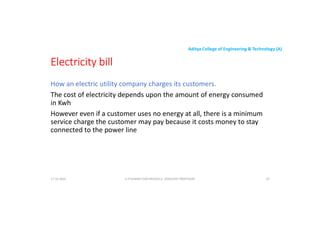
Electricity bill
How an electric utility company charges its customers.
The cost of electricity depends upon the amount of energy consumed
in Kwh
However even if a customer uses no energy at all, there is a minimum
service charge the customer may pay because it costs money to stay
connected to the power line
U P KUMAR CHATURVEDULA ASSOCIATE PROFESSOR 59
17-10-2024
Aditya College of Engineering & Technology (A)
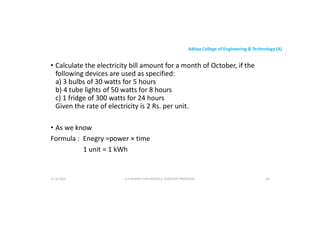
• Calculate the electricity bill amount for a month of October, if the
following devices are used as specified:
a) 3 bulbs of 30 watts for 5 hours
b) 4 tube lights of 50 watts for 8 hours
c) 1 fridge of 300 watts for 24 hours
Given the rate of electricity is 2 Rs. per unit.
• As we know
Formula : Enegry =power × time
1 unit = 1 kWh
17-10-2024 U P KUMAR CHATURVEDULA ASSOCIATE PROFESSOR 60
Aditya College of Engineering & Technology (A)
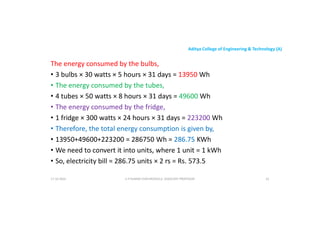
The energy consumed by the bulbs,
• 3 bulbs × 30 watts × 5 hours × 31 days = 13950 Wh
• The energy consumed by the tubes,
• 4 tubes × 50 watts × 8 hours × 31 days = 49600 Wh
• The energy consumed by the fridge,
• 1 fridge × 300 watts × 24 hours × 31 days = 223200 Wh
• Therefore, the total energy consumption is given by,
• 13950+49600+223200 = 286750 Wh = 286.75 KWh
• We need to convert it into units, where 1 unit = 1 kWh
• So, electricity bill = 286.75 units × 2 rs = Rs. 573.5
17-10-2024 U P KUMAR CHATURVEDULA ASSOCIATE PROFESSOR 61
Aditya College of Engineering & Technology (A)
U P KUMAR CHATURVEDULA ASSOCIATE PROFESSOR 62
17-10-2024
Aditya College of Engineering & Technology (A)
U P KUMAR CHATURVEDULA ASSOCIATE PROFESSOR 63
17-10-2024
Aditya College of Engineering & Technology (A)
U P KUMAR CHATURVEDULA ASSOCIATE PROFESSOR 64
17-10-2024
Aditya College of Engineering & Technology (A)
U P KUMAR CHATURVEDULA ASSOCIATE PROFESSOR 65
17-10-2024
Aditya College of Engineering & Technology (A)
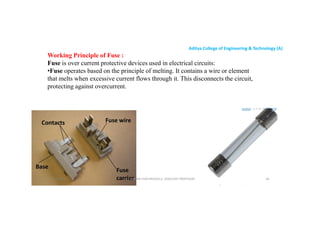
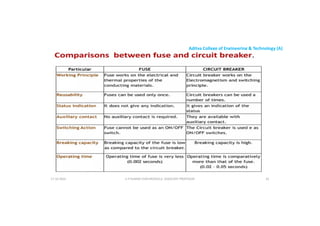
Working Principle of Fuse :
Fuse is over current protective devices used in electrical circuits:
•Fuse operates based on the principle of melting. It contains a wire or element
that melts when excessive current flows through it. This disconnects the circuit,
protecting against overcurrent.
U P KUMAR CHATURVEDULA ASSOCIATE PROFESSOR 66
17-10-2024
Aditya College of Engineering & Technology (A)
U P KUMAR CHATURVEDULA ASSOCIATE PROFESSOR 67
17-10-2024
Aditya College of Engineering & Technology (A)
U P KUMAR CHATURVEDULA ASSOCIATE PROFESSOR 68
17-10-2024
Aditya College of Engineering & Technology (A)
U P KUMAR CHATURVEDULA ASSOCIATE PROFESSOR 69
17-10-2024
Aditya College of Engineering & Technology (A)
•Merits of Fuse:
• Simplicity and reliability.
• Cost-effective.
• Effective in certain applications.
•Demerits of Fuse:
• One-time use, needs replacement.
• Slower response compared to MCB.
U P KUMAR CHATURVEDULA ASSOCIATE PROFESSOR 70
17-10-2024
Aditya College of Engineering & Technology (A)
U P KUMAR CHATURVEDULA ASSOCIATE PROFESSOR 71
17-10-2024
Aditya College of Engineering & Technology (A)
Working Principle of Miniature Circuit Breaker (MCB):
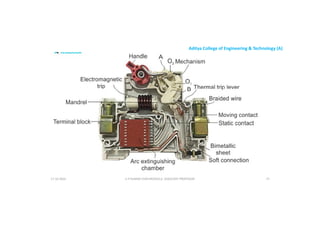
MCB is an automatically operated electromechanical switch that is specially
designed to protect an electrical circuit from damage caused by the excess current
in case of an overload or short circuit condition.
The basic function of MCB is to interrupt current flow in the circuit after a fault
is detected
•MCB operates as an automatic switch. It has a bimetallic strip that bends when
exposed to excessive current or a magnetic coil that triggers when a fault occurs.
This opens the circuit, providing protection.
U P KUMAR CHATURVEDULA ASSOCIATE PROFESSOR 72
17-10-2024
Aditya College of Engineering & Technology (A)
U P KUMAR CHATURVEDULA ASSOCIATE PROFESSOR 73
17-10-2024
Aditya College of Engineering & Technology (A)
U P KUMAR CHATURVEDULA ASSOCIATE PROFESSOR 74
17-10-2024
Aditya College of Engineering & Technology (A)
Working Principle of MCB
MCBs is a compact cased device and they have two different tripping
mechanisms, the delayed thermal tripping mechanism for overload protection and
the magnetic tripping mechanism for short circuit protection
The working principle of the MCB is based on two effects-
 Electromagnetic Effect.
 Thermal Effect
Also, there are essentially three different mechanisms that provide overload and
short circuit protection.
U P KUMAR CHATURVEDULA ASSOCIATE PROFESSOR 75
17-10-2024
Aditya College of Engineering & Technology (A)
Bimetallic Strip
:
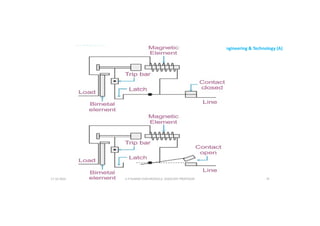
Thermal effect takes place whenever the condition of overload occurs
in the electrical circuit. This bimetallic strip arrangement is used in
situations where a constant overload condition prevails over a long time
in the connected circuit thus resulting in heating of the bimetallic strip.
Overheating of the bi-metallic strip results in the deformation of the
strip i.e. the bimetallic strip bends further than the predefined level due
to which latch mechanism is released and contacts get open. The moving
contact of the MCB is arranged by means of spring pressure. The
displacement of the latch point causes the attached spring to get released
and the moving contactor opens the circuit.
U P KUMAR CHATURVEDULA ASSOCIATE PROFESSOR 76
17-10-2024
Aditya College of Engineering & Technology (A)
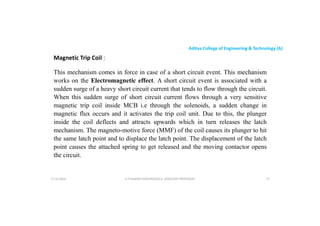
Magnetic Trip Coil :
This mechanism comes in force in case of a short circuit event. This mechanism
works on the Electromagnetic effect. A short circuit event is associated with a
sudden surge of a heavy short circuit current that tends to flow through the circuit.
When this sudden surge of short circuit current flows through a very sensitive
magnetic trip coil inside MCB i.e through the solenoids, a sudden change in
magnetic flux occurs and it activates the trip coil unit. Due to this, the plunger
inside the coil deflects and attracts upwards which in turn releases the latch
mechanism. The magneto-motive force (MMF) of the coil causes its plunger to hit
the same latch point and to displace the latch point. The displacement of the latch
point causes the attached spring to get released and the moving contactor opens
the circuit.
U P KUMAR CHATURVEDULA ASSOCIATE PROFESSOR 77
17-10-2024
Aditya College of Engineering & Technology (A)
Manual Switching :
MCB also has an external ON/OFF switching option to manually break the circuit.
This is used in cases of any maintenance or repair activities or for resetting of MCB
in case of an already occurred trip event.
It may be due to deformation of a bi-metallic strip, or increased MMF of a trip coil,
or maybe a manual operation, but every time the same latch point is displaced and
the same deformed spring is released, which ultimately responsible for the
movement of the moving contact. When the moving contact is separated from fixed
contact, there may be a high chance of arc. Again, when we switch it on, we reset the
displaced operating latch to its previous position i.e on position and the MCB is
ready for another trip operation.
U P KUMAR CHATURVEDULA ASSOCIATE PROFESSOR 78
17-10-2024
Aditya College of Engineering & Technology (A)
Advantages
MCBs are much more sensitive to faults than fuses.
They act faster than fuse during short circuits.
Offer better overload protection than fuses.
Reusable even after interruption of the circuit after an overload or short
circuits. MCB resets after the clearance of fault whereas fuses need to be
rewired or replaced.
Offers a safer interruption of short-circuit current and arc quenching.
U P KUMAR CHATURVEDULA ASSOCIATE PROFESSOR 79
17-10-2024
Aditya College of Engineering & Technology (A)
•Merits of MCB:
• Quick response to faults.
• Reusable after tripping.
• More precise in terms of current rating.
•Demerits of MCB:
• More expensive than fuses.
• May not provide the same level of short-
circuit protection as fuses.
U P KUMAR CHATURVEDULA ASSOCIATE PROFESSOR 80
17-10-2024
Aditya College of Engineering & Technology (A)
U P KUMAR CHATURVEDULA ASSOCIATE PROFESSOR 81
17-10-2024
Aditya College of Engineering & Technology (A)
Electrical shock
Electrical shock occurs when an individual comes into contact with an electric
current. The severity of an electrical shock can vary widely, ranging from a mild
tingling sensation to severe injury or even death. Here are key points to consider
regarding electrical shocks:
Path of the Current:
The severity of an electrical shock depends on the path the electric current takes through the
body.
Current passing through vital organs, such as the heart or brain, can be more dangerous than
when it passes through other parts of the body.
Factors Affecting Severity:
The severity of an electrical shock is influenced by several factors, including the amount of
current, the duration of exposure, the voltage, and the pathway the current takes through the body.
Effects on the Body:
Mild shocks may cause tingling sensations, while more severe shocks can lead to muscle
contractions, burns, and injuries to internal organs.
High-voltage shocks can cause cardiac arrest, respiratory failure, and other life-threatening
conditions. U P KUMAR CHATURVEDULA ASSOCIATE PROFESSOR 82
17-10-2024
Aditya College of Engineering & Technology (A)
Injuries and Burns:
Electrical shocks can cause burns at the point of contact with the electrical source or along the
path of the current.
Thermal burns can occur if the electrical current causes a fire or if the individual comes into
contact with a hot surface as a result of the shock.
Cardiac Effects:
High-voltage shocks can disrupt the normal rhythm of the heart, leading to cardiac arrest.
Immediate cardiopulmonary resuscitation (CPR) may be necessary in such cases.
Preventing Electrical Shocks:
To prevent electrical shocks, it is crucial to follow electrical safety practices, such as using
insulation, grounding electrical devices, and ensuring proper wiring.
Electrical equipment should be installed and maintained by qualified professionals.
U P KUMAR CHATURVEDULA ASSOCIATE PROFESSOR 83
17-10-2024
Aditya College of Engineering & Technology (A)
Rescue and First Aid:
If someone is experiencing an electrical shock, it is essential to ensure the
safety of the rescuer first. Do not touch the person until the power is turned off
or the person is moved away from the electrical source using non-conductive
materials.
materials.
Call for emergency medical assistance immediately.
Medical Attention:
Even if the person appears to be unharmed, it is important to seek medical
attention after an electrical shock. Internal injuries may not be immediately
apparent.
Safety Measures:
Safety Measures:
Follow safety protocols and use personal protective equipment (PPE) when
working with electricity.
Be aware of electrical hazards in the environment and take necessary
precautions.
U P KUMAR CHATURVEDULA ASSOCIATE PROFESSOR 84
17-10-2024
Aditya College of Engineering & Technology (A)
Training and Awareness:
Individuals working with electricity should receive proper training on electrical
safety to minimize the risk of electrical shocks.
Raising awareness about electrical safety in both professional and residential
settings is crucial.
Preventing electrical shocks involves a combination of proper safety measures,
awareness, and adherence to electrical codes and standards. Understanding
the risks associated with electricity and taking appropriate precautions can help
reduce the likelihood of electrical shock incidents.
U P KUMAR CHATURVEDULA ASSOCIATE PROFESSOR 85
17-10-2024
Aditya College of Engineering & Technology (A)
Protection from Shock
Education and Training
Personal Protective Equipment (PPE)
Turn Off Power
Use Ground Fault Circuit Interrupters (GFCIs)
Regular Equipment Inspection and Maintenance
Keep Work Areas Dry
Barricade Hazardous Areas
Maintain Proper Wiring
Residual Current Devices (RCDs)
Safe Work Practices
Safe Work Practices
Avoid Overloading Circuits
Emergency Preparedness
Regular Electrical Safety Audits
U P KUMAR CHATURVEDULA ASSOCIATE PROFESSOR 86
17-10-2024
Aditya College of Engineering & Technology (A)
By following these safety measures and incorporating them into daily work
practices, individuals can significantly reduce the risk of electrical shock and
create a safer working environment. Always prioritize safety, and if in doubt,
seek guidance from qualified professionals.
U P KUMAR CHATURVEDULA ASSOCIATE PROFESSOR 87
17-10-2024
Aditya College of Engineering & Technology (A)
After Shock
Ensure Safety:
The first priority is to ensure the safety of both the victim and anyone nearby.
Do not touch the person if they are still in contact with the electrical source. Use
a non-conductive object, such as a dry wooden stick, to move the person away
from the source of electricity.
Disconnect Power:
If it is safe to do so, disconnect the power source or turn off the electrical
equipment to prevent further exposure.
Use appropriate procedures, such as turning off the circuit breaker or unplugging
the equipment.
U P KUMAR CHATURVEDULA ASSOCIATE PROFESSOR 88
17-10-2024
Aditya College of Engineering & Technology (A)
Call for Help:
Call for emergency medical assistance immediately. Dial emergency services
and provide information about the situation.
If the person is unconscious, not breathing, or experiencing severe injuries,
start cardiopulmonary resuscitation (CPR) if you are trained to do so.
Check for Breathing and Circulation:
Assess the person's breathing and circulation.
If the person is not breathing or there is no pulse, begin CPR.
If the person is breathing, place them in a recovery position to help maintain an
open airway.
Administer First Aid:
Check for burns or other injuries caused by the electrical shock.
If there are burns, do not use ice; cover the affected area with a sterile, non-
stick dressing.
Do not apply creams, ointments, or adhesive bandages to the burns.
U P KUMAR CHATURVEDULA ASSOCIATE PROFESSOR 89
17-10-2024
Aditya College of Engineering & Technology (A)
Keep the Person Warm:
If the person is responsive and breathing, keep them warm by covering them with
a blanket or clothing.
Shock can be a concern after an electrical injury, and maintaining body
temperature is important.
Monitor for Other Injuries:
Electrical shocks can cause injuries beyond burns, such as fractures or injuries from
falling. Check for other injuries and provide appropriate first aid.
Seek Medical Attention:
Even if the person seems to have recovered or has minor injuries, seek medical
attention promptly.
attention promptly.
Internal injuries may not be immediately apparent, and a medical professional can
assess the extent of the damage.
U P KUMAR CHATURVEDULA ASSOCIATE PROFESSOR 90
17-10-2024
Aditya College of Engineering & Technology (A)
Do Not Attempt to Treat Severe Burns:
If the person has severe burns or injuries, do not attempt to treat them beyond basic
first aid. Wait for professional medical assistance.
Follow Up:
After receiving medical attention, follow any recommendations or instructions
provided by healthcare professionals.
Report the incident to relevant authorities, especially if it occurred in a workplace or
public setting.
Remember that electrical shocks can have serious consequences, and professional
medical evaluation is essential even if the initial symptoms appear minor. Quick and
appropriate action can make a significant difference in the outcome for someone
who has experienced an electrical shock.
U P KUMAR CHATURVEDULA ASSOCIATE PROFESSOR 91
17-10-2024
Aditya College of Engineering & Technology (A)
electrical safety
1. The first step of electrical safety, avoid water at all times when working
with electricity. Never touch or try repairing any electrical equipment or
circuits with wet hands. It increases the conductivity of the electric current.
2. Never use equipment with frayed cords, damaged insulation, or broken
plugs.
3. If you are working on any receptacle at your home then always turn off the
mains. It is also a good idea to put up a sign on the service panel so that
nobody turns the main switch ON by accident.
4. Always use insulated tools while working.
U P KUMAR CHATURVEDULA ASSOCIATE PROFESSOR 92
17-10-2024
Aditya College of Engineering & Technology (A)
5. Electrical hazards include exposed energized parts and unguarded electrical
equipment which may become energized unexpectedly. Such equipment always
carries warning signs like “Shock Risk”. Always be observant of such signs and follow
the safety rules established by the electrical code followed by the country you’re in.
6. Always use appropriate insulated rubber gloves and goggles while working on any
branch circuit or any other electrical circuit.
7. Never try repairing energized equipment. Always check that it is de-energized first
by using a tester. When an electric tester touches a live or hot wire, the bulb inside the
tester lights up showing that an electrical current is flowing through the respective
wire. Check all the wires, the outer metallic covering of the service panel, and any
other hanging wires with an electrical tester before proceeding with your work.
U P KUMAR CHATURVEDULA ASSOCIATE PROFESSOR 93
17-10-2024
Aditya College of Engineering & Technology (A)
8. Never use an aluminum or steel ladder if you are working on any receptacle at
height in your home. An electrical surge will ground you and the whole electric current
will pass through your body. Use a bamboo, wooden or a fiberglass ladder instead.
9. Know the wire code of your country.
10. Always check all your GFCI’s once a month. A GFCI (Ground Fault Circuit
Interrupter) is a RCD (Residual Current Device). They have become very common in
modern homes, especially damp areas like the bathroom and kitchen, as they help
avoid electrical shock hazards. It is designed to disconnect quickly enough to avoid
any injury caused by over-current or short circuit faults.
U P KUMAR CHATURVEDULA ASSOCIATE PROFESSOR 94
17-10-2024
Aditya College of Engineering & Technology (A)
Earthing
Earthing, also known as grounding, is a fundamental safety measure in
electrical systems. It’s a method that connects the neutral points of a system
to the earth, providing an alternative path for electrical energy to discharge
safely during a fault. This prevents dangerous potential build-ups in exposed
conductive materials.
A well-designed earthing system has low impedance, which ensures sufficient
current can flow through safety devices and disconnect from the supply during
a fault.
This safeguards both people and electrical devices from electrical hazards
and current leakage.
In this blog we will understand the the concept of Types of Earthing, focusing
on Plate Earthing, Diagram of Plate Earthing, it’s procedure and applications.
U P KUMAR CHATURVEDULA ASSOCIATE PROFESSOR 95
17-10-2024
Aditya College of Engineering & Technology (A)
What is Plate Earthing?
Plate Earthing is a method where a plate made of galvanized copper or iron is
buried vertically at least 3 meters below ground level.
This plate connects all conductors to the earth, providing a path for electrical
discharge.
The Diagram of Plate Earthing typically illustrates this setup, showing the plate’s
position in relation to the ground level and the conductors it connects.
The Plate Earthing Diagram also often includes the dimensions of the plate.
For instance, a copper plate used in this method typically measures 600mm x
600mm x6.35mm.
The plate’s size and material can vary based on specific requirements, but the
principle remains the same, to provide a safe path for fault current to the earth
U P KUMAR CHATURVEDULA ASSOCIATE PROFESSOR 96
17-10-2024
Aditya College of Engineering & Technology (A)
U P KUMAR CHATURVEDULA ASSOCIATE PROFESSOR 97
17-10-2024
Aditya College of Engineering & Technology (A)
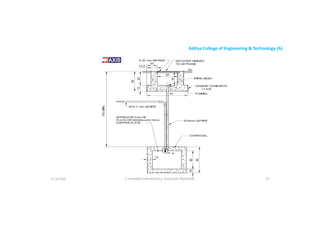
The diagram of plate earthing shows a plate electrode, which is either made of
galvanized iron or steel (with a minimum thickness of 6.3 mm) or copper (with a
minimum thickness of 3.15 mm). The plate should be at least 60 cm by 60 cm in
size.
The plate is buried in the earth, surrounded by alternating layers of charcoal and
salt. The charcoal layer is used to retain moisture, which helps to maintain a low
earth resistance.
A galvanized iron strip is connected to the plate and extends above the ground.
This strip is used to connect the plate to the electrical system that is being
earthed.
A pipe is also shown in the diagram, which is used for watering the earth
around the plate. This helps to maintain the moisture levels around the plate,
ensuring effective earthing. Finally, an inspection chamber is built around
the earth pit. This chamber allows for regular inspection and maintenance of
the earthing system.
U P KUMAR CHATURVEDULA ASSOCIATE PROFESSOR 98
17-10-2024
Aditya College of Engineering & Technology (A)
Plate Earthing Procedure
The procedure for Plate Earthing involves several steps, often illustrated in a
Diagram of Plate Earthing:
1. Earth Pit: An earth pit is excavated at a suitable location in the substation, with a
minimum size of 900mm x900mm and a depth of 3m below the surface.
2. Plate Electrode: A GI plate of minimum size 600mm x600mm and thickness of 6.3 mm is
used. If a copper plate is used, a minimum thickness of 3.15mm is required. The plate is
surrounded by alternating layers of charcoal and salt.
3. Earthing Connection: Galvanized Iron strips are fixed and welded to the plate at two
different locations. Loose earthing can adversely affect the electrode system resistivity, so
these connections are made strong.
4. Water Connection: A pipe is fixed at the top to maintain moist conditions around the
earth plate. The pipe is covered with a wire mesh, and water is poured through it. The
excavated pit is then filled with stone-free soil.
5. Inspection Chamber: A brick chamber is built over the earth pit on a P.C.C layer. The top
cover is placed with cast iron hinges to a CI frame.
U P KUMAR CHATURVEDULA ASSOCIATE PROFESSOR 99
17-10-2024

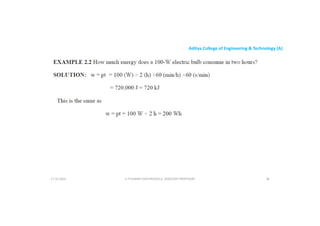
LECTURE NOTES ON SOLAR, NUCLEAR, WIND POWER ENERGY

  • 1.
    Aditya College ofEngineering & Technology (A) BEEE By U P KUMAR CHATURVEDULA Associate Professor BEEE Course Code: 231ES1T01 Associate Professor Aditya College of Engineering Technology (A) Surampalem. . U P KUMAR CHATURVEDULA ASSOCIATE PROFESSOR 1 17-10-2024
  • 2.
    Aditya College ofEngineering & Technology (A) UNIT III: Energy Resources, Electricity Bill & Safety Measures Energy Resources: Conventional and non-conventional energy resources; Layout and operation of various Power Generation systems: Hydel, Nuclear, Solar & Wind power operation of various Power Generation systems: Hydel, Nuclear, Solar & Wind power generation. Electricity bill: Power rating of household appliances including air conditioners, PCs, Laptops, Printers, etc. Definition of “unit” used for consumption of electrical energy Equipment Safety Measures: Working principle of Fuse and Miniature circuit breaker Equipment Safety Measures: Working principle of Fuse and Miniature circuit breaker (MCB), merits and demerits. Personal safety measures: Electric Shock, Earthing and its types, Safety Precautions to avoid shock. U P KUMAR CHATURVEDULA ASSOCIATE PROFESSOR 2 17-10-2024
  • 3.
    Aditya College ofEngineering & Technology (A) SOURCES of POWER GENERATION • Nonconventional energy (or) renewable energy sources are energy sources that are continuously produced in nature and are limitless. • Non-Conventional (Renewable) Energy Sources Non-Conventional (Renewable) Energy Sources 1. Hydro 2. Solar 3. Wind 4. Tidal 5. Wave 6. Ocean Thermal Energy Conversion 6. Ocean Thermal Energy Conversion 7. Bio-Mass U P KUMAR CHATURVEDULA ASSOCIATE PROFESSOR 3 17-10-2024
  • 4.
    Aditya College ofEngineering & Technology (A) • Conventional sources of energy are the ones that are commonly used, and generally non-renewable sources of energy, which are being used since a long time. • Conventional Energy Sources (Thermal) • Conventional Energy Sources (Thermal) 1. Coal 2. Gas 3. Oil 4. Nuclear U P KUMAR CHATURVEDULA ASSOCIATE PROFESSOR 4 17-10-2024
  • 5.
    Aditya College ofEngineering & Technology (A) U P KUMAR CHATURVEDULA ASSOCIATE PROFESSOR 5 17-10-2024
  • 6.
    Aditya College ofEngineering & Technology (A) Nuclear Power Generation A nuclear power plant is a thermal power station in which the heat energy is converted into electrical energy. (generating heat energy is converted into electrical energy. (generating electricity by using nuclear reactions) Working: In all thermal power plants the heat is used to generate steam which drives a steam turbine connected to a generator which produces electricity. a generator which produces electricity. U P KUMAR CHATURVEDULA ASSOCIATE PROFESSOR 6 17-10-2024
  • 7.
    Aditya College ofEngineering & Technology (A) Nuclear fuel • 1 kg of Uranium U235 can produce as much energy as the burning of 4500 tonnes of high grade variety of coal or 2000 tonnes of oil. • • Construction: The major parts in nuclear power plants are • nuclear reactor, • heat exchanger, • turbine, • alternator, • condenser, • cooling towers, • control rods and water source U P KUMAR CHATURVEDULA ASSOCIATE PROFESSOR 7 17-10-2024
  • 8.
    Aditya College ofEngineering & Technology (A) Nuclear fission…  Nuclear fission: heavy nuclei split into two smaller parts in order to become more stable proton neutron Kr-92 nucleus energy U P KUMAR CHATURVEDULA ASSOCIATE PROFESSOR 8 U-235 nucleus Ba-141 nucleus 17-10-2024
  • 9.
    Aditya College ofEngineering & Technology (A) Nuclear Fission… • It is a process of splitting up of nucleus of fissionable material like uranium into two or more fragments with release of enormous amount of energy. amount of energy. • The nucleus of U235 is bombarded with high energy neutrons U235+0n1 Ba 141+Kr92+2.50n1+200 MeV energy. • The neutrons produced are very fast and can be made to fission other nuclei of U235, thus setting up a chain reaction. • Out of 2.5 neutrons released one neutron is used to sustain the chain reaction. U P KUMAR CHATURVEDULA ASSOCIATE PROFESSOR 9 • Out of 2.5 neutrons released one neutron is used to sustain the chain reaction. 1 eV = 1.6X10⁻¹⁹ joule. 1 MeV = 106 eV 17-10-2024
  • 10.
    Aditya College ofEngineering & Technology (A) Nuclear (Atomic) Power Plant… Principal parts of a nuclear reactor: U P KUMAR CHATURVEDULA ASSOCIATE PROFESSOR 10 Core : Here the nuclear fission process takes place. Moderator : This reduces the speed of fast moving neutrons. Most moderators are graphite, water or heavy water. 17-10-2024
  • 11.
    Aditya College ofEngineering & Technology (A) Nuclear (Atomic) Power Plant… Principal parts of a nuclear reactor… Control rods : Control rods limit the number of fuel atoms that can split. They are Coolant : They carry the intense heat generated. Water is used as a coolant, some reactors use liquid sodium as a coolant. fuel atoms that can split. They are made of boron or cadmium which absorbs neutrons U P KUMAR CHATURVEDULA ASSOCIATE PROFESSOR 11 Fuel : The fuel used for nuclear fission is U235 isotope. Radiation shield : To protect the people working from radiation and (thermal shielding) radiation fragments. 17-10-2024
  • 12.
    Aditya College ofEngineering & Technology (A) control rods electric power turbine steam (low pressure) steam (high pressure) fuel rods  They contain the nuclear fuel: uranium (U-235) water (cool) water (hot) coolant out turbine steam (low pressure) steam coolant in generator steam condenser (U-235)  They are surrounded by a moderator (water or graphite) to slow down the neutrons released. reactor pressure vessel water (cool) (high (low water pressure) coolant out U P KUMAR CHATURVEDULA ASSOCIATE PROFESSOR 12 pump water pressure) primary loop secondary loop 17-10-2024
  • 13.
    Aditya College ofEngineering & Technology (A) control rods steam (high pressure) electric power turbine steam (low r pressure) fuel  They control the rate of reaction by moving in and out of the reactor.  Move in: rate of reaction  wat (coo wate (hot) r pressure) steam coolant in generator steam condenser er coolant out l) fuel rods  Move out: rate of reaction   All are moved in: the reactor is shut down  They are made of boron or cadmium that can absorb neutrons. pump U P KUMAR CHATURVEDULA ASSOCIATE PROFESSOR 13 reactor pressure vessel wat (coo water (low pressure) l) water (high pressure) secondary loop primary loop pump 17-10-2024
  • 14.
    Aditya College ofEngineering & Technology (A) control rods steam (high pressure) • coolant in steam condenser fuel steam (low turbine electric power generator steam generator • coolant out • pump fuel rods generator. water (hot)  The steam drives a turbine, which turns the generator. water  Electricity is produced by the (cool) steam (low pressure) turbine reactor pressure vessel water (low pressure) U P KUMAR CHATURVEDULA ASSOCIATE PROFESSOR 14 water (high pressure) secondary loop primary loop generator. (cool) 17-10-2024
  • 15.
    Aditya College ofEngineering & Technology (A) control rods fuel rods water steam (low pressure) turbine electric power steam (high pressure) rods water (cool) water (hot) coolant out coolant in steam condenser pressure) steam generator pump reactor pressure vessel (cool) water (low pressure) U P KUMAR CHATURVEDULA ASSOCIATE PROFESSOR 15 pump water (high pressure) primary loop secondary loop  Two separate water systems are used to avoid radioactive substances to reach the turbine. 17-10-2024
  • 16.
    Aditya College ofEngineering & Technology (A) control rods turbine electric power steam (low fuel  The energy released in fissions heats up the water around the steam (high pressure) Heat exchanger: This heat is used to produce steam, which drives turbines connected to generators turbine steam (low pressure) coolant in steam condenser coolant out fuel rods reactor.  The water in the secondary loop is boiled to steam. water (hot) water steam generator reactor pressure vessel (high water (low pressure) coolant out pump water pressure) primary loop secondary loop water (cool) U P KUMAR CHATURVEDULA ASSOCIATE PROFESSOR 16 17-10-2024
  • 17.
    Aditya College ofEngineering & Technology (A) U P KUMAR CHATURVEDULA ASSOCIATE PROFESSOR 17 17-10-2024
  • 18.
    Aditya College ofEngineering & Technology (A) NUCLEAR POWER PLANT U P KUMAR CHATURVEDULA ASSOCIATE PROFESSOR 18 17-10-2024
  • 19.
    Aditya College ofEngineering & Technology (A) • Merits: • High energy output: Nuclear power plants can generate large amounts of electricity. electricity. • Low greenhouse gas emissions: Nuclear energy is a low-carbon source. • Continuous operation: Nuclear plants can operate consistently. • Demerits: • Radioactive waste: Disposal of nuclear waste is a challenge. • Safety concerns: Accidents can have catastrophic consequences. • Safety concerns: Accidents can have catastrophic consequences. • High initial costs: Building and maintaining nuclear facilities is expensive. U P KUMAR CHATURVEDULA ASSOCIATE PROFESSOR 19 17-10-2024
  • 20.
    Aditya College ofEngineering & Technology (A) Hydropower plant U P KUMAR CHATURVEDULA ASSOCIATE PROFESSOR 20 17-10-2024
  • 21.
    Aditya College ofEngineering & Technology (A) Hydel Power Generation refers to the generation of electricity by harnessing the energy of flowing or falling water. •Working Principle: When water flows through the turbines, it exerts •Working Principle: When water flows through the turbines, it exerts pressure on their blades. This mechanical energy is converted into electrical energy by the generators. •Construction: Hydropower plants consist of a dam to create a reservoir, which stores water. Water is then released from the reservoir and falls through turbines, which are connected to generators to produce through turbines, which are connected to generators to produce electricity. U P KUMAR CHATURVEDULA ASSOCIATE PROFESSOR 21 17-10-2024
  • 22.
    Aditya College ofEngineering & Technology (A) Energy conversion stages of Hydro electric Power Station Potential Energy Kinetic Energy Mechanical Energy Electrical Energy @ CHATURVEDULA 22
  • 23.
    • Water isused available at high altitudes like (a) Waterfalls (b) Artificial storage reservoir Working of Hydroelectric Power Station reservoir • It is passed through penstocks to the turbines from reservoir. • This flowing water hits the blades of turbine and kinetic energy is converted @ CHATURVEDULA 23 turbine and kinetic energy is converted into mechanical energy.
  • 24.
    • Therefore theturbine rotates. • Turbine acts as a prime mover & Working of Hydroelectric Power Station (contd..) • Turbine acts as a prime mover & rotates the alternator. • Electrical energy is generated in the Alternator. @ CHATURVEDULA 24
  • 25.
    Aditya College ofEngineering & Technology (A) • In Hydropower plants the potential energy of water at higher level is converted into kenetic energy when allowed to flow down stream Principle of Hydro Electric Power Station into kenetic energy when allowed to flow down stream • kinetic energy is converted into Mechanical energy with turbine which is mechanically coupled on the same shaft of alternator which converts mechanical energy into electrical energy @ CHATURVEDULA 25
  • 26.
    Aditya College ofEngineering & Technology (A) Schematic diagram of Hydro-electric power plant • The dam is barrier which stores water, constructed across a river or lake and water from the catchment area collects at the back of the dam to form a reservoir. • Water at a pressure tunnel flows from the reservoir to the valve house at the start of the penstock. valve house at the start of the penstock. • The valve house contains main sluice valves and isolating valves. The former controls the water flow to the powerhouse and the latter cuts off supply of water when the penstock bursts. • From the valve house, water is taken to water turbine through a huge steel pipe known as penstock. • The water turbine converts hydraulic energy into mechanical • The water turbine converts hydraulic energy into mechanical energy. The turbine drives the alternator which converts mechanical energy into electrical energy. • When the gate closes, there is a sudden stopping of water at the lower end of the penstock and consequently the penstock may burst. The surge tank absorbs this pressure swing by increase in its level of water. U P KUMAR CHATURVEDULA ASSOCIATE PROFESSOR 26 17-10-2024
  • 27.
    Aditya College ofEngineering & Technology (A) Hydro Electric Power Projects - Photos @ CHATURVEDULA 27 Srisailam Dam Nagarjuna Sagar Dam
  • 28.
    Aditya College ofEngineering & Technology (A) Hydroelectric power station: Advantages 1) It requires no fuel as water is used for the generation of electrical energy. 2) It is quite neat and clean as no smoke or ash is produced. 3) It requires very small running charges because water is the source of energy 3) It requires very small running charges because water is the source of energy which is available free of cost. 4) It is comparatively simple in construction and requires less maintenance. 5) It does not require a long starting time like a steam power station. In fact, such plants can be put into service instantly. 6) It is robust and has a longer life. 7) Such plants serve many purposes. In addition to the generation of electrical energy, they also help in irrigation and controlling floods. 8) Although such plants require the attention of highly skilled persons at the time of construction, yet for operation, a few experienced persons may do the job well. U P KUMAR CHATURVEDULA ASSOCIATE PROFESSOR 28 17-10-2024
  • 29.
    Aditya College ofEngineering & Technology (A) Hydroelectric power station: Advantages Environmentally friendly: Hydropower is a clean energy source that produces no greenhouse gases. produces no greenhouse gases. Reliable: It provides a stable and consistent source of electricity. Low operating costs: Once the plant is built, the ongoing costs are relatively low. U P KUMAR CHATURVEDULA ASSOCIATE PROFESSOR 29 17-10-2024
  • 30.
    Aditya College ofEngineering & Technology (A) Hydroelectric power station: Disadvantages 1) It involves high capital cost due to construction of dam. 2) There is uncertainty about the availability of huge amount of water due to dependence on weather conditions. dependence on weather conditions. 3) Skilled and experienced hands are required to build the plant. 4) It requires high cost of transmission lines as the plant is located in hilly areas which are quite away from the consumers. 5) Limited locations: Suitable sites for dams are limited, generally located in hilly areas areas 6) Environmental impact: Dam construction can disrupt ecosystems and habitats. U P KUMAR CHATURVEDULA ASSOCIATE PROFESSOR 30 17-10-2024
  • 31.
    Aditya College ofEngineering & Technology (A) • Solar power is the conversion of energy from sun light into electricity, either directly using photovoltaics or indirectly using concentrated solar power. • Photovoltaic cells convert light into an electric current using • Photovoltaic cells convert light into an electric current using the photovoltaic effect • Concentrated solar power systems use lenses or mirrors and solar tracking systems to focus a large area of sunlight to a hot spot, often to drive a steam turbine U P KUMAR CHATURVEDULA ASSOCIATE PROFESSOR 31 17-10-2024
  • 32.
    Aditya College ofEngineering & Technology (A) PhotoVoltaic cells Solar radiation may be converted directly into electricity by solar cells (photovoltaic cells). In such cells, a small electric voltage is generated when light strikes the junction between a metal and a semiconductor (such as silicon) or the junction between two between a metal and a semiconductor (such as silicon) or the junction between two different semiconductors by photovoltaic effect. U P KUMAR CHATURVEDULA ASSOCIATE PROFESSOR 32 17-10-2024
  • 33.
    Aditya College ofEngineering & Technology (A) The power generated by a single photovoltaic cell is typically only about two watts. By connecting large numbers of individual cells together, however, as in solar-panel arrays, hundreds or even thousands of kilowatts of electric power can be generated in a solar electric plant or in a large household array. Grid Connected PV Cell solar Power System U P KUMAR CHATURVEDULA ASSOCIATE PROFESSOR 33 17-10-2024
  • 34.
    Aditya College ofEngineering & Technology (A) There are five main components involved in the making of a grid- connected solar system. 1.Solar Panels Solar panels absorb energy from the sunlight and promptly convert it into Solar panels absorb energy from the sunlight and promptly convert it into a DC supply. That DC power is sent to a solar inverter. 2. Solar Inverter The inverter is an essential component in the grid connected PV system. It converts the DC power it receives from the panels into AC power. The inverter then sends the AC supply to the house so that all the connected devices can run on solar electricity. 17-10-2024 U P KUMAR CHATURVEDULA ASSOCIATE PROFESSOR 34 connected devices can run on solar electricity. If the system generates more power than the consumer’s requirement during the day, it is sent through the net meter and stored in the grid.
  • 35.
    Aditya College ofEngineering & Technology (A) 3. Fuse Box The fuse box contains fuses for the positive and negative terminals of the string combiner box and the recombiner box. 4.Net meter (bidirectional meter) The net meter withdraws (imports) the exported units from the grid at night. It keeps all the appliances running. This power exchange is known as net metering. 17-10-2024 U P KUMAR CHATURVEDULA ASSOCIATE PROFESSOR 35 5.Grid Grid is the essential part of a grid-connected PV system. It’s more of a sort of battery since that’s where excess power is sent and then taken back when needed. So, it’s basically a sort of power backup.
  • 36.
    Aditya College ofEngineering & Technology (A) U P KUMAR CHATURVEDULA ASSOCIATE PROFESSOR 36 17-10-2024
  • 37.
    Aditya College ofEngineering & Technology (A) Solar pond electric power plant  A low temperature thermal electric power production scheme using solar pond is shown schematically in Fig.4.37.  The energy obtained from a solar pond is used to drive a  The energy obtained from a solar pond is used to drive a Rankine cycle heat engine. Hot water from the bottom level of the pond is pumped to boiler where the organic working fluid is vapourized.  The vapour then flows under high pressure to the turbine where it expands and runs an electric generator producing where it expands and runs an electric generator producing electricity.  The exhaust vapour is then condensed in a condenser and the liquid is pumped back to the evaporator and the cycle is repeated. U P KUMAR CHATURVEDULA ASSOCIATE PROFESSOR 37 17-10-2024
  • 38.
    Aditya College ofEngineering & Technology (A) Advantages of Solar Energy • Make Money and Save Money • Solar Energy Is Abundant • Solar Energy Is Abundant • As Long As there is Light – It Works • Sunshine Is Free and Environmentally Friendly • Solar Energy Is Cost Effective & Solar Energy Is Clean • Greatly Reduced Contribution to Global Warming, reduces carbon emissions emissions • low maintenance cost U P KUMAR CHATURVEDULA ASSOCIATE PROFESSOR 38 17-10-2024
  • 39.
    Aditya College ofEngineering & Technology (A) • Disadvantages • The energy is not constantly available on earth so storage is needed to sustain a solar power system through the night and during bad weather conditions. to sustain a solar power system through the night and during bad weather conditions. • The solar energy is diffused (i.e.,) scattered all over. Since the total amount of energy available is enormous, the collection and conservation of solar energy should be carried out over a large area, which requires large capital investment for the conversion apparatus. • The high initial costs of installing panels • The high initial costs of installing panels • Solar energy storage is expensive • Solar doesn’t work for every roof type • Solar panels are dependent on sunlight U P KUMAR CHATURVEDULA ASSOCIATE PROFESSOR 39 17-10-2024
  • 40.
    Aditya College ofEngineering & Technology (A) Wind Power Plant • A wind power plant is a facility that harnesses the kinetic energy of the wind to generate electricity also known as a wind farm or wind energy facility,. • Wind power is a renewable and clean energy source, and plays significant role in the global effort to transition to more sustainable energy sources. • The key components and concepts associated with wind power plants: Wind Turbines, Towers, Generators, Power Grid Connection, Wind Turbines, Towers, Generators, Power Grid Connection, Wind Resource Assessment, Environmental Impact, Maintenance and Operations, Advantages, Challenges U P KUMAR CHATURVEDULA ASSOCIATE PROFESSOR 40 17-10-2024
  • 41.
    Aditya College ofEngineering & Technology (A) Typical wind turbine components: 1. Foundation 2. Connection to the electric grid 3. Tower 4. Access ladder 5. Wind orientation control (yaw control) 5. Wind orientation control (yaw control) 6.Nacelle 7. Generator 8. Anemometer 9. Electric or mechanical brake 10. Gearbox 11. Rotor blade 12.Blade pitch control 13. Rotor hub 13. Rotor hub U P KUMAR CHATURVEDULA ASSOCIATE PROFESSOR 41 17-10-2024
  • 42.
    17-10-2024 U PKUMAR CHATURVEDULA ASSOCIATE PROFESSOR 42
  • 43.
    Aditya College ofEngineering & Technology (A) Wind Turbines Wind turbines are the primary components of a wind power plant. They consist of large rotor blades connected to a hub, which is mounted on a tall tower. As the wind blows, it causes the rotor blades to spin, converting the kinetic energy of the wind into mechanical energy. the wind into mechanical energy. Towers Wind turbine towers are structures that support the rotor blades at a height above the ground. Taller towers allow access to stronger and more consistent winds, increasing energy production. Generator Generator The generator is usually located at the top of the tower and connected to the rotor hub. The mechanical energy generated by the rotation of the turbine blades is converted into electricity by a generator. U P KUMAR CHATURVEDULA ASSOCIATE PROFESSOR 43 17-10-2024
  • 44.
    Aditya College ofEngineering & Technology (A) Nacelle • A nacelle is a cover housing that houses all of the generating • A nacelle is a cover housing that houses all of the generating components in a wind turbine, including the generator, gearbox, drive train, and brake assembly. Power Grid Connection, • The electricity generated by the wind turbines is transmitted through power lines to the electrical grid. • Wind power plants are often located in areas with high wind speeds, such as • Wind power plants are often located in areas with high wind speeds, such as coastal regions or open plains. U P KUMAR CHATURVEDULA ASSOCIATE PROFESSOR 44 17-10-2024
  • 45.
    Aditya College ofEngineering & Technology (A) Wind Resource Assessment, • Before constructing a wind power plant, developers perform a wind resource assessment to determine the suitability of the location. • This involves measuring and analyzing wind speeds at different heights to estimate the energy potential. estimate the energy potential. Environmental Impact, • Wind power is considered a clean energy source, but the construction and operation of wind power plants can have environmental impacts. • Potential concerns include bird and bat collisions, habitat disruption, and visual aesthetics. U P KUMAR CHATURVEDULA ASSOCIATE PROFESSOR 45 17-10-2024
  • 46.
    Aditya College ofEngineering & Technology (A) Maintenance and Operations, • Regular maintenance is essential to ensure the efficient and safe operation of the wind turbines. • Monitoring systems are often employed to detect issues and optimize performance. Advantages, • Wind power is renewable, produces no greenhouse gas emissions during operation, and reduces dependence on fossil fuels. • Wind turbines can be installed in various sizes, from small turbines for residential use to large utility-scale wind farms. Challenges Challenges • Wind power is intermittent, as it depends on wind availability. • Energy storage solutions and backup power sources are often needed to address fluctuations in wind power output. U P KUMAR CHATURVEDULA ASSOCIATE PROFESSOR 46 17-10-2024
  • 47.
    Aditya College ofEngineering & Technology (A) Electrical Appliances: i) Electrical Home Appliances: • Water pump • Grinder • Mixers • Compressors • Compressors • Heaters • Kettles ii) Electrical at Industrial Application: • Diesel Locomotive • Electrical Locomotive • Fork Lift trucks • Fork Lift trucks • Material Handling Systems • Rolling Mills • Spindle and Feed Drives • CNC Machines/Synchronous Capacities U P KUMAR CHATURVEDULA ASSOCIATE PROFESSOR 47 17-10-2024
  • 48.
    Aditya College ofEngineering & Technology (A) • Power rating of household appliances is the amount of electrical power they consume. It is measured in watts (W) or kilowatts (kW). • Common household appliances have different power ratings: • Low-power appliances: e.g., LED lights (5-20W) • Low-power appliances: e.g., LED lights (5-20W) • Medium-power appliances: e.g., refrigerator (100-800W) • High-power appliances: e.g., air conditioner (1-5kW) • Understanding power ratings is crucial for proper electrical system design and energy management in homes. • It helps ensure that circuits and wiring can handle the load and prevent • It helps ensure that circuits and wiring can handle the load and prevent overloading. U P KUMAR CHATURVEDULA ASSOCIATE PROFESSOR 48 17-10-2024
  • 49.
    Aditya College ofEngineering & Technology (A) Appliance Minimum Maximum 100W light bulb (Incandescent) 100W 100W 22 Inch LED TV 17W 17W Appliance Minimum Maximum Home Air Conditioner 1000W 4000W Home Internet Router 5W 15W 22 Inch LED TV 17W 17W 25" colour TV 150W 150W 60W light bulb (Incandescent) 60W 60W Air Cooler 65W 80W Air Fryer 1500W 1500W Router Home Phone 3W 5W Home Sound System 95W 95W Inkjet Printer 20W 30W Inverter Air conditioner 1300W 1800W Air Fryer 1500W 1500W Air Purifier 25W 30W American-Style Fridge Freezer 40W 80W Aquarium Pump 20W 50W conditioner 1300W 1800W Iron 1000W 1000W Kitchen Extractor Fan 200W 200W Laptop Computer 50W 100W U P KUMAR CHATURVEDULA ASSOCIATE PROFESSOR 49 17-10-2024
  • 50.
    Aditya College ofEngineering & Technology (A) Bathroom Towel Heater 60W 150W Ceiling Fan 60W 70W Clothes Dryer 1000W 4000W Laser Printer 600W 800W Lawnmower 1000W 1400W LED Christmas Lights 5W 5W Coffee Maker 800W 1400W Computer Monitor 25W 30W Curling Iron 25W 35W Desk Lamp 40W 65W Desktop LED Light Bulb 7W 10W Microwave 600W 1700W Night Light 1W 1W Oven 2150W 2150W Phone Desktop Computer 100W 450W Dishwasher 1200W 1500W Domestic Water Pump 200W 300W DVD Player 26W 60W Phone Charger 4W 7W Projector 220W 270W Refrigerator 100W 200W Rice Cooker 200W 800W U P KUMAR CHATURVEDULA ASSOCIATE PROFESSOR 50 17-10-2024
  • 51.
    Aditya College ofEngineering & Technology (A) Laser Printer 600W 800W Lawnmower 1000W 1400W LED Christmas Lights 5W 5W Electric Boiler 4000W 14000W Electric Doorbell Transformer 2W 2W Electric Heater Fan 2000W 3000W LED Light Bulb 7W 10W Microwave 600W 1700W Night Light 1W 1W Oven 2150W 2150W Phone Charger 4W 7W Electric Kettle 1200W 3000W Electric Pressure Cooker 1000W 1000W Electric Shaver 15W 20W Electric stove 2000W 2000W Phone Charger 4W 7W Projector 220W 270W Refrigerator 100W 200W Rice Cooker 200W 800W EV Car Charger 2000W 7000W EV Home Charger 1600W 3400W Extractor Fan 12W 12W U P KUMAR CHATURVEDULA ASSOCIATE PROFESSOR 51 17-10-2024
  • 52.
    Aditya College ofEngineering & Technology (A) Fluorescent Lamp 28W 45W Fridge 100W 220W Gaming PC 300W 600W Toaster 800W 1800W Tower Fan 60W 60W Treadmill 280W 900W Gaming PC 300W 600W Hair Blow Dryer 1800W 2500W Washing Machine 500W 500W Water Filter 70W 100W Treadmill 280W 900W Tube Light (1500mm) 22W 22W TV (19" colour) 40W 100W Vacuum Water Filter and Cooler 70W 100W Window Air Conditioner 500W 1500W Vacuum Cleaner 450W 900W Wall Fan 45W 60W U P KUMAR CHATURVEDULA ASSOCIATE PROFESSOR 52 17-10-2024
  • 53.
    Aditya College ofEngineering & Technology (A) Sandwich Maker 700W 1000W Scanner 10W 18W Set Top Box 27W 30W Sewing Machine 70W 80W Sewing Machine 70W 80W Soldering Iron 30W 60W Space Heater 2000W 5000W Steam Iron 2200W 2500W Submersible Water 200W 400W Submersible Water Pump 200W 400W Table Fan 10W 25W Tablet Computer 5W 10W U P KUMAR CHATURVEDULA ASSOCIATE PROFESSOR 53 17-10-2024
  • 54.
    Aditya College ofEngineering & Technology (A) • Merits of understanding power ratings of household appliances include: • Energy Efficiency: It helps consumers choose energy-efficient appliances, reducing electricity bills and environmental impact. • Proper Circuit Sizing: Ensures that circuits and wiring can handle the load, preventing overheating or electrical fires. preventing overheating or electrical fires. • Optimal Appliance Usage: Allows users to prioritize power-hungry appliances, managing them effectively. • Demerits of power ratings include: • Complexity: Some consumers may find it challenging to interpret and compare power ratings. • Variable Loads: Appliances may have variable power consumption, making it • Variable Loads: Appliances may have variable power consumption, making it difficult to estimate usage accurately. • Potential Overloading: Ignoring power ratings can lead to circuit overloads, tripped breakers, and inconvenience. U P KUMAR CHATURVEDULA ASSOCIATE PROFESSOR 54 17-10-2024
  • 55.
    Aditya College ofEngineering & Technology (A) U P KUMAR CHATURVEDULA ASSOCIATE PROFESSOR 55 17-10-2024
  • 56.
    Aditya College ofEngineering & Technology (A) Problem Three household appliances with the following power ratings: 1.Refrigerator: 150 W 2.Microwave Oven: 800 W 3.Washing Machine: 1.2 kW 3.Washing Machine: 1.2 kW use these appliances simultaneously. Calculate the total power consumption and determine if it can be safely accommodated on a standard 15-amp circuit (120V). U P KUMAR CHATURVEDULA ASSOCIATE PROFESSOR 56 17-10-2024
  • 57.
    Aditya College ofEngineering & Technology (A) Solution: 1.Convert power ratings to a common unit (Watt): Refrigerator: 150 W Microwave Oven: 800 W Washing Machine: 1.2 kW = 1,200 W Washing Machine: 1.2 kW = 1,200 W 2.Calculate the total power consumption: Total = 150 W + 800 W + 1,200 W = 2,150 W (or 2.15 kW) 3.Check if it can be accommodated on a 15-amp circuit (P = IV): P = 2.15 kW = 2,150 W I = 15 A V = 120 V P = IV P = IV 2,150 W = 15 A * 120 V The total power consumption can be accommodated on a standard 15-amp circuit. U P KUMAR CHATURVEDULA ASSOCIATE PROFESSOR 57 17-10-2024
  • 58.
    Aditya College ofEngineering & Technology (A) U P KUMAR CHATURVEDULA ASSOCIATE PROFESSOR 58 17-10-2024
  • 59.
    Aditya College ofEngineering & Technology (A) Electricity bill How an electric utility company charges its customers. The cost of electricity depends upon the amount of energy consumed in Kwh However even if a customer uses no energy at all, there is a minimum service charge the customer may pay because it costs money to stay connected to the power line U P KUMAR CHATURVEDULA ASSOCIATE PROFESSOR 59 17-10-2024
  • 60.
    Aditya College ofEngineering & Technology (A) • Calculate the electricity bill amount for a month of October, if the following devices are used as specified: a) 3 bulbs of 30 watts for 5 hours b) 4 tube lights of 50 watts for 8 hours b) 4 tube lights of 50 watts for 8 hours c) 1 fridge of 300 watts for 24 hours Given the rate of electricity is 2 Rs. per unit. • As we know Formula : Enegry =power × time Formula : Enegry =power × time 1 unit = 1 kWh 17-10-2024 U P KUMAR CHATURVEDULA ASSOCIATE PROFESSOR 60
  • 61.
    Aditya College ofEngineering & Technology (A) The energy consumed by the bulbs, • 3 bulbs × 30 watts × 5 hours × 31 days = 13950 Wh • The energy consumed by the tubes, • The energy consumed by the tubes, • 4 tubes × 50 watts × 8 hours × 31 days = 49600 Wh • The energy consumed by the fridge, • 1 fridge × 300 watts × 24 hours × 31 days = 223200 Wh • Therefore, the total energy consumption is given by, • 13950+49600+223200 = 286750 Wh = 286.75 KWh • 13950+49600+223200 = 286750 Wh = 286.75 KWh • We need to convert it into units, where 1 unit = 1 kWh • So, electricity bill = 286.75 units × 2 rs = Rs. 573.5 17-10-2024 U P KUMAR CHATURVEDULA ASSOCIATE PROFESSOR 61
  • 62.
    Aditya College ofEngineering & Technology (A) U P KUMAR CHATURVEDULA ASSOCIATE PROFESSOR 62 17-10-2024
  • 63.
    Aditya College ofEngineering & Technology (A) U P KUMAR CHATURVEDULA ASSOCIATE PROFESSOR 63 17-10-2024
  • 64.
    Aditya College ofEngineering & Technology (A) U P KUMAR CHATURVEDULA ASSOCIATE PROFESSOR 64 17-10-2024
  • 65.
    Aditya College ofEngineering & Technology (A) U P KUMAR CHATURVEDULA ASSOCIATE PROFESSOR 65 17-10-2024
  • 66.
    Aditya College ofEngineering & Technology (A) Working Principle of Fuse : Fuse is over current protective devices used in electrical circuits: •Fuse operates based on the principle of melting. It contains a wire or element that melts when excessive current flows through it. This disconnects the circuit, protecting against overcurrent. protecting against overcurrent. U P KUMAR CHATURVEDULA ASSOCIATE PROFESSOR 66 17-10-2024
  • 67.
    Aditya College ofEngineering & Technology (A) U P KUMAR CHATURVEDULA ASSOCIATE PROFESSOR 67 17-10-2024
  • 68.
    Aditya College ofEngineering & Technology (A) U P KUMAR CHATURVEDULA ASSOCIATE PROFESSOR 68 17-10-2024
  • 69.
    Aditya College ofEngineering & Technology (A) U P KUMAR CHATURVEDULA ASSOCIATE PROFESSOR 69 17-10-2024
  • 70.
    Aditya College ofEngineering & Technology (A) •Merits of Fuse: • Simplicity and reliability. • Cost-effective. • Effective in certain applications. •Demerits of Fuse: • One-time use, needs replacement. • Slower response compared to MCB. U P KUMAR CHATURVEDULA ASSOCIATE PROFESSOR 70 17-10-2024
  • 71.
    Aditya College ofEngineering & Technology (A) U P KUMAR CHATURVEDULA ASSOCIATE PROFESSOR 71 17-10-2024
  • 72.
    Aditya College ofEngineering & Technology (A) Working Principle of Miniature Circuit Breaker (MCB): MCB is an automatically operated electromechanical switch that is specially designed to protect an electrical circuit from damage caused by the excess current in case of an overload or short circuit condition. in case of an overload or short circuit condition. The basic function of MCB is to interrupt current flow in the circuit after a fault is detected •MCB operates as an automatic switch. It has a bimetallic strip that bends when exposed to excessive current or a magnetic coil that triggers when a fault occurs. This opens the circuit, providing protection. U P KUMAR CHATURVEDULA ASSOCIATE PROFESSOR 72 17-10-2024
  • 73.
    Aditya College ofEngineering & Technology (A) U P KUMAR CHATURVEDULA ASSOCIATE PROFESSOR 73 17-10-2024
  • 74.
    Aditya College ofEngineering & Technology (A) U P KUMAR CHATURVEDULA ASSOCIATE PROFESSOR 74 17-10-2024
  • 75.
    Aditya College ofEngineering & Technology (A) Working Principle of MCB MCBs is a compact cased device and they have two different tripping mechanisms, the delayed thermal tripping mechanism for overload protection and mechanisms, the delayed thermal tripping mechanism for overload protection and the magnetic tripping mechanism for short circuit protection The working principle of the MCB is based on two effects-  Electromagnetic Effect.  Thermal Effect Also, there are essentially three different mechanisms that provide overload and short circuit protection. short circuit protection. U P KUMAR CHATURVEDULA ASSOCIATE PROFESSOR 75 17-10-2024
  • 76.
    Aditya College ofEngineering & Technology (A) Bimetallic Strip : Thermal effect takes place whenever the condition of overload occurs in the electrical circuit. This bimetallic strip arrangement is used in in the electrical circuit. This bimetallic strip arrangement is used in situations where a constant overload condition prevails over a long time in the connected circuit thus resulting in heating of the bimetallic strip. Overheating of the bi-metallic strip results in the deformation of the strip i.e. the bimetallic strip bends further than the predefined level due to which latch mechanism is released and contacts get open. The moving to which latch mechanism is released and contacts get open. The moving contact of the MCB is arranged by means of spring pressure. The displacement of the latch point causes the attached spring to get released and the moving contactor opens the circuit. U P KUMAR CHATURVEDULA ASSOCIATE PROFESSOR 76 17-10-2024
  • 77.
    Aditya College ofEngineering & Technology (A) Magnetic Trip Coil : This mechanism comes in force in case of a short circuit event. This mechanism works on the Electromagnetic effect. A short circuit event is associated with a sudden surge of a heavy short circuit current that tends to flow through the circuit. sudden surge of a heavy short circuit current that tends to flow through the circuit. When this sudden surge of short circuit current flows through a very sensitive magnetic trip coil inside MCB i.e through the solenoids, a sudden change in magnetic flux occurs and it activates the trip coil unit. Due to this, the plunger inside the coil deflects and attracts upwards which in turn releases the latch mechanism. The magneto-motive force (MMF) of the coil causes its plunger to hit the same latch point and to displace the latch point. The displacement of the latch the same latch point and to displace the latch point. The displacement of the latch point causes the attached spring to get released and the moving contactor opens the circuit. U P KUMAR CHATURVEDULA ASSOCIATE PROFESSOR 77 17-10-2024
  • 78.
    Aditya College ofEngineering & Technology (A) Manual Switching : MCB also has an external ON/OFF switching option to manually break the circuit. This is used in cases of any maintenance or repair activities or for resetting of MCB This is used in cases of any maintenance or repair activities or for resetting of MCB in case of an already occurred trip event. It may be due to deformation of a bi-metallic strip, or increased MMF of a trip coil, or maybe a manual operation, but every time the same latch point is displaced and the same deformed spring is released, which ultimately responsible for the movement of the moving contact. When the moving contact is separated from fixed movement of the moving contact. When the moving contact is separated from fixed contact, there may be a high chance of arc. Again, when we switch it on, we reset the displaced operating latch to its previous position i.e on position and the MCB is ready for another trip operation. U P KUMAR CHATURVEDULA ASSOCIATE PROFESSOR 78 17-10-2024
  • 79.
    Aditya College ofEngineering & Technology (A) Advantages MCBs are much more sensitive to faults than fuses. They act faster than fuse during short circuits. They act faster than fuse during short circuits. Offer better overload protection than fuses. Reusable even after interruption of the circuit after an overload or short circuits. MCB resets after the clearance of fault whereas fuses need to be rewired or replaced. Offers a safer interruption of short-circuit current and arc quenching. U P KUMAR CHATURVEDULA ASSOCIATE PROFESSOR 79 17-10-2024
  • 80.
    Aditya College ofEngineering & Technology (A) •Merits of MCB: • Quick response to faults. • Reusable after tripping. • More precise in terms of current rating. • More precise in terms of current rating. •Demerits of MCB: • More expensive than fuses. • May not provide the same level of short- circuit protection as fuses. U P KUMAR CHATURVEDULA ASSOCIATE PROFESSOR 80 17-10-2024
  • 81.
    Aditya College ofEngineering & Technology (A) U P KUMAR CHATURVEDULA ASSOCIATE PROFESSOR 81 17-10-2024
  • 82.
    Aditya College ofEngineering & Technology (A) Electrical shock Electrical shock occurs when an individual comes into contact with an electric current. The severity of an electrical shock can vary widely, ranging from a mild tingling sensation to severe injury or even death. Here are key points to consider regarding electrical shocks: regarding electrical shocks: Path of the Current: The severity of an electrical shock depends on the path the electric current takes through the body. Current passing through vital organs, such as the heart or brain, can be more dangerous than when it passes through other parts of the body. Factors Affecting Severity: The severity of an electrical shock is influenced by several factors, including the amount of The severity of an electrical shock is influenced by several factors, including the amount of current, the duration of exposure, the voltage, and the pathway the current takes through the body. Effects on the Body: Mild shocks may cause tingling sensations, while more severe shocks can lead to muscle contractions, burns, and injuries to internal organs. High-voltage shocks can cause cardiac arrest, respiratory failure, and other life-threatening conditions. U P KUMAR CHATURVEDULA ASSOCIATE PROFESSOR 82 17-10-2024
  • 83.
    Aditya College ofEngineering & Technology (A) Injuries and Burns: Electrical shocks can cause burns at the point of contact with the electrical source or along the path of the current. Thermal burns can occur if the electrical current causes a fire or if the individual comes into contact with a hot surface as a result of the shock. Cardiac Effects: High-voltage shocks can disrupt the normal rhythm of the heart, leading to cardiac arrest. Immediate cardiopulmonary resuscitation (CPR) may be necessary in such cases. Preventing Electrical Shocks: To prevent electrical shocks, it is crucial to follow electrical safety practices, such as using insulation, grounding electrical devices, and ensuring proper wiring. insulation, grounding electrical devices, and ensuring proper wiring. Electrical equipment should be installed and maintained by qualified professionals. U P KUMAR CHATURVEDULA ASSOCIATE PROFESSOR 83 17-10-2024
  • 84.
    Aditya College ofEngineering & Technology (A) Rescue and First Aid: If someone is experiencing an electrical shock, it is essential to ensure the safety of the rescuer first. Do not touch the person until the power is turned off or the person is moved away from the electrical source using non-conductive materials. materials. Call for emergency medical assistance immediately. Medical Attention: Even if the person appears to be unharmed, it is important to seek medical attention after an electrical shock. Internal injuries may not be immediately apparent. Safety Measures: Safety Measures: Follow safety protocols and use personal protective equipment (PPE) when working with electricity. Be aware of electrical hazards in the environment and take necessary precautions. U P KUMAR CHATURVEDULA ASSOCIATE PROFESSOR 84 17-10-2024
  • 85.
    Aditya College ofEngineering & Technology (A) Training and Awareness: Individuals working with electricity should receive proper training on electrical safety to minimize the risk of electrical shocks. Raising awareness about electrical safety in both professional and residential settings is crucial. settings is crucial. Preventing electrical shocks involves a combination of proper safety measures, awareness, and adherence to electrical codes and standards. Understanding the risks associated with electricity and taking appropriate precautions can help reduce the likelihood of electrical shock incidents. U P KUMAR CHATURVEDULA ASSOCIATE PROFESSOR 85 17-10-2024
  • 86.
    Aditya College ofEngineering & Technology (A) Protection from Shock Education and Training Personal Protective Equipment (PPE) Turn Off Power Use Ground Fault Circuit Interrupters (GFCIs) Use Ground Fault Circuit Interrupters (GFCIs) Regular Equipment Inspection and Maintenance Keep Work Areas Dry Barricade Hazardous Areas Maintain Proper Wiring Residual Current Devices (RCDs) Safe Work Practices Safe Work Practices Avoid Overloading Circuits Emergency Preparedness Regular Electrical Safety Audits U P KUMAR CHATURVEDULA ASSOCIATE PROFESSOR 86 17-10-2024
  • 87.
    Aditya College ofEngineering & Technology (A) By following these safety measures and incorporating them into daily work practices, individuals can significantly reduce the risk of electrical shock and create a safer working environment. Always prioritize safety, and if in doubt, seek guidance from qualified professionals. seek guidance from qualified professionals. U P KUMAR CHATURVEDULA ASSOCIATE PROFESSOR 87 17-10-2024
  • 88.
    Aditya College ofEngineering & Technology (A) After Shock Ensure Safety: The first priority is to ensure the safety of both the victim and anyone nearby. Do not touch the person if they are still in contact with the electrical source. Use a non-conductive object, such as a dry wooden stick, to move the person away a non-conductive object, such as a dry wooden stick, to move the person away from the source of electricity. Disconnect Power: If it is safe to do so, disconnect the power source or turn off the electrical equipment to prevent further exposure. Use appropriate procedures, such as turning off the circuit breaker or unplugging Use appropriate procedures, such as turning off the circuit breaker or unplugging the equipment. U P KUMAR CHATURVEDULA ASSOCIATE PROFESSOR 88 17-10-2024
  • 89.
    Aditya College ofEngineering & Technology (A) Call for Help: Call for emergency medical assistance immediately. Dial emergency services and provide information about the situation. If the person is unconscious, not breathing, or experiencing severe injuries, start cardiopulmonary resuscitation (CPR) if you are trained to do so. start cardiopulmonary resuscitation (CPR) if you are trained to do so. Check for Breathing and Circulation: Assess the person's breathing and circulation. If the person is not breathing or there is no pulse, begin CPR. If the person is breathing, place them in a recovery position to help maintain an open airway. Administer First Aid: Check for burns or other injuries caused by the electrical shock. If there are burns, do not use ice; cover the affected area with a sterile, non- stick dressing. Do not apply creams, ointments, or adhesive bandages to the burns. U P KUMAR CHATURVEDULA ASSOCIATE PROFESSOR 89 17-10-2024
  • 90.
    Aditya College ofEngineering & Technology (A) Keep the Person Warm: If the person is responsive and breathing, keep them warm by covering them with a blanket or clothing. Shock can be a concern after an electrical injury, and maintaining body temperature is important. temperature is important. Monitor for Other Injuries: Electrical shocks can cause injuries beyond burns, such as fractures or injuries from falling. Check for other injuries and provide appropriate first aid. Seek Medical Attention: Even if the person seems to have recovered or has minor injuries, seek medical attention promptly. attention promptly. Internal injuries may not be immediately apparent, and a medical professional can assess the extent of the damage. U P KUMAR CHATURVEDULA ASSOCIATE PROFESSOR 90 17-10-2024
  • 91.
    Aditya College ofEngineering & Technology (A) Do Not Attempt to Treat Severe Burns: If the person has severe burns or injuries, do not attempt to treat them beyond basic first aid. Wait for professional medical assistance. Follow Up: After receiving medical attention, follow any recommendations or instructions After receiving medical attention, follow any recommendations or instructions provided by healthcare professionals. Report the incident to relevant authorities, especially if it occurred in a workplace or public setting. Remember that electrical shocks can have serious consequences, and professional medical evaluation is essential even if the initial symptoms appear minor. Quick and medical evaluation is essential even if the initial symptoms appear minor. Quick and appropriate action can make a significant difference in the outcome for someone who has experienced an electrical shock. U P KUMAR CHATURVEDULA ASSOCIATE PROFESSOR 91 17-10-2024
  • 92.
    Aditya College ofEngineering & Technology (A) electrical safety 1. The first step of electrical safety, avoid water at all times when working with electricity. Never touch or try repairing any electrical equipment or circuits with wet hands. It increases the conductivity of the electric current. 2. Never use equipment with frayed cords, damaged insulation, or broken plugs. 3. If you are working on any receptacle at your home then always turn off the mains. It is also a good idea to put up a sign on the service panel so that nobody turns the main switch ON by accident. nobody turns the main switch ON by accident. 4. Always use insulated tools while working. U P KUMAR CHATURVEDULA ASSOCIATE PROFESSOR 92 17-10-2024
  • 93.
    Aditya College ofEngineering & Technology (A) 5. Electrical hazards include exposed energized parts and unguarded electrical equipment which may become energized unexpectedly. Such equipment always carries warning signs like “Shock Risk”. Always be observant of such signs and follow the safety rules established by the electrical code followed by the country you’re in. the safety rules established by the electrical code followed by the country you’re in. 6. Always use appropriate insulated rubber gloves and goggles while working on any branch circuit or any other electrical circuit. 7. Never try repairing energized equipment. Always check that it is de-energized first by using a tester. When an electric tester touches a live or hot wire, the bulb inside the tester lights up showing that an electrical current is flowing through the respective tester lights up showing that an electrical current is flowing through the respective wire. Check all the wires, the outer metallic covering of the service panel, and any other hanging wires with an electrical tester before proceeding with your work. U P KUMAR CHATURVEDULA ASSOCIATE PROFESSOR 93 17-10-2024
  • 94.
    Aditya College ofEngineering & Technology (A) 8. Never use an aluminum or steel ladder if you are working on any receptacle at height in your home. An electrical surge will ground you and the whole electric current will pass through your body. Use a bamboo, wooden or a fiberglass ladder instead. 9. Know the wire code of your country. 10. Always check all your GFCI’s once a month. A GFCI (Ground Fault Circuit Interrupter) is a RCD (Residual Current Device). They have become very common in modern homes, especially damp areas like the bathroom and kitchen, as they help avoid electrical shock hazards. It is designed to disconnect quickly enough to avoid any injury caused by over-current or short circuit faults. U P KUMAR CHATURVEDULA ASSOCIATE PROFESSOR 94 17-10-2024
  • 95.
    Aditya College ofEngineering & Technology (A) Earthing Earthing, also known as grounding, is a fundamental safety measure in electrical systems. It’s a method that connects the neutral points of a system to the earth, providing an alternative path for electrical energy to discharge safely during a fault. This prevents dangerous potential build-ups in exposed safely during a fault. This prevents dangerous potential build-ups in exposed conductive materials. A well-designed earthing system has low impedance, which ensures sufficient current can flow through safety devices and disconnect from the supply during a fault. This safeguards both people and electrical devices from electrical hazards This safeguards both people and electrical devices from electrical hazards and current leakage. In this blog we will understand the the concept of Types of Earthing, focusing on Plate Earthing, Diagram of Plate Earthing, it’s procedure and applications. U P KUMAR CHATURVEDULA ASSOCIATE PROFESSOR 95 17-10-2024
  • 96.
    Aditya College ofEngineering & Technology (A) What is Plate Earthing? Plate Earthing is a method where a plate made of galvanized copper or iron is buried vertically at least 3 meters below ground level. This plate connects all conductors to the earth, providing a path for electrical This plate connects all conductors to the earth, providing a path for electrical discharge. The Diagram of Plate Earthing typically illustrates this setup, showing the plate’s position in relation to the ground level and the conductors it connects. The Plate Earthing Diagram also often includes the dimensions of the plate. The Plate Earthing Diagram also often includes the dimensions of the plate. For instance, a copper plate used in this method typically measures 600mm x 600mm x6.35mm. The plate’s size and material can vary based on specific requirements, but the principle remains the same, to provide a safe path for fault current to the earth U P KUMAR CHATURVEDULA ASSOCIATE PROFESSOR 96 17-10-2024
  • 97.
    Aditya College ofEngineering & Technology (A) U P KUMAR CHATURVEDULA ASSOCIATE PROFESSOR 97 17-10-2024
  • 98.
    Aditya College ofEngineering & Technology (A) The diagram of plate earthing shows a plate electrode, which is either made of galvanized iron or steel (with a minimum thickness of 6.3 mm) or copper (with a minimum thickness of 3.15 mm). The plate should be at least 60 cm by 60 cm in size. The plate is buried in the earth, surrounded by alternating layers of charcoal and The plate is buried in the earth, surrounded by alternating layers of charcoal and salt. The charcoal layer is used to retain moisture, which helps to maintain a low earth resistance. A galvanized iron strip is connected to the plate and extends above the ground. This strip is used to connect the plate to the electrical system that is being earthed. A pipe is also shown in the diagram, which is used for watering the earth A pipe is also shown in the diagram, which is used for watering the earth around the plate. This helps to maintain the moisture levels around the plate, ensuring effective earthing. Finally, an inspection chamber is built around the earth pit. This chamber allows for regular inspection and maintenance of the earthing system. U P KUMAR CHATURVEDULA ASSOCIATE PROFESSOR 98 17-10-2024
  • 99.
    Aditya College ofEngineering & Technology (A) Plate Earthing Procedure The procedure for Plate Earthing involves several steps, often illustrated in a Diagram of Plate Earthing: 1. Earth Pit: An earth pit is excavated at a suitable location in the substation, with a minimum size of 900mm x900mm and a depth of 3m below the surface. minimum size of 900mm x900mm and a depth of 3m below the surface. 2. Plate Electrode: A GI plate of minimum size 600mm x600mm and thickness of 6.3 mm is used. If a copper plate is used, a minimum thickness of 3.15mm is required. The plate is surrounded by alternating layers of charcoal and salt. 3. Earthing Connection: Galvanized Iron strips are fixed and welded to the plate at two different locations. Loose earthing can adversely affect the electrode system resistivity, so these connections are made strong. 4. Water Connection: A pipe is fixed at the top to maintain moist conditions around the 4. Water Connection: A pipe is fixed at the top to maintain moist conditions around the earth plate. The pipe is covered with a wire mesh, and water is poured through it. The excavated pit is then filled with stone-free soil. 5. Inspection Chamber: A brick chamber is built over the earth pit on a P.C.C layer. The top cover is placed with cast iron hinges to a CI frame. U P KUMAR CHATURVEDULA ASSOCIATE PROFESSOR 99 17-10-2024