Module 2
CO2:
Understand about oscillators and
operational amplifiers
Syllabus
Oscillators – Barkhausen criterion, sinusoidal and non-sinusoidal
oscillators, Ladder network oscillator, Wein bridge oscillator,
Multivibrators, Single-stage astable oscillator, Crystal controlled oscillators
(Only Concepts, working, and waveforms. No mathematical derivations)
Operational amplifiers -Operational amplifier parameters,
Operational amplifier characteristics, Operational amplifier configurations,
Operational amplifier circuits. Text 1)
• 1.Mike Tooley, ‘Electronic Circuits, Fundamentals &
Applications’,4thEdition, Elsevier, 2015.
Oscillators:
•An oscillator is a circuit which produces a continuous,
repeated, alternating waveform without any input.
•Oscillators basically convert unidirectional current
flow from a DC source into an alternating waveform
which is of the desired frequency, as decided by its
circuit components.
Conditions for Oscillation (Barkhausen criterion):
Two conditions
(a) The feedback must be positive (i.e. the signal fed back must
arrive back in-phase with the signal at the input);
(b) The overall loop voltage gain must be greater than 1 (i.e. the
amplifier’s gain must be sufficient to overcome the losses
associated with any frequency selective feedback network).
Hence, to create an oscillator we simply need an amplifier with sufficient
gain to overcome the losses of the network that provide positive feedback.
Types of Oscillators:
Oscillators can broadly be classified into two main categories
•  Sinusoidal or Harmonic Oscillators
(also known as Linear Oscillators)
• Non Sinusoidal or Relaxation Oscillators.
•In a sinusoidal oscillator, the energy flow is
always from the active components to the
passive components and the frequency of
oscillations is decided by the feedback path.
•Further, sinusoidal oscillators produce low-
distorted sine-wave outputs
•Whereas in a relaxation oscillator, the energy is
exchanged between the active and the passive
components and the frequency of oscillations is
determined by the charging and discharging time-
constants involved in the process.
The relaxation oscillators generate non-sinusoidal
(saw-tooth, triangular or square) wave-forms.
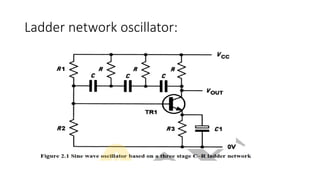
Ladder network oscillator:
• TR1 operates as a conventional common-emitter amplifier stage with
R1 and R2 providing base bias potential and R3 and C1 providing
emitter stabilization. The total phase shift provided by the C–R ladder
network (connected between collector and base) is 180° at the
frequency of oscillation.
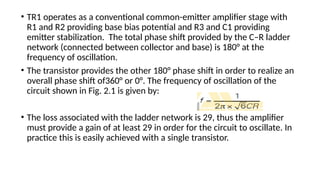
• The transistor provides the other 180° phase shift in order to realize an
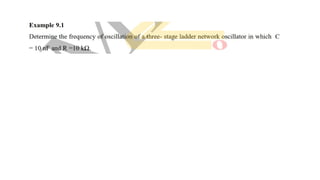
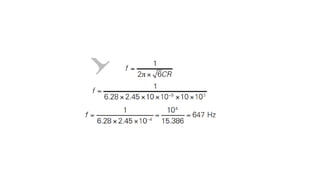
overall phase shift of360° or 0°. The frequency of oscillation of the
circuit shown in Fig. 2.1 is given by:
• The loss associated with the ladder network is 29, thus the amplifier
must provide a gain of at least 29 in order for the circuit to oscillate. In
practice this is easily achieved with a single transistor.
Wien bridge oscillator:

basic electronics module 2 introduction to basics

  • 1.
    Module 2 CO2: Understand aboutoscillators and operational amplifiers
  • 2.
    Syllabus Oscillators – Barkhausencriterion, sinusoidal and non-sinusoidal oscillators, Ladder network oscillator, Wein bridge oscillator, Multivibrators, Single-stage astable oscillator, Crystal controlled oscillators (Only Concepts, working, and waveforms. No mathematical derivations) Operational amplifiers -Operational amplifier parameters, Operational amplifier characteristics, Operational amplifier configurations, Operational amplifier circuits. Text 1) • 1.Mike Tooley, ‘Electronic Circuits, Fundamentals & Applications’,4thEdition, Elsevier, 2015.
  • 3.
    Oscillators: •An oscillator isa circuit which produces a continuous, repeated, alternating waveform without any input. •Oscillators basically convert unidirectional current flow from a DC source into an alternating waveform which is of the desired frequency, as decided by its circuit components.
  • 4.
    Conditions for Oscillation(Barkhausen criterion): Two conditions (a) The feedback must be positive (i.e. the signal fed back must arrive back in-phase with the signal at the input); (b) The overall loop voltage gain must be greater than 1 (i.e. the amplifier’s gain must be sufficient to overcome the losses associated with any frequency selective feedback network). Hence, to create an oscillator we simply need an amplifier with sufficient gain to overcome the losses of the network that provide positive feedback.
  • 5.
    Types of Oscillators: Oscillatorscan broadly be classified into two main categories •  Sinusoidal or Harmonic Oscillators (also known as Linear Oscillators) • Non Sinusoidal or Relaxation Oscillators.
  • 6.
    •In a sinusoidaloscillator, the energy flow is always from the active components to the passive components and the frequency of oscillations is decided by the feedback path. •Further, sinusoidal oscillators produce low- distorted sine-wave outputs
  • 7.
    •Whereas in arelaxation oscillator, the energy is exchanged between the active and the passive components and the frequency of oscillations is determined by the charging and discharging time- constants involved in the process. The relaxation oscillators generate non-sinusoidal (saw-tooth, triangular or square) wave-forms.
  • 8.
  • 9.
    • TR1 operatesas a conventional common-emitter amplifier stage with R1 and R2 providing base bias potential and R3 and C1 providing emitter stabilization. The total phase shift provided by the C–R ladder network (connected between collector and base) is 180° at the frequency of oscillation. • The transistor provides the other 180° phase shift in order to realize an overall phase shift of360° or 0°. The frequency of oscillation of the circuit shown in Fig. 2.1 is given by: • The loss associated with the ladder network is 29, thus the amplifier must provide a gain of at least 29 in order for the circuit to oscillate. In practice this is easily achieved with a single transistor.
  • 12.