
Real-time 
• A real-time operating system is a multi tasking operating system that aims at 
executing real-time applications. 
• The main objective of real-time operating systems is their quick and response 
to events. They have an event-driven or time-sharing design and often aspects 
of both. 
• An event-driven system switches between tasks based on their importance or 
external events while time-sharing operating systems switch tasks based on 
clock interrupts. 
• Time-sharing operating systems schedule tasks for efficient use of the system 
and may also include accounting software for cost allocation of processor time, 
mass storage, printing, and other resources.
Multi-user 
– A multi-user operating system allows multiple users to access a computer 
system at the same time. 
– Time-sharing systems and Internet servers can be classified as multi-user 
systems as they enable multiple-user access to a computer through the 
sharing of time. 
– Single-user operating systems have only one user but may allow multiple 
programs to run at the same time.
Distributed 
• A distributed operating system manages a group of independent 
computers and makes them appear to be a single computer. 
• The development of networked computers that could be linked and 
communicate with each other gave rise to distributed computing. 
• Distributed computations are carried out on more than one machine. 
When computers in a group work in cooperation, they make a 
distributed system.
Embedded 
• Embedded operating systems are designed to be used in embedded 
computer systems. 
• They are designed to operate on small machines like PDAs with less 
autonomy. 
• They are able to operate with a limited number of resources. They are 
very compact and extremely efficient by design. 
• Windows CE and Minix 3 are some examples of embedded operating 
systems.
• Mac OS is a series of graphical user interface-based operating systems developed 
by Apple Inc. 
• Apple operating system was released on 1984. 
• It was developed for the Macintosh line of computer systems. 
• The Macintosh, specifically its system software, is credited with having popularized 
the early graphical user interface concept 
• All of Apple’s designs are quite simple and unique.
Development 
• Mac os is an operating system, based on Unix’s the NeXTSTEP operating system 
and the XNU kernel. 
• OS X is based upon the Mach kernel. Certain parts from FreeBSD's and NetBSD's 
implementation of Unix were incorporated in NeXTSTEP, the core of Mac OS X. 
• NeXTSTEP was the graphical, object-oriented, and UNIX-based operating system 
developed by Steve Jobs' company NeXT after he left Apple in 1985. While Jobs 
was away from Apple. 
• The project was first known as Rhapsody and was later renamed to Mac OS X.
• Mac os was referred to as the "System". 
• Referred to by its major version starting with "System 6 and "System 7“. 
• Apple rebranded version 7.6 as "Mac OS" as part of their Macintosh clone program 1996 
• Macintosh operating systems have been released in two major series. 
• Up to major version 9, from 1984 to 2000, it is historically known as Classic Mac • Major version 10, from 2001 to present, is branded OS X(originally referred to OS X)

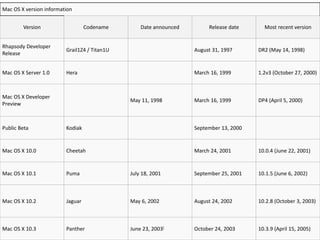
Mac OS X version information 
Version Codename Date announced Release date Most recent version 
Rhapsody Developer 
Release 
Grail1Z4 / Titan1U August 31, 1997 DR2 (May 14, 1998) 
Mac OS X Server 1.0 Hera March 16, 1999 1.2v3 (October 27, 2000) 
Mac OS X Developer 
Preview 
May 11, 1998 March 16, 1999 DP4 (April 5, 2000) 
Public Beta Kodiak September 13, 2000 
Mac OS X 10.0 Cheetah March 24, 2001 10.0.4 (June 22, 2001) 
Mac OS X 10.1 Puma July 18, 2001 September 25, 2001 10.1.5 (June 6, 2002) 
Mac OS X 10.2 Jaguar May 6, 2002 August 24, 2002 10.2.8 (October 3, 2003) 
Mac OS X 10.3 Panther June 23, 2003[ October 24, 2003 10.3.9 (April 15, 2005)
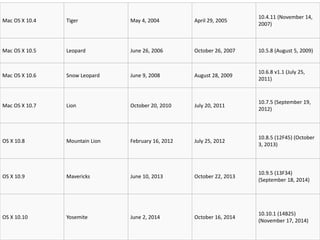
Mac OS X 10.4 Tiger May 4, 2004 April 29, 2005 
10.4.11 (November 14, 
2007) 
Mac OS X 10.5 Leopard June 26, 2006 October 26, 2007 10.5.8 (August 5, 2009) 
Mac OS X 10.6 Snow Leopard June 9, 2008 August 28, 2009 
10.6.8 v1.1 (July 25, 
2011) 
Mac OS X 10.7 Lion October 20, 2010 July 20, 2011 
10.7.5 (September 19, 
2012) 
OS X 10.8 Mountain Lion February 16, 2012 July 25, 2012 
10.8.5 (12F45) (October 
3, 2013) 
OS X 10.9 Mavericks June 10, 2013 October 22, 2013 
10.9.5 (13F34) 
(September 18, 2014) 
OS X 10.10 Yosemite June 2, 2014 October 16, 2014 
10.10.1 (14B25) 
(November 17, 2014)
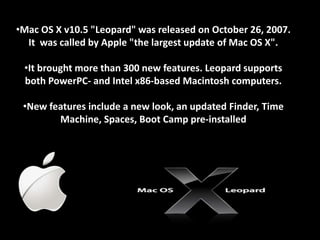
•Mac OS X v10.5 "Leopard" was released on October 26, 2007. 
It was called by Apple "the largest update of Mac OS X". 
•It brought more than 300 new features. Leopard supports 
both PowerPC- and Intel x86-based Macintosh computers. 
•New features include a new look, an updated Finder, Time 
Machine, Spaces, Boot Camp pre-installed
•OS X v10.8 "Mountain Lion" was released on July 25, 2012. It 
incorporates some features seen in iOS 5, which 
include Game Center, support for iMessage in the 
new Messages messaging application, and Reminders as a to-do 
list app separate from 
•It also includes support for storing iWork documents 
in iCloud. Notification Center iCal (which is renamed as 
Calendar, like the iOS app).
•OS X 10.9 "Mavericks" was released on October 22, 2013. 
This is a free upgrade to all users running OS X Snow 
Leopard or later. Its changes include the addition of the 
previously iOS-only Maps and iBook's applications, 
improvements to the Notification Center, enhancements 
to several applications, and many under-the-hood 
improvements
YOSEMITE 
•OS X 10.10 "Yosemite" was released on October 16, 2014. 
Apple's showcase new feature in Yosemite is Handoff, 
which lets users with iPhones running iOS 8.1 or later to 
answer phone calls, receive and send SMS messages, and 
complete unfinished iPhone emails on their Mac.
• Microsoft Windows or Windows is a 
superfamily of graphical operating 
systems developed, marketed, and sold 
by Microsoft. It consists of several families 
of operating systems, each of which cater to 
a certain sector of the computing industry.
MICROSOFT WINDOWS 
• Microsoft introduced an operating 
environment named Windows on November 20, 
1985 as a graphical operating system shell for MS-DOS 
in response to the growing interest in graphical 
user interfaces (GUIs). 
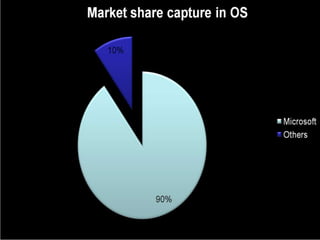
• Microsoft Windows came to dominate the 
world's personal computer market with over 90% 
market share, overtaking Mac OS, which had been 
introduced in 1984. However, it is outsold 
by Android on smartphones and tablets
Name 
Release 
date 
Release 
version 
number 
Editions 
Windows 10 TBA NT 10.0[1] •TBA 
Windows 8.1 18 October 2013 NT 6.3 
•Windows 8.1 
•Windows 8.1 Pro 
•Windows 8.1 Enterprise 
Windows 8 26 October 2012 NT 6.2 
•Windows 8 
•Windows 8 Pro 
•Windows 8 Enterprise 
See Windows 8 editions 
In this section, a client version of Windows is a version that can be purchased and installed on personal •Windows 7 Home Basic
• MS-DOS is a non-graphical command 
line operating system derived from 
86-DOS that was created for IBM 
compatible computers. 
• MS-DOS originally written by Tim 
Paterson and introduced by Microsoft 
in August 1981 and was last updated 
in 1994 when MS-DOS 6.22 was 
released. 
• Today, MS-DOS is no longer used; 
however, the command shell, more 
commonly known as the Windows 
command line is still used by many 
users.
WINDOWS XP 
• Windows XP is a personal computer operating 
system produced by Microsoft as part of the Windows 
NT family of operating systems. The operating system was 
released to manufacturing on August 24, 2001 
• WINDOWSXP was a major advance from the MS-DOS 
based versions of Windows in security, stability and 
efficiencygenerally released for retail sale on Windows XP 
eventually proved to be popular and widely used 
• . It is estimated that at least 400 million copies of Windows XP 
were sold globally within its first five years of 
availabilityOctober 25, 2001
WINDOWS 7 
• Windows XP remained popular 
even after the release of newer 
versions, particularly due to the 
poorly received release of its 
successor Windows Vista. Vista's 
2009 successor, Windows 7, only 
overtook XP 
• Windows 7 is a personal 
computer operating 
system developed by Microsoft,n 
total market share at the end of
WINDOWS 8 
• Windows 8 introduced major changes to the 
operating system's platform and user 
interface to improve its user experience 
on tablets, where Windows was now 
competing with mobile operating systems, 
including Android and iOS. 
• In particular, these changes included a 
touch-optimized Windows shell based on 
Microsoft's "Metro" design language,
WINDOWS 8 
• . Windows 8 added support for USB 
3.0, Advanced Format hard 
drives, near field communications, 
and cloud computing. Additional 
security features were introduced, 
such as built-in antivirus software, 
integration with Microsoft 
SmartScreen phishing 
filtering service and support forUEFI 
Secure Boot on supported devices 
with UEFI firmware, to 
prevent malware from infecting the 
boot process.
• WindoWS 8.1 is a version of 
the Windows NT operating system and 
an upgrade for Windows8 
• Windows 8.1 cannot be acquired 
via Windows Update and only accepts 
8.1-specific product keys.
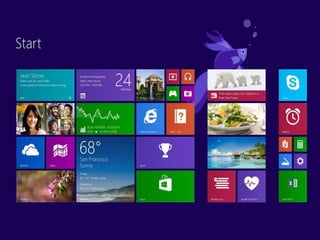
WINDOWS 8.1 
• Start faster 
• Search 
everywhere 
• Multitask with 
apps 
• Browse better
Comparison based on 
 Supporters Opinions 
 Cost 
 Crashes/Vulnerabilities 
 Software Compatibility
Introduction 
 Several users of Windows-based PCs simply 
use them because they are most familiar with 
them. Several users of Macs are strong 
supporters of the operating system because 
they feel the graphics are far superior to that 
of Windows. I weighed the pros and cons of 
both operating systems and hope to give 
future computer buyers an idea of which will 
best fit their needs.
Supporters
PC Supporters 
PC Supporters prefer PCs because they find 
they are cheaper than Macs. 
Supporters of PCs also prefer them simply 
because they are more familiar with them 
than Macs. PCs are more likely to be found in 
the office place, library, or school than Macs 
are.
Mac Supporters 
Supporters of Macs prefer them because they 
prefer the design of Macs over that of the PC. 
Macs also have better graphics for playing 
video games, creating computer art, etc. 
Mac supporters also prefer Macs over PCs 
because they are less prone to viruses. 
Hackers are more drawn towards PCs because 
they make up most of the computer market.
Cost Cost
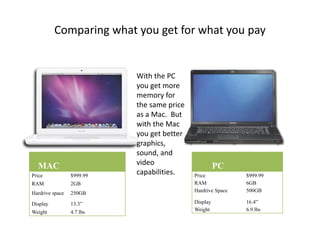
Comparing what you get for what you pay 
MAC 
Price $999.99 
RAM 2GB 
Hardrive space 250GB 
Display 13.3” 
Weight 4.7 lbs 
PC 
Price $999.99 
RAM 6GB 
Hardrive Space 500GB 
Display 16.4” 
Weight 6.9 lbs 
With the PC 
you get more 
memory for 
the same price 
as a Mac. But 
with the Mac 
you get better 
graphics, 
sound, and 
video 
capabilities.
Vulnerabilities between Macs and PCs
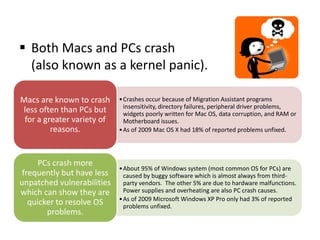
 Both Macs and PCs crash 
(also known as a kernel panic). 
•Crashes occur because of Migration Assistant programs 
insensitivity, directory failures, peripheral driver problems, 
widgets poorly written for Mac OS, data corruption, and RAM or 
Motherboard issues. 
•As of 2009 Mac OS X had 18% of reported problems unfixed. 
Macs are known to crash 
less often than PCs but 
for a greater variety of 
reasons. 
•About 95% of Windows system (most common OS for PCs) are 
caused by buggy software which is almost always from third-party 
vendors. The other 5% are due to hardware malfunctions. 
Power supplies and overheating are also PC crash causes. 
•As of 2009 Microsoft Windows XP Pro only had 3% of reported 
problems unfixed. 
PCs crash more 
frequently but have less 
unpatched vulnerabilities 
which can show they are 
quicker to resolve OS 
problems.
Software Compatibility 
Mac platforms have fewer software 
applications available as compared to 
Windows based PC software. In fact, one of 
the best-selling software programs for Macs is 
a Microsoft Office program, a popular PC 
software suite. 
Currently, there are only 24 software 
programs that have been identified that are 
not compatible with Windows Vista based 
PCs.
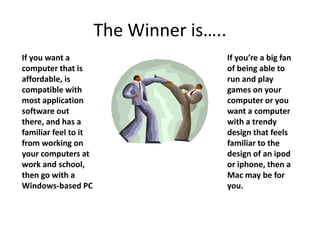
The Winner is….. 
If you want a 
computer that is 
affordable, is 
compatible with 
most application 
software out 
there, and has a 
familiar feel to it 
from working on 
your computers at 
work and school, 
then go with a 
Windows-based PC 
If you’re a big fan 
of being able to 
run and play 
games on your 
computer or you 
want a computer 
with a trendy 
design that feels 
familiar to the 
design of an ipod 
or iphone, then a 
Mac may be for 
you.
•Unix is a multi-tasking, multi-user Operating System which was 
developed by Dennis Ritchie and Ken Thompson in the AT&T Bell 
Laboratories. 
•It provides a set of simple tools that performs limited, well defined 
functions with a unified file system as the main means of 
communication. 
•It is mainly based on the C language developed by Dennis Ritchie. 
•It also has a shell scripting feature and a command language to help 
perform complex functions. 
•A shell is a command line interpreter for Unix’s command language.
•The Linux Kernel or Linux as it is commonly called, is a UNIX based OS which is a free 
and open-source OS. 
•It was developed in October 10, 1991 by Linus Torvalds primarily for his personal 
use. 
•When Linux came to the limelight it began to rapidly spread among computer 
enthusiasts mainly because it is an open-source and free OS. 
•It easily provides complete control over the hardware, therefore the hardware can 
be easily used up to it’s complete potential. 
•Also it provided a GUI so it became relatively easy for both the common people and 
the computer enthusiasts and they preferred it to Windows and MacOS because it 
was free of cost.
•Debian is actually not a single OS. It is rather a name for various 
Operating Systems, which come under a single name. 
•These operating systems are Open Source and they all come under the 
GNU General Public License. 
•It may be based on either of the two kernels of which one is Linux 
based and the other is kFreeBSD. 
•It was announced in 1993 by Ian Murdock and released in 1996. 
•It consists of the source codes of the various freeware which are 
available as open source software.
•SteamOS is a Debian Linux kernel-based operating system in development 
by Valve Corporation designed to be the primary operating system for 
the Steam Machine game consoles. 
•It was released in December 13, 2013. 
•Primarily designed for playing video games and high-end graphical uses. 
•Users will be able to stream games from their Windows and Mac systems to 
their Steam devices.
Special features make 
it easy to add new 
capability or to fix problems 
without having to restart the system. Solaris has exercised 
and fixed almost any code path that might break.It can be 
upgraded, monitored, and controlled from a remote console
• you move to a larger processor, your applications should 
not only run, but run faster. Solaris can handle heavy 
multi-tasking work. 
you move to a larger processor, 
your applications should not only run, but run faster. 
Solaris can handle heavy multi-tasking work.
>Fully virus protected. 
>It can handle 
many users at 
a time. 
>Reboot is not 
required for Solaris 
so it can run 24/7.
>Lack of good GUI. 
>This OS is not user friendly. 
>It is not recommended to run 
Solaris on other architectures.
Google Chrome 
Operating System is new 
invention by search engine giant Google. 
Google Chrome Operating System is an open 
source , lightweight Operating System. 
Its based on Google's Chrome Web Browser and 
Linux Kernel.
>>Speed, simplicity and security 
>>fast and less memory-intensive,enabling 
users to access the web in a few seconds 
>>Google provides 
the security from virus, malware and security updates. 
. 
FEATURES
This operating system is entirly different from other OS 
It is working based on the principle of cloud computing , 
storing every data in the internet rather then 
storing in your hard disk.
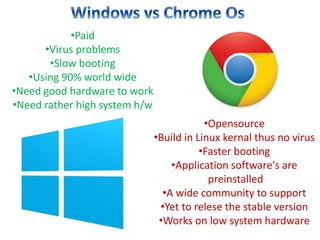
•Opensource 
•Build in Linux kernal thus no virus 
•Faster booting 
•Application software's are 
preinstalled 
•A wide community to support 
•Yet to relese the stable version 
•Works on low system hardware 
•Paid 
•Virus problems 
•Slow booting 
•Using 90% world wide 
•Need good hardware to work 
•Need rather high system h/w
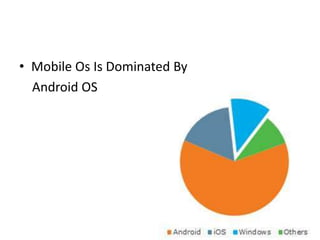
• Mobile Os Is Dominated By 
Android OS
Os ppt full content
Os ppt full content

Os ppt full content

  • 4.
    Real-time • Areal-time operating system is a multi tasking operating system that aims at executing real-time applications. • The main objective of real-time operating systems is their quick and response to events. They have an event-driven or time-sharing design and often aspects of both. • An event-driven system switches between tasks based on their importance or external events while time-sharing operating systems switch tasks based on clock interrupts. • Time-sharing operating systems schedule tasks for efficient use of the system and may also include accounting software for cost allocation of processor time, mass storage, printing, and other resources.
  • 5.
    Multi-user – Amulti-user operating system allows multiple users to access a computer system at the same time. – Time-sharing systems and Internet servers can be classified as multi-user systems as they enable multiple-user access to a computer through the sharing of time. – Single-user operating systems have only one user but may allow multiple programs to run at the same time.
  • 6.
    Distributed • Adistributed operating system manages a group of independent computers and makes them appear to be a single computer. • The development of networked computers that could be linked and communicate with each other gave rise to distributed computing. • Distributed computations are carried out on more than one machine. When computers in a group work in cooperation, they make a distributed system.
  • 7.
    Embedded • Embeddedoperating systems are designed to be used in embedded computer systems. • They are designed to operate on small machines like PDAs with less autonomy. • They are able to operate with a limited number of resources. They are very compact and extremely efficient by design. • Windows CE and Minix 3 are some examples of embedded operating systems.
  • 9.
    • Mac OSis a series of graphical user interface-based operating systems developed by Apple Inc. • Apple operating system was released on 1984. • It was developed for the Macintosh line of computer systems. • The Macintosh, specifically its system software, is credited with having popularized the early graphical user interface concept • All of Apple’s designs are quite simple and unique.
  • 10.
    Development • Macos is an operating system, based on Unix’s the NeXTSTEP operating system and the XNU kernel. • OS X is based upon the Mach kernel. Certain parts from FreeBSD's and NetBSD's implementation of Unix were incorporated in NeXTSTEP, the core of Mac OS X. • NeXTSTEP was the graphical, object-oriented, and UNIX-based operating system developed by Steve Jobs' company NeXT after he left Apple in 1985. While Jobs was away from Apple. • The project was first known as Rhapsody and was later renamed to Mac OS X.
  • 11.
    • Mac oswas referred to as the "System". • Referred to by its major version starting with "System 6 and "System 7“. • Apple rebranded version 7.6 as "Mac OS" as part of their Macintosh clone program 1996 • Macintosh operating systems have been released in two major series. • Up to major version 9, from 1984 to 2000, it is historically known as Classic Mac • Major version 10, from 2001 to present, is branded OS X(originally referred to OS X)
  • 12.
    Mac OS Xversion information Version Codename Date announced Release date Most recent version Rhapsody Developer Release Grail1Z4 / Titan1U August 31, 1997 DR2 (May 14, 1998) Mac OS X Server 1.0 Hera March 16, 1999 1.2v3 (October 27, 2000) Mac OS X Developer Preview May 11, 1998 March 16, 1999 DP4 (April 5, 2000) Public Beta Kodiak September 13, 2000 Mac OS X 10.0 Cheetah March 24, 2001 10.0.4 (June 22, 2001) Mac OS X 10.1 Puma July 18, 2001 September 25, 2001 10.1.5 (June 6, 2002) Mac OS X 10.2 Jaguar May 6, 2002 August 24, 2002 10.2.8 (October 3, 2003) Mac OS X 10.3 Panther June 23, 2003[ October 24, 2003 10.3.9 (April 15, 2005)
  • 13.
    Mac OS X10.4 Tiger May 4, 2004 April 29, 2005 10.4.11 (November 14, 2007) Mac OS X 10.5 Leopard June 26, 2006 October 26, 2007 10.5.8 (August 5, 2009) Mac OS X 10.6 Snow Leopard June 9, 2008 August 28, 2009 10.6.8 v1.1 (July 25, 2011) Mac OS X 10.7 Lion October 20, 2010 July 20, 2011 10.7.5 (September 19, 2012) OS X 10.8 Mountain Lion February 16, 2012 July 25, 2012 10.8.5 (12F45) (October 3, 2013) OS X 10.9 Mavericks June 10, 2013 October 22, 2013 10.9.5 (13F34) (September 18, 2014) OS X 10.10 Yosemite June 2, 2014 October 16, 2014 10.10.1 (14B25) (November 17, 2014)
  • 14.
    •Mac OS Xv10.5 "Leopard" was released on October 26, 2007. It was called by Apple "the largest update of Mac OS X". •It brought more than 300 new features. Leopard supports both PowerPC- and Intel x86-based Macintosh computers. •New features include a new look, an updated Finder, Time Machine, Spaces, Boot Camp pre-installed
  • 15.
    •OS X v10.8"Mountain Lion" was released on July 25, 2012. It incorporates some features seen in iOS 5, which include Game Center, support for iMessage in the new Messages messaging application, and Reminders as a to-do list app separate from •It also includes support for storing iWork documents in iCloud. Notification Center iCal (which is renamed as Calendar, like the iOS app).
  • 16.
    •OS X 10.9"Mavericks" was released on October 22, 2013. This is a free upgrade to all users running OS X Snow Leopard or later. Its changes include the addition of the previously iOS-only Maps and iBook's applications, improvements to the Notification Center, enhancements to several applications, and many under-the-hood improvements
  • 17.
    YOSEMITE •OS X10.10 "Yosemite" was released on October 16, 2014. Apple's showcase new feature in Yosemite is Handoff, which lets users with iPhones running iOS 8.1 or later to answer phone calls, receive and send SMS messages, and complete unfinished iPhone emails on their Mac.
  • 20.
    • Microsoft Windowsor Windows is a superfamily of graphical operating systems developed, marketed, and sold by Microsoft. It consists of several families of operating systems, each of which cater to a certain sector of the computing industry.
  • 21.
    MICROSOFT WINDOWS •Microsoft introduced an operating environment named Windows on November 20, 1985 as a graphical operating system shell for MS-DOS in response to the growing interest in graphical user interfaces (GUIs). • Microsoft Windows came to dominate the world's personal computer market with over 90% market share, overtaking Mac OS, which had been introduced in 1984. However, it is outsold by Android on smartphones and tablets
  • 22.
    Name Release date Release version number Editions Windows 10 TBA NT 10.0[1] •TBA Windows 8.1 18 October 2013 NT 6.3 •Windows 8.1 •Windows 8.1 Pro •Windows 8.1 Enterprise Windows 8 26 October 2012 NT 6.2 •Windows 8 •Windows 8 Pro •Windows 8 Enterprise See Windows 8 editions In this section, a client version of Windows is a version that can be purchased and installed on personal •Windows 7 Home Basic
  • 24.
    • MS-DOS isa non-graphical command line operating system derived from 86-DOS that was created for IBM compatible computers. • MS-DOS originally written by Tim Paterson and introduced by Microsoft in August 1981 and was last updated in 1994 when MS-DOS 6.22 was released. • Today, MS-DOS is no longer used; however, the command shell, more commonly known as the Windows command line is still used by many users.
  • 26.
    WINDOWS XP •Windows XP is a personal computer operating system produced by Microsoft as part of the Windows NT family of operating systems. The operating system was released to manufacturing on August 24, 2001 • WINDOWSXP was a major advance from the MS-DOS based versions of Windows in security, stability and efficiencygenerally released for retail sale on Windows XP eventually proved to be popular and widely used • . It is estimated that at least 400 million copies of Windows XP were sold globally within its first five years of availabilityOctober 25, 2001
  • 28.
    WINDOWS 7 •Windows XP remained popular even after the release of newer versions, particularly due to the poorly received release of its successor Windows Vista. Vista's 2009 successor, Windows 7, only overtook XP • Windows 7 is a personal computer operating system developed by Microsoft,n total market share at the end of
  • 30.
    WINDOWS 8 •Windows 8 introduced major changes to the operating system's platform and user interface to improve its user experience on tablets, where Windows was now competing with mobile operating systems, including Android and iOS. • In particular, these changes included a touch-optimized Windows shell based on Microsoft's "Metro" design language,
  • 31.
    WINDOWS 8 •. Windows 8 added support for USB 3.0, Advanced Format hard drives, near field communications, and cloud computing. Additional security features were introduced, such as built-in antivirus software, integration with Microsoft SmartScreen phishing filtering service and support forUEFI Secure Boot on supported devices with UEFI firmware, to prevent malware from infecting the boot process.
  • 32.
    • WindoWS 8.1is a version of the Windows NT operating system and an upgrade for Windows8 • Windows 8.1 cannot be acquired via Windows Update and only accepts 8.1-specific product keys.
  • 33.
    WINDOWS 8.1 •Start faster • Search everywhere • Multitask with apps • Browse better
  • 36.
    Comparison based on  Supporters Opinions  Cost  Crashes/Vulnerabilities  Software Compatibility
  • 37.
    Introduction  Severalusers of Windows-based PCs simply use them because they are most familiar with them. Several users of Macs are strong supporters of the operating system because they feel the graphics are far superior to that of Windows. I weighed the pros and cons of both operating systems and hope to give future computer buyers an idea of which will best fit their needs.
  • 38.
  • 39.
    PC Supporters PCSupporters prefer PCs because they find they are cheaper than Macs. Supporters of PCs also prefer them simply because they are more familiar with them than Macs. PCs are more likely to be found in the office place, library, or school than Macs are.
  • 40.
    Mac Supporters Supportersof Macs prefer them because they prefer the design of Macs over that of the PC. Macs also have better graphics for playing video games, creating computer art, etc. Mac supporters also prefer Macs over PCs because they are less prone to viruses. Hackers are more drawn towards PCs because they make up most of the computer market.
  • 41.
  • 42.
    Comparing what youget for what you pay MAC Price $999.99 RAM 2GB Hardrive space 250GB Display 13.3” Weight 4.7 lbs PC Price $999.99 RAM 6GB Hardrive Space 500GB Display 16.4” Weight 6.9 lbs With the PC you get more memory for the same price as a Mac. But with the Mac you get better graphics, sound, and video capabilities.
  • 43.
  • 44.
     Both Macsand PCs crash (also known as a kernel panic). •Crashes occur because of Migration Assistant programs insensitivity, directory failures, peripheral driver problems, widgets poorly written for Mac OS, data corruption, and RAM or Motherboard issues. •As of 2009 Mac OS X had 18% of reported problems unfixed. Macs are known to crash less often than PCs but for a greater variety of reasons. •About 95% of Windows system (most common OS for PCs) are caused by buggy software which is almost always from third-party vendors. The other 5% are due to hardware malfunctions. Power supplies and overheating are also PC crash causes. •As of 2009 Microsoft Windows XP Pro only had 3% of reported problems unfixed. PCs crash more frequently but have less unpatched vulnerabilities which can show they are quicker to resolve OS problems.
  • 45.
    Software Compatibility Macplatforms have fewer software applications available as compared to Windows based PC software. In fact, one of the best-selling software programs for Macs is a Microsoft Office program, a popular PC software suite. Currently, there are only 24 software programs that have been identified that are not compatible with Windows Vista based PCs.
  • 46.
    The Winner is….. If you want a computer that is affordable, is compatible with most application software out there, and has a familiar feel to it from working on your computers at work and school, then go with a Windows-based PC If you’re a big fan of being able to run and play games on your computer or you want a computer with a trendy design that feels familiar to the design of an ipod or iphone, then a Mac may be for you.
  • 48.
    •Unix is amulti-tasking, multi-user Operating System which was developed by Dennis Ritchie and Ken Thompson in the AT&T Bell Laboratories. •It provides a set of simple tools that performs limited, well defined functions with a unified file system as the main means of communication. •It is mainly based on the C language developed by Dennis Ritchie. •It also has a shell scripting feature and a command language to help perform complex functions. •A shell is a command line interpreter for Unix’s command language.
  • 50.
    •The Linux Kernelor Linux as it is commonly called, is a UNIX based OS which is a free and open-source OS. •It was developed in October 10, 1991 by Linus Torvalds primarily for his personal use. •When Linux came to the limelight it began to rapidly spread among computer enthusiasts mainly because it is an open-source and free OS. •It easily provides complete control over the hardware, therefore the hardware can be easily used up to it’s complete potential. •Also it provided a GUI so it became relatively easy for both the common people and the computer enthusiasts and they preferred it to Windows and MacOS because it was free of cost.
  • 52.
    •Debian is actuallynot a single OS. It is rather a name for various Operating Systems, which come under a single name. •These operating systems are Open Source and they all come under the GNU General Public License. •It may be based on either of the two kernels of which one is Linux based and the other is kFreeBSD. •It was announced in 1993 by Ian Murdock and released in 1996. •It consists of the source codes of the various freeware which are available as open source software.
  • 54.
    •SteamOS is aDebian Linux kernel-based operating system in development by Valve Corporation designed to be the primary operating system for the Steam Machine game consoles. •It was released in December 13, 2013. •Primarily designed for playing video games and high-end graphical uses. •Users will be able to stream games from their Windows and Mac systems to their Steam devices.
  • 58.
    Special features make it easy to add new capability or to fix problems without having to restart the system. Solaris has exercised and fixed almost any code path that might break.It can be upgraded, monitored, and controlled from a remote console
  • 59.
    • you moveto a larger processor, your applications should not only run, but run faster. Solaris can handle heavy multi-tasking work. you move to a larger processor, your applications should not only run, but run faster. Solaris can handle heavy multi-tasking work.
  • 61.
    >Fully virus protected. >It can handle many users at a time. >Reboot is not required for Solaris so it can run 24/7.
  • 62.
    >Lack of goodGUI. >This OS is not user friendly. >It is not recommended to run Solaris on other architectures.
  • 68.
    Google Chrome OperatingSystem is new invention by search engine giant Google. Google Chrome Operating System is an open source , lightweight Operating System. Its based on Google's Chrome Web Browser and Linux Kernel.
  • 69.
    >>Speed, simplicity andsecurity >>fast and less memory-intensive,enabling users to access the web in a few seconds >>Google provides the security from virus, malware and security updates. . FEATURES
  • 70.
    This operating systemis entirly different from other OS It is working based on the principle of cloud computing , storing every data in the internet rather then storing in your hard disk.
  • 71.
    •Opensource •Build inLinux kernal thus no virus •Faster booting •Application software's are preinstalled •A wide community to support •Yet to relese the stable version •Works on low system hardware •Paid •Virus problems •Slow booting •Using 90% world wide •Need good hardware to work •Need rather high system h/w
  • 74.
    • Mobile OsIs Dominated By Android OS