Optimizing Query Answering
           under
  Ontological Constraints


  Giorgio Orsi1,2 and Andreas Pieris2
   1
       Institute for the Future of Computing
               Oxford Martin School
                University of Oxford
       2
           Department of Computer Science
                University of Oxford


                    VLDB 2011
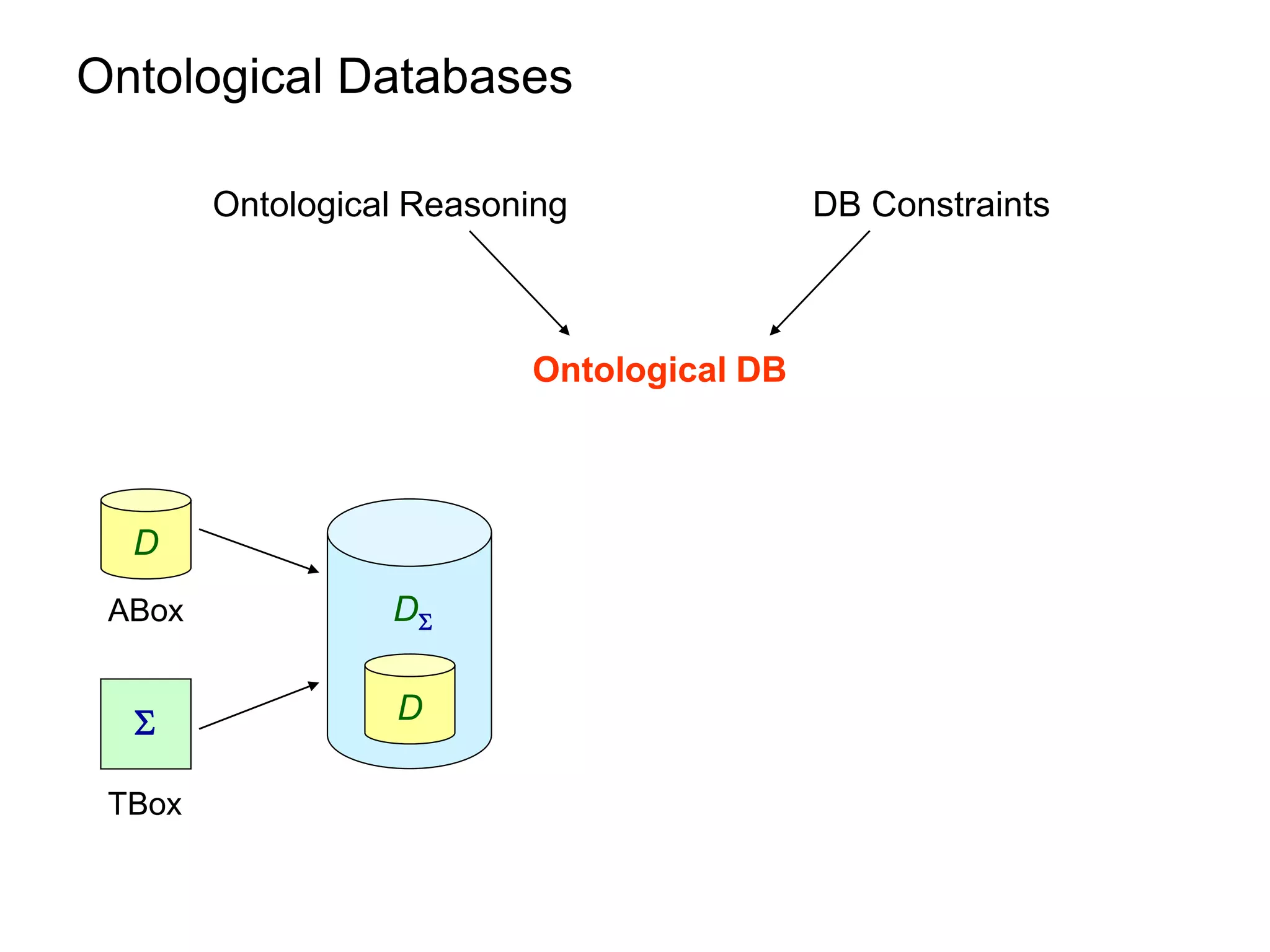
Ontological Databases

     Ontological Reasoning              DB Constraints


                       Ontological DB
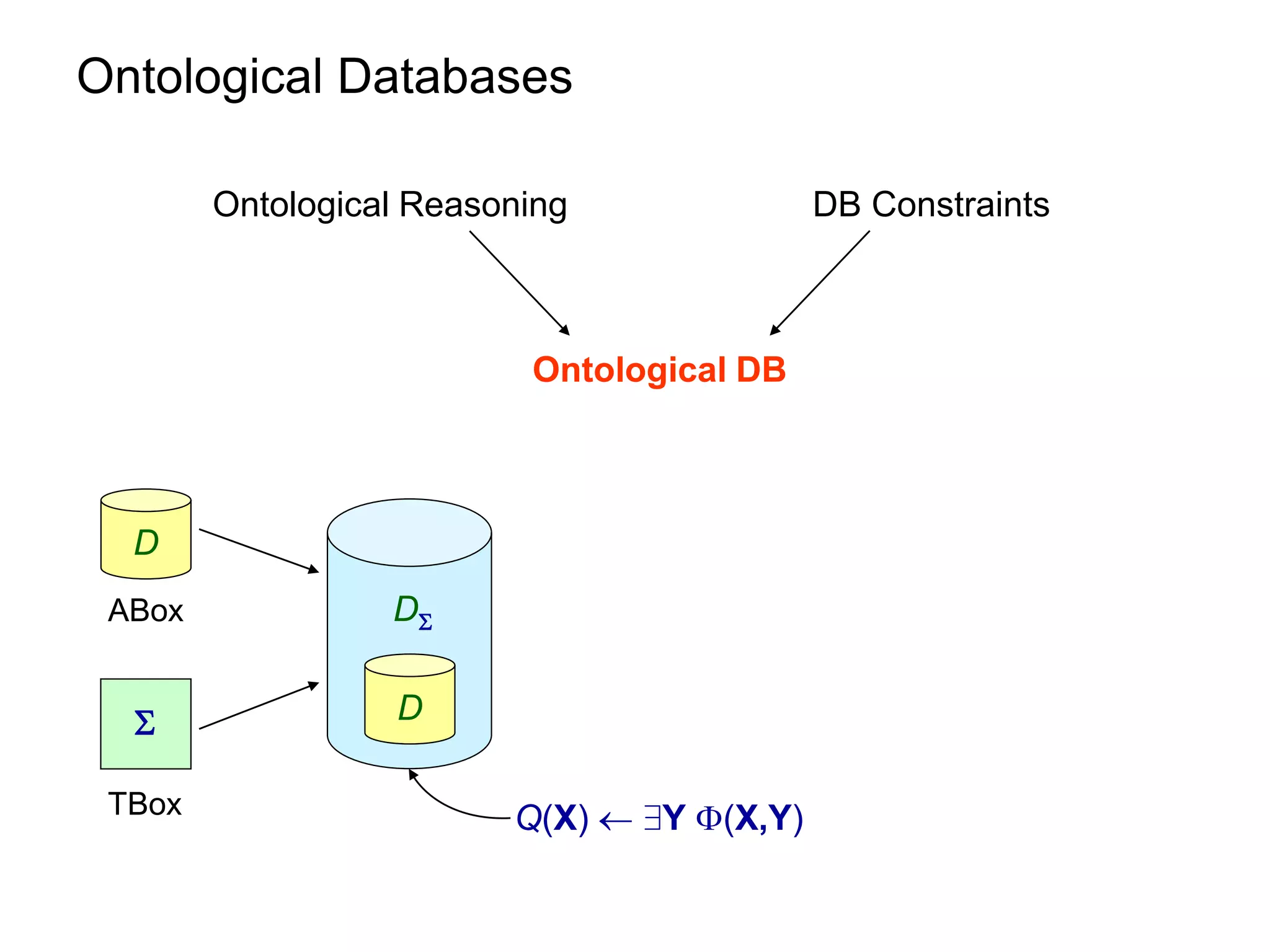
Ontological Databases

        Ontological Reasoning              DB Constraints


                          Ontological DB


  D
 ABox             D


                 D

 TBox
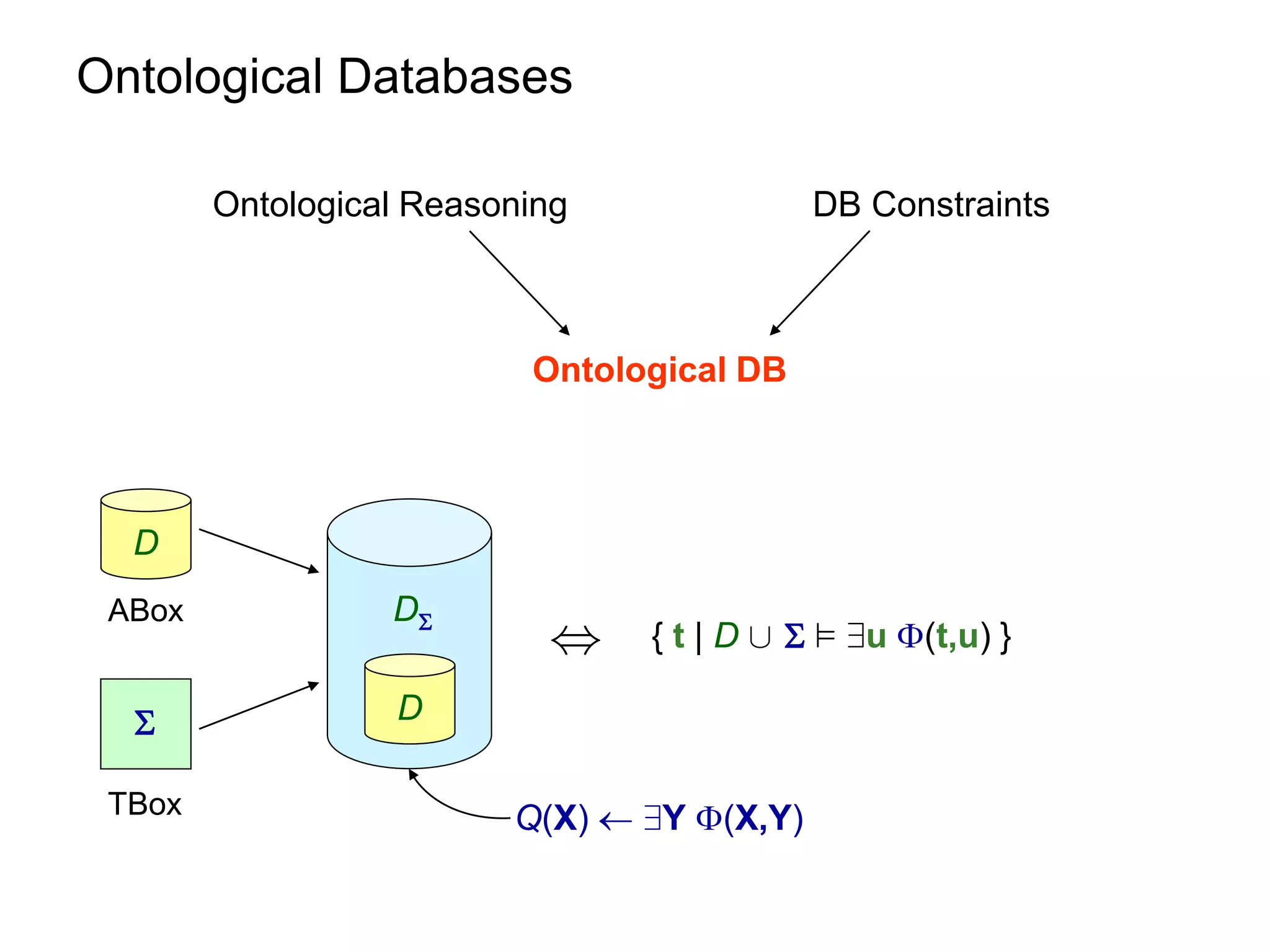
Ontological Databases

        Ontological Reasoning               DB Constraints


                          Ontological DB


  D
 ABox             D


                 D

 TBox                    Q(X)  9Y (X,Y)
Ontological Databases

        Ontological Reasoning               DB Constraints


                          Ontological DB


  D
 ABox             D
                           ,    { t | D [  ² 9u (t,u) }

                 D

 TBox                    Q(X)  9Y (X,Y)
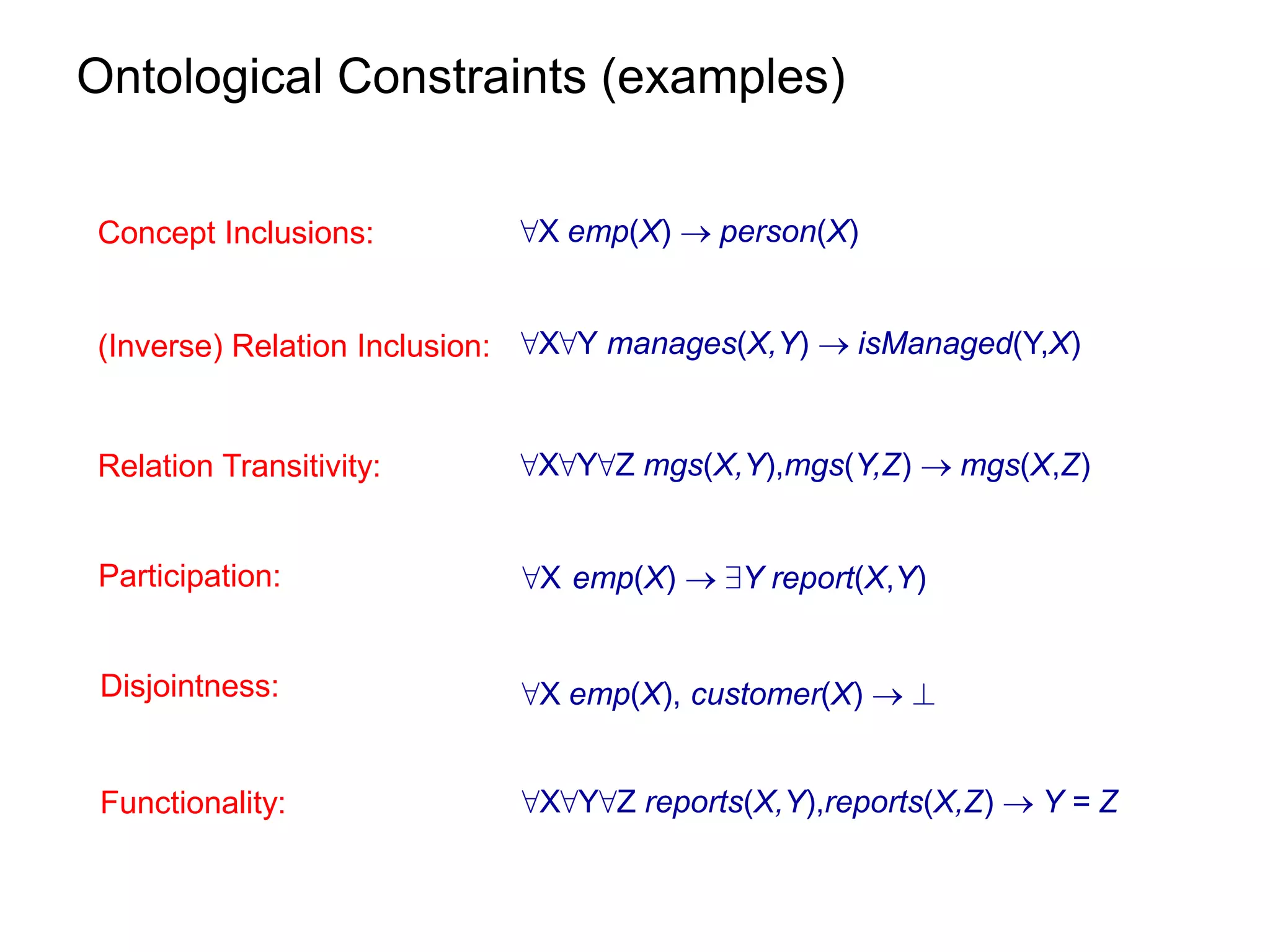
Ontological Constraints (examples)


Concept Inclusions:        8X emp(X)  person(X)


(Inverse) Relation Inclusion: 8X8Y manages(X,Y)  isManaged(Y,X)


Relation Transitivity:     8X8Y8Z mgs(X,Y),mgs(Y,Z)  mgs(X,Z)


Participation:             8X emp(X)  9Y report(X,Y)


 Disjointness:             8X emp(X), customer(X)  ?


 Functionality:            8X8Y8Z reports(X,Y),reports(X,Z)  Y = Z
Datalog§    [Cali’ et Al, PODS 09]


¡ Datalog variant allowing in the head:
       - 9-variables ! TGDs 8X8Y (X,Y)  9Z (X,Z)
       - Equality atoms ! EGDs 8X (X)  Xi=Xj        Datalog+
       - Constant false (?) ! NCs 8X (X)  ?
Datalog§      [Cali’ et Al, PODS 09]


¡ Datalog variant allowing in the head:
       - 9-variables ! TGDs 8X8Y (X,Y)  9Z (X,Z)
       - Equality atoms ! EGDs 8X (X)  Xi=Xj         Datalog+
       - Constant false (?) ! NCs 8X (X)  ?


¡ But, query answering under Datalog+ is undecidable
Datalog§      [Cali’ et Al, PODS 09]


¡ Datalog variant allowing in the head:
       - 9-variables ! TGDs 8X8Y (X,Y)  9Z (X,Z)
       - Equality atoms ! EGDs 8X (X)  Xi=Xj         Datalog+
       - Constant false (?) ! NCs 8X (X)  ?


¡ But, query answering under Datalog+ is undecidable


¡ Datalog+ is syntactically restricted ! Datalog§
Datalog§      [Cali’ et Al, PODS 09]


¡ Datalog variant allowing in the head:
       - 9-variables ! TGDs 8X8Y (X,Y)  9Z (X,Z)
       - Equality atoms ! EGDs 8X (X)  Xi=Xj          Datalog+
       - Constant false (?) ! NCs 8X (X)  ?


¡ But, query answering under Datalog+ is undecidable


¡ Datalog+ is syntactically restricted ! Datalog§


¡ TGDs more expressive than inclusion dependencies

      8D8P8A runs(D,P),area(P,A)  9E employee(E,D,A)
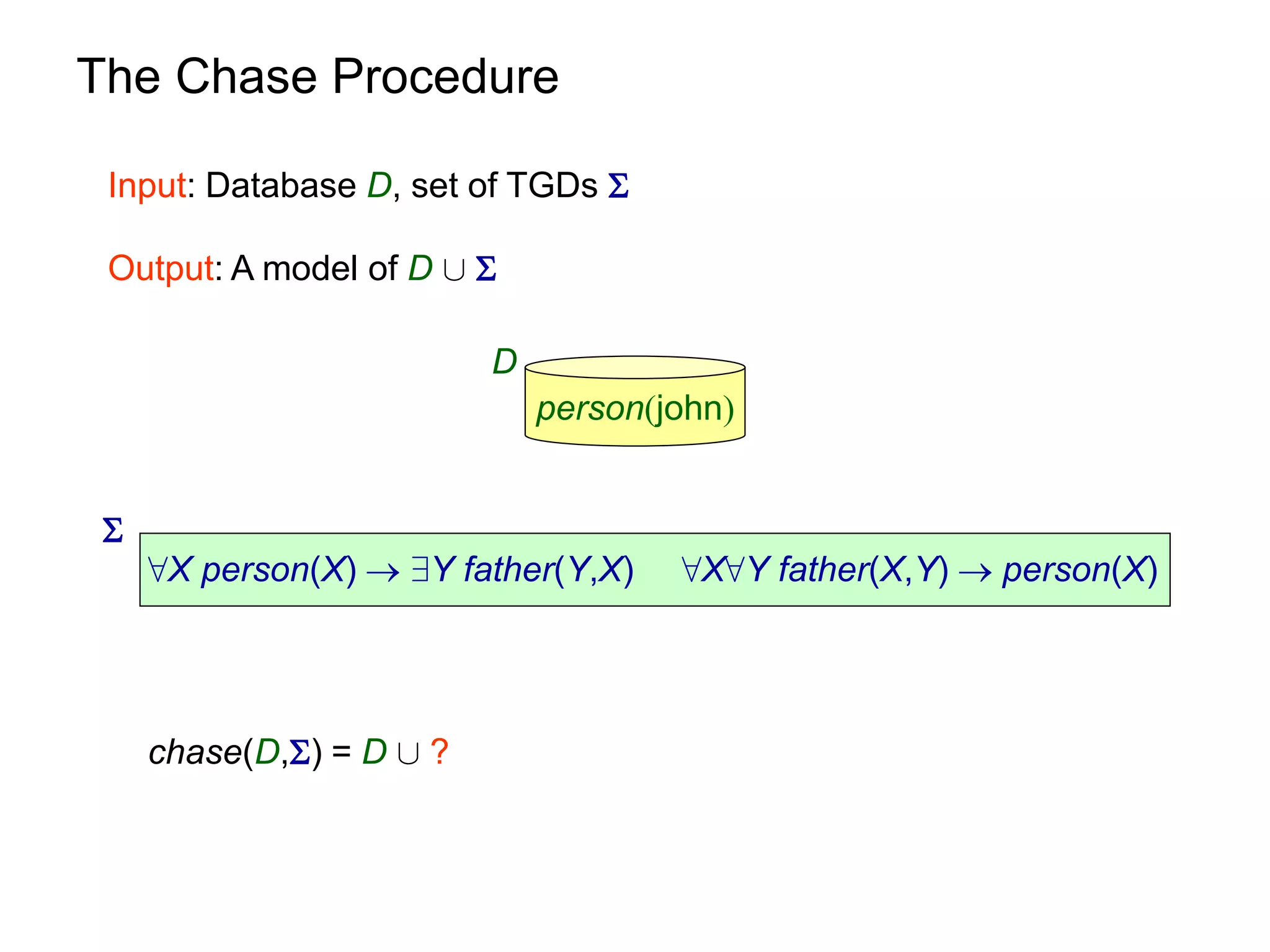
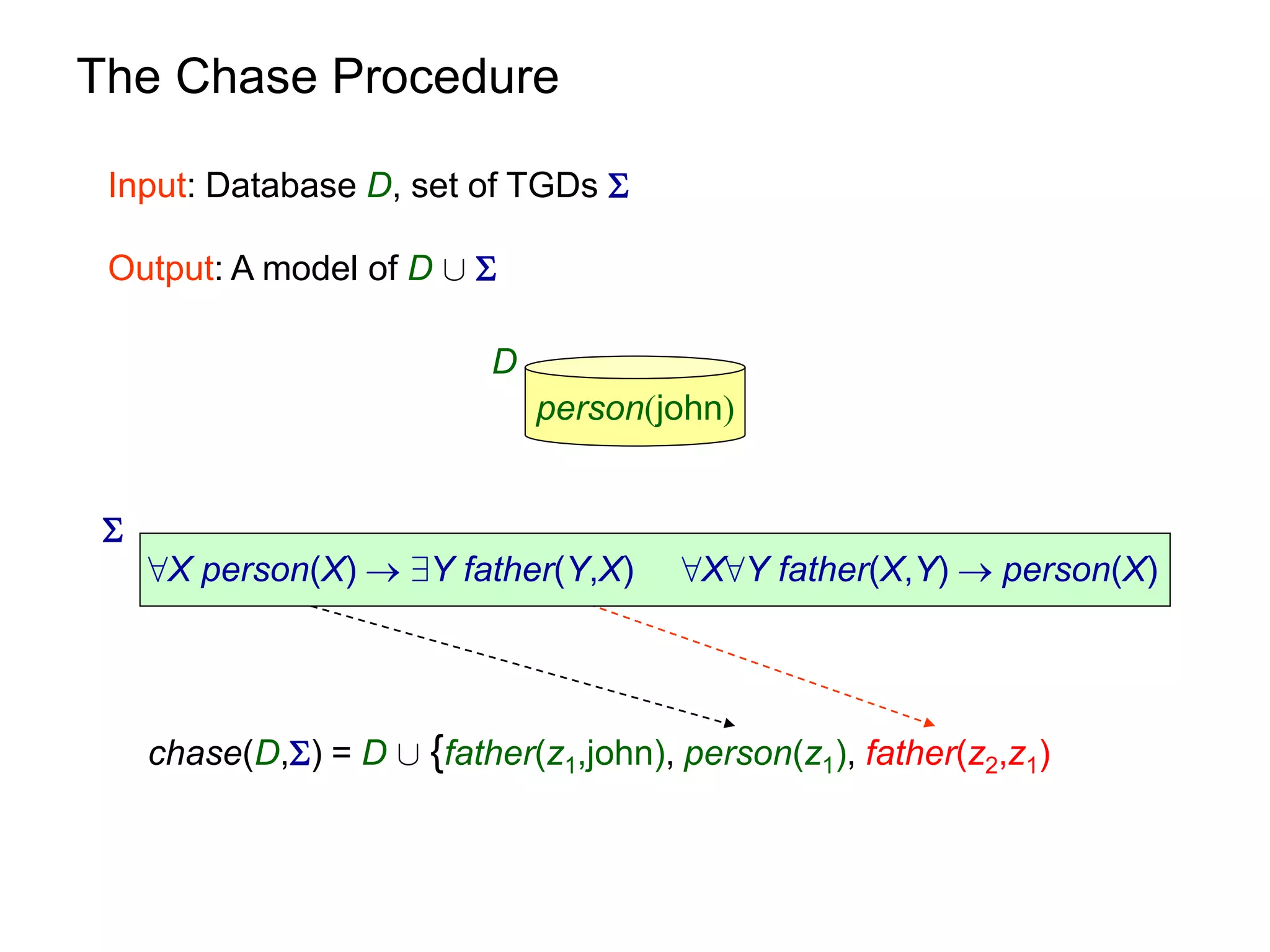
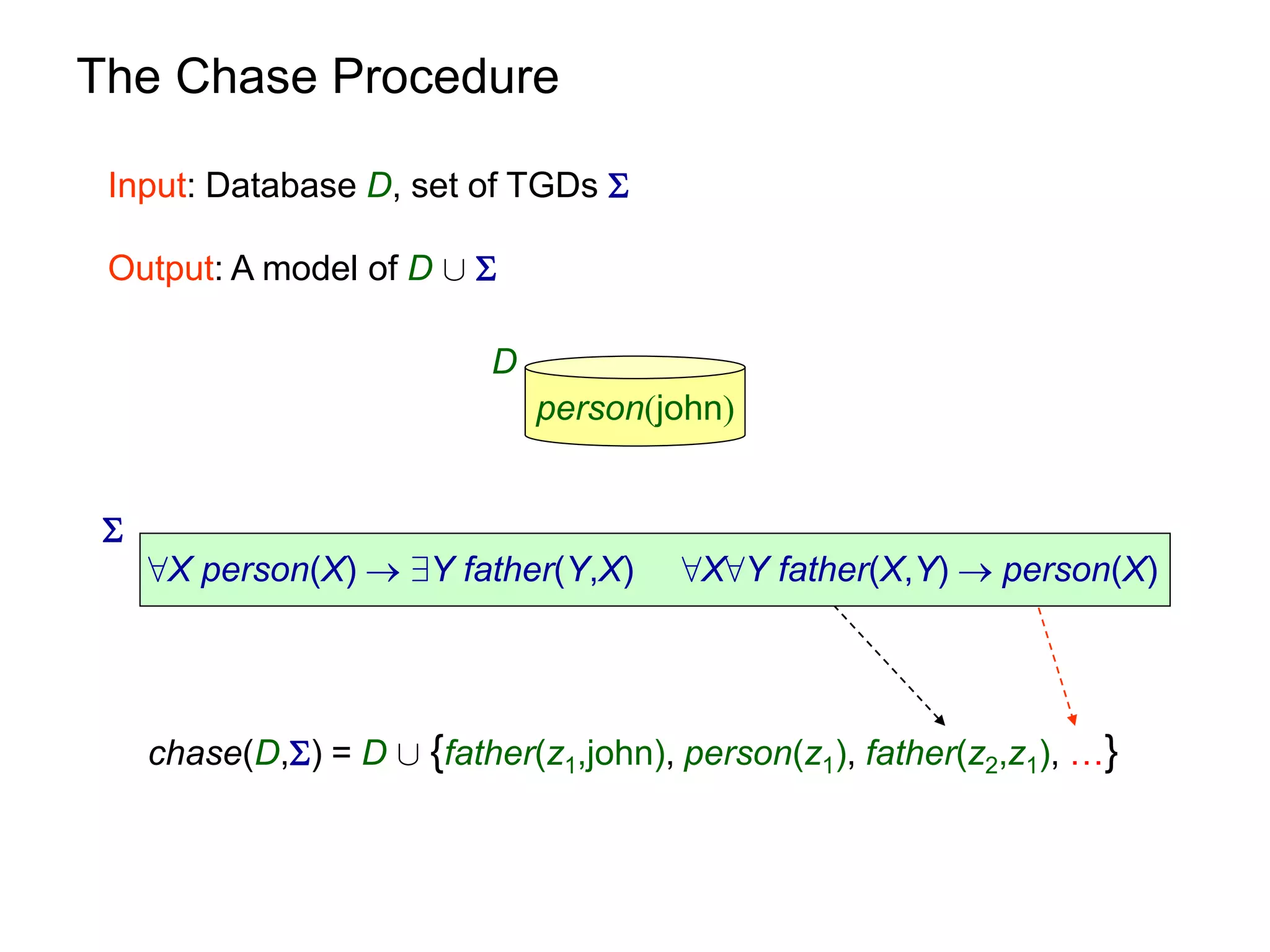
The Chase Procedure

 Input: Database D, set of TGDs 

 Output: A model of D [ 

                          D
                              person(john)


 
     8X person(X)  9Y father(Y,X)    8X8Y father(X,Y)  person(X)


     chase(D,) = D [ ?
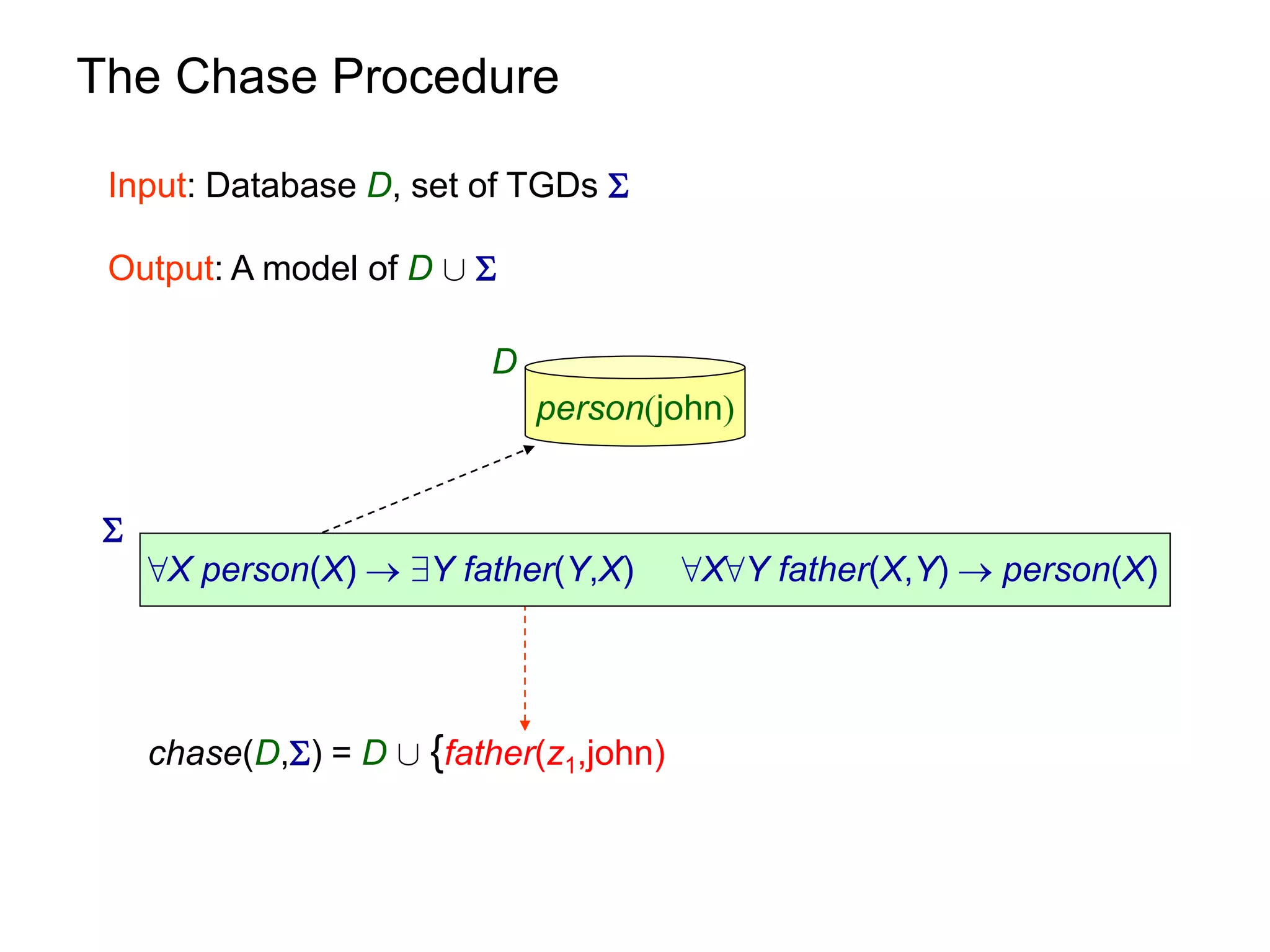
The Chase Procedure

 Input: Database D, set of TGDs 

 Output: A model of D [ 

                          D
                              person(john)


 
     8X person(X)  9Y father(Y,X)       8X8Y father(X,Y)  person(X)


     chase(D,) = D [ {father(z1,john)
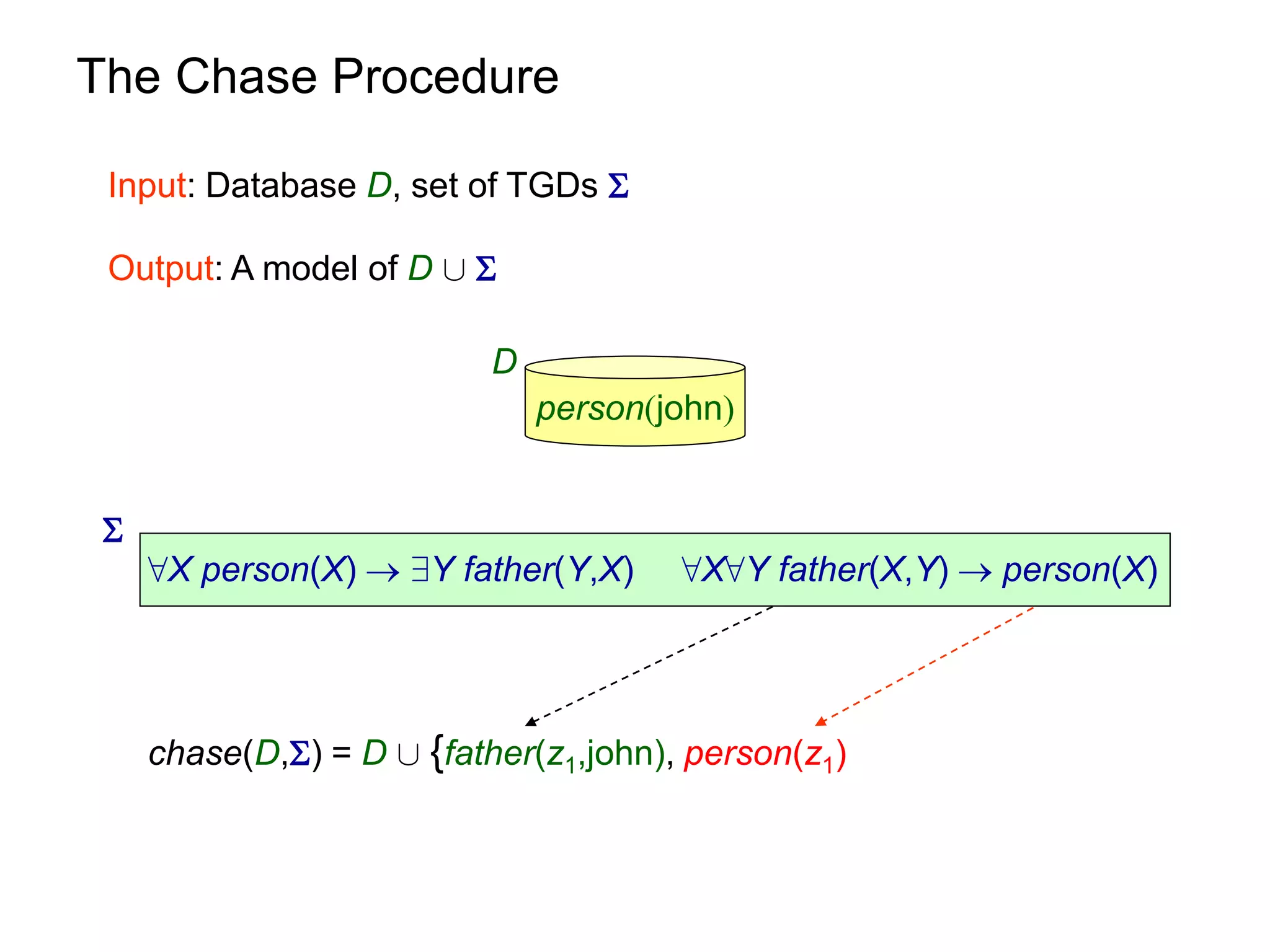
The Chase Procedure

 Input: Database D, set of TGDs 

 Output: A model of D [ 

                           D
                               person(john)


 
     8X person(X)  9Y father(Y,X)     8X8Y father(X,Y)  person(X)


     chase(D,) = D [ {father(z1,john), person(z1)
The Chase Procedure

 Input: Database D, set of TGDs 

 Output: A model of D [ 

                           D
                               person(john)


 
     8X person(X)  9Y father(Y,X)      8X8Y father(X,Y)  person(X)


     chase(D,) = D [ {father(z1,john), person(z1), father(z2,z1)
The Chase Procedure

 Input: Database D, set of TGDs 

 Output: A model of D [ 

                           D
                               person(john)


 
     8X person(X)  9Y father(Y,X)      8X8Y father(X,Y)  person(X)


     chase(D,) = D [ {father(z1,john), person(z1), father(z2,z1), …}
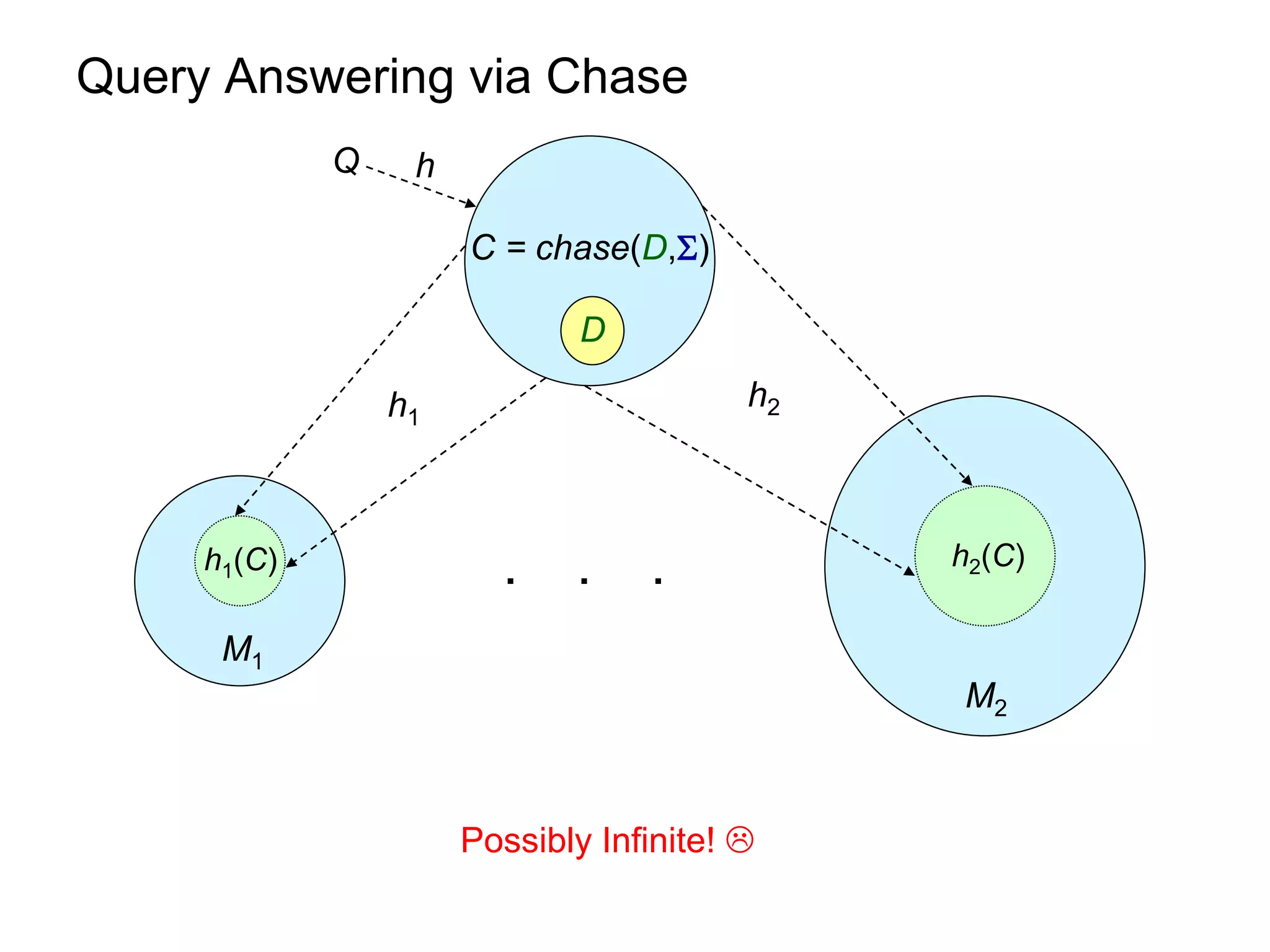
Query Answering via Chase
             Q    h

                      C = chase(D,)

                            D

                 h1                     h2


                                                        h2(C)
     h1(C)             .    .   .
      M1
                                                         M2

             D[²Q         ,    chase(D,) ² Q
                                [see, e.g., Deutsch, Nash & Remmel, PODS 08]
Query Answering via Chase
             Q    h

                      C = chase(D,)

                              D

                 h1                      h2


                                              h2(C)
     h1(C)              .    .    .
      M1
                                              M2


                      Possibly Infinite! 
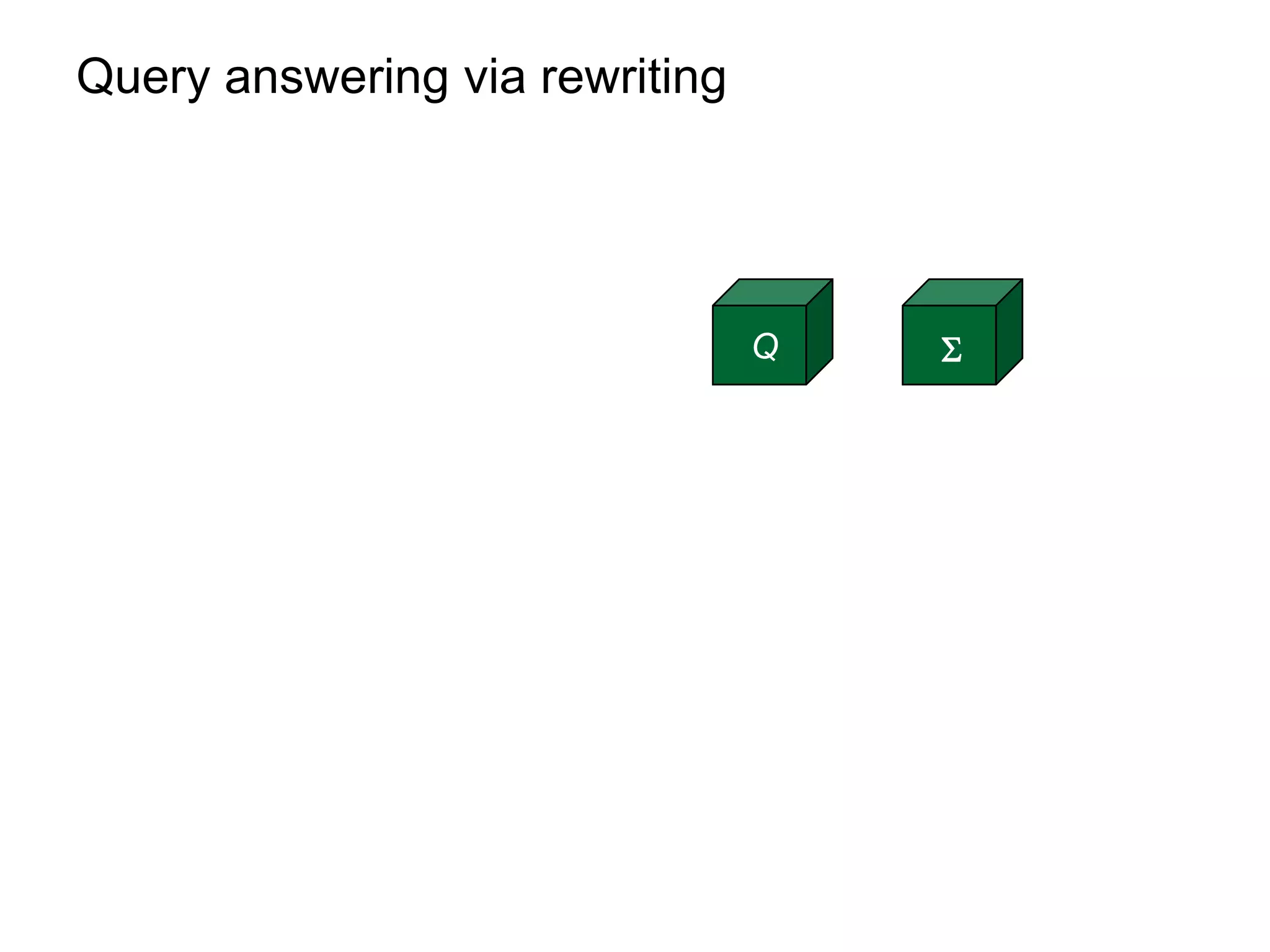
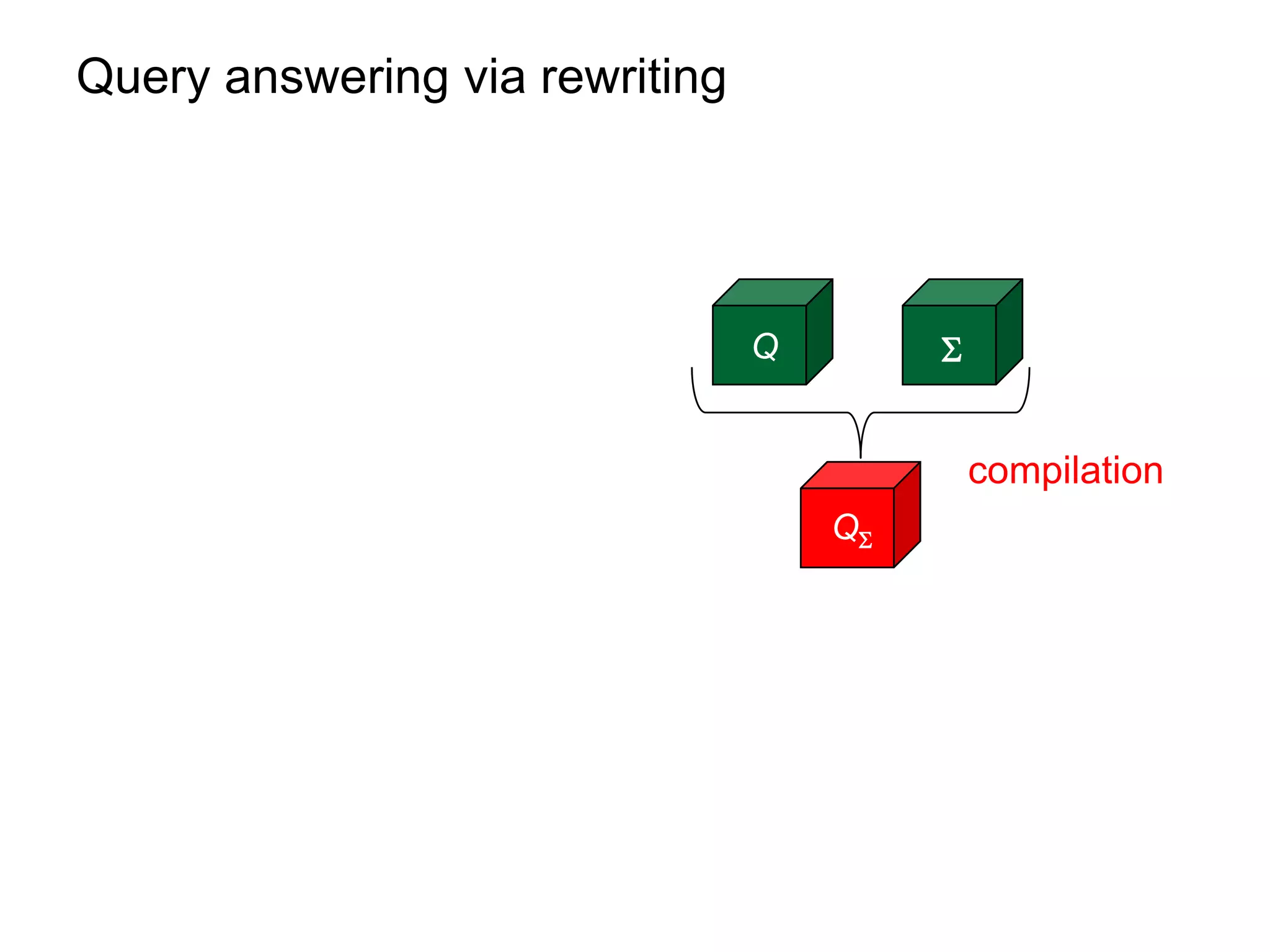
Query answering via rewriting


                                Q   
Query answering via rewriting


                                Q        


                                             compilation
                                    Q
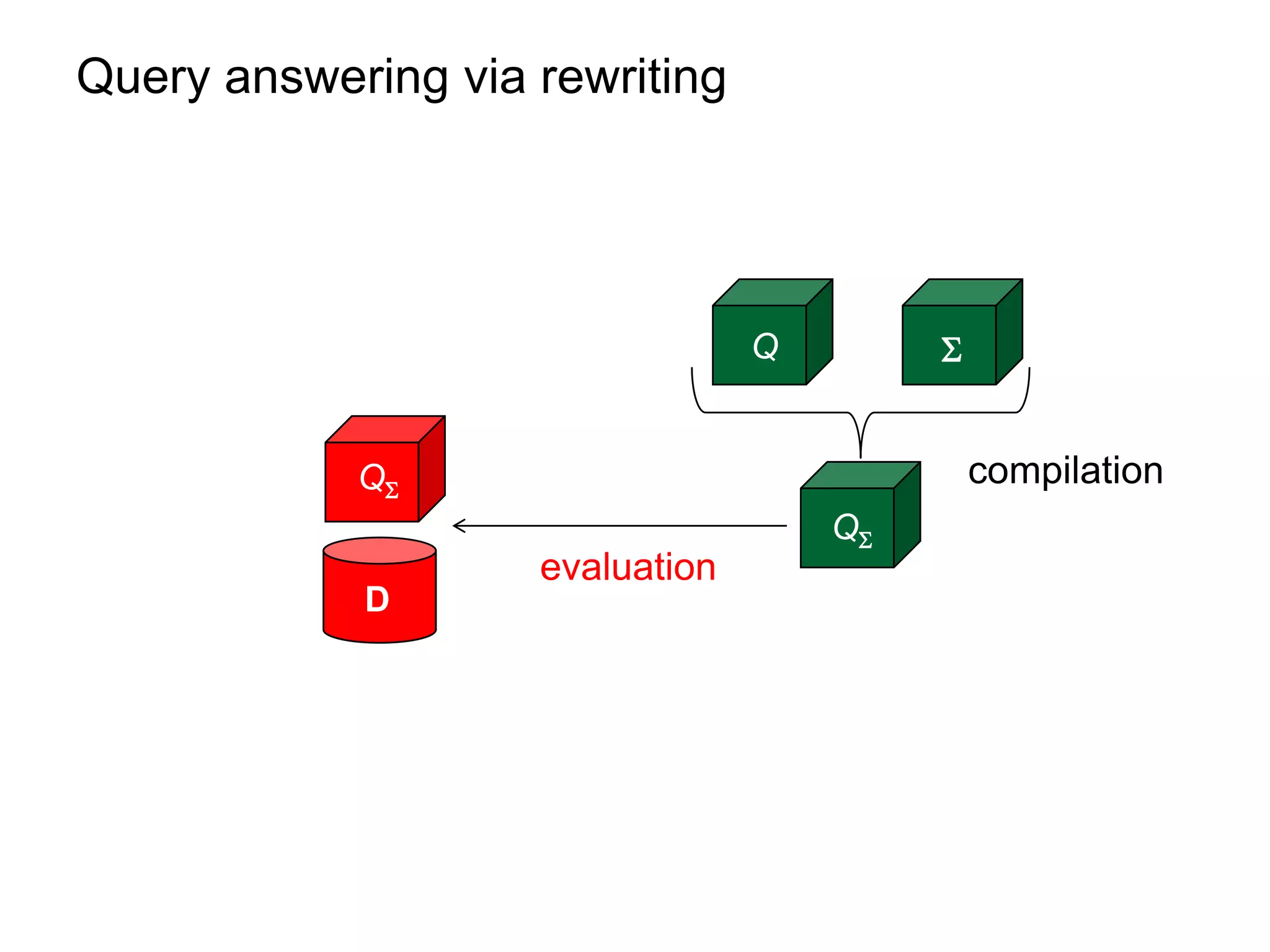
Query answering via rewriting


                                 Q        


            Q                                compilation
                                     Q
                    evaluation
            D
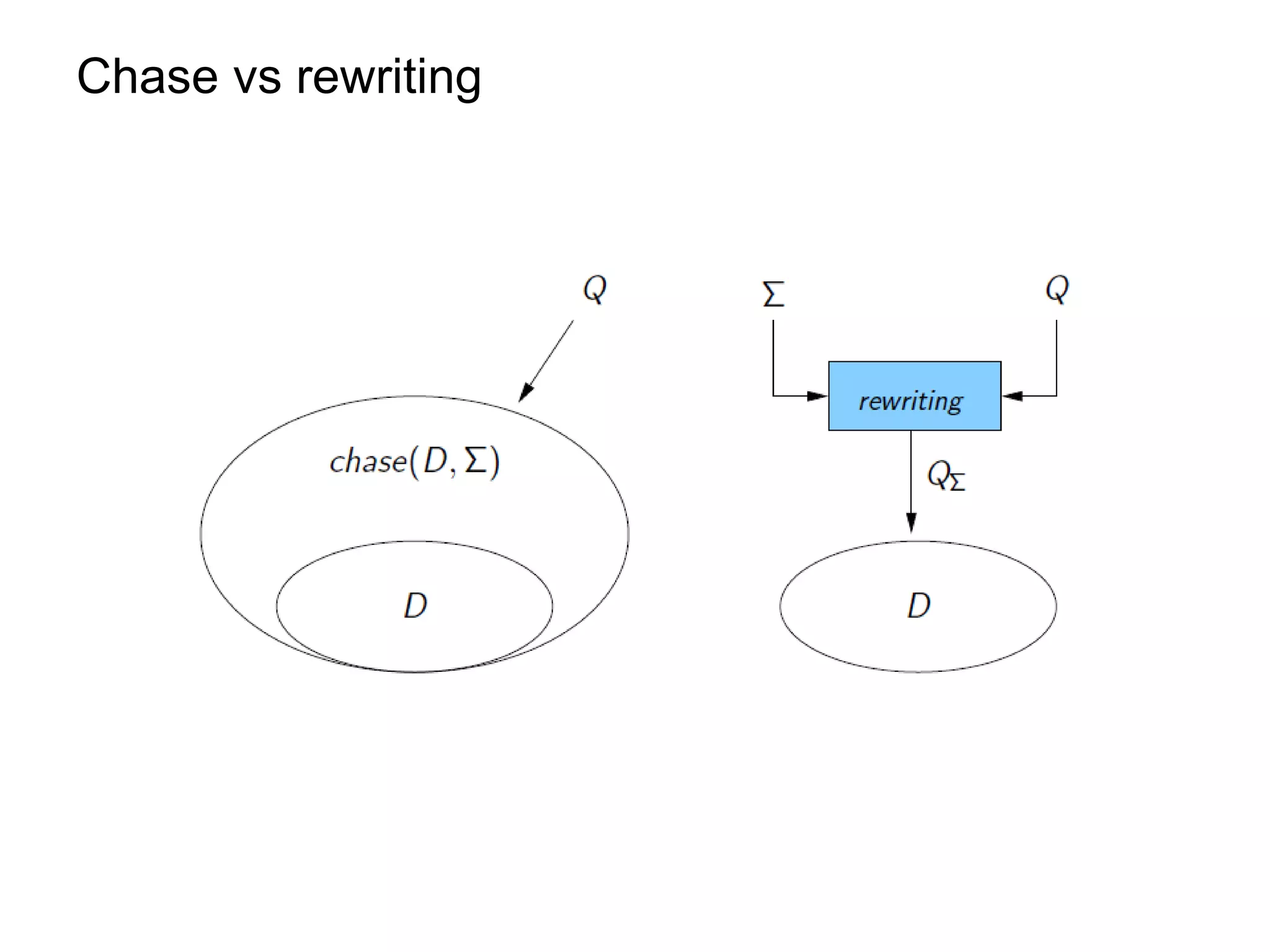
Chase vs rewriting
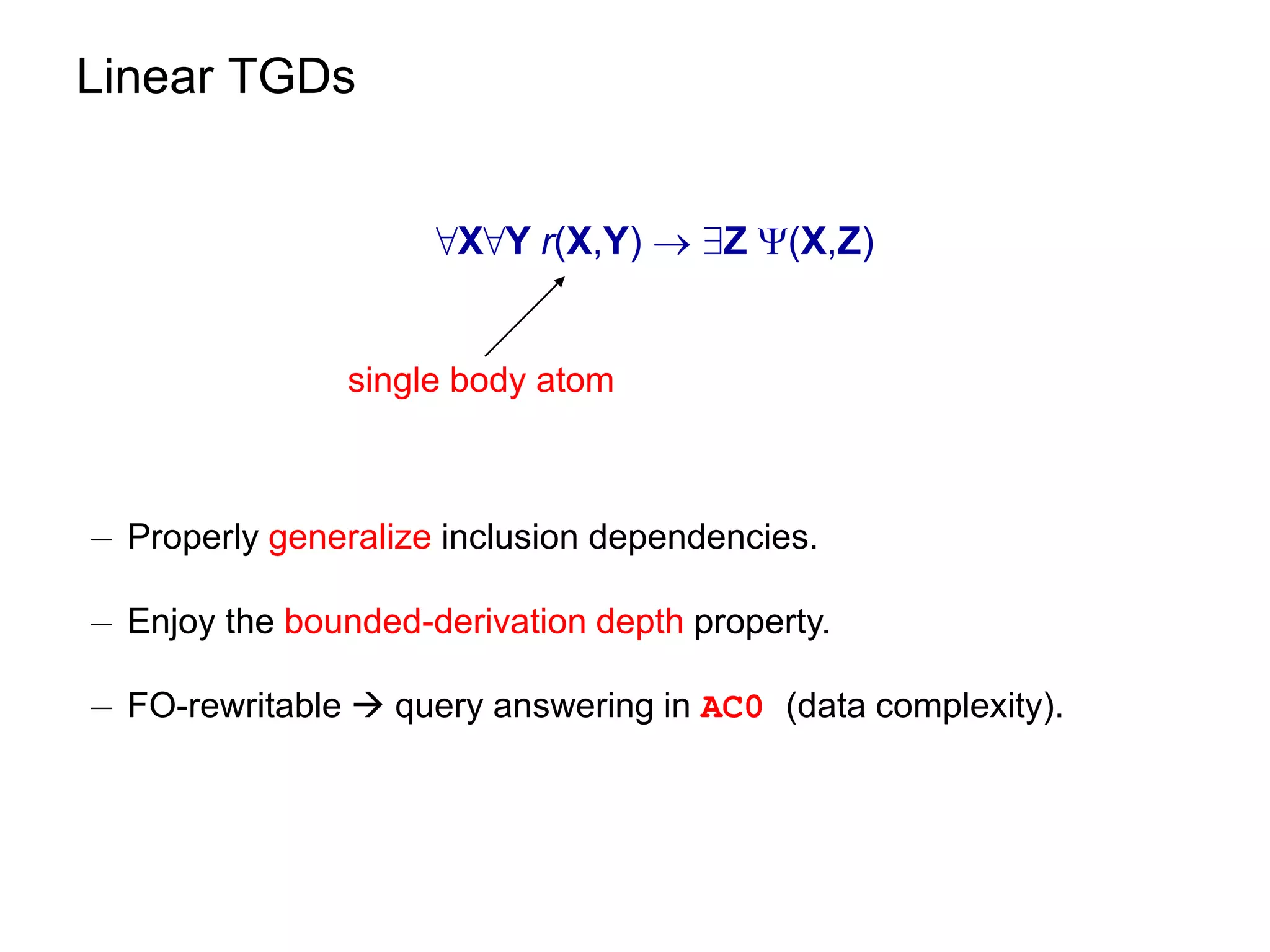
Linear TGDs


                     8X8Y r(X,Y)  9Z (X,Z)


                single body atom


¡ Properly generalize inclusion dependencies.

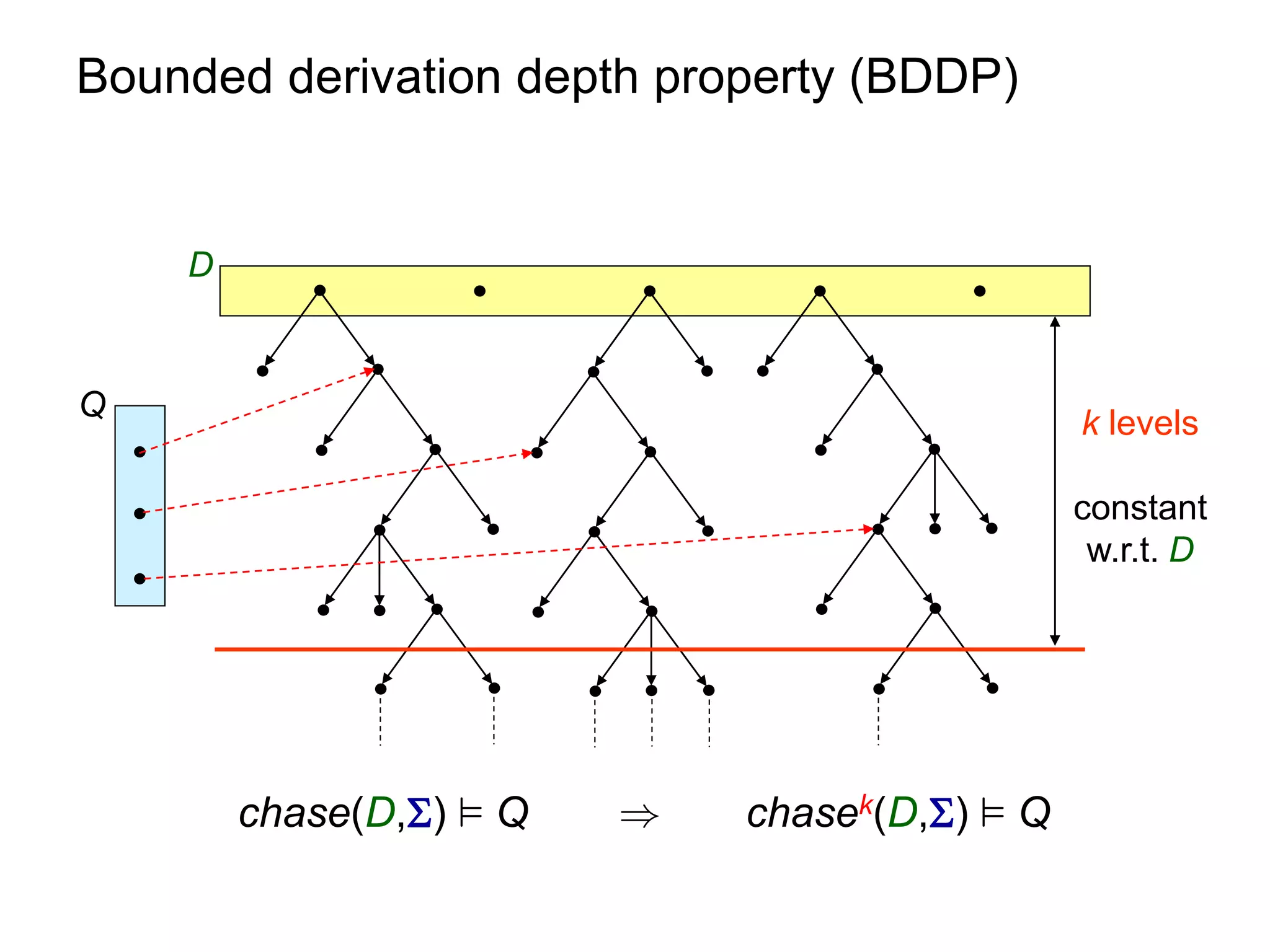
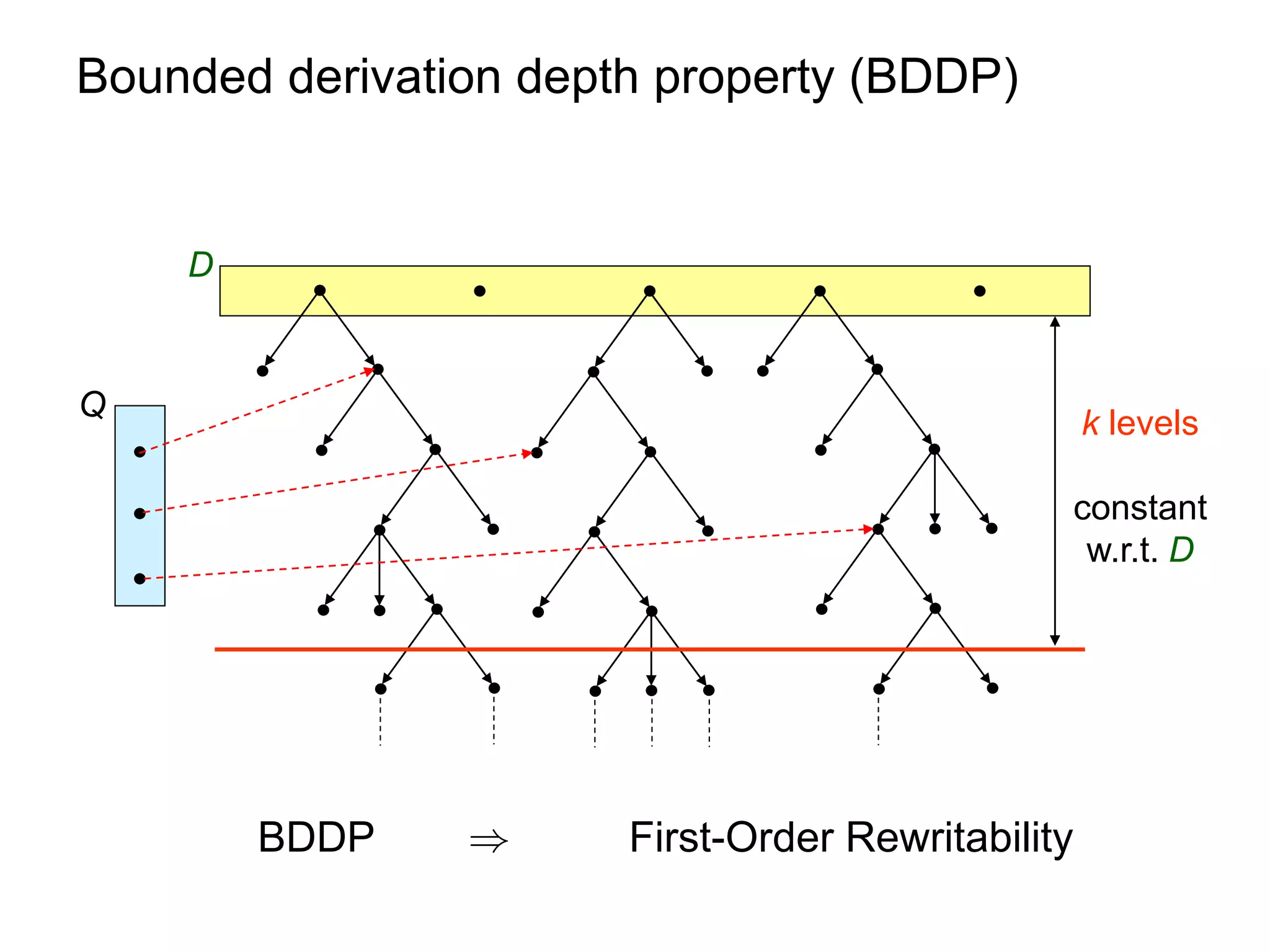
¡ Enjoy the bounded-derivation depth property.

¡ FO-rewritable  query answering in AC0 (data complexity).
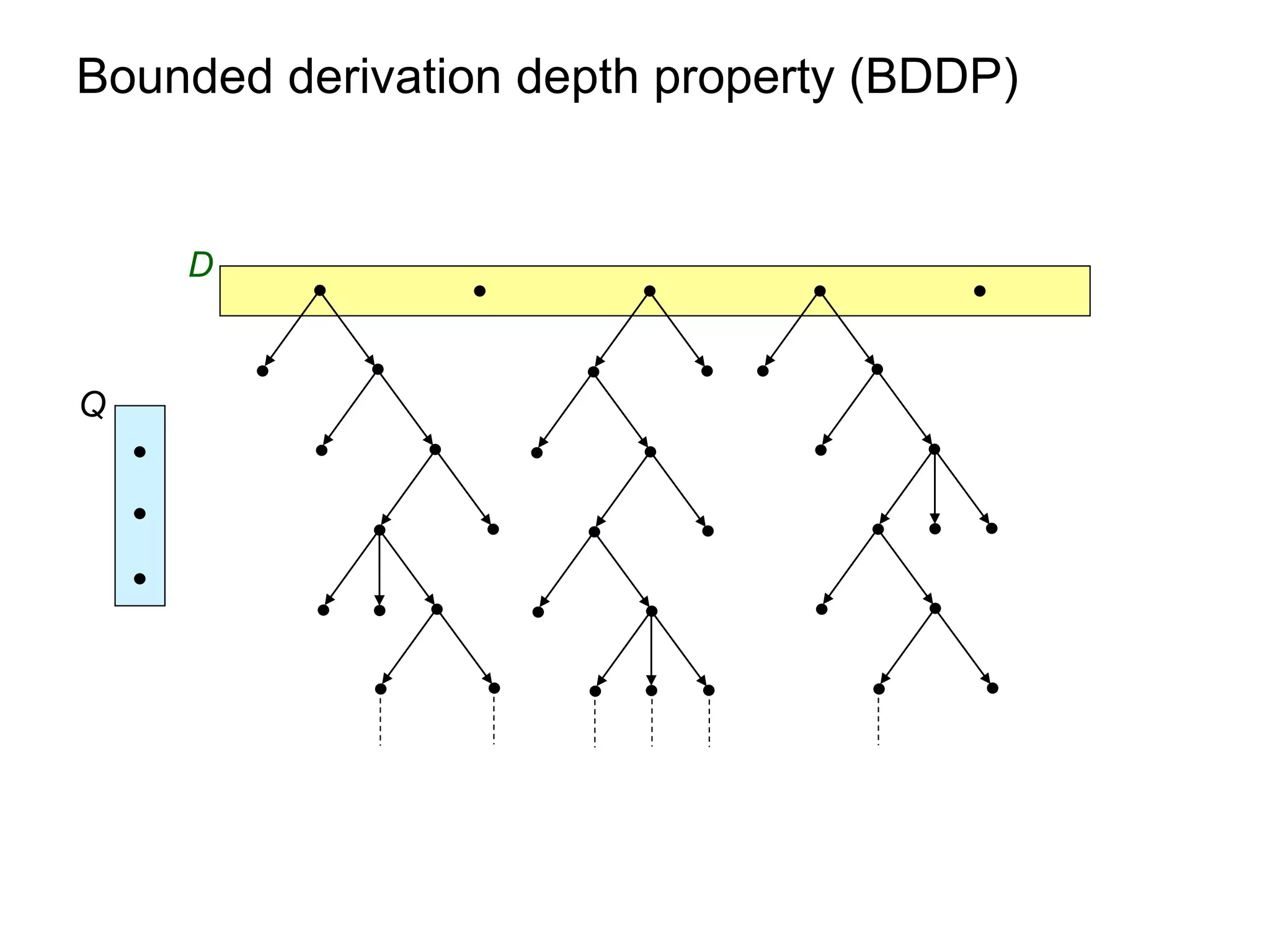
Bounded derivation depth property (BDDP)


    D


Q
Bounded derivation depth property (BDDP)


    D


Q
                                               k levels

                                               constant
                                                w.r.t. D


        chase(D,) ² Q   )   chasek(D,) ² Q
Bounded derivation depth property (BDDP)


    D


Q
                                                   k levels

                                               constant
                                                w.r.t. D


        BDDP    )      First-Order Rewritability
FO-rewritability: Example [Gottlob et Al., ICDE 11]


                promoter(X)  Y promotesTo(X,Y)
                 promotesTo(X,Y)  customer(Y)

            Q     q  promotesTo(A,B), customer(B)


 Q

q  promotesTo(A,B), customer(B)       (original query)
FO-rewritability: Example [Gottlob et Al., ICDE 11]


                 promoter(X)  Y promotesTo(X,Y)
                  promotesTo(X,Y)  customer(Y)

            Q     q  promotesTo(A,B), customer(B)


 Q

q  promotesTo(A,B), customer(B)           {Y=B}

q  promotesTo(A,B), customer(V0,B)      ( V0 is fresh )
FO-rewritability: Example [Gottlob et Al., ICDE 11]


                  promoter(X)  Y promotesTo(X,Y)
                   promotesTo(X,Y)  customer(Y)

              Q    q  promotesTo(A,B), customer(B)


  Q

q  promotesTo(A,B), customer(B)
                                      factorization
q  promotesTo(A,B), promotesTo(V0,B)             ans(A)  promotesTo(A,B)
                                       { A = V0 }
FO-rewritability: Example [Gottlob et Al., ICDE 11]


                 promoter(X)  Y promotesTo(X,Y)
                  promotesTo(X,Y)  customer(Y)

             Q    q  promotesTo(A,B), customer(B)


 Q

q  promotesTo(A,B), customer(B)

q  promotesTo(A,B)      {X = A, Y = B}
q  promoter(A)
FO-rewritability: Example [Gottlob et Al., ICDE 11]


                 promoter(X)  Y promotesTo(X,Y)
                  promotesTo(X,Y)  customer(Y)

             Q    q  promotesTo(A,B), customer(B)


  Q

q  promotesTo(A,B), customer(B)

q  promotesTo(A,B)                                  UCQ rewriting
                                                      (first-order)
q  promoter(A)
FO-rewritability

¡ Desirable properties of a FO-rewriting:
   independent on the DB
   executable by any DBMS
   easy to compute (e.g., polynomial time)
   small size (e.g., polynomial size)
FO-rewritability

¡ Desirable properties of a FO-rewriting:
   independent on the DB
   executable by any DBMS
   easy to compute (e.g., polynomial time)
   small size (e.g., polynomial size)


¡ Unions of Conjunctive Queries (UCQs)
                                              Calvanese et Al, JAR 07
   executable by any DBMS
                                              Perez Urbina et Al, JAL 09
   DB independent                            Cali’ et Al, PODS 09
   easy to optimize and distribute           Gottlob et Al, ICDE 11
                                              and others…
   worst-case exponential size in Q and 
FO-rewritability

 ¡ Combined and hybrid FO-rewriting
    good computational properties    Kontchakov et Al., KR 10
                                      Gottlob and Schwentick, DL 11
     (e.g., polynomial in size)
    requires access to the DB
FO-rewritability

 ¡ Combined and hybrid FO-rewriting
    good computational properties            Kontchakov et Al., KR 10
                                              Gottlob and Schwentick, DL 11
     (e.g., polynomial in size)
    requires access to the DB


 ¡ Purely intensional Datalog rewriting
                                             Perez Urbina et Al, JAL 09
    very compressed representation          Rosati and Almatelli., KR 10
    purely intensional                      Orsi and Pieris., VLDB 11 
    requires view-creation or Datalog engine
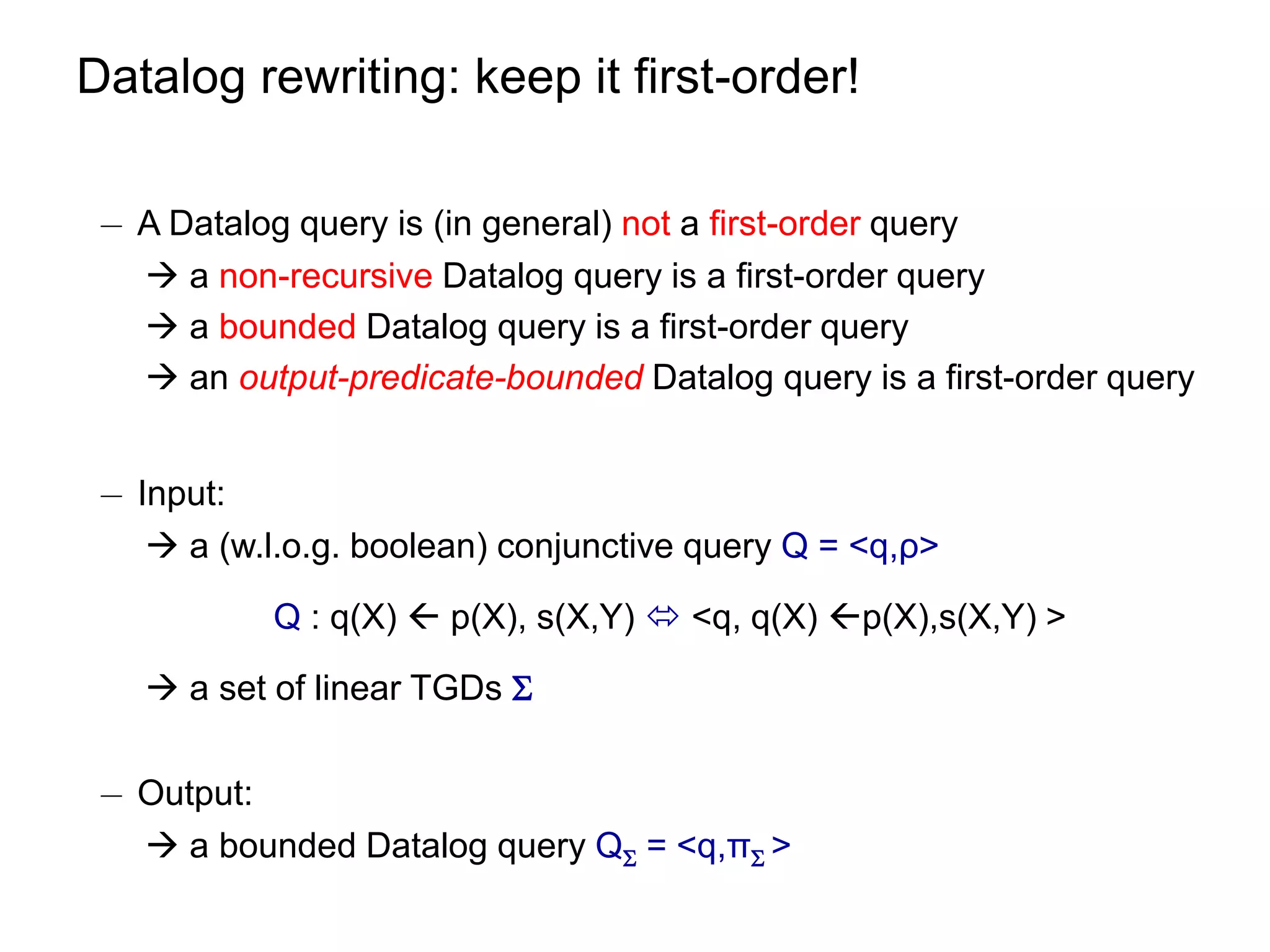
Datalog rewriting: keep it first-order!

 ¡ A Datalog query is (in general) not a first-order query
    a non-recursive Datalog query is a first-order query
    a bounded Datalog query is a first-order query
    an output-predicate-bounded Datalog query is a first-order query
Datalog rewriting: keep it first-order!

 ¡ A Datalog query is (in general) not a first-order query
    a non-recursive Datalog query is a first-order query
    a bounded Datalog query is a first-order query
    an output-predicate-bounded Datalog query is a first-order query


 ¡ Input:
     a (w.l.o.g. boolean) conjunctive query Q = <q,ρ>

            Q : q(X)  p(X), s(X,Y)  <q, q(X) p(X),s(X,Y) >

    a set of linear TGDs 

 ¡ Output:
    a bounded Datalog query Q = <q,π >
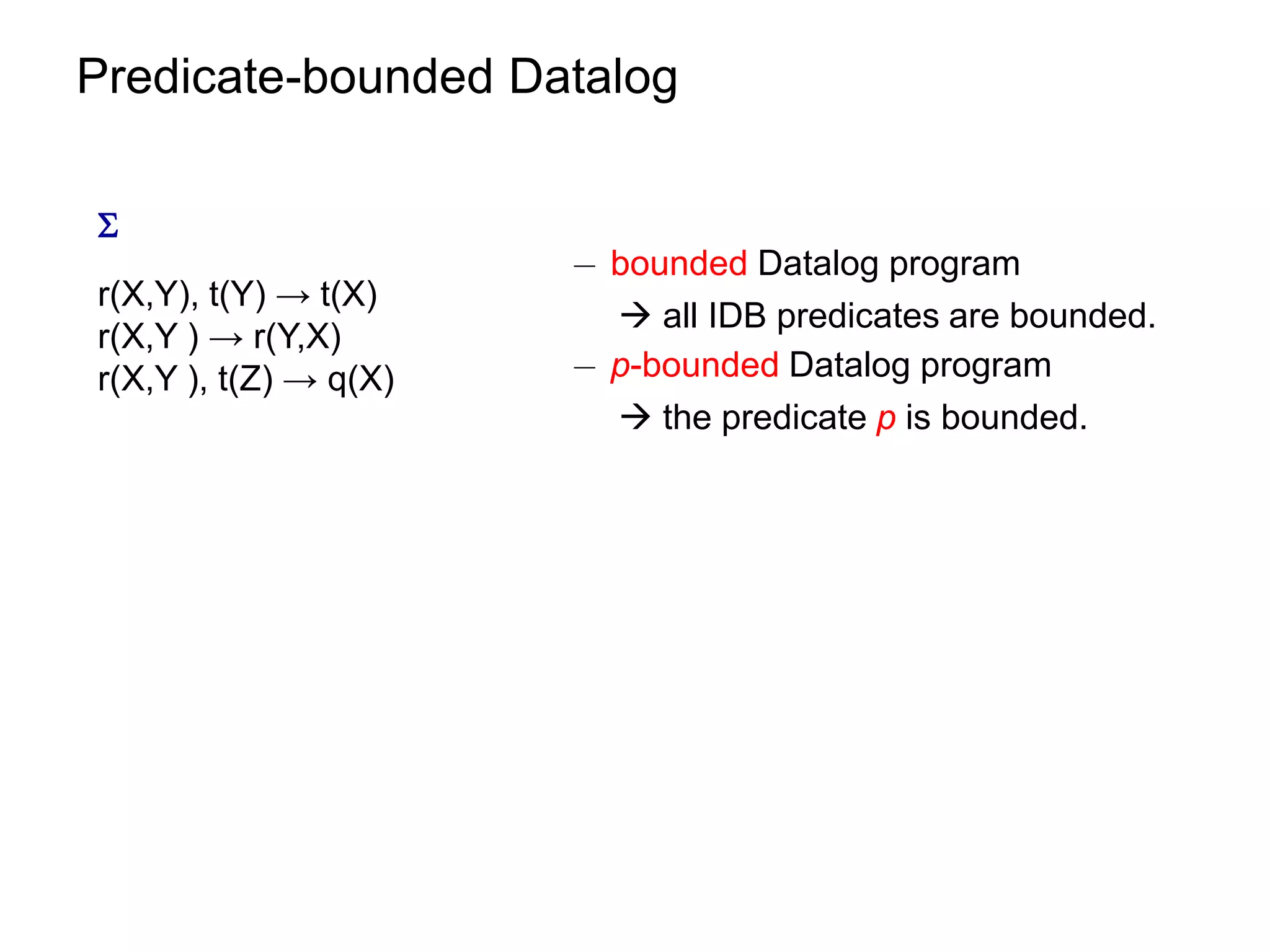
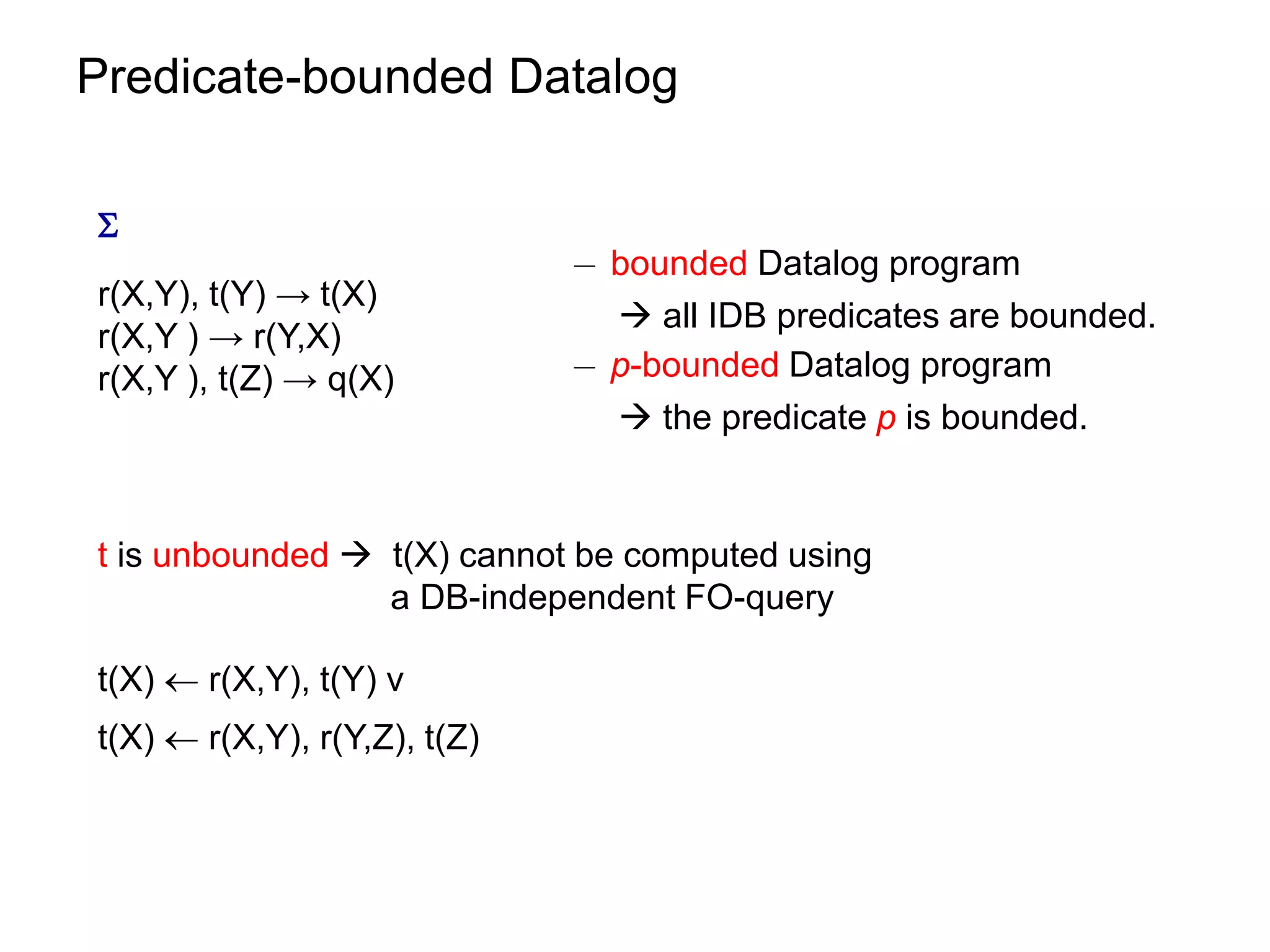
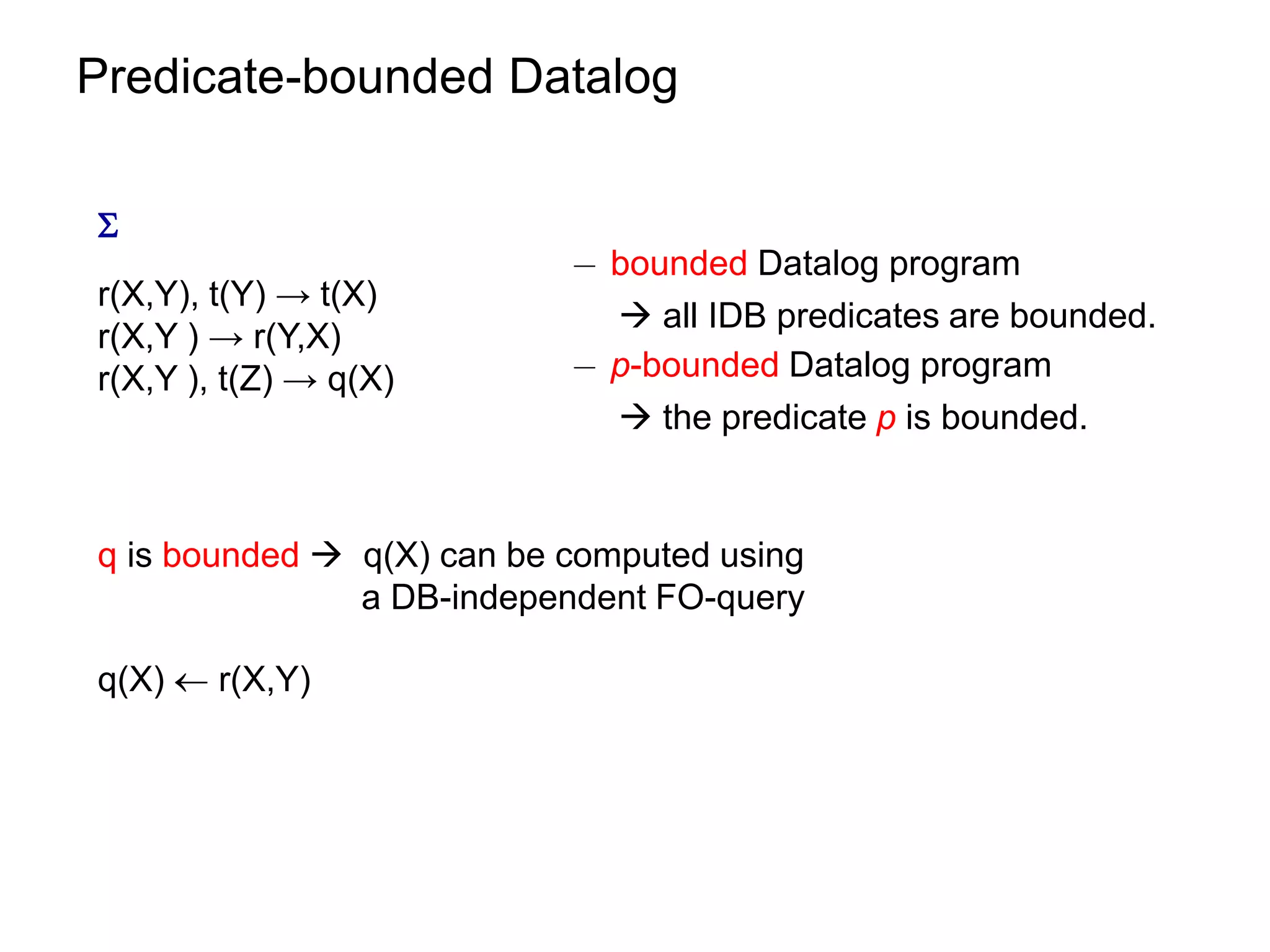
Predicate-bounded Datalog


                       ¡ bounded Datalog program
r(X,Y), t(Y) → t(X)
                          all IDB predicates are bounded.
r(X,Y ) → r(Y,X)
r(X,Y ), t(Z) → q(X)   ¡ p-bounded Datalog program
                          the predicate p is bounded.
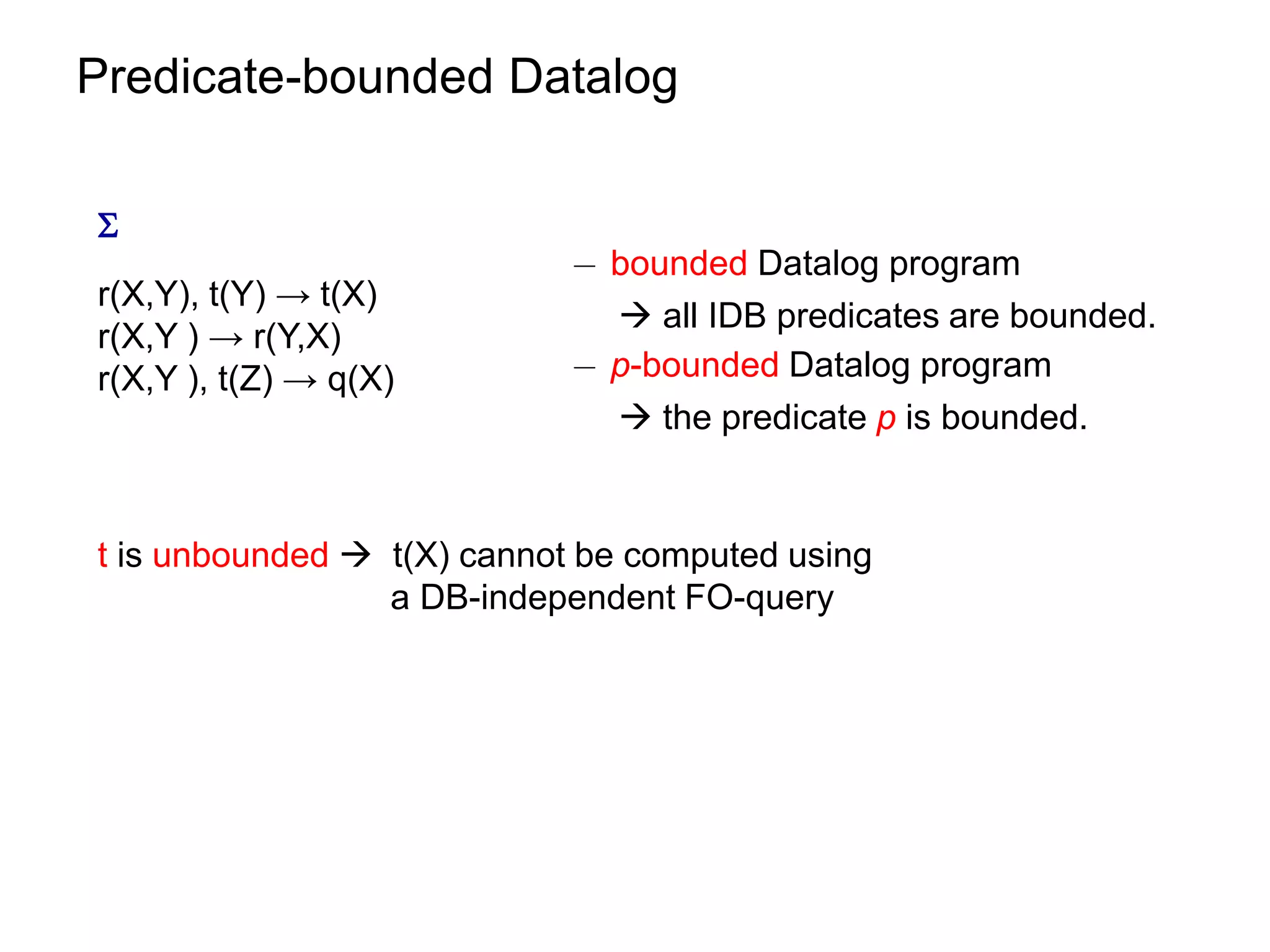
Predicate-bounded Datalog


                            ¡ bounded Datalog program
r(X,Y), t(Y) → t(X)
                               all IDB predicates are bounded.
r(X,Y ) → r(Y,X)
r(X,Y ), t(Z) → q(X)        ¡ p-bounded Datalog program
                               the predicate p is bounded.


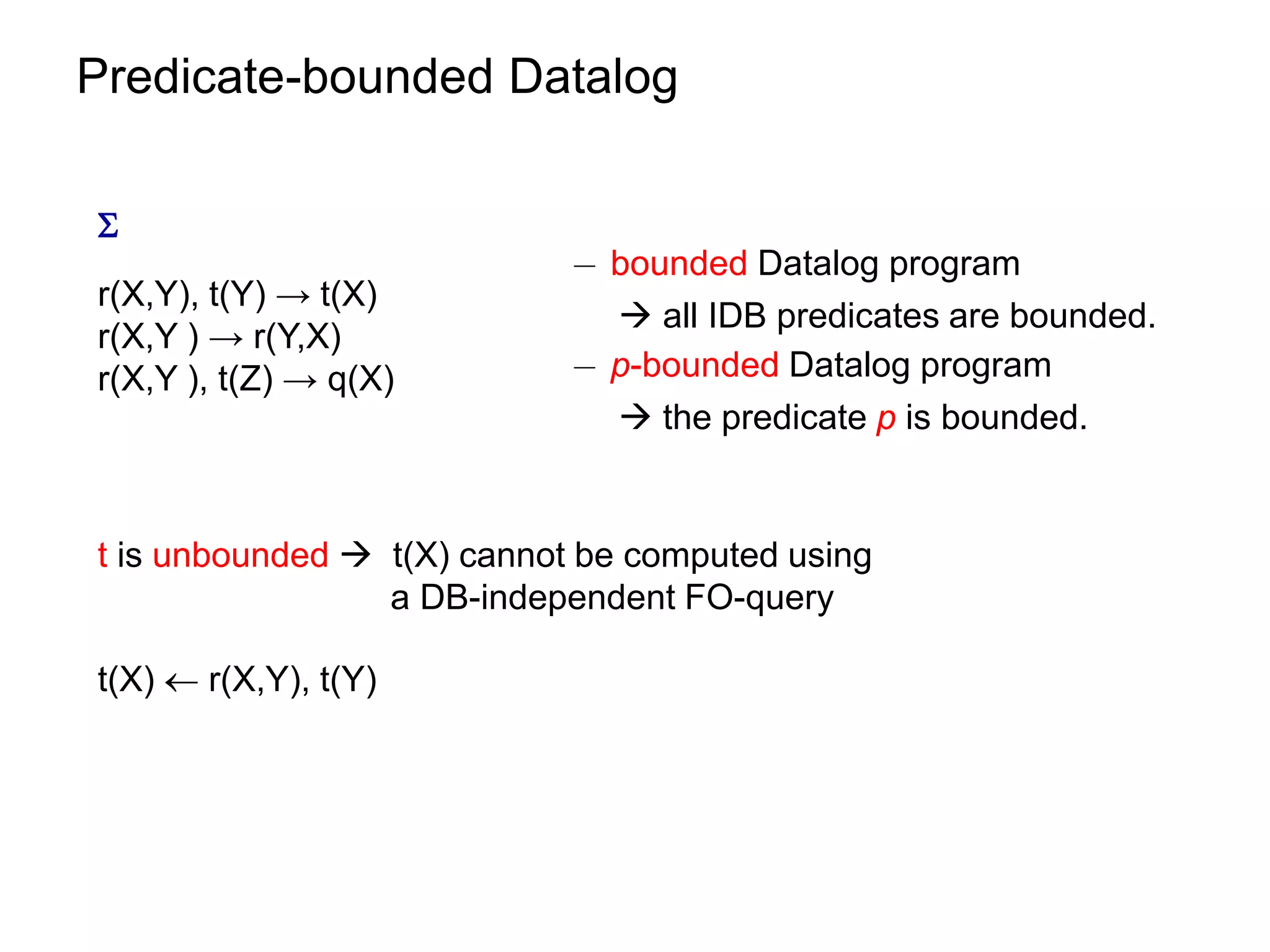
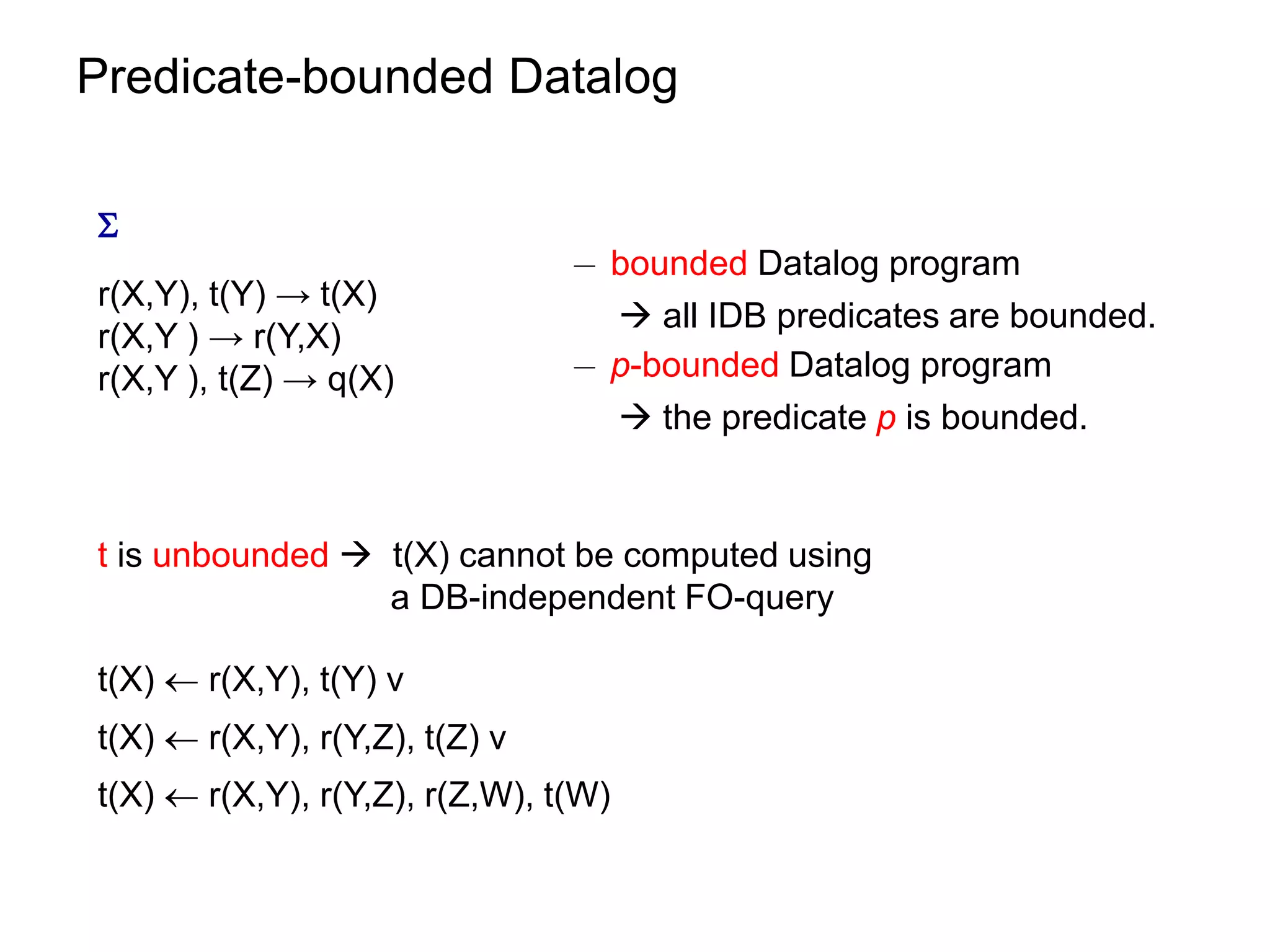
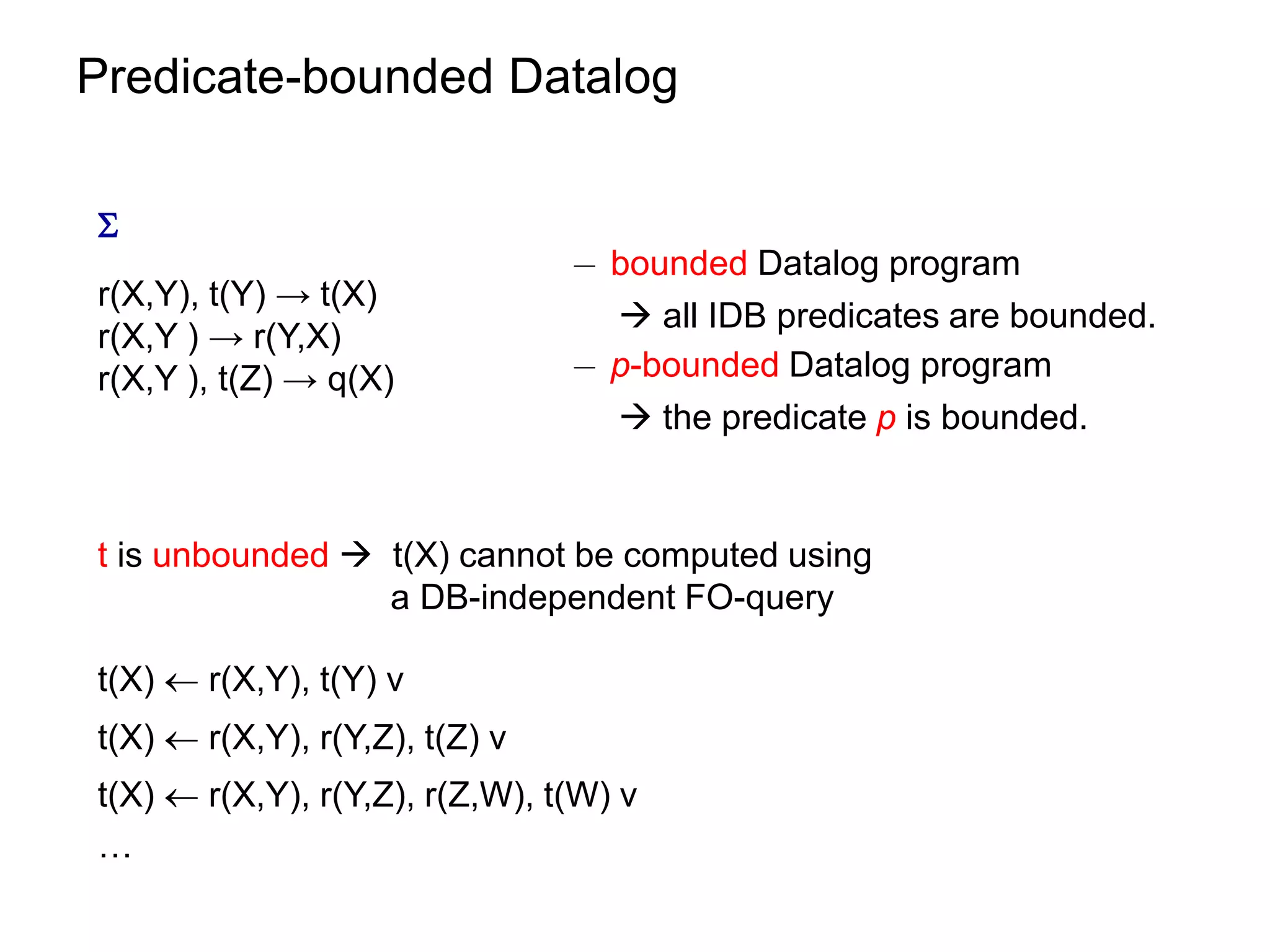
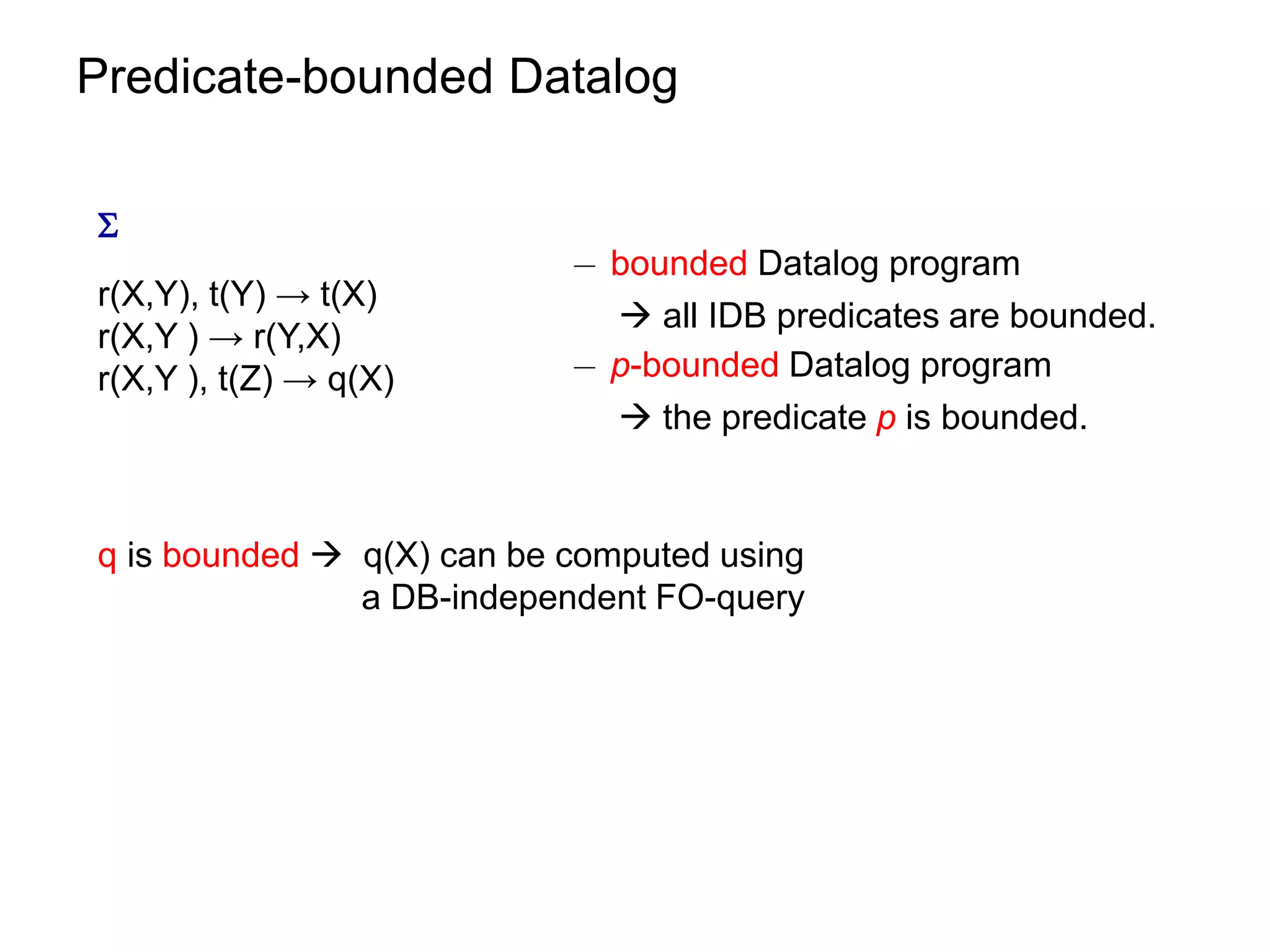
t is unbounded  t(X) cannot be computed using
                 a DB-independent FO-query
Predicate-bounded Datalog


                            ¡ bounded Datalog program
r(X,Y), t(Y) → t(X)
                               all IDB predicates are bounded.
r(X,Y ) → r(Y,X)
r(X,Y ), t(Z) → q(X)        ¡ p-bounded Datalog program
                               the predicate p is bounded.


t is unbounded  t(X) cannot be computed using
                 a DB-independent FO-query

t(X)  r(X,Y), t(Y)
Predicate-bounded Datalog


                              ¡ bounded Datalog program
r(X,Y), t(Y) → t(X)
                                 all IDB predicates are bounded.
r(X,Y ) → r(Y,X)
r(X,Y ), t(Z) → q(X)          ¡ p-bounded Datalog program
                                 the predicate p is bounded.


t is unbounded  t(X) cannot be computed using
                 a DB-independent FO-query

t(X)  r(X,Y), t(Y) v
t(X)  r(X,Y), r(Y,Z), t(Z)
Predicate-bounded Datalog


                                ¡ bounded Datalog program
r(X,Y), t(Y) → t(X)
                                   all IDB predicates are bounded.
r(X,Y ) → r(Y,X)
r(X,Y ), t(Z) → q(X)            ¡ p-bounded Datalog program
                                   the predicate p is bounded.


t is unbounded  t(X) cannot be computed using
                 a DB-independent FO-query

t(X)  r(X,Y), t(Y) v
t(X)  r(X,Y), r(Y,Z), t(Z) v
t(X)  r(X,Y), r(Y,Z), r(Z,W), t(W)
Predicate-bounded Datalog


                                ¡ bounded Datalog program
r(X,Y), t(Y) → t(X)
                                   all IDB predicates are bounded.
r(X,Y ) → r(Y,X)
r(X,Y ), t(Z) → q(X)            ¡ p-bounded Datalog program
                                   the predicate p is bounded.


t is unbounded  t(X) cannot be computed using
                 a DB-independent FO-query

t(X)  r(X,Y), t(Y) v
t(X)  r(X,Y), r(Y,Z), t(Z) v
t(X)  r(X,Y), r(Y,Z), r(Z,W), t(W) v
…
Predicate-bounded Datalog


                           ¡ bounded Datalog program
r(X,Y), t(Y) → t(X)
                              all IDB predicates are bounded.
r(X,Y ) → r(Y,X)
r(X,Y ), t(Z) → q(X)       ¡ p-bounded Datalog program
                              the predicate p is bounded.


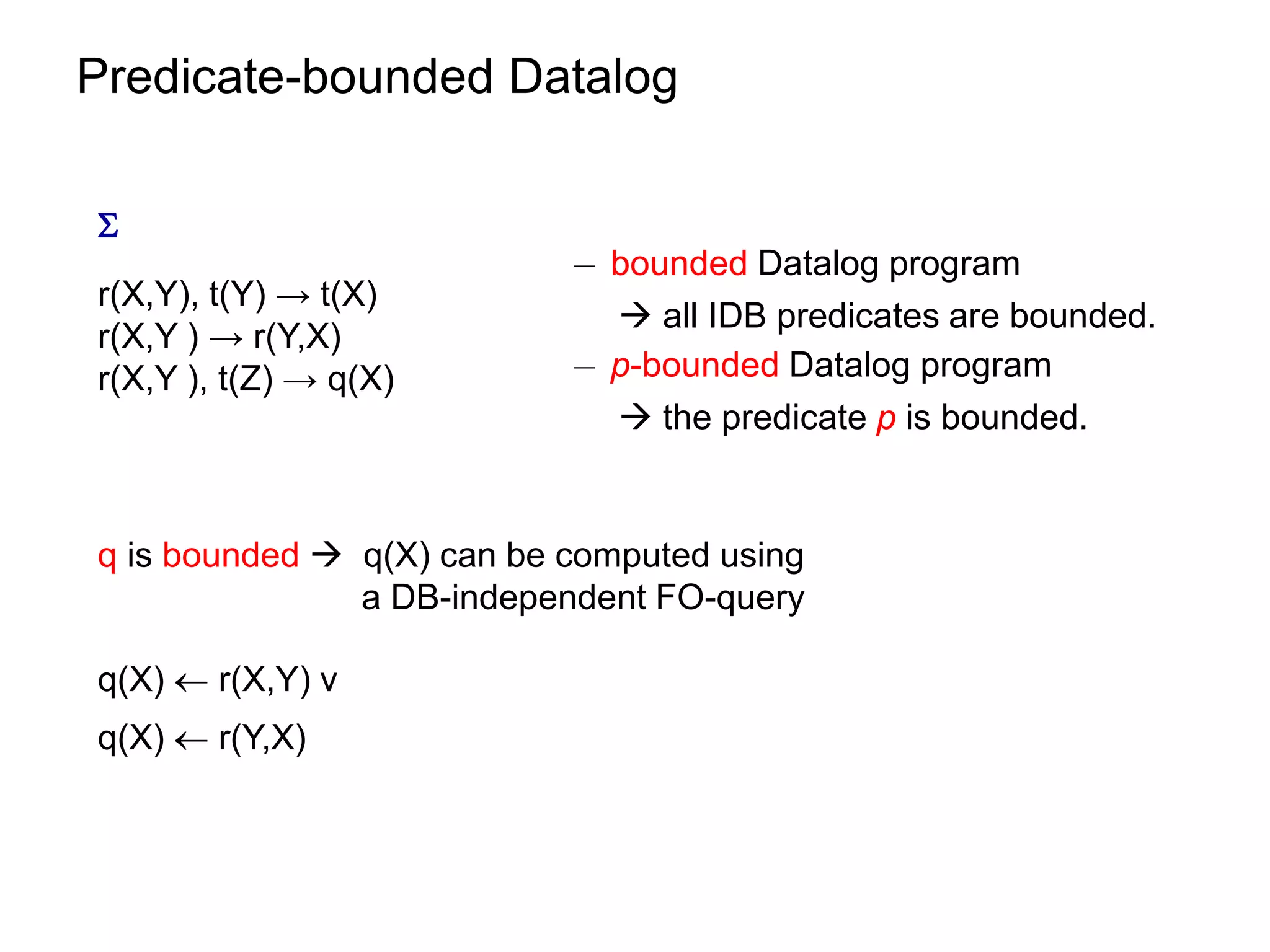
q is bounded  q(X) can be computed using
               a DB-independent FO-query
Predicate-bounded Datalog


                           ¡ bounded Datalog program
r(X,Y), t(Y) → t(X)
                              all IDB predicates are bounded.
r(X,Y ) → r(Y,X)
r(X,Y ), t(Z) → q(X)       ¡ p-bounded Datalog program
                              the predicate p is bounded.


q is bounded  q(X) can be computed using
               a DB-independent FO-query

q(X)  r(X,Y)
Predicate-bounded Datalog


                           ¡ bounded Datalog program
r(X,Y), t(Y) → t(X)
                              all IDB predicates are bounded.
r(X,Y ) → r(Y,X)
r(X,Y ), t(Z) → q(X)       ¡ p-bounded Datalog program
                              the predicate p is bounded.


q is bounded  q(X) can be computed using
               a DB-independent FO-query

q(X)  r(X,Y) v
q(X)  r(Y,X)
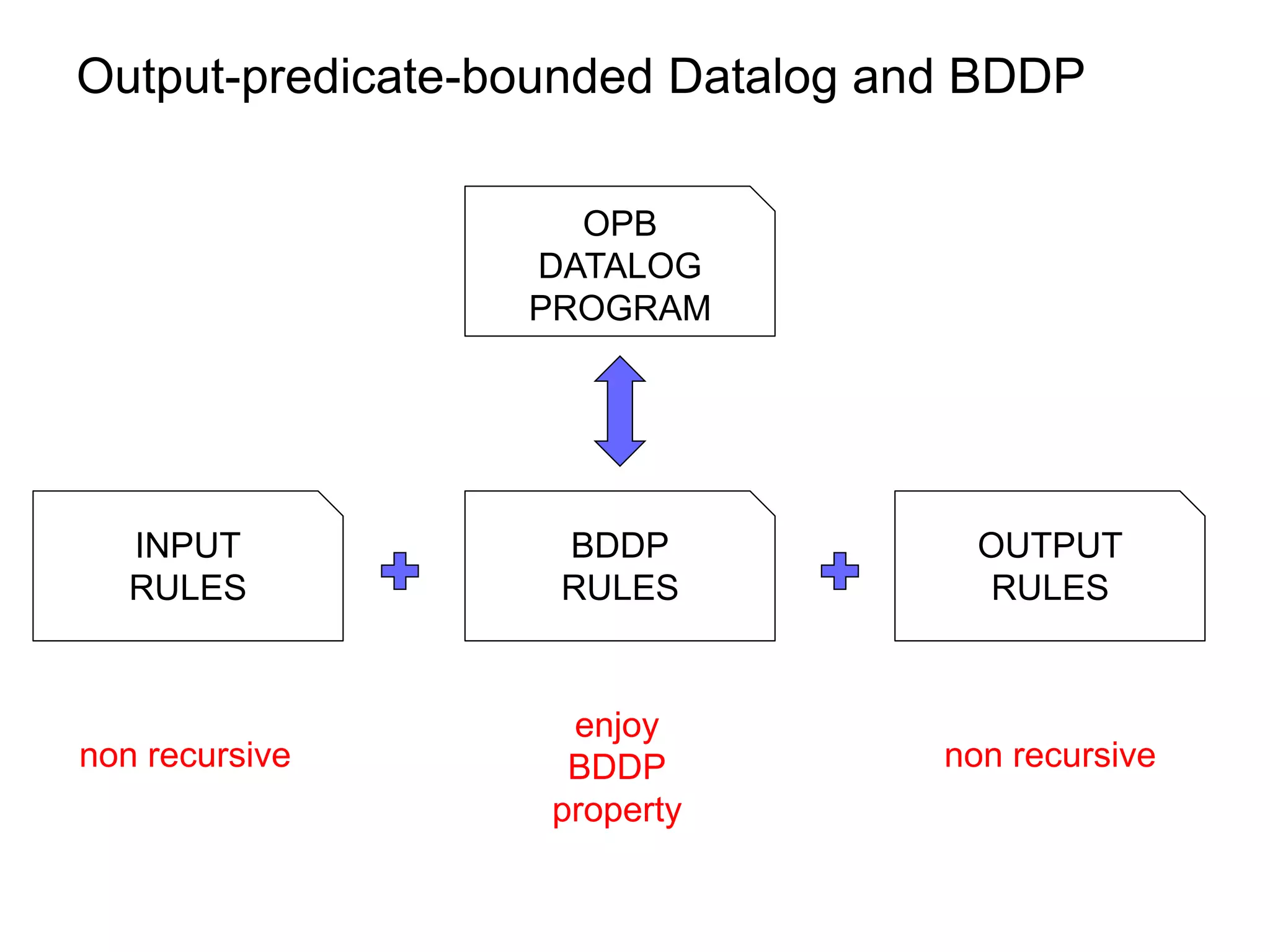
Output-predicate-bounded Datalog and BDDP

                    OPB
                  DATALOG
                  PROGRAM
Output-predicate-bounded Datalog and BDDP

                    OPB
                  DATALOG
                  PROGRAM


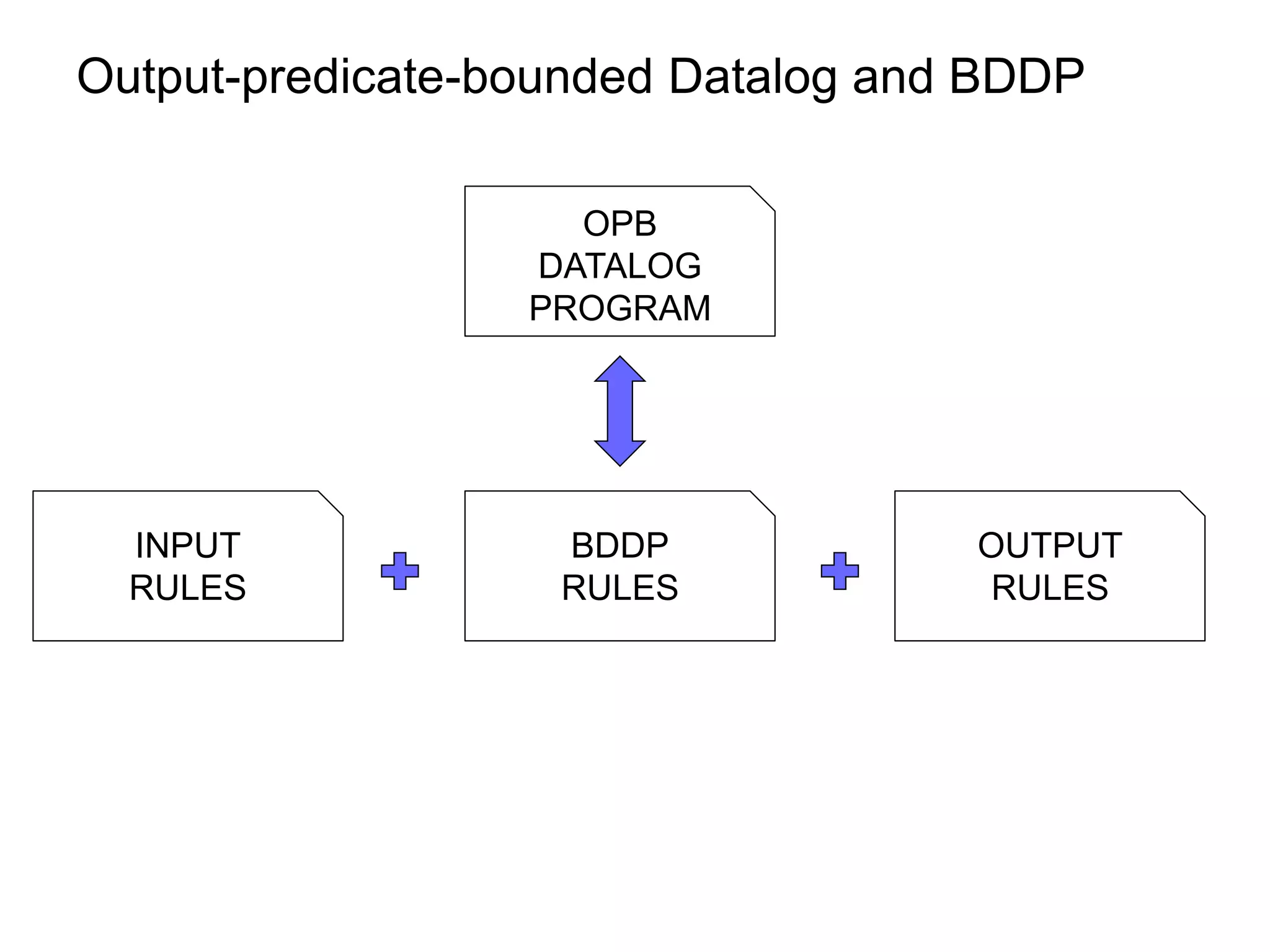
  INPUT            BDDP             OUTPUT
  RULES            RULES             RULES
Output-predicate-bounded Datalog and BDDP

                    OPB
                  DATALOG
                  PROGRAM


   INPUT           BDDP              OUTPUT
   RULES           RULES              RULES


                    enjoy
non recursive       BDDP           non recursive
                   property
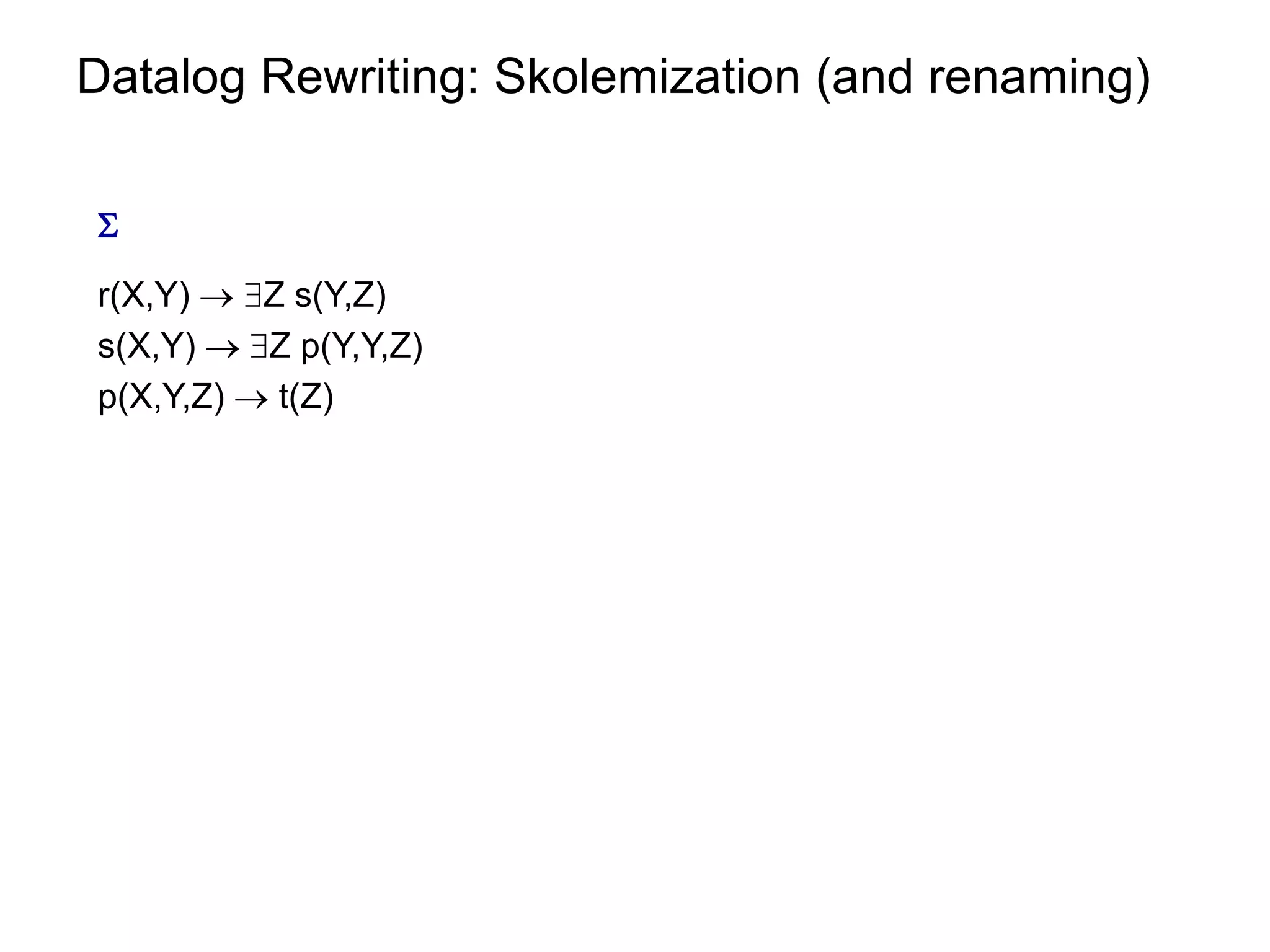
Datalog Rewriting: Skolemization (and renaming)


r(X,Y)  Z s(Y,Z)
s(X,Y)  Z p(Y,Y,Z)
p(X,Y,Z)  t(Z)
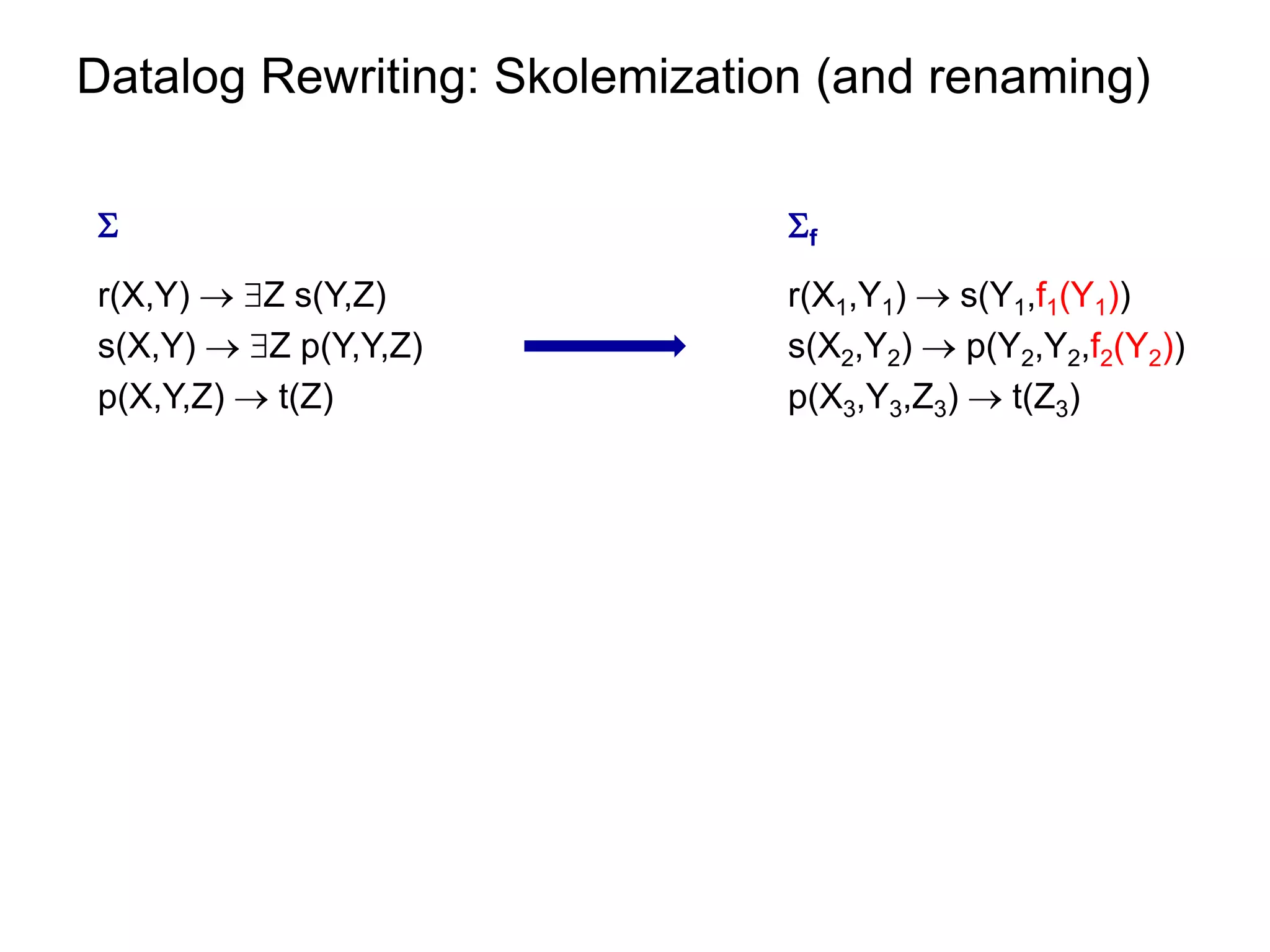
Datalog Rewriting: Skolemization (and renaming)

                              f
r(X,Y)  Z s(Y,Z)             r(X1,Y1)  s(Y1,f1(Y1))
s(X,Y)  Z p(Y,Y,Z)           s(X2,Y2)  p(Y2,Y2,f2(Y2))
p(X,Y,Z)  t(Z)                p(X3,Y3,Z3)  t(Z3)
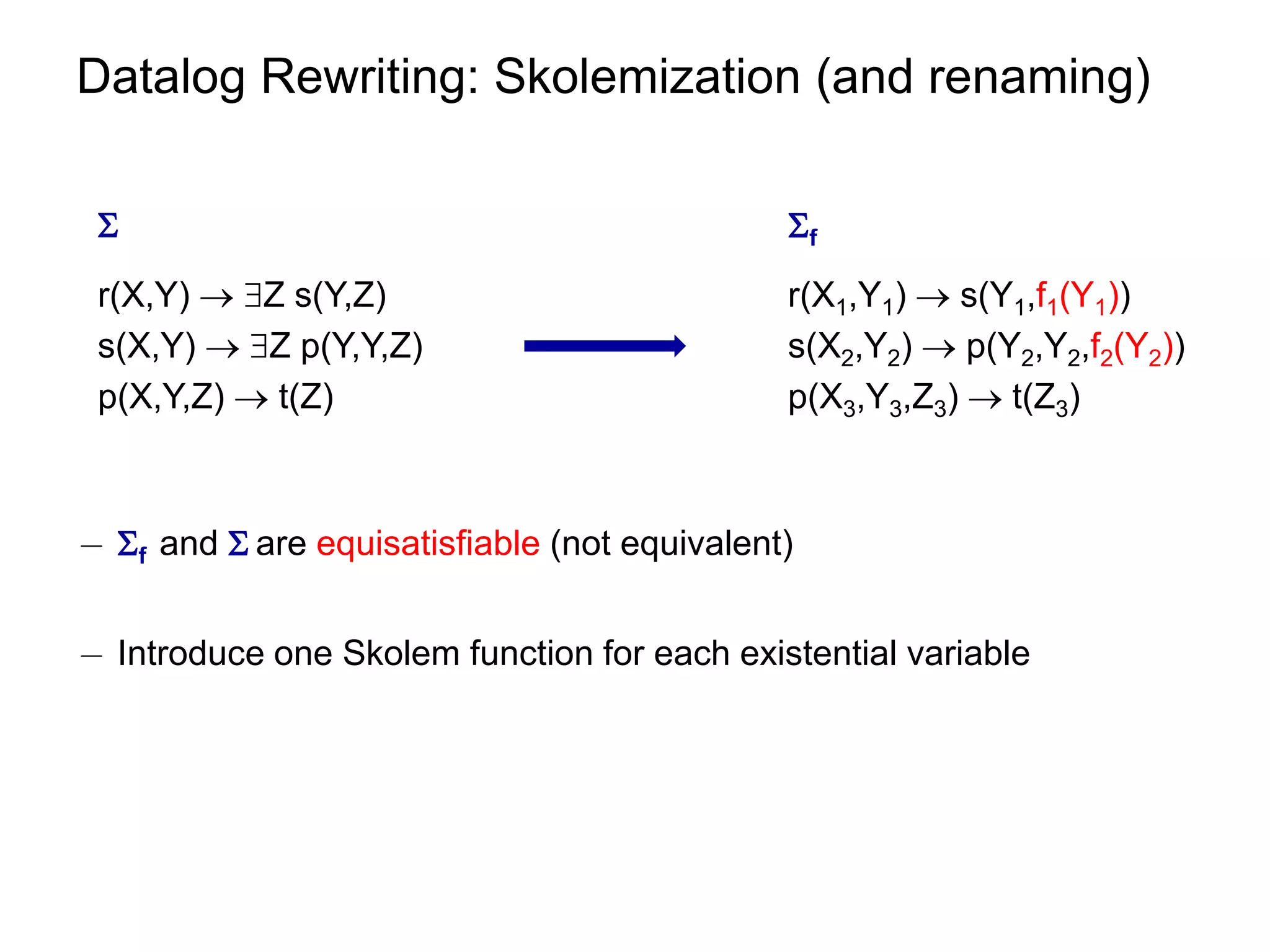
Datalog Rewriting: Skolemization (and renaming)

                                             f
 r(X,Y)  Z s(Y,Z)                           r(X1,Y1)  s(Y1,f1(Y1))
 s(X,Y)  Z p(Y,Y,Z)                         s(X2,Y2)  p(Y2,Y2,f2(Y2))
 p(X,Y,Z)  t(Z)                              p(X3,Y3,Z3)  t(Z3)


¡ f and  are equisatisfiable (not equivalent)


¡ Introduce one Skolem function for each existential variable
Datalog Rewriting: Rule Saturation

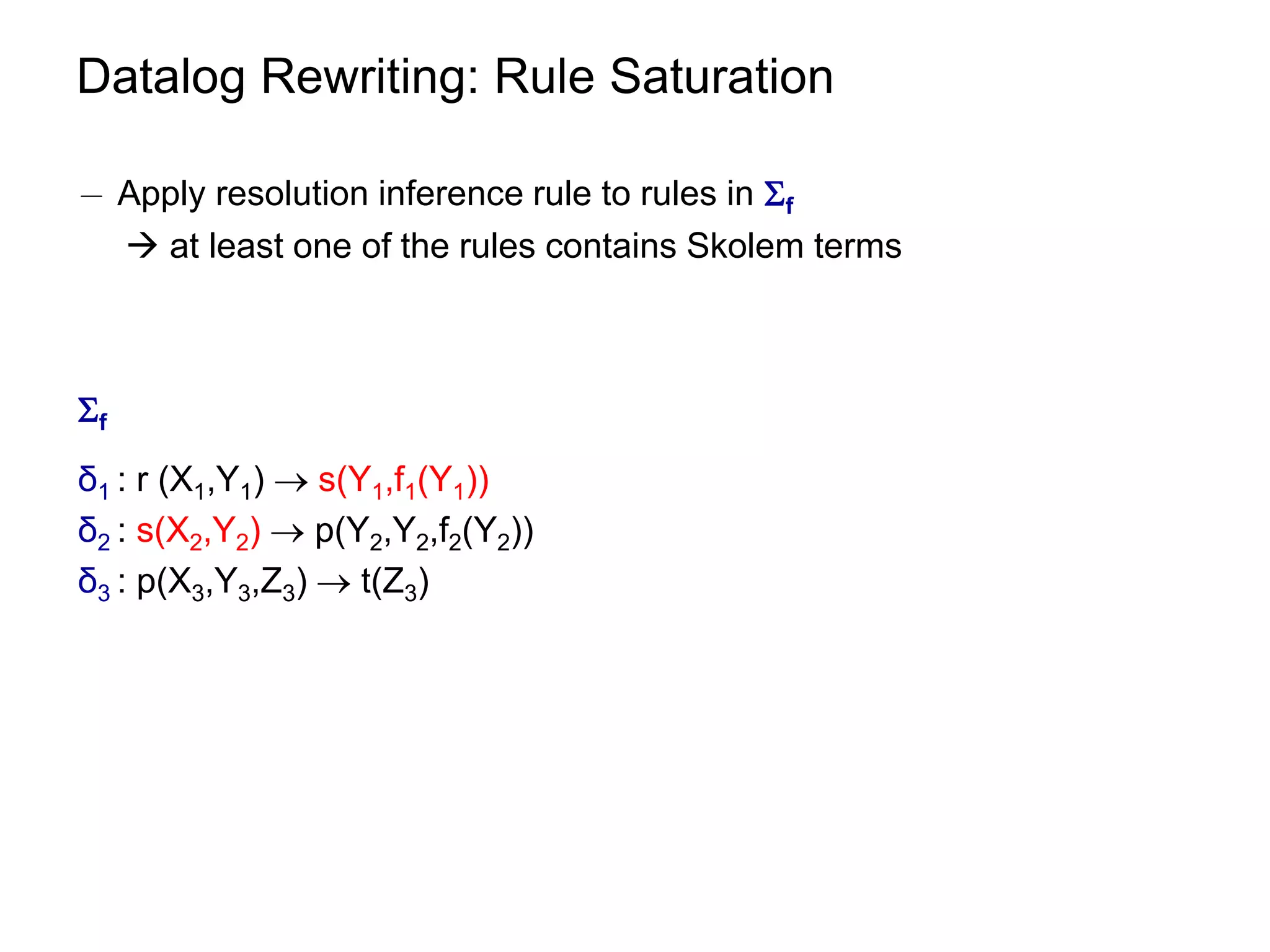
¡ Apply resolution inference rule to rules in f
   at least one of the rules contains Skolem terms


f
δ1 : r (X1,Y1)  s(Y1,f1(Y1))
δ2 : s(X2,Y2)  p(Y2,Y2,f2(Y2))
δ3 : p(X3,Y3,Z3)  t(Z3)
Datalog Rewriting: Rule Saturation

¡ Apply resolution inference rule to rules in f
   at least one of the rules contains Skolem terms


f                                                   [f]
δ1 : r (X1,Y1)  s(Y1,f1(Y1))                         …
δ2 : s(X2,Y2)  p(Y2,Y2,f2(Y2))      r(X1,Y1)  p(f1(Y1) ,f1(Y1), f2(f1(Y1)))
δ3 : p(X3,Y3,Z3)  t(Z3)                              …
Datalog Rewriting: Properties of Rule Saturation

¡ [f] mimics the chase derivations.
Datalog Rewriting: Properties of Rule Saturation

¡ [f] mimics the chase derivations.


    δ1 : r (X1,Y1)  s(Y1,f1(Y1))
    δ2 : s(X2,Y2)  p(Y2,Y2,f2(Y2))
    δ3 : p(X3,Y3,Z3)  t(Z3)
Datalog Rewriting: Properties of Rule Saturation

¡ [f] mimics the chase derivations.


    δ1 : r (X1,Y1)  s(Y1,f1(Y1))
    δ2 : s(X2,Y2)  p(Y2,Y2,f2(Y2))
    δ3 : p(X3,Y3,Z3)  t(Z3)


¡ [f] depends only on .

¡ [f] is possibly infinite
   linear TGDs have BDDP: suffices to construct it up to k steps [f]k.
Datalog Rewriting: Query Saturation

¡ resolve [f] with the query Q.
    use only rules with Skolem terms.
Datalog Rewriting: Query Saturation

¡ resolve [f] with the query Q.
    use only rules with Skolem terms.


 [f]                     …                                     Q
                                                        Q  s(A,B), p(B,B,C)
   δ1 : r (X1,Y1)  s(Y1,f1(Y1))
   δ2 : s(X2,Y2)  p(Y2,Y2,f2(Y2))
   δ3 : p(X3,Y3,Z3)  t(Z3)
                          …
   [δ12]] : r (X1,Y1)  p(f1(Y1) ,f1(Y1), f2(f1(Y1)))
                          …


                                      …
[Q,f]                  Q  r(X1,Y1), p(f1(Y1), f1(Y1),C)
                                      …
Datalog Rewriting: Query Saturation

¡ bypasses chase derivations with function symbols


 Q
 Q  s(A,B), p(B,B,C)


[f]                    …
 δ1 : r (X1,Y1)  s(Y1,f1(Y1))
 δ2 : s(X2,Y2)  p(Y2,Y2,f2(Y2))
 δ3 : p(X3,Y3,Z3)  t(Z3)
                        …
 [δ12]] : r (X1,Y1)  p(f1(Y1) ,f1(Y1), f2(f1(Y1)))
                        …
Datalog Rewriting: Finalization

¡ keep only the function-free rules from [f] [ [Q,f]


¡ derivations producing certain answers are captured by function-
  symbol-free rules.


¡ (optional) add auxiliary rules to make the rewriting a proper Datalog
   query  i.e., clear distinction IDB/EDB.
OPB-Datalog and BDDP revisited

                    OPB
                  DATALOG
                  PROGRAM


   INPUT           BDDP            OUTPUT
   RULES           RULES            RULES


    aux             ff([f])      ff([Q,f])

                    enjoy
non recursive       BDDP         non recursive
                   property
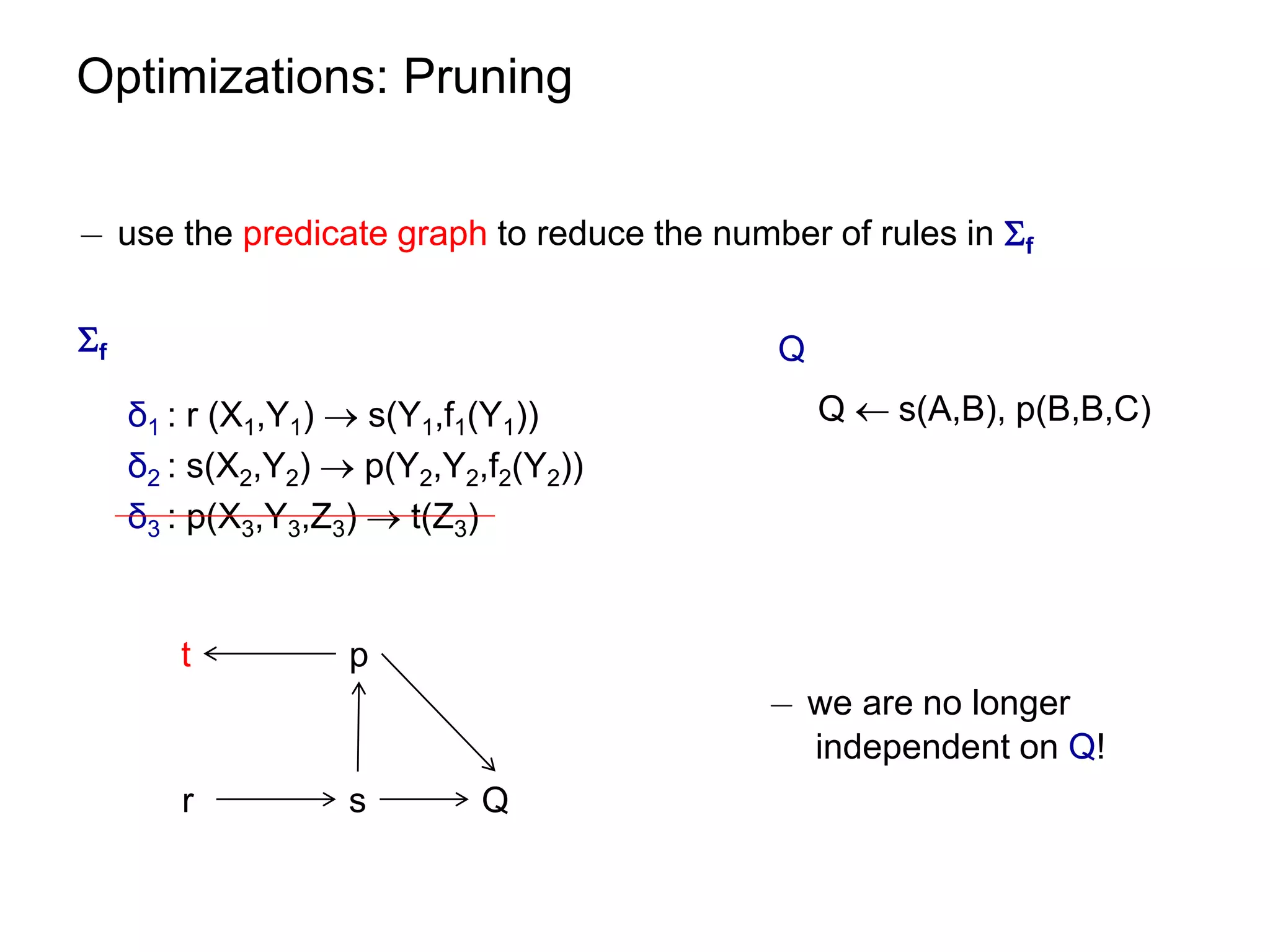
Optimizations: Pruning


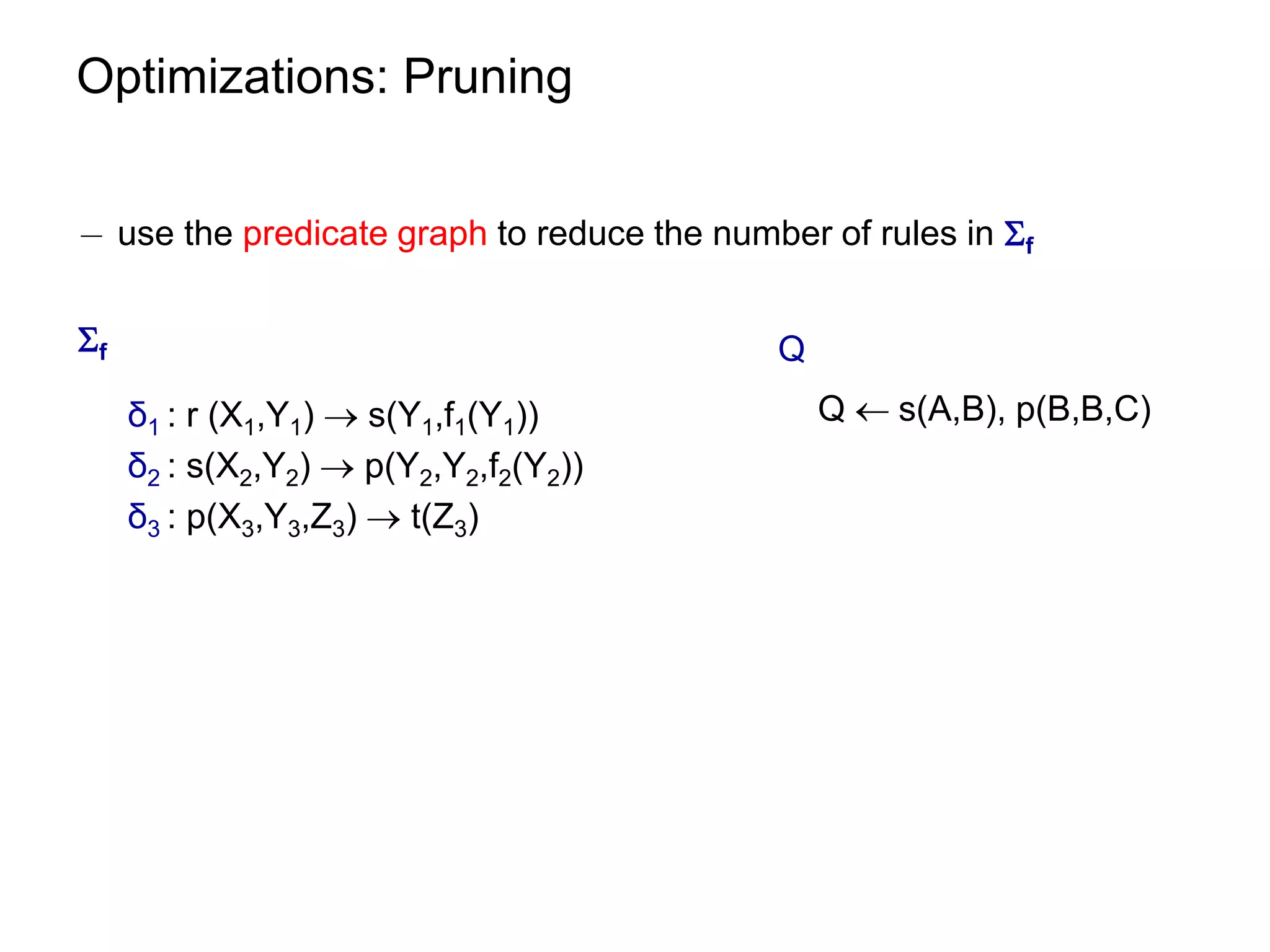
¡ use the predicate graph to reduce the number of rules in f


f                                          Q
     δ1 : r (X1,Y1)  s(Y1,f1(Y1))              Q  s(A,B), p(B,B,C)
     δ2 : s(X2,Y2)  p(Y2,Y2,f2(Y2))
     δ3 : p(X3,Y3,Z3)  t(Z3)
Optimizations: Pruning


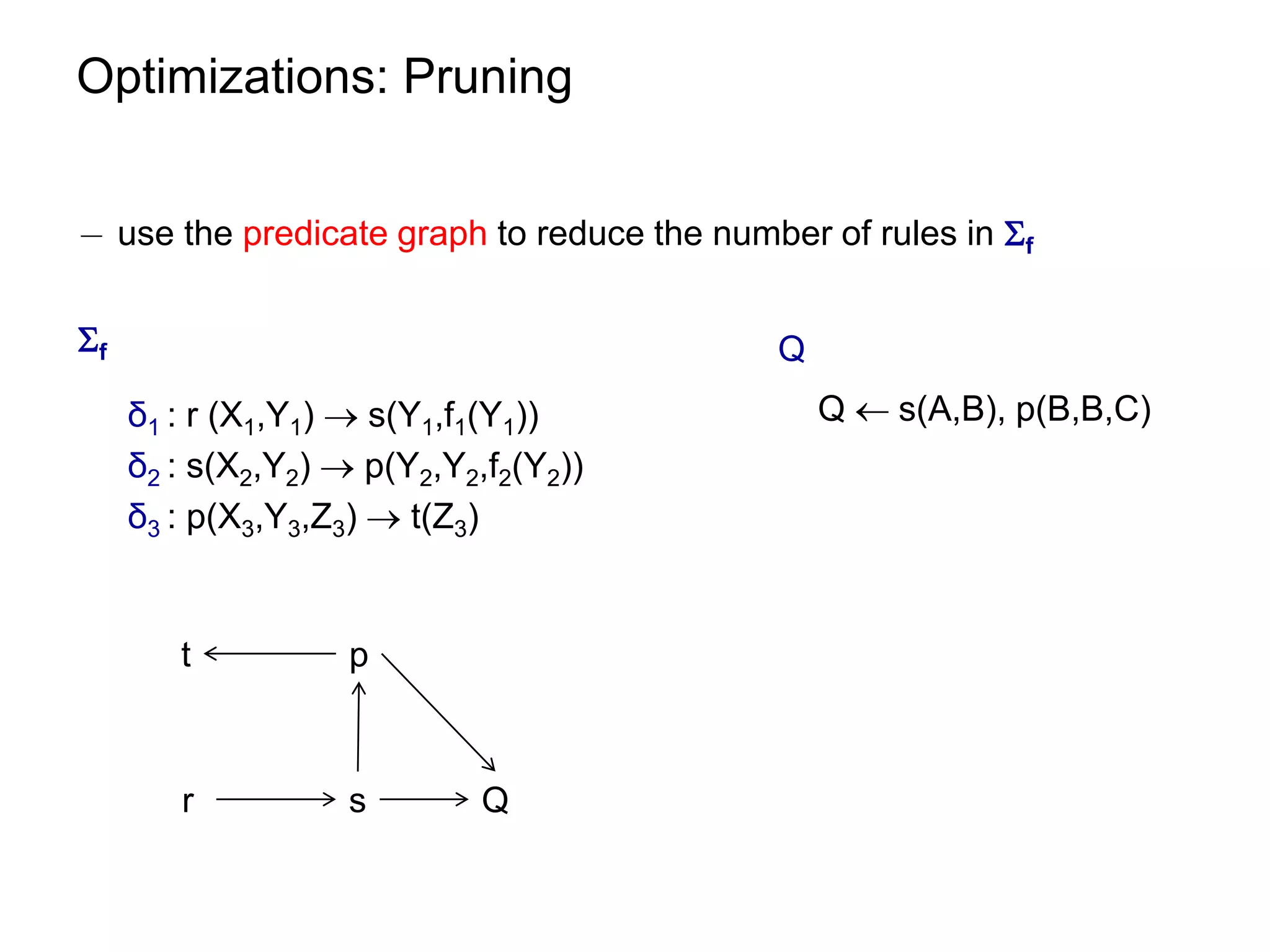
¡ use the predicate graph to reduce the number of rules in f


f                                          Q
     δ1 : r (X1,Y1)  s(Y1,f1(Y1))              Q  s(A,B), p(B,B,C)
     δ2 : s(X2,Y2)  p(Y2,Y2,f2(Y2))
     δ3 : p(X3,Y3,Z3)  t(Z3)


        t           p


        r           s        Q
Optimizations: Pruning


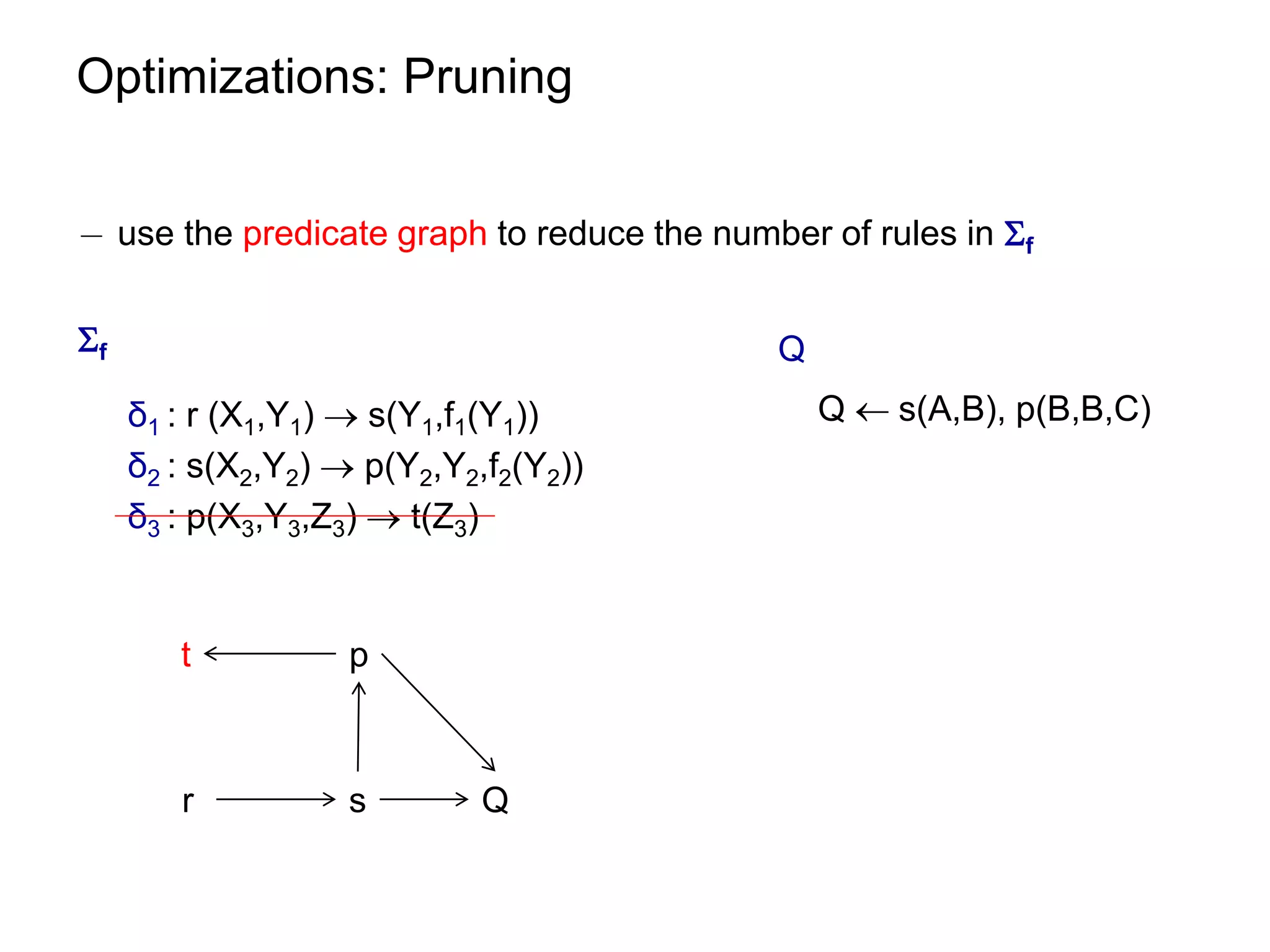
¡ use the predicate graph to reduce the number of rules in f


f                                          Q
     δ1 : r (X1,Y1)  s(Y1,f1(Y1))              Q  s(A,B), p(B,B,C)
     δ2 : s(X2,Y2)  p(Y2,Y2,f2(Y2))
     δ3 : p(X3,Y3,Z3)  t(Z3)


        t           p


        r           s        Q
Optimizations: Pruning


¡ use the predicate graph to reduce the number of rules in f


f                                          Q
     δ1 : r (X1,Y1)  s(Y1,f1(Y1))              Q  s(A,B), p(B,B,C)
     δ2 : s(X2,Y2)  p(Y2,Y2,f2(Y2))
     δ3 : p(X3,Y3,Z3)  t(Z3)


        t           p
                                            ¡ we are no longer
                                              independent on Q!
        r           s        Q
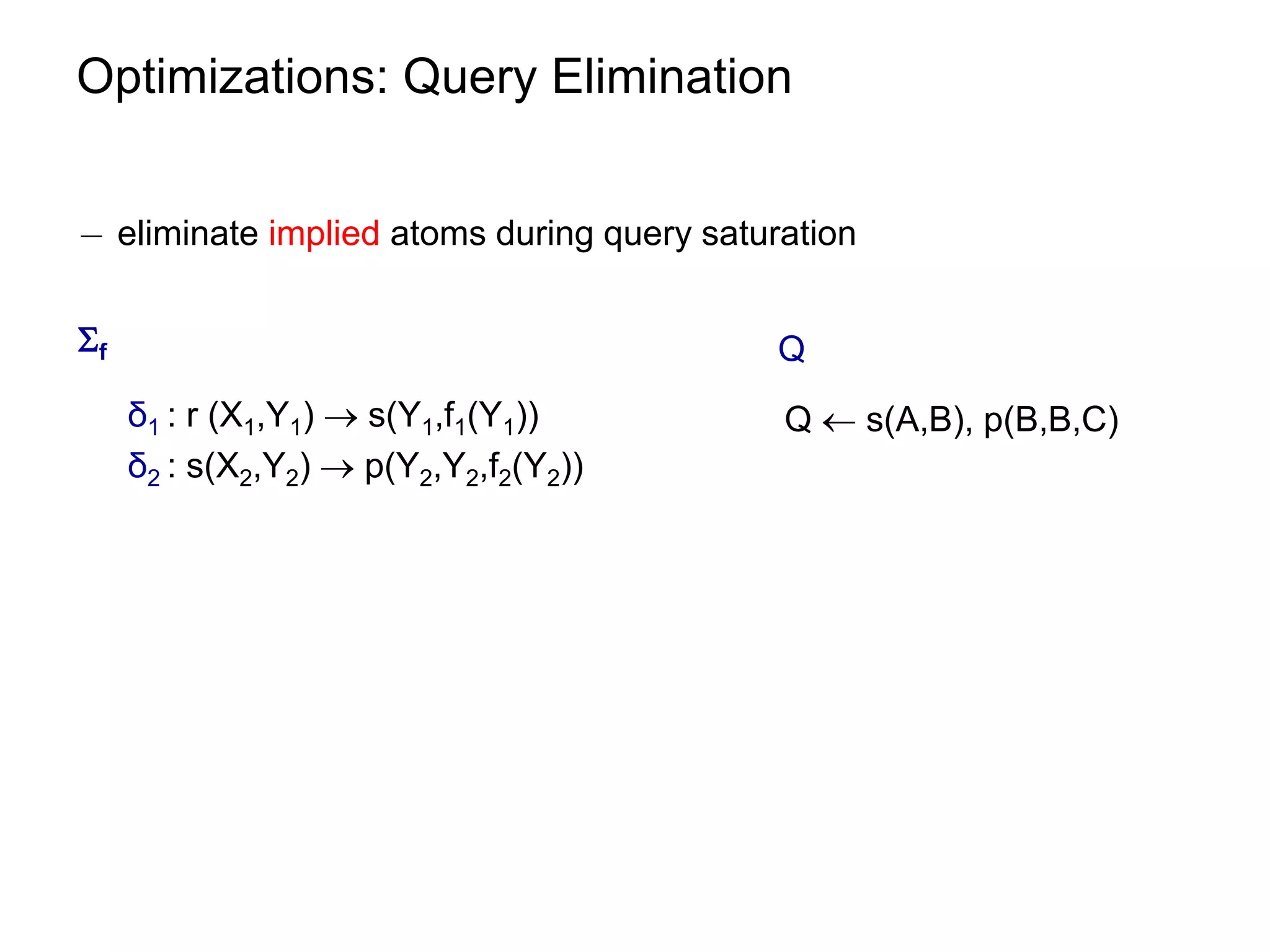
Optimizations: Query Elimination


¡ eliminate implied atoms during query saturation


f                                          Q
     δ1 : r (X1,Y1)  s(Y1,f1(Y1))          Q  s(A,B), p(B,B,C)
     δ2 : s(X2,Y2)  p(Y2,Y2,f2(Y2))
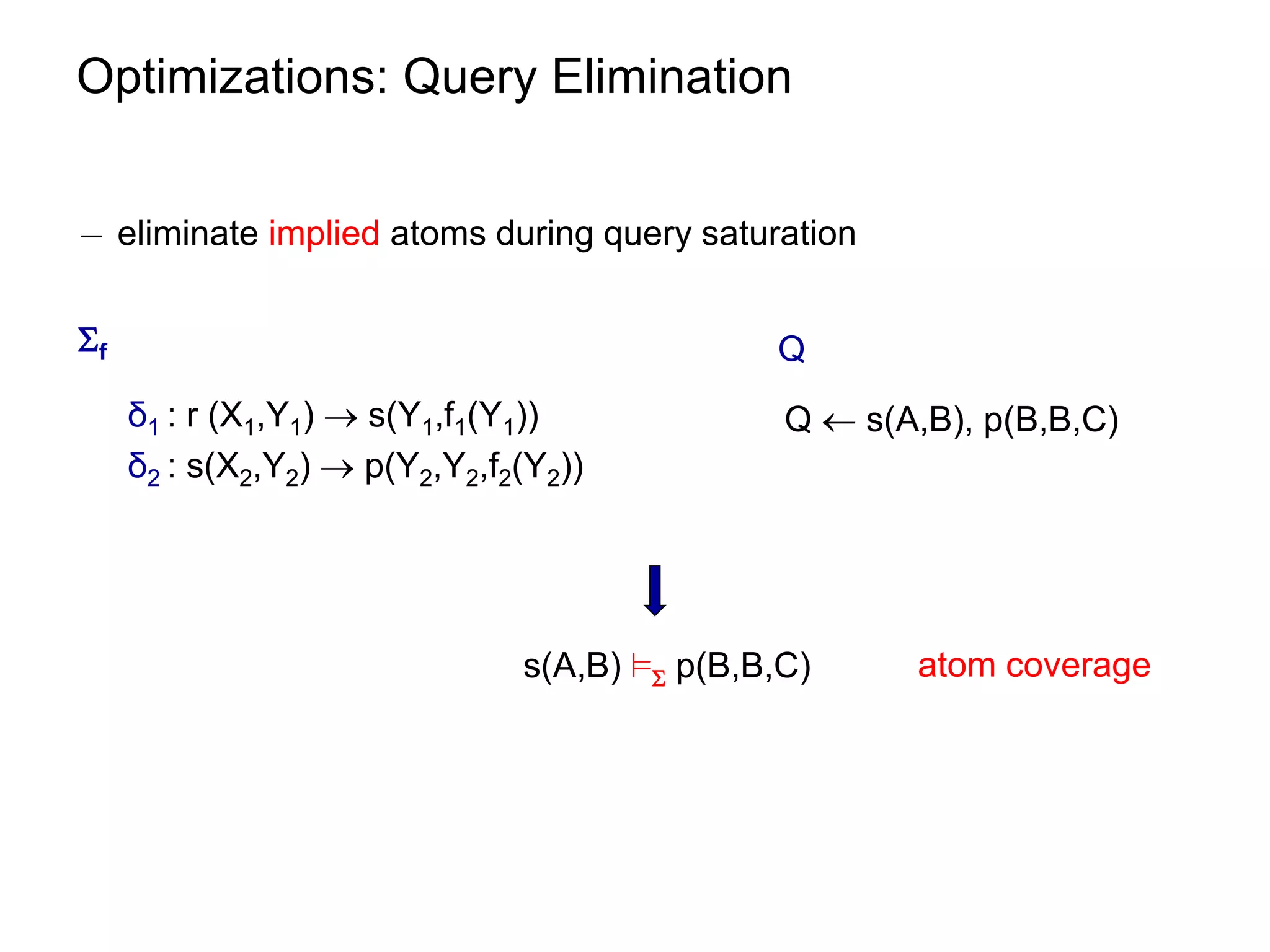
Optimizations: Query Elimination


¡ eliminate implied atoms during query saturation


f                                            Q
     δ1 : r (X1,Y1)  s(Y1,f1(Y1))             Q  s(A,B), p(B,B,C)
     δ2 : s(X2,Y2)  p(Y2,Y2,f2(Y2))


                               s(A,B) ² p(B,B,C)     atom coverage
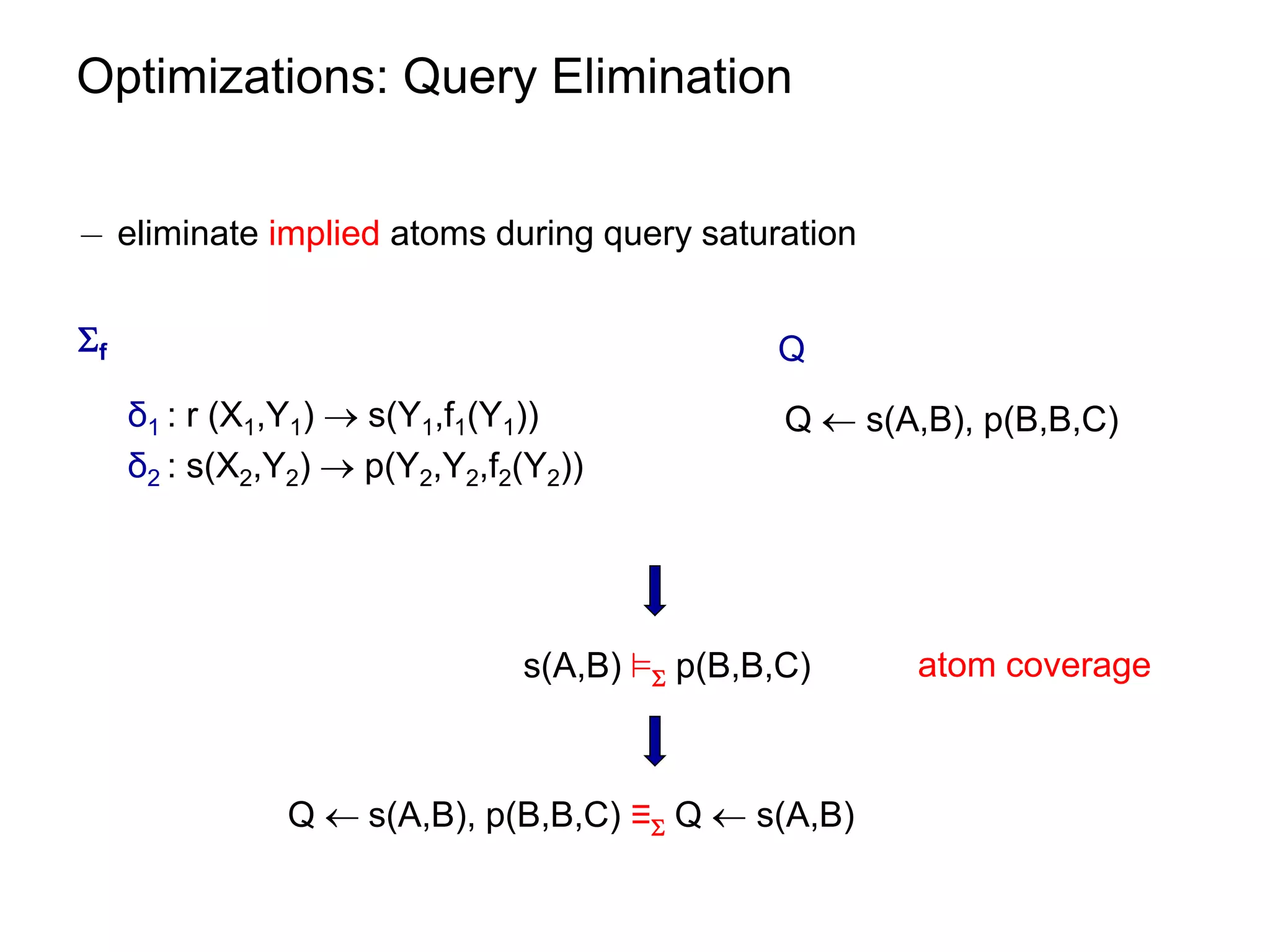
Optimizations: Query Elimination


¡ eliminate implied atoms during query saturation


f                                            Q
     δ1 : r (X1,Y1)  s(Y1,f1(Y1))             Q  s(A,B), p(B,B,C)
     δ2 : s(X2,Y2)  p(Y2,Y2,f2(Y2))


                               s(A,B) ² p(B,B,C)     atom coverage


               Q  s(A,B), p(B,B,C) ≡ Q  s(A,B)
Optimizations: Query Elimination


¡ atom coverage under linear TGDs can be checked in polynomial time
   see paper.


¡ unique elimination strategy (w.r.t. the number of eliminated atoms)
   see paper.


¡ given m = |body(ρ)| and n = ||
   worst-case size of [f] [ [Q,f] is O((n∙m)m)
   worst-case size of Q = <q,π > is O(n+m)m
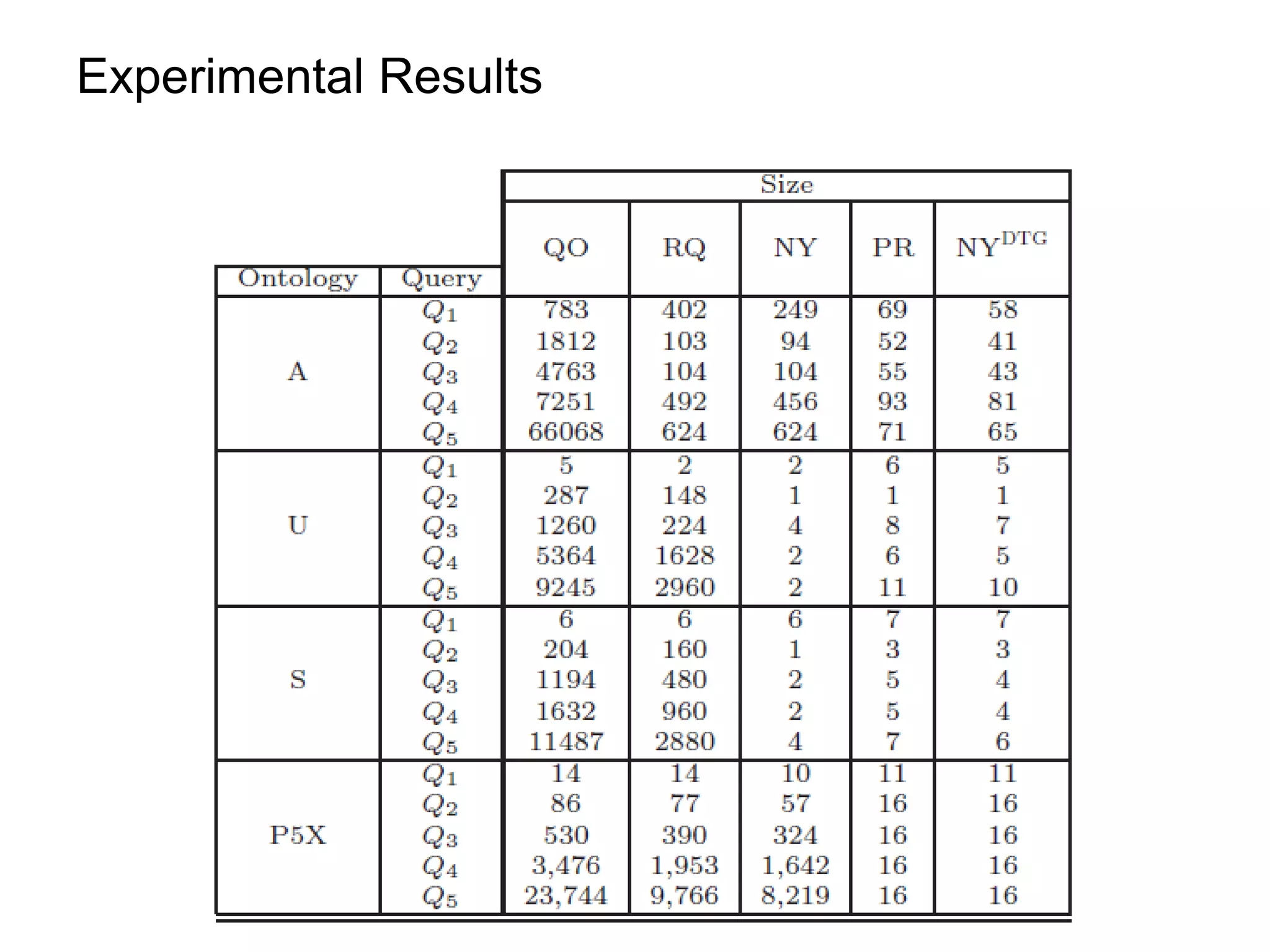
Experimental Results
Discussion


¡ Datalog rewriting is substantially more compact than UCQ rewriting.


¡ Does Datalog improve the end-to-end performance?


¡ Extend the procedure to larger classes of TGDs
  guarded TGDs [Cali’ et Al, PODS 09]  non FO-rewritable
  sticky-join TGDs [Cali’ et Al, VLDB 10]
Thank you!


             The Datalog Family


Georg       Thomas    Andreas   Andrea   Giorgio
Gottlob   Lukasiewicz Pieris     Calì     Orsi

Orsi Vldb11

  • 1.
    Optimizing Query Answering under Ontological Constraints Giorgio Orsi1,2 and Andreas Pieris2 1 Institute for the Future of Computing Oxford Martin School University of Oxford 2 Department of Computer Science University of Oxford VLDB 2011
  • 2.
    Ontological Databases Ontological Reasoning DB Constraints Ontological DB
  • 3.
    Ontological Databases Ontological Reasoning DB Constraints Ontological DB D ABox D  D TBox
  • 4.
    Ontological Databases Ontological Reasoning DB Constraints Ontological DB D ABox D  D TBox Q(X)  9Y (X,Y)
  • 5.
    Ontological Databases Ontological Reasoning DB Constraints Ontological DB D ABox D , { t | D [  ² 9u (t,u) }  D TBox Q(X)  9Y (X,Y)
  • 6.
    Ontological Constraints (examples) ConceptInclusions: 8X emp(X)  person(X) (Inverse) Relation Inclusion: 8X8Y manages(X,Y)  isManaged(Y,X) Relation Transitivity: 8X8Y8Z mgs(X,Y),mgs(Y,Z)  mgs(X,Z) Participation: 8X emp(X)  9Y report(X,Y) Disjointness: 8X emp(X), customer(X)  ? Functionality: 8X8Y8Z reports(X,Y),reports(X,Z)  Y = Z
  • 7.
    Datalog§ [Cali’ et Al, PODS 09] ¡ Datalog variant allowing in the head: - 9-variables ! TGDs 8X8Y (X,Y)  9Z (X,Z) - Equality atoms ! EGDs 8X (X)  Xi=Xj Datalog+ - Constant false (?) ! NCs 8X (X)  ?
  • 8.
    Datalog§ [Cali’ et Al, PODS 09] ¡ Datalog variant allowing in the head: - 9-variables ! TGDs 8X8Y (X,Y)  9Z (X,Z) - Equality atoms ! EGDs 8X (X)  Xi=Xj Datalog+ - Constant false (?) ! NCs 8X (X)  ? ¡ But, query answering under Datalog+ is undecidable
  • 9.
    Datalog§ [Cali’ et Al, PODS 09] ¡ Datalog variant allowing in the head: - 9-variables ! TGDs 8X8Y (X,Y)  9Z (X,Z) - Equality atoms ! EGDs 8X (X)  Xi=Xj Datalog+ - Constant false (?) ! NCs 8X (X)  ? ¡ But, query answering under Datalog+ is undecidable ¡ Datalog+ is syntactically restricted ! Datalog§
  • 10.
    Datalog§ [Cali’ et Al, PODS 09] ¡ Datalog variant allowing in the head: - 9-variables ! TGDs 8X8Y (X,Y)  9Z (X,Z) - Equality atoms ! EGDs 8X (X)  Xi=Xj Datalog+ - Constant false (?) ! NCs 8X (X)  ? ¡ But, query answering under Datalog+ is undecidable ¡ Datalog+ is syntactically restricted ! Datalog§ ¡ TGDs more expressive than inclusion dependencies 8D8P8A runs(D,P),area(P,A)  9E employee(E,D,A)
  • 11.
    The Chase Procedure Input: Database D, set of TGDs  Output: A model of D [  D person(john)  8X person(X)  9Y father(Y,X) 8X8Y father(X,Y)  person(X) chase(D,) = D [ ?
  • 12.
    The Chase Procedure Input: Database D, set of TGDs  Output: A model of D [  D person(john)  8X person(X)  9Y father(Y,X) 8X8Y father(X,Y)  person(X) chase(D,) = D [ {father(z1,john)
  • 13.
    The Chase Procedure Input: Database D, set of TGDs  Output: A model of D [  D person(john)  8X person(X)  9Y father(Y,X) 8X8Y father(X,Y)  person(X) chase(D,) = D [ {father(z1,john), person(z1)
  • 14.
    The Chase Procedure Input: Database D, set of TGDs  Output: A model of D [  D person(john)  8X person(X)  9Y father(Y,X) 8X8Y father(X,Y)  person(X) chase(D,) = D [ {father(z1,john), person(z1), father(z2,z1)
  • 15.
    The Chase Procedure Input: Database D, set of TGDs  Output: A model of D [  D person(john)  8X person(X)  9Y father(Y,X) 8X8Y father(X,Y)  person(X) chase(D,) = D [ {father(z1,john), person(z1), father(z2,z1), …}
  • 16.
    Query Answering viaChase Q h C = chase(D,) D h1 h2 h2(C) h1(C) . . . M1 M2 D[²Q , chase(D,) ² Q [see, e.g., Deutsch, Nash & Remmel, PODS 08]
  • 17.
    Query Answering viaChase Q h C = chase(D,) D h1 h2 h2(C) h1(C) . . . M1 M2 Possibly Infinite! 
  • 18.
    Query answering viarewriting Q 
  • 19.
    Query answering viarewriting Q  compilation Q
  • 20.
    Query answering viarewriting Q  Q compilation Q evaluation D
  • 21.
  • 22.
    Linear TGDs 8X8Y r(X,Y)  9Z (X,Z) single body atom ¡ Properly generalize inclusion dependencies. ¡ Enjoy the bounded-derivation depth property. ¡ FO-rewritable  query answering in AC0 (data complexity).
  • 23.
    Bounded derivation depthproperty (BDDP) D Q
  • 24.
    Bounded derivation depthproperty (BDDP) D Q k levels constant w.r.t. D chase(D,) ² Q ) chasek(D,) ² Q
  • 25.
    Bounded derivation depthproperty (BDDP) D Q k levels constant w.r.t. D BDDP ) First-Order Rewritability
  • 26.
    FO-rewritability: Example [Gottlobet Al., ICDE 11]  promoter(X)  Y promotesTo(X,Y) promotesTo(X,Y)  customer(Y) Q q  promotesTo(A,B), customer(B) Q q  promotesTo(A,B), customer(B) (original query)
  • 27.
    FO-rewritability: Example [Gottlobet Al., ICDE 11]  promoter(X)  Y promotesTo(X,Y) promotesTo(X,Y)  customer(Y) Q q  promotesTo(A,B), customer(B) Q q  promotesTo(A,B), customer(B) {Y=B} q  promotesTo(A,B), customer(V0,B) ( V0 is fresh )
  • 28.
    FO-rewritability: Example [Gottlobet Al., ICDE 11]  promoter(X)  Y promotesTo(X,Y) promotesTo(X,Y)  customer(Y) Q q  promotesTo(A,B), customer(B) Q q  promotesTo(A,B), customer(B) factorization q  promotesTo(A,B), promotesTo(V0,B) ans(A)  promotesTo(A,B) { A = V0 }
  • 29.
    FO-rewritability: Example [Gottlobet Al., ICDE 11]  promoter(X)  Y promotesTo(X,Y) promotesTo(X,Y)  customer(Y) Q q  promotesTo(A,B), customer(B) Q q  promotesTo(A,B), customer(B) q  promotesTo(A,B) {X = A, Y = B} q  promoter(A)
  • 30.
    FO-rewritability: Example [Gottlobet Al., ICDE 11]  promoter(X)  Y promotesTo(X,Y) promotesTo(X,Y)  customer(Y) Q q  promotesTo(A,B), customer(B) Q q  promotesTo(A,B), customer(B) q  promotesTo(A,B) UCQ rewriting (first-order) q  promoter(A)
  • 31.
    FO-rewritability ¡ Desirable propertiesof a FO-rewriting:  independent on the DB  executable by any DBMS  easy to compute (e.g., polynomial time)  small size (e.g., polynomial size)
  • 32.
    FO-rewritability ¡ Desirable propertiesof a FO-rewriting:  independent on the DB  executable by any DBMS  easy to compute (e.g., polynomial time)  small size (e.g., polynomial size) ¡ Unions of Conjunctive Queries (UCQs) Calvanese et Al, JAR 07  executable by any DBMS Perez Urbina et Al, JAL 09  DB independent Cali’ et Al, PODS 09  easy to optimize and distribute Gottlob et Al, ICDE 11 and others…  worst-case exponential size in Q and 
  • 33.
    FO-rewritability ¡ Combinedand hybrid FO-rewriting  good computational properties Kontchakov et Al., KR 10 Gottlob and Schwentick, DL 11 (e.g., polynomial in size)  requires access to the DB
  • 34.
    FO-rewritability ¡ Combinedand hybrid FO-rewriting  good computational properties Kontchakov et Al., KR 10 Gottlob and Schwentick, DL 11 (e.g., polynomial in size)  requires access to the DB ¡ Purely intensional Datalog rewriting Perez Urbina et Al, JAL 09  very compressed representation Rosati and Almatelli., KR 10  purely intensional Orsi and Pieris., VLDB 11   requires view-creation or Datalog engine
  • 35.
    Datalog rewriting: keepit first-order! ¡ A Datalog query is (in general) not a first-order query  a non-recursive Datalog query is a first-order query  a bounded Datalog query is a first-order query  an output-predicate-bounded Datalog query is a first-order query
  • 36.
    Datalog rewriting: keepit first-order! ¡ A Datalog query is (in general) not a first-order query  a non-recursive Datalog query is a first-order query  a bounded Datalog query is a first-order query  an output-predicate-bounded Datalog query is a first-order query ¡ Input:  a (w.l.o.g. boolean) conjunctive query Q = <q,ρ> Q : q(X)  p(X), s(X,Y)  <q, q(X) p(X),s(X,Y) >  a set of linear TGDs  ¡ Output:  a bounded Datalog query Q = <q,π >
  • 37.
    Predicate-bounded Datalog  ¡ bounded Datalog program r(X,Y), t(Y) → t(X)  all IDB predicates are bounded. r(X,Y ) → r(Y,X) r(X,Y ), t(Z) → q(X) ¡ p-bounded Datalog program  the predicate p is bounded.
  • 38.
    Predicate-bounded Datalog  ¡ bounded Datalog program r(X,Y), t(Y) → t(X)  all IDB predicates are bounded. r(X,Y ) → r(Y,X) r(X,Y ), t(Z) → q(X) ¡ p-bounded Datalog program  the predicate p is bounded. t is unbounded  t(X) cannot be computed using a DB-independent FO-query
  • 39.
    Predicate-bounded Datalog  ¡ bounded Datalog program r(X,Y), t(Y) → t(X)  all IDB predicates are bounded. r(X,Y ) → r(Y,X) r(X,Y ), t(Z) → q(X) ¡ p-bounded Datalog program  the predicate p is bounded. t is unbounded  t(X) cannot be computed using a DB-independent FO-query t(X)  r(X,Y), t(Y)
  • 40.
    Predicate-bounded Datalog  ¡ bounded Datalog program r(X,Y), t(Y) → t(X)  all IDB predicates are bounded. r(X,Y ) → r(Y,X) r(X,Y ), t(Z) → q(X) ¡ p-bounded Datalog program  the predicate p is bounded. t is unbounded  t(X) cannot be computed using a DB-independent FO-query t(X)  r(X,Y), t(Y) v t(X)  r(X,Y), r(Y,Z), t(Z)
  • 41.
    Predicate-bounded Datalog  ¡ bounded Datalog program r(X,Y), t(Y) → t(X)  all IDB predicates are bounded. r(X,Y ) → r(Y,X) r(X,Y ), t(Z) → q(X) ¡ p-bounded Datalog program  the predicate p is bounded. t is unbounded  t(X) cannot be computed using a DB-independent FO-query t(X)  r(X,Y), t(Y) v t(X)  r(X,Y), r(Y,Z), t(Z) v t(X)  r(X,Y), r(Y,Z), r(Z,W), t(W)
  • 42.
    Predicate-bounded Datalog  ¡ bounded Datalog program r(X,Y), t(Y) → t(X)  all IDB predicates are bounded. r(X,Y ) → r(Y,X) r(X,Y ), t(Z) → q(X) ¡ p-bounded Datalog program  the predicate p is bounded. t is unbounded  t(X) cannot be computed using a DB-independent FO-query t(X)  r(X,Y), t(Y) v t(X)  r(X,Y), r(Y,Z), t(Z) v t(X)  r(X,Y), r(Y,Z), r(Z,W), t(W) v …
  • 43.
    Predicate-bounded Datalog  ¡ bounded Datalog program r(X,Y), t(Y) → t(X)  all IDB predicates are bounded. r(X,Y ) → r(Y,X) r(X,Y ), t(Z) → q(X) ¡ p-bounded Datalog program  the predicate p is bounded. q is bounded  q(X) can be computed using a DB-independent FO-query
  • 44.
    Predicate-bounded Datalog  ¡ bounded Datalog program r(X,Y), t(Y) → t(X)  all IDB predicates are bounded. r(X,Y ) → r(Y,X) r(X,Y ), t(Z) → q(X) ¡ p-bounded Datalog program  the predicate p is bounded. q is bounded  q(X) can be computed using a DB-independent FO-query q(X)  r(X,Y)
  • 45.
    Predicate-bounded Datalog  ¡ bounded Datalog program r(X,Y), t(Y) → t(X)  all IDB predicates are bounded. r(X,Y ) → r(Y,X) r(X,Y ), t(Z) → q(X) ¡ p-bounded Datalog program  the predicate p is bounded. q is bounded  q(X) can be computed using a DB-independent FO-query q(X)  r(X,Y) v q(X)  r(Y,X)
  • 46.
    Output-predicate-bounded Datalog andBDDP OPB DATALOG PROGRAM
  • 47.
    Output-predicate-bounded Datalog andBDDP OPB DATALOG PROGRAM INPUT BDDP OUTPUT RULES RULES RULES
  • 48.
    Output-predicate-bounded Datalog andBDDP OPB DATALOG PROGRAM INPUT BDDP OUTPUT RULES RULES RULES enjoy non recursive BDDP non recursive property
  • 49.
    Datalog Rewriting: Skolemization(and renaming)  r(X,Y)  Z s(Y,Z) s(X,Y)  Z p(Y,Y,Z) p(X,Y,Z)  t(Z)
  • 50.
    Datalog Rewriting: Skolemization(and renaming)  f r(X,Y)  Z s(Y,Z) r(X1,Y1)  s(Y1,f1(Y1)) s(X,Y)  Z p(Y,Y,Z) s(X2,Y2)  p(Y2,Y2,f2(Y2)) p(X,Y,Z)  t(Z) p(X3,Y3,Z3)  t(Z3)
  • 51.
    Datalog Rewriting: Skolemization(and renaming)  f r(X,Y)  Z s(Y,Z) r(X1,Y1)  s(Y1,f1(Y1)) s(X,Y)  Z p(Y,Y,Z) s(X2,Y2)  p(Y2,Y2,f2(Y2)) p(X,Y,Z)  t(Z) p(X3,Y3,Z3)  t(Z3) ¡ f and  are equisatisfiable (not equivalent) ¡ Introduce one Skolem function for each existential variable
  • 52.
    Datalog Rewriting: RuleSaturation ¡ Apply resolution inference rule to rules in f  at least one of the rules contains Skolem terms f δ1 : r (X1,Y1)  s(Y1,f1(Y1)) δ2 : s(X2,Y2)  p(Y2,Y2,f2(Y2)) δ3 : p(X3,Y3,Z3)  t(Z3)
  • 53.
    Datalog Rewriting: RuleSaturation ¡ Apply resolution inference rule to rules in f  at least one of the rules contains Skolem terms f [f] δ1 : r (X1,Y1)  s(Y1,f1(Y1)) … δ2 : s(X2,Y2)  p(Y2,Y2,f2(Y2)) r(X1,Y1)  p(f1(Y1) ,f1(Y1), f2(f1(Y1))) δ3 : p(X3,Y3,Z3)  t(Z3) …
  • 54.
    Datalog Rewriting: Propertiesof Rule Saturation ¡ [f] mimics the chase derivations.
  • 55.
    Datalog Rewriting: Propertiesof Rule Saturation ¡ [f] mimics the chase derivations. δ1 : r (X1,Y1)  s(Y1,f1(Y1)) δ2 : s(X2,Y2)  p(Y2,Y2,f2(Y2)) δ3 : p(X3,Y3,Z3)  t(Z3)
  • 56.
    Datalog Rewriting: Propertiesof Rule Saturation ¡ [f] mimics the chase derivations. δ1 : r (X1,Y1)  s(Y1,f1(Y1)) δ2 : s(X2,Y2)  p(Y2,Y2,f2(Y2)) δ3 : p(X3,Y3,Z3)  t(Z3) ¡ [f] depends only on . ¡ [f] is possibly infinite linear TGDs have BDDP: suffices to construct it up to k steps [f]k.
  • 57.
    Datalog Rewriting: QuerySaturation ¡ resolve [f] with the query Q.  use only rules with Skolem terms.
  • 58.
    Datalog Rewriting: QuerySaturation ¡ resolve [f] with the query Q.  use only rules with Skolem terms. [f] … Q Q  s(A,B), p(B,B,C) δ1 : r (X1,Y1)  s(Y1,f1(Y1)) δ2 : s(X2,Y2)  p(Y2,Y2,f2(Y2)) δ3 : p(X3,Y3,Z3)  t(Z3) … [δ12]] : r (X1,Y1)  p(f1(Y1) ,f1(Y1), f2(f1(Y1))) … … [Q,f] Q  r(X1,Y1), p(f1(Y1), f1(Y1),C) …
  • 59.
    Datalog Rewriting: QuerySaturation ¡ bypasses chase derivations with function symbols Q Q  s(A,B), p(B,B,C) [f] … δ1 : r (X1,Y1)  s(Y1,f1(Y1)) δ2 : s(X2,Y2)  p(Y2,Y2,f2(Y2)) δ3 : p(X3,Y3,Z3)  t(Z3) … [δ12]] : r (X1,Y1)  p(f1(Y1) ,f1(Y1), f2(f1(Y1))) …
  • 60.
    Datalog Rewriting: Finalization ¡keep only the function-free rules from [f] [ [Q,f] ¡ derivations producing certain answers are captured by function- symbol-free rules. ¡ (optional) add auxiliary rules to make the rewriting a proper Datalog query  i.e., clear distinction IDB/EDB.
  • 61.
    OPB-Datalog and BDDPrevisited OPB DATALOG PROGRAM INPUT BDDP OUTPUT RULES RULES RULES aux ff([f]) ff([Q,f]) enjoy non recursive BDDP non recursive property
  • 62.
    Optimizations: Pruning ¡ usethe predicate graph to reduce the number of rules in f f Q δ1 : r (X1,Y1)  s(Y1,f1(Y1)) Q  s(A,B), p(B,B,C) δ2 : s(X2,Y2)  p(Y2,Y2,f2(Y2)) δ3 : p(X3,Y3,Z3)  t(Z3)
  • 63.
    Optimizations: Pruning ¡ usethe predicate graph to reduce the number of rules in f f Q δ1 : r (X1,Y1)  s(Y1,f1(Y1)) Q  s(A,B), p(B,B,C) δ2 : s(X2,Y2)  p(Y2,Y2,f2(Y2)) δ3 : p(X3,Y3,Z3)  t(Z3) t p r s Q
  • 64.
    Optimizations: Pruning ¡ usethe predicate graph to reduce the number of rules in f f Q δ1 : r (X1,Y1)  s(Y1,f1(Y1)) Q  s(A,B), p(B,B,C) δ2 : s(X2,Y2)  p(Y2,Y2,f2(Y2)) δ3 : p(X3,Y3,Z3)  t(Z3) t p r s Q
  • 65.
    Optimizations: Pruning ¡ usethe predicate graph to reduce the number of rules in f f Q δ1 : r (X1,Y1)  s(Y1,f1(Y1)) Q  s(A,B), p(B,B,C) δ2 : s(X2,Y2)  p(Y2,Y2,f2(Y2)) δ3 : p(X3,Y3,Z3)  t(Z3) t p ¡ we are no longer independent on Q! r s Q
  • 66.
    Optimizations: Query Elimination ¡eliminate implied atoms during query saturation f Q δ1 : r (X1,Y1)  s(Y1,f1(Y1)) Q  s(A,B), p(B,B,C) δ2 : s(X2,Y2)  p(Y2,Y2,f2(Y2))
  • 67.
    Optimizations: Query Elimination ¡eliminate implied atoms during query saturation f Q δ1 : r (X1,Y1)  s(Y1,f1(Y1)) Q  s(A,B), p(B,B,C) δ2 : s(X2,Y2)  p(Y2,Y2,f2(Y2)) s(A,B) ² p(B,B,C) atom coverage
  • 68.
    Optimizations: Query Elimination ¡eliminate implied atoms during query saturation f Q δ1 : r (X1,Y1)  s(Y1,f1(Y1)) Q  s(A,B), p(B,B,C) δ2 : s(X2,Y2)  p(Y2,Y2,f2(Y2)) s(A,B) ² p(B,B,C) atom coverage Q  s(A,B), p(B,B,C) ≡ Q  s(A,B)
  • 69.
    Optimizations: Query Elimination ¡atom coverage under linear TGDs can be checked in polynomial time  see paper. ¡ unique elimination strategy (w.r.t. the number of eliminated atoms)  see paper. ¡ given m = |body(ρ)| and n = ||  worst-case size of [f] [ [Q,f] is O((n∙m)m)  worst-case size of Q = <q,π > is O(n+m)m
  • 70.
  • 71.
    Discussion ¡ Datalog rewritingis substantially more compact than UCQ rewriting. ¡ Does Datalog improve the end-to-end performance? ¡ Extend the procedure to larger classes of TGDs guarded TGDs [Cali’ et Al, PODS 09]  non FO-rewritable sticky-join TGDs [Cali’ et Al, VLDB 10]
  • 72.
    Thank you! The Datalog Family Georg Thomas Andreas Andrea Giorgio Gottlob Lukasiewicz Pieris Calì Orsi