2. The LoLA Input Language
Plan

• Place/Transition nets
• Verification task
• High-Level nets
• Demo
Place/Transition Nets
N = [P,T,F,W,m0]               treated as variables

PLACE p1, p2, p3, p4;
                            can be replaced as a whole
MARKING p1:2, p3:1, p1:1;
                            compatible with computed
                                     markings
{ this is a comment }

TRANSITION t1
 CONSUME p1:3, p2: 1;
 PRODUCE p3: 2, p1 : 2;
                               treated as procedures
 TRANSITION t2
  CONSUME p3 : 1;
  PRODUCE ;
                            only one reference per arc
Identifiers

Many special characters permitted, eg.


p4 23 message[x=13,from=”bla”]


Reason: easier for tools to generate such
names
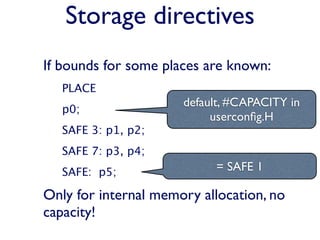
Storage directives
If bounds for some places are known:
   PLACE
                      default, #CAPACITY in
   p0;
                           userconfig.H
   SAFE 3: p1, p2;
   SAFE 7: p3, p4;
   SAFE: p5;               = SAFE 1

Only for internal memory allocation, no
capacity!
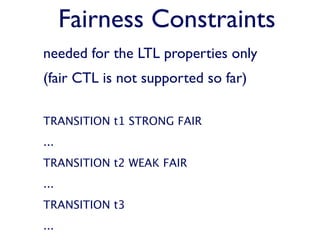
Fairness Constraints
needed for the LTL properties only
(fair CTL is not supported so far)

TRANSITION t1 STRONG FAIR
...
TRANSITION t2 WEAK FAIR
...
TRANSITION t3
...
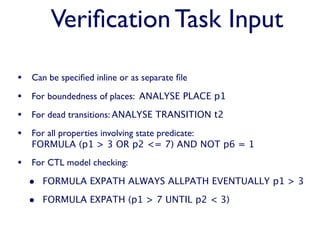
Verification Task Input

• Can be specified inline or as separate file
• For boundedness of places: ANALYSE PLACE p1
• For dead transitions: ANALYSE TRANSITION t2
• For all properties involving state predicate:
   FORMULA (p1 > 3 OR p2 <= 7) AND NOT p6 = 1

• For CTL model checking:
  • FORMULA EXPATH ALWAYS ALLPATH EVENTUALLY p1 > 3
  • FORMULA EXPATH (p1 > 7 UNTIL p2 < 3)
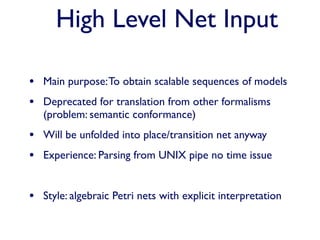
High Level Net Input

• Main purpose: To obtain scalable sequences of models
• Deprecated for translation from other formalisms
   (problem: semantic conformance)
• Will be unfolded into place/transition net anyway
• Experience: Parsing from UNIX pipe no time issue

• Style: algebraic Petri nets with explicit interpretation
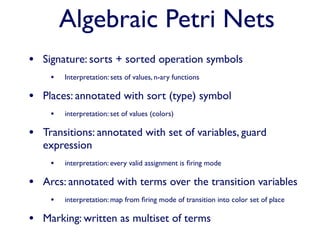
Algebraic Petri Nets
• Signature: sorts + sorted operation symbols
    •   Interpretation: sets of values, n-ary functions

• Places: annotated with sort (type) symbol
    •   interpretation: set of values (colors)

• Transitions: annotated with set of variables, guard
   expression
    •   interpretation: every valid assignment is firing mode

• Arcs: annotated with terms over the transition variables
    •   interpretation: map from firing mode of transition into color set of place

• Marking: written as multiset of terms
Signature: Sorts and
           their interpretation
SORT
 a = [ 1 , 5 ];         { 1,2,3,4,5 }
 b = BOOLEAN;               { TRUE, FALSE }
 c = ENUMERATE red blue green END; { red, blue, green }


       “successor” canonically defined on each value set

               scalar              arbitrary         each value has
                                                       unique text
 d = ARRAY [1,3] OF BOOLEAN;
                                                     representation
   { [FALSE|FALSE|FALSE], ... , [TRUE|TRUE|TRUE] }

 e = RECORD
     receiver : a;
     sender : b;
   END ;             { <1|FALSE>, ...., <3|TRUE> }
Signature: operations
         and their interpretation
SORT phils = [1 , 5 ]; forks = [1 , 5];

FUNCTION leftfork (x : phils) : forks     signature
BEGIN
 RETURN x
END                interpretation
FUNCTION rightfork(x : phils): forks
BEGIN
 RETURN x + 1
                                          expressions evaluate
END                                          on all integers,
FUNCTION allthinking () : phils           assignments align to
VAR x : phils;
BEGIN
                                           value set (modulo
 FOR ALL x DO                                  arithmetic)
  RETURN x
 END
END                  result is multiset
Statements in function body
 EXIT
                          leave function

 RETURN E
                      add value of E to return multiset, continue

 L = E
                         assignment

 S1 ; S2
                       sequential composition

 WHILE E DO S END
              while loop

 REPEAT S UNTIL E END
          until loop

 FOR x := E1 TO E2 DO S END
    for loop in canonical order of values

 FOR ALL x DO S END
            for loop through all elements of sort of x

 IF E THEN s1 [ELSE S2] END
    branch statement

 SWITCH E
  CASE E1: S1 ... CASE En: Sn
  ELSE S
 END
                           multibranch statement
Expressions in function body
                                                                 pointwise for
 X      X[a + b]       X.c[a + b]
                                                                  arrays and
                                                                   records
 645      TRUE     FALSE

 A <-> B      A -> B       A AND B      A OR B     NOT A

 A<B       A <= B      A>B          A >= B     A=B     A <> B     A#B

 A+B         A*B       A-B      A/B          A MOD B

 (E)

 [ E1 | E2 | .... | En ]                                        no modulo
 bla ( E1, ...., En)
                                                                  before
                                    function must               assignment
                                    return exactly
                                      one value
Example: Network
SORT dimensions = [ 1 , 3 ];          row = [ 1 , 3 ];           agent = ARRAY dimensions OF row ;
      message = RECORD               receiver : agent;           sender : agent;        END;


FUNCTION X (a:agent;b:agent):message
      VAR m : message;
BEGIN
      m . receiver = a;               m . sender = b;                   RETURN m
END


FUNCTION N(z:agent):agent
VAR l : dimensions;         low : row;               high : row;
BEGIN
      low = 1;             high = low - 1; { remind canonical order }
      FOR ALL l DO
            IF z [ l ] > 1ow THEN       z [ l ] = z [ l ] - 1;          RETURN z;      z[l]=z[l]+1    END;
            IF z [ l ] < high THEN             z [ l ] = z [ l ] + 1;     RETURN z;     z[l]=z[l]-1   END
      END
END
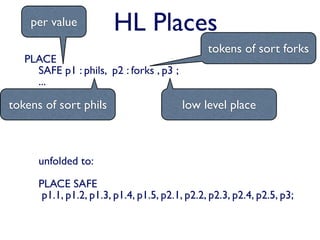
per value           HL Places
                                                tokens of sort forks
   PLACE
     SAFE p1 : phils, p2 : forks , p3 ;
     ...

tokens of sort phils                      low level place


      unfolded to:

      PLACE SAFE
       p1.1, p1.2, p1.3, p1.4, p1.5, p2.1, p2.2, p2.3, p2.4, p2.5, p3;
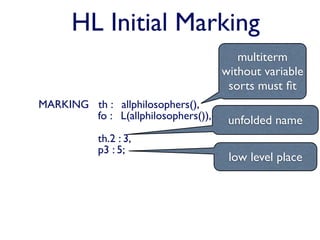
HL Initial Marking
                                        multiterm
                                     without variable
                                      sorts must fit
MARKING th : allphilosophers(),
        fo : L(allphilosophers()),    unfolded name
           th.2 : 3,
           p3 : 5;
                                      low level place
HL Transitions
                                               valid for all
TRANSITION receive WEAK FAIR                    instances
VAR sender , receiver : agent;
GUARD is_neighbour( sender , receiver)       firing mode
CONSUME channe1 : X ( sender, receiver )
PRODUCE channel : X (N(sender),sender), internal :
receiver

                         multiterms
unfolded to

TRANSITION receive.[sender=1,receiver=2] WEAK FAIR
CONSUME ....

Only instances with satisfied guards are generated
Isolated places are finally removed
HL Verification tasks
                  parentheses
                  compulsory


EXISTS x : phils : ( eating . ( x ) > 0 ) AND thinking.1 = 0
ALL y : phils : ( [y = 1] OR fo . ( L(y) ) = 0 )


                          any expression

Verification with LoLA: 2 The LoLA Input Language

  • 1.
    2. The LoLAInput Language
  • 2.
    Plan • Place/Transition nets •Verification task • High-Level nets • Demo
  • 3.
    Place/Transition Nets N =[P,T,F,W,m0] treated as variables PLACE p1, p2, p3, p4; can be replaced as a whole MARKING p1:2, p3:1, p1:1; compatible with computed markings { this is a comment } TRANSITION t1 CONSUME p1:3, p2: 1; PRODUCE p3: 2, p1 : 2; treated as procedures TRANSITION t2 CONSUME p3 : 1; PRODUCE ; only one reference per arc
  • 4.
    Identifiers Many special characterspermitted, eg. p4 23 message[x=13,from=”bla”] Reason: easier for tools to generate such names
  • 5.
    Storage directives If boundsfor some places are known: PLACE default, #CAPACITY in p0; userconfig.H SAFE 3: p1, p2; SAFE 7: p3, p4; SAFE: p5; = SAFE 1 Only for internal memory allocation, no capacity!
  • 6.
    Fairness Constraints needed forthe LTL properties only (fair CTL is not supported so far) TRANSITION t1 STRONG FAIR ... TRANSITION t2 WEAK FAIR ... TRANSITION t3 ...
  • 7.
    Verification Task Input •Can be specified inline or as separate file • For boundedness of places: ANALYSE PLACE p1 • For dead transitions: ANALYSE TRANSITION t2 • For all properties involving state predicate: FORMULA (p1 > 3 OR p2 <= 7) AND NOT p6 = 1 • For CTL model checking: • FORMULA EXPATH ALWAYS ALLPATH EVENTUALLY p1 > 3 • FORMULA EXPATH (p1 > 7 UNTIL p2 < 3)
  • 8.
    High Level NetInput • Main purpose: To obtain scalable sequences of models • Deprecated for translation from other formalisms (problem: semantic conformance) • Will be unfolded into place/transition net anyway • Experience: Parsing from UNIX pipe no time issue • Style: algebraic Petri nets with explicit interpretation
  • 9.
    Algebraic Petri Nets •Signature: sorts + sorted operation symbols • Interpretation: sets of values, n-ary functions • Places: annotated with sort (type) symbol • interpretation: set of values (colors) • Transitions: annotated with set of variables, guard expression • interpretation: every valid assignment is firing mode • Arcs: annotated with terms over the transition variables • interpretation: map from firing mode of transition into color set of place • Marking: written as multiset of terms
  • 10.
    Signature: Sorts and their interpretation SORT a = [ 1 , 5 ]; { 1,2,3,4,5 } b = BOOLEAN; { TRUE, FALSE } c = ENUMERATE red blue green END; { red, blue, green } “successor” canonically defined on each value set scalar arbitrary each value has unique text d = ARRAY [1,3] OF BOOLEAN; representation { [FALSE|FALSE|FALSE], ... , [TRUE|TRUE|TRUE] } e = RECORD receiver : a; sender : b; END ; { <1|FALSE>, ...., <3|TRUE> }
  • 11.
    Signature: operations and their interpretation SORT phils = [1 , 5 ]; forks = [1 , 5]; FUNCTION leftfork (x : phils) : forks signature BEGIN RETURN x END interpretation FUNCTION rightfork(x : phils): forks BEGIN RETURN x + 1 expressions evaluate END on all integers, FUNCTION allthinking () : phils assignments align to VAR x : phils; BEGIN value set (modulo FOR ALL x DO arithmetic) RETURN x END END result is multiset
  • 12.
    Statements in functionbody EXIT leave function RETURN E add value of E to return multiset, continue L = E assignment S1 ; S2 sequential composition WHILE E DO S END while loop REPEAT S UNTIL E END until loop FOR x := E1 TO E2 DO S END for loop in canonical order of values FOR ALL x DO S END for loop through all elements of sort of x IF E THEN s1 [ELSE S2] END branch statement SWITCH E CASE E1: S1 ... CASE En: Sn ELSE S END multibranch statement
  • 13.
    Expressions in functionbody pointwise for X X[a + b] X.c[a + b] arrays and records 645 TRUE FALSE A <-> B A -> B A AND B A OR B NOT A A<B A <= B A>B A >= B A=B A <> B A#B A+B A*B A-B A/B A MOD B (E) [ E1 | E2 | .... | En ] no modulo bla ( E1, ...., En) before function must assignment return exactly one value
  • 14.
    Example: Network SORT dimensions= [ 1 , 3 ]; row = [ 1 , 3 ]; agent = ARRAY dimensions OF row ; message = RECORD receiver : agent; sender : agent; END; FUNCTION X (a:agent;b:agent):message VAR m : message; BEGIN m . receiver = a; m . sender = b; RETURN m END FUNCTION N(z:agent):agent VAR l : dimensions; low : row; high : row; BEGIN low = 1; high = low - 1; { remind canonical order } FOR ALL l DO IF z [ l ] > 1ow THEN z [ l ] = z [ l ] - 1; RETURN z; z[l]=z[l]+1 END; IF z [ l ] < high THEN z [ l ] = z [ l ] + 1; RETURN z; z[l]=z[l]-1 END END END
  • 15.
    per value HL Places tokens of sort forks PLACE SAFE p1 : phils, p2 : forks , p3 ; ... tokens of sort phils low level place unfolded to: PLACE SAFE p1.1, p1.2, p1.3, p1.4, p1.5, p2.1, p2.2, p2.3, p2.4, p2.5, p3;
  • 16.
    HL Initial Marking multiterm without variable sorts must fit MARKING th : allphilosophers(), fo : L(allphilosophers()), unfolded name th.2 : 3, p3 : 5; low level place
  • 17.
    HL Transitions valid for all TRANSITION receive WEAK FAIR instances VAR sender , receiver : agent; GUARD is_neighbour( sender , receiver) firing mode CONSUME channe1 : X ( sender, receiver ) PRODUCE channel : X (N(sender),sender), internal : receiver multiterms unfolded to TRANSITION receive.[sender=1,receiver=2] WEAK FAIR CONSUME .... Only instances with satisfied guards are generated Isolated places are finally removed
  • 18.
    HL Verification tasks parentheses compulsory EXISTS x : phils : ( eating . ( x ) > 0 ) AND thinking.1 = 0 ALL y : phils : ( [y = 1] OR fo . ( L(y) ) = 0 ) any expression