Theory Seminar - Cryptography


               A Signature Scheme as Secure as the Diffie
                           Hellman Problem
                                        Theory Seminar


                                Eu-Jin Goh and Stanislaw Jarecki
                                        Eurocrypt 2003

                                          Subhashini V
                                           IIT Madras
Theory Seminar - Cryptography


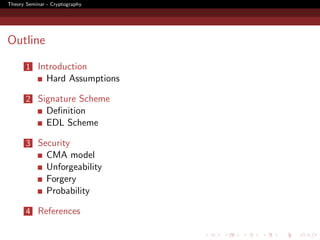
Outline

       1 Introduction
               Hard Assumptions

       2 Signature Scheme
               Definition
               EDL Scheme

       3 Security
               CMA model
               Unforgeability
               Forgery
               Probability

       4 References
Theory Seminar - Cryptography
  Introduction


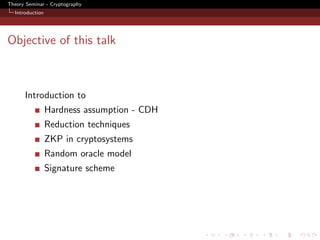
Objective of this talk


      Introduction to
                 Hardness assumption - CDH
                 Reduction techniques
                 ZKP in cryptosystems
                 Random oracle model
                 Signature scheme
Theory Seminar - Cryptography
  Introduction
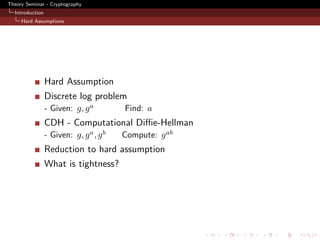
     Hard Assumptions


                 Hard Assumption
                 Discrete log problem
                 - Given: g, g a         Find: a
                 CDH - Computational Diffie-Hellman
                 - Given: g, g a , g b   Compute: g ab
                 Reduction to hard assumption
                 What is tightness?
Theory Seminar - Cryptography
  Signature Scheme
     Definition


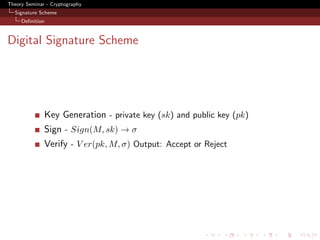
Digital Signature Scheme


                 Key Generation - private key (sk) and public key (pk)
                 Sign - Sign(M, sk) → σ
                 Verify - V er(pk, M, σ) Output: Accept or Reject
Theory Seminar - Cryptography
  Signature Scheme
     EDL Scheme


EDL Signature scheme
      Proposed originally by [CEVDG88] and [CP93].
              Key-generation
              sk = x ∈R Zq , pk = y ← g x
Theory Seminar - Cryptography
  Signature Scheme
     EDL Scheme


EDL Signature scheme
      Proposed originally by [CEVDG88] and [CP93].
              Key-generation
              sk = x ∈R Zq , pk = y ← g x
              Sign(x, M )
Theory Seminar - Cryptography
  Signature Scheme
     EDL Scheme


EDL Signature scheme
      Proposed originally by [CEVDG88] and [CP93].
              Key-generation
              sk = x ∈R Zq , pk = y ← g x
              Sign(x, M )
                  1   r ∈R {0, 1}nr , h ← H(M, r) , z ← hx
Theory Seminar - Cryptography
  Signature Scheme
     EDL Scheme


EDL Signature scheme
      Proposed originally by [CEVDG88] and [CP93].
              Key-generation
              sk = x ∈R Zq , pk = y ← g x
              Sign(x, M )
                  1   r ∈R {0, 1}nr , h ← H(M, r) , z ← hx
                  2   NI-ZKP DLh (z) = DLg (y)
Theory Seminar - Cryptography
  Signature Scheme
     EDL Scheme


EDL Signature scheme
      Proposed originally by [CEVDG88] and [CP93].
              Key-generation
              sk = x ∈R Zq , pk = y ← g x
              Sign(x, M )
                  1   r ∈R {0, 1}nr , h ← H(M, r) , z ← hx
                  2   NI-ZKP DLh (z) = DLg (y)
                  3   k ∈R Zq , u ← g k , v ← hk
Theory Seminar - Cryptography
  Signature Scheme
     EDL Scheme


EDL Signature scheme
      Proposed originally by [CEVDG88] and [CP93].
              Key-generation
              sk = x ∈R Zq , pk = y ← g x
              Sign(x, M )
                  1   r ∈R {0, 1}nr , h ← H(M, r) , z ← hx
                  2   NI-ZKP DLh (z) = DLg (y)
                  3   k ∈R Zq , u ← g k , v ← hk
                  4   c ← H (g, h, y, z, u, v) ∈ Zq
Theory Seminar - Cryptography
  Signature Scheme
     EDL Scheme


EDL Signature scheme
      Proposed originally by [CEVDG88] and [CP93].
              Key-generation
              sk = x ∈R Zq , pk = y ← g x
              Sign(x, M )
                  1   r ∈R {0, 1}nr , h ← H(M, r) , z ← hx
                  2   NI-ZKP DLh (z) = DLg (y)
                  3   k ∈R Zq , u ← g k , v ← hk
                  4   c ← H (g, h, y, z, u, v) ∈ Zq
                  5   s ← k + cx
Theory Seminar - Cryptography
  Signature Scheme
     EDL Scheme


EDL Signature scheme
      Proposed originally by [CEVDG88] and [CP93].
              Key-generation
              sk = x ∈R Zq , pk = y ← g x
              Sign(x, M )
                  1   r ∈R {0, 1}nr , h ← H(M, r) , z ← hx
                  2   NI-ZKP DLh (z) = DLg (y)
                  3   k ∈R Zq , u ← g k , v ← hk
                  4   c ← H (g, h, y, z, u, v) ∈ Zq
                  5   s ← k + cx
                  6   σ ← (z, r, s, c)
Theory Seminar - Cryptography
  Signature Scheme
     EDL Scheme


EDL Signature scheme
      Proposed originally by [CEVDG88] and [CP93].
              Key-generation
              sk = x ∈R Zq , pk = y ← g x
              Sign(x, M )
                  1   r ∈R {0, 1}nr , h ← H(M, r) , z ← hx
                  2   NI-ZKP DLh (z) = DLg (y)
                  3   k ∈R Zq , u ← g k , v ← hk
                  4   c ← H (g, h, y, z, u, v) ∈ Zq
                  5   s ← k + cx
                  6   σ ← (z, r, s, c)
              Verify
Theory Seminar - Cryptography
  Signature Scheme
     EDL Scheme


EDL Signature scheme
      Proposed originally by [CEVDG88] and [CP93].
              Key-generation
              sk = x ∈R Zq , pk = y ← g x
              Sign(x, M )
                  1   r ∈R {0, 1}nr , h ← H(M, r) , z ← hx
                  2   NI-ZKP DLh (z) = DLg (y)
                  3   k ∈R Zq , u ← g k , v ← hk
                  4   c ← H (g, h, y, z, u, v) ∈ Zq
                  5   s ← k + cx
                  6   σ ← (z, r, s, c)
              Verify
                      h ← H(M, r) , u ← g s y −c , v ← h s z −c
Theory Seminar - Cryptography
  Signature Scheme
     EDL Scheme


EDL Signature scheme
      Proposed originally by [CEVDG88] and [CP93].
              Key-generation
              sk = x ∈R Zq , pk = y ← g x
              Sign(x, M )
                  1   r ∈R {0, 1}nr , h ← H(M, r) , z ← hx
                  2   NI-ZKP DLh (z) = DLg (y)
                  3   k ∈R Zq , u ← g k , v ← hk
                  4   c ← H (g, h, y, z, u, v) ∈ Zq
                  5   s ← k + cx
                  6   σ ← (z, r, s, c)
              Verify
                      h ← H(M, r) , u ← g s y −c , v ← h s z −c
                                                          ?
                      c = H (g, h , y, z, u , v ). Check c = c
Theory Seminar - Cryptography
  Signature Scheme
     EDL Scheme


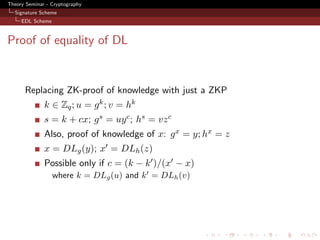
Proof of equality of DL


      Replacing ZK-proof of knowledge with just a ZKP
              k ∈ Zq ; u = g k ; v = hk
              s = k + cx; g s = uy c ; hs = vz c
              Also, proof of knowledge of x: g x = y; hx = z
              x = DLg (y); x = DLh (z)
              Possible only if c = (k − k )/(x − x)
                  where k = DLg (u) and k = DLh (v)
Theory Seminar - Cryptography
  Security
     CMA model


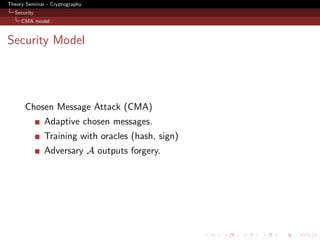
Security Model


      Chosen Message Attack (CMA)
              Adaptive chosen messages.
              Training with oracles (hash, sign)
              Adversary A outputs forgery.
Theory Seminar - Cryptography
  Security
     Unforgeability


Unforgeability

      Random oracle model - solve CDH. (Proof is from [?])
              Setup: y = g a (a is unknown)
              H queries: embed - H(M, r) = h = (g b )d , d - random
              H queries: all random.
              Sign queries:
                      r ∈R {0, 1}nr . If H(M, r) is queried - abort.
                      κ ∈R Z . Set, z = y κ , h = g κ and H(M, r) = h
                      DLh (z) = DLg (y)
                      c ∈R Zq , s ∈R Zq ,. Set u = g s y −c and v = hs z −c
                      Store H (g, h, y, z, u, v) = c
                      σ = (z, r, s, c)
Theory Seminar - Cryptography
  Security
     Forgery


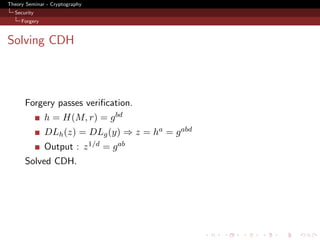
Solving CDH


      Forgery passes verification.
               h = H(M, r) = g bd
               DLh (z) = DLg (y) ⇒ z = ha = g abd
               Output : z 1/d = g ab
      Solved CDH.
Theory Seminar - Cryptography
  Security
     Probability


Analysis - Probability of solving CDH

      Abort cases
             1   H(M, r) was queried! ⇒ P r = qH 2−nr
                 - Aborting in Step1 of signature P r = qsig · qH · 2−nr
             2   Abort at Step4 of signature H (g, g k , y, y k , u, uk ) queried!
                 - Probability of collision (qH + qsig ) · 2−2nq
                 - Final : P r = qsig · (qH + qsig ) · 2−2nq
      Cannot solve CDH on successful forgery (because of DL)
             1   Pr[N H ∧ ¬N Q] = 2−nq
             2   Pr[N Q] = qH · 2−nq

      NH - event that the attacker does not query H-oracle.
      NQ - event that DLg (y) = DLh (z)
Theory Seminar - Cryptography
  Security
     Probability


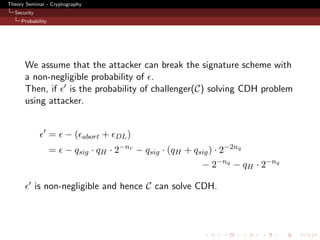
      We assume that the attacker can break the signature scheme with
      a non-negligible probability of .
      Then, if is the probability of challenger(C) solving CDH problem
      using attacker.


                   = −(         abort   +   DL )
                                             −nr
                   = − qsig · qH · 2               − qsig · (qH + qsig ) · 2−2nq
                                                                     − 2−nq − qH · 2−nq

             is non-negligible and hence C can solve CDH.
Theory Seminar - Cryptography
  References


References I


               David Chaum, Jan-Hendrik Evertse, and Jeroen Van De Graaf.
               An improved protocol for demonstrating possession of discrete
               logarithms and some generalizations. In Proceedings of the 6th
               annual international conference on Theory and application of
               cryptographic techniques, EUROCRYPT’87, pages 127–141,
               Berlin, Heidelberg, 1988. Springer-Verlag.
               David Chaum and Torben P. Pedersen. Wallet databases with
               observers. In Proceedings of the 12th Annual International
               Cryptology Conference on Advances in Cryptology, CRYPTO
               ’92, pages 89–105, London, UK, 1993. Springer-Verlag.
Theory Seminar - Cryptography
  References


References II


               Eu-Jin Goh and StanisJarecki. A signature scheme as secure as
               the diffie-hellman problem. In Proceedings of the 22nd
               international conference on Theory and applications of
               cryptographic techniques, EUROCRYPT’03, pages 401–415,
               Berlin, Heidelberg, 2003. Springer-Verlag.
Theory Seminar - Cryptography
  References


Questions?


                                Thank You!

A Signature Scheme as Secure as the Diffie Hellman Problem

  • 1.
    Theory Seminar -Cryptography A Signature Scheme as Secure as the Diffie Hellman Problem Theory Seminar Eu-Jin Goh and Stanislaw Jarecki Eurocrypt 2003 Subhashini V IIT Madras
  • 2.
    Theory Seminar -Cryptography Outline 1 Introduction Hard Assumptions 2 Signature Scheme Definition EDL Scheme 3 Security CMA model Unforgeability Forgery Probability 4 References
  • 3.
    Theory Seminar -Cryptography Introduction Objective of this talk Introduction to Hardness assumption - CDH Reduction techniques ZKP in cryptosystems Random oracle model Signature scheme
  • 4.
    Theory Seminar -Cryptography Introduction Hard Assumptions Hard Assumption Discrete log problem - Given: g, g a Find: a CDH - Computational Diffie-Hellman - Given: g, g a , g b Compute: g ab Reduction to hard assumption What is tightness?
  • 5.
    Theory Seminar -Cryptography Signature Scheme Definition Digital Signature Scheme Key Generation - private key (sk) and public key (pk) Sign - Sign(M, sk) → σ Verify - V er(pk, M, σ) Output: Accept or Reject
  • 6.
    Theory Seminar -Cryptography Signature Scheme EDL Scheme EDL Signature scheme Proposed originally by [CEVDG88] and [CP93]. Key-generation sk = x ∈R Zq , pk = y ← g x
  • 7.
    Theory Seminar -Cryptography Signature Scheme EDL Scheme EDL Signature scheme Proposed originally by [CEVDG88] and [CP93]. Key-generation sk = x ∈R Zq , pk = y ← g x Sign(x, M )
  • 8.
    Theory Seminar -Cryptography Signature Scheme EDL Scheme EDL Signature scheme Proposed originally by [CEVDG88] and [CP93]. Key-generation sk = x ∈R Zq , pk = y ← g x Sign(x, M ) 1 r ∈R {0, 1}nr , h ← H(M, r) , z ← hx
  • 9.
    Theory Seminar -Cryptography Signature Scheme EDL Scheme EDL Signature scheme Proposed originally by [CEVDG88] and [CP93]. Key-generation sk = x ∈R Zq , pk = y ← g x Sign(x, M ) 1 r ∈R {0, 1}nr , h ← H(M, r) , z ← hx 2 NI-ZKP DLh (z) = DLg (y)
  • 10.
    Theory Seminar -Cryptography Signature Scheme EDL Scheme EDL Signature scheme Proposed originally by [CEVDG88] and [CP93]. Key-generation sk = x ∈R Zq , pk = y ← g x Sign(x, M ) 1 r ∈R {0, 1}nr , h ← H(M, r) , z ← hx 2 NI-ZKP DLh (z) = DLg (y) 3 k ∈R Zq , u ← g k , v ← hk
  • 11.
    Theory Seminar -Cryptography Signature Scheme EDL Scheme EDL Signature scheme Proposed originally by [CEVDG88] and [CP93]. Key-generation sk = x ∈R Zq , pk = y ← g x Sign(x, M ) 1 r ∈R {0, 1}nr , h ← H(M, r) , z ← hx 2 NI-ZKP DLh (z) = DLg (y) 3 k ∈R Zq , u ← g k , v ← hk 4 c ← H (g, h, y, z, u, v) ∈ Zq
  • 12.
    Theory Seminar -Cryptography Signature Scheme EDL Scheme EDL Signature scheme Proposed originally by [CEVDG88] and [CP93]. Key-generation sk = x ∈R Zq , pk = y ← g x Sign(x, M ) 1 r ∈R {0, 1}nr , h ← H(M, r) , z ← hx 2 NI-ZKP DLh (z) = DLg (y) 3 k ∈R Zq , u ← g k , v ← hk 4 c ← H (g, h, y, z, u, v) ∈ Zq 5 s ← k + cx
  • 13.
    Theory Seminar -Cryptography Signature Scheme EDL Scheme EDL Signature scheme Proposed originally by [CEVDG88] and [CP93]. Key-generation sk = x ∈R Zq , pk = y ← g x Sign(x, M ) 1 r ∈R {0, 1}nr , h ← H(M, r) , z ← hx 2 NI-ZKP DLh (z) = DLg (y) 3 k ∈R Zq , u ← g k , v ← hk 4 c ← H (g, h, y, z, u, v) ∈ Zq 5 s ← k + cx 6 σ ← (z, r, s, c)
  • 14.
    Theory Seminar -Cryptography Signature Scheme EDL Scheme EDL Signature scheme Proposed originally by [CEVDG88] and [CP93]. Key-generation sk = x ∈R Zq , pk = y ← g x Sign(x, M ) 1 r ∈R {0, 1}nr , h ← H(M, r) , z ← hx 2 NI-ZKP DLh (z) = DLg (y) 3 k ∈R Zq , u ← g k , v ← hk 4 c ← H (g, h, y, z, u, v) ∈ Zq 5 s ← k + cx 6 σ ← (z, r, s, c) Verify
  • 15.
    Theory Seminar -Cryptography Signature Scheme EDL Scheme EDL Signature scheme Proposed originally by [CEVDG88] and [CP93]. Key-generation sk = x ∈R Zq , pk = y ← g x Sign(x, M ) 1 r ∈R {0, 1}nr , h ← H(M, r) , z ← hx 2 NI-ZKP DLh (z) = DLg (y) 3 k ∈R Zq , u ← g k , v ← hk 4 c ← H (g, h, y, z, u, v) ∈ Zq 5 s ← k + cx 6 σ ← (z, r, s, c) Verify h ← H(M, r) , u ← g s y −c , v ← h s z −c
  • 16.
    Theory Seminar -Cryptography Signature Scheme EDL Scheme EDL Signature scheme Proposed originally by [CEVDG88] and [CP93]. Key-generation sk = x ∈R Zq , pk = y ← g x Sign(x, M ) 1 r ∈R {0, 1}nr , h ← H(M, r) , z ← hx 2 NI-ZKP DLh (z) = DLg (y) 3 k ∈R Zq , u ← g k , v ← hk 4 c ← H (g, h, y, z, u, v) ∈ Zq 5 s ← k + cx 6 σ ← (z, r, s, c) Verify h ← H(M, r) , u ← g s y −c , v ← h s z −c ? c = H (g, h , y, z, u , v ). Check c = c
  • 17.
    Theory Seminar -Cryptography Signature Scheme EDL Scheme Proof of equality of DL Replacing ZK-proof of knowledge with just a ZKP k ∈ Zq ; u = g k ; v = hk s = k + cx; g s = uy c ; hs = vz c Also, proof of knowledge of x: g x = y; hx = z x = DLg (y); x = DLh (z) Possible only if c = (k − k )/(x − x) where k = DLg (u) and k = DLh (v)
  • 18.
    Theory Seminar -Cryptography Security CMA model Security Model Chosen Message Attack (CMA) Adaptive chosen messages. Training with oracles (hash, sign) Adversary A outputs forgery.
  • 19.
    Theory Seminar -Cryptography Security Unforgeability Unforgeability Random oracle model - solve CDH. (Proof is from [?]) Setup: y = g a (a is unknown) H queries: embed - H(M, r) = h = (g b )d , d - random H queries: all random. Sign queries: r ∈R {0, 1}nr . If H(M, r) is queried - abort. κ ∈R Z . Set, z = y κ , h = g κ and H(M, r) = h DLh (z) = DLg (y) c ∈R Zq , s ∈R Zq ,. Set u = g s y −c and v = hs z −c Store H (g, h, y, z, u, v) = c σ = (z, r, s, c)
  • 20.
    Theory Seminar -Cryptography Security Forgery Solving CDH Forgery passes verification. h = H(M, r) = g bd DLh (z) = DLg (y) ⇒ z = ha = g abd Output : z 1/d = g ab Solved CDH.
  • 21.
    Theory Seminar -Cryptography Security Probability Analysis - Probability of solving CDH Abort cases 1 H(M, r) was queried! ⇒ P r = qH 2−nr - Aborting in Step1 of signature P r = qsig · qH · 2−nr 2 Abort at Step4 of signature H (g, g k , y, y k , u, uk ) queried! - Probability of collision (qH + qsig ) · 2−2nq - Final : P r = qsig · (qH + qsig ) · 2−2nq Cannot solve CDH on successful forgery (because of DL) 1 Pr[N H ∧ ¬N Q] = 2−nq 2 Pr[N Q] = qH · 2−nq NH - event that the attacker does not query H-oracle. NQ - event that DLg (y) = DLh (z)
  • 22.
    Theory Seminar -Cryptography Security Probability We assume that the attacker can break the signature scheme with a non-negligible probability of . Then, if is the probability of challenger(C) solving CDH problem using attacker. = −( abort + DL ) −nr = − qsig · qH · 2 − qsig · (qH + qsig ) · 2−2nq − 2−nq − qH · 2−nq is non-negligible and hence C can solve CDH.
  • 23.
    Theory Seminar -Cryptography References References I David Chaum, Jan-Hendrik Evertse, and Jeroen Van De Graaf. An improved protocol for demonstrating possession of discrete logarithms and some generalizations. In Proceedings of the 6th annual international conference on Theory and application of cryptographic techniques, EUROCRYPT’87, pages 127–141, Berlin, Heidelberg, 1988. Springer-Verlag. David Chaum and Torben P. Pedersen. Wallet databases with observers. In Proceedings of the 12th Annual International Cryptology Conference on Advances in Cryptology, CRYPTO ’92, pages 89–105, London, UK, 1993. Springer-Verlag.
  • 24.
    Theory Seminar -Cryptography References References II Eu-Jin Goh and StanisJarecki. A signature scheme as secure as the diffie-hellman problem. In Proceedings of the 22nd international conference on Theory and applications of cryptographic techniques, EUROCRYPT’03, pages 401–415, Berlin, Heidelberg, 2003. Springer-Verlag.
  • 25.
    Theory Seminar -Cryptography References Questions? Thank You!