European GNSS Applications
in Horizon 2020
EU SPACE WEEK - 06 DECEMBER 2018
MARINE AND MARITIME
ALAIN BOUHET, PROGRAM COORDINATOR
EUROPEAN GNSS APPLICATIONS
IN HORIZON 2020
COSPAS-SARSAT BEACONS FOR GALILEO/EGNOS SEARCH & RESCUE APPLICATIONS
IN MEOSAR ENVIRONMENT
ACCELERATED ALERT DETECTION & PRECISE
TARGET POSITIONING:
A NEW GENERATIONS OF EMERGENCY DISTRESS BEACONS
OFFERING ENHANCED LIFE SAVING CAPABILITIES.
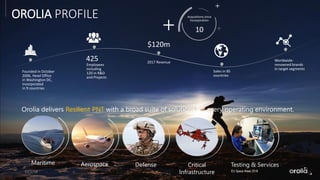
OROLIA PROFILE
Founded in October
2006, Head Office
in Washington DC,
incorporated
in 9 countries
425
Employees
including
120 in R&D
and Projects
$120m
2017 Revenue
Sales in 85
countries
Worldwide-
renowned brands
in target segments
Acquisitions since
Incorporation
10
210/1/18
Orolia delivers Resilient PNT with a broad suite of solutions for every operating environment.
Aerospace Defense Critical
Infrastructure
Maritime Testing & Services
EU Space Week 2018
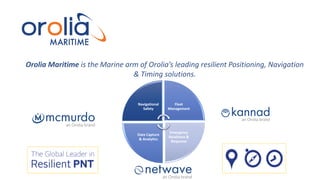
Orolia Maritime is the Marine arm of Orolia’s leading resilient Positioning, Navigation
& Timing solutions.
Navigational
Safety
Fleet
Management
Emergency
Readiness &
Response
Data Capture
& Analytics
Orolia Maritime Innovation
Trusted For Safer Journeys
✓2018 First Personal Locator Beacon (PLB) with Galileo
✓2017 First AIS, Multi GNSS (inc. Galileo) EPIRB
✓2013 First AIS Man Overboard device approved for US
✓2011 First AIS Man Overboard devices integrated into a life jacket
✓2011 First Satellite Local User Terminal for MEOSAR
✓2010 First AIS SART (search & rescue transponder) accepted by GMDSS
✓2009 First compact Personal Locator Beacon (PLB)
✓2005 First non commercial Personal Locator Beacon (PLB)
HELIOS PROJECT
Driving Search & Rescue Innovation
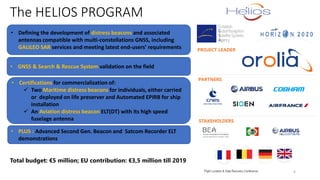
Total budget: €5 million; EU contribution: €3,5 million till 2019
PROJECT LEADER
PARTNERS
STAKEHOLDERS
6
The HELIOS PROGRAM
Flight Location & Data Recovery Conference
• Defining the development of distress beacons and associated
antennas compatible with multi-constellations GNSS, including
GALILEO SAR services and meeting latest end-users’ requirements
• Certifications for commercialization of:
✓ Two Maritime distress beacons for individuals, either carried
or deployed on life preserver and Automated EPIRB for ship
installation
✓ An Aviation distress beacon ELT(DT) with its high speed
fuselage antenna
• GNSS & Search & Rescue System validation on the field
• PLUS : Advanced Second Gen. Beacon and Satcom Recorder ELT
demonstrations
Search & Rescue
International
Program
12/11/2018 7
11/09/2018
Meosar – Accelerated Rescue
Medium-altitude earth Orbiting Search and rescue system
VS
8
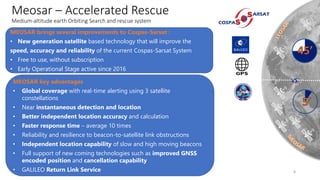
MEOSAR brings several improvements to Cospas-Sarsat :
• New generation satellite based technology that will improve the
speed, accuracy and reliability of the current Cospas-Sarsat System
• Free to use, without subscription
• Early Operational Stage active since 2016
MEOSAR key advantages
• Global coverage with real-time alerting using 3 satellite
constellations
• Near instantaneous detection and location
• Better independent location accuracy and calculation
• Faster response time – average 10 times
• Reliability and resilience to beacon-to-satellite link obstructions
• Independent location capability of slow and high moving beacons
• Full support of new coming technologies such as improved GNSS
encoded position and cancellation capability
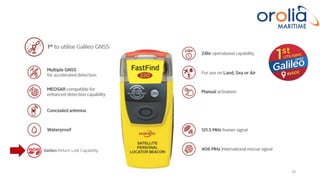
• GALILEO Return Link Service
Meosar – Accelerated Rescue
Medium-altitude earth Orbiting Search and rescue system
9
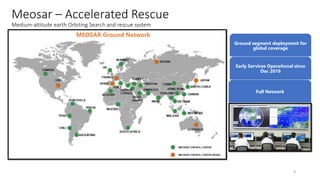
MEOSAR Ground Network
Ground segment deployment for
global coverage
Full Network
Early Services Operational since
Dec 2016
Galileo – Significantly Improving Search &
Rescue
10
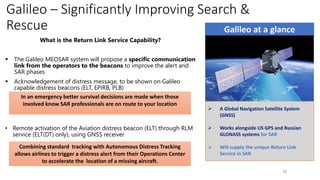
What is the Return Link Service Capability?
▪ The Galileo MEOSAR system will propose a specific communication
link from the operators to the beacons to improve the alert and
SAR phases
▪ Acknowledgement of distress message, to be shown on Galileo
capable distress beacons (ELT, EPIRB, PLB)
• Remote activation of the Aviation distress beacon (ELT) through RLM
service (ELT(DT) only), using GNSS receiver
Galileo at a glance
➢ A Global Navigation Satellite System
(GNSS)
➢ Works alongside US GPS and Russian
GLONASS systems for SAR
➢ Will supply the unique Return Link
Service in SAR
In an emergency better survival decisions are made when those
involved know SAR professionals are on route to your location
Combining standard tracking with Autonomous Distress Tracking
allows airlines to trigger a distress alert from their Operations Center
to accelerate the location of a missing aircraft.
1
3
4
5
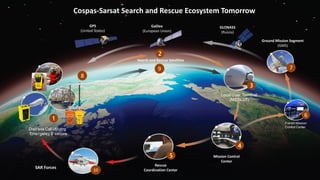
Cospas-Sarsat Search and Rescue Ecosystem Tomorrow
2
Ground Mission Segment
(GMS)
6
79
8
10
SAR Forces
GPS
(United States)
Galileo
(European Union)
GLONASS
(Russia)
Search and Rescue Satellites
Mission Control
Center
Rescue
Coordination Center
EPIRB: Emergency Position-Indicating
Radio Beacon
13
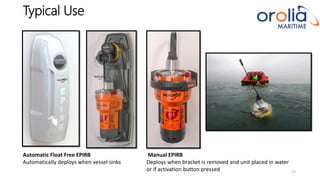
Typical Use
Automatic Float Free EPIRB
Automatically deploys when vessel sinks
Manual EPIRB
Deploys when bracket is removed and unit placed in water
or if activation button pressed
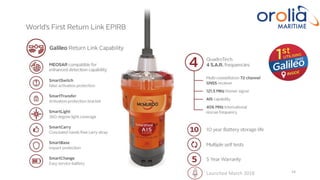
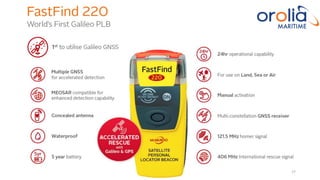
14Launched March 2018
PLB: Personal Locator Beacon
16
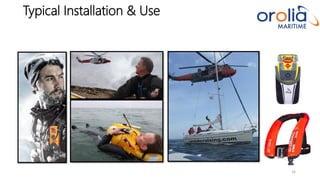
Typical Installation & Use
17
18
Visit our website: www.helios-gsa-project.eu
Project Officer: Carmen AGUILERA-RIOS
carmen.aguilera@gsa.europa.eu
Program Coordinator: Alain BOUHET
alain.bouhet@orolia.com
Product Manager: Robin GEORGES
robin.george@orolia.com
THIS DOCUMENT IS COPYRIGHT © 2018 OROLIA GROUP AND/OR ITS AFFILIATES. ALL RIGHTS ARE STRICTLY RESERVED. THIS DOCUMENT AND ANY ATTACHED
MATERIALS CONTAINS PROPRIETARY AND CONFIDENTIAL INFORMATION AND DATA AND IS THE SOLE PROPERTY OF OROLIA GROUP AND/OR ITS
AFFILIATES. THE DOCUMENTS, ANY ATTACHED MATERIALS AND/OR INFORMATION CONTAINED THEREIN MUST NOT BE USED, DISSEMINATED, OR
DISTRIBUTED EXCEPT FOR THE AGREED PURPOSE. UNAUTHORIZED USE, REPRODUCTION, OR ISSUE TO ANY THIRD PARTY IS NOT PERMITTED WITHOUT THE
PRIOR WRITTEN CONSENT OF THE OROLIA GROUP. THIS DOCUMENT IS TO BE RETURNED TO THE OROLIA GROUP WHEN THE AGREED PURPOSE IS FULFILLED.

Orolia EU Space Week 2018 - Maritime session

  • 1.
    European GNSS Applications inHorizon 2020 EU SPACE WEEK - 06 DECEMBER 2018 MARINE AND MARITIME ALAIN BOUHET, PROGRAM COORDINATOR EUROPEAN GNSS APPLICATIONS IN HORIZON 2020 COSPAS-SARSAT BEACONS FOR GALILEO/EGNOS SEARCH & RESCUE APPLICATIONS IN MEOSAR ENVIRONMENT ACCELERATED ALERT DETECTION & PRECISE TARGET POSITIONING: A NEW GENERATIONS OF EMERGENCY DISTRESS BEACONS OFFERING ENHANCED LIFE SAVING CAPABILITIES.
  • 2.
    OROLIA PROFILE Founded inOctober 2006, Head Office in Washington DC, incorporated in 9 countries 425 Employees including 120 in R&D and Projects $120m 2017 Revenue Sales in 85 countries Worldwide- renowned brands in target segments Acquisitions since Incorporation 10 210/1/18 Orolia delivers Resilient PNT with a broad suite of solutions for every operating environment. Aerospace Defense Critical Infrastructure Maritime Testing & Services EU Space Week 2018
  • 3.
    Orolia Maritime isthe Marine arm of Orolia’s leading resilient Positioning, Navigation & Timing solutions. Navigational Safety Fleet Management Emergency Readiness & Response Data Capture & Analytics
  • 4.
    Orolia Maritime Innovation TrustedFor Safer Journeys ✓2018 First Personal Locator Beacon (PLB) with Galileo ✓2017 First AIS, Multi GNSS (inc. Galileo) EPIRB ✓2013 First AIS Man Overboard device approved for US ✓2011 First AIS Man Overboard devices integrated into a life jacket ✓2011 First Satellite Local User Terminal for MEOSAR ✓2010 First AIS SART (search & rescue transponder) accepted by GMDSS ✓2009 First compact Personal Locator Beacon (PLB) ✓2005 First non commercial Personal Locator Beacon (PLB)
  • 5.
    HELIOS PROJECT Driving Search& Rescue Innovation
  • 6.
    Total budget: €5million; EU contribution: €3,5 million till 2019 PROJECT LEADER PARTNERS STAKEHOLDERS 6 The HELIOS PROGRAM Flight Location & Data Recovery Conference • Defining the development of distress beacons and associated antennas compatible with multi-constellations GNSS, including GALILEO SAR services and meeting latest end-users’ requirements • Certifications for commercialization of: ✓ Two Maritime distress beacons for individuals, either carried or deployed on life preserver and Automated EPIRB for ship installation ✓ An Aviation distress beacon ELT(DT) with its high speed fuselage antenna • GNSS & Search & Rescue System validation on the field • PLUS : Advanced Second Gen. Beacon and Satcom Recorder ELT demonstrations
  • 7.
  • 8.
    11/09/2018 Meosar – AcceleratedRescue Medium-altitude earth Orbiting Search and rescue system VS 8 MEOSAR brings several improvements to Cospas-Sarsat : • New generation satellite based technology that will improve the speed, accuracy and reliability of the current Cospas-Sarsat System • Free to use, without subscription • Early Operational Stage active since 2016 MEOSAR key advantages • Global coverage with real-time alerting using 3 satellite constellations • Near instantaneous detection and location • Better independent location accuracy and calculation • Faster response time – average 10 times • Reliability and resilience to beacon-to-satellite link obstructions • Independent location capability of slow and high moving beacons • Full support of new coming technologies such as improved GNSS encoded position and cancellation capability • GALILEO Return Link Service
  • 9.
    Meosar – AcceleratedRescue Medium-altitude earth Orbiting Search and rescue system 9 MEOSAR Ground Network Ground segment deployment for global coverage Full Network Early Services Operational since Dec 2016
  • 10.
    Galileo – SignificantlyImproving Search & Rescue 10 What is the Return Link Service Capability? ▪ The Galileo MEOSAR system will propose a specific communication link from the operators to the beacons to improve the alert and SAR phases ▪ Acknowledgement of distress message, to be shown on Galileo capable distress beacons (ELT, EPIRB, PLB) • Remote activation of the Aviation distress beacon (ELT) through RLM service (ELT(DT) only), using GNSS receiver Galileo at a glance ➢ A Global Navigation Satellite System (GNSS) ➢ Works alongside US GPS and Russian GLONASS systems for SAR ➢ Will supply the unique Return Link Service in SAR In an emergency better survival decisions are made when those involved know SAR professionals are on route to your location Combining standard tracking with Autonomous Distress Tracking allows airlines to trigger a distress alert from their Operations Center to accelerate the location of a missing aircraft.
  • 11.
    1 3 4 5 Cospas-Sarsat Search andRescue Ecosystem Tomorrow 2 Ground Mission Segment (GMS) 6 79 8 10 SAR Forces GPS (United States) Galileo (European Union) GLONASS (Russia) Search and Rescue Satellites Mission Control Center Rescue Coordination Center
  • 12.
  • 13.
    13 Typical Use Automatic FloatFree EPIRB Automatically deploys when vessel sinks Manual EPIRB Deploys when bracket is removed and unit placed in water or if activation button pressed
  • 14.
  • 15.
  • 16.
  • 17.
  • 18.
  • 19.
    Visit our website:www.helios-gsa-project.eu Project Officer: Carmen AGUILERA-RIOS carmen.aguilera@gsa.europa.eu Program Coordinator: Alain BOUHET alain.bouhet@orolia.com Product Manager: Robin GEORGES robin.george@orolia.com
  • 20.
    THIS DOCUMENT ISCOPYRIGHT © 2018 OROLIA GROUP AND/OR ITS AFFILIATES. ALL RIGHTS ARE STRICTLY RESERVED. THIS DOCUMENT AND ANY ATTACHED MATERIALS CONTAINS PROPRIETARY AND CONFIDENTIAL INFORMATION AND DATA AND IS THE SOLE PROPERTY OF OROLIA GROUP AND/OR ITS AFFILIATES. THE DOCUMENTS, ANY ATTACHED MATERIALS AND/OR INFORMATION CONTAINED THEREIN MUST NOT BE USED, DISSEMINATED, OR DISTRIBUTED EXCEPT FOR THE AGREED PURPOSE. UNAUTHORIZED USE, REPRODUCTION, OR ISSUE TO ANY THIRD PARTY IS NOT PERMITTED WITHOUT THE PRIOR WRITTEN CONSENT OF THE OROLIA GROUP. THIS DOCUMENT IS TO BE RETURNED TO THE OROLIA GROUP WHEN THE AGREED PURPOSE IS FULFILLED.