LIB 630
    Organizing and Managing Library Collections
                   Spring 2012


Organizing and Managing
  Library Collections:
         Why?
What is a collection?
  collection
3. concr. A number of objects collected or
    gathered together, viewed as a whole;
    a group of things collected and
    arranged:
   •   in a general sense; e.g. of
       extracts, historical or literary materials.
    b. of scientific specimens, objects of
       interest, works of art, etc. spec. The range
       of clothes (as for a season, etc.) displayed
       by a fashion designer; a display of such
       apparel.
   c. A quantity of anything, as water, which has
       collected into one mass; an accumulation.

                                                      2
Another definition
    collection

 1: the act or process of collecting
 2 a: something collected; especially
   : an accumulation of objects gathered
   for study, comparison, or exhibition
   or as a hobby b: group, aggregate
   c: a set of apparel designed for sale
   usually in a particular season


                                           3
Slides from Presentation: Collection Level Description [ PowerPoint]
[HTML] for Workshop at 8th International Dublin Core Metadata
Initiative Workshop (DC-8) Ottawa, Canada, October 4 - 6, 2000

                                                                       4
From a cataloging website
    What is a collection?
   A collection is an aggregation of
    physical and/or electronic items. e.g.
    library collections; museum
    collections; archives;
    library, museum and archival
    catalogues; digital archives; Internet
    directories; Internet subject
    gateways; collections of text; images;
    sounds; datasets; software etc. A
    collection may be made up of any
    number of items from one to many.
      • CLD Online Tutorial

                                             5
More from the same site
   What Is A Collection?
 A collection is a group of
  resources that are related to each
  other in some identifiable way.
  The relationship might be
  through a topic, a place, a person,
  an organisation or a type of
  object.
    • About This Document
       – This briefing document provides a brief
         introduction to the concept of
         Collections.

                                                   6
library collection
    The total accumulation of
 books and other materials owned
 by a library, cataloged and
 arranged for ease of access, often
 consisting of several smaller
 collections (reference, circulating
 books, serials, government
 documents, rare books, special
 collections, etc.).
  − http://www.abc-
    clio.com/ODLIS/odlis_l.aspx#libcollec

                                            7
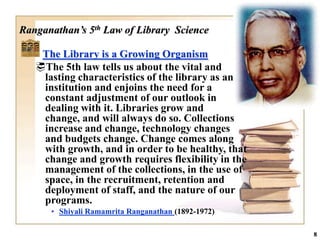
Ranganathan’s 5th Law of Library Science

    The Library is a Growing Organism
   The 5th law tells us about the vital and
    lasting characteristics of the library as an
    institution and enjoins the need for a
    constant adjustment of our outlook in
    dealing with it. Libraries grow and
    change, and will always do so. Collections
    increase and change, technology changes
    and budgets change. Change comes along
    with growth, and in order to be healthy, that
    change and growth requires flexibility in the
    management of the collections, in the use of
    space, in the recruitment, retention and
    deployment of staff, and the nature of our
    programs.
      • Shiyali Ramamrita Ranganathan (1892-1972)

                                                    8
What is a collection?

A collection is a set of resources
 brought together for a particular
 audience or to serve a specific
 function.

   • School Library Collections
     http://eduscapes.com/sms/access/cd1.html
   • ©2004-2010 Annette Lamb and Larry Johnson


                                                 9
So, what is a collection?
   A collection is:
  “an aggregation of physical
   and/or electronic items”: “stuff”
  It may have “research potential”
  It is “a group of resources that are
   related to each other in some identifiable
   way”
  It is “total accumulation of books and
   other materials owned by a library”
  It is a “growing organism”
  It is a “set of resources brought together
   for a particular audience or to serve a
   specific function.”
                                                10
Two crucial concepts
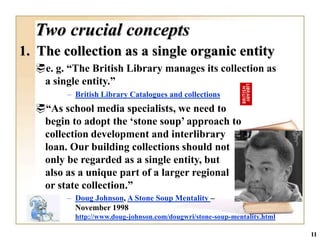
1. The collection as a single organic entity
  e. g. “The British Library manages its collection as
   a single entity.”
         – British Library Catalogues and collections
  “As school media specialists, we need to
   begin to adopt the „stone soup‟ approach to
   collection development and interlibrary
   loan. Our building collections should not
   only be regarded as a single entity, but
   also as a unique part of a larger regional
   or state collection.”
         – Doug Johnson, A Stone Soup Mentality –
           November 1998
           http://www.doug-johnson.com/dougwri/stone-soup-mentality.html

                                                                           11
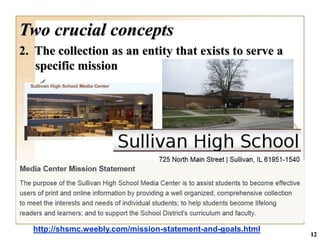
Two crucial concepts
2. The collection as an entity that exists to serve a
   specific mission
    


  http://shsmc.weebly.com/mission-statement-and-goals.html
                                                             12
What is a Collection?


            Why manage a collection?
                It exists for a purpose:
            The purpose of building a collection is
             to support the needs of students and
             teachers in addressing the curriculum.
             It is essential that all educators be
             involved in developing this collection.
             The teacher librarian must develop
             partnerships across grade levels and
             subject areas to ensure that the
             collection addresses the needs of the
             curriculum.
                 • Information Access & Delivery: School
                   Library Collections

June 3, 2008                                               13
What is a Collection?


            Why organize a collection?

                    Why Organize Your Library?
                 An organized . . . library should be
                  efficient to use so you know what
                  resources you have and exactly
                  where they are.
                        • Adapted from a Q & A for Lentz
                          Libraries Architecture and Design
                          Library Services


June 3, 2008                                                  14

Organizing and Managing Library Collections: Why?

  • 1.
    LIB 630 Organizing and Managing Library Collections Spring 2012 Organizing and Managing Library Collections: Why?
  • 2.
    What is acollection? collection 3. concr. A number of objects collected or gathered together, viewed as a whole; a group of things collected and arranged: • in a general sense; e.g. of extracts, historical or literary materials. b. of scientific specimens, objects of interest, works of art, etc. spec. The range of clothes (as for a season, etc.) displayed by a fashion designer; a display of such apparel. c. A quantity of anything, as water, which has collected into one mass; an accumulation. 2
  • 3.
    Another definition collection 1: the act or process of collecting 2 a: something collected; especially : an accumulation of objects gathered for study, comparison, or exhibition or as a hobby b: group, aggregate c: a set of apparel designed for sale usually in a particular season 3
  • 4.
    Slides from Presentation:Collection Level Description [ PowerPoint] [HTML] for Workshop at 8th International Dublin Core Metadata Initiative Workshop (DC-8) Ottawa, Canada, October 4 - 6, 2000 4
  • 5.
    From a catalogingwebsite What is a collection? A collection is an aggregation of physical and/or electronic items. e.g. library collections; museum collections; archives; library, museum and archival catalogues; digital archives; Internet directories; Internet subject gateways; collections of text; images; sounds; datasets; software etc. A collection may be made up of any number of items from one to many. • CLD Online Tutorial 5
  • 6.
    More from thesame site What Is A Collection? A collection is a group of resources that are related to each other in some identifiable way. The relationship might be through a topic, a place, a person, an organisation or a type of object. • About This Document – This briefing document provides a brief introduction to the concept of Collections. 6
  • 7.
    library collection The total accumulation of books and other materials owned by a library, cataloged and arranged for ease of access, often consisting of several smaller collections (reference, circulating books, serials, government documents, rare books, special collections, etc.). − http://www.abc- clio.com/ODLIS/odlis_l.aspx#libcollec 7
  • 8.
    Ranganathan’s 5th Lawof Library Science The Library is a Growing Organism The 5th law tells us about the vital and lasting characteristics of the library as an institution and enjoins the need for a constant adjustment of our outlook in dealing with it. Libraries grow and change, and will always do so. Collections increase and change, technology changes and budgets change. Change comes along with growth, and in order to be healthy, that change and growth requires flexibility in the management of the collections, in the use of space, in the recruitment, retention and deployment of staff, and the nature of our programs. • Shiyali Ramamrita Ranganathan (1892-1972) 8
  • 9.
    What is acollection? A collection is a set of resources brought together for a particular audience or to serve a specific function. • School Library Collections http://eduscapes.com/sms/access/cd1.html • ©2004-2010 Annette Lamb and Larry Johnson 9
  • 10.
    So, what isa collection? A collection is: “an aggregation of physical and/or electronic items”: “stuff” It may have “research potential” It is “a group of resources that are related to each other in some identifiable way” It is “total accumulation of books and other materials owned by a library” It is a “growing organism” It is a “set of resources brought together for a particular audience or to serve a specific function.” 10
  • 11.
    Two crucial concepts 1.The collection as a single organic entity e. g. “The British Library manages its collection as a single entity.” – British Library Catalogues and collections “As school media specialists, we need to begin to adopt the „stone soup‟ approach to collection development and interlibrary loan. Our building collections should not only be regarded as a single entity, but also as a unique part of a larger regional or state collection.” – Doug Johnson, A Stone Soup Mentality – November 1998 http://www.doug-johnson.com/dougwri/stone-soup-mentality.html 11
  • 12.
    Two crucial concepts 2.The collection as an entity that exists to serve a specific mission  http://shsmc.weebly.com/mission-statement-and-goals.html 12
  • 13.
    What is aCollection? Why manage a collection? It exists for a purpose: The purpose of building a collection is to support the needs of students and teachers in addressing the curriculum. It is essential that all educators be involved in developing this collection. The teacher librarian must develop partnerships across grade levels and subject areas to ensure that the collection addresses the needs of the curriculum. • Information Access & Delivery: School Library Collections June 3, 2008 13
  • 14.
    What is aCollection? Why organize a collection? Why Organize Your Library? An organized . . . library should be efficient to use so you know what resources you have and exactly where they are. • Adapted from a Q & A for Lentz Libraries Architecture and Design Library Services June 3, 2008 14