Organizing Defined
Reasons for Organizing
The Organizational Structure and
its Determinants
The Formal Organization
Informal Groups
Levels of Management and
Supervision
Basic Elements of Organizational
Structure
Basic Organizational Designs
The manager needs to acquire various skills in
management, including those for organizing
business activities. In this highly competitive
environment, the unskilled manager may not be
able to bring his unit, or his company, as the
case may be, to success.
The benefits of superior organizing skills are
too important for the manager to ignore.
The Organizational
Structure and its
Determinants
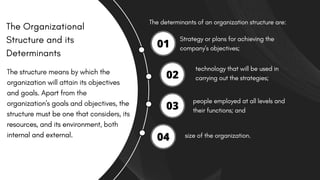
The structure means by which the
organization will attain its objectives
and goals. Apart from the
organization's goals and objectives, the
structure must be one that considers, its
resources, and its environment, both
internal and external.
Strategy or plans for achieving the
company's objectives;
01
technology that will be used in
carrying out the strategies;
02
people employed at all levels and
their functions; and
03
size of the organization.
04
The determinants of an organization structure are:
Gerente General
The Formal Organization
The formal organization, as described by Nelson
and Quick "is the part of the system that has
legitimacy and official recognition." What is
depicted in the organization chart is the formal
organization.
It is the planned structure representing the intended
configuration of positions, job duties, and lines of
authority among the component parts of the
organization.
The formal group is a part of the organizational
structure.
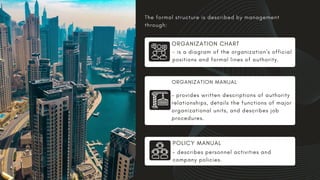
- is a diagram of the organization's official
positions and formal lines of authority.
ORGANIZATION CHART
- provides written descriptions of authority
relationships, details the functions of major
organizational units, and describes job
procedures.
ORGANIZATION MANUAL
POLICY MANUAL
- describes personnel activities and
company policies.
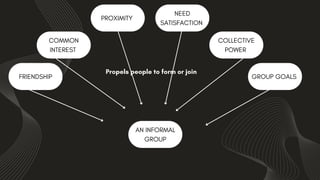
Informal Groups
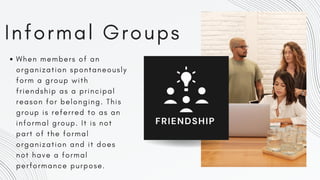
When members of an
organization spontaneously
form a group with
friendship as a principal
reason for belonging. This
group is referred to as an
informal group. It is not
part of the formal
organization and it does
not have a formal
performance purpose.
FRIENDSHIP
FRIENDSHIP
COMMON
INTEREST
PROXIMITY
NEED
SATISFACTION
COLLECTIVE
POWER
GROUP GOALS
AN INFORMAL
GROUP
Propels people to form or join
The management and
supervision may be done
through levels of hierarchy,
which may be flat or tall.
Levels of Management
and Supervision
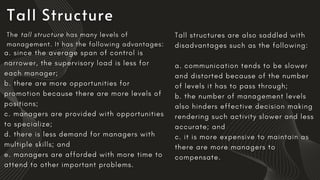
1. Flat Structure
The flat structure has few levels of management. This
characteristic provides it with the following advantages:
a. communication is generally faster and less
distorted;
b. decisions can be made quickly; and
c. supervisor's salary are eliminated
Flat structure, however, have the following distinct
disadvantages:
a. they require managers with experience in the
various tasks;
b. a manager may have little time for all subordinates;
c. when manager is out, the group is without a leader;
and
d. managers may have little time to anticipate
problems.
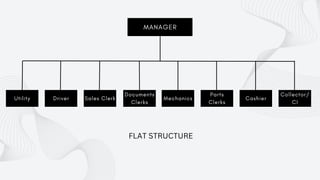
MANAGER
Utility Driver Sales Clerk
Documents
Clerks
Mechanics
Parts
Clerks
Cashier
Collector/
CI
FLAT STRUCTURE
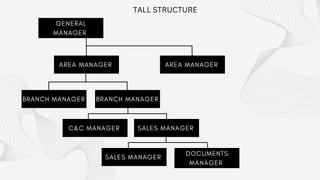
GENERAL
MANAGER
AREA MANAGER AREA MANAGER
BRANCH MANAGER BRANCH MANAGER
C&C MANAGER SALES MANAGER
SALES MANAGER
DOCUMENTS
MANAGER
TALL STRUCTURE
BASIC ELEMENTS OF
ORGANIZATIONAL
STRUCTURE
Organizational
Structure
Refers to the formal arrangement of roles, responsibilities,
communication systems, and authority within an
organization. It defines how activities such as task
allocation, coordination, and supervision are directed
toward achieving the organization’s goals.
1.) Work Specialization
2.) Departmentation
3.)Pattern of Authority
4.)Span of control
5.)Coordination of activities
Basic Elements of
Organizational Structure
The degree to which tasks are divided in the
organization is referred to as work specialization.
A decision must be made regarding this element
and it should be reflected in the organizational
structure.
Work Specialization
Why specialization? Specialization promotes
efficiency.
-refers to the grouping of job based on criteria that
managers believe help in the coordination and control of
activities. A decision must also be made on whether the
organization would be departmentalized or not.
Departmentation advantages to the organization. They are the following:
1. SUPERVI SI ON I S MADE EASI ER
2. COMMUNI CATI ON I S ENCOURAGE
3. COMMON MEASURES OF PERFORMANCE ARE
ESTABLI SHED
4. THE SHARI NG OF RESOURCES, SUCH AS MEN, MACHI NE
AND MATERI ALS RESULT I N MAXI MUM USE OF SUCH
RESOURCES.
DEPARTMENTATION
Authority patterns may ne centralized or decentralized.
Centralized - when decision making is concentrated in the
hands of higher-level managers.
Decentralized - when decision making authority is granted to
middle and lower management positions.
PATTERN OF AUTHORITY
Is an element in designing organizational
structure refers to the extent by which
organization members are allowed to make
decisions without getting the approval of
another member.
1.
2.
3.
4.
1.
2.
3.
4.
Span of Control
-it is nother consideration in designing the
organizational structure. It refers to the number
of subordinates reporting to a single supervisor.
The span of control may either be narror or wide.
Narrow- when thereare few subordinates reporting to
a supervisor.
Wide- when there are many subordinates reporting to
a supervisor.
1.
2.
3.
4.
1.
2.
3.
4.
Coordination
Another basic element considered in designing
the organizational structure is coordination. This
term refers to the linking of activities in the
organization that serve to achieve a commor
goal or objectiv.
DESIGNS
BUSINESS ORGANIZATIONAL
There are four basic organizational designs. These
are the following:
FUNTIONAL
DESIGN
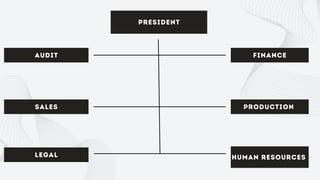
An organization may be designed
basically according to function. In
organizations with functional design,
employees are grouped together in
separate departments on the basis of
common tasks, skills, or activities.
PRESIDENT
FINANCE
PRODUCTION
HUMAN RESOURCES
AUDIT
SALES
LEGAL
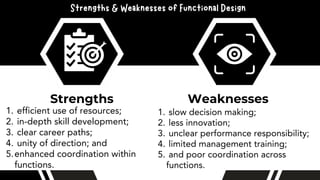
Strengths
efficient use of resources;
1.
in-depth skill development;
2.
clear career paths;
3.
unity of direction; and
4.
enhanced coordination within
functions.
5.
Weaknesses
slow decision making;
1.
less innovation;
2.
unclear performance responsibility;
3.
limited management training;
4.
and poor coordination across
functions.
5.
Strengths & Weaknesses of Functional Design
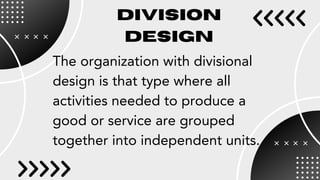
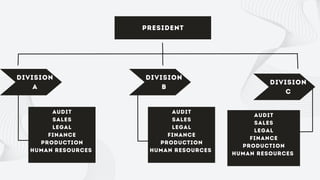
DIVISION
DESIGN
The organization with divisional
design is that type where all
activities needed to produce a
good or service are grouped
together into independent units.
PRESIDENT
AUDIT
SALES
LEGAL
FINANCE
PRODUCTION
HUMAN RESOURCES
DIVISION
A
DIVISION
B
DIVISION
C
AUDIT
SALES
LEGAL
FINANCE
PRODUCTION
HUMAN RESOURCES
AUDIT
SALES
LEGAL
FINANCE
PRODUCTION
HUMAN RESOURCES
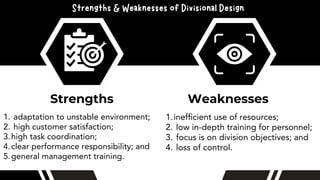
Strengths
adaptation to unstable environment;
1.
high customer satisfaction;
2.
high task coordination;
3.
clear performance responsibility; and
4.
general management training.
5.
Weaknesses
inefficient use of resources;
1.
low in-depth training for personnel;
2.
focus is on division objectives; and
3.
loss of control.
4.
Strengths & Weaknesses of Divisional Design
The hybrid design, also called
the matrix structure, is a
combination of divisional units
and functional departments.
HYBRID
DESIGN
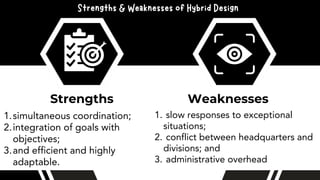
Strengths
simultaneous coordination;
1.
integration of goals with
objectives;
2.
and efficient and highly
adaptable.
3.
Weaknesses
slow responses to exceptional
situations;
1.
conflict between headquarters and
divisions; and
2.
administrative overhead
3.
Strengths & Weaknesses of Hybrid Design
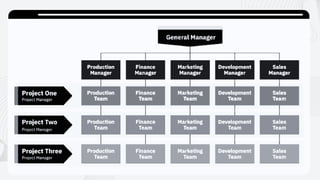
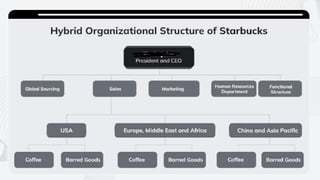
An organization with a matrix design is one
that implements functional and divisional
structures simultaneously in each
department. The employee is supervised by
the functional manager in his work as a
specialist. The divisional manager
integrates the activities of the specialists.
MATRIX
DESIGN
The following conditions favor the use of
matrix design:
1. environmental pressures exist for a dual
focus, such as innovation and quality;
2. large quantities of information must be
processed; and
3. efficiency is needed in the use of
resources.
MATRIX
DESIGN
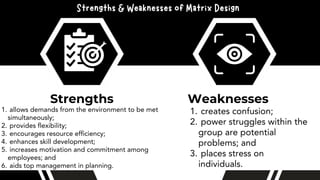
Strengths
allows demands from the environment to be met
simultaneously;
1.
provides flexibility;
2.
encourages resource efficiency;
3.
enhances skill development;
4.
increases motivation and commitment among
employees; and
5.
aids top management in planning.
6.
Weaknesses
creates confusion;
1.
power struggles within the
group are potential
problems; and
2.
places stress on
individuals.
3.
Strengths & Weaknesses of Matrix Design
Thank you for
listening!

Midterm(2)_Business Organization_Organizing

  • 2.
    Organizing Defined Reasons forOrganizing The Organizational Structure and its Determinants The Formal Organization Informal Groups Levels of Management and Supervision Basic Elements of Organizational Structure Basic Organizational Designs
  • 3.
    The manager needsto acquire various skills in management, including those for organizing business activities. In this highly competitive environment, the unskilled manager may not be able to bring his unit, or his company, as the case may be, to success. The benefits of superior organizing skills are too important for the manager to ignore.
  • 6.
    The Organizational Structure andits Determinants The structure means by which the organization will attain its objectives and goals. Apart from the organization's goals and objectives, the structure must be one that considers, its resources, and its environment, both internal and external. Strategy or plans for achieving the company's objectives; 01 technology that will be used in carrying out the strategies; 02 people employed at all levels and their functions; and 03 size of the organization. 04 The determinants of an organization structure are:
  • 7.
    Gerente General The FormalOrganization The formal organization, as described by Nelson and Quick "is the part of the system that has legitimacy and official recognition." What is depicted in the organization chart is the formal organization. It is the planned structure representing the intended configuration of positions, job duties, and lines of authority among the component parts of the organization. The formal group is a part of the organizational structure.
  • 8.
    - is adiagram of the organization's official positions and formal lines of authority. ORGANIZATION CHART - provides written descriptions of authority relationships, details the functions of major organizational units, and describes job procedures. ORGANIZATION MANUAL POLICY MANUAL - describes personnel activities and company policies.
  • 9.
    Informal Groups When membersof an organization spontaneously form a group with friendship as a principal reason for belonging. This group is referred to as an informal group. It is not part of the formal organization and it does not have a formal performance purpose. FRIENDSHIP
  • 10.
  • 11.
    The management and supervisionmay be done through levels of hierarchy, which may be flat or tall. Levels of Management and Supervision
  • 12.
    1. Flat Structure Theflat structure has few levels of management. This characteristic provides it with the following advantages: a. communication is generally faster and less distorted; b. decisions can be made quickly; and c. supervisor's salary are eliminated Flat structure, however, have the following distinct disadvantages: a. they require managers with experience in the various tasks; b. a manager may have little time for all subordinates; c. when manager is out, the group is without a leader; and d. managers may have little time to anticipate problems.
  • 13.
    MANAGER Utility Driver SalesClerk Documents Clerks Mechanics Parts Clerks Cashier Collector/ CI FLAT STRUCTURE
  • 15.
    GENERAL MANAGER AREA MANAGER AREAMANAGER BRANCH MANAGER BRANCH MANAGER C&C MANAGER SALES MANAGER SALES MANAGER DOCUMENTS MANAGER TALL STRUCTURE
  • 16.
  • 17.
    Organizational Structure Refers to theformal arrangement of roles, responsibilities, communication systems, and authority within an organization. It defines how activities such as task allocation, coordination, and supervision are directed toward achieving the organization’s goals.
  • 18.
    1.) Work Specialization 2.)Departmentation 3.)Pattern of Authority 4.)Span of control 5.)Coordination of activities Basic Elements of Organizational Structure
  • 19.
    The degree towhich tasks are divided in the organization is referred to as work specialization. A decision must be made regarding this element and it should be reflected in the organizational structure. Work Specialization Why specialization? Specialization promotes efficiency.
  • 20.
    -refers to thegrouping of job based on criteria that managers believe help in the coordination and control of activities. A decision must also be made on whether the organization would be departmentalized or not. Departmentation advantages to the organization. They are the following: 1. SUPERVI SI ON I S MADE EASI ER 2. COMMUNI CATI ON I S ENCOURAGE 3. COMMON MEASURES OF PERFORMANCE ARE ESTABLI SHED 4. THE SHARI NG OF RESOURCES, SUCH AS MEN, MACHI NE AND MATERI ALS RESULT I N MAXI MUM USE OF SUCH RESOURCES. DEPARTMENTATION
  • 21.
    Authority patterns mayne centralized or decentralized. Centralized - when decision making is concentrated in the hands of higher-level managers. Decentralized - when decision making authority is granted to middle and lower management positions. PATTERN OF AUTHORITY Is an element in designing organizational structure refers to the extent by which organization members are allowed to make decisions without getting the approval of another member.
  • 22.
  • 23.
    Span of Control -itis nother consideration in designing the organizational structure. It refers to the number of subordinates reporting to a single supervisor. The span of control may either be narror or wide. Narrow- when thereare few subordinates reporting to a supervisor. Wide- when there are many subordinates reporting to a supervisor.
  • 24.
  • 25.
    Coordination Another basic elementconsidered in designing the organizational structure is coordination. This term refers to the linking of activities in the organization that serve to achieve a commor goal or objectiv.
  • 26.
    DESIGNS BUSINESS ORGANIZATIONAL There arefour basic organizational designs. These are the following:
  • 27.
    FUNTIONAL DESIGN An organization maybe designed basically according to function. In organizations with functional design, employees are grouped together in separate departments on the basis of common tasks, skills, or activities.
  • 28.
  • 29.
    Strengths efficient use ofresources; 1. in-depth skill development; 2. clear career paths; 3. unity of direction; and 4. enhanced coordination within functions. 5. Weaknesses slow decision making; 1. less innovation; 2. unclear performance responsibility; 3. limited management training; 4. and poor coordination across functions. 5. Strengths & Weaknesses of Functional Design
  • 30.
    DIVISION DESIGN The organization withdivisional design is that type where all activities needed to produce a good or service are grouped together into independent units.
  • 31.
  • 32.
    Strengths adaptation to unstableenvironment; 1. high customer satisfaction; 2. high task coordination; 3. clear performance responsibility; and 4. general management training. 5. Weaknesses inefficient use of resources; 1. low in-depth training for personnel; 2. focus is on division objectives; and 3. loss of control. 4. Strengths & Weaknesses of Divisional Design
  • 33.
    The hybrid design,also called the matrix structure, is a combination of divisional units and functional departments. HYBRID DESIGN
  • 35.
    Strengths simultaneous coordination; 1. integration ofgoals with objectives; 2. and efficient and highly adaptable. 3. Weaknesses slow responses to exceptional situations; 1. conflict between headquarters and divisions; and 2. administrative overhead 3. Strengths & Weaknesses of Hybrid Design
  • 36.
    An organization witha matrix design is one that implements functional and divisional structures simultaneously in each department. The employee is supervised by the functional manager in his work as a specialist. The divisional manager integrates the activities of the specialists. MATRIX DESIGN
  • 37.
    The following conditionsfavor the use of matrix design: 1. environmental pressures exist for a dual focus, such as innovation and quality; 2. large quantities of information must be processed; and 3. efficiency is needed in the use of resources. MATRIX DESIGN
  • 39.
    Strengths allows demands fromthe environment to be met simultaneously; 1. provides flexibility; 2. encourages resource efficiency; 3. enhances skill development; 4. increases motivation and commitment among employees; and 5. aids top management in planning. 6. Weaknesses creates confusion; 1. power struggles within the group are potential problems; and 2. places stress on individuals. 3. Strengths & Weaknesses of Matrix Design
  • 40.