1
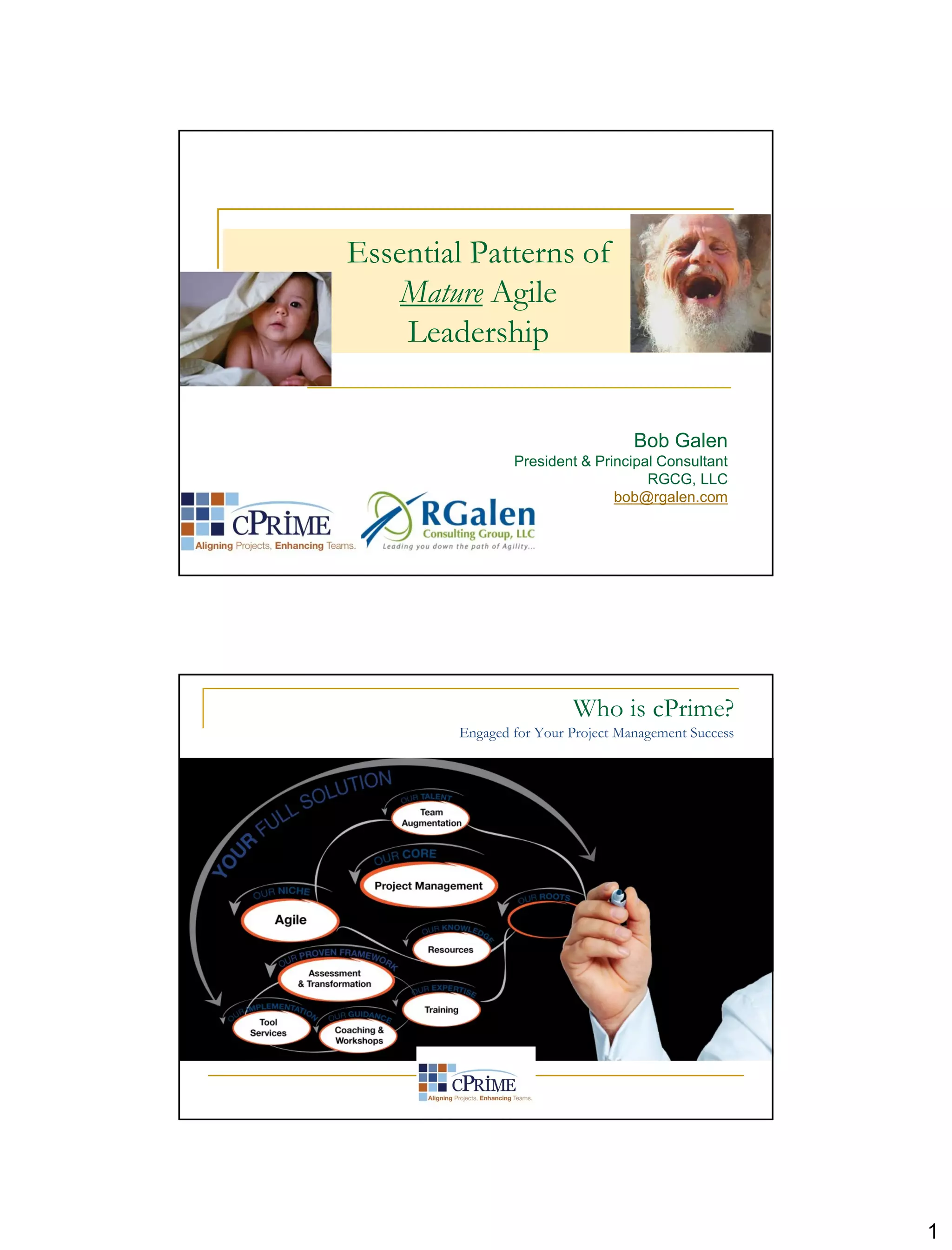
Essential Patterns of
Mature Agile
Leadership
Bob Galen
President & Principal Consultant
RGCG, LLC
bob@rgalen.com
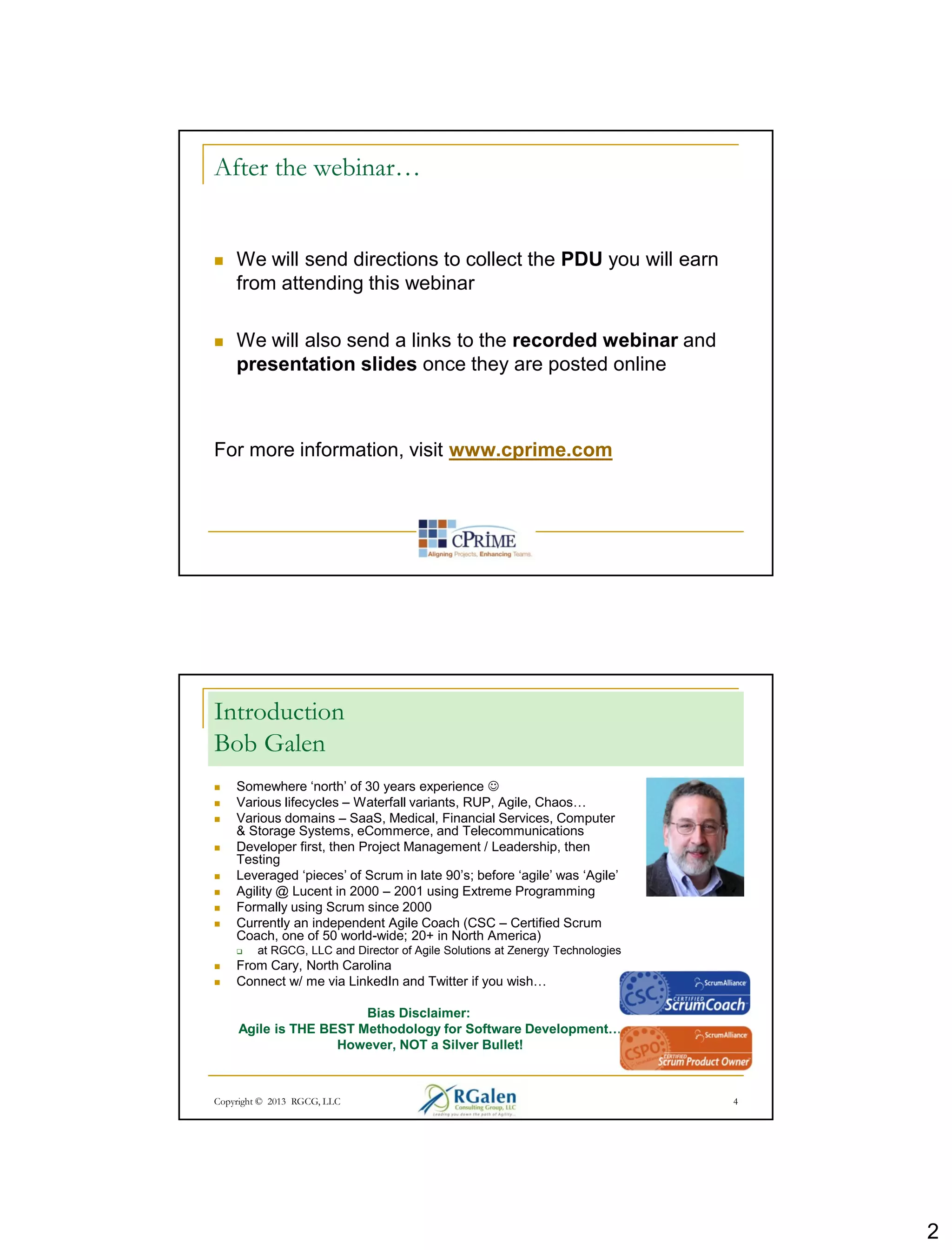
Who is cPrime?
Engaged for Your Project Management Success
2
After the webinar…
 We will send directions to collect the PDU you will earn
from attending this webinar
 We will also send a links to the recorded webinar and
presentation slides once they are posted online
For more information, visit www.cprime.com
Copyright © 2013 RGCG, LLC 4
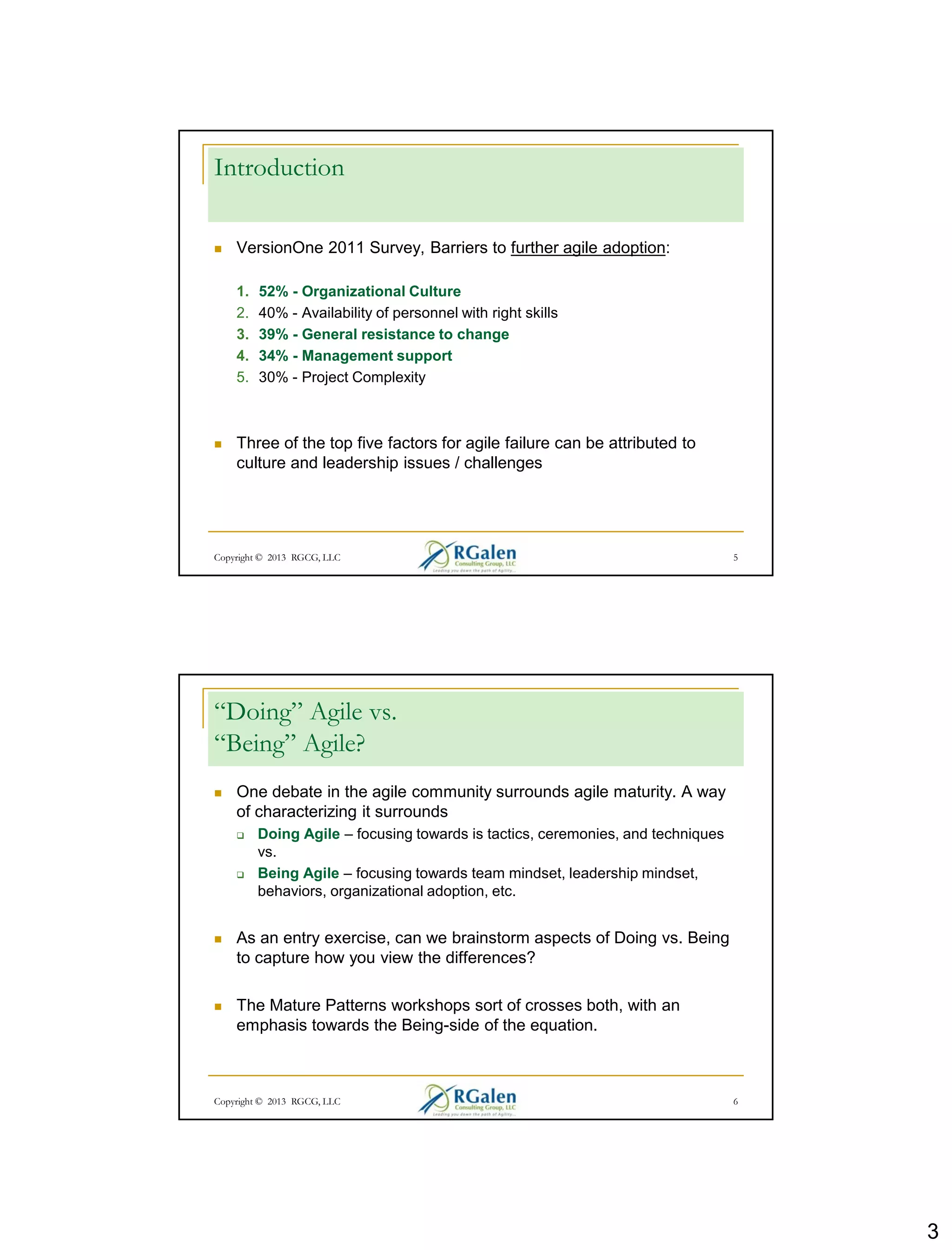
Introduction
Bob Galen
 Somewhere ‘north’ of 30 years experience 
 Various lifecycles – Waterfall variants, RUP, Agile, Chaos…
 Various domains – SaaS, Medical, Financial Services, Computer
& Storage Systems, eCommerce, and Telecommunications
 Developer first, then Project Management / Leadership, then
Testing
 Leveraged ‘pieces’ of Scrum in late 90’s; before ‘agile’ was ‘Agile’
 Agility @ Lucent in 2000 – 2001 using Extreme Programming
 Formally using Scrum since 2000
 Currently an independent Agile Coach (CSC – Certified Scrum
Coach, one of 50 world-wide; 20+ in North America)
 at RGCG, LLC and Director of Agile Solutions at Zenergy Technologies
 From Cary, North Carolina
 Connect w/ me via LinkedIn and Twitter if you wish…
Bias Disclaimer:
Agile is THE BEST Methodology for Software Development…
However, NOT a Silver Bullet!
3
Introduction
 VersionOne 2011 Survey, Barriers to further agile adoption:
1. 52% - Organizational Culture
2. 40% - Availability of personnel with right skills
3. 39% - General resistance to change
4. 34% - Management support
5. 30% - Project Complexity
 Three of the top five factors for agile failure can be attributed to
culture and leadership issues / challenges
Copyright © 2013 RGCG, LLC 5
“Doing” Agile vs.
“Being” Agile?
 One debate in the agile community surrounds agile maturity. A way
of characterizing it surrounds
 Doing Agile – focusing towards is tactics, ceremonies, and techniques
vs.
 Being Agile – focusing towards team mindset, leadership mindset,
behaviors, organizational adoption, etc.
 As an entry exercise, can we brainstorm aspects of Doing vs. Being
to capture how you view the differences?
 The Mature Patterns workshops sort of crosses both, with an
emphasis towards the Being-side of the equation.
Copyright © 2013 RGCG, LLC 6
4
Copyright © 2013 RGCG, LLC 7
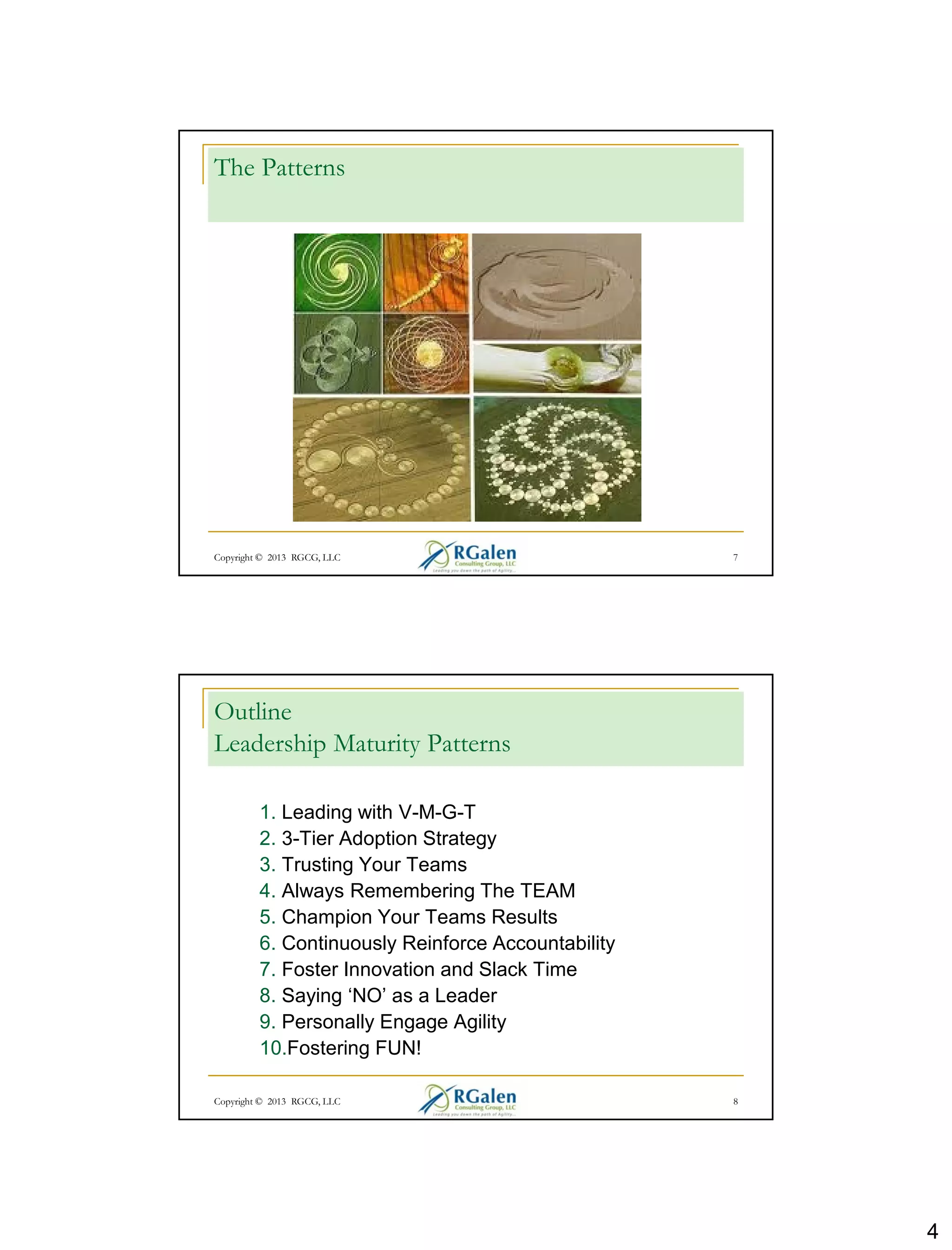
The Patterns
Copyright © 2013 RGCG, LLC 8
Outline
Leadership Maturity Patterns
1. Leading with V-M-G-T
2. 3-Tier Adoption Strategy
3. Trusting Your Teams
4. Always Remembering The TEAM
5. Champion Your Teams Results
6. Continuously Reinforce Accountability
7. Foster Innovation and Slack Time
8. Saying ‘NO’ as a Leader
9. Personally Engage Agility
10.Fostering FUN!
5
Copyright © 2013 RGCG, LLC 9
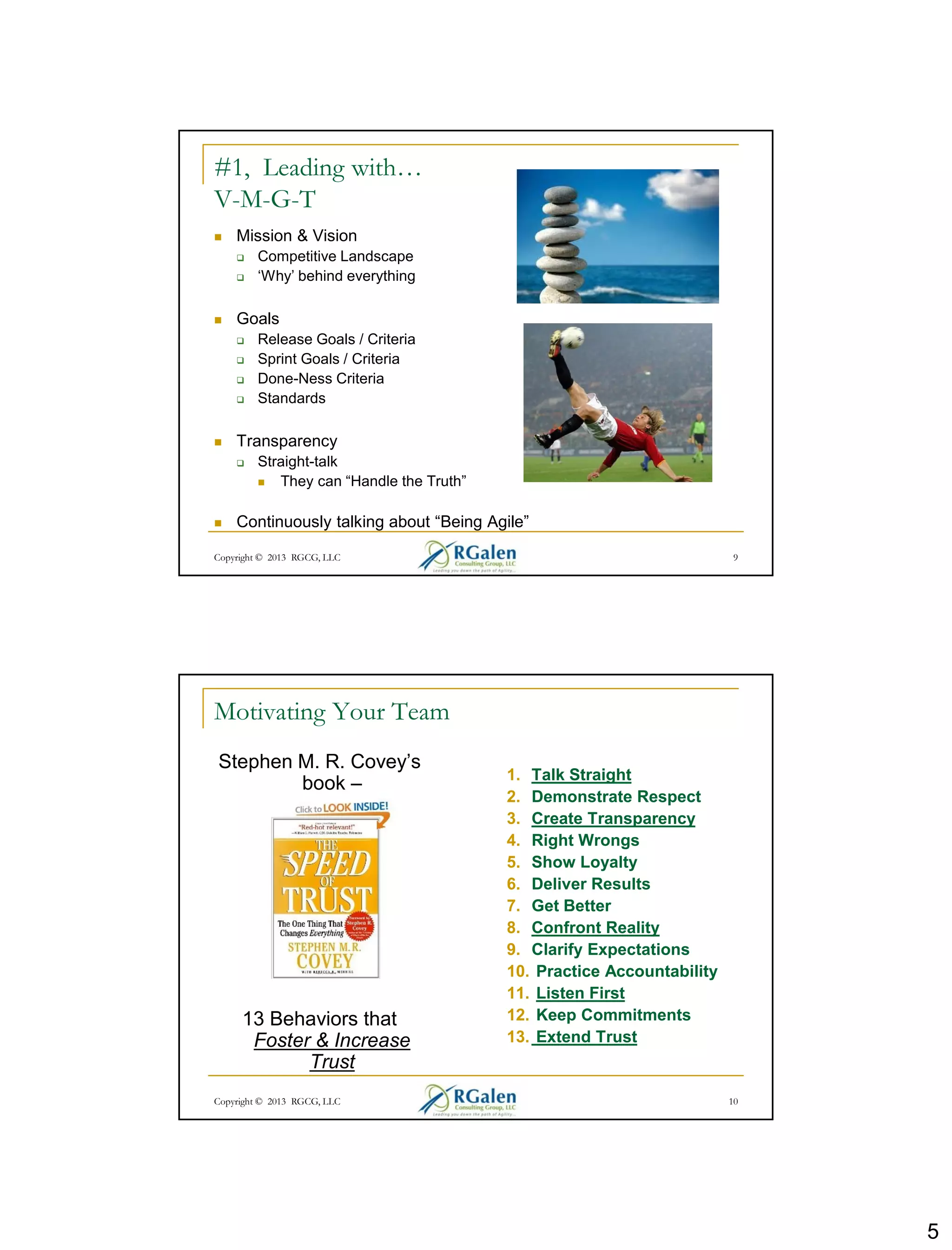
#1, Leading with…
V-M-G-T
 Mission & Vision
 Competitive Landscape
 ‘Why’ behind everything
 Goals
 Release Goals / Criteria
 Sprint Goals / Criteria
 Done-Ness Criteria
 Standards
 Transparency
 Straight-talk
 They can “Handle the Truth”
 Continuously talking about “Being Agile”
Motivating Your Team
Stephen M. R. Covey’s
book –
13 Behaviors that
Foster & Increase
Trust
1. Talk Straight
2. Demonstrate Respect
3. Create Transparency
4. Right Wrongs
5. Show Loyalty
6. Deliver Results
7. Get Better
8. Confront Reality
9. Clarify Expectations
10. Practice Accountability
11. Listen First
12. Keep Commitments
13. Extend Trust
10Copyright © 2013 RGCG, LLC
6
Copyright © 2013 RGCG, LLC 11
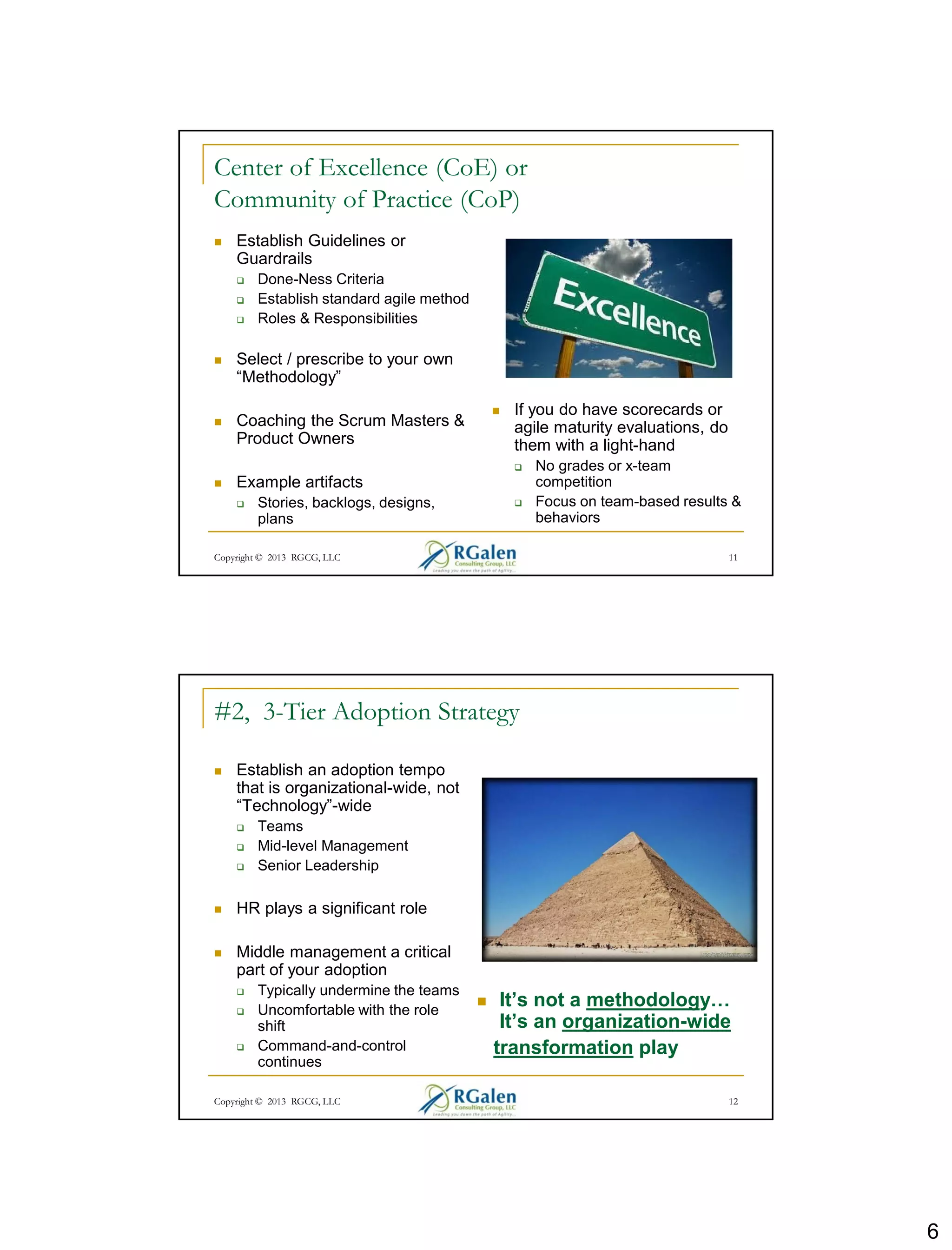
Center of Excellence (CoE) or
Community of Practice (CoP)
 Establish Guidelines or
Guardrails
 Done-Ness Criteria
 Establish standard agile method
 Roles & Responsibilities
 Select / prescribe to your own
“Methodology”
 Coaching the Scrum Masters &
Product Owners
 Example artifacts
 Stories, backlogs, designs,
plans
 If you do have scorecards or
agile maturity evaluations, do
them with a light-hand
 No grades or x-team
competition
 Focus on team-based results &
behaviors
Copyright © 2013 RGCG, LLC 12
#2, 3-Tier Adoption Strategy
 Establish an adoption tempo
that is organizational-wide, not
“Technology”-wide
 Teams
 Mid-level Management
 Senior Leadership
 HR plays a significant role
 Middle management a critical
part of your adoption
 Typically undermine the teams
 Uncomfortable with the role
shift
 Command-and-control
continues
 It’s not a methodology…
It’s an organization-wide
transformation play
7
Copyright © 2013 RGCG, LLC 13
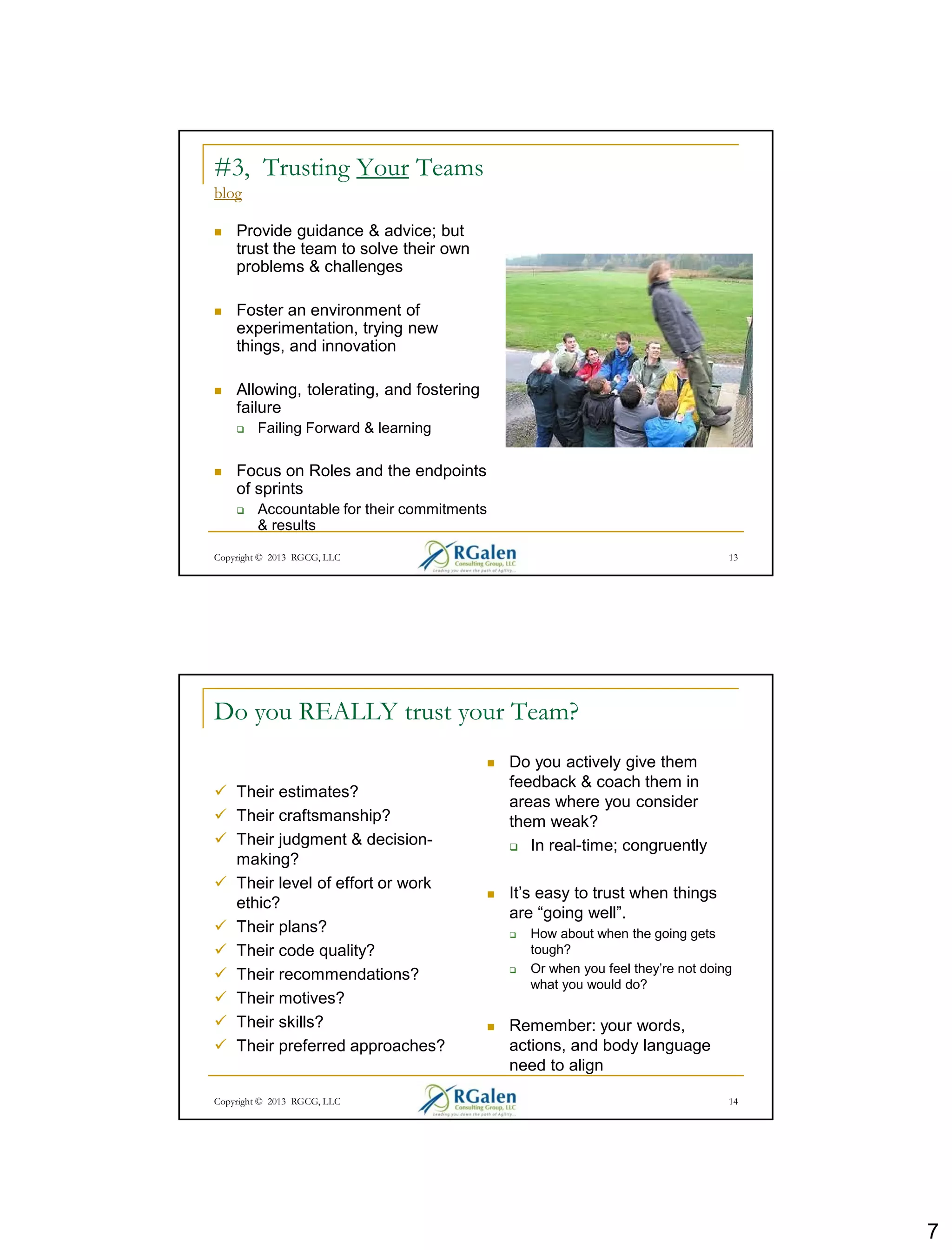
#3, Trusting Your Teams
blog
 Provide guidance & advice; but
trust the team to solve their own
problems & challenges
 Foster an environment of
experimentation, trying new
things, and innovation
 Allowing, tolerating, and fostering
failure
 Failing Forward & learning
 Focus on Roles and the endpoints
of sprints
 Accountable for their commitments
& results
Do you REALLY trust your Team?
 Their estimates?
 Their craftsmanship?
 Their judgment & decision-
making?
 Their level of effort or work
ethic?
 Their plans?
 Their code quality?
 Their recommendations?
 Their motives?
 Their skills?
 Their preferred approaches?
 Do you actively give them
feedback & coach them in
areas where you consider
them weak?
 In real-time; congruently
 It’s easy to trust when things
are “going well”.
 How about when the going gets
tough?
 Or when you feel they’re not doing
what you would do?
 Remember: your words,
actions, and body language
need to align
Copyright © 2013 RGCG, LLC 14
8
Copyright © 2013 RGCG, LLC 15
#4, Always Remembering…the TEAM
blog
 Shifting from individual
rewards…to team rewards
 Ask the team to “reward itself”
 Recognizing and acknowledging
the behavior within teams
 Teamwork, collaboration, mutual
respect
 Changing your language…
 Why didn’t we find that in test?
 Why aren’t the developers coding
right now?
 Stop referring to ‘developers’ vs,
‘testers’
 Holding the team accountable
to results, commitments, and
support of standards of
craftsmanship
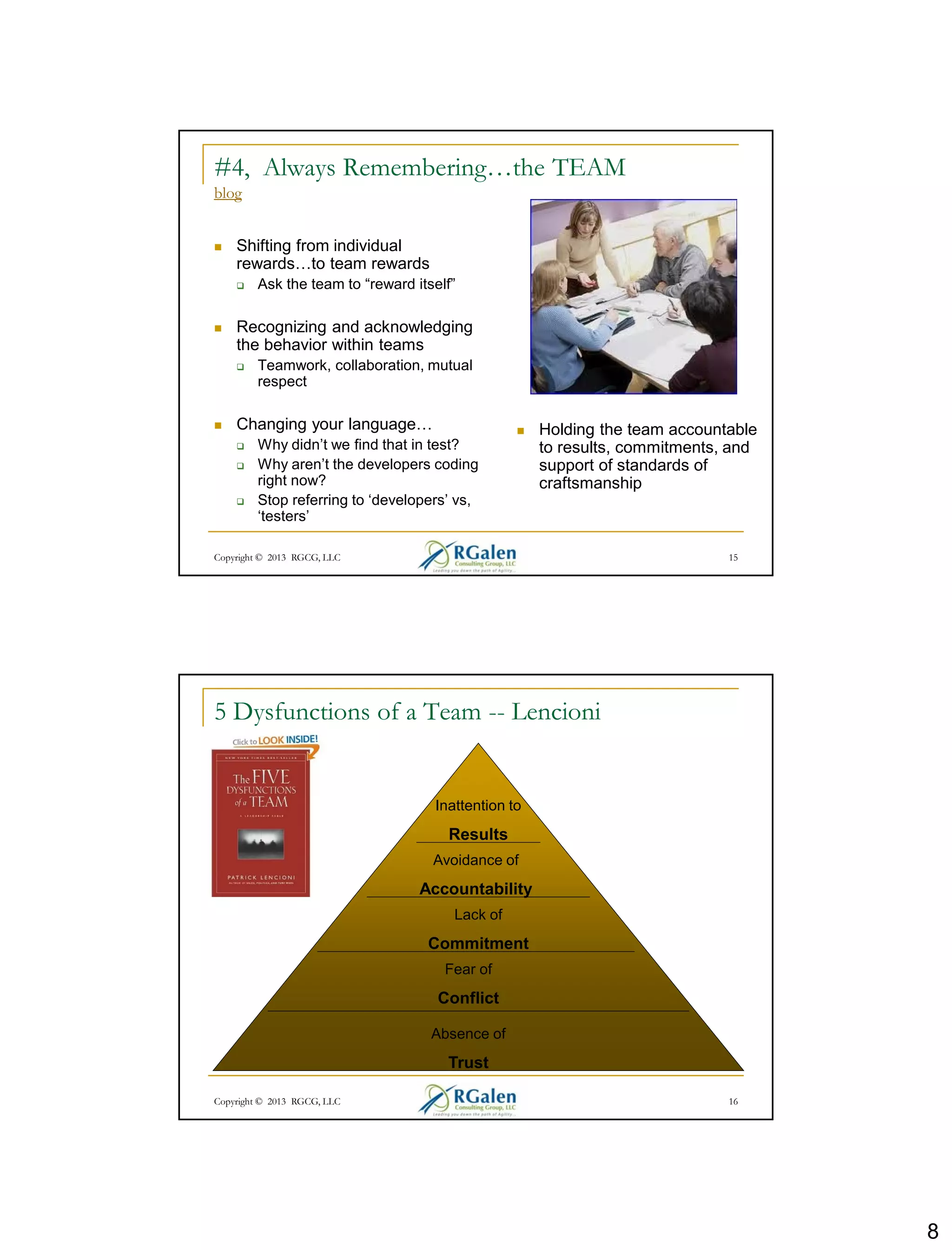
5 Dysfunctions of a Team -- Lencioni
Absence of
Trust
Fear of
Conflict
Lack of
Commitment
Avoidance of
Accountability
Inattention to
Results
16Copyright © 2013 RGCG, LLC
9
Copyright © 2013 RGCG, LLC 17
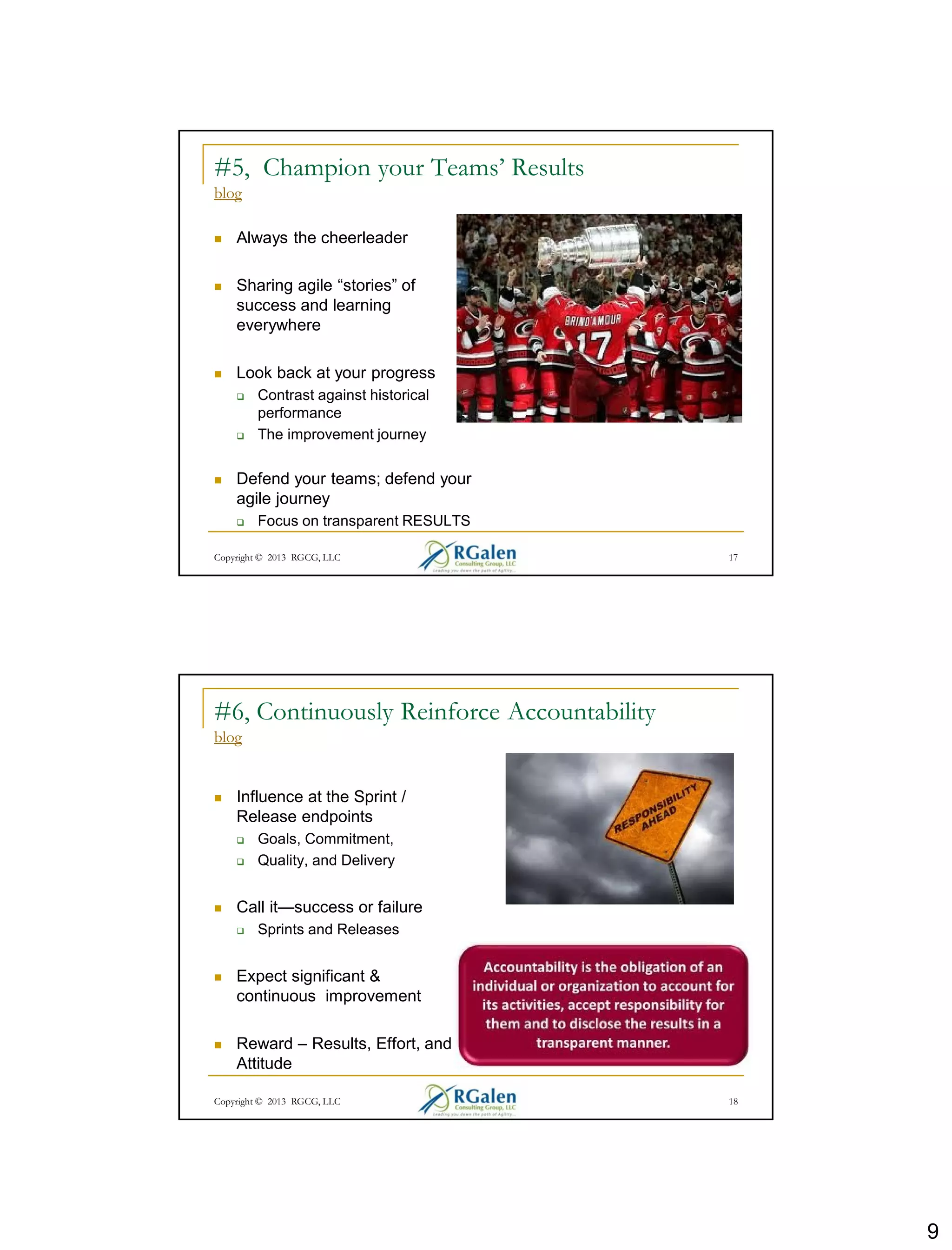
#5, Champion your Teams’ Results
blog
 Always the cheerleader
 Sharing agile “stories” of
success and learning
everywhere
 Look back at your progress
 Contrast against historical
performance
 The improvement journey
 Defend your teams; defend your
agile journey
 Focus on transparent RESULTS
Copyright © 2013 RGCG, LLC 18
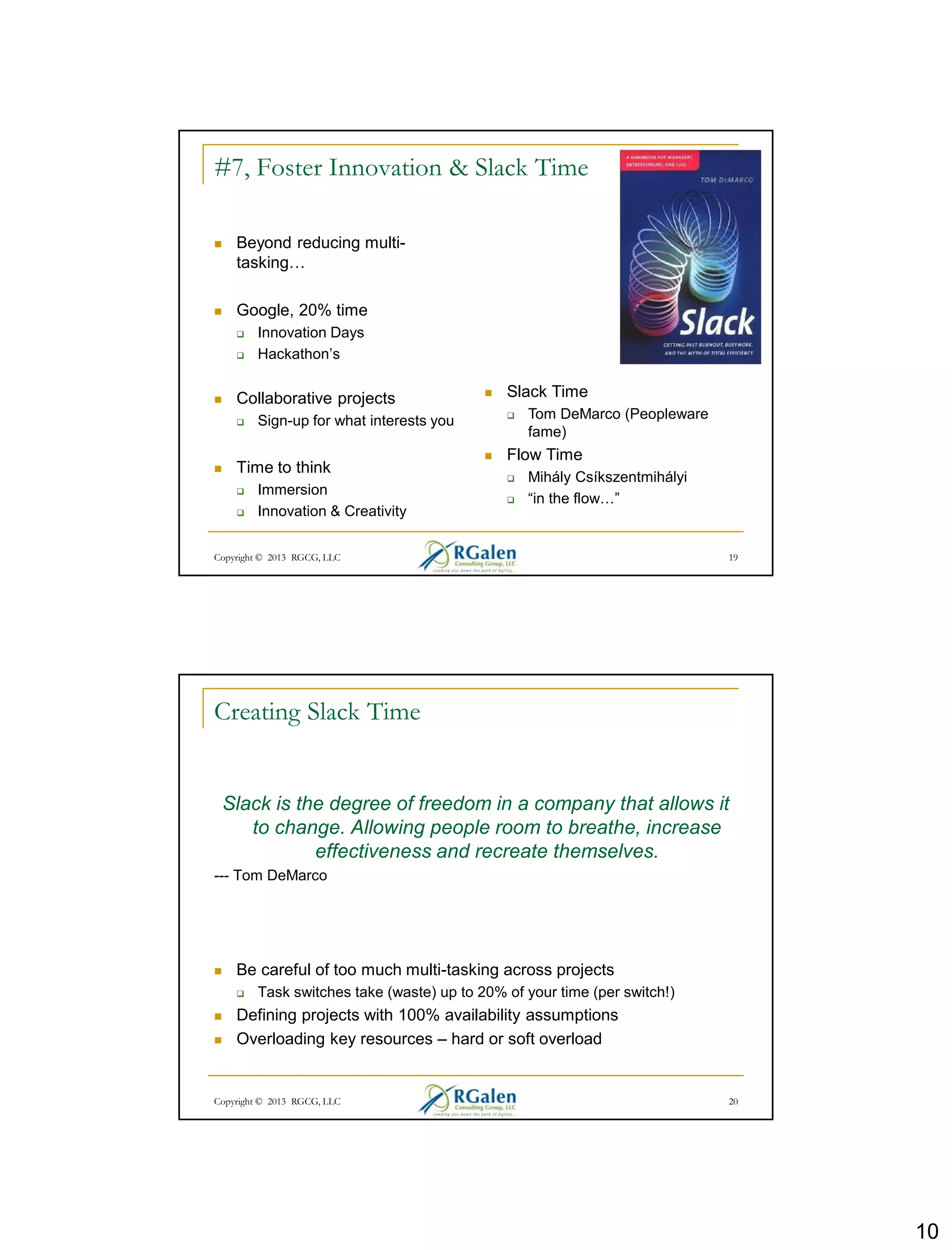
#6, Continuously Reinforce Accountability
blog
 Influence at the Sprint /
Release endpoints
 Goals, Commitment,
 Quality, and Delivery
 Call it—success or failure
 Sprints and Releases
 Expect significant &
continuous improvement
 Reward – Results, Effort, and
Attitude
10
Copyright © 2013 RGCG, LLC 19
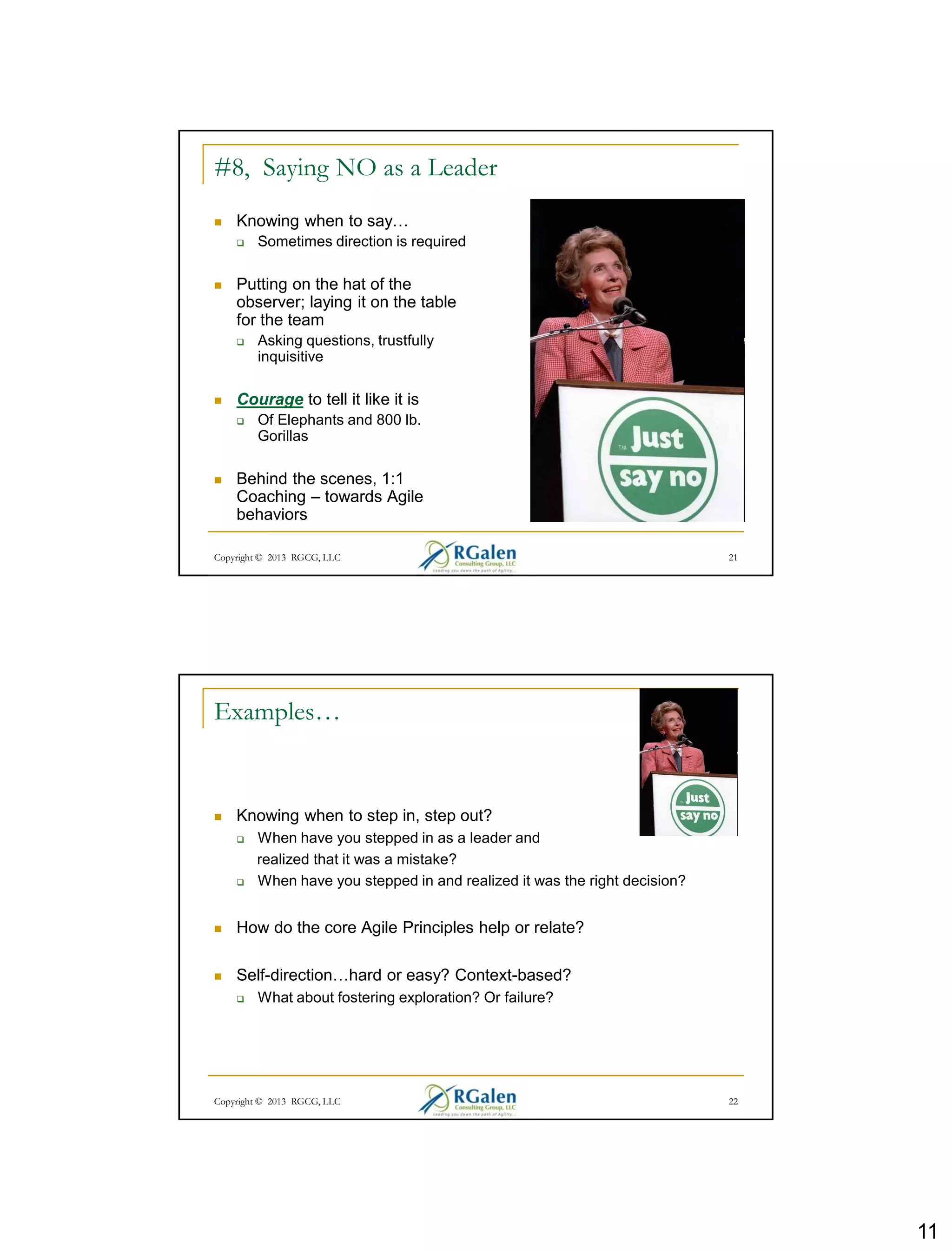
#7, Foster Innovation & Slack Time
 Beyond reducing multi-
tasking…
 Google, 20% time
 Innovation Days
 Hackathon’s
 Collaborative projects
 Sign-up for what interests you
 Time to think
 Immersion
 Innovation & Creativity
 Slack Time
 Tom DeMarco (Peopleware
fame)
 Flow Time
 Mihály Csíkszentmihályi
 “in the flow…”
Creating Slack Time
Slack is the degree of freedom in a company that allows it
to change. Allowing people room to breathe, increase
effectiveness and recreate themselves.
--- Tom DeMarco
 Be careful of too much multi-tasking across projects
 Task switches take (waste) up to 20% of your time (per switch!)
 Defining projects with 100% availability assumptions
 Overloading key resources – hard or soft overload
20Copyright © 2013 RGCG, LLC
11
Copyright © 2013 RGCG, LLC 21
#8, Saying NO as a Leader
 Knowing when to say…
 Sometimes direction is required
 Putting on the hat of the
observer; laying it on the table
for the team
 Asking questions, trustfully
inquisitive
 Courage to tell it like it is
 Of Elephants and 800 lb.
Gorillas
 Behind the scenes, 1:1
Coaching – towards Agile
behaviors
Copyright © 2013 RGCG, LLC 22
Examples…
 Knowing when to step in, step out?
 When have you stepped in as a leader and
realized that it was a mistake?
 When have you stepped in and realized it was the right decision?
 How do the core Agile Principles help or relate?
 Self-direction…hard or easy? Context-based?
 What about fostering exploration? Or failure?
12
23
The “One Thing”
When it comes to risky, controversial, and
emotional conversations, skilled people
find a way to get all relevant information
out into the open.
That’s it. At the core of every successful
conversation lies the free flow of relevant
information. People openly and honestly
express their opinions, share their
feelings, and articulate their theories.
They willingly and capably share their
views, even when their ideas are
controversial or unpopular.
-- Crucial Conversations, Patterson, Grenny, McMillan, Switzler
Copyright © 2013 RGCG, LLC
Copyright © 2013 RGCG, LLC 24
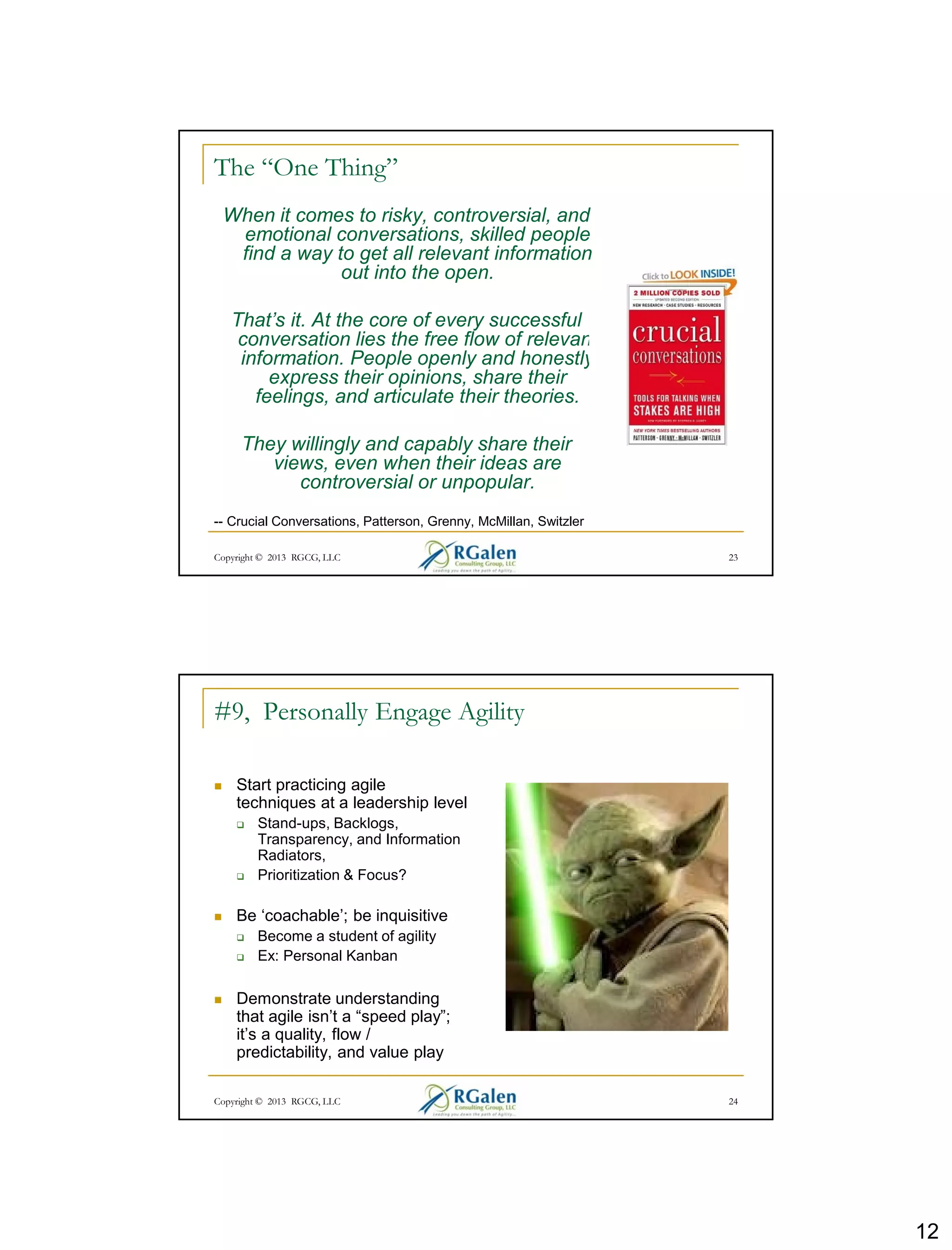
#9, Personally Engage Agility
 Start practicing agile
techniques at a leadership level
 Stand-ups, Backlogs,
Transparency, and Information
Radiators,
 Prioritization & Focus?
 Be ‘coachable’; be inquisitive
 Become a student of agility
 Ex: Personal Kanban
 Demonstrate understanding
that agile isn’t a “speed play”;
it’s a quality, flow /
predictability, and value play
13
Copyright © 2013 RGCG, LLC 25
#10, Fostering FUN!
 Have a sense of humor; self-
deprecation
 Be ‘playful’ as a leader
 Practical jokes
 Find ‘partners’ in your teams
that identify opportunities for
having fun
 Don’t allow the teams to get
“too serious”;
 Take breaks, Team-building
 Fund event ideas
 Hire positive, “can do” people
Copyright © 2013 RGCG, LLC 26
Webinar
Wrap-up
 What were the most compelling
patterns?
 What essential patterns did I miss?
 Final questions or discussion?
Thank you!
14
Contact Info
Bob Galen
Principal Consultant,
RGalen Consulting Group, L.L.C.
Experience-driven agile focused training,
coaching & consulting
Contact: (919) 272-0719
bob@rgalen.com
www.rgalen.com
Blogs
Project Times - http://www.projecttimes.com/robert-galen/
BA Times - http://www.batimes.com/robert-galen/
Podcast on all things ‘agile’ - http://www.meta-cast.com/
27Copyright © 2013 RGCG, LLC 27

Essential Patterns for Agile Leaders

  • 1.
    1 Essential Patterns of MatureAgile Leadership Bob Galen President & Principal Consultant RGCG, LLC bob@rgalen.com Who is cPrime? Engaged for Your Project Management Success
  • 2.
    2 After the webinar… We will send directions to collect the PDU you will earn from attending this webinar  We will also send a links to the recorded webinar and presentation slides once they are posted online For more information, visit www.cprime.com Copyright © 2013 RGCG, LLC 4 Introduction Bob Galen  Somewhere ‘north’ of 30 years experience   Various lifecycles – Waterfall variants, RUP, Agile, Chaos…  Various domains – SaaS, Medical, Financial Services, Computer & Storage Systems, eCommerce, and Telecommunications  Developer first, then Project Management / Leadership, then Testing  Leveraged ‘pieces’ of Scrum in late 90’s; before ‘agile’ was ‘Agile’  Agility @ Lucent in 2000 – 2001 using Extreme Programming  Formally using Scrum since 2000  Currently an independent Agile Coach (CSC – Certified Scrum Coach, one of 50 world-wide; 20+ in North America)  at RGCG, LLC and Director of Agile Solutions at Zenergy Technologies  From Cary, North Carolina  Connect w/ me via LinkedIn and Twitter if you wish… Bias Disclaimer: Agile is THE BEST Methodology for Software Development… However, NOT a Silver Bullet!
  • 3.
    3 Introduction  VersionOne 2011Survey, Barriers to further agile adoption: 1. 52% - Organizational Culture 2. 40% - Availability of personnel with right skills 3. 39% - General resistance to change 4. 34% - Management support 5. 30% - Project Complexity  Three of the top five factors for agile failure can be attributed to culture and leadership issues / challenges Copyright © 2013 RGCG, LLC 5 “Doing” Agile vs. “Being” Agile?  One debate in the agile community surrounds agile maturity. A way of characterizing it surrounds  Doing Agile – focusing towards is tactics, ceremonies, and techniques vs.  Being Agile – focusing towards team mindset, leadership mindset, behaviors, organizational adoption, etc.  As an entry exercise, can we brainstorm aspects of Doing vs. Being to capture how you view the differences?  The Mature Patterns workshops sort of crosses both, with an emphasis towards the Being-side of the equation. Copyright © 2013 RGCG, LLC 6
  • 4.
    4 Copyright © 2013RGCG, LLC 7 The Patterns Copyright © 2013 RGCG, LLC 8 Outline Leadership Maturity Patterns 1. Leading with V-M-G-T 2. 3-Tier Adoption Strategy 3. Trusting Your Teams 4. Always Remembering The TEAM 5. Champion Your Teams Results 6. Continuously Reinforce Accountability 7. Foster Innovation and Slack Time 8. Saying ‘NO’ as a Leader 9. Personally Engage Agility 10.Fostering FUN!
  • 5.
    5 Copyright © 2013RGCG, LLC 9 #1, Leading with… V-M-G-T  Mission & Vision  Competitive Landscape  ‘Why’ behind everything  Goals  Release Goals / Criteria  Sprint Goals / Criteria  Done-Ness Criteria  Standards  Transparency  Straight-talk  They can “Handle the Truth”  Continuously talking about “Being Agile” Motivating Your Team Stephen M. R. Covey’s book – 13 Behaviors that Foster & Increase Trust 1. Talk Straight 2. Demonstrate Respect 3. Create Transparency 4. Right Wrongs 5. Show Loyalty 6. Deliver Results 7. Get Better 8. Confront Reality 9. Clarify Expectations 10. Practice Accountability 11. Listen First 12. Keep Commitments 13. Extend Trust 10Copyright © 2013 RGCG, LLC
  • 6.
    6 Copyright © 2013RGCG, LLC 11 Center of Excellence (CoE) or Community of Practice (CoP)  Establish Guidelines or Guardrails  Done-Ness Criteria  Establish standard agile method  Roles & Responsibilities  Select / prescribe to your own “Methodology”  Coaching the Scrum Masters & Product Owners  Example artifacts  Stories, backlogs, designs, plans  If you do have scorecards or agile maturity evaluations, do them with a light-hand  No grades or x-team competition  Focus on team-based results & behaviors Copyright © 2013 RGCG, LLC 12 #2, 3-Tier Adoption Strategy  Establish an adoption tempo that is organizational-wide, not “Technology”-wide  Teams  Mid-level Management  Senior Leadership  HR plays a significant role  Middle management a critical part of your adoption  Typically undermine the teams  Uncomfortable with the role shift  Command-and-control continues  It’s not a methodology… It’s an organization-wide transformation play
  • 7.
    7 Copyright © 2013RGCG, LLC 13 #3, Trusting Your Teams blog  Provide guidance & advice; but trust the team to solve their own problems & challenges  Foster an environment of experimentation, trying new things, and innovation  Allowing, tolerating, and fostering failure  Failing Forward & learning  Focus on Roles and the endpoints of sprints  Accountable for their commitments & results Do you REALLY trust your Team?  Their estimates?  Their craftsmanship?  Their judgment & decision- making?  Their level of effort or work ethic?  Their plans?  Their code quality?  Their recommendations?  Their motives?  Their skills?  Their preferred approaches?  Do you actively give them feedback & coach them in areas where you consider them weak?  In real-time; congruently  It’s easy to trust when things are “going well”.  How about when the going gets tough?  Or when you feel they’re not doing what you would do?  Remember: your words, actions, and body language need to align Copyright © 2013 RGCG, LLC 14
  • 8.
    8 Copyright © 2013RGCG, LLC 15 #4, Always Remembering…the TEAM blog  Shifting from individual rewards…to team rewards  Ask the team to “reward itself”  Recognizing and acknowledging the behavior within teams  Teamwork, collaboration, mutual respect  Changing your language…  Why didn’t we find that in test?  Why aren’t the developers coding right now?  Stop referring to ‘developers’ vs, ‘testers’  Holding the team accountable to results, commitments, and support of standards of craftsmanship 5 Dysfunctions of a Team -- Lencioni Absence of Trust Fear of Conflict Lack of Commitment Avoidance of Accountability Inattention to Results 16Copyright © 2013 RGCG, LLC
  • 9.
    9 Copyright © 2013RGCG, LLC 17 #5, Champion your Teams’ Results blog  Always the cheerleader  Sharing agile “stories” of success and learning everywhere  Look back at your progress  Contrast against historical performance  The improvement journey  Defend your teams; defend your agile journey  Focus on transparent RESULTS Copyright © 2013 RGCG, LLC 18 #6, Continuously Reinforce Accountability blog  Influence at the Sprint / Release endpoints  Goals, Commitment,  Quality, and Delivery  Call it—success or failure  Sprints and Releases  Expect significant & continuous improvement  Reward – Results, Effort, and Attitude
  • 10.
    10 Copyright © 2013RGCG, LLC 19 #7, Foster Innovation & Slack Time  Beyond reducing multi- tasking…  Google, 20% time  Innovation Days  Hackathon’s  Collaborative projects  Sign-up for what interests you  Time to think  Immersion  Innovation & Creativity  Slack Time  Tom DeMarco (Peopleware fame)  Flow Time  Mihály Csíkszentmihályi  “in the flow…” Creating Slack Time Slack is the degree of freedom in a company that allows it to change. Allowing people room to breathe, increase effectiveness and recreate themselves. --- Tom DeMarco  Be careful of too much multi-tasking across projects  Task switches take (waste) up to 20% of your time (per switch!)  Defining projects with 100% availability assumptions  Overloading key resources – hard or soft overload 20Copyright © 2013 RGCG, LLC
  • 11.
    11 Copyright © 2013RGCG, LLC 21 #8, Saying NO as a Leader  Knowing when to say…  Sometimes direction is required  Putting on the hat of the observer; laying it on the table for the team  Asking questions, trustfully inquisitive  Courage to tell it like it is  Of Elephants and 800 lb. Gorillas  Behind the scenes, 1:1 Coaching – towards Agile behaviors Copyright © 2013 RGCG, LLC 22 Examples…  Knowing when to step in, step out?  When have you stepped in as a leader and realized that it was a mistake?  When have you stepped in and realized it was the right decision?  How do the core Agile Principles help or relate?  Self-direction…hard or easy? Context-based?  What about fostering exploration? Or failure?
  • 12.
    12 23 The “One Thing” Whenit comes to risky, controversial, and emotional conversations, skilled people find a way to get all relevant information out into the open. That’s it. At the core of every successful conversation lies the free flow of relevant information. People openly and honestly express their opinions, share their feelings, and articulate their theories. They willingly and capably share their views, even when their ideas are controversial or unpopular. -- Crucial Conversations, Patterson, Grenny, McMillan, Switzler Copyright © 2013 RGCG, LLC Copyright © 2013 RGCG, LLC 24 #9, Personally Engage Agility  Start practicing agile techniques at a leadership level  Stand-ups, Backlogs, Transparency, and Information Radiators,  Prioritization & Focus?  Be ‘coachable’; be inquisitive  Become a student of agility  Ex: Personal Kanban  Demonstrate understanding that agile isn’t a “speed play”; it’s a quality, flow / predictability, and value play
  • 13.
    13 Copyright © 2013RGCG, LLC 25 #10, Fostering FUN!  Have a sense of humor; self- deprecation  Be ‘playful’ as a leader  Practical jokes  Find ‘partners’ in your teams that identify opportunities for having fun  Don’t allow the teams to get “too serious”;  Take breaks, Team-building  Fund event ideas  Hire positive, “can do” people Copyright © 2013 RGCG, LLC 26 Webinar Wrap-up  What were the most compelling patterns?  What essential patterns did I miss?  Final questions or discussion? Thank you!
  • 14.
    14 Contact Info Bob Galen PrincipalConsultant, RGalen Consulting Group, L.L.C. Experience-driven agile focused training, coaching & consulting Contact: (919) 272-0719 bob@rgalen.com www.rgalen.com Blogs Project Times - http://www.projecttimes.com/robert-galen/ BA Times - http://www.batimes.com/robert-galen/ Podcast on all things ‘agile’ - http://www.meta-cast.com/ 27Copyright © 2013 RGCG, LLC 27